I have put together a new timeline of landscape and the arts based on entries in this blog. It covers five hundred people, ranging in time from Sargon II, King of Assyria, to Robert Macfarlane. It replaces the earlier chronology I did. This long list was starting to feel a bit burdensome to keep up (I've also decided to drop my index for the same reason, and because in practical terms the search function here works pretty well). The software for the timeline is free and uses Google Docs - I think it is pretty cool. It was not really designed to have as many entries as I have so you will need to use the zoom buttons to navigate clearly through the more recent years. I have shown an example of this below for a point in the twentieth centur. If you want to go straight to a version that is on maximum zoom and pointed at the current year, click here. But from any point you can drag the timeline forwards and backwards. It is also easy just to move along one entry at a time.
As this timeline relates to people rather than events, there is only one entry per person. So Emily Carr is recorded in 1942 (late in her career), the year she published 'The Book of Small', rather than, say, 1928 when she painted Kitwancool. William and Dorothy Wordsworth, Charlotte Smith and Lord Byron all get one entry only. I could have included a lot more than 500, based just on the blog as it now stands. However, I have omitted artists only mentioned in passing, lesser artists and more peripheral figures or well known names that have not really been prominent in exploring landscape (I decided not to include Picasso). The timeline also concentrates on creative figures rather than critics, theorists, geographers and historians. I intend to amend it occasionally and add to it gradually, especially for earlier years; you can see now why I was interested in writing last week about a datable art work from 1072. But the blog won't be skewed towards filling in gaps in the timeline. Some Landscapes is not intended to be a historical encyclopedia of landscape and the arts and doesn't aim at being comprehensive (hence the word 'some'). It will continue to evolve through a process of serendipity, featuring whatever I have come across that seems interesting and worth sharing.
Saturday, September 21, 2019
Sunday, September 15, 2019
A dialectic of the near and the far
Guo Xi, Early Spring, 1072
In 1072 the Chinese artist Guo Xi completed one of the most celebrated landscape paintings, Early Spring. It is his only surviving large scale work - there are smaller scrolls in museums (I have mentioned one here before). There is a story that he would 'have plasterers roughen the surface of a wall so that in painting his mountains and chasms he could follow the bumps and hollows they had made and get an even more convincing effect of relief' (Michael Sullivan, Symbols of Eternity). One day I may do a post devoted to Guo's theories of painting, assembled by his son - Lofty Ambition in Forest and Streams (Ernest Fenollosa considered it, with the exception of a few dry sections, 'one of the greatest essays of the world'). Here I'll just provide five quotes about Early Spring interspersed with close-up details.
'His greatest surviving work, the Early Spring of 1072 in the National Public Museum, Taipei, shows him as a master of monumental design, in which the realistic details of buildings, boats, and fishermen are totally subordinated to broad effects and dramatic contrasts of light and dark.' - Michael Sullivan, Symbols of Eternity
'Rather than an expression of the painter's love of nature in the abstract, it may have been understood by contemporary audiences at court as showing, not real nature, but the ideal landscape of a Daoist paradise.' - Craig Clunas, Art in China
'The man Guo Xi served, the emperor Shenzong, only rarely in his life had occasion to directly enjoy the natural world outside of his imperial palaces ... Early Spring is a vision of flux, growth, life, and order precisely suited to the imperial gaze.' Richard M. Barnhart, Three Thousand Years of Chinese Painting
'The mountain as majestic lord is complemented by the figures that reflect perceptions of social hierarchy. At the bottom of the composition, country fol and fishermen represent the foundation of society.' - Alfreda Murck, Poetry and Painting in Song China
'One cannot keep the near separate from the far; the two mesh intimately, mirroring each other rather than standing apart; so much so that there is no place for middle distance in a work such as this, which exhibits a dialectic of the near and the far - of the rocks below and the mountains above and behind it.' - Edward S. Casey, Representing Place: Landscape Painting and Maps
My reason for highlighting one datable painting from history in this way will become clear in my next blog post. Suffice it to say now that I find it fascinating to think about the point at which this painting emerged into the river of world history: in the time of Omar Khayyam and El Cid, and just as a group of needleworkers whose names have not come down to us were embroidering the Bayeux Tapestry.
Location:
Henan, China
Friday, September 13, 2019
Bare plain, leafless, treeless
Reading the exiled Ovid's Tristia and Black Sea Letters you keep wanting him to tell his correspondents back in Rome about the landscape at Tomis. But all of these poems are about one thing - his desire to get back home - and so his brief descriptions do not go into any details, they are a means of provoking sympathy in the reader. Here is what translator Peter Green says about Ovid's account of the region where Tomis was situated, on the tip of a peninsula, seventy miles south of the Danube delta.
Nevertheless, Ovid does not really say what Tomis was like outside winter. Now called Constanța, it is a tourist destination and has 'a humid subtropical climate' with cool breezes in summer and warm autumns. The treelessness Ovid complained about was true of his immediate location but if he had ventured further afield he would have encountered forests. Presumably the dangers from the local tribesmen, with their poison-tipped arrows, prevented him leaving the town. So this wasn't a poetic exile like some others that I have written about here - Xie Lingyun, for example, banished in 422 to the southeast coast of China, but able to draw solace from his walks in the mountains. Ovid was trapped and desperate to leave.
I will end here with a few lines of Ovid's poetry, from Tristia Book III, written de profundis in his frozen hell. The north wind screams and 'no comber will surge up from the hard packed flood' and Ovid sadly recalls those early autumn days when everything in Italy is ripening.
'Its treeless, monotonous steppe, he writes, resembles a frozen grey sea, patched - appropriately enough - with wormwood, a maquis of bitter and symbolic associations. There are no vines, he repeatedly complains, no orchards: spring in the Italian sense doesn't exist and few birds sing. The countryside is ugly, harsh, savage, inhuman. The water is brackish, and merely exacerbates thirst. But Ovid's two great fearful obsessions are the biting cold and the constant barbarian raids. Again and again he returns to the snow, the ice, the sub-zero temperatures: bullock-carts creaking across the frozen Danube, wine broken off and sold in chunks, the violent glacial north-easter (today known as the crivat) that rips off roof-tiles, sears the skin, and even blows down buildings if they are not solidly constructed.'Was he exaggerating? In the tenth Black Sea Letter Ovid actually gave some scientific proof that the Black Sea did actually freeze at Tomis. In this area many freshwater rivers flow into the sea and there is a cold north wind that chills the air. As Peter Green says in one of his endnotes (which are wonderfully witty and erudite): 'Dr. Stefan Stoenescu informs me that 'the rich salty waters [of the Danube delta] create a brackish region ear the littoral which allows an inversion of temperature to take place. The unsalty waters of the Danube have sufficient power to maintain a thin layer of comparatively sweet fresh water above the deeply settled salty Mediterranean current. As a result, near the Danube delta shores freezing is not an unusual occurrence. Ovid was right.''
Eugène Delacroix, Ovid among the Scythians, 1862
Nevertheless, Ovid does not really say what Tomis was like outside winter. Now called Constanța, it is a tourist destination and has 'a humid subtropical climate' with cool breezes in summer and warm autumns. The treelessness Ovid complained about was true of his immediate location but if he had ventured further afield he would have encountered forests. Presumably the dangers from the local tribesmen, with their poison-tipped arrows, prevented him leaving the town. So this wasn't a poetic exile like some others that I have written about here - Xie Lingyun, for example, banished in 422 to the southeast coast of China, but able to draw solace from his walks in the mountains. Ovid was trapped and desperate to leave.
I will end here with a few lines of Ovid's poetry, from Tristia Book III, written de profundis in his frozen hell. The north wind screams and 'no comber will surge up from the hard packed flood' and Ovid sadly recalls those early autumn days when everything in Italy is ripening.
... No sweet grapes here beneath thick shady vine-leaves,
no frothing must to top up the deep vats;
no orchards, no fruit trees, no apple on which Acontius
could cut the message for his love to read:
nothing to meet the eye here but bare plain, leafless, treeless -
not the habitat any luckier man would choose -
and this, with the whole wide world's expanse to choose from,
is the region selected for my punishment!
Location:
Constanța, Romania
Sunday, September 08, 2019
A map of Elmbourne
I have just read All Among the Barley, the third novel by Melissa Harrison, whose writings and nature observations I've been following over the last few years via her prolific Twitter feed. Looking online afterwards to see what had been written about the novel, I found a piece in Elementum by the artist who drew maps for her book, Neil Gower. He says that over the years the most indecipherable author sketches he has had to work with are those of Jilly Cooper, 'A2 Basquiat-esque collages of who’s bonking whom (and where)'. I was actually given a copy of Jilly Cooper's Riders as a joke birthday present recently and have just dug it out to see if it has a map in it. I can't see one - perhaps they're in her other books? Anyway, back to Melissa Harrison, who, by contrast, gave Gower very meticulous notes on her imagined Suffolk village of Elmbourne, along with 'stylistic cues in the form of an 1853 tithe map and a 1941 Tunnicliffe map (from Faber’s first edition of Henry Williamson’s The Story of a Norfolk Farm).' Williamson, author of Tarka the Otter and supporter of Oswald Mosley, is mentioned in the novel - his opinions are admired by Constance FitzAllen, whose arrival from London leads to conflict in the village and confusion in the mind of Edie, the novel's teenage protagonist.
From the perspective of this blog, I suppose I would rather the protagonist had been this character Connie, so as to learn more about her thinking on landscape. It would have been interesting to read a bit more about the wider currents of nativist politics and rural revivalism - Lord Lymington, Rolf Gardiner and so on. But that would have been a different novel; this one is very much contained within the fields and lanes that make up the world of Edie Mather. According to Gower, Melissa Harrison too 'inhabits the landscape intimately, like her characters'. For example, she advised him that in 'Suffolk lanes you often get a little triangle of grass left as an island with a white signpost on it. This is because the junctions were formed by carts/wagons and not cars. Carts can't turn such a tight corner as cars can...' There's a potential paradox here, in reducing such a richly textured place to a two dimensional diagram. But a map is a portal that can help the reader enter a novel's world and experience more than the author has been able to set down.
A few years ago The New Yorker carried an article on 'The Allure of the Map', beginning inevitably with Treasure Island and Lord of the Rings. It went on to say that
Genre fiction often involves cartographic illustration, but so, too, do highly regionalist works. Sherwood Anderson commissioned a map of the titular town “Winesburg, Ohio,” as did the novelist Jan Karon for her novels set in the fictional town of Mitford, North Carolina. Henry David Thoreau surveyed Walden Pond for a map that he included in “Walden,” and William Faulkner drew his own map of Yoknapatawpha County for the publication of “Absalom, Absalom!” Faulkner revised the map ten years later for “The Portable Faulkner,” going so far as to call himself “sole owner and proprietor,” and adding a note: “Surveyed & mapped for this volume by William Faulkner.”The list could be added to with British novels of place: I have mentioned here before Thomas Hardy's sketch map of Egdon Heath in The Return of the Native, for example. All Among the Barley is part of this history of deeply imagined literary landscapes.
Finally, as a kind of postrscript, I can't resist mentioning another map in that New Yorker article, the one Ursula K. Le Guin drew for the Earthsea trilogy. Just as I was reading All Among the Barley, my younger son was finishing A Wizard of Earthsea. We have been talking about the book and he says he loves the way the archipelago contains so many different lands and ways of living. It made me think about the way books open up our horizons, something that starts to happen to Edie in All Among the Barley... The map of Earthsea particularly appealed to my son and he has identified on it his three favourite places (Too, Tor and O). It is clear that he is now sailing his way among those islands in his imagination.
Saturday, August 31, 2019
Blue River
The other day I pulled out from my library the anthology Poems of Arab Andalusia that City Lights Books published back in 1989. The translations were made by Cola Franzen (1923-2018) and she based them on an anthology that Emilio García Gómez (1905-95) published in 1930. Those modern Spanish versions of Andalusian Arabic poetry influenced Spain's Generation of 27, in particular Lorca, whose Divan del Tamarit (unfinished when he was assasinated) uses some of their imagery. Gómez was working from a medieval codex he acquired in 1928, Banners of the Champions and the Standards of the Distinguished, a collection put together by the great Andalusian writer and traveller Ibn Sa'id and completed on 21 June 1243. There is frustratingly little information to be found in the anthology or online about the actual poets. Of Muhammad ibn Ghalib al-Rusafi, for example, who wrote a lovely little poem called 'Blue River', we are just told that he died in 1177 and came from Ruzafa, now part of Valencia (a 'hip district', I see from Google, noted for its indie clothing boutiques and organic food shops).
As usual on this blog, I'm reluctant to quote whole poems from a book for copyright reasons. But here are some extracts - five examples of rivers in medieval Andalusian poems, beginning with that blue one:
Blue River
As usual on this blog, I'm reluctant to quote whole poems from a book for copyright reasons. But here are some extracts - five examples of rivers in medieval Andalusian poems, beginning with that blue one:
Blue River
The river of diaphanous waters
murmuring between its banks
would have you believe
it is a stream of pearls.
...
Muhammad ibn Ghalib al-Rusafi (d. 1177)
Rain Over The River
The wind does the delicate workof a goldsmithcrimping water into meshfor a coat of mail....
Abu I-Qasim al-Manishi (12th century)
The Valley of Almería
...See how excited the river is?Listen to its murmured applause
sounding beneath the dancing trees
that arch over it
wearing garlands of blossom....
Ibn Safr al-Marini (12th century)
Tide in the Guadalquivir
When the West Wind ripped the river's tunicthe river overflowed its banksto pursue and take revenge;
But the doves laughed, and made fun
from a sheltering thicket....
Ibn Safr al-Marini
Honey River
...Reflections of floating lightspointed like lancesat the cuirasse of the river.There we stayed untilthe jewels of frostforced us to separate....
Ibn Abi Rawh (12th century)
Friday, August 30, 2019
Roma antica e moderna
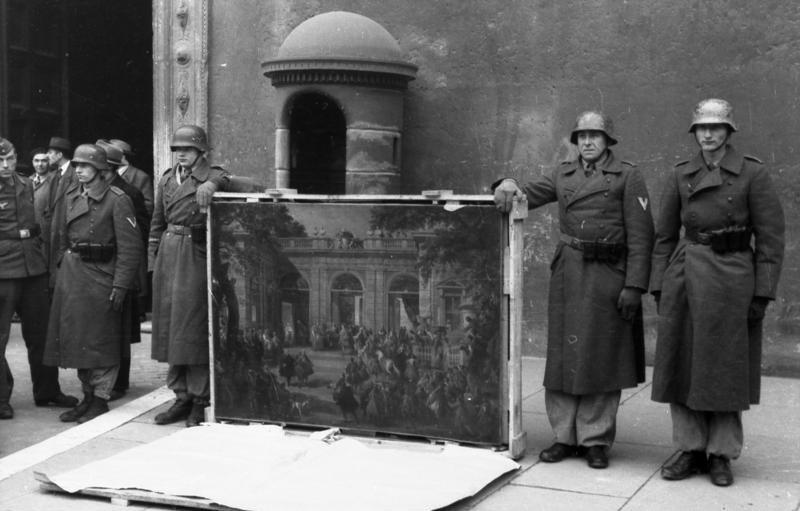
German soldiers in 1944, posing with a picture by Giovanni Paolo Panini taken from Naples
Source: Wikimedia Commons
We have just returned from a holiday in Berlin where quite a lot of time was spent at museums and monuments describing the rise of Nazism and the consequences of the Second World War. So it was something of a relief to spend a day at Sanssouci ('without worries'), the beautiful rococo summer palace of Frederick the Great, built to the design of Georg Wenzeslaus von Knobelsdorff between 1745 and 1747. There we saw the painting below, by Giovanni Paolo Panini, a vedute showing some architectural highlights of Baroque Rome. It came to Sanssouci in 1750 and was paired there with a similar painting showing the Forum and ancient Rome. Viewers could compare the two, like readers of the popular contemporary city guidebook Roma antica e moderna (1745), written by Gregorio Roisecco, who owned a bookshop at the Piazza Navona. What I like about Panini's painting is not the distant church spires and dome of St Peter's Basilica, but the foreground of fields and vineyards. This is now the district of Prati, described on websites as a 'white collar' area of 'high end shopping streets' and 'cool restaurants'.
Giovanni Paolo Panini, View of Rome from the foot of Monte Mario, 1749
My photograph in Sanssouci
When I included a Panini painting in my year of landscape art tweets, I made a bit of a lame joke comparing the collecting of Panini paintings by Grand Tourists with the collecting of Panini stickers by football fans. I don't think the Panini brothers, who founded their company in Modena in 1961, are related to the eighteenth century artist. But look at the painting below, now in the Met, and it is hard not to think of a Panini sticker album, like the ones I collected as a boy (I actually managed to complete the 1982 World Cup collection). In Panini's Ancient Rome (1757), the Count of Stainville, who commissioned the painting, can be seen in the middle with a guidebook, visiting an imaginary gallery in Rome. Panini himself is visible behind the chair. There is a companion painting to this that shows Modern Rome, now owned by the Museum of Fine Arts in Boston.
Giovanni Paolo Panini, Ancient Rome, 1757
Source: Wikimedia Commons
Frederick the Great built his own picture gallery between 1755 and 1764 which we saw on our trip to Sanssouci. However, only ten of the original paintings were retrieved after the war and although some more were brought back from the USSR in 1958, others remain in Russia. Theft is the dark side of the collecting impulse. One of the most widely reproduced photographs of Nazi looting, reproduced above, shows soldiers from the Hermann Göring Division posing with a Panini painting. Naturally there have been many instances of Panini sticker robberies, from the 300,000 packs stolen in Brazil in 2014 and the armed robbery at a printing house in Argentina in 2018, down to domestic burglaries targeting albums carefully assembled by individual collectors.
Engraved sheets from Roma antica e moderna
Of course sight-seeing itself is a form of collecting. The guidebook Roma antica e moderna laid out distinct itineraries for a ten day stay and included illustrations of each site. The photograph above shows a set of detached sheets that was up for sale, transforming the old book into a collection of collectible images. Another, earlier guidebook entitled Roma antica e moderna (published by Giordano Ziletti in 1558) contained a whole section listing every Roman statue still visible in the city. I wonder how many people (men!) went round and tried to tick them all off. Last week, looking at the sites in Panini's painting, I was enjoying a collection (of buildings) within a collection (of paintings), and this was itself part of the collection of places in and around Berlin that we made for ourselves during a week's holiday.
Tuesday, August 13, 2019
River Landscape
Annibale Carracci, The Sacrifice of Isaac, c. 1599-1600
In The Vision of Landscape in Renaissance Italy (1966), A. Richard Turner singled out this painting as the most brilliant landscape painted by Annibale Carracci (1560-1609). It is quite hard to find on the Louvre's website but I eventually tracked it down ('le drame imminent du sujet biblique trouve un écho dans le paysage environnant.') Why did Turner rate it so highly? Partly, it was the way Carracci managed to achieve something monumental on such a small scale (45 x 34 cm). It was painted on copper - a medium usually approached with the techniques of a miniaturist - but Carracci used a much looser, more confident approach. Then there are those 'unforgettable' colours, the 'light-drenched blues and greens' of the valley are enough to make you forget the drama taking place on the cliff. The way the landscape was structured is also unusual - we look both upwards to the scene of sacrifice and downwards towards the valley. Light flowing in from the left delineates the landforms but then melts 'into softly differentiated colours and luminosities'. Through his handling of light and colour Annibale showed himself more interested in tonality than form. He had a 'flawless feeling for atmosphere'.
Annibale Carracci, Landscape with the Flight into Egypt, c. 1604
Turner's chapter on Carracci goes on to talk about the influence of Paul Bril, who had popularised landscape painting in Italy in the 1580s, showing how Carracci moved beyond him. Two similar paintings in lunette format offer an obvious point of comparison, Carracci's Flight into Egypt and a Bril landscape in the piano nobile of the Lateran palace. 'Annibale's landscape has a clear focus and is simple, while Bril's is panoramic and laden with discursive anecdote.' Carracci's painting has its own Wikipedia page and has long been regarded as one of the great works of Western landscape art - numerous people have written about it as an influence on later artists like Claude and Poussin. By contrast, I cannot find any images or mention of the Bril painting online at all, which just goes to show how valuable books like The Vision of Landscape in Renaissance Italy remain.
Annibale Carracci, The Penitent Magdalene in a Landscape, c. 1598
This time next week I will be in Berlin, where there is a Carracci River Landscape that Turner discusses in his book; perhaps I should try to see it, as I can find almost nothing about it online. There is though another lovely River Landscape now in Washington that you can access via the Google Art Project - its caption says that 'nature here is appreciated first and foremost for herself and not as the backdrop for a story. A mellow sunlight dapples the land and picks out the ripples disturbing the surface of the river. The gold in the treetops suggests a day in early autumn.' Turner, by contrast, concludes his discussion of Carracci with a painting in which landscape shares prominence with the penitent Magdalene, who is not so much 'in' a landscape as 'before it'. He thinks that this painting shows Carracci's strengths as a landscapist and weakness as an artist, since there is no real relationship between figure and setting. Nevertheless, that dark frame of trees around a brilliant cerulean sky 'suggests the sublimity of calm, permanence and civilised nature, all presented through the hand of a fine painter.'
Annibale Carracci, River Landscape, c. 1590
Monday, August 12, 2019
Windsor Castle and Park
Well, here's some interesting news from the British Library:
In fact this is not news but a quote from a book published over sixty years ago: Maurice Harold Grant's A Chronological History of the Old Landscape Painters (in oil), from the XVIth Century to the XIXth Century (8 vols, Leigh on Sea, 1957-1961), I, p. 31. However, as the most recent blog post in the BL's excellent 'Picturing Places' series says, 'Grant’s suggestion that this image represents the first stirring of British landscape art has been universally ignored'. Fred Smith has now looked again at the evidence that the sketch, pasted into the flyleaf of an edition of Myles Coverdale’s 1538 New Testament, may have been done by the future king. For example, Edward is reported to have been proficient on the lute, but could he have also been taught how to draw? On the landscape itself,
'With something like a thrill we must record that probably the very germ and protoplasm of landscape art in Britain sprang from a king, and took form and shape in the very national heart of all the kingdom. Somewhere about the year 1550 the son and heir to King Henry VIII, afterwards King Edward VI (1537–1553), sat down in Windsor Park and drew and coloured a view of the Castle.'
Edward Tudor (??), Coloured ink drawing of Windsor Castle and Park,
Source: British Library
In fact this is not news but a quote from a book published over sixty years ago: Maurice Harold Grant's A Chronological History of the Old Landscape Painters (in oil), from the XVIth Century to the XIXth Century (8 vols, Leigh on Sea, 1957-1961), I, p. 31. However, as the most recent blog post in the BL's excellent 'Picturing Places' series says, 'Grant’s suggestion that this image represents the first stirring of British landscape art has been universally ignored'. Fred Smith has now looked again at the evidence that the sketch, pasted into the flyleaf of an edition of Myles Coverdale’s 1538 New Testament, may have been done by the future king. For example, Edward is reported to have been proficient on the lute, but could he have also been taught how to draw? On the landscape itself,
'Although Edward passed relatively little time at Windsor, he spent a prolonged period there on at least one occasion. Fearing unrest in the capital, Protector Somerset had conveyed the young king to Windsor for his safety in October 1549. Having spent some days confined to the castle and its grounds, Edward reportedly likened it to a prison, complaining: ‘here be no galleries nor no gardens to walke in’. Perhaps he took to drawing the castle to divert his attention?'I have mentioned royal painters here before, from the Qianlong Emperor of China to Prince Eugen of Sweden, but have not been particularly interested in discussing the amateur efforts of our own royal family - Queen Victoria, for example, or Prince Charles (whose watercolours the Telegraph described as 'torpor-inducingly conventional'). This sketch though, if it is by Edward, would be fascinating as it is so early in the history of Western landscape art. Unfortunately, there is evidence that it was not painted by the prince. It looks as if it may have been copied from a background in Marcus Gheeraerts’s print 'Procession of the Knights of the Garter', published in 1576, after Edward's death. Disappointing, although as Fred Smith says, such a conclusion still 'raises some intriguing questions. Where and when did the myth of Edward’s authorship originate?' And, whoever painted it, there is something charming about those delicately sketched deer sitting, walking and jumping around on the turf, underneath the dark ramparts of the castle.
Sunday, August 04, 2019
Viewing the Three Lakes
Hsieh T'iao
'Viewing the Three Lakes'
I have previously devoted a post to Hsieh Ling-yün (Xie Lingyun, 385-433), known as the founder of the shan-shui ("rivers-and-mountains") tradition in Chinese poetry. Here I want to focus on Hsieh T'iao (Xie Tiao), a younger kinsman also known for his landscape poetry, who lived from 464-499. His work is not easy to find online and his Wikipedia entry is currently just a stub. However, I have actually quoted one of his poems before, 'Viewing the Three Lakes' - 'Red clouds mirrored where the waters meet. / From the red terrace -- birds returning, / the encircling plains, mosaic of river isles. / Inklings of spring's luxuriance / as autumn's last yellows fade...'
Cynthia L. Chennault has written a study of Hsieh's work. In The Indiana Companion to Traditional Chinese Literature, she says that his poetry 'is perhaps best known for the rich variety of ways in which it describes qualities of light'. She points to two ways in which he developed the nature writing tradition in Chinese poetry:
- Subject matter: his landscapes are expansive, more generalized, less 'vertical' and often include man-made features.
- Style: he uses syntactic variation to give more variety to his descriptions and incorporate emotional expression - a river as a metaphor for the poet's directional ambivalence, for instance.
Hsieh T'iao held various official posts and in 495 was made governor of Hsüan-ch'eng (Xuancheng). 'Hardly different from a hermit's life' he called it, with 'few law suits to hear on the grass-grown terrace.' Hsieh built himself there a pavilion that would later feature in a poem by Li Po (Li Bai, 701-62) - 'Farewell to Uncle Yun, Imperial Librarian, at Xie Tiao Pavilion in Xuancheng'. A century later another great poet, Tu Mu (Du Mu, 803-52), came to the city and saw Hsieh's old home. There he wrote poems about Kai-yuan temple, built earlier in the T'ang Dynasty, long after Hsieh's time ('the brook's sound enters the dreams of monks, / and the moonlight glows on its stucco walls.')
Moving further ahead in time to 1170, another great poet, Lu Yu (Lu You, 1125-1209), visited Hsieh's old residence, and also the Southern capital of Chin-Ling (Jinling) where Hsieh had lived and written poetry. There is a good article by Nathan Woolley, based on Lu's 'An Account of a Journey to Shu', of his time at Chin-Ling. It quotes three of Hsieh's poems - here are the opening lines of 'About to Set Forth From Stone Fortress, I Ascend the Beacon-fire Loft':
Departure for Hsieh was hard when all he could see beyond the city was upsurging hills and a sea of dashing waves.Wavering and hesitant, I pine over the capital;
With dragging steps, I tread up to the storied loft.
Seen from a height, the palace grounds and gate towers seem close by,
But as I peer into the distance, windblown clouds are many.
Ten poems by Hsieh appear in the anthology New Songs from a Jade Terrace (compiled 534-45) but none of them are 'landscape' poetry. Five might be considered 'still life' - 'object poems' on a lamp, a candle, a bed, a mirror stand and falling plum blossom. He also wrote a set of 'Songs of the Drum and Flute', dedicated to the Prince of Sui which Cynthia Chennault describes as charming early works. Arthur Waley translated one of them in his seminal anthology, A Hundred and Seventy Chinese Poems (1919), a 'Song of the Men of Chin-Ling' who are marching back to the capital.
Hsieh T'iao did not make it into our sixth century - he died in prison in 499. It was a sad echo of the fate of his predecessor Hsieh Ling-yün, who was executed following a third and final banishment from court. A year before his death, Hsieh T'iao wrote a 'Poetic Essay Requiting a Kindness', addressed to his fellow poet Shen Yüeh (it is the subject of a 1990 article by Richard Mather). After Hsieh's death, Shen wrote a lament for him. 'His melodies resound in tune with bells and lithophones; / His thoughts soar high above the winds and clouds.'The green canals of the city stretch on and on
And its high towers stretch up and up.
Flying gables lean over the bridle-road:
Drooping willows cover the Royal Aqueduct.
Chinese edition of The Selected Works of Xie Tiao and Yu Xin
Location:
Xuancheng, Anhui, China
Thursday, August 01, 2019
The sky was a subtle newsprint grey
Last month, in connection with the Apollo landing anniversary, I mentioned Earth-Moon-Earth (Moonlight Sonata Reflected from the Surface of the Moon) (2007), Katie Paterson's work in which Beethoven’s Moonlight Sonata was translated into Morse code and sent to the Moon and back. Morse code has been used since 1844 and I guess Samuel Morse, who developed an early version in 1837, must be one of the most universally known eponymous inventors. But Morse only became an involved in telegraphic communication in the 1830s - until then he had been a professional painter, mainly of portraits, although he did do landscapes too. A profile of Morse in Wired, 'The American Leonardo', notes that he 'died rich and famous in 1872. Congress passed a memorial resolution praising his contribution to modern communications.' Morse had once written to his friend Fenimore Cooper that "I have no wish to be remembered as a painter, for I never was a painter."
This was Samuel Morse the painter, of an allegorical landscape that relocates NYU’s University Building from Washington Square to an idyllic Claudian landscape. Aganippe is a fountain at the foot of Mount Helicon dedicated to the Muses. In her book Anglophilia: Deference, Devotion, and Antebellum America, Elisa Tamarkin notes that in this painting Morse 'finds the promise of the college not in the vitality of its students and faculty (which he joined) but in the symbolic grandeur of the institution and in an organic vision that admits no sign of change but a formulaic dawn.' Such conservatism was in line with Morse's reactionary politics - he was anti-Catholic, anti-immigrant and pro-slavery. This was the kind of worldview that would influence elite American universities as they developed policies to exclude minorities.
If you are familiar with Robert Smithson's writings you can probably guess where I am going with this... 'A Tour of the Monuments of Passaic, New Jersey' on 30 September 1967 famously begins with Smithson purchasing a copy of the Brian W. Aldiss novel, Earthworks to read on the bus. But he also picked up a copy of that morning's New York Times and there he saw a reproduction of Morse's allegorical landscape:
Samuel F. B. Morse, Landscape composition: Helicon and Aganippe
(allegorical landscape of New York University), 1836
This was Samuel Morse the painter, of an allegorical landscape that relocates NYU’s University Building from Washington Square to an idyllic Claudian landscape. Aganippe is a fountain at the foot of Mount Helicon dedicated to the Muses. In her book Anglophilia: Deference, Devotion, and Antebellum America, Elisa Tamarkin notes that in this painting Morse 'finds the promise of the college not in the vitality of its students and faculty (which he joined) but in the symbolic grandeur of the institution and in an organic vision that admits no sign of change but a formulaic dawn.' Such conservatism was in line with Morse's reactionary politics - he was anti-Catholic, anti-immigrant and pro-slavery. This was the kind of worldview that would influence elite American universities as they developed policies to exclude minorities.
If you are familiar with Robert Smithson's writings you can probably guess where I am going with this... 'A Tour of the Monuments of Passaic, New Jersey' on 30 September 1967 famously begins with Smithson purchasing a copy of the Brian W. Aldiss novel, Earthworks to read on the bus. But he also picked up a copy of that morning's New York Times and there he saw a reproduction of Morse's allegorical landscape:
'the sky was a subtle newsprint grey, and the clouds resembled sensitive stains of sweat reminiscent of a famous Yugoslav watercolourist whose name I have forgotten. A little statue with right arm held high faced a pond (or was it the sea?). “Gothic” buildings in the allegory had a faded look, while an unnecessary tree (or was it a cloud of smoke?) seemed to puff up on the left side of the landscape.'So much for Morse; Smithson makes no mention of his role in developing an entirely new form of signification and communication. Smithson got off the bus when he reached the first 'monument' of his tour, a bridge over the Passaic. He must still have been thinking about the dead landscape reproduced in the paper. As he watched the bridge open to let a barge go past, he viewed these actions as 'the limited movements of an outmoded world.'
Sunday, July 28, 2019
Mountain R
Mountain R is a 1996 novel by the French Oulipian writer Jacques Jouet (1947-) about a failed attempt to construct an artificial mountain. The Dalkey Archive published an English translation by Brian Evenson in 2004. The story is a dark satire told in three parts, from three different points of view. It begins with a speech by The President of the Republican Council, setting out the proposal for this grand projet and arguing that a 1,500 meter high mountain would bring in tourism, reduce unemployment and provide a fitting symbol for the greatness of the nation. The second part is a dialogue between one of the contractors involved in building Mountain R and his daughter, which gradually reveals shocking truths about the human cost of its construction. The third part is an excerpt from the trial of those responsible for the project's failure, recounted by another unreliable narrator, a novelist paid to write about Mountain R, whose full role in the enterprise becomes progressively more apparent.
As I began reading I thought back to The Man Without Qualities, a novel about a pointless national celebration that I read at about the same time the Millennium Dome fiasco was unfolding here. However, as a construction project driven by hubris, funded in murky circumstances and failing to leave anything worthwhile it actually reminded me more of several recent initiatives, some of them in London. For many years, cities have measured themselves on who can erect the biggest tower. In Mountain R the President begins his speech by complaining that the Republic, though magnificent already, 'looks like a flat-chested girl. Too bad! But we are going to alter her, the Republic ... we are here to act ... to give her what we can: a womanly figure.' It sounds like 'Northumberlandia', the proposal for a giant 'curvaceous woman' which I wrote about here in 2009 (it was subsequently built and opened in 2012).
I have discussed the construction of other artificial mountains here before, from the marble peak on a Greek island made sometime between 2550-2400 BCE, to the holy mount for the first Celebration of the Supreme Being in post-Revolutionary France. All such ventures share common traits, but perhaps the closest precursor to Mountain R that I have written about is the Mountain of Stability, centre piece of Emperor Huizong's great garden at Kaifeng, which led to instability in China as resentment rose over the costs of building it, until Huizong was deposed and his construction left in ruins. Mountain R is built by migrant workers who have to live in appalling conditions. There are an unknown numbers of fatalities as the authorities try to hide the true cost of the project. Reading this brought to mind what we have heard about the Qatar World Cup - see for example the BBC's 2015 report on the death toll there, which had been put then at 1,200 workers.
There was an article about Mountain R in The French Review by Oulipo scholar Warren Motte (whose actually crops up in the book as the name of an American funding body). He shows how the book is about language and the processes of narration, pointing in particular to a passage in which the third narrator compares the writing of a novel to a construction project. The failure to complete his novel mirrors the failure to complete the mountain. Motte has also provided a useful introduction to Jouet's work on the Dalkey Archive website. Of Mountain R he says that 'Jouet asks us to consider how we view monuments and how we tend to monumentalize our leaders, our progenitors, and the tasks we pursue, both individually and severally.'
Motte also discusses some of Jouet's other works and, although it has nothing to do with Mountain R, I can't resist ending here by quoting the first of Jouet's Poèmes de métro, which itself defines the Oulipian constraint involved in writing them. Something to consider, for those of us who use the London Underground everyday...
A metro poem is a poem composed
in the metro, during the duration
of a trip.
A metro poem has as many verses as
your trip has stations, minus one.
The first verse is composed in your
head between the two first stations
of your trip (counting the station
from which you departed).
It is transcribed onto paper when the
train stops at the second station.
The second verse is composed in
your head between the second and
third stations of your trip.
It is transcribed onto paper when the
train stops at the third station. And
so forth.
One must not transcribe when the
train is in motion.
One must not compose when the
train is stopped.
The last verse of the poem is
transcribed on the platform of
your last station.
If your trip involves one or more
changes of subway lines, the poem
will have two or more stanzas.
Friday, July 19, 2019
Lunar surface and horizon
Apollo 11 Mission image - Lunar surface and horizon
Source: Internet Archive
There are photographs of the moonscape from the Apollo 11 mission in which the astronauts do not feature. They have an austere beauty, despite the absence of colour or any significant landforms. The ones I have embedded here resemble Rothko's black paintings. Paintings of the lunar surface have been made by the fourth man on the moon, Alan Bean, who pursued a career as an artist after retiring from NASA in 1981. He has incorporated dust from the lunar surface into some of these. Here is what he has written about his influences:
"I have been inspired by other explorer artists such as Thomas Moran and Albert Bierstadt and Frederick Remington and Charles Russell. As the first artist on another world, I believe I am doing the same thing for the opening of the universe that they did for the opening of the American West, that my painting will satisfy the human need to record and remember new beginnings."
Naturally the anniversary of the moon landing has prompted various art events, like The Met's exhibition, 'Apollo's Muse'. Last month, James Attlee wrote a piece on artists and the moon, appropriately for Apollo Magazine, mentioning the Katie Paterson piece I discussed here recently, Earth-Moon-Earth (Moonlight Sonata Reflected from the Surface of the Moon). Moon-related music is a theme at this year's Proms, which opens with Zosha Di Castri's 'Long Is the Journey - Short Is the Memory', a piece partly inspired by the famous moon poems of Sappho and Leopardi. There's an acclaimed documentary that I haven't seen yet, Apollo 11, and many new or reissued books about the mission. The photograph below shows two of my own books - a Penguin Special published in 1969 that my father passed on to me and Andrew Chaikin's superb account of the Apollo programme. Chaikin carries the story all the way through to Apollo 17 and it is noticeable how much emphasis there was on geology in those final missions. With no life to discover, the moon landings became increasingly focused on the moon's grey landscape, and eventually there was not enough interest in this to keep the Apollo programme going.
Sunday, July 14, 2019
Black ice
Sólheimajökull glacier, Iceland
Photographed by me in May 2019
'The first block has fallen from the glacier’s face before he and his companions turn to look, and then an enormous white train seems to be driving out of its wall before plunging into the water, and it pulls white wagons after it, followed by the semblance of a cathedral and a whole fracturing city. ... Then, he adds, something terrible happens. A submerged, black pyramid of ancient, compacted ice rears up from the water as high as the glacier itself, a shape as hard as meteorite, and he and the others are dancing and shouting, “appalled and thrilled to have seen this repulsive, exquisite thing rise up that should never have surfaced.”'An object like this can perhaps only be conveyed effectively in words. Googling for images of black icebergs, I learned that a few years ago one particular photograph went viral - someone described it as 'goth as fuck' - and there was an article about it on the Smithsonian website. Apparently 'flipped' icebergs, with the older parts on top, may become more common. Glaciers no longer stretch into the cold seas but break apart at the edge of the land, "so you get these really thin pieces of ice that flip over right when they’ve broken off." Nonetheless, this black iceberg was extremely rare, and the photographer considered himself incredibly lucky: "it’s like if you see a double rainbow over a whale breaching". You can imagine Rob Macfarlane feeling equally lucky that the landscape had delivered up such a perfect metaphor for him.
Blue iceberg, Greenland
Photo: Wikimedia Commons - claire rowland
When I got back from Iceland, several people at work asked if I had gone 'to see the northern lights'. It brought home to me what a bucket-list tourist phenomenon this has become. No, we had not, and I suspect that if I did organise such a trip it would only be disappointing. One of my colleagues went recently, to Norway I think he said, and said it had been cloudy until the last night, when they finally experienced the sky flickering, but witnessed none of the green light you see on photographs. In Greenland, Rob and his companions first experience the Northern Lights as 'a scarf of radar-green' with the mountains shooting 'jade searchlights into space.' On another night it appears as 'green fog-banks, rolling, coalescing, ebbing.' And finally, at the end of the trip, they see a display that is 'profuse, extravagant, spinning over thousands of miles of sky.' The stars seem to shine more brightly through the aurora. It seems paradoxical - 'none of us can explain how the green light could be collaborative rather than competitive with the starlight.'
Collaboration is a key theme in Underland and one of the reasons why companionship is important on the trips it describes. Rob is accompanied to Greenland by Helen Mort, 'a rock climber, a runner and a writer of rare abilities', and Bill Carslake, a composer who is able to hear notes in the sound of wind on the glacier ("it's the harmonic series of D!") Nick Papadmitriou has complained that everyone encountered in Underland is 'imbued with a wisdom and roundness of character that marks them out as irritatingly exceptional human beings', but this is not a conventional travel book and there isn't space to develop proper portraits of people. As a reader, part of the pleasure is trying to imagine travelling with Rob and his companions, coping with the exhausting ice peaks and crevasses, negotiating a dangerous scree slope and a narrow snow bridge, not to mention keeping pace conversationally with three erudite Cambridge graduates (a kind of intellectual Sublime). I know I would not have made it far (I've an image of myself stuck on the glacier, driven mad with fear and exhaustion, like Leni Riefenstahl's husband in The White Hell of Pitz Palu, who has to be tied up for his own safety). Fortunately, our holiday in Iceland presented no such hazards. There were also many memorable sights in addition to the black and white Sólheimajökull glacier. Nevertheless, I would love to have been on that beach in Greenland to witness the appearance of that extraordinary iceberg...
Twenty minutes after falling into the sea, it settles in the water. Gulls land 'on this new territory in their dozens, shake out their wings, tuck one leg up into their breast feathers for warmth, hunker down.' The next day Rob finds a small chunk of it, washed up on the shoreline and, with difficulty, lifts the dark ice and carries it back to the tents.
'The sun shines through it. Air bubbles inside it show as silver: wormholes, right-angle bends, incredible zigzags and sharp layers.
That night an arctic fox comes to our camp, a playful blue shadow.
The little berg takes two days to melt. It leaves a stain on the rock that won't vanish.'
Wednesday, July 10, 2019
The white island
Keros and Dhaskalio
Source: Wikimedia Commons, Zde
I've just been reading an interesting article in the Independent about a kind of artificial mountain in the Aegean, built 'within 100 years or so of the creation of Stonehenge, the first Egyptian pyramids, the great cities of the Indus Valley and the first known Mesopotamian kingdoms.' From around 2550-2400 BCE, an islet off the coast of Keros was gradually transformed using marble brought to it by boat. Excavations have revealed buildings and Cycladic artefacts, but from a landscape art perspective I am most interested in the idea of constructing an artificial landform:
'The architects “terra-formed” the pyramid-shaped island “mini-mountain”, known in recent centuries as Dhaskalio (possibly just meaning “islet”), to create around 1,000m of artificial terracing, arranged in six “steps” on its steep slopes. ... The 7,000-10,000 tonnes of white marble, needed for the project, were quarried in the southeastern part of Naxos.
From the south, the island would have been visible from many miles away as a gleaming white pyramid-shaped mini-mountain rising out of the sea. It is not known for sure whether the pyramidic shape was in any way significant. But the place had certainly been specifically selected as a religious site in preference to other much higher, more impressive and potentially more accessible mountains that did not have that shape.'The article goes on to talk about the Egyptian pyramids, which were made to gleam in the sun (like the white marble of Dhaskalio) by having their summits painted with gold leaf. In both places the builders may have wanted to symbolise the idea of earth arising out of primordial chaos. '“It is potentially a fundamental place of origin for the phenomenon of sacred mountains within the Greek world,” said the world’s leading expert on Greek mountain-top sanctuaries, Dr Alan Peatfield.'
The findings at Dhaskalio are not all news - an Archaeology.com piece from last year noted that 'visits to the island were presumably seen as a special activity, and the way that the terraces on Dhaskalio were constructed to create rising walls in receding planes must have made the site look very impressive to those approaching by sea from the north.' Dhaskalio is not accessible to ordinary visitors, but last year the writer Ben Okri went there to meet the archaeologists and wrote about his impressions in the FT. He doesn't sound like he had a particularly interesting time. 'I shift soil and rock in a task that seems to yield nothing but that adds to the slow revelation of what was there.'
The Independent's article was picked up by the Evening Standard today with a hyperbolic headline: 'Archaeologists unearth probable origins of ancient Greece in groundbreaking discovery '. An hour or so ago another article appeared on the Daily Mail site: 'Pyramid-shaped island in the Aegean Sea where sailors hauled marble to build complex structures and forged DAGGERS from copper 4,600 years ago reveals new clues on early Greek society'. I love the way the word daggers is in capitals! You can read more on their website but be warned that the 'sidebar of shame' next to the article has some 'Love Island Spoilers'. Looking at this made me very aware of the gulf of time separating those pilgrims to the sacred island of Dhaskalio and the 'hot young singles' of Love Island...
Labels:
artificial mountains,
mountains
Location:
Daskalio
Saturday, July 06, 2019
The Sun's my Fire
Joan Carlile, The Carlile Family with Sir Justinian Isham
in Richmond Park, detail, 1650s
Today we made our way through the Pride crowds in London to Lyon & Turnbull for “Bright Souls”: The Forgotten Story of Britain’s First Female Artists, an exhibition curated by Bendor Grosvenor devoted to Mary Beale, Joan Carlile and Anne Killigrew. The landscape above and below is by Joan Carlile (1600-79), the first female professional artist in Britain, who lived in Richmond. I like the fact that it is recognisable as Richmond - a park I have been visiting since I was a child - whilst in its distant vista framed by trees it reveals a rural landscape that has now largely disappeared. Up close the sky's craquelure is rather beautiful, conveying the distance separating us from the time and place of this group portrait. The portrait below also contains a landscape, possibly inspired by a painting seen in the collection of King Charles I (her husband was a courtier). Beneath the arch of rock, rosy light touches the tips of trees and tops of mountains. This soft light, contrasting with the bright sheen of the lady's dress, draws you into a world of mist and shadows. The name of the artist is wrong on the painting - ironically the attribution was to another female artist, Mary Beale. It was Carlile who, according to Grosvenor, was the first artist of any gender in Britain to master complex landscape backgrounds.
Joan Carlile, Portrait of a Lady, possibly Elizabeth Massingberd, 1650s
Mary Beale mainly painted portraits, as did the third of the artists in Bright Souls, Anne Killigrew, although in her painting below you can see to the left of the lady a dark, melancholy landscape. There is a lake bordered by trees, a ridge of green hills and the last traces of a sunset in the sky. The sad subject of the picture may be the artist herself, depicted as Venus grieving over Adonis, possibly marking some personal loss. Sadly, Anne Killigrew was only 25 when she died, already a renowned poet as well as a painter - Dryden compared her to Sappho in his ode 'To The Pious Memory of the Accomplish'd Young Lady Mrs. Anne Killigrew'. Here is one of her poems, which includes some landscape imagery and takes as its subject one of her own paintings: 'St. John Baptist Painted by her self in the Wilderness,
with Angels appearing to him, and with a Lamb by him.'
The Sun's my Fire, when it does shine,
The hollow Spring's my Cave of Wine,
The Rocks and Woods afford me Meat;
This Lamb and I on one Dish eat:
The neighbouring Herds my Garments send,
My Pallet the kind Earth doth lend:
Excess and Grandure I decline,
M'Associates onely are Divine.
Anne Killigrew, Portrait of a Lady, probably the Artist, detail, c. 1685
The image above is a screen grab from the exhibition video trailer,
which I have embedded below. I'm afraid today was the last day of Brights Souls, but I suspect over time we will see more exhibitions devoted to these artists.
Friday, July 05, 2019
Grand Canyon
Grand Canyon (1958)
In 1959, the Oscar for Best Short Subject (Live Action) was won by a Walt Disney film, Grand Canyon. Nearly twenty years early the studio had received critical acclaim for Fantasia, its animated interpretations of eight pieces of classical music, and it was one of the directors of Fantasia, James Algar, who made Grand Canyon. It was also conceived in relation to music, in this case as 'a pictorial interpretation of Ferde Grofé's Grand Canyon Suite.' The film contains actual landscape footage but was initially shown with the animation Sleeping Beauty. You can see all thirty minutes of Grand Canyon on YouTube at the moment - I'm not sure how long it will stay up, but I've embedded a link below. The music was composed by Grofé between 1929 and 1931 structured into five parts: I. Sunrise, II. Painted Desert, III. On the Trail, IV. Sunset, and V. Cloudburst.
Who was Ferde Grofé? He began as a jazz pianist and was the arranger for Paul Whiteman in the twenties, when the band leader was calling himself "King of Jazz". The New York Times actually called Grofé the Prime Minister of Jazz in 1932 (an absurd title, but I'm now imagining my own fantasy jazz Cabinet). 'On the Trail', the middle section of the Grand Canyon Suite was used for thirty years to advertise a brand of cigarettes. In addition to the Grand Canyon, Grofé composed musical evocations of the Mississippi and Hudson rivers, Death Valley and the Nigara Falls (a suite commissioned by the Niagara Falls Power Generation project). Grofé conducted some of these pieces outside in the landscape: the Death Valley Suite was performed in Desolation Valley at a centennial celebration of the '49ers, with a narration by film star James Stewart. The event was far more popular than anticipated - crowds came by bus from Las Vegas, planes circled trying to land at the small airstrip and a long line of automobiles stretched into the desert.
How mant other landscape films won the Oscar for Best Short Subject (Live Action)? Originally there were two categories - 'comedy' (the first winner was that famous Laurel & Hardy film where they have to get a piano up a flight of stairs) and 'novelty' - early nominees included short documentaries about Krakatoa and Everest. Then the films were categorised by length - in 1937 Julian Huxley's celebrated British nature film The Private Life of the Gannets won the 'one reel' Oscar (it beat Jacques Tourneur's Romance of Radium). The Grand Canyon was actually the subject of a 1942 nominee, Desert Wonderland. Disney and James Algar won the Oscar in 1949 for Seal Island, the first in its True Life Adventures series which by the end of the fifties had included films on the Everglades, Arctic and South American jungle.
In 1967, a lovely short film I have written about here before, Paddle to the Sea, was nominated for the award. I am not sure what all the films in the shortlists since the 1970s were about but I get the impression they were mainly the film equivalent of short stories and rarely about landscape or nature. The Solar Film (1979) sounds interesting though: commissioned by Robert Redford, made by Elaine and Saul Bass (the graphic designer who worked with Hitchcock, Kubrick, Scorsese etc.) and featuring 'Tubular Bells' on the soundtrack, it was a film about solar energy. Since 1977 the BAFTAs also given out a short film award and the last winner was 73 Cows, a film about a couple who take up vegan organic farming. Perhaps the climate crisis and boom in nature writing will lead to more short films that deal with aspects of landscape.
I will conclude here by embedding from YouTube a trailer for one of Walt Disney's True Life Adventure Series, The Vanishing Prairie (1954). This was another James Algar directed Oscar Winner, but in the longer 'Best Documentary Feature' category. Disney had won the previous year too with The Living Desert, and the year before that the winner was a documentary based on Rachel Carson's classic study, The Sea Around Us (this film was made by Irwin Allen who would later produce The Poseidon Adventure). In 1956, the Oscar went to The Silent World, Jacques Cousteau's pioneering film, co-directed with the young Louis Malle. As with the short film award, landscape became less prominent as a theme from the late 1960s, but more recently winners have included March of the Penguins, The Cove and this year's Free Solo, about an attempt to climb El Capitan without any ropes or harnesses.
Subscribe to:
Posts (Atom)


.jpg)