Showing posts with label springs. Show all posts

Sunday, August 16, 2026

The island of Calypso

periplum, not as land looks on a map
but as sea bord seen by men sailing.

Ezra Pound, Canto LIX 


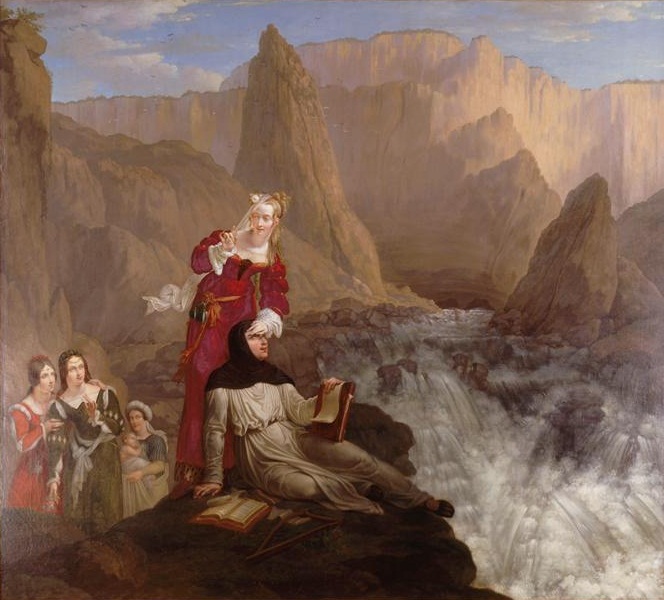
We went to see Christopher Nolan's The Odyssey. What did I think of it? I agree with what translator Daniel Mendelsohn wrote in the New York Review of Books and I recommend reading his essay. Emily Wilson's scathing LRB review was entertaining but had me wincing from that second paragraph, where the recurrent themes he has explored in his films are brutally dismissed ("yet again... yet again"). In The Guardian I noticed a 4 star review of Richard E Grant’s Very Modern Odyssey and thought this might be fun, but I should have read more carefully before trying to watch it. He is a National Treasure of course and beyond criticism, but... I'll just say that this series, sponsored by P&O cruises, wasn't really really my thing. In what I saw of the first episode he was on Gozo, looking at Calypso's cave, a site associated with her mythical island, Ogygia, since the 4th century BCE. Christopher Nolan actually filmed at the cave on Gozo, but for the beach scenes (above) he chose a saltwater lagoon near Dakhla in the Western Sahara. The reasons why this has been so controversial are set out in a Guardian article by Mohamed Sleiman Labat.    

The Paris Review has an extract online from Daniel Mendelsohn's translation of The Odyssey Book V, describing the landscape seen by Hermes after he arrives on the island, after crossing the seas and skimming along the breakers. He finds 'the nymph of the beautiful braids' by an enormous fire and the aroma of cedar and juniper 

Drifted all over the isle while she lifted her lovely voice
In song and wove back and forth at her loom with a golden shuttle.
A luxuriant growth of trees spread out all around the cave,
Alder and black poplar and sweet-smelling cypress as well,
And the birds inside them were sleeping, their wings outstretched,
Little horned owls and hawks, as well as cormorants,
Their chattering tongues stretched out—birds who work the sea.
Round about the mouth of the hollow cave, a vine
Had been trained to climb; now it flourished, bursting with clusters of grapes.
Four springs, all in a row, flowed with the clearest water,
Their streams running side by side, then turning this way and that.
All around were velvety meadows where violets and bay grass were growing Lushly.
Even a god who chanced upon this scene
Would marvel at the sight, pleasure filling his mind.
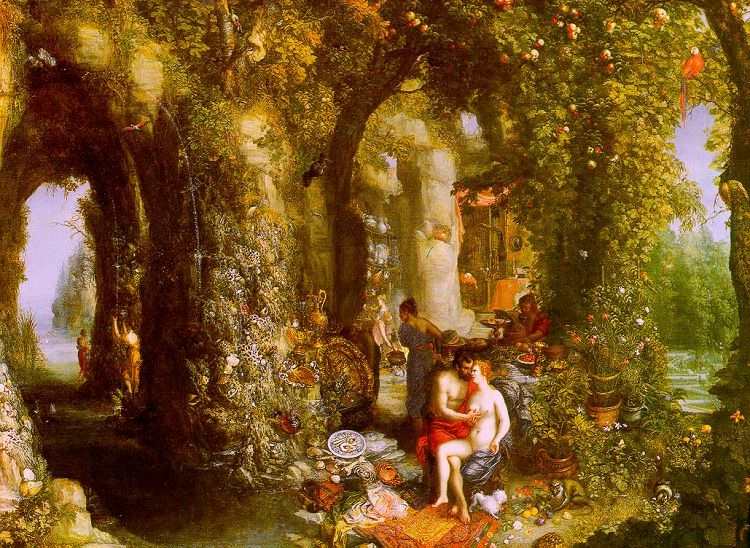


Jan Brueghel the Elder, Odysseus and Calypso in the caves of Ogygia, 1606-9

Gozo is far from being the only contenders for Calypso's island - Greece, for example, currently favours Othonoi which has another picturesque cave that tourists can visit. Many writers since Strabo and Plutarch have pronounced on the subject and the great French Homer scholar Victor Bérard (1864-1931) decided it was Perejil, an islet off the coast of Morocco (the country now occupying Western Sahara). Perejil, owned by Spain, is near Ceuta, scene of the recent mass migrant crossings and there was nearly a conflict there in 2002 when Moroccan troops turned up. These tensions were very much there when Bérard was trying to find Ogygia. 'General Alfau, who commands the Spanish troops in the Western Rif and resides in Ceuta, had written to our consul in Gibraltar stating that he would support our search for Calypso with all the means at his disposal; thanks to him, after ten years of anxiety and doubt, I have seen all my hopes confirmed...' I read this in the four-volume account of his travels round the Mediterranean that Bérard published in 1927-1929. You can see below my photograph of the map he made of The Odyssey, and in other volumes his illustrations of Ithaca and 'Le Royaume de Calypso' - Ile Peregil. Bérard managed to overcome the fact that Perejil doesn't have the crucial four springs by noting that there were some on the mainland, just across a short stretch of water. It doesn't sound very convincing to me, but when Bérard was in the cave on Perejil he received a Homeric sign - a little owl actually fell on his head. 


Before these travels Bérard had advanced a new theory that The Odyssey is based on Phoenician trade routes, as set out in periploi, the lists of ports and navigation marks compiled by ancient sailors. 'Tout périple est un chapelet de noms propres. Notre poème est une galerie de personnages. Ce sont les noms du périple qui sont devenus les personnages du poème.' Names become people, so Calypso, for example, would have been the personification of a geographical name on a periplus. The poem represents the transformation of a static list of sites into dynamic human actions that form a story. Perhaps therefore, in one sense, The Odyssey can be seen as a kind of landscape writing. 

All this brings us back to Ezra Pound, whom I quoted at the start. Pound read Bérard in 1930 and mentioned the 'periplum' (spelling it with an 'm') in The ABC of Reading (1934). In his Cantos, the form of a reader's journey emerges from information encountered along the way, like islands in the Mediterranean.

Victor Bérard discovered that the geography of The Odyssey, grotesque when referred to a map, was minutely accurate according to the Phoenician voyagers' periploi. The image of successive discoveries breaking upon the consciousness of the voyager is one of Pound's central themes of the New Learning ... The periplum, the voyage of discovery among facts, whose tool is the ideogram, is everywhere contrasted with the conventions and artificialities of the bird's eye view afforded by the map. Forms grow out of data. They are not imposed upon data.' 

- Hugh Kenner, The Poetry of Ezra Pound (1951)

Sunday, April 21, 2024

The Fountain of Arethusa

 There is sweet music in that pine tree's whisper...

- Theocritus, Idyll 1, trans. Anthony Verity

Last week I was in Syracuse, the home of Theocritus and, by extension, pastoral poetry. The first of his Idylls begins with two comparisons of nature and music. The words above are spoken in the poem's opening line by Thyrsis, praising the music of a goatherd's pan pipes. The goatherd replies 'shepherd, your song sounds sweeter than the water tumbling / over there from the high rock.' Thyrsis is persuaded to sing The Sufferings of Daphnis, the lament of a dying Sicilian cowherd (the reasons for his death are left mysterious). I have described here before Virgil's references to Daphnis in his Eclogues, and also the ancient novel Daphnis and Chloe, although in that story Daphnis tends goats on Lesbos. Re-reading Theocritus after visiting Sicily reminded me that many of his poems are set in the wider Greek world, although Idyll 16, is addressed to the tyrant of Syracuse, Hieron II. Both Idyll 16 and Idyll 1 refer to Arethusa, a spring that you can still visit on the island of Ortygia (the old centre of Syracuse). It is just be the sea and walled in to create a pond inhabited by fish and ducks.  


In Greek mythology, Arethusa was a nymph who fled from her home in Arcadia, emerging eventually as a fresh water fountain on Ortygia. The predatory male in this story was Alpheus, a river god, who pursued her until she prayed to be transformed into a cloud. But Alpheus wouldn't let up and, perspiring with fear, she turned into a stream and flowed through the sea until she reached safety in Syracuse. Ovid called her Alpheius - the name of a Greek river (it is said that a wooden cup thrown into the Alfeiós will eventually turn up in the Spring of Arethusa). Virgil alludes to this story when Aeneas reaches Sicily: 'an island lies over against wave-washed Plemyrium, / stretched across a Sicilian bay: named Ortygia by men of old. / The story goes that Alpheus, a river of Elis, forced /a hidden path here under the sea, and merges / with the Sicilian waters of your fountain Arethusa.' Virgil addresses his tenth Eclogue to Arethusa and refers to the story of Daphnis told by Theocritus, relocating the setting from Sicily to (an imaginary) Arcadia.


John Martin, Alpheus and Arethusa, 1832


Unsurprisingly Arethusa gets frequently mentioned in later pastoral poetry, right up to Wordsworth, who wonders in The Prelude whether 'that fountain be in truth no more'. Milton had referred to it in his elegy Lycidas, along with Mincius, a river in Italy that features in Virgil's Eclogue 7. 'O fountain Arethuse, and thou honour'd flood, / Smooth-sliding Mincius, crown'd with vocal reeds, / That strain I heard was of a higher mood.' But Samuel Johnson was not impressed with poetry of this kind. 'It is not to be considered as the effusion of real passion; for passion runs not after remote allusions and obscure opinions. Passion plucks no berries from the myrtle and ivy, nor calls upon Arethuse and Mincius, nor tells of rough satyrs and fauns with cloven heel. Where there is leisure for fiction there is little grief.'

Tuesday, January 07, 2020

A terrace of incense lit by the dawn


I have been reading the Tang Dynasty poet Wei Yingwu (737-92) in Red Pine's award-winning translation, In Such Hard Times (2009).  Anyone who has read Chinese poetry will know of the An Lushan rebellion and its impact on the lives of China's greatest writers.  Wei himself had been a young palace guard when the insurrection took place and his life as an official played out in the 'hard times' that followed. He was born "within a horseback commute of Ch'ang an", the biggest city in the world, but the first poems in the book were written in 763 in Loyang, the eastern capital that had just been recaptured from the rebels. Like other Chinese poets, he was torn between official duty and the desire for scholarly retreat, with the example of  Tao Yuanming constantly in his mind.  There's a lovely poem called 'East of Town' that concludes with Wei wishing he could retire and build a hut like Old Tao. It begins: 'Stuck in an office all year / I left the city for the wide-open dawn / where willow catkins soothed the wind / and blue mountains stilled my cares...'

A few years ago I mentioned Red Pine's Han Shan book in which the translator talks about the mountains that inspired the poems.  In this book, his footnotes explain exactly where each was written, so I thought here I would give a sense of Chinese landscape through Wei's eyes by quoting lines he wrote at different locations over the course of two decades.  Of course these brief images are not unique to these places - similar scenes could have been experienced all over the country, or even further afield: the same moonlight admired by Wei and his friends also fell on Charlemagne's Europe...  Perhaps because I have never been to China, or been taught about it, I sometimes struggle a bit with its geography, so here, just for fun and to give sense of Wei's travels, I've superimposed a map of eastern China, in blue, on Europe (using thetruesize.com). I have positioned it so that the Tang Dynasty capital Ch'ang-an is where you see Paris and Loyang is roughly on top of Stuttgart. 


The Sungshan mountains, 771
 
'... from the summit I heard a chorus of winds
in the woods I bathed in a secluded stream
the sound of a bell roused me on the Way
the evening chime cleared the clouds and mist...'

The Sungshan mountains lie just to the southeast of Loyang. Here Wei writes of stopping on a pine ridge and hearing the bell from the Shaolin Temple, marking the end of the meditation period.  The temple is well known for its association with martial arts (the seventh Wu-Tang Clan album was called Once Upon a Time in Shaolin).

Hsiangshan Springs at Lungmen, 772

'... darkened ledges glistening with water
towering trees encircled with vines
the torrent divides into different streams
with eddies swirling beside the current. ...'

Hsiangshan (Incense Mountain) was across the river from Lungmen (Dragon Gate), ten kilometres from Loyang. Wei admired the seclusion of these jade springs, finding it hard to leave.

Mei Reservoir, at Huhsien, 777

'White water surges along the embankment
mist swirls in a sunny sky
green is taking over the trees
there's jade on a thousand mountains. ...'

Huhsien is fifty kilometres southwest of Ch'ang-an - relative to Paris this is further than Versailles but nearer than Chartres. The reservoir he mentions here was formed where the Mei river met the Laoyu river and in a later poem Wei calls it a 'boundless clear lake'. Tu Fu (Du Fu, 712-70) had written a poem about boating on it.

The Huai River, 782

'... as the wind whipped the waves higher
an the sun's setting light grew dimmer
people returned to darkened village walls
wild geese landed on white island sands...'

Wei stopped for the night at Hsuyi, a post station on the Huai river, while journeying from Ch'ang-an to take up a new post at Chuchou. The nearest city on my map to Chuchou would be Zagreb, so he had done the equivalent of travelling from Paris through Germany, then south through Austria to Slovenia.  In heading south, he was like the wild geese.

Chuchou's West Stream, 783

'I love unnoticed plants that grow beside a stream
orioles singing overhead somewhere in the trees
at dusk the current quickens fed by springtime rains
I pull myself across on an unmanned country ferry.'

This is the entire poem - four lines of description, written after a day in the countryside west of Chuchou. But possibly there is some symbolism here: neglected plants = unappreciated officials, orioles = unheeded advisers, and having to pull across the river = looking out for yourself in politically turbulent times.

Lushan Mountains, 786

'... the tiger tracks in the mud look fresh
as we mount up the sun finally breaks through
I survey the landscape of dawn
flowers are as dense as fog...'

This was written of a journey on horseback in heavy rain.  Lushan is the famous mountain that I have discussed here before.  It was near Chiangchou, where Wei became a magistrate in 785. The city is located about where Bologna is on my map.

Kaiyuan Hermitage, 790

'... I love to follow trails to monastic retreats
to an orchard of fruit trees after a rain
a terrace of incense lit by the dawn
where green shade nurtures quiet days...'

Having returned from Chingchou to Ch'ang-an (the equivalent of a journey from Bologna to Paris) Wei was appointed to Souchou in the Yangtze Delta (back down south - equivalent to.northern Bosnia).  Kaiyuan temple was to the south of the city.  This is from one of his last poems.  He died a year later, too ill to return to Ch'ang-an.

Saturday, November 05, 2016

The source of the Sorgue

 Philippe-Jacques van Brée, Laura and Petrarch at Fountaine-de-Vaucluse, 1816
Source: Wikimedia Commons

In 1337, a year after his ascent of Mont Ventoux, Petrarch travelled to Rome. On his return to Avignon he found that the city's decadence still disgusted him.  In his 'Letter to Posterity' he says that 'seeking some means of escape, I fortunately discovered a delightful valley, narrow and secluded, called Vaucluse, about fifteen miles from Avignon, where the Sorgue, the prince of streams, has its source.  Captured by the charms of the place, I transferred myself and my books there' (trans. Mark Musa).  Elsewhere he wrote a wonderful description of his home at Fountaine-de-Vaucluse.  The translation of this passage below is in The Wind and the Source by Allen S. Weiss.  
'Here I have acquired two small gardens perfectly suited to my skills and taste. To attempt a description for you would be too long. In short, I believe that no similar spot exists in all the world, and, to confess my unmanly fickleness, I regret only that it is not in Italy. I customarily call it my transalpine Helicon. The one garden is very shady, suitable only for study and sacred to our Apollo. It overhangs the source of the Sorgue, and beyond it lies nothing but ravines and cliffs, remote and accessible only to wild beasts or birds. The other garden, near the house, appears more cultivated, and it is a delight to Bacchus. This one, astonishing as it may seem, is in the midst of the very beautiful and swift-running river. Nearby, divided from it by a very small bridge on the further side of the house, hangs a curved vault of native rock that now provides shelter against the summer heat. It is a place that inspires studies, and I suspect is not too dissimilar to the little hall where Cicero used to declaim his orations, except that he did not have a Sorgue flowing alongside. Under this vault, therefore, I spend my afternoons, and my mornings on the hillsides; the evenings I spend in the meadows or in my less cultivated garden at the source where my efforts have conquered nature and cleared a spot under the high cliff in the midst of the waters, narrow indeed but very inspiring, in which even a sluggish mind can rise to the noblest thoughts.'
As Weiss points out, this description suggests a perfect balance between the Apollonian and Dionysian temperaments which Nietzsche would make famous in his writings on aesthetics. Petrarch was influenced by both Christian and Pagan traditions, by Saint Augustine and Cicero.  In a letter to Cardinal Colonna, he described his creation of a garden as a war with the Nymphs, who try to chase away his Muses, but when he thinks of erecting an altar it is to Mary, rather than to the gods of rivers and springs.  It sounds like a delightful retreat, where Petrarch could concentrate on his writing 'amidst the sound of birds and nymphs, and accompanied by few servants but many books.'  It was also a base from which Petrarch could wander the countryside, 'roving over the meadows and mountains and fountains, living in the woods and in the countryside, fleeing human footsteps, following the birds, loving the shadows, enjoying the mossy caves and the blooming meadows...' 

Sunday, September 27, 2015

A Tour Through the Whole Island of Great Britain

 James Norrie and Jan Griffier II, Panorama of Taymouth Castle and Loch Tay, c. 1733-9

I recently wrote here about Daniel Defoe's A Tour Through the Whole Island of Great Britain, focusing on his remarks about Derbyshire.  I mentioned the wealth of illustrations in the Yale Press edition and some of the colour reproductions are spectacular, a full page for example given over to one detail in the painting above, showing soft light on the distant Loch Tay.  It's a shame there aren't more because some of the book's small black and white images are equally remarkable, like Balthasar Nebot's painting of extreme topiary that looks like it has come from the imagination of Giorgio De Chirico.  As these two examples indicate, many of the artists represented in the book came from abroad, particularly the Low Countries: Johannes Kip, Herman Moll, Jan Siberechts, Peter Tillemans.  Other groupings of topographical artists might be made: antiquarians, professional painters and engravers, or artists associated with the military: Paul Sandby, Greenville Collins, John Slezer.  Slezer came over to Scotland from Holland in 1669 but was a supporter of James VII rather than William of Orange and went to prison for it.  Defoe, a great supporter of King William, was writing just after the Act of Union and subsequent uprising by James's son, the Old Pretender.  His observations on Scotland have a particular resonance today.
 
Balthasar Nebot, Garden View of Hatwell House, 1738

Defoe is not generally very expansive on matters of landscape, but here are ten miscellaneous quotes that I thought worth noting.  The final illustration below also appears in the Yale edition and shows the kinds of trading and commercial activities Defoe was really most interested in recording.
  1. Essex: the effect of the marshes on the people - 'all along this county it was very frequent to meet with men that had had from five or six, to fourteen or fifteen wives; nay, and some more ... The reason, as a merry fellow told me, who said he had had about a dozen and half of wives, (tho' I found afterwards he fibb'd a little) was this; That they being bred in the marshes themselves, and season'd to the place, did pretty well with it; but that they always went up into the hilly country, or to speak their own language into the uplands for a wife: That when they took the young lasses out of the wholesome and fresh air, they were healthy, fresh and clear, and well; but when they came out of their native air into the marshes among the fogs and damps, there they presently chang'd their complexion, got an ague or two, and seldom held it above half a year, or a year at most; and then, said he, we go to the uplands again, and fetch another...'

  2.  Harwich: a town paved with petrified clay - 'there is a sort of clay in the cliff, between the town and the beacon-hill adjoining, which when it falls down into the sea, where it is beaten with the waves and the weather, turns gradually into stone: but the chief reason assign'd, is from the water of a certain spring or well, which rising in the said cliff, runs down into the sea among those pieces of clay, and petrifies them as it runs ... The same spring is said to turn wood into iron: But ... I presume, that those who call the harden' d pieces of wood, which they take out of this well by the name of iron, never try'd the quality of it with the fire or hammer; if they had, perhaps they would have given some other account of it.'

  3. Bagshot-Heath: a desert in Surrey -  'Those that despise Scotland, and the north part of England, for being full of wast and barren land, may take a view of this part of Surrey, and look upon it as a foil to the beauty of the rest of England ... here is a vast tract of land, some of it within seventeen or eighteen miles of the capital city; which is not only poor, but even quite steril, given up to barrenness, horrid and frightful to look on, not only good for little, but good for nothing; much of it is a sandy desert, and one may frequently be put in mind here of Arabia Deserta, where the winds raise the sands, so as to overwhelm whole caravans of travellers, cattle and people together; for in passing this heath, in a windy day, I was so far in danger of smothering with the clouds of sand, which were raised by the storm, that I cou'd neither keep it out of my mouth, nose or eyes; and when the wind was over, the sand appeared spread over the adjacent fields of the forest some miles distant, so as that it ruins the very soil.'

  4. Surrey: the effect of chalk on a traveller - 'From this town of Guilford, the road to Farnham is very remarkable, for it runs along west from Guilford, upon the ridge of a high chalky hill, so narrow that the breadth of the road takes up the breadth of the hill, and the declivity begins on either hand, at the very hedge that bounds the highway, and is very steep, as well as very high; from this hill is a prospect either way, so far that 'tis surprising; and one sees to the north, or N.W. over the great black desart, call'd Bagshot-Heath, mentioned above, one way, and the other way south east into Sussex, almost to the South Downs, and west to an unbounded length, the horizon only restraining the eyes: This hill being all chalk, a traveller feels the effect of it in a hot summer's day, being scorch'd by the reflection of the sun from the chalk, so as to make the heat almost insupportable; and this I speak by my own experience.'

  5. London: swallowing up the surrounding villages - 'It is the disaster of London, as to the beauty of its figure, that it is thus stretched out in buildings, just at the pleasure of every builder, or undertaker of buildings, and as the convenience of the people directs, whether for trade, or otherwise; and this has spread the face of it in a most straggling, confus'd manner, out of all shape, uncompact, and unequal ... We see several villages, formerly standing, as it were, in the country, and at a great distance, now joyn'd to the streets by continued buildings, and more making haste to meet in the like manner ... That Westminster is in a fair way to shake hands with Chelsea, as St. Gyles's is with Marybone; and Great Russel Street by Montague House, with Tottenham-Court: all this is very evident, and yet all these put together, are still to be called London: Whither will this monstrous city then extend? and where must a circumvallation or communication line of it be placed?'

  6. The Fens: the ominous sound of bitterns - 'This part is indeed very properly call'd Holland, for 'tis a flat, level, and often drowned country, like Holland itself; here the very ditches are navigable, and the people pass from town to town in boats, as in Holland: Here we had the uncouth musick of the bittern, a bird formerly counted ominous and presaging, and who, as fame tells us, (but as I believe no body knows) thrusts its bill into a reed, and then gives the dull, heavy groan or sound, like a sigh, which it does so loud, that with a deep base, like the sound of a gun at a great distance, 'tis heard two or three miles, (say the people) but perhaps not quite so far.'

  7. Nottingham: its vaults and cellars - 'The town of Nottingham is situated upon the steep ascent of a sandy rock; which is consequently remarkable, for that it is so soft that they easily work into it for making vaults and cellars, and yet so firm as to support the roofs of those cellars two or three under one another; the stairs into which, are all cut out of the solid, tho' crumbling rock; and we must not fail to have it be remember'd that the bountiful inhabitants generally keep these cellars well stock'd with excellent ALE; nor are they uncommunicative in bestowing it among their friends. as some in our company experienc'd to a degree not fit to be made matter of history.'

  8. Yorkshire: magical springs - 'The country people told us a long story here of gipsies which visit them often in a surprising manner. We were strangely amused with their discourses at first, forming our ideas from the word, which, in ordinary import with us, signifies a sort of strolling, fortune-telling, hen-roost-robbing, pocket-picking vagabonds, called by that name. But we were soon made to understand the people, as they understood themselves here, namely, that at some certain seasons, for none knows when it will happen, several streams of water gush out of the earth with great violence, spouting up a huge heighth, being really natural jette d'eaus or fountains; that they make a great noise, and, joining together, form little rivers, and so hasten to the sea. I had not time to examine into the particulars; and as the irruption was not just then to be seen, we could say little to it: That which was most observable to us, was, that the country people have a notion that whenever those gipsies, or, as some call 'em, vipseys, break out, there will certainly ensue either famine or plague.'

  9. Dumfries: a fine palace in a hideous landscape - 'We could not pass Dumfries without going out of the way upwards of a day, to see the castle of Drumlanrig, the fine palace of the Duke of Queensberry ... Drumlanrig, like Chatsworth in Darbyshire, is like a fine picture in a dirty grotto, or like an equestrian statue set up in a barn; 'tis environ'd with mountains, and that of the wildest and most hideous aspect in all the south of Scotland; as particularly that of Enterkin, the frightfullest pass, and most dangerous that I met with, between that and Penmenmuir in North Wales; but of that in its place...' 

  10. Stirling: the meanders of the River Forth - 'The Governor's lady (who was the Countess Dowager of Marr, when we were there, and mother of the late exil'd Earl of Marr), had a very pretty little flower-garden, upon the body of one of the bastions, or towers of the castle, the ambrusiers, serving for a dwarf-wall round the most part of it; and they walk'd to it from her Ladyship's apartment upon a level, along the castle-wall.  As this little, but very pleasant spot, was on the north side of the castle, we had from thence a most agreeable prospect indeed over the valley and the river; as it is truly beautiful, so it is what the people of Sterling justly boast of, and, indeed seldom forget it, I mean the meanders, or reaches of the River Forth. They are so spacious, and return so near themselves, with so regular and exactly a sweep, that, I think, the like is not to be seen in Britain, if it is in Europe, especially where the river is so large also. The River Sein, indeed, between Paris and Roan, fetches a sweep something like these some miles longer, but then it is but one; whereas here are three double reaches, which make six returns together, and each of them three long Scots miles, or more in length; and as the bows are almost equal for breadth, as the reaches are for length, it makes the figure compleat. It is an admirable sight indeed.' 

Unknown painter, Broad Quay Bristol, early 18th century

Sunday, March 02, 2014

Like a crystal flood

The story of Acis and Galatea is rooted in the landscape of Sicily.  When the sea-nymph sees her lover killed by a great rock, thrown by the jealous Cyclops Polyphemus, she transforms his blood into the river Acis. Polyphemus tries to lure Galatea away from the sea with descriptions of life on the island.  'Here there are bays, and here slender cypresses, / Here is sombre ivy, and here the vine's sweet fruit / Here there is ice-cold water which dense-wooded Etna / Sends from its snows - a drink fit for the gods.'  These lines are given him by Theocritus in Idyll 11 (trans Anthony Verity), whilst in Virgil's ninth Eclogue the Cyclops tells her 'Coloured spring is here.  The river banks are spangled / with flowers of many hues.  Above my grotto a silvery / Poplar sways, and vines cast a shifting lace of shadow.' (trans. C. Day Lewis).

Nicholas Poussin, Landscape with Polyphemus, 1648

Landscape imagery is used in a different way in Ovid's Metamorphoses, where Polyphemus climbs to the apex of a hill on a spur jutting out into the sea and sings in praise of Galatea, listing her qualities in terms of the beauties of nature.  She is

whiter than the snowy columbine
a sweeter flower than any in the meadows 
taller and more stately than alder
more radiant than crystal
friskier than a tender kid
smoother than shells polished by the sea
more welcome than sun in winter or summer shade
more choice than apples
lovelier to see than the tall plane trees
more sparkling than ice
sweeter than ripe grapes
softer than swansdown or creamy cheese
fairer than a watered garden

But also

wilder than an untamed heifer
harder than an ancient oak
more treacherous than the sea
tougher than willow-twigs or white vine branches
as immovable as the rocks
more turbulent than a river
vainer than the much-praised peacock
fiercer than fire
harsher than harrows
more truculent than a pregnant bear
deafer than the waters
crueler than a trodden snake

What Polyphemus most regrets however, is her ability to outrun him, for she is 'swifter than the deer, driven by loud barking, swifter even than the winds, and the passing breeze'.

Claude Lorrain, Landscape with Acis and Galatea, 1657

As you can see above, Claude and Poussin both based beautiful paintings on the myth, one a view looking out to sea, the other looking back into the island's rocky interior.  Acis and Galatea are small figures in the foreground and Polyphemus is barely distinguishable from the landscape.  In Poussin's painting his back merges into the rocks where he sits, turned away from the lovers, playing his flute.  In Claude's, the Cyclops is barely visible - you can just glimpse him (right) sadly watching from the wooded slope, his view of the lovers obscured by the sheet they have put up to afford them some privacy.  Of course not all artists put emphasis on the landscape and Poussin himself did a version with additional cherubs and embracing lovers in which Polyphemus looks on like the sad guy at a particularly riotous party.


It was at a hunting party that Jean-Baptiste Lully's opera Acis et Galatée saw its first performance in 1686.  Elaborate artificial sets of the kind he had previously specialised in were no longer an option now that he was out of favour with Louis XIV (who had become increasingly religious and less tolerant of Lully's openly homosexual lifestyle).  It is tempting to imagine this being successfully performed with very little scenery, perhaps even outside amid 'natural' scenery.  After Lully there are a few more steps in the operatic story before we get to Handel's Acis and Galatea.  There was an English version by John Eccles and P.A. Motteux in 1701, which depressingly included 'a subplot concerned with the quarrel of rustic couple Roger and Joan, introduced to “make the piece the more dramatical.”'  Then came Giovanni Bononcini's Polyfemo (1702) and an Italian version by the young Handel himself, Aci, Galatea e Polifemo (1708).  Ten years later Handel had moved to England and was employed by James Brydges, 9th Baron Chandos, the 'Apollo of the Arts', and it was for him that Acis and Galatea, was composed, with a libretto by John Gay (aided by two more poets, John Hughes and Alexander Pope).


Acis and Galatea was first performed on a summer's day at Cannons, the house Brydges was then still building at vast expense (and which would be razed to the ground in 1747 when the family fortune gave out).   Pleasingly this does seem to have taken place in the open air, although The Grove Book of Operas is a bit sniffy about this 'local tradition', remarking that the discovery of piping to supply an old fountain "might fancifully be invoked as support".  If true, the audience would have been within earshot of the water features designed by John Theophilus Deaguliers, another remarkable individual patronised by Brydges, who combined the roles of local priest and hydraulic engineer.  Perhaps the sound of water would have been a constant reminder of Galatea, the sea nymph loved by both Acis and Polyphemus. At the end of the opera, as you can hear in the clip embedded below, when Galatea transforms Acis into a river, she sings
Heart, the seat of soft delight,
Be thou now a fountain bright!
Purple be no more thy blood,
Glide thou like a crystal flood.
Rock, thy hollow womb disclose!
The bubbling fountain, lo! it flows;
Through the plains he joys to rove,
Murm'ring still his gentle love.

Friday, December 20, 2013

Where sea-grass tangles with shore-grass

The hard sand breaks,
And the grains of it
Are clear as wine.
Far off over the leagues of it,
The wind,       
Playing on the wide shore,
Piles little ridges,
And the great waves
Break over it.

These are the opening lines of H.D.'s poem 'Hermes of the Ways', which was published in Ezra Pound's anthology Des Imagistes almost a hundred years ago.  It was one of the poems Pound had been shown in 1912 by the 'ardent young Hellenists', H.D. and Richard Aldington and which he sent in to Harriet Monroe's Poetry.  It was, he thought, "objective - no slither - direct - no excess of adjectives. etc.  No metaphors that won't permit examination. - It's straight talk - straight as the Greek!"  In The Pound Era Hugh Kenner describes the first three lines of this poem: 'perception slides over perception, each line the natural unit of the process ... one line of statement, its narrative implication (feet crushing salty dried shore) compressed to the uttermost; one line of microscopic attention, discerning the grains; one line of arresting comparison, casual and evaluative (like wine, this shore is welcome; like sand, the benison is equivocal).'

Hermes, Orator - Roman copy from the late 1st century CE-early 2nd century CE
 after a Greek original of the 5th century BC

In H.D.'s poem a statue of Hermes - the god of travellers, transitions and boundaries - stands 'where sea-grass tangles with / shore-grass.'  Nearby there is an orchard with twisted trees and small hard apples ripened late by 'a desperate sun / that struggles through sea-mist.'  The statue 'fronts the great dunes' where the wind rushes through coarse grass, crusted in salt.  A small white stream flows underground from a poplar-shaded hill and emerges on the sands.  'Hermes of the Ways' (as you can see at the Modernist Journals Project site) was published in the January 1913 edition of Poetry under the title 'Verses, Translations and Reflections from 'The Anthology''.  This is a reference to The Greek Anthology which has a group of epigrams by Anyte, including the one that H.D. adapted and expanded for her poem.  This prose translation of Anyte's poem is by Richard Aldington and was first published in 1915:


HERMES OF THE WAYS

I, Hermes, stand here at the cross-roads by the wind-beaten orchard, near the hoary-grey coast;
And I keep a resting-place for weary men. And the cool stainless spring gushes out.


Anyte of Tegea lived in Arcadia in the early third century BCE.  She seems to have been, as it says in my Penguin edition of The Greek Anthology, 'the first poet to write epitaphs on animals, and to introduce bucolic themes into epigram.'  Her epigram 'Hermes of the Ways' interests me both as a condensed landscape poem (orchard, coast and spring) and as the evocation of a landscape sculpture.  Another (given in Aldington's translation below) provides a contrasting image of a statue by the sea. In poems like this, Marylin B. Skinner has suggested that Anyte offers an 'introspective' approach to ekphrasis, in contrast to male poets' detached way of reporting a visual experience (see 'Ladies' Day at the Art Institute: Theocritus, Herodas and the Gendered Gaze'). 'Aphrodite's benevolent mood is mirrored in the translucent expanse of water viewed from her headland and transmuted into concern for the mariners she beholds from afar. In the third line, there is an abrupt switch in perspective to the reverent tremor of the water as it, in turn, observes the goddess' glistening statue.'


ENGRAVED ON A STATUE OF APHRODITE

This is the land of Kypris, since it pleases her to gaze for ever from land over the glittering sea.
So that she may bear the sailors safe to land; and the sea quivers, looking upon her shining image.


The Cyprus Mail reported earlier this year on plans to build a four-metre tall bronze statue of Aphrodite on a rock in the sea. Ten years ago a more controversial proposal for a hundred-foot statue based on Botticelli's Venus was stopped. 'Artists and environmentalists branded published photographs as ‘ugly’, and reminiscent of Hollywood and Las Vegas kitsch.  One artist said it looked like a cake.  The Chamber of Fine Arts (EKATE) said the idea of a Statue of Liberty sized goddess of love was “base, barbaric, morbid, bizarre, provocative, flashy, grotesque, monstrous, out of proportion, over the top, tacky, cheap, pointless and offensive”'.  Planning for the new project is in its early stages so it is not yet clear whether this bronze Aphrodite will one day be gazing over the glittering sea.  There are no such statues of gods in the other two 'landscape poems' of Anyte that survive in The Greek Anthology: just trees and spring waters and a cool breeze.  I think Ezra Pound's advice to poets in 'A Few Don'ts By an Imagiste', written for the March 1913 edition of Poetry, should be heeded by all those commissioning public artworks: 'Use either no ornament or good ornament'. 


TO A GIRL

Sit beneath the beautiful leaves of this laurel, and draw the sweet water from the fresh spring:
You are breathless from the heat; rest your dear limbs and let the breath of Zephyros touch them.


FOR A FOUNTAIN

O wanderer, rest your tired limbs under this elm; the breeze murmurs in the light-green branches. Drink a cool draught from the spring. This resting place is dear to wayfarers in the hot summer. 

Saturday, August 04, 2007

The Bandusian spring

O fons Bandusiae, splendidior uitro,
dulci digne mero non sine floribus,
cras donaberis haedo,
cui frons turgida cornibus...
- Horace, Ode 3.13
Landscape poetry often evokes the sounds of nature and it would be interesting to take a subject like rivers and survey the ways words have been used to convey the different forms a river can take, from spring to sea. Modern writers like Ezra Pound, Louis Zukofsky and Basil Bunting have considered sound and musicality central to poetry, even to the extent that an audience can take pleasure from verse in another language when they do not understand the meaning of the words. Bunting once said ‘... all my life, since I was a youngster, I wanted to do the ‘O fons bandusaie’ and I can’t even get the first line. Like nearly all the great poets, Horace depended on sound and the ‘O fons Bandusiae creates throughout, but especially in the first lines, the actual sound of the running water of a stream. You might be able to create a spring in English, perhaps if you were skilful and able, but it wouldn’t bear any resemblance, however unique, to Horace’s sounds’ (quoted in Victoria Forde’s Basil Bunting).

The full text of Horace’s poem can be seen here along with various translations (including one by William Ewart Gladstone!) There are also a couple of paragraphs from Norman Douglas’s Old Calabria - he spends a chapter looking for the Bandusian spring. Gilbert Highet, whose visit to the springs of Clitumnus, I’ve mentioned here before, also went looking for the site of the poem. ‘We came to a slope, from which rushes a stream of clear water, absolutely clear and transparent, and – even in July, under the burning Dog-star – deliciously cold... This little place, because of Horace’s eloquence, became one of the ideal spots in the imagination of thousands of readers. It is not wildly romantic: not a savage place, holy and enchanted, beset by demoniac presences; nor even hallowed by the memory of a thirsty hero or a benign nymph or a saintly hermit. It is merely a spring, quiet and beautiful.’

Friday, August 18, 2006

The Springs of Clitumnus


Sometimes there’s nothing more pleasurable than the lucid prose of a scholar of the old school. A particular favourite of mine is Gilbert Highet’s Poets in a Landscape (1957) which brings alive the Roman poets through vivid translations and an imaginative evocation of their environment. There is, for example, Sextus Propertius, one of whose elegies includes the line
among the woods where the Clitumnus hides its lovely
springs, and white oxen bathe in the cool stream
Highet gets underneath this brief description by quoting other writings by Virgil and Pliny the younger; Pliny says in a letter to his friend Romanus: ‘There is a fair-sized hill, dark with ancient cypress-woods. Beneath this the spring rises, gushing out in several veins of unequal size. After the initial flow has smoothed out, it spreads into a broad pool, pure and clear as glass, so that you can count the coins that have been thrown into it and the pebbles glittering at the bottom.’

Highet himself provides his own description of the site, as he follows in the footsteps of the Roman writers: ‘the springs are about three feet deep. Their bed is creamy white gravel mixed with fine sand. Even in the smallest inlet, a pool the size of a little table, the gravel is constantly stirring, and the surface quivers every fifteen seconds with a tiny explosion of water… All water in motion is wonderful. Cool copious fresh water, absolutely clean, rising out of dry earth under a hot sun, is very wonderful…Willows hang over the wells, gazing into them with a soft narcissus melancholy. Poplar trees, lifting heads and arms to the sky, disdain their own reflections. Between their trunks we see the glinting sides of white oxen, and the timbre of church bells drifts faintly over the water. There is no noise: but there is, in the water and in the air, a ceaseless happy whisper, as though kind spirits inhabited the place.’

He is glad the springs are off the tourist trail and thus little-frequented, ‘… even so it was depressing to see, in one of the fountain-beds, half a dozen Coca-Cola bottles set to cool for possible sale to tourists. Only the charm and quiet of the scene made us forget the profanation’.

Friday, December 09, 2005

Fountain on a heath


In September 1801 Samuel Taylor Coleridge noted in his journal “The spring with the little tiny cone of loose sand ever rising and sinking at the bottom, but its surface without a wrinkle.” The following year he published a poem inspired by this site Inscription for a Fountain on a Heath. “Here Twilight is and Coolness: here is moss, / A soft seat, and a deep and ample shade…” Thus the poem describes a lovely spot for the weary walker.
Drink, Pilgrim, here; Here rest! and if thy heart
Be innocent, here too shalt thou refresh
Thy spirit, listening to some gentle sound,
Or passing gale or hum of murmuring bees!
It is a pleasant poem, but what if there really was a fountain with this inscription? What if Coleridge himself had carved these lines beside the spring or on the “jutting stone” of the "fountain" itself? Would this have enhanced the landscape? I don’t think many of us would want there to be a real inscription, even by the hand of Coleridge.

We tend to want the 'real' landscape kept pure, with text and poems confined to our gardens. Ian Hamilton Finlay’s Little Sparta is the most celebrated modern example, but he acknowledges the influence of poet-gardener William Shenstone. Shenstone compiled a book of Inscriptions, mostly in Latin, many of which were used in his garden The Leasowes. Shenstone was also an inspiration for the garden at Ermenonville, designed by Rouseau's friend the Marquis de Giradin, where the poem in the grotto of the naiads, for example, is derived from one of Shenstone’s inscriptions.