Showing posts with label mountains. Show all posts

Friday, June 19, 2026

The Epic of Everest

The Epic of Everest (1924) is an extraordinary landscape film - mainly shot in black and white but sometimes tinted in vivid colours, including pink, as you can see above. It was shot by John Noel, 'a soldier by profession but an artist in spirit', as Wade Johnson says in an excellent Sight & Sound essay He was heavily influenced by Herbert Ponting's footage of the equally ill-fated Antarctic expedition that was eventually turned into a film, The Great White Silence, which was also released in 1924. Both have beautiful shots of ice and snow and both now have soundtracks by Simon Fisher Turner. Noel also drew on the pioneering mountain photography of Vittorio Sella, whose work you can see at the extensive Fondazione Sella website.  

In my last post about Michael Snow, I talked about a new kind of camera installed on top of a mountain. The climax of The Epic of Everest is footage Noel took using a state of the art telephoto lens. Through this we watch George Mallory, Sandy Irvine and the others who helped their ascent as tiny black figures silhouetted against the snow, creeping up the North East ridge. While Snow deliberately excluded any human figures, Noel is desperate to spot them. But after two days the party returns, signalling from a distance with blankets in the shape of a cross that the expedition has ended in the climbers' deaths. The film’s final title card reads “if you had lived, as they had lived and died in the heart of nature, would you, yourself, wish for any better grave than a grave of pure white snow?” It is a noble idea, although in recent years these snows have been trodden by thousands of climbers and the remnants of their bodies have been identified on the mountain. 

A review of the BFI restoration noted that ‘modern viewers may squirm at the contrast between Noel's reverent approach to the mountain and his condescension toward the Tibetan locals.’ This is indeed what I felt when I watched it. And, as another article on the film notes, there is a shocking moment when an intertitle notes the death of two porters without providing their names (they were Darjeeling cobbler Manbahadur and Gurkha Lance Corporal Shamsherpun). The first performance of the The Epic of Everest, with Tibetan monks brought over to 'perform', set off a chain of events that influenced the history of Tibet. This 'Affair of the Dancing Lamas' has its own Wikipedia page where you can read the details. As Wade Johnson explains, the controversy ended up 'undercutting the reforms of the 13th Dalai Lama – reforms that no doubt would have placed Tibet in a much stronger position to cope politically and militarily with the Chinese invasion of 1950, which led to the death of an independent nation.'

Sunday, June 14, 2026

La Région Centrale


 Michael Snow, still from La Région Centrale, 1971

I thought I would focus here on a fascinating work of landscape art that I have only briefly referred to previously. In the late sixties, Michael Snow created three seminal 'camera motion' films which influenced later structural and minimal cinema. La Région Centrale was the third of these, made in the Canadian wilderness using a Camera Activating Machine (CAM) that an engineer, Pierre Abbeloos, built for him. This involved a camera mounted on a robotic arm and able to rotate through 360 degrees so that it could capture a total vision of the landscape. Five days' footage was edited down to a three hour film, which you can see on YouTube. I'll embed it below, although I realise these embedded links tend to disappear after a while.

In 'About Snow' (1979), published in October, the journal she co-founded, Annette Michelson quotes Kant's view that we measure everything in relation to ourselves, even cosmic space, and relates it to La Région Centrale. 

This film, in its circling, spiraling, rising, sweeping movements, crossing the distances between peaks, creating, in imperceptible loops through empty skies, reversals of direction which disorient the riveted spectator, seems to question, through kinetic counter-example and disorientation, the "ground" of the Kantian "view" which founds the modern sense of "place".

The absence of a 'cameraman' leaves the viewer free to identify with the camera itself. 'Snow's infinitely mobile framing, his mimesis of and gloss upon spatial exploration' provide a 'cinematic rendering of the grand metaphor of the transcendental subject.'

In a 1995 article for Parachute Thierry de Duve takes a different view. He disagrees with those, like Michelson, who have thought of the CAM as an ideal model of the Cartesian-Kantian subject, because the machine is not reflexive - it sees everything but itself. His article discusses Michael Snow's 'deictics of experience' - deictics being words that depend for their meaning on context (like 'I' and 'you'). Michael Snow is not the 'I' looking on this landscape. 'He is not the monk before the sea, or atop of the mountain'. What we see is not his experience. 'He has set the conditions of experience, but stopped short of its synthesis.' We as viewers are in a similar position to Snow, who says that while making the film "I only looked in the camera once." La Région Centrale is centripetal - 'the camera never reaches out into the landscape, it pulls the landscape towards the center.' Watching it we can't identify with the camera. As Snow said of one of his other films, "you aren't within it, it isn't within you, you're beside it."

La Région Centrale clearly offers rich material for theorists but also provided an ideal ending for Malcolm Andrews' fine book, Landscape and Western Art (1999). Snow's original 1969 proposal had positioned the project in art historical terms, as "a gigantic landscape film equal in terms of film to the great landscape paintings of Cézanne, Poussin, Corot, Monet, Matisse." But this would be something new in art, confusing the old stable coordinates of foreground and distance. Nevertheless, by filming on a Canadian mountain, Snow tapped into themes that, as Andrews says, have perennially haunted discussions of landscape in art: vanishing wilderness, the end of nature and representation of landscape as 'souvenir'. 

Over the last 500 years western landscape art has been like a barometer of anxieties over the balance of power between nature and culture. In the late twentieth century, we know that nature — that 'out there', that 'other' — is not necessarily perpetually self-renewing. It is more like ourselves than we ever feared. When it is not offering us dreams of green spaces as utopian as ever the most artificial pastoral managed to be, landscape art in our time comes burdened with guilt. 'I recorded the visit of some of our minds and bodies and machinery to a wild place,' wrote Snow, 'but I didn't colonise it, enslave it. I hardly even borrowed it'

Sunday, May 03, 2026

Soracte white with deep snow

Mountains in the Classical Tradition was a research project based at St. Andrews University from 2017 to 2023. It incorporated a blog which considered, among other cultural topics, 'William Golding at Thermopylae' and 'Edward Dodwell on Mt. Hymettos' (the subject of a post here back in 2013). In 'Augustus Hare on Mt. Soracte' Jason Konig discusses the travel writer and watercolourist who published two books about his walks near Rome. These volumes not only described Hare's own impressions of Mount Soracte (now called Monte Soratte) but also referred to twelve other nineteenth century writers who wrote about it. These included Byron, whose Childe Harold lists this rather modest peak alongside the most famous mountains of classical Greece. Soracte's unlikely fame was entirely down to just a few words of Latin verse: the first stanza of Horace's Ode 1.9, in which it stands covered in snow. 

As Jason Konig points out, 

It seems extraordinary that such a brief glimpse could have haunted the imagination of centuries of later readers. It was the opening line of this poem that Patrick Leigh Fermor’s German captive, General Kreipe, quoted to him in looking at the sunrise on Mt Ida in Crete in 1944; Leigh Fermor claims to have quoted the rest of the poem to him from memory in response, an incident which united the two men temporarily in their shared mastery of the classical heritage.

After describing the winter landscape Horace turns to his young companion, Thaliarchus, and urges him not to waste his youth - a similar theme to the famous carpe diem lines in Ode 1.11. There are numerous translations of the full poem online - at the Pantheon Poets site, for example, where you can hear it in Latin. I'll just quote here the start and end of a modern version by David Ferry. 

See Mount Soracte shining in the snow.
See how the laboring overladen trees
Can scarcely bear their burdens any longer.

See how the streams are frozen in the cold.
Bring in the wood and light the fire and open
The fourth-year vintage wine in the Sabine jars.

O Thaliarchus, as for everything else,
Forget tomorrow. Leave it up to the gods. [...] 

[...] While you’re still young,
And while morose old age is far away,

There’s love, there are parties, there’s dancing and there’s music,
There are young people out in the city squares together
As evening comes on, there are whispers of lovers, there’s laughter.

The American literary scholar H. T. Kirby-Smith, a witty historian of poetry, discusses the Soracte Ode in his book The Celestial Twins.   
Critical commentary on this poem usually neglects the metrics and settles on the issue of whether it consistently develops its subject. One reads indignant objections to the idea of sending some young man out into the streets in the dead of winter in hopes of picking up a girl, or suggestions that Horace simply meandered away from his original intention of evoking a winter landscape and contrasting it with the consolations of a roaring fire and a drink. Others, more sensibly, suggest that as Horace turns from himself to his young friend he imagines a more hospitable season — of life as well as the year — when the perils of senescent hypothermia are less threatening. 

It is easy to find online images of snow on Mt. Ida (height 2,456 m) but I failed to locate any of Mt. Soracte (height 691 m). I guess we live in warmer times, but perhaps it was a rare event even in Horace's day. Kirby-Smith thinks the poem's familiar landscape transformed by snow sets the poem going with 'Alpine excitement and novelty.' Neither August Hare nor his literary sources mention seeing the kind of scene described by Horace - they describe Soracte as a distant blue peak. This is how it appears in Edward Lear's panoramic vision (below). Corot painted it several times and you can see pale areas of rock on its slopes, but no sign of snow anywhere. Perhaps Horace was only ever using it as a metaphor - in Kirby-Smith's phrase, 'age as the season of snow.'


Edward Lear, Monte Soratte near Rome, 1880s(?)

Saturday, October 25, 2025

Fireworks in the Himalayas

I was curious to see the White Cube's Cai Guo-Qiang exhibition but conflicted after the recent controversy surrounding his firework performance in the Himalayas, The Rising Dragon, sponsored by an outdoor clothing company called Arc’teryx. According to Artnet, Cai thought he was bringing "energy, awe, blessings and hope to the world,” but there was a swift backlash over a work 'threatening one of the planet’s most fragile ecosystems and for showing cultural insensitivity, as the Tibetan plateau and its mountains are sacred in Tibetan Buddhism.' It sounds like the worst possible kind of art-in-the-landscape. Two days after the fireworks Cai and Arc'teryx were issuing apologies and explanations. Cai said his fireworks were biodegradable and had passed environmental standards when used for the Beijing Olympics, but scientists 'warned that the damage could be irreversible, given the plateau’s fragile ecosystem' and 'pointed out that standards designed for urban settings do not apply at such high altitudes.' An official investigation was launched. Artnet point out that Cai got into more trouble recently for a drone performance in Quanzhou which 'ended in chaos when drones, unregistered with local authorities, were shot down en masse during the event', and four months earlier an event in Los Angeles caused ash to rain down on spectators and unexpected noise disruption for surrounding neighborhoods. 


Cai Guo-Qiang, Mountain, 2019  

Aware of all this I nevertheless decided to have a look at the gunpowder canvases on display at White Cube, where flower and bird forms emerge from attractive and colourful abstract swirls to create 'cosmic gardens'. The curators wax lyrical: 'amber collides with ash-grey in fevered bursts; diffusions of cerulean are flecked with inky lapis; whirlpools of fuchsia and blue converge and dissolve.' The example above is much less colourful; Mountain (2019) was 'conceived in response to Cézanne yet reframed within a broader horizon that unsettles the paradigm of Eastern and Western art histories, advancing instead a vision of heritage as shared experience.' I'm not sure how far it achieves this, but it's true that it resembles both Cézanne's Mont Sainte-Victoire and the misty contours of a Chinese landscape painting. Cézanne was actually the source for Cai’s controversial fireworks in Tibet, via an early unrealised project for a firework display over Mont Sainte-Victoire, Ascending Dragon: Project for Extraterrestrials No 2 (1989). According to Artnet, 'Cai had originally sought to realize the piece both at Mount Fuji, in Japan, and at Mont Sainte-Victoire in France, but was reportedly denied permission by local authorities due to environmental concerns.'

Wednesday, July 02, 2025

Latticework landscape


This latticework landscape is currently on display in Kensington High Street at the Japan House exhibition The Craft of Carpentry: Drawing Life from Japan’s Forests. It was made five years ago by Sakae Tategu Kogei, the firm founded by Eiichi Yokota, a master of kumiko craft. 'The origins of kumiko likely date back to the Kamakura period (1185–1333), with techniques passed down through generations. The central process involves crafting thin, delicate pieces of wood and assembling them in various geometric patterns to form a seamless surface.' The different coloured woods include Japanese whitebark magnolia, Chinese pyramid juniper, lignitized Japanese castor aralia and Kiso hinoki cypress. The delicate shapes used to make the components of the landscape range from a basic triangle joint to the yae asa-no-ha (eight-layer hemp leaf) and dahlia patterns.   


The fact that some of these wooden patterns are named after natural forms does not of course mean that they are designed to signify dahlias or hemp leaves. My photo above shows the dahlia pattern and you can see this used in the mountain landscape for the third-from-bottom slope on the left. There is an interesting semiotic effect here, where flower shapes are used not to imply anything about vegetation in the scene. Instead they suggest the complexity of light and shade or strength of shadow on a particular slope. This reminds me of a broader feature of Chinese and Japanese arts where the names for technical components often evoke specific natural effects, but could have been used freely. To paint a whirlpool you could use the brush stroke tan wo ts’un ('like eddies of a whirlpool'), but maybe it would be more interesting to deploy the luan yün ts’un ('like rolling billows of cloud').   

We use kumiko coasters every day to put drinks and pans on but I don't remember seeing the technique used to create a landscape before. I would love to know more about the history of kumiko used in this way, but information online is scant. Simpler kumiko lattices (square and rectangles) are used on shoji screens which could themselves have landscapes painted onto them, although surely it is preferable to leave them blank. As Tanizaki said in praise of shadows: 'the light from the garden steals in but dimly through paper-paneled doors, and it is precisely this indirect light that makes for us the charm of a room.' The garden and landscape beyond can then be revealed by sliding the screen doors open. 

Friday, June 13, 2025

Changes to a Summit


Eugène-Emmanuel Viollet-le-Duc, Mont Blanc Seen from the Massif, Les Aiguilles Rouges, 1874

This wonderful watercolour is reproduced in Kelly Presutti's excellent new book Land into Landscape. As she points out, the mountain panorama was evidently so vast it required sticking two sheets of paper together. Viollet-le-Duc is famous for having restored Carcassonne and Notre-Dame de Paris but he also spent eight summers making a study of Mont Blanc, culminating in the publication of a detailed map and 'study of its geodesic and geological construction, of its transformations, and of the old and modern state of its glaciers.' His book Le massif du Mont Blanc (1876) includes a fascinating diagram (see below) that begins with a purely geometric shape imagined as a more pristine original state, before the forces of erosion had turned it into the landscape equivalent of a ruined cathedral. This sequence looks like an illustration of the way computer game landscapes have evolved from grid frameworks (Atari's Battlezone) to the complex realism facilitated by 3D graphics cards. Painters had always produced idealised mountain forms but Viollet-le-Duc's 'treatise was meant to be practical and proscriptive, to pertain to an ambition to modify the real as much as an aspiration to evoke the ideal.' Presutti's book includes fascinating information about the steps taken in nineteenth century France to preserve mountains, through the establishment in 1882 of a government service dedicated to the Restauration des terrains en montaigne. 
 

Eugène-Emmanuel Viollet-le-Duc, Changes to a Summit, 1876
  
At this time two new technologies were changing the ways mountains could be seen and depicted. One, obviously, was photography. The other was the 'teleiconograph', which Presutti describes in an article on the Yale University Pres website
Designed by fellow architect Henry Révoil, the teleiconograph combines a telescope with a camera obscura to bring distant points nearer and enable the observer to trace them onto a page. Révoil advertised the efficacy of his device by illustrating the sculptures on the rooftop of Notre Dame, an application sure to attract Viollet-le-Duc’s interest.The teleiconograph provided the kind of precise rendering Viollet-le-Duc needed to decipher the mountains. Using it, he produced detailed studies of peaks, carefully calibrating angles and timing his studies to coincide with optimal lighting conditions. Intricate lines trace the cuts and angle of rock faces; blank spaces denote areas concealed by snow. The resulting diagrams are less a picture of a mountain than a translation of its materiality into mathematical properties.

Saturday, March 29, 2025

Great Fear on the Mountain


I still occasionally end up buying a book for its cover, or at least picking it out to look at on that basis. This one (published last year) got to me through that Ernst Ludwig Kirchner painting, Mountain Peak (1918). It is extremely well chosen as an illustration of the story, which concerns a high pasture with an evil reputation, avoided for twenty years until a new group of shepherds volunteer to spend a summer up there. It doesn't end well for them. There is an excellent, comprehensive article by Alice-Catherine Carls about Great Fear on the Mountain (1926) and its Swiss author Charles Ferdinand Ramuz. I'll quote here some of what she says about his landscape imagery: 
In Great Fear, the glacier tests the limits of human understanding and causes a loss of reality conducive to extracorporal and paranormal sensations, hallucinations, phantasms, and dreams. It becomes a purgatory to “vapors and legions of errant souls” experiencing a “hypnotic delirium, a kind of awake-dream.” 
Other settings that describe unfamiliar, disorienting light and sound effects include the mountain slopes’ dense forest, the absolute darkness of the night, the blinding light of the noon sun, and the silence of high altitudes’ “mineral world.” The magnificent sunrises on the jagged mountain summits are described in impressionistic, worshipping fervor, with dawn alighting on the landscape like a bird and the sky being so close that one could touch it.
The disturbed psychologies of the characters in Great Fear could be likened to the state Kirchner was in after being discharged from the army. As a recent article in the Art Newspaper explains, he 'was a physical and psychological wreck when he first arrived in Davos in 1917. Addicted to alcohol and morphine, he was suffering from blackouts and paralysis.' At first he stayed with a nurse on the Stafelalp, in a mountain hut  - “It’s very beautiful up here ... and I could paint so much, if I weren’t so weak.” A year later he was doing better and living in Davos where he remained until 1925, painting landscapes like the one Archipelago Books have used for Great Fear on the Mountain

Saturday, June 08, 2024

The Angle of a Landscape


The renowned American poetry critic Helen Vendler died a few weeks ago; there was a nice piece in The Atlantic by Adam Kirsch comparing her to Marjorie Perloff, who also passed away this year. I thought I'd pick three poems from Vendler's Emily Dickinson anthology and quote from her illuminating commentaries. I'll begin with this one, which has one of those arresting first lines that draw you straight into Dickinson's poems (see my earlier post on how these have been used by artist Roni Horn).


Our lives are Swiss—
So still—so Cool—
Till some odd afternoon
The Alps neglect their Curtains
And we look farther on!

Italy stands the other side!
While like a guard between—
The solemn Alps—
The siren Alps
Forever intervene!

Here, Vendler says, 'while the blocking Alps are obscured by mist, one cannot even speculate about what lies beyond; but when they let down their guard, and forget to draw the curtain over their landscape, one can see, beyond the passes, an ecstatic vista. The still, cool, white life of an Alpine region remains untroubled until one senses a possible warmth. If only one could traverse the mountains!' I've always loved this idea of glimpsing a promised land, somewhere sunny and beautiful summed up in that italicised word, Italy. The Alps here are both solemn - "thou halt not" - and sirens, leading us on. Eden could be ours if it weren't forever barred from us.


The Angle of a Landscape – 
That every time I wake – 
Between my Curtain and the Wall
Upon an ample Crack – 

Like a Venetian – waiting – 
Accosts my open eye – 
Is just a Bough of Apples – 
Held slanting, in the Sky – 

The Pattern of a Chimney – 
The Forehead of a Hill – 
Sometimes – a Vane’s Forefinger – 
But that’s – Occasional – 

The Seasons – shift – my Picture –
Upon my Emerald Bough,
I wake – to find no – Emeralds – 
Then – Diamonds – which the Snow

From Polar Caskets – fetched me –
The Chimney – and the Hill – 
And just the Steeple’s finger – 
These – never stir at all – 

Vendler describes this as three sequential poems in one. The first three stanzas provide 'an enticing picture of a small sliver of landscape that is familiar to Dickinson because she sees it every morning between the edge of her curtain and the wall of her room.'  Then she moves through autumn and winter with emerald leaves replaced by diamond frost and snow. Finally there are the last three lines which leave us with a static chimney and the finger of a steeple. 'The denuding of the landscape in the last stanza is an almost invisible process' and we are left with 'a heartbreaking picture of a once-enhanced Nature which, with the death of its participatory observer, itself suffers rigor mortis.'


To make a prairie it takes a clover and one bee,
One clover, and a bee.
And revery.
The revery alone will do,
If bees are few.

Vendler ends her book Dickinson with this beautiful epigram, long a favourite poem of ours and one I've quoted on this blog before. She looks at the poet's word choice - for example, "prairie" is a good rhyme, distinctly American and reflects in its spelling the Latin pratum, "meadow". She also analyses the poem's linguistic game that is one of its most appealing features: the way "a" and "one" reverse their order. A bee needs just one random clover to sip nectar from, but in the second line they are separated by a comma and joined by the third essential term, "revery", which seems to arise 'as a "surprise" even to herself'. The word "revery" has various meanings, ranging from a vision to a state of being lost in thought. Its three syllables make it 'spread out' in a way you wouldn't have with the simple word 'dream'. This poem's last six brisk monosyllables bring us 'out of the dreamy reverie itself (here a clover, there a bee) into the poet's argument for the power of reverie alone, even when it is unsupported by correlative natural images. Dickinson is a rapturous poet of nature's flowers and bees, but her more abstract meditations can arise powerfully from reverie alone.'

Friday, March 15, 2024

The purple glow of evening

Carl Gustav Carus, Woman on a Balcony, 1824
(used as the cover for OUP edition of The Mysteries of Udolpho).

The Mysteries of Udolpho is one of those famous novels like Wuthering Heights or Frankenstein that I've read with certain prior expectations, only to be surprised by how much else there is beyond the story I imagined it would be. One reason is that, like many people, I came to Ann Radcliffe's Gothic bestseller with a caricature in mind, formed by Jane Austen's parody Northanger Abbey (a book I quoted here back in 2008). But it is also a novel designed to frustrate your expectations, with slow sections and plot digressions that must be read before its numerous mysteries are explained. The obvious reaction on putting it down is that this 670 page novel could have been an exciting 200 page story if it had stuck to the Castle of Udolpho and not allowed its heroine an anticlimactic and relatively easy escape from the villain Montoni. But if you are interested in landscape and the way it was appreciated there is much of interest before and after Emily is incarcerated in the Apennines.

Ann Radcliffe's reference points are the standard ones in Britain at the time:

  • The Mysteries of Udolpho is greatly influenced by Edmund Burke's theory of the Sublime and the term itself is frequently used. Descriptions of mountain landscapes, the great gloomy castle and Montoni's fierce face are clearly designed to evoke feelings of delightful terror. 
  • The perilous paths Emily travels are straight out of Salvator Rosa. Banditti and murderous armed men are not just figments of her imagination. The novel is set in the sixteenth century but a 'scene of barrenness' interrupted by 'the spreading branches of the larch and cedar, which threw their gloom over the cliff, or athwart the torrent that rolled in the vale' was 'such a scene as Salvator would have chosen, had he then existed'.
  • The novel's chapters begin with quotations from poets and it is no surprise to see James Thomson's The Seasons featuring along with Shakespeare, Milton and others. Verse epigraphs are still standard practice (Thomas Halliday uses them effectively in his recent book on prehistoric landscapes, Otherlands) but Radcliffe pioneered this technique. 

Like other writers from the Romantic period, Radcliffe's way of viewing nature was influenced by William Gilpin and she had followed him to the Lake District in search of picturesque scenery. Her heroine meets and falls in love with a free-spirited young chevalier encountered while he is on the kind of walking tour alone in the mountains that Coleridge and Wordsworth would later enjoy. As the OUP edition's editor Bonamy Dobrée says in his notes 'it is surely no accident that Radcliffe's villains do not care for landscape'. 

Because Radcliffe had never at this stage set foot in the south of France or Italy, her descriptive passages are based on those of travel writers like Hester Thrale. Some readers might dislike the idea of landscape imagined from a distance and through the prism of other books in this way, but there are moments where The Mysteries of Udolpho reminded me of the dream-like journeys I have praised here before in books by Kafka and Eichendorff. Radcliffe's vision of Venice, with its unintentional anachronisms, is as unreal as Kafka's New York and Eichendorff's Rome, but it has a poetic quality that would appeal to Byron. 

Terry Castle, in her introduction to the OUP edition, describes the early part of the novel as a 'bizarre quasi-travelogue' where 'the narrative repeatedly dissolves into extended diffuse, often phantasmagoric descriptions of landscape'. And she quotes the passage, below, saying that at moments like this the novel 'seems hypnotized by the possibility of not becoming a Gothic novel - of remaining instead in a world of beautiful unfolding description. Transported by the hallucinatory 'charms' of nature, Emily and her friends may in turn remind us of moon-walkers, travelling in endless slow motion through a mauve-tinted dusk.'

It was evening when they descended the lower alps, that bind Rousillon, and form a majestic barrier round that charming country, leaving it open only on the east to the Mediterranean. The gay tints of cultivation once more beautified the landscape; for the lowlands were coloured with the richest hues, which a luxuriant climate, and an industrious people can awaken into life. Groves of orange and lemon perfumed the air, their ripe fruit glowing among the foliage; while, sloping to the plains, extensive vineyards spread their treasures. Beyond these, woods and pastures, and mingled towns and hamlets stretched towards the sea, on whose bright surface gleamed many a distant sail; while, over the whole scene, was diffused the purple glow of evening.

Saturday, November 04, 2023

The Eight Mountains

I recently watched The Eight Mountains which I'd been looking forward to since reading Peter Bradshaw's review in The Guardian:

This rich, beautiful and inexpressibly sad film is about the friendship between men who can’t talk about their feelings and about winning and losing at the great game of life. It is set in the breathtaking and wonderfully photographed Italian Alpine valley of Aosta, which includes the slopes of Mont Blanc and the Matterhorn. But the “eight mountains” of the title refers to the eight highest peaks of Nepal: a mysterious symbol of worldly ambition and conquest. Belgian film-makers Felix van Groeningen and Charlotte Vandermeersch have adapted the award-winning 2016 novel by Italian author Paolo Cognetti and have created a deeply intelligent meditation on our capacity for love, and how it is shaped by the arbitrary, irreversible experiences of childhood, and by our relationship with the landscape. The Aosta valley is depicted with magnificent sweep, and van Groeningen and Vandermeersch find a stratum of sadness under it, a kind of water table of tears.

Unfortunately, although I did quite enjoy it, I was disappointed - my view of the film was closer to Richard Brody's review in The New Yorker. In this he describes a scene that echoes a central dilemma of landscape appreciation I've referred to often on this blog. 'By far the best scene in the film is one in which the adult Pietro (Luca Marinelli) brings a trio of Turin friends to the mountains; in response to their rapturous enthusiasm for “nature,” Bruno (Alessandro Borghi) explains that the people who live in the mountains never use that “abstract” word but rather speak lovingly of the physical specifics—“forest, meadow, river, rock, path: things you can point at, things you can use.”' 

However, 

that line of dialogue conveys more of the essence of the movie’s alpine setting than does the cinematography. Much of the action there takes place outdoors; Pietro’s father (Filippo Timi) is an enthusiastic hiker and climber who takes the two boys with him on his expeditions, and Pietro, in his many returns to the region, delights in the peaks, in the clear water of the lake, in the rock formations. The movie presents these landscapes as cinematic abstractions, with drones and Steadicams and cameras perched on high to show the small figures of humans overwhelmed by, yes, nature, and to show the spectacular sights that surround the characters. But it stints on the visual point of view of the characters, voids itself of contemplative poise and analytical precision, hardly stays still long enough, looks in detail long enough. It doesn’t pay enough closeup, hands-on attention to soil and stone and water and snow, to wood and fire, to flesh and fabric, to suggest that the characters have any more of a physical connection to the settings than they have a perceptual one.

We used to exclaim "oh no, not a drone shot!" whenever they appeared on TV documentatries or movies, until they became almost ubiquitous. But complaining about the drone shot cliché has itself become a cliché, so I won't labour the point here. A New York Times article on the phenomenon did note some highly effective examples - Werner Herzog 'opens his remarkable 2016 picture “Into the Inferno” with an astounding aerial sequence that soars up a mountain and then into the volcano at its center.' Maybe we could just have some more drone shots that are grainy or misty or flawed in some way, rather than being taken on smooth glides over perfect landscapes that are not as awe-inspiring as they should be, because they look almost computer-generated. 

Another review of The Eight Mountains notes that 'some obvious drone shots are included, but much of the hiking sequences appear to have been done with Steadicams, following the men through their treacherous treks. Andrea Rauccio is listed as the Steadicam operator, but the credits for camera operators are lengthy, and the entire crew deserves credit.' Richard Brody may be being a bit harsh on all this, but I do know what he means when he says that in these scenes it's hard not to 'hear and see the crew, the walkie-talkies, the muffled clamor that goes into turning raw experience into overcooked and denatured images.' 

I feel I should end on a more positive note though. So here are a few more quotes from reviews (ending back with Peter Bradshaw), where the temptation to use mountain metaphors has proved irresistible.

  • 'Stately and serene from a distance, but up close riven with the fissures and follies of a friendship that costs both men so much but gives them even more, the movie, too, is a mountain.' (Variety)
  • 'Luca Marinelli and Alessandro Borghi put in mountain-sized performances to offset the film’s silences and propensity for postcard shots, bringing heart and guts to the chilliest scenery. A worthwhile hike through many obstacles to friendship.' (Irish Times)
  • 'A movie that seems to grow before your eyes, leaping across continents as years go by, all the while slowly accruing power. By the end it has scaled a peak, offering a bracing perspective on life experience.' (FT)
  • Much like climbing a mountain, the two-and-a-half-hour runtime may occasionally feel arduous, but the emotional release is worth it once you reach the peak.' (Time Out)
  • 'This film has mystery and passion, it climbs mountainous heights and rewards you with the opposite of vertigo: a sort of exaltation.' (The Guardian) 

Saturday, August 26, 2023

Ocean waves and mountain echoes


Kuncan, Origin of Immortals, 1661

I've been looking into the art of Kuncan (or Kun Can, 1623-73), a Buddhist monk who lived in and around Nanjing. In Three Thousand Years of Chinese Painting, a book I've quoted from before, Nie Chongzheng highlights Kuncan's use of calligraphy and quotes lines he added to a 1661 landscape painting, Origin of Immortals. I'll reproduce these here as they are already quoted online in a Daily Art post about Kuncan.

I still find joy in this secluded life,

Treading on the path, I find beautiful scenes as I please,

I play my musical instrument as I walk along the river,

Until I enter a fascinating place through the clouds,

The water is deep, and the land is open and flat,

Mountains shine under the sunlight,

The deafening sound of spring covers other noises,

The flat rocks look so clean, as if they have been swept,

I feel so happy I forget my fatigue,

The stream winds all the way up to the high mountain,

When I look ahead, the mountains look as if they are cut,

And the irregular mountain caves are exquisite,

I feel as if I am high in the sky.

My steps feel so light as I walk in the pine woods,

Resting in the mountains, I forget about the material world.

The place is so quiet that even monks don’t come here,

I plan to live here for the rest of my life,

Until I die in the mountain.

These lines are lovely but not very memorable. The main reason I wanted to write this post was to include another Kuncan quote that I really like, this one taken from a 1670 landscape painting that was on loan to the Met.

Master Cheng Lian [a musician, 7th century B.C.] transformed people’s temperament with the sound of ocean waves. Zong Shaowen [the landscape artist Zong Bing, 375–443] did it with echoes in the mountains. Temperament can be transformed to transcend romantic and worldly attachments. Mr. Wang Dengxian [active mid-17th century] studies in the Gaozuo Monastery [in Nanjing], taking rainy woods as his ocean waves and mountain echoes. Every day he strolls in them, chanting his literary compositions and, when gay, singing out loud while tapping trees [to keep time]. He lives as he wishes. My senior Ji once said, “As emotions arise, wisdom is blocked. When thoughts shift, the body changes in accord.” How can anyone say there is no transformation-inducing cinnabar in this process? I painted this landscape to amuse myself. When Mr. Wang saw it, I gave it to him as a present.

Cheng Lian (Ch'eng-lien) was the qin player who taught Bo Ya (Po Ya), who I have referred to here previously. Zong Bing wrote the early aesthetic essay Huashanshuixu (“Preface on Landscape Painting"). Gaozuosi is in Rain Flower Terrace park in the south of Nanjing. It looks like there are still plenty of trees there in which one could walk and listen to the rain, but this landscape now has a dark place in history, with a monument commemorating the thousands of communists executed on the site by the Kuomintang.

Tuesday, August 15, 2023

Sunlit emptiness


West Lake, Hangzhou
Source: Wikimedia

I've just read Love & Time: The Poems of Ou-Yang Hsiu, a slim volume of J. P. Seaton translations published by the Copper Canyon Press in 1989. It includes Ou-Yang's series of ten poems entitled West Lake Is Good, which popularised the tz'u form (ci in pinyin) where verse is fitted into the form of a pre-existing song. His West Lake poems (the lake is in Hangzhou - see my earlier post on it) were written to the tune Picking Mulberries. I guess it would be like someone writing a set of poems about Windermere using the rhythms and rhyme scheme of 'Scarborough Fair'. Ouyang also wrote some beautiful landscape poems in the short shih (shi) style, like 'Drifting at I-Ch'uan' in which a stream grows in a gorge and rapids turn a tiny boat. 'Birds on the sand turn too: / away from me / and fly, to the grove's green tips.'  

Ouyang Xiu (1007-72 - I'm swapping now to pinyin spelling) had the Zuiweng Pavilion constructed at Langya Mountain near Chuzhou. It was built to his design by a Buddhist priest of the mountain, Zhi Xian, and you can now build one yourself – I see that a Lego set is available to buy! Ouyang called it The Pavilion of the Old Drunkard, but as Richard Strassberg writes in Inscribed Landscapes, what Ouyang ‘cares about is to be amid mountains and streams. The joy of the landscape has been captured in his heart, and wine drinking merely expresses this.’ Ouyang’s calligraphy was engraved at the pavilion in 1048 but because it was difficult to make rubbings, Su Shi (1037-1101) rewrote it in larger characters (rubbings of this still exist). Inscribed Landscapes includes a further text on another pavilion ordered near here by Ouyang Xiu: The Pavilion of Joyful Abundance, which is by a spring at the foot of Mount Abundance, Fengshan. 

In 1070 Ouyang wrote his ‘Account of the Pavilion on Mount Xian’ (1070), an early description of the ‘principle whereby a place becomes known through a particular person’, as Stephen Owen says in his Anthology of Chinese Literature. ‘Mount Xian looks down on the river Han', Ouyang wrote. 'when I gaze at it, I can barely make it out. It is surely the smallest of the major mountains, yet its name is particularly well known in Jingzhou. This is, of course, because it of the persons associated with it. And who are those persons? None other than Yang Hu and Du Yu.’ Yang Hu and Du Yu were governors during the Jin Dynasty and Mount Xian, near Xiangyang (formerly Xiangfan) had a ‘stele for shedding tears’ dedicated to Yang Hu.  

Of course Ouyang himself created sites of future literary pilgrimage - not just the pavilions near Chuzhou. Pingshan Hall was built in 1048 when he was prefecture chief of Yangzhou. Su Shi was again on hand to commemorate the older poet, writing a poem after Ouyang’s death on an occasion when he revisited the hall. It can still be visited today - it is in the western part of Daming Temple, on the middle peak of Shugang Mountain near Yangzhou - but it has been destroyed and re-built many times over the years. Stephen Owen’s anthology includes ‘An Account of the Reconstruction of Level Mountain Hall’ written in the seventeenth century by Wei Xi (1624-80). Pingshan means ‘Level Mountain’ and comes from the fact that the mountains from this viewpoint all appear at the same level. J. P. Seaton translated one of Ouyang's poems on this landscape. He looks out and leans into 'sunlit emptiness, / the mountain's colours in the mist / now there, now gone.'


Saturday, August 13, 2022

The Path of Perspectives

Last month Dezeen reported on a new landscape intervention by Snøhetta, a 'disappearing walkway' of 55 stepping stones on the Traelvikosen Scenic Route in Helgeland.

'Traelvikosen Scenic Route was commissioned by the Norwegian Public Roads Administration. It forms part of the Norwegian tourist routes, which is a series of experiences for road travellers. "Along carefully selected roads in Norway, natural wonders are amplified by art, design, and architecture, with emphasis on the unique landscape and qualities of the different locations," Kvamme Hartmann explained. ... "At Trælvikosen, we wanted to intentionally design the site to ensure visitors were enticed to stay longer than normal," she continued. "To truly experience the details, the time and nature itself, and hence also understand it better, as it offers an opportunity to observe the ever-changing rhythms of our nature."'

It's an interesting thought, that an already beautiful landscape needs some additional help from art to get people to stop and experience 'nature itself'. 


Last week I experienced a similar Snøhetta intervention on Nordkette, the mountain overlooking Innsbruck. This viewing platform was also reported on by Dezeen - see their article from 2019. I was expecting this to be something like the suspension walkway on Mt. Titlis in Switzerland, where in addition to getting views across the Alps, tourists are given the thrill of looking down from a vertiginous height over empty space. However the Snøhetta platform is built on a relatively gentle green slope so all you see below you is grass. Whether the corten steel design makes a photograph here especially Instagrammable I'm not sure - there were spectacular backdrops already all around this mountaintop. The metal walkway curves onto a trail circling the mountain, the Path of Perspectives, although everyone I saw on it had clambered down a more direct desire path from the cable car station. There are other Snøhetta structures dotted round this trail - benches and viewing platforms - and they have quotes on them in German and English. I see now from the Dezeen article these quotes are by Wittgenstein (this wasn't evident to me, but it was distractingly hot up there, so I probably missed the explanation!) According to Snøhetta, "the words invite visitors to take a moment and reflect, both inwardly and out over the landscape, giving a dual meaning to the path of perspectives."

Wednesday, April 20, 2022

I leave my door open when spring days get longer


I've discussed Red Pine's translations from Chinese poetry before (see 'No Trace of Cold Mountain' and 'A terrace of incense lit by the dawn'). His enthusiasm for tracking down and exploring the landscapes experienced by the ancient poets is particularly relevant to this blog. In 1991 Red Pine visited the mountain on which the Zen monk and poet Stonehouse (Shihwu, 1272-1352) had lived. Five years earlier he had self-published a set of translations, having discovered this relatively obscure poet whilst working on Han Shan. Now he and a couple of friends were heading up Hsiamushan in a battered Skoda, having stopped on the way at a temple Stonehouse knew that had been almost completely destroyed in the Cultural Revolution. Near the summit of the mountain they encountered soldiers at a radar station. The commander kindly cut a path through the bamboo and they reached a farm that had once been a temple. This was where Stonehouse had made his home in a simple hut - the spring he mentions in his poems was still there, along with slopes of tea and bamboo, although the pines had disappeared. Twenty years later Red Pine returned and found better roads, a water bottling plant in place of the military blockhouses, and the farmhouse replaced by a new temple. Stonehouse's stupa must be somewhere in the mountain cemetery, where the inscriptions are no longer legible. His memorial stone has now merged into the hillside.

To give a sense of this place through poetry, I've chosen ten elements of the landscape. First I'll quote couplets from Stonehouse's poems, then in italics some information from Red Pine's explanatory notes. 


Bamboo

'a trail through green mist red clouds and bamboo / to a hut that stays cold and dark all day'

Bamboo grows so thick on Hsiamushan, trails don't last long. When I first visited the mountain in 1991, the army officer who led me to the area where Stonehouse first lived needed a machete to reach it.

Drifting clouds

'As soon as a drifting cloud starts to linger / the wind blows it past the vines.'

Clouds are often used as metaphors for thoughts, while vines represent convoluted logic. Drifting clouds can also refer to monks.

Flat-topped rock

'sometimes I sit on a flat-topped rock / late cloudless nights once a month'

The flat-topped rock is still there, just up the slope from the water-bottling plant. Local farmers call it "chess-playing rock".

Gibbon howls

'gibbons howl at night when the moon goes down / few visitors get past the moss by the cliffs'

Gibbons and their eerie howls were once common throughout the Yangtze watershed but are now found in the wild only in a few nature reserves in the extreme south.

Hibiscus

'a winding muddy trail / a hedge of purple hibiscus'

The hibiscus is found throughout the southern half of China, where it is often grown to form a hedge.

Orange tree

'down by the stream I rake leaves for my stove / after a frost I wrap a mat around my orange tree.'

The Yangtze watershed is the earliest known home of not only the orange but also such citrus fruits as the tangerine, the kumquat, and the pomelo. Apparently Stonehouse's orange tree (or "trees," as Chinese is ambiguous when it comes to number) didn't make it. He never mentions it again.

Paulownia

'I leave my door open when spring days get longer / when paulownias bloom and thrushes call'

The paulownia is one of China's most fragrant trees. It blooms in late March and early April and is the only tree on which the phoenix will alight - should a phoenix be flying by.


Pine pollen

'when Solomon's seal is gone there is still pine pollen / and one square inch free of care.'

The root of Solomon's seal, or Polygonatum cirrhiflium, contains a significant amount of starch. It is usually dug up in early spring. Pine pollen is slightly sweet and also has nutritional value. It is gathered in late spring by placing a sheet under a pine tree and knocking the branches with a bamboo pole. The "square inch" refers to the mind.


Thatch

'mist soaks through my thatch roof / moss covers up the steps on the trail'

A thatched covering of grass or rushes is still the most common roofing in the mountains. However, hermits who can afford them use fired clay tiles. 

Tiger tracks

'dried snail shells on rock walls / fresh tiger tracks in the mud' 

Until recently, hermits in China often reported encounters with the South China tiger, which is much smaller than its Siberian and Bengali cousins but still dangerous.

Monday, January 03, 2022

Double Red Mountain

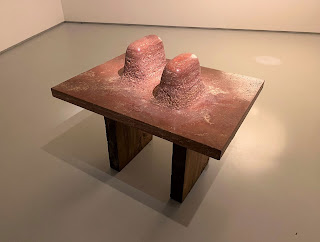
Isamu Noguchi, Double Red Mountain, 1968


I instinctively liked this sculpted landscape in the Barbican's Isamu Noguchi exhibition because of its beautiful colour and the texture of the marble. I tried to imagine owning such an object, but as usual found it impossible to conceive of an artwork surviving long in our messy house before being submerged under junk mail, coffee mugs and discarded clothes. Noguchi is certainly easy to criticise and Jonathan Jones was scathing in his review: 'what struck me most is how nice these objects would look in a smart luxury house or apartment. Noguchi makes you see the history of modern art in a new, and disappointing, way.' Double Red Mountain is normally safely housed in The Isamu Noguchi Foundation and Garden Museum, New York. By the time Noguchi made it he was a globe-spanning art star and this sculpture combines Persian travertine, Japanese pine, and Noguchi's memories of the mesas of Arizona.


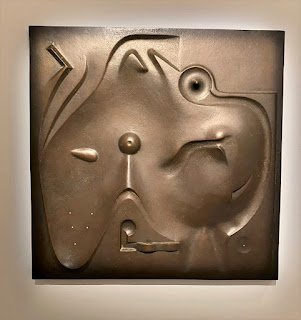
Isamu Noguchi, Contoured Playground, 1941 (cast 1963)


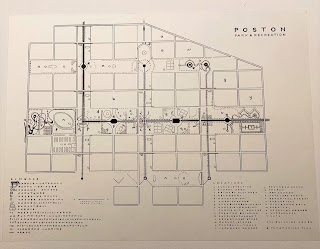
This wall-mounted bronze sculpture depicts one of his ideas for an actual landscape design - a playground in Central Park. It was never built, partly because the country was soon at war. Noguchi's residence in New York meant he was exempt from forced imprisonment but he voluntarily chose to enter one of the internment camps in Arizona. Here, at Poston War Relocation Center, he tried to develop an arts and recreation programme to improve the lives of the Japanese-American prisoners. His plan for the site, featuring a Japanese garden and a tree-line irrigation stream, is on display in the exhibition (see below). However, there was no real desire from the authorities to make conditions pleasant or build anything too permanent and so his ideas were frustrated. The temperature extremes and dust storms were hard to endure ("O! for the sea!" he wrote to Man Ray) and he decided to leave. He had to wait three months for his request to be granted and he returned to New York in 1943.


Tuesday, November 23, 2021

Loss of the Rhône

Jean-Antoine Linck, The confluence of the river Valsereine with the river Rhône, c. 1800-20

The British Museum currently has a small temporary exhibition, 'Enticing Peaks Swiss prints from the Lloyd Bequest'. It is confined to part of one room and so they don't have space for more than a tiny fraction of the 'collection of over 5,000 Swiss prints and books' amassed by Robert Wylie Lloyd (1868-1958). Sadly  there are no books on display, but there are some interesting landscapes, like the one above by a Swiss artist whose work was very popular at the time. Of course some of these Alpine views have changed significantly in recent years with the retreat of the glaciers, although this one was already altered by the construction of a dam. The BM's curators explain:

'This print represents a phenomenon known as the ‘Perte du Rhône’ (‘Loss of the Rhône’) near Bellegarde, France, which today no longer exists. In the dry season, the Rhône used to plunge into an underground gorge ninety metres deep, emerging downstream close to the confluence with the river Valsereine. The river is seen here appearing from its subterranean passage. Platforms were created for visitors to view the thundering river emerging from below ground. The construction of the Génissiat Dam south of Bellegarde in 1948 transformed the underground section of the Rhône into a reservoir, just over twenty kilometres in length.'


Christian von Mechel, Bird's Eye View of the Mont-Blanc Massif above the valley of Chamonix, 1790

Another print (above) was produced by a Basel print shop owner in 1788 to commemorate the ascent of Mont Blanc a year earlier by pioneer Alpinist Horace Bénédict de Saussure. This interested me because it was based not on direct observation of the mountains but on a model of the landscape.

'The model was produced in relief by Charles-François Exchaquet (1746-92), a Swiss engineer, cartographer and keen mountaineer, who sold his models in different sizes, together with rock specimens from the area, across Europe. Today, five are known to have survived, including one in Haarlem (Teylers Museum) and another in Geneva (Swiss Alpine Club). The long inscription provides information about Exchaquet’s model, and refers to the main peaks, glaciers and refuge huts. The red line shows the route taken by de Saussure for his ascent in August 1787.'

I have looked on the Teylers Museum website and their photograph of this model makes it look less impressive than you might imagine (then again, I guess you wouldn't expect tourists to carry home with them huge table-top relief sculptures). Here's their description of it (I used Google translate from the Dutch):

'The relief consists of nine glued blocks of wood that were chiselled into the correct relief, modelled with plaster and covered with crushed quartz to represent the glaciers. ... It is unknown how many models were made. The model was donated in 1799 by the Amsterdam merchant Govert Lups.'

The Teylers Museum's director Martinus van Marum apparently made a trip through Europe in 1802 and visited the son of de Saussure. He bought 'a fine collection of his father's rocks from him, including the top of Mont Blanc, the highest piece of rock found just below the ice cap.'

Saturday, June 13, 2020

A Vale of Tears


Literature and Nature in the English Renaissance: An Ecocritical Anthology edited by Todd Andrew Borlik was published last year and so far has a solitary one star review on Amazon.  "Frankly, if a book of out-of-copyright texts is THAT expensive, you may as well download the contents list to Kindle and go and find the texts yourself. Absurd pricing."  At £84, it is certainly out of reach of my pocket, but as this reviewer notes, the contents list is freely available.  Here are two sections:


In this post I wanted to highlight the first text above, Robert Southwell's poem 'A Vale of Tears'.  Here are its first four stanzas:
A vale there is, enwrapt with dreadful shades,
     Which thick of mourning pines shrouds from the sun,
Where hanging cliffs yield short and dumpish glades,
     And snowy flood with broken streams doth run.

Where eye-room is from rock to cloudy sky,
     From thence to dales with stony ruins strew'd,
Then to the crushèd water's frothy fry,
     Which tumbleth from the tops where snow is thaw'd.

Where ears of other sound can have no choice,
     But various blust'ring of the stubborn wind
In trees, in caves, in straits with divers noise;
     Which now doth hiss, now howl, now roar by kind.

Where waters wrestle with encount'ring stones,
     That break their streams, and turn them into foam,
The hollow clouds full fraught with thund'ring groans,
     With hideous thumps discharge their pregnant womb.
It is certainly a pretty bleak-sounding place, where pleasant landscape features we associate with pastoral poetry provide no comfort ('crystal springs crept out of secret vein, / Straight find some envious hole that hides their grace').  Surrounded by all this, the mind turns inward and dwells on sin and the need for repentance. 'Come, deep remorse,' the poet concludes, 'possess my sinful breast; / Delights, adieu!  I harbour'd you too long.'

Robert Southwell was a Jesuit Catholic martyr: canonised in 1970; hung, drawn and quartered at Tyburn in 1595.  A recent profile of him in The Tablet describes his training in France and Rome and return to England in 1586 to undertake clandestine missionary work.
'Southwell’s literature infiltrated the Catholic country houses of England. Though he was a priest without a pulpit and an outlaw, Southwell hoped that word of a Catholic revival would disseminate through the secret printing presses to the peasantry, yeomanry, and lesser gentry. [...] His great poem “A vale of teares”, issued in the year of his death, likens England’s perceived fallen state under Elizabeth I to a “dumpish” (melancholy) wasteland, “Where nothing seemed wronge yet nothing right”. In the absence of a settled spiritual solution to England’s break from Rome, the poem offered Catholics a negative solace.'    
In a 2018 article, Gary Bouchard cites critics who have explained the poem in terms of a prescribed Ignatian penitential framework or in psychological terms as a 'therapeutic scene'.  His own view is that it can be read as an anti-pastoral, contrasting it specifically with Spenser's 'The Shepheard's Calender' (1579).  But he also notes that some of the language and imagery is proto-Romantic - a landscape one could imagine 'Victor Frankenstein and his creature passing through'.  Southwell had crossed the Alps via the St. Gotthard Pass on his journey to Rome in 1578 and would have seen sights that later writers and artists would come to admire for their sublimity.

J. M. W. Turner, A Ravine in the Pass of St Gotthard, 1802 
Source: Tate

I will close here with one more stanza from the poem:
The pines thick set, high grown and ever green,
     Still clothe the place with sad and mourning veil;
Here gaping cliff, there mossy plain is seen,
     Here hope doth spring, and there again doth quail.
Reading Robert Southwell's poem prompts the obvious thought that in these dark times - of climate crisis, global pandemic, economic hardship and racist brutality - it is hard not to feel that we are all walking through a vale of tears.

Saturday, March 14, 2020

Wandering on the Tiantai Mountains

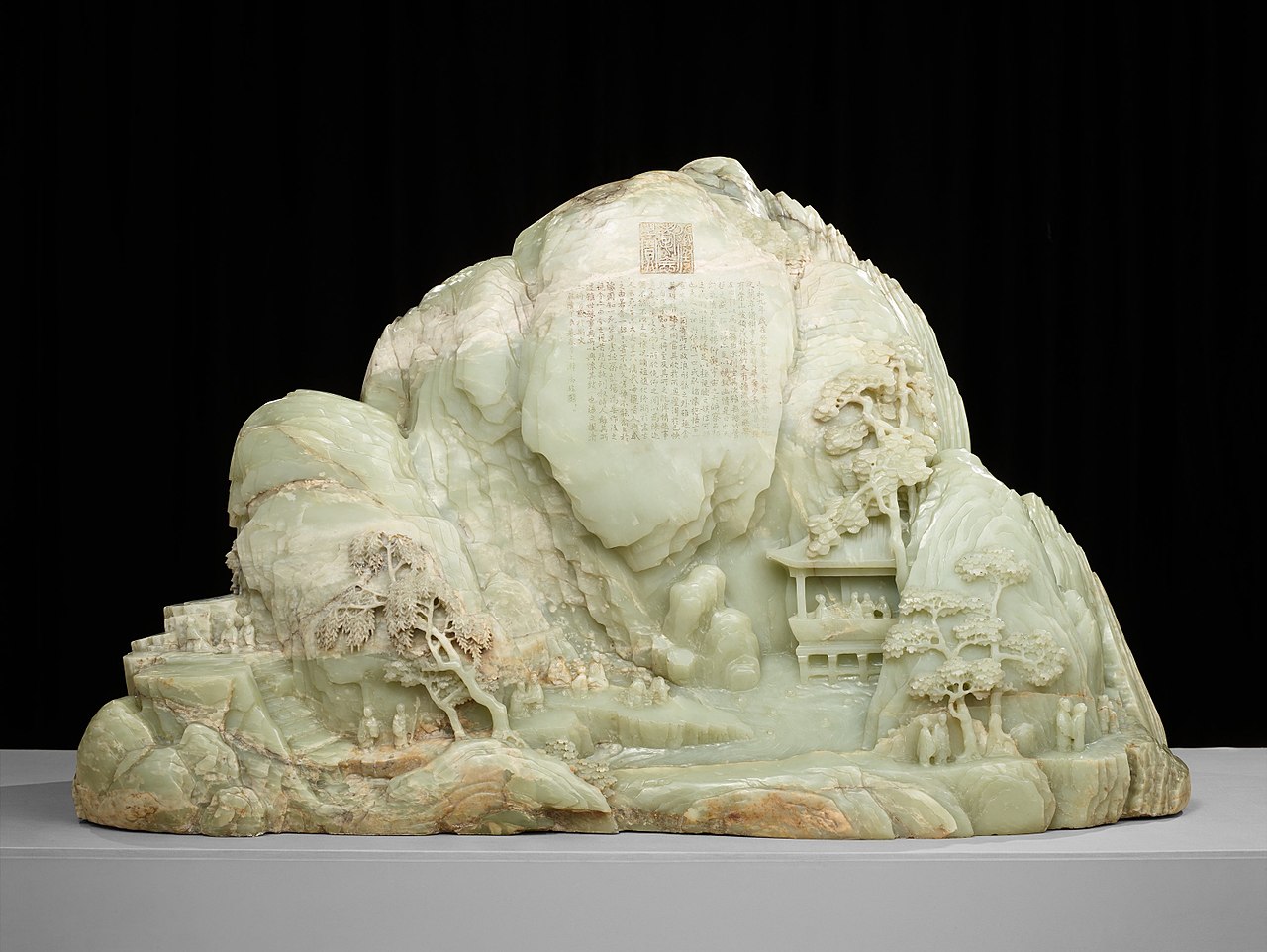
Unknown artist, Jade Mountain Illustrating 
the Gathering of Scholars at the Lanting Pavilion, 1790
Source: Wikimedia Commons

This landscape in jade shows Mount Kuaiji (in present-day Zhejiang) and the celebrated Orchard Pavilion Gathering that took place there during the Spring Purification Festival on the third day of the third month in the year 353.  The event is most famous for a piece of calligraphy, the Lantingji Xu - 'Preface to the Poems Collected from the Orchid Pavilion' written by Wang Xizhi (303-361).  He describes the location, with its
'mighty mountains and towering ridges covered with lush forests and tall bamboo, where a clear stream with swirling eddies cast back a sparkling light upon both shores.  From this we cut a winding channel in which to float our wine cups, and around this everyone took their appointed seats.  True, we did not have harps and flutes of a great feast, but a cup of wine and a song served well enough to free our most hidden feelings.' (trans. Stephen Owen)
Feng Chengsu, Tang Dynasty copy of Wang Xizhi's Lantingji Xu (now lost) 
Source: Wikimedia Commons

There were forty-two literati at this famous party and one of them was the poet Sun Chuo (Sun Ch'o, 314-71), whose fu 'Wandering on the Tiantai Mountains' has also been translated by Stephen Owen.  Here is an extract:
... I pushed through thickets,     dense and concealing,
I scaled sheer escarpments     looming above me.
I waded the You Creek,      went straight on ahead,
left five borders behind me     and fared swiftly forward.
I strode over arch     of a Sky-Hung Walkway,
looked down ten thousand yards     lost in its blackness;
I trod upon mosses     of slippery rock,
clung to the Azure Screen     that stands like a wall ...
Burton Watson has also translated this poem and writes of Sun's journey that 'as he proceeds up the mountain, the scenery becomes increasingly fantastic and idealized, until at the end he reaches a plane of pure philosophy, in which Taoist and Buddhist allusions are balanced one against the other.'

Dai Xi,  Rain-coming Pavilion by the Stone Bridge at Mt. Tiantai, 1848
Source: Wikimedia Commons

The Sky-Hung Walkway referred to in this poem was a natural stone bridge.  It has often been depicted in art - The Smithsonian has a twelfth century painting of it by Zhou Jichang and they describe it as follows:
'The natural rock bridge spanning a waterfall is one Tiantai's most famous sights. According to legend, this arch is also a pathway to paradise where the five-hundred luohan, saintly guardians of the Buddhist faith, worship and dwell among magnificent celestial temples. Those who venture to tread this perilous trail, however, find that the bridge, which narrows to a width of several centimeters, is obstructed at its far end by an insurmountable block of stone.'
There are some photographs online of tourists admiring what I assume is this same rock bridge (e.g. on Wikimedia).  In the Japanese ink painting below by Soga Shōhaku (1730–1781) it looks much more spectacular.  In this dramatic scene a mother lion throws cubs over the cliff to see which will succeed in life by being able to climb back up to her.

Soga Shōhaku, Lions at the Stone Bridge of Mount Tiantai, 1790 
Source: Met Museum

An article by Zornica Kirkova explains that Mount Tiantai also features in a poem by Sun Chuo’s friend, the Buddhist monk Zhidun (314–366).  This 'opens in the idyllic setting of a spring garden, where the poet leisurely reflects on the passage of time and, “moved by things” ... lets his thoughts soar up to the sacred realm of the Celestial Terrace Mountain'.
The piping creek plays clear tunes.
Empyrean cliffs nurture numinous mists,
Divine plants, holding moisture, grow.
Cinnabar sand shimmers in the turquoise stream,
Fragrant mushrooms sparkle with the five brilliances.
In this poem, 'the mountains are envisioned as a sublime and sacred realm of purity and beauty.'  As with Sun Chuo, more realistic images - the cool breeze, the clear tunes of the creek - are combined with 'fantastic paradise depictions, pertaining to the theme of immortality (eternal divine plants, cinnabar sand, magic mushrooms)'.  It is easy to forget when you read poetry like this that it is a real mountain, so I will end here with an image from the internet taken with an iPhone 6S in June 2016, 1,663 years after the Orchard Pavilion Gathering.

The cliffs of Mount Tiantai
Source: Huangdan2060