Showing posts with label sunsets. Show all posts

Tuesday, May 27, 2025

Der Rhein

Some landscapes in the Ashmolean's exhibition Anselm Kiefer: Early Works, with quotes from the accompanying wall texts. 

Der Rhein (The Rhine), 1982 

'The Rhine has been a German national symbol while also providing a border to France. During the Romantic era of the early 19th century, countless travelogues by writers such as Friedrich Hölderlin and paintings by J.M.W. Turner helped develop a fascination with the beauty of Rhine landscapes. The river also played a major role in Wagner's opera cycle, The Ring. Kiefer's woodcut collage, however, is equally concerned with the political connotations of the Rhine, merging its landscape with National Socialist architecture.'

The building in Der Rhein relates to a series paintings showing Nazi architecture Kiefer made in the early eighties - the exhibition included a watercolour, Innenraum (1982) of Albert Speer's New Reich Chancellery, destroyed in 1945. Christie's sold a similar woodcut to Der Rhein for £313K in 2012 and their description includes this quote from Kiefer: ''I grew up on the banks of the Rhine. France was on the other side. As a child, I saw the river as an insuperable obstacle, something you couldn't swim across. It thus acquired a mythical status for me. When you came to this barrier you could turn left or right but not go straight ahead, except in your imagination." The Rhine (Melancholia) is the name of an Anselm Kiefer installation I wrote about in 2014, 'a collage of black-and-white woodcuts on canvas with acrylic and shellac compiled over more than two decades, between 1982 and 2013.' 


Unternehmen 'Trappenfang' (Operation Bustard Hunt), 1976 

'The title of this painting references a WWII military codename, 'Unternehmen Trappenjagd' ('Operation Bustard Hunt'). The words summon the aftermath of an attack, a landscape scarred by the treads of troop movements and tanks. In May 1942, Germany bombed the easternmost tip of Crimea, the Kerch Peninsula, amplifying the destruction by artillery and tank divisions. Looming above Kiefer's scene is not a bustard but a large painter's palette, linking war memory with an emblem of artistic identity.'

Kiefer often uses high horizons with paths heading towards them, invoking ideas of motion through time. This horizon has a snow covered village, a dark church spire and a bleak grey sky. Looking here at how he was painting fifty years ago, I thought how similar it is in many ways to Kiefer's most recent work, which we have seen in shows at the White Cube gallery. His Superstrings for example, which I discussed here in 2019, are 'desolate landscapes of earth, snow, muddy water, stubble, straw and leafless trees.' I said then that I could see a connection between such paintings and Van Gogh's ploughed fields, something that may well be apparent in the forthcoming Royal Academy exhibition that will pair the two artists. 


Ausbrennen des Landkreises Buchen (Burning of the Rural District of Buchen), 1974 

'This book features photographs of Buchen, where the artist's studio was located, and carbonized sections of former paintings. The photos initially focus on farmland and streets, before showing staged explosions. The final pages present charcoal-encrusted paper. Devoid of people, the photographs allude to the economic decline of Buchen. The explosions also reference the presence of the German armed forces.'
Matthew Biro's Phaidon monograph on Kiefer has a section on this work. 'Leafing through the book engenders a sense of moving through Kiefer's rural environment', but what starts as apparently simple representations of specific geographic regions end up with images overpainted in black wash, singular 'originals' rather than repeatable photographic reproductions. At this time Kiefer was interested in ideas of destruction: 'in addition to burning a town, as it were, Kiefer also flooded Heidelberg in two volumes from 1969 and covered the Brandenburg Heath with sand in four tomes from 1976'. The Ashmolean exhibition had the original 1974 Buchen book, but Kiefer made seven more on the same theme the following year. I referred to one of these in a previous post and quoted Martin Gayford: 'this is how the traditions of Friedrich and Schinkel looked and felt to Kiefer in the aftermath of the Third Reich: burnt out, haunted by overpowering, terrible events.'

Stefan I, 1975

Poet and translator Stefan Anton George was embraced by the Nazis as a hero, despite his criticism of National Socialism and self-imposed exile to Switzerland. In Kiefer's surreal paintings he appears to be resting on his death bed. The works allude to the charged complexities of German cultural heritage and present an attempt to redeem George from political exploitation. 
I can never resist a giant figure in a landscape (see various previous posts) and the exhibition had two watercolours of Stefan George as a mountain. In the other one a sun is setting behind slopes that incorporate his head, and there is an inscription 'aller Tage Abend, aller Abende Tag' (the Evening of All Days, the Days of All Evenings). This is a reference to Ernst Bloch's Principle of Hope, which encourages positive social change, a book with a utopian message that was influential when these paintings were made.

Die Kunst geht knapp nicht unter (Art Will Survive its Ruins), 1975 

'Kiefer travelled to Norway's North Cape, where summer sunlight appears never ending. The location was associated with a 1943 battle, when a German battlecruiser was sunk by a British ship. Over 1900 people drowned. Kiefer's title refers to German post-war discourse on art which had been censored, denunciated or misused to propagate Nazi ideologies. As the German title of Kiefer's work suggests, art almost 'drowned'. The North Cape, however, shaped through several ice ages, is representative of survival.'
I have written here before about the North Cape, subject of some eerie nineteenth century landscape paintings by the Peder Balke. Kiefer visited in 1974 and described the experience in an interview with Klaud Dermutz. 'I’d spent some time that summer on North Cape and there you have that phenomenon in which the sun barely sets. It grazes the horizon and then rises again. This made a deep impression on me, the way the sun at first appears to set but then doesn’t. On the watercolour Nordkap [North Cape, 1975], I wrote ‘die Kunst geht knapp nicht unter’ [art just barely avoids going under or just barely survives]. It’s very difficult to define art, impossible, in fact. It can’t really be grasped. Art is like a fish you pull out of the water that then slips away from you. Art is always very endangered, constantly under threat.'

Sunday, June 09, 2024

At the brink of dawn, the morne

 At the brink of dawn, the morne, forgotten, forgetful of blowing up.

- Aimé Césaire, Notebook of a Return to My Native Land 

Near the start of Césaire's long poem about Martinique there are five passages beginning 'at the brink of dawn, the morne.' To an English reader it sounds like a reference to morning, but he is actually talking about a West Indian landscape feature. The Bloodaxe translation by Mireille Rosello and Annie Pritchard includes a glossary and this is their explanation:

morne: In the West Indies, the word 'mornes' designates hills of volcanic origins. Metropolitan French people would not be familiar with the term. Symbolically, the 'morne' is linked with marooning because runaway slaves usually tried to hide there. Sometimes groups of maroons managed to establish more permanent settlements. In Caribbean literature, a paradigm exists opposing the plain, cane fields, submissiveness and the 'morne,' marooning, revolt and the woods.

I have never travelled in the West Indies but a quick google will show up 'mornes' in various islands aside from Martinique (where le Morne-Vert, le Morne-Rouge and Gros-Morne are the names of three Communes). There is Morne Fortune on Saint Lucia, Morne-à-l'Eau on Guadeloupe and various Dominican volcanoes with names like Morne aux Diables and Morne Plat Pays. Travellers to Martinique like Paul Gauguin and Lafcadio Hearn encountered mornes. A University of Plymouth blog post describes a visit to Morne d'Orange in pursuit of the vantage point from where Gauguin painted Martinique Landscape, now in the National Gallery of Scotland. A Telegraph article mentions Morne Lacroix in this context and quotes a curator who says it was painted from Habitation Beauregard - anyway, it's a bit confusing, but safe to say a morne is undoubtedly involved somewhere!


Paul Gauguin, Martinique Landscape, 1887


Lafcadio Hearn's Two Years in the French West Indies includes another definition of mornes: they 'usually have those beautiful and curious forms which bespeak volcanic origin even to the unscientific observer: they are most often pyramidal or conoid up to a certain height; but have summits either rounded or truncated;—their sides, green with the richest vegetation, rise from valley-levels and coast-lines with remarkable abruptness, and are apt to be curiously ribbed or wrinkled.' Search for 'mornes' in his text and you'll find numerous descriptions of landscape. I'll quote just one here, on the mornes of Martinique (ths could literally be described as purple prose):

Day wanes. The further western altitudes shift their pearline gray to deep blue where the sky is yellowing up behind them; and in the darkening hollows of nearer mornes strange shadows gather with the changing of the light—dead indigoes, fuliginous purples, rubifications as of scoriae,—ancient volcanic colors momentarily resurrected by the illusive haze of evening. And the fallow of the canes takes a faint warm ruddy tinge. On certain far high slopes, as the sun lowers, they look like thin golden hairs against the glow,—blond down upon the skin of the living hills. 

This is not how mornes appear in Notebook of a Return to My Native Land. Césaire's island is a 'sick paradise' (Mireille Rosello), with colonial diseases, rural poverty and a long history of slavery. Hearn describes a beautiful sunset view; here is Césaire's morne at the brink of dawn...

At the brink of dawn, the morne squatting in front of a boulimia a craving for thunderstorms and mills, slowly vomiting its human exhaustion, the morne alone and its spilt blood, the morne with its bandages of shade, the morne with its rivulets of fear, the morne with its great hands of wind.

Friday, September 23, 2022

My Road

M. K. Čiurlionis, My Road I-III, 1907

Dulwich Picture Gallery has frequently provided material for this blog - see my earlier posts on Adam Elsheimer (2006), Paul Nash (2010), Salvator Rosa (2010), Tom Thomson (2011), James McNeill Whistler (2013), Emily Carr (2015), Eric Ravilious (2015), Adriaen van der Velde (2016), Tove Jansson (2018), Edward Bawden (2018) and Harald Sohlberg (2019). Yesterday we went to see their new show devoted to M. K. Čiurlionis, the Lithuanian artist-composer whose work I described here ten years ago. I was looking forward to seeing Fuga (1908), the striking semi-abstract painting of trees resembling a kind of graphic score, but it isn't included. However, the other works I mentioned are on show, including Creation of the World, which takes up a whole wall.

Čiurlionis produced all his art in six years and his earliest work includes symbolist landscapes like Serenity (1904/5), a mountain that resembles a giant figure emerging from the sea. Influences include Arnold Böcklin, Whistler and Japanese prints (including Hokusai's wave), Lithuanian folklore, theosophy, the Indian Vedas, Ruskin and the Young Poland movement. Although his mountains, cities and forests have a dream-like quality, the exhibition does include one relatively conventional specific landscape - the triptych Raigardas (1907). Kathleen Soriano describes this in the catalogue: 'the higher foreground is painted at the bottom left and right of the far panels so that the viewer falls into the valley laid out between them, the silvery line of the Kulbinyčia river streaking across it. The actual valley is very close to Druskininkai and was a favourite walking location for Čiurlionis.' (Google doesn't recognise "Kulbinyčia", but Druskininkai is a spa town in the south of Lithuania where Jacques Lipchitz also grew up - he remembered as a boy seeing Čiurlionis "passing like a shadow always in deep thoughts").

M. K. Čiurlionis, Sorrow I-II, 1906/7

The photographs I've included here show examples of the 'landscapes' Čiurlionis painted in which natural elements are recognisable but take on strange forms. My Road begins with a path leading towards a towering mountain but the middle panel is more abstract, its striations like 'inverted musical notation' and stars 'somehow still connected to the earth by long stalks reaching up towards them, potentially noting specific achievements in life'; in the third panel the road has reached a kind of castle. Sorrow I-II shows the sun going down on scenes partly obscured by mysterious dark forms. In the first painting they stretch around a bay like some kind of coastal defence and in the second a solitary grey shape occludes the view of a ruined city and distant line of birds. These have been interpreted as black flags, a reference to the flags carried by political protestors, with the birds perhaps symbolising fallen souls. Čiurlionis sadly never lived to see Lithuanian independence, dying in 1911 when his country was still controlled by the Russian Empire.

Friday, December 31, 2021

The waves were like agate


Eugène Delacroix, Sunset, c. 1850

I have been reading the Journals of Eugène Delacroix in a lovely, pristine Folio edition I found in a secondhand bookshop in York (the selections were originally translated by Lucy Norton for Phaidon in 1951). Most of what Delacroix writes about concerns art - how to achieve the effects he wants and admires in great artists of the past like Rubens and Titian. Landscape art as such was not a particular concern for him, although he was always looking at the way other artists painted skies, trees and waves. The appeal of the journals is the way they mix his ideas on aesthetics with everyday concerns - health, relationships, conversations, travel. I thought here I would just extract a few moments where he writes about walks in nature and describes views with the eye of a great painter. In 1849 he was fifty-one and dividing his time between Paris and Champrosay, now in the city's southern suburbs, with holidays on the Normandy coast near Dieppe.

Champrosay, 24 June 1849

In the morning it had been thundery and oppressive, but by the afternoon the quality of the heat had changed and the setting sun lent everything a gaiety which I never used to see in the evening light. I find that, as I grow older, I am becoming less susceptible to those feelings of deepest melancholy that used to come over me when I looked at nature, and I congratulated myself on this as I walked along.

Valmont, 9 October 1849

We went down to the sea by a little path on the right which was unfamiliar to me. There was the loveliest greensward imaginable, sloping gently downwards, from the top of which we had a view of the vast expanse of sea. I am always deeply stirred by the great line of the sea, all blue or green or rose-coloured - that indefinable colour of a vast ocean. The intermittent sound reaches from far away and this, with the smell of the ozone, is actually intoxicating.

Cany, 10 October 1849

Magnificent view as we climbed the hill out of Cany; tones of cobalt in the green masses of the background in contrast to the vivid green and occasional gold tones in the foreground.

Champosay, 27 October 1853

Went for a stroll in the garden and then stood for a long time under the poplars at Baÿvet; they delight me beyond words, especially the white poplars when they are beginning to turn yellow. I lay down on the ground to see them silhouetted against the blue sky with their leaves blowing off in the wind and falling off about me.

Paris, 5 August 1854

A lump of coal or a piece of flint may show in reduced proportions the form of enormous rocks. I noticed the same thing when I was in Dieppe. Among the rocks that are covered by the sea at high tide I could see bays and inlets, beetling crags overhanging deep gorges, winding valleys, in fact all the natural features which we find in the world around us. It is the same with waves which are themselves divided into smaller waves and then subdivided into ripples, each showing the same accidents of light and the same design.

Dieppe, 25 August 1854

During my walk this morning I spent a long time studying the sea. The sun was behind me and thus the face of the waves as they lifted towards me was yellow; the side turned towards the horizon reflected the colour of the sky. Cloud shadows passing over all this made delightful effects; in the distance where the sea was blue and green, the shadows appeared purple, and a golden and purple tone extended over the nearer part as well, where the shadow covered it. The waves were like agate. 

Dieppe, 17 September 1854

A rather miserable dinner. However, when I went down to the beach, I was compensated by seeing the setting sun amidst banks of ominous-looking red and gold clouds. These were reflected in the sea, which was dark wherever it did not catch the reflection. I stood motionless for more than half an hour on the very edge of the waves, never growing tired of their fury, of the foam and the backwash and the crash of the rolling pebbles.

Saturday, April 17, 2021

In the twilight there is a field


Yosa Buson, Travels Through Mountains and Fields, c. 1765
Source: Wikimedia Commons

I've been reading The Collected Haiku of Yosa Buson, translated by W. S. Merwin and Takako Lento. The collection was put together just after Buson's death in 1784. Such brief verse can evoke a landscape through metonymy but rarely makes you think immediately of landscape views like the Buson painting above, the Met's Travels Through Mountains and Fields. I did notice a general exception to this rule though and it occurs when fiels are the subject of the poem - you can't really talk about a field without evoking a landscape. There are 868 haiku in the volume so I think it is probably OK under fair use to reproduce just four here, one for each season. For spring it is a toss-up between numbers 58, 140 and 183 but I'll go for the first, which actually has a 'landscape' title, 'Looking across the Field'.

Mist in the grass

the water silent

just before sunset

This summer poem, no. 317, also has a title, 'On the Way Home from Seeing the Nunobiki Waterfall with Tairo and Kito'. Tairo and Kito were his disciples. Nunobiki Waterfall I have mentioned here before in connection with The Tales of Ise (c. 900).

Evening sun slipping behind the hills

a waterwheel is turning

in the field of ripening wheat

The autumn poem, no. 487, is again set at sunset

The mountains darken after the sun goes down

in the twilight there is a field

of silver grass

And finally, no. 742, winter

Vast dry field

out in the desolation

the sun slips into the rock

Clearly these are all variations on a theme: the field and the sunset are constants, but the atmosphere is different in each poem.


Finally, a message I have to pass on from Blogger. 'Recently, the FeedBurner team released a system update announcement , that the email subscription service will be discontinued in July 2021.
After July 2021, your feed will still continue to work, but the automated emails to your subscribers will no longer be supported.' Sorry about this...

Saturday, July 06, 2019

The Sun's my Fire

Joan Carlile, The Carlile Family with Sir Justinian Isham 
in Richmond Park, detail, 1650s

Today we made our way through the Pride crowds in London to Lyon & Turnbull for “Bright Souls”: The Forgotten Story of Britain’s First Female Artists, an exhibition curated by Bendor Grosvenor devoted to Mary Beale, Joan Carlile and Anne Killigrew.  The landscape above and below is by Joan Carlile (1600-79), the first female professional artist in Britain, who lived in Richmond.  I like the fact that it is recognisable as Richmond - a park I have been visiting since I was a child - whilst in its distant vista framed by trees it reveals a rural landscape that has now largely disappeared.  Up close the sky's craquelure is rather beautiful, conveying the distance separating us from the time and place of this group portrait.  The portrait below also contains a  landscape, possibly inspired by a painting seen in the collection of King Charles I (her husband was a courtier).  Beneath the arch of rock, rosy light touches the tips of trees and tops of mountains.  This soft light, contrasting with the bright sheen of the lady's dress, draws you into a world of mist and shadows.  The name of the artist is wrong on the painting - ironically the attribution was to another female artist, Mary Beale.  It was Carlile who, according to Grosvenor, was the first artist of any gender in Britain to master complex landscape backgrounds.


Joan Carlile, Portrait of a Lady, possibly Elizabeth Massingberd, 1650s

Mary Beale mainly painted portraits, as did the third of the artists in Bright Souls, Anne Killigrew, although in her painting below you can see to the left of the lady a dark, melancholy landscape. There is a lake bordered by trees, a ridge of green hills and the last traces of a sunset in the sky.  The sad subject of the picture may be the artist herself, depicted as Venus grieving over Adonis, possibly marking some personal loss.  Sadly, Anne Killigrew was only 25 when she died, already a renowned poet as well as a painter - Dryden compared her to Sappho in his ode 'To The Pious Memory of the Accomplish'd Young Lady Mrs. Anne Killigrew'.  Here is one of her poems, which includes some landscape imagery and takes as its subject one of her own paintings: 'St. John Baptist Painted by her self in the Wilderness, with Angels appearing to him, and with a Lamb by him.'
The Sun's my Fire, when it does shine,
The hollow Spring's my Cave of Wine,
The Rocks and Woods afford me Meat;
This Lamb and I on one Dish eat:  
The neighbouring Herds my Garments send,
My Pallet the kind Earth doth lend:
Excess and Grandure I decline,  
M'Associates onely are Divine.

Anne Killigrew, Portrait of a Lady, probably the Artist, detail, c. 1685

The image above is a screen grab from the exhibition video trailer, which I have embedded below.  I'm afraid today was the last day of Brights Souls, but I suspect over time we will see more exhibitions devoted to these artists.

Saturday, February 16, 2019

Heaven My Blanket, Earth My Pillow


The Song Dynasty poet Yang Wanli (1127–1206) currently has a mere three-line entry on Wikipedia and there is no anthology of his verse in translation currently in print.  However, it is easy to pick up a copy of Heaven My Blanket, Earth My Pillow second-hand - something I've done, as you can see above. The book's title comes from a four-line poem which begins 'the pure wind makes me chant poems, / the bright moon urges me to drink.'  There is quite a lot of drinking in these poems (the translations by Jonathan Chaves, published in 1975, perhaps indicate their age by the way he describes this as getting high).  A love of poetry also comes through - for example in the lovely short poem 'Reading by the Window', in which Yang opens a book of Tang Dynasty poetry to find inside a peach blossom petal, still fresh, that had been caught inside the previous spring.  But nature is his main theme and there are examples in this book of what can unhesitatingly be described as 'landscape poems', recalling a view seen from a boat, a mountain temple or a moon viewing terrace. 

Landscape poems like these may frame the world like a painting but their words are able to convey sound and motion and time passing.  There are two 'Evening Lake Scenes' for example, in the first of which Yang watches geese in Vs and crows in flocks, flying over a lake and taking their time settling down for the night.  In the second he describes the sunset:
I sit watching the sun set over the lake.
The sun is not swallowed by mountains or clouds:
it descends inch by inch, then disappears completely,
leaving no trace where it sinks into the water.
In his introduction, Chaves highlights Yang's 'obsession with capturing the momentary changes in natural phenomena'.  This is from a poem recording his impressions as he crossed between Zhedong and Yongfeng on a spring day in 1179.
The sunlight must be moving the waves by itself;
the sky is calm, and there is no wind.

Wu Zhen, Fisherman, c. 1350
One of the Chinese paintings reproduced as illustrations in Heaven My Blanket, Earth My Pillow

Yang Wanli is the last poet in David Hinton's anthology, Mountain Home: The Wilderness Poets of Ancient China. Hinton says that 'with him China's rivers-and-mountains poetry had opened up virtually all of its possibilities'. He highlights Yang's adherence to Ch'an Buddhism and the way it gave rise to a 'crystalline attention to things themselves ... The rivers-and-mountains realm was the natural terrain for this attentiveness, as its grandeur so easily calls one from the limitations of self to the expansiveness of a mirror-like empty mind that contains all things.'  Here, to conclude, are four lines from Hinton's translation of a poem Yang wrote after a hike to Universal-Completion Monastery. 
As our boat lacing mists angles off the cove's willow shores,
cloud mountains appear and disappear among the willows.

And the beauty of climbing a mountain while adrift on a lake?
It's this lake's mind - that gaze holding the mountain utterly.

Friday, February 15, 2019

The Ascent to the Village


I was very tempted this week to go to Cafe Oto for Brunhild Ferrari in conversation with David Grubbs, but it was on 14 February and I didn't think this proposal would go down very well.  I did though enjoy reading her 'Epiphany' at the back of February's Wire Magazine, which recalls how she met and started making music with Luc Ferrari (1929-2005). Apparently they bonded over a love of rocks - she loved painting them, he was fascinated by the geology of Corsica, where his father came from.  In the paragraph below she describes their experiments in field recording and mentions two famous landscapes that I have featured here before (in connection with Petrarch and Monet).  I have embedded above a clip of the composition she mentions, Presque Rien No. 1 (1967-70).


A couple of years ago Ferrari's four 'Presque Rien' ('Almost Nothing') compositions were reissued by Editions Mego.  Here, from a review by John Kealy, is a description of the fourth.
Presque Rien No. 4: La Remontée du Village (Almost Nothing No. 4: The Ascent to the Village) seemingly returns to bare elegance of the original work. This is the sound of Ferrari and his wife Brunhild ascending the hill to the Italian town of Ventimiglia and it is remarkably similar to the moods and feelings of the first piece. However, the sleepy isolation of the 1960s countryside has been lost as sounds from nearby televisions and passing scooters permeate the air around Ferrari’s microphones. Gradually, evidence of Ferrari’s tinkering becomes more and more noticeable as he slowly blends the sounds as they were recorded into something more akin to musique concrète. The climax of this is the powerful intrusion of a cow, preposterously embellished by Ferrari to sound super-real.
Another landscape-related piece reissued by Editions Mego was Petite symphonie intuitive pour un paysage de printemps (1973–1974).  Ferrari's notes explain that this too was based on a walk with his wife.
'Brunhild and I were in the Gorges du Tarn area. We chose to take a small path that was going up a rocky mountain for about ten kilometres. After a last turn, a totally unexpected landscape opened before my eyes. It was sunset. Before us, a vast plateau spread open with soft curves up to the horizon, up to the sun. The colours ranged from dry grass yellow to purple, in the distance, with the darkness of a few small groves punctuating the space. The almost bare nature was presenting itself to the eye, free from any obstacle. We could see everything. Later, when I recollected this place and the sensations I had experienced there, I tried to compose a music that could revive this memory.'
The reviewer for Pitchfork thought initially that this sounded like Boards of Canada, but then decided it 'feels more complex than that. For as alien as musique concrète can be, in the hands of Ferrari, he was able to render it into something that felt warmly familiar. Here he paints a stunning vista at dusk, capturing the expansive horizon with sound rather than sight.'

Sunday, July 15, 2018

Evening Calm, Concarneau


I am over halfway through the year now in my project to tweet a landscape a day. Looking back to January 1st when I launched this initiative, I see I was particularly keen to include as many women artists as possible, and this remains the case.  I recently featured Cecilia Beaux for example, who is not so well known now, but a century ago was highly regarded in America (albeit for her portraits).  Her luminous Half Tide, Annisquam River received just three 'likes' though (including one from my Mum!), suggesting that my 'followers' are not especially bothered about my attempts to unearth unheralded women landscape painters...  Of course little can really be concluded from these Twitter 'likes' - a simple, colourful, modern image is likely to do better than a complicated composition by a Northern Renaissance artist or Ming Dynasty literatus.  I think the most popular image I have tweeted so far was Fuga ('Fugue') by Mikalojus Konstantinas Čiurlionis, which I discussed on this blog back in 2012.  I'm therefore hoping for a few retweets for the painting above, which I'll be tweeting this week - it is another painting inspired by music, with the subtitle: Adagio, Opus 221.

Paul Signac,  Morning Calm, Concarneau, Opus 219 (Larghetto), 1891

Signac's Setting Sun, Sardine Fishing is discussed in Peter Vergo's book The Music of Painting.  He explains that it is one of five that Signac painted while in Brittany that summer, each with musical instructions assigned to them.  Opus 221 was joined by three others with specific tempos: Opus 219 (above) was larghetto, Opus 220 (below) was allegro maesttoso and Opus 222 was presto-finale.  The first in the series of five, Sardine Boat, Concarneau, was smaller and might be seen as a kind of prelude (labelled scherzo, i.e. playful or light-hearted). Vergo suggests that although clearly a series, they were not meant to resemble sections of a single composition (which would imply not giving them separate Opus numbers).  Signac was always fascinated in the analogies between art and music, and in his essay D'Eugène Delacroix au Néo-Impressionnisme, published in 1899, he quoted Charles Baudelaire, who wrote that 'in colour one finds harmony, melody and counterpoint.'

Paul Signac, Evening Calm, Concarneau, Opus 220 (Allegro Maestoso), 1891

Peter Vergo quotes Signac, writing about painting in general but in words that could well describe his paintings of Concarneau: 'if he is sensitive to the play of harmony, he will soon perceive ... how the kind of symphony created by boats with blue sails is completed by the arrival of the crew dressed in orange clothing.'  In addition to colour harmony, these compositions, with their pointillist dots and visual repetitions, convey a clear sense of rhythm.  In painting, the visual field is punctuated by objects that can be perceived in two ways: as they would be in three dimensional space (some boats nearer than others) and as they appear on the image (spaced across the water).  Such patterns play through all the Concarneau paintings but they are most obvious in Setting Sun, Sardine Fishing.  Here, Vergo writes, 'there is so little to distract us - only sea and sky and the ever-present line of the horizon - that the eye inevitably lingers on the repeated patterns of the fishing boats with their identically shaped hulls and steeply raked masks.'   

Saturday, June 23, 2018

The sun is slowly eclipsed

I wrote here a few weeks ago about two of the Tacita Dean exhibitions in London this year; this post is about the third one, 'Landscapes', at the Royal Academy.  The first thing that will strike any visitor is the venue itself, the new RA extension, and (if you're my age) a feeling of déjà vu as you realise you're entering what was once the Museum of Mankind.  Then, the first room is full of clouds.  They were all created on slate, using spray chalk, gouache and charcoal pencil.  These obviously stand in the long tradition of artist cloud studies - Cozens, Constable, Stieglitz - but are immediately recognisable as the kind of blackboard drawing she became well known for in the nineties (her Turner Prize nomination was twenty years ago).  One cloud triptych is called Bless Our Europe and another Where England?  I found myself thinking about the chalk cliffs I wrote about in Frozen Air and the way clouds float freely over national borders. 

Beside these cloud studies, a whole wall is taken up by one of Dean's large-scale mountain drawings, The Montafon Letter (2017).  Here the brief textual annotations, which are a feature of her work in different media, come from the account of a devastating avalanche that took place in 1689.  A priest tending to the dying was buried by falling snow, but then unburied when another avalanche struck, and survived.  There is a photograph of Tacita Dean working on this, accompanying an interesting Guardian interview prior to the opening of this exhibition.  Another mountain scene dominates the second room: Quarantania (2018).  This shows a forbidding rock wall under a blood red sky - Mt. Quanrantania is the site in the Judean Desert where the devil is said to have tempted Jesus.  The image was constructed by manipulating early photographs and above the desert floor there is a kind of blurred mirage effect.  

In the final room you can watch Antigone, a new hour-long film which Tacita Dean has finally completed after one false start and many years reflecting on its underlying themes.  Landscape footage (which is of most relevance to the subject of this blog) is set alongside various approaches to the story of Antigone and her father, so that, for example, two bubbling volcanic vents remind you of the blind eyes of Oedipus.  In the catalogue she explains that: 
'Antigone has taken form as a result of the inherent blindness of film. Using masking inside the camera's aperture gate, I filmed one part of the film frame before rewinding the camera to film another part. This meant that the film was composed without the possibility of seeing what was already exposed in the frame. So Bodmin Moor under February drizzle sat in blind relationship with the shores of the Mississippi or geysers in Yellowstone with the total eclipse of the Sun. Only when I returned to California in the late Summer of 2017 and processed and printed my rolls of negative, did the film revealed itself to me.'

Sunlight on the catalogue for Landscapes, showing pages related to Antigone 

Adrian Searle, in his Guardian review, said that 'it is impossible to do justice' to this film. 
'We visit the floodplains of the Mississippi in Wyoming, the town of Thebes, Illinois, and the courthouse where Abraham Lincoln first practiced. Here we meet Anne Carson and actor Stephen Dillane.  For much of the film, Dillane is an Oedipus blinded by tinted glasses made for viewing the eclipse, and wearing a huge, straggly beard. He maunders across the world as though without purpose, at one point followed by a pair of curious dogs. As he walks out of frame, the dogs start copulating. Think ZZ Top. Think Saint Jerome. Think Harry Dean Stanton in the film Paris, Texas. A man on a mission, escaping his fate. Eagles circle the sky, their call a distant mewing. There are vultures and a crow stalks the horizon. Every moment of Antigone is a confusion, a complexity and a delight – a rich muddled stew of words and images, places and atmospheres. And through the imaginary day on which everything takes place, the sun is slowly eclipsed.'
I know what he means about ZZ Top, although I was thinking more of Warren Ellis from The Bad Seeds.  Those eclipse glasses were like the distinctive sun goggles in Herzog's Fata Morgana and the split-screen wandering of Oedipus reminded me of Ori Gersht's film about the last walk of Walter Benjamin, Evaders The idea of filming in Thebes, Illinois may seem a bit forced, but its old courthouse was a wonderfully atmospheric setting.  The whole film is worth seeing just for the way the early evening light falls on its old books and floorboards, and for the view across the river of the sun glowing and setting behind distant trees.  I would recommend arriving at the start (there's a showing every hour) and trying to get a front seat.  We did, and were engrossed by Antigone from start to finish.

Saturday, January 13, 2018

Lichens and Ferns on a Rock Face

Gherardo Cibo, Men Collecting Specimens on a Hillside, 16th century

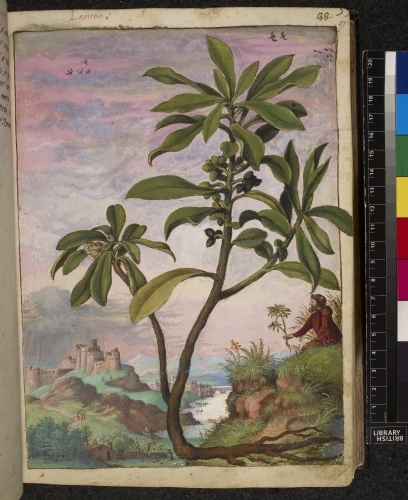
This illuminated manuscript page shows specimen hunters on an Italian hillside, equipped with sickle, mattock and sack.  They are so intent on their work they seem oblivious to the beautiful sunset behind them.  It was painted by the amateur botanist Gherardo Cibo (1512-1600) who illustrated his own researches in Urbino and incorporated elements of the surrounding landscape into his botanical illustrations.  The example below is one of several that can be seen at the British Library page for 'Additional MS. 22332'.  In addition to the Daphnoides it shows 'a botanist gathering plants on a mountainside and a fortified town and river in the background.'  In other paintings of specimens we see a countrywoman gathering plants, a man sitting on a fallen column, people harvesting olives, a person reading a book and a man hitting a snake with a branch.  But it his distant views that are particularly appealing - a flock of sheep, a weir and watermill, a fortified town, a port, a rocky island, a mountainous landscape.  Cibo's people are in scale with these landscapes; it is the plants that have grown to giant proportions, like a Fumewort under which two young girls are able to sit in the shade and chat.

Gherardo Cibo, Daphne Laureola (Spurge-laurel), 16th century 

I came upon the painting of specimen hunters last week in the 'Herbology' section of the British Library's exhibition Harry Potter: A History of Magic.  There is clearly something magical about the other pictures in the MS too, as Cibo transforms herbs into plants the size of trees.  J. K. Rowling's treatment of landscape is something I can't really discuss as I've not read her books (though I have caught the gist of the story while Mrs Plinius was reading them to our kids and seen bits of the Harry Potter movies). The exhibition is excellent though, whether you're bothered about Harry Potter or not, with many interesting objects and books in addition to the Gherardo Cibo herbal.  However, one manuscript that wasn't on display was the second one by Cibo that the Library owns, 'Additional MS. 22333'.  The images on the British Library page include two seascapes and a landscape, along with the delightful view below, which at first appears to be a typical sixteenth century depiction of the Italian countryside, until you see the outsize lichens and ferns growing over the surface of the rocky hillside.

 Gherardo Cibo, Lichens and Ferns on a Rock Face, 1584

Friday, February 10, 2017

Wind at Walden Pond


The artwork on the cover of this January 2008 edition of Art in America is by Spencer Finch: Sunlight in an Empty Room (Passing Cloud for Emily Dickinson, Amherst, MA, August 28, 2004).  Emily Dickinson once famously wrote of 'a certain Slant of light' - 'when it comes, the Landscape listens...'  On his visit to her home, Finch took precise measurements of the level of sunlight and then tried to recreate the effect using a cloud of blue gels suspended in front of two rows of fluorescent lights.  Finch is fascinated with light and has made various similar cultural pilgrimages to record it: heading, for example, to Ingmar Bergman’s Stockholm residence at the ‘magic hour’ when the director did much of his filming, to Time Square, the inspiration for Mondrian’s Broadway Boogie Woogie, and to Giverny where he was looking for a shadow similar to the one Monet captured in the painting reproduced below.  Things don't always go to plan: in 1996 he travelled to Rouen only to find that the cathedral Monet had painted in different lights was under scaffolding; undaunted, he did a piece instead based on the colours of his hotel room.  The artworks arising from these trips range from drawings to sculptures and installations.  Eos (Dawn, Troy, 10/27/02), for example, resembles a Dan Flavin light piece, but is designed to match the measurements Finch took at Troy during the hour of Homer's ‘rosy-fingered Dawn’.

Claude Monet, Grainstacks at Sunset (Snow Effect), 1890-91

The Art in America review by Stephanie Cash describes two works Finch had recently completed that were inspired by Thoreau.  The first of these concerns wind rather than light - I have drawn a diagram below to show how the gallery installation worked.  ‘For about two hours the fans periodically create a gentle, intermittent breeze from various directions and at various speeds, determined by Finch’s measurements using a digital anenometer and weathervane while standing on the shore of Walden Pond, where Thoreau spent two years, two months and two days.  Viewers standing at the work’s centre can experience the approximate breeze that Finch, and presumably Thoreau, did.’ Not having experienced this work I can only imagine it from Cash's description, another level of mediation which only goes to emphasise the impossibility of feeling the wind that rippled the surface of the water during the years 1845-7.  


Diagram showing Spencer Finch's
Two hours, Two minutes, Two seconds (Wind at Walden Pond, March 12, 2007)

The other work, Walden Pond (morning effect, March 13, 2007), sounds less appealing because it mixes together Thoreau and Monet, although it is hard to tell from photographs.  The finished work was  
'a wall collage comprising 139 reproductions, arranged in the shape of the pond, of aqueous paintings by Monet.  From 20 spots around the pond’s perimeter, Finch noted the hues of the water and ice, then located their matches in the Monet reproductions.  Each image bears a notation with an arrow pointing to the particular colour, and the time, location on the shore and direction he was facing.  It’s a rather complicated enterprise, and visually and intellectually engaging, but atypically for Finch, it doesn’t present a coherent, unified effect.’

There was a Spencer Finch show at Turner Contemporary in 2014, which regrettably I didn't get to see.  In the video clip above he talks about the influence of Turner and installs a sculpture which resembles the Emily Dickinson one, called Passing Cloud (After Constable).  [Incidentally, I did get to go to the previous exhibition at Turner Contemporary in 2014 - which was also inspired by clouds, including Constable's - and wrote about it here.]  Finch has done cloud studies himself, as well as drawings of ice, wind, sunlight and water.  The colours of the surface of the Hudson River were his raw material for The River That Flows Both Ways, an installation on New York's High Line that could be seen last year.  His website has some other examples of recent work but I will end here with a piece he made some time ago, described in the Art in America article.  It sounds preposterous but also rather magical.
‘Resembling an amateur science project, an early installation that also looks to the cosmos, Blue (One second brainwave transmitted to the star Rigel), 1993, comprises a tattered orange armchair, a TV set, an old Apple computer, electrodes, an antenna and a tripod-mounted transmitter.  Using these jury-rigged components, Finch recorded his brain wave for one second as he watched the huge blue wave in the opening sequence of the 1970s TV show Hawaii Five-O, a still of which appears on the TV screen.  His brainwave was then translated by the software and projected into space by the transmitter.  It should reach its destination, the bluest star in our sky, in the year 2956.  With the ‘real’ work supposedly somewhere in the cosmos, modern-day viewers are left with a scrappy installation that belies the beauty of the concept.’

Friday, August 28, 2015

The Green Ray

'In America they call it the green flash. When the sun sets, in a very clear horizon, with no land mass for many hundreds of miles, and no moisture or atmospheric pressure, you have a good chance of seeing it. The slowest ray is the blue ray, which comes across as green when the sun sets in perfect atmospheric conditions. It’s the last ray as the sun recedes with the curvature of the earth.' - Tacita Dean, Bomb Magazine, 2006

Still from one of several videos of the phenomenon that have been 
uploaded to YouTube, this one by Noel Barlau

The quote above comes from a conversation with Jeffrey Eugenides, who briefly refers to the green ray in his novel Middlesex...  “They say you can’t take a picture of a green ray, but I got one. I always keep a camera in the cab in case I come across some mind-blowing shit like that. And one time I saw this green ray and I grabbed my camera and I got it.”  In the interview Eugenides asks Tacita Dean about the elusiveness of the phenomenon in her film The Green Ray.  "I think you said that you got the green ray in the film, but it never appears in any single frame. But you can see it momentarily when the film is running. Is that right?"  "Yes. The film is 24 frames a second but you can’t isolate a single frame that has it.  He goes on to ask her whether everybody sees the green ray when they see the film.  "No. That’s what’s nice about it, because otherwise the film would just be about a phenomenon. But in the end it’s more about perception and faith, I think."

From Tacita Dean's video, The Green Ray (2001)

I first heard of the green ray when Eric Rohmer's beautiful film was released in 1986.  Delphine, alone on her summer holiday and nervous of any new intimacy after a split with her boyfriend, overhears a group discussing a novel by Jules Verne, The Green Ray (1882).  One of them says that "when you see the green ray you can read your own feelings and others too."  Later she sees a beach cafe named Le Rayon Vert and at the end of the film, when she finally meets an appealing young man (they both like Dostoyevsky), she asks him to sit with her and watch the sunset over the sea.  What follows is, according to Gilbert Adair in his book about the first century of cinema, Flickers, 'the tiniest and most moving special effect in the history of cinema.'  Tacita Dean was less impressed: "it’s very heavy-handed; it’s like this huge, green thing. I mean, the real green ray makes your heart miss a beat, because you look, you look, you look. And then you see it so suddenly, and it’s gone. Somehow rapidity is part of its beauty."

From Eric Rohmer's film, The Green Ray (1986)

I have not read Verne's novel and it is hard to find any reviews that wholeheartedly recommend it - see for example the description on with hidden noise: 'as fiction it is sorely disappointing'.  In Jules Verne, Geography and Nineteenth Century Scotland, Ian B. Thompson describes it as the slightest of his three Scottish novels; however, it is informed by Verne's 'passion for sea travel and is meticulous in the nautical, meteorological and geographical detail of the journey.'  At the climax of the story the two lovers, having repeatedly failed to glimpse a green ray, miss seeing it because they only have eyes for each other.  Verne was clearly fascinated by the idea - in an impressive Annotated bibliography of mirages, green flashes, atmospheric refraction, etc., Andrew T. Young refers to an earlier mention of the green ray in Verne's novel Les Indes Noires (1877).  This is the earliest fictional reference in the bibliography, but the phenomenon was noted by other nineteenth century writers, like J. A. Froud, whose account of a voyage to South Africa describes a sunset on 'the sea calm as Torbay in stillest summer ... The disk, as it touched the horizon, was deep crimson. As the last edge of the rim disappeared there came a flash, lasting for a second, of dazzling green - the creation I suppose of my own eyes.'

I will end here with another art form, music.  Gavin Bryars has described witnessing the green ray in Southern California, but his 1991 composition refers back to the setting for Verne's novel.  'This part of Western Scotland is also the place where certain piping traditions originated. Male pipers practised in one cave on the seashore, females in another ( the "piper's cave" and the "pigeon's cave"). As they played their laments at twilight a triangulation, similar to that in the Verne story (male-ray-female) may well have occurred without the knowledge of the innocent participants, hence the sequence of simultaneous laments in the coda.'   The clip below is the first half of The Green Ray - I can't find anything to embed that includes the coda, with its laments for saxophone, cor anglais, French horn, and solo violin.  You can buy or hear the whole piece elsewhere of course, but perhaps it is appropriate to the theme that this should be left here to the imagination.

Sunday, August 02, 2015

Frozen waves

A photo posted by marcquinnart (@marcquinnart) on

I've written here before about the way Modernism distanced itself from landscape painting and how Oscar Wilde could only look upon a sunset as a 'second-rate Turner'.  Over a hundred years later it is interesting to see the lengths Marc Quinn has gone to in his new exhibition The Toxic Sublime to turn  a Caribbean sunrise into art now that, as he says, “you can’t do sublime any more.  You can’t make a painting of nature.”  Having transferred the original photograph to a set of canvases he sanded them down and stuck on strips of 'aeronautical grade aluminium tape'.  Then he spray-painted them in the lurid colours of urban graffiti through templates of plastic chord and other rubbish collected from a beach.  Next he took them into the street and rubbed into them impressions of drain covers (the familiar words 'Thames Water').  I thought for a moment of the Situationists' 'beach beneath the street' but Quinn is referencing the way water is taken and controlled in the city.  Finally they were bonded to aluminium sheets and subjected to creasing and denting so that they look like they have been retrieved from some kind of wreckage.  In the photograph accompanying the Telegraph review they actually look rather beautiful and, although I have some sympathy for the Alastair Smart's view that they 'represent an awful lot of work for awfully little reward', I think he goes too far in likening them to crumpled crisp packets.

This White Cube exhibition also includes four Frozen Wave sculptures which are much easier to like (even though their shiny stainless steel surfaces reminded me uncomfortably of Jeff Koons' Rabbit.)  These are based on eroded shells, copied and cast at different scales, including one that has a whole room to itself and looks from the side like a small sperm whale.  As the curators explain, 'in the moment before they disappear and become sand, all conch shells end up in a similar form – an arch that looks like a wave, as though an unwitting self-portrait by nature.'  And it is remarkable how wave-like they look, with their rough surfaces and glassy-smooth undersides.  At the same time, the largest (23 feet long) might be a fragment of landscape, a silver sea cave, with the shells' exposed layers blown up to resemble surf-polished rock strata.  There are also two sculptures made from 3D-printed conch shells that seemed less interesting and more obvious.  There was no way of putting one of these to the ear, but look inside and their mirrored surfaces are like jets of water, recalling the surging currents and breaking waves that pick them up and sculpt them.

Friday, November 28, 2014

Views from the Internet


Last week I went to a discussion on landscape and photography at Tate Modern.  This wasn't linked to their new exhibition Conflict, Time, Photography but to one at Somerset House I referred to here last year, 'Landmark: the Fields of Photography'.  The event was to promote a book of the show, edited by William Ewing, who chaired the panel of five artists: Thomas Struth, Massimo Vitali, Lauren Marsolier, Penelope Umbrico and Mishka Henner.  This represented a kind of spectrum, from Struth and Vitali who still compose and takes photographs to Umbrico and Henner who construct images from sources found on the internet.  Marsolier might be seen as somewhere in the middle, using her camera to capture fragments of landscape which she then digitally montages into scenes that convey a sense of feeling "disorientated and disconnected".  These oneiric visions with their blank windows and pale skies, "absolutely still with no breath of air" as Ewing observed, seem to fuse the reality of California with the abstract spaces of the internet.


Penelope Umbrico said she sees the Web itself as her landscape.  In Views from the Internet she collected landscapes glimpsed through windows found on home decor sites. 'Used as peripheral devices to elicit desire for the objects (and lifestyles) sold on these websites, the views are an invitation: they invite retreat and escape - into utterly flat space that is nowhere.' She has also made a series called Honeymoon Suites by scanning the candy coloured horizons and skies in holiday brochures to create distilled digital abstractions of happiness. 'While the horizon is intended to signify perfect love and escape, it equally points to the unattainability of both.'  The vast archive of holiday photographs on Flickr is the source for her installation Suns (from Sunsets), which I saw at the Landmark exhibition.  A a sense of the digital sublime is conveyed by retitling the work each time she exhibits it according to the number of sunsets available on Flickr at that date: in 2006 this was 541,795, on the day of the talk last week it stood at 22,177,914.  Apparently people have taken to photographing themselves in front of her wall of sunsets as if they were posing in front of a real sun.   

The two quotes in the paragraph above are from this book

I found Mishka Henner particularly interesting, although his dry humour seemed to bypass some in the audience (he sounded like Simon Armitage would if he read BLDGBLOG).  He argued that the problem with digital culture is not that there are too many images, but that we have not yet found ways to navigate through them.  He talked about the world of GoogleEarth and online photography as a kind of landscape of infinite detail.  He has been able to construct striking aerial views of oil fields that would have been impossible to photograph directly, exposing the way pipelines have grown like root systems through river valleys, farmland and urban centres.  Thomas Struth took issue with this kind of work, suggesting that it has immediate political impact but no aesthetic value.  Henner didn't argue the point, although it seemed pretty obvious that his images of US feedlots, for example, composed from satellite imagery, have a horrible beauty. Struth has himself chosen political subjects - Ramala, Chinese industrialisation - and his early work in Germany documenting urban architecture always seems to ask the basic question of why we have designed our living environment to look like this.

Although Struth is a major figure I find it quite hard to think of anything particularly interesting to say about him (I went to his retrospective at the Whitechapel in 2011 but didn't write about it on this blog).  His large-scale photographs of people in museums are similar to the beach scenes that  Massimo Vitali has been photographing for the last twenty years.  At first sight such photographs have more in common with the panoramic crowd scenes painted by artists like William Powell Frith than the panoramic unpeopled views we associate with 'landscape photography'.  However, in Vitali's case, what is beyond the foreground seems important: the people sporting around in the water in his 1995 photographs at Viareggio are overlooked by watch towers and cranes, whilst in another image of Rosignano from the same year, the sunbathers are oblivious to the cooling towers of a power station behind them.  There is pathos in the way these apparently unprepossessing strips of coast attract so many people, despite the proximity of factories, viaducts and graffiti.  "Being a tourist," Vitali told the Tate audience, "is one of the worst experiences you can have."