Utagawa Hiroshige, Listening to Insects at Dōkan Hill,
from the series Famous Places in the Eastern Capital, 1835-1845
This is one of the prints that was on display in the British Museum's exhibition Hiroshige: artist of the open road last year. Lafcadio Hearn published an essay on 'insect musicians' and the listening practices surrounding them in his collection Exotics and Retrospectives (1898):
There are charming references to singing-insects in poetical collections made during the tenth century, and doubtless containing many compositions of a yet earlier period. And just as places famous for cherry, plum, or other blossoming trees, are still regularly visited every year by thousands and tens of thousands, merely for the delight of seeing the flowers in their seasons,—so in ancient times city-dwellers made autumn excursions to country-districts simply for the pleasure of hearing the chirruping choruses of crickets and of locusts,—the night-singers especially. Centuries ago places were noted as pleasure-resorts solely because of this melodious attraction;—such were Musashino (now Tōkyō), Yatano in the province of Echizen, and Mano in the province of Ōmi. Somewhat later, probably, people discovered that each of the principal species of singing-insects haunted by preference some particular locality, where its peculiar chanting could be heard to the best advantage; and eventually no less than eleven places became famous throughout Japan for different kinds of insect-music. [He goes on to list them...]
The Hiroshige print is analysed in a 2023 acoustic ecology paper by soundscape researcher Keiko Torigoe. She includes a description of Dōkan Hill from the Edo Meisho Zue (1834-6).
There are many medicinal herbs in this area, and people who gather medicines always come here. Especially in autumn, pine insects and bell ringers make exquisite sounds. Therefore, courtesans and persons of elegance and refinement all come here to recite poems in the winds and sing songs under the moon, appreciating the sound of the insects.
The pine insect is the matsumushi 'much esteemed for the peculiar clearness and sweetness of its notes', according to Hearn, and the bell ringer is the suzumushi which 'in certain lonesome places might easily be mistaken,—as it has been by myself more than once,—for the sound of rapids.' You can hear what they sound like on YouTube: here are links for the pine cricket and bell cricket. There is actually a temple in Kyoto known as Suzumushidera because the monks keep bell crickets there to sing all year round.
Dōkan Hill features in other 19th century prints. Hiroshige's son-in-law Suzuki Chinpei (Hiroshige II) composed a scene similar to the one above in 1864: Listening to insects on Dōkan Hill. There is a comic 1859 scene by Utagawa Hirokage called Catching fireflies at Mount Dōkan, which the Library of Congress describes as showing 'four men drinking alcoholic beverages in a field at night' (one of them is rolling round, clearly pissed as a pudding). And in 1884 Kobayashi Kiyochika depicted a couple climbing the hill to enjoy the views, whilst in the foreground a horse looks startled, perhaps by the sight of some huge white daikon radishes lying on the floor. I'll end here with another example: a simple and rather lovely pink and turquoise view of the landscape below Dōkan Hill, by Hiroshige himself.
I was going to write here about Raven Chacon after seeing him perform at Tate Modern's Preemptive Listening Symposium in 2024. I didn't have time then, nor when he was featured in The Wire magazine in April this year (see above), but he is definitely overdue a mention. Chacon described Field Recordings (1999), his first piece, and For Four (Caldera), a recent 2024 performance, in an Art in America article:
Field Recordings - 'The idea was to go to different places I’m very familiar with, two of them on Navajo Nation land, to find locations that would be very quiet. ... Then I started making these postcards that are also flexi-discs you can play on a turntable. The idea was to make something like tourist mementos. I have a few pieces like this that critique people’s thinking of ”deep listening,” or going to places in the Southwest and meditating and having profound experiences in silence—the tourist nature of going to places like Monument Valley or places in the Navajo Nation and sending postcards to friends.'
For Four (Caldera) - 'This piece can be performed in any valley that was created by some kind of disruption. This valley is a volcanic crater, from an eruption millions of years ago. Over one of the hills is Los Alamos National Laboratory, where they developed the atomic bomb. Within the piece there are four singers who sing the contour of the landscape as a melody. ... Another version of this piece in Norway has a much different sound. That one has joikers, who practice a tradition of Sámi singing that already is influenced by the landscape, whether literally by the contours of the horizon or something more about stories within a place.'
As another example of his approach to landscape, I am embedding a YouTube clip here from an installation midway through his career, Singing Toward The Wind Now / Singing Toward The Sun Now. These are sculptures in Arizona's Canyon de Chelly: two function as harps and two are solar-powered oscillators that provide a beat.
When you look across Raven Chacon's career you can a see various ways landscape has been a source for his work:
The soundscape captured and amplified via field recordings.
The natural environment playing instruments (as in the clip above).
The form of the landscape shaping the form of song, as in For Four (Caldera).
Natural sounds informing musical compositions, e.g. Owl Songwhich features onhis recent Voiceless Mass album.
Ancient petroglyphs found in the desert landscape as an inspiration for graphic scores.
Site specific events where surrounding sounds interact with a composition, like the 2019 performance at San Francisco's Land's End.
And then there is landscape as a zone of conflict, as in the Dispatch project where he recorded crowds protesting against a pipeline being drilled through the Standing Rock Reservation. Dispatch 2: The Gathering involves prompts for players 'derived from an analysis of the dynamics and organisation of the Water Protectors ... not glossing over the miscommunication, profiteering, and injustices.' He begins this piece with a meditation on the rock itself.
Rocks have harmonics, resonant frequencies. They are also deities, lives begun millions of years ago, witnesses to the formation of the earth. They can pick up the tremors of extractive colonialism exposing wide caverns that lead to trails deep inside the ground, generating sludge and slurry, releasing poisons meant to stay undisturbed. The time is now to protect these rocks as though it is a last stand.
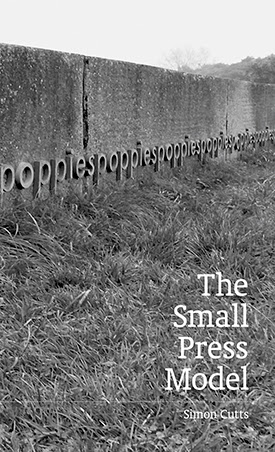
The cover of Simon Cutts' The Small Press Model is a photograph of his 'forgotten one-word poem' which can be found outside Skellingthorpe, 'A History of the Airfields of Lincolnshire'. It comprised seven slabs of concrete taken from RAF Sinderby with letters in orange anodised aluminium, glued on 'with the fiercest epoxy and a contraption that allowed it to set'. You can read a description at Simon's blog. Within the book is a the script for a talk he gave in New York called
'The Metaphor Books' which describes the book version of this poem and a
later version where the word 'flax' is used to evoke the image of flak and the blue flowers that were becoming more prevalent on the old
airbase. I doubt I'll ever visit Skellingthorpe, but I did have a look on Google Earth and found the sculpture - see my screenshot below (there is a visual glitch where the software has joined up photographs). Presumably that's the photographer's bicycle, well chosen to match the orange lettering.
The Small Press Model discusses artists and writers that I have written about here
over the years, like Ian Hamilton Finlay, Richard Long and Jonathan
Williams. Of particular interest for my theme is the introduction to The Unpainted Landscape, a 1987 exhibition that featured Finlay, Long, Thomas Joshua Cooper, Roger Ackling, Hamish Fulton, Andy Goldsworthy and Chris Drury (I've linked these names here to different Some Landscapes posts).
The only artist Simon Cutts describes that I've not mentioned before is
David Tremlett, who was up for the Turner Prize back in 1992 with his
wall drawings. The Tate owns one of his early works, The Spring Recordings, comprising short soundscapes collected during 1972 in all 81 counties (there is a detailed description on their website). The tapes should ideally be heard when the work is on show, but in The Unpainted Landscape they were lined up on a shelf as 'a silent wallwork, referring to its source and potential replay.'
The Small Press Model was reviewed a few months ago on Caught by the River by Sukhdev Sandhu. 'Like its publisher Uniformbooks, The Small Press Model
celebrates the local, the non-metropolitan, those who have a ‘resolve
for a critical alternative to mainstream publishing’. ... It’s a model that stands for
the dignity of production, the importance of collaboration, the need for
alternative networks—and alternative publics.' The book's short texts range over five decades and the cumulative effect of reading them is to feel moved by lives 'built and lived' to support the idea of poetry - as words, objects, spaces and projects, carried out with serious attention to detail and a playful, questioning creativity.
I have been reading Rob St John's Örö (available via Bandcamp), a book based on fieldwork and experiments undertaken during two periods as an artist in residence on the Finnish island of Örö, in January 2016 and June 2017. You can also see on Rob's website a film he made using footage and sounds from the island. Örö is an abandoned military base (before that it provided pasture for mainland farmers) and since 2014 it has hosted many artists, as can be seen on the ÖROS 21 exhibition page. It's easy to see the appeal of a location like this for contemporary land artists, field recordists and experimental film makers. One makes art that explores 'memory, ecology and destruction', another operates 'site-sensitively collaborating with weathers, insects, soil and scrap materials', another works with future fossils, 'relics of consumerism, the traces that humankind leaves in the environment'. Amy Cutler, who I've mentioned here before, was there in the winter of 2019-20 (see her Vigil for Örö). The island is a node in an international network of environmental art residences, often located in sparse, elemental landscapes. One of the Örö artists, Jessica MacMillan, has also worked on Svalbard, a location I discussed in my post High Arctic, and also at Seyðisfjörður in Iceland,where Richard Skelton did two artist residences a few years ago.
It must be somewhat daunting now to rock up at Örö and be aware of all the documentation, photography, sound recording and artistic interventions that have preceded you. What's particularly interesting about Rob's book is the way he covered so many possibilities in his time there: sampling the island through different recording methods and strategies to collect indexical signs, then processing the collected materials to create film, sound and visual art. Herecorded the winter and summer soundscape using hydrophones and binaural mics, collected archive recordings and sourced data to use in sonifications. He used cameraless photography for cyanotypes, durational pinhole solargraphs and polargrams, lumen prints and panchromatic plates. He used film and digital cameras, keeping the viewpoint still to allow water to ripple, specks of snow to fall and bark to flutter in the wind. He exposed polaroids for eighteen months on the forest floor to see what would happen. He walked the island according to transects drawn on a map, stopping every hundred steps to make notes. In other methods reminiscent of Richard Long and Andy Goldsworthy, he designed text pieces and photographed the crack in a split rock which he filled with different kinds of material washed in by the tide. He also made inks by steeping Örö's bilberries, rowan berries, birch leaves and rusted iron, painting simple diamonds of colour which I think are particularly beautiful.
The book provides fascinating detail on all these approaches. I love the way it uses an impersonal scientific style and reports on experiments in the passive voice ('metal fence wires marking island enclosures were bowed with a violin bow, as were coat peg nails in an empty disused barracks'). It is full of paragraphs I'd like to quote but I'll just choose one here, concerning photograms he made of organic winter island materials - lichens, dried seed pods, bird feathers, reeds, sands and sediments.
'In the dark of the cabin bathroom, film canisters were cracked and unfurled - like the unrolling of the ecologist's transect line or the archivist's microfilm reel - and weighted at each end with stones. Relying only on touch in the pitch black, the island materials were laid out on the film strip and exposed in a brief flash of headtorch light; a visual patterning akin to the experience of being in the forest at night. Later experiments encased the island materials in ice lenses frozen inside the used metal containers of burnt-out tea lights. In both cases, when subsequently developed, the island objects became traced onto the film strips as abstracted forms: an archipelago archive. Lichen forms echo the shape of the island itself, micro-ice formations mimic patterned ground. Seed pods become dormant expressions of microbial life: pre-echoes of the ecological unfurling of the midsummer island.'
December's Wire magazine included an interesting 'Aeolian Harp Music 15' chart compiled by Irish experimental musician Natalia Beylis. There is no explanatory text, just the list, but a bit more info on a Dublin Digital Radio mixcloud site: 'I went to buy a theremin off a retired plumber in Clare. He toured me
through his workshop of trinkets & said "I'm building an aeolian
harp inspired by this fellow" & showed me a copy of an lp by Sverre
Larssen. Back at home, I fell down a windharp rabbit hole & put this
show together...' You can listen to the Sverre Larssen album shown above on Spotify. Here's what his Bandcamp page says:
In the early 1970s the Norwegian businessman Sverre Larssen decided to
construct a wind harp at his cabin at Sele, Jæren on the west coast of
Norway. Using his free imagination and amateur engineering skills,
Larssen constructed a harp with 12-strings, which was brought to vibrate
by the wind. Based on the principle of the electrical guitar, Larssen
amplified the strings using four contact microphones and then recorded
the sounds direct to tape. Word about Sverre Larssen’s instrument began
to spread and during the 1970s notable artists such as Liv Dommersnes,
Åse-Marie Nesse, Ketil Bjørnstad, Kjell Bækkelund and Jan Garbarek
utilized the sounds of Larssen’s wind harp.
The next one on her list is The Wind Harp, an LP released by United Artists. Here's what Wikipedia has to say about it:
In 1972, Chuck Hancock and Harry Bee recorded a giant 30-foot-tall
(9.1 m) Aeolian harp designed and built by 22-year-old Thomas Ward
McCain on a hilltop in Chelsea, Vermont. United released their double LP titled The Wind Harp: Song from the Hill. An excerpt of this recording appears in the movie The Exorcist. The harp was destroyed in a hurricane, but it was rebuilt and now resides in Hopkinton, New Hampshire.
There isn't a huge amount about this online and I get 'this content isn't avilable in your region' when I try one link. Nevertheless, if you go back more than a decade, when for example I wrote here about the wind resonating wires of Alan Lamb in New Zealand, it was a lot harder to find out about modern Aeolian harps. Now it really is possible via Discogs, YouTube and Google to just click away and head down a "windharp rabbit hole", even if you are often left with incomplete information. Another American wind harp Natalia Beylis lists is a case in point.
Ron Konzak came up with the idea for his Aeolian harp in 1982 and, as his article on the Harp Spectrum website relates, he began building it at a location on Bainbridge Island, Puget Sound. Sadly a few years later it had become 'a forlorn sight: a two-story harp, perilously close to an eroding cliff, surrounded by young alder trees that screen it from the very breezes that could bring it to life.' He said there were plans to rebuild it, but did this ever happen? I found a recent blog post on a sailing site that describes seeing the harp's building but not the harp itself. The author tried to get in contact with Konzak but learned he had died in 2008. 'Other
efforts to find more information, including asking a harp-playing friend
who lives on Bainbridge Island were also unsuccessful.'
I've mentioned the environmental recordings put out by Gruenrekorder before (see for example a post I did back in 2009) and they are very good at providing background information on what they release. One of their albums included on this list is Path of the Wind by
Eisuke Yanagisawa - music made on a small home-made Aeolian harp. The
landscapes he took it to include 'Kehi no Matsubara, a quiet and scenic
beach with many pine trees', Mt. Oeyama where 'nature and objects on
the mountainside fade in
and out as the place where the sunlight shines gradually changes' and
Yosano-cho, where he placed the harp near a 1,200-year-old Camellia
tree. You can read reviews and commentary on the Greunrekorder website.
Drift by Mark Garry and Sean Carpio began with a site-specific performance. As explained on the Kerlin Gallery site, this
took place in a natural amphitheater called “Horseshoe Bay” on Sherkin Island, located off the coast of West Cork.
This one-off performance took place in and around the bay, with
audience members arriving on two passenger ferries, moored next to a
traditional Irish wooden sail boat which bore an Aeolian harp (a harp
played by the wind). On land, a brass quartet performed a series of
short musical pieces based on Sumerian Hymns, which were controlled by a
form of improvised conducting.
A subsequent record was made with two saxophonists, an accordionist and three Aeolian harps positioned in
a small forest in Dublin’s Phoenix Park.
Of course Aeolian harps were all the rage in the Romantic period and this list includes some recordings made by Mins Minssen using an instrument built in 1837 by Wilhelm Peter Melhop (1802-68). Melhop is quite an interesting figure from a landscape perspective - he wrote poems, stories and descriptions of his walks. According to German Wikipedia he 'kept
a diary from 1816 to 1844, which he provided with his own
illustrations. The entries show that he was often in nature, especially
in the Wandsbeker wood, where he was impressed by the “magical abundance of nightingale song”'. In addition to building Aeolian harps he constructed a telescope and discovered a comet.
Another historical recording with a link to nature writing is Kenneth Turkington's Walden Winds,
an attempt to recreate the sound of the kind of harp Thoreau built for
himself (see sleeve notes from Discogs below). I looked into getting a
window harp myself a few years ago (they were available on EBay) but decided it wouldn't be worthwhile as any subtle wind-plucked notes would be drowned out by the noise of
children in surrounding gardens, delivery vans trundling down the
road and police sirens heading up our local high street.
If you want to continue down the rabbit hole, here are the other wind harps mentioned on Natalia Beylis's list...
Mario Bertoncini was an Italian avant garde composer whose music for Aeolian harps can be found on a CD and accompanying book.
Nature's Dream-Harp: Aeolian Music, Played by the Summer Wind on Devaharp I is a 1979 private pressing album by Robert Archer, about whom I can find no further information.
Aeolica was recorded in 1988 by Pier Luigi Andreoni and Francesco Paladino and features them improvising on synthesisers to the sound of a wind harp created by the artist Mario Ciccioli.
Voices of the Wind is a set of recordings of his Aeolian harps made in the nineties by Roger Winfield.
There are some field recordings of wind made in 1996 in France by Toy Bizarre (Cédric Peyronnet) - the ep cover shows the harp used for this purpose.
Rick Tarquinio's experiments using fishing string and natural forces to create soundscapes are available on his Bandcamp page - they're pretty good.
Something more recent from Tara Baoth Mooney is hard to envisage from a description - I'm not sure whether this genuinely used an Aeolian harp??
And finally there's Rhodri Davies, a much more familiar name from his own harp recordings and collaborations (including the mighty Hen Ogledd). He is in the list for Five Knotsfrom 2008, made with an electric harp: 'left channel: harp facing Anglesey', 'right channel: harp facing Lochtyn island'.
A recent edition of The Early Music Showon Radio 3 focused on the music of Latin America and had a segment on the soundscapes of ancient meso-American and Andean cultures. Music archaeologists Matthias Stöckli and Alexander Herrera described the way musical instruments were drawn from the landscape - llama hoof drums, bone flutes, turtle shells - and used in rituals to encourage fertile crops. Sixteenth century dictionaries describe a Mayan shell horn trumpet that would promote the "greening of the fields". In the Andes, music and dance were associated with the changing seasons. They provided a way of communicating with ancestors, particularly through echoes.
"...So the echoes of the instruments in the landscape are a way of communicating with the landscape, of making those sacred mountains speak to you. We find it in caves, we find it in spaces with rock art, which have a particular sound to them. They also have names. [One of these denoted] a place with a very special soundscape and that soundscape was made to resonate at specific times of the year with specific instruments..."
Andean musical instruments Source: Wikimedia Commons (Andean Culture History
by Wendell Clark Bennett)
Whenever I come across something like this, from a field of knowledge I know nothing about, I find myself trawling the internet for information and hoping it will lead to unfamiliar intersections between culture and landscape. You can find a lot online about the wind and percussion instruments of Latin America but what interests me is the way that the wider landscape would have featured in performance. The Met website has an article on ancient Andean music and mentions the ceremonial centre of Chavín de Huántar, where 'engraved stone slabs
surrounding a sunken circular court show elaborately dressed figures
walking in procession and carrying ritual objects such as spondylus
shells, hallucinogenic cactus stalks, and shell trumpets.' There is website devoted to the Chavín de Huántar Archaeological Acoustics project where you can watch a short video and hear the sound of a pututu conch shell trumpet. But these shells were not taken from the local landscape, they were obtained through long-distance trade. So really this would have been the opposite of music attuned to nature: the sound of the conch shell has been a means of summoning people in many cultures (as readers of Lord of the Flies are aware) and here it would have cut across the soundscape, collapsed distance and, like Wallace Stevens' jar in Tennessee, taken dominion everywhere.
One writer I have come across with help from Google is Henry Stobart, a Reader in Music and Ethnomusicology at Royal Holloway, who has written about traditional music in Bolivia. I will quote here one interesting paragraph, pointing to the importance of landscape features. Stobart has a whole chapter on Andean sirenas in an anthology of essays, Music of the Sirens.
During feasts people may also dance for many miles across the landscape, singing and playing instruments as they go, as they make a tour of community boundaries, undertake pilgrimages, or visit particular homesteads. The lyrics of the songs they perform on such journeys may also reference a range of features of the landscape. Links between music and landscape are made especially explicit in rural discourses about sirinus or sirenas, spirit beings that are typically associated with specific places in the landscape, such as waterfalls, springs, rocks or caves. While living over several years, during the 1990s, in the rural community of Kalankira in the Macha region of Northern Potosí, I was often told that all music ultimately comes from the sirinus. And, just as music comes from these spirit beings of the landscape, it was also often played back as consuelo or “consolation” to the powers of the “animated” landscape that ensure human welfare. On many occasions I joined friends in Kalankira to play music in the landscape, focusing our attention on particular rocks, corrals or other places that were seen to ensure the welfare and reproduction of the herds, rather than on any human audience.
I was very tempted this week to go to Cafe Oto for Brunhild Ferrari in conversation with David Grubbs, but it was on 14 February and I didn't think this proposal would go down very well. I did though enjoy reading her 'Epiphany' at the back of February's Wire Magazine, which recalls how she met and started making music with Luc Ferrari (1929-2005). Apparently they bonded over a love of rocks - she loved painting them, he was fascinated by the geology of Corsica, where his father came from. In the paragraph below she describes their experiments in field recording and mentions two famous landscapes that I have featured here before (in connection with Petrarch and Monet). I have embedded above a clip of the composition she mentions, Presque Rien No. 1 (1967-70).
A couple of years ago Ferrari's four 'Presque Rien' ('Almost Nothing') compositions were reissued by Editions Mego. Here, from a review by John Kealy, is a description of the fourth.
Presque Rien No. 4: La Remontée du Village (Almost Nothing No. 4: The Ascent to the Village)
seemingly returns to bare elegance of the original work. This is the
sound of Ferrari and his wife Brunhild ascending the hill to the Italian
town of Ventimiglia and it is remarkably similar to the moods and
feelings of the first piece. However, the sleepy isolation of the 1960s
countryside has been lost as sounds from nearby televisions and passing
scooters permeate the air around Ferrari’s microphones. Gradually,
evidence of Ferrari’s tinkering becomes more and more noticeable as he
slowly blends the sounds as they were recorded into something more akin
to musique concrète. The climax of this is the powerful intrusion of a cow, preposterously embellished by Ferrari to sound super-real.
Another landscape-related piece reissued by Editions Mego was Petite symphonie intuitive pour un paysage de printemps (1973–1974). Ferrari's notes explain that this too was based on a walk with his wife.
'Brunhild and I were in the Gorges du Tarn area. We chose to take a
small path that was going up a rocky mountain for about ten kilometres.
After a last turn, a totally unexpected landscape opened before my eyes.
It was sunset. Before us, a vast plateau spread open with soft curves
up to the horizon, up to the sun. The colours ranged from dry grass
yellow to purple, in the distance, with the darkness of a few small
groves punctuating the space. The almost bare nature was presenting
itself to the eye, free from any obstacle. We could see everything.
Later, when I recollected this place and the sensations I had
experienced there, I tried to compose a music that could revive this
memory.'
The reviewer for Pitchfork thought initially that this sounded like Boards of Canada, but then decided it 'feels more complex than that. For as alien as musique concrète
can be, in the hands of Ferrari, he was able to render it into something
that felt warmly familiar. Here he paints a stunning vista at dusk,
capturing the expansive horizon with sound rather than sight.'
I thought it was time to bring back my regular surveys of 'landscape music', having had a couple of years off. The last one I did was in 2015 - it contains links to the earlier ones, or you can just check back through my old December posts. I should apologise for some dead links in my previous surveys, as videos and tracks have been moved or taken down over the years. Looking back I see there's now a missing video in a post I wrote back in 2010 about Toshiya Tsunoda, the Japanese sound artist. He's the first of my picks for 2018, with the album Wovenland, a collaboration with Taku Unami (the title refers to the way their separate field recordings are woven together). Reviewing it in Wire Magazine, Derek Walmsley thought this 'one of the most original and startling recording projects in recent years.'
One of the albums I missed by not doing this in 2016 was 3hattrio's Solitaire, inspired by Edward Abbey’s nature writing classic, Desert Solitaire (1968). Abbey, author of The Monkey Wrench Gang, based this, his first non-fiction book, on the time he spent as a park ranger at Arches National Monument. 3hattrio say they play 'American desert music':
'Their aim is to create a new music which responds to the
natural world of their sacred homeland near Zion National Park in Utah.
They also strive to acknowledge the cultural traditions of generations
of people who have worked and lived on the deserts of the American
southwest. The subject matter of the songs is often desert oriented,
sometimes not. Mostly, they express the desert experientially from a
daily-ness of watching light off distant mesas and hearing the way sound
plays off sheer sandstone cliffs. Then they play music. They don’t
over-think it.'
Their new release is Lord Of The Desert andincludes tracks called 'Night Sky', 'Skeleton Tree' and 'Dust Devil' (see video clip below).
My earlier round-ups always featured music from Touch and their most recent release is relevant - Howlround's The Debatable Lands. This was inspired by the border region in Cumbria which Graham Robb wrote about in his latest book (quite interesting, but not as rewarding a read as I was expecting). Another liminal space was the source for Jana Winderen's Spring Bloom in the Marginal Ice Zone, originally a sound installation for the 2017 Sonic Acts Festival:
'The marginal ice zone is the dynamic border between the open sea and the
sea ice, which is ecologically extremely vulnerable. The phytoplankton
present in the sea produces half of the oxygen on the planet. During
spring, this zone is the most important CO2 sink in our biosphere. In Spring Bloom in the Marginal Ice Zone
the sounds of the living creatures become a voice in the current
political debate concerning the official definition of the location of
the ice edge.'
I'm listening to the album now as I write this, streaming from Jana Winderen's bandcamp page.
In my round-up for 2012 I featured Erland Cooper's Orkney Symphony. In March this year he released Solan Goose, its tracks named after the Orcadian words for seabirds (the solan goose is a northern gannet). He also released Murmeration, with a Norman Ackroyd picture on the cover (incidentally, Ackroyd's daughter Poppy is a Brighton-based composer, whose work sometimes references landscape themes and uses field recordings). Erland Cooper is planning a third record in this vein, as he explained in an interview for The Island Review, which will explore 'our relationship and respect for the sea: how it surrounds the community
and the landscape; how it supports the greatest ecosystem of all.' Together these albums are inspired by the words of the poet George Mackay Brown. “The essence of Orkney's magic is silence, loneliness and the deep marvellous rhythms of sea and land, darkness and light.”
Stuart Hyatt's Metaphonics: The Complete Field Works Recordings comprises 7 LPs and a book, based around his own field recordings but incorporating collaborations from around forty other artists. The YouTube clip below presents a track from the album Pogue's Run - 'from its source, through the city, into a mysterious three-mile
underground tunnel, and finally to the White River, Pogue’s Run
represents the ongoing tension between nature and civilization.' I enjoyed seeing field recordists filmed as if they were in a pop video, although as this goes on and they reach the underground river, it more closely resembles scenes a scene from a science fiction film. There is an interview with Hyatt at the online art/science magazineCLOT. He quotes from an essay by Yiorgis Sakellariou in the Metaphonics book, which views field recording as "an alchemical
practice, a transformation of perception of both recordist and
environment. A recording location is not simply a geographically framed
scenery, but more importantly, a place of inquiry, experimentation, and
wonder."
I will stick there at five main recommendations, but here, briefly, are a few other albums from 2018 that reflect landscape in different ways. Further suggestions in the comments below would be welcome.
Grouper's Grid of Points, written by Liz Harris during a residency in Ucross, Wyoming. One of its tracks is inspired by Zabriskie Point, a film I wrote about here in May.
Richard Skelton's Front Variations subjected sine waves 'to increasing amounts of feedback in
order to simulate the so-called ice-albedo feedback mechanism.
This is the process whereby the action of melting glaciers reduces the
global surface area of ice, thereby reducing the amount of solar
radiation that glaciers reflect, which in turn increases global
temperatures and causes further glacial melting.'
Laurie Anderson's Landfall is a cycle of songs about Hurricane Sandy - a recording was released this year with the Kronos Quartet. Tracks include 'Wind Whistles Through the Dark City,' 'The Water Rises' and 'Our Street is a Black River'...
Daniel Bachman's guitar in The Morning Star is set against a background of field recordings. It continues a sequence of 'Songs for the Setting Sun' that he began on the 2015 album River (which was featured on my 2015 round-up).
Jim Ghedi's A Hymn For Ancient Land, was a bit too pastoral for the Quietus reviewer: 'only on ‘Phoenix Works’, a song dealing with the decline of traditional
industries in the north, does he explicitly deal with darkness. This,
coupled with the dense, meandering tonalities of ‘Fortingall Yew’, saves
the album from being a landscape painting.'
According to The Quietus, the album of the year was Gazelle Twin's Pastoral, which 'picks away at the bucolic, Constable-generated image of English countryside like a fetid scab.' Gazelle Twin is Brighton-based electonic musician Elizabeth Bernholz, whose previous project was based on J. G. Ballard's last novel Kingdom Come.
Finally, I will conclude here not with an album, but with an app. Numero Group's 'Environments collects the entire historic record series by master sound
engineer Irv Teibel into one easy to use package for the iPhone and
iPad' (it costs £2.99). If you're not familiar with Irv Teibel's 1970s psychoacoustic nature recordings, there's a good article about him at Pitchfork. Aquarium Drunkarddescribed the new app as 'an ingenious re-contextualization of this retro-futurist
“gebrauchtsmusik” that recapitulates the series’ initial novelty.
However captivating Teibel’s tale, the Environments app
now illuminates an anthropocene landscape where 'Dusk in the Okefenokee
Swamp' and a 'Summer Cornfield' are mediated by an inescapable layer of
sleek, fabricated hardware and playfully nostalgic software.'
Land Makar is a half hour film by Margaret Tait, whose centenary is being celebrated this year. Here is a brief description from the BFI's website, where it is listed as one of '10 films that defined Tait’s filmmaking style.'
'Starting with harvest, Land Makar
(‘makar’ is a Scottish word for poet) is divided into seasons. The main
character, Tait’s farming neighbour Mary Graham Sinclair, is filmed
driving a tractor on the fields of an Orkney croft, going about her
daily activity on the land and talking about “the beauty of a work day”.
Tait started filming this place in 1977, observing the hard labour and
activities that define the land. With Sinclair, she also explores the
rarely told story of women and land labour.'
Maragaret Tait was a doctor-poet (like William Carlos Williams) as well as a film maker. In a recent piece about Land Makar, for Sight and Sound, Becca Voelcker quotes the poem 'Now' in which Tait advises the reader to take poetry quickly,
'without water'.
'For Tait, poems are as ephemeral as wildflowers. Prescribing a quickness of mind and body, like a capsule 'without water', the poem ends with urgency: 'Tomorrow they'll be something else.' The poem, like Land Makar, imagines place as a cluster of transforming elements. For Tait, landscape is a continuing process.'
I went to see Land Makar last week - it was part of the BFI season 'Rhythm and Poetry: The Films of Margaret Tait'. Watching Sinclair on her tractor, scything long grass and climbing onto a compost heap, it was impossible not to admire her energy - all the physical effort put into this stretch of land. At one point she recalls helping some swans build their nests (I caught the drift of this, but found the Orcadian dialect impossible to follow exactly). Voelcker quotes another poem, 'The Scale of things', where Tait describes 'all the tiny plants
and flowers / Which, together interlaced and inter-related, / Make the
fine springing turf which people and animals / walk on.' Crofters and
poets (and swans) are makers' whose collective labour sustains the
land.'
Land Makar was shown at the NFT with The Drift Back (1956), a ten minute 'offical' documentary on the return of some families to Orkney, and The Big Sheep (1966), a 41 minute essay film concerning the landscape of East Sutherland, with striking music and sound effects. Here is Margaret Tait's own description of The Big Sheep:
"A picture of East Sutherland in 1966.
Tourists come north, coach-load after coach-load; and here is the
countryside they come to see, dotted with sheep continually nibbling at
grass and whin. Then the lamb sales, an open-air auction, after which
the lambs are carried south, float after float. Vote, vote, vote, on the
posters for a general election, but "Why don't you get your sheep to
go and fight for you ? " echoes a voice from the past, at the sight of a
recruiting poster at the local Drill Hall. In the glens stand stand
roofless houses, as well as more ancient (prehistoric) remains, beside
the Highland river.
PART TWO and the seaboard life of today; the
railway line along the very edge of that marvellous strip of coast,
school sports near the salmon river, crofter's fields where the Cheviot
sheep now figure, local buses, electricity, the Highland Games and
pibroch contest. Then John N MacAskill plays the "Lament for Donald of
Laggan", while a small burn tumbles endlessly seaward, sometimes
quietly, sometimes spate, and the film searches the same few yards of it
again and again, watching along with the coalman who stands listening
to the sound of it as if he could listen to it for ever."
It was that final sequence that I found most moving, with the pibroch constantly changing as it flowed from the pipes, before giving way to the natural music of the river.
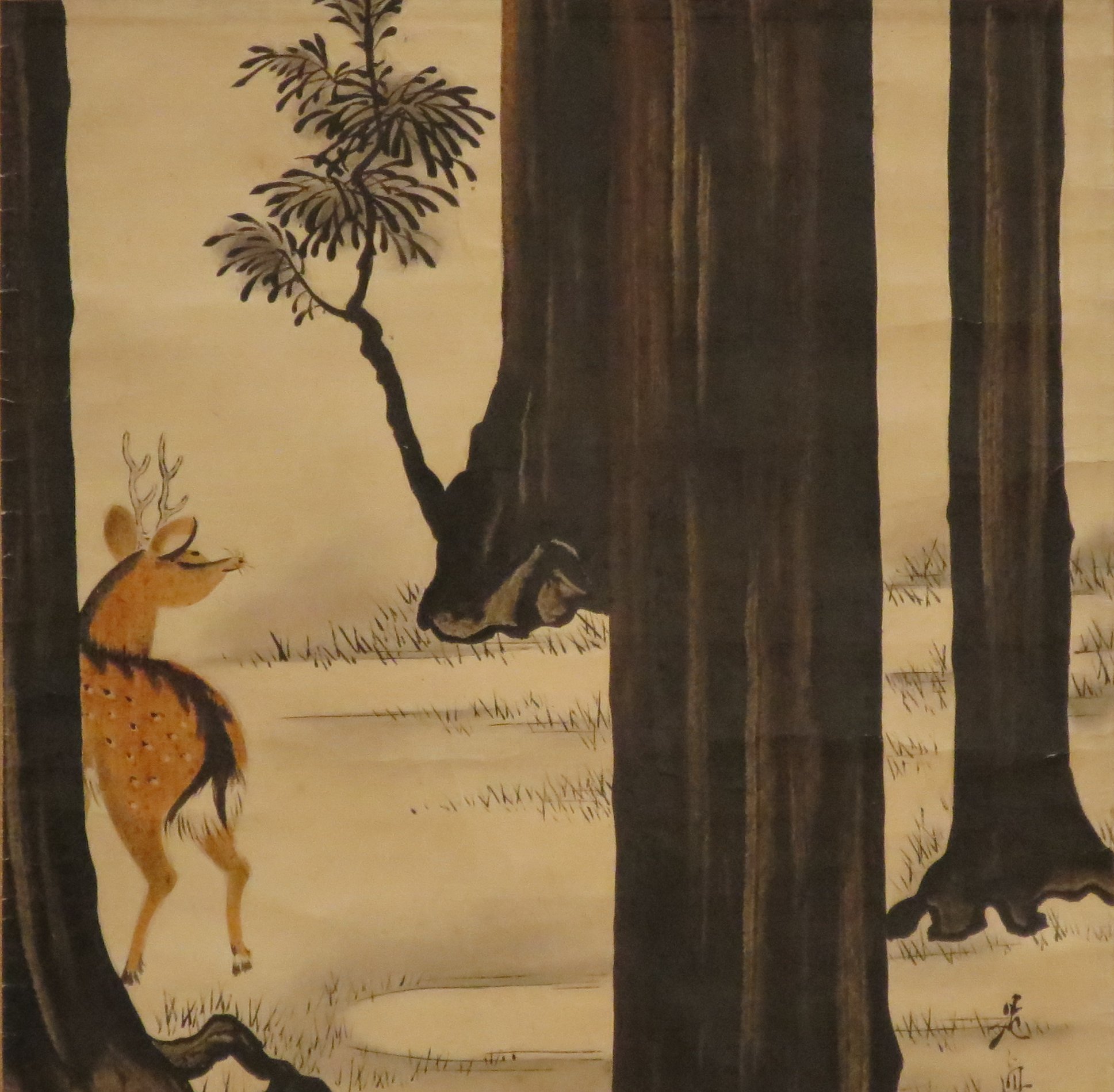
This week I attended the opening gala concert of the 2018 World Shakuhachi Festival. The photograph below (by Jean-François Lagrost) was taken during one of the performances and shows the audience in the Union Chapel, Islington. In the second half of the concert, Riley Lee and Christopher Yohmei Blasdel performed a shakuhachi duet, Shika No Tōne, 'The Distant Cry of the Deer'. This began with Blasdel on stage, playing the opening phrase, then, at the back of the audience, Lee answering on his flute and beginning to walk slowly through the audience. Eventually the two players met on stage. Listening to this it occurred to me that they had transformed the listening audience into a landscape: we were like the trees in a Japanese forest through which the calls of two animals sounded. This setting is evoked in the conclusion to the piece, as described on the International Shakuhachi Society website: 'it is as if, rather than viewing deer, the
focus is changed to that of the scenery deep in the mountains where the
leaves on the trees have turned red and yellow.'
The ISS page on Shika No Tōne has various notes on the piece and I will pass on here a few quotes from texts by Yokoyama Katsuya.
'According to legend, Kurosawa Kinko, founder of the Kinko school, was
taught this piece by a komusō priest named Ikkei in Nagasaki. The piece
is interpreted as a representation either of two deer calling to one
another to stress their territorial rights or of a male and a female
deer responding to one another's calls deep in the autumnal mountains.'
'In ancient literature, it was sometimes said, "the stag and hind are
calling each other." but in fact the hind does not cry, so it should
perhaps be interpreted as the echo of the stag's cry.'
'Within its lonesomeness and liveliness, the music depicts the world
seikan or the serene contemplation: it is just the same world as an
ancient poet once depicted in his famous Tanka-poem:
Far up the mountain side,
While tramping over the scarlet maple leaves,
I hear the mournful cry of the wild deer:
This sad, sad autumn tide.'
In the sections on landscape and music in my book Frozen Air, I wrote about the difficulty of translating the physical forms of cliffs into music. However, in Alexander Nevsky (1938), Sergei Eisenstein and
Sergei Prokofiev did try to do just this, as can be seen in this extract from a diagram in Eisenstein's Film Sense (1948). The full fold-out page showed the 'dawn of anxious waiting' sequence preceding the famous battle on the ice, with stills from the film, musical notation, diagrams of the film's visuals and a representation in lines of the way sound and image move forward. In this frame, the cliff shape is mirrored by the score's descending arpeggio of G#. I have embedded a clip of this sequence from the rather crackly original film above so you can see how this worked. In the version of the film
re-released in 1995 with a newly recorded score, this descending
'cliff' phrase is less obvious and actually comes in the subsequent shot.
Does this sonic correspondence really help us imagine the steepness of the cliff? The idea was criticised by Hanns Eisler and Theodor Adorno. As Peter Vergo writes in his book The Music of Painting (2010), they 'justifiably derided the idea that it is possible to depict a cliff musically'. Eisenstein's diagram shows a congruence between cliff form and the visual appearance of a score, but what we actually hear when listening to music does not necessarily correspond to the way musical notation appears on the page.
I have been trying to recall when I saw Alexander Nevsky with a live orchestra - at the Royal Festival Hall sometime in the nineties I think? I may just be misremembering watching the re-released version of the film when it arrived in London. Watching this scene now I am struck by those beautiful Sugimoto-style shots of the ice field. The first of these, which comes after some close-ups of the soldiers, can also be seen in the Film Sense diagram, matched to a flat musical vista. Some notes for the Criterion Collection release of the film describe how the visual effects for the Battle of the Ice were achieved.
'Nevsky’s extraordinary set piece was filmed first—during a blazing hot
summer—in the countryside outside Moscow. Cinematographer Eduard Tissé
used a filter to suggest winter light; trees were painted light blue and
dusted with chalk; an artificial horizon was created out of sand. The
ice itself was a mixture of asphalt and melted glass. In a remarkable
engineering feat, sheets of this fake ice were supported by floating
pontoons to be deflated on cue so that it would shatter under the weight
of the Teutonic knights according to pre-cut patterns.'
I'll conclude here with another YouTube clip, this time just Prokofiev's music and score, from a 1966 recording by the USSR State Academic Symphony Orchestra.
In 2011, Australian harpist Alice Giles got the opportunity to follow in the footsteps of her geologist grandfather Cecil Madigan, who has been a member of Mawson's First Australasian Antarctic Expedition a century earlier. At Davis Station she left her instrument by the shore as an aeolian harp, as you can see in the clip from her website embedded above. "The sound of the wind through the strings was incredibly clear and concentrated,'' she told the Sydney Morning Herald. On her return she composed Alice in Antarctica, mixing music and extracts from Madigan's expedition diary. She also participated in a conference about the Antarctic and music, the papers for which can be read (open access) in Antarctica — Music, Sounds and Cultural Connections (Australian National University Press, 2015). Here are some other things covered in this book that seemed worth noting on this blog.
Gilbert Kerr playing bagpipes to an indifferent penguin
on the Scottish National Antarctic Expedition
Music made by explorers and scientists. Various kinds of instruments and music making equipment were taken on the polar voyages, from hand organs on Franklin's expedition to the pianola used by Scott. One of the book's essays concerns a well-known
photograph of Gilbert Kerr and his bagpipes (above) - the pipes
themselves were later taken to the war and lost during the Battle of the
Somme. A piano on the Morning, a relief ship sent to Scott's first expedition in 1902, was used to compose what is probably the first published music written on an Antarctic polar journey. Gerald S. Doorly wrote a small collection of songs, including 'Ice King', written as they searched the coastline looking for Scott's ship Discovery. Most intriguing for me though is the idea that a Japanese flute may have been played over the ice on the Shirase Antarctic Expedition (1910-12). Research by Rupert Summerson, himself a Shakuhachi player, polar explorer and scholar (a pretty cool job description), suggests that the player would have been Keiichi Tada, who also wrote tanka inspired by his journey to the Antarctic:
Looking back
Looking back again
Looking back
All I’ll see are mountains
And mountains of snow(trans. Amelia Fielden)
Compositions inspired by the Antarctic. The earliest example of a composition based on experience of the continent may be James Dwight Dana's musical setting of lines from Thulia: a Tale of the Antarctic, a narrative poem written by James Croxall Palmer, who was assistant surgeon to the United States Exploring Expedition of 1838–42. Dana was an eminent geologist and part of the same expedition, though not on the ship that sailed down to the edge of Antarctica. Of course there are numerous more recent examples of music directly inspired by encounters with the Antarctic - I have mentioned here before the work of Peter Maxwell Davies for example. An essay in the book by Patrick Shepherd refers to his own experience and that of three other New Zealand composers who have been to Antarctica: Chris Cree Brown, Gareth Farr, and Phil Dadson, who experienced a kind of epiphany while out on the ice:
'I was recording ice cracks for one entire night (without too much luck I have to say) and during this time sat motionless, simply watching and listening, much of the time focused on my relationship with the planet and to the sun. Instead of watching the sun slowly creeping along the horizon line, I could literally sense the earth turning around the sun. It was a simple and profound sensation and it has stayed with me.'
Sound art made on the continent. Pure field recording may be rarer now than it was when Douglas Quin made Antarctica twenty years ago. Instead it tends to be a component of projects that combine different kinds of sound or used it to accompany other media. Philip Samartzis provided field recordings for Body of Ice, a dance piece byChristina Evans, who contributes an essay to the book describing how she worked with her dancers to imitate the movements of ice - rolling, crumbling, melting and freezing. When Cheryl E. Leonard visited the Antarctic she collected material to make natural instruments: limpet shells, the bones of adelie penguins, igneous rock slabs forming a scale of tones and glossy rock shards that chimed like glass. She is now able to play these instruments to the accompaniment of her own field recordings, of seals, meltwater and the Antarctic ice, cracking and drifting in the sea.
Yesterday evening I listened yesterday to a recent episode of 'Late Junction' in which Anne Hilde Neset was taken by Jana Winderen to a snowy forest just outside Oslo to discuss field recording. I have embedded a clip of this below, although I'm not sure how long it will be available. I would actually recommend listening to the whole programme while you can (among other things it includes a wonderful Morton Feldman tribute on what would have been his ninety-second birthday, David Fennessy's 'Piano Trio - Music for the pauses in a conversation between John Cage and Morton Feldman'). Winderen talks about the way the sounds of the forest change completely day by day - sound like light has to be captured instantly or it is gone forever. She has been waiting many years to catch a particular lake when it is just about freezing. At that moment the ice is like a drum skin and if you tap it you can hear the sound flying over the surface. But on the rare occasions when the lake has been in this state, she has happened to be without her equipment. "Then I just have to listen to it with my ears and remember that, recorded in my memory".
After listening to this programme I took up a book, the latest collection of Thomas A Clark's poems, Farm by the Shore. As I read it, I kept thinking of the deep listening and close attention to landscape that Jana Winderen describes. Poems refer to the drone of the wind, the water song in leaves, the lapping of little waves, unquiet on quiet. A small brown bird hidden in glancing light seems to vanish when it stops singing. There is often a focus on such moments, when what is observed offers an insight into the processes of thought. 'Quicker than tadpoles / in pools the shadows / of tadpoles in pools / or the notion of shadows / of tadpoles in pools.' There are places, these poems suggest, to which you can retreat to tune the mind or simply find repose in the shadows of trees. Jana Winderen's recording includes the sound of tadpoles at rest, hibernating in their cold winter pools, waiting for spring. Waiting is essential for her too, as she "concentrates into the environment" and begins to notice small things or experience chance phenomena like snow falling from a tree. It is easy to picture Thomas A Clark walking the winter woods and listening to them with similar quiet patience: 'snowflakes on eyelashes / frail songs by torrents.'
TheDocumenta 14 catalogue is organised in a way that appeals to my fondness for chronologies - each of the 163 living artists is allotted a double page corresponding to a day during the duration of the exhibition, and is also allowed to pick one date that is particularly important for them. The artists are then ordered in accordance with their special dates, so for example Susan Hiller chose 4 November 1899 (the date Freud's Interpretation of Dreams was published) which means that she gets August 16th, in between artists who went for events in 1900 and 1897. I'm not sure if this makes sense without looking through the catalogue.. in any case it's not really relevant to what I thought I would do here: highlight those artists in Documenta who have been addressing the landscape in various ways. This is not necessarily an exhaustive list but it gives an idea of the range of current practice. Some of these artists are using various media to consider sites round the world that are threatened, contested or marked with traces of recent political change. Others are finding new approaches to the profusion of new land and environmental art practices that emerged in the sixties.
The landscape as artist
Probably every artist at Documenta is influenced at some level by landscape, but some allow it to act on their own work, bring a chance element to the final product. Nevin Aladağ has made a sound piece out of furniture for Documenta but she has previously made city symphonies by filming instruments being played by the environment itself. In City Language I , 'a flute held out the car window is
played by the wind; claves tumble
down streets; a tambourine skates across the water behind a boat'.
That was in Istanbul; in the video clip below she describes a more recent piece made in the playgrounds and pedestrian areas of Stuttgart. Another artist who allows the landscape to complete her artworks is the
Guatemala-based painter Vivian Suter. Leaving her work outdoors, 'she befriends deluge and mud; she invites time to act on her canvases in
the manner of acid biting an etched plate. Implicit in the work is a
politics of insistent experimentation and an embrace of ruin.'
Landscape documentation Khvay Samnang's is represented at Documenta
by work he made in the Areng Valley, the last great forest in Cambodia,
now under threat from a hydroelectric dam project. A few years ago he
highlighted pollution in the lakes of Phnom Phen, wading into them and
pouring buckets of sand over his head. Bonita Ely has had similar environmental concerns and is best known for The Murray River Project. In the video clip below she describes coming to the river in 1977 when concerns over pollution were first emerging. She did field research at five locations, objectively photographing the water through cartographic grids (she says she is fascinated by maps and the way they reflect our real interests - "we don't make maps of where daisies grow, we don't make maps of how a butterfly flies across the landscape"). The ecology of the river continues to be disrupted through irrigation and the construction of weirs: "the health of the river depends on flooding but nobody wants it to flood." Ely has recently returned to the original locations to document how they have changed. She has also reprised a performance piece called Murray River Punch in
which she serves up an unappealing cocktail of all the pollutants that are put into
the river.
Landscape performance
Many of the artists here incorporate performance into their multimedia practice. It might seem a stretch to think of Annie Sprinkle and Beth Stephens as landscape artists but perhaps we should. Sprinkle recently took a Guardian journalist on an “ecosexy nature walk” - "a nature walk with a former porn star who keeps encouraging me to find
my Eco spot (or E-spot) is much more exciting than anything I’ve seen on
Countryfile". Something perhaps for a future Robert Macfarlane book? Documenta also contains archival material from the long career of postmodern dance pioneer Anna Halprin. In their catalogue essay Pierre Bal-Blanc and Lou Forster highlight the continuing importance of her outdoor dance deck, 'built in collaboration with Lawrence, her
husband, the landscape architect, urban designer, and ecologist, between
1953 and 1954, in the redwood area of Kentfield, California.' Performances that relate in different ways to nature and landscape stretch from The Branch Dance (1957) to Spirit of Place (2009). You can see the dance deck in the video clip below.
Land art structures Agnes Denes is an artist I discussed here in one of my early blog entries, a short post about Tree Mountain. Much more recently she has made another land art pyramid, in Long Island City, New York.Candice Hopkins describes it in the Documenta catalogue: 'constructed
of stacked wooden terraces filled with soil and thousands of various
living plants, the sculpture arcs nine meters up toward the sky. It is a
social structure. Social because the planted material conveys ideas of
evolution and regeneration; the work also cultivates a micro-society of
people responsible for its planting and ongoing care.' You can see images of it in a Brooklyn Rail article
which praises her pioneering role, as a land artist more interesting in
growing things than excavating new landforms. However, it also notes
that she has been criticised for creating in Tree Mountain a version of mono-agriculture, 'the creatures inhabiting her forests aren’t
allowed the kind of complex habitat that would be more to their liking.
We now know that trees communicate through their root systems, educating
their neighbors. Nature has no voice in Denes’s work.'
Artificial landscapes Lois Weinberger works with ruderals (plants growing on waste ground) and for this year's exhibition at Kassel 'he has
excavated a “cut” through the park beside the Orangerie and then
abandoned it to whatever will emerge.' You can see a similar work made in Cologne on his website - what makes it interesting is the contrast between the 'wild' weeds and carefully mown park grass. Twenty years ago for Documenta 10, Weinberger 'planted a garden amongst the railway tracks of Kassel’s
central station. The plants were cultivated from seeds of ruderal
plants collected throughout Central and Eastern Europe, during and after
the collapse of communism. These nomadic survivors, ‘foreign
immigrants’ to German soil, flourished amongst the transit lines of ‘Old
Europe’, subverting any human projection of territorial sovereignty, or
fixed borders, and still do so today' (Tom Trevor, 'Lois Weinberger: The Three Ecologies').
Louis Weinberger, What is Beyond the Plants / Is at One with Them, 1997
Political landscapes
Mexican artist Guillermo Galinda has made instruments from objects found along the U.S. border and for Documenta he is is composing new music scores, 'odes for
border crossers'. The video below shows a more spectacular work about the U.S./Mexican border, Repellent Fence by the Postcommodity collective. Where borders have come down, there is a fascination in what the landscape retains of societies that have been completely changed. Ulrich Wüst trained as a town planner and began photographing East Germany in the 1970s. There were usually no people in his images - 'the sozialistischer Staat der Arbeiter und Bauern is symbolically devoid of its titular workers and farmers.' Edi Hila lives in Tirana and paints buildings that have been left behind in time. "In these abandoned houses hope and the desire to inhabit them has
departed with the migrant. These houses have been transformed into
objects, almost weird and absurd..."
Disappearing landscapes
Here's a good opening line for one of the catalogue entries. 'In August 1988, four days after appearing in the seminal Freeze
exhibition with fellow students at Goldsmiths College of Art, Lala Meredith-Vula
left London for the Albanian countryside, where she began
to photograph haystacks.' While the YBAs did their thing, she continued
making her photographs in what had been Yugoslavia. 'Their forms are
governed by habits of working the land, which are older
than nations. The needs of animals and the poetic license of farmers
play their parts. Yet, even if haystacks do not belong in the polis, are not political subjects per se, they do bear silent witness to history.' There is actual hay from another part of Eastern Europe in Documenta, woven into the work of Olaf Holzapfel. His hay canvases are made with local people in a village on the border between Lower
Silesia and Greater Poland (as explained in an article in Frieze). They are part of a complicated installation, Zawn, with components that 'range the gamut from architectural models of medieval churches and
nineteenth-century mine shafts to the writings of Austrian critic
Kristian Sotriffer and the graphic work of Hermann Glöckner.'
Landscape as memory
Finally, there is art made from the artist's own memories of places that have undergone profound change. Abel Rodriguez was born around 1944 in the Colombian Amazon and became an expert in
plants. He was employed by a Dutch NGO, Tropenbos International Colombia, that wanted local experts and later moved to the city, assuming a Western name. There he began working again with the NGO, creating
botanical drawings from memory. These jungle landscapes 'are the
visions of someone who sees
the potential of plants as food, material for dwellings and clothing,
and for use in sacred rites.' He doesn't consider his pictures as art,
but talks about what they show and how the animals and plants in them behave with the changing
seasons. Fish "start going up the river because they know that the
water is going to
rise, and they're looking for the overflows to enjoy the abundance of
worms and seeds." Monkeys "stay because they like to look at their
reflection, as ugly as it is, in the water."




_(17574900113).jpg/800px-Andean_culture_history_(1964)_(17574900113).jpg)