Showing posts with label orchards. Show all posts

Friday, December 20, 2013

Where sea-grass tangles with shore-grass

The hard sand breaks,
And the grains of it
Are clear as wine.
Far off over the leagues of it,
The wind,       
Playing on the wide shore,
Piles little ridges,
And the great waves
Break over it.

These are the opening lines of H.D.'s poem 'Hermes of the Ways', which was published in Ezra Pound's anthology Des Imagistes almost a hundred years ago.  It was one of the poems Pound had been shown in 1912 by the 'ardent young Hellenists', H.D. and Richard Aldington and which he sent in to Harriet Monroe's Poetry.  It was, he thought, "objective - no slither - direct - no excess of adjectives. etc.  No metaphors that won't permit examination. - It's straight talk - straight as the Greek!"  In The Pound Era Hugh Kenner describes the first three lines of this poem: 'perception slides over perception, each line the natural unit of the process ... one line of statement, its narrative implication (feet crushing salty dried shore) compressed to the uttermost; one line of microscopic attention, discerning the grains; one line of arresting comparison, casual and evaluative (like wine, this shore is welcome; like sand, the benison is equivocal).'

Hermes, Orator - Roman copy from the late 1st century CE-early 2nd century CE
 after a Greek original of the 5th century BC

In H.D.'s poem a statue of Hermes - the god of travellers, transitions and boundaries - stands 'where sea-grass tangles with / shore-grass.'  Nearby there is an orchard with twisted trees and small hard apples ripened late by 'a desperate sun / that struggles through sea-mist.'  The statue 'fronts the great dunes' where the wind rushes through coarse grass, crusted in salt.  A small white stream flows underground from a poplar-shaded hill and emerges on the sands.  'Hermes of the Ways' (as you can see at the Modernist Journals Project site) was published in the January 1913 edition of Poetry under the title 'Verses, Translations and Reflections from 'The Anthology''.  This is a reference to The Greek Anthology which has a group of epigrams by Anyte, including the one that H.D. adapted and expanded for her poem.  This prose translation of Anyte's poem is by Richard Aldington and was first published in 1915:


HERMES OF THE WAYS

I, Hermes, stand here at the cross-roads by the wind-beaten orchard, near the hoary-grey coast;
And I keep a resting-place for weary men. And the cool stainless spring gushes out.


Anyte of Tegea lived in Arcadia in the early third century BCE.  She seems to have been, as it says in my Penguin edition of The Greek Anthology, 'the first poet to write epitaphs on animals, and to introduce bucolic themes into epigram.'  Her epigram 'Hermes of the Ways' interests me both as a condensed landscape poem (orchard, coast and spring) and as the evocation of a landscape sculpture.  Another (given in Aldington's translation below) provides a contrasting image of a statue by the sea. In poems like this, Marylin B. Skinner has suggested that Anyte offers an 'introspective' approach to ekphrasis, in contrast to male poets' detached way of reporting a visual experience (see 'Ladies' Day at the Art Institute: Theocritus, Herodas and the Gendered Gaze'). 'Aphrodite's benevolent mood is mirrored in the translucent expanse of water viewed from her headland and transmuted into concern for the mariners she beholds from afar. In the third line, there is an abrupt switch in perspective to the reverent tremor of the water as it, in turn, observes the goddess' glistening statue.'


ENGRAVED ON A STATUE OF APHRODITE

This is the land of Kypris, since it pleases her to gaze for ever from land over the glittering sea.
So that she may bear the sailors safe to land; and the sea quivers, looking upon her shining image.


The Cyprus Mail reported earlier this year on plans to build a four-metre tall bronze statue of Aphrodite on a rock in the sea. Ten years ago a more controversial proposal for a hundred-foot statue based on Botticelli's Venus was stopped. 'Artists and environmentalists branded published photographs as ‘ugly’, and reminiscent of Hollywood and Las Vegas kitsch.  One artist said it looked like a cake.  The Chamber of Fine Arts (EKATE) said the idea of a Statue of Liberty sized goddess of love was “base, barbaric, morbid, bizarre, provocative, flashy, grotesque, monstrous, out of proportion, over the top, tacky, cheap, pointless and offensive”'.  Planning for the new project is in its early stages so it is not yet clear whether this bronze Aphrodite will one day be gazing over the glittering sea.  There are no such statues of gods in the other two 'landscape poems' of Anyte that survive in The Greek Anthology: just trees and spring waters and a cool breeze.  I think Ezra Pound's advice to poets in 'A Few Don'ts By an Imagiste', written for the March 1913 edition of Poetry, should be heeded by all those commissioning public artworks: 'Use either no ornament or good ornament'. 


TO A GIRL

Sit beneath the beautiful leaves of this laurel, and draw the sweet water from the fresh spring:
You are breathless from the heat; rest your dear limbs and let the breath of Zephyros touch them.


FOR A FOUNTAIN

O wanderer, rest your tired limbs under this elm; the breeze murmurs in the light-green branches. Drink a cool draught from the spring. This resting place is dear to wayfarers in the hot summer. 

Saturday, December 14, 2013

A landscape built of pure life

Among the Convolutes of Walter Benjamin's Arcades Project (translated by Howard Eiland and Kevin MacLoughlin), one section is devoted to 'Ancient Paris, Catacombs, Demolitions, Decline of Paris.'  There, Benjamin observes that 'few things in the history of humanity are as well known to us as the history of Paris':
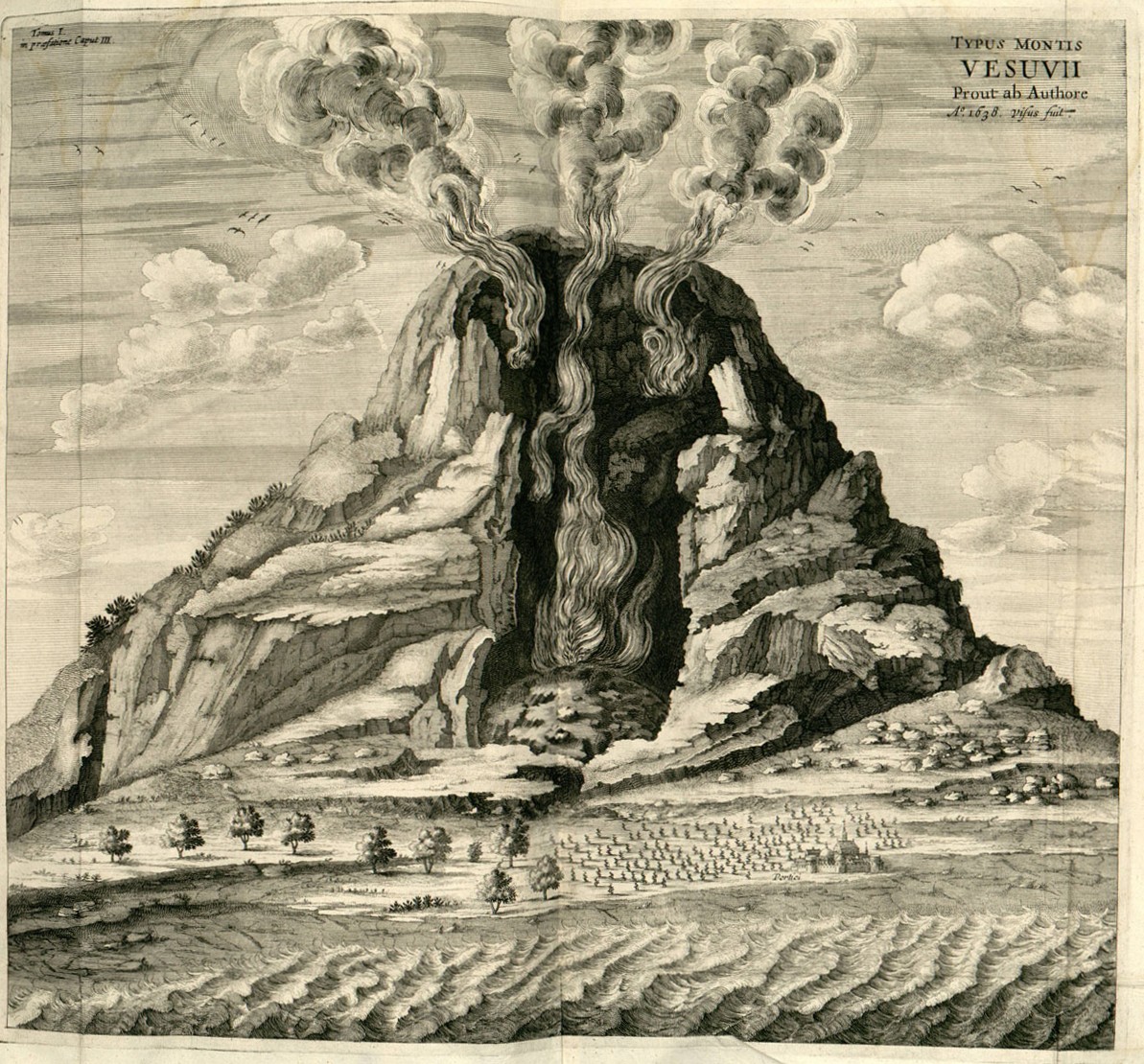
'Many of the main thoroughfares have their own special literature, and we possess written accounts of thousands of the most inconspicuous houses.  In a beautiful turn of phrase, Hugo von Hofmannsthal called [this city] 'a landscape built of pure life:' And at work in the attraction it exercises on people is the kind of beauty that is proper to great landscapes - more precisely, to volcanic landscapes.  Paris is a counterpart in the social order to what Vesuvius is in the geographic order: a menacing, hazardous massif, an ever-active hotbed of revolution.  But just as the slopes of Vesuvius, thanks to the layers of lava that cover them, have been transformed into paradisal orchards, so the lava of revolutions provides uniquely fertile ground for the blossoming of art, festivity, fashion.'

Vesuvius, from Mundus Subterraneus by Athanasius Kircher, 1664

Friday, April 20, 2012

Grand View Garden

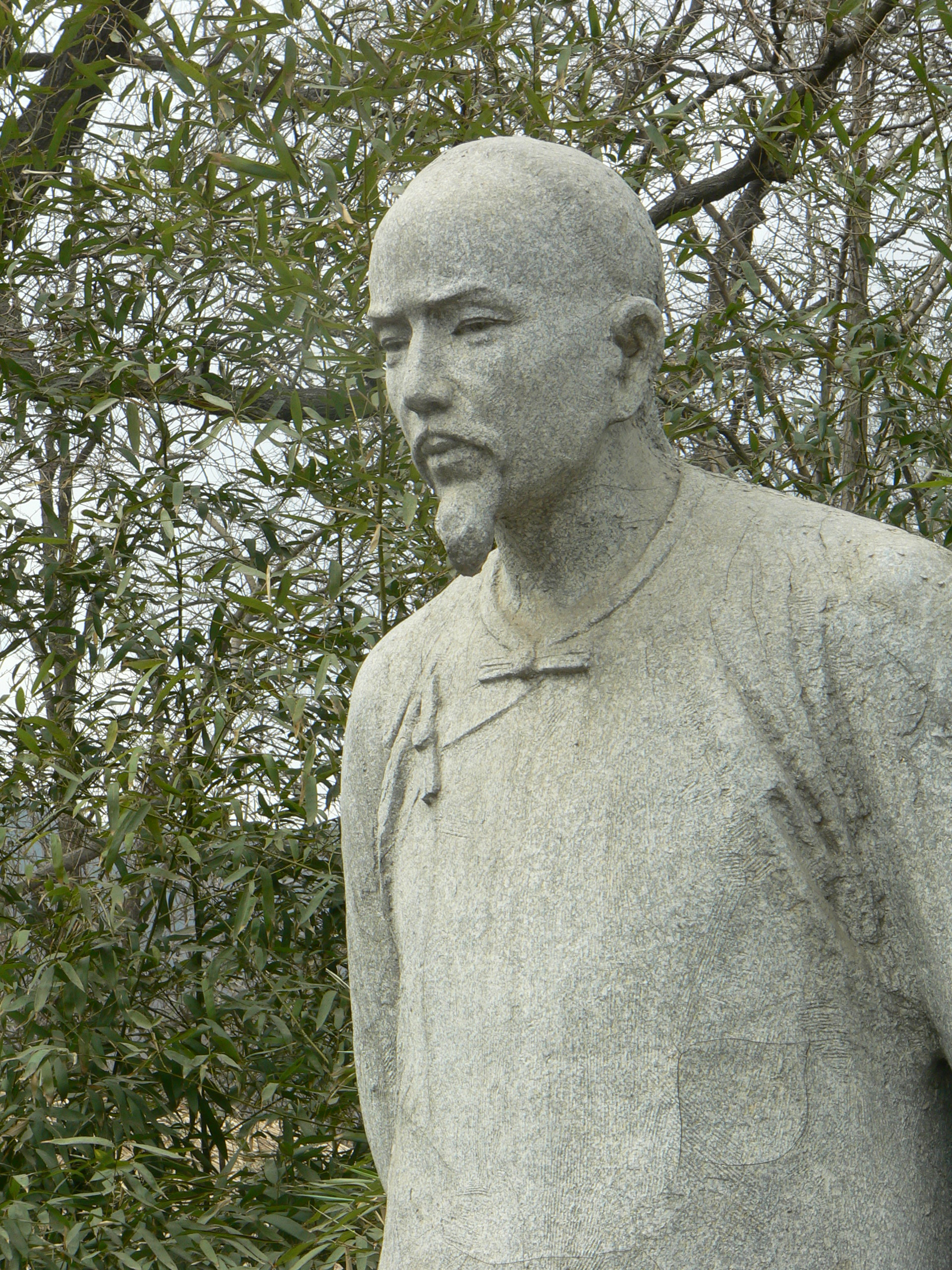
There is a wonderful description of landscape design in Cao Xueqin's Hong Lou Meng ('Dream of the Red Chamber', c. 1760 - translated by David Hawkes as The Story of the Stone).  The daughter of Jia Zheng has been selected to become an Imperial Concubine, but will be allowed to see her family again on a special Visitation.  To prepare for this event, the Jia family grounds are re-designed, creating a new Separate Residence and garden, the Da Guan Yuan, or Grand View Garden.  Eventually the work is complete and Jia Zheng is asked about the bian, those calligraphic boards hung in Chinese gardens with poetic phrases, often taken from classic literature.  '"These inscriptions are going to be difficult,' he said eventually. 'By rights, of course, Her Grace should have the privilege of doing them herself; but she can scarcely be expected to make them up out of her head without having seen any of the views which they are to describe. On the other hand, if we wait until she has already visited the garden before asking her, half the pleasure of the visit will be lost. All those prospects and pavilions - even the rocks and trees and flowers will seem somehow incomplete without that touch of poetry which only the written word can lend a scene.'"

One of Jia Zheng's literary friends offers a solution to this dilemma: provisional names and couplets can be composed and written on lanterns; then, when the Imperial Concubine arrives, she can decide which ones to make permanent.  Zheng agrees but worries whether he is up to it (I can't resist quoting what he says as I think I know how he feels): "In my youth I had at best only indifferent skill in the art of writing verses about natural objects - birds and flowers and scenery and the like; and now I that I am older and have devoted my energies to official documents and government papers, I am even more out of touch with this sort of thing than I was then; so that even if I were to try my hand at it, I fear that my efforts would be rather dull and pedantic ones."  As Zheng and his friends start their walk through the garden they encounter Zheng's son Bao-yu, whose behaviour has constantly disappointed his father, but who has started to show some promise in composing poetry.  The humour in what follows comes from the exchanges between father and son: Bao-yu repeatedly manages to come up with better phrases than his elders.   

Having named a miniature mountain, a pavilion on a bridge and a small retreat surrounded by green bamboos, the party reach a miniature farm with an orchard of apricot trees and enter a thatched building 'from which all hint of urban refinement has been banished'.  Bao-yu's father lectures him on the beauty of this 'natural' simplicity, but his son is not impressed: "a farm set down in the middle of a place like this is obviously the product of human artifice."  He says he is not sure what the ancients meant when they talked of things as being 'natural': '"For example, when they speak of a 'natural painting', I can't help wondering if they are not referring to precisely that forcible interference with the landscape to which I object: putting hills where they are not meant to be, and that sort of thing.  However, great the skill with which this is done, the results are never quite..."  His discourse was cut short by an outburst of rage from Jia Zheng.  "Take that boy out of here!"' 

But the work of writing poetry onto the garden is not complete, and Bao-yu is called back.  They resume their walk, considering other garden features like the place where 'a musical murmur of water issued from a cave', recalling to mind the Peach-blossom Stream of T'ao Yüan-ming (which I described here in an earlier post).  Eventually they complete their circuit back at the foot of the artificial mountain and Bao-yu is allowed to 'get back to the girls' (as a character he is rather like Proust's narrator in À l'ombre des jeunes filles en fleurs).  It is not until the following year that the Imperial Concubine, Bao-yu's older sister, makes her Visitation and it is quite striking how many of the garden inscriptions she does choose to amend or reject.  Coming, for example, by boat over a lake to the landing stage in a grotto named 'Smartweed Bank and Flowery Harbour', she says '"Surely 'Flowery Harbour' is enough by itself?  Why 'Smartweed Bank' as well?"  At once an attendant eunuch disembarked and rushed like the wind to tell Jia Zheng, who immediately gave orders to have the inscription changed.'

Statue of Cao Xueqin in Beijing

Friday, April 16, 2010

The bright sun was extinguish'd


With flights grounded following the eruption of Eyjafjallajokull and a cloud of volcanic ash covering the country, causing spectacular sunsets, it seems a good moment to recall Jonathan Bate's account of the impact another eruption had on Romantic poetry.  In 1815, the volcano of Tambora, in Indonesia, blasted dust into the stratosphere and cooled global temperatures.  'The effect lasted for three years, straining the growth-capacity of life across the planet. Beginning in 1816, crop failure led to food riots in nearly every country in Europe. Only in 1819 were there good harvests again'. (The Song of the Earth, 2000 p97).  It 'rained in Switzerland on 130 out of the 183 days from April to September 1816. The average temperature that July was an astonishing 4.9º Fahrenheit below the mean for that month in the years 1807-24'.  And it was during that gloomy summer that Lord Byron composed his poem ‘Darkness’ on the shores of Lake Geneva: 

I had a dream, which was not all a dream.
The bright sun was extinguish'd, and the stars
Did wander darkling in the eternal space,
Rayless, and pathless, and the icy earth
Swung blind and blackening in the moonless air;
Morn came and went--and came, and brought no day...

John Keats wrote his 'Ode to Autumn’ in September 1819.  Jonathan Bate argues that this poem celebrates the end of the failed harvests caused by the eruption of Tambora. In August Keats wrote to his sister Fanny:  "The delightful Weather we have had for two Months is the highest gratification I could receive--no chill'd red noses--no shivering--but fair atmosphere to think in..."  And here's the famous opening stanza of Keats' poem:

Season of mists and mellow fruitfulness!
Close bosom-friend of the maturing sun;
Conspiring with him how to load and bless
With fruit the vines that round the thatch-eaves run;
To bend with apples the mossed cottage-trees,
And fill all fruit with ripeness to the core;
To swell the gourd, and plump the hazel shells
With a sweet kernel; to set budding more,
And still more, later flowers for the bees,
Until they think warm days will never cease,
For Summer has o'erbrimmed their clammy cells.

1819 was Keats' great year, when he composed his other major odes, finished 'The Eve of St Agnes' and wrote 'La Belle Dame Sans Merci.'  He also fell in love with Fanny Brawne.  Wentworth Place, where Keats lived next door to the Brawnes, has been newly restored.  We paid it a visit last week and found its grey rooms, lit by the spring sunshine, less melancholy than might have been expected.  After such a long bleak winter it was a relief to enjoy the garden in "delightful Weather" that would have gladdened the poet.  This garden is a lovely spot to sit in and read, or play hide and seek, or admire the old mulberry tree that Keats himself would have seen as he looked out on the orchard. 


The old mulberry tree in the garden at Keats House,
photographed last week

Tuesday, February 16, 2010

Garden in Sochi

Arshile Gorky, One Year the Milkweed, 1944
Image added here in 2019 following expiry of copyright

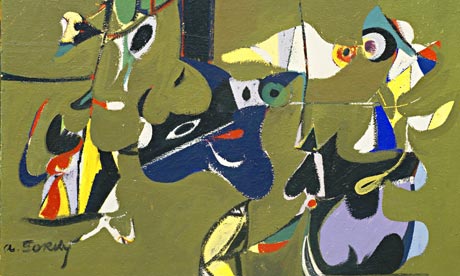
The Tate's impressive and moving new Arshile Gorky retrospective includes a room entitled 'Landscape', with paintings like One Year the Milkweed and Cornfield of Health (both 1944).  André Breton said of these works (for which he provided some of the titles) that they reveal the rhythm of life through Gorky's way of decoding nature.  Gorky had begun working in the Connecticut and Virginia countryside in the early 1940s, improvising drawings and developing his abstract paintings, like the Tate's own Waterfall (1943).  The exhibition guide says of these paintings that they 'combine the immediate with buried memories of childhood.'  I think it is these buried memories (rather than our knowledge of Gorky's suicide in 1948) that give the paintings in the exhibition such poignancy - whether indirectly in paintings like One Year the Milkweed or directly in The Artist and His Mother, that remarkable memorial to his mother who had fled with the rest of the family from the pograms in Armenian Turkey only to starve to death in Russia in 1919.

Arshile Gorky, Garden in Sochi Motif, 1942
Image added here in 2019 following expiry of copyright

Earlier in the exhibition there is a room devoted to the Garden in Sochi series.  This is based on Gorky's memories of childhood, specifically his father's orchard at Khorkom.  He said in 1942 that "there was a ground constantly in shade where grew incalculable amounts of wild carrots, and porcupines had made their nests.  There was a blue rock half buried in the black earth with a few patches of moss placed here and their like fallen clouds."  This description (which reminds me of Bruno Schulz) provides an obvious starting point for a biomorphic composition in the style of Arp or Miró, which is what the Garden in Sochi works resemble.  However, William Feaver quotes another more extravagant explanation for these paintings, where Gorky relates them to The Garden of Wish Fulfillment:  "Often I had seen my mother and other village women opening their bosoms and taking their soft and dependable breasts in their hands to rub them on the rock. Above all this stood an enormous tree all bleached under the sun the rain the cold and deprived of leaves. This was the Holy Tree. I myself did not know that this tree was holy but I had witnessed many people whoever did pass by that would voluntarily strip off their clothes and attach this to the tree."

Sunday, September 30, 2007

The Printed Path

I spent the day yesterday at an interesting Tate event: ‘The Printed Path: Landscape, Walking and Recollection’: ‘taking the late German-born writer WG Sebald as their guide, artists and writers consider our relationship to place and its recollection’. The event was linked to the Sebald-inspired Waterlog exhibition which is now on in Lincoln (I probably won’t get to it but I can say that the catalogue is quite good). Waterlog includes a superb new film by Tacita Dean, Michael Hamburger (2007), in which the poet and translator of Hӧlderlin (who features in Sebald’s Rings of Saturn) is seen talking about his apple trees. So inspired were we by seeing this that today we headed straight for Apple Day at Fenton House to buy a selection of unusual apples... Anyway, Waterlog also features Alec Finlay, Jeremy Millar, Simon Pope, Matthew Hollis, critic Brian Dillon and George Szirtes, poet and friend of Sebald’s, all of whom were at Tate Britain for ‘The Printed Path’. Robert Macfarlane is also in Waterlog but was not at the Tate – hardly surprising given how busy he seems to be... Having published The Wild Places, he is now apparently working on a biography of Sebald.

The Sebaldian sense of a landscape haunted gave an opportunity for the ‘Printed Path’ organisers to include Mark Fisher talking about hauntological music, with extracts from Brian Eno and the Belbury Poly, both of whom I have talked about here before. The Tate event also included Iain Sinclair (always good value), Geoff Dyer (also excellent), Marina Warner and her colleague from Essex University, Philip Terry, who has taken an Oulipian strategy from Queneau’s Morale Élémentaire and applied it to landscape. Terry’s Elementary Estuaries are a string of brief descriptors like a text piece by Fulton or Long - they can be seen at the V&A site.

One of the themes of the day was the notion of travelling the landscape in the footsteps of a writer. This is what Macfarlane is now doing in the case of Sebald and he’s hardly the first - I myself once went on a trip to Suffolk searching for Sebaldian locations like Dunwich beach (see my photograph below). At the Tate, Iain Sinclair talked about the walk he wrote about in The Edge of the Orison, following John Clare’s ‘journey out of Essex’, Geoff Dyer described his disappointment on finally finding D H Lawrence’s house in Sicily, Alec Finlay read a poem about his trip to the remains of Wittgenstein’s home in Norway, and Brian Dillon related his attempt to trace Robert Smithson’s Monuments of Passaic. Dillon’s article describing this trip is referred to in an interesting blog, New Jersey as an Impossible Object. I may expand in this blog on some of the themes covered in ’The Printed Path’ when I have a bit more time...

Saturday, July 21, 2007

Above the frenzied sea

Some years ago we visited the Cinque Terra, a group of five villages on the Ligurian coast of Italy. One day we did the coast walk between them, starting at Riomaggiore and ending at Monterosso (see photo below). I remember the curves of the landscape, the glittering sea, the wind blowing in the pine trees... but I also remember a harsher side to the place: the crumbling, dusty path, a relentless sun overhead and dense brambles hiding the view. Soon afterwards I read Eugenio Montale’s first book Ossi di Seppia (Cuttlefish Bones) and found all these elements in poems set in the Liguria of his childhood and youth. In 1900 Montale’s family had built a villa at Fegina, near Monterosso. As Jonathan Galassi says in his notes to Collected Poems 1920-1954, ‘here Montale will spend long summer holidays until he is nearly thirty, and absorb the elemental landscape – hallucinatory sun, agitated sea, barren cliffs and shoals – that is the primary material of his first poetry.’ The Ossi di Seppia poems were first published in 1925, when Montale was 29.


The path to Monterosso

To get a sense of the Ligurian landscape in Ossi di Seppia you need to read the poems. What I’ve attempted to do below is give a flavour by extracting some phrases from Galassi’s translations, starting with the orchard of ‘In limine’ and ending with the flight of swifts in ‘Riviere’.

the wind inside the orchard ... among the lemon trees ... whispering of friendly branches ... the fragrance of lemons ... the golden horns of sunlight ... the copper horizon ... the livid sea ... swallowed by the haze ... the rock that shimmers with salt ... old-silver shimmer on the walls ... the bitter scent of the sea ... fired reflections ... the plain of the sea ... a blistering garden wall ... among the thorns and brambles ... throb of sea scales ... cicadas’ wavering screaks ... the shade of that green thicket ... wavering mother-of-pearl haze ... the stillness of the country ... my field parched by the salt sea wind ... the sunflower crazed with light ... the statue in the drowsiness of noon ... the trees give up no shade ... walking in dry, glassy air ... butterflies danced fleetingly ... among thin reeds and brush ... the well’s pulley creaks ... the owl darts ... wet smoke hangs heavy on roofs ... the arc of the sky ... slanting shadows of cluster pines ... the sight of the sea ... foam raining back on the rocks ... the sun bakes ... mosquitoes cloud the air ... cork and seaweed and starfish ... the dry cliffs ... the rocks that edged the road ... shaking tufts of thirsty cane ... briny gusts ... rivers of rainwater ... the sea’s lashing ... the wind’s erratic gales ... air so blue it goes dark ... the sun in darkened courtyards ... a throbbing sea hatched with furrows ... tangled seaweed and drifting tree trunks ... scarlet houses built of ancient brick ... the thin hair of tamarisks ... vines and pine groves ... the bald, hunched backs of hillocks ... steep embankments ... bramble thickets ... a wisp of breeze ... the house by the sea ... shivering tamarisks ... false calm over carved waters ... sirocco gale that burns ... the sky alive with pale lights ... the choppy sea talks in the rocks ... a few seabirds are flying ... clouds pressed between the branches ... among the silver blades of tender leaves ... a patch of sky burns overhead ... the rumble of a train ... the solemn cicadas ... the dusty streets ... tops of elders shiver ... the sea that shudders ... the windy gorge ... the branches of dwarf pines ... a lead stormcloud high above the riptide ... a salty, roiling maelstrom ... thunder rolls with a struck-metal clang ... the apprehensive sky starts spattering ... among the stones ... the sun hides in the clouds ... hazy afternoon ... the gentle breakers ... copper water riffled by a breeze ... the swarm of bats that sunset scatters ... a fisherman lets down his line ... tranquil afternoon ... the excess of light stuns ... edges go abstract ... tendrils of the low vines ... an eddy of deepening blue ... assiduous, slow waves ... sluggish mists ... the sigh of the breaker ... someone hangs out nets ... a curve of flayed horizon ... the whistle of the tugboat ... the offshore wind’s hot eddies ... a cormorant’s wing beats up above ... the rivermouth, waterless, but alive with rocks and lime ... a roadway of dried mud ... a dense fog ... glancing light ... a few blades of agave ... above the frenzied sea ... a pair of pale camellias ... shuddering olive trees and staring sunflowers ... the cuttlefish bone ... a stone smoothed by the sea ... the arcs of shifting branches ... rocks brown in the foam ... arrows of roving swifts.


The 'copper horizon', Riomaggiore

Sunday, January 14, 2007

The fields of Ennor

Artists trying to find a new way of seeing the landscape may need to try something more unusual than standing and gazing at the view or walking and taking notes. I always think of Peter Lanyon, driving round Cornwall trying to find new angles and eventually taking to the sky in his glider. Roger Deakin's book Waterlog might also be seen in this way: he chose a cold, wet option - swimming in rivers, ponds, lakes and seas around Britain. Literally immersed in these places he not only got a different perspective, he was also sometimes able to see landscapes that would be otherwise inaccessible, like the submerged fields of Ennor...

Deakin's swimming journey started off the coast of Cornwall, where he swam between the Scilly Isles of Bryer and Tresco. He explains: 'The Scilly Isles are the last outcrop of a ridge of volcanic granite that forms the backbone of Cornwall and they were, until about 4000 years ago, the high points of a big island called Ennor. But the melting of the polar ice caps that began after the last Ice Age meant that Ennor’s lowland valleys and fields were gradually submerged. I donned the wetsuit, mask and snorkel, and swam out into the shallow sandy bay. It was high tide and about thirty yards off the shore I looked down at a pair of stone walls meeting at a right angle, and a circle of stones that must once have been a sheep pen. With seaweed hedges growing from the stones, these are the patterns and remains of the patchwork of old fields that once stretched all the way across the valley to Tresco. They are really just a continuation of the remaining field boundaries on shore. This may be why some stretches of water around the Scillies still have names from Before the Flood that are literally outlandish, like Garden of the Maiden Bower or Appletree Bay.'

There are many obituaries and memories of Deakin (who died last year) on line: see here for example. Ken Worpole pays tribute to Deakin on the Open Democracy site (one of several short pieces he has written there on Landscape and Identity). There are also various texts by Deakin, like this one about orchards on the Common Ground site. And the Radio 4 site has a programme Deakin made on a canoe journey from Redgrave Fen in Suffolk to Geldeston Lock in Norfolk, along with another about his garden.

Monday, April 03, 2006

April at the Chateau of Dourdan


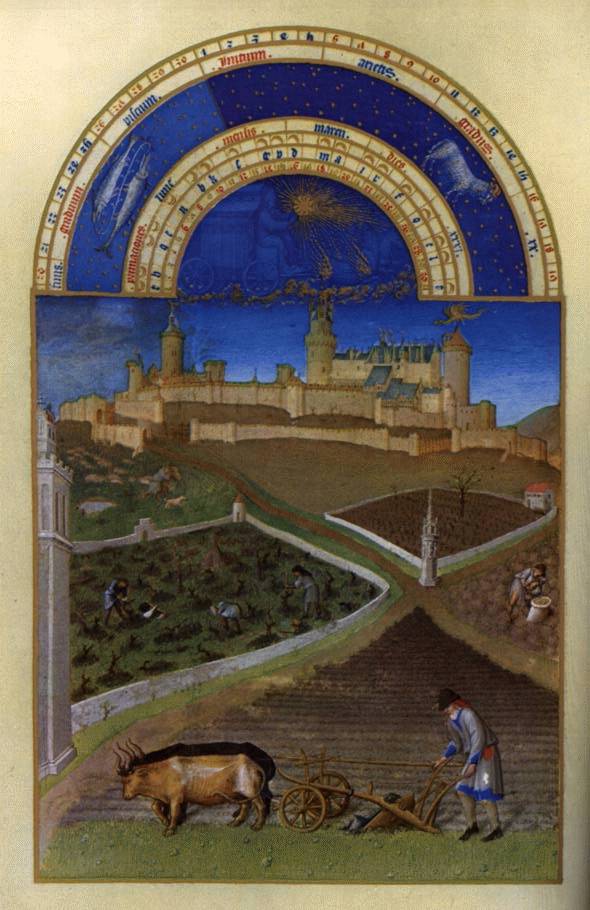
In the Limbourg Brothers’ Les très riches heures du Duc de Berry, April (above) is symbolised by a newly betrothed couple standing in a green landscape, with the Duc’s chateau of Dourdan dominating the background. March also features a castle, Lusignan, but the foreground is taken up with agricultural work: sowing and ploughing fields. In contrast April seems to convey the delights of spring - full of pleasure and hope for the future. Two maidens are picking flowers. The trees are in full leaf and new blossoms are visible in the orchard.

The miniatures were painted by the Limbourgs in 1413-16 and completed later by Jean Colombe. There are landscape elements in every month, ranging from February’s scene of winter snow to November’s detailed view of ploughing in fields near the Louvre. However the Hours also include many other illustrations of scenes from the Bible and these too display an interest in landscape: for example a plan of Rome, the Annunciation to the Shepherds in the hills near Bethlehem, and an unusual night scene at Gethsemane. Sadly the Limbourgs were not able to paint the Flight into Egypt, always a stimulating subject for landscape painters, and so it was left to Jean Colombe to execute this particular miniature.