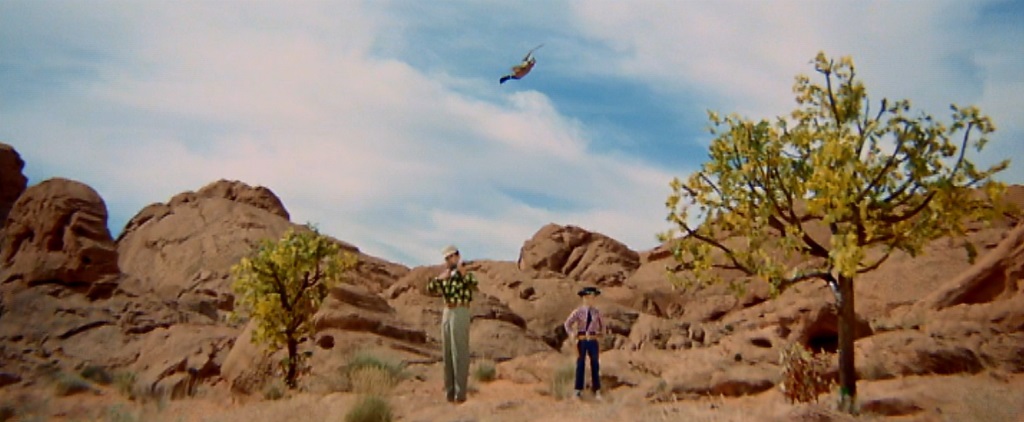
Tate Modern's Electric Dreams exhibition includes the film Tele-Mack, shot in 1968, featuring the work of West German artist Heinz Mack. It starts in black and white with him driving an E-type through a city, looking like
David Hemmings in Blow-Up. Then it leaps into colour - Mack is now in a silver suit carrying an aluminium disc into a stretch of water (accompanied by 'tense music', as you can see from my photograph above). The voice on the soundtrack tells us this is a kind of artificial sun and is an experiment related to the artist's Sahara Project. Next we see him planting fragmented mirrors in a field (a kind of landscape art I've written about here before). Then we see an installation of kinetic sculptures made of aluminium foil and coloured Plexiglas - Mack is wearing a cool sixties suit while a groovy young woman in plastic orange raincoat and hat takes photographs of him. From this Warhol-like scene we are transported to the Tunisian desert, where the artist in his silver suit resembles an astronaut, setting up aluminium sculptures that face into the sun. Here we are witnessing the culmination of his long-planned Sahara Project. There are only two colours - the blue of the sky and the white-brown of the sand, until Mack places a pink translucent sheet in front of the camera. Finally he creates an artificial garden of metal-winged sculptures, the kind of thing you might see in J. G. Ballard's Vermilion Sands (1971).
You can watch a short video about the Sahara Project on the Guggenheim website. Mack conceived it in the early fifties when he and his wife drove their VW Beetle into the desert and first experienced its intense light. Curator Valerie Hillings says Mack told her a story about how he broke off the mirror in his hotel room and 'took it into the desert to see what happened.' Mack himself describes the attraction of a place with no distractions, the perfect setting for sculptures: a landscape unspoiled by the "fingerprints of civilisation." By 1959 he had worked out his thoughts on paper and exhibited them as a concept, years before the American land artists came up with similar ideas of using remote locations and mirrors. Although light and reflection were central to the work he was making in the sixties, it wasn't until the Tele-Mack filmmakers suggested going out to Tunisia that he got to take these sculptures and set them up in the desert. The key difference here between Mack and earth artists like Michael Heizer was that his work was temporary. He left no trace behind - Sahara Project was thus as ephemeral as a walk by Hamish Fulton (and can thus be viewed as relatively environmentally sensitive). It was also a one-off performance, only preserved on the medium of film. And what an excellent film Tele-Mack is - I'm not at all surprised it got an honourable mention at the 1971 Venice Film festival.
Postscript 14/3/25
A week after writing this I have realised that Tate Etc. magazine carried an interview with Heinz Mack in which he discusses the film and Sahara Project.
'The gravity of the desert, its absolute tranquillity, its endless dimensions – all this radiated mystery. In this landscape, infinitely vast and untouched, I now experimented with my comparatively small models and sculptures. This was inspired by the question of whether my art could stand up to this open landscape or would be lost in it. I discovered that, despite the contradictory proportions, something could be created there that had a poetic radiance.'
Master of the Darmstadt Passion, Saint Onuphrius, 1460
You could write a whole book about landscapes in
depictions of the Desert Fathers and Desert Mothers (and I would read it). A chapter on Saint
Onuphrius would certainly include this painting, which I photographed three years ago in Zurich. The desert here resembles a summer lawn and the little stream seems to provide just enough water to irrigate a few herbs. Also in Switzerland, the Kunstmuseum Basel has an austere landscape from 1519 in which Onuphrius prays among bare red rocks and broken tree trunks. It was painted by a local artist, Conrad Schnitt. Sadly there is no image freely available online -
all I could find was one overwritten throughout with 'Alamy' to prevent
copying. I'm therefore only able to provide a tiny detail below, showing a distant building that I'm guessing is the monastery Onuphrius lived in before he headed into the desert. In the Zurich painting there is a similarly-placed structure, which looks like a beautiful medieval castle standing out against the golden sky.
We only really know about Onuphrius from an account of Paphnutius the Ascetic, a fourth century Egyptian anchorite. Paphnutius ventured into the desert to see what it would be like to be a hermit and there he saw a wild man covered in hair, wearing only leaves. This was Onuphrius, who said he had survived as a hermit out there for seventy years. They spoke until sunset and spent the night in prayer. In the morning Onuphrius died and Paphnutous covered his body with a cloak and left it in a cleft in the rocks because the ground was too hard to bury him.
You would think such an inhospitable place would always appear as a bleak-looking landscape in art. But this isn't always the case, as can be seen in Cornelis Cort's print. Here there are trees in full leaf and plentiful water in a wonderfully well-drawn river. I have reproduced another print below by Albrecht Dürer. It shows John the Baptist with a saint once thought to have been Saint Jerome, but as the National Gallery curators write, there is no lion to be seen and 'instead,
the garland of hops points towards Saint Onuphrius.' They note that 'the relatively densely worked areas in the centre of the print contrast with almost rudimental landscape in the background.' However, for me, the distant vista is beautiful rather than 'rudimental', with its sense of space and light, and that sea fringed with trees and dotted with two small boats beneath waves of cloud...
Albrecht Dürer, John the Baptist and Saint Onuphrius in the Wilderness, c. 1503-4
I won't try your patience here by describing lots more images of Onuphrius in the history of art. There have been many icons in which his standing figure is placed in front of his cell, between hills or on a rocky plain. Artists whose views of the saint are set in interesting wilderness landscapes include Lorenzo Monaco (c. 1370-1425), Francesco Morone (1471-1529), Jan van Haelbeck (1595-1635), Francisco Collantes (1599-1656) and Salvator Rosa (1615-1673). I will conclude with just one more: a painting orginally made for the Buen Retiro Palace in Madrid. The artist
responsible for the figure of Onuphrius is not known but the painter of the landscape
is unmistakable. The life of a hermit in this sublime landscape looks almost inviting.
Claude Lorrain, Landscape with Saint Onuphrius, c. 1638
Katie Paterson, Inside this desert lies the tiniest grain of sand, 2010
Photography was permitted: this is my photograph of her photograph
We recently took the train down to Margate to see the exhibitionA place that exists only in moonlight: Katie Paterson & J.M.W. Turner. I last mentioned Paterson's work here nearly ten years ago when I saw her talk at a conference:
She described a work completed only last week,Inside this desert lies the tiniest grain of sand, which
had involved returning to the Sahara desert a grain of sand that had
been chiseled to 0.00005mm using the techniques of nanotechnology. At
extreme magnification the grain of sand resembled a planet and
presumably the chiseling process could have created some nano-land art -
a microscopic Spiral Jetty or near invisible Double Negative.
The point was made (by Brian Dillon) that she brings a necessary sense
of humour to art that deals with cosmic scales of space and time.
As can be seen above, the Turner Contemporary exhibition included a large black and white photograph of this work, showing the artist returning her tiny artwork to the desert.
Most of Paterson's work has been on a cosmic or planetary scale and therefore doesn't really qualify as landscape art. For example,
Fossil Necklace (2013), my favourite piece in the show, in which time is considered as a circle of beads, charting the evolution of life on earth from its monocellular origins. You can view every bead individually on the artist's website.
Earth-Moon-Earth (Moonlight Sonata Reflected from the Surface of the Moon) (2007), where Beethoven’s Moonlight Sonata was translated into Morse code and sent to the Moon and back. Craters on the moon fragmented the signal, leaving gaps in the music.
The Cosmic Spectrum (2019), a colour wheel designed to show the colour of the universe at each point in its development (the exhibit was broken and didn't rotate when we were there, but this might have made it easier for us to study it). It resembles Olafur Eliasson's Turner Colour Experiments, shown at the Tate in 2014 (see my earlier post).
Turner's work was interspersed with Paterson's and included some marvellous studies inspired by light, such as Moonlight on the River(1826)and ? Boats at Sea (c. 1830-45), both from the Tate's collection.
J. M. W. Turner, Moonlight on the River, 1826
J. M. W. Turner, ? Boats at Sea, c. 1830-45
There is also a new book, A place that exists only in moonlight, published to coincide with the exhibition but oddly not on sale at the gallery itself (you have to send off for it and I have not (yet) done this). It comprises short texts that describe artworks that can exist only in the imagination. Some were placed on the wall, like the one below, which reads like a landscape haiku. These reminded me of the work of her fellow Scottish artist-poets Thomas A. Clark and Alec Finlay. As instructions for art projects, they are like the walking proposals of Richard Long, or indeed any of those texts of conceptual artists, writers and composers who have been interested in exploring space and time, light and substance. Just one example that springs to mind as I write this: La Monte Young's Composition 1960 #15: 'This piece is little whirlpools out in the middle of the ocean.' Someone could compile an anthology of such works, although they would probably seem less inspiring out of context. Among the 'Ideas' on Katie Paterson's website, I particularly like A beach made with dust from spiral galaxies, Gravity released one unit at a time and, of course, A place that exists only in moonlight.
I thought it was time to bring back my regular surveys of 'landscape music', having had a couple of years off. The last one I did was in 2015 - it contains links to the earlier ones, or you can just check back through my old December posts. I should apologise for some dead links in my previous surveys, as videos and tracks have been moved or taken down over the years. Looking back I see there's now a missing video in a post I wrote back in 2010 about Toshiya Tsunoda, the Japanese sound artist. He's the first of my picks for 2018, with the album Wovenland, a collaboration with Taku Unami (the title refers to the way their separate field recordings are woven together). Reviewing it in Wire Magazine, Derek Walmsley thought this 'one of the most original and startling recording projects in recent years.'
One of the albums I missed by not doing this in 2016 was 3hattrio's Solitaire, inspired by Edward Abbey’s nature writing classic, Desert Solitaire (1968). Abbey, author of The Monkey Wrench Gang, based this, his first non-fiction book, on the time he spent as a park ranger at Arches National Monument. 3hattrio say they play 'American desert music':
'Their aim is to create a new music which responds to the
natural world of their sacred homeland near Zion National Park in Utah.
They also strive to acknowledge the cultural traditions of generations
of people who have worked and lived on the deserts of the American
southwest. The subject matter of the songs is often desert oriented,
sometimes not. Mostly, they express the desert experientially from a
daily-ness of watching light off distant mesas and hearing the way sound
plays off sheer sandstone cliffs. Then they play music. They don’t
over-think it.'
Their new release is Lord Of The Desert andincludes tracks called 'Night Sky', 'Skeleton Tree' and 'Dust Devil' (see video clip below).
My earlier round-ups always featured music from Touch and their most recent release is relevant - Howlround's The Debatable Lands. This was inspired by the border region in Cumbria which Graham Robb wrote about in his latest book (quite interesting, but not as rewarding a read as I was expecting). Another liminal space was the source for Jana Winderen's Spring Bloom in the Marginal Ice Zone, originally a sound installation for the 2017 Sonic Acts Festival:
'The marginal ice zone is the dynamic border between the open sea and the
sea ice, which is ecologically extremely vulnerable. The phytoplankton
present in the sea produces half of the oxygen on the planet. During
spring, this zone is the most important CO2 sink in our biosphere. In Spring Bloom in the Marginal Ice Zone
the sounds of the living creatures become a voice in the current
political debate concerning the official definition of the location of
the ice edge.'
I'm listening to the album now as I write this, streaming from Jana Winderen's bandcamp page.
In my round-up for 2012 I featured Erland Cooper's Orkney Symphony. In March this year he released Solan Goose, its tracks named after the Orcadian words for seabirds (the solan goose is a northern gannet). He also released Murmeration, with a Norman Ackroyd picture on the cover (incidentally, Ackroyd's daughter Poppy is a Brighton-based composer, whose work sometimes references landscape themes and uses field recordings). Erland Cooper is planning a third record in this vein, as he explained in an interview for The Island Review, which will explore 'our relationship and respect for the sea: how it surrounds the community
and the landscape; how it supports the greatest ecosystem of all.' Together these albums are inspired by the words of the poet George Mackay Brown. “The essence of Orkney's magic is silence, loneliness and the deep marvellous rhythms of sea and land, darkness and light.”
Stuart Hyatt's Metaphonics: The Complete Field Works Recordings comprises 7 LPs and a book, based around his own field recordings but incorporating collaborations from around forty other artists. The YouTube clip below presents a track from the album Pogue's Run - 'from its source, through the city, into a mysterious three-mile
underground tunnel, and finally to the White River, Pogue’s Run
represents the ongoing tension between nature and civilization.' I enjoyed seeing field recordists filmed as if they were in a pop video, although as this goes on and they reach the underground river, it more closely resembles scenes a scene from a science fiction film. There is an interview with Hyatt at the online art/science magazineCLOT. He quotes from an essay by Yiorgis Sakellariou in the Metaphonics book, which views field recording as "an alchemical
practice, a transformation of perception of both recordist and
environment. A recording location is not simply a geographically framed
scenery, but more importantly, a place of inquiry, experimentation, and
wonder."
I will stick there at five main recommendations, but here, briefly, are a few other albums from 2018 that reflect landscape in different ways. Further suggestions in the comments below would be welcome.
Grouper's Grid of Points, written by Liz Harris during a residency in Ucross, Wyoming. One of its tracks is inspired by Zabriskie Point, a film I wrote about here in May.
Richard Skelton's Front Variations subjected sine waves 'to increasing amounts of feedback in
order to simulate the so-called ice-albedo feedback mechanism.
This is the process whereby the action of melting glaciers reduces the
global surface area of ice, thereby reducing the amount of solar
radiation that glaciers reflect, which in turn increases global
temperatures and causes further glacial melting.'
Laurie Anderson's Landfall is a cycle of songs about Hurricane Sandy - a recording was released this year with the Kronos Quartet. Tracks include 'Wind Whistles Through the Dark City,' 'The Water Rises' and 'Our Street is a Black River'...
Daniel Bachman's guitar in The Morning Star is set against a background of field recordings. It continues a sequence of 'Songs for the Setting Sun' that he began on the 2015 album River (which was featured on my 2015 round-up).
Jim Ghedi's A Hymn For Ancient Land, was a bit too pastoral for the Quietus reviewer: 'only on ‘Phoenix Works’, a song dealing with the decline of traditional
industries in the north, does he explicitly deal with darkness. This,
coupled with the dense, meandering tonalities of ‘Fortingall Yew’, saves
the album from being a landscape painting.'
According to The Quietus, the album of the year was Gazelle Twin's Pastoral, which 'picks away at the bucolic, Constable-generated image of English countryside like a fetid scab.' Gazelle Twin is Brighton-based electonic musician Elizabeth Bernholz, whose previous project was based on J. G. Ballard's last novel Kingdom Come.
Finally, I will conclude here not with an album, but with an app. Numero Group's 'Environments collects the entire historic record series by master sound
engineer Irv Teibel into one easy to use package for the iPhone and
iPad' (it costs £2.99). If you're not familiar with Irv Teibel's 1970s psychoacoustic nature recordings, there's a good article about him at Pitchfork. Aquarium Drunkarddescribed the new app as 'an ingenious re-contextualization of this retro-futurist
“gebrauchtsmusik” that recapitulates the series’ initial novelty.
However captivating Teibel’s tale, the Environments app
now illuminates an anthropocene landscape where 'Dusk in the Okefenokee
Swamp' and a 'Summer Cornfield' are mediated by an inescapable layer of
sleek, fabricated hardware and playfully nostalgic software.'
Michelangelo Antonioni's film Zabriskie Point (1970) is named for the ancient lake beds where it is partially set. The two protagonists Daria and Mark drive to this viewpoint and explore its dry slopes before making love. As Adam Scovell has written, the way they become gradually covered with sand 'unites them with the topography and camouflages their presence from themselves and the world around them'. The dream-like appearance of a whole bunch of other hippies coupling in the dust adds to the effect (and, to be honest, would be quite hard to take if it wasn't for the accompanying music by Jerry Garcia). This empty terrain seems as far from the city as it is possible to get (Zabriskie Point had stood in for Mars in one earlier film), but Death Valley is hardly an idyllic retreat. After the two of them part, Daria drives on through the desert to the lavish modernist home of her boss Lee Allen, built among some rocks near Phoenix. Here, in a kind of capitalist oasis, women sit around a pool and businessmen discuss the possibility of investing in Allen's new real estate development. As Daria leaves she imagines the whole luxury house destroyed in an explosion.
Daria and Mark explore the landscape in Zabriskie Point
Whilst Zabriskie Point itself is central to the film and its wind-sculpted shapes are pretty remarkable, what really seems strange to the modern (British) viewer are the earlier scenes set in Los Angeles. This is the LA of Ed Ruscha, designed around the automobile and full of garish signs and billboards. At one point Mark drives past a large hoarding painted incongruously with a rural scene of barn, animals and farmers. The film features other artificial landscapes too, like the one we glimpse in an absurd promotional film for Lee Allen's new development, Sunny Dunes. At the end of the film, when he is trying to sell his proposal, the businessmen congregate around a semi-transparent map of the scheme. Here the landscape is no more than an abstraction onto which they can project their financial schemes. As they discuss the possible deal, drinks are served by two native American women, suggesting the way power and ownership of the land has changed in the course of a century.
Mark driving through LA
Promotional film for Sunny Dunes with fake bird and people
A map of the proposed development
I will conclude here with a paragraph from an excellent Lightmonkey essay which I think illustrates the point that, whilst Zabriskie Point undoubtedly has its faults, it is fascinating for anyone interested in landscape and cinema.
'In a series of striking shots we see
glimpses of an older Los Angeles from Lee Allen’s modernist office with
large windows overlooking the city. This office was located near
Wilshire Boulevard in the downtown area and had a spectacular view of
the city skyline. Antonioni went to great pains, and expense, to light
the office with the same color temperature as the outside, creating the
possibility of using deep focus to shoot Lee Allen at his desk and the
skyline, both in sharp focus, establishing a dialog between actors and
location. These extraordinary shots give the sensation that the interior
space and the man made landscape outside go on forever morphing into
one large electronically controlled space. Buildings from various time
periods rise up like markers, most prominently a magnificent black and
gold Art Deco tower on Flower St. Not surprisingly this landmark
building was demolished shortly after the film was made, to make way for
the new sleek skyscrapers that would come to dominate the city, and
that were more in keeping with the international style of architecture
favored by the surging corporate state. From the point-of-view of Mark,
as he rides around on his truck the city seems to already be a collage
that is in the process of being created and destroyed at the same time,
with no time to reflect on the historical causes or the psychological
effects.'
If you haven't been yet, there are still two days left to make your way through the long David Hockney queues and see Tate Britain's Paul Nash retrospective. His work may seem familiar from relatively frequent exhibitions and the permanent collections of the Tate and Imperial War Museum, but there are a few exhibits on show that I don't remember seeing before, including two borrowed from Canadian museums. Monster Shore (1939) shows a shattered elm which Nash encountered while 'the declining sun suffused the evening sky to a brickish red; beneath
which the Malverns piled up intensely blue.' Those hills almost seem to belong in a different painting - T. J. Clark refers to this work in his partly critical LRB review as 'a Dali-plus-Ernst assemblage'. The other painting from Canada, Dymchurch Steps (1924, reworked 1944), is centered on a concrete structure that would not look out of place on Ballard's Terminal Beach, Sebald's Orford Ness, or somewhere in Tarkvosky's Zona. According to the curator Emma Chambers it is 'one of the most important works for understanding the beginnings of
Nash’s interest in the metaphysical possibilities of architecture, and
is among the earliest of a group of works which place a substantial
architectural object having an uncompromising and mysterious presence in
the centre of a landscape composition.'
'I wish the car had got into his paintings occasionally' writes T. J. Clark. Figures too are largely absent, as Laura Cummings notes in her review of the exhibition.
'People do appear in his art,
surprisingly often, but always as wraiths or surrogates. Far more
haunting are nature’s figures, such as the two tiny trees holding still
at the centre of The Pyramids in the Sea. This irreducibly strange vision shows roiling seas by night, two
pyramids dropped among them, and sand dunes metamorphosing into waves.
It is a vision from the land of counterpane, made when Nash was scarcely
23. Yet it contains the future like a kernel – the intermingling of
land and sea, the premonition of surrealism, the Samuel Palmer moon
(long before Palmer was discovered in the 1920s) of Nash’s English
nocturnes. Above all the bell-shaped waves that rise and fall across the
picture, and all through the rest of his work.'
Paul Nash, Pyramids in the Sea, 1912
Source: Tate Gallery - public domain
In his catalogue essay, 'A Spectral Modernity', David Mellor wonders if this picture may partly have been inspired by a writer Nash is known to have enjoyed, Algernon Blackwood. In one of Blackwood's stories,'Sand', an English explorer experiences the desert as if it were liquefied. 'Rising above the yellow Libyan horizon, gloomed the vast triangles of a dozen Pyramids, cutting their wedge-shaped clefts out of a sky fast crimsoning through a sea of gold.' Mellor's essay traces the influence of spiritualism on Nash and his wife Margaret, who believed she was clairvoyant. I wonder whether she considered Pyramids in the Sea a kind of premonition of their first meeting, a year after it was drawn. Margaret spent her early childhood in Cairo and her father was an Arab, born near Jerusalem, who later moved to Oxford where he taught the undergraduate T. E. Lawrence colloquial Arabic. Lawrence admired Nash's work - he bought his first painting of the sea at Dymchurch and asked him to provide illustrations for an edition of The Seven Pillars of Wisdom. Ten years later Paul and Margaret Nash were about to visit Lawrence at Cloud's Hill when they heard the news that he had been killed.
After the war Margaret Nash wrote a memoir of her husband. It was published last year in a new edition of Outline, Nash's unfinished autobiography and letters from the front which originally appeared in 1949. It provides a moving insight into the way Nash endured his asthma attacks, caused, it was thought, by breathing in the poison gas at Passchendaele. At the end of 1933 the couple journeyed south through France and Spain, having to stop periodically while Nash recovered his health. They visited Matisse in his studio, where Nash had to put up with advice from the great man on using a rowing machine to help improve his breathing. Eventually they reached Ronda in southern Spain, from where it was a short journey across the Straits of Gibraltar to Morocco. 'Here Paul felt very well, as we were greeted in that lovely April by a glowing sun and a light, refreshing breeze which came from the Atlas Mountains, still snow covered.' They returned home with plans to try to go back to North Africa but sadly it wasn't to be, as Nash's health problems persisted and war eventually closed in again. Nash went on to paint a sea of wrecked war planes in Totes Meer (1944) - evidence according to T. J. Clark of 'an artist at last
sure of his ground'. But he would never get to experience the moonlit waves of the desert.
This year, Paul Nash entered the public domain so I have returned to some earlier posts on this blog and added images of his paintings and drawings:
a post on Nash's views of the sea wall at Dymchurch, one of the seven significant landscapes featured in a 1989 exhibition, 'Paul Nash: Places';
a post on the flowers he saw growing in the trenches, and on his vision of flowers in the sky during the Second World War;
a post on his late painting Landscape of the Vernal Equinox (1944), discussed by Roger Cardinal in The Landscape Vision of Paul Nash;
a post on his the way landscapes intrude into interiors in work at the Dulwich Picture Gallery's 'Paul Nash: The Elements' exhibition in 2010;
and a post on his letters home from France, describing the landscape he would paint in We are Making a New World.
Nash is also referred to in other posts - to see these click on the 'Paul Nash' label below, consult the index or use the search box.
James Norrie and Jan Griffier II, Panorama of Taymouth Castle and Loch Tay, c. 1733-9
I recently wrote here about Daniel Defoe's A Tour Through the Whole Island of Great Britain, focusing on his remarks about Derbyshire. I mentioned the wealth of illustrations in the Yale Press edition and some of the colour reproductions are spectacular, a full page for example given over to one detail in the painting above, showing soft light on the distant Loch Tay. It's a shame there aren't more because some of the book's small black and white images are equally remarkable, like Balthasar Nebot's painting of extreme topiary that looks like it has come from the imagination of Giorgio De Chirico. As these two examples indicate, many of the artists represented in the book came from abroad, particularly the Low Countries: Johannes Kip, Herman Moll, Jan Siberechts, Peter Tillemans. Other groupings of topographical artists might be made: antiquarians, professional painters and engravers, or artists associated with the military: Paul Sandby, Greenville Collins, John Slezer. Slezer came over to Scotland from Holland in 1669 but was a supporter of James VII rather than William of Orange and went to prison for it. Defoe, a great supporter of King William, was writing just after the Act of Union and subsequent uprising by James's son, the Old Pretender. His observations on Scotland have a particular resonance today.
Balthasar Nebot, Garden View of Hatwell House, 1738
Defoe is not generally very expansive on matters of landscape, but here are ten miscellaneous quotes that I thought worth noting. The final illustration below also appears in the Yale edition and shows the kinds of trading and commercial activities Defoe was really most interested in recording.
Essex: the effect of the marshes on the people - 'all along this county it was very frequent to meet with men that had had
from five or six, to fourteen or fifteen wives; nay, and some more ... The reason, as a merry fellow
told me, who said he had had about a dozen and half of wives, (tho' I
found afterwards he fibb'd a little) was this; That they being bred in
the marshes themselves, and season'd to the place, did pretty well with
it; but that they always went up into the hilly country, or to speak
their own language into the uplands for a wife: That when they took the
young lasses out of the wholesome and fresh air, they were healthy,
fresh and clear, and well; but when they came out of their native air
into the marshes among the fogs and damps, there they presently chang'd
their complexion, got an ague or two, and seldom held it above half a
year, or a year at most; and then, said he, we go to the uplands again,
and fetch another...'
Harwich: a town paved with petrified clay - 'there is a sort of clay in the cliff, between the town and the
beacon-hill adjoining, which when it falls down into the sea, where it
is beaten with the waves and the weather, turns gradually into stone:
but the chief reason assign'd, is from the water of a certain spring or
well, which rising in the said cliff, runs down into the sea among those
pieces of clay, and petrifies them as it runs ... The same spring is said to turn wood into iron: But ... I presume, that those who call the harden' d pieces
of wood, which they take out of this well by the name of iron, never
try'd the quality of it with the fire or hammer; if they had, perhaps
they would have given some other account of it.'
Bagshot-Heath: a desert in Surrey - 'Those that despise Scotland, and the north part of England, for being
full of wast and barren land, may take a view of this part of Surrey,
and look upon it as a foil to the beauty of the rest of England ... here is a vast tract of land, some of it within seventeen or
eighteen miles of the capital city; which is not only poor, but even
quite steril, given up to barrenness, horrid and frightful to look on,
not only good for little, but good for nothing; much of it is a sandy
desert, and one may frequently be put in mind here of Arabia Deserta,
where the winds raise the sands, so as to overwhelm whole caravans of
travellers, cattle and people together; for in passing this heath, in a
windy day, I was so far in danger of smothering with the clouds of sand,
which were raised by the storm, that I cou'd neither keep it out of my
mouth, nose or eyes; and when the wind was over, the sand appeared
spread over the adjacent fields of the forest some miles distant, so as
that it ruins the very soil.'
Surrey: the effect of chalk on a traveller - 'From this town of Guilford, the road to Farnham is very remarkable, for it runs along west from Guilford,
upon the ridge of a high chalky hill, so narrow that the breadth of the
road takes up the breadth of the hill, and the declivity begins on
either hand, at the very hedge that bounds the highway, and is very
steep, as well as very high; from this hill is a prospect either way, so
far that 'tis surprising; and one sees to the north, or N.W. over the
great black desart, call'd Bagshot-Heath, mentioned above, one way, and
the other way south east into Sussex, almost to the South Downs, and
west to an unbounded length, the horizon only restraining the eyes: This
hill being all chalk, a traveller feels the effect of it in a hot
summer's day, being scorch'd by the reflection of the sun from the
chalk, so as to make the heat almost insupportable; and this I speak by
my own experience.'
London: swallowing up the surrounding villages - 'It is the disaster of London, as to the beauty of its figure, that it
is thus stretched out in buildings, just at the pleasure of every
builder, or undertaker of buildings, and as the convenience of the
people directs, whether for trade, or otherwise; and this has spread the
face of it in a most straggling, confus'd manner, out of all shape,
uncompact, and unequal ... We see several villages, formerly standing, as it were, in the
country, and at a great distance, now joyn'd to the streets by continued
buildings, and more making haste to meet in the like manner ... That Westminster is in a fair way to shake hands with Chelsea, as St. Gyles's is with Marybone;
and Great Russel Street by Montague House, with Tottenham-Court: all
this is very evident, and yet all these put together, are still to be
called London: Whither will this monstrous city then extend? and where
must a circumvallation or communication line of it be placed?'
The Fens: the ominous sound of bitterns - 'This part is indeed very properly call'd Holland, for 'tis a flat,
level, and often drowned country, like Holland itself; here the very
ditches are navigable, and the people pass from town to town in boats,
as in Holland: Here we had the uncouth musick of the bittern, a bird
formerly counted ominous and presaging, and who, as fame tells us, (but
as I believe no body knows) thrusts its bill into a reed, and then gives
the dull, heavy groan or sound, like a sigh, which it does so loud,
that with a deep base, like the sound of a gun at a great distance, 'tis
heard two or three miles, (say the people) but perhaps not quite so
far.'
Nottingham: its vaults and cellars - 'The town of Nottingham
is situated upon the steep ascent of a sandy rock; which is
consequently remarkable, for that it is so soft that they easily work
into it for making vaults and cellars, and yet so firm as to support the
roofs of those cellars two or three under one another; the stairs into
which, are all cut out of the solid, tho' crumbling rock; and we must
not fail to have it be remember'd that the bountiful inhabitants
generally keep these cellars well stock'd with excellent ALE; nor are
they uncommunicative in bestowing it among their friends. as some in our
company experienc'd to a degree not fit to be made matter of history.'
Yorkshire: magical springs - 'The country people told us a long story here of gipsies which visit them
often in a surprising manner. We were strangely amused with their
discourses at first, forming our ideas from the word, which, in ordinary
import with us, signifies a sort of strolling, fortune-telling,
hen-roost-robbing, pocket-picking vagabonds, called by that name. But we
were soon made to understand the people, as they understood themselves
here, namely, that at some certain seasons, for none knows when it will
happen, several streams of water gush out of the earth with great
violence, spouting up a huge heighth, being really natural jette d'eaus
or fountains; that they make a great noise, and, joining together, form
little rivers, and so hasten to the sea. I had not time to examine into
the particulars; and as the irruption was not just then to be seen, we
could say little to it: That which was most observable to us, was, that
the country people have a notion that whenever those gipsies, or, as some call 'em, vipseys, break out, there will certainly ensue either famine or plague.'
Dumfries: a fine palace in a hideous landscape - 'We could not pass Dumfries without going out of the way upwards of a day, to see the castle of
Drumlanrig, the fine palace of the Duke of Queensberry ... Drumlanrig, like Chatsworth in Darbyshire, is like a fine picture in a dirty grotto, or like an
equestrian statue set up in a barn; 'tis environ'd with mountains, and
that of the wildest and most hideous aspect in all the south of
Scotland; as particularly that of Enterkin, the frightfullest pass, and
most dangerous that I met with, between that and Penmenmuir in North Wales; but of that in its place...'
Stirling: the meanders of the River Forth - 'The Governor's lady (who was the Countess Dowager of Marr, when we
were there, and mother of the late exil'd Earl of Marr), had a very
pretty little flower-garden, upon the body of one of the bastions, or
towers of the castle, the ambrusiers, serving for a dwarf-wall round the
most part of it; and they walk'd to it from her Ladyship's apartment
upon a level, along the castle-wall. As this little, but very pleasant spot, was on the north side of
the castle, we had from thence a most agreeable prospect indeed over the
valley and the river; as it is truly beautiful, so it is what the
people of Sterling
justly boast of, and, indeed seldom forget it, I mean the meanders, or
reaches of the River Forth. They are so spacious, and return so near
themselves, with so regular and exactly a sweep, that, I think, the like
is not to be seen in Britain, if it is in Europe, especially where the
river is so large also.
The River Sein, indeed, between Paris and Roan, fetches a sweep
something like these some miles longer, but then it is but one; whereas
here are three double reaches, which make six returns together, and each
of them three long Scots miles, or more in length; and as the bows are
almost equal for breadth, as the reaches are for length, it makes the
figure compleat. It is an admirable sight indeed.'
Unknown painter, Broad Quay Bristol, early 18th century
'Blood Meridian
is also a novel about place, about the landscape of Texas and Chihuahua
and Sonora; a kind of anti-pastoral novel in which the landscape looms
in its leading role, imposingly—truly the new world, silent and
paradigmatic and hideous, with room for everything except human beings.
It could be said that the landscape of Blood Meridian is a
landscape out of de Sade, a thirsty and indifferent landscape ruled by
strange laws involving pain and anesthesia, laws by which time often
manifests itself.'
There is extraordinary landscape writing in every chapter of Blood Meridian, although given the accumulation of bloody events described in Cormac McCarthy's novel it is perhaps not too surprising to see this went unremarked in the original New York Times review. Nevertheless, in a recent Guardian article the Alaskan writer David Vann concludes that because 'we have no access to the thoughts or feelings of any of the characters ... the landscape and human violence in the landscape come to the fore. Blood Meridian is the Inferno of our time, though the
architecture has changed. Hell here is an open desert landscape, an
endless journey past demonic shapes and beings living and dead.' In fact this desert does come to an end eventually, but when the novel's protagonist finally reaches the ocean at San Diego there is no real respite. He stands by the tideline, contemplating a single horse, dark against the darkening sky, 'watching, out there past men's knowing, where the stars are drowning and whales ferry their vast souls through the black and seamless sea.'
It is hard to convey the quality of McCarthy's metaphorical landscapes without quoting directly from the text. Here then are a few sentences from the beginning of Chapter XIV, descriptions of the journey taken by the scalphunters after leaving Chihuahua, from where they turned west and headed, 'infatuate and half fond toward the red demise of that day, toward the evening lands and the distant pandemonium of the sun.'
They ascended through a rocky pass and lightning shaped out the distant shivering mountains and lightning rang the stones about and tufts of blue fire clung to the horses like incandescent elementals that would not be driven off. They crossed a flooded plain with the footed shapes of the horses reflected in the water among clouds and mountains and the riders slumped forward and rightly skeptic of the shimmering cities on the distant shore of that sea whereon they trod miraculous.
They climbed up through rolling grasslands where small birds shied away chittering down the wind and a buzzard labored up from among bones with wings that went whoop whoop whoop like a child's toy swung on a string and in the long red sunset the sheets of water on the plain below them lay like tidepools of primal blood. They passed through a highland meadow carpeted with wild-flowers, acres of golden groundsel and zinnia and deep purple gentian and wild vines of blue morninglory and a vast plain of varied small blooms reaching onward like a gingham print to the farthest serried rimlands blue with haze and the adamantine ranges rising out of nothing like the backs of seabeasts in a devonian dawn. They rode through the long twilight and the sun set and no moon rose and to the west the mountains shuddered again and again in clattering frames and burned to final darkness and the rain hissed in the blind night land.
The Atacama desert: a 'vast open book of memory' whose clear skies have allowed astronomers to look back in time to uncover the origins of the universe, whilst archaeologists excavate human remains from pre-Columbian times miraculously preserved in the arid climate. But it is also a place where women come to search for traces of their husbands, murdered by the Pinochet regime and disposed of at unrecorded sites, whose locations must still be known to those involved. Patricio Guzmán's acclaimed documentary Nostalgia for the Light (2010) contrasts these researches into our distant past with the difficulties in uncovering Chile's buried history. Not far from the observatories there is an old nineteenth century mining camp, whose remoteness and cramped old huts required only the addition of barbed wire for its conversion into a concentration camp after the 1973 coup. The film interviews an architect and former prisoner who memorised its dimensions and exact layout so that if he was released he would be able to draw and bear witness to what he had experienced there. At another camp, a doctor with some knowledge of astronomy taught a small group of fellow prisoners about the stars. One of them remembers how "observing the sky and the stars, marvelling at the constellations, we felt completely free." The military put a stop to this, convinced that the prisoners might be able to escape, guided by the constellations.
The fortieth anniversary of the coup was marked last week by the Whitechapel Gallery with a showing of Compañero: Víctor Jara of Chile (1975). This deeply affecting documentary was built around an interview with Joan Jara, who fled to England with her two young daughters after the killing of her husband. The evening also included readings and short film clips, beginning with a sequence from Nostalgia for the Light in which leaves blowing outside an old Santiago house turn into a galaxy of dust motes. Watching this, memories stirred in me too, from a period when my wife was interviewing victims of the dictatorship as part of the legal team trying to have Pinochet extradited to Spain or prosecuted in England. A few years after that, work took me to Chile and I went to visit Pablo Neruda's house, La Chascona, which he designed to resemble a boat and evoke ideas of water and the sea. As journalist Jollyon Attwooll writes, 'the house's original plot of land had streams and a waterfall that so
captivated Neruda and his wife they felt compelled to buy it, and, as the
house took shape, water was diverted to flow right outside the galley-like
dining room'. On the day of the coup La Chascona was raided 'and the running water that had at first so charmed Neruda was
used to flood the house.' All these years later, we still do not know whether Neruda, who died a few days later, was poisoned. Whilst the bones of the great poet are being examined now by toxicologists, lawyers are pursuing a new case against Victor Jara's alleged killer. His widow Joan, like the women searching the desert in Nostalgia for the Light, refuses to let the past be forgotten: “we want to
shine a light on the severe human rights abuses from this era and bring
those responsible to justice.”
We'll be raising a glass to the memory of Don Van Vliet / Captain Beefheart this evening. The clip here shows the band in their final incarnation doing 'Ice Cream for Crow' and features examples of the paintings to which he would subsequently devote himself. At 1:36 and 2:42, for example, you can see canvasses planted in the landscape that clearly inspired them. Also, about two minutes in, the band start adding pot plants to the desert - a gesture that may well make some significant point about culture and landscape that I ought to be elaborating upon here.
I saw an exhibition of Don Van Vliet's paintings in Brighton back in 1994. I remember it was hard to be objective about them when you had 'I'm Gonna Booglarize You Baby' playing on a TV monitor in a corner. The exhibition's introduction noted that 'for many years Van Vliet lived in the Mohave Desert before moving more recently to the Northern Californian coast and his palette, with its heavy greens, blues and ochres, is entirely reminiscent of the landscape he inhabits and his concerns for that environment, while his strong use of thick washes of black and white serve to delineate his own interior sensibilities.'
London is completely black and white today, lying in thick cold snow, and has been reminding me of a Captain Beefheart song:
Steal softly thru sunshine
Steal softly thru snow
The wild goose flies from winter
Breaks my heart that I can`t go...
One of the best exhibitions I've seen in London this year has been Francis Alÿs: A Story of Deception, and in the very first room you encounter a kind of landscape film - footage of a mirage on a desert highway in Patagonia. This work provides the title for the exhibition and it is accompanied by a small canvas with a murky indistinct view, Untitled, Patagonia 2004 - the canvas is slashed and, going further than Lucio Fontana, the cut actually penetrates the wall of the gallery. The mirage reminded me of Herzog's Fata Morgana; other Alÿs works like Rehearsal I (1999-2001), where a VW Beetle is repeatedly driving up a hill, and Tornado (2000-10), documenting attempts to to run into the eye of a dust storm, might also have been scenes in Herzog's films.
In my previous post on Francis Alÿs I described When Faith Moves Mountains, a communal effort that challenged earlier land art. "When Richard Long made his walks in the Peruvian desert, he was pursuing a contemplative practice that distanced him from the immediate social context. When Robert Smithson built the Spiral Jetty on the Salt Lake in Utah, he was turning civil engineering into sculpture and vice versa. Here, we have attempted to create a kind of Land art for the land-less, and, with the help of hundreds of people and shovels, we created a social allegory." In this exhibition there were other works that provided interesting contrasts with land artists, like Paradox of Praxis 1 (Sometimes Doing Something Leads to Nothing) (1997) where, three years before Andy Goldsworthy left snowballs melting around London, Alÿs was pushing a block of ice around the centre of Mexico City until it disappeared.
This kind of walking project, reminiscent of Richard Long but with a strong social or political edge, has been a persistent element of Alÿs's practice. In The Green Line he trod the 1948-67 border between Israel and Jordan dripping green paint as he went. In The Collectors (1990-92) he walked round Mexico City with magnetised 'dogs' collecting metal detritus. And in my favourite, Patriotic Tales(1997), he 'led a circle of sheep around the flagpole in the Zócalo, the ceremonial square and the site of political rallies. The action is based on an event in 1968 when civil servants were paraded in the city to show support for the government, but bleated like sheep to protest their subservience.'
On Friday I got to see extracts from Patrick Keiller's forthcoming film, Robinson in Ruins, at the AHRC's 'Art and Environment' conference at Tate Britain. Keiller has been making it as part of an interdisciplinary project for the Landscape and Environment programme. With him to present and talk about the film were an all-star panel - Patrick Wright, Doreen Massey, Matthew Flintham and Iain Sinclair. Each of these, apart from Sinclair, was involved in the project, but working in parallel rather than contributing directly to the film itself. Robinson in Ruins looks similar to Robinson in Space, filmed this time around Oxfordshire and focusing on the financial crisis unfolding through 2008. Vanessa Redgrave takes over from Paul Scofield as the narrator. The film documents sites of political or historical significance, like the woodland where Professor David Kelly committed suicide, interleaved with recurrent images - letter boxes, wind blown flowers, lichen growing on traffic signs.
The Five Sisters - shale bings admired by John Latham
It was great to talk yesterday to some readers of this blog and enjoy a post-conference dinner in the sunlit landscape of St James Park with Kathryn and Jen (Kathryn Yusoff contributed a talk in the afternoon about the relationship between weather and climate). Here, as promised, are a few quick impressions of the rest of the conference, which focused mainly on art and and had quite a lot to say about land art. Richard Long's A Ten Mile Walk (1968), for example, was discussed by Nicholas Alfrey, who uncovered the historical landscape of Exmoor that the artist had traversed. Craig Richardson talked about John Latham's involvement with the earthwork-like shale bings of West Lothian. Ben Tufnell described Cai Guo Qiang's encounters with Spiral Jetty and Double Negative,and a trip to the Nevada testing site where the artist and his team managed to cause panic by detonating a small mushroom cloud.
The theme of artistic pilgrimage came up several times in different sessions. Joy Sleeman described her trip to see Spiral Jetty and Sun Tunnels, finding there the idea of a pristine landscape (as described by Nancy Holt) belied by the evidence of some spent gun cartridges on the ground. Brian Dillon re-told the story of his pilgrimage to Robert Smithson’s Monuments of Passaic and discussed examples of other recent artistic encounters with the ruins of modernism. Spanish artist Lara Almarcegui talked about regularly re-visiting her own special site, A Wasteland in Rotterdam Harbour, 2003-2018. Of course there is nothing new about footstepping earlier artists and Richard Wrigley began his presentation on the climate of the Roman Campagna with Corot's La promenade de Poussin.
Jean-Baptiste-Camille Corot, La promenade de Poussin, c1826
The landscapes imagined by Ballard, Tarkovsky, Sebald remain key influences - Matthew Gandy mentioned all of these in his talk (he included a bizarre photograph of a Ballardian luxury development in Argentina that has been inspired by the writings of Borges). Russell Hoban's novel Riddley Walker, which imagines a post-apocalypse 'Inland' on the present landscape of Kent, is the source for a new work described yesterday by artist Heather Morison - a puppet show to be staged in Tasmania. Heather and Ivan Morison travel the world making art but are based in Wales, where they own a wood and are creating an arboretum. They also have a studio in Brighton where they are 'developing an atelier'. Their approach somehow put me in mind of those glossy food/garden/design programmes on TV. At one point we were shown a slide of the artists cooking for the locals in the manner of Hugh Fearnley-Wittenstall - the Morisons had designed their own burger and named it a 'J.G.' in honour of Ballard (I didn't manage to note down the ingredients).
More interesting to me was Katie Paterson, whose work was discussed in a session on the Sublime. She described a work completed only last week,Inside this desert lies the tiniest grain of sand, which had involved returning to the Sahara desert a grain of sand that had been chiseled to 0.00005mm using the techniques of nanotechnology. At extreme magnification the grain of sand resembled a planet and presumably the chiseling process could have created some nano-land art - a microscopic Spiral Jetty or near invisible Double Negative. The point was made (by Brian Dillon) that she brings a necessary sense of humour to art that deals with cosmic scales of space and time. This idea was reinforced near the end of the conference when Simon Faithfull showed his film of a domestic chair lifted to the edge of space by a weather balloon (see below). He also showed extracts from 0°00 Navigation, a Keaton-esque journey from the Channel to the North Sea along the Greenwich Meridian. The clip below shows a section of this epic journey starting with the artist climbing undaunted through the back gardens of East Grinstead. Watching this it was hard not to think back to Richard Long, negotiating the obstacles of Exmoor, climbing doggedly over fences and sticking rigidly to the straight line on his Ordinance Survey Map.
My previous post described Peter Cusack's recordings of the sounds of nature at Chernobyl. Jacob Kirkegaard's Four Rooms project, in contrast, sought to capture the atmosphere of the site's abandoned spaces: 'The sound of each room was evoked by sonic time layering: In each room, he recorded 10 minutes of it and then played the recording back into the room, while at the same time recording it again. This process was repeated up to ten times. As the layers got denser, each room slowly began to unfold a drone with various overtones.'
In J.G. Ballard's story 'The Sound Sweep', extraneous ultrasonic noise can be swept up, leaving only the most beautiful vibrations of earlier sounds, like those emanating from the fragments of a thirteenth century church pediment. Kirkegaard's amplification of the hidden sounds in resonant spaces like Chernobyl seems predicated on the idea that they hold a sonic memory of past events. He has recently been working at Belchite, a village destroyed by Franco in the Spanish Civil War, making a book and CD in collaboration with Lydia Lunch. (I note in passing that Lydia Lunch is one of many post-punk musicians involved in one way or another with environmental sound art - Chris Watson and Jem Finer, for example, have been discussed here previously).
The Wire magazine had a feature on Kirkegaard earlier this year and their website includes 'images from Nagaras, a series of eight photographs shot on an expedition into the deserts of Oman in December 2008. The work explores a sonic phenomenon which only occurs in a few deserts around the world: The Singing Sands. The photographs aim to capture momentary visual fragments of the millions of sand grains which, in joint movement, emit such "marvelous" sounds. The seemingly chaotic patterns generated on the desert dunes during the sands' sonic emissions offer a visualization of sound in the making, through movement in matter.'
Here are some other examples on Kirkegaard's website that use recordings made out in the landscape:
Tide (2006) - '16-channel sound installation located at the tidal sea shore of the Danish west coast, Vadehavet. The sounds are processed water sounds recorded in the area'.
Iron Wind(2006) - 'recordings of iron fences stretching along the Cologne Rhine river in Germany. The movement of water, wind and passing ships make the iron fences vibrate and thereby to emit subtle tones. Attaching highly sensitive contact microphones (accelerometers) on the iron Jacob Kirkegaard recorded the hundreds of meters of fences throughout a period of four years. Unfolding the resonating body of the fences is the immense force of the Rhine river acoustically brought to life.'
Sphere (2007) - 'a collection of VLF (very low frequency) recordings of the Northern Lights (Aurora Borealis). It was captured during travels in Iceland in the year of 2004. Kirkegaard used electromagnetic antennas in order to pick up the electric and magnetic oscillations of the solar winds.'
'In May the days were pink like Egyptian stamps', writes Bruno Schulz in Sanatorium Under the Sign of the Hourglass. 'There sailed across the sky the great corvette of Guiana, exploding with all its sails... Then the scenery changed in the sky: in massed clouds three simultaneous pink eclipses occurred, shiny lava began to smolder, outlining luminously the fierce contours of clouds (Cuba, Haiti, Jamaica), and the center of the world receded, its glaring colors became deeper. Roaring tropical oceans, with their azure archipelagos, happy currents and tides and equatorial and salty monsoons made their appearance. With the stamp album in my hand, I was studying the spring. Was it not a great commentary on the times, the grammar of its days and nights?' (trans. Celina Wieniewska)
The power of stamps to transport a child's imagination and transform the landscape around them may have dwindled since this was written about eighty years ago. Nevertheless, when I used to collect stamps from the French colonies like this one from New Caledonia, I loved them both as small windows onto distant lands and images of a past that no longer existed. Looking back, it is actually quite surprising how recently some of these stamps could have been used - decolonisation had only taken place since the War and these understated monochrome drawings had only relatively recently been replaced by an effulgence of all kinds of images in full colour. The view of the Sahara shown below is by Henry Cheffer, an engraver
(related to Rodin) who specialised in stamps, and dates from 1936. It
gives a feeling of the quiet mystery contained in these ephemeral but
collectible objects.
The British Museum has an exhibition of Georg Gerster's aerial photographs of historical sites, The Past From Above. The images that struck me initially were those with an unexpected formal beauty, like the long oval of the Stadium of Aphrodisias in Turkey, or a burial mound in the Niger inland delta (with its superficial resemblance to Smithson's Spiral Jetty), or the contrast between the ancient ruins at Ebla in Syria and the intricate and beautifully coloured field pattern that now surrounds it. Some of the photographs show landscapes that would be spectacular even without a historical trace, particularly those associated with religious sites: tombs built onto the side of Cerro de los Metates, a volcanic chimney in Mexico; or the Dabra Damo monastery, built on a table mountain in Ethiopia; or the wave-battered island of Skellig Michael, site of another monastery.
Some of the most interesting photographs show natural processes at work, like the sand dunes threatening the ancient field system visible at Kharga Oasis, Egypt. Gerster photographed another dune landscape at Sistan, Iran, where the Wind of 120 Days seems to have obliterated everything beneath the sands, except for the circular shape of Qalat-i Gird fortress. According to Dietrich Huff, this 'much-feared' wind determines the angles of trees and buildings and creates 'bizarrely beautiful and distinctly shaped shifting dunes.' The fortress probably dates from the 13th century, after the composition of Firdausi's Shahnama in which the legendary hero Rustam was depicted as the saviour of Sistan, but early enough to have witnessed the conquest of Tamburlaine and his wounding at the siege there.
In Wind, Sand and Stars (Terre des hommes) Antoine de Saint-Exupéry describes flying over the desert and seeing high plateaux shaped like truncated cones where the pilots on the Casablanca-Dakar line would occasionally have to make emergency landings. On one occasion he touches down on one of these plateaux, rising from the sand like a polar ice-floe. Leaving the plane, it is clear that he must be the first human being to tread there. 'That white surface, I thought had stood open only to the stars for hundreds of thousands of year.' And yet, looking round he is puzled to see a black pebble lying on the ground... How could this be? 'I was standing on shells to the depth of a thousand feet. The vast structure, in its entirety, was in itself an absolute ruling against the presence of any stone. Flints might be sleeping deep down within it, born of the planet's slow digestive processes, but what miracle could have brought one of them to this all-too-new surface?' As he picks the heavy black stone up he realises what it is - a meteorite. Looking around he finds others, lying undisturbed from where they had fallen, perhaps thousands of years ago. 'And thus did I witness, in a compelling compression of time high up there on my starry rain-gauge, that slow and fiery downpour' (trans. William Rees).