This picture, which I saw yesterday at the Lisson Gallery in London, appears to show a mountain landscape. However, it is actually a byproduct of a more ambitious work of landscape art that I saw last November at the Barbican: Lucy Raven's film Murderers Bar (2025). I have written here before about art addressing the environmental impacts of dams; this film does the opposite - celebrating the undamming of the Klamath River in Northern California. At the Barbican I arrived at just the right time to watch drone footage of the wider landscape and workers laying dynamite. Then, the loud detonation arrives making you jump (I stayed to watch it again and managed to film it on my phone - see below). The beauty of the film really becomes apparent as her camera follows the wave of water flooding through miles of the old river valley, all the way to the Pacific Ocean. 'The film then follows the river back upstream through the drained reservoir, a stark terrain of sediment cut by the new path of the river that will be transformed by life in years to come. The original drowned landscape is now revealed as potential'.
Sunday, January 18, 2026
Deposition
Friday, February 07, 2025
Maps of Other Possibilities
Yesterday I went to a wonderful event at Tate Britain devoted to the Bow Gamelan Ensemble. There were three short films and then a conversation between Louisa Buck and the two remaining members, Anne Bean and Richard Wilson. It was probably one of the best artist talks I've ever been to - they were so engaging, articulate and inspiring. Paul Burwell died in 2007 but his thoughts were captured in one of the films, framed by retrospective questions from Bean. His Guardian obituary described the time when, 'memorably for those who were there, Burwell engaged the leader of the famous Kodo Drummers in a drum battle that traversed the entire harbour area of Sado Island, Japan.' Bean reminisced about this experience, recalling how it had ended with the Japanese drummer bowing in respect.
Regrettably I never saw them perform and the old footage of them staging events on derelict land by the river is increasingly hard to relate to what you experience in the modern city. They talked about how cheap it was to live in Butler's Wharf when they first met in the seventies. It sounds like a magical time, with Anne Bean's studio the venue for art world parties that included key figures from the punk movement. From the perspective of this blog, I'm interested in the way they worked at scale and transformed whole cityscapes - Simon Reynolds called them 'the missing link between Test Dept’s metal-bashing clangour and the Land Art of figures like Robert Smithson'. One of their most striking ideas was a concert for cranes, making use of the fact that Docklands was a permanent building site, with instruments picked up and moved around in three dimensions. Their use of pyrotechnics would not be possible now, although apparently they did get away with breaking the rules recently. Back in 1993 Burwell and Bean staged a spectacular event at Bankside power station (an image can be seen in my photo above). The woman who organised it was in the audience last night and she said they were only allowed to do it if they insured the building, but nobody knew what it was worth. So she got a quote from a local insurance company and it set them back £375. A few years later Bankside had become Tate Modern.'they were filmed for over ten hours as the tide ebbed and flowed capturing the massive energy of this amount of incoming water and the ways one could harness this power to shift and shape sound. As the huge resonant chambers of the barges filled up, they deepened the sounds of the metal reinforcing bars sticking out as they were played with sticks and beaters. Passing vessels obliged by blasting their horns, adding to the Bow Gamelan’s own array of foghorns, sirens and hooters.'
Saturday, November 25, 2023
Salt Island
I recently went to look around RE/SISTERS A Lens on Gender and Ecology, at the Barbican. In this exhibition the politics goes well beyond environmentalism and feminism, encompassing work that reflects on sexuality, race and the history of colonialism. And yet it would be possible in some cases to wilfully ignore all these strata of meaning and admire a work as landscape art, like Salt Island, a sequence of five photographs embroidered with green thread. We are told by the wall label that Mónica de Miranda's work 'considers the complex experience of Afrodiasporic lives and Europe's colonialist past through a Black ecofeminist lens, drawing on ideas of matrilineal relationships, kinship, migration, slavery and African liberation movements.' However it's hard to get all this from Salt Island and the exhibition would ideally have displayed more of the multimedia project of which this is just a part, The Island. There is a good description of this in a text by Ana Nolasco on the artist's website, including historical background on the “Ilha dos Pretos” (Island of Blacks) which inspired it - stories of an eighteenth century settlement of people of African origin by the Sado River.
The addition of new ways of understanding our relationship with the planet make it increasingly hard to position art in this field. Agnes Denes, for example, is included for her famous Manhattan Wheatfield project, but she is now being criticised for using wheat, a Eurocolonial industrial cereal crop, 'implicated in the displacement of Indigenous people and indigenous plants over much of the continent for at least two centuries' (Catriona Sandilands). Today, artists need to think intersectionally. They have to create arresting work while steering (if I can use a mythological gendered landscape metaphor) between the Scylla of 'Mother Earth' attitudes, that equate women too closely with nature, and the Charybdis of panoramic or abstracting viewpoints, associated with power and possession
Back in 1986, Tee A. Corinne's Isis photomontages placed vulvas
in the landscape of Oregon. Did this go too far in equating the female
body with nature? Context is important: Corinne is well known for her
books and images celebrating lesbian lives and these 'landscapes' were
just one small project in a prolific lifetime's work. It is hard to
criticise artists like Corinne, Ana Mendieta,
Laura Aguilar and others for positioning themselves as part of their
environments, as an alternative to the disembodied vistas of landscape
painters or large-scale interventions of land artists. They were 'performing
ground' - locating 'the self not merely in the world but of it' (Lucy Bradnock). Writing about Corinne's work, Tamsin Wilton argues that her 'celebration of woman in the woodland focuses on women's sexuality, the seat of female sexual pleasure. In other words, precisely what is most often erased in the women-as-landscape genre.'
Symrin Gill's aerial photographs of open-pit mines can be seen as avoiding the industrial sublime by 'alluding to the corporeal' (the series is called Eyes and Storms), emphasising the landscape's 'bodily textures' by allowing shadows to disrupt a two-dimensional 'extractivist viewpoint.' By contrast, Sim Chi Yin does provide a beautiful abstract aerial view (below) as part of her Shifting Sands project. But this aestheticisation of the 'infrastructural' gaze' is juxtaposed with other photographs ('the human gaze') that show the impact of erosion in poorer areas of the Global South. Another artist, Mary Mattingly is represented by some striking unpeopled 2016 photographs: Mineral Seep, where a cliff is transformed into a drip painting by black and brown stains, and Ore Transport, where an uncanny, unfathomable concrete structure, framed by grey water and pale sky, draws you into its shadowy interior. But these too are contextualised with a chalk board Cobalt Map showing the complex system that supports its production and distribution, 'a network of violence that percolates outward from the original site of extraction.'
Saturday, July 25, 2020
Industry on the Riverside
'The unframed scene casts landscape into a new kind of subject. The view is not given an off-the-peg edge, independent of and indifferent to its contents. It is given a bespoke edge that responds to and defines the character of the scene.'
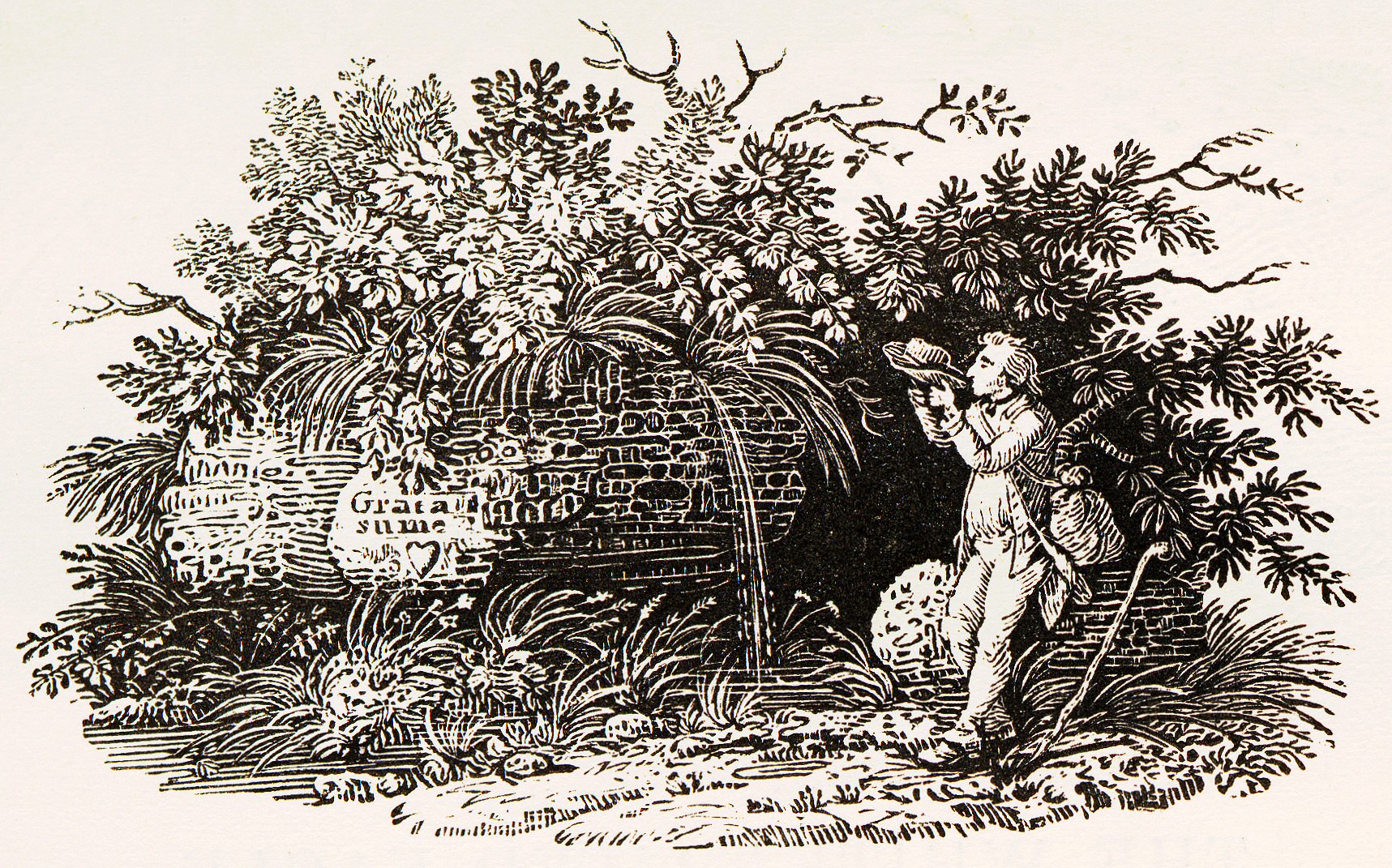
Tom Lubbock makes this interesting observation in his essay 'Defining the vignette', written to accompany a 2009 exhibition Thomas Bewick: Tale-pieces and reprinted in his posthumous collection, English Graphic. You can see in the image below of a thirsty traveller how the vignette's edges are defined by branches, leaves and tufts of grass. Lubbock saw this as 'place-portraiture', with Bewick isolating a site's distinctive features, 'those elements by which you would know it again'.
In his essay Lubbock includes a vignette of a hunter in the snow and then, underneath, the same image with a rectangular frame added. Without the frame, the snow's whiteness feels stronger, drawing into itself the whiteness of the surrounding page. Charles Rosen and Henri Zerner had previously described the way light in Bewick's landscapes 'changes imperceptibly into the paper of the book, and realises, in small, the Romantic blurring of art and reality.' Unfortunately I cannot convey the effect here because the background of the JPEG is a different white to the computer screen and thus creates its own frame.
Friday, April 24, 2020
Springwell Quarry
The image above shows the first use of a quarry in Dr Who, for the 1964 series The Dalek Invasion of the Earth. This story was mainly set in central London but John's Hole Quarry in Kent was used as the site of a Dalek mine. As noted already, the locations website stops in 2012 and the last quarry location it mentions is Aberthaw Quarry in Wales. I imagine there have been more recent examples, but I've not been watching Dr Who since the Tom Baker era so can't really comment on this myself. I see from Wikipedia (which has information on every series) that overseas locations are now used, but I hope they still manage to fit some quarries in. Some of the recent Jodie Whittaker episodes were made in South Africa. The Daily Express relayed the news that Jodie had 'opened up on what the experience was like. She told Doctor Who Magazine how the shoot in the warm country lasted three weeks. The actress said: “It was warm, so that was good!"'
Aberthaw Quarry (The Time of Angels)
Argoed Quarry (Utopia)
Associated Portland Cement Company Quarry (The Macra Terror)
Beachfields Quarry (Frontier in Space)
Beachfields Quarry (Planet of the Daleks)
Beachfields Quarry (The Invasion of Time)
Betchworth Quarry (Genesis of the Daleks)
Betchworth Quarry (The Deadly Assassin)
Castle Cement Quarry (Battlefield)
Cloford Quarry (Time and the Rani)
Cwt y Bugail Quarry (Rigcycle) (The Five Doctors)
Gerrards Cross Sand and Gravel Quarry (Attack of the Cybermen)
Gerrards Cross Sand and Gravel Quarry (The Dominators)
Gerrards Cross Sand and Gravel Quarry (The Tomb of the Cybermen)
Gerrards Cross Sand and Gravel Quarry (The Twin Dilemma)
Hanson's Aggregates (Binnegar Plain quarry) (Death to the Daleks)
John's Hole Quarry (The Dalek Invasion of Earth)
Little Rollright Quarry (The Stones of Blood)
Shire Lane Quarry (The Savages)
Slickstones Quarry (The Hand of Fear)
Springwell Quarry (Delta and the Bannermen)
Springwell Quarry (Earthshock)
Springwell Quarry (The Three Doctors)
Springwell Quarry (The Twin Dilemma)
Tank Quarry (The Krotons)
Trefil Quarry (Enemy of the Bane)
Trefil Quarry (Planet of the Ood)
Trefil Quarry (The Temptation of Sarah Jane)
Vaynor Quarry (Last of the Time Lords)
Warmwell Quarry (Survival)
Warmwell Quarry (The Greatest Show in the Galaxy)
Wenvoe Quarry (The Impossible Planet)
Wenvoe Quarry (The Satan Pit)
Wenvoe Quarry (Utopia)
West of England Quarry (The Krotons)
Westdown Quarry (Time and the Rani)
Whatley Quarry (Time and the Rani)
Winspit Quarry (Destiny of the Daleks)
Winspit Quarry (The Underwater Menace)
Worsham Quarry (The Android Invasion)
Wrotham Quarry (The Dominators)
Tuesday, March 19, 2019
A dark and desolate place
... it seems to me that I had a dream
And in that dream
I am suddenly woken up by
the fracas of deafening explosions.
I open my eyes
on infinite smoke and fog.
The incandescence of the ground
under my feet reveals to me that
I am in a dark and desolate place.
With one glance around me I discover
That I have arrived at the edge
of the well of hell.
Zhao Liang’s documentary, Behemoth (2015), on environmental destruction and the blighting of lives in Inner Mongolia, is consciously modelled on Dante's The Divine Comedy. The black pits created by mining and the fiery furnace in which men toil, shaping lumps of metal, certainly resemble Hell. Later in the film we see the grey industrial Purgatory that has arisen where once the steppe was verdant grassland. Finally, in a brilliantly ironic touch, we reach Paradise: the ghost city of Ordos, built by developers with the materials that have caused so much suffering to extract, but empty of all life except a solitary street cleaner. Zhao, interviewed for the Walker Art Centre by someone with the appropriate name of Bosch, said he read The Divine Comedy whilst making the film. At several points we see a 'guide', walking ahead with a mirror on his back, reflecting the landscape.
'The pneumoconiosis patients who carry the mirror represent the poet Virgil, who leads Dante. The naked guy in the broken mirror represents “me”—and is also Dante himself. The mirror being carried on the back and the broken mirror echoed each other. The black frame symbolizes death. The broken mirror also symbolizes broken mountains and rivers.'
'Panoramic shots of the mines, and the termite trail of trucks that crawl down the side of these gouged-out wounds in the land, evoke iconic photographs by Sebastiao Salgado of the Serra Pelada gold mine in Brazil. There are also parallels with the work of Edward Burtynsky, whose large-format shots of factories and industrial blight were the subject of Jennifer Baichwal’s documentary Manufactured Landscapes, and with Dorothea Lange’s seminal portraits of Americans displaced by the Great Depression.'
Footnote: the lines quoted at the start of this post I found on a movie script site. I could have used the slightly different English version in the subtitles for the film, but the translation seems less good.
Saturday, August 11, 2018
River in the Catskills
What was the first appearance of a train in a painting? Most people know Turner's Rain, Steam and Speed (1844), which is the earliest example listed on a Wikipedia page dedicated to railways and art. However, visitors to the National Gallery's Thomas Cole exhibition will see an earlier one in the painting reproduced above, River in the Catskills (1843). At the scale you're reading this you probably can't see the train, just a faint puff of steam in an idyllic landscape. But the railroad is in place and there are other signs too that the landscape is being changed - in the foreground men are chopping down trees. At the exhibition this painting is juxtaposed with a similar view painted in the 1830s, showing a vision of America unsullied. A baby reaches for the bouquet of wild flowers her mother has picked and on the gentle river an Indian canoe suggests a world of harmonious coexistence. However, as the curators point out, not everyone regretted the way things were going - there is a third view of this river by Asher Brown Durand, painted in 1853, with unmistakable signs of alteration and 'development', entitled Progress (The Advance of Civilisation).
It would probably take too long to write here about the main subject of the National Gallery's exhibition, Cole's series of paintings charting The Course of Empire, or about their simultaneous Ed Ruscha show that updates the theme and raises questions about contemporary America. You can read about these in various online reviews - e.g. Jonathan Jones, Waldemar Janusczcak, Michael Glover. Instead I will just add a few words more on Cole's remarkable painting Titan's Goblet which normally hangs in the Met, where its curators admit that it 'defies explanation'. This huge stone goblet is higher than the surrounding mountains and along its rim there are is a flourishing civilisation. Water falls like divine light onto the ground far below, where there are also signs of habitation but of a more primitive kind. That small sunlit sea, framed by the goblet's rim, is a landscape-within-a-landscape. But it could also be viewed as an unusual example of the hybrid genre I discussed in connection with Tacita Dean recently, the still-life-within-a-landscape. You can lose yourself in most of Cole's paintings but this is particularly true here. His friend Louis Legrand Noble saw a kind of Mediterranean in those waters, where tourists might travel to versions of Greece or Syria, tracing their fancies in 'in the golden splendours of a summer sunset.'
Wednesday, September 14, 2016
The open pit at Dannemora mine
Sadly we didn't get to witness the movable elements of this painting in motion. You can see one of these, the hoist used to bring up the ore, in the detail above. This feature is also visible in a watercolour by Elias Martin (below), which was clearly the source for the painting. Martin, Sweden's first prominent landscape painter, was best known for more Romantic landscapes. Compare the two views and you will see that the clockmaker added a church as a new focal point, which gives the composition a slightly surreal quality. It contrasts with the black pit in the centre foreground, where we would normally wish to find a limpid pool or shady grove. Perhaps it was put there to suggest the opposition of heaven and hell, or maybe it was there to strike a note of approval, blessing the labours of the miners and mine owners. Dannemora mine was established in the Middle Ages and it is hard to imagine the countless hours of work that went into it, until eventually it was shut down in the early nineties. Recently the mine was bought and reopened in a ceremony featuring King Carl XVI Gustaf but I see it has subsequently ceased operation again.
This hybrid clock/painting made we imagine an alternative history for the cuckoo clock without the chalet or woodcutters or water wheels. Each hour a bird would simply emerge from an attractive Black Forest scene to emit a melodious song. A few examples of nineteenth century paintings with inbuilt clocks can be seen online, their faces placed where a sun or a flower might be. You half expect them to start melting like the soft watches in Dalí's The Persistence of Memory. Clocks within paintings were popular in Austria and Germany but rarely had moving parts. You can view one on Youtube though, in which two hammers beat on an anvil when the hour is struck. It's a bit hard to make out what the figures in the foreground are doing - is there some nudity involved or is that my imagination? Again the setting here is industrial - it must have been hard to imagine a clockwork mechanism without thinking of the machines used to channel and reshape nature. For centuries artists have found ways to convey the diurnal cycle or capture a fleeting instant, but painting, fundamentally, is not a time-based medium. A clock measures out the hours, a landscape painting should be timeless.
Thursday, May 19, 2016
The Lower Falls of the Labrofoss
The new wall text for The Lower Falls of the Labrofoss notes that this location is now the site of a hydroelectric power station. Reading this I imagined curating a whole exhibition of paintings of rivers that were subsequently tapped for their hydroelectric power - images of the Romantic sublime that could only now be depicted in terms of the industrial sublime. In providing this information for the visitor, the Gallery turns the painting into a kind of an environmental art work. But Dahl was not painting a pristine wilderness. The foreground is strewn with tree trunks that are too large to have been felled by the river. They were the product of a lumbering operation were logs were thrown into the river and then collected downstream. Thus the forest trees and running water depicted in this painting were already being treated as a 'standing reserve' for technological exploitation when Johan Christian Dahl passed this way, nearly two centuries ago.
Saturday, September 19, 2015
The abandoned city of Prypiat
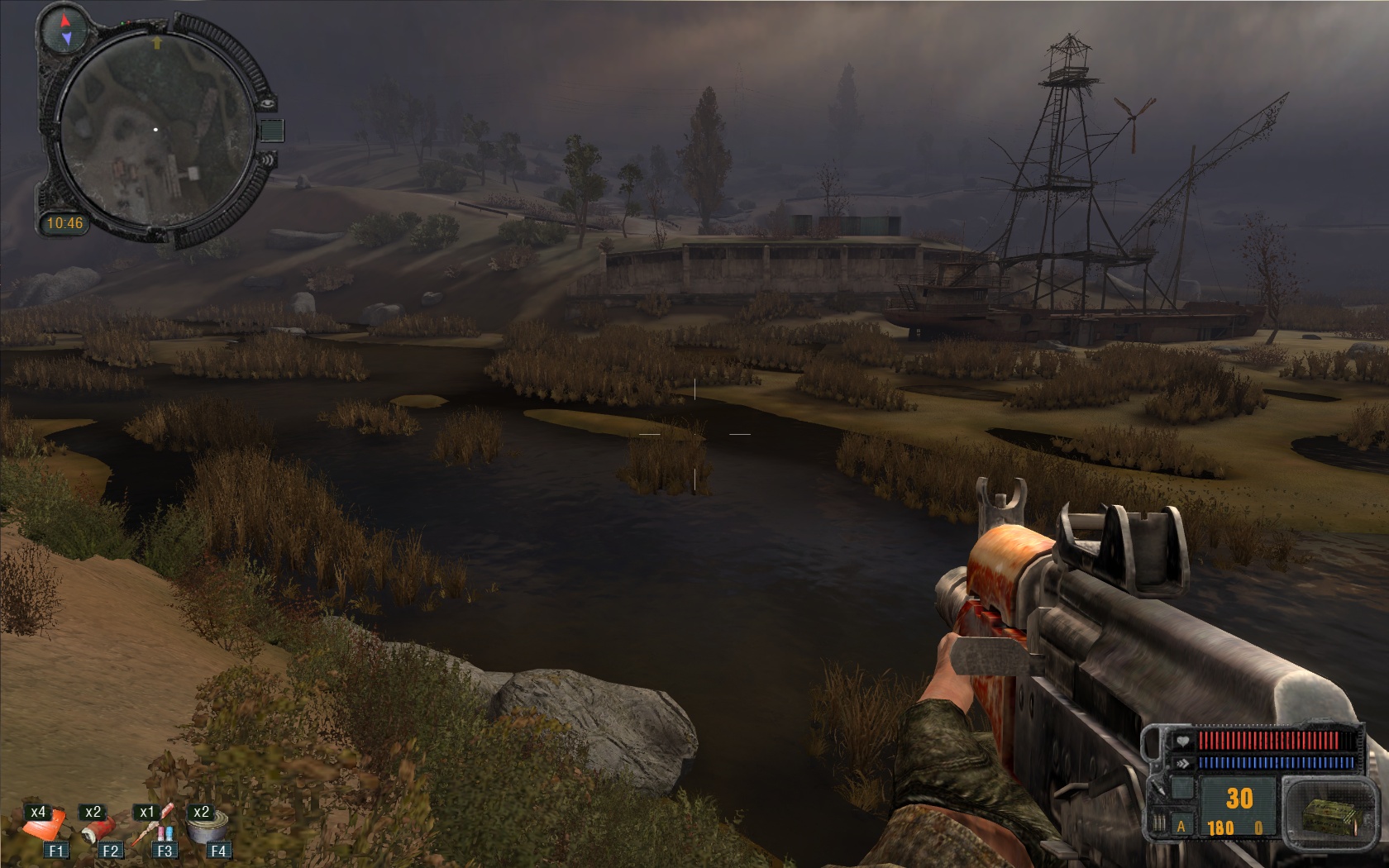
'The asphalt surface is split as if rotten, and welters around strapping trunks. Every two- and three-storey building has been overgrown and is deep in tree shade. Leaf ghosts camouflage grey concrete panels, where last year's emulsified foliage has printed itself on to the walls, This year's leaves are adjacent and ready. In other places the concrete is veined with green deltas of moss and water runs up as well as down. The buildings seep...'Prypiat was the U.S.S.R.'s ninth nuclear city, built in 1970 to service the workers at Chernobyl. Its ruins are increasingly well-explored and photographed and are possibly too rich in symbolism to offer much scope for artists. They have appeared in music videos and TV programmes (an episode of Top Gear), fictionalised in novels, movies and video games like S.T.A.L.K.E.R. It is now possible to go on tourist trips to see the dead city but restrictions on access have allowed some non-professional artists to receive attention for their work. The Daily Telegraph published a set of photographs by 'Michael Day, 29, an air traffic controller from London' who 'visited the disaster scene with a Ukrainian government escort to photograph the ghost town'. The drone footage in Postcards from Pripyat (above) was put together in his spare time by a photographer working for CBS. In a crowd-funded project, Prypyat mon Amour, Alina Rudya has returned to the city her parents left in 1986 to take ghostly photographs of herself in and around what remains of their old apartment block; a book is due out next year to coincide with the thirtieth anniversary.
Research continues. Tim Mousseau was interviewed in the New York Times last year about new research on adaptation in some bird species. He still 'dismisses the idea that the Zone is some kind of post-apocalyptic Eden. But the latest study has given him pause, he said, because it shows the kind of adaptations that may allow some creatures — chaffinches and great tits in this case, though not barn swallows or robins — to thrive in the Zone. However, it remains to be seen whether these species are truly thriving...' Mousseau is broadening and deepening his research around Chernobyl, but he now has to divide his time. Since 2011 he has made more than ten trips to Fukishima.
Wednesday, September 02, 2015
Falling Upwards
Whilst in Spain last month we took to the air in a balloon. I also read Richard Holmes' entertaining history of nineteenth century ballooning, Falling Upwards, which included some details that reminded me of our flight over the volcanic landscape of Garrotxa. Holmes describes an ascent made by the leading Victorian balloonist Charles Green, accompanied by a wealthy MP and an Irish musician, Monck Mason, who wrote the trip up as Aeronautica (1838). They set off in the Royal Vauxhall from London on a November afternoon in 1836 and by dusk they were over the Channel and tucking into ‘a huge meal of cold meats and wine’. I smiled on reading this as it was exactly what we were given to tuck into after we landed. Whilst aloft we toasted the flight with a glass of pink cava. Champagne drinking seems to have been de riguer on most nineteenth century balloon trips, although Monck Mason claimed that the lower pressure at altitude made it too frothy, shooting from the bottle and ‘revealing what he called its "natural tendency to flying". Perhaps under the influence of these refreshments, the landscapes of northern France seen after dusk, with isolated points of candlelight "burning late" in the villages below, seemed infinitely romantic and mysterious.’
Above the Garrotxa we were flying over winding rivers, terracotta-tiled farm buildings and the densely wooded slopes of extinct volcanoes, but it was impossible not to register too the motorway network, ribbon developments and light industrial buildings on the outskirts of every sizable settlement. Holmes recounts how, when the Royal Vauxhall reached the Meuse, the crew were astonished to realise that the great industrial complex visible below them was the historic city of Liège. Its surrounding districts "appeared to blaze with innumerable fires … to the full extent of our visible horizon." At the height we were flying we could not hear the sounds of industry below - perhaps it is relatively silent these days. Holmes describes what the balloonists could hear as they passed over Liège: 'disembodied shouting, coughing, swearing, metallic banging and sometimes, weirdly, sharp echoing bursts of laughter. They were being granted a unique, nightmare vision of the new industrial future, a world of ever extending ironworks, where every street was "marked out by its particular line of fires."’
The Royal Vauxhall continued into the night. "Occasional faint flashes of lightning would for an instant illuminate the horizon ... Not a single object of terrestrial nature could anywhere be distinguished; an unfathomable abyss of 'darkness visible' seemed to encompass us on every turn."
Holmes observes that Mason's description of night's "cold and dark embrace", like "an immense block of black marble", might have come from Edgar Allan Poe, whose story 'The Unparalleled Adventure of One Hans Pfaall' appeared the year before this flight, and who went on to feature Green and Monck in his newspaper hoax 'The Atlantic Balloon' in 1844. Eventually the aeronauts recognised the Rhine but continued eastwards and by morning thought they might have reached "the barren and inhospitable Steppes of Russia". In fact they finally landed in some north German fir trees. Our balloon flight looked at one point like it might end in some trees too, or even on a small traffic island, but we eventually touched down smoothly on some rocky ground and once the balloon had been furled and loaded onto its trailer we set off back to enjoy our botifarra.
Friday, July 10, 2015
Vision of a possible city
In 2012 William Kentridge delivered the Charles Eliot Norton Lectures at Harvard University. This was the lecture series that gave us Italo Calvino's wonderful Six Memos for the Next Millenium (he died before he could deliver them); I wonder how differently these might have been conceived now, in the age of Ted Talks and multi-media. It is no surprise that an artist like Kentridge interspersed his words with film clips or that Harvard University Press have produced an enhanced e-book of the lectures, Six Drawing Lessons. However, I've been reading an old-fashioned hardback version and thought I'd share here a few observations he makes on the history and geography of Johannesburg, a city he has lived in his entire life.
Johannesburg is a city that has 'an entirely geological justification'. When a meteor struck the land it's impact caused a thin seam of subterranean gold to be tilted so that it met the surface a hundred kilometers from the impact site. After the discovery of gold in 1886 Johannesburg was, for its first thirty years, the fastest growing city in the world. There is a map made in 1889 that shows the physical landscape, the initial constructions (see photograph below) and 'a vision of a possible city. At the time the map was drawn and printed, only about 3 percent of the streets and buildings and suburbs on it had been made. It is extraordinary that now, 120 years later, almost all the map exists as a physical fact.'
Kentridge goes on to describe an episode that would have intrigued Calvino, author of Invisible Cities and The Baron in the Trees.
'Around 1900, at the end of the war between the British and the Afrikaners for control of the gold mines, the city of Johannesburg, wanting to keep the demobilized soldiers busy rather than drunk, employed them at a penny a tree to plant a forest of a million trees on the pavements and gardens of the city. Johannesburg, by its own and some outside estimations, is the largest man-made forest in the world. From my studio, you look out over an undulating sea of treetops.'The lush gardens and trees are sustained in this naturally dry, inhospitable land by irrigation that brings water from rivers hundreds of kilometers away. 'The streams of the city itself are miserable ditches, stormwater drains awaiting the rainstorms. But underground, where the mining is, it is the reverse.' The continual pumping away of this water has left the ground prone to sinkholes, an unstable foundation for the racially segregated suburbs. 'In my childhood there were stories of an entire tennis match - the umpire on his high chair, the tea and orange juice on the table next to the court, the family Labrador - all being swallowed by a huge sinkhole, never found, never recovered.'
Friday, November 28, 2014
Views from the Internet
Last week I went to a discussion on landscape and photography at Tate Modern. This wasn't linked to their new exhibition Conflict, Time, Photography but to one at Somerset House I referred to here last year, 'Landmark: the Fields of Photography'. The event was to promote a book of the show, edited by William Ewing, who chaired the panel of five artists: Thomas Struth, Massimo Vitali, Lauren Marsolier, Penelope Umbrico and Mishka Henner. This represented a kind of spectrum, from Struth and Vitali who still compose and takes photographs to Umbrico and Henner who construct images from sources found on the internet. Marsolier might be seen as somewhere in the middle, using her camera to capture fragments of landscape which she then digitally montages into scenes that convey a sense of feeling "disorientated and disconnected". These oneiric visions with their blank windows and pale skies, "absolutely still with no breath of air" as Ewing observed, seem to fuse the reality of California with the abstract spaces of the internet.
Penelope Umbrico said she sees the Web itself as her landscape. In Views from the Internet she collected landscapes glimpsed through windows found on home decor sites. 'Used as peripheral devices to elicit desire for the objects (and lifestyles) sold on these websites, the views are an invitation: they invite retreat and escape - into utterly flat space that is nowhere.' She has also made a series called Honeymoon Suites by scanning the candy coloured horizons and skies in holiday brochures to create distilled digital abstractions of happiness. 'While the horizon is intended to signify perfect love and escape, it equally points to the unattainability of both.' The vast archive of holiday photographs on Flickr is the source for her installation Suns (from Sunsets), which I saw at the Landmark exhibition. A a sense of the digital sublime is conveyed by retitling the work each time she exhibits it according to the number of sunsets available on Flickr at that date: in 2006 this was 541,795, on the day of the talk last week it stood at 22,177,914. Apparently people have taken to photographing themselves in front of her wall of sunsets as if they were posing in front of a real sun.
I found Mishka Henner particularly interesting, although his dry humour seemed to bypass some in the audience (he sounded like Simon Armitage would if he read BLDGBLOG). He argued that the problem with digital culture is not that there are too many images, but that we have not yet found ways to navigate through them. He talked about the world of GoogleEarth and online photography as a kind of landscape of infinite detail. He has been able to construct striking aerial views of oil fields that would have been impossible to photograph directly, exposing the way pipelines have grown like root systems through river valleys, farmland and urban centres. Thomas Struth took issue with this kind of work, suggesting that it has immediate political impact but no aesthetic value. Henner didn't argue the point, although it seemed pretty obvious that his images of US feedlots, for example, composed from satellite imagery, have a horrible beauty. Struth has himself chosen political subjects - Ramala, Chinese industrialisation - and his early work in Germany documenting urban architecture always seems to ask the basic question of why we have designed our living environment to look like this.
Although Struth is a major figure I find it quite hard to think of anything particularly interesting to say about him (I went to his retrospective at the Whitechapel in 2011 but didn't write about it on this blog). His large-scale photographs of people in museums are similar to the beach scenes that Massimo Vitali has been photographing for the last twenty years. At first sight such photographs have more in common with the panoramic crowd scenes painted by artists like William Powell Frith than the panoramic unpeopled views we associate with 'landscape photography'. However, in Vitali's case, what is beyond the foreground seems important: the people sporting around in the water in his 1995 photographs at Viareggio are overlooked by watch towers and cranes, whilst in another image of Rosignano from the same year, the sunbathers are oblivious to the cooling towers of a power station behind them. There is pathos in the way these apparently unprepossessing strips of coast attract so many people, despite the proximity of factories, viaducts and graffiti. "Being a tourist," Vitali told the Tate audience, "is one of the worst experiences you can have."
Saturday, June 16, 2012
Oil fields
I last wrote about Edward Burtynsky here four years ago, after seeing Manufactured Landscapes. Some of the images in that film, like the Chittagong shipbreaking beach in Bangladesh, have appeared subsequently in various exhibitions entitled Burtynsky: Oil. The series continues to develop: in May 2010 Burtynsky flew to the Gulf of Mexico to take some extraordinary aerial shots of the BP oil spill. These feature in a new version of the exhibition that marks the re-opening of London's Photographer's Gallery. I was there yesterday, reflecting on how hard it is here in England to even imagine landscapes like Highway #1, Intersection 105 & 110, Los Angeles, California, USA or Oil Fields #22," Cold Lake, Alberta, Canada. Writing about these photographs for the LRB, Tony Wood notes that sometimes their scale is so vast that any actual humans are too small even to register. He describes Alberta Oil Sands #6: 'a massive installation for extracting oil from tar sands. The picture is dominated by two huge yellow rectangles that seem like abstract forms drawn onto the landscape – but then you realise they are vats of sulphur hundreds of metres wide and hundreds more long.' Such images prompted another reviewer to conclude: 'Turner might have believed the landscape to be an ineffable manifestation of God, but Burtnysky proves that, post-industrially, it’s in the firm grip of the devil.'
A similar set of Burtynsky: Oil photographs is currently also on display at the Nevada Museum of Art (such things are possible in the age of mechanical reproduction...) Linked to this, there was an interesting conversation between Burtynsky, Geoff Manaugh and Nicola Twilley - the first manifestation of Venue, a travelling 'pop-up interview studio and multimedia rig'. Their discussion touches on Burtynsky's preference for photographing during “the shoulders of the day" (early morning and late evening), his desire not to frame the work in an activist or political terms, and his difficulties in gaining access to certain sites, like the Ghawar oil field in Saudi Arabia. But the most interesting exchange occurs when Geoff asks him, "Do you see a time when you’re not going to be riding in a helicopter over Los Angeles but, instead, piloting a little drone that’s flying around up there and taking photographs for you?" Burtynsky: "I’m already doing it." Twilley: "You have a drone?" Burtynsky: "Yeah. I use it to go into places where I don’t have any air space. I work with a team. One guy runs the chopper, one guy runs the head, and I take the shutter release and compose. For example, there is no civil aviation space in China, so I was using it there. I used it to shoot the big dam area, and I used it to photograph agriculture."
Tuesday, May 27, 2008
Manufactured landscapes
It's a very long way from the subject of my last posting to the industrial landscapes of modern China, explored in Jennifer Baichwal's film Edward Burtynsky: Manufactured Landscapes. Then again, Burtynsky's photographs are still a Western take on China - the exotic Rococo dream replaced by a nightmare of environmental apocalypse...
I tend to agree with Mark Sinker's verdict: "visually, the film is rich and subtle - Burtynsky finds an eerie beauty in the starkest, most poisoned, emptied vistas; what's deathly here is also potent and haunting. The words and music are less successful - the former somewhat diffident and unspecific, perhaps tactically, the latter rather off-the-peg, an Eno-esque soundtrack to an arch suspension of judgement. And the problem of the cliché of the Chinese as a teeming, purposeful yet inscrutable ocean of humanity is perhaps not quite pushed back against as much as it might be."
Sinker may be hinting here that the 'diffident and unspecific' commentary was necessary to get agreement to shoot the film. I suppose I was expecting something more creative, like the poetic science fiction of Herzog's Lessons of Darkness. The relative banality of the narrative in Manufactured Landscape does allow you to focus on the visual imagery, but it left me pondering (no doubt unfairly) whether the photographer and film maker had sufficiently reflected on what they were filming. Sinker provides an example in highlighting the Ballardian landscape of the Chittagong shipbreaking beach in Bangladesh, "where huge rusting tankers sit stranded on otherwise naked mudflats, scavenged and dismantled by local teenagers. We're told almost nothing about this set-up - except that it's very poorly paid and very dangerous - but Burtynsky perhaps judges the force of the image more effective than any lecture about economics or sociology."
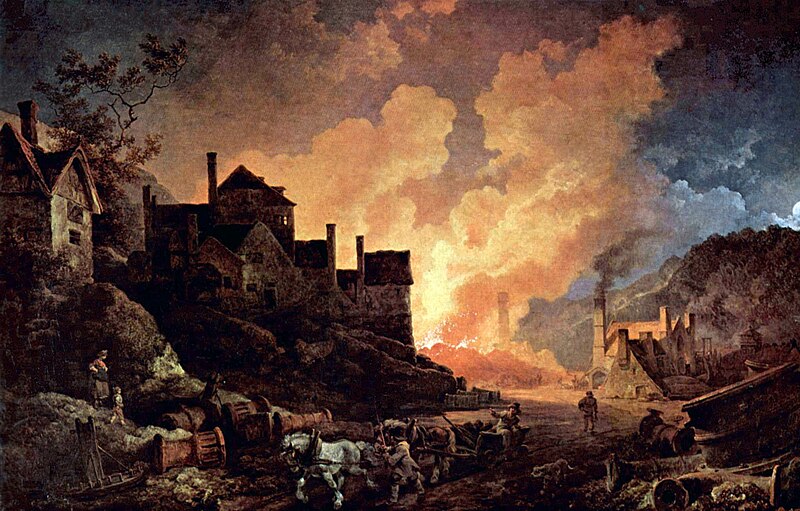
How far would the emotions felt two hundred years ago in front of a painting like Coalbrookdale by Night have differed from those experienced by a modern viewer of Manufactured Landscapes. There is the same frightening power to alter landscapes and replace natural with manufacturing forces, and the same human and environmental costs (which were, of course, evident to poets like Blake and Wordsworth). But the sense of scale is far greater in this film - there is something of Kant's mathematical sublime in Burtynsky's photograph of seemingly endless mountains of coal, or in Baichwal's long opening shot of a vast factory floor. The enormity of the Three Gorges Dam, where Burtynsky photographed a city about to be drowned, is difficult to grasp. This awesome construction seems to have been unscathed by the recent Sichuan earthquake, in which terrifying natural forces have created new lakes through landslides, as well as weakening dams built by the Chinese (including one that is over 2000 years old).
Friday, August 03, 2007
Red Desert
Michael Gandy quotes a 1964 Sight and Sound article in which Michele Manceaux describes Antonioni’s choice of Ravenna ‘for its smoky factories, its oil derricks, its steel pylons. After the war, the pinewoods stretched down to the sea and the town had thirty thousand inhabitants. Today the silos and oil refineries have killed off the trees. Oil has been found here, artificial islands have been built; and there are a hundred and forty thousand inhabitants.’ Manceaux interviewed Antonioni, who said ‘I don’t say that there ought to be a return to nature, that industrialization is wrong. I even find something very beautiful in this mastery of man over matter. To me, these pipes and girders seem just as moving as the trees. Of course it’s horrifying to think that birds which fly through these fumes are going to fall dead, that the gas makes it impossible to grow anything for miles around. But every age, after all, has called for its sacrifices, and it’s out of these that something else has grown.’
Wednesday, July 11, 2007
Coalbrookdale by Night
Source: Wikimedia Commons
Monday, July 09, 2007
St Louis zinc smelting establishments
'Coming back to St. Louis this evening, at sundown, and for over an hour afterward, we follow’d the Mississippi, close by its western bank, giving me an ampler view of the river, and with effects a little different from any yet. In the eastern sky hung the planet Mars, just up, and of a very clear and vivid yellow. It was a soothing and pensive hour—the spread of the river off there in the half-light—the glints of the down-bound steamboats plodding along—and that yellow orb (apparently twice as large and significant as usual) above the Illinois shore. (All along, these nights, nothing can exceed the calm, fierce, golden, glistening domination of Mars over all the stars in the sky.)
As we came nearer St. Louis, the night having well set in, I saw some (to me) novel effects in the zinc smelting establishments, the tall chimneys belching flames at the top, while inside through the openings at the facades of the great tanks burst forth (in regular position) hundreds of fierce tufts of a peculiar blue (or green) flame, of a purity and intensity, like electric lights—illuminating not only the great buildings themselves, but far and near outside, like hues of the aurora borealis, only more vivid...'