Showing posts with label plein air. Show all posts

Friday, January 31, 2025

An Outcrop in the Campagna


 Frederic Leighton, A Nile View, 1868

'The keynote of this landscape is a soft, variant, fawn-coloured brown, than which nothing could take more gratefully the warm glow of sunlight or the cool purple mystery of shadow; the latter perhaps especially, deep and powerful near the eye (the local brown slightly overruling the violet), but fading as it receded into tints exquisitely vague, and so faint that they seem rather to belong to the sky than to the earth. At this time of year the broad coffee-coloured sweep of the river is bordered on either side by a fillet of green of the most extraordinary vivacity, but redeemed from any hint of crudity by the golden light which inundates it.' - Leighton's travel journal, October 1868

This panorama is one of the highlights of Leighton and Landscape: Impressions from Nature, an exhibition of oil sketches which we saw at Leighton House last month. It was painted on the first of three trips he made to Egypt - Leighton was a lifelong traveller and, having grown up on the continent, was fluent in several languages. A wealthy bachelor, he was also extremely well connected and for this trip was provided with a steamer to take him up the Nile. He evidently took pleasure in making oil sketches but didn't do them on every trip, or at least so it appears - we don't have a record of them all and he mainly kept them private, only showing some of them late in his career. His modesty about them can be explained in terms of his self-image as President of the Royal Academy, engaged in the highest-regarded genre of history painting, but it still seems extraordinary.

There is an excellent catalogue which apart from anything else smells delightful (mine still has that fresh paper new book aroma!) The main author is Pola Durajska who did a PhD at York on Leighton's landscapes. She and the other authors point out some interesting features of his sketches:

  • He experimented with different shapes of canvas (cutting them to size himself) and varied his technique from impasto to thin wash-like effects. 
  • He looked for interesting light effects at different times of day and studied the intense shadows and bright white buildings of north Africa.   
  • His interest in architecture influenced his choice of landscapes, with castles and towns blending into their surroundings and rock formations shaped like ruins.
  • He rarely included figures or local colour and did not record where the sketches were done, making the locations of some of them hard to pin down.
  • He also avoided the obvious, painting unregarded corners of cities like Venice and Jerusalem, or framing famous vistas differently to earlier artists.   
I'll end here with one of the Gere Collection paintings normally on display at the National Gallery. The wall text at Leighton House says that 'it is not easy to understand exactly what attracted Leighton to paint this particular grassy, hillside slope in Italy. Without any discernible focal point or distinctive feature, other than a flash of yellow sandy soil in the foreground, perhaps its appeal was in the simple combination of the green mass of the landforms against the deep blue of the sky. This apparently unpromising combination of elements typifies Leighton's approach to finding a subject.' 


Frederic Leighton, An Outcrop in the Campagna, probably 1866

Saturday, March 28, 2020

Scrub and quarry

Painting en plein air can bring many unexpected problems, from the bandits encountered by Thomas Jones to the waves that drenched Claude Monet.  The British artist Ray Atkins has not made it easy for himself:
'He sets up his boards – sometimes up to 10 foot wide, and weighing a hundredweight – in the landscape he's painting, tethering the work to the ground with rocks and leaving them in situ for weeks at a time. Obviously this method leaves the work at the mercy of the elements and of vandals - indeed, one of his monumental works of the Thames at Millwall ended up floating downstream after his secret painting place was discovered by local vandals.' (The Guardian, October 2012)
Wind is a particular risk if you're going to set up pictures on this scale - once one of Atkins' pictures ended up at the bottom of a quarry, as William Feaver noted in his catalogue essay for a 1996 retrospective.

Catalogue for the 1996 Ray Atkins exhibition at Art Space Gallery, Bristol

It would be easy to criticise this approach to painting as playing out the stereotype of 'man' against nature.  But William Feaver argued that
'there is no need to label Atkins 'heroic' in his persistence. The difficulties he makes for himself are essential to the outcome. Without them he would lack the resistance necessary for deep impetus. Painting on board rather than canvas gives him another sort of resistance. He dedicates himself to laborious cultivation; his is a kind of fieldcraft and makes him more the hunter-farmer than the painter of pleasing projects.' 
Feaver was impressed by Atkins's paintings of Cornwall, which were mainly done inland in an environment of 'scrub and quarry, land worked over and worked out.'  Scrapyard IV (1989) is particularly striking - 'crumpled colours dumped on the landscape'.


Eventually Atkins left Cornwall for the French Pyrennees, where he still lives and paints.  There is a YouTube video of him made in 2018 which shows a soft-focus sun-dappled landscape a world away from the docks of Millwall and scrapyards of Cornwall.  Here, near his home, you see him fixing up one of his boards in a field and beginning to work, before breaking off to enjoy the sunset.  As someone says at the end of the film, artistic fame may have passed him by, but at least he has been able to spend a lifetime painting.

Saturday, October 05, 2019

Emerald City


I’ve been looking through a library copy of The Art of the Hollywood Backdrop, a huge, glossy and expensive book based on material in the Art Directors Guild archives. Among its many full page illustrations there is a relatively brief history of painted backdrops in Hollywood, followed by short chapters on some key figures: George Gibson, Ben Carré, Duncan Alanson Spencer and two family dynasties, the Coakleys and the Strangs.

George Gibson (1904-2001) is possibly the most interesting of these from a landscape perspective, partly because he was also a well regarded water colourist and leading figure in the Californian School of plein air artists (many of whom worked in Hollywood). Gibson had been trained at Glasgow School of Art before emigrating to America during the Depression.  He had quite a low opinion of some of the backdrop artists he found working at MGM...
‘We had a large backing of mountains and pine trees to paint. At that time we had to work off fixed scaffolding with standing levels seven feet apart with a forty foot high backing. The pine trees in the foreground of the backing ran full size top to bottom. [When we] struck the fixed scaffolding, the only part of the pine trees that matched was their trunks. Every section on the seven levels [of scaffolding] had a different version of pine needles because each artist had his own conception of what pine needles should look like. It was obvious that they hadn’t been painting in the out-of-doors, or even bothered to look critically at a pine tree, if ever.’ 
Gibson was put in charge of work on backdrops for The Wizard of Oz, Brigadoon, North by Northwest, Forbidden Planet and many others.  The book includes photographs of the sound stages on which such movies were acted out, with their foreground props merging quite convincingly with painted landscape backgrounds.  There is an example of one landscape setting he painted himself, a church in the snow which can be seen in The Brothers Karamazov (1958).  However, many of the old backdrops have long since been damaged and lost.

When Mark Cousins was directing the Edinburgh Film Festival in the mid 90s he decided to draw a link between The Wizard of Oz and the city of Gibson's birth.  "We thought it would be fun and challenging to transform Edinburgh Castle into the Emerald City. No-one knew about the Gibson connection at that time."  I'm not sure what this transformation entailed, but certainly the connection has now been established and you'll find Gibson referred to in several online guides to Edinburgh.

Friday, May 03, 2019

The Lithuanian forests

..."What do you think?" He knelt and showed his drawing.
Telimena studied his efforts with much grace,
Though clearly she was a connoisseur.  Her praise
Was sparing, but she encouraged him generously.
"Bravo!" she said. "You've great ability.
Though never forget: an artist has a duty
To seek out nature's loveliness.  Oh, the beauty
Of Italy's skies!  Of Rome's imperial
Rose gardens! Tibur's ancient waterfall,
Pausilippo's fearsome tunnel!  Now that's a land
For art!  This place is pitiful my friend!"
'This place' was Lithuania, setting for the epic poem, Pan Tadeusz, which has been newly translated by Bill Johnston and published in a beautiful edition by Archipelago. My quotation exemplifies a scene often encountered in early nineteenth century literature, where a 'connoisseur' (usually male) is unable to see beyond classical ideals of landscape and appreciate what is in front of them. The conversation between Telimena and the artist, a wealthy young Count, turns to the 'azure skies' of Italy whilst all around them 'the Lithuanian woods stretch limitless'.  Pan Tadeusz, the story's hero and a simple young man who 'still felt nature's draw', urges the Count to paint the trees surrounding them. Tadeusz cares little for "those skies of Italy / All clear and blue - they look like stagnant water! Wind and rain are surely so much better. / Look up right now..." and he goes on to describe the variety and endless beauty of the clouds.

In addition to its forests and skies, Pan Tadeusz celebrates the music, clothing, food and customs of Lithuania in a plot that dramatises the cause of Polish nationalism (Poland and Lithuania had existed as a powerful joint state in Europe before being carved up by its neighbours).  The book was set in Lithuania but written in Polish from Paris, where Adam Mickiewicz (who was actually born in what is now Belarus) had gone to live. Reading Pan Tadeusz I was conscious of the influence of Scott, Byron and Pushkin, but it also reminds me of Turgenev, while Bill Johnston sees elements of Thomas Hardy.  Some of the poem's most famous scenes lend themselves to landscape illustration, such as the bear hunt (below), or a mushroom picking excursion in which the young men look for chanterelles and the ladies seek 'the slim boletus known / In song as the mushroom's general.'

Franciszek Kosttrzevski, Hunting scene in 'Pan Tadeusz', 1886

It is not possible now to write about Pan Tadeusz without referring to Landscape and Memory, which opens with Simon Schama in the puszcza, the woodland wilderness that has become the 'consolatory myth of sylvan countryside that would endure uncontaminated whatever disasters befell the Polish state'.  He discusses Pan Tadeusz and the life of Adam Mickiewicz at some length, showing how, for example, 'no writer before Mickiewicz had described the etiology of the ancient forest with such a keen eye, or worked harder to convey its shifting zones of light and darkness.'  Beyond its tangle of broken trunks there are deep ponds 'half overgrown with grass' where 'the water has a bloody, rust-red sheen / While wisps of noxious smoke rise from within.'  But at the centre of the forest, Mickiewicz imagined a hidden world, ruled by bears, aurochs and bison, where 'decorousness prevails' and an unarmed man would be left unharmed.  Schama pictures Mickiewicz writing this in his Paris apartment, where it was a 'landscape of memory, seen through a lead-pane window: grey houses metamorphosing into timber ruins, the streets invaded by the forest primeval; an unattainable Lithuania governed by bison, a commonwealth of perfect justice and peace, impregnable behind palisades of splintered hornbeam.'

Friday, July 14, 2017

View of the Garden of the Villa Medici

 Diego Velázquez, View of the Garden of the Villa Medici, c. 1630
Source: Wikimedia Commons

In the course of her fascinating book on Velázquez, The Vanishing Man, published last year, Laura Cumming writes about 'a picture without precedent.'  The View of the Garden of the Villa Medici 'seems to have no pretext, no definitive narrative or focus.  A fragmentary glimpse, strikingly modern in its random observations, it is simply itself - the momentary scene.'  Velázquez was in Rome in 1630 and knew Poussin and Claude, who were painting their great classical landscapes at this time.  But 'to depict nature purely for itself, live and unadorned - in its natural state, as it were - was very much the innovation of Velázquez.'  Cumming sees nothing similar in art before Corot, 'whose silvery landscapes with their secretive air have a genetic link back to Velázquez'.  But is it really the case that Velázquez was so ahead of his time?  

Albrecht Altdorfer, Landscape with Footbridge, 1516
Source: Wikimedia Commons
 
In Western art, earlier 'independent' landscape paintings, going back to Albrecht Altdorfer, do not have the air of real places seen at real moments.  There are plein air sketches that have this quality, but they do not resemble the Velázquez eitherClaude made such studies in the Roman Campagna and the example below is by another contemporary, Van Dyck, who was court painter to Charles I while Velázquez worked for Philip IV of Spain (The Vanishing Man is about a portrait of the young Charles that was apparently painted by Velázquez, or possibly by Van Dyck, or maybe neither...)  The View of the Garden of the Villa Medici is different, more reminiscent of certain oil sketches made in the late eighteenth century (the cloth on the balcony is like the washing hung out on Thomas Jones' A Wall in Naples).  It could have been a sketch of this kind, but the Prado's curators (quoting Javier Portús) say that it is currently considered to be a finished, self-sufficient work.

Anthony van Dyck, An English Landscape, c. 1635
Source: Wikimedia Commons

Laura Cumming describes The Vanishing Man as 'a book of praise for Velázquez, greatest of painters.'  She writes effusively about the brilliant and subtle ways he found to apply paint to canvas.  In the View of the Garden of the Villa Medici, which is relatively small (48.5 x 43 cm), she notices something remarkable.
'The weave of the cloth is exactly the right size to imitate the pattern of bricks at that distance.  This is one of Velázquez's unimaginably subtle calculations.  How could he guess in advance, or did it come to him as he painted?  This is a great question with his art: what grows out of what, how it all evolves at leisure, or at speed, by chance or design.  But what one sees here is something akin to precision engineering, in terms of vision and judgement: each brick finds its tiny outline in the grid of threads.'
   Diego Velázquez, View of the Garden of the Villa Medici [detail], c. 1630
Source: Prado

Perhaps surprisingly, Cumming makes no mention of the fact that this painting of the Villa Medici has a companion piece, also in the Prado: a view of the same structure seen from a different angle, but with more prominent foreground figures.  It is a marvellously strange, enigmatic image; in the background a man looks out at the distant view, like a Romantic Rückenfigur, and beside him the statue of sleeping Ariadne foreshadows the sequence of mysterious Ariadne paintings de Chirico painted in 1912-13.  There might originally have been two more of these paintings.  It may be that what we have now 'are two of the four little landscapes that the artist sold to Phillip IV in 1634' (Portús).  The disappearance and reappearance of artworks is central to The Vanishing Man and now, after having read it, I can't help wondering about the possibility of other Velázquez landscapes one day coming to light.

Diego Velázquez, View of the Garden of the Villa Medici, with the statue of Ariadne, c. 1630
Source: Prado

Friday, June 02, 2017

The ruins of Karnak

Paul Nash, The Wanderer (detail), 1911
Source: British Museum

The British Museum currently has an exhibition of British landscape watercolours which focuses on the period 1850-1950, the century after the Golden Age.  It includes familiar names that I have often featured here - Samuel Palmer, John Ruskin, James McNeill Whistler, Paul Nash (see above). There are also landscapes by artists more usually associated with other genres - John Singer Sargent (society portraits), Anna Airy (war workers), Hubert von Herkomer (depictions of the poor).  And there are the somewhat forgettable Victorian artists with their double names - Alfred William Hunt, George Pryce Boyce, Edward John Poynter - whose picturesque views are painted beautifully but don't stick in the mind very long.  One of the things you realise from this show is how many now-rather-obscure artists were renowned at the time and made a fortune from their paintings.  I made a note of one nice winter scene by William Russell Flint, who you would be forgiven for not having heard of, even though he was knighted in 1947 (according to Wikipedia he 'enjoyed considerable commercial success but little respect from art critics, who were disturbed by a perceived crassness in his eroticized treatment of the female figure.') 

William Russell Flint quote (after Thomas à Kempis) from 1924,
on display at the Places of the mind: British watercolour landscapes 1850–1950

The British Museum has been collecting watercolours for a long time - the exhibition includes one painting by Francis Towne that was part of his bequest in 1816.  Some parts of its collection have never been seen publicly before, including one work by an artist about whom very little is now known, Henry Stanier.  According to the Guardian, 'the long-awaited public showing comes 113 or so years after the death of the artist' (who was waiting for it they don't say - perhaps we all were, without knowing it).  Kim Sloan, this exhibition's curator 'discovered the huge watercolour in an obscure corner of the museum more than 10 years ago, when she was looking for the original frames for some Turner watercolours.  To her astonishment she found not just empty frames, but three paintings by Stanier, an artist she had never heard of. They appear to have been stashed away in the 1950s without ever being recorded in the museum’s collection.'  The unearthing of this view of the temple complex at Karnak sunds almost like an act of archaeology.  Karnak itself continues to yield new finds a century after Stanier was there and you wonder how much else there is to find in the recesses of the British Museum.

Sunday, February 05, 2017

Cattle and their doubles in the lucid shallows of the bay


This little book, Letters on Landscape Photography, was published in London in 1888.  By then there were numerous such books dedicated to the hobby, but many people, like its author Henry Peach Robinson, were old enough to recall the days when photography was still in its infancy.  It would take almost another century for the question that underlies the book - can photography be art? - to be definitely settled by museum curators in the affirmative.  Robinson writes that ‘more than twenty years ago, when the opposition to art in photography was at its fiercest, there was a capital article on landscape painting in a now dead review.’  The author of this article had criticised the idea of the landscape photographer with an anecdote about a trip to the Highlands.  There, one day, he had settled down to paint en plein air, having found the perfect spot in a ‘wide open space of sea and sky, with a glorious foreground of cattle and their doubles in the lucid shallows of the bay.’  He was soon painting quietly...
'The ripple hardly broke louder than my pulse.  Presently a stoat bounds into the road, and I had time to observe what enjoyment of life there was in the unalarmed, untamed step of the creature.  The heron rose near me; and as I was beginning to take it all in with half-shut eyes, and to remark how the powerful tones of the cattle, fawn and flame colour, white and yellow, blood-red and black, seemed to give infinitude to space – a photographer walks briskly before me, and with an air and noise of satisfaction begins to open and adjust his box.  I give you my word that the look of quiet horror that came over the scene was unmistakable – not horror exactly – did you ever remark the face of a girl when she sets it?  It was precisely that.  Not only did the stoat disappear, but – I don’t know whether it was the creaking of the machine, or the business-like stare of the man – the cattle grew conscious and uncomfortable, and it was not without satisfaction that I saw a mist creep up from the sea, and steal away the shimmer and the charm.  I left him some cows lashing their tails, some blackthorn and Scotch fir, and the average coast formation.’
Robinson concedes that this is prettily written but thinks ‘this sort of tip-tilting of the nose at photography as an art is only possible now with fifth-rate painters, or, in the press, with their friends, or those who have failed in the art.’  It's a good example of the never-ending arguments about how to behave in the landscape and have an 'authentic' experience of nature.  These will return every time there is a new technological development that provides a novel means of 'capturing' the view.  I note that the title of Hamish Fulton's new exhibition, starting next week in Munich, is called 'Walking without a Smartphone'...  The paragraph is interesting too from a gender perspective, where the painter is permitted to see the view in its natural state, while the business-like 'stare of the man' with his camera prompts nature to set her face.  You half expect the photographer to be set upon by dogs like Actaeon.  And yet there remains an impression that the painter himself has not really been seeing what is before him, apparently and paradoxically able to 'take it all in with half-shut eyes...'

Sunday, July 17, 2016

A Panorama of the Engadine

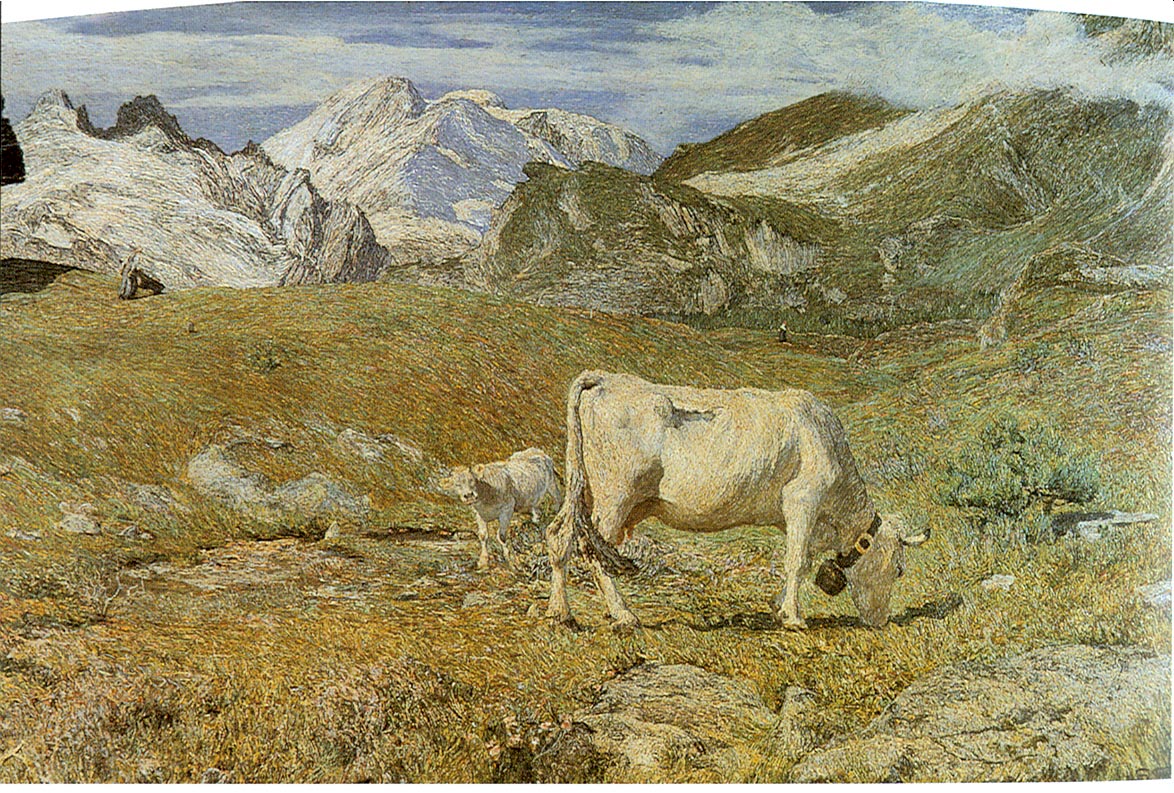
Giovanni Segantini, Spring Pastures, 1896
Source: Wikimedia Commons

In Journey to Mount Tamalpais, Etel Adnan's book that I discussed here a fortnight ago, she looks backwards to the mountain-haunted art of Hokusai and Cézanne.  Hans Ulrich Obrist mentions these artists too in the course of the interview transcribed in Etel Adnan in all her Dimensions, but he also refers to another painter of mountains, Giovanni Segantini, who ‘lived higher and higher up and when he died he was at 2500 metres in his cabin.’  This ascent was parallelled by his growing fame at the end of the nineteenth century, as the Segantini Museum in St. Moritz points out.  Segantini's search for ever higher places to paint en plein air was influenced in part by his reading of Nietzsche and he chose to work in the Swiss Engadine mountains that had inspired Thus Spake Zarathustra.   He was only 41 when he died in 1899, whilst painting the middle section of his Alpine Triptych, his health having been affected by working at altitude on the mountain of Schafberg.

 Giovanni Segantini, Alpine Triptych: Death, 1898-99
Source: Wikimedia Commons

A year after Segantini's death, the Universal Exposition in Paris might have contained his extraordinary panorama of the Engadine region.  In the event it was never painted, despite having initial financial support from a group of hotel owners inspired by Segantini's 'proclamation', which is quoted in Stephan Oettermann's book The Panorama: History of a Mass Medium.
Men of the Engadine!
       The project I have the honour of submitting to you, dear Engadiners and sons of the Alps, is a bold one, but as clear as the sunlight that shines on the mountains.  The world knows me as a painter of Alpine scenes.  My art was born amidst the solemn majesty of these peaks and here achieved the heights of its form. [...]  My panorama will have nothing in common with previous products of this genre. I intend to capture this portion of the Alps on canvas, the quality of its light and the clarity of its air; I will create the perfect illusion that the observer is high in the mountains, in a green meadow, surrounded by jagged peaks and sparkling glaciers, which feed our woody slopes with never-failing streams of fresh water and lave the smiling, fruitful valleys like emeralds in the hollows....
But this painted vista, stretching over 40,000 square feet, was by no means the summit of his ambition.

Segantini's 1897 sketch for the rotunda to contain his panorama (Segantini Museum).
This original design echoed the architecture of the Engadine's old Alpine houses.

As the proclamation goes on to explain, visitors would enter the building through a 'gallery hewn in rock' and ascend until they emerged on a craggy prominence 50 feet high with fir trees, 'mossy stones, little bridges, streams and gorges, wild flowers and fragrant herbs'.  Electrical ventilators would provide fresh air (his original idea had been to include giant ozone-producing machines) and a realistic atmosphere would be provided by lighting and hidden acoustic and hydraulic devices.  Between this viewing place and the wall of the panorama Segantini pictured 'barns full of fragrant hay, grazing cattle, and various geological features as well as the most important botanical and zoological specimens of our region.'  The building's facade would include symbolic representations of villages in the Upper Engadine, but also provide 28,000 square feet for advertising purposes.  Oettermann concludes that the withdrawal of support for the project 'spelled the end for a project that would have resulted in the most ambitious panorama of all time, in quality as well as sheer size.  It was also the death knell of the age of panoramas.'

Friday, March 25, 2016

Topological loss

The building work I mentioned a fortnight ago is well underway, covering everything in layers of dirt from crumbling Victorian bricks so that any neglected surfaces begin to look like Man Ray's Dust Breeding (1920).  Meanwhile I have been reading this week about the first study of London's air quality which puts a figure on the number who die prematurely from the long run effects of nitrogen dioxide and dangerous fine particulates.  Such airborne pollutants have been used by the Italian artist Luca Vitone for a new kind of plein air landscape art, canvases that capture the grey substance of the city that we all have to breathe.  He has also made similar works from the kind of dust I am surrounded by now: Rooms (1914) comprised four watercolours made from dust collected in the German Federal Court, Bundesbank, Bundestag and Berlin's Pergamonmuseum.  You can see an example of a dust piece accompanying an article on Vitone in Frieze from a couple of years ago.  In this overview of Vitone's art Barbara Casavecchia discusses other works that deal with a sense of placelessness:
'In 1988, at the age of 24, Luca Vitone began working on ‘Carte Atopiche’ (Atopic Maps), a series of 1:25,000 scaled maps from which he removed all topographic indications. [...] ‘All my works reference a condition to which we are subject, which I call “topological loss”,’ Vitone explained in an interview with the critic Emanuela De Cecco in 1992.2 So deep-rooted were his feelings that he had the geographical coordinates of his place of birth, the Galliera hospital in Genoa (Lat. N. 44°24’07’’ Long. E. 8°56’31’’), tattooed on his arm, while his website constantly updates his position with a tracking system. Travelling widely and regularly exhibiting internationally, Vitone (who is now based in Berlin) compensates for his placelessness through constant scrutiny of his relationship to the contemporary Italian landscape, which he transforms into minimalist installations, soundscapes and, more recently, monochromes and videos.'  
The article concludes with a description of Vitone's recent work in which visitors to the Venice Biennale were confronted with a scent that the artist had developed 'in collaboration with the master perfumer Maria Candida Gentile by mixing three rhubarb essences.'  This was no perfume though, it was designed to evoke the smell of asbestos. For Vitone there was a particular association with asbestos-related deaths in Piedmont.  (When we first moved in here we were told by the man who dismantled an old structure in the garden that he thought it contained a small amount of asbestos. In mentioning this I should point out that our garden is pretty small and a significant portion of it constitutes an inconvenient ivy-clad mound that we understand to be a concreted-in World War Two air raid shelter nobody has had the energy or money to have removed.  Still, I suspect this visible remnant of the past is something of an antidote to feelings of placelessness and topological loss). 


After Venice, Vitone and Gentile created a new olfactory sculpture for an exhibition in Berlin, Imperium (2014), 'composed of different fragrances, which together evoke the “smell of power”' (something I think I may have sniffed before). Olfactory landscape art may well be a growing trend.  One of the best known artists working with smell, Sissel Tolaas (who recently featured in The Guardian) is also based in Berlin and made an installation charting the smells of its districts back in 2004.  The city is also home to a Smell Lab dedicated to olfactory experiments.  The results from one of its field trips are not hugely impressive ('Piece of Textile Left for an Hour Underneath a Rug at a Späti on Kottbusser Damm' - 'Smells like Nothing'), but I guess this kind of smellscape research is still in its infancy.  It is not yet possible to embed smell clips into these blog posts so I have added a short video about Luca Vitone above.  Now, on a fine evening here in Stoke Newington, I think I can smell the spring at last, overlaid with a whiff of brick dust and a hint of ancient soot from the old kitchen fireplace we have just uncovered.

Fragment of old wallpaper, Stoke Newington, date unknown

Sunday, January 31, 2016

A Ruin on the Road

 
 Francis Towne, A Ruin on the Road to the Ponte Nomentana, 1780
 
Yesterday I visited the British Museum for Light, time, legacy: Francis Towne’s watercolours of Rome.  The exhibition is curated by Richard Stephens, whose Catalogue Raisonné will soon be appearing online.  This is based on the PhD. Richard was still completing when he commented on a post I wrote here ten years ago referring to Francis Towne.  Back then I was sharing a favourite passage from the diaries of Thomas Jones, another painter rediscovered in the twentieth century.  Jones had taken Towne sketching in the countryside near Naples.  There they encountered 'three ugly-looking fellows dressed in the fantastic garb of the Sbirri di Campagna, with long knives, cutting up a dead jackAss… Towne started back as if struck by an electric Shock… "I'll go no further" says he, with a most solemn face, adding with a forced smile, that however he might admire Scenes in a Picture - he did not relish them in Nature.' 

Francis Towne, Temple of Minerva at Sunset, 1781

While he stayed in Rome, Towne also left the environs of the city to paint the surrounding countryside.  However, as Jonathan Jones points out in his  review of the exhibition, by 1780 the city itself had become a picturesque landscape.
'Towne’s Rome is not a modern living city: it’s a woodland dotted with half-collapsed temples, a meandering countryside populated by a few peasants, antiquaries and market traders, dwarfed by the melancholy remains of a greater past.  While Towne was wandering the seven hills of Rome, the historian Edward Gibbon was six years into writing The History of the Decline and Fall of the Roman Empire. Their visions of Rome are remarkably similar. Gibbon’s masterpiece is an awed attempt to understand how something as vast and powerful as the Roman empire could vanish. Towne’s watercolours ask that same question: what has happened in these sleepy valleys and woods? Temples and palaces that once ruled a huge part of the world are now the decaying picturesque decorations of a pastoral landscape where time seems to have slowed down like the meandering Tiber.'

Paul Oppé's article, 'Francis Towne, Landscape painter'  

Francis Towne, Arricia, 1781
Images from the exhibition's downloadable guide

The exhibition refers at several points to the revival of interest in Towne's work following his rediscovery and promotion by the collector Paul Oppé.  'Modernist taste of the 1920s and 1930s embraced the flat planes and spare, angular design of drawings like Arricia and Towne was feted as a pioneer.'  It made me wonder how future generations will look back on the more recent excitement over landscape paintings by Balke and Strindberg (which I discussed here).  I confess I usually find myself agreeing with modernist taste and for me the high points of this exhibition are the works they found most admirable.  Hard too not to envy Oppé, then a young civil servant at the ministry of education, who bought a bunch of uncatalogued watercolours in 1907 for 25 shillings that included several works by Towne, including A Study on the Spot at Tivoli.  The closest I'll ever get to owning a sketch of Tivoli is to paint one myself...  Having tried this on a couple of holidays, wrestling with the strong light contrasts and struggling to unify details of pine branches, Roman brickwork and distant ruins, I'm in awe at the way Towne achieved his elegant compositions.  As Laura Cummings writes in another Guardian review: 'he puts together a version of the great outdoors of exceptional lucidity – the world contained in limber lines, its colours pearly with light and marked by the ever-shifting atmosphere.'

Sketching on the Spot, Hadrian's Villa, Tivoli, 2014

Monday, May 06, 2013

Mountain Rhythm and Mountain Plateau


When I mentioned Xu Bing in a post here three years ago I referred to installations I could not see, in New York and Sydney, so it was a pleasure on Saturday to enter the portico of the Ashmolean for an exhibition devoted to his art.  Ideally the Tate would put on a full retrospective, including his celebrated Book from the Sky (1991), but the Ashmolean's Landscape/Landscript was fine from the perspective of this blog, tracing as it did the artist's engagement with landscape and language.  This story, from student sketches to four lithographs completed last autumn, The Suzhou Landscripts, is outlined briefly in the notes below.
Xu Bing was born in 1955 to parents who both worked at Peking University, but during the Cultural Revolution his mother was demoted and his father paraded through the streets and jailed.  School was suspended and so Xu Bing taught himself calligraphy and engraving.  In 1974 he was sent to a mountain village north of the Great Wall to do agricultural labour, as part of an 'educated youth' detachment.  The exhibition includes a winter view of farm buildings drawn on wrapping paper in which the white children's crayon used to depict snow shows signs of having frozen in the cold and then melted.       
In 1977 the Central Academy of Fine Arts reopened and Xu Bing was among its first intake.  His training included trips to work alongside rural labourers and industrial workers - the exhibition has a drawing of a timber yard in northeast China whose stacks of logs foreshadow Xu Bing's later compositions based on notions of repetition.  His sketching became simpler and more abstract as he left behind the influence of academic art (the Ashmolean has a case of nineteenth century French drawings to show how this shaped first Soviet and then Chinese socialist realism).  Now employed as a teacher at the Academy, Xu Bing's developed his own vocabulary of 'shaping lines' for increasingly experimental woodblock prints.    
Two of the most interesting landscapes in the exhibition, Mountain Rhythm and Mountain Plateau were made in July 1986 near the hydroelectric power station on the Yellow River at Longyang Gorge.  As the catalogue says, 'the process was unusual.  Xu Bing took with him to Qinghai copper plates that had been waxed in Beijing.  In the open air he scratched through the wax to create the image, using a needle from the travelling printmaking kit he customarily used for his peripatetic teaching.  He added the acid in the evening on his return to the workers' housing where he was staying and the images were printed on his return to Beijing.'      
In 1987 he started his Repetitions series, which you can see on Xu Bing's website'for these works, he made an impression of each state - beginning with a solid black print from an uncarved block and ending with a blank white ''print'' representing the block after the raised surface had been completely carved away.'  The example in the exhibition resembles blocks of newsprint in an unknown script and shows the Ziluidi system of agriculture in which each family was allowed to retain one plot for their own use.   
The exhibition skips over the next ten years, when Xu Bing was establishing his international reputation after moving to the US in 1990.  The idea for the Landscripts came to him in 1999 whilst sketching in the Himalayas.  'I sat on a mountain and, facing a real mountain, I wrote 'mountain' (you might also say I painted a mountain, as for Chinese people to write mountain and to paint a mountain are the same thing).  Where there was river water I wrote the character for 'water'.  The clouds shifted, the mountain colours changed, the wind blew and the grasses moved ... At this point I could set aside completely the historical theories of style and brushstroke and allow myself to be entirely in the feeling of that moment.'   
For me the best kind of Landscript is composed purely of text, and there is a beautiful example in this exhibition from 2002, executed in ink on Nepalese paper with the characters for rock, rain, pine and so on.  In the four new Suzhou Landscripts Chinese characters are less conspicuous, incorporated within the brush strokes of traditional landscapes (versions of paintings by Liu Jue, Zhai Da Kun, Zheng Yuan Xun and Wang Shi Min).  The forms of ancient pictographs are also overlayed in red and the landscapes are surrounded with inscriptions in Xu Bing's Square Word Calligraphy (which turns English words into the shapes of Chinese characters).
The final room in the exhibition has works from Xu Bing's 2005 contribution to UNESCO's Human/Nature project and a 2010 adaptation of The Mustard Seed Garden Manual of Painting (1679), which is discussed in a short MFA Boston video.   The latter illustrates Xu Bing's belief that 'a core characteristic of Chinese painting is its semiotic nature': the manual is a dictionary of signs (some of which I have mentioned here before) and an artist need only memorise them, like a language, in order to piece together a world.

Saturday, September 29, 2012

The Bay of Naples from Palazzo Sessa

Expanding Horizons: Giovanni Battista Lusieri and the Panoramic Landscape, the most exciting art exhibition this year, will shortly be coming to the end of its run at the Scottish National Gallery.  You can be forgiven for not knowing much about Lusieri: scholarly interest in him has been growing but as recently as 1996 he was not deemed important enough to include in the thirty-four volume Macmillan-Grove Dictionary of Art.  His posthumous obscurity would have seemed surprising in 1799, when the 7th Earl of Elgin wrote delightedly at having engaged the 'first painter in Italy' to accompany him to Constantinople'. Lady Elgin thought him superior to any artist working in London - 'high praise indeed', Aidan Weston-Lewis writes in the exhibition catalogue, 'for among the English artists Lord Elgin had approached unsuccessfully to join his embassy were J. M. W. Turner and Thomas Girtin, arguably the two landscape watercolourists held in highest esteem in Britain to this day.'  In Athens, Lusieri became increasingly embroiled in archaeology and the operation to remove sculptures from the Acropolis, only returning properly to painting as an old man in 1817.  Byron encountered him during this period, finding that Lusieri's 'works as far as they go are most beautiful; but they are almost all unfinished.' Lusieri died in 1821 and most of the paintings he had completed in Greece were lost when a ship bringing them back to Elgin was wrecked off the coast of Crete in 1828.

Giovanni Battista Lusieri, The Bay of Naples from Palazzo Sessa, 1790  
The Bay of Naples from Palazzo Sessa 
A few examples might convey why I found Expanding Horizons so fascinating, and the most obvious place to start is with this painting, described accurately in the catalogue as 'one of the most spectacular exhibitions of the art of watercolour ever created.'  It measures nearly nine feet across and took Lusieri nearly two years to complete (1789-90), working from a room at the residence of Sir William Hamilton.  This room, incidentally, was designed by Hamilton with large mirrors to reflect the bay so that, as Wilhelm Tischbein found, 'if you sat on the sofas installed around the room, you imagined you were out of doors, sitting on a rocky peak above sea and land.'  What I think really makes Lusieri's panoramic view so breathtaking is not the incredible detail of the foreground - figures, buildings, boats - but that view out to sea, where the distant water and sky fuse in a haze of brilliant Mediterranean light. 
View of Rome with St Peter's and the Vatican from the Lower Slopes of Monte Mario
When Thomas Jones first mentions Lusieri in his memoirs he describes him as a painter of 'tinted drawings' and although this seems an inadequate description of the luminous landscapes Lusieri produced, it does capture the way in which they took shape.  It is thus no surprise to find some exceptionally detailed drawings like this View of Rome, sketched in 1780.  A 'tour de force' according to the curators, in which 'the black chalk is handled with an astonishing range of mark and pressure', and where the real subject seems to be the way the light describes the shape of every stone, leaf and tree root with as much care as it illuminates the dome of St Peter's and walls of the Vatican.
Panoramic View of Rome from Piazza San Pietro in Montorio on the Janiculum
These three of the four surviving sheets from a 180 degree panorama of the city lead your eye from St Peters in soft golden sunshine over the rooftops to trees on the outskirts of the city which seem still to be emerging from the grey mist of early morning.  The paintings probably date from 1778-9, and there is an interesting question of precedence because Louis Le Masson painted a very similar panorama of Rome in 1779, commissioned by Louis XVI to decorate the interior of a luxurious dairy he was building for Marie-Antionette (complete with buckets made of Sèvres porcelain) at the Château de Rambouillet.
Vesuvius during the Eruption of 1794
In 1787 Lusieri had painted some moonlit views of the Bay of Naples in which the tranquillity of the scene is threatened by the distant orange glow from the volcano.  He was still in Naples for the eruption of 1794 which was, as Sir William Hamilton reported to the Royal Society, the most spectacular since 1631 and AD79 (when the original Plinius, Pliny the Elder lost his life).  It is possible that Lusieri, like Pliny, was out in a boat - the sketch and the watercolour have no foreground save a flat expanse of water.  The dark volcano is dwarfed by an inverted mountain of fiery clouds and smoke pours from the long river of lava, flowing all the way down to the sea.  In 1799, after the Bourbon court had fled Naples, Lusieri found himself in Sicily, appointed to oversee work on its antiquities, a brief foretaste of the work he was about to engage in with Elgin.  There he painted another volcano, a View of Taormina and the Coast Looking South towards Etna, a near-monochrome composition of grey washes which may record the effects of ash darkening everything except the waves breaking on the shore.
The Temple of Serapis, Pozzuoli  
This watercolour includes a figure sitting among the broken stones with his head in his hand, like Fuseli's The Artist Overcome by the Grandeur of Antique Remains, and probably similar to the way I was gazing at this painting, the tourist overcome by the grandeur of eighteenth century art.  What is particularly interesting about this subject is the way the temple has become an index of geological change.  'The corrosive action of salt water and lithodomes on the monumental shafts of cipollino marble, as a result of bradyseismic activity (the slow rising and falling of the earth's crust) in the area, can be clearly seen.'
    The Monument to Philopappos
    Although there are relatively few completed paintings from Lusieri's years in Greece, two versions exist of this, a study of the funerary monument to Emperor Trajan's consul in Athens.  One is a watercolour, completed in 1805 and the other, just as beautiful, an oil painting (one of only two that we know of by Lusieri). A contemporary, Edward Daniel Clarke, marvelled at Lusieri's ability to convey 'every grace and beauty of the sculpture, every fair and exquisite proportion, every trace of the injuries of time'.  But Lusieri pays as much attention to the stones at the base of the monument and the grassy slope on which it stands as he does to the frieze of marble figures and the broken statue of Philopappos.  
At the end of his life, Lusieri was visited in Athens by an Englishman, John Fuller, who remembered the artist, still 'labouring with the greatest exactness and diligence' at a panoramic view of the plain of Attica.  'Day after day did this indefatigable veteran pass on the hill of the Museum; and his meagre figure, his drawing apparatus, and the large umbrella over his head, are as much attached to the spot in the recollections of those who have visited Athens, as the monument of Philopappos itself.'  Lusieri's perfectionism was such that it seemed to Fuller few of his paintings would actually be finished.  When he raised this with the old man, Lusieri said (perhaps with a mischievous smile) 'that colouring was such a fascinating employment he feared if he once began it he should never again have the patience to return to the dry details of outline; and that therefore (though he acknowledged himself to be in his 74th year and with a portfolio crowded with sketches), he reserved it [colouring] as an amusement for his adanced age.  Two mornings afterwards he was found dead in the chair in which he had been left sitting the previous evening, his supper before him, like his drawings, unfinished.'

Saturday, September 15, 2012

La femme dans le Paysage


In 1994 the Belgian painter Marie Desbarax became bewitched by a certain landscape near the city of Nivelles. A text inspired by the paintings she produced there over the course of a year, 'La femme dans le Paysage,' was written by  François Emmanuel for her exhibition, 'Variations sur un paysage.'  It can be found on the artist's website and was integrated into the writer's collection of thematically related stories, L'invitation au voyage (2003), a book translated last year into English by Justin Vicari for the Dalkey Archive Press.  'Woman in a Landscape' describes a woman captivated by an 'earthly lover'.  Everything she wants is in this landscape, 'everything she needs to nourish her eye, to quench her thirst, to feed her flesh...'  But this is not a lifelong attachment to an extraordinary place, like Nan Shepherd's love for the Cairngorms.  It is a brief, intense affair with somewhere that would not seem particularly special to other people, 'just an acre or two land by the road'.  Every detail, each sprig, chestnut bur and pebble is precious.  She sees musical scales in the alignment of the trees - 'I want the sound of the wind in the poplars on my paper, I want those rustlings, these murmurs.'  Imagining her there with her easel planted in the ground, Emmanuel is reminded of the Chinese artist who had the idea of painting fog and then disappeared inside it.  They never recovered his brushes, 'but he did leave behind a few sketches, a few canvases, proof that the whole story is true.'

[Footnote: Psychogeographers and Patrick Keiller admirers may enjoy another of the stories in Invitation to a Voyage, 'The Cartographer's Waltz', in which a man sent to map lichen species in Arras meets a mysterious soundscape researcher whilst exploring tunnels under the town.] 

Sunday, June 03, 2012

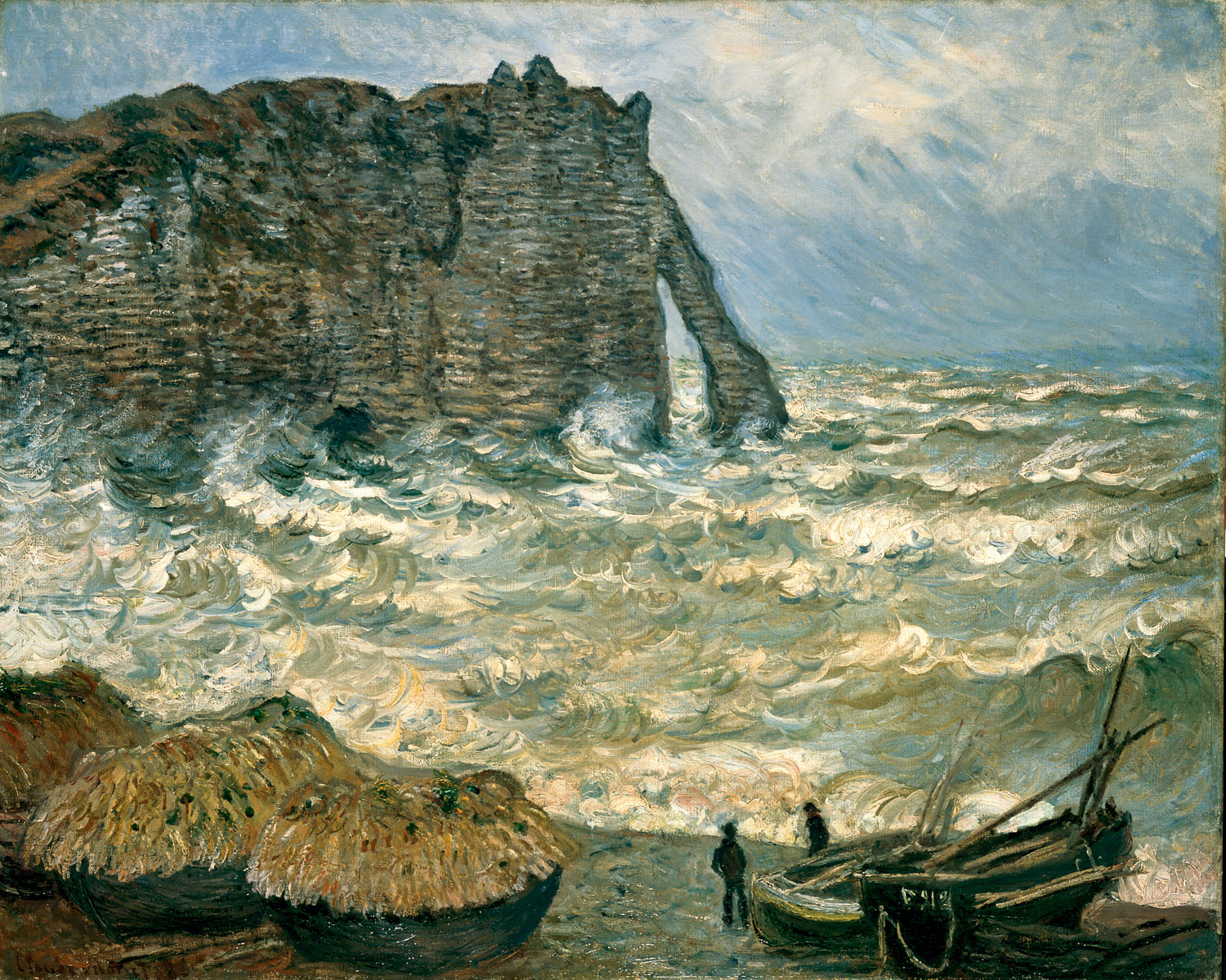
Agitated Sea at Etretat

There may be unexpected dangers in the gentle art of plein air painting, as is evident in a letter Monet wrote to his future wife Alice Hoschedé from Etretat on the evening of November 27th 1885.  'I was hard at work beneath the cliff, well sheltered from the wind, in the spot which you visited with me; convinced that the tide was drawing out I took no notice of the waves which came and fell a few feet away from me.  In short, absorbed as I was, I didn't see a huge wave coming; it threw me against the cliff and I was tossed about in its wake along with my materials!  My immediate thought was that I was done for, as the water dragged me down, but in the end I managed to clamber out on all fours, but Lord, what a state I was in! My boots, my thick stockings and my coat were soaked through; the palette which I had kept a grip on had been knocked over my face and my beard was covered in blue, yellow etc.'

Claude Monet, Agitated Sea at Etretat, 1883

Four years later Monet was in central France, painting the Creuse river and writing to Alice from Fresselines about the 'damnable' spring weather (the translation here is, again, by Bridget Stevens Romer).  'It will be a gloomy series.  A few have some sunlight in them but they were started so long ago that I'm very much afraid that when the sun finally re-emerges I shall find my effects considerably altered.'  It was changes in the weather that really frustrated his efforts.  'The weather's wearing me down, a terrible cold wind which wouldn't have bothered me in the slightest if I'd captured my effect, but the endless succession of clouds and sunny intervals couldn't be worse, especially when I'm getting to the end; but the thing that is upsetting me the most is that with the drought the Creuse is shrinking visibly and its colour is altering so radically that everything around it is transformed.'

Claude Monet, Valley of the Creuse at Sunset, 1889

You would think an artist averse to fluctuations in the weather might stay clear of England but in March 1900 he was here, complaining to Alice of the effects of the fog. 'I've never seen such changeable conditions and I had over 15 canvases under way, going from one to the other and back again, and it was never quite right; a few unfortunate brushstrokes and in the end I lost my nerve and in a temper I packed everything away in crates with no desire to look out of the window...'  This blog post is being written on a cold and misty morning, with the weather forecasters promising a very British day of rain showers for the Queen's Diamond Jubilee Pageant on the Thames.  Monet himself witnessed a royal spectacle whilst in London - the funeral procession for Victoria - and pronounced it superb: a 'feast of gold and colour'.  He was still in a good mood the following day as the sun rose dazzling over the river and the joys of impressionism seemed to outweigh its frustrations.  'I can't begin to describe a day as wonderful as this.  One marvel after another, each lasting less than five minutes, it was enough to drive one mad.  No country could be more extraordinary for a painter.'     

 Claude Monet, Waterloo Bridge. Effect of Fog, 1903

Friday, March 09, 2012

The Arrival of Spring in Woldgate, East Yorkshire

"In a crowd, he that talks loudest, not he that talks best, is surest of commanding attention; and in an art exhibition, he that does not attract the eye, does nothing."  This was the regrettable conclusion of John Opie, Professor of Painting at the Royal Academy (1805-09), who urged artists to paint '"for eternity," not for fashion and the contemporary acclaim of corrupt and incompetent judges"' (Kay Dian Kriz, The Idea of the English Landscape Painter).  Kriz notes that 'such practices may have prompted changes in the exhibition sites themselves.  In 1807 a commentator on the state of the arts, writing in the short lived Beau Monde, speculated that the (much-hated) red walls of the new British Gallery might serve "perhaps as a precaution against too vivid colours, which a desire of attracting notice has introduced into the school of painting."'  When a few years later John Martin started exhibiting those spectacular paintings that were on show at Tate Britain earlier this year, the Royal Academy were not impressed (but still found it convenient to promote Francis Danby as a poential rival to Martin).  One of the best known art stories from this period involves Turner turning up to add a bright red buoy to the foreground of his seascape, Helvoetsluys, so as to attract attention away from Constable's Opening of Waterloo Bridge.  "He has been here," said Constable, "and fired a gun."


Three years ago I went to the Royal Academy to see Anish Kapoor's gun firing brightly coloured red wax at the gallery wall.  Last weekend I was back, with the whole family, for another contemporary art spectacle, David Hockney's A Bigger Picture.  This new exhibition was inspired by the success of his Bigger Trees Near Warter (40ft by 15ft) at the 2007 Royal Academy Summer Exhibition (see Richard Dorment's Telegraph review: 'Hockney shows that biggest is best.')  My expectations were relatively low, based on what I had seen in 2007, when Tate Britain showed some of Hockney's East Yorkshire landscapes along with his selection of Turner paintings.  But overall I enjoyed the exhibition, having stopped worrying about the quality of individual works and begun to view it more as a set of huge installations documenting a kind of postmodern performance of painting en plein air.  For Hockney this now involves iPad sketches, blown up here to about sixty times their original size, and whilst it's true that as Laura Cumming says, they 'appear inert and dehumanised', perhaps that's partly the point.  They depict The Arrival of Spring in Woldgate, East Yorkshire in 2011 (twenty eleven) and comprise a 52-part work, wallpapering the gallery in a bright computer-screen colours.  According to the RA there is 'a deliberate sense of theatricality ... the viewer is placed centre-stage with the drama of the approaching spring played out on all sides.'  It is the kind of theatricality that was criticised in the sixties by advocates of Modernism like Michael Fried, but, like John Opie a century and a half earlier, they were swimming against the tide.

Rosalind Krauss, in her essay 'Grids' (1979), argued that grids 'declare the modernity of modern art'; they are 'what art looks like when it turns its back on nature.'  In the grids that make up Hockney's landscapes he reintroduces a stylised version of nature, patterns and bright colours that reference artists from the early days of Modernism (Van Gogh, Vuillard, Vlaminck).  In her review, Laura Cumming complains of 'a neutralising tidiness. It isn't just those regular blocks into which the big works are split for ease of construction; it isn't even the superlatively concise draughtsmanship that underpins every image. It is a kind of graphic fastidiousness – nothing too out of place or too wild – bordering on neatness. Can Yorkshire be like that these days?'  Not according to The Telegraph: 'there are calls for the area to be cleaned up before it becomes a major tourist trail.One visitor said: "A tourist trap was mentioned but hopefully not in its present state. We travelled the whole length of Woldgate recently and the whole route was an eyesore. "The woods and copses were more like tips – strewn with abandoned household items. The hedgerows were littered with plastic and paper. It's fly-tipping on an almost industrial scale."'  


There has already been a huge amount written about the exhibition online, but I've noticed that some reviewers omit to mention the room devoted to Hockney's versions of a landscape by Claude, The Sermon on the Mount (c. 1656). These come as a bit of a surprise, hung between all those images of the arrival of spring in Woldgate and a darkened seating area where you can experience the Yorkshire Wolds through two grids of video screens, showing footage taken from the bonnet of Hockney's jeep.  Charles Darwent in The Independent could 'see why Hockney would be fascinated by Claude Lorrain, who, like him, invented a light that was more real than real. But his computer-cleaned takes on Claude's Sermon on the Mount are just appalling: it is as well that the dead cannot sue.'  Brian Sewell in The Evening Standard complained that 'Hockney is not another Turner expressing, in high seriousness, his debt to the old master' and described Hockney's engagement with The Sermon on the Mount as 'a sickening impertinence, contemptible.'  I would agree that he doesn't seem very reverential: you can't help thinking that Hockney's figures (elongated like Claude's) are climbing the Mount in order to dive into the swimming pool coloured sea beyond.  In an article for The Economist Karen Wright recounts her meetings with David Hockney over the last few years and recalls being shown his vast painting after Claude as a work-in-progress. 'It fills the entire wall, about 15ft high and 40ft wide, and the colours are eye-popping: there are fields of jacaranda purple in the background, and the sea has been lightened to a soft, milky, opalescent blue. ... As we leave the “Sermon” behind, he says, “I have named it ‘The Bigger Message’,” and he laughs uproariously.'

Friday, April 22, 2011

Electric Eden


Britain's rural landscape is a constant presence in Rob Young's exploration of visionary folk music, Electric Eden. His prologue follows Vashti Bunyan as she sets out from London in 1968 on the road to Skye, where Donovan was hoping to set up a 'Renaissance Community' of artists (it was the same year that Paul McCartney introduced Linda Eastman to his farm on the Kintyre peninsula).  At the same time groups like the Incredible String Band and Fairport Convention were retreating to cottages and developing psychedelic folk music with a shifting cast of like-minded musicians and artists.  Some of this is familiar history, like the recording of Liege and Lief at Farley Chamberlayne, where Fairport Convention reinvigorated songs from the archives of the English Folk Dance and Song Society whilst recovering from the M1 crash that killed Richard Thomspon's girlfriend and drummer Martin Lamble.  But Young also discusses forgotten groups like Heron, who went to seek inspiration in rural seclusion for their two albums at a farmhouse in Berkshire and a cottage in Devon.  Their lyrics are infused with what Rob Young describes as a 'Wordworthian hippy mood'; 'Lord and Master' for example, 'a reverie sung by a pantheistic nature-god whose being is entwined with the seasonal cycles he describes: 'I am the maker of everything and I soar with the birds in the sky'.'


I have described two examples here recently of recordings made en plein air - Richard Skelton's Landings and Movietone's The Sand and the Stars - but Heron pursued this approach forty years ago, as can be heard from the birdsong at the end of the clip above.  For their first album, the band played their songs outside on a circle of chairs, whilst an additional microphone was set up some distance away to capture the surrounding ambience, as if Nature were a fifth member of the group.  For their follow-up, Twice as Nice & Half the Price (1971), a local RAF base commander was persuaded to suspend flights so that the outdoor recording would not be sullied with the sounds of jet fighters.  Later in the book Young gives another example of outdoor recording from what he calls 'the final bright bloom in the garden of British folk-rock' - John Martyn's One World (1977).  Sitting overlooking the lake on Chris Blackwell's Berkshire estate, Martyn played his guitar through amplifiers floating on the water. 'Time seems arrested; the music is the still centre of a turning world of surging waves and intermittent bird calls.'

Sunday, March 20, 2011

Threads Across the River

Richard Skelton is interviewed by Clive Bell in the latest issue of The Wire, talking about landscape and loss and photographed on Anglezarke Moor, standing alone by a dry stone wall near a recumbent (dead?) sheep. There is a fascinating discussion of Skelton's music making en plein air, as they walk the moors and visit places that feature on Landings - an album I discussed here in an earlier post.  The clip below features 'Scar Tissue', which was 'the result of a single encounter with a particular place', and 'Threads Across the River', 'an accretion of different times and different places ... a weave of sounds recorded in the two ruins which straddle the river Yarrow: Old Rachel's and Simms.'


The interview moves on to talk about ways in which the landscape has permeated Skelton's musical instruments - grasses and leaves intertwined around a fretboard, balsam leaves threaded into the sound hole of a mandola, bits of bark used as plectra.  "Because I was using really cheap instruments, I could leave them out in the wood and cover them in leaves.  It didn't matter if they got knackered.  I was coming to terms with a process of decay."  I've written here before about Ross Bolleter's pianos, left exposed in the landscape until 'all the damp and unrequited loves of Schumann, Brahms and Chopin dry out, degrading to a heap of rotten wood and rusting wire'.


The article also touches on a third way in which Skelton makes direct connections with the West Pennine Moors, in addition to exposing his instruments to the elements and recording himself in the wider soundscape (you can hear birdsong at the end of the clip above - 'Pariah', another track from Landings).  Discussing Box of Birch, Skelton says he has sometimes tried to play the environment directly: bowing barbed wire and playing trees to get a 'grating, rattling undercurrent'. "The barbed wire stretched across the landscape was like the strings on an instrument" he says, a comment that reminded me of my recent post on the aeolian telephone wires of Australia. I suppose the trouble with attempting to 'play a landscape' is the risk of seeming to possess and use it, rather than amplify its natural sounds. Of course it should be possible to making sounds from a living tree without harming it, and yet I wonder if the clip below (which I came upon via Twitter) would seem less acceptable if it involved a tree located out in some 'wild' location. 


Finally, I should return to Richard Skelton and mention his latest release, Wolf Notes, which was 'inspired by the landscape, place-names, flora and fauna of Ulpha, in Cumbria'.  There is a useful review at The Liminal which describes Skelton's use of 'the place names, the roots, of Cumbria ...  Wolf Notes derives from the etymological root of ‘ulpha’, understood to mean “the hill frequented by wolves,” from the Old Norse ulfr, “wolf”, and haugr, “hill or mound.”' The limited first edition (now sold out) came with a book of poems, a glossary and a 'phial of specially prepared, hand-mixed incense made from birch leaves, yarrow, wild grasses and a selection of resins.'