Sunday, November 17, 2024
Drunkard's Rock
Sunday, May 05, 2024
A tin flash in the sun-dazzle
I'm going to write about landscape in this book, but it needs a bit of explanation first. Here's the New Directions publisher's blurb:
Rummaging through his papers in 1958, Ezra Pound came across a cache of notebooks dating back to the summer of 1912, when as a young man he had walked the troubadour landscape of southern France. Pound had been fascinated with the poetry of medieval Provence since his college days. His experiments with the complex lyric forms of Arnaut Daniel, Bertran de Born, and others were included in his earliest books of poems; his scholarly pursuits in the field found their way into The Spirit of Romance (1910); and the troubadour mystique was to become a resonant motif of the Cantos. In the course of transcribing and emending the text of “Walking Tour 1912,” editor Richard Sieburth retraced Pound’s footsteps along the roads to the troubadour castles. “What this peripatetic editing process… revealed,” he writes, “was a remarkably readable account of a journey in search of the vanished voices of Provence that at the same time chronicled Pound’s gradual discovery of himself as a modernist poet.”
This transition towards Imagism was leading Pound to look for precise observation of nature in the best troubadour poetry. In Sieburth's introduction he describes Pound's attempts to read their poems in elements of the landscape he passed through.
Ambling down the valley of the Dronne near Arnaut Daniel's birthplace at Ribérac, he verified the vernal vegetation of the countryside against vocabulary of the poet's cansos. Observing the rhythm of "cusps & hills, of prospects opened & shut" as the road climbed northward toward Mareuil, he wondered whether the structure of Arnaut's sestinas might not derive from patterns of recurrence in the local terrain. Having fought the wind and rain through the greater part of his journey, he reflected that he now "found a deal more force in certain lines & stanzas than I had ever expected ... if we consider them as sung by men to whom the condition of the weather was a necessary concomitant of every action & enjoyment... the prelude of weather in nearly every canzon becomes self evident, it is the actual reflection." (Three decades later, exposed to the elements at Pisa, the full force of these observations would hit home.)
Pound also had a theory about troubadour topography: that Bertran de Born's 'Lady Since You Care Nothing For Me', about a composite ideal love with features taken from the fairest beauties of Provence, actually disguised a military plan to take the castles where these ladies lived. Sieburth suspects that 'Pound was in fact unconsciously projecting his own private scenarios of phallic beleaguerment and grandeur onto the landscape of his troubadour alter-ego'.
The notes Pound made are fragmentary - readable but hardly polished travel writing. They nevertheless contain flashes of imagistic description that anticipate the Cantos. Sieburth quotes one example, where light on the river Dordogne, 'a band of bluish metal with rippled chevrons in the shadows', looks forward to this phrase from Canto 2: 'There is a wine-red glow in the shallows, / a tin flash in the sun-dazzle.'
The book also includes three poems from 1915 that were directly inspired by the walk - one of these, 'Provincia Deserta' provides 'the first occurrence in Pound's poetry of that rarefied, virtually Chinese landscape of mountains and valleys which provides the elevated topography of the paradiso of the late Cantos.' Sieburth quotes lines from this poem that refer to the town of Foix in the Pyrenees and I'll conclude here with some of the original notes Pound made in 1912:
To Foix by night...
We are come again to a place where the waters run swiftly & where we have always this chinese background. The faint grey of the mountains...
I had at last my plan of starting late in the day so the hills were full of cloud & mist & there were bright & dim colours upon them. I went into this Coliseum of hills with Foix like Caesar's stand behind me, but with a veiled light over it & scarcely visible. I went out the other end where a great sheet of rock juts thru the quarry, out & into a paler basin that faced me with light emerald & pearlish shadows. Then you go up & over till the sky shows blue before you. It is not the rd. of the diligence. One may lie on the earth & possess it & feel the world below one.
Of related interest:
'Ezra the Troubadour' - an article on Pound's travels and poems that includes Sieburth's map.
'Poundian Itineraries': An attempt to map Pound's later 1919 walking tour (and another article on his third walking tour in 1923).
Sunday, April 02, 2017
This loud brook’s incessant fall
My previous post, on Henry Wadsworth Longfellow's anthology Poems of Places, brings to mind Geoffrey Grigson, whose (considerably shorter) anthology Poems & Places I discussed here in 2009. In another of his books, Recollections (1984), Grigson writes of the pleasures to be had in 'visiting or soaking myself for a while in scenery spiritualized, I suppose that is the word, by writers in their poems.' He lists the Quantocks (Coleridge), the Lakes (the Wordsworths), the Cotswolds (Gurney), the Vale of Clwyd (Hopkins), Long Island (Whitman - 'wiping it clean again in fancy to the nakedness of sands and sea birds he knew') and outside Brecon in Wales, 'the Black Mountains, rivers, streams and waterfalls and the Langhorse Lake, recognizable in Vaughan's verbal spiritualization of the scenery he had known since childhood.' He goes on to sayAs this loud brook’s incessant fallIn streaming rings restagnates all,Which reach by course the bank, and thenAre no more seen, just so pass men.
- from Henry Vaughan's 'The Waterfall', 1655
'There are discoveries to be made in this way. Searching the map, I found that there exists a neglected waterfall just outside Brecon which Vaughan might have had in mind when he wrote his waterfall poem. Had he translated the Welsh name of the stream, which is Ffrwdgrech, into the 'loud brook' of his poem? That could be the meaning of the Welsh in these Ffrwdgrech Falls. So I looked for the waterfall, to which there is no path, which can be missed on a lane which doesn't give a hint of the Falls' existence; and I felt as if I were the first person to recognize the falls and admire their extraordinary charm since Vaughan had been their repeatedly in the seventeenth century.'
Ffrwdgrech Waterfall, near Brecon, 1880s
In his introduction to Poems & Places Grigson says that few poets before the Romantics 'felt landscape more powerfully and with a completer consciousness than Henry Vaughan.' He quotes Vaughan's 'twin brother Thomas, alchemist and clergyman in the same parish', on the idea that we should try 'to refer all naturals to their spirituals by the way of secret analogy.' Hence a poem like 'The Waterfall' in which landscape is a metaphor for the spirit. Thomas Vaughan is represented in Grigson's anthology be one poem, 'So Have I Spent on the Banks of Ysca Many a Serious Hour', his brother by seven, including 'The Waterfall'. I'll end here with more of Henry Vaughan's poem, this time from the beginning, where short lines evoke the rapid descent of the water.
With what deep murmurs through time’s silent stealthDoth thy transparent, cool, and wat’ry wealthHere flowing fall,And chide, and call,As if his liquid, loose retinue stay’dLing’ring, and were of this steep place afraid;The common passWhere, clear as glass,All must descendNot to an end,But quicken’d by this deep and rocky grave,Rise to a longer course more bright and brave.
Saturday, November 05, 2016
The source of the Sorgue
Source: Wikimedia Commons
In 1337, a year after his ascent of Mont Ventoux, Petrarch travelled to Rome. On his return to Avignon he found that the city's decadence still disgusted him. In his 'Letter to Posterity' he says that 'seeking some means of escape, I fortunately discovered a delightful valley, narrow and secluded, called Vaucluse, about fifteen miles from Avignon, where the Sorgue, the prince of streams, has its source. Captured by the charms of the place, I transferred myself and my books there' (trans. Mark Musa). Elsewhere he wrote a wonderful description of his home at Fountaine-de-Vaucluse. The translation of this passage below is in The Wind and the Source by Allen S. Weiss.
'Here I have acquired two small gardens perfectly suited to my skills and taste. To attempt a description for you would be too long. In short, I believe that no similar spot exists in all the world, and, to confess my unmanly fickleness, I regret only that it is not in Italy. I customarily call it my transalpine Helicon. The one garden is very shady, suitable only for study and sacred to our Apollo. It overhangs the source of the Sorgue, and beyond it lies nothing but ravines and cliffs, remote and accessible only to wild beasts or birds. The other garden, near the house, appears more cultivated, and it is a delight to Bacchus. This one, astonishing as it may seem, is in the midst of the very beautiful and swift-running river. Nearby, divided from it by a very small bridge on the further side of the house, hangs a curved vault of native rock that now provides shelter against the summer heat. It is a place that inspires studies, and I suspect is not too dissimilar to the little hall where Cicero used to declaim his orations, except that he did not have a Sorgue flowing alongside. Under this vault, therefore, I spend my afternoons, and my mornings on the hillsides; the evenings I spend in the meadows or in my less cultivated garden at the source where my efforts have conquered nature and cleared a spot under the high cliff in the midst of the waters, narrow indeed but very inspiring, in which even a sluggish mind can rise to the noblest thoughts.'As Weiss points out, this description suggests a perfect balance between the Apollonian and Dionysian temperaments which Nietzsche would make famous in his writings on aesthetics. Petrarch was influenced by both Christian and Pagan traditions, by Saint Augustine and Cicero. In a letter to Cardinal Colonna, he described his creation of a garden as a war with the Nymphs, who try to chase away his Muses, but when he thinks of erecting an altar it is to Mary, rather than to the gods of rivers and springs. It sounds like a delightful retreat, where Petrarch could concentrate on his writing 'amidst the sound of birds and nymphs, and accompanied by few servants but many books.' It was also a base from which Petrarch could wander the countryside, 'roving over the meadows and mountains and fountains, living in the woods and in the countryside, fleeing human footsteps, following the birds, loving the shadows, enjoying the mossy caves and the blooming meadows...'
Tuesday, August 30, 2016
The Black Place
We had a good look round this exhibition at Tate Modern yesterday and got the sense of an artist engaged with New Mexico's indigenous inhabitants and culture as well as it's shapes and shadows, hard blue skies and extraordinary colours. Olivia Laing wrote a great piece about O'Keeffe that describes her first experience of the place. 'Back in 1929 she had spent a summer in Taos with the painter Beck Strand. The pair were taken up by a community of powerfully independent women, among them Mabel Dodge Luhan, the formidable heiress and art patron, and the Hon Dorothy Brett, a stone-deaf Englishwoman who carried a knife in her boots.' It sounds fun, although O'Keeffe arrived in Taos too late to encounter D. H. Lawrence. She did paint The Lawrence Tree (1929) though, with a viewpoint right up its trunk and into the night sky. In Tate Magazine artist Lucy Stein writes of this painting that 'the mental image that this summons of two of the titans of nature-worshipping modernism having cosmic and sexy thoughts beneath this ancient pine is as intoxicating as the picture itself.'
I will conclude here with a longer quote from Olivia Laing on the New Mexico period (I would agree with what she says here of the potential strengths and weaknesses of these paintings). O'Keeffe's work is in copyright but you can see the painting referred to on The Guardian site.
“As you come to it over a hill, it looks like a mile of elephants – grey hills all about the same size with almost white sand at their feet,” O’Keeffe wrote of the Black Place, a remote landscape that inspired her more than any other location. The paintings she made there tip geological form over the threshold of abstraction: the serried hills smashed into shards of grey and puce, bifurcated by yolk-coloured cracks or spills of oily black.
'Hills like elephants sounds an echo of Hemingway, and there is something of his habits of compression at work in O’Keeffe, a desire to erase everything extraneous, to convey emotion without confessing it directly. She painted very flat, making surfaces so smooth she once compared the sensation to roller-skating. The risk is blandness, but it can also produce – The Black Place, 1943, say – cleanly assembled structures that quiver with unvoiced feeling.'
Tuesday, August 23, 2016
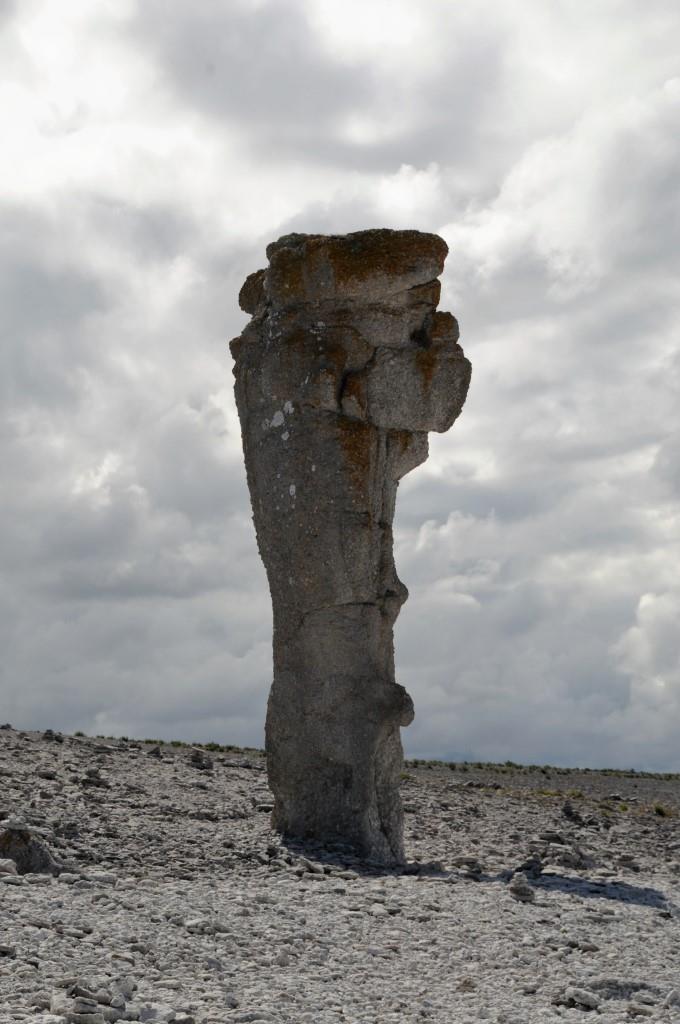
The rocks of Fårö
'My ties with Fårö have several origins. The first was intuitive. This is your landscape, Bergman. It corresponds to your internal imaginings of forms, proportions, colours, horizons, sounds, silences, lights and reflections. Security is here. Don't ask why. Explanations are clumsy rationalisations with hindsight. In, for instance, your profession you look for simplification, proportion, exertion, relaxation, breathing. The Fårö landscape gives you a wealth of all that.'
- Ingmar Bergman in his autobiography The Magic Lantern (1987, trans. Joan Tate)
This notion of finding ones ideal landscape is an interesting one and prompts me to wonder what my own might be. Bergman spent much of his life in theatres and the island of Fårö, with its rocks and trees and open skies, seems at first to be a very different kind of space. But as he says here, it suited his outlook on directing as well as the deeper need for a retreat which we often see in creative artists. Bergman was only persuaded to visit Fårö in the first place when Svensk Filmindustri requested that he consider an alternative to Orkney as a setting for Through a Glass Darkly (1961). He made three more films there, along with two documentaries about life on the island and the TV series Scenes From a Marriage (1973), which led to an upsurge in the Swedish divorce rate and was apparently an inspiration for Dallas.
It might be thought that Bergman filmed more often on Fårö than he actually did because rocky coastal settings are so associated with his work. In a post I wrote just after he died I referred to the chess game on the beach in The Seventh Seal, but this was made four years before he had set foot on the island. I was only able to quote a description of Fårö then; now I have been myself and walked, for example, the windswept shore at Langhammars, with its strange rock formations, that Bergman used for the final scene in Shame (1968). In this the couple – Liv Ullman and Max Von Sidow - wait for a boat which they hope will take them and other refugees away from their war-torn country. The film ends with them adrift in a grey featureless sea.
Perhaps another reason we associate Bergman so strongly with Fårö is the continuing fascination with Persona, which is I think, after The Seventh Seal, his most famous and iconic film (both are parodied in Woody Allen’s Love and Death). Fårö's Bergmancenter currently has an exhibition marking its fiftieth anniversary. Among the exhibits are Liv Ullman’s camera, Bibi Andersson’s shades and some atmospheric behind-the-scenes colour photographs of a film that is hard to imagine in anything other than beautifully-lit black and white. Sadly it is not possible to visit the actual house used in Persona, situated on the rocky eastern shore of Fårö, where the troubled actress played by Liv Ullman withdraws from the world. This no longer survives.
Friday, September 11, 2015
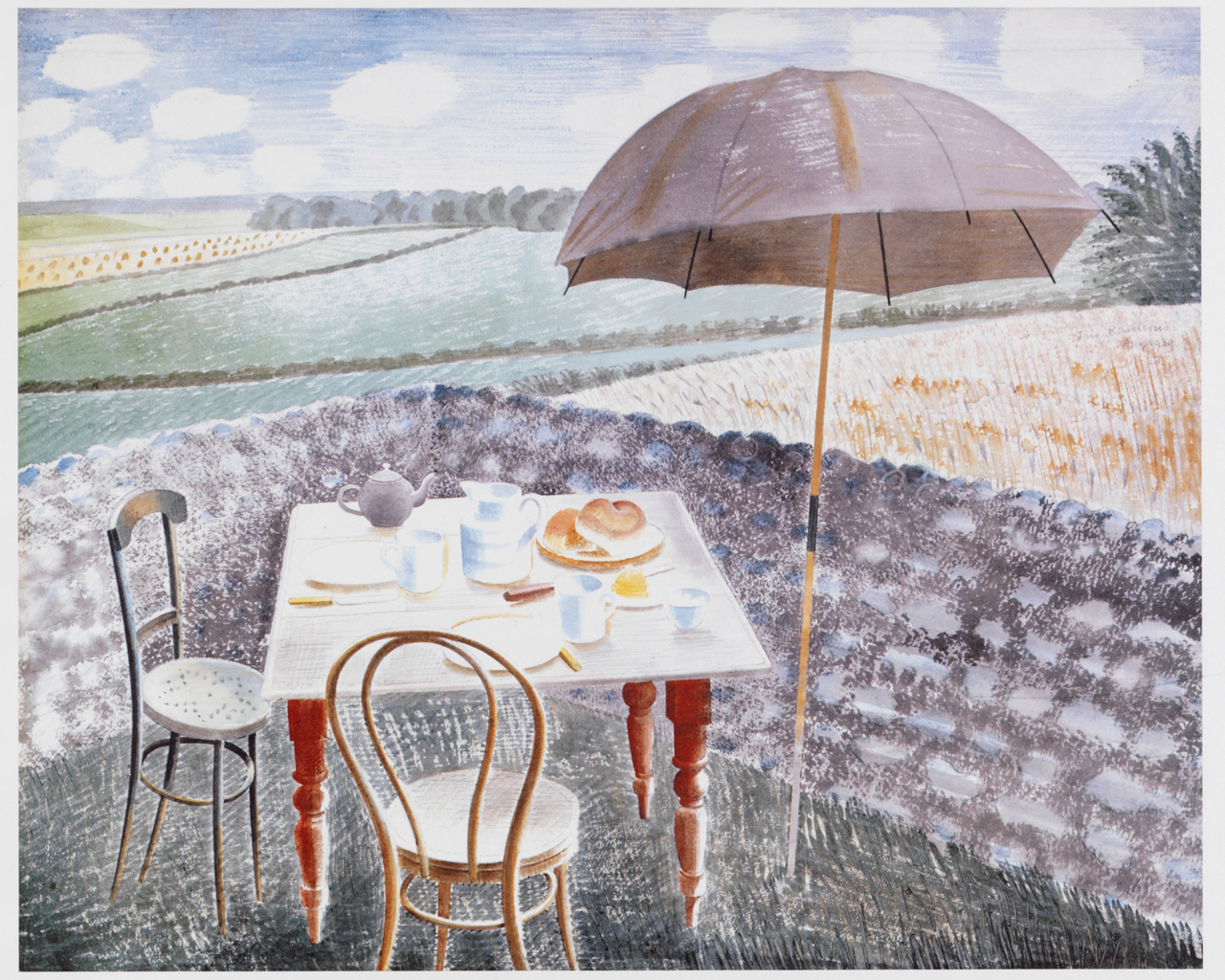
Tea at Furlongs
At Furlongs, Ravilious was a guest of Peggy Angus, whom he had met when they were students at the Royal College of Art. She had left London in 1933 to teach in Sussex and found a tenant farmer willing to let her rent a cottage with a spare room, next door to a ploughman who appears in some of Ravilious's paintings. Life there, Russell writes, 'involved a good day's work, scratch meals and long evenings of music and song. Water had to be hauled out of a well and amenities consisted of a primitive stove for cooking and an earth closet in the garden.' Furlongs is quite a long walk from any main road but my parents went to look at it this summer and have sent me the photographs below. Apparently the current owners are building a new wall, perhaps prompted by the increase in visitors as Ravilious's popularity continues to grow. This cottage has an important place in British art history as the inspiration for some of Ravilious's best known work, like Train Landscape and The Wilmington Giant. 'Furlongs', he wrote, 'altered my whole outlook and way of painting, I think because the colour of the landscape was so lovely and the design so beautifully obvious...'
Friday, July 03, 2015
As we descended to this valley
Samuel Palmer is the inspiration for the fourth part of Ronald Johnson's marvellous book-length poem, an 'attempt, as a brash American, to make new the traditional British long seasonal poem', recently re-published by Uniformbooks. Johnson had come over to England in 1963 and he descended into Palmer's 'Valley of Vision' with Jonathan Williams, who would write his own 'Two Pastorals for Samuel Palmer at Shoreham, Kent'. These can be read at the Poetry Foundation, although they omit a footnote in which Williams refers readers to Geoffrey Grigson's Samuel Palmer: Valley of Vision and Samuel Palmer: The Visionary Years. Johnson was also influenced by Grigson's anthologies and writings on Romanticism: 'one should read all of Grigson' he wrote, 'his books are seminal and essential.' The Book of the Green Man concludes with a yellow moon rising over Palmer's hills and newly-cut wheat: 'beneath a husk / of twilight / were as many suns as kernels, / & fields were far / as the eye / could reach.'As we descended to this valley,
where Samuel Palmer had used to walk - bareheaded
under the moon -
the passing clouds above
"did marvellously supple the ground."
- Ronald Johnson, The Book of the Green Man (1967)
Jonathan Williams quoted this 'ecstatic reverie' in the appreciation he wrote when Johnson died in 1999. He also recalled their early walks together in America, 'perfect training for poets: learning to attend the names of birds and plants and stars and trees and stones.' Their discovery of Palmer's Shoreham was just one part of an extraordinary British 'Grand Tour' which formed the basis for The Book of the Green Man (links are to earlier posts on this blog):
We went up to Ardgay in Easter Ross in the north of Scotland to meet Ian Hamilton Finlay. We saw Hugh MacDiarmid in both Langholm and Biggar. We saw Basil Bunting up the Tyne above Newcastle at Wylam. And Herbert Read at Stonegrave House in the hills north of York. We went to Broad Town under the Wiltshire Downs to see Geoffrey and Jane Grigson. Geoffrey took us to Faringdon for Lord Berners' folly tower, to Buscot Park for Burne-Jones's Briar-Rose paintings, and to Lydiard Tregoze for the splendid interior of the Church of St Mary. Jane fixed Welsh girdle cakes for breakfast, the first we had ever tasted. We visited the graves of Blake and Palmer, Stanley Spencer and Walter Sickert, Delius and William Morris. In the spring of 1963 we walked from the mouth of the River Wye at Chepstow, up its long, winding valley, to its source high on the flanks of Great Plynlimmon. We hitched a few rides to allow us to add Kilpeck Church to Francis Kilvert's at Bredwardine along the route. And Strata Florida and the site of Hafod House further into Wales. And more pilgrimages that summer. To Nottinghamshire to Southwell Minster and the amazing foliate heads and plant carvings in the Chapter House. To Gilbert White's Selborne in Hampshire. To Samuel Palmer's Shoreham in Kent. To the Cerne Abbas Giant in Dorset. To Compton in Surrey for the Watts Mortuary Chapel. To Brighton for John Nash's Royal Pavilion. We were looking for all things, as RJ said, 'most rich, most glittering, most strange'.
Friday, October 03, 2014
Tusculan's romantic groves
As reviewers of Tate Britain's Late Turner – Painting Set Free have pointed out, there is much more to the artist's final years than the 'sublimely empty pictures' that regularly get compared to the work of abstract artists. The last Turner show I went to, at Margate earlier this year, paired him with Helen Frankenthaler and two years ago the Tate itself mounted an exhibition that made the link with Cy Twombly's later paintings. Visiting this new exhibition last weekend, I came ready to enjoy the art anachronistically: the abstract expressionism of Turner's Rough Sea (1840-5), the minimalist sequence of blue and grey sky studies (similar to those in the Channel Sketchbook viewable at Google Art) and of course those famous visions of Venice dissolved in light. The temptation to forget Turner's subject matter and see his work in terms of pure colour was also encouraged by the presence of Olafur Eliasson's Turner Colour Experiments (for a discussion of these, see BLDGBLOG). But ultimately I found I was just as interested in the way Turner persisted with history painting, where his spectacular effects seem often to magnify rather than overshadow the incidents they depict, drawn from Shakespeare, the Bible and the classics. For this post I want to focus on one of these, Cicero at his Villa, which Turner exhibited in 1839.
I have written here before about the appeal of bringing the work of Latin writers to life by imagining them in their setting, as Gilbert Highet did in his classic study Poets in a Landscape (1957). In 1819 Turner was in Italy, sketching at Frascati, which, according to a travel book he owned, was the site of Roman Tusculum. There he would have pictured Marcus Tullius Cicero, who wrote Stoical essays there (the Tusculan Disputations, 45 BCE) on such cheerful topics as grief of mind, bearing pain and contempt of death, two years before being killed as an enemy of the state. However, Turner was approaching Cicero through the lens of art, because, as his sketchbook makes clear, he was looking for the site where his admired predecessor, Richard Wilson, had set Cicero and his Friends at his Villa. This painting, first exhibited in 1770, is usually identified with Arpinum, but Turner would have seen another version (see below) which its owner called Cicero at Tusculum. Another source for Turner's painting may have been 'The Pleasures of Memory', a long poem that brought Samuel Rogers literary celebrity when it appeared in 1792, which mentions Cicero at Tusculum. Thus there are various paths that lead from Turner's picture back to its classical source and the three texts below (all referred to in a 1981 article by William Chubb) show how art drawn from landscape leads back to art again.
(1) First there is Turner himself, drawing a parallel between Wilson and Cicero in a lecture called 'Backgrounds, Introduction of Architecture and Landcape' which he delivered in February 1811. This can be found in an old edition of the Journal of the Warburg and Courtauld Institutes - the reason it is not widely published is presumably that it is not very well written (Roger Fry tried to transcribe it and gave up saying that "it would be unfair to Turner to publish work that only shows his weaknesses"). Towards the end of the lecture, Turner regrets the fact that Zuccarelli's 'meretricious' paintings
'defrauded the immortal Wilson of his right and snatched the laurel from his aged brow. In vain did ... the Cicero at his Villa sigh for the hope, the pleasure of peaceful retirement, or the dignified simplicity of thought and grandeur, the more than solemn solitude that told his feelings. In acute anguish he retired, and as he lived he died neglected.'(2) Then there is the passage on Cicero that Turner marked in his own copy of Rogers' Poems (1827). Turner knew the poet and illustrated the long poem Italy that Rogers based on his travels (fit was from Italy that Rogers wrote to a friend: 'Oh if you knew what it was to look upon a Lake which Virgil has mentioned & Catullus sailed upon, to see a house in which Petrarch has lived.') In 'The Pleasures of Memory', Rogers describes 'the charm historic scenes impart' and refers to the time Cicero (Tully) visited Syracuse a hundred and sixty years after the death of Archimedes, to find the Sage's grave unregarded and overgrown.
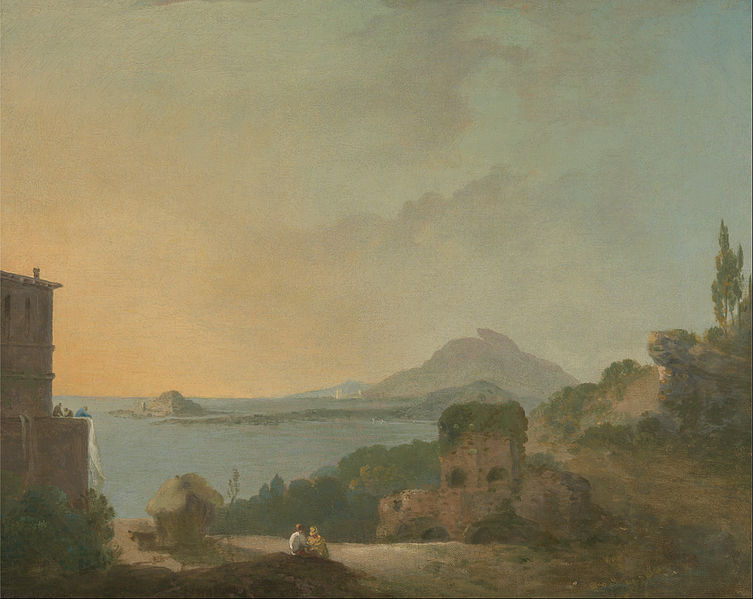
(3) Finally, Cicero. At various times he owned villas at different locations, so that Wilson was able to paint another Cicero-related view (below) that combines Italian light and classical allusion. Cicero's Arpinum villa was used as the setting for his book on law, De Legibus. This begins with the scene Wilson depicts in the painting shown above, where Cicero (Marcus), his brother Quintus and friend Atticus are looking at an old oak tree associated with the Consul Gaius Marius (157-86 BCE). Thus the poignant capacity of landscape to preserve fragments of culture, which Wilson, Rogers and Turner experienced in Italy and exemplified in their art and poetry, can be found in De Legibus described by the writer who inspired them. Cicero's dialogue refers to his own earlier poem, and to a palm tree on Delos that takes us all the way back to Homer.'So TULLY paus'd, amid the wrecks of Time,
On the rude stone to trace the truth sublime;
When at his feet, in honour'd dust disclos'd,
The immortal Sage of Syracuse repos'd.
And as his youth in sweet delusion hung,
Where once a PLATO taught, a PINDAR sung;
Who now but meets him musing, when he roves
His ruin'd Tusculan's romantic groves?'
'Atticus. —This is the very grove, and this the oak of Arpinum, whose description in your poem on Marius, I have often read. If, my Marcus, that oak is still in being, this must certainly be it, but it appears extremely old.
Quintus Cicero. —Yes, my Atticus, my brother’s oak tree still exists, and will ever flourish, for it is a nursling of genius. No plant can owe such longevity to the care of the agriculturist as this derives from the verse of the poet.
Atticus. —How can that happen, my Quintus? How can poets bestow immortality on trees? It seems to me that in eulogising your brother, you flatter your own vanity.
Quintus. —You may rally me as much as you please, but as long as the Latin language is spoken, this oak of Marius will not lose its reputation; and as Scævola said of my brother’s poem on Marius, it will “Extend its hoary age, through countless years.” Do not your Athenians maintain that the olive near their citadel is immortal, and that tall and slender palm tree which Homer’s Ulysses says he beheld at Delos, do they not make an exhibition of it to this very day? and so with regard to other things, in many places, whose memorial endures beyond the term of their natural life. Therefore this acorn-bearing oak, on which once lighted “Jove’s golden Eagle, dazzling as the sun,” still flourishes before us. And when the storms of centuries shall have wasted it, there will still be found a relic on this sacred spot, which shall be called the Oak of Marius'
Friday, September 12, 2014
American Smoke
It was the season of autumn ghosts, a dampness in the soul. November 2013. I stopped outside the sea cadets building in Stoke Newington's Church Street, now re-purposed as an exhibition space: 'building-F'. In the old bricks there were ghost traces of a painted sign: S S OKE. The roof was an abandoned deck with white railings and a solitary flag pole. Looking down at the street, a life-size photograph of J. G. Ballard. In the new front window, a neat stack of Iain Sinclair's American Smoke. Inside I was hoping to encounter the man himself, having heard that he would be selling off his old books for a limited period. But there was no sign of him: just framed artwork and a bookcase filled almost entirely with his own publications, signed and annotated, with prices to match. Ridiculous, I now realise, to imagine he would be there in person, presiding over tables stacked with the remnants of his book selling days: paperbacks by overlooked London writers, pulp novelists, underground poets. I lingered awhile - not buying anything felt like an affront to the couple from Test Centre who politely stood by as I looked at the shelves. Eventually I left with a book of poems: Firewall.
American Smoke begins in Gloucester, Massachusetts, where Sinclair went to deliver a lecture on Charles Olson, 'poet, scholar and last rector of Black Mountain College'. There he met Henry Ferrini, whose film on Olson I included in a post here on the Maximus Poems back in 2010. He visited Dogtown, where Olson came and walked in the woods 'to refine the art of getting creatively lost'. He even booked a tourist whale-watching cruise (assuring us that 'the excursion was being made for my wife'). Olson's first book, published in 1947, was a study of Moby Dick. The boat trip cancelled, he headed for the local library, looking for Olson's marginalia in books that had found their way onto the stacks after his death. He says he found rough notes for a poem in the endpapers of one volume (much harder to decipher than the text Sinclair added to his own books for the pop-up shop in Stoke Newington). Back in London he was pleased to have 'absorbed some of the weather of the place' but realised in watching Ferrini's film again that Olson can only be experienced in the energy field of his poems.
My landscape interest in American Smoke had been kindled by Sinclair's account of a journey to see Gary Snyder, published initially as an essay in the LRB. Snyder evaded discussion of poetics but was happy to talk about logging, ecological threats and the day-to-day work needed to maintain the land he bought cheaply in 1966: 'a hundred acres of manzanita thickets, with open stretches of ponderosa pine, black oak, cedar, madrone, Douglas fir, bunchgrass...'
'Taking responsibility for a portion of Sierra ridge, once occupied, river valley to densely forested upper slopes, by Indian tribes, was a major statement of intent from Snyder. ‘We were cash poor and land rich,’ he said. ‘And who needs more second-growth pine and manzanita?’ Alexander Pope, in his upstream exile at Twickenham, laid out garden and grotto as a conceit, an extension of his work into the world, and a powerful attractor for patrons and lesser talents. To fund the Sierra reinhabitation, as Snyder saw it, he took on reading tours and an academic position at UC Davis, fifty miles down the road near the state capital, Sacramento. He called his land Kitkitdizze, after the Wintu Indian name for the aromatic shrub known as bear clover. ... This Thoreau-inspired wilderness encampment, real as it appears, is underwritten by the requirement to represent itself as a topic for thesis writers, a reluctant paradigm. A magnet for approved visitors, students, localists, or anyone needing to understand if this thing can be managed: a self-funding, functioning centre that is not a retreat, but a resettlement...'The whole book is structured around these encounters with writers, living and dead: Corso in New York, Burroughs in Kansas, the grave of Malcolm Lowry in Sussex. From Vancouver, Sinclair goes to the Burrard Inlet in search of the shack Lowry and his wife constructed from driftwood and sawmill lumber. It was a kind of idyll - described as such in some beautiful passages in Under the Volcano - and Sinclair visits the spot on a crystalline morning. He is led along a winding path through resinous woodland, down to the shore. Lowry had enjoyed the view here, across the water to an oil refinery where the S had fallen from the word SHELL. Sinclair is tempted to go in - 'I'd like to swim, the water is strobing gold' - but he paddles instead in the cold, sharp-stoned shallows. There is an old bottle top glinting in the water - not Lowry's, but something to pick up and take away.
Monday, May 26, 2014
Coniston Water
During our trip to the Lake District last week we stayed in Coniston and went to visit Ruskin's old home at Brantwood (above). There was much of interest there, although Mrs Plinius expressed some disappointment that the decor, objects and furniture were not more beautiful. Ruskin, it seems, cared little for interior decoration. In the 1883 Preface to Modern Painters he wrote that he had often been asked 'by the æsthetic cliques of London' (maybe that's people like us) why
'in the pictures they have seen of my home, there is no attempt whatever to secure harmonies of colour, or form, in furniture. My answer is, that I am entirely independent for daily happiness upon the sensual qualities of form or colour; that, when I want them, I take them either from the sky or the fields, not from my walls, which might be either whitewashed, or painted like a harlequin’s jacket, for aught I care; but that the slightest incident which interrupts the harmony of feeling and association in a landscape, destroys it all to me, poisoning the entire faculty of contemplation. From my dining-room, I am happy in the view of the lower reach of Coniston Water, not because it is particularly beautiful, but because it is entirely pastoral and pure. Were a single point of chimney of the Barrow iron-works to show itself over the green ridge of the hill, I should never care to look at it more.'Happily, as you can see in the photograph I took below from The Coniston Steam Yacht Gondola, the view from Brantwood is still 'pastoral and pure'. There was even a cow posing obligingly for me at the edge of the lake.
Friday, July 06, 2012
No trace of Cold Mountain
Cold Mountain, Red Pine, Copper Canyon. The Copper Canyon Press publish a beautiful edition of the complete poems of Cold Mountain (Han-shan) by Bill Porter, who translates Chinese literature under the name Red Pine. Nobody knows Han-shan's real name, but it is said that he called himself after the location of the cave which he made his home. In his introduction Red Pine describes visiting this cave, 'located in Chekiang province at the base of Hanyen, or Cold Cliff, a two-day walk from the East China Sea ... Even now, Cold Mountain's old home attracts few visitors. In May of 1989 and again in October 1991, Layman Fang of Kuoching Temple arranged for a motorized rickshaw to take me and two friends there.' The road was poor and when they got there they found a roofless hut inside the cave, owned by an old farmer. After sharing with them his lunch of noodles and red pepper paste, the farmer guided them around the area. 'In the centuries that followed Cold Mountain's disappearance, Buddhists built a monastery just beyond the base of the cliff. It had since been replaced by terraced field of corns and peanuts but our host told us he still dug up the occasional temple tile.'
Red Pine's search reminded me of Gilbert Highet, seeking traces of Poets in a Landscape (1957): guided by the descriptions in Virgil, Pliny and Sextus Propertius, for example, he finds the Springs of Clitumnus still a source of 'cool copious fresh water, absolutely clean, rising out of dry earth under a hot sun' but is drawn back to the present when he notices 'in one of the fountain-beds, half a dozen Coca-Cola bottles set to cool for possible sale to tourists.' Robert Macfarlane has just written an article about artistic pilgrimage, including his own attempt to follow W. G. Sebald (seemingly not yet abandoned when I did a post called The Printed Path in 2007). In his new book The Old Ways, the guiding spirit is Edward Thomas, but he also travels in the footsteps of Eric Ravilious and Nan Shepherd. Macfarlane's experience of the pine forests of the Siete Picos (described in my last post) reminded me of Richard Holmes on the trail of Robert Louis Stevenson in Footsteps (1985): 'I slept out that night under an outcrop of pines, facing east on a slight incline, with the light of the Costaros far way to my left. The turf was springy, and the pine needles seemed to discourage insects. As I lay in my bag, a number of late rooks came winging out of the gloaming, and settled in the pine branches, chuckling to each other. They gave me a sense of companionship, even security: nothing could move up through the trees below me without disturbing them. Once or twice I croaked up at them (it was the wine) and they croaked back: 'Tais-toi, tais-toi.' This night I fell asleep quickly. Only once, waking, I drank two ice-cold mouthfuls of water from my can and, leaning back, saw the Milky Way astonishingly bright through the pine tops, and felt something indescribable - like falling upwards into someone's arms.'
I seem to have become side-tracked... 'People ask the way to Cold Mountain,' Han-shan wrote, 'but roads don't reach Cold Mountain / in summer the ice doesn't melt / and the morning fog is too dense...' In a footnote to this poem, Red Pine observes that a road does reach Cold Mountain, even though it is only wide enough for one cart and its condition is very variable, depending on the rain. Furthermore, although the fog can drift inland from the nearby ocean in spring, 'ice and snow appear only briefly during the winter. But then, this poem is about a different mountain.' Han-shan's mountain poems are no more topographically specific than Petrarch's spiritual narrative, The Ascent of Mount Ventoux. Petrarch descends after reading this passage in St. Augustine: 'And men go about admiring the high mountains and the mighty waves of the sea and the wide sweep of rivers and the sound of the ocean and the movement of the stars, but they themselves they abandon.' Han-shan took the opposite path, abandoning himself to the landscape and remaining in the Tientai Mountains writing poems until one day, it is said, he disappeared into the rocks themselves, squeezing into a crevice which then closed around him. Red Pine is shown this spot by the old farmer. 'Several vines led down from the spot, and we pulled ourselves up to a fine view of the hills to the south but no trace of Cold Mountain.'
Friday, June 08, 2012
Wastelands to Wonderlands
This J. G. Ballard poster can be seen outside the British Library, advertising the exhibition Writing Britain: Wastelands to Wonderlands, which 'examines how the landscapes of Britain permeate great literary works.' It is quite an ambitious aim and you'll have no trouble spotting omissions in the list of exhibits, including people I've written about here (The Anathemata by David Jones, for example). There is an understandable emphasis on the visual - so a whole case is devoted to Remains of Elmet and there is no place for, say, Charles Tomlinson's Stoke poems or Roy Fisher's City. The writers are mostly British, so we don't get Sebald on Suffolk, and the language is almost always English, although one notable exception is a reading of Edwin Morgan's 'The Loch Ness Monster's Song' (my five-year-old son's favourite exhibit). 'Britain' is taken to extend as far as the Ireland of Yeats, Joyce and Heaney but there is quite a large focus on the city and suburbs of London, the River Thames and the M25. Perhaps this reflects the 'London 2012' tie-in and the site of the exhibition. I was puzzled by the inclusion of Harry Potter and the Philosopher's Stone among these 'great literary works' permeated by the British landscape, but it may have something to do with the fact that the British Library is next door to the refurbished Kings Cross Station, with its newly sited mock-up of Platform 9 ¾.
As with earlier British Library exhibitions, the main pleasures are to be had from simply looking at books as objects - from fine art editions like Auden Poems, Moore Lithographs, to well-remembered paperbacks (Susan Cooper and Alan Garner) - and seeing original manuscripts like the 14th century copy of Sir Gawain and the Green Knight, or a poignant letter from John Clare asking for help from the Royal Literary Fund, or the heavily annotated typescript of J. G. Ballard's Crash. There may be time to say more in later posts here about some of the specific exhibits - one listed simply as 'Robert Southey poem', for example, is much more interesting than it sounds. The texts are complemented by readings and sound clips: in addition to the Loch Ness Monster you can hear Ballard on Crash (it was not easy convincing my son he wouldn't want to listen to this exciting-sounding book). There is also Ezra Pound performing his translation of The Seafarer, which John Woolrich wrote amusingly about some years ago: an attempt to fuse poetry with the sound of kettle drums, 'it would have been "magnificent", someone said, "with a rehearsal."' Several short videos were made to accompany Writing Britain and I have included three of these below. In the first clip Simon Armitage says "if I had to choose one thing that characterised British literature - both prose and poetry - I would have to say it was geography and, more widely, I would say: landscape."
Saturday, April 30, 2011
Top Withens
The next photograph after that is another house: Wentworth Place, where John Keats live. We visited it on a sunny Spring day last year but in Brandt’s photograph all is dark, except for one partially open window - Keats's room. The accompanying text quotes a letter to Fanny - 'come round to my window for a moment when you have read this' - and lines from 'Ode to Psyche': 'A bright torch, and a casement ope at night, To let the warm love in.' Looking at this I started to feel that the photographs of houses were just as interesting as the landscapes in their own way. Turning back to the image of Johnson's house, you see the same aesthetic of simplified forms and strong shadows that Brandt uses in his landscapes, and notice details that start to seem suggestive of the writer - a sturdy white structure with three classical pillars but an asymmetric roof and a set of windows with small rectangular panes that resemble rows of books.
In Romantic Moderns Alexandra Harris writes about the pains Brandt took to get just the right conditions, travelling with heavy equipment and waiting for the perfect weather conditions. ‘Reclaiming the pathetic fallacy, he ensured that each writer got the weather he deserved … Literary Britain is a catalogue of English weather: D. H. Lawrence’s Eastwood terrace is slushy with half-thawed snow, menacing clouds hang suspended over Horace Walpole’s Strawberry Hill, and an ecstatically illuminated mist fills Anthony Trollope’s cathedral.’ The last image of the six above is Top Withens, the supposed location of Wuthering Heights, which Brandt first tried to capture in 1944. “I went to the West Riding in summer, but there were tourists and it seemed quite the wrong time of year. I liked it better misty, rainy, and lonely in November. But I was not satisfied until I saw it again in February. I took the picture just after a hailstorm when a high wind was blowing over the moors.” And yet even this was insufficient, so Brandt superimposed a sky from a different photograph, ‘over-exposing both negatives so that the moorland earth became impenetrably black, pitted with the spectral white of the settled hailstones.’
Friday, March 25, 2011
Fore-edge painting of the Pont a la Carraia
The Boston Public Library has a most excellent online collection of fore-edge book paintings. Anne C. Bromer's short essay there explains the development of this art form after the sixteenth century, when 'a Venetian artist, Cesare Vecellio, devised a way to enhance the beauty of a book by painting on its edges. The images, mostly portraits, were easily viewed when the covers of the book were closed. A century later in England, Samuel Mearne, a bookbinder to the royal family, developed the art of the “disappearing painting” on the fore-edge of a book. ... In the late eighteenth and early nineteenth centuries, fore-edge painting reached its height in England. The famous bookbinding firm, which is always referred to with “the territorial suffix” Edwards of Halifax, was responsible for this surge of interest. Artists were employed to paint landscape scenes with country estates on the fore-edges of books, which were then handsomely bound in painted vellum covers or in exotic leather bindings.'
The river scene in Florence above is actually one of two landscapes on this edition of Thomas Moore's poems. It is an example of a double fore-edge - when the pages are bent to the right instead of the left, a different scene appears, showing Enniscorthy in Wexford. Sometimes fore-edge landscapes were directly related to the book's contents, like the edition of Oberon below, or William Rae Wilson's Travels in the Holy Land, Egypt &c. &c. (1831), volume 1 of which shows a view of Joppa and volume 2 a view of Corfu. Others seem to have no obvious link - a four volume edition of Homer features views of Eton from the river, Hampton Court Place, Oystermouth Castle and the city of Bath.
Friday, November 06, 2009
At Dieppe: Green and Grey
There used to be several good secondhand bookshops in Brighton's Duke Street, and in one of them about twenty years ago I bought Geoffrey Grigson's Faber Book of Poetry and Places (1980). It is, as you would expect with Grigson, an excellent survey of the British landscape in poetry, and includes many of the poems in his earlier anthology The Poet's Eye. One thing I like about this selection is that Grigson can't resist including a selection of poems on France and Italy ("across the Channel, up to the present (but how will it be later?) our general emotions have flowed with most willingness and familiarity into France and Italy ... so I add a section for each country.") There are only five English poems in the France section, two of which describe the Channel coast -Wordsworth's 'Evening on Calais Beach' ("Breathless with adoration; the broad sun / Is sinking down in its tranquillity") and Arthur Symons' sad vision of Dieppe:
At Dieppe: Green and Grey
to Walter Sickert
The grey-green stretch of sandy grass,
Indefinitely desolate;
A sea of lead, a sky of slate;
Already autumn in the air, alas!
One stark monotony of stone,
The long hotel, acutely white,
Against the after-sunset light
Withers grey-green, and takes the grass's tone.
Listless and endless it outlies,
And means, to you and me, no more
Than any pebble on the shore,
Or this indifferent moment as it dies.
The other three poems in English are Matthew Arnold's 'Scenes from Carnac', Roy Campbell's imagistic 'Fishing Boats in Martiques' and an extract from Alexander Hume's descriptive poem 'Of the Day Estivall' (1599) (called in the anthology 'Midsummer Day in France'). Hume's poem featured in Arthur Quiller-Couch's 1919 Oxford Book of English Verse as 'A Summer Day'. But was it really about France? Grigson has an interesting endnote - 'though he became a severe Puritan, Alexander Hume went to Paris as a young man to study law. During his four years in France he must have visited, I would say on the evidence of this poem, the neighbourhood of Bourdeaux, and then have written this wine-country piece - perhaps about the country where the Dordogne flows into the Gironde - amazed by a Midsummer Day's heat so different from his Scotch summers. Scotch commentators like to deny that he is picturing a French scene, but what about the salads with olive oil, the wine in caves, the peaches, and the honey plums, i.e. reines claudes or greengages, which reached the British Isles only in 1724?'
Which French poems of place does Grigson include alongside these English verses? Here's a list:
- A sonnet of Joachim du Bellay's evoking Liré (near the château of La Turmelière where he was born)
- Various poems by du Bellay's friend Pierre de Ronsard set in Blois, Couture and Vendômois
- The 'Stances' of Honorat de Racan (1618)
- André Chénier on the river Seine
- The beginning of a long poem by Pierre Lebrun recording a return to Tancarville, where he grew up; Grigson's endnote says that 'petrol, not moss and leaves and the tidal Seine, is the modern smell of Tancarville, from the barges which go up and down under the great modern suspension bridge'
- An extract from the Cuban poet José María de Heredia's Les trophées ('La Mer de Bretagne' section) on Brittany
- Victor Hugo's 'Près d'Avranches' (1843) and a 'Lettre' from Champagne
- Tristan Corbière's 'Au Vieux Roscoff'
- Part of 'Paris aux réverbères' by Alphonse Esquiros
- Paris again in Verlaine's 'Nocturne Parisien'
- Two poems by Paul Claudel - 'Châteaux de Loire' and 'The Cathedral and the Plain', the latter an extract from 'Présentation de la Beauce à Notre-Dame de Chartres' (but wasn't this actually written by Charles Péguy not Paul Claudel?)
- And finally, Guillaume Apollinaire on 'Le Pont Mirabeau'
Des vallons de Bourgogne, ô toi, fille limpide,
Qui pares de raisins ton front pur et liquide,
Belle Seine, à pas lents de ton berceau sacré
Descends, tandis qu’assise en cet antre azuré,
D’un vers syracusain la Muse de Mantoue
Fait résonner ton onde où le cygne se joue.
Friday, October 02, 2009
The ride to Stone Court
Margaret Drabble has published a new edition of her 1979 book, 'A Writer's Britain'. Like other books I've discussed here - Edward Thomas's The Literary Pilgrim in England and the Phaidon Companion to Art and Artists in the British Isles - it offers a chance to view the whole country through the lens of culture and the lives of writers. And as The Metro's three star review says, 'A Writer’s Britain will get you walking'!
In The Guardian Margaret Drabble lists her Top Ten Literary Landscapes. There is an unsurprising emphasis on Romantic poets (four mentions for Wordsworth) and sublime locations: Goredale Scar, Stonehenge. The one that was new to me (never having read Arnold Bennett) is Burslem, and it sounds like an interesting place to visit. 'The Potteries still have some of the picturesque pot banks Arnold Bennett made famous in his Five Towns novels. It's a weird post-industrial landscape now, with a haunting poetic dereliction. The draper's shop from The Old Wives Tale is still there on the street corner in Burslem, and was for sale last time I saw it (in June this year).'
There is an interview with Margaret Drabble on Woman's Hour in which she says that British authors write a lot about landscape in preference to sex (compare, for example, Wordsworth to Romantic poets on the continent...) She also feels that Wordsworth is fundamental to the link between landscape and memories of childhood. Gillian Clarke is on the programme too and says that before she writes any poetry she looks out at the surrounding landscape from a room with two walls made of glass (as I type this I can see the terraced houses opposite, and the next terrace beyond, and the chimneys of the one beyond that...) She regrets that Drabble included no poetry by Dafydd ap Gwilym or more scenes of the Welsh valleys. The clip starts with a reading from George Eliot's Middlemarch, a landscape with which I'll conclude this post:
'The ride to Stone Court, which Fred and Rosamond took the next morning, lay through a pretty bit of midland landscape, almost all meadows and pastures, with hedgerows still allowed to grow in bushy beauty and to spread out coral fruit for the birds. Little details gave each field a particular physiognomy, dear to the eyes that have looked on them from childhood: the pool in the corner where the grasses were dank and trees leaned whisperingly; the great oak shadowing a bare place in mid-pasture; the high bank where the ash-trees grew; the sudden slope of the old marl-pit making a red background for the burdock; the huddled roofs and ricks of the homestead without a traceable way of approach; the gray gate and fences against the depths of the bordering wood; and the stray hovel, its old, old thatch full of mossy hills and valleys with wondrous modulations of light and shadow such as we travel far to see in later life, and see larger, but not more beautiful. These are the things that make the gamut of joy in landscape to midland-bred souls -- the things they toddled among, or perhaps learned by heart standing between their father's knees while he drove leisurely.'
Saturday, August 30, 2008
Turf rich and fragrant with thyme and burnet
In The Literary Pilgrim in England, first published in 1917, Edward Thomas described the 'homes and haunts' of British writers. He covered a good range of poets and topographical writers: London and the Home Counties (Blake, Lamb, Keats), The Thames (Shelley, William Morris), The Downs and South Coast (Aubrey, Gilbert White, Cobbett, Jefferies, Hardy, Belloc), the West Country (Herrick, Coleridge, W.H. Hudson), The East Coast and Midlands (Cowper, Crabbe, Clare, Tennyson), the North (Wordsworth, Emily Bronte) and Scotland (Burns, Scott). Mostly obvious names, but not all. John Aubrey, for example, is perhaps not as immediately synonymous with a particular landscape as some of these writers, although his magnum opus was a book on Wiltshire antiquities.
Thomas begins his essay on Aubrey by praising the way he was able to isolate telling details: 'who but Aubrey would have noticed and entered in a book the spring after the fire of London "all the ruins were overgrown with an herb or two, but especially with a yellow flower, Ericolevis Neapolitana."' Aubrey seems to have been the first to notice the stones at Avebury which he first encountered in 1648 and later showed to Charles II. Thomas relates that the grey wethers, the 'grey stones scattered sheep like over the slopes' of the Marlborough Downs, were then much more numerous and looked to Aubrey like the scene "where the giants fought with huge stones against the gods, as is described by Hesiod in his Theogonia". On another visit to this country, Aubrey wrote, "our sport was very good and in a romantic country, for the prospects are noble and vast, the downs stocked with numerous flocks of sheep, the turf rich and fragrant with thyme and burnet... nor are the nut-brown shepherdesses without their graces." Sadly Aubrey never quite finished his book on antiquities but hoped that some "public-spirited young Wiltshire man" would polish and complete his "natural remarques."
Although brief lives and landscapes such as the account of John Aubrey make for an enjoyable read, they proved a bore to write. In a December 1913 letter Edward Thomas complained: 'Homes & Haunts I have got to Detest, & I believe I have been doing it intolerably ll through indifference & haste to be done with it.' He worked on it through the spring and summer of 1914, finally sending it off to the publishers at the beginning of August. By this time war was imminent and Thomas wondered whether the book would sell. He wrote, 'I am a little at a loose end after sending off Homes and Haunts yesterday. Who will want the thing now? I may as well write poetry.'
Saturday, April 26, 2008
Greta Bridge
- Many northern artists left to work in London and elsewhere, but there are artists born in the region of who seem to have been strongly influenced by the local landscape. There was John Martin, for example, for whom ‘the wild scenery around Haydon Bridge, especially Allendale Gorge, had undoubtedly helped foster his lifelong fascination for the terrifying and the spectacular.’ Henry Moore and Barbara Hepworth were born in Castleford and Wakefield respectively – Moore later recalled the influence of a sculptural rocky outcrop called Adel Crag. The urban landscape also influenced artists, like Vorticist Edward Wadsworth, whom Wyndham Lewis described as a genius of industrial England just as much as John Crome was a genius of agricultural England. In its caption for View of a Town (c1918) the Tate says that Wadsworth ‘took Wyndham Lewis on a tour of some of Yorkshire’s cities including Halifax. Lewis recalled, ‘He stopped the car and we gazed down into its blackened labyrinth. I could see he was proud of it. “It’s like Hell, isn’t it?” he said enthusiastically’
- Other artists stayed in the North and became associated with particular landscapes, the most famous I suppose being L.S. Lowry in Manchester. Lowry was taught by the Frenchman Auguste Valette whose ‘impressionistic canvases show loney, stylized figures set against a foggy gloom.’ Other notable local painters include Atkinson Grimshaw, who lived in Leeds all his life and specialised in moonlit scenes, the Liverpool pre-Raphaelites William J. J. C. Bond and William Davis, who painted Wirral landscapes, and Ethel Walker, based at Robin Hood’s Bay in North Yorkshire. But one of the most interesting is one of the first English landscape painters, Francis Place, who lived mostly in York. As the Tate site says, Place ‘made various sketching tours of the north of England. He often travelled on foot, and worked outdoors on the spot... Such activity was so unusual at the time that he was arrested as a spy, suspected of involved in a Catholic plot.’
- Then there are artists who came to live in the north, like landscape painter Julius Caesar Ibbotson, who moved to Masham in Yorkshire in 1805, near the home of his patron William Danby. John Ruskin first visited the Lakes at the age of five and eventually moved north to live in Coniston Water in 1871. Another more surprising resident of Cumbria was Dadaist Kurt Schwitters who painted some local scenes to make money while working on his Merzbarn. The best known artists’ colony in the region was at Staithes, a fishing village ‘discovered’ in the 1880s by Gilbert Foster.
- The Companion’s authors Michael Jacobs and Malcolm Warner note with some surprise that the Romantic landscape painters were more attracted to the Yorkshire landscape than the Lake District. Thomas Girtin, for example, was one of many to depict Kirstall Abbey, Turner used to stay at Farnley with his patron Walter Ramsden Hawkes, and James Ward painted the famous view of Gordale Scar now in the Tate. Another visitor to Yorshire was John Sell Cotman, who stayed at Rokeby Hall in 1805 (in 1814 the owner of this Palladian manor, classical scholar John Morritt, would purchase a Velazquez painting that’s now known as The Rokeby Venus). Here Cotman discovered the landscape around Greta Bridge and painted some of the most celebrated watercolours in the history of art.
- Finally, there is the modern trend for sculpture parks and site-specific works. The Companion mentions David Nash’s carvings and constructions along the Silurian Way in Grizedale Forest. However, the Yorkshire Sculpture Park had only just been set up when the book was written and the Angel of the North wasn’t even a gleam in Antony Gormley’s eye...