I've been twice now to the Tate's Hurvin Anderson exhibition - a refreshingly cool, air-conditioned experience on these recent hot days, even though many of his landscape paintings depict tropical vegetation and sunlit Caribbean beaches. In her catalogue essay, 'Home and the World: The Britishness of Hurvin Anderson's Diasporic Landscapes', Gillian Forrester lists British painters whose work Anderson admires: 'Michael Andrews, Francis Bacon, William Coldstream, John Constable, Peter Doig, David Hockney and Euan Uglow, but particularly Andrews. Over time he has absorbed the lessons their methods and preoccupations offer, but his constantly evolving practice is strikingly distinctive and seems unburdened by the freight of both predecessors and contemporaries.' For me the most obvious comparison is with Peter Doig, whose work I've discussed here several times before (including in 2008, when he had a major Tate retrospective). However, as Eddy Frankel points out in his Guardianreview, Hurvin Anderson is 'unlike Peter Doig (also a serious painter of memory and the Caribbean)' because his work 'isn’t a purely emotional attempt to deal with the past; it’s a deeply political one, too. The Jamaican hotels Anderson paints were built for white guests, in a country founded on slavery and colonial exploitation.'
Hurvin Anderson, Maracas III, 2004
Gillian Forrester expands on this point in her essay and draws connections to the Romantic period's preoccupation with ruins, evident in the paintings of Constable and Turner.
The adjective 'ruinate', meaning spoilt or irreparably damaged, was first used in sixteenth-century England, but became obsolete. The term was revived in Jamaica after emancipation, when it took on a new meaning: the process of nature taking over previously cultivated land. In his book Jamaica as it was, as it is, and as it may be (1835) Bernard Martin Senior, a retired military officer and owner of the Glenbirnie estate in Westmoreland, Jamaica, wrote of 'lands termed "ruinate" which means such as have been used till worn out, and then allowed to grow up in bushes and woods.' Senior optimistically argued that Jamaica could be revitalised as an agricultural and mercantile hub, but huge tracts of the country remained ruinate, and do so to this
day.
Anderson saw evidence of this in 2017, when he visited Oracabessa: a 'large unfinished hotel complex, partially reclaimed by vegetation, which evoked to him an ancient abandoned palace. The photograph he took was the starting point for an ongoing series of paintings that - to borrow Bernard Martin Senior's formulation - encapsulate Jamaica 'as it was, as it is, and as it may be'. Oracabessa was a banana plantation and then a self-sufficient community for former slaves before it was ruined by hurricanes and floods. In the twentieth century redevelopment began and new properties arrived, including Ian Fleming's bungalow Goldeneye, which is now a luxury resort. Anderson though, 'prefers to look beyond Oracabessa's present reputation as a celebrity haunt, making it a focus for his profound meditations on Jamaica's longer history.'
Here are J. M. W. Turner's The Fall of an Avalanche in the Grisons (1810) and an explosive rock fall in Victor Kossakovsky's new essay film Architecton. I watched the latter from the safety of my cinema seat, immersed in the noise and right up close to the violence of rocks crashing down and smashing into themselves. As Burke said of the Sublime, where you are not at risk of destruction, such experiences produce 'a sort of delightful horror, a sort of tranquility tinged with terror; which, as it belongs to self-preservation, is one of the strongest of all the passions.' Landscape drone footage may now be a cliché in movies, but I did feel watching this that the technology has given us a new way of experiencing delightful horror.
Architecton is good on the life cycle of stone, from quarrying, to building to destruction, but its structure is confusing - you only really understand where in the world the rockfall happened towards the end. A prologue shot in Ukraine feels a bit tacked on. Personally I didn’t care for the music or some of the black and white footage. However, I did warm to the film's central figure, an amiable old Italian architect-designer called Michele De Lucchi. He wanders round Baalbek's Roman ruins, admiring the lovely old stone (no ugly concrete) and marveling at how they cut it with such precision. Back at his idyllic-looking family home in Italy, we see him direct two workmen to build a circular stone garden feature. You worry he is going to catch pneumonia standing out in the snow while it takes shape, although maybe this inclement day was chosen by the director. The result is reminiscent of a Richard Long circle and it becomes clear he aims to let the interior grow naturally, like herman de vries's meadow. In Peter Bradshaw's review he says that despite some faults, the film 'is so striking, especially on the big screen, almost itself a kind of land art.'
We recently went to the beautiful Van Gogh exhibition at the National Gallery. I thought it very well done and tastefully presented, focusing on the art (even if the NG website does offer opportunities for an 'ochre afternoon tea' with Sunflower Chocolate Pot, a 'healing plants of Provence' creative workshop and a 5-minute meditation session based on Van Gogh's Wheatfield, with Cypresses). As Rachel Cooke says in her review, 'on the walls you’ll find only titles and dates (to know more, you must look up each painting in a booklet): a minimalism designed to allow one’s thoughts and feelings to flow freely, unimpeded by talk of bloody ears and gunshot wounds.'
Jonathan Jones enthused about the show and observed that
In a conventional telling, Van Gogh’s life in Provence was brutally split, as his first ecstatic months ended in self-harm and hospitalisation. Here, the translation to Saint-Rémy is not a tragedy at all. You see how his style got ever more free there. A later room is filled with landscapes he painted around Saint-Rémy that teeter on total abstraction: in The Olive Trees, the earth erupts in waves like the sea, trees dance, and a cartoon cloud is so free from rules it could be by Picasso.
The 1889 drawing of olive trees above that I photographed in the exhibition shows just how abstract and decorative his work was becoming.
There is a whole room dedicated to one landscape series: drawings made in the vicinity of the ruined 12th-century Montmajour Abbey. The curators note that its 'terrain put the artist strongly in mind of the abandoned garden 'Le Paradou' (a Provençal word for 'Paradise'), which featured in Emile Zola's novel The Sin of Abbé Mouret (1875).' The sketch below is The Rock of Montmajour with Pine Trees (1888) and it 'includes an obscured glimpse of Arles on the far left. In Zola's novel, the Abbé, who has forgotten his vows of chastity due to amnesia, occupies the wild paradise of Le Paradou with his lover, distanced from the realities of everyday life.' After reading this I thought I would make an effort to read the novel and then do some more in depth comments here, but online reviews of it are not encouraging. A film adaptation by Georges Franju doesn't sound that enticing either. If I ever do get round to either of these I may add a postscript to this blog post.
Years ago when I studied art history I was very taken with a particular passage in Heidegger's essay 'The Origin of the Work of Art'. He deliberately looks at a non-representational work of art: a Greek temple which 'portrays nothing. It simply stands there in the middle of the rock-cleft valley.' But it is through such a temple that 'the unity of those paths and relations in which birth and death, disaster and blessing, victory and disgrace, endurance and decline acquire the shape of destiny for human being.' He goes on to describe how the temple affects the landscape:
Standing there, the building holds its ground against the storm raging above it and so first makes the storm itself manifest in its violence. The luster and gleam of the stone, though itself apparently glowing only by the grace of the sun, first brings to radiance the light of the day, the breadth of the sky, the darkness of the night. The temple’s firm towering makes visible the invisible space of air. The steadfastness of the work contrasts with the surge of the surf, and its own repose brings out the raging of the sea.
This passage is quoted in Sarah Bakewell's 2016 history of existentialism and phenomenology, At the Existentialist Cafe: Freedom, Being & Apricot Cocktails - one of the most off-putting titles for a book I have ever come across and one which (I'm sorry to say) stopped me picking it up until recently. Don't judge this book by it's cover - it's very good! She says of Heidegger's temple, 'I'm prepared for the possibility that someone else will find this boring or even odious. But Heidegger's idea that a human architectural construction can make even the air show itself differently has stayed somewhere behind my perceptions of buildings and art ever since I read the essay.'
Heidegger had never seen a Greek temple when he wrote this but in 1962 he finally decided to go on an Aegean cruise, along with his wife and a centre right politician friend 'who had a past at least as embarrassing as Heidegger's since he'd joined the Nazi Party in 1937.' Cromwell describes Heidegger's disappointment with Olympus, ruined by 'hotels for American tourists', and also with Crete, Rhodes and Athens. Finally though, they encountered some gleaming white ruins on a headland - the Temple of Poseidon on Cape Sounion.
The bare rock of the cape lifted the temple towards the sky. Heidegger noted how 'this single gesture of the land suggests the invisible nearness of the divine', then observed that even though the Greeks were great navigators, they 'knew how to inhabit and demarcate the world against the barbarous'. Even now, surrounded by sea, Heidegger's thoughts naturally turned to imagery of enclosing, bounding and holding in.
Edward Dodwell, Temple of Poseidon, 1821
In her concluding chapter Cromwell acknowledges the continuing interest in Heidegger's writing about technology and ecology but highlights again a claustrophobic quality in his writing - 'his dimly lit world of forest paths and tolling bells'. She prefers Simone de Beauvoir's enduring fascination with the world and quotes (twice) from Force of Circumstance in which de Beauvoir lists some of the experiences that have made up her life. I'll end with these, a sequence of condensed landscapes: 'the dunes of El-Oued, Wabanasia Avenue, the dawns in Provence, Tiryns, Castro talking to five hundred thousand Cubans, a sulphur sky over a sea of clouds, the purple holly, the white nights of Leningrad, the bells of the Liberation, an orange moon over the Piraeus, a red sun rising over the desert...'
We just got back from Prague, where there is a lot of interesting landscape-related art I could talk about. When I last went there photography in museums was prohibited; now I find my phone full of images and snaps of the accompanying wall texts. I thought here I would highlight three nineteenth century Czech artists in the National Museum, none of whom I've mentioned before: Antonín Mánes, Julius Marák and Otakar Lebeda. Here are the images, the curators' brief explanations and a few additional thoughts prompted by them.
Antonín Mánes, Landscape with Temple Ruins, 1827-8
Text: Mánes is considered to be the founder of Czech landscape
painting. During 1836-1843, he was the professor of the landscape school
at the Academy of Fine Arts in Prague and prepared his three children,
Josef, Quido, and Amalie, for careers in painting. Landscape with Kelso
Abbey Ruins was inspired by the popular poem Elegy Written in a Country
Church-Yard by Thomas Gray, translated into Czech by Josef Jungmann with
the title Elegie na hrobkach veskych in 1807. The view of the landscape
with the abbey ruins is a symbolical reminder of ephemerality and death
- memento mori; therefore, the painter placed his signature 'Antonius
Manes Bohemus' on the tombstone.
I was intrigued by the idea of a Czech landscape painting in the classical style (which we associate with Italian scenery) based on a ruin in Scotland but also (according to the above), derived from a poem written about a Buckinghamshire churchyard. Of course Gray's Elegy (1751) was so influential that the general idea of writing about the passing of time in a landscape with ruins quickly caught on and spread to other sites - John Langhorne's Written among the ruins of Pontefract Castle in 1756, to name just one example. The Elegy was also quickly translated into many languages - in a 2013 study Thomas N. Turk found at least 266 versions in forty languages (he mentions the Jungmann Czech translation but has it down as 1886 - maybe he's referring to a later edition).
There are several notable families of painters in the history of Czech art. Mánes's daughter Amálie Mánesová actually specialised in landscape (see for example Landscape with a Figure, 1843) although appranently this was because her father thought portrait painting inappropriate for women.
Julius Marák, Sumava Virgin Forest in a Storm, 1891-2
Text: In 1887, Julius Marák, who was in Vienna at that time, was called to the
Academy of Fine Arts in Prague to be in charge of the landscape
painting studio. In 1891, he received a commission from the Ministry of
Culture and Education to paint two large canvases of old-growth forests.
Marak created the preparatory sketches in Boubin Virgin Forest, which
was designated as a protected area as early as 1858. He first completed
Sumava Virgin Forest in the Storm while he worked on the counterpart
canvas Sumava Virgin Forest in the Sun (today in possession of Ceská
sporitelna bank) until 1897. The delay was caused by Marak's health
problems and his full-time position at the Academy, where he educated
many young landscape artists such as Antonin Slavicek, Frantisek Kaván,
and Otakar Lebeda.
This is a large canvas showing trees engulfed in darkness and swirling strands of mist with what light there is illuminating broken stumps and moss but barely penetrating the depths of the forest. It feels like a primal scene with no hint of human activity. It woud be interesting to see the companion piece owned by the Česká spořitelna (Czech Savings Bank) - I can't see this online. What's particularly interesting here is the idea of art being commissioned as part of the effort to preserve old-growth forests. This sounds quite progressive. Sumava is now a National Park, on the southern border with Bavaria. It stretches northwest of Horní Planá, the town where Adalbert Stifter was born, and it was in this region that he set many of his stories. The park website explains that when the prtected area began in 1858 it extended to 143.7 hectares, but 'the wind and subsequent bark beetle calamities, especially in the areas affected by wood extraction on Pažení mountain and in vicinity of Boubín peak' reduced this to less than fifty.
Julius Marák also had a daughter who became a painter. One of the highlights of the fourth floor of the huge Trade Fair Palace in Prague is an 1896 self-portrait byJosefina Mařáková with her father. Sadly her health wasn't good and she died in 1907.
Otakar Lebeda, Mountain Lake in the Krkonoše Mountains,
1896
Text: Otakar Lebeda painted this canvas during his last holiday stay in September 1896. Lebeda painted the two glacial lakes, Small and Big, today in Poland, several times, always choosing an unusual view from above to the depth.
The realistic depictions of steep stone hillsides sloping down to the water may also be interpreted as a view into a soul, or as a symbol of death. In June 1897, Lebeda graduated from the landscape painting studio of Julius Marák at the Academy of Fine Arts in Prague where he was one of the most talented students. Four years later, he prematurely ended his life and promising career by shooting himself with a revolver as a result of depression and physical exhaustion.
Otakar Lebeda was only twenty-three when he died and during his final months he was
working on a large painting Killed by
Lightening, 'inspired by a true event that took place in the Chodsko region' (NGP). What to make of the idea that a landscape like this mountain lake reflects a depressed mental state? Is there anything documented that supports this or is it over-interpretation? It certainly is a gloomy scene.
I wrote here in 2016 about the affect of mental health on the landscapes of Lars Hertervig, where the painting style does seem clearly disturbed. (Last year's Nobel Prize winner for literature Jon Fosse has written two novels about Hertevig, Melancholy I and II, but I haven't felt like wanting to read them). There are other examples where we are tempted to look for signs of depression in landscape painting, most obviously Vincent Van Gogh, whose last painting was Wheat Field with Crows (1890)... Except it actually wasn't, as the Van Gogh Museum explains. 'It is often claimed that this was his very last work. The menacing sky,
the crows and the dead-end path are said to refer to the end of his life
approaching. But that is just a persistent myth. In fact, he made
several other works after this one.'
Conway Castle - Panoramic View of Conway on the L.& N.W. Railway
I've been reading Bryony Dixon's book The Story of Victorian Film which can be seen as an extension of the brilliant free-to-access BFI Victorian Film archive. For example, she discusses Conway Castle - Panoramic View of Conway on the L.& N.W. Railway, a 'sedately paced' landscape film which the BFI website describes thus:
This beautiful film, shot in February 1898, has a dream-like quality
and is hand tinted (possibly stencilled). It is believed to have been
coloured some time after it was first shown as no contemporary reviews
or advertisements refer to what would surely have been a major
selling/talking point, 1898 being very early for coloured films.
This film was made in response to the first American phantom
train ride film (by the British Mutoscope and Biograph's parent company,
the American Mutoscope and Biograph Company), 'The Haverstraw Tunnel',
which showed the scenery around the Hudson river and a tunnel and so
delighted the audience that the British operation decided to make their
own version, which also proved very popular - it showed not only in
London but also in Rochester, New York, and then travelled all over
Europe, still being shown in cinemas as late as 1910. This film is
preserved by the EYE Filmmuseum, Netherlands.
Dixon's chapter 'Moving Images: Panoramas, Phantom Rides and Travel' explains that the first travel film made from a moving vehicle was Alexander Promio's Panorama du Grand Canal pris d'un bateaux, shot from a gondola on 25 October 1896. There are several versions of this uploaded on YouTube and I've embedded one of them below. Two years later Biograph produced Panoramic View of the Vegetable Market at Venicewith a large format camera that gives a remarkably clear, almost 3D stereoscopic effect. Such films can be related in their subjects and composition to earlier picturesque views in art, as well as the more recent phenomenon of moving panoramas (views unfurled on rolled-up cotton with a lecturer explaining each scene). A little later we get more Italian travelogues with more than one shot - Visit to Pompeii(1901) is 8 minutes long and features a 360-degree pan of the ruins, a lovely misty view of Vesuvius with sheep providing motion in the foreground and then a ride up the volcano's funicular railway (another version of the 'phantom train ride'). One more to recommend you look at is Ride on the Peak Tramway (1900), filmed in Hong Kong, which has a grainy, mesmerising quality. 'As the tram crests the peak it's just possible to see the huge vista of Victoria Harbour and Kowloon laid out before us, as if viewed from the world's greatest natural rollercoaster.'
Another interesting genre discussed in Bryony Dixon's book is the sea wave film. 'Nearly every report of early film screening mentions audience reaction to films of sea waves. Films showing the movement of water were very popular for their mesmeric effect as well as for the initial shock they gave audiences at their feeling of 'absolute realness''. She quotes a reaction to Birt Acres' early Rough Sea at Dover (1895) - "It is not too much to say that persons seated near the screen must have shrunk from the approaching billows which gathered, lifted their foam-tossed crests, curled and crashed down with an absolute realism from which nothing was wanted but the roar." Again there are obvious precedents in art and recent photography (Acres was himself a photographer). Cecil Hepworth's film Rough Seas Breaking on Rocks (1899) reminds me of the 'rough seas' genre of postcards I wrote about here in 2011. Dixon lists other examples but notes in particular 'the beautiful Sea Cave Near Lisbon, filmed by Henry Short for Robert Paul in 1896, in which Portugal's famous Boca di Inferno (Mouth of Hell) frames the waves swirling and smashing against the rocks.'
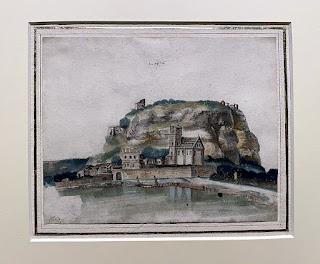
I recently visited the National Gallery's Dürer’s Journeys: Travels of a Renaissance Artist, which I had been looking forward to all year, although I was forewarned that it would be a disappointment by Laura Cummings' Guardian review. She notes that
There is no clear chronology and barely any discernible narrative. The show feels on the one hand congested – too many passengers on board – and on the other, lacking in the forcefield presence of the German master. A humdrum portrait medal of Dürer, instead of a single one of his many self-portraits in ink, chalk, silverpoint or paint – so spectacular, so pioneering, so original – can only mean inevitable bathos. Still, there are marvels by Dürer along the way. He is up there in the Alps getting an image of the shelter down on paper: noticing the fragility of the ruined roof and the weirdly human profile of the foreground rocks...
I let that quote run on to the comment about the shelter because I too was struck by this incomplete sketch. I had been hoping to see in this exhibition some landscape sketches like the wonderful View of the Arco Valley in the Tyrol owned by The Louvre. There was just one - see my photo above: a simplified view of Trento outlined against what appears to be a blank sky. In reality Trento is surrounded by green hills and mountains. This erasure of the landscape is even more striking in his sketch of the mountain shelter from twenty years later. It's almost as if the wider view is too vast and beautiful to capture in paint and so the artist turns his back on it, ignoring the towering rocks and trees around him and electing instead to draw the crumbling stone walls and roof beams of a vulnerable human structure.
I recently read Jeremy Noel-Tod's excellent anthology The Penguin Book of Prose Poetry and it prompted me to get down a few books from our library and look up some examples of prose poems. James Wright, for example: in Above the River: The Complete Poems there are several short prose pieces written during the seventies, when he and his wife were spending their summers in Europe. I have chosen seven of these in order to quote brief imagistic landscape descriptions; but as usual when I do this kind of thing, I need to apologise for taking such descriptions out of context and failing to do convey the actual point of the poems. Still, as I sit writing this in London under lockdown, these fragments of text are a pleasant reminder of the light and beauty of Italy, and an excuse to include again a photograph of the Colosseum from our 2014 trip.
The Colosseum, Rome
As Donald Hall notes in his introduction, James Wright's Italy was a literary place: the landscape of Catullus, Virgil and Ovid, of Goethe's Italian Journey, Keats and Shelley, and the American novelists - Henry James, Edith Wharton and William Dean Howells (who was 'the other literary
figure born in Martins Ferry, Ohio'). Sometimes thoughts of Ohio comes to Wright when he writes about Italy. In the poem 'One Last Look at the Adige: Verona
in
the Rain', he imagines the Ohio river once looking something like the
Adige, 'to the people who loved it / Long before I was born'. Verona was, for Wright, 'one of the earth's
loveliest places' and I will begin and end my quotes there.
On a sunlit day its pink and white marbles glow from within, and they glow from within when it is raining.
- The Arena, Verona
In all directions below us were valleys whose villages were just beginning to appear out of the mist, a splinter of a church here, an olive grove there. It was a life in itself.
- San Gimignano
The fragrance of the water moves heavily and slowly with mussel shells and the sighs of drowned men. There is nothing so heavy with earth as the sea's breath and the breath of fresh wilderness, the camomilla fields along the shore.
- Bari
All over Apulia, currents of sea air snarl among winds from the landwise mountains. I can see thistle seeds tumbling everywhere, but I lose their pathways, they are so many.
- Apulia
At noon on a horizon the Colosseum poises in mid-flight, a crumbling moon of gibbous gold. It catches an ancient light, and gives form to that light.
- The Colosseum, Rome
It is only the evenings that give the city this shape of light; they make the darkness frail and they give substance to the light.
- Venice
Its shape holds so fine a balance between the ground and the sky that its very stones are a meeting and an intermingling of light and shadow. At noon, even the fierce Italian sunlight cannot force a glare out of the amphitheatre's gentleness.
- The Arena, Verona
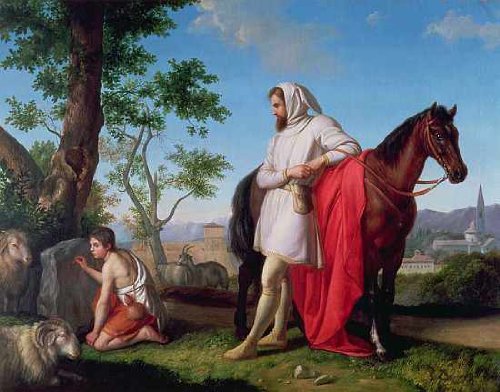
There is one of Wright's prose poems written in Italy that I particularly like, 'The Lambs on the Boulder'. It is about Cimabue and the story of how he 'discovered' Giotto, then just a shepherd boy, scratching sketches of lambs on a rock. I always like the idea of treating such fanciful stories seriously (a different example of this impulse is Eric Rohmer's serious treatment of pastoral in The Romance of Astrea and Celadon). 'One of my idle wishes,' Wright says, 'is to find that field where Cimabue stood in the shade and watched the boy Giotto scratching his stone with his pebble.' He imagines the way Cimabue would have observed the boy:
I wonder how long Cimabue stood watching before he said anything. I'll bet he waited for a long time. He was Cimabue.
I wonder how long Giotto worked before he noticed that he was being watched. I'll bet he worked a long time. He was Giotto.
He probably paused every so often to take a drink of water and tend to the needs of his sheep, and then returned patiently to his patient boulder, before he heard over his shoulder in the twilight the courtesy of the Italian good evening from the countryside man who stood, certainly out of the little daylight left to the shepherd and his sheep alike.
I wonder where that boulder is. I wonder if the sweet faces of the lambs are still scratched on its sunlit side.
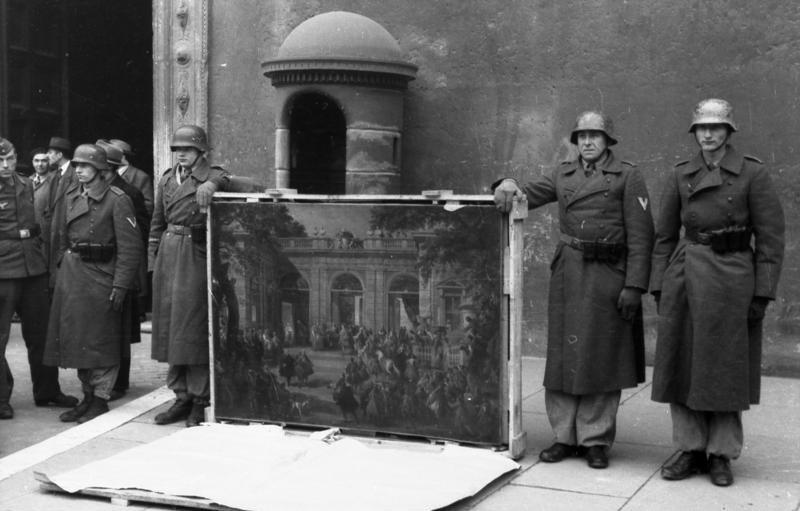
German soldiers in 1944, posing with a picture by Giovanni Paolo Panini taken from Naples Source: Wikimedia Commons
We have just returned from a holiday in Berlin where quite a lot of time was spent at museums and monuments describing the rise of Nazism and the consequences of the Second World War. So it was something of a relief to spend a day at Sanssouci ('without worries'), the beautiful rococo summer palace of Frederick the Great, built to the design of Georg Wenzeslaus von Knobelsdorff between 1745 and 1747. There we saw the painting below, by Giovanni Paolo Panini, a vedute showing some architectural highlights of Baroque Rome. It came to Sanssouci in 1750 and was paired there with a similar painting showing the Forum and ancient Rome. Viewers could compare the two, like readers of the popular contemporary city guidebook Roma antica e moderna (1745), written by Gregorio Roisecco, who owned a bookshop at the Piazza Navona. What I like about Panini's painting is not the distant church spires and dome of St Peter's Basilica, but the foreground of fields and vineyards. This is now the district of Prati, described on websites as a 'white collar' area of 'high end shopping streets' and 'cool restaurants'.
Giovanni Paolo Panini, View of Rome from the foot of Monte Mario, 1749
My photograph in Sanssouci
When I included a Panini painting in my year of landscape art tweets, I made a bit of a lame joke comparing the collecting of Panini paintings by Grand Tourists with the collecting of Panini stickers by football fans. I don't think the Panini brothers, who founded their company in Modena in 1961, are related to the eighteenth century artist. But look at the painting below, now in the Met, and it is hard not to think of a Panini sticker album, like the ones I collected as a boy (I actually managed to complete the 1982 World Cup collection). In Panini's Ancient Rome (1757), the Count of Stainville, who commissioned the painting, can be seen in the middle with a guidebook, visiting an imaginary gallery in Rome. Panini himself is visible behind the chair. There is a companion painting to this that shows Modern Rome, now owned by the Museum of Fine Arts in Boston.
Giovanni Paolo Panini, Ancient Rome, 1757
Source: Wikimedia Commons
Frederick the Great built his own picture gallery between 1755 and 1764
which we saw on our trip to Sanssouci. However, only ten of the original paintings were retrieved
after the war and although some more were brought back from the USSR in 1958,
others remain in Russia. Theft is the dark side of the collecting impulse. One of the most widely reproduced photographs of Nazi looting, reproduced above, shows soldiers from the Hermann Göring Division posing with a Panini painting. Naturally there
have been many instances of Panini sticker robberies, from the 300,000
packs stolen in Brazil in 2014 and the armed robbery at a printing house
in Argentina in 2018, down to domestic burglaries targeting albums
carefully assembled by individual collectors.
Engraved sheets from Roma antica e moderna
Of course sight-seeing itself is a form of collecting. The guidebook Roma antica e moderna
laid out distinct itineraries for a ten day stay and included
illustrations of each site. The photograph above shows a set of
detached sheets that was up for sale, transforming the old book into a
collection of collectible images. Another, earlier guidebook entitled Roma antica e moderna
(published by Giordano Ziletti in 1558) contained a whole section
listing every Roman statue still visible in the city. I wonder how many people (men!) went round and tried to tick them all off. Last week, looking at the sites in Panini's painting, I was enjoying a collection (of buildings) within a collection (of paintings), and this was itself part of the collection of places in and around Berlin that we made for ourselves during a week's holiday.
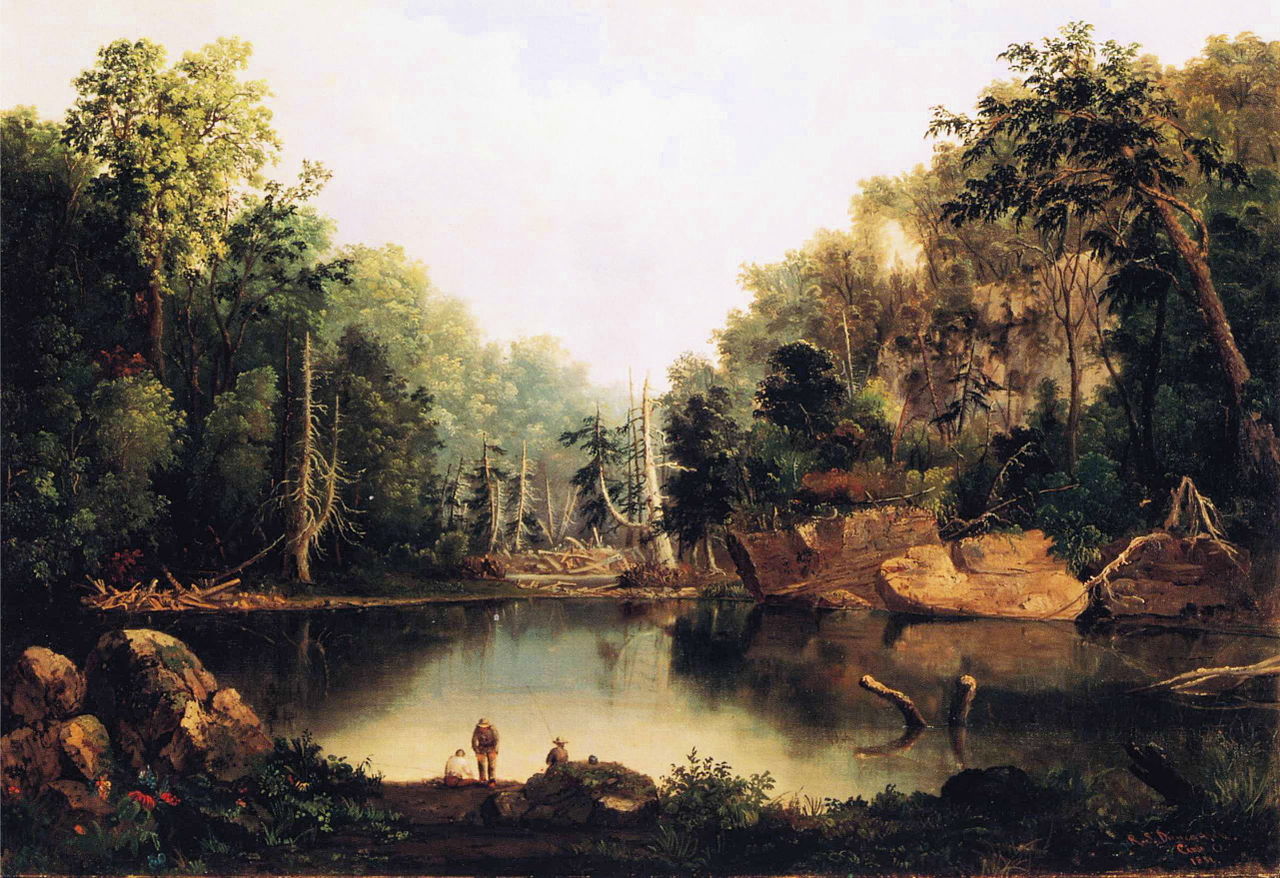
I now have just over a month left of my project to tweet a landscape a day for 2018. It is never possible to predict how many 'likes' these will get - obviously I feel they're all interesting or beautiful in one way or another. Possibly my least popular one this year, with just two 'likes' (one of which came from my mother!) was a Robert S. Duncanson landscape painting showing Vesuvius and Pompeii. This, despite the fact I posted it with the hashtag #BlackHistoryMonth... Clearly if anyone was looking for this hashtag during that particular month, they were not interested in my Duncanson painting. He may have been the first prominent African-American landscape artist, but his style of painting is perhaps too unfashionable to excite much buzz on social media. But his paintings are interesting in their own right - in my tweet I said that "in this view of Pompeii I particularly like that painting-within-a-painting, a large fresco resembling an outdoor cinema."
Robert S. Duncanson was born in 1821 in the state of New York. His grandfather was a freed slave from Virginia and his father lived there, until growing opposition to freed black men persuaded him to move north. The family settled in Michigan and then, as a young man, Robert Duncanson taught himself painting in Cincinnati, 'the Athens of the West'. His first significant landscape painting, Cliff Mine, Lake Superior (1848) was acquired by Charles Avery, one of several abolitionist patrons who bought his work. In 1853 he visited Europe and a year later he collaborated with the prominent African-American photographer James Presley Ball on an anti-slavery panoramic painting, Mammoth Pictorial Tour of the United States Comprising Views of the African Slave Trade. When the Civil War began, he moved to Canada and then Britain, where he was particularly impressed by the Scottish Highlands. He returned to America and died at the age of just 51, possibly due to the effects of lead poisoning. The view of Vesuvius and Pompeii is thus a late work, inspired by his travels almost twenty years earlier.
Robert S. Duncanson, Blue Hole, Flood Waters, Little Miami River, 1851
Until this year, Duncanson did not have a tombstone. However, it was good to come upon a report in the Detroit Free Press (via a JStor article last week), explaining that this is about to change.
'For more than a century, his body has remained in Monroe, about 40
miles south of Detroit, with nothing but grass growing over his grave.
Now, a small foundation marks the site of his burial awaiting the
arrival of a tombstone.
“No one has asked about him — not in my lifetime,” said
Michael Huggins, 55, the manager of the Historic Woodland Cemetery for
the past two decades, and the person who helped find the exact location
of Duncanson’s burial plot.
[... Now] nearly a century and a half later, Monroe resident Dora Kelley is looking to rewrite a chapter of Duncanson’s life. Kelley worked with LeClair Monuments in Lambertville to design a
sleek black granite tombstone for Duncanson complete with his full name,
the year of his death and an etched version of his Ellen’s Isle painting from the DIA’s collection. Kelley also chose a quote from the late artist to grace
the monument, which speaks to Duncanson’s unprecedented position as a
freeborn artist in the era of slavery: “I have no color on the brain;
all I have on the brain is paint.”
Robert S. Duncanson, Ellen's Isle, Loch Katrine, 1871
Last week the BBC published an interesting article by Paul Cooper on the theme of ruins and Arabic writing. He notes that the 'motif of the atlal (‘ruins’) originates in the pre-Islamic period', possibly with the 6th Century poet-king Imru’ al-Qais. In 'The Mu’allaqah of Imru al-Qais', the landscape conveys an overwhelming sense of loss: 'The courtyards and enclosures of the old home have become desolate; / The dung of the wild deer lies there thick as the seeds of pepper.' Robert Irwin includes a translation of this qasida (ode) in his excellent anthology of classical Arabic literature, Night & Horses & The Desert, and notes that in English Literature, Tennyson's 'Locksley Hall' begins in the same way, with the poet asking companions to leave him in peace with his memories. Ruins recur in Arabic poetry down the years, even though the trope was being mocked as early as the eighth century, in a poem by Abu Nuwas: 'The wretch paused to examine an abandoned campsite, / While I paused to inquire about the neighbourhood tavern.'
Having set the historical context, the BBC article goes on to give three examples of ruins in more recent Arabic culture:
In a poem by Palestinian writer, Mahmoud Darwish, 'Standing Before the Ruins of Al-Birweh'
which describes his return to a village left in ruins after the Israeli
occupation in 1948.
In the novels of Iraqi author Sinan Antoon, e.g. The Corpse Washer, where a character wonders through 'the ruin of the
Baghdad National Library, which was destroyed during the 2003 invasion,
and the National Film Archive, the repository of a century of Arab
film-making destroyed by a US bomb.'
In the film Son of Babylon by Mohamed al-Daradji, in which a Kurdish boy searches for his imprisoned
father through the earliest remains of civilisation - Ur, Nimrud, Bablyon - and the new ruins created by the Iraq war. But 'rather than seeing memories held in the
ruins, al-Daradji’s characters find only blankness and emptiness...'
I have summarised Paul Cooper's article here but I could equally have drawn this from his Twitter thread on the same subject. Personally, I find these threads irritating to read and suspect they are quite fiddly to compose. Perhaps the thread is developing its own form, like a qasida... I still prefer to use this blog to write about landscape, rather than split thoughts up into Twitter threads. But of course nothing beats a good old fashioned book, and Cooper's article prompted me to dig out Desert Tracings, an anthology of six classical odes translated by Michael A. Sells. Particularly moving is 'The Mu’allaqah of Labid', which begins, again, with the poet looking for traces of his beloved's campsite. The images that follow convey the way memory can be effaced and restored. The dung-strewn ground that suggests how long it has been since humans were present, is replenished by the rain:
The rills and the runlets
uncovered marks like the script
of faded scrolls
restored with pens of reed.
And yet, 'although renewed, the inscriptions are indecipherable. When the poet questions the ruins, they are summ (hard, deaf), offering only a lapidary silence, or words whose meaning is unclear.'
I have been immersed in Athanasius Kircher's Theatre of the World, a (literally) wonderful and wittily-written book about the great seventeenth century polymath. Its author Joscelyn Godwin is something of a polymath himself but has written mainly about music and the occult (he has featured on this blog before as translator of the Hypnerotomachia Poliphili). The book discusses Kircher's inventions, some of which were housed in his museum at the Jesuit Roman College, and covers his extensive writings in Latin on language, religion, geography, science, music and many other topics. There have been numerous books on Kircher in recent years and Godwin was the author of one of the first of these (in 1979); his aim in this subsequent volume was to focus attention on Kircher's illustrations. These, in contrast to the some of the original texts, 'have a quality of ingenuity and strangeness that are particular to his century, and of singular appeal to ours.'
Pieter Bruegel the Elder, The Tower of Babel, c. 1563
The engravers worked from Kircher's designs which were either his own inventions or adaptations from other sources, sometimes mere sketches sent by travellers and correspondents. The Tower of Babel reproduced on the cover of this book comes from Turris Babel (1679) and was obviously inspired by the famous Breugel painting. It was actually drawn by Coenraet Decker and engraved by Lievin Cruyle. The tower differs from Bruegel's in having 'a system of crossing ramps from one of Kircher's favourite ancient buildings, the Temple of Fortune in Praeneste'. Bruegel's tower looks like it is being built in the Flemish countryside, but Kircher's is surrounded by ancient monuments, including numerous pyramids and obelisks, subjects he treated extensively in Oedipus Aegyptiacus (1652-4) and Obeliscus Aegyptiacus (1666). His fascination with the obelisks of Rome made me want to revisit the city and spend a day tracking them all down, from the Flaminian obelisk now in the Piazza del Popolo to the Sallustian obelisk at the top of the Spanish Steps.
Athanasius Kircher, The Earthly Paradise, from Arca Noë (1675)
Kircher's depictions of ancient sites as they might once have appeared range from the Roman villas that he could visit around Tivoli to places for which he had to rely on ancient texts: the Hanging Gardens of Babylon, the citadel of Atlantis and the Garden of Eden (above). For China Illustrata (1667) he made use of the Travels of Marco Polo and more recent information sent back by his fellow Jesuits. It includes depictions of the Mountain of Fe, shaped either naturally or artificially (Kircher
puts arguments for both possibilities) into the resemblance of a Chinese
god; the Seven Peaks, which seem to correspond to the configuration of the Great Bear; and Lake Chin, on the surface of which float waterlilies and, more strangely, a child on a piece of wood, the sole survivor of a city destroyed by an earthquake. In this volume Kircher also illustrates Dragon and Tiger Mountain with the creatures themselves about to fight each other. Although sceptical of some mythical creatures, Kircher believed in the existence of dragons, even in Europe. 'It may surprise the reader', Joscelyn Edwards observes, 'to learn that dragons were nowhere more prevalent than in Switzerland.' The idea of a dragon on Mt Pilatus terrorising Lucerne inevitably recalled for me Smaug's destruction of Lake-town in The Hobbit.
Athanasius Kircher, Dragons of Lake Lucerne, from Mundus Subterraneous (1664-78)
Some of Kircher's most famous 'landscape' drawings are in Mundus Subterraneus where they illustrate his theories of geography, geology and the movement and actions of fire and water. His notion of the hydrological cycle required underground mountain reservoirs and subterranean channels connecting the seas. At the North and South Poles, as yet unknown, he imagined the global flow of water governed by a vast whirlpool and spring. I have included here before his image of Mt Vesuvius, a volcano Kircher explored himself. Inside the crater he 'perceived the groaning and shaking of the dreadful mountain, the inexplicable stench, the dark smoke mixed with globes of fire which the bottom and sides of the mountain continuously vomited forth from eleven different places, forcing me at times to vomit it out myself...'
Athanasius Kircher, The Loudspeaker System at Mentorella, from Phonurgia Nova (1673)
Kircher wrote a topographical study, Latium (1671) about the region around Rome. He was particularly drawn to the sanctuary of Mentorella, which he helped preserve, and it was here that he performed some of his acoustic experiments, with loudspeakers directed at the surrounding hills (see above). This sacred place had witnessed the conversion of St Eustace, when the figure of Christ appeared between the antlers of a stag (see illustration below). Kircher's book Historia Eustachio-Mariana (1665) contains a memorable description of his discovery of the sanctuary and I will end this post with it. As Joscelyn Godwin remarks, 'the eighteenth century did not invent the Sublime, nor the Romantic era the melancholy attraction of ruined choirs.'
'In 1661, while I was exploring the mountains of Polano and Praeneste, I started in Tivoli and passed through wild mountains and rocks. Around noon I came to a horrid, solitary place, hemmed round with rocks like a crown. It really was a place filled with horror, where the stony pyramids seemed to scrape the heavens, and, falling from hanging rocks in formidable vortices, seemed to express infernal motion. In the midst of all this, among dark trees and rocks, I came across the remnants of a roof: it was a church, all but collapsed. But how could there be a church in this place of terror and solitude? I asked the guide. Going in I saw the pictures and sculptures of the saints. Everything breathed the devotion of ancient piety.'
Athanasius Kircher, The Conversion of St. Eustace, from Latium (1671)
Charles-Joseph Flipart, Landscape with an architectural view surrounded by trompe-l’oeil elements symbolising the Arts, c. 1779
Image from the Prado site for non-commercial use
This painting is two things at once, a still-life and a landscape. The landscape has a mysterious, De Chirico feel to it, with its strange architectural fragments rendered in slightly unsettling perspective and absence of people beyond those visible in the foreground. In the centre, out of scale with the huge columns, there is what appears to be a curious quincunx-like arrangement of short pillars or steles, until you realise these are actually skittles. It was painted as the design for a console table, which could have had actual fruit, books and musical instruments placed on it. The Prado has another similar sketch by Flipart which also shows ruins casting long shadows. In both paintings leaves curl round the border of the landscape - they could be part of the still life or the world beyond.
Image from the Prado site for non-commercial use
I am not sure how numerous hybrid works combining still life and landscape are, but in a recent exhibition I saw Flipart's Landscape with an architectural view hanging next to the painting below. Here too, the eye can focus for a while on the foreground detail, yet cannot help being drawn away into the sunlit space of the landscape. Perhaps those alluring distances offered the paintings' owners a respite from the decorative excess of their own interiors. Flipart also did one of his still life/landscapes with a view out to sea and there are parallels in the two artists' careers. Johann Rudolf Bys (1660–1738) was Swiss but became a court painter in Prague after travels that took him to Germany, Holland and England. Charles-Joseph Flipart (1721–1797), who was French, also travelled in Europe before becoming court painter in Spain.
Johann Rudolf Bys, Flower Still Life with Veduta in a Cartouche, before 1713
The flowers in the painting by Bys are reminiscent of those used by
other artists at that time to create intricate illusionistic borders.
Garlands surround images of the holy family in seventeenth century paintings by the Breughels and other Flemish artists. The art of Abraham Brueghel (1631 – c. 1690) is diverse but always full of
flowers and in one example in Zagreb they frame a sunlit country scene. There have been many artists who painted still life in the foreground of a landscape - the dead game paintings of Jan Weenix, for example - but fewer who separated the two and gave them equal prominence within the same painting. Perhaps there is still potential in this genre - I'm thinking of what George Shaw might do: a sylvan landscape surrounded by trompe-l'œil renderings of the bottles, discarded clothes and other litter to be found in our woodlands. But there is something fresh in the paintings of Bys and Flipart, in their fascination and delight in nature and culture, that seems to arise directly from the dreams and desires of early modern Europe.
The British Museum currently has an exhibition of British landscape watercolours which focuses on the period 1850-1950, the century after the Golden Age. It includes familiar names that I have often featured here - Samuel Palmer, John Ruskin, James McNeill Whistler, Paul Nash (see above). There are also landscapes by artists more usually associated with other genres - John Singer Sargent (society portraits), Anna Airy (war workers), Hubert von Herkomer (depictions of the poor). And there are the somewhat forgettable Victorian artists with their double names - Alfred William
Hunt, George Pryce Boyce, Edward John Poynter - whose picturesque views
are painted beautifully but don't stick in the mind very long. One of the things you realise from this show is how many now-rather-obscure artists were renowned at the time and made a fortune from their paintings. I made a note of one nice winter scene by William Russell Flint, who you would be forgiven for not having heard of, even though he was knighted in 1947 (according to Wikipedia he 'enjoyed considerable commercial success but little respect from art
critics, who were disturbed by a perceived crassness in his eroticized
treatment of the female figure.')
William Russell Flint quote (after Thomas à Kempis) from 1924,
on display at the Places of the mind:
British watercolour landscapes 1850–1950
The British Museum has been collecting watercolours for a long time - the exhibition includes one painting by Francis Towne that was part of his bequest in 1816. Some parts of its collection have never been seen publicly before, including one work by an artist about whom very little is now known, Henry Stanier. According to the Guardian, 'the long-awaited public showing comes 113 or so years after the death of the artist' (who was waiting for it they don't say - perhaps we all were, without knowing it). Kim Sloan, this exhibition's curator 'discovered the huge watercolour in an obscure
corner of the museum more than 10 years ago, when she was looking for
the original frames for some Turner watercolours. To her astonishment she found not just empty frames, but three
paintings by Stanier, an artist she had never heard of. They appear to
have been stashed away in the 1950s without ever being recorded in the
museum’s collection.' The unearthing of this view of the temple complex at Karnak sunds almost like an act of archaeology. Karnak itself continues to yield new finds a century after Stanier was there and you wonder how much else there is to find in the recesses of the British Museum.
Before leaving for our Easter break in Northumberland I had joked about shivering on beaches in a freezing North Sea wind. However, I hadn't appreciated how beautiful the effect of this would be, with a layer of sand swirling constantly across the surface - see my brief clip below. Watching back the video footage I took over the course of a week it sounds as if there was a constant howling gale. In one sequence on Lindisfarne I can be heard saying excitedly to the camera that the birdsong is just as you can hear it on Chris Watson's album, In St Cuthbert's Time, but none of it can be made out above the wind. It was different when we were there though, sitting among the stones on the shore, near the ruins of Lindisfarne Abbey, listening to the cry of the eider duck that is so prominent in the Lencten section of In St Cuthbert's Time. I wrote in an earlier post about hearing these recordings at Durham Cathedral in the quiet of a chapel; on Holy Island we were able to hear these sounds unmediated, carried over the water on the wind.
Earlier this month there was a short programme on the BBC called 'Into the Wind'. It followed Tim Dee as he talked of the ways the wind shapes his experiences of walking and birdwatching. An accompanying piece in the Guardian, 'The Man Who Interviewed the Wind', provoked the inevitable below the line jokes (from which I learnt the meaning of 'Dutch oven' - not a piece of landscape vocabulary that will find its way into Robert Macfarlane's word hoard), but also explains how Tim uses the natural soundscape in his work as a radio producer. 'Turning to record a little minute of the wind lets me experience the
place beyond human talk. On good days, in good places, I can sense
myself joined to a landscape. It is the wind that carries me there.' The programme ends with a dramatic wide-angle view of Tim pointing his microphone towards the vast mudflats of the Wash to record the wind as it surges in from the North Sea.
As Chris Watson pointed out in one of the BBC's Tweets of the Day, the sound of the eider duck is often thought to resemble that of Frankie Howerd. I found myself wondering if Cuthbert ever felt goaded by it - in Bede's Life of St Cuthbert the monks are constantly vigilant against temptation, 'our loins ever girt against the snares of the devil and all temptations'. The sounds on In St Cuthbert's Time give a peaceful impression of monastic life, but perhaps the cries of the seabirds could be a torment to monks in search of spiritual purity. 'How often have the demons tried to cast me headlong from yonder rock,' Cuthbert told visitors to his hermitage on Inner Farne. Although he was an active missionary, his life looks like a series of steps to free himself from the world. After entering the monastery of Melrose as a boy, he eventually joined the priory of Lindisfarne, easily accessible only at low tide, then isolated himself on what is now St Cuthbert's island - an islet next to Lindisfarne also regularly cut off by the sea - before leaving the priory altogether to live as a hermit on the Farne Islands. There the walls of his cell were such that all he could see was the sky, so that 'eyes and thoughts might be kept from wandering.'
A raven brings pig's lard to Cuthbert on Farne
from the Yates Thomson MS of Bede's Life of Cuthbert, c. 1200
We took a boat trip to Inner Farne, the small island where Cuthbert lived as a hermit from 676. It is now managed as a nature reserve by the National Trust and their rangers make do with no running water ("we might smell a bit as we only shower once a week"). Cuthbert, according to Bede, found a well there with the help of God. He also persuaded the birds not to eat his crops and shamed a pair of ravens into bringing him a gift of pig's lard - incidents depicted in medieval illuminated manuscripts. Cuthbert is celebrated now for conserving the eider ducks, instituting one of the first bird protection laws. However, the language of Bede in his Life of St Cuthbert is very much about mastery over nature. In Chapter 21, Cuthbert is aided by the sea itself, which deposits with the tide a length of wood just right for his dwelling. 'It is hardly strange that the rest of creation should obey the wishes and commands of a man who has dedicated himself with complete sincerity to the Lord's service. We, on the other hand, often lose that dominion over creation which is ours by right through neglecting to serve its Creator.'
Guillemots on Inner Farne
The tide times meant that we arrived early on Lindisfarne, before anywhere was open, and so while the others ambled over the beach I tried to do some sketching. Thomas Girtin and J. M. W. Turner both came here within a year of each other at the end of the eighteenth century and drew the interior of the ruined priory. Girtin's crumbling columns were influenced by seeing the way Piranesi had depicted the ruins of Rome. Cuthbert himself must have known more Roman remnants than we see in northern Britain today; in the Life he visits Carlisle and is shown an old Roman fountain set into the city walls. Now the medieval priory, built on the site of the original one that the monks, fleeing the vikings, abandoned in 875, lies exposed to the wind. There is less of it standing than there was when Turner came here in 1797. Girtin's paintings of the priory 'emphasised the fact that it had been untouched by the hand of improvers' (Greg Smith, Thomas Girtin: The Art of Watercolour). In them, and in Turner's drawings, the ground is uneven and overgrown, very different from the green lawns maintained today by English Heritage.
Lindisfarne has a castle, built in 1550, the subject of dramatic paintings by both Girtin and Turner, renovated in Arts and Crafts style by Lutyens. It is now being restored again and is inaccessible, covered in scaffold. We were able though to see nearby the little garden designed by Lutyens' friend Gertrud Jekyll, sheltered inside a dry stone wall. Before leaving the island, we walked some way round the coast, listening again to the eider ducks. We past that point where some figures can be seen in Girtin's painting, grouped around a fire. The way he shows the smoke blowing suggests the strength of the wind on the island. I will conclude here with a story in the Life of St Cuthbert that concerns wind and fire. One day, Cuthbert was staying in the home of a holy woman, who rushed in to warn him that a house in the village was alight. Cuthbert told her to keep calm and 'he went out and lay full length in front of the door. Before he had finished praying the wind had changed to the west and put the house the man of God had entered completely out of danger.' Bede concludes that God will 'give us grace, unworthy though we are, to extinguish the flames of vice in this world, and escape flames of punishment in the next.'