Showing posts with label seas. Show all posts

Tuesday, December 26, 2023

Conway Castle - Panoramic View

Conway Castle - Panoramic View of Conway on the L.& N.W. Railway

I've been reading Bryony Dixon's book The Story of Victorian Film which can be seen as an extension of the brilliant free-to-access BFI Victorian Film archive. For example, she discusses Conway Castle - Panoramic View of Conway on the L.& N.W. Railway, a 'sedately paced' landscape film which the BFI website describes thus:

This beautiful film, shot in February 1898, has a dream-like quality and is hand tinted (possibly stencilled). It is believed to have been coloured some time after it was first shown as no contemporary reviews or advertisements refer to what would surely have been a major selling/talking point, 1898 being very early for coloured films.

This film was made in response to the first American phantom train ride film (by the British Mutoscope and Biograph's parent company, the American Mutoscope and Biograph Company), 'The Haverstraw Tunnel', which showed the scenery around the Hudson river and a tunnel and so delighted the audience that the British operation decided to make their own version, which also proved very popular - it showed not only in London but also in Rochester, New York, and then travelled all over Europe, still being shown in cinemas as late as 1910. This film is preserved by the EYE Filmmuseum, Netherlands.

Dixon's chapter 'Moving Images: Panoramas, Phantom Rides and Travel' explains that the first travel film made from a moving vehicle was Alexander Promio's Panorama du Grand Canal pris d'un bateaux, shot from a gondola on 25 October 1896. There are several versions of this uploaded on YouTube and I've embedded one of them below. Two years later Biograph produced Panoramic View of the Vegetable Market at Venice with a large format camera that gives a remarkably clear, almost 3D stereoscopic effect. Such films can be related in their subjects and composition to earlier picturesque views in art, as well as the more recent phenomenon of moving panoramas (views unfurled on rolled-up cotton with a lecturer explaining each scene). A little later we get more Italian travelogues with more than one shot - Visit to Pompeii (1901) is 8 minutes long and features a 360-degree pan of the ruins, a lovely misty view of Vesuvius with sheep providing motion in the foreground and then a ride up the volcano's funicular railway (another version of the 'phantom train ride'). One more to recommend you look at is Ride on the Peak Tramway (1900), filmed in Hong Kong, which has a grainy, mesmerising quality. 'As the tram crests the peak it's just possible to see the huge vista of Victoria Harbour and Kowloon laid out before us, as if viewed from the world's greatest natural rollercoaster.' 


Another interesting genre discussed in Bryony Dixon's book is the sea wave film. 'Nearly every report of early film screening mentions audience reaction to films of sea waves. Films showing the movement of water were very popular for their mesmeric effect as well as for the initial shock they gave audiences at their feeling of 'absolute realness''. She quotes a reaction to Birt Acres' early Rough Sea at Dover (1895) - "It is not too much to say that persons seated near the screen must have shrunk from the approaching billows which gathered, lifted their foam-tossed crests, curled and crashed down with an absolute realism from which nothing was wanted but the roar." Again there are obvious precedents in art and recent photography (Acres was himself a photographer). Cecil Hepworth's film Rough Seas Breaking on Rocks (1899) reminds me of the 'rough seas' genre of postcards I wrote about here in 2011.  Dixon lists other examples but notes in particular 'the beautiful Sea Cave Near Lisbon, filmed by Henry Short for Robert Paul in 1896, in which Portugal's famous Boca di Inferno (Mouth of Hell) frames the waves swirling and smashing against the rocks.'


Sea Cave Near Lisbon

Sunday, November 05, 2023

Lake Superior, Cascade River

Sugimoto Seascapes at the Hayward Gallery

I wrote about Hiroshi Sugimoto's seascape photographs here in 2007, referring to some online images at the Smithsonian's Hirshhorn Museum. Checking back just now I found the link was dead, but there is still information on the exhibition at their website. I would love to visit the actual building in Washington one day - not only did they do that major career retrospective, they have also more recently commissioned Sugimoto (who is also an architect) to redesign their lobby and renovate their sculpture garden. This autumn though, at long last, a British gallery has put on a Sugimoto retrospective and it's just a 341 bus ride away from our home. Hiroshi Sugimoto: Time Machine includes the photograph I mentioned sixteen years ago, Boden Sea, Uttwil (1993), along with others just as beautiful. 

These luminous images, made with an old large-format camera, are referred to by the artist as seascapes, although Boden Sea is what Sugimoto calls Bodensee, i.e. Lake Constance, and my photo below shows another lake view. But The Guardian exhibition review begins with a wonderful view of the North Atlantic Ocean and the Evening Standard's includes Sugimoto's photograph of the Bay of Sagami. I will briefly quote Laura Cummings' article, as she manages to include the lovely word for a cold sea fog, 'haar'.

These monochrome photographs must all be captured at a particular moment, by their very nature, and yet they appear to stand outside time. Their poetry lies in more than they show. [They] hover between representation and abstraction. There are visions of shining light where up and down appear inscrutable, seas that tip over the horizon, or resemble nothing but haar. There are seas that register as oblongs of graphite shading. All are real – look closely and you can even distinguish tidal flow – but as intangible as outer space.


Lake Superior, Cascade River, 1995

Sugimoto's photographs allow you to imagine a primal sea untouched by humanity. In my book Frozen Air I described looking out on the English Channel, which Sugimoto has photographed for this series from both shores. There can be passages of time when no ships cross your field of vision, and nothing but light and water lie in front of you. In Marcel Proust's first book, Pleasures and Days, he described this pristine vision: ‘unlike the earth, the sea does not bear the traces of human works and human life. Nothing remains on the sea, nothing passes there except in flight, and how quickly the wake of a ship disappears! Hence the sea's great purity, which earthly things do not have.'

Wednesday, April 13, 2022

Grass pillow

Natsume Sōseki's Kusamakura ('Grass Pillow'), published in 1906, was an attempt at a haiku-style novel, a reaction against the enthusiasm for European-style naturalism that had recently entered Japanese literature, and it works so beautifully (at least, to my mind, in English translation) that it is disappointing he didn't try anything like it again. Maybe one luminous book is enough. Its narrator is an artist escaping fast-modernising urban Japan for a solo-walking tour in the mountains, where he stays at a hot-spring resort and encounters a beautiful and enigmatic young woman, Nami (which means 'beauty'). His project is to see the world in aesthetic terms and experience everything he encounters as if it is a poem. Like Sōseki, he is at home in Chinese, Japanese and Western literature and over the course of the novel he quotes Basho, Wang Wei and Shelley. I should probably refer here to the parts of the novel where he theorises natural beauty and discusses landscape art (at one point he describes British painters' inability to paint light - 'nothing bright could be produced in that dismal air of theirs'.) Instead I will include one of his paragraphs of word painting. This is from near the end of the book, where the narrator lies down on the grass among wild japonica bushes, sensing as he does so 'that I am inadvertently crushing beneath me an invisible shimmer of heat haze.'

'Down beyond my feet shines the sea. The utterly cloudless spring sky casts its sunlight over the entire surface, imparting a warmth that suggests the sunlight has penetrated deep within its waves. A swath of delicate Prussian blue spreads lengthwise across it, and here and there an intricate play of colours swims over a layering of fine white-gold scales. Between the vastness of the spring sunlight that shines upon the world, and the vastness of the water that brims beneath it, the only visible thing is a single white sail no bigger than a little fingernail. The sail is absolutely motionless. Those ships that plied these waters in days gone by, bearing tributes from afar, must have looked like this. Apart from the sail, heaven and earth consist entirely of the world of shining sunlight and the world of sunlit sea.'

Friday, June 25, 2021

Untitled (Moon Image)


The oceans and deserts of Vija Celmins are monochrome patterns of pencil marks and brush strokes - no landmarks, just abstract surfaces. She may have looked at particular sites but the artworks only reproduce her photographs, or photographs taken by others - landscape at two removes. Their sources are hidden in titles like Untitled (Desert) and Untitled (Ocean). Nevertheless, the patience and attention needed to make her art seems to ask questions about how closely we attend to the world and really spend time in a particular environment. Observational drawing has a long history - Briony Fer cites the examples of Dürer's Large Piece of Turf and Ruskin's advice in The Elements of Drawing in her essay in Vija Celmins: To Fix the Image in Memory (ed. Gary Garrels). But art of this kind is closer to still life than landscape. Celmins' drawings of the sea are each 'a graphic rendering of a ready-made image and not a record of the vastness of the ocean.'    


A page from Vija Celmins: To Fix the Image in Memory showing moon drawings from 1968-9


One sentence from another essay in this book by Russell Ferguson particularly struck me. In discussing Celmins' early paintings he suggests that 'T.V. (1964) shows an everyday object from the studio - a television set - but a very contemporary one: this is probably one of the earliest representations of a TV in painting.' If this is true it is remarkable to think that art can have ignored such an important object in people's lives for twenty years. One could also say that in the late sixties Celmins was one of the first artists to depict the landscape of the moon, although her drawings of NASA photographs are clearly at second hand, deliberately reproducing the blurring and imperfections in the source images. In this way they are quite different from the pastel drawing John Russell made nearly two centuries earlier using a telescope, which despite the vast distance was based on direct observation. 


John Russell,  The Face of the Moon, 1793-97

Friday, December 18, 2020

Beach at Low Tide

In between the first and second waves of coronavirus I managed to get to an art exhibition - the Royal Academy's Léon Spilliaert retrospective. It was a strange experience, trying to enjoy paintings while wearing a mask (steaming up my glasses) and keeping a safe distance from other people. Laura Cumming had written a preview in February which made it sound great. 'This is a vital opportunity, then, to catch sight of his dark and startling art in all its precise originality, and to understand him as more than a painter of the cold North Sea'. He certainly was a fascinating artist, but here, in keeping with the blog's focus, I will focus on his sea paintings, with quotes drawn from an essay by Anne Adriaens-Pannier and Noémie Goldman. Here is a page from the catalogue, open to show a remarkable early work, now in a private collection: Seascape with Beacons (c. 1900).

'The sea appears in his earliest works like a lightly coloured patch of life, gentle and calm, betraying an aesthetic borrowed from the Impressionists. The pastel is applied in shapeless strokes, the delicate colours creating muted harmonies sometimes brightened by tiny spots of light.'


Léon Spilliaert, Seascape Seen from Mariakerke, 1909

'When Spillaert wanted to enhance the intensity of the sea, he introduced a disturbing nocturnal atmosphere and put greater emphasis on the horizon, where the silhouette of the urban coastline can sometimes be made out. In this series of  'sombre seascapes' ... the water , waves, currents, clouds and light evoke constant motion, the uncertainty of life and the suffering of a tormented character...' 

 
Léon Spilliaert, Beach at Low Tide, c. 1909

'Spillaert then abandoned these broader horizons to look at something closer to hand, at the water's edge on the beach ... The narrowing of his gaze led him to simplified forms, images stripped bare. Subtly sinuous, the waves take possession of a sandbank, tracing an organic, almost abstract shape on the damp, dark beach.'

I will conclude here with three more quotes about Spilliaert's Ostende beach scenes, taken from reviews of the exhibition.

'A longing to escape – or at least to have the option – is palpable in many of Spilliaert’s land- and seascapes. In a 1908 gouache and watercolour of Ostend’s Hofstraat, a towering street leads to a lantern in the sea, an inviting will-o’-the-wisp in the murk. Spilliaert’s beaches often surge towards the ocean beyond' - Joe Lloyd

'His beachscapes depict the breakwater as an advance, an invasion, while poles, pillars, lighthouses, masts, lampposts are all ranged precariously against the relentless horizontality of the sea. The vertical is temporary – the horizontal always wins.' - Patrick McGuiness 

'With a work such as Seascape Seen from Mariakerke (1909), you peer into the layers of India ink – shade upon shade of black – as though into mist, until a stray brushstroke or a scrub-mark that reveals the paper beneath reminds you that you’re looking at a two-dimensional surface. The immediate physical sensation is a kind of retinal whiplash – but as the process is repeated in seascape after seascape it amounts at last to something more like yearning: wishing yourself into another world while unable to forget where you are.' - Samuel Reilly

Sunday, April 26, 2020

On a sunlit day

I recently read Jeremy Noel-Tod's excellent anthology The Penguin Book of Prose Poetry and it prompted me to get down a few books from our library and look up some examples of prose poems.  James Wright, for example: in Above the River: The Complete Poems there are several short prose pieces written during the seventies, when he and his wife were spending their summers in Europe.  I have chosen seven of these in order to quote brief imagistic landscape descriptions; but as usual when I do this kind of thing, I need to apologise for taking such descriptions out of context and failing to do convey the actual point of the poems.  Still, as I sit writing this in London under lockdown, these fragments of text are a pleasant reminder of the light and beauty of Italy, and an excuse to include again a photograph of the Colosseum from our 2014 trip.

The Colosseum, Rome

As Donald Hall notes in his introduction, James Wright's Italy was a literary place: the landscape of Catullus, Virgil and Ovid, of Goethe's Italian Journey, Keats and Shelley, and the American novelists - Henry James, Edith Wharton and William Dean Howells (who was 'the other literary figure born in Martins Ferry, Ohio').  Sometimes thoughts of Ohio comes to Wright when he writes about Italy.  In the poem 'One Last Look at the Adige: Verona in the Rain', he imagines the Ohio river once looking something like the Adige, 'to the people who loved it / Long before I was born'.  Verona was, for Wright, 'one of the earth's loveliest places' and I will begin and end my quotes there.

On a sunlit day its pink and white marbles glow from within, and they glow from within when it is raining.

- The Arena, Verona

In all directions below us were valleys whose villages were just beginning to appear out of the mist, a splinter of a church here, an olive grove there.  It was a life in itself.

- San Gimignano

The fragrance of the water moves heavily and slowly with mussel shells and the sighs of drowned men.  There is nothing so heavy with earth as the sea's breath and the breath of fresh wilderness, the camomilla fields along the shore.

- Bari

All over Apulia, currents of sea air snarl among winds from the landwise mountains.  I can see thistle seeds tumbling everywhere, but I lose their pathways, they are so many.

- Apulia

At noon on a horizon the Colosseum poises in mid-flight, a crumbling moon of gibbous gold.  It catches an ancient light, and gives form to that light.

- The Colosseum, Rome

It is only the evenings that give the city this shape of light; they make the darkness frail and they give substance to the light.

- Venice

Its shape holds so fine a balance between the ground and the sky that its very stones are a meeting and an intermingling of light and shadow.  At noon, even the fierce Italian sunlight cannot force a glare out of the amphitheatre's gentleness.

- The Arena, Verona

There is one of Wright's prose poems written in Italy that I particularly like, 'The Lambs on the Boulder'.  It is about Cimabue and the story of how he 'discovered' Giotto, then just a shepherd boy, scratching sketches of lambs on a rock.  I always like the idea of treating such fanciful stories seriously (a different example of this impulse is Eric Rohmer's serious treatment of pastoral in The Romance of Astrea and Celadon).  'One of my idle wishes,' Wright says, 'is to find that field where Cimabue stood in the shade and watched the boy Giotto scratching his stone with his pebble.'  He imagines the way Cimabue would have observed the boy:
    I wonder how long Cimabue stood watching before he said anything.  I'll bet he waited for a long time.  He was Cimabue.
    I wonder how long Giotto worked before he noticed that he was being watched.  I'll bet he worked a long time.  He was Giotto.
    He probably paused every so often to take a drink of water and tend to the needs of his sheep, and then returned patiently to his patient boulder, before he heard over his shoulder in the twilight the courtesy of the Italian good evening from the countryside man who stood, certainly out of the little daylight left to the shepherd and his sheep alike.
    I wonder where that boulder is.  I wonder if the sweet faces of the lambs are still scratched on its sunlit side.


Gaetano Sabatelli, Cimabue and Giotto, 1846

Monday, April 06, 2020

Sea Pictures


On 5 October 1899 attendees at the Norfolk and Norwich Festival heard the first performance of Edward Elgar's Sea Pictures, with Elgar conducting and Clara Butt singing, dressed as a mermaid.  The five songs were each based on a nineteenth century poem.

'Sea Slumber Song' by Roden Noel

Sea-birds are asleep,
The world forgets to weep,
Sea murmurs her soft slumber-song
On the shadowy sand
Of this elfin land...

Roden Noel (1834-94) was a poet attracted to sublime landscape: he called an 1885 collection Songs of the Heights and Deeps. One of these poems is 'Suspiria' - a word that for the modern reader recalls De Quncey's Suspiria de Profundis and the Dario Argento films it has inspired.  Like the film Suspiria, it is full of colour and drama. 'Do you remember the billowy roar of tumultuous ocean? / Darkling, emerald, eager under vaults of the cave, / Shattered to simmer of foam on a boulder of delicate lilac, / Disenchantless youth of the clear, immortal wave?' (and so on).  A posthumous collection was called My Sea and Other Poems and its editor praised Noel's nature poetry: 'numerous are the poets, still living, who will babble to you of brooks and flowers, but few or none who care to fathom the deeper mysteries of nature'.  It was the sea, above all, that 'had an overmastering fascination for him' and his poems inspired by it ring with a 'grand yet subtle music'.

In Haven (Capri) by Caroline Alice Elgar

... Closely cling, for waves beat fast,
Foam-flakes cloud the hurrying blast ...

The second 'Sea Picture' uses text by the composer's wife, who had also written 'The Wind at Dawn', a poem she gave Elgar on their engagement and that he had set to music in 1888.  'The Wind at Dawn' gives a dramatic description of a day beginning: 'The wind went out to meet with the sun / At the dawn when the night was done, / And he racked the clouds in lofty disdain / As they flocked in his airy train...'  C. Alice Roberts was actually a published novelist before she met Elgar.  In his book about the composer, Jerrold Northrop Moore notes the landscape symbolism in her book Marchcroft Manor (1882), where 'the feminine presence of Nature is recognised as the initiator of insight.'  In it she describes the beauty of autumn days when 'the lights and shades which we see varying and changing in the sunlight, enter into and work strange changes in the lives of some of us as well as play over the surface of the waters and hills.'

Sabbath Morning at Sea by Elizabeth Barrett Browning

The ship went on with solemn face:
    To meet the darkness on the deep.
        The solemn ship went onward...

This one can't be called a seascape poem. Harper's Magazine for some reason reprinted it a few years ago and explained that 'for a modern audience, this may still be one of the less approachable of her major poems. It seems a typical example of Victorian religious sentimentality – the theme is the approach of death, and on All Saints Day, the narrator finds herself on a ship at sea.'  Of more interest to readers of this blog would be 'A Sea-side Walk', published three years earlier in 1836.  Again, the mood of the landscape affects the thoughts of those walking through it: 'For though we never spoke / Of the grey water and the shaded rock, / Dark wave and stone unconsciously were fused / Into the plaintive speaking that we used / Of absent friends and memories unforsook...'

Where Corals Lie by Richard Garnett

The deeps have music soft and low
When winds awake the airy spry,
It lures me, lures me on to go
And see the land where corals lie.

Richard Garnett was a biographer employed by the British Museum - Constance Garnett, translator of the Russian classics was his daughter-in-law and Bloomsbury writer David Garnett was his grandson.  His poems are (perhaps deservedly) seldom read these days.  Looking through the contents list of his collection Io in Egypt a few titles look promising, but they are marred by stale and out-dated language. 'Summer Moonlight', for example, begins with clouds leaving the moon 'half pillaged' of her light, until suddenly she is revealed and lights up a cascade.  Then, in an effect quite hard to imagine, the 'lustrous foam' melts 'into the rosy fires that made / The brown demureness of the rocks superb.' Another poem, 'Fading leaf and Fallen-leaf', sounds almost Japanese in its theme, but I couldn't get beyond the opening lines: 'Said Fading-leaf to Fallen-leaf, / "I toss alone on a forsaken tree..."'
The Swimmer by Adam Lindsay Gordon

With short, sharp, violent lights made vivid,
   To southward far as the sight can roam;
Only the swirl of the surges livid,
   The seas that climb and the surfs that comb...

The final poem is by an Australian poet whose reputation has fluctuated over the years - Bernard Shaw mocked him but he is the only Australian in Westminster Abbey's Poet's Corner.  The Queen (praised for her coronavirus speech yesterday) actually quoted him in her 1992 annus mirabilis Christmas message.  'The Swimmer' appeared in Gordon's second collection Bush Ballads and Galloping Rhymes, published a day before his suicide in 1870.  The phrase 'galloping rhymes' is an allusion to his career as a jockey.  At Blue Lake in South Australia an obelisk was erected to commemorate one of his horse-riding feats: 'This obelisk was erected as a memorial to the famous Australian poet. From near this spot in July, 1864, Gordon made his famed leap on horseback over an old post and rail guard fence onto a narrow ledge overlooking the Blue Lake and jumped back again onto the roadway...'  From a landscape perspective this monument may be his most significant contribution - few of his poems stop long to admire a view.

Stamp issued in May 1985

Sea Pictures itself is apparently not well known outside Europe, possibly affected by Elgar's Last Night of the Proms reputation, as an Arts Fuse article suggests.  I cannot comment on the music because it so far removed from what I normally listen to, but it certainly drew praise at the time.  'A certain amount of less favourable criticism was directed towards the poetry,' however, according to an ABC article.  'Elgar did seem to have sentimentally Victorian tastes when it came to lyrics.'  Of the five writers he alighted on, only Roden Noel could really be described as a landscape poet and his work is now largely forgotten.  It is strange how some creative figures have an afterlife only via another medium, painted by a great artist, say, or inspiring a character in a novel, or in this case, drawn into a piece of music that has carried this odd little collection of poems floating out of their original time like flotsam drifting on the sea. 

Sunday, July 15, 2018

Evening Calm, Concarneau


I am over halfway through the year now in my project to tweet a landscape a day. Looking back to January 1st when I launched this initiative, I see I was particularly keen to include as many women artists as possible, and this remains the case.  I recently featured Cecilia Beaux for example, who is not so well known now, but a century ago was highly regarded in America (albeit for her portraits).  Her luminous Half Tide, Annisquam River received just three 'likes' though (including one from my Mum!), suggesting that my 'followers' are not especially bothered about my attempts to unearth unheralded women landscape painters...  Of course little can really be concluded from these Twitter 'likes' - a simple, colourful, modern image is likely to do better than a complicated composition by a Northern Renaissance artist or Ming Dynasty literatus.  I think the most popular image I have tweeted so far was Fuga ('Fugue') by Mikalojus Konstantinas Čiurlionis, which I discussed on this blog back in 2012.  I'm therefore hoping for a few retweets for the painting above, which I'll be tweeting this week - it is another painting inspired by music, with the subtitle: Adagio, Opus 221.

Paul Signac,  Morning Calm, Concarneau, Opus 219 (Larghetto), 1891

Signac's Setting Sun, Sardine Fishing is discussed in Peter Vergo's book The Music of Painting.  He explains that it is one of five that Signac painted while in Brittany that summer, each with musical instructions assigned to them.  Opus 221 was joined by three others with specific tempos: Opus 219 (above) was larghetto, Opus 220 (below) was allegro maesttoso and Opus 222 was presto-finale.  The first in the series of five, Sardine Boat, Concarneau, was smaller and might be seen as a kind of prelude (labelled scherzo, i.e. playful or light-hearted). Vergo suggests that although clearly a series, they were not meant to resemble sections of a single composition (which would imply not giving them separate Opus numbers).  Signac was always fascinated in the analogies between art and music, and in his essay D'Eugène Delacroix au Néo-Impressionnisme, published in 1899, he quoted Charles Baudelaire, who wrote that 'in colour one finds harmony, melody and counterpoint.'

Paul Signac, Evening Calm, Concarneau, Opus 220 (Allegro Maestoso), 1891

Peter Vergo quotes Signac, writing about painting in general but in words that could well describe his paintings of Concarneau: 'if he is sensitive to the play of harmony, he will soon perceive ... how the kind of symphony created by boats with blue sails is completed by the arrival of the crew dressed in orange clothing.'  In addition to colour harmony, these compositions, with their pointillist dots and visual repetitions, convey a clear sense of rhythm.  In painting, the visual field is punctuated by objects that can be perceived in two ways: as they would be in three dimensional space (some boats nearer than others) and as they appear on the image (spaced across the water).  Such patterns play through all the Concarneau paintings but they are most obvious in Setting Sun, Sardine Fishing.  Here, Vergo writes, 'there is so little to distract us - only sea and sky and the ever-present line of the horizon - that the eye inevitably lingers on the repeated patterns of the fishing boats with their identically shaped hulls and steeply raked masks.'   

Saturday, January 06, 2018

The sea like a vortex


"The sixth storm, rain. Just barely saved the boat. The sea like a vortex, the surf like cannon fire. The tent broke. Wonderfully beautiful." - Tove Jansson
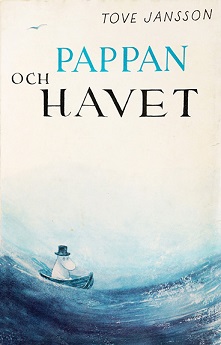
In the middle of the Tove Jansson exhibition, which is on for a few more days at Dulwich Picture Gallery, there are three large paintings of waves: Abstract Sea (1963), Weathering (1965), Eight Beaufort (1966).  You can see the first of these reproduced in the Telegraph's review, 'Revelatory show about the Moomins creator'. They were painted after she had returned to painting, in the wake of abstract expressionism and after having spent two decades creating the world of the Moomins.  As Tuula Karjalainen writes in the catalogue, Jansson was at this point 'so committed to storytelling that she usually included a figurative element even in her abstract works.  As subjects, she often selected motifs that in themselves already appeared abstract', hence these studies of the sea.  It was also at this time that she was planning and building her cottage on Klovharun island - the quotation above describes her experience camping there before construction began.  The islands of the Finnish archipelago appear through her art and have become part of the imaginative world of anyone who has loved Moominpappa at Sea or The Summer Book.


Thirty years before these abstract sea paintings, at the beginning of her painting career, Tove Jansson painted landscapes in strong colours which are reminiscent of early twentieth century Primitive, Symbolist and Surrealist artists (looking at them I thought of Rousseau, Munch and Nash).  These inevitably prefigure the later Moomin illustrations, like a set of watercolours in this exhibition showing scenes from The Dangerous Journey (1976).  The most striking of her early landscape compositions is actually called Mysterious Landscape and has no precise date.  Mostly painted in cold shades of blue, it shows ghostly trees lining a path to a white building that reminded me of what I saw last year at dusk in Stockholm's woodland cemetery.  Paths of light lead up dark mountains, bare trees burn bright red, and in the distance there is a moonlit fjord.  It seems to be part of a strange and magical story that at the time, before Moomintroll came along, she was still just telling to herself.

Saturday, April 22, 2017

The voice of the north wind sad

Zhang Fengyi as Cao Cao in John Woo's Red Cliff (2008-9)

In a post earlier this month I referred to the musical duel in Red Cliff, John Woo's epic film about  events at the end of the Han dynasty, based on 'the Iliad of China', The Romance of the Three Kingdoms.  The composer/writer I discussed there, Cai Yong, only briefly features in The Romance of the Three Kingdoms and doesn't appear in Red Cliff, but here I want to focus on Cao Cao, the great warlord at the heart of the story, whose army is defeated spectacularly in the movie.  Cao Cao was himself a renowned poet and wrote a famous poem just before the Battle of Red Cliff.  You can see him recite it in the clip from YouTube below - a scene from the 95-episode Chinese TV dramatisation Three Kingdoms.  This moment has often been depicted in art - there is a painting in the Long Corridor of the Beijing Summer Palace, for example, and I have reproduced below a Japanese ukiyo-e print showing Cao Cao composing the poem in a boat, with the moon rising and crows wheeling in the sky.


Tsukioka Yoshitoshi, Moon rising over Mount Nanping, contemplated by Cao Cao, 1885

The real reason for mentioning Cao Cao on this blog is not his eve-of-battle composition, but a beautiful short poem 'Viewing the Ocean', which is an early example in world literature of pure landscape poetry.  Here are the first six lines in Burton Watson's translation; the Jieshi (Chieh-shi) mountains overlook the Bohai Gulf.
East looking down from Chieh-shih,
I scan the endless ocean:
waters restlessly seething,
mountained islands jutting up,
trees growing in clusters,
a hundred grasses, rich and lush.
Other translations of the full poem can easily be found online (there are two on a Chinese Poems site for example).

Another poem of Cao Cao's that has stayed with me over the years (since reading it in Burton Watson's The Columbia Book of Chinese Poetry) is the 'Song on Enduring the Cold'.  This was probably written in 206 when Cao Cao was leading his troops across the Tai-hang mountains to attack a rival.  Taken out of context though, it could simply be a description of an arduous mountain journey - 'stark and stiff the forest trees, the voice of the north wind sad.'  The poem ends with a literary allusion, to 'that song of the Eastern Hills', a 'troubled tale that fills me with grief.'  It is a reference to a song in the Classic of Poetry (No. 156), attributed to the Duke of Zhou.  He had also been on a military campaign in the East, over a thousand years earlier, c. 1040 BCE (as distant from the time of Cao Cao as we are from Charlemagne).  I'll end here with the refrain from this ancient poem, repeated at the start of each verse (trans. Stephen Owen):
We marched to those eastern mountains,
streaming on and never turning.
And now we come back from the east,
in the pall of driving rain.   

Friday, July 22, 2016

Coulisses de Forêt

 Six friezes for a paper theatre, 1880-1920
Source: 50Watts

I have been rather busy of late, as the tidal wave of consequences from the Referendum has swept over and fundamentally altered my place of work, and so it's been hard to find time to think about landscape and art.  However, I've just looked back at some draft posts and come upon the material here, which I wrote in 2011 after reading Will Schofield's 50Watts blog, where he reproduced various sets of scenery, like the one above, from a Dutch Puppetry Museum database.  They are all in muted colours, like memories of childhood.  When we were growing up I wasn't that taken with the Pollock’s Toy Theatre my parents got us; more recently, however, my sons did play a little with a Czech magnetic theatre.  The novelty wore off quite quickly though.  In an essay on the toy theatre, Robert Louis Stevenson looked back on the pleasure he had experienced admiring and painting these scenes and figures.  But then what?  'You might as well set up a scene or two to look at, but to cut the figures out was simply sacrilege; nor could any child twice court the tedium, the worry, and the long-drawn disenchantment of an actual performance.'

Another of my favourite blogs back in 2011, the now defunct Venetian Red, did an informative post on the history of toy theatres and their enthusiasts (you can read it here).  Writers and artists who remembered them with fondness included Goethe, Jack B. Yeats, Cocteau and Chesterton, who asked
“has not everyone noticed how sweet and startling any landscape looks when seen through an arch? This strong, square shape, this shutting off of everything else, is not only an assistance to beauty; it is the essential of beauty… This is especially true of toy theatre, that by reducing the scale of events it can introduce much larger events… Because it is small it could easily represent the Day of Judgement. Exactly in so far as it is limited, so far it could play easily with falling cities or with falling stars.”

Marcel Jambon, set design model for Verdi's Otello, 1895
Source: Wikimedia Commons

I wonder if there were painters who toyed with toy theatres while working up their compositional ideas, like set designers experimenting with their scale models?  Thomas Gainsborough, after all, was said to have 'built model landscapes in his studio, consisting of coal, clay or sand with pieces of mirror for lakes and sprigs of broccoli to represent trees, in order to help him construct his compositions.'  The set of Coulisses de Forêt below could have been used to design a hunting scene with framing trees and repoussoir stag, except, I suppose, that by the time it was printed in 1889, art had largely left behind these classical conventions.  The Toy Theatre blog says that the Épinal-based firm behind this example, Pellerin, produced scenes that were 'very distinctive in style and very French, but for all that rather second rate. The Pellerin sheets were like its other cut-out products, intended to be made, set up and looked at but not performed. There were no Toy Theatre plays as such, only tableaux.'

Coulisses de Forêt, 1889
Source: Geheugen van Nederland


Postscript
It is a month later and I have just seen a toy theatre - the one used at the start of Ingmar Bergman's Fanny and Alexander.  As I mention in my most recent post, I visited the Bergmancentrer on Fårö and it is on display there. I have included a photograph below (sorry about the unavoidable reflection from the window opposite).  The sign above the stage means 'Not for Pleasure Alone'.  The film begins with running water and then cuts to this theatre, where a young boy's face is revealed as he pulls up the background landscape scenery.

Friday, August 28, 2015

The Green Ray

'In America they call it the green flash. When the sun sets, in a very clear horizon, with no land mass for many hundreds of miles, and no moisture or atmospheric pressure, you have a good chance of seeing it. The slowest ray is the blue ray, which comes across as green when the sun sets in perfect atmospheric conditions. It’s the last ray as the sun recedes with the curvature of the earth.' - Tacita Dean, Bomb Magazine, 2006

Still from one of several videos of the phenomenon that have been 
uploaded to YouTube, this one by Noel Barlau

The quote above comes from a conversation with Jeffrey Eugenides, who briefly refers to the green ray in his novel Middlesex...  “They say you can’t take a picture of a green ray, but I got one. I always keep a camera in the cab in case I come across some mind-blowing shit like that. And one time I saw this green ray and I grabbed my camera and I got it.”  In the interview Eugenides asks Tacita Dean about the elusiveness of the phenomenon in her film The Green Ray.  "I think you said that you got the green ray in the film, but it never appears in any single frame. But you can see it momentarily when the film is running. Is that right?"  "Yes. The film is 24 frames a second but you can’t isolate a single frame that has it.  He goes on to ask her whether everybody sees the green ray when they see the film.  "No. That’s what’s nice about it, because otherwise the film would just be about a phenomenon. But in the end it’s more about perception and faith, I think."

From Tacita Dean's video, The Green Ray (2001)

I first heard of the green ray when Eric Rohmer's beautiful film was released in 1986.  Delphine, alone on her summer holiday and nervous of any new intimacy after a split with her boyfriend, overhears a group discussing a novel by Jules Verne, The Green Ray (1882).  One of them says that "when you see the green ray you can read your own feelings and others too."  Later she sees a beach cafe named Le Rayon Vert and at the end of the film, when she finally meets an appealing young man (they both like Dostoyevsky), she asks him to sit with her and watch the sunset over the sea.  What follows is, according to Gilbert Adair in his book about the first century of cinema, Flickers, 'the tiniest and most moving special effect in the history of cinema.'  Tacita Dean was less impressed: "it’s very heavy-handed; it’s like this huge, green thing. I mean, the real green ray makes your heart miss a beat, because you look, you look, you look. And then you see it so suddenly, and it’s gone. Somehow rapidity is part of its beauty."

From Eric Rohmer's film, The Green Ray (1986)

I have not read Verne's novel and it is hard to find any reviews that wholeheartedly recommend it - see for example the description on with hidden noise: 'as fiction it is sorely disappointing'.  In Jules Verne, Geography and Nineteenth Century Scotland, Ian B. Thompson describes it as the slightest of his three Scottish novels; however, it is informed by Verne's 'passion for sea travel and is meticulous in the nautical, meteorological and geographical detail of the journey.'  At the climax of the story the two lovers, having repeatedly failed to glimpse a green ray, miss seeing it because they only have eyes for each other.  Verne was clearly fascinated by the idea - in an impressive Annotated bibliography of mirages, green flashes, atmospheric refraction, etc., Andrew T. Young refers to an earlier mention of the green ray in Verne's novel Les Indes Noires (1877).  This is the earliest fictional reference in the bibliography, but the phenomenon was noted by other nineteenth century writers, like J. A. Froud, whose account of a voyage to South Africa describes a sunset on 'the sea calm as Torbay in stillest summer ... The disk, as it touched the horizon, was deep crimson. As the last edge of the rim disappeared there came a flash, lasting for a second, of dazzling green - the creation I suppose of my own eyes.'

I will end here with another art form, music.  Gavin Bryars has described witnessing the green ray in Southern California, but his 1991 composition refers back to the setting for Verne's novel.  'This part of Western Scotland is also the place where certain piping traditions originated. Male pipers practised in one cave on the seashore, females in another ( the "piper's cave" and the "pigeon's cave"). As they played their laments at twilight a triangulation, similar to that in the Verne story (male-ray-female) may well have occurred without the knowledge of the innocent participants, hence the sequence of simultaneous laments in the coda.'   The clip below is the first half of The Green Ray - I can't find anything to embed that includes the coda, with its laments for saxophone, cor anglais, French horn, and solo violin.  You can buy or hear the whole piece elsewhere of course, but perhaps it is appropriate to the theme that this should be left here to the imagination.

Sunday, August 02, 2015

Frozen waves

A photo posted by marcquinnart (@marcquinnart) on

I've written here before about the way Modernism distanced itself from landscape painting and how Oscar Wilde could only look upon a sunset as a 'second-rate Turner'.  Over a hundred years later it is interesting to see the lengths Marc Quinn has gone to in his new exhibition The Toxic Sublime to turn  a Caribbean sunrise into art now that, as he says, “you can’t do sublime any more.  You can’t make a painting of nature.”  Having transferred the original photograph to a set of canvases he sanded them down and stuck on strips of 'aeronautical grade aluminium tape'.  Then he spray-painted them in the lurid colours of urban graffiti through templates of plastic chord and other rubbish collected from a beach.  Next he took them into the street and rubbed into them impressions of drain covers (the familiar words 'Thames Water').  I thought for a moment of the Situationists' 'beach beneath the street' but Quinn is referencing the way water is taken and controlled in the city.  Finally they were bonded to aluminium sheets and subjected to creasing and denting so that they look like they have been retrieved from some kind of wreckage.  In the photograph accompanying the Telegraph review they actually look rather beautiful and, although I have some sympathy for the Alastair Smart's view that they 'represent an awful lot of work for awfully little reward', I think he goes too far in likening them to crumpled crisp packets.

This White Cube exhibition also includes four Frozen Wave sculptures which are much easier to like (even though their shiny stainless steel surfaces reminded me uncomfortably of Jeff Koons' Rabbit.)  These are based on eroded shells, copied and cast at different scales, including one that has a whole room to itself and looks from the side like a small sperm whale.  As the curators explain, 'in the moment before they disappear and become sand, all conch shells end up in a similar form – an arch that looks like a wave, as though an unwitting self-portrait by nature.'  And it is remarkable how wave-like they look, with their rough surfaces and glassy-smooth undersides.  At the same time, the largest (23 feet long) might be a fragment of landscape, a silver sea cave, with the shells' exposed layers blown up to resemble surf-polished rock strata.  There are also two sculptures made from 3D-printed conch shells that seemed less interesting and more obvious.  There was no way of putting one of these to the ear, but look inside and their mirrored surfaces are like jets of water, recalling the surging currents and breaking waves that pick them up and sculpt them.

Sunday, June 21, 2015

Sonic Waters and Fantastic Caverns

I have written here before about composers who have sought to impress the environment into their music by burying instruments in the earth (Richard Skelton) or immersing recordings in river water (Rob St. John).  A desire to enter into the landscape may also lie behind music that has been created underwater or in caves beneath the ground.  I have mentioned a few examples of the latter before, but there is now a relatively long history to these genres of landscape music and so I thought I would highlight here some examples from over thirty years ago, beginning with the work of Michel Redolfi, whose Pacific Tubular Waves / Immersion was recently reissued by Editions MegoPacific Tubular Waves (1979) is not an underwater piece - it was 'inspired by the oceanic horizons of San Diego' - but it became the raw material for Immersion (1980).  For this, Redolfi played his earlier piece through a sonar loudspeaker underwater, so that it was 'shuffled by the waves and unexpected filtering effects resulted from its passing through clouds of foam.  Its dispersion at sea by currents would send back incredibly smooth harmonic echoes.'  If he had left a recording of Immersion in the sea it might have been brought up years later, scoured by the underwater currents but still usable as the basis for a third version of this composition.


In 1981 Redolfi's Sonic Waters concert was broadcast underwater in the Pacific for an audience who could experience it floating on the surface or submerged in diving suits.  However, as Stefan Helmreich has pointed out, this concert was 'accompanied by campy sea creaturey devices, such as the giant colorful “jellyfish” that kept a low-frequency speaker afloat in La Jolla Cove. Such playfulness is a reminder that Redolfi does not imagine crustaceans, fish, or marine mammals as audiences ... Redolfi’s approach looks similar to that of the Florida Keys underwater music festival. Celebrating its twenty-fifth anniversary in 2009, the festival offers to scuba divers music played over Lubell Laboratory speakers attached to boats floating near the reef.  Attendees dress up as fish.'  There is an ocean of difference between that festival's 'reef rockstars, "Paul McCarpney" and "Ringo Starfish"' performing sea-themed pop songs and the experimental underwater investigations of modern sound artists like Jana Winderen.  I can't help feeling there must be potential between these extremes for new forms of site-specific undersea composition and performance in the future. 


Over the last few decades most of Redolfi's concerts (see clip above) have taken place in swimming pools, where the emphasis is on the unusual auditory experience rather than the character of the sea. However, the ambience and special qualities of these locations will never be irrelevant.  The pools chosen by Redolfi and others like the Wetsounds organisation or Max Neuhaus, the pioneer in this field, will have had their own acoustic properties and historical associations.  Similarly, performances in cave-like spaces in cities or industrial locations can be as atmospheric as concerts in natural caverns.  As with the underwater composers, much of the motivation for seeking out resonant underground spaces has been to make use of their unique sound properties - the Deep Listening Band, for example, have played in the giant Fort Worden Cistern which has a 45 second reverberation time.  But caves have a deeper significance, having been the sites for music making since prehistoric times, a point brought home to me recently by the discovery of an ancient lyre in a cave on Skye.  Here there is no direct parallel with performing underwater, although if there is an atavistic urge to make subterranean music, there may be an even more profound source for subaquatic music, since all of us begin life experiencing sound and music immersed in amniotic fluid.


Back in the late 1950s (when the real Paul McCartney was making his first appearances at the Cavern club with The Quarrymen), the Great Stalacpipe Organ, designed by Leland W. Sprinkle, was under construction at the Luray Caverns in Virginia.  Although described as ‘the largest natural musical instrument in the world’ its design involved altering the shape of some of the stalactites.  Music had actually been performed in this sonorous cave (as the postcard above from 1906 below shows) almost since its discovery in 1878.  A delegation from the Smithsonian Institution were surprised on an 1880 tour when co-discoverer Andrew Campbell picked out a tune on the rock formation that was later used for the Organ.  There are no other Stalacpipe Organs, but many other American caves have been settings for concerts: Bristow Cave, Tennessee, the Great Saltpeter Cave, Kentucky, Longhorn Cavern, Texas.  Worth mentioning here if only for its cover is a live recording from 1968, The Fantastic Thrashers at Fantastic Caverns.  According to its sleeve notes, 'the underground auditorium was packed and jammed. The dripping water, the underground river in the background, the weird effect of the lights off moist stalagmites were all made to come alive by the sparkling sound of the Thrashers.'


Then, in a very different vein, there was Don Cherry, who recorded two improvisations at the Mammoth Cave in Kentucky in 1978.   Here is Anna Mayo's description (from the useful Caveinspiredmusic site)
“On a morning in early October I watched the great free jazzman Don Cherry as he scaled a ledge high on the sheer wall of the Longest Cave in the World and played the rocks like a xylophone. Far below, our guide had fired up two kerosene lanterns so that we were able to doff our miners’ hats. Cherry, on the ledge, gave off vibes of the leopard-spirit of the Ngbe tribe as he improvised a roller-coaster of sound. Throughout Cherry’s performance, producer Verna Gillis sat on the cave floor, at one with her Stellavox tape recorder, earphones like a ceremonial headdress... Adjusting the AKG microphone... was sculptor Bradford Graves. Cherry darted from one rock to another, striking them with two hickory branches he’d brought along at the guide’s suggestion.”
Perhaps improvisers are best suited to exploring the musical possibilities of cave systems.  The Summartónar festival has brought jazz musicians like John Tchicai to perform to an audience in small boats in the sea caves of the Faroe Islands.  However, it is more usual to find show caves used as natural halls for the staging of more traditional concerts.  There are several such venues in Germany, including the cavern at Hohler Fels where, some 35,000 years ago, Palaeolithic musicians left behind bone and ivory flutes.  In Lebanon the Jeïta caves were opened for concerts in 1969 and closed a decade later during the Civil War, its passages converted into a munitions store.  Thus the distinction between caves and buildings becomes blurred - 'natural' spaces cease to become natural when they are discovered.  My last example below below combines natural and electronic sounds.  It is part of Jeïta ou Murmure des eaux (1970), a composition by François Bayle, who performed the inaugural concert at the the Jeïta caves.  When he found back in Paris that some of the field recordings he made in the cave were not good enough for his purposes he decided to replace them with 'beautiful water sounds' recorded in the bathroom of the studio.

Saturday, May 23, 2015

The questions of the sea


The Royal Academy's Richard Diebenkorn exhibition divides neatly into three rooms, the first covering his early abstract period in Albuquerque and Urbana, the second charting his move into figurative drawing and painting while living at Berkeley, the third focusing on his famous Ocean Park series (1967-88).  Diebenkorn had grown up in the San Francisco Bay area and moved in 1950 to Albuquerque to complete his MA at the University (Agnes Martin, the subject of a respective at Tate Modern opening next month, taught there a few years later).  The city is located on a high plateau of the Chihuahua desert and, as co-curator Sarah C. Bancroft writes, 'the dusty whites, tans, reds, ochres, oranges, yellows and pinks of his environment are seemingly baked onto many of his paintings'.  It was on flight from California to Albuquerque in 1951 that Diebenkorn was first struck by the view of landscape from the air. "I guess it was the combination of desert and agriculture that really turned me on,” he said, “because it has so many things I wanted in my paintings. Of course, the earth’s skin itself had ‘presence’ - I mean, it was all like a flat design - and everything was usually in the form of an irregular grid.”  Diebenkorn's paintings in the 1950s often remind me of the contemporary works of Peter Lanyon who also used an aerial perspective - it is sad to think that Lanyon might have had an equivalent of the Ocean Park series ahead of him if he had not died in a glider accident in 1964.

By the early sixties Diebenkorn was painting more recognisable landscapes like Cityscape #1, which you can see and read about in the RA's Exhibition in Focus PDF.  'The colours and atmosphere of these landscapes are clear, crystalline and bright.'  Too bright, some viewers have apparently felt, although as Bancroft says Diebenkorn himself was struck by the vividness of Northern California when he made a return visit in the 1980s: "God, that is the colour I used to use, when I lived up here!"  Whilst in Berkeley he was also painting interiors with views through windows, influenced to by Matisse, Bonnard and Hopper.  These, Steven A. Nash writes in the catalogue, 'provided a means to compare internal and external light, a way to project attention into the far distance, and a device for exploring the emotional contrasts of near and far, culture and nature, and a sense of confinement versus longing for release and freedom'.  Nash also makes a connection with Caspar David Friedrich's paintings of windows (which I've referred to here before), whose 'reigning mood is serenity tinged with melancholy'.   

Back in 2006 I wrote about the Ocean Park paintings and their relationship to landscape.  Since then an essay by poet and former Ocean Park resident Peter Levitt has appeared called 'Richard Diebenkorn and the Poetics of Place'.  It can currently be read online as a PDF and I will end this post with a quotation from it that conveys the rapture these extraordinary paintings can provoke.  However, I think Laura Cumming is as usual very perceptive in her review, when she notes that up close they 'are stranger than expected, and this paradise is not without shadows – sometimes a grey pall, or a funereal black border edging into the frame.  In fact the Ocean Park series that has given so many people such pleasure arrives out of hesitation, correction, uncertainty, further attempts, frequent cancellations.  How can one tell?  Diebenkorn leaves the workings on show.  The veils of colour that settle on the painting like a misty haar lie over many trials and second thoughts.  The paintings look light, bright, uplifting, slim; but this only comes after long and patient thinking.'  Here then is Peter Levitt, who first visited Ocean Park in 1967 and marvelled 'at the unique and beautiful quality of the light, how from morning to night the sky’s variable shades of blue seemed to retain a moist translucence, as if the colour rose from the nearby sea to cool the heated summer air.'  
'The paintings call forth how it actually felt to live bathed in a wash of such colour and light, to feel the steady, calm, and gradual movement of time reflected in the environment as one lived one’s moments, days, months, and years in a small seaside town (now grown overlarge) whose primary quality was the interaction of this extraordinary light with everything and everyone it fell upon. ...  There is something that moves through me when I stand calmly before this work that doesn’t seem to have a beginning and, equally, may never end.  It may be the way Diebenkorn caught the light I’ve been discussing.  It may be how the shapes are so perfectly drawn and coloured that they call to mind the sound of the nearby ocean, where, as Pablo Neruda wrote, waves repeat the questions of the sea.  How can I know?  Should I even try to comprehend?  To stand in the company of these paintings—where the world I know is one a painter helped to create, and what lies beneath the paint is the common bond of what I call home —is enough.

Tuesday, May 12, 2015

Wave Movements

Billboard poster advertising Mountains and Waves, Highbury, April 2015

We were at the Barbican on Sunday for the last concert in a weekend of new music entitled 'Mountains and Waves'.  The first half was a premiere of Wave Movements by Richard Reed Parry of Arcade Fire and Bryce Dessner of The National (see the clip embedded below).  This was 'composed directly to the actual rhythms of waves' and began with rising and falling sounds reminiscent of breakers arriving and departing.  It was pleasant enough but after a while I started hoping for more of the drama and beauty you hear in the great sea compositions (Debussy, Sibelius, Britten), or to hear something more surprising than swelling violins and the rumble of kettle drums.  The ending was rather surprising - Maddy Pryor, once of Steeleye Span, came on and sang what sounded like a sea-themed folk song (her voice was half drowned by the surging strings).  Having read that the performance would feature Hiroshi Sugimoto's Seascapes I had expected something quieter and more minimal.  Hung in a gallery setting, his images radiate silence and mystery, their skies empty, their grey seas stilled by the camera.  Perhaps we try too hard to project music on natural processes.  It was almost easier to sense 'wave movements' in the second part of the concert, listening to So Percussion perform Steve Reich's Drumming (1971)I could imagine something sounding like this inspired by the uneven phasing of waves striking a rocky coastline.  Drumming was composed under the influence of West African polyrhythms and Reich later recalled the impact of studying percussion in Accra with the Ghana Dance Ensemble: 'I was overwhelmed by their music, like being in front of a tidal wave.'

Wednesday, April 15, 2015

A landscape of touch and double-touch

From the film Possession (2002): poets Christabel LaMotte and Randolph Henry Ash

These two fictional nineteenth century poets in A. S. Byatt's novel Possession (1990) both draw inspiration from nature.  In one brief, intense summer they explore together the coast and moors of Yorkshire.  They write under the influence of Lyell and Ruskin but, like their Romantic predecessors, they are fascinated too with myths of metamorphosis, animism and elemental forces.  The poems of Christabel LaMotte (her name recalls Coleridge's poem 'Christabel' and the author of 'Undine', Friedrich de la Motte Fouqué) become, by the time the contemporary sections of the novel are set, the subject of close readings by feminist scholars.  One such critical study is read by Possession's unassuming hero, a lowly 1980s academic called Roland, just before he sets off to retrace the poets' journey north.  It leaves him with a vision of a land 'covered with sucking human orifices and knotted human body hair.'  I'd like to quote a paragraph here because, even as an amusing parody of academic writing, it is interesting on writing and landscape.  Byatt's novel is full of such extracts from fictitious poems, letters and journals.  Here, places reimagined by nineteenth century novelists are reinterpreted a century later by an American scholar who is herself merely a fictional character in Possession - nature transformed and distorted through three cultural filters.
'And what surfaces of the earth do we women choose to celebrate, who have appeared typically in phallocentric texts as a penetrable hole, inviting or abhorrent, surrounded by, fringed with-something? Women writers and painters are seen to have created their own significantly evasive landscapes, with features which deceive or elude the penetrating gaze, tactile landscapes which do not privilege the dominant stare. The heroine takes pleasure in a world which is both bare and not pushy, which has small hillocks and rises, with tufts of scrub and gently prominent rocky parts which disguise sloping declivities, hidden clefts, not one but a multitude of hidden holes and openings through which life-giving waters bubble and enter reciprocally. Such external percepts, embodying inner visions, are George Eliot's Red Deeps, George Sand's winding occluded paths in Berry, Willa Cather's cañons, female-visioned female-enjoyed contours of Mother Earth. Cixous has remarked that many women experience visions of caves and fountains during the orgasmic pleasures of autoeroticism and shared caresses. It is a landscape of touch and double-touch, for as Irigaray has showed us, all our deepest "vision" begins with our self-stimulation, the touch and kiss of our two lower lips, our double sex. Women have noted that literary heroines commonly find their most intense pleasures alone in these secretive landscapes, hidden from view. I myself believe that the pleasure of the fall of waves on the shores is to be added to this delight, their regular breaking bearing a profound relation to the successive shivering delights of the female orgasm. There is a marine and salty female wave-water to be figured which is not, as Venus Anadyomene was, put together out of the crud of male semen scattered on the deep at the moment of the emasculation of Father Time by his Oedipal son. Such pleasure in the shapeless yet patterned succession of waters, in the formless yet formed sequence of waves on the shore, is essentially present in the art of Virginia Woolf and the form of her sentences, her utterance, themselves. I can only marvel at the instinctive delicacy and sensitivity of those female companions of Charlotte Bronte who turned aside when she first came face to face with the power of the sea at Filey, and waited peacefully until, her body trembling, her face flushed, her eyes wet, she was able to rejoin her companions and walk on with them.'