periplum, not as land looks on a map
but as sea bord seen by men sailing.
Ezra Pound, Canto LIX

We went to see Christopher Nolan's The Odyssey. What did I think of it? I agree with what translator Daniel Mendelsohn wrote in the New York Review of Books and I recommend reading his essay. Emily Wilson's scathing LRB review was entertaining but had me wincing from that second paragraph, where the recurrent themes he has explored in his films are brutally dismissed ("yet again... yet again"). In The Guardian I noticed a 4 star review of Richard E Grant’s Very Modern Odyssey and thought this might be fun, but I should have read more carefully before trying to watch it. He is a National Treasure of course and beyond criticism, but... I'll just say that this series, sponsored by P&O cruises, wasn't really really my thing. In what I saw of the first episode he was on Gozo, looking at Calypso's cave, a site associated with her mythical island, Ogygia, since the 4th century BCE. Christopher Nolan actually filmed at the cave on Gozo, but for the beach scenes (above) he chose a saltwater lagoon near Dakhla in the Western Sahara. The reasons why this has been so controversial are set out in a Guardian article by Mohamed Sleiman Labat.
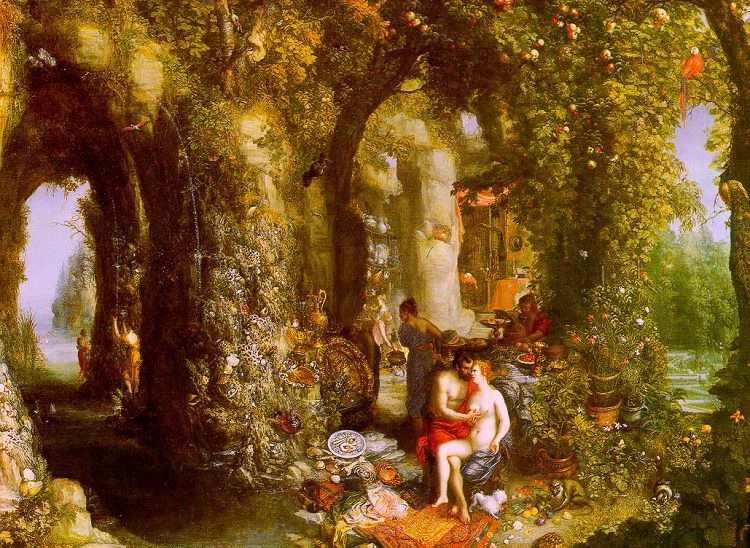
The Paris Review has an extract online from Daniel Mendelsohn's translation of The Odyssey Book V, describing the landscape seen by Hermes after he arrives on the island, after crossing the seas and skimming along the breakers. He finds 'the nymph of the beautiful braids' by an enormous fire and the aroma of cedar and juniper
Drifted all over the isle while she lifted her lovely voice
In song and wove back and forth at her loom with a golden shuttle.
A luxuriant growth of trees spread out all around the cave,
Alder and black poplar and sweet-smelling cypress as well,
And the birds inside them were sleeping, their wings outstretched,
Little horned owls and hawks, as well as cormorants,
Their chattering tongues stretched out—birds who work the sea.
Round about the mouth of the hollow cave, a vine
Had been trained to climb; now it flourished, bursting with clusters of grapes.
Four springs, all in a row, flowed with the clearest water,
Their streams running side by side, then turning this way and that.
All around were velvety meadows where violets and bay grass were growing Lushly.
Even a god who chanced upon this scene
Would marvel at the sight, pleasure filling his mind.
Jan Brueghel the Elder, Odysseus and Calypso in the caves of Ogygia, 1606-9
Gozo is far from being the only contenders for Calypso's island - Greece, for example, currently favours Othonoi which has another picturesque cave that tourists can visit. Many writers since Strabo and Plutarch have pronounced on the subject and the great French Homer scholar Victor Bérard (1864-1931) decided it was Perejil, an islet off the coast of Morocco (the country now occupying Western Sahara). Perejil, owned by Spain, is near Ceuta, scene of the recent mass migrant crossings and there was nearly a conflict there in 2002 when Moroccan troops turned up. These tensions were very much there when Bérard was trying to find Ogygia. 'General Alfau, who commands the Spanish troops in the Western Rif and resides in Ceuta, had written to our consul in Gibraltar stating that he would support our search for Calypso with all the means at his disposal; thanks to him, after ten years of anxiety and doubt, I have seen all my hopes confirmed...' I read this in the four-volume account of his travels round the Mediterranean that Bérard published in 1927-1929. You can see below my photograph of the map he made of
The Odyssey, and in other volumes his illustrations of Ithaca and 'Le Royaume de Calypso' - Ile Peregil. Bérard managed to overcome the fact that Perejil doesn't have the crucial four springs by noting that there were some on the mainland, just across a short stretch of water. It doesn't sound very convincing to me, but when Bérard was in the cave on Perejil he received a Homeric sign - a little owl actually fell on his head.
Before these travels Bérard had advanced a new theory that The Odyssey is based on Phoenician trade routes, as set out in periploi, the lists of ports and navigation marks compiled by ancient sailors. 'Tout périple est un chapelet de noms propres. Notre poème est une galerie de personnages. Ce sont les noms du périple qui sont devenus les personnages du poème.' Names become people, so Calypso, for example, would have been the personification of a geographical name on a periplus. The poem represents the transformation of a static list of sites into dynamic human actions that form a story. Perhaps therefore, in one sense, The Odyssey can be seen as a kind of landscape writing.
All this brings us back to Ezra Pound, whom I quoted at the start. Pound read Bérard in 1930 and mentioned the 'periplum' (spelling it with an 'm') in The ABC of Reading (1934). In his Cantos, the form of a reader's journey emerges from information encountered along the way, like islands in the Mediterranean.
Victor Bérard discovered that the geography of The Odyssey, grotesque when referred to a map, was minutely accurate according to the Phoenician voyagers' periploi. The image of successive discoveries breaking upon the consciousness of the voyager is one of Pound's central themes of the New Learning ... The periplum, the voyage of discovery among facts, whose tool is the ideogram, is everywhere contrasted with the conventions and artificialities of the bird's eye view afforded by the map. Forms grow out of data. They are not imposed upon data.'
- Hugh Kenner, The Poetry of Ezra Pound (1951)


.jpg/960px-Labradorite_polie_1_(Madagascar).jpg?utm_source=commons.wikimedia.org&utm_campaign=index&utm_content=thumbnail&_=20130127004903)
.png)
.png)
.png)