Showing posts with label artificial mountains. Show all posts

Sunday, October 20, 2019

Rising sun over the landscape of Mount Paektu

Last week I discussed here the way artists over the centuries have depicted Korea's Diamond Mountains, but these extraordinary peaks are are not the most revered landscape in this part of the world.  The great stratovolcano, Mount Paektu, features in both North and South Korea's national anthems and has always been considered a sacred site - the birthplace of Dangun, founder of the first Korean kingdom, whose father was the Son of Heaven.  Mount Paektu is in what is now North Korea and has become inextricably linked with ideas of the country's leaders, a process that began with an epic poem, Cho Ki-chon's 'Mt. Paektu' (1947).  A recent example is 'We Will Go to Mount Paektu', a song which Laibach wanted to cover on their controversial visit to North Korea in 2015.

Heaven Lake, Mount Paektu

For his 2016 documentary Into the Volcano, Werner Herzog visited Mount Paektu with volcanologist Clive Oppenheimer.  In the film they note how frequently it appears in official iconography as a backdrop to images of North Korean leaders.  They are also shown another pilgrimage site, Kim Il-sung's secret log cabin where, according to his official biography, Kim Jong-il was born in 1941.  Herzog says in his voiceover that "in the Christian World, this would be like visiting the birthplace of Jesus - the stable in Bethlehem".  I have featured the humble retreats of poets and artists many time on this blog in the past; here again we have an example of the cultural significance of a solitary hut in a mountain landscape. 


The film goes on to show images of this log cabin in the snow and Mount Paektu at sunrise.  These represent a form of landscape art that requires vast numbers of people all obeying strict instructions, neither creating or seeing the image but themselves forming a human canvas.
"In the country's biggest stadium, more than 100,000 people participate in creating a unique artform.  The picture of the hut in the snow is not a painting.  It is made of human pixels.  And this is how it's done.  A prearranged pattern of coloured cards is held and flipped over in sync.  Here: the rising sun over the landscape of Mount Paektu." 
We often think of the way nature is reshaped in response to our dreams and desires, or the way artists have painted mountains as an expression of their individuality and subjective experience.  Here, in a setting that approaches the scale of a real landscape, there are no individuals and only one official story. 
  

Sunday, July 28, 2019

Mountain R


Mountain R is a 1996 novel by the French Oulipian writer Jacques Jouet (1947-) about a failed attempt to construct an artificial mountain.  The Dalkey Archive published an English translation by Brian Evenson in 2004.  The story is a dark satire told in three parts, from three different points of view.  It begins with a speech by The President of the Republican Council, setting out the proposal for this grand projet and arguing that a 1,500 meter high mountain would bring in tourism, reduce unemployment and provide a fitting symbol for the greatness of the nation.  The second part is a dialogue between one of the contractors involved in building Mountain R and his daughter, which gradually reveals shocking truths about the human cost of its construction.  The third part is an excerpt from the trial of those responsible for the project's failure, recounted by another unreliable narrator, a novelist paid to write about Mountain R, whose full role in the enterprise becomes progressively more apparent.

As I began reading I thought back to The Man Without Qualities, a novel about a pointless national celebration that I read at about the same time the Millennium Dome fiasco was unfolding here. However, as a construction project driven by hubris, funded in murky circumstances and failing to leave anything worthwhile it actually reminded me more of several recent initiatives, some of them in London.  For many years, cities have measured themselves on who can erect the biggest tower.  In Mountain R the President begins his speech by complaining that the Republic, though magnificent already, 'looks like a flat-chested girl.  Too bad!  But we are going to alter her, the Republic ... we are here to act ... to give her what we can: a womanly figure.'  It sounds like 'Northumberlandia', the proposal for a giant 'curvaceous woman' which I wrote about here in 2009 (it was subsequently built and opened in 2012).  

I have discussed the construction of other artificial mountains here before, from the marble peak on a Greek island made sometime between 2550-2400 BCE, to the holy mount for the first Celebration of the Supreme Being in post-Revolutionary France.  All such ventures share common traits, but perhaps the closest precursor to Mountain R that I have written about is the Mountain of Stability, centre piece of Emperor Huizong's great garden at Kaifeng, which led to instability in China as resentment rose over the costs of building it, until Huizong was deposed and his construction left in ruins. Mountain R is built by migrant workers who have to live in appalling conditions.  There are an unknown numbers of fatalities as the authorities try to hide the true cost of the project.  Reading this brought to mind what we have heard about the Qatar World Cup - see for example the BBC's 2015 report on the death toll there, which had been put then at 1,200 workers.

There was an article about Mountain R in The French Review by Oulipo scholar Warren Motte (whose actually crops up in the book as the name of an American funding body).  He shows how the book is about language and the processes of narration, pointing in particular to a passage in which the third narrator compares the writing of a novel to a construction project.  The failure to complete his novel mirrors the failure to complete the mountain.  Motte has also provided a useful introduction to Jouet's work on the Dalkey Archive website.  Of Mountain R he says that 'Jouet asks us to consider how we view monuments and how we tend to monumentalize our leaders, our progenitors, and the tasks we pursue, both individually and severally.' 

Motte also discusses some of Jouet's other works and, although it has nothing to do with Mountain R, I can't resist ending here by quoting the first of Jouet's Poèmes de métro, which itself defines the Oulipian constraint involved in writing them.  Something to consider, for those of us who use the London Underground everyday...
A metro poem is a poem composed
in the metro, during the duration
of a trip.
A metro poem has as many verses as
your trip has stations, minus one.
The first verse is composed in your
head between the two first stations
of your trip (counting the station
from which you departed).
It is transcribed onto paper when the
train stops at the second station.
The second verse is composed in
your head between the second and
third stations of your trip.
It is transcribed onto paper when the
train stops at the third station. And
so forth.
One must not transcribe when the
train is in motion.
One must not compose when the
train is stopped.
The last verse of the poem is
transcribed on the platform of
your last station.
If your trip involves one or more
changes of subway lines, the poem
will have two or more stanzas.

Wednesday, July 10, 2019

The white island

Keros and Dhaskalio
Source: Wikimedia Commons, Zde

I've just been reading an interesting article in the Independent about a kind of artificial mountain in the Aegean, built 'within 100 years or so of the creation of Stonehenge, the first Egyptian pyramids, the great cities of the Indus Valley and the first known Mesopotamian kingdoms.'  From around 2550-2400 BCE, an islet off the coast of Keros was gradually transformed using marble brought to it by boat. Excavations have revealed buildings and Cycladic artefacts, but from a landscape art perspective I am most interested in the idea of constructing an artificial landform:
'The architects “terra-formed” the pyramid-shaped island “mini-mountain”, known in recent centuries as Dhaskalio (possibly just meaning “islet”), to create around 1,000m of artificial terracing, arranged in six “steps” on its steep slopes. ... The 7,000-10,000 tonnes of white marble, needed for the project, were quarried in the southeastern part of Naxos.
From the south, the island would have been visible from many miles away as a gleaming white pyramid-shaped mini-mountain rising out of the sea.  It is not known for sure whether the pyramidic shape was in any way significant. But the place had certainly been specifically selected as a religious site in preference to other much higher, more impressive and potentially more accessible mountains that did not have that shape.'
The article goes on to talk about the Egyptian pyramids, which were made to gleam in the sun (like the white marble of Dhaskalio) by having their summits painted with gold leaf.  In both places the builders may have wanted to symbolise the idea of earth arising out of primordial chaos. '“It is potentially a fundamental place of origin for the phenomenon of sacred mountains within the Greek world,” said the world’s leading expert on Greek mountain-top sanctuaries, Dr Alan Peatfield.'

The findings at Dhaskalio are not all news - an Archaeology.com piece from last year noted that 'visits to the island were presumably seen as a special activity, and the way that the terraces on Dhaskalio were constructed to create rising walls in receding planes must have made the site look very impressive to those approaching by sea from the north.'  Dhaskalio is not accessible to ordinary visitors, but last year the writer Ben Okri went there to meet the archaeologists and wrote about his impressions in the FT.  He doesn't sound like he had a particularly interesting time. 'I shift soil and rock in a task that seems to yield nothing but that adds to the slow revelation of what was there.'

The Independent's article was picked up by the Evening Standard today with a hyperbolic headline: 'Archaeologists unearth probable origins of ancient Greece in groundbreaking discovery '.  An hour or so ago another article appeared on the Daily Mail site: 'Pyramid-shaped island in the Aegean Sea where sailors hauled marble to build complex structures and forged DAGGERS from copper 4,600 years ago reveals new clues on early Greek society'. I love the way the word daggers is in capitals!  You can read more on their website but be warned that the 'sidebar of shame' next to the article has some 'Love Island Spoilers'.  Looking at this made me very aware of the gulf of time separating those pilgrims to the sacred island of Dhaskalio and the 'hot young singles' of Love Island... 

Thursday, June 16, 2016

The Mountain of Stability

Emperor Huizong, Plum and Birds, early 12th century
Source: Wikimedia Commons

A few years ago I wrote here about filial conflict and garden design in the wonderful eighteenth century Chinese novel known in English as Dream of the Red Chamber.  I recently finished reading another vast novel charting the rise and fall of a Chinese family, Chin P’ing Mei (The Plum in the Golden Vase), written at the end of the sixteenth century.  Two essays on it have appeared in The New York Review coinciding with the publication of the first and final volumes of David Toy Roy’s translation, one back in 1994 ‘when Roy reported that he had already been working on the project for a quarter century’, and the other last year, when the eighty-year old translator finally made it to the end.  It took me six months to read the five volumes my son is only just about managing to hold up for this photograph.


The ambitious, corrupt and sexually voracious merchant at the centre of the book, Hsi-men Ch’ing, extends his private estate as he becomes more affluent. But unlike the characters in Dream of the Red Chamber, he has no real interest in landscape design.  The arbours and grottoes of his garden are a stage set for parties and trysts.  Nature poetry is not written in response to the beauty of the seasons - it is a tool of seduction, the means of pursuing a drinking game, or an element in the songs performed for Hsi-men Ch’ing by troupes of actors and prostitutes from the licensed quarter.  Occasionally there are expeditions to monasteries but the monks there are more interested in money, alcohol and sex than they are in contemplating the surrounding mountains:
'For what purpose are Taoist sanctuaries and
  Buddhist temples established?
The Taoists worship their Heavenly Worthies,
    the Buddhists worship Buddha.
They are beautifully landscaped in order to
    give a false sense of purity;
Providing for visitors and welcoming guests
   they engage in perverse doings.
Accoutering their disciples with attractive
   clothes and handsome outfits;
They make use of wanton wine and leisured tea
    in ravishing female beauties...'

Zhang Zeduan, Games in the Jinming Pool, early 12th century
Source: Wikimedia Commons

The Plum in the Golden Vase can be read as an extended critique of Ming society (Roy draws parallels with Dickens’ Bleak House), even though it is set nearly five hundred years in the past, during the reign of Emperor Hui-tsung (pinyin: Huizong).  There were clearly parallels to be drawn between Hui-tsung and the Ming emperors, who were ‘among the most irresponsible rulers in the history of imperial irresponsibility’ according to Roy.  Hui-tsung was very interested in landscape design - so interested that his ambitious projects may have contributed to the fall of the northern Song dynasty, as Robin Lane-Fox explained in a piece for the FT entitled 'How gardening led to the downfall of one Chinese Emperor.'  Not content with one garden, The Basin of the Clarity of Gold (shown in the painting above) he decided to build a second one:
'At Kaifeng, just south of the Yellow river, the emperor lived inside a palace complex that was not, by Chinese standards, outrageously large. What became notorious was his man-made rock garden, which was up to 220ft high. To build it, Huizong sent orders for every sort of plant from all over his empire: lychees, gardenias, palms and plum trees. He also ordered the rarest and biggest stones. Chinese rulers had often been lithomaniacs but Huizong’s orders for waterworn rock outdid them all.  At the foot of this immovable mount, known as the Genyue [Mountain of Stability], Huizong arranged big stones, some with markings like human faces. He had them honoured with plaques and poems, using gold letters if they were particularly distinguished.'
The emperor only had five years to enjoy all this splendour before Kaifeng was captured by tribesmen from the north. Huizong was taken off to Manchuria and his garden smashed up.  Resentment has built up during its construction, as the process of shipping 'so many huge rocks and plants had cluttered up the canals and transport system. There had also been endless corruption and compulsion during the entire high-speed plan'.  Unsurprisingly Hsi-men Ch’ing got involved in this.  At one point in the novel he discusses with an official the way the 'flower and rock convoys' had impoverished ordinary people, before inviting him to partake of a typically lavish lunch.  Just as the collapse of the Song state can be ascribed to the way the country's resources were depleted by the emperor, Hsi-men Ch’ing's own graphically described demise is directly attributable to his excessive appetites.

Saturday, January 16, 2016

The holy mount for the Festival of the Supreme Being

Pierre-Antoine Demachy, The Festival of the Supreme Being, 1794

On 8 June 1794 (20 Prairial Year II) an artificial landscape was erected in the centre of Paris.  This day had been chosen for the first Celebration of the Supreme Being, a new godhead devised by Robespierre, then at the zenith of power.  He had been elected President of the Convention four days earlier; less than two months later he would be guillotined without trial in the Place de la Révolution.  The landscape was designed by the great revolutionary artist Jacques-Louis David.  A plaster-and cardboard mountain topped with a liberty tree was built on the Champ de Mars.  That afternoon, as Simon Schama writes in Citizens, 'deputies of the Convention climbed to the summit and looked down to the twenty-four hundred deployed along the paths, slopes and terraces that had been cut into the mountain.  At a crucial moment, when the singing and blaring of martial brass had been silenced, Robespierre descended from the mountain like some Jacobinical Moses, parting the waves of tricolored patriots, and graciously received the burst of orchestrated applause that broke over his head.'  Jacques-Alexis Thuriot, a former president of the Convention, was heard saying, "Look at the bugger; it’s not enough for him to be master, he has to be God".

Thomas Naudet, Festival of the Supreme Being at the Champs-de-Mars, 1794
 
What kind of mountain would be adequate for the Supreme Being?  Not, it would seem from contemporary prints, a perfectly shaped one.  In his book Political Landscape, in a section that discusses the perennial desire of leaders to carve massive statues and faces into mountains, Martin Warnke remarks on this:
'The mount as a whole appears strangely rugged, as if its irregular shape had been copied from works by Mantegna; what we see is a kind of nature monument that could be construed as an enormous head, but the caverns, paths and platforms also serve to direct the movement of the crowd: the men march on the right, the women on the left; the young people march round the hill, and a special commissaire sees to it that there is no confusion.  Only optically does the landscape admit of irregularity and contingency.  It belongs to the type of fantastic landscape that once rose towards gold skies in the backgrounds of altarpieces, in the early days of landscape painting.  Yet the overall physiognomy of the rock still has some of the impressive force attributed to faces in mountains.'

Friday, April 20, 2012

Grand View Garden

There is a wonderful description of landscape design in Cao Xueqin's Hong Lou Meng ('Dream of the Red Chamber', c. 1760 - translated by David Hawkes as The Story of the Stone).  The daughter of Jia Zheng has been selected to become an Imperial Concubine, but will be allowed to see her family again on a special Visitation.  To prepare for this event, the Jia family grounds are re-designed, creating a new Separate Residence and garden, the Da Guan Yuan, or Grand View Garden.  Eventually the work is complete and Jia Zheng is asked about the bian, those calligraphic boards hung in Chinese gardens with poetic phrases, often taken from classic literature.  '"These inscriptions are going to be difficult,' he said eventually. 'By rights, of course, Her Grace should have the privilege of doing them herself; but she can scarcely be expected to make them up out of her head without having seen any of the views which they are to describe. On the other hand, if we wait until she has already visited the garden before asking her, half the pleasure of the visit will be lost. All those prospects and pavilions - even the rocks and trees and flowers will seem somehow incomplete without that touch of poetry which only the written word can lend a scene.'"

One of Jia Zheng's literary friends offers a solution to this dilemma: provisional names and couplets can be composed and written on lanterns; then, when the Imperial Concubine arrives, she can decide which ones to make permanent.  Zheng agrees but worries whether he is up to it (I can't resist quoting what he says as I think I know how he feels): "In my youth I had at best only indifferent skill in the art of writing verses about natural objects - birds and flowers and scenery and the like; and now I that I am older and have devoted my energies to official documents and government papers, I am even more out of touch with this sort of thing than I was then; so that even if I were to try my hand at it, I fear that my efforts would be rather dull and pedantic ones."  As Zheng and his friends start their walk through the garden they encounter Zheng's son Bao-yu, whose behaviour has constantly disappointed his father, but who has started to show some promise in composing poetry.  The humour in what follows comes from the exchanges between father and son: Bao-yu repeatedly manages to come up with better phrases than his elders.   

Having named a miniature mountain, a pavilion on a bridge and a small retreat surrounded by green bamboos, the party reach a miniature farm with an orchard of apricot trees and enter a thatched building 'from which all hint of urban refinement has been banished'.  Bao-yu's father lectures him on the beauty of this 'natural' simplicity, but his son is not impressed: "a farm set down in the middle of a place like this is obviously the product of human artifice."  He says he is not sure what the ancients meant when they talked of things as being 'natural': '"For example, when they speak of a 'natural painting', I can't help wondering if they are not referring to precisely that forcible interference with the landscape to which I object: putting hills where they are not meant to be, and that sort of thing.  However, great the skill with which this is done, the results are never quite..."  His discourse was cut short by an outburst of rage from Jia Zheng.  "Take that boy out of here!"' 

But the work of writing poetry onto the garden is not complete, and Bao-yu is called back.  They resume their walk, considering other garden features like the place where 'a musical murmur of water issued from a cave', recalling to mind the Peach-blossom Stream of T'ao Yüan-ming (which I described here in an earlier post).  Eventually they complete their circuit back at the foot of the artificial mountain and Bao-yu is allowed to 'get back to the girls' (as a character he is rather like Proust's narrator in À l'ombre des jeunes filles en fleurs).  It is not until the following year that the Imperial Concubine, Bao-yu's older sister, makes her Visitation and it is quite striking how many of the garden inscriptions she does choose to amend or reject.  Coming, for example, by boat over a lake to the landing stage in a grotto named 'Smartweed Bank and Flowery Harbour', she says '"Surely 'Flowery Harbour' is enough by itself?  Why 'Smartweed Bank' as well?"  At once an attendant eunuch disembarked and rushed like the wind to tell Jia Zheng, who immediately gave orders to have the inscription changed.'

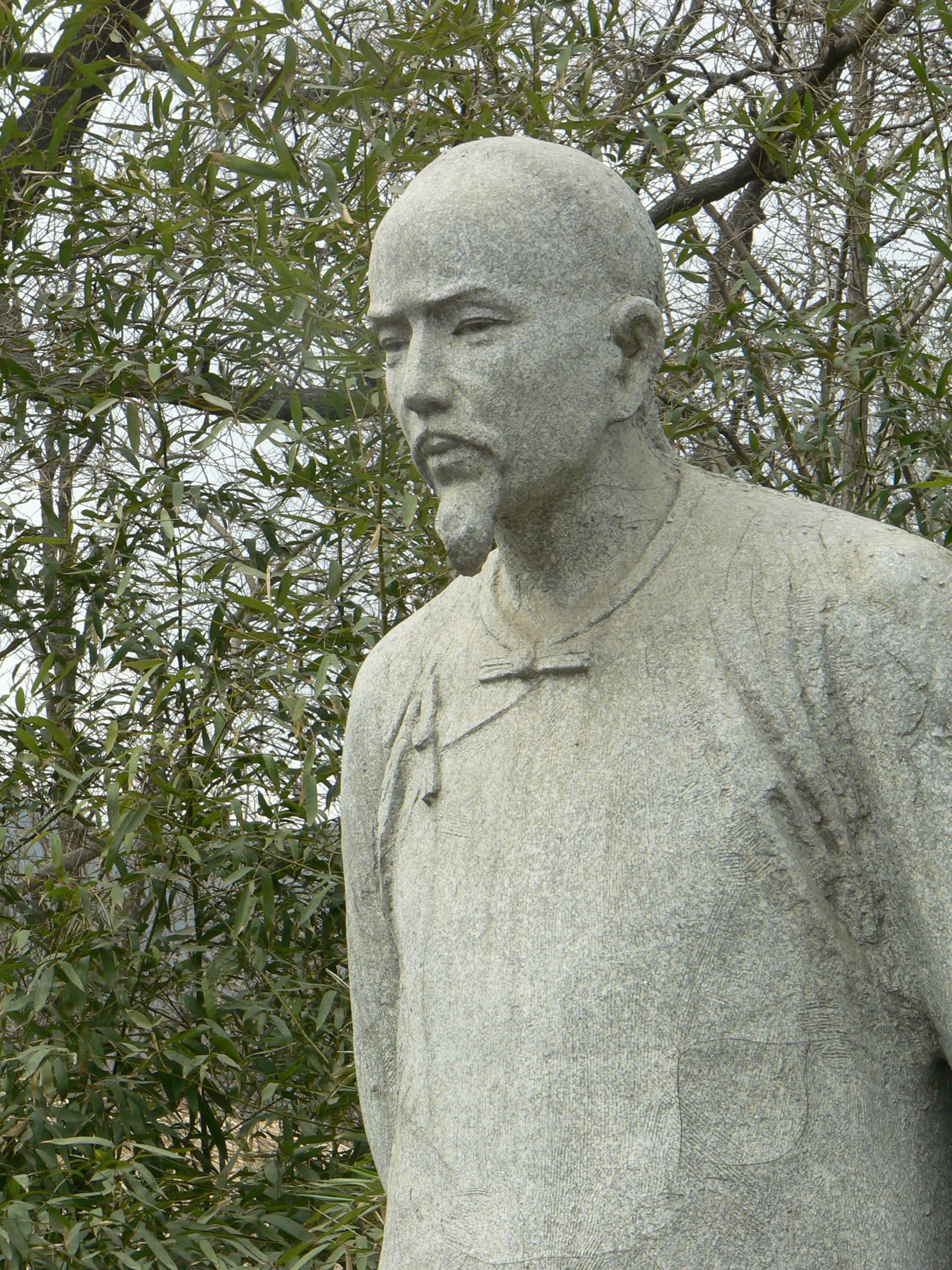
Statue of Cao Xueqin in Beijing

Friday, May 11, 2007

View of Kósciuszko Mound, Krakow

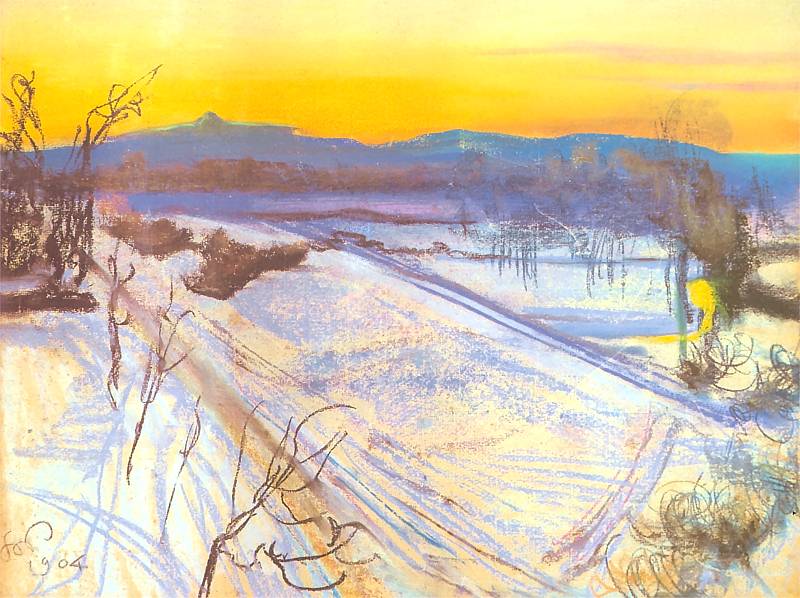
Looking through the Polish landscape paintings in Warsaw’s Muzeum Narodowe there are examples of topography, Claudian idyll, the sublime (a dramatic Mountain Landscape with Waterfall (c1820) by Franciszek Ksawery Lampi), Impressionism, Symbolism... It’s difficult to get very excited about some of these and perhaps a Polish visitor to Britain would feel the same about paintings by, say, Richard Wilson. There seems to be more scope for unfamiliar artists to leave a distinct impression when you reach the late nineteenth century, even when they’re relatively derivative, e.g. Józef Pankiewicz’s striking Whistler-style Nocturne – Swans in the Saski Garden in Warsaw at Night, 1894. I am thinking here in particular of the pastel landscapes drawn by Stanislaw Wyspianski (1869-1907), like his View of Kósciuszko Mound, Krakow (1905). These have a certain calm harmony but at the same time a creeping sense of unease in the slightly discordant colours and shadowy, skeletal trees; you have a sense of someone trapped in their studio and looking out with a sense of quiet desperation. 
 
Stanislaw Wyspianski is actually much better known as a writer and ‘founder of modern Polish drama’, so has much in common with that other painter of strange landscapes, August Strindberg. The excellent Adam Mickiewicz Institute which I visited in Warsaw has an article about him. (Incidentally, among the fascinating artefacts on display at the Institute was a volume of Byron poems given with a dedication by Mickiewicz to his friend Pushkin – ah, heady times...) There is a Wyspianski museum in Krakow and an image of one of the pastel landscape views at a Katowice museum site.

 Stanislaw Wyspianski, View of Kósciuszko Mound, Krakow (1905)
Source: Wikimedia Commons


Postscript, July 2023

We have just been to Krakow and from its royal castle, the Wawel, were able to look over the river and beyond the city centre to the distant Kósciuszko Mound (see first photograph below). Intrigued to see it up close, we took a tram and climbed a hill until we emerged at what appeared to be a nineteenth century brick fortress. Rising above its walls was the mound itself, a monument to Polish national leader Tadeusz Kościuszko. With its artificial shape and winding path it looks like a work of land art or something Charles Jencks might have considered for his Garden of Cosmic Speculation. As you can see below, the Ukrainian flag, yellow and blue like Wyspianski's drawing, was flying alongside two Polish ones.