Showing posts with label window views. Show all posts

Saturday, August 09, 2025

Empty places

In my last blog post I talked about how disability can impose restrictions on how a landscape is seen and said I would say more about this in connection with Edward Burra, the subject of a current retrospective at Tate Britain. The wall captions explain all this clearly: 

By the 1960s, Burra's already frail health had begun to decline making travelling abroad difficult. Instead, he embarked on driving tours of Britain with his sister Anne. 

Burra observed fields, mountains and valleys as passing impressions through his car window. His attention was also caught by smog-belching power stations and collieries as well as newly built motorways, which had become a common feature of Britain's changing landscapes. His sister would stop periodically so he could study the view intensely. Burra's friend Billy Chappell sometimes joined them. Chappell was struck by the artist's uncanny memory and eye for detail: 

It fascinated me to watch Edward when the car halted by some especially splendid spread of hills, moorland, and deep valleys. He sat very still and his face appeared completely impassive... I do not remember Edward ever making any sort of note: not even the faintest scribble; yet weeks, even months later, the shapes, the tones, the actual atmosphere; and the colour of the clouded skies looming above those moors, hills, and valleys he had looked at so intently, would appear on paper. 

The painting below actually resembles the view from a car window. Here and in other late landscapes Burra makes use of the properties of watercolour - the way that road shades from dark blue to white is really beautiful. Earlier work could at first be mistaken for oil or acrylic, but for health reasons he mostly used watercolours throughout his career. As a Guardian article about an earlier Burra show at Pallant House explains, 'a lifelong struggle with rheumatoid arthritis and a debilitating blood disease meant that he was never able to use an easel in the conventional way. Instead he opted to sit, working mostly in unfashionable watercolour on thick paper laid flat on a table.' 


Edward Burra, English Countryside, 1965-67

Laura Cumming's review of the current exhibition expresses a preference for these late landscapes over his pre-war scenes of 'seedy nightclubs'. But Burra's vision of England can be pretty bleak and depressing. Christopher Neve writes vividly about this in Unquiet Landscape (1990), so I will end here by quoting him. 
Beginning in 1965, Burra was driven on regular car journeys around England by his sister Anne. It was she who chose where to stop. They went to empty places where he could see a long way, in East Anglia, on the Yorkshire moors and in the Welsh borders. He sat wherever she chose and watched impassively from lay-bys, just as he had watched human antics through the fumes of nightclubs, memorizing the faces of waiters so that a long time later he could make accurate and compelling pictures from what he had seen. 
Was it disenchantment with people that led him repeatedly to paint these empty places, or a fascinated disenchantment with the places themselves? He seemed to dread them. They swell, stretch, curve, crease. Bruised clouds stack over them and break open. Floods and fields make their puddles of watercolour. Trees are abruptly lit up in negative as if by a nuclear blast. Rock outcrops are swollen with disease. Chasms dwarf. Bile-yellow and a punishing green can hardly contain themselves. It is as though Cotman were reborn specifically to see England in its worst light... 

Saturday, June 08, 2024

The Angle of a Landscape


The renowned American poetry critic Helen Vendler died a few weeks ago; there was a nice piece in The Atlantic by Adam Kirsch comparing her to Marjorie Perloff, who also passed away this year. I thought I'd pick three poems from Vendler's Emily Dickinson anthology and quote from her illuminating commentaries. I'll begin with this one, which has one of those arresting first lines that draw you straight into Dickinson's poems (see my earlier post on how these have been used by artist Roni Horn).


Our lives are Swiss—
So still—so Cool—
Till some odd afternoon
The Alps neglect their Curtains
And we look farther on!

Italy stands the other side!
While like a guard between—
The solemn Alps—
The siren Alps
Forever intervene!

Here, Vendler says, 'while the blocking Alps are obscured by mist, one cannot even speculate about what lies beyond; but when they let down their guard, and forget to draw the curtain over their landscape, one can see, beyond the passes, an ecstatic vista. The still, cool, white life of an Alpine region remains untroubled until one senses a possible warmth. If only one could traverse the mountains!' I've always loved this idea of glimpsing a promised land, somewhere sunny and beautiful summed up in that italicised word, Italy. The Alps here are both solemn - "thou halt not" - and sirens, leading us on. Eden could be ours if it weren't forever barred from us.


The Angle of a Landscape – 
That every time I wake – 
Between my Curtain and the Wall
Upon an ample Crack – 

Like a Venetian – waiting – 
Accosts my open eye – 
Is just a Bough of Apples – 
Held slanting, in the Sky – 

The Pattern of a Chimney – 
The Forehead of a Hill – 
Sometimes – a Vane’s Forefinger – 
But that’s – Occasional – 

The Seasons – shift – my Picture –
Upon my Emerald Bough,
I wake – to find no – Emeralds – 
Then – Diamonds – which the Snow

From Polar Caskets – fetched me –
The Chimney – and the Hill – 
And just the Steeple’s finger – 
These – never stir at all – 

Vendler describes this as three sequential poems in one. The first three stanzas provide 'an enticing picture of a small sliver of landscape that is familiar to Dickinson because she sees it every morning between the edge of her curtain and the wall of her room.'  Then she moves through autumn and winter with emerald leaves replaced by diamond frost and snow. Finally there are the last three lines which leave us with a static chimney and the finger of a steeple. 'The denuding of the landscape in the last stanza is an almost invisible process' and we are left with 'a heartbreaking picture of a once-enhanced Nature which, with the death of its participatory observer, itself suffers rigor mortis.'


To make a prairie it takes a clover and one bee,
One clover, and a bee.
And revery.
The revery alone will do,
If bees are few.

Vendler ends her book Dickinson with this beautiful epigram, long a favourite poem of ours and one I've quoted on this blog before. She looks at the poet's word choice - for example, "prairie" is a good rhyme, distinctly American and reflects in its spelling the Latin pratum, "meadow". She also analyses the poem's linguistic game that is one of its most appealing features: the way "a" and "one" reverse their order. A bee needs just one random clover to sip nectar from, but in the second line they are separated by a comma and joined by the third essential term, "revery", which seems to arise 'as a "surprise" even to herself'. The word "revery" has various meanings, ranging from a vision to a state of being lost in thought. Its three syllables make it 'spread out' in a way you wouldn't have with the simple word 'dream'. This poem's last six brisk monosyllables bring us 'out of the dreamy reverie itself (here a clover, there a bee) into the poet's argument for the power of reverie alone, even when it is unsupported by correlative natural images. Dickinson is a rapturous poet of nature's flowers and bees, but her more abstract meditations can arise powerfully from reverie alone.'

Friday, April 28, 2023

Sussex Waters


I had been looking forward to 'Sussex Landscape: Chalk, Wood and Water' at Pallant House but was sadly too ill to go down and see it. The catalogue is interesting though, with an overview of the exhibition and essays on photography, engraving, chalk and flint. Some of the artists I discuss in Frozen Air were included - Frank Newbould, Eric Ravilious, John Piper, Bill Brandt and Jem Southem. Other famous artists associated with places in Sussex featured - William Blake (Felpham), John Constable (Brighton), Vanessa Bell (Charleston), Lee Miller (Farleys) - along with art by people I have discussed on this blog before - Roger Fenton, Paul Nash, Graham Sutherland, Andy Goldsworthy. I imagine the exhibition's centrepiece would have been Turner's stunning Chichester Canal (c. 1828) which includes the hazy silhouette of the cathedral, located just a street away from Pallant House.  

I'll mention here a few less well known works from the catalogue:    

  1. A View of East Dean and Mr. Dipperay's House from the Hills on the East Side of the Village, 1785 by Samuel Hieronymous Grimm. One of the views commissioned for a planned history of Sussex, this is closer to documentation than art but is fascinating now as a record of what could be seen from a specific spot at the end of the eighteenth century. The British Library has 866 of these topographical watercolours.
  2. View of the Sussex Weald. c. 1927 by C.R.W. Nevinson. If I'm ever in Reading I'll have to visit their museum to see this delightful view through a window, strikingly different to the 'angular views of the war-scarred Western Front' we associate with Nevinson. 'A flourishing genre of images of the Sussex landscape framed by the domestic window is testament to the many artists who made the area their home for short or long periods during the inter-war years.'
  3. The Wave, 1966 by Gluck. This one is in a private collection and the catalogue's reproduction is a bit small and dark so it's hard to tell what it is really like. A small cropped view in an unusual frame: the whitewater and face of a breaker emerging from a turquoise-grey sea. It was painted when Gluck was living at Chantry House in Steyning with Edith Shackleton Heald.   
  4. Track with Sheep (Near Lewes) c. 1983-87 by John Holloway. 'Holloway began photographing the landscape in 1978, and over the next twenty-five years would provide a unique view of the land by taking photographs at a height of 1,500 feet from a small aeroplane. He would work at two specific times of the year - either side of the spring and autumn equinox - when the angle of the sun reveals the textures of the Downs.' You can see examples of his work in The Guardian's obituary.
  5. Solar, Seven Sisters, 2019 by Jeremy Gardiner. This combines a familiar (to me) view of the cliffs and buildings at Cuckmere Haven with abstract planes reminiscent of St Ives painters or Richard Diebenkorn. The relief surfaces 'represent both pictorially and conceptually the geological strata of the coastline.'

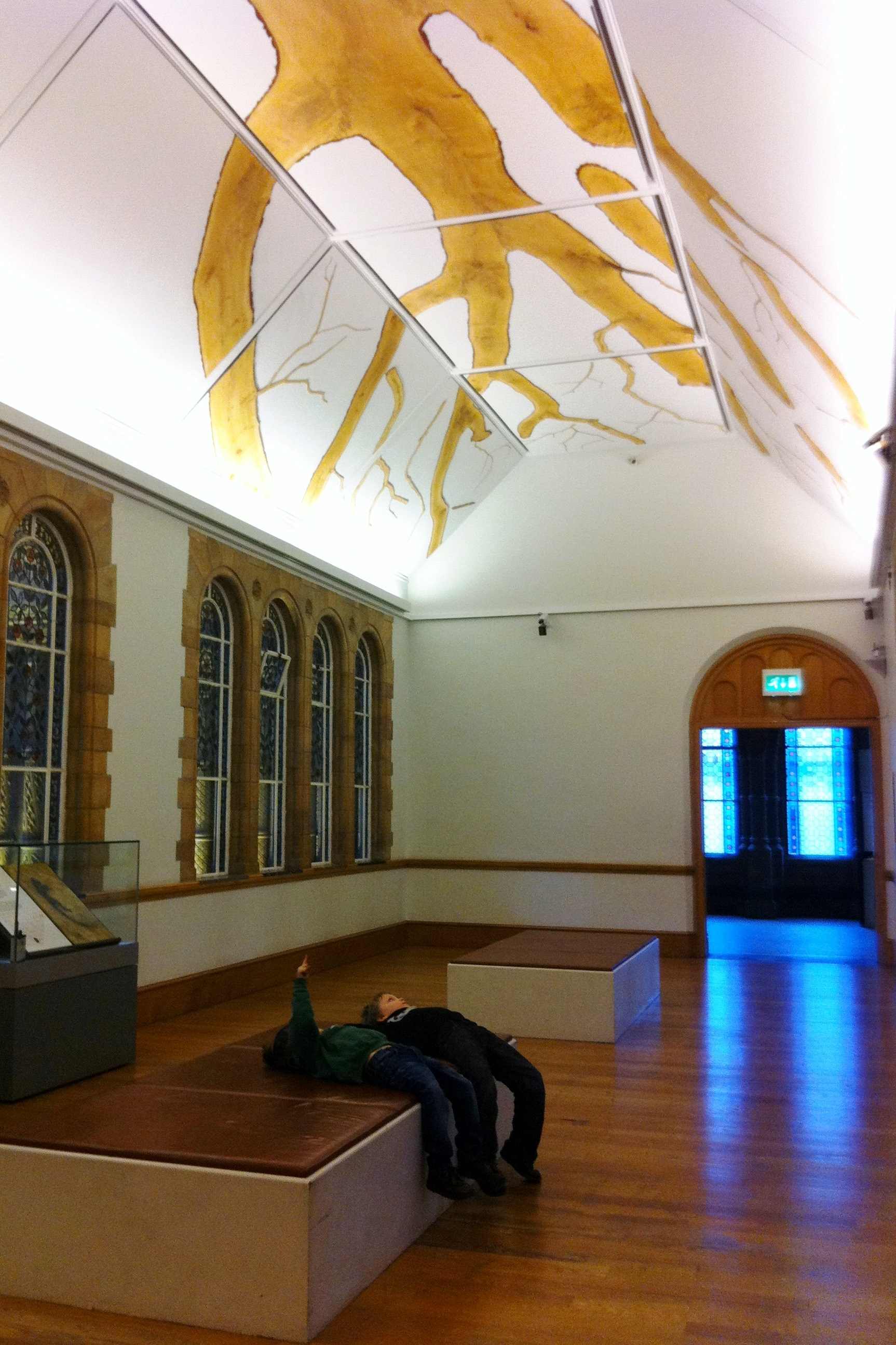
Before concluding I will just mention one of the book's essays as it's by an artist I'm surprised I haven't mentioned here before, Tania Kovats. I remember going to see her Darwin-inspired artwork TREE at the Natural History Museum back in 2011 (see photo below!) For Sussex Waters in this exhibition she installed bottles of water taken from the county's rivers. The idea of collecting and exhibiting water samples isn't new - Roni Horn's Library of Water in Iceland is more dramatic and directly addresses climate change in preserving glacial meltwater. But if you come from Sussex, the list of rivers Kovats visited is evocative in itself. They have some beautiful, resonant names - Cuckmere of course, and Cowfold, Woodsmill, Adur, Arun, Rother, Uck, Ouse. Glynde evokes an image of well-healed highbrow culture, Gatwick Stream a remnant of a landscape built over for a 'London' airport. There are quite a few I've never heard of but would like to visit. As she says, 'even naming rivers opens us up to connection.'

Tuesday, April 19, 2022

The Sea View Has Me Again

The 'Sea View' of Patrick Wright's recent book was actually the name of one of the two pubs Uwe Johnson frequented during his final decade, living in Sheerness and almost failing to complete the fourth volume of his novel Jahrestage (Anniversaries). Johnson did have a sea view from his house on Marine Parade, although it was almost blocked by a defensive flood wall that was still under construction at the time of his death in 1984. Wright notes that 'views over water mattered greatly to Johnson', and windows feature in his novel as a device for framing the vistas of New York visible to his protagonist Gesine, providing a surface on which she pictures scenes from her youth. Looking out towards the icy New Jersey shore she is reminded of a winter morning on Lake Constance, but the moment this happens both memory and present view begin to 'corrode'. Instead of regaining a complete image of an earlier landscape, she can only experience scraps and shards of it. The streets of New York can suddenly be transformed, smog covered houses recalling 'a soft rolling landscape, forest meadows', but the memory remains partial, like somewhere seen from a boat and then obscured from view, although 'reachable not far past the shoreline cliff.'

In his chapter 'Beach, Sea and 'the View of Memory'' Wright discusses the importance of lakes and rivers for Uwe Johnson. Indeed 'Anniversaries itself comes to resemble the geography of Mecklenburg', where Johnson and Gesine grew up: 'sea-edged and filled with marshes, inland canals and lakes as well as rivers and the occasional swimming pool.' When I read Anniversaries I found this unfamiliar and complicated geography further confused by Johnsons' references to both real and imaginary places. I am no more familiar with Sheerness, never having been there, although any reader of Wright's book will learn a lot about its history. At several points it touches on resemblances between Sheerness and Mecklenburg, which could offer some explanation for Johnson's puzzling decision to move to this unloved corner of Kent. 

Wright concludes his exploration of Sheerness with the story of a Second World War ship full of explosives that has never been removed - Johnson wrote an essay about it entitled 'An Unfathomable Ship'. This essay suggests that Johnson saw the sea as 'a non-human force that is nevertheless the witness and even bearer of the murderous history that keeps troubling the surface of Gesine Cresspahl's consciousness.' It features in Johnson's books not as a unified force, resembling simplified political narratives of the historical tides that swept over Germany, but as discrete waves, 'singular and yet interconnected', like the 365 days that make up the chapters of Anniversaries. The first paragraph in the first volume of Johnson's novel describes the action of waves on the beach at New Jersey, and this sea view reminds Gesine of her childhood by the Baltic.

'Long waves beat diagonally against the beach, bulge hunchbacked with cords of muscle, raise quivering ridges that tip over at their greenest. Crests stretched tight, already welted white, wrap round activity of air crushed by the sheer mass like a secret made and then broken.'     
(translation by Damion Searls. For more information on The Sea View Has Me Again see Patrick Wright's website).

Sunday, July 05, 2020

A Room with a View


"I wanted so to see the Arno..."   

Disappointed Lucy Honeychurch gets her wish when Mr Emerson and his son George kindly offer to swap rooms ("women like looking at a view; men don't").  The next morning she wakes and leans from the window, 'out into sunshine with beautiful hills and trees and marble churches opposite, and close below, the Arno, gurgling against the embankment of the road.'  Forster spends a paragraph describing the scene below - river men, children, soldiers, a tram temporarily unable to proceed.  'Over such trivialities as these many a valuable hour may slip away, and the traveller who has gone to Italy to study the tactile values of Giotto, or corruption of the Papacy, may return remembering nothing but the blue sky and the men and women who live under it.'  Eventually, over the course of the novel, Lucy chooses life over culture, George over the aesthete Cecil (memorably played by Daniel Day Lewis in the film), and A Room with a View ends with the newlyweds in Florence again, looking out over the Arno from the same window.

It is landscape - the desire for a good view - that leads to the novel's decisive moment, placing Lucy in the situation where George is compelled to kiss her.  Along with the other English travellers in Florence, they are invited by the chaplain, Mr Eager, to make an excursion into the hills.
"We might go up by Fiesole and back by Settignano. There is a point on that road where we could get down and have an hour’s ramble on the hillside. The view thence of Florence is most beautiful—far better than the hackneyed view of Fiesole. It is the view that Alessio Baldovinetti is fond of introducing into his pictures. That man had a decided feeling for landscape. Decidedly. But who looks at it to-day? Ah, the world is too much for us.” 
 
 Alesso Baldovinetti, Nativity (detail), between 1460 and 1462

And so they set off on the excursion and stop on the hillside with its view of the Val d'Arno. The group separate and Lucy finds herself at a place where 'the view was forming at last; she could discern the river, the golden plain, other hills.'  But then she slips and finds herself on a terrace covered with violets.
From her feet the ground sloped sharply into view, and violets ran down in rivulets and streams and cataracts, irrigating the hillside with blue, eddying round the tree stems collecting into pools in the hollows, covering the grass with spots of azure foam. But never again were they in such profusion; this terrace was the well-head, the primal source whence beauty gushed out to water the earth.
Here, unexpectedly, she encounters George who sees 'the flowers beat against her dress in blue waves'.  He steps forward and kisses her.


In the Merchant Ivory film there are no violets - presumably they couldn't find any on location. Instead there is long grass and poppies and a rather overwhelming Puccini aria sung by Kiri Te Kanawa. The second kiss, which again takes Lucy by surprise, takes place after a tennis match some months later, when they are back in England. As she observes George playing in the fading sunshine, she imagines the landscape of Italy overlaying the familiar surroundings of Surrey.
Ah, how beautiful the Weald looked! The hills stood out above its radiance, as Fiesole stands above the Tuscan Plain, and the South Downs, if one chose, were the mountains of Carrara. She might be forgetting her Italy, but she was noticing more things in her England. One could play a new game with the view, and try to find in its innumerable folds some town or village that would do for Florence. Ah, how beautiful the Weald looked!
Everything in Forster is tinged with irony (see my earlier post on Howards' End) and of course these lines are there to show how Lucy is unaware of her own feelings, for George and the place he first kissed her.  But having grown up on the edge of the South Downs, I would love to believe that they are capable of becoming the hills of Tuscany.

Saturday, May 27, 2017

Trees that in moving keep their intervals

A constant keeping-past of shaken trees,
And a bewildered glitter of loose road;
Banks of bright growth, with single blades atop
Against white sky; and wires—a constant chain—
That seem to draw the clouds along with them
(Things which one stoops against the light to see
Through the low window; shaking by at rest,
Or fierce like water as the swiftness grows);
And, seen through fences or a bridge far off,
Trees that in moving keep their intervals
Still one 'twixt bar and bar; and then at times
Long reaches of green level, where one cow,
Feeding among her fellows that feed on,
Lifts her slow neck, and gazes for the sound.
These lines describe a train journey from London to Folkestone on 27 September 1849.  It was the end of a decade of remarkable expansion, when railways had developed from isolated lines to a national network, and the novelty of moving at speed through the countryside is evident in this poetry.  Ironically though, the writer - twenty-one-year-old Dante Gabriel Rossetti - was heading into the past, to see the medieval architecture and paintings of Paris, Bruges, Ghent and Antwerp.  He was accompanied on the trip by William Holman Hunt and addressed his verse letters home to the recently formed Pre-Raphaelite Brotherhood.   Among these are poems inspired by the places they visited - Notre Dame, the Louvre, the Field of Waterloo etc. - but they are interspersed by accounts of the journey itself and the embodied experience of moving through landscape.  Rossetti, as a painter, was also fascinated by the way the carriage windows framed what was visible, and how the railway line itself recomposed its surroundings.  The reference in the lines above to wires and clouds reminds me of what I wrote here last week about Fog Lines.  I will reproduce a few more examples of this landscape-in-motion poetry here.  The full set of poem can be read at the Rossetti Archive.

Having reached Folkestone and sailed the 'the iron-coloured sea' to Boulogne, the travellers took a train to Amiens and thence to Paris.
The sea has left us, but the sun remains.
Sometimes the country spreads aloof in tracts
Smooth from the harvest; sometimes sky and land
Are shut from the square space the window leaves
By a dense crowd of trees, stem behind stem
Passing across each other as we pass:
Sometimes tall poplar-wands stand white, their heads
Outmeasuring the distant hills.
From Paris they made an excursion by train to Versailles.
The wind has ceased, or is a feeble breeze
Warm in the sun. The leaves are not yet dry
From yesterday's dense rain. All, low and high,
A strong green country; but, among its trees,
Ruddy and thin with Autumn. After these
There is the city still before the sky.
Versailles is reached. Pass we the galleries
And seek the gardens...
At the end of their stay in Paris, they took the train to Belgium.  Rossetti struggled to sleep (insomnia would plague him in later life) and there were several stops at stations where he looked in some wonder at the train itself.  'The mist of crimson heat / Hangs, a spread glare, about our engine's bulk.'  The landscape they passed on this journey was anything but picturesque. 
A sky too dull for cloud. A country lain
In fields, where teams drag up the furrow yet;
Or else a level of trees, the furthest ones
Seen like faint clouds at the horizon's point.
Quite a clear distance, though in vapour. Mills
That turn with the dry wind. Large stacks of hay
Made to look bleak. Dead autumn, and no sun.

The smoke upon our course is borne so near
Along the earth, the earth appears to steam.
Blanc-Misseron, the last French station, passed.
We are in Belgium.

J. M. W. Turner, Rain, Steam and Speed – The Great Western Railway, 1844
 
From Brussels they travelled to the old cities of Flanders.  In Bruges Rossetti felt himself close to Van Eyck and Memling, listening to the same bells that had rung through the city when they were at work in the fifteenth century (perhaps he was thinking of the passage in Victor Hugo that I quoted earlier this month?)  I will end this selection of quotations with lines that refer to the title of Turner's famous painting, first exhibited five years earlier.  Writing recently in the LRB, Inigo Thomas says that John Ruskin, the great champion of the Pre-Raphaelites, 'never wrote a word about Rain, Steam and Speed, and he was never convinced that any train, or any idea of the ‘scientific people’, as he scornfully described them, was worthy of artistic representation.'  In 1849 Ruskin was yet to meet Rossetti and you wonder what he would have made of these railway journey poems.  They were only published decades later, two years after Rossetti's death, and given by his brother the rather prosaic title, 'A Trip to Paris and Belgium'.
The country swims with motion. Time itself
Is consciously beside us, and perceived.
Our speed is such the sparks our engine leaves
Are burning after the whole train has passed.

The darkness is a tumult. We tear on,
The roll behind us and the cry before,
Constantly, in a lull of intense speed
And thunder. Any other sound is known
Merely by sight. The shrubs, the trees your eye
Scans for their growth, are far along in haze.
The sky has lost its clouds, and lies away
Oppressively at calm: the moon has failed:
Our speed has set the wind against us. Now
Our engine's heat is fiercer, and flings up
Great glares alongside. Wind and steam and speed
And clamour and the night. We are in Ghent.

Friday, July 29, 2016

Snow Light, Water Light


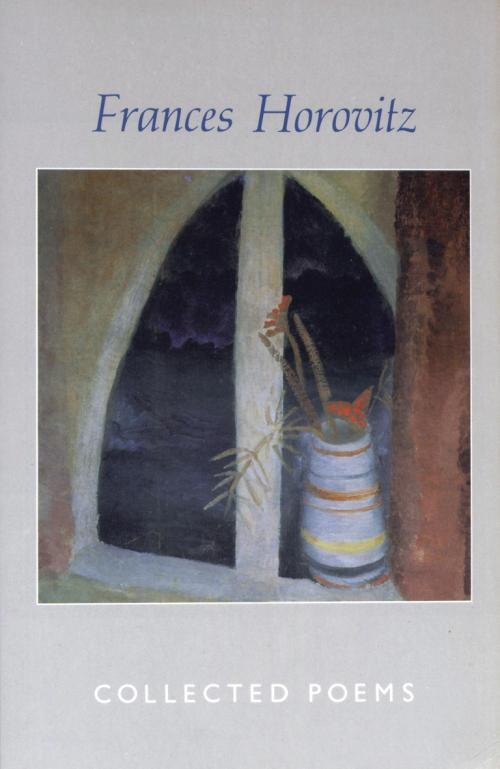
The Collected Poems of Frances Horovitz only runs to 118 poems but many are centred on the natural world and the landscapes of Cumbria, the Welsh Marches and the Cotswolds, where she lived for ten years across the valley from the white-roofed cottage that inspired Laurie Lee's Cider with Rosie.  Here are some brief examples of her imagistic writing, from the poems 'Irthing Valley' 'Finding a Sheep's Skull', 'Walking in Autumn' and 'Sightings':
'... the wind lays itself down / at dusk / a fine cloth over the stones ...'
'... I hold it up to the sunlight, / a grey-green translucent shell. / Light pours in / like water / through blades and wafers of bone. ...'
'... Pale under-leaves of whitebeam, alder / gleam at our feet like stranded fish / or Hansel's stones. ... '
'... crow's wing / brushed on snow, / three strokes / twice etched / as faint and fine / as fossil bone. ...' 

In a 1984 review of her short posthumous collection Snow Light, Water Light Peter Levi wrote that she had 'perfect rhythm, great delicacy and a rather Chinese and yet very locally British sense of landscape. (I take 'Chinese' to imply high praise).  Her last poems show a healthy influence of Basil Bunting, and of the landscape of Birdoswald and Hadrian's Wall.  She has a thrilling sense of history and archaeology. ... She does in a small degree what David Jones has done, who was the wizard of this age.'  Levi might have been thinking here of a poem I particularly like, 'An Old Man Remembers', which retells the Mabinogian story of a beautiful woman, Blodeuedd, who was formed out of 'the flowers of the oak, the broom and the meadowsweet' but ends her days transformed into an owl.

Levi goes on to quote in full an atmospheric short poem entitled 'The Crooked Glen' - a translation of 'Camboglana', the Celtic name for Birdoswald.  Camboglana has been identified as one of three possible sites for Arthur's last battle, after which, mortally wounded, the king asked Sir Bedevere to take Excalibur back to the waters whence it came.  (I saw this scene recreated a couple of years ago when my son took the role of King Arthur in his school play and other children shook a sheet of blue plastic to simulate the waves on the water).  Bedevere's words on his return,  I saw nothing but waves and winds, are the first line of 'The Crooked Glen'.  Horovitz writes of an ushering wind shaking ash and alder by the puckered river and stirring the blood-dark berries. 

In October 1983, Frances Horovitz died - she was just forty-five years old.  I find some of her final poems almost too poignant to read, like 'For Adam, nearly twelve' and 'Letter to My Son' (my own son is now twelve; Adam Horovitz grew up to become a poet himself).  Her last poem, a haiku, reminded me, sadly, of the late poems of Masaoka Shiki (described here previously) who died even younger, at thirty-four.  A disciple of Shiki's had glass installed in the sliding doors of his room, so that he was able to see out into his garden.  Frances Horovitz could see Garway Hill through the window by her bed, but in 'Orcop Haiku' it is glimpsed through September rain, 'glass beads flung on glass'.  In an obituary in Poetry Review Anne Stevenson observed that 'the fine poems of her last collection, Snow Light, Water Light, forecast her own death in the images of light and dark, water and stone, she always made her own. We who loved her miss her very much. But everyone inherits these poems which, like Hardy's and Edward Thomas's, will outlast all fluctuations of fashion.'

Saturday, May 23, 2015

The questions of the sea


The Royal Academy's Richard Diebenkorn exhibition divides neatly into three rooms, the first covering his early abstract period in Albuquerque and Urbana, the second charting his move into figurative drawing and painting while living at Berkeley, the third focusing on his famous Ocean Park series (1967-88).  Diebenkorn had grown up in the San Francisco Bay area and moved in 1950 to Albuquerque to complete his MA at the University (Agnes Martin, the subject of a respective at Tate Modern opening next month, taught there a few years later).  The city is located on a high plateau of the Chihuahua desert and, as co-curator Sarah C. Bancroft writes, 'the dusty whites, tans, reds, ochres, oranges, yellows and pinks of his environment are seemingly baked onto many of his paintings'.  It was on flight from California to Albuquerque in 1951 that Diebenkorn was first struck by the view of landscape from the air. "I guess it was the combination of desert and agriculture that really turned me on,” he said, “because it has so many things I wanted in my paintings. Of course, the earth’s skin itself had ‘presence’ - I mean, it was all like a flat design - and everything was usually in the form of an irregular grid.”  Diebenkorn's paintings in the 1950s often remind me of the contemporary works of Peter Lanyon who also used an aerial perspective - it is sad to think that Lanyon might have had an equivalent of the Ocean Park series ahead of him if he had not died in a glider accident in 1964.

By the early sixties Diebenkorn was painting more recognisable landscapes like Cityscape #1, which you can see and read about in the RA's Exhibition in Focus PDF.  'The colours and atmosphere of these landscapes are clear, crystalline and bright.'  Too bright, some viewers have apparently felt, although as Bancroft says Diebenkorn himself was struck by the vividness of Northern California when he made a return visit in the 1980s: "God, that is the colour I used to use, when I lived up here!"  Whilst in Berkeley he was also painting interiors with views through windows, influenced to by Matisse, Bonnard and Hopper.  These, Steven A. Nash writes in the catalogue, 'provided a means to compare internal and external light, a way to project attention into the far distance, and a device for exploring the emotional contrasts of near and far, culture and nature, and a sense of confinement versus longing for release and freedom'.  Nash also makes a connection with Caspar David Friedrich's paintings of windows (which I've referred to here before), whose 'reigning mood is serenity tinged with melancholy'.   

Back in 2006 I wrote about the Ocean Park paintings and their relationship to landscape.  Since then an essay by poet and former Ocean Park resident Peter Levitt has appeared called 'Richard Diebenkorn and the Poetics of Place'.  It can currently be read online as a PDF and I will end this post with a quotation from it that conveys the rapture these extraordinary paintings can provoke.  However, I think Laura Cumming is as usual very perceptive in her review, when she notes that up close they 'are stranger than expected, and this paradise is not without shadows – sometimes a grey pall, or a funereal black border edging into the frame.  In fact the Ocean Park series that has given so many people such pleasure arrives out of hesitation, correction, uncertainty, further attempts, frequent cancellations.  How can one tell?  Diebenkorn leaves the workings on show.  The veils of colour that settle on the painting like a misty haar lie over many trials and second thoughts.  The paintings look light, bright, uplifting, slim; but this only comes after long and patient thinking.'  Here then is Peter Levitt, who first visited Ocean Park in 1967 and marvelled 'at the unique and beautiful quality of the light, how from morning to night the sky’s variable shades of blue seemed to retain a moist translucence, as if the colour rose from the nearby sea to cool the heated summer air.'  
'The paintings call forth how it actually felt to live bathed in a wash of such colour and light, to feel the steady, calm, and gradual movement of time reflected in the environment as one lived one’s moments, days, months, and years in a small seaside town (now grown overlarge) whose primary quality was the interaction of this extraordinary light with everything and everyone it fell upon. ...  There is something that moves through me when I stand calmly before this work that doesn’t seem to have a beginning and, equally, may never end.  It may be the way Diebenkorn caught the light I’ve been discussing.  It may be how the shapes are so perfectly drawn and coloured that they call to mind the sound of the nearby ocean, where, as Pablo Neruda wrote, waves repeat the questions of the sea.  How can I know?  Should I even try to comprehend?  To stand in the company of these paintings—where the world I know is one a painter helped to create, and what lies beneath the paint is the common bond of what I call home —is enough.

Sunday, April 27, 2014

The Ruins of Hohenbaden

 
Carl Philipp Fohr, The Ruins of Hohenbaden, (1814-15)

Today was the last day to see A Dialogue with Nature, an excellent little exhibition at The Courtauld which included works from New York's Morgan Library & Museum that I'd not seen before, like Carl Philipp Fohr's 'jewel-like watercolour', The Ruins of Hohenbaden (1814-15).  I was particularly fascinated to see German paintings and drawings like this alongside those by familiar British names (Cozens, Girtin, Turner etc.).  Three more examples: Caspar David Friedrich's The Jakobikirche in Greifswald as a Ruin (c. 1817), the kind of nineteenth century 'anticipatory ruin' highlighted in the Tate's current Ruin Lust exhibition; Theodor Rehbenitz's strange little Fantastic Landscape with Monk Crossing a Bridge (c. 1826-30), a throwback to the style of Dürer's woodcuts; and the composer Felix Mendelssohn's sketchbook for 1837-9 open to show that popular Romantic trope, the view from a window.  Although there were few surprised in these British and German artists' subject matter, the exhibition conveyed a wonderful sense of technical creativity in the means used to engage in 'a dialogue with nature'.  I left with a mental list of ways in which an innovative artist of the period might demonstrate a distinctive landscape vision...

  • Use stylised strokes...  I have written here before about the vocabulary of marks used by Chinese landscape painters and named after the natural phenomena they resembled, like tan wo ts’un – 'eddies of a whirlpool'. The Courtauld curator drew attention to the foliage in Johann Georg Wagner's Wooded landscape with stream and oxcart on road (1760s), depicted using 'whirls and coils in a lively, almost calligraphic manner', a device which 'imbues this tranquil scene with vitality and movement.'  Wagner didn't have a chance to develop his style, dying at the age of just twenty-two (the same age at which Carl Philipp Fohr was killed, after an accident swimming in the Tiber). 
  •  
  • Use a 'stump'...  This was how Thomas Gainsborough, in Wooded Upland Landscape with Cottage, Figures and Cows (c. 1785), created subtle shades of grey on the road leading into the picture, the walls and the trees beyond and the distant hills and clouds in the background.  By rubbing a tightly rolled stump of leather or paper over the surface he left areas of soft shadow that contrast satisfyingly with the grainy texture of the unsmoothed chalk elsewhere in the landscape. 
     
  • Add gouache and gum arabic...  Mainly self-taught, Samuel Palmer also used distinctive ways of applying ink and paint, like the stippled trees in The Haunted Stream (c. 1826).  But what's really striking about another experiment, Oak Tree and Beech, Lullingstone Park (1828), are the different materials used. The extraordinary fiery evening light in the depths of the trees is 'yellow watercolour over white gouache, to which he applied gum arabic, imparting shine, and occasional dots of red watercolour.'
     
  • Choose coloured paper... The exhibition included one of Constable's cloud studies in which, it appears, he had insufficient time to record all the gradations of colour.  Nearby is one of the 150 cloud studies made by his German contemporary Johann Georg Dillis, executed with white chalk on blue paper so that he could avoid the issue of colour and concentrate on pure form.  I would love to see a large selection of these all on display together.

  • Leave a hole...  The moon must present a particular challenge for landscape painters and Turner makes it look easy in the Courtauld's On Lake Lucerne, looking towards Fluelen (1841).  Hung next to this in the exhibition was Friedrich's Moonlit Landscape (1808) in which he made no attempt to paint the moon itself: instead a circular hole was left so that a blank piece of paper behind shines through. In fact this was originally designed to be illuminated by lamplight and viewed to the accompaniment of music.
  • Saturday, July 27, 2013

    That vast horizon, those thick clouds, that raging sea are all but a picture


    The first description of a landscape photograph was written in 1760, almost eighty years before the invention of photography.  In Giphantie, Charles-François Tiphaigne de la Roche relates the experiences of a traveler in the land of Giphantia, a fertile place in the centre of Africa 'given to the elementary spirits the day before the Garden of Eden was allotted to the parent of mankind.'  After seeing various wonders he is led by the Prefect of Giphantia into a subterranean hall, 'not much adorned', but with a window opening out onto 'a sea which seemed to me to be about a quarter of a mile distant.  The air, full of clouds, transmitted only that pale light which forbodes a storm: the raging sea ran mountains high, and the shore was whitened with the foam of the billows which broke on the beach.'  Astonished to see the ocean in the center of Africa, the traveler rushes forward to put his head out of the window, but knocks his head 'against something that felt like a wall.  Stunned with the blow, and still more with so many mysteries, I drew back a few paces.'  His guide explains:  'That window, that vast horizon, those thick clouds, that raging sea are all but a picture.'  And the means by which this light painting was made can be read now as a remarkable anticipation of the photographic process:
    'The elementary spirits (continued the Prefect), are not so able painters as naturalists; thou shalt judge by their way of working. Thou knowest that the rays of light, reflected from different bodies, make a picture and paint the bodies upon all polished surfaces, on the retina of the eye, for instance, on water, on glass. The elementary spirits have studied to fix these transient images: they have composed a most subtile matter, very viscous, and proper to harden and dry, by the help of which a picture is made in the twinkle of an eye. They do cover with this matter a piece of canvas, and hold it before the objects they have a mind to paint. The first effect of the canvas is that of a mirrour; there are seen upon it all the bodies far and near whose image the light can transmit. But what the glass cannot do, the canvas, by means of the viscous matter, retains the images. The mirrour shows the objects exactly; but keeps none; our canvases show them with the same exactness, and retains them all. This impression of the image is made the first instant they are received on the canvas, which is immediately carried away into some dark place; an hour after, the subtile matter dries, and you have a picture so much the more valuable, as it cannot be imitated by art nor damaged by time. We take, in their purest source, in the luminous bodies, the colours which painters extract from different materials, and which time never fails to alter. The justness of the design, the truth of the expression, the gradation of the shades, the stronger or weaker strokes, the rules of perspective, all these we leave to nature, who, with a sure and never-erring hand, draws upon our canvases, images which deceive the eye, and make reason to doubt whether, what are called real objects, are not phantoms which impose upon the sight, the hearing, the feeling, and all the senses at once.'
    (anonymous English translation 1761)

    Sunday, June 16, 2013

    The winter sun shines in

                                                                    mikan hagu
                                                                    tsuma-saki ki nari
                                                                    fuyugomori

                                                                    Through the glass door
                                                                    the winter sun shines in -
                                                                    sickroom
    - 1899


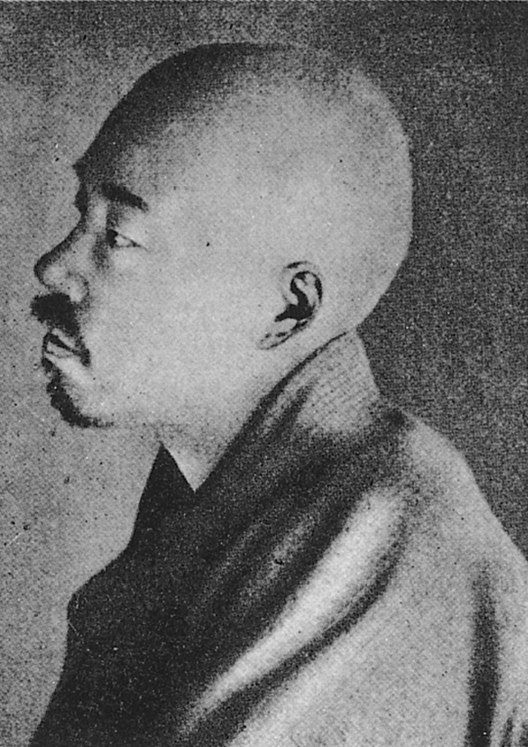
    One of the most poignant books I know, Burton Watson's anthology of poems by Masaoka Shiki begins with haiku written in the summer of 1891 and ends with Shiki's death from tuberculosis at the age of thirty-four, just eleven years later.  He first showed signs of the illness in 1889 and his family and friends were convinced he would die when he suffered a severe hemorrhage on returning from the Sino-Japanese War, where despite his ill health Shiki had volunteered to work as a war correspondent.  From that time he was mainly confined to bed and could only concentrate on writing when the morphine he needed to relieve the pain took effect.  In December 1899 one of his disciples arranged to have glass installed in the sliding doors of Shiki's room, so that he could see out into the garden (glass was still rare in Japan).  His later haiku focus on what he could experience from his bed: apples on a table, sparrows among the pines, a winter moon seen above bare trees, the sound of scissors clipping roses. He writes of reaching the summit of Mount Fuji, but only in a dream. In his youth Shiki enjoyed baseball and took walking trips through different parts of Japan, but confined to the house, landscape is something he could only imagine by fusing memories and sense impressions: 'Summer grass - / in the distance / people playing baseball.'  Here is one of his last haiku:

                                                                      kubi agete
                                                                      ori-ori miru ya
                                                                      niwa no hagi

                                                                      Now and then
                                                                      lifting my head to look -
                                                                      bushclover in the garden

    - 1902
     

    Friday, March 15, 2013

    Wafting winds of dusky night


    “There’s nothing more boring on this earth than to have to read the description of an Italian journey, except maybe to have to write one — and the writer can only make it halfway bearable by speaking as little as possible of Italy itself.” - Heinrich Heine, 'The Baths of Lucca', 1829

    Thus we are warned not to expect 'travel pictures' in Heine's Travel Pictures. When the landscape around Lucca is described, it is by his comic character, the Marquis Gumpelino: "How do you like this natural landscape?  What a marvelous creation!  Just look at the trees, the mountains, the sky, the river down there - doesn't it all look just like a painting?  Have you ever seen the like of it on stage?  The very sight of it makes you a poet, so to speak."  Heine can't disguise his contempt for such contrived sentiments and is accused in return by the Marquis of being "a torn man, a torn soul, a Byron."  Poor Byron, Heine thinks, to be incapable of such transports of emotion before a misty valley.  'Or was Percy Shelley right when he wrote that you'd espied nature in her maidenly nakedness, and so, like Actaeon, were ripped apart by her dogs.  Enough of this: we're getting to a better subject, namely Signora Leticia's and Francesca's apartments...'  And there follows a description of an erotic encounter with the second of these ladies that Byron would certainly have appreciated.

    Heine monument on The Brocken

    Heine's impatience with Romantic cliché is equally evident in the best known of his Travel Pictures, 'The Harz Journey'.  This walking tour, taken in 1824 during his first year of legal studies at Göttingen University, culminates in a night spent at a crowded inn at the summit of the Brocken.  All of the guests seem to be after a glimpse of the Sublime, assembling in a watchtower to witness the sunset.  Afterwards they return for a supper which gets increasingly rowdy as 'bottles emptied themselves out and heads filled up', whilst the wind outside on the mountain seems to be singing along.  Heine watches two young men about to have a quintessential Romantic moment by flinging open a window and gazing out at the night.  But in their tired and emotional state they open the door of a large cupboard instead.  '"Oh ye wafting winds of dusky night!" cried the first, "How refreshing is your breath upon my cheeks!"'  And after some more fine phrases, the second addresses a pair of yellow trousers, mistaking them for the moon: "Lovely art thou, daughter of the heavens..."

    Thursday, February 16, 2012

    A View of the Untersberg

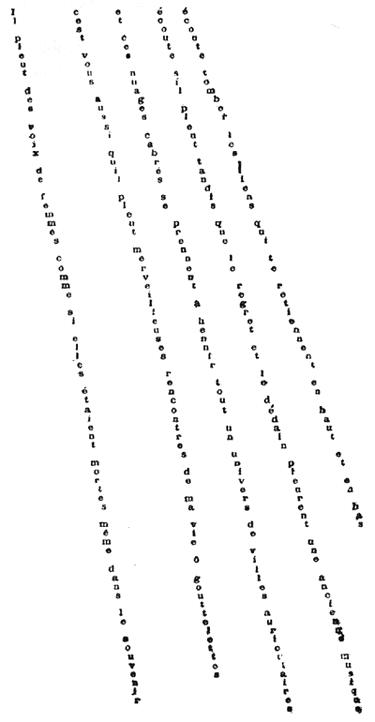
    In an earlier post I considered two examples of visual poetry in which words are placed on the page to convey the impression of a landscape: Guillaume Apollinaire's 'Paysage' (1918) and Guillermo de Torre's 'Paisaje Plastico' (1919).  These Modernist experiments are one source for the many kinds of visual poetry that have emerged since the 1950s, but another much older tradition is the shaped poem, whose most famous English exponent was George Herbert ('Easter Wings').  Montaigne was not a fan of this kind of thing - poems in 'the shapes of eggs, globes, wings, and hatchets' feature in his essay 'On Vain Subtleties'.  But the fact that 'shaped poems have usually been considered clever, fussy tricks at best' did not deter the American poet John Hollander from publishing a whole collection of them, Types of Shape (1969, expanded 1991).  To produce poems that would be more than just momentarily amusing, Hollander aimed to translate his objects into striking typographical silhouettes whilst ensuring that the poem would work as a poem even if the shape were destroyed and the lines printed all flush to the leftThe example below (and I hope my photo is sufficiently grainy to avoid copyright issues) is called 'A view of the Untersberg'. 


    The poem's subtitle provides a more precise location and places it in the sub-genre of window view poems: 'Elev. 6,000 ft., SW of Salzburg, as seen through a window in Schloß Leopoldskron.'  I can't help recalling that the one time I went to Salzburg it rained all week and the view from the window would have been adequately represented by Apollinaire's visual poem 'Il Pleut'.  Hollander was obviously luckier with the weather and he provides an accurate description of the mountain's shape (see for example, the image here).  It is possible to imagine a far larger visual poem that would imitate not just the outline but also the structure of the mountain, with spaces for its patches of snow, or an even more ambitious poem in which every path and tree would be discernible...   'A View of the Untersberg' starts at the summit (with a reference to the etymology of 'Untersberg'): 'I / stand / high on what / was once Odins / mound of power...'  And it ends with the poet back down on the plain 'at the bottom of the day', haunted by mountain ghosts and feeling 'changed by having been on that unreal height'.  

    Next on Some Landscapes: reflections on PLACE: Taking the Waters, a landscape-themed event this weekend which is due to feature Noel Burch, Jay Griffiths, Robert Macfarlane, Olivia Chaney, Jules Pretty, David Rothenberg, Ken Worpole, Jem Finer, Andrew Kötting, Iain Sinclair, Ben Eastop, Rachel Lichtenstein, Manu Luksch and Simon Read.

    Sunday, November 27, 2011

    Impressionism 2.0

    "As my work was often compared to the French Impressionist movement, I decided to follow their traces in Normandy. Filming on the same spots where Monet or Corot used to paint, I will create a kind of Impressionism 2.0" - Jacques Perconte


    Impressions: Voyage en Normandie is the latest in a series of digitally manipulated landscape films made by Jacques Perconte. The 'actual' view (at least as seen through the camera lens) gradually pixelates and transforms into something more strange.  The films enter a kind of 'Impressionist' phase where light patterns and subtle motion in nature are slowed and attended to.  But the moving images soon start to resemble Symbolism, Fauvism and eventually Abstract Expressionism - trees turned into jagged patches of colour like a Clyfford Still painting, the horizon flickering like a Barnett Newman zip line.  'We no longer see the image of the landscape, we see the landscape of the image' Perconte says. Violaine Boutet de Monvel has written of a moment in Après le feu, filmed from the back of a train, where a gap appears to open up under the tracks, transforming the real topography. Perconte is interested in this re-imagining of the familiar - as he followed in the footsteps of the Impressionists, he sensed that their landscape was still present, despite the constant movement of clouds and restless activity of the sea.  This process tends towards the dissolution of familiar landscape elements into a vision of pure colour.  In Perconte's notes on Impressions he quotes Rousseau, losing himself in a reverie and feeling objectes slip away so that he feels nothing but the whole: 'Alors tous les objets particuliers lui échappent; il ne voit et ne sent rien que dans le tout.'

    The artist has posted numerous Vimeo clips, photographs, production notes and comments on his own site and his technart blog. I'll end here with a recent film I'll be thinking of on my next train journey: a view of nondescript fields under a grey sky which briefly disappears as the train enters a cutting, only to re-emerge partially smeared away, as if to reveal the software behind this fake landscape of tree forms and wind farms, then progressively changes until we are left with just a few remnants of distorted colour before the screen goes white. 


    Saturday, July 16, 2011

    Rome must be like the clouds


    A reference to one of Joseph von Eichendorff's poems in that last post reminds me that I've not previously mentioned here one of my favourite Romantic Novellen, his 'Life of a Good-for-Nothing' (1826).  Its guileless hero makes his way to Italy... 'Eventually, when I had covered quite a distance, I gathered that I was only a few miles from Rome. This filled me with joy, for when I was a child at home I had heard many wonderful stories of the splendour of this city. As I lay on the grass outside the mill on Sunday afternoons and everything around was so quiet, I used to think that Rome must be like the clouds moving above me, with wonderful mountains and ravines going down to the blue sea, and golden gates, and tall gleaming towers on which the golden-robed angels were singing. Night had fallen long since, and the moon was shining brightly when I finally came out of the wood onto a hilltop and suddenly saw the city in the distance. The sea was glimmering far off, the immeasurable heavens were twinkling and sparkling with their countless stars, and below them lay the Holy City, of which only a long strip of mist was visible, like a sleeping lion on the quiet earth, while the hills stood round like dark giants watching over it.' (trans. F.G. Nichols)

    He walks on over 'a wide, lonely heath' and on to the city where 'the tall palaces and gates and the golden cupolas gleamed in the bright moonlight.'  We have entered a Rome of the northern imagination here, with the same appeal as that dream image of 'Amerika' in Kafka's novel (which I quoted from here in an earlier post). Eichendorff's hero goes 'past a few small houses and then through a magnificent gate into the renowned city of Rome. The moon shone between the palaces and down into the streets as though it were broad daylight, but the streets were all deserted except for the occasional ragged fellow lying in a marble doorway in the warm night and sleeping like the dead. The fountains were plashing in the silent squares, and the gardens along the street were rustling and filling the air with refreshing scents.'  In Rome he encounters a painter and visits his studio in the attic of an old house, where we are given one of those images of the Romantic artist at the window I described yesterday. 'The painter flung the window open, so that the fresh morning air swirled through the whole room. There was a marvellous outlook over the city and towards the mountains, with the early sun shining on the white villas and vineyards. "Here's to our cool green Germany beyond those mountains!" cried the painter, drinking from the bottle he then passed to me. I responded to him politely and in my heart I thought again and again of my beautiful distant home.'

    Friday, July 15, 2011

    From a Bus Window in Central Ohio, Just Before a Thunder Shower

    One of the James Wright poems in The Branch Will Not Break that I didn't mention in my previous post is 'From a Bus Window in Central Ohio, Just Before a Thunder Shower'.  The view through a window provides a natural frame for a 'landscape poem', although if a fixed point of view is required that  hammock at William Duffy's farm would do just as well.  Looking out of the bus in central Ohio, James Wright saw 'cribs loaded with roughage huddle together / before the north clouds', poplars, silver maples leaves and an old farmer calling 'a hundred black-and-white Holsteins / from the clover field.'  It would be great to compile an anthology of 'window poetry' like this, and from my landscape perspective I would be tempted to group them according to what was being seen: storms, sunsets, industrial landscapes, rural scenes, or just some cropped fragment of a city or the slowly moving branches of a tree. A more interesting arrangement might reflect the nature of the frame itself: windows open and closed, windows in castles and palaces, in suburban houses, office buildings, hospital wards, school rooms, prison cells, or the windows of trains, aeroplanes, buses, still or in motion.  A third version of the anthology would order poems according to the nature of the viewer: their identity, their attitude and their mood, projected onto the landscape beyond the window.

    In his classic 1955 essay, 'The Open Window and the Storm-Tossed Boat: An Essay in the Iconography of Romanticism' Lorenz Eitner describes a favourite theme in Romantic literature: 'the poet at the window surveys a distant landscape and is troubled by a desire to escape from his narrow existence into the world spread out before him'  The example he gives is Eichendorff's poem 'Longing' where the golden stars and sound of a distant post-horn make the poet's heart ache to travel out into the summer night.  'The window is like a threshold and at the same time a barrier.  Through it nature, the world, the active life beckon, but the artist remains imprisoned, not unpleasantly, in domestic snugness ... This juxtaposition of the very close and the far-away adds a peculiar tension to the sense of distance, more poignant than could be achieved in pure landscape.  "Eveything at a distance," wrote Novalis, "turns into poetry: distant mountains, distant people, distant events; all become romantic."'

    Eitner's essay was an inspiration for the Met's recent exhibition Rooms with a View: The Open Window in the 19th Century.  According to the exhibition notes, 'Caspar David Friedrich's two sepia drawings of the river Elbe of 1805–6 (View from the Artist's Studio, Window on the Right and View from the Artist's Studio, Window on the Left) inaugurated the Romantic motif of the open window. Unlike the stark balance between the darkened interior and the pale landscape rendered in these views, the artists who followed Friedrich created gentler versions of the motif. Their windows open onto flat plains in Sweden, parks in German spas, or rooftops in Copenhagen. Artists' studios overlook houses in Dresden or Turin, bucolic Vienna suburbs, or Roman cityscapes saturated with light. In several sitting rooms offering urban views of Berlin, the interiors evoke stage sets to satisfy the artist's delightful mania [sic!] with perspective and reflections. ... Even a barren landscape, when framed in a window, can be transformed into an enthralling scene. Some artists recorded actual sites—Copenhagen's harbor, the river Elbe near Dresden, the Bay of Naples—while others invented, or even largely blocked, the views from their studios or painted them in the chill of moonlight.' 

    Caspar David Friedrich, Woman at a Window, 1822

    One of the paintings referred to by Lorenz Eitner was Friedrich's Woman at a Window, in which the artist's wife looks out at the world beyond the shutters.  This painting was in the first of the Met's the four exhibition rooms, dedicated to interiors with figures; the second room displayed images of artists' studios.  These suggest another category for an imaginary poetry anthology: domestic scenes in which the window view is just one element.  And when you think about it such interior spaces could feature in a whole companion anthology where the position of the observer is reversed, to be on the outside, looking in.  As Charles Baudelaire says in his prose poem 'Les Fenêtres', 'Ce qu'on peut voir au soleil est toujours moins intéressant que ce qui se passe derrière une vitre. Dans ce trou noir ou lumineux vit la vit, rêve la vie, souffre la vie. (What we can see out in the sunlight is always less interesting than what we can perceive taking place behind a pane of windowglass. In that pit, in that blackness or brightness, life is being lived, life is suffering, life is dreaming.... )'

    Sunday, May 15, 2011

    Tortoise above the Venetian lagoon

    A year ago in the LRB Marina Warner wrote a fascinating review of Erik Fischer's monumental four-volume catalogue devoted to the work of Melchior Lorck. Born in Danish-controlled Schleswig-Holstein in 1526 or 1527, he trained as a goldsmith but produced maps, medals, heraldry, portraits and landscape drawings.  Lorck travelled to Italy and then, in 1555, following in the footsteps of Gentile Bellini, to the Turkey of Suleiman the Magnificent in the company of humanist scholar Ogier Ghiselin de Busbecq.  Before leaving he produced the drawing below in which 'a large tortoise is placed on the sheet as if paddling through the air above the Venetian lagoon. Lorck added the sly inscription, ‘Made in Venice from Life’, as if daring the viewer to see the colossal creature flying overhead, a reptilian version of the Rukh, the huge raptor from The Arabian Nights who lifts Sinbad, but is also capable of carrying off an elephant.'

     Melchior Lorck, Tortoise above the Venetian Lagoon, 1555

    Arriving in Constantinople, Lorck sketched the view from his window (rather like the wall in Naples painted by Thomas Jones). Marina Warner quotes Busbecq as saying that the view was blocked by bars and parapets, 'in deference to the complaints of the neighbours, who declared that they had no privacy from the gaze of the Christians. Lorck was probably trying to overcome these constraints when he looked out of the window, or perhaps his curiosity was aroused by them, because, in spite of all the attempts to prevent the gaze of Christians, he captures a tiny vignette of a couple making love on a terrace screened by rushes.'  This drawing wasn't in the LRB article but is readily available on Wikimedia Commons - see below.  Warner says that 'if I hadn’t gone to Copenhagen to look at Lorck’s work, I wouldn’t have noticed these figures, squirming like a sea anemone' (a simile that reminded me of Sebald's couple resembling 'some great mollusc washed ashore' in The Rings of Saturn).  'Lorck,' she says, 'doesn’t draw attention to the lovers’ presence in his roofscape, he doesn’t show or refer to erotic couplings from the Renaissance repertory. He simply sets down what he saw. His sepia ink records one tile as being as interesting as the next, in the manner of a surveyor measuring and recording. This mode was very radical for its time, and it would be hard to date the work accurately without further context. Apart from Rembrandt’s tender intimacies – and occasional frank scatology – I can’t think of another artist who makes so little fuss about looking at sex.' 

    Melchior Lorck, View over the rooftops of Constantinople, 1555
    Source: Wikimedia Commons

    Lorck stayed in Constantinople until 1559 and in that year drew a vast panorama of the city from the heights of the fortifications in Galata, overlooking the Golden Horn. 'In the foreground Lorck shows himself at work; the scroll and a chalice for his ink and paint – there are washes of green and pink on the drawing – are being held for him by a seated Ottoman grandee who is wearing the huge rolled turban that marked a mufti or emir, both important definers and upholders of the law. ... The visiting artist is able to record the city, its layout, its dwellings, its fortifications, its trade and shipping, but only because he has been given permission, and that permission was granted because the Ottoman Empire has nothing to fear from being revealed to foreigners, so confident are its citizens, the official proclaims, in what they have achieved and what they are. So The Prospect is triple-faced: an act of intelligence-gathering by a visitor from a hostile power, a reverent homage to a munificent and enthralling country, and a message to the neighbouring European empire about what it has to reckon with.'  

    Thursday, February 24, 2011

    The bracing glories of our clouds


    I have enjoyed reading Romantic Moderns, which has much to say about the revival of interest in the English landscape before and during the war.  Alexandra Harris acknowledges her debt to Kitty Hauser, whose Shadow Sites: Photography, Archaeology and the British Landscape, 1927-1955 begins with a discussion of the 'topophilia' characteristic of writers and artists in this period.  In 1947 Auden defined this topophilia as having 'little in common with nature love.  Wild or unhumanized nature holds no charms for the average topophil because it is lacking in history' (cf. Sebald vs. Mabey in my recent 'After Nature' post).  What unites 'topophils', Hauser writes, 'is an interest, sometimes amounting to an obsession, with local landscapes marked by time, places where the past is tangible.  For some, such as Betjeman, John Piper and Geoffrey Grigson, this topophilia - as Auden suggests - is eclectic, including medieval churches, Gothic and mock Gothic architecture, Regency terraces and ancient sites.  Some topophils of this generation, such as Paul Nash with his fascination with the genius loci, made atmospheric prehistoric landscapes a particular focus. Others, like painter Graham Sutherland, were attracted to scarred nature and geological vistas.  In the Four Quartets, T. S. Eliot looked for redemption and history in an English village: 'History is now and England'.  And with an eye to continental Surrealism, photographers and film makers including Bill Brandt, Humphrey Jennings, Michael Powell and Emeric Pressburger found in pockets of the British landscape curious and moody survivals from the past.' 

    All of these writers and artists feature in Romantic Moderns, along with others less directly concerned with landscape but whose work looked nostalgically at a fast vanishing world of country houses and village traditions.  The Bright Young Things, for example - Evelyn Waugh, Cecil Beaton, Rex Whistler, the Sitwells -  whose work has never appealed much to me, are discussed alongside Eric Ravilious and Edward Bawden in an interesting chapter on the 1930s Georgian Revival.  Kathryn Hughes in The Guardian, praises the book's 'tactful generosity towards people and places, sights and sounds, that have tended to get written off as embarrassing or just plain wrong. Never has this seemed more important than now, as we work through our own complicated millennial feelings about the romance of the past. Thanks to Harris it no longer seems entirely shaming to admit to a secret Cath Kidston habit. Taking tea in the stable block of a National Trust property becomes a dignified activity, rather than something to pretend to find a chore.'

    I'm no stranger to National Trust tea shops but have always been constrained in where I could go by not owning a car.  Motorists of the 1930s were encouraged to discover the landscape of Britian by the posters for Shell-Mex designed by artists like Vanessa Bell, Graham Sutherland and Frank Dobson (whose depiction of the Cerne Abbas giant is reproduced in Romantic Moderns - the giant's most famous feature is obscured by the shadow of a strategically placed cloud).  In 1934 Cyril Connolly titled his review of an exhibition of Shell-Mex commissioned artwork 'The New Medici'.  He observed that it was 'not the awe-inspiring or exceptional which now seems important, but what is most cheerful and genuine in our countryside - England is merry again - farewell romantic caves and peaks, welcome the bracing glories of our clouds, the cirrus and the cumulus, the cold pastoral of the chalk.'  The Shell County Guides that John Betjamen commissioned also looked beyond the obvious - a fact typified by John Piper's Oxon which deliberately excluded the city of Oxford.  As Alexandra Harris says, 'Piper's Oxfordshire is not a land of touristic sensation.  Old England is allowed to be almost a modern lived-in country.  A photograph of clustered advertisements which would have troubled purist preservationists is captioned 'a tree of knowledge', and an oval photograph with faded edges evokes nostalgia only to affront it with a big sign advertising a 'super cinema.''  It almost sounds like a journey through Oxfordshire's edgelands, prompting the thought that we could have a new series of county guides for the psychogeographically inclined pedestrian, written by Iain Sinclair, Rachel Lichtenstein, Patrick Keiller and so on.

    Romantic Moderns won the Guardian First Book Award and Alexandra Harris can be seen talking about it on the Guardian website.  Thames and Hudson have now signed her up for two more books - a short biography of Virginia Woolf and another one, The Weather Glass, which I am looking forward to as it will apparently 'explore the British preoccupation with the weather, from Beowulf onwards'.  In Romantic Moderns these interests come together in a chapter called 'The Weather Forecast', where there is a discussion of Woolf's unfinished history of literature, 'Reading at Random'.  She makes this sound fascinating: it was to be a book 'shaped by views from windows and stretches of country ... a passionate exercise in literary geography.'  Harris argues that the twentieth century threatened to alienate people from the weather, as Modernist art looked beyond the incidentals of atmosphere to uncover clear cut shapes and colours.  She contrasts this with the rain-filled lithographs of her book's other main protagonist, John Piper (of whose drawings of Windsor George VI said, "You seem to have very bad luck with your weather, Mr. Piper").  Working outside, Piper 'loved the odd splashes that arrived unexpectedly in his paintings.'  These blots have the effect of confirming 'the allegiance between art and the world beyond the painting.  And, like the sand found in a half-read book, they are the souvenirs of a time and place, nature's signature added next to that of the artist.'