Showing posts with label rivers. Show all posts

Monday, June 08, 2026

A yellow roughness in the land


Round Soria the land is dry and cold.
Over the hills, the barren ranges,
through green bits of meadow,
up the cindery peaks
the spring advances, leaving its small white daisies
scattered in the fragrant grasses. 
The earth is not reborn: the country dreams...

- from 'The Soria Country' by Antonio Machado, trans. Alan S. Trueblood

In 1909 the Spanish poet Antonio Machado (1875-1939), a leading figure in the Generation of '98, was offered a job teaching French in the old city of Soria in northeastern Spain. There he fell in love with Leonor, the young daughter of the owner of his boarding house (like the unfortunate Lars Hertervig, who I wrote about here earlier this year). They married and spent some time in Paris but she was suffering from tuberculosis and died in 1912. Machado had just published the collection Campos de Castilla featuring poems inspired by the landscape around Soria. He was so devastated by the loss of Leonor that he left Soria and never returned. 

I first encountered Machado via Charles Tomlinson, with Henry Gifford, made a small selection of translations, Castilian Ilexes, in 1963. Their book was named after a poem which compares ilexes to other kinds of tree and describes the regions of Spain in which they grow. A couple of poems in this book particularly appealed to me – ‘To José Maria Palacio’, with its vivid description of springtime, and ‘Novermber 1913’, with its final image of mountains ‘made of stone / of light.’ Castilian Ilexes also introduced me to Machado’s short, aphoristic, haiku-like poems, the ‘Proverbs and Canticles.’


Leonor and Antonio Machado

Henry Gifford's introduction to Castilian Ilexes explains that Machado carried with him to Soria memories of his childhood in Seville, a very different place with its fountains and lemon trees. But 

Soria replaced that vision by the mountains and stony fields, the ilexes and the silent figures in the Castilian solitude. It was Castile that had formed Spain, and here Machado could find a moral dignity born of endurance among the mountains. ... As Yvor Winters has written: 'in an empty place / I met the unmoved landscape face to face.' ... Machado did not go to the landscape like the townsman Rousseau: he sought there 'the countryman's emotion, essentially Georgic, for land that is worked'. ... There is little joy in this landscape, any more than in the Flintcomb-Ash where Tess grubbed swedes, chilled by the rain and buffeted by the wind. Machado like Hardy sees man as 'slighted and enduring': words that apply to the ilexes of Castile and by analogy to the Castilian peasant. 

In Alan S. Trueblood's Selected Poems there are two poems Machado wrote with the same title, 'Along the Duero', both describing walks beside the river that flows past the city. The first recounts the ascent of a hill and moves from a description of the landscape to a meditation on the river of Spanish history. The second begins by describing the humbleness of the river and 'a yellow roughness in the land / like the raw weave of country clothes', then observes the tiny farming plots with shoots of wheat and barley, above them 'rocks and still more rocks' and finally craggy spurs haunted by eagles. This is Castile: a place of woe, a seat of war. The sky begins to darken and Machado hears running water, the Duoro, 'lifestream of Castile, / cutting its way across cold barren plains'. The poem ends with a vision of permanence which is difficult to read now without thinking about the way global heating is affecting the climate of Spain.

Duero, your flowing waters still shall flow
as long as suns of May
melt winter snows and set them loose
through canyons and ravines,
as long as peaks stay capped
in snows and storms
and the sun's bugle flashes
through ashen cloud...

Sunday, February 08, 2026

Over stones, under alders


At the Small Publishers Fair last year I caught a reading by John Bevis from A Surrey Naturalist, his new collection of eighty found poems derived from an old book by the broadcaster and conservationist Eric Parker. Afterwards I talked to John and his publisher Colin Sackett about the techniques of found poetry and the challenges of writing about the landscape of your childhood. His main method was erasure, where poems emerge from the original work by retaining only a few words, in their original order, arranged into stanzas. I liked his simple idea for 'Swifts innumerable', a poem where everything is erased but the punctuation, which floats freely on the page like swifts glimpsed in a cloudy sky. He also used a Jonathan Williams-style cutout - 'a piece of card, smaller than a postcard, with a central rectangle about the size of a matchbox removed' - and an approach inspired by stargazing where he would visually sweep Parker's pages in order to spot interesting words in his peripheral vision. 


Having grown up in Brighton, I always viewed Surrey as the place you had to pass through on the way to London. John addresses the stereotypical view of Surrey in his introduction and regrets that it is 'pretty much at the bottom of the heap in terms of poetic credibility, authenticity of voice, rootedness.' It has a strong association with stories of childhood - Lewis Carroll, J. M. Barrie, E. H. Shepard. I remember as a teenage Tolkien fan reading Michael Moorcock's description of the Shire (in 'Epic Pooh') as 'a Surrey of the mind', and thinking how unfair it was to compare Middle Earth to a place I associated with retired bankers. However, as John points out, there were always elements of industry here and links to writers like Wells and Huxley who had darker visions of humanity. Eric Parker's book, published in 1952, covers this cultural history but also provided fresh and vivid observations of nature that John felt he could rework into poems evoking the landscape of his childhood whilst bypassing the selectivity of memory.

A Surrey Naturalist (this version but evidently the original too) varies its approach from chapter to chapter, providing different lenses on the county and its topography. I particularly enjoyed a section called 'Country Chances', the first page of which is reproduced on the Uniformbooks website. You can see there the Ian Hamilton Finlayesque 'Visitors from Sea', a brief meditation on travel in 'Thought of a Journey' and the enigmatic 'Riddles of a Lawn'.  Later in the chapter there is a poem called 'Cuttings of Hazel' that turns Parker into a haiku poet: 'Difficult to choose / a carpet of snow // over a carpet / of primroses.' I will end here by quoting a poem on the Surrey landscape (sticking, as ever, to my blog's theme), from the chapter 'Rivers and Streams'. I was briefly tempted to create my own composite found poem from John's, but will spare you this further level of condensation and abstraction. You could also, I suppose, move in the opposite direction and re-imagine Parker's chapter based solely on his found texts, but the resulting descriptions would no doubt let back in that 'Surrey of the mind' we all carry around with us. 

Over stones, under alders. Under oaks, dun water.
Above, the sun. More beyond.
Dried up in summer, the drought of last summer.
Dried up in spring, and dry in summer.
Heard of streams: a bubbling melody in three bars, of moaning, loud cries, whoop and whirr.
To find the source, to trace the river to a pond, to some fish, to swimming.
This photograph was taken in August last year, when I was walking with my sons by Tillingbourne in the Surrey Hills.  Sunlight on dun water...  

Sunday, January 18, 2026

Deposition

 
Lucy Raven, Deposition, Dam Breach, 16, 2024

This picture, which I saw yesterday at the Lisson Gallery in London, appears to show a mountain landscape. However, it is actually a byproduct of a more ambitious work of landscape art that I saw last November at the Barbican: Lucy Raven's film Murderers Bar (2025). I have written here before about art addressing the environmental impacts of dams; this film does the opposite - celebrating the undamming of the Klamath River in Northern California. At the Barbican I arrived at just the right time to watch drone footage of the wider landscape and workers laying dynamite. Then, the loud detonation arrives making you jump (I stayed to watch it again and managed to film it on my phone - see below). The beauty of the film really becomes apparent as her camera follows the wave of water flooding through miles of the old river valley, all the way to the Pacific Ocean. 'The film then follows the river back upstream through the drained reservoir, a stark terrain of sediment cut by the new path of the river that will be transformed by life in years to come. The original drowned landscape is now revealed as potential'.    


At the Lisson Gallery (until the end of this month) there are three Deposition panels and a video piece showing the water and mud from which gave rise to them. What they are is prints that reveal part of the working process behind the film. 'By constructing a large steel and wooden channel lined with expanses of silk, Raven staged smaller-scale floods and dam breaches in a studio environment, before revealing the aftermath, traced as sedimentary imprints or chance echoes on fabric sidewalls.' The resulting images are made of the same raw materials - sand, mud, cement, salt water - that she filmed at the Klamath River, but they bear no visual link to the landscape. The way they relate to the main film reminded me of the sketches artists used to make in preparing for major landscape paintings, or the documentary material assembled and exhibited by land artists. Murderers Bar itself is also only a part of a whole, as it represents the final installment of Raven's series The Drumfire. As an ArtReview article explains, this this focuses 'on how the landscape’s natural materials are placed under pressure, broken apart, reconstituted.' Earlier videos feature mining in Idaho and military detonations in New Mexico. You can see her talk about all this in a short film, Pressure & Release, at Art 21.

Tuesday, May 27, 2025

Der Rhein

Some landscapes in the Ashmolean's exhibition Anselm Kiefer: Early Works, with quotes from the accompanying wall texts. 

Der Rhein (The Rhine), 1982 

'The Rhine has been a German national symbol while also providing a border to France. During the Romantic era of the early 19th century, countless travelogues by writers such as Friedrich Hölderlin and paintings by J.M.W. Turner helped develop a fascination with the beauty of Rhine landscapes. The river also played a major role in Wagner's opera cycle, The Ring. Kiefer's woodcut collage, however, is equally concerned with the political connotations of the Rhine, merging its landscape with National Socialist architecture.'

The building in Der Rhein relates to a series paintings showing Nazi architecture Kiefer made in the early eighties - the exhibition included a watercolour, Innenraum (1982) of Albert Speer's New Reich Chancellery, destroyed in 1945. Christie's sold a similar woodcut to Der Rhein for £313K in 2012 and their description includes this quote from Kiefer: ''I grew up on the banks of the Rhine. France was on the other side. As a child, I saw the river as an insuperable obstacle, something you couldn't swim across. It thus acquired a mythical status for me. When you came to this barrier you could turn left or right but not go straight ahead, except in your imagination." The Rhine (Melancholia) is the name of an Anselm Kiefer installation I wrote about in 2014, 'a collage of black-and-white woodcuts on canvas with acrylic and shellac compiled over more than two decades, between 1982 and 2013.' 


Unternehmen 'Trappenfang' (Operation Bustard Hunt), 1976 

'The title of this painting references a WWII military codename, 'Unternehmen Trappenjagd' ('Operation Bustard Hunt'). The words summon the aftermath of an attack, a landscape scarred by the treads of troop movements and tanks. In May 1942, Germany bombed the easternmost tip of Crimea, the Kerch Peninsula, amplifying the destruction by artillery and tank divisions. Looming above Kiefer's scene is not a bustard but a large painter's palette, linking war memory with an emblem of artistic identity.'

Kiefer often uses high horizons with paths heading towards them, invoking ideas of motion through time. This horizon has a snow covered village, a dark church spire and a bleak grey sky. Looking here at how he was painting fifty years ago, I thought how similar it is in many ways to Kiefer's most recent work, which we have seen in shows at the White Cube gallery. His Superstrings for example, which I discussed here in 2019, are 'desolate landscapes of earth, snow, muddy water, stubble, straw and leafless trees.' I said then that I could see a connection between such paintings and Van Gogh's ploughed fields, something that may well be apparent in the forthcoming Royal Academy exhibition that will pair the two artists. 


Ausbrennen des Landkreises Buchen (Burning of the Rural District of Buchen), 1974 

'This book features photographs of Buchen, where the artist's studio was located, and carbonized sections of former paintings. The photos initially focus on farmland and streets, before showing staged explosions. The final pages present charcoal-encrusted paper. Devoid of people, the photographs allude to the economic decline of Buchen. The explosions also reference the presence of the German armed forces.'
Matthew Biro's Phaidon monograph on Kiefer has a section on this work. 'Leafing through the book engenders a sense of moving through Kiefer's rural environment', but what starts as apparently simple representations of specific geographic regions end up with images overpainted in black wash, singular 'originals' rather than repeatable photographic reproductions. At this time Kiefer was interested in ideas of destruction: 'in addition to burning a town, as it were, Kiefer also flooded Heidelberg in two volumes from 1969 and covered the Brandenburg Heath with sand in four tomes from 1976'. The Ashmolean exhibition had the original 1974 Buchen book, but Kiefer made seven more on the same theme the following year. I referred to one of these in a previous post and quoted Martin Gayford: 'this is how the traditions of Friedrich and Schinkel looked and felt to Kiefer in the aftermath of the Third Reich: burnt out, haunted by overpowering, terrible events.'

Stefan I, 1975

Poet and translator Stefan Anton George was embraced by the Nazis as a hero, despite his criticism of National Socialism and self-imposed exile to Switzerland. In Kiefer's surreal paintings he appears to be resting on his death bed. The works allude to the charged complexities of German cultural heritage and present an attempt to redeem George from political exploitation. 
I can never resist a giant figure in a landscape (see various previous posts) and the exhibition had two watercolours of Stefan George as a mountain. In the other one a sun is setting behind slopes that incorporate his head, and there is an inscription 'aller Tage Abend, aller Abende Tag' (the Evening of All Days, the Days of All Evenings). This is a reference to Ernst Bloch's Principle of Hope, which encourages positive social change, a book with a utopian message that was influential when these paintings were made.

Die Kunst geht knapp nicht unter (Art Will Survive its Ruins), 1975 

'Kiefer travelled to Norway's North Cape, where summer sunlight appears never ending. The location was associated with a 1943 battle, when a German battlecruiser was sunk by a British ship. Over 1900 people drowned. Kiefer's title refers to German post-war discourse on art which had been censored, denunciated or misused to propagate Nazi ideologies. As the German title of Kiefer's work suggests, art almost 'drowned'. The North Cape, however, shaped through several ice ages, is representative of survival.'
I have written here before about the North Cape, subject of some eerie nineteenth century landscape paintings by the Peder Balke. Kiefer visited in 1974 and described the experience in an interview with Klaud Dermutz. 'I’d spent some time that summer on North Cape and there you have that phenomenon in which the sun barely sets. It grazes the horizon and then rises again. This made a deep impression on me, the way the sun at first appears to set but then doesn’t. On the watercolour Nordkap [North Cape, 1975], I wrote ‘die Kunst geht knapp nicht unter’ [art just barely avoids going under or just barely survives]. It’s very difficult to define art, impossible, in fact. It can’t really be grasped. Art is like a fish you pull out of the water that then slips away from you. Art is always very endangered, constantly under threat.'

Sunday, May 18, 2025

Forest Green

Giuseppe Penone, Albero Folgorato (Thunderstruck Tree) 

The last Giuseppe Penone exhibition I went to was a joint show with Richard Long back in 2011 - see the blog post I wrote then, 'To Repeat the Forest'. Now Penone is showing work at the Serpentine Gallery, with some large tree sculptures in the park outside. The one in my photograph above is reminiscent of the storm-blasted trees Salvator Rosa painted, its gold paint as bright as lightening in the May sunshine. It reminded me of the gold used to repair broken bowls in Japanese kintsugi - if only we treated trees with the care we treat valuable ceramics. 

In his Guardian review Jonathan Jones enjoys describes another tree sculpture. 'A grove of stones, worn smooth in riverbeds, surround two trees. But boulders also balance in their high branches. The Earth and sky are reversed. Are the boulders as real as they look? Is disaster about to descend?' As I stood under them I thought of that amusing scene in the film Official Competition where a filmmaker played by Penélope Cruz gets her actors stressed out by making them perform underneath a suspended rock. Jones starts his review by saying he was lured inside by the aroma of laurel leaves, and references the story of Daphne and Apollo. This myth also features in the new Ian Hamilton Finlay show at Victoria Miro, although Jones' hatchet job on that exhibition doesn't mention it. 

Giueseppe Penone, Verde del bosco (Forest Green), 2008

In addition to being a sculptor, is Penone ever what might be called a landscape artist? Yes, see above. The trees here are indexical signs bearing the imprint of themselves. The curators note that 'Penone wraps natural cotton fibres around the trunks of living trees and creates frottage rubbings using leaves. The distinctive furrows of the bark are transferred and recorded on the fabric, forming the foundation of the rich vegetation in the drawings.'

Penone's use of vegetable colour here brings to mind another recent Guardian article profiling Su Yu-Xin, 'The landscape artist who makes her paint from pearls, crystals and volcanic dust'. Her art almost sounds like a byproduct of the research that goes into sourcing her pigments. I was also reminded of the special ink Robert Macfarlane has been using to sign limited editions of his new book Is a River Alive? This uses water samples collected by participants on last year's March for Clean Water, mixed with water from the Pools of Dee in Scotland. Since 1981 Penone has done a whole series that I think Rob Macfarlane might like, To Be a River. Here are some quotes from Penone's website:
To know every stone, each ravine, each small bed of sand of a stream, to revisit it each year probing its bed to record the changes produced by rains, by frost.
No element, none of its forms are accidental.
Hands turning white from staying in the water to be, at least once, part of the river.
The bends in rivers are closely related to the fullness of the earth, the bends in the path to the emptiness of the air. 
The breath too, breathing expands following a path, sometimes meandering, other times more taut following the air currents. 
Filling a space with the meanderings of the breath, the volume of the breath produced by the life of a man. 

Friday, February 07, 2025

Maps of Other Possibilities


Yesterday I went to a wonderful event at Tate Britain devoted to the Bow Gamelan Ensemble. There were three short films and then a conversation between Louisa Buck and the two remaining members, Anne Bean and Richard Wilson. It was probably one of the best artist talks I've ever been to - they were so engaging, articulate and inspiring. Paul Burwell died in 2007 but his thoughts were captured in one of the films, framed by retrospective questions from Bean. His Guardian obituary described the time when, 'memorably for those who were there, Burwell engaged the leader of the famous Kodo Drummers in a drum battle that traversed the entire harbour area of Sado Island, Japan.' Bean reminisced about this experience, recalling how it had ended with the Japanese drummer bowing in respect. 

I have mentioned the Bow Gamelan Ensemble before on this blog, as the highlight of a 2013 exhibition about the Thames. 'Most enjoyable of all, there is footage of The Bow Gamelan Ensemble from 1985, performing 51º 29'.9"North - 0º11' East, Rainham Barges, bashing out music from makeshift instruments at the river's edge as the tide rises and night falls.' You can read more about this performance on the Ensemble's website
'they were filmed for over ten hours as the tide ebbed and flowed capturing the massive energy of this amount of incoming water and the ways one could harness this power to shift and shape sound. As the huge resonant chambers of the barges filled up, they deepened the sounds of the metal reinforcing bars sticking out as they were played with sticks and beaters. Passing vessels obliged by blasting their horns, adding to the Bow Gamelan’s own array of foghorns, sirens and hooters.'

Regrettably I never saw them perform and the old footage of them staging events on derelict land by the river is increasingly hard to relate to what you experience in the modern city. They talked about how cheap it was to live in Butler's Wharf when they first met in the seventies. It sounds like a magical time, with Anne Bean's studio the venue for art world parties that included key figures from the punk movement. From the perspective of this blog, I'm interested in the way they worked at scale and transformed whole cityscapes - Simon Reynolds called them 'the missing link between Test Dept’s metal-bashing clangour and the Land Art of figures like Robert Smithson'. One of their most striking ideas was a concert for cranes, making use of the fact that Docklands was a permanent building site, with instruments picked up and moved around in three dimensions. Their use of pyrotechnics would not be possible now, although apparently they did get away with breaking the rules recently. Back in 1993 Burwell and Bean staged a spectacular event at Bankside power station (an image can be seen in my photo above). The woman who organised it was in the audience last night and she said they were only allowed to do it if they insured the building, but nobody knew what it was worth. So she got a quote from a local insurance company and it set them back £375. A few years later Bankside had become Tate Modern. 

Friday, January 31, 2025

An Outcrop in the Campagna


 Frederic Leighton, A Nile View, 1868

'The keynote of this landscape is a soft, variant, fawn-coloured brown, than which nothing could take more gratefully the warm glow of sunlight or the cool purple mystery of shadow; the latter perhaps especially, deep and powerful near the eye (the local brown slightly overruling the violet), but fading as it receded into tints exquisitely vague, and so faint that they seem rather to belong to the sky than to the earth. At this time of year the broad coffee-coloured sweep of the river is bordered on either side by a fillet of green of the most extraordinary vivacity, but redeemed from any hint of crudity by the golden light which inundates it.' - Leighton's travel journal, October 1868

This panorama is one of the highlights of Leighton and Landscape: Impressions from Nature, an exhibition of oil sketches which we saw at Leighton House last month. It was painted on the first of three trips he made to Egypt - Leighton was a lifelong traveller and, having grown up on the continent, was fluent in several languages. A wealthy bachelor, he was also extremely well connected and for this trip was provided with a steamer to take him up the Nile. He evidently took pleasure in making oil sketches but didn't do them on every trip, or at least so it appears - we don't have a record of them all and he mainly kept them private, only showing some of them late in his career. His modesty about them can be explained in terms of his self-image as President of the Royal Academy, engaged in the highest-regarded genre of history painting, but it still seems extraordinary.

There is an excellent catalogue which apart from anything else smells delightful (mine still has that fresh paper new book aroma!) The main author is Pola Durajska who did a PhD at York on Leighton's landscapes. She and the other authors point out some interesting features of his sketches:

  • He experimented with different shapes of canvas (cutting them to size himself) and varied his technique from impasto to thin wash-like effects. 
  • He looked for interesting light effects at different times of day and studied the intense shadows and bright white buildings of north Africa.   
  • His interest in architecture influenced his choice of landscapes, with castles and towns blending into their surroundings and rock formations shaped like ruins.
  • He rarely included figures or local colour and did not record where the sketches were done, making the locations of some of them hard to pin down.
  • He also avoided the obvious, painting unregarded corners of cities like Venice and Jerusalem, or framing famous vistas differently to earlier artists.   
I'll end here with one of the Gere Collection paintings normally on display at the National Gallery. The wall text at Leighton House says that 'it is not easy to understand exactly what attracted Leighton to paint this particular grassy, hillside slope in Italy. Without any discernible focal point or distinctive feature, other than a flash of yellow sandy soil in the foreground, perhaps its appeal was in the simple combination of the green mass of the landforms against the deep blue of the sky. This apparently unpromising combination of elements typifies Leighton's approach to finding a subject.' 


Frederic Leighton, An Outcrop in the Campagna, probably 1866

Sunday, September 29, 2024

Streams had burst their banks and sallied out

In 1809 Ivan Krylov (1769-1844) published his first collection of twenty-three verse fables - over time the book grew to include 197. Gordon Pirie’s translations of a few of these were praised in reviews of The Penguin Book of Russian Poetry. Ever since Aesop, fables have mainly featured animals - wolves, lions, foxes, tortoises, hares etc. - but Krylov's ‘The Peasants and the River’ concerns landscape features. Local streams are in spate and inundate the peasants’ land (I can picture this now from all the flooded fields I saw on a train to Cambridgeshire yesterday). The peasants believe that the main river, bordered by country estates and flowing through towns to the sea has 'never been guilty of such misdemeanours.' So they go to this river to ask her to bring her tributaries into order, only to see their own possessions, 'precious things they'd lost', carried along in the river like 'discarded lumber'. The moral of the story is this: ‘great men profit from the small man’s crime, / to seek redress is just a waste of time.’ 

Has landscape been used in other fables? Trees and plants occasionally feature, sometimes debating which is the most beautiful, or providing comparisons like the unbending oak and pliant reed, an idea referred to in Troilus and Criseyde but found much earlier in the Tao Te Ching. There is also the plane tree that assures travellers it is not 'useless' because it is providing them with shade, and the trees that object to being cut down by axes made from their own wood. A river is the setting for fables that illustrate the proverb 'still waters run deep' - in La Fontaine a peasant drowns in a smooth flowing river. Elsewhere, a farmer blames the sea for a shipwreck only to be told by the sea that it was the wind who was to blame, not her. In The Seven Wise Masters, a medieval collection, rivers complain to the sea that she spoils their sweet water, only to be told if that's how they feel they should avoid contact with her. Despite these odd examples, I have to acknowledge that in comparison with animals, it is hard to personify human behaviours in whole landscapes. Nevertheless, a mountain is the protagonist in one of Aesop's fables, illustrated below, 'The Mountain and the Mouse'. 


Auguste Delierre's 1883 etching of 'The Mountain in Labour' (Wikimedia)

Saturday, March 23, 2024

Mirror of Holland

This morning I walked along our local canal, with bright sunny weather creating reflections of the barges and bridges, the buildings of Hoxton and Haggerston, a few trees and many joggers pounding down the path. This evening I watched Mirror of Holland, made up entirely of shots of canal reflections, which won the short film Palme d'Or in 1951. It begins with the windmill below and a young lad who bends down to see the image the 'right way round' - the rest of the film continues in this way, with the reflections turned into water-blurred moving images of farms, gabled houses, a church tower, locks and canal boats. The director Bert Haanstra went on to make many other documentary films - his other big success was based on another reflective medium, Glass (1958).

Mirror of Holland put me in mind of Haanstra's Dutch contemporary M.C. Escher, whose compositions like Puddle and Three Worlds are interested in how water can contain a landscape. There are some abstract moments in the film that look like Escher's Rippled Surface which also dates from 1950. Of course there are reflections in Dutch Golden Age paintings too and you could probably make a version of Haanstra's film by montaging these together - the example below is in Jan Van de Heyden's Country House on the Vliet near Delft (1665). 

Saturday, December 16, 2023

Branches Waving in the Current

Back in October I was fortunate to be able to attend a book launch for Michael Wood's new book In the Footsteps of Du Fu. He gave an excellent speech on Du Fu's life and importance (not everyone present had read the poetry) and was clearly moved when he quoted '500 Words on the Road to Fengxian'. He said his interest in Chinese poetry was sparked by A. C. Graham's Poems of the Late T’ang, published in 1965 (this was the book that inspired Roger Waters' lyrics for 'Set the Controls for the Heart of the Sun'). When I first read this book in the mid eighties there were still hardly any translations of Chinese poetry available, although Arthur Cooper's Li Po and Tu Fu had appeared as a Penguin Classic in 1973. I've never understood why more haven't appeared over the years, although readers of this blog will have encountered quotes from the trickle of books published by American publishers. I doubt Michael Wood's book will provoke a new wave of enthusiasm here for Du Fu, but you never know.

 
Michael Wood on the Yangtze
(from the one hour BBC documentary Du Fu: China's Greatest Poet, 2020)

Rather than discuss the whole book, I thought I'd use the opportunity to talk here about a specific landscape which Du Fu wrote about. White Emperor City (Baidicheng or Baidi Fortress) is on the northern shore of the Yangtze, near Fengjie. Sadly, construction of the Three Gorges Dam submerged many buildings although tourists can still visit what remains on an island. Du Fu was one of many poets who came here over the years - ‘Early Departure from White King City’ by his friend Li Bai (701-62) is in the Arthur Cooper book. On the 15th of November 767 Du Fu saw here ‘a pupil of the Lady Kung-Sun dance the sword mime.’ In response he wrote a beautiful, moving meditation on aging, at about the age I am now. He had seen Lady Kung-Sun when he was a child in 717, but now even her pupil was past her prime. Arthur Cooper says in his notes for the poem that the dance, in the style of ‘West of the Yangtse’, was ‘probably at its climax very fast and vigorous, much like Tartar or so-called Polovtian dances known today through Russian ballet.’

A. C. Graham, in Poems of the Late T'ang, explains that Kuizhou (K’uei-chou), was ‘a town adjoining and apparently no longer distinguished from Pai Ti (White Emperor City)’. These places can be seen in the helpful map above, which I hope it's OK to reproduce from Michael Wood's book. ‘K’uei-chou had been part of the old kingdom of Shu and contained a temple to the great Shu statesman Chu-ko Liang, who was one of Tu Fu’s heroes’ (David Hawkes). ‘Ballad of the Old Cypress’ concerns a tree that Chu-ko Liang (Zhuge Liang) was supposed to have planted. Also near the city ‘there was a formation of dolmens which appeared as the Yangzi river sank. This was supposed to have been Zhuge Liang’s symbolic representation of the military formations his army should assume in the conquest of Wu’ (Stephen Owen). Du Fu wrote a famous poem about these too, ‘The Diagram of Eight Formations’. This was the setting for Brian W. Aldiss's 1978 short story 'The Small Stones of Tu Fu' in which a time traveller meets the aging poet. 

Zhuge Liang's Diagram of Eight Formations, or Stone Sentinel Maze, features in The Romance of the Three Kingdoms, written in the 14th century about events at the end of the Han Dynasty. Lu Xun is leading his troops towards Kui Pass when he begins to sense danger, but no sign of enemy soldiers. One of his followers inspects the area but finds only 'eighty or ninety chaotic rock piles alongside the river.' Some locals tell Lu Xun that when his enemy Zhuge Liang had been here, he had sent troops to arrange these rock formations and 'since then, a kind of cloudlike effluvium seems to emanate from their interiors'. As the sun goes down Lu Xun goes to investigate the rocks himself. Suddenly violent winds appear, the river rumbles and the sky is covered with streams of sand and stone. An old man appears and tells him this is the Eightfold Maze, whose openings appear unpredictably. They each have a name and Lu Xun had entered by the one called 'Perish'. But the man, who identifies himself as Zhuge Liang's father-in-law, leads him to safety. The novel then quotes Du Fu's poem.   

Du Fu had arrived in the Kuizhou-Baidicheng area in the spring of 766 and found two farmsteads to live in, the main house an hour’s walk uphill. Michael Wood, in the footsteps of Du Fu, noted that the poet's ‘vegetable garden with an orchard and orange grove of almost six acres commanded wonderful views which with a little imagination we can still see in the mind’s eye. Sometimes he walked higher up above the Gorges to see the whole vista unfold with distant mountain ranges beyond. So although the river has covered the site of Du Fu’s houses, if we look up, something of the ‘landscape remains’, as we would say’. It was here that the poet wrote his two great 'Autumn' sequences, which many consider the greatest of all Chinese poems. 


Bill Porter (Red Pine) visited this location a few years before Michael Wood for his odyssey round the poetic sites of China, Finding Them Gone (2016). The island of Baidicheng (Paiticheng) was surprisingly quiet - 'the only sounds I heard above the wind were those of crickets and doves. I was also joined by a passel of sparrows and what must have been the last butterflies of the year.' The famous view down the gorge (which can be found on a 10 Yuan note) still looked beautiful. As the site of Du Fu's Western Study has been drowned, a replacement version has been carved from rocks higher up. Red Pine ignored this and headed instead for Huanhua Village, named after the stream Du Fu lived by in Chengdu where he could look down over a slope of farm plots to the water, beneath which the poet's hut and orange grove now lie. He then made for the site of Du Fu's second submerged home, at a place called Huangchuehshu. A local explained that it is named for the ancient trees (Ficus virens) planted there.

'The trees were so big, he said, it took the outstretched arms of several people to encircle one of them. The huang-chueh was a relative of the banyan and was often used in that part of China to honour sites of historical or communal importance, and the site of Tu Fu's former house would have qualified. I thought about all those branches waving in the current where so many poems were written. It wasn't simply the landscape that inspired Tu Fu's poems. It was also his life coming to an end and he felt it.'

Friday, June 02, 2023

Drinking the Rivers of Dartmoor


A few weeks ago I saw this at the National Gallery's excellent exhibition themed around Saint Francis of Assisi. It reminded me that I hadn't had a chance to note here anything about the recent Richard Long show at the Lisson Gallery, Drinking the rivers of Dartmoor (in the website's video clip interview he says he has used Dartmoor as his studio all his life). I found looking at these works rather moving because some of them clearly looking back over his long career and revisit ideas that shaped his walks. 'A Path of Innocence' (2022), for example, relates only tangentially to the landscape of Wales and uses phrases that relate to different phases of his life. He says the title was inspired by something he heard Wisława Szymborska say in her Nobel acceptance speech (although I can't see a source for it).


Another text work I particularly liked was 'Walking at the Speed of Spring' - a lovely concept, although one that only emerged retrospectively.

"I had the idea to walk from the southern tip to the northern tip of Great Britain, and the idea was to make a walking sculpture, so I put a stone on the road every day. The text work that came out of that was 'A Line of 33 Stones, A Walk of 33 days'. I thought that was it, and then I happened to be looking at some of the photographs I took on that walk and I noticed the beautiful yellow of the gorse. And then I realised that that gorse was also in Cornwall when I started the walk. So I realised that I actually had been walking at the speed of spring. And that was on the cusp of winter turning into spring, that walk, because in Lincolnshire I remember some snow showers and hail storms. So I had some bad weather, but it started in the spring and it ended in the spring."


Friday, April 28, 2023

Sussex Waters


I had been looking forward to 'Sussex Landscape: Chalk, Wood and Water' at Pallant House but was sadly too ill to go down and see it. The catalogue is interesting though, with an overview of the exhibition and essays on photography, engraving, chalk and flint. Some of the artists I discuss in Frozen Air were included - Frank Newbould, Eric Ravilious, John Piper, Bill Brandt and Jem Southem. Other famous artists associated with places in Sussex featured - William Blake (Felpham), John Constable (Brighton), Vanessa Bell (Charleston), Lee Miller (Farleys) - along with art by people I have discussed on this blog before - Roger Fenton, Paul Nash, Graham Sutherland, Andy Goldsworthy. I imagine the exhibition's centrepiece would have been Turner's stunning Chichester Canal (c. 1828) which includes the hazy silhouette of the cathedral, located just a street away from Pallant House.  

I'll mention here a few less well known works from the catalogue:    

  1. A View of East Dean and Mr. Dipperay's House from the Hills on the East Side of the Village, 1785 by Samuel Hieronymous Grimm. One of the views commissioned for a planned history of Sussex, this is closer to documentation than art but is fascinating now as a record of what could be seen from a specific spot at the end of the eighteenth century. The British Library has 866 of these topographical watercolours.
  2. View of the Sussex Weald. c. 1927 by C.R.W. Nevinson. If I'm ever in Reading I'll have to visit their museum to see this delightful view through a window, strikingly different to the 'angular views of the war-scarred Western Front' we associate with Nevinson. 'A flourishing genre of images of the Sussex landscape framed by the domestic window is testament to the many artists who made the area their home for short or long periods during the inter-war years.'
  3. The Wave, 1966 by Gluck. This one is in a private collection and the catalogue's reproduction is a bit small and dark so it's hard to tell what it is really like. A small cropped view in an unusual frame: the whitewater and face of a breaker emerging from a turquoise-grey sea. It was painted when Gluck was living at Chantry House in Steyning with Edith Shackleton Heald.   
  4. Track with Sheep (Near Lewes) c. 1983-87 by John Holloway. 'Holloway began photographing the landscape in 1978, and over the next twenty-five years would provide a unique view of the land by taking photographs at a height of 1,500 feet from a small aeroplane. He would work at two specific times of the year - either side of the spring and autumn equinox - when the angle of the sun reveals the textures of the Downs.' You can see examples of his work in The Guardian's obituary.
  5. Solar, Seven Sisters, 2019 by Jeremy Gardiner. This combines a familiar (to me) view of the cliffs and buildings at Cuckmere Haven with abstract planes reminiscent of St Ives painters or Richard Diebenkorn. The relief surfaces 'represent both pictorially and conceptually the geological strata of the coastline.'

Before concluding I will just mention one of the book's essays as it's by an artist I'm surprised I haven't mentioned here before, Tania Kovats. I remember going to see her Darwin-inspired artwork TREE at the Natural History Museum back in 2011 (see photo below!) For Sussex Waters in this exhibition she installed bottles of water taken from the county's rivers. The idea of collecting and exhibiting water samples isn't new - Roni Horn's Library of Water in Iceland is more dramatic and directly addresses climate change in preserving glacial meltwater. But if you come from Sussex, the list of rivers Kovats visited is evocative in itself. They have some beautiful, resonant names - Cuckmere of course, and Cowfold, Woodsmill, Adur, Arun, Rother, Uck, Ouse. Glynde evokes an image of well-healed highbrow culture, Gatwick Stream a remnant of a landscape built over for a 'London' airport. There are quite a few I've never heard of but would like to visit. As she says, 'even naming rivers opens us up to connection.'

Thursday, December 31, 2020

Rock and Brook


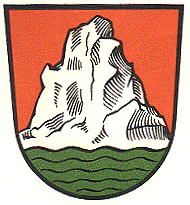
The Coat of Arms of Alland, Lower Austria

I like the way that when you look somewhere up on Wikipedia you tend to get given its coat of arms and I've noticed over time that the heraldry for particular places and regions occasionally includes landscape features. Rivers are an obvious example. Wikimedia includes a whole category 'rivers in heraldry' which range from the subtle - just wavy lines or patches of blue - to complete symbolic landscapes like the one above, for the market town of Alland in Austria. 

Although my father is a heraldry buff, I know little about it and so I will have to quote here from the International Heraldry site. They explain how landscape symbols ('charges') have been used over the years:

The oldest geological charge is the mount, typically a green hilltop rising from the lower edge of the field, providing a place for a beast, building or tree to stand. Natural mountains and boulders are not unknown, though ranges of mountains are differently shown. An example is the arms of Edinburgh, portraying Edinburgh Castle atop Castle Rock. Volcanos are shown, almost without exception, as erupting, and the eruption is generally stylised. In the 18th century, landscapes began to appear in armoury, often depicting the sites of battles. For example, Admiral Lord Nelson received a chief of augmentation containing a landscape alluding to the Battle of the Nile. 

Lord Nelson's coat of arms - note the landscape above the shield.

If you take a particular European region and look at its heraldry you will mostly see lots of lions and eagles and crosses, but there will also be a few clues to the local topography. Taking a pretty much random example, consider the state of Rhineland-Palatinate in Germany, which has twenty-four districts. River symbols representing the Rhine appear on the arms of the districts of Ahrweiler, Germersheim and Rhein-Pfalz-Kreis. A wavy white line in the arms of Mayen-Koblenz represents both the Rhine and the Moselle. The district of Südliche Weinstraße is named after the tourist wine route and has a white bar representing the route and grapes representing the wine. As this shows, such designs are not ancient, although they can incorporate older motifs - the Rhein-Pfalz-Kreis shield includes water lilies which were used in earlier Rhineland heraldry. The best one from a landscape point of view is shown below. The jug represent the ceramic industry, the green band refers to forests and the basalt columns symbolise the Westerwald's volcanic rock.    

The Coat of Arms of Westerwald District, Rhineland-Palatinate
 
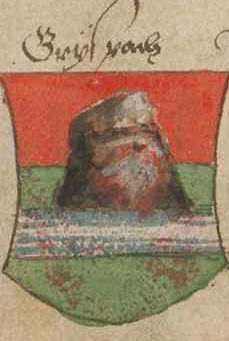
If it seems reductive to think of place as mere landscape, for example by representing a complex four dimensional environment within a two-dimensional painting, then an image like this goes a stage further. Here we have an icon signifying a whole district of Germany made of just three colours and three shapes. It has to be said that modern heraldry like this can seem no more interesting than corporate branding. I am sure though that there are fascinating examples of landscape in the history of heraldry if you dig into the subject (which I've not done). I did a quick search and came up with one: Bad Griesbach in Bavaria, which has a design canting on the name of the town (Gries = rock, Bach = brook). The Heraldry Wiki includes the modern arms but also an image from a manuscript of 1599. This is rather lovely and could almost be a fragment of an early landscape painting. 
 
The Coat of Arms of Bad Griesbach im Rottal, Bavaria

Sunday, November 08, 2020

There I sat viewing the silver streams


I should have more time for the blog soon, but for now I will make do with posting a long quotation from The Compleat Angler, first published in 1653. As Marjorie Swann's introduction to the Oxford World's Classics edition explains, Izaak Walton's story of vacationing fishermen 'embodies his artistic response to trauma' - the death of his son and the national tragedy of the Civil War. The book asks how we should live and turns to the natural world for an answer. As such it reminds me of the way people have been finding solace in nature and landscape during the pandemic. In my extract below, Walton's alter ego, Piscator, has just been demonstrating chub fishing to his companion Venator, and they are about to head to an inn for supper. "Let's be going, good master," Venator says, "for I am hungry again with fishing." But Piscator isn't quite ready:  

"Nay, stay a little, good scholar. I caught my last Trout with a worm; now I will put on a minnow, and try a quarter of an hour about yonder trees for another; and, so, walk towards our lodging. Look you, scholar, thereabout we shall have a bite presently, or not at all. Have with you, Sir: o' my word I have hold of him. Oh! it is a great logger-headed Chub; come, hang him upon that willow twig, and let's be going. But turn out of the way a little, good scholar! toward yonder high honeysuckle hedge; there we'll sit and sing whilst this shower falls so gently upon the teeming earth, and gives yet a sweeter smell to the lovely flowers that adorn these verdant meadows.

"Look! under that broad beech-tree I sat down, when I was last this way a-fishing; and the birds in the adjoining grove seemed to have a friendly contention with an echo, whose dead voice seemed to live in a hollow tree near to the brow of that primrose-hill. There I sat viewing the silver streams glide silently towards their centre, the tempestuous sea; yet sometimes opposed by rugged roots and pebble-stones, which broke their waves, and turned them into foam; and sometimes I beguiled time by viewing the harmless lambs; some leaping securely in the cool shade, whilst others sported themselves in the cheerful sun; and saw others craving comfort from the swollen udders of their bleating dams. As I thus sat, these and other sights had so fully possess my soul with content, that I thought, as the poet has happily express it,

    I was for that time lifted above earth,
    And possest joys not promis'd in my birth.

"As I left this place, and entered into the next field, a second pleasure entertained me; 'twas a handsome milk-maid, that had not yet attained so much age and wisdom as to load her mind with any fears of many things that will never be, as too many men too often do; but she cast away all care, and sung like a nightingale. Her voice was good, and the ditty fitted for it; it was that smooth song which was made by Kit Marlow, now at least fifty years ago; and the milk-maid's mother sung an answer to it, which was made by Sir Walter Raleigh, in his younger days. They were old-fashioned poetry, but choicely good; I think much better than the strong lines that are now in fashion in this critical age. Look yonder! on my word, yonder, they both be a-milking again. I will give her the Chub, and persuade them to sing those two songs to us.

These songs, reproduced in Walton's text, are of course the famous pastoral poems 'The Passionate Shepherd to His Love' and 'The Nymph's Reply to the Shepherd'.

Friday, September 18, 2020

A river made of crystal water-drops

Gaṅgā, the personification of the sacred river Ganges,
early 19th century watercolour in The British Museum

Eric Newby's Slowly Down the Ganges introduced me to the fact that the river has 108 names, all of which he lists so that they form a kind of poem at the beginning of the book.  The river is also a goddess, Ganga, and these names are thus part of Hindu faith, but as I have often talked here about aspects of landscape in European religious art, it does not seem inappropriate to take them out of context here. You can find the full list in English translation online. Here are the first ten, which show the way they mix very short geographical description with snatches of mythology and descriptions of the goddess herself.

  1. One who flows
  2. One who is born from the lotus feet of Lord Vishnu
  3. Dearest to Shiva
  4. Daughter of Lord of Himalaya
  5. One who flows through the mountains
  6. Mother of Kartikeya
  7. One who liberated 60,000 cursed sons of King Sagara
  8. Meeting Saraswati at Allahabad
  9. Being sweet and melodious
  10. Flowing and meeting the ocean

And from the remaining 98 names, here are ten more that together form a word picture of the river.

  • One who is imperishable, eternal (24)
  • One who is delightful (33)
  • A river made of crystal water-drops (34)
  • One whose water is as good as nectar (43)
  • As noisy as a conch-shell and drum (49)
  • One who flows with a force (54)
  • Just like the autumn moon (66)
  • One who drives away all sorrows (72)
  • One who is muttering (94)
  • One who is light amid the darkness of ignorance (104)

Saturday, February 29, 2020

White torrents and emerald depths

Because this blog focuses on the arts, I have rarely mentioned books by geographers, although it goes without saying that they often write beautifully about landscape.  In A Commentary on the Book of Rivers, Li Tao-Yuan (Li Daoyuan, d. 527) quoted no less than 437 different sources, but he also drew on his own memories and included the kind of description that would become common in future Chinese travel writing.  His monumental book was an expansion of an earlier author's Guide to Rivers, now lost, and it described 1,389 Chinese rivers (or 1,252 - I've seen both numbers quoted, but either way, that's a lot of water).

Li is regarded as the first writer to describe the famous Three Gorges landscape in detail.  For example:
'When winter turns to spring, there are white torrents and emerald depths; reflections appear upside down in the swirling eddies. Many oddly shaped junipers grow forth from jagged mountain peaks from which waterfalls plummet clamorously. Pure, verdant, lofty, flourishing—such qualities provide innumerable kinds of fascination. After a storm has cleared, or on frosty mornings, among forests chilled and streams desolate, the loud cry of a gibbon is often heard, prolonged and mournful. As it echoes through the empty valleys, its despairing wail lingers before disappearing. So the fishermen sing,
Of the Three Gorges in Eastern Pa
   Shaman Gorge is the longest.
Three cries of the gibbon
   and one's clothes become drenched with tears.'
Xie Shichen, Clouds and Waves at the Wu Gorge, 1368

This translation is from Richard E. Strassberg's Inscribed Landscapes, a wonderful book I have quoted from here before.  Strassberg also includes Li's descriptions of two other landscapes.  Meng's Gate Mountain (Meng-men-shan) straddles the Yellow River and Li describes its slanting cliffs with giant boulders poised to fall, white mist on the water where currents collide and colossal waves that 'multiply and collapse all the way down to the outlet.'  Lotus Mountain (Hua-shan) is one of the Five Sacred Mountains of China and Li describes climbing it: ascending through junipers and past shrines and rock altars until, at the summit, he is able to see two sacred springs, one called Reed Pond that flows westwards, and the other, Supremely Exalted Spring, flowing east.

Friday, February 14, 2020

A bend in the river


This is a detail from one of the colour Polaroid photographs taken by Wim Wenders in 1974, when he was working on The Wrong Move.  These Polaroids were on show in London a couple of years ago and I recently treated myself to the accompanying book, Instant Stories, where they are mostly reproduced in their original 7 x 9cm dimensions, re-photographed with all the dust and markings of age.  This particular image, along with a few others, is blown up to five times its original size, as if to see how it works as a photographic art, rather than a small physical artefact of the film making process.  When I saw this Polaroid in the exhibition, I thought it was the river bend the characters in The Wrong Move have behind them on their walk up the hill.  But memory mists over details and, as you can see from the embedded clip below, it is not the same place.


For this post I will just note three other highlights of the book (focusing on landscape subjects):
  • There are a small group of location scouting Polaroids from his unsuccessful adaptation of The Scarlet Letter (1973), eventually filmed in Spain.  New England hadn't looked right (I have written before here about the gap between the real American landscape and the way Europeans imagine it).  At first, when the archivist unearthed these Polaroids, Wenders thought they must be views of the Baltic. 'Those Polaroids had aged, but the amazing effect was: they had become more beautiful in the process.  They now showed the place that I had been looking for in vain. A lost America.' 
  • For the third of his road movies, Kings of the Road, Wenders says 'I traveled all along the German/German border and visited each and every movie theater that was left in that stretch of land from the Elbe river in the North down to the German/Czech border in the South.  the entire border covered some 1400 kilometres. A deep depression had befallen these lost little towns and villages that were cut off from their hinterland.'  In these places he took a poignant sequence of black and white Polaroids showing these small, drab cinemas with their grandiose names, Capital, RIO, LUX...
  • On this page you can see Wenders' shots of the Elbe where he filmed the memorable opening sequence of Kings of the Road. The location was near the old Dömitz fortress. 'There, across the stream, stood the watchtowers of the East German border patrol.  Wherever we shot, we saw their binoculars blinking.  I always wondered what they were thinking of us.'
Finally, I am embedding below a video of Wim Wenders in which he describes his use of the Polaroid camera.

Tuesday, January 07, 2020

A terrace of incense lit by the dawn


I have been reading the Tang Dynasty poet Wei Yingwu (737-92) in Red Pine's award-winning translation, In Such Hard Times (2009).  Anyone who has read Chinese poetry will know of the An Lushan rebellion and its impact on the lives of China's greatest writers.  Wei himself had been a young palace guard when the insurrection took place and his life as an official played out in the 'hard times' that followed. He was born "within a horseback commute of Ch'ang an", the biggest city in the world, but the first poems in the book were written in 763 in Loyang, the eastern capital that had just been recaptured from the rebels. Like other Chinese poets, he was torn between official duty and the desire for scholarly retreat, with the example of  Tao Yuanming constantly in his mind.  There's a lovely poem called 'East of Town' that concludes with Wei wishing he could retire and build a hut like Old Tao. It begins: 'Stuck in an office all year / I left the city for the wide-open dawn / where willow catkins soothed the wind / and blue mountains stilled my cares...'

A few years ago I mentioned Red Pine's Han Shan book in which the translator talks about the mountains that inspired the poems.  In this book, his footnotes explain exactly where each was written, so I thought here I would give a sense of Chinese landscape through Wei's eyes by quoting lines he wrote at different locations over the course of two decades.  Of course these brief images are not unique to these places - similar scenes could have been experienced all over the country, or even further afield: the same moonlight admired by Wei and his friends also fell on Charlemagne's Europe...  Perhaps because I have never been to China, or been taught about it, I sometimes struggle a bit with its geography, so here, just for fun and to give sense of Wei's travels, I've superimposed a map of eastern China, in blue, on Europe (using thetruesize.com). I have positioned it so that the Tang Dynasty capital Ch'ang-an is where you see Paris and Loyang is roughly on top of Stuttgart. 


The Sungshan mountains, 771
 
'... from the summit I heard a chorus of winds
in the woods I bathed in a secluded stream
the sound of a bell roused me on the Way
the evening chime cleared the clouds and mist...'

The Sungshan mountains lie just to the southeast of Loyang. Here Wei writes of stopping on a pine ridge and hearing the bell from the Shaolin Temple, marking the end of the meditation period.  The temple is well known for its association with martial arts (the seventh Wu-Tang Clan album was called Once Upon a Time in Shaolin).

Hsiangshan Springs at Lungmen, 772

'... darkened ledges glistening with water
towering trees encircled with vines
the torrent divides into different streams
with eddies swirling beside the current. ...'

Hsiangshan (Incense Mountain) was across the river from Lungmen (Dragon Gate), ten kilometres from Loyang. Wei admired the seclusion of these jade springs, finding it hard to leave.

Mei Reservoir, at Huhsien, 777

'White water surges along the embankment
mist swirls in a sunny sky
green is taking over the trees
there's jade on a thousand mountains. ...'

Huhsien is fifty kilometres southwest of Ch'ang-an - relative to Paris this is further than Versailles but nearer than Chartres. The reservoir he mentions here was formed where the Mei river met the Laoyu river and in a later poem Wei calls it a 'boundless clear lake'. Tu Fu (Du Fu, 712-70) had written a poem about boating on it.

The Huai River, 782

'... as the wind whipped the waves higher
an the sun's setting light grew dimmer
people returned to darkened village walls
wild geese landed on white island sands...'

Wei stopped for the night at Hsuyi, a post station on the Huai river, while journeying from Ch'ang-an to take up a new post at Chuchou. The nearest city on my map to Chuchou would be Zagreb, so he had done the equivalent of travelling from Paris through Germany, then south through Austria to Slovenia.  In heading south, he was like the wild geese.

Chuchou's West Stream, 783

'I love unnoticed plants that grow beside a stream
orioles singing overhead somewhere in the trees
at dusk the current quickens fed by springtime rains
I pull myself across on an unmanned country ferry.'

This is the entire poem - four lines of description, written after a day in the countryside west of Chuchou. But possibly there is some symbolism here: neglected plants = unappreciated officials, orioles = unheeded advisers, and having to pull across the river = looking out for yourself in politically turbulent times.

Lushan Mountains, 786

'... the tiger tracks in the mud look fresh
as we mount up the sun finally breaks through
I survey the landscape of dawn
flowers are as dense as fog...'

This was written of a journey on horseback in heavy rain.  Lushan is the famous mountain that I have discussed here before.  It was near Chiangchou, where Wei became a magistrate in 785. The city is located about where Bologna is on my map.

Kaiyuan Hermitage, 790

'... I love to follow trails to monastic retreats
to an orchard of fruit trees after a rain
a terrace of incense lit by the dawn
where green shade nurtures quiet days...'

Having returned from Chingchou to Ch'ang-an (the equivalent of a journey from Bologna to Paris) Wei was appointed to Souchou in the Yangtze Delta (back down south - equivalent to.northern Bosnia).  Kaiyuan temple was to the south of the city.  This is from one of his last poems.  He died a year later, too ill to return to Ch'ang-an.