Showing posts with label language. Show all posts

Tuesday, December 30, 2025

Mimic Pond


This is a photograph I took on Boxing Day of Mounts Pond on Blackheath. The small mound with trees behind it is now called Whitfield Mount after the eighteenth century open air preacher, but has been a radical landmark since the middle ages. Legend has it that John Ball made his famous speech here during the Peasants’ Revolt, Cornish rebels gathered on it in 1497 and later the Chartists and Suffragettes met at the spot, aware of its tradition as a rallying point for dissent. The pond is seasonal, emerging in winter and disappearing in the summer. Currently, as you can see, it is little more than a large puddle, with crows circling and using it as a bath.

I went to look at this small section of London landscape because I had just read Carol Watts' excellent book of poems about it, Mimic Pond. The cover shows grass poking through the shallow water like lines of verse and in the poem she compares the black crows hovering over winter ice to 'black script' or 'notes on a stave'. Her title comes from Henry David Thoreau's Journal for 16 April 1852 - 'here is a mimic sea - with its gulls' (he was describing the look of a meadow after rain and snow melt). Other writers she draws on, whose work I've mention before on this blog, include Emily Dickinson, Thomas Hardy, Francis Ponge, Gary Snyder and Allen Fisher. Her poems cover a year of close observation and at about this time she saw the pond as 'a replication of expanses / on different scales, wondering / what the pond sees in the crow / or the crow, as it flies, sees / in the pond / also in motion.'

I went to an excellent online talk by Carol Watts a couple of years ago, 'Pond weathers and inventories: practices of eco-attention in making poetry', but have unfortunately mislaid the notes I made at the time. If I ever come across them I'll amend this blog post... Instead, I'll direct you to an excellent long review of Mimic Pond by Susie Campbell at Long Poem Magazine. She notes, for example, that its 'language fluctuates through shifting levels of meaning and strange reversals, an active playful thinking about pond in writing', and that the rhythms of the poetry sequence 'communicate a quiet spaciousness.'

'Not the restless, trickster shiftings of the pond itself but more like the wheeling, diurnal rhythms of earth and sky, suggesting perhaps that the restless energies of the pond are held within the bigger rhythms of the universe. We feel in them the earth’s curves and parabolas, a recurring motif throughout the collection. Read aloud, these rhythms create a sense of how the great rise and fall of the universe is mirrored in the restless turbulence of the pond.' 

Tuesday, July 26, 2022

The vault of light as the sun goes down


Philip Terry is an academic at Exeter specialising in the Oulipo and experimental writing - he recently edited The Penguin Book of Oulipo and described the experience in an article for The Irish Times. Carcanet have recently published his new book The Lascaux Notebooks, which they describe as 'the oldest poetry yet discovered, as written down or runed in the Ice Age in Lascaux and other caves in the Dordogne, and now translated – tentatively – into English for the first time.' 

In his introduction, Terry claims to have come across the name of a local poet, Jean-Luc Champerret, while on holiday in the Charente. He was given a box of the poet's papers, which took some opening but were found to contain a set of notebooks. In these he found what appeared to be modernist poetry derived from 'diagrams reminiscent of Chinese calligraphy.' Champerret, Terry learned, had been sent into the Lascaux caves soon after their discovery in 1940 by his Resistance cell, in the hope that they might prove a good hideout. Getting there before the archaeologists, he noticed that some of the marks on the walls resembled a kind of code. Speculating that they were a form of Ice Age poetry, he noted them down and then over time managed to produce translations them by imagining the signs' likely meaning. Initial versions were simple grids of words but, like a translator from ancient Chinese, he added some connectors and imaginative interpretation to render them as French poems.


If Ice Age people had poetry, there would probably have been frequent mention of their landscape in it. The extract above from the list of Lascaux signs used in these poems includes markings interpreted as meaning forest tracks, rivers, mountains and caves. They are of course reminiscent of Chinese ideograms, which were so important for Ezra Pound and which I've discussed here before as natural signs - see 'Climbing Omei Mountain' and 'Water falling, drop by drop'. They also reminded me of the poetry many of us find in studying the legends of Ordnance Survey maps! 

I'll give one example here of a Lascaux poem, but Terry's books is pretty long - 400 pages - so I can't really do his whole project justice. The 3 x 3 grid poem I've reproduced at the start of this post is rendered as follows:

                                light              sun             night

                                birdsong       birdsong     waterfall

                                track             river           mountains 

This is turned initially into simple sentences with the addition of a few words, e.g. line two: 'the song / of the birds / by the waterfall.' The text then undergoes two more transformations (which it is tempting to describe as Oulipian). First a version is made with slightly extended vocabulary - 'the bright song / of the birds / by the waterfall'. Finally, inspired by this, a more recognisable poem is presented: 'The vault of light / as the sun goes down / before nightfall // suffused by the song / of the birds / by the waterfall's torrent // the twisting track / following the river / winds into the distance.' 

Tuesday, April 14, 2020

Nature is not a place to visit

One use now made of writing on landscape that didn't exist when I started this blog is the Instagram Caption.  Many websites now offer Instagrammers advice on captions for their landscape photographs, because of course these images won't simply speak for themselves.  "Having a cool text will bring attraction to your photos and your social profile will gain popularity (that means more followers, likes, comments…)"  Some of the phrases suggested are inspirational statements with no definite author that seem to have arisen spontaneously from the internet itself, but others are real quotes.  Elite Daily, for example, has a Top Thirty for you to pick from, ranging from "Sometimes, all you need is a change in scenery" (no author) to "I seek to sea more" (which I guess I guess is just a bad pun?  Again, no author).  The actual writers in this list form a strange kind of pantheon: Confucious, Cat Stevens, John Ruskin, Dr. Seuss, John Muir, Mattie Stepanek and George Santayana.

Here are some other Instagram caption sites:
  • Captionclick has "150+" quotes.  "Nature captions for Instagram are in demand as we live on the most beautiful planet i.e Earth.... We see nature, enjoy it and click pictures of every moment and post it on social media..."  They have a section of real quotes which includes some writers I have featured here on this blog in the past: Gary Snyder, Walt Whitman, Jane Austin (sic), Dante Alighieri and Henry David Thoreau.
  • Quotesmaster boasts "200+" nature captions.  None of these are attributed to writers, although "Nature is not a place to visit it is home" is there and this is an unpuctuated version of the Gary Snyder quote provided on the other site.  Interestingly, but perhaps not surprisingly, the actual word "landscape" appears nowhere in their list.
  • Sweety High gives just 13 examples but offers specific advice to Instagrammers. "For the pic of you looking happy and carefree among the trees," they suggest: "Study nature, love nature, stay close to nature. It will never fail you" (Frank Lloyd Wright). Or, "for the over-the-shoulder image of you creating art inspired by the world around you", there is: "The richness I achieve comes from nature, the source of my inspiration" (Claude Monet).  And then there's Gary Snyder again: "For the shot of you camping out in your favorite place: 'Nature is not a place to visit. It is home' - Gary Snyder."

  • I have embedded a video above with suggestions form a site called Travel+Leisure.  They recommend using their list of nature captions "so you can spend more time exploring our nation's amazing national parks, or chasing fleeting natural wonders — and spend less time brainstorming. That way, when the Wi-Fi signal picks up again, you can thank us for your most-liked nature posts ever." They have some different suggestions of writers, including Edgar Allen Poe, Sylvia Plath and Robin Williams ("Spring is nature's way of saying ‘let's party!").  They also suggest embellishing a John Muir quote: '"The mountains are calling and I must go.” ― John Muir *insert mountain emoticon*' [it occurs to me that the resulting post would provide an interesting semiotic combination of icon, index and symbol].
  • These websites may sound a bit obscure, but lists of suggested Instagram captions appear everywhere. Good Housekeeping, a media institution that dates back to 1885, had some seasonal spring quotes recently, although Robin Williams didn't feature in their selection.  Dickens, Neruda and Lady Bird Johnson were on the list, whilst they also had songwriters like The Beatles and John Denver (though sadly nothing from George Formby's 'Springtime's Here Again').  
So do people on Instagram really use these quotes?  I have just checked and the asnwer is: Yes!  However, the quotes and authors seem mostly to be turned into hashtags.  There are 1,218 posts with the hashtag #natureisnotaplacetovisititishome and 5,802 with #garysnyder. Instagram actually allows you to 'follow' #garysnyder, along with the 'related hashtags' which are as follows: #sunrise_sunsets_aroundtheworld, #treesilhouettes, #worldonsunset, #skypainters, #firesky, #cloudscapephotography, #powerofnature, #sunsetsworld, #cloudshot, #mothernature.  Nothing here about poetry, Buddhism, or ecology - presumably the algorithm's idea of 'garysnyder' is based on what photographs people have captioned with his name.


I should probably point out that in their 11 tips for crafting the perfect Instagram caption, Hootsuite advice against the use of quotes of 'the cliché inspirational variety'.  They also recommend a special app for ensuring Instagram texts are clear and use simple words: "Readability is key, especially on a medium like Instagram where users scroll through content quickly. The Hemingway app will help you craft clear, punchy copy that draws in a scanning set of eyes."  This suggests that accompanying a landscape photo with a quote from, say, Gerard Manley Hopkins, would not be advisable.

In some ways the unattributed caption suggestions on these sites are as interesting as their choice of literary quotes (especially as some of them seem to have been put through a translation package to give sentences like this: "I receive more than I initially seek when I walk in the nature.")  Most of these lists include a section of 'funny' captions.  The IG site explains that "by using nature captions for Instagram in lighthearted tone, does not mean that you are not appreciating it. It is actually the opposite instead, you are so awed by the nature that it is reflected through your witty personality."  The first suggestion in its list is this: "You won’t experience nature on the internet."

Monday, April 13, 2020

Hope-of-dew the giants call them, power-of-storms the elves

Alvíssmál ('All-Wise's Sayings') is a poem in the Poetic Edda in which Thor outwits a dwarf called Alvíss, 'All-Wise'.  All-Wise is 'the image of an ogre' and as 'pale as a corpse', but otherwise he's a kind of Robert Macfarlane character, ascending from the underland to list and explain poetic words and phrases for natural phenomena.  Here, for example, is the exchange on clouds, beginning with Thor's question.
'Tell me this, All-wise - I reckon, dwarf,
that you know all the fates of men -
what those clouds are called which mix with showers,
in each world.'

'Clouds they're called by men, and hope-of-showers by the gods,
the Vanir call them wind-floaters,
hope-of-dew the giants call them, power-of-storms the elves,
in hell the concealing helmet.'
W. G. Collingwood's illustration of the poem: 
The god Þórr holds his daughter Þrúðr while conversing with the dwarf Alvíss

Here are some of my favourites from the rest of Alvíssmál - the elves seem best at coming up with memorable kennings.
Earth: 'splendid-green' (the giants), 'the growing one' (the elves)
Sky: 'wind-weaver' (the Vanir), 'the dripping hall' (the dwarfs)
Moon: 'the hastener' (the giants), 'counter of years' (the elves)
Sun: 'everglow' (the giants), 'the lovely wheel' (the elves)
Wind: 'the waverer' (the gods), 'din-journeyer (the elves)
Calm: 'wind-end' (the Vanir), 'day-soother' (the elves)
Ocean: 'rolling one' (the Vanir), 'liquid-fundament' (the elves)
Fire: 'waverer' (the Vanir), 'ravener' (the giants)
Wood: 'wand' (the Vanir), 'lovely boughs' (the elves)
Night: 'unlight' (the giants), 'sleep-joy' (the elves)
Some of these kennings endow nature with human abilities (weaving, journeying) whilst others (used elsewhere in the Poetic Edda) attribute elements of landscape to the human body: a beard is a cheek-forest, a head is a shoulder-rock. Humanity was created, according to the 'Seeress's Prophecy', from driftwood and people are often compared to trees. One hero, Helgi, is called a 'splendidly-born elm'.  Warriors are an 'apple-tree of strife' or a 'maple of sharp weapons'; the blood they shed is 'slaughter-dew'.  Animals too can be linked to landscapes - wolves are heath-wanderers - and places can be names for animals - one of the dwarf Alviss's phrases for the sea is 'eel-land' (I prefer the kenning for sea used in Beowulf - whale-road.)  

I have quoted so far from the translation by Carolyne Larrington (The Poetic Edda itself was compiled in Iceland in the 1270s, drawing on much older material).  There is an excellent online resource, the Skaldic Project, which has a list of kennings found in the wider corpus of Skaldic verse, including those The Poetic Edda (i.e. the Codex Regius). Some of the longer kennings can read like cryptic crossword clues or compressed landscape poems in their own right.  I will conclude here with three examples from the site's list of 'big kennings' - those with at least four referents.  'Generosity' is gold, arising in a landscape of green rocks or from the 'salty, cool meadow' of the sea, whilst 'poetry' is a powerful drink, found in a cave on the 'path of the snow-drift.'

Tuesday, December 03, 2019

This earth is cursed


I was at the White Cube on Sunday to see the latest batch of Anselm Kiefer paintings, Superstrings, Runes, The Norns, Gordian Knot.  I am a huge admirer, but I know he does not appeal to everyone.  For me, the beauty of these artworks as physical objects is evident regardless of their possible meanings and interpretations.  The composition above, for example, is in a room devoted to the theme of the Gordian Knot, but I didn't immediately start puzzling out its meaning or worrying over whether it is profound or pretentious; instead, what struck me was the feeling that I'd never before seen a field painted with such dramatic intensity.  What you can't appreciate from a photograph is the sense of scale, the texture of paint or the subtleties of its wintry colours (that sunset glow and the purples and greys of the sky).  Writing in The Guardian, Jonathan Jones described these waves of wheat as being 'arrayed like a flowing frieze of abundance. Real branches daubed with gold have been used to create their colossal stalks. But two axes hang in the gleaming fullness, waiting to devastate this cornucopian field. This earth is cursed.'


The second landscape I want to highlight here is called Väinämoinen sucht die drei fehlende Buchstaben ('Väinämoinen Searches for the Three Missing Letters' - a reference to the Kalevala, Runo XVI).  Those black posts standing in rows in the snow (or is it ash?) are shaped like runes.  In the foreground some of them are made from actual pieces of charred wood.  This painting is a kind of text (like the Landscripts of Xu Bing) and because runes were used for divination there seems to be some kind of hidden prophecy in this bleak landscape.  The Norns, which Kiefer refers to in the title of his exhibition, were the spinners of fate in Norse mythology.  In an installation stretching the length of the gallery, their names - Urd, Verdandi and Skuld - are written alongside the equations of string theory, suggesting a continuity between ancient and modern means of unlocking the world's secrets.


I'll conclude this post with one of three paintings called Superstrings, each of which measures nearly three metres high and eight metres wide.  All of them appear to be desolate landscapes of earth, snow, muddy water, stubble, straw and leafless trees.  Approaching the one I have photographed here, I felt I could still make an art historical connection to Van Gogh's ploughed fields.  Right up close, the paint surface resembles a rain soaked field or a muddy path.  But from further away, those furrows start to seem more abstract - lines of force, converging at speed towards a grey sunless horizon.  We are used to thinking of the universe in terms of pure and beautiful structures like celestial spheres or Platonic solids, but Kiefer is clearly drawn to a messier, more chaotic theory of the cosmos. 

Sunday, November 24, 2019

Sentences on the sea


I am looking forward to reading Experiments on Reality, a new collection of essays by Tim Robinson.  Googling him this weekend and looking at his Wikipedia page, it struck me that for all the praise his work has received, and the reverence in which he is held by those interested in writing about landscape, he doesn't seem to be as famous as you would think...  Oh well, here are three quotes from his book Aran: Pilgrimage (1986), which give me a chance to include a few photos from our stay on Inis Meáin six years ago.  The first quote concerns the way sailors use landmarks to navigate - for example, to reach one particular tiny offshore island, Robinson was told you needed to line up a dip in the Cliffs of Moher with the southern tip of Inis Meáin, and then align a small church with some boulders on a cliff edge (my photograph below was actually taken from Inis Meáin and you can see a dip in the distant Cliffs of Moher).
'The currach-fishermen had dozens of these runes to guide them to good fishing grounds and keep them out of danger. They often involve places the fishermen had never visited and to which they gave names their inhabitants would not recognize. ... A tiny patch of green grass clinging to the brinkof the cliff below Túr Mháirtín is well known to the Inis Meáin boatmen as An Réallóg, whereas few Árainn men would know it had a name at all ... Thus offshore usage recreates the surrounding landscapes; like a poet I know who finds his lines by glancing along titles on library shelves, so the fisherman low among the waves raises his eyes and picks words off the land with which to write sentences on the sea.'

My second quote links landscape, myth and music.  Robinson is talking about a sea cave which is said, improbably, to connect to a lake on the north coast.  The story goes that a piper once entered the cave and was never seen again, though his music can still sometimes be heard.
'Tom O'Flaherty mentions this legend in one of his autobiographical pieces.  According to him the piper was a fugitive outlaw from Connemara, and "anyone who hears his mournful music will before long be called to the Piper's Castle, from which none return."  ... I am told by a spelaeologist that similar legends are widespread in other countries too, connecting certain caves with the traditional musical instruments of the locality.  Orpheus himself was probably not the first musician to visit the Underworld.'

There are many paragraphs like these in Aran: Pilgrimage that could be quoted, but I will conclude here with a description of the idea underpinning his walk and his book, the attempt to take 'a single step as adequate to the ground it clears as is the dolphin's arc to its wave'.  To do this it is necessary to bring into unity 'geologies, biologies, myths, history, politics etcetera', not to mention personal associations.
'To forget these dimensions of the step is to forgo our honour as human beings, but an awareness of them equal to the involuted complexities under foot at any given moment would be a crushing backload to have to carry.  Can such contradictions be forged into a state of consciousness even fleetingly worthy of its ground?  At least one can speculate that the structure of condensation and ordering necessary to pass from such various types of knowledge to such an instant of insight would have the characteristics of a work of art, partaking of the individuality of the mind that bears it, yet with a density of content and richness of connectivity surpassing any state of mind.'  
At the end of the book, Robinson concludes that such an artwork has proven impossible to write.  But what does seem evident is that a sequence of steps can still amount to something: momentary propositions, taken with a freedom beyond academic or national boundaries.  There may be a likelihood of 'superficiality, restlessness, fickleness and transgression', but also 'by contraries, goes the possibility of recurrency, of frequentation, of a deep, an ever-deeper, dwelling in and on a place, a sum of whims and fancies totalling a constancy as of stone.'

Sunday, February 24, 2019

Wild Geese Returning


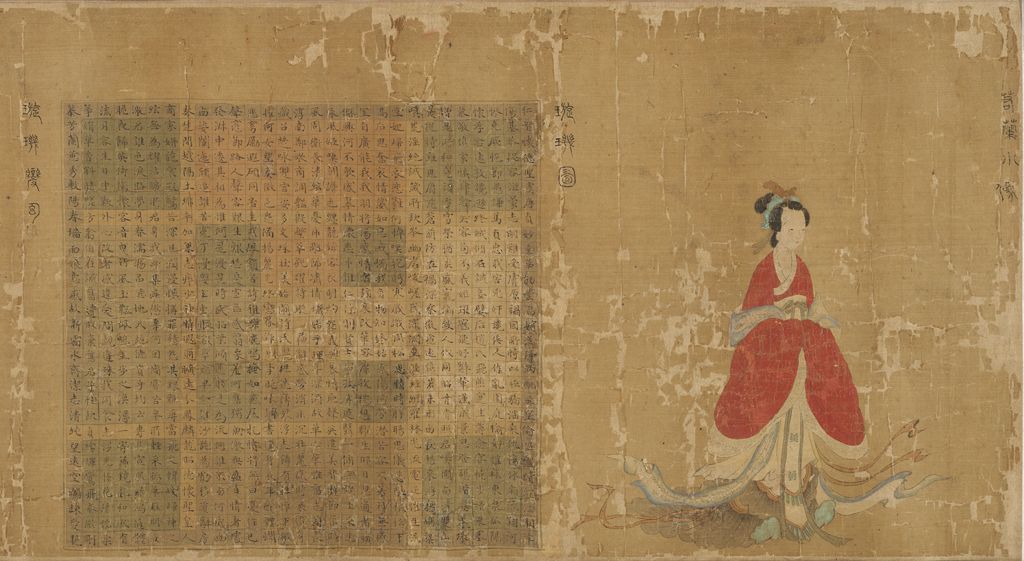
Wild Geese Returning: Chinese Reversible Poems (2011) is an introduction to a form of poetry that can be read in different directions.  Thanks to the way Chinese written characters take meaning from their position in a text, it is possible to write poetry that reads both forwards and backwards, whilst still retaining the formal the rhymes and syllable counts specific to poetic forms.  As it says on the Calligrams site, reversible poetry's 'greatest practitioner, and the focus of this critical anthology, is Su Hui, a woman who, in the fourth century, embroidered a silk for her distant husband consisting of a grid of 840 characters. No one has ever fully explored all of its possibilities, but it is estimated that the poem—and the poems within the poem—may be read as many as twelve thousand ways.'  Michèle Métail is a sinologist and poet who was also the first woman to be elected to the Oulipo back in 1975.  She has studied this underground current in Chinese literature and translated examples by providing French versions (English, in Jody Gladding's recent translation) that go first one way and then another. 

Su Hui with her great palindrome poem, the Xuanji Tu.

For this blog, I am particularly interested in landscape poems, and there are plenty of examples in Métail's book.  Wang Rong (468-494), for example, wrote a short 'Reversible Poem Composed in the Imperial Garden'  which begins with mountain peaks and ends with cicadas singing in the trees, and vice versa.  'In contemplating this landscape', Métail writes, we move from the distant to the close and from the close to the distant.'  The imperial garden was the setting for a sequence of reversible quatrains composed in the next century by a gathering of poets in the circle of the emperor of the Liang dynasty, Xiao Gang (503-551).  Xiao himself wrote of clouds over rocky peaks, water flowing through mountain slopes, a pond with swans and trees losing their leaves.  Or, in reverse, leaves flying from the trees, swans gathered on a lake, mountains with veins of water and rock summits dividing the clouds.

Some of the most famous Chinese poets wrote reversible poems.  The writer I discussed here last week, Yang Wanli, is included in Wild Geese Returning, along with two other Song Dynasty writers I have mentioned on this blog: Wang Anshi and Su Shi.  Wang Anshi (1021-86) wrote 'Thoughts of a Traveler', which begins with geese on a secluded island and ends with the twists and turns of a river, then, twisting back on itself, returns across the landscape to the wild geese at rest.  Su Shi (or Su Dongpo, 1036-1101) wrote poems to be sung in which the second half is the mirror image of the first.  In one of them, there are reminders of the way nature itself produces reversals, in a branch turned upside down, or with reflections in water.  This poem begins with the image of a horse running after fragrances and ends with a light fragrance following a horse.  Su Shi also wrote a sequence on the fours seasons in which each individual line is sung and then reversed.

The theme of the seasons was also used by a more obscure Song Dynasty poet, Mei Chuang (dates unknown) and landscape imagery can be found within his other four extant reversible poems.  In 'Two Poems Composed on West Lake for Amusement' the reverse reading renders the name West Lake into a description, 'west of the lake'.  The same is true of Gushan, Solitary Mountain, and thus his poem provides new readings for Chinese place names.  Earlier in the Song Dynasty, Qian Weizhi wrote a collection of ninety reversible and circular poems of which six have come down to us.  'Climbing the Pavilion of Great Compassion on a Spring Day' describes an ascent, or, read backwards, a descent.  Circular poems are a separate genre that can be read from any point in one way or the other.  Métail provides eight examples from the forty possibilities in one of Qian's poems.  I will give two below (you have to think of 'kiosk' in its original sense as a garden pavilion).

Mountains like a point, snow lights the pavilion
Distant and close, sky turns the kiosk blue.
Peacefully receiving the moon, the shades shine
Cold penetrates the shelter in the misty evening.

Snow punctuates the mountainous shelter
Evening mist pentrates the cold shades.
Brilliant moon on the peaceful kiosk
Blue sky, near and sistant pavilion. 

After the Song Dynasty there are further isolated examples of these kinds of poem, culminating, it could be said, in the sequence Zhang Yude wrote in the late eighteenth century for the Great Contemplation Pavilion in Xi'an, two hundred and sixty of which survive carved on stone stelas.  But what of contemporary Chinese poets?  Unsurprisingly perhaps, reversible poetry has not featured in recent official histories of Chinese literature, or written except as games or curiosities.  However, Métail is aware of one exception: Xiong Yinzuo, a Chinese writer living in the US who has published collections of Reversible Poems on the Four Seasons (1978) and Reversible Poems from the Ju Hsin Studio (1980).  Sadly, these have not been translated as far as I can see. Métail writes that they are 'devoted to the impressionistic notation of the smallest details of a landscape in order to comprehend the multiple changes at work in the universe, for which the reversible poem remains the most original poetic illustration.' 

Saturday, October 07, 2017

Memoryscapes

I was pleased that Caught by the River made Frozen Air their Book of the Month, although they have now sneaked in a second one - The Lost Words by Robert Macfarlane and Jackie Morris - a book it's been impossible to avoid this week, with coverage everywhere from the reviews pages to the Today programme.  There was a typically rich and thought-provoking essay by Robert Macfarlane on children, nature and reading in The Guardian, and I am tempted to set down my own reflections here, but they would be based on nothing more than personal experiences as a child and parent.

For fans of Macfarlane, The Lost Words will fill a gap while he completes Underland, a book that sounds from scattered interviews to be increasingly ambitious in scope.  Whatever it covers, it is certain to delight in language and the physical challenges of exploring a landscape.  In The Telegraph, two years ago, he described exploring the River Timavo which flows through the karst region of Slovenia and northern Italy. “I descended a 100ft doline, a sort of narrow, eroded vertical channel, with a 70-year-old Italian man called Sergio, who smoked a briarwood pipe all the way down. That was one of the most extreme places I have ever been: a great black river roaring out of a cave mouth on one side and disappearing down a rabbit hole on the other, and the sense of the earth’s surface above us.”

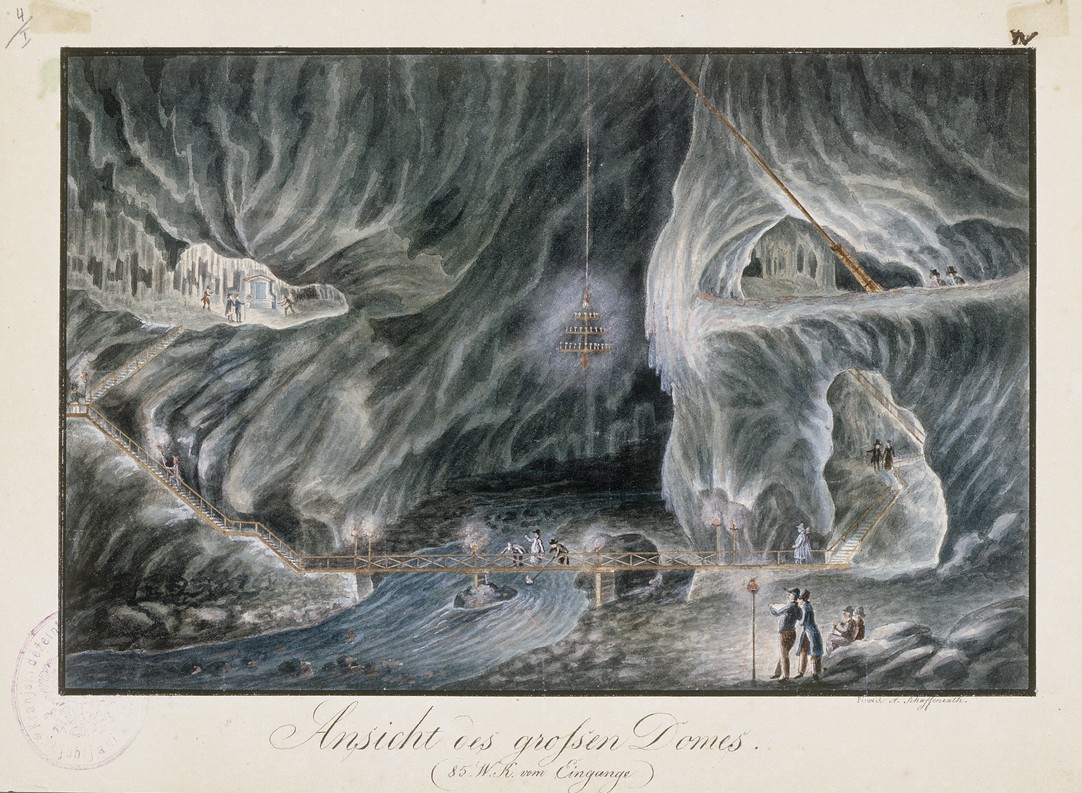
Alojzij Schaffenrath,  Postojna: view of the Great Cave, c. 1821

'The right names, well used, can act as portals.'  A doline is the name for a portal to the underland, and there are others too on the karstic plateau: foiba (a deep inverted funnel), abîme (a vertical shaft) uvala (a collection of sinkholes).  My only experience of descending into this world was on a family holiday to Yugoslavia, when we visited the spectacular Postojna cave system in Slovenia.  It felt as if I had suddenly entered the marvellous subterranean settings of my recent childhood reading: The Silver Chair, The Hobbit, Journey to the Centre of the Earth.  I can still recall the soundscape too - a a strange babel of amplified sound as competing tour groups listened to guides in the different languages of Europe.

As can be seen in the image above, tourism at Postojna stretches back to the early nineteenth century.  When Crown Prince Ferdinand visited in 1819, soon after the main caves were opened, he was greeted with a band and singers.  Perhaps the caves would have been too eerie, experienced in dripping silence.  They have subsequently hosted orchestras, jazz bands and even the La Scala chorus.  There is a long tradition of music making in caves and now, it seems, a new trend for concert halls themselves to be built underground.  I have written about caves and music before, so here I will conclude by returning to the surface and highlighting some recent music made in the karst landscape of Slovenia.


For Memoryscapes, the experimental folk trio Širom returned to the regions of Slovenia they grew up in and improvised outdoors, curious to see how the environment would affect what they played.  The film of the project (embedded below) begins with the construction of some bamboo balafons which they carry down into the hollow of the Bukovnik sinkhole.  As they sit under the trees, the camera pans slowly round, catching motes of light and the slight movement of branches in the breeze.  Watching this made me think that taking children into the woods to make and play instruments would be another way to reconnect them with nature.

On Mt Tolminski Migovec, the music is harsher and the surroundings cold and inhospitable.  In a mountain hut they do some more percussion with pots and pans (it looks like this would get annoying pretty quickly, as I know from having heard my own sons try it).  In the final segment, they sit surrounded by a sea of yellow flowers; if the music was as pretty as the visuals it would be too much to take.  The film ends by a watermill, with an insistent rhythmic sound, like hundreds of squeaky gears and cog wheels.  Eventually the music fades and breaks apart, leaving nothing but sunlight on the water.

Friday, January 20, 2017

Journey to the Land of the Real


Returning from the Small Publishers Fair last November and looking on the bus at my new copy of Journey to the Land of the Real felt like being a teenager again, after finally tracking down some long-desired record I had read about but never actually seen.  Victor Segalen is my favourite French writer.  Not having known the Atlas Press were bringing out a new translation of Equipée (first published posthumously in 1929), I was astounded to see it lying on their table, like some precious piece of calligraphy or mysterious jade artefact.  The book is a beautifully printed hardback with endpapers reproducing photographs of a mountain pass taken by Jean Lartigue, Segalen's travelling companion in 1914.  The text was partly inspired by this journey, an archaeological expedition in China and Tibet, although, as the editors of the Wesleyan UP edition of Stèles note, Segalen 'wrote travel literature only in the sense that we might say Proust wrote an autobiography or Baudelaire recorded Parisian street life.'  At the beginning of the Journey to the Land of the Real, Segalen says that what follows is 'not a poem about a journey, nor is it the travel diary of a wanderer’s dream.'

The question of landscape description is addressed in Chapter 21, which opens with a criticism of conventional writing, 'pleasant verbal colour.'  He says he cannot describe some of what he has seen in words - the red hills of western China, the entrance to Tibet, 'so many mineral landscapes'.  He talks about the chaos of forms in the valleys.
'A landscape of yellow earth.  Literally made entirely of earth, yellow earth enriched with subtle tones, pinky-yellow in the morning, salmon-yellow in the light from the west, growing pale towards midday, violet in the evening, and at night, deepest black - for not the slightest glimmer of diffused light penetrates at that hour.  Perspectives, indentations and architecture, both bland and fantastical, all more astonishing than the colours themselves.  [...]  I find respite and calm only by climbing as high as possible, fleeing the low, chaotic regions for the high, paradoxical plateaux, where the soothing plain dominates and unfolds beneath the skies.'
This passage reminded me of 'Terre Jaune', one of the poems in Stèles (1912) which, according to the free online collection of sources and contexts, was based on some notes Segalen made in August 1909.  I've reproduced the French version in full below - the Chinese characters mean 'high plain (tranquillity above), chaos below'.  Stèles is not a collection of landscape poems but it takes its title from the stone tablets dotted around China which could, I suppose, be thought of as a great authorless text covering the landscape.  In his introduction to Stèles, Segalen says that these 'embed their low foreheads in the Chinese sky.  One encounters them unexpectedly: on roadsides, in temple courtyards, before tombs.'  'Terre Jaune' is placed in a section entitled 'Stèles by the wayside.'  Such monuments 'offer themselves without reserve to passers-by, to mule-drivers, to chariot drivers, to eunuchs, to footpads, to mendicant monks, to people of the dust, to merchants.  Towards all of these they turn their faces radiant with signs...'

Terre Jaune
D'autres monts déchirent le Ciel, et portant le plus haut qu'ils peuvent les tourments de leurs sommets, laissent couler profondément la vallée.
Ici, la Terre inversée cache au creux des flancs ses crevasses, tapit ses ressauts, étouffe ses pics -- et tout en bas
Les vagues de boue chargées d'or, délitées par les sécheresses, léchées par les pleurs souterrains gardent pour quelque temps la forme des tempêtes.
o
Alors que, supérieure, ignorant les tumultes, droite comme une table et haute à l'égal des cimes, -- la plaine étendue
Nivelle sa face jaune sous le Ciel quotidien des jours qu'elle recueille dans son plat.

Wednesday, May 25, 2016

Reed writing


Sesonji Koreyuki, Wakan rōeishū Anthology, 1160

Ashide, reed writing, developed in the Heian dynasty as a form of calligraphy written in such a way as to imitate natural forms: reeds, rivers, trees.  By the twelfth century they were being written over actual landscape paintings, creating a hybrid form.  There is an example dating from 1160 in the Kyoto National Museum by Sesonji Koreyuki (or Fujiwara no Koreyuki), Poems from Wakan Roeishu'As the line of characters crosses the drawn-out contours of the image, it transforms into sprouting grasses and cranes standing along what might be a riverine strand' (Thomas LaMarre, Uncovering Heian Japan: An Archaelogy of Sensation and Inscription). Landscape is depicted in the overall image and text, but also registered at different levels of magnitude in the shapes and sounds of the individual words.  This artwork opens up the possibility that calligraphy can itself evoke elements of the setting and atmosphere, like a film soundtrack, whilst words and pictures tell the story.

If calligraphy were to take on too many of the attributes of landscape painting it would lose its status as an artform.  The point is made by Stephen Addiss in relation to the first piece in his book 77 Dances: Japanese Calligraphy by Poets, Monks and Scholars, 1568-1868.  This poem, a detail of which is shown here, was written by Emperor Goyozei (1571-1617).  The most heavily inked characters mean big well river and the next most visually stressed character means snow. ‘Even a quick viewing therefore reveals the main theme of the poem: the Ōi River in snow.’ And although this is not an example of reed writing, since its symbols do not have a dual role as words and image, the paper itself provides a subtle link to its subject matter:
‘The primary pattern on the paper is that of waves, sometimes almost still and sometimes curving, with a secondary element of reeds appearing several times. Near the top, however, a heavier undulating line in blue suggests possible islands in the river or perhaps even the nest of reeds covered with snow. If the latter, it is done in a semi abstract manner, since too much visual correspondence with the poem might be considered vulgar by refined court aesthetes.’
 Vincent Van Gogh, Marsh with Water Lilies, 1881

From a Western perspective the idea of 'reed writing' evokes the idea of the reed pen, used in landscape art by Rembrandt and Van Gogh. In 1888 Van Gogh wrote to tell his brother "These drawings are done with a reed cut the same way as you’d cut a goose quill. I plan to do a series like that. And I hope to do better than the first two. It’s a process I already tried in Holland in the past, but I didn’t have as good reeds there as here."  I have mentioned his use of a reed pen before in relation to an 1881 drawing of the marsh at Passievaart.  And I'll end here by quoting Robert Hughes on the way Van Gogh used his reeds to draw stems of grass in a style that approached calligraphy.
'The reed was not flexible, like other pens. Nor did it hold a lot of ink, so it would not produce long, sinuous lines. The style it favoured was short, blunt, angular and (in a limited way) calligraphic. In some drawings you can see Van Gogh brilliantly exploiting the limitations of the reed. He draws a tuft of grass, for instance, as five or six springing, more or less parallel strokes. The first one is heavy with ink. The next, less so. By the fourth or fifth, the reed is almost empty and the ink strokes faint. This creates the impression of a round tussock, rendered not as flat pattern, but turned towards the light. Then he dips his reed in the ink bottle, recharges it and begins again, on a different clump of grass.'

Thursday, June 11, 2015

Uncommon Ground


A few weeks ago, on leaving the job I had done for six years, I was gifted a copy of Dominick Tyler's Uncommon Ground.  It combines attractive photographs with short descriptions of some of the words that have been used for British landscape features, partly inspired, like Robert Macfarlane's Landmarks, by the Barry Lopez/Debra Gwartney collection Home Ground. There are some intriguingly obscure words here like 'fraon', a place of shelter in the mountains, which Tyler found in a couple of early eighteenth century Gaelic dictionaries.  But many will be familiar from school geography lessons: tor, meander, blowhole, clint and gryke.  As I remember it the standard geographical terms were taught rather than local British variants: arête rather than druim or aonach.  However in one case I do recall being offered three interchangeable terms - cirque, cwm and corrie - as there seemed to be no collective agreement on what to call these glacial basins.  Tyler groups these under the word 'coire' - the Gaelic original of 'corrie'.  He says coombes are the same thing too which I don't think my geography teacher would quite have agreed with (we had lots of coombes in periglacial Sussex).  The one that Edward Thomas described in his poem 'The Combe', 'dark, ancient and dark', would have been quite difficult to photograph for Uncommon Ground: 'The sun of Winter, / The moon of Summer, and all the singing birds / Except the missel-thrush that loves juniper, /Are quite shut out.'


Uncommon Ground quotes sparingly from writers, but there are three lines from Milton's 'Comus' that mention both 'dingle' and 'dell': 'I know each lane, and every alley green / Dingle or bushy dell of this wilde Wood, / And every bosky bourn from side to side.'  The photograph accompanying this text shows Bunyan's Dell in Hertfordshire, where a large congregation of non-conformists once gathered 'under the canopy of heaven' to hear John Bunyan preach.  Milton's word 'bosky', referring to a thicket of trees, 'was also a word for a state of mild inebriation, perhaps drawing a parallel between a confusion of mind and a tangle of branches.'  I can't find any of these terms in the Landmarks glossaries, which suggests there is less overlap between the two books than you might think.  Robert Macfarlane is happy to admit words coined by poets, most notably Gerard Manley Hopkins, whose poems include: 'twindle' - stream foam dividing into two braids;  'heavengravel' - hailstones, and in the same line of poetry 'wolfsnow' for a sea-blizzard; 'slogger' - the sucking sound made by a waves against the side of a boat; 'shadowtackle' - the shifting patterns of shadow on woodland floors; 'leafmeal' which evokes the way leaves fall one by one and then lie like ground grain, 'silk-ash' - the fine ash covering glowing embers; and 'doomfire', an apocalyptic sunset.


Bunyan's Dell

Uncommon Ground starts with a local word, 'zawn', derived from a Cornish word for a chasm, but reading it through you keep coming across connections with other languages and landscapes.  'Shiver', the Cumbrian term for a fragment of slate derives from the Germanic word for splinter, 'scivero', which in turn, 'in a nice little etymological loop', led to the modern German 'schiefer', slate.  It is pleasing to learn that the Russian word 'Zastrugi' which gives us the name for ridges in snow formed by the wind also means 'the splintering of planed wood against the grain' and 'the undercut bank of a stream' (although even more pleasing would be to learn that Russian has two additional words for these precise phenomena).  This kind of thing made me want to see the global glossary of landscape terms being slowly compiled, according to Robert Macfarlane, by the Arabic scholar Abdal Hamid Fitzwilliam-Hall.  It has occurred to me that this Borgesian encyclopedia may prove insufficiently ambitious if it excludes the rimae, catena and dorsa of the Moon, or the words that will be needed to describe detailed features or atmospheric effects elsewhere in the solar system.  But I suppose I am betraying here my urban sensibility, where the daily experience of nature can seem as remote as those planetary features discerned in telescopes and given Latin names before anyone has been able to experience them.

Sunday, March 15, 2015

Landmarks


You might feel you have read enough about Landmarks over the last few days - an essay by Robert Macfarlane in The Guardian introducing his new book (which, as I write this, has been 'shared' 39,000 times), reviews, excerpts, interviews, even an unfunny parody.  I will not add much to all this here, although as the book explores the literature of landscape as well as its language, there are many pages it would be nice to quote.  I will restrict myself to one example, from a chapter devoted to 'Edgelands', where Richard Jefferies (writing in 1883) is read as a philosopher of vision, anticipating geography's phenomenological turn and those contemporary artists and authors who approach landscape as bodily experience.
'Often Jefferies wobbles our sense of reliable vision, showing the impossibility of achieving a privileged position of perception: 'Even trees which have some semblance of balance in form are not really so, and as you walk round them so their outline changes.'   If you 'walk all round [a] meadow ... still no vantage point can be found where the herbage groups itself, whence a scheme of colour is perceivable.'  Repeatedly, phenomena refuse to resolve into order: a wind blowing across water makes 'wavelets' that 'form no design; watch the sheeny maze as long as one will, the eye cannot get at the clue, and so unwound the pattern.''
The pattern may be indiscernible but the phenomenon can be named.  In Landmarks the 'Waterlands' glossary offers for wind-blown ripples on the surface of water the word cockles.  In Gaelic there is a term for the 'first slight ruffling of the water after a calm' (caitein) and in Scots there is a word for 'a splashing or dashing in small waves or ripple' (jabble).  Jefferies worried that we fail even to see such things and it is the details in landscape that Landmarks celebrates, rather than its broad sweep.  Under 'Pools, Ponds and Lakes' the words for the largest bodies of water are well-known to anyone who has used a map in the British Isles - llyn, loch, lough, tarn.  But focus down and you reach less familiar terms - large ponds are grimmers and hassocks, small ponds are mardles and pulks, puddles are swidges and blatters, little puddles are pudges.  The Gaelic word lodan can mean both a little pool and 'water in one's shoe.'

Some Robert Macfarlane readers coming to this after his previous books may expect more action and less quotation.  No doubt there will some arduous activity in Underland, the book he is now writing on caves.  In Landmarks he does praise the 'unostentacious bravery' of Roger Deakin, borne along in the swell of a tide, 'locked in by the current, with no obvious means of escape', and he quotes the 'exceptionally intrepid' John Muir, surfing an avalanche in the Sierra Nevada ('on no part of the rush was I buried.  I was only moderately imbedded on the surface or at times a little below it...')  However, the only hint of risk-taking is in the Cumbrian fells where Richard Skelton invites him to explore a tunnel in an old quarry.  Earlier that day, before the rain set in, Robert had been reading a story (in Richard's journal Reliquiae) from The Kalevala in which a similar cleft in a hillside must be entered by the hero to find 'the lost words'.  The coincidence provokes 'an eerie tremor of recognition'.  They explore this tunnel by the light of a weak torch as water courses through the roof, 'showing silver in the beam, like silk.'  After a few minutes they retrace their footsteps and return to the path, now running with water, wet but unscathed.  'I could feel feel rain streaming down the inside of my trousers and into my shoes.'  Water in one's shoe - lodan.


This blog is listed under the heading 'On Language and Landscape' in the Landmarks select bibliography.  The best way to find relevant posts here is to click on the 'language' label, although I suspect I have not been rigorously consistent in the way it has been used.  I have tended to append it to posts talking about words themselves, like the one I wrote this week on the old rune poems, but other entries may also be of interest, like those I wrote earlier this month on landscape as metaphor in the poetry of John Donne and the Chan Buddhist monks of China.  Looking back I see that the second post I ever wrote on this blog, back in 2005, was on language and landscape.  It quotes one of the books that influenced Landmarks, Arctic Dreams by Barry Lopez.  'For Lopez, language is not imposed on the landscape, it evolves from a conversation, and “a long-lived enquiry produces a discriminating language”.'

Friday, March 13, 2015

Bark of rivers and roof of the wave

Is
Is byþ oferceald, ungemetum slidor,
glisnaþ glæshluttur gimmum gelicust,
flor forste geworuht, fæger ansyne.
These lines come from one of the old rune poems, in which descriptive verses were associated with letters of the runic alphabet.  They refer to the rune Isa, which means 'ice', and can be translated from the Anglo-Saxon as follows
Ice is very cold and immeasurably slippery;
it glistens as clear as glass and most like to gems;
it is a floor wrought by the frost, fair to look upon.
That second line is nice but it does sound better in alliterative Old English: "glisnaþ glæshluttur gimmum gelicust..."  Two other rune poems have survived, in Norwegian and Icelandic, and here are their descriptions of this same ice rune:
Isa
Ice we call the broad bridge;
the blind man must be led.
Ice
Bark of rivers
and roof of the wave
and destruction of the doomed.
These imagistic definitions of natural phenomena can be seen as an early form of nature poetry.  Here are three more examples from the Anglo-Saxon rune poem, which dates from the 8th/9th century and is preserved in a copy made in 1705 (the original manuscript perished in a fire in 1731).  The first, for the rune called Berkana, describes a poplar, although it is given as a birch in the other two rune poems.  The second, for Eihwaz, praises the yew tree, 'greenest of trees in winter' according to the Norwegian version, and in the Icelandic, source of the bow, speeder of arrows.  In his guide to the runes, Bernard King writes that 'the hunting God Ull built his hall in Ydalir, Yewdale, and the bow was regarded as his sacred weapon'.   The third, for Algiz, describes 'eolh-sedge', a kind of sedge grass which would cut you if you brushed against it.  According to King, this rune 'implies defence and protection, possibly even in the form of an amulet or temple sanctuary, and related words are the Gothic alhs, temple, and the Old English ealgian, to protect. There may also be a relationship here with the mysterious runeword alu. The meaning has also been equated with the elk, mentioned by Caesar as sleeping upright leaning against a tree to elude the hunter more easily, and thus in some measure a symbol of preservation in the face of adversity.'

Beorc
The poplar bears no fruit; yet without seed it brings forth suckers,
for it is generated from its leaves.
Splendid are its branches and gloriously adorned
its lofty crown which reaches to the skies. 

Eoh
The yew is a tree with rough bark,
hard and fast in the earth, supported by its roots,
a guardian of flame and a joy upon an estate.

Eolh
The Eolh-sedge is mostly to be found in a marsh;
it grows in the water and makes a ghastly wound,
covering with blood every warrior who touches it.

Friday, March 28, 2014

When the brush moves, water flows from a spring

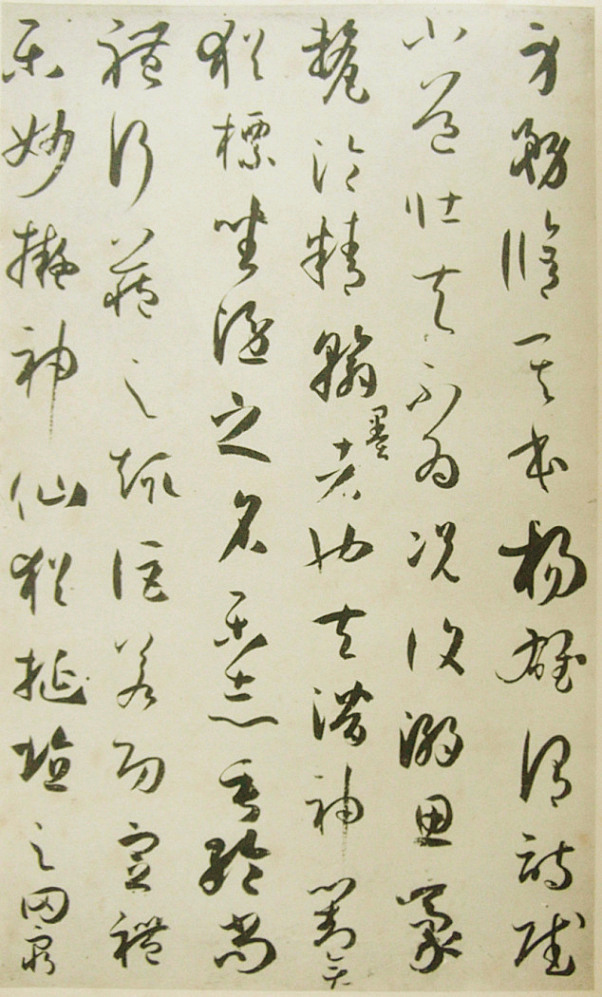
'Consider that when the brush moves, water flows from a spring, and when the brush stops, a mountain stands firm' -  Sun Guoting (648-703)
Sun Guoting, part of the Treatise on Calligraphy, 687
 
In Tim Ingold's book Lines: a Brief History he quotes two writers on the history of Chinese calligraphy (Yen and Billeter) who describe the importance that has been attached to emulating nature - not in its forms, but in its movements.  Sun Guoting, for example asked his readers to consider the difference between two strokes - the 'suspended needle' and the 'hanging-dewdrop' - and to draw inspiration from rolling thunder, toppling rocks, flying geese, animals in flight, dancing phoenixes, startled snakes, sheer cliffs, crumbling peaks, threatening clouds and cicadas wings.  An earlier Jin Dynasty text, Lady Wei's Chart of Brush Manoeuvres (quoted by Yen, but not by Ingold), suggests that 'an elongated horizontal line should convey the openness of an array of clouds stretching for a thousand miles' whilst a dot should 'contain the energy of a rock from a mountain peak.'  A sweeping stroke (na) should contain the 'orgiastic vigour of rolling waves, or crushing thunder and lightning.'

From Billeter's The Art of Chinese Writing Ingold gives five more examples:
  • A thirteenth-century master who compared the moment the brush makes contact with the paper to ‘the hare leaping and the hawk swooping down on its prey’
  • Another who in writing two particular characters tried to move his hand like a flying bird, and for two others imitated the 'somersaulting of rats at play'
  • The Sung Dynasty calligrapher Lei Chien-fu who 'described how he heard a waterfall, and imagined the water swirling, rushing and tumbling into the abyss. ‘I got up to write’, he recalled, ‘and all that I had imagined appeared beneath my brush''
  • Another Sung Dynasty calligrapher, Huang T’ing-chien (Huang Tingjian, 1045–1105), who only mastered a particular stroke after observing the way boatmen on the Yangtze River angled their oars 'as they entered the water, pulled through in the development of the stroke, and lifted them out at the end, and how they put their whole body into the work'.
  • And a treatise on painting from the same period describing the way Wang Hsi-chih (or Wang Xizhi, 321-79) drew inspiration from geese, whose necks undulate like the wrist of the calligrapher
 Qian Xuan, Painting of Wang Xizhi (and geese), thirteenth century.

Monday, May 06, 2013

Mountain Rhythm and Mountain Plateau


When I mentioned Xu Bing in a post here three years ago I referred to installations I could not see, in New York and Sydney, so it was a pleasure on Saturday to enter the portico of the Ashmolean for an exhibition devoted to his art.  Ideally the Tate would put on a full retrospective, including his celebrated Book from the Sky (1991), but the Ashmolean's Landscape/Landscript was fine from the perspective of this blog, tracing as it did the artist's engagement with landscape and language.  This story, from student sketches to four lithographs completed last autumn, The Suzhou Landscripts, is outlined briefly in the notes below.
Xu Bing was born in 1955 to parents who both worked at Peking University, but during the Cultural Revolution his mother was demoted and his father paraded through the streets and jailed.  School was suspended and so Xu Bing taught himself calligraphy and engraving.  In 1974 he was sent to a mountain village north of the Great Wall to do agricultural labour, as part of an 'educated youth' detachment.  The exhibition includes a winter view of farm buildings drawn on wrapping paper in which the white children's crayon used to depict snow shows signs of having frozen in the cold and then melted.       
In 1977 the Central Academy of Fine Arts reopened and Xu Bing was among its first intake.  His training included trips to work alongside rural labourers and industrial workers - the exhibition has a drawing of a timber yard in northeast China whose stacks of logs foreshadow Xu Bing's later compositions based on notions of repetition.  His sketching became simpler and more abstract as he left behind the influence of academic art (the Ashmolean has a case of nineteenth century French drawings to show how this shaped first Soviet and then Chinese socialist realism).  Now employed as a teacher at the Academy, Xu Bing's developed his own vocabulary of 'shaping lines' for increasingly experimental woodblock prints.    
Two of the most interesting landscapes in the exhibition, Mountain Rhythm and Mountain Plateau were made in July 1986 near the hydroelectric power station on the Yellow River at Longyang Gorge.  As the catalogue says, 'the process was unusual.  Xu Bing took with him to Qinghai copper plates that had been waxed in Beijing.  In the open air he scratched through the wax to create the image, using a needle from the travelling printmaking kit he customarily used for his peripatetic teaching.  He added the acid in the evening on his return to the workers' housing where he was staying and the images were printed on his return to Beijing.'      
In 1987 he started his Repetitions series, which you can see on Xu Bing's website'for these works, he made an impression of each state - beginning with a solid black print from an uncarved block and ending with a blank white ''print'' representing the block after the raised surface had been completely carved away.'  The example in the exhibition resembles blocks of newsprint in an unknown script and shows the Ziluidi system of agriculture in which each family was allowed to retain one plot for their own use.   
The exhibition skips over the next ten years, when Xu Bing was establishing his international reputation after moving to the US in 1990.  The idea for the Landscripts came to him in 1999 whilst sketching in the Himalayas.  'I sat on a mountain and, facing a real mountain, I wrote 'mountain' (you might also say I painted a mountain, as for Chinese people to write mountain and to paint a mountain are the same thing).  Where there was river water I wrote the character for 'water'.  The clouds shifted, the mountain colours changed, the wind blew and the grasses moved ... At this point I could set aside completely the historical theories of style and brushstroke and allow myself to be entirely in the feeling of that moment.'   
For me the best kind of Landscript is composed purely of text, and there is a beautiful example in this exhibition from 2002, executed in ink on Nepalese paper with the characters for rock, rain, pine and so on.  In the four new Suzhou Landscripts Chinese characters are less conspicuous, incorporated within the brush strokes of traditional landscapes (versions of paintings by Liu Jue, Zhai Da Kun, Zheng Yuan Xun and Wang Shi Min).  The forms of ancient pictographs are also overlayed in red and the landscapes are surrounded with inscriptions in Xu Bing's Square Word Calligraphy (which turns English words into the shapes of Chinese characters).
The final room in the exhibition has works from Xu Bing's 2005 contribution to UNESCO's Human/Nature project and a 2010 adaptation of The Mustard Seed Garden Manual of Painting (1679), which is discussed in a short MFA Boston video.   The latter illustrates Xu Bing's belief that 'a core characteristic of Chinese painting is its semiotic nature': the manual is a dictionary of signs (some of which I have mentioned here before) and an artist need only memorise them, like a language, in order to piece together a world.

Sunday, January 27, 2013

Stepping Stones

I've been reading the late Dennis O'Driscoll's Stepping Stones: Interviews with Seamus Heaney.  Among the interesting things I learnt was that Heaney's poem 'The Mud Vision', in which a strange religious apparition briefly visits modern secular Ireland, was partly inspired by Richard Long.  As Heaney explains in another interview, 'the actual mud-vision idea came from seeing a work by the English artist Richard Long, a big flower-face on a wall, made up entirely of muddy handprints. It began as a set of six or eight petals of mud and then moved out and out concentrically until it became this huge sullied rose window.'  Another strange image - a tree-clock made of tin cans - appears in the poem 'Fosterling', although this was not inspired by a piece of land art.  In Stepping Stones, Heaney recalls that it came from an old story about a Faustian pact: a band of tinkers built a fantastic clock in a tree and set it to the wrong time to fool the devil when he returned for the local people's souls.  Such marvels took Heaney many years to work into his poetry.  Growing up he inhabited a 'lowlands of the mind', a silted place where poetry was 'sluggish in the doldrums of what happens'. It took a long time 'for air to brighten, / Time to be dazzled and the heart to lighten.' 


I've embedded above a brief YouTube clip showing Dennis O'Driscoll interviewing Seamus Heaney and below I've set down a few observations on five landscape-related Heaney poems, with comments derived from Stepping Stones:

  • 'The Peninsula'   Heaney mentions in Stepping Stones that this poem (in his second collection, Door into the Dark) was written after a drive to the Ards peninsula in County Down. In it he writes about the way landscape can restore the ability to really see the world when it seems there is 'nothing more to say.'  Heaney imagines driving all day around the peninsula, a 'land without marks', until dusk arrives, when 'horizons drink down sea and hill.'  Then, heading home, details begin to emerge in memory - 'a glazed foreshore and silhouetted log' for example.  Such an experience makes it possible to 'uncode all landscapes / by this: things founded clean on their own shapes, / water and ground in their extremity.'
  • 'Bogland'  "I was putting my right leg into the trousers when I got the first line," says Heaney in Stepping Stones.  We have this pair of trousers to thank for some of Heaney's most famous poems.  "From the moment I wrote it, I felt promise in 'Bogland'  Without having any clear notion of where it would lead or even whether I would go back to the subject, I realised that new co-ordinates had been established."  This last poem in Door into the Dark would open the door to others in which the bog and its Iron Age victims serve partly as metaphor for events in Northern Ireland: 'Tollund Man' in Wintering Out and then the poems of North: 'Kinship', 'Punishment', 'Strange Fruit'... The drowned bodies are inseparable from their landscape: the Bog Queen preserved on the gravel bottom, 'between heathery levels / and glass-toothed stone'; the Grauballe Man, who 'lies / on a pillow of turf / and seems to weep / the black river of himself'.
  • 'Gifts of Rain'   In Stepping Stones Heaney is asked about a new interest in the semantic and phonetic in his fourth collection, Wintering Out, where poems take the sound of words as their subject.  I've described one of these, 'Anahorish', before, but there is also 'Toome' and 'Broagh', in which the rain beating on 'windy boortrees / and rhubarb-blades' ends suddenly like the word itself, with that gh that strangers find 'difficult to manage.' 'Gifts of Rain' describes a flooded landscape and the swollen river Moyola 'harping on / its gravel beds.'  This too is a phonetic place poem: 'The tawny guttural water / spells itself: Moyola / is its own score and consort, / bedding the locale in the utterance...'  
  • 'Höfn'   Heaney is periodically drawn into politics by O'Driscoll's questions and this poem, with its aerial view of a melting glacier in Iceland, is the pretext for a question on the environment (Heaney says he inclines more to lament than protest).  'Höfn' focuses on Heaney's primal fear of the glacier as it looked that day, an 'undead grey-gristed earth-pelt', so cold that it would 'deepfreeze the seep of adamantine tilth'.  Heaney is of course 'a man of the soil' and tells O'Driscoll that he has rarely felt as exposed as he did that day over the "stony grey scar of ice."
  • 'Postscript'   This is the last poem in The Spirit Level and is similar to 'The Peninsula', but much more specific: the drive is 'out west / into County Clare, along the Flaggy Shore, / in September or October, when the wind / and the light are working off each other.'  The poet observes swans on the surface of a lake but is content to drive on rather than park and try to 'capture' the moment.  The 'known and strange things' will, he realises, pass by and through him like the wind, catching 'the heart off guard' and blowing it open. Asked about this poem in Stepping Stones, Heaney says that it came to him quickly, as he recollected a windy day on Galway Bay: "we drove on into this glorious exultation of air and sea and swans."  You can hear him read the poem in the clip below.

Saturday, December 01, 2012

Field Notes


Autumn Richardson and Richard Skelton have kindly sent me a copy of Field Notes, a compilation of their place-poems. The first section reprints Typography of the Shore which explored connections between the experience of landscape and the making of a book.  Thus, on the ‘ragged shoreline’ of Tentsmuir in Scotland there are ‘spurred stems’ and ‘wind-kerned grasses’ – ‘ragged’ is unjustified type, a ‘spur’ is the serif-like ending to a letterform and ‘kern’ is the action of adjusting spaces between the letters.  The second chapbook in the series, Skin and Heather, used text from Richard’s book on Anglezarke, Landings: ‘climb the small stile / gather the small stream’, ‘moors like scar tissue / skin and heather’. The third, Induviae, was a set of Autumn poems which took its name from the withered leaves which cling to the stem of some plants.  The fourth, Into the Bare Moorland, was written from Ireland about the West Pennine Moors and the final section of the book, The Flowering Rock, is a new collection of poems describing the landscape of the Burren: madder and thrift, eyebright and hart's tongue living in the seams between the shattered rocks; beneath them, arterial passages where the 'wailing notes / of water and wind' create 'hollow songs / of hollow hills.'  A sixth sequence, not included in the Field Notes compilation, is Wolf Notes, which I described in a post here last year.  The Field Notes series is intended to grow into ‘a poetic map of seemingly disparate locations – a distillation of what is unique to each, whilst also charting the underlying connections that may exist between them.’  

The language of landscape is a common preoccupation in these texts, and in the authors' other Corbel Stone Press publications.  The name *AR that they used for Wolf Notes stands not just for Autumn and Richard, but is also 'an archaic place-name element found in river names. It is thought to stem from the Celtic language spoken by ancient Britons, known as Brythonic. The asterisk indicates that it is a hypothetical, reconstructed form, as there is no surviving documentary evidence. It is thought to mean ‘starting up, springing up, setting in motion.’  Landings (reprinted in a new edition earlier this year) includes thirty pages of Lancashire dialect terms.  Among my favourites are: Borrans - rough, craggy places, to which foxes run for safety; Carrwater - red peaty water; Dag - dew on the grass; Fub - long withered grass on old pastures or meadows; Hare-gate - an opening in a hedge, sufficient for the passage of hares; Hippings - stepping-stones in a brook; Leawks - tufts of barren dry grass; Rindle - a small stream; and Stanner - a ridge of stones formed by the sea.  Their newest work, Limnology is 'a sequence of word-lists, text rivers and myth-poems that explore the rich corpus of water words found in English, the dialect of Cumberland, Icelandic, Anglo-Saxon, Gaelic, Irish, Manx, Welsh and Proto-Celtic.'  You can hear an extract from the accompanying CD below, river music 'that has gradually accrued volume and pace over the past six years, swelling to nearly 30 minutes of vivid, and sometimes violent, intensity'.