Showing posts with label mists. Show all posts

Monday, September 01, 2025

A glorious sunburst-streak

The Wire magazine, which I referenced yesterday, has just put out its 500th issue. I started reading it in 1987 when I was a student, buying my first jazz LPs and looking for information about the history of the music. Over the years, the magazine has broadened its scope and covered a lot of landscape-related sounds. I have often drawn on it in writing Some Landscapes. Perhaps the most influential article for my developing interest in this area was Phil England's survey of Acoustic Ecology in December 2002 - I referred to this excellent article in a 2007 blog post. The Wire archive has become an extraordinary resource and you can spend hours hunting through it for references to landscape - as inspiration for music, or the setting for concerts, or just as a source of metaphors for the way a song or a jazz solo sounds. You can also search for references to actual landscape artists and writers. Robert MacFarlane, for example, has been mentioned eight times so far. Here are almost all the references to Caspar David Friedrich in The Wire's first 500 issues. 


Caspar David Friedrich, Wanderer above the Sea of Fog, c. 1818


Visionary Wanderer: a Disco Inferno song described by Rob Young (April 1994)
Tumbling headlong through beatless space and tunes hung on skyhooks, there's a humming tension which comes to a head in "Footprints In Snow", a glorious sunburst-streak of a song where Crause becomes the visionary Wanderer in a Caspar David Friedrich painting, but transmuted to the end of the 20th century, sapping up whatever moments of beauty he can before it all goes down the tube.
Mountaintop: Günter Schickert characterised in an album review by Brian Morton (March 2019)
Schickert has always had his mountaintop side. He is the Caspar David Friedrich of krautrock, his textures often moonlit, like “Nocturnus” here, or loftily speculative, like the closing “Reflection Of The Future”.
Mind Walks: Wolfgang Voigt's approach described in a review of Gas's Nah Und Fern by Philip Sherburne (June 2008)
Voigt has spoken of taking “mind walks” through the woods, imagining a Gas-like music that he would later recreate in the studio, using contemporary looping techniques to evoke “the continuous rustle of the forest”. In his mythic German imaginary, he provides the musical missing link between Caspar David Friedrich and Gerhard Richter, approaching the subject matter of the former – the landscape, the forest – via the blurred indeterminacy of the latter.
Memory Vague: Oneohtrix Point Never reworking of Chris De Burgh analysed by Mark Fisher (September 2010)

Oneohtrix Point Never’s “Nobody Here”, collected on the album Memory Vague, has been greeted as a sliver of sublimity. His lift – a slowed down four-bar sample – lacks any parodic designs. Instead, the decontextualised phrase “nobody here” is mined for all its evocative power, calling up the empty Caspar David Friedrich landscapes also suggested by the title of another track from Memory Vague, “Zones Without People”. 
Fluffy Clouds: Lisa Blanning didn't enjoy Hans-Joachim Roedelius at the ICA (July 2006)
Sunday night began with fluffy clouds from Hans-Joachim Roedelius. The German Kluster veteran used a film of mountainscape – a single take of clouds forming and reforming – as the visual accompaniment to his music. There appeared to be aspirations to Caspar David Friedrich-style sublime, but the music was just fluff: inert, insipid, insensate, a dreary series of non-events. Even the occasional jarring moment didn’t lift the music from its fundamental torpor. 
Black Metal: Nico Vascellari in an interview with Anne Hilde Neset (December 2009)

"I completely share the parallel between Black Metal and Caspar David Friedrich," he comments when I suggest the connection. "What [Werner] Herzog said about the jungle [in My Best Fiend, Herzog’s film about Klaus Kinski] is directly connected to my interest in Metal: ‘… Nature is violence based. I would not see anything erotic here. I would see fornication, asphyxiation and choking and fighting for survival and growing and just rotting away… The trees here are in misery and the birds are in misery. I don’t think they sing; I just think they screech in pain.'"

Turbulent: Biba Kopf on a La! Neu! album (March 1999)
Gold Rain relegates Klaus [Dinger] to a supporting drum and producer role behind regular singer Victoria Weyrmeister and pianist Rembrand Lensink who recast Dingerland as a 19th century German drawing room. Inside, a family serenely performs five finger exercises beneath a turbulent Caspar David Friedrich landscape. 
Deep Song: a review of the book Jan Garbarek: Deep Song by Andy Hamilton (March 1999)
Garbarek's amalgam of jazz and World Musics can't be understood outside a wider cultural context. But his response is a massive referential overload, covering influences that are either tenuous or non-existent. We are treated, in order of relevance, to discussions about Norwegian culture, German Romantics - artist Caspar David Friedrich and poet Hölderlin -TS Eliot, Freud, Auschwitz. ... The song may be deep, but surely not that deep.

HyperrealCarsten Nicolai interviewed by Rob Young (June 2010) 

“I totally related to the Romantic movement,” he enthuses. “Most of the time the problem is the name itself. It’s not so much about Romance, it’s very scientific. Actually it’s a total construction.” Here, he mentions how the landscape painter Caspar David Friedrich would make sketches of scenes out in the field, but on his finished canvases would recombine separate sketches in a hyperreal, intensified fashion. “Those landscapes don’t exist: they are virtual reality, you could say.” Romanticism, Nicolai believes, is “really important when you are from Germany, because it’s a source. Even if you don’t know you have a relationship [with it], you have a relationship."
Techno fetishists: second-rate Friedrichs in a review of the Atonal festival by Derek Walmsley (October 2015)
A solo set from Alessandro Cortini is so gothic and brooding that it turns insular, and although Lustmord has some of the most beautiful visuals of the weekend, his evocations of dread and probing of psychological pressure points are so subjective they fall flat with many. The droners and techno fetishists at Atonal come across like doomed Romantics. You wonder if, with time, the greyscale portentousness of these and similar performances (typically the ones where artists seem most wedded to their laptops) will be looked back on with the same bemusement as so many forgotten 19th century German Romantic landscape painters – second-rate Caspar David Friedrichs of the dull sublime.

 Communicational Sublime: Mark Fisher on Kraftwerk (October 2009)

Kraftwerk sensed here a new version of the sublime, which they adapted into a European context. Theirs was a communicational sublime which replaced the Caspar David Friedrich mountain panoramas of the classical sublime with the neon vistas of midnight cities and the intricacies of circuitry. Communication, in the sense that geographers use it – comprising not only telephones, computers, photographs and stock exchanges, but also roads and trains – is Kraftwerk’s great theme.
Sounds of Waste: a Jacob Kirkegaard exhibition reviewed by George Grella (May 2021)

If there’s dread in hearing the environment swamped by the wastefulness of consumer capitalism, it’s that of the sublime. Kirkegaard thinks that any listener could find something beautiful in the sounds of waste that he’s assembled, and TESTIMONIUM exerts the same fascination as a Caspar David Friedrich painting. There may be something dreadful out there, but that just makes one want to touch it even more.

Sunday, June 30, 2024

A thickening flurry


Determined now to rid ourselves of Netflix and save some money, we have started watching a few last films that we hadn't got round to before cancelling: last night it was Charlie Kaufman's I'm Thinking of Ending Things (2020). At some points in this, Jessie Buckley's character is a landscape painter (I won't spoil the story by explaining why I say "at some points"). There is an awkward conversation over dinner at the parental home of her boyfriend Jake (Jesse Plemons), where she tries to explain that she imbues landscapes with "interiority". David Thewlis, Jake's father, says he wouldn't understand a landscape to be sad unless there was a sad person in the painting looking at it. Elsewhere in the house there is a reproduction of Friedrich's Wanderer above the Sea of Fog (1818) - a man looking at a landscape, but one that is so obscured in mist that it may not even exist. Jake's father will descend (or has descended) into dementia, gradually forgetting everything. Plemons and Buckley spend a lot of the film surrounded by darkness and a blizzard of snow.  

When Jessie Buckley pulls up some images of her paintings on her phone to show the parents, they are actually by Ralph Albert Blakelock (1847-1919) - later we see posters of his work in Jake's basement. Blakelock was a fairly obscure painter until late in life when his work began attracting attention and started selling for high prices. But he never got to enjoy the recognition - he had succumbed to mental illness in the 1890s and spent his last two decades in institutions suffering from schizophrenic delusions. There are echoes of this in I'm Thinking of Ending Things, with Jake's feelings of paranoia and the way he slips into an elaborate fantasy at the film's climax (winning the Nobel prize on the set of Oklahoma!) 

Ralph Albert Blakelock, Moonlight, c. 1885-89 
Source: Google Art Project
 

This Blakelock painting in the Brooklyn Museum also features in Moon Palace, a novel by Paul Auster, whose work occupies a similar territory to Kaufman (I've been an admirer of Auster since New York Stories and was sad to read of his death in April).  'A perfectly round full moon sat in the middle of the canvas - the precise mathematical center, it seemed to me - and this pale white disc illuminated everything above it and below it: the sky, a lake, a large tree with spidery branches, and the low mountains on the horizon...' I won't quote the full ekphrasis, although you can find the extract on a website for German English teachers. Instead I'll end here with the moment Auster's protagonist starts to notice something odd about the painting.

The sky, for example, had a largely greenish cast. Tinged with the yellow borders of clouds, it swirled around the side of the large tree in a thickening flurry of brushstrokes, taking on a spiralling aspect, a vortex of celestial matter in deep space. How could the sky be green? I asked myself. It was the same color as the lake below it, and that was not possible. Except in the blackness of the blackest night, the sky and the earth are always different. Blakelock was clearly too deft a painter not to have known that. But if he hadn't been trying to represent an actual landscape, what had he been up to? I did my best to imagine it, but the greenness of the sky kept stopping me. A sky the same color as the earth, a night that looks like day, and all human forms dwarfed by the bigness of the scene - illegible shadows, the merest ideograms of life...

Saturday, October 23, 2021

Indigo fields, sun-warmth


The NYRB Poets series has a volume devoted to Li Shangyin (c. 813–858) contaiing the work of three translators. All of them have a go at his most famous poem, 'Brocade Zither' (or 'The Opulent Zither' or 'The Patterned Lute)'. I first read the last of these many years ago in A. C. Graham's Poems of the Late T'ang and was intrigued by one particular line: 'On Blue Mountain the sun warms, a smoke issues from the jade.' Graham explained this as a reference to Dai Shulun (732-89) who 'said that the scene presented by a poet is like the smoke which issues from fine jade when the sun is warm on Blue Mountain (Lan-t'ien, "Indigo field"); it can be seen from a distance but not from close to.' Although I understood the idea that poetry presents things imprecisely, like smoke on a mountain, and that its richness cannot be studied at close quarters, I was still a bit baffled by the metaphor.

Lantian (Blue Fields) is in Shaanxi province and is most famous now perhaps for Lantian man, the early hominid species. 'In Lantian,' according to Wikipedia, 'white and greenish nephrite jade is found in small quarries and as pebbles and boulders in the rivers flowing from the Kun-Lun mountain range northward into the Takla-Makan desert area.' There is a specific area called Yushan, Jade Mountain, famous for its fine jade. In recent years the Chinese architect Ma Quingyun has established a winery here (as described at some length in an article in The California Sunday Magazine). Back in the eighth century Dai Shulun was saying that in intense heat, the jade hidden in the rocks of Lantian rises into the air. If this is taken literally, I guess he was referring to fine clouds of jade powder from the quarries. 

It is possible to go further and read into this line of poetry deeper allusions to its elements: heat, smoke, jade. Just to give one example, there is a story of a girl called Purple Jade who returned after death to redeem the reputation of her lover, accused of tomb robbery. Her mother wanted to embrace her spirit but she just turned to smoke. Therefore, as Maja Lavrač writes in 'Li Shangyin and the Art of Poetic Ambiguity', jade can symbolize something unattainable. Li Shangyin may be alluding in his poem to something or someone attractive but inaccessible. And this is done through a single landscape image that simultaneously alludes to the mysterious beauty of poetry.

There is a lot more to say about Li Shangyin of course - see for example an excellent interview with translator Chloe Garcia Roberts at The Critical Flame. But I will simply end here with her own rendering of this single line of Li Shangyin's:

Indigo fields, sun-warmth,
Jade begets smoke


Tuesday, February 04, 2020

Clouds Sweeping Distant Mountains

 
The Guide to Capturing a Plum Blossom by Sung Po-jen is the world’s earliest-known printed art book, published in 1238.  Only one copy seems to have survived the Mongol invasion of 1276 and this eventually came to be owned by the 16th century artist Wen Cheng-ming (Wen Zhengming), who I have mentioned here before in connection with his painting Garden of the Inept Administrator.  This copy disappeared from view until it was found in 1801 in a Peking antique market by a connoisseur who recognised its importance and had it reprinted.  There is an English translation by Red Pine, published in a lovely edition by the Copper Canyon Press.  Sung Po-jen's book takes the form of one hundred ink drawings, showing a plum blossom in all its stages from budding to opening, flowering, fading and forming fruit.  Each is accompanied by a short poem on a subject suggested by the shape of the blossom.  Thus there are poems on bowls and drinking vessels, hats, birds, insects, fruit, shells, an ancient coin, an arrow head, a zither pick, a hanging bell, a fan and a jade dipper.

Some of the poem titles evoke actual landscapes and moments of time, suggested by nothing more than the simple form of a single branch and flower.  'Lone Goose Calling to the Moon', 'New Lily Pads in Pouring Rain', 'Crow Landing on a Tree in Winter...'  Poem 78 in the sequence is called 'Clouds Sweeping Distant Mountains'.  Looking at the accompanying image (left), I can start to see it.  Through this visual metaphor Sung's plum blossom becomes a kind of landscape drawing.

The four lines of 'Clouds Sweeping Distant Mountains' each recall other the words of other poets. The first pictures clouds 'aimlessly rolling out of mountain caves' and refers to something T'ao Yuan-ming wrote (I mentioned T'ao last month in my post about We Ying-wu). The second, 'one wave and the slopes are gone' quotes a contemporary poet, Huang Keng, whose 'Evening Stroll in the West Garden in Spring', describes the disappearance of a mountain at sunset.  The third refers to to a Tu Fu poem on the changeability of the sky: 'a turn of the hand and the clouds appear / another turn and they become rain'.  And the last line, which mentions the 'demon of drought', is derived from 'River of Clouds', a poem in the earliest collection Chinese poetry, the Book of Songs

Sunday, May 05, 2019

A place that exists only in moonlight

Katie Paterson, Inside this desert lies the tiniest grain of sand, 2010
Photography was permitted: this is my photograph of her photograph

We recently took the train down to Margate to see the exhibition A place that exists only in moonlight: Katie Paterson & J.M.W. Turner.  I last mentioned Paterson's work here nearly ten years ago when I saw her talk at a conference:
She described a work completed only last week, Inside this desert lies the tiniest grain of sand, which had involved returning to the Sahara desert a grain of sand that had been chiseled to 0.00005mm using the techniques of nanotechnology.  At extreme magnification the grain of sand resembled a planet and presumably the chiseling process could have created some nano-land art - a microscopic Spiral Jetty or near invisible Double Negative.  The point was made (by Brian Dillon) that she brings a necessary sense of humour to art that deals with cosmic scales of space and time. 
As can be seen above, the Turner Contemporary exhibition included a large black and white photograph of this work, showing the artist returning her tiny artwork to the desert.

Most of Paterson's work has been on a cosmic or planetary scale and therefore doesn't really qualify as landscape art.  For example,
  • Fossil Necklace (2013), my favourite piece in the show, in which time is considered as a circle of beads, charting the evolution of life on earth from its monocellular origins. You can view every bead individually on the artist's website
  •  
  • Earth-Moon-Earth (Moonlight Sonata Reflected from the Surface of the Moon) (2007), where Beethoven’s Moonlight Sonata was translated into Morse code and sent to the Moon and back. Craters on the moon fragmented the signal, leaving gaps in the music.
  • The Cosmic Spectrum (2019), a colour wheel designed to show the colour of the universe at each point in its development (the exhibit was broken and didn't rotate when we were there, but this might have made it easier for us to study it).  It resembles Olafur Eliasson's Turner Colour Experiments, shown at the Tate in 2014 (see my earlier post).
Turner's work was interspersed with Paterson's and included some marvellous studies inspired by light, such as Moonlight on the River (1826) and ? Boats at Sea (c. 1830-45), both from the Tate's collection.

 J. M. W. Turner, Moonlight on the River, 1826

 J. M. W. Turner, ? Boats at Sea, c. 1830-45

There is also a new book, A place that exists only in moonlight, published to coincide with the exhibition but oddly not on sale at the gallery itself (you have to send off for it and I have not (yet) done this).  It comprises short texts that describe artworks that can exist only in the imagination.  Some were placed on the wall, like the one below, which reads like a landscape haiku.  These reminded me of the work of her fellow Scottish artist-poets Thomas A. Clark and Alec Finlay.  As instructions for art projects, they are like the walking proposals of Richard Long, or indeed any of those texts of conceptual artists, writers and composers who have been interested in exploring space and time, light and substance.  Just one example that springs to mind as I write this: La Monte Young's Composition 1960 #15: 'This piece is little whirlpools out in the middle of the ocean.'  Someone could compile an anthology of such works, although they would probably seem less inspiring out of context.  Among the 'Ideas' on Katie Paterson's website, I particularly like A beach made with dust from spiral galaxies, Gravity released one unit at a time and, of course, A place that exists only in moonlight.

Friday, March 16, 2018

Feelings from Mountain and Water


Feelings from Mountain and Water (山水情) is essentially an animated ink painting. It is a film about a master of the guqin, an instrument that seems to embody the Chinese landscape, as I have discussed in earlier posts on this blog.  The master and pupil are seen in various shan shui (rivers and mountains) settings, painted in a minimal and near-monochrome style.  We see the changing of the seasons and hear the sound of blowing wind and running water (there is no dialogue).  The camera pans across misty mountains which emerge out of the mist as ink spreads on paper.  I have embedded the film above - it only lasts 20 minutes.


Feelings from Mountain and Water was made in Shanghai in 1988 by the renowned Chinese animator Te Wei (1915-2010).  His ink wash technique, developed in the late fifties, was based on that of painter Qi Baishi (1864-1957), who was in turn influenced by Bada Shanren (1626 - 1705).  There is a fishing scene in Feelings From Mountain and Water that resembles Bada Shanren's Fish and Rocks (1696), a painting I've written about here before and featured today in my regular landscape 'tweet of the day'.  Another influence, evident in The Cowboy's Flute (1963), was the painter Li Keran (1907-89).  It was soon after the release of this film that the Cultural Revolution brought Te Wei's career to a sudden halt and, as Alex Dudok de Wit has written in a piece for the BFI site, he was interned in solitary confinement for a year, beaten, deprived of sleep and obliged to pen self-criticisms.  He kept himself sane by drawing sketches on the glass pane of a table, erasing them when guards approached.  Later he worked on a pig farm with his fellow animator A Da and it was only after Mao's death that they could consider returning to their work.


Feelings from Mountain and Water can now be seen as the culmination of Te Wei's career.  In 1989 he was honoured as one of the four outstanding Chinese filmmakers, and yet, as de Wit writes, 'the artist who had survived the Cultural Revolution did not weather the transition to the market economy, and he did not work in the last two decades of his life.'  Perhaps Te Wei's style of animation will be carried forward by others?  The knowledge that this was his last film gives added poignancy to the final scene involving the old master, in which he plays a qin that is merely a blur of ink, surrounded by layers of mist.  The precious instrument is passed on to his student, who plays it as the master's boat travels up the screen and into the distance until it seemingly fades into the sky.

Friday, March 09, 2018

Nine acres of orchids

'The fluttering swallows leave on their homeward journey;
The forlorn cicada makes no sound;
The wild geese call as they travel southwards;
The partridge chatters with a mournful cry.'
'Jiu bian', 'Nine Changes', is a set of poems attributed to Song Yu, a third century BCE poet about whom little is known.  Charles Hartman has described them as 'the locus classicus for later Chinese poetry of autumnal melancholy.'  David Hawkes translated them in his version of Chu ci (The Songs of the South) the collection in which they have come down to us (the second great source of Chinese poetry, along with The Book of Odes). He contrasts 'Jiu bian' with the great poem that opens the anthology, 'Li sao' ('Encountering Sorrow'), by Qu Yuan.
''Li sao' is full of allegorical flowers, birds and trees, but its author [...] has little time for contemplating the world of nature.  It would be hard to imagine him composing the magnificent threnody to dying nature with which 'Jiu bian' begins.  In 'Jiu bian' we encounter, perhaps for the first time, a fully developed sense of what the Japanese call mono no aware, the pathos of natural objects, which was to be the theme of so much Chinese poetry through the ages.' 
The author of 'Jiu bian' is all too aware of the passing years, expressing sentiments that strike a chord with me in my bleaker moments...
'I have left behind my blossom-burgeoning prime:
Sere and withered, I am full of melancholy.
First autumn heralds with warning of white dew;
Then winter redoubles rigour with bitter frost.'
'Song Yu Mourns Autumn' is a qin tune from the Xilutang Qintong (1525 CE), recorded by John Thompson and available on his wonderful silkqin website.

Yokoyama Taikan, Qu Yuan, 1898
Source: Wikimedia Commons

Qu Yuan, China's first great poet, was banished from the court of King Huai of Chu (who reigned from 328 to 299 BCE) and drowned himself in the River Miluo.  He is now associated with the Dragon Boat Festival, celebrated each year on the anniversary of his death.  'Li sao' may not contain landscape description but it is full of symbolic flowers.  Some of these clearly represent people at the Chu court: 'I thought that orchid could be trusted ... Pepper is full of flattery'.  Here (to swap translators) is Burton Watson's version of a few lines of 'Li sao', comparing Qu's official career to the planting of a garden. 
'In the past I planted nine acres of orchids,
sowed a hundred fields with heliotrope,
set out peonies and cart-halt flowers,
mixed them with asarums and fragrant angelica,
hoping their stems and leaves would flourish and grow firm,
looking for the time when I could reap them.
Though they wither and die, how would that pain me?'
Qu Yuan and Song Yu both often feature in later writing.  'The Poetic Exposition on Gao-tang', for example, was probably written about Song Yu by a Han Dynasty writer.  In Stephen Owen's translation it begins thus:
'Once upon a time King Xiang of Chu visited the high terrace of Yun-meng with Song Yu, when he gazed of toward the lodge of Gao-tang.  Above it was a mass of cloudy vapors, first rising up towering, then suddenly changing its aspect, so that in a moment there were endless transformations...'
Song Yu explains to the king that these are 'the clouds of dawn' which 'billow out like the perpendicular pine' and then 'glow like a comely maiden.'  They recall the goddess who visited a former king of Chu in a dream and made love to him.  On leaving she said she would be 'found on Wu Mountain's sunlit slope, on the steeps of the high hill.  In the early morning I am the clouds of dawn; in the evening I am the passing rain.'  This is the origin of the poetic term for sexual intercourse which you find in Chinese literature, 'clouds and rain.'

Friday, September 29, 2017

Elegant Rocks and Sparse Trees

 Zhao Mengfu, Autumn Colours on the Qiao and Hua Mountains, 1296

Back to normal now, for blog post number 1,001, and at this time of year it seems appropriate to admire these Autumn Colours on the Qiao and Hua Mountains.  Most of the trees in this marshy landscape are still green, as they are here in London as I write this, but the red seal marks added to the handscroll cover the sky like wind-blown maple leaves.  This is the best known work of Zhao Mengfu, who was able to observe the seasons change around these mountains after becoming governor of Jinan in 1293.  Mount Qiao and Mount Hua lie to the north of the city and can be seen in the video clip below.  This scroll was painted after Zhao had returned south, for a friend whose family came from Shandong.  It offered a new way forward for Chinese art, neither naturalistic or idealised, referring back to older 'antique' styles - specifically that of Dong Yuan (d. 962) who, founder of the distinct southern Jiangnan style.  Dong was said (by the great Song dynasty scientist/polymath Shen Kuo) to be 'particularly skilled in painting the mists of autumn and distant views'.


Zhao Mengfu is an artist I have referred to here three times before: first in connection with his scroll, The Mind Landscape of Xie Youyu; secondly as exemplifying, in his interest in recovering older styles, a kind of Renaissance attitude analogous to Italian quattrocento artists; and thirdly for a painting owned by the Met, Twin Pines, Level Distance.  I have not however mentioned one of the most interesting facts about Zhao, that he was married to an artist prominent in her own right, the painter, poet and calligrapher Guan Daosheng.  Guan seems to have taken up painting around the time they were living in Jinan (which was, incidentally, the city where China's greatest female poet, Li Qingzhao, lived two centuries earlier).  Guan worked in various genres but became known for her bamboo painting.  She qualifies for a mention on this blog because, instead of depicting individual branches, she tended to paint thickets and set them in landscapes.  In the example below, the bamboo in the background is covered in a band of mist.  She wrote on the scroll that it had actually been painted "in a boat on the green waves of the lake."

 Guan Daosheng, Bamboo Groves in Mist and Rain (detail), 1308

Chinese bamboo paintings are cropped close-ups of landscape, with rocks and old trees as likely to feature as bamboo plants.  Zhao Mengfu himself produced a marvellous example, Elegant Rocks and Spare Trees, which included a quatrain arguing that "calligraphy and painting have always been the same".  Although this is painting, not writing, the brushstrokes resemble calligraphy: broad ones ('flying white') for the rocks, blunt ones ('seal script') for the branches, spiky and tapered ones ('late clerical script') for the foliage.  Bamboo was a symbol of the scholar, surviving through difficult times.  Zhao Mengfu himself initially resisted the lure of Kublia Khan but elected to work for the new administration, an act that affected his later reputation.  He would not be numbered among the Four Masters of the Yuan dynasty, although one of those artists, Wang Meng, was his grandson.  Zhao Mengfu died in 1322, three years after Guan Daosheng, a wife whose "manner was winning… [and]… intelligence clear as moonlight."

Zhao Mengu, Elegant Rocks and Sparse Trees, Yuan Dynasty

Friday, May 19, 2017

Fog Line


A fortnight ago I was at the Wellcome Trust for an event curated by Amy Cutler in which artists, musicians and academics re-soundtracked nature documentaries by performing texts, improvising music and creating alternative soundscapes.  The ways in which animals are filmed and presented to viewers are continually changing (demonstrated vividly last year in the BBC's Zoo Quest in Colour) and this event included footage made with very different purposes in mind, from the scientific (Julian Huxley) to the surreal (Jean Painlevé).  As someone who grew up with Animal Magic and Johnny Morris doing amusing voiceovers to the 'antics' of zoo creatures, I've always viewed nature programmes with some suspicion and they clearly offer a rich field for academic enquiry, raising many more questions than the obvious ones around anthropomorphism.  The reason for mentioning the Wellcome Trust event here is that two of the performers, Justin Hopper and Sterling MacKinnon, chose not to soundtrack a nature documentary, performing instead to Larry Gottheim's seminal landscape film, Fog Line (1970). 


In introducing this performance Amy said that her students hate it when she makes them sit through Fog Line.  If this seems hard to believe, check out the hostility of the film's lone reviewer on IMDB.  In The Garden in the Machine: A Field Guide to Independent Films about Place, Scott MacDonald describes a kind of blindness in people who are asked to watch it.  'When I ask viewers immediately after a screening of Fog Line what they've just seen, a frequent response is a sardonic "Nothing!"'  Many are unaware that there are horses in the film, shadowy forms that become visible about two thirds of the way through.  It is as if the static camera, slow silence and gradual evaporation of the fog condition the viewer into thinking nothing at all will happen.  MacDonald suggests that an inability to notice the horses also reflects a refusal to see the filmmaker 'as the designer of the image'; in fact Gottheim chose his location partly because he had observed horses moving in and out of the space.

In his discussion of the film, MacDonald suggests that it presents the viewer with three conundrums: why did Gottheim include the wires, how is it that the horses appear so small compared to the trees, and what is that blurry grey disc, like a dark sun, that appears above the trees?  The answers illustrate Gottheim's interest in the way landscape vision is mediated through technology.  Those power lines offer a frame to measure the change in our field of vision, from blankness to a flat grey pattern and finally a three-dimensional space.  The depth of field that seems to distort what would naturally be seen by someone on the spot is the result of using a telephoto lens.  And that mysterious disc in the sky is simply a smudge on the camera that Gottheim did not remove - even if the film lasted longer than the last of the fog, we would never see the landscape perfectly.

I had only ever seen Fog Line in silence, though never of course in absolute silence, and as I watch it now the lifting fog is accompanied by the hum of my computer, a distant intermittent drill and the slow rumble of an aeroplane.  Nevertheless, the film itself projects a sense of quiet, and it is easy to imagine the fog muting any ambient sound.  At the Wellcome Trust, Fog Line was accompanied by a gradual amplification, with the emergence of recognisable landscape features echoed in the way a spoken fragment - 'Fogs also vary' - was repeated with more and more words until it became William Gilpin's complete sentence: 'Fogs also vary a distant country as much as light, soften the harsh features of landscape and spreading over them a beautiful, grey, harmonising tint.'

In preparing his piece, Justin discovered that Fog Line was filmed near the small town (Binghamton, New York) where he grew up.  So, after the Gilpin quote, he included words to evoke the 'physical and psychic landscape of small-town America: William S Burroughs, Walt Whitman and others. This telephone-wired and neon-lit landscape that dramatically appears from behind the fog's gauze, coming into focus just in time to snap back out again.'  It's strange, because to me those mist-covered trees and fields don't seem particularly American at all.  Instead they bring to mind the Sussex of my own childhood, although as I try now to recall that 'distant country' it slips slowly back into the fog.

Wednesday, October 05, 2016

The fog has pathways

I was thinking, walking home this evening, that the season of mists is upon us again here in London.  Then, later, I found myself reading about a proposal for a fleet of sculptures in Santa Monica bay that would harvest fog and turn it into water. Regatta H2O, by Christopher Sjoberg and Ryo Saito, has just won first prize in the biannual Land Art Generator Initiative (LAGI) contest. According to the Smithsonian website, the 'sails are made of mesh, which is veined with troughs to collect fog and transport it to the masts, where it can be piped to storage containers on the shore. When there’s not enough moisture in the air to generate fog, the sails retract for an unobstructed view. The energy needed to operate the pumping and steering mechanisms is wind-generated. At night, extra energy lights up rings that serve as navigational safety markers.'

The photographs of this artwork suggest that the sails would not actually disperse the blanket of water vapour covering the bay.  It would, after all, be a shame to lose our fogs or demystify our mists.  I'm reminded of something Etel Adnan said in an interview with Hans Ulrich Obrest (Etel Adnan in all her Dimensions, 2014), how she regretted that London no longer has its great fogs.  Adnan, whose art and poetry I wrote about earlier this year, has been inspired by the fogs of San Franciso.  ‘I love fog.  The arrival of fog is the coming of a new living being, the entering in the world of an extraordinary event.’  Fogs would come in from the ocean every afternoon around five o’clock. ‘It is not something static, it arrives like a horizontal cascade.  This fog has pathways.  It is stopped by the mountain, and by hills in the East, but it pours and even forms a huge curtain that isolates San Francisco by its surroundings.’  She has even tried to film the fog. In Journey to Mount Tamalpais she says ‘I made a movie, once, of fog, fog, fog.  They said “It’s a study in greys, an abstract movie, a joke!”  It’s none of these things.  It is the fog.’
 

Sunday, March 08, 2015

Clouds break over the land, spring light stirs

From a 1996 interview for the Paris Review on the Art of Poetry:
'Interviewer:
Since we are talking about Chinese poetry I wanted to ask you about the Han Shan translations, Cold Mountain Poems. It is curious because Chinese poetry is so canonical, and Han Shan is not in the canon. I think at the time there were people who thought that you made him up. I wondered how you discovered him?
Gary Snyder:
Well, he is only noncanonical for Europeans and Americans. The Chinese and the Japanese are very fond of Han Shan, and he is widely known in the Far East as an eccentric and as possibly the only Buddhist poet that serious Far Eastern litterateurs would take seriously. They don't like the rest of Buddhist poetry—and for good reason, for the most part.'

Given this (mostly) negative assessment of Buddhist poetry it would be interesting to know what Gary Snyder makes of a recently published anthology, Clouds Thick, Whereabouts Unknown:Poems by Zen Monks of China.  In his introduction Charles Egan says that 'poetry from the monasteries comprises a distinct tradition of rich imagery and profound reflection, spiced liberally with wit and humor.'  His book covers the writings of Chan (Zen) Buddhist priests but also stretches to former monks who were more central to the literary tradition: Jiaoran, Guanxiu, Jia Dao (I'll be using pinyin versions of names here).  A reviewer in the Journal of the American Oriental Society worries that their inclusion makes it hard to see a distinction between 'Chan poetry' and literati poems more generally. He notes that the title of the book is an unusual rendering of the final line of Jia Dao's 'Looking for a Recluse and Not Finding Him', turning one of many poems on this theme in Chinese literature into something that sounds more distinctively Buddhist, a kind of koan.  But even without such literati poems the anthology would interest me for the way it shows the mountain-dwelling monks expressing their religion through landscape.     

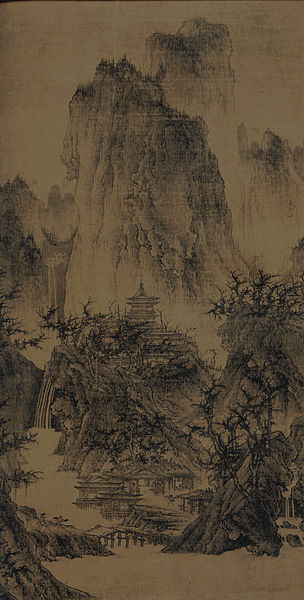
Li Cheng, A Solitary Temple Amid Clearing Peaks, c. 960
Source: Wikimedia Commons

Rather than describe the book as a whole, I will try to convey the atmosphere of its poetry by quoting couplets from seven poems that all have the same title, 'Living in the Mountains'.*    
'Mist rises, separating summit colors;
Rain falls, muting sounds of spring'

'I love pines, and leave the branches
  that hinder other men's way'                                  

'incense from a jade censer
     curls and roils;
water in a stone brook
     burbles and splashes'

'lazily watching white clouds
     rise on jasper peaks;
quietly hearing clear chimes
     fall in murmuring water'

'willow catkins are all flown,
   green shadows merge'

'Clouds break over the land, spring light stirs;
A faint scent of plum blossom, whence does it come?' 

'thinking back on the past,
it seems like madness now.'
Mi Youren, Cloudy mountains, 1130
Source: Wikimedia Commons

Finally, for my own benefit but perhaps of interest to others, here are some notes drawn from Charles Egan's endnotes, forming a brief guide to nature imagery in the anthology.  Some have Chan associations, most would apply more generally to Chinese poetry.
  • Bamboo, pines and plum trees, the 'three friends of winter' were metaphors for 'one who maintains moral principles even in adversity'.
  • Butterflies - a symbol of unreality and uncertainty, from the famous story of Zhuangzi who dreamt he was a butterfly and then, on waking, wondered if he was not really a butterfly dreaming of being Zhuangzi.
  • Chrysanthemums - blooming on into the autumn they became an image of longevity.
  • Cicadas - in Chinese poetry their sound could be optimistic (a symbol of rebirth through the transformation from larva to insect) or mournful, as a sign of autumn.
  • Clouds - might denote the freedom of wandering monks or in other contexts the way that ignorance obscures the true path.  Their shadows symbolised emptiness.
  • Cuckoos - their cry was a sign of separation.
  • Dead trees - no longer subject to change, they symbolised detachment from the world
  • Grass hut - the home of a recluse.
  • Monkeys and gibbons - they conveyed either 'the insatiable curiosity of the uncultivated mind wholly immersed in the world of causation', or the original buddha mind, 'spontaneous and free of time and space'.
  • Peaches - represented immortality; I wrote about the story of the Peach Blossom Spring in an earlier post.
  • Reeds - specifically associated with Chan Buddhism; the First Patriarch Bodhidharma crossed the Yangtze on a reed.
  • Reflections - the illusory nature of reality. In a recent post I mentioned the association in Chinese literature between mirrored pools and the mind.
  • Rivers and streams - crossing them represented the process of enlightenment.
  • Sunflowers - they always face the sun, rather than the wind, just as a Chan practitioner 'should remain focused on the buddha nature'.
  • Vines and lichens - associated with the hermit life.  Descriptions involving the creeping fig (ficus pumila) and bearded lichen (usnea longissima) referred back to the opening lines of 'The Mountain Spirit', one of the 'Nine Songs of Chu'.
  • Waterfalls - traditionally they symbolised dynamism, purity or proximity to the source, but they could also be a rushing torrent of worries preventing enlightenment.
  • White egrets, cranes or stalks - the enlightened mind (the origin of this association is the Daoist immortal Wangzi Qiao who flew on the back of a crane).  The white-on-white of egrets standing in snow was an example of a kind of metaphor showing how different phenomena all ultimately derive from the same Source.
  • White lotus flowers - buddha nature


*  The seven poets:
  • Changda (d. 874), who had 'a purity akin to that of a white heron', wrote eight poems on this theme and lived on Mount Lu
  • Guanxiu (832-912), a famous poet, calligrapher and painter, spent some time in a temple on Mount Shishuang
  • Danxia Zichun (1064-1117), 'of a lofty disposition and stern appearance', was the abbot at various mountain temples
  • Changling Shouzhou (1065-1123), also abbot of several temples and also said to have been stern and severe: 'he gained the nickname Iron Face'
  • Botang Nanya (fl. 12th century), another abbot at different monasteries, he said of this poem: 'True clarity is reflected therein'
  • Hanshan Deqing (1546-1623), a famous Buddhist priest who meditated by a stream on Mount Wutai until he could no longer hear the sounds of spring torrents
  • Yongjue Yuanxian (1578-1657), another eminent priest who was abbot at Mount Gu and later directed charitable relief work during the Manchu invasion.

Friday, February 13, 2015

Of Walking in Ice

A few days before Bruce Chatwin's death in January 1989 he asked Werner Herzog to visit him.  They shared a belief in the restorative powers of walking and Chatwin was convinced that Herzog had healing powers.  Too weak now to rise from his bed, Chatwin nevertheless longed to be out on the road again.  Herzog's account of their conversation appears in Nicholas Shakespeare's biography Bruce Chatwin (1999).  'He looked down at himself and he saw the legs were only spindles and he looked at me in this very lucid moment and he said: "I'm never going to walk again." He said: "Werner, I'm dying." And I said, "Yes I am aware of that." and then he said: "You must carry my rucksack, you are the one who must carry it."  And I said: "Yes, I will proudly do that."'

In 1978 Herzog had published a short book, Vom Gehen im Eis (Of Walking in Ice) that had particularly impressed Chatwin.  'At the end of November 1974', Herzog wrote in its preface, 'a friend from Paris called and told me that Lotte Eisner was seriously ill and would probably die.  I said that this must not be, not at this time, German cinema could not do without her now, we would not permit her death.  I took my jacket, a compass and a duffel bag with the necessities.  My boots were so solid and new that I had confidence in them.  I set off on the most direct route to Paris, in full faith, believing that she would stay alive if I came on foot.'  Herzog set off from Munich and arrived twenty days later, exhausted, to sit by her bedside.  Lotte Eisner made a recovery and lived on until 1983. 

I have created a map that tries to give a visual impression of this elemental journey, through snow and ice (white), rain and water (blue), mist and fog (grey) and the occasional burst of sunshine (yellow).  You can click on each square for a short quote from the book and imagine them read in Herzog's familiar voice: 'The snow lies wet on the fields, darkness comes, all lies barren...'  The black circles record the places he found to sleep: a barn, a stable, a few inns, abandoned buildings and empty holiday homes.  It would of course be possible to derive many alternative maps from the text, marking, for example, moments of physical pain and exhaustion, or fleeting, strange encounters with Herzogian characters, or those points in the narrative where the account of his walk dissolves into descriptions of dreams.


'A rainbow before me all at once fills me with the greatest confidence.  What a sign it is, over and in front of him who walks.  Everyone should walk.'
- Werner Herzog, Thursday 5th December, 1974

Wednesday, August 27, 2014

A hedge of rain to hinder my good fortune


I was reading Dafydd ap Gwilym in a Welsh wood last week.  Many of his nature poems were addressed to a llaitai - love-messenger - like the seagull or the skylark.  As Jay Griffiths wrote in her essay, 'The Grave of Dafydd', 'he sung himself into the land, asking birds, animals and the wind to carry messages to all his well-beloveds.  More yet: the now-printed words echo the print of his body on the land, as he tells of the way that the places where he made love, the crushed leaves and grass, the bed-shapes under the saplings, will remain imprinted on the landscape forever, and on the landscapes of the heart.'

Those trysting places were not always accessible though - sometimes nature thwarted Dafydd's desires.  Finding the River Dyfi in spate he composed a song in its praise in the hope that it would allow him to cross.  On another day it was mist that descended just as the poet was setting out for a liaison with a slender maid.  Here are some lines from the translation of Y Niwl ('The Mist') by Rachel Bromwich (from my book, pictured above, sadly no longer in print).  Even in English I think they convey a vivid sense of fog on the Welsh landscape.


But there came Mist, resembling night,
across the expanse of the moor,
a parchment-roll, making a black-cloth for the rain,
coming in grey ranks to impede me
like a tin sieve that was rusting,
a snare for birds on the black earth,
a murky barrier on a narrow path,
an endless coverlet to the sky,
a grey cowl discolouring the ground,
placing in hiding every hollow valley,
a scaffolding that can be seen on high,
an enormous bruise over the hill, a vapour on the land,
a thick and pale-grey, weakly-trailing fleece,
like smoke, a hooded cowl upon the plain,
a hedge of rain to hinder my good fortune,
coat-armour of the oppressive shower.