Showing posts with label ceramics. Show all posts

Friday, October 16, 2015

A formed handful of earth as mountain and atmosphere

 Hon'ami Koetsu, Fujisan, 17th century
Source: Wikimedia Commons

In his book Zen Landscapes Allen S. Weiss discusses the way Japanese connoisseurs have seen natural forms in the surfaces of pottery.  Two famous examples are Fujisan and Seppo, tea bowls made by the great artistic polymath Hon'ami Koetsu (1558-1637).  On Fujisan the white glaze is said to resemble the snow on Mt. Fuji.  Seppo ('Snow Peaks') is a renowned example of kin-zukuroi (repairing with gold) in which the filled cracks resemble water flowing through melting snow.  Other pots by Koetsu include Amagumo (Rain Cloud) and Shigure (Drizzle).  Weiss observes that 'in Fujisan the pottery surface recasts a formed handful of earth as mountain and atmosphere.'  He writes about the importance of the foot of a vessel, where the unglazed clay is revealed to the drinker, a trace of the earth from which the bowl came. 'This appreciation of clay flavour is not unlike the sense of terroir in French gastronomy, signifying those site-specific characteristics of taste so often evoked in wine connoisseurship.'

There are other ways in which bowls can become a kind of landscape art.  I have mentioned here before for example the music of suikinkutsu, those reverberant vessels placed in Japanese gardens, and made a connection with Wallace Stevens' poem 'Anecdote of the Jar'.  Weiss suggests that pottery objects are subject to the same viewing conventions as other art forms in Japan, and therefore it is relevant to consider the the idea familiar from Japanese gardens of the 'borrowed view'.  He discusses a contemporary sake bowl (guinomi) by Satoshi Sato which has bamboo forms on the exterior and mountain shapes inside.  'In a greatly reduced sense, the guinomi 'landscape' may exhibit such a borrowed view every time it is examined and drunk from.  As the cup is raised, its lip serves as the 'horizon' that links the proximate scene on the front to the 'distant' landscape beyond the lake of sake within, as is the case for the cup by Sato Satoshi, where the bamboo branch forms the proximate field for viewing the distant mountains.  That the sake is transformed into a cascade as the elbow is bent and the guinomi is tilted is rarely an unwelcome effect.'

Sunday, May 06, 2012

Gone fishing

I've been getting interested in the work of Finnish artist Caroline Slotte, who aims to reveal 'the poetry of everyday objects' by reworking found objects, mainly second hand ceramic items. In the examples below, she has cut into and sanded down the dream-like ideal landscapes to be found on discarded plates.  Writing on the V&A blog, Glenn Adamson describes her work as evoking 'the sense of loss and memory that old china often carries in our lives, as it sits silent and half-forgotten in the cupboard.' The museum has an example of her Rose Border Multiple series, in which a set of plates has been cut through and stacked to evoke the 'historical recession of time'.  Looking into these tiny stage sets, like paper theatres, an awareness of their history as mass-produced objects gives way to early childhood memories in which blue and white china plates were an exotic and unfathomable feature of the dining room, with figures that seemed capable of coming to life and landscapes that might allow themselves to be entered into.


Caroline Slotte, Rose Border Multiple, Double Blue II,
reworked second hand object, 2007 
Source: Caroline Slotte, used with permission

Other Caroline Slotte pieces work through a process of erasure, leaving only boats in the Gone Fishing series and cloud patterns in Under Blue Skies.  The former are particularly poignant, where seemingly everything has been forgotten but the presense of a fishing boat. They seem to have sailed into the kind of misty emptiness we associate with Chinese landscape painting, a Taoist void.  In the example below, the tiny vessel appears to be heading past a stain on the plate resembling a low sun seen through fog. (Writing this reminds me that in the previous post here I referred to Leonardo's comment that the artist could turn stains into imaginary landscapes...)  But in Gone Fishing, the landscape, which was nothing more than in fantasy in the first place, has disappeared, and any memories of the plate itself and the story of how it sustained that crack are unrecoverable.


Caroline Slotte, Gone Fishing,
reworked second hand object, 2007 
Source: Caroline Slotte, used with permission

Caroline Slotte is one of several contemporay ceramic artists re-working found objects.  Another is Paul Scott who (like Slotte) features in  Edmund De Waal's The Pot Book, with a piece called Cumbrian Blue(s) Trees in a Fenced Garden (made in collaboration with Ann Linnemann).  The trees are on two porcelain cups and look as if they could come from a Willow pattern landscape but for the small silhouette of an aeroplane above.  The fenced garden is a tray printed with a rolling landscape but surrounded by the kind of railings you would expect to find in a municipal park.  This kind of anti-pastoral pastiche has been used in recent years by designers in various media: the toile wallpaper patterns, for example, of Timorous Beasties and Jessica Smith.  Paul Scott's other designs include Foot and Mouth, Dounreay and Three Gorges After the Dam - a theme addressed by other artists I've mentioned here, in which a Spode bone china Willow pattern plate is mostly submerged beneath the waves.  Pieces like these may provoke a reaction in the spirit of eighteenth century satire, but they have little of the haunting quality to be found in Slotte's reworked objects.  As Edmund De Waal says, her work is engaged in uncovering a mystery, whilst simultaneously contructing a new one.

Sunday, April 18, 2010

A Prospect of Vapourland


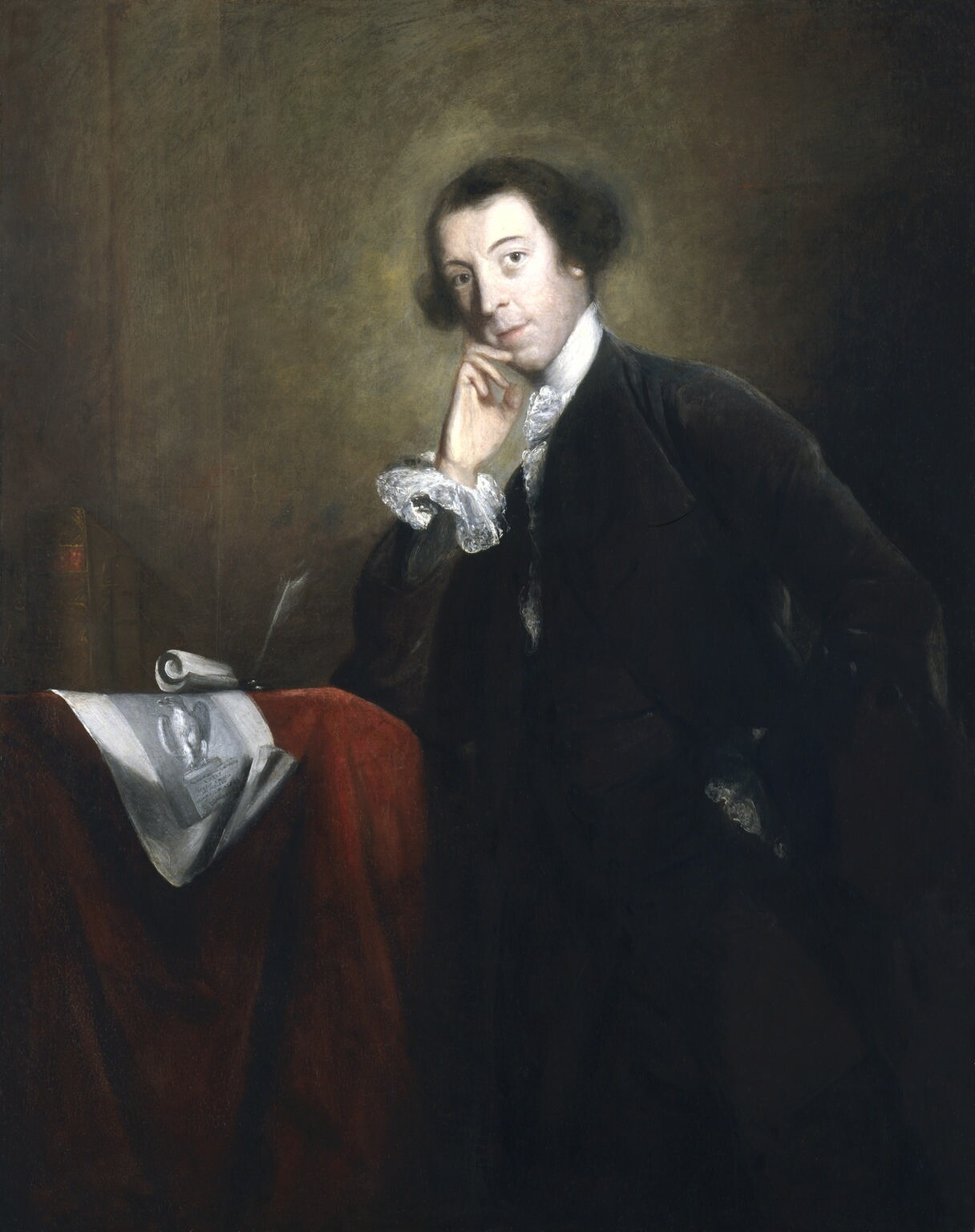
Sir Joshua Reynolds, Horace Walpole, c. 1756-7

You have to love Horace Walpole - aesthete, antiquary, art historian, man of letters, man of enthusiasms, inventor of the Gothic novel and designer of the extraordinary house at Strawberry Hill.  Simon Schama has a good story in Landscape and Memory about the young Walpole seeking out picturesque scenery in the Alps.  Walpole wrote, "I had brought with me a little black spaniel of King Charles’s breed, but the prettiest, fattest, dearest creature! I had let it out of the chaise for the air, and it was waddling along, close to the head of the horses, on top of one of the highest Alps, by the side of a wood of firs. There darted out a young wolf, seized poor Tory by the throat, and before we could possibly prevent it, sprung up the side of the rock and carried him off."  As Schama says, 'Walpole was the son of the formidable Whig prime minister Sir Robert Walpole, and until the lamentable encounter with the wolf had obviously enjoyed having a silk-eared, sycophantic ‘Tory’ in his lap.'

Tory wasn’t the only pet of Walpole’s that met a sticky end. When his cat drowned in a goldfish bowl it prompted Thomas Gray, Walpole’s traveling companion in the Alps, to write his ‘Ode on the Death of a Favourite Cat’ (1748):

‘Twas on a lofty vase’s side,
Where China’s gayest art had dyed
The azure flowers, that blow;
Demurest of the tabby kind,
The pensive Selima reclined,
Gazed on the lake below…

When Selima reached out for a fish she ‘tumbled headlong in. Eight times emerging from the flood / She mewed to every watry god, Some speedy aid to send.’ But all in vain. And thus Gray warned ‘ye beauties’ (women!) ‘not all that tempts your wand’ring eyes / And heedless hearts is lawful prize; Nor all that glisters gold.’

This Chinese vase can be seen in a wonderful exhibition currently showing at the V&A, along with other items from Walpole's collection: Renaissance maiolica, medieval coins, a French suit of armour, an Italian shield, old master paintings, portait miniatures (he was an expert on these), a sixteenth century book of swan marks, Cardinal Wolsey's hat, Dr Dee's mirror, a lock of Mary Tudor's hair and a carved limewood cravat which Walpole wore, together with the 'gloves of James I', to greet a party of guests to Strawberry Hill in 1769.  Some exhibits reminded me of objects I've considered on this blog before.  For example, there were two views of Strawberry Hill by Paul Sandby, part of a Sheldon tapestry, and a cup and saucer in the style of Wedgwood's Green Frog Service with delicate painted views of Richmond Castle, the Mausoleum at Castle Howard and Stoke Gifford in Gloucestershire.  Walpole, like Bruce Chatwin, loved the stories connected with objects.  It's easy to see how desirable, for example, he would have found Alexander Pope's own copy of The Iliad, the very book used to make Pope's celebrated translation.  This small volume has a sketch on the flyleaf drawn by the poet himself, showing Twickenham seen from Pope's Grotto.

Last week I wrote about landscapes viewed from a specific house, where the real subject of the painting is the house itself.  Walpole commissioned sketches of this kind, including a striking View from the Holbein Chamber by Joseph Charles Barrow, in which two figures are seen approaching through a strange tunnel of trees, like characters in a Gothic novel.  However, the most unusual painting in the exhibition is a dream landscape in which a distant hill takes on the form of a lion and a nearby tree is full of snakes. Painted in 1759 by Walpole's friend Richard Bentley, who helped design the Gothick rooms of Strawberry Hill, its title is A Prospect of Vapourland.


Johann Heinrich Müntz, Strawberry Hill, c. 1755-59

Thursday, January 21, 2010

1,244 real Views of Great-Britain

In 1772 Catherine the Great wrote to Voltaire, saying that she loved gardens in the English style: ‘the curving lines, the gentle slopes, the ponds in the forms of lakes, the archipelago on dry land, and I scorn straight lines and twin allées.’  Catherine invited John Busch to Russia to work at Pulkova and then on Tsarskoye Selo, near St Petersburg, where he collaborated with the architect Vasily Neyelov.  It must have been quite a  leap from Hackney, where Busch owned a nursery off Church Street that he sold on to Conrad Loddiges in 1771 (it became famous for its rare plants in the early nineteenth century).  Another landscape architect who went to Russia and contributed to the design of Tsarskoye Selo was Charles Cameron, who later worked for Alexander I and became Architect-in-Chief to the Admiralty.  But perhaps the most extraordinary example of Catherine's anglophile taste in landscapes was the order she placed with Josiah Wedgwood, for a 'Table and Dessert Service, consisting of 952 pieces and ornamented in enamel with 1244 real Views of Great Britain'.

Now 1,244 is not a trivial number and Wedgwood was understandably concerned: 'why all the gardens of England will scarcely furnish subjects sufficient for this sett, every piece having a different subject'.  How he did it is explained by Alison Kelly in 'Wedgwood's Catherine Services', an article for The Burlington Magazine (August 1980).  Wedgwood and his partner Thomas Bentley started with the famous landscape gardens that Catherine was particularly interested in, basing designs on published engravings like Beauties of Stowe, by George Bickham (1750-56) and Chambers's Description of the Gardens and Buildings of Kew (1771), as well as views sent in by sympathetic friends, like Mr Anson of Shugborough.  Stowe, unsurprisingly, provided more views (43) than any other landscape garden.

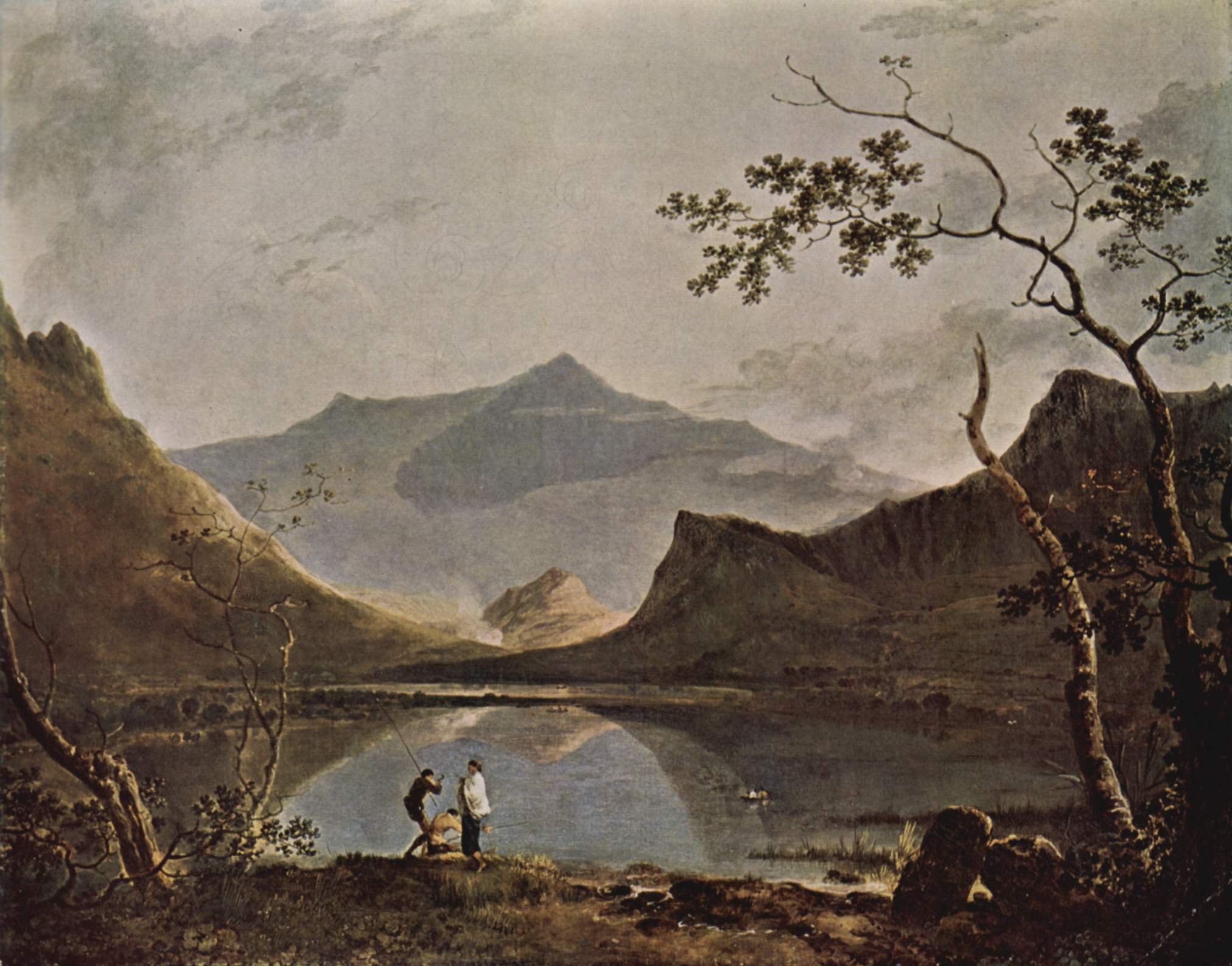
In addition to the nation's most celebrated gardens, Wedgwood and Bentley used images of famous country houses, although Bentley wrote that 'we have purposely omitted to represent the most modern buildings, considering them unpicturesque'.  Picturesque landscapes accounted for a good number of the designs: ruined abbeys, castles (150 of these) and even some early remains: Stonehenge, Kit's Coty House, a Cornish Dolmen and the Roman ruins of Silchester.  Wedgwood and Bentley were also up-to-date with tastes in the Sublime, including various views of the Lake District, the Peak Cavern, the Giant's Causeway and Fingal's Cave.  There is a letter from Wedgwood to Bentley in 1773 asking about Richard Wilson's landscapes: 'Pray have you Wilson's Views from different places in Wales? If you have not, Mr. Sneyd will lend them us'.  Alison Kelly writes that 'after reading this letter it is pleasant to recognise on a dish the unmistakable outlines of Wilson's Snowdon from Llyn Nantlle.'

Richard Wilson, Snowdon from Llyn Nantlle, c1766

Given their role in the Industrial Revolution it is interesting that a few of the pieces feature such scenes as Papermills at Rickmansworth, a Colliery and Pump near Bristol and the Dock at Plymouth.  However, urban views are largely absent, with the notable exception of London.  You can see a plate from the dinner service showing Somerset House on the Hermitage website (there don't seem to be any non-copyright images available to put up here).  Other obvious London highlights included Kensington Palace, the Mall and Horseguards Parade but there were also a few views from the fringes of the city - Erith, Sunbury, Shepperton.  Mention of Shepperton made me wonder what a contemporary 952 piece Ballardian dinner service might look - traffic islands, car parks, terminal beaches, abandoned hotels...

Eventually Wedgwood and Bentley had got together all 1,244 views and the completed service went on show in London before being sent to Russia.  Apparently this was a great social success, as people were came to see whether one man's country estate featured more prominently than another's.  When it arrived, Catherine the Great was satisfied and used it for state occasions in the Chesmenski Palace. But after her death it was eventually forgotten about and only rediscovered at the beginning of the last century, when nearly 800 pieces were found to have survived.

Sunday, November 01, 2009

Sarayama

One of the ways we can view artists as having affected the physical landscape before the advent of land art is through their requirement for raw materials.  The marble quarries of Carrara and Pietrasanta, for example, were partly the creation of Michelangelo.  A less dramatic but still significant impact on local areas comes from the concentration of artists living and working there - whether it be Montmartre or Pont Aven.  And a combination of these influences can be found in villages or distrcits devoted to particular crafts.  Here is a paragraph from Brian Moeran's Folk Art Potters of Japan in which he describes the soundscape of Sarayama.

'Ever since Sarayama was founded, wooden crushers have been used to pound the clay with which generation after generation of potters have worked. The two streams running through the village have been stepped in a series of five-to-six foot dams the whole length of the valley, and water is drawn from these along channels to the crushers. Each crusher is made from a large pine-tree trunk between four and five metres in length, with one end hollowed out into a scoop. Into this the river water is director. The crusher is critically balanced on a cross-axle of wood, so that when the scoop is filled the weight of the water makes the crusher seesaw down toward the river bed. As the other end of the pine beam rises high into the air, the water flows out of the scoop and the crusher falls back with a thud onto a mound of clay piled under the far end. The noise that the crushers make cannot be expressed adequately in words. It is this sound that dominates everything that goes on in the valley, all day, all night, every day and every night, except for one respite of 24 hours from the New Year’s Eve. The potters can tell from the changes in the thudding rhythm of the day how much water is in the streams, whether their crushers are working, and if so, how efficiently. These pounding pine trunks… belong to a world of which people living in industrialised urban Japan can only dream.'

Sunday, October 21, 2007

Poems of moon and breeze

Yesterday we went to look at the Korean moon jar on show at the British Museum. It was bought in 1935 in an antique shop in Seoul by Bernard Leach and subsequently lent to Lucie Rie. As the BM site says, ‘When Leach saw the jar in Rie's studio, he decided that it should remain there.’ There is an article about the exhibition at the London Korean Links site.
  
One of the wall captions mentions the particular significance of the moon in Korean culture. I put “Korean Moon Poem” into google and the first thing that came up was “we are very pleased to advise that... Brigitte Bardot has taken up the cause of Korea's moon bears...” Turning instead to my copy of Peter H. Lee’s Columbia Anthology of Traditional Korean Poetry, I had a look through to see how the moon had been treated in the nature poetry of Korea. It doesn’t seem to me to be a dominant theme, but it is a strong element in many of the poems. For example, there is Songs of Five Friends by Yun Sondo (whose verses making up The Angler’s Calendar (1651) I have mentioned here before); the five friends are water, stone, pine, bamboo and the moon. For Yun the moon’s appeal lies in the way it sees everything, but says nothing.

The moon also features in some of the poems of scholarly retreat written by Neo-Confucian philosophers in the previous century. The moon’s brightness and the wind’s freshness provide the setting for peaceful thought, far from the cares of the city. Kwon Homun mentions the clarity provided by ‘the windy air and bright round moon’, while Song Hon says ‘a clear breeze has no price, the bright moon no lover.’ Yi I (1536-84) writes ‘my study by the water, how cool and clean! Here I will discuss learning and make poems of moon and breeze.’ These lines are in the fifth of his Nine Songs of Mount Ku, which describe a series of inspirational landscapes: Crown Rock, Flower Rock, Emerald Screen, Pine Cliff, Hidden Screeens, Fisher’s Gorge, Maple Rock, Zither Shoal and Mount Mun.

Moon Jar in the National Museum of Korea