Showing posts with label the moon. Show all posts

Sunday, June 30, 2024

A thickening flurry


Determined now to rid ourselves of Netflix and save some money, we have started watching a few last films that we hadn't got round to before cancelling: last night it was Charlie Kaufman's I'm Thinking of Ending Things (2020). At some points in this, Jessie Buckley's character is a landscape painter (I won't spoil the story by explaining why I say "at some points"). There is an awkward conversation over dinner at the parental home of her boyfriend Jake (Jesse Plemons), where she tries to explain that she imbues landscapes with "interiority". David Thewlis, Jake's father, says he wouldn't understand a landscape to be sad unless there was a sad person in the painting looking at it. Elsewhere in the house there is a reproduction of Friedrich's Wanderer above the Sea of Fog (1818) - a man looking at a landscape, but one that is so obscured in mist that it may not even exist. Jake's father will descend (or has descended) into dementia, gradually forgetting everything. Plemons and Buckley spend a lot of the film surrounded by darkness and a blizzard of snow.  

When Jessie Buckley pulls up some images of her paintings on her phone to show the parents, they are actually by Ralph Albert Blakelock (1847-1919) - later we see posters of his work in Jake's basement. Blakelock was a fairly obscure painter until late in life when his work began attracting attention and started selling for high prices. But he never got to enjoy the recognition - he had succumbed to mental illness in the 1890s and spent his last two decades in institutions suffering from schizophrenic delusions. There are echoes of this in I'm Thinking of Ending Things, with Jake's feelings of paranoia and the way he slips into an elaborate fantasy at the film's climax (winning the Nobel prize on the set of Oklahoma!) 

Ralph Albert Blakelock, Moonlight, c. 1885-89 
Source: Google Art Project
 

This Blakelock painting in the Brooklyn Museum also features in Moon Palace, a novel by Paul Auster, whose work occupies a similar territory to Kaufman (I've been an admirer of Auster since New York Stories and was sad to read of his death in April).  'A perfectly round full moon sat in the middle of the canvas - the precise mathematical center, it seemed to me - and this pale white disc illuminated everything above it and below it: the sky, a lake, a large tree with spidery branches, and the low mountains on the horizon...' I won't quote the full ekphrasis, although you can find the extract on a website for German English teachers. Instead I'll end here with the moment Auster's protagonist starts to notice something odd about the painting.

The sky, for example, had a largely greenish cast. Tinged with the yellow borders of clouds, it swirled around the side of the large tree in a thickening flurry of brushstrokes, taking on a spiralling aspect, a vortex of celestial matter in deep space. How could the sky be green? I asked myself. It was the same color as the lake below it, and that was not possible. Except in the blackness of the blackest night, the sky and the earth are always different. Blakelock was clearly too deft a painter not to have known that. But if he hadn't been trying to represent an actual landscape, what had he been up to? I did my best to imagine it, but the greenness of the sky kept stopping me. A sky the same color as the earth, a night that looks like day, and all human forms dwarfed by the bigness of the scene - illegible shadows, the merest ideograms of life...

Friday, June 25, 2021

Untitled (Moon Image)


The oceans and deserts of Vija Celmins are monochrome patterns of pencil marks and brush strokes - no landmarks, just abstract surfaces. She may have looked at particular sites but the artworks only reproduce her photographs, or photographs taken by others - landscape at two removes. Their sources are hidden in titles like Untitled (Desert) and Untitled (Ocean). Nevertheless, the patience and attention needed to make her art seems to ask questions about how closely we attend to the world and really spend time in a particular environment. Observational drawing has a long history - Briony Fer cites the examples of Dürer's Large Piece of Turf and Ruskin's advice in The Elements of Drawing in her essay in Vija Celmins: To Fix the Image in Memory (ed. Gary Garrels). But art of this kind is closer to still life than landscape. Celmins' drawings of the sea are each 'a graphic rendering of a ready-made image and not a record of the vastness of the ocean.'    


A page from Vija Celmins: To Fix the Image in Memory showing moon drawings from 1968-9


One sentence from another essay in this book by Russell Ferguson particularly struck me. In discussing Celmins' early paintings he suggests that 'T.V. (1964) shows an everyday object from the studio - a television set - but a very contemporary one: this is probably one of the earliest representations of a TV in painting.' If this is true it is remarkable to think that art can have ignored such an important object in people's lives for twenty years. One could also say that in the late sixties Celmins was one of the first artists to depict the landscape of the moon, although her drawings of NASA photographs are clearly at second hand, deliberately reproducing the blurring and imperfections in the source images. In this way they are quite different from the pastel drawing John Russell made nearly two centuries earlier using a telescope, which despite the vast distance was based on direct observation. 


John Russell,  The Face of the Moon, 1793-97

Friday, July 19, 2019

Lunar surface and horizon

Apollo 11 Mission image - Lunar surface and horizon
Source: Internet Archive
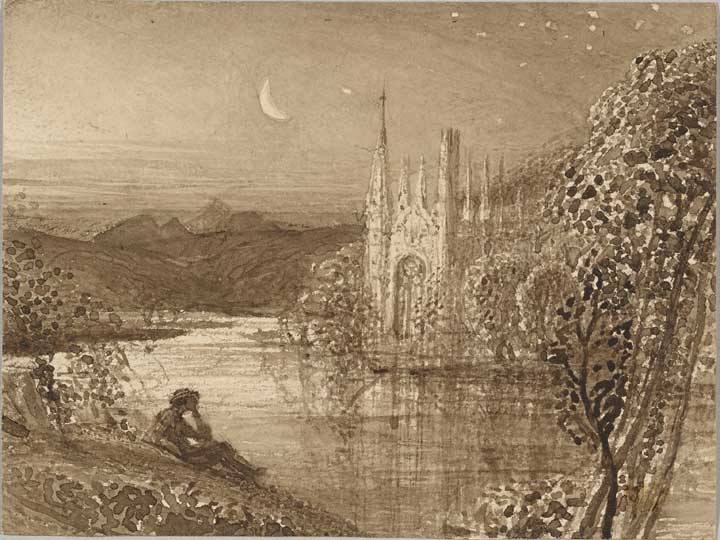
Tomorrow is the fiftieth anniversary of the moon landing and it feels too momentous to let it pass without mention on this blog.  I have written here before about landscape art and poetry in which the moon plays a central role, like the poetry of Du Fu, the drawings of Samuel Palmer or the long-exposure photographs of Darron Almond.  I have also mentioned here the lunar landscape itself, as imagined by artists before the Apollo programme, like Chesley Bonestell who painted a mural for the Boston Museum of Science, and then photographed by astronauts from orbit and the surface of the moon.  Jonathan Jones (or his Guardian sub-editor) recently called the shots taken by Armstrong and Aldrin 'the greatest photographs ever'.  In Armstrong's images of Aldrin, 'his scientific work seems ritualised and meaningless. It’s the astonishing fact of being on this desolate landscape that we’re drawn to.'


There are photographs of the moonscape from the Apollo 11 mission in which the astronauts do not feature.  They have an austere beauty, despite the absence of colour or any significant landforms.  The ones I have embedded here resemble Rothko's black paintings.  Paintings of the lunar surface have been made by the fourth man on the moon, Alan Bean, who pursued a career as an artist after retiring from NASA in 1981.  He has incorporated dust from the lunar surface into some of these. Here is what he has written about his influences:
"I have been inspired by other explorer artists such as Thomas Moran and Albert Bierstadt and Frederick Remington and Charles Russell. As the first artist on another world, I believe I am doing the same thing for the opening of the universe that they did for the opening of the American West, that my painting will satisfy the human need to record and remember new beginnings."


Naturally the anniversary of the moon landing has prompted various art events, like The Met's exhibition, 'Apollo's Muse'.  Last month, James Attlee wrote a piece on artists and the moon, appropriately for Apollo Magazine, mentioning the Katie Paterson piece I discussed here recently, Earth-Moon-Earth (Moonlight Sonata Reflected from the Surface of the Moon). Moon-related music is a theme at this year's Proms, which opens with Zosha Di Castri's 'Long Is the Journey - Short Is the Memory', a piece partly inspired by the famous moon poems of Sappho and Leopardi.  There's an acclaimed documentary that I haven't seen yet, Apollo 11, and many new or reissued books about the mission. The photograph below shows two of my own books - a Penguin Special published in 1969 that my father passed on to me and Andrew Chaikin's superb account of the Apollo programme.  Chaikin carries the story all the way through to Apollo 17 and it is noticeable how much emphasis there was on geology in those final missions.  With no life to discover, the moon landings became increasingly focused on the moon's grey landscape, and eventually there was not enough interest in this to keep the Apollo programme going. 

Sunday, May 05, 2019

A place that exists only in moonlight

Katie Paterson, Inside this desert lies the tiniest grain of sand, 2010
Photography was permitted: this is my photograph of her photograph

We recently took the train down to Margate to see the exhibition A place that exists only in moonlight: Katie Paterson & J.M.W. Turner.  I last mentioned Paterson's work here nearly ten years ago when I saw her talk at a conference:
She described a work completed only last week, Inside this desert lies the tiniest grain of sand, which had involved returning to the Sahara desert a grain of sand that had been chiseled to 0.00005mm using the techniques of nanotechnology.  At extreme magnification the grain of sand resembled a planet and presumably the chiseling process could have created some nano-land art - a microscopic Spiral Jetty or near invisible Double Negative.  The point was made (by Brian Dillon) that she brings a necessary sense of humour to art that deals with cosmic scales of space and time. 
As can be seen above, the Turner Contemporary exhibition included a large black and white photograph of this work, showing the artist returning her tiny artwork to the desert.

Most of Paterson's work has been on a cosmic or planetary scale and therefore doesn't really qualify as landscape art.  For example,
  • Fossil Necklace (2013), my favourite piece in the show, in which time is considered as a circle of beads, charting the evolution of life on earth from its monocellular origins. You can view every bead individually on the artist's website
  •  
  • Earth-Moon-Earth (Moonlight Sonata Reflected from the Surface of the Moon) (2007), where Beethoven’s Moonlight Sonata was translated into Morse code and sent to the Moon and back. Craters on the moon fragmented the signal, leaving gaps in the music.
  • The Cosmic Spectrum (2019), a colour wheel designed to show the colour of the universe at each point in its development (the exhibit was broken and didn't rotate when we were there, but this might have made it easier for us to study it).  It resembles Olafur Eliasson's Turner Colour Experiments, shown at the Tate in 2014 (see my earlier post).
Turner's work was interspersed with Paterson's and included some marvellous studies inspired by light, such as Moonlight on the River (1826) and ? Boats at Sea (c. 1830-45), both from the Tate's collection.

 J. M. W. Turner, Moonlight on the River, 1826

 J. M. W. Turner, ? Boats at Sea, c. 1830-45

There is also a new book, A place that exists only in moonlight, published to coincide with the exhibition but oddly not on sale at the gallery itself (you have to send off for it and I have not (yet) done this).  It comprises short texts that describe artworks that can exist only in the imagination.  Some were placed on the wall, like the one below, which reads like a landscape haiku.  These reminded me of the work of her fellow Scottish artist-poets Thomas A. Clark and Alec Finlay.  As instructions for art projects, they are like the walking proposals of Richard Long, or indeed any of those texts of conceptual artists, writers and composers who have been interested in exploring space and time, light and substance.  Just one example that springs to mind as I write this: La Monte Young's Composition 1960 #15: 'This piece is little whirlpools out in the middle of the ocean.'  Someone could compile an anthology of such works, although they would probably seem less inspiring out of context.  Among the 'Ideas' on Katie Paterson's website, I particularly like A beach made with dust from spiral galaxies, Gravity released one unit at a time and, of course, A place that exists only in moonlight.

Saturday, April 22, 2017

The voice of the north wind sad

Zhang Fengyi as Cao Cao in John Woo's Red Cliff (2008-9)

In a post earlier this month I referred to the musical duel in Red Cliff, John Woo's epic film about  events at the end of the Han dynasty, based on 'the Iliad of China', The Romance of the Three Kingdoms.  The composer/writer I discussed there, Cai Yong, only briefly features in The Romance of the Three Kingdoms and doesn't appear in Red Cliff, but here I want to focus on Cao Cao, the great warlord at the heart of the story, whose army is defeated spectacularly in the movie.  Cao Cao was himself a renowned poet and wrote a famous poem just before the Battle of Red Cliff.  You can see him recite it in the clip from YouTube below - a scene from the 95-episode Chinese TV dramatisation Three Kingdoms.  This moment has often been depicted in art - there is a painting in the Long Corridor of the Beijing Summer Palace, for example, and I have reproduced below a Japanese ukiyo-e print showing Cao Cao composing the poem in a boat, with the moon rising and crows wheeling in the sky.


Tsukioka Yoshitoshi, Moon rising over Mount Nanping, contemplated by Cao Cao, 1885

The real reason for mentioning Cao Cao on this blog is not his eve-of-battle composition, but a beautiful short poem 'Viewing the Ocean', which is an early example in world literature of pure landscape poetry.  Here are the first six lines in Burton Watson's translation; the Jieshi (Chieh-shi) mountains overlook the Bohai Gulf.
East looking down from Chieh-shih,
I scan the endless ocean:
waters restlessly seething,
mountained islands jutting up,
trees growing in clusters,
a hundred grasses, rich and lush.
Other translations of the full poem can easily be found online (there are two on a Chinese Poems site for example).

Another poem of Cao Cao's that has stayed with me over the years (since reading it in Burton Watson's The Columbia Book of Chinese Poetry) is the 'Song on Enduring the Cold'.  This was probably written in 206 when Cao Cao was leading his troops across the Tai-hang mountains to attack a rival.  Taken out of context though, it could simply be a description of an arduous mountain journey - 'stark and stiff the forest trees, the voice of the north wind sad.'  The poem ends with a literary allusion, to 'that song of the Eastern Hills', a 'troubled tale that fills me with grief.'  It is a reference to a song in the Classic of Poetry (No. 156), attributed to the Duke of Zhou.  He had also been on a military campaign in the East, over a thousand years earlier, c. 1040 BCE (as distant from the time of Cao Cao as we are from Charlemagne).  I'll end here with the refrain from this ancient poem, repeated at the start of each verse (trans. Stephen Owen):
We marched to those eastern mountains,
streaming on and never turning.
And now we come back from the east,
in the pall of driving rain.   

Sunday, November 20, 2016

Autumn on Mount Oshio

ÅŒtagaki Rengetsu, Autumn Moon, 1870
Source: Wikimedia Commons

I've been very busy this week, but I just have time for a short post to recommend the website of The Rengetsu Foundation Project, which is dedicated to one of Japan's most fascinating cultural figures.  ÅŒtagaki Rengetsu's achievements were so various that she is hard to classify - in his primer How to Look at Japanese Art, Stephen Addiss decides to place her in his chapter on calligraphy, but she was equally famous for her waka poetry and ceramics (Rengetsu ware).  She was also skilled in painting, dance, sewing and the tea ceremony.  Not only that, but in her youth, before becoming a nun, she was a famous beauty proficient in the martial arts - sword, spear and sickle and chain - having been adopted as a child by a family known for training ninjas.  However, the Foundation site's biography explains that 'she was a pacifist, advocating mutual respect and gentle persuasion in resolving conflict.'  In her middle years she travelled widely and landscape is treated in many of her poems, brushed or carved onto pots and presented as calligraphy on tanzaku and shikishi paper.

The Rengetsu Foundation has 917 poems in a searchable database; I see that 133 of them, for example, contain the word 'mountain'.  I will quote just one of the translations below.  As I write this, I can hear the cold wind outside and it feels like we are nearing the end of autumn... 

Piercing my body
   the sad departure of autumn
      on Mount Oshio...
   where red leaves fall—
      the withering wind.

Friday, April 22, 2016

The Black World


I did a post here back in 2010 about Trevor Paglen, the artist-geographer who has explored the 'black world' of US military and intelligence agencies.  I focused then on his 'limit telephotography' in which restricted landscapes, cut-off and unseeable with the naked eye, can be glimpsed using high-powered telescopes.  Today I popped into an excellent small exhibition of his work to coincide with the Deutsche Börse prize (like the exhibition of Richard Mosse photographs I described here two years ago).  Three exhibits of particular interest from a landscape perspective:
  • They Watch the Moon (2010), which you can see above in the window of the Photographers Gallery, is a beautiful vista of hills completely covered in rich green vegetation.  At their centre, a constellation of artificial lights and the dishes of telescopes arranged in a circle like orbiting moons.  In an essay on Paglen's work, 'Visiting the Planetarium: Images of the Black World', Brian Holmes has written of this photograph that whilst we may see in it something grand, an image of the cosmic relation of earth and sky, in fact 'the radio telescope depicted is devoted to banalities: it picks up stray cell-phone conversations bouncing off the lunar surface from halfway around the globe.'
  • Untitled (Reaper Drone) 2010, is just as visually stunning: a late-Turner swirl of yellow light - the desert sky near Las Vegas - and caught in the image the tiny silhouette of military drone.  This series of photographs, the curators explain, are achieved with a large-format camera trained on the sky: 'when the film is developed, small insect-like drones are peppered throughout the images.'  There is another, Untitled (Predators), not in the exhibition, which could be a high cirrus sky over Suffolk - an ominous contemporary version of Constable's cloud studies.
  • NSA-Tapped Fiber Optic Cable Landing Site, Marseilles, France (2015) partly comprises another large-scale landscape photograph, juxtaposed with a nautical map onto which various diagrams and images have been pinned like the visual prompts on a crime investigation board.  The view of rocky islands in the bay of Marseilles inevitably brings to mind The Count of Monte Cristo, a novel that features surveillance, secret locations, political plots and, here where the NSA-tapped cable came ashore, the fortress prison where the novel's hero is cut off from all communication with the outside world. 

Paul Cézanne, The Bay of Marseilles from L'Estaque, c. 1885
(a postcard of this painting is one of the items Paglen has attached to the map of Marseilles)

Having written this I see that the Photographers Gallery have just today posted an interview with Paglen on their website.  In this clip, embedded here, he talks in front of the map of Marseille about the way his work aims to make visitors look at the world more closely and more suspiciously.

Friday, January 09, 2015

Hunger Mountain


In the clip I've embedded above, David Hinton introduces his book Hunger Mountain (2012)The eponymous peak is in Vermont, where Hinton lives and works on the translations of Chinese poetry often referred to here (see for example this post from 2006: 'Lit dew shimmers').  Hunger Mountain uses walks on the mountain to frame a discussion of the 'spiritual ecology' he has found in the old poets and philosophers. It begins with the notion of 'sincerity', expressed as a character that combines a person standing and words rising from a mouth.  Although he doesn't mention it, this Confucian term is also the first Chinese character in The Cantos, where Ezra Pound applies it in praise of the sixth US president John Quincy Adams.  Hinton uses it to discuss 'a more fundamental sense of sincerity as an identification of outside and inside', a deep feeling of belonging to the cosmos.  This is evident, for example, in Tu Fu's poem 'Moonrise' (a different poem to 'Full Moon', which I quoted here in an earlier post on moonlit landscapes). 'Moonrise' doesn't simply project an emotion into the landscape, it describes a fundamental identity between the poet and the world. By the time Tu Fu wrote his poem, the character for 'friend' was being written as it still is as two moons side by side (below).  Hinton sees a form of 'friendship' in the way Tu Fu, his modern reader and the wider cosmos are united through contemplation of the moon.


The idea that consciousness is like a lake or mirrored pool is common in Chinese literature.  One of the four masters of southern Sung poetry, Yang Wan-li, wrote of the lake's 'mind': a gaze 'holding the mountain utterly.'   The character for mind is derived from the image for a heart, suggesting that thinking and feeling are deeply connected.  'Thinking' is written as this symbol for heart-mind underneath the character for 'fieldland'.  'Feeling' is a stylized version of the heart-mind symbol written next to the character for the blue-green of landscape.  In light of this it seems unsurprising that poets expressed themselves by writing directly about nature.  Hunger Mountain is quite dense in places with speculations on the connection between language and natural processes, something that has fascinated poets since Ezra Pound published Ernest Fenollosa's The Chinese Written Character as a Medium for Poetry in 1918.  It is a subject I have written about here before in connection with Cecilia Lindqvist's wonderful book China: Empire of Living Symbols.  The extent to which these ideas are widely accepted is something I am not qualified to judge, but they are certainly inspiring to read about.

It remains possible that even poetry drawn directly from the the rivers and mountains will be a kind of barrier.  Hinton talks about the risk that ultimately 'we can say nothing about the world without creating in some sense a breach between consciousness and landscape'.  In one of his many wine poems the poet T'ao Ch'ien, discussed in an earlier post here, wrote that whenever he started trying to explain Lu Mountain, 'I forget words altogether'.  Lu Mountain is the range of peaks that have been central to Chinese landscape poetry (the subject of another post here). Throughout the book Hunger Mountain stands in for Lu and Hinton tries to learn, like the poets, from his frequent walks to the summit. Su Tung p'o, who came to Lu seven centuries after T'ao Ch'ien, stayed at the East Forest Monastery, but said he learnt more from the mountain's streams and mirrored pools.
'Su Tung p'o established himself as a master of Tao's mental dimensions when he described flowing waters as the form of mind negotiating the exigencies of life, a spontaneous and crystalline responsiveness working its way through, taking shape according to whatever it encounters.  This is mind moving through the occasions of its attention like water through stones and branches and colourful leaves, adapting itself to the forms it encounters, becoming sometimes loud and othertimes silent, sometimes seething with light and other times lost in shadow.'
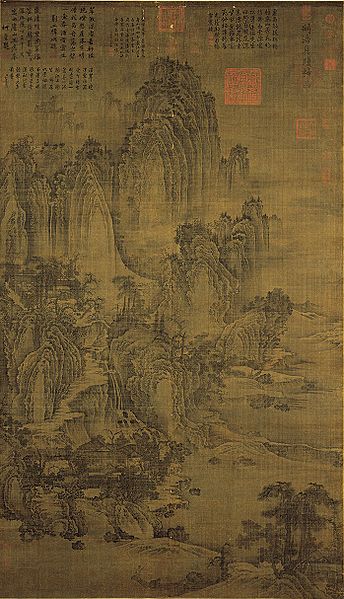
Attributed to Jing Hao, Mount Lu, c.900

Friday, October 10, 2014

In the Sierra

All day cloud shadows have moved over the face of the mountain,   
The shadow of a golden eagle weaving between them   
Over the face of the glacier.
At sunset the half-moon rides on the bent back of the Scorpion,   
The Great Bear kneels on the mountain.
Ten degrees below the moon
Venus sets in the haze arising from the Great Valley.
- from 'Fall, Sierra Nevada' in 'Toward an Organic Philosophy' (1940) by Kenneth Rexroth (the full poem can be read at the Poetry Foundation)


In the Sierra: Mountain Writings collects the poems Kenneth Rexroth wrote about his years exploring the Sierra Nevada, along with extracts from his autobiography, newspaper columns and a practical guide to camping in the Western Mountains.  Its editor Kim Stanley Robinson is well known for science fiction that explores environmental themes, often involving mountain climbing - similar in some ways to M. John Harrison, the British science fiction writer and climber I talked about here last year.  Robinson provides endnotes that try to place the poems, speculating on the trails Rexroth must have taken and the vantage points from which he describes the landscape.  There is also a short piece at the end of the book by another Californian SF writer and 'amateur astronomer' Carter Scholz, that tries to locate the poems in time using Rexroth's frequent references to stars and planets.  For example, using information in the poem quoted above he deduces that Rexroth was camping on September 28th 1938 'at Lake Catherine, from which the San Joaquin ("Great") Valley is also visible; from this vantage Ursa Major would have been "kneeling" above Mount Davis to the northwest."

For me this astronomical detective work only serves to emphasise what becomes evident when you read through these poems, that for Rexroth the mountain landscape extends out into space.  Camping out on a high trail he already had a long view: 'Looking out over five thousand / Feet of mountains and mile / Beyond mile of valley and sea.'  Then, as night falls, he could lie back and study the stars.  This poem is 'The Great Nebula of Andromeda', one of a group called 'The Lights in the Sky are Stars', written for his young daughter Mary.  The Poetry Centre Digital Archive has a recording of Rexroth reading these poems in 1955 (he breaks off to tell his listeners what they could see if they looked up at the constellation of Hercules, apologising that 'the finer details of astronomy may escape a miscellaneous audience.') The final poem in this sequence is 'Blood on a Dead World', describing Mary's excitement at viewing an eclipse (Carter Scholz pins this to 6:30pm on January 18 1954).  Earlier this week the same phenomenon, a 'blood moon', was visible over America and Asia.  Rexroth stands in wisps of fog and watches with his daughter as the moon slowly darkens.
        "Is it all the blood on the earth  
        Makes the shadow that color?"  
        She asks. I do not answer.

Wednesday, July 02, 2014

A Prospect of Wales


Last year I asked here 'why isn't the art of Recording Britain better known?'  Well Sheffield's Millenium Gallery is currently hosting a touring exhibition devoted to Recording Britain, with some of the original paintings from the 1940s set alongside earlier topographical watercolours and recent landscape art by people like Richard Long, Keith Arnatt and Ingrid Pollard.  A display case has books from the period, including A Prospect of Wales (1948), one of the old King Penguins (like John Piper's book on Romney Marsh which I described in  another post last summer). This book has illustrations by Kenneth Rowntree, whose contributions to the Prospect of Britain project were often quite unusual, e.g. The Smoke Room, Ashopton Inn, Derbyshire (1940) - a rather unprepossessing interior with dartboard, wall calendar and a fish mounted in a case. The accompanying essay is by Gwyn Jones, who founded The Welsh Review, wrote novels and translated Icelandic sagas.  Seeing this in the exhibition, and having just booked a week's holiday in Wales this summer, I thought I would get hold of a copy.

The title, A Prospect of Wales, sounds paradoxical - how is it possible to see the whole country?  To some extent Gwyn Jones' essay represents a kind of landscape writing I've mentioned here previously, the imaginary prospect which begins with the local and then spreads out far beyond the limits of sight.  Jacquetta Hawkes does this in A Land, which was published three years later than a A Prospect of Wales; as I wrote in an earlier post here, 'the book ends with 'A Prospect of Britain', from the city streets round her home in Primrose Hill to the different landscapes of Britain described in the order they were created: the chalk Downs, the Cotswold's, the West Riding, the Lake District.'  Another example: Virginia Woolf's Orlando (1928), whose hero/ine is able to climb a hill so high 'that nineteen English counties could be seen beneath; and on clear days thirty or perhaps forty, if the weather was very fine.'  And another, which I have not mentioned here before because it takes the reader completely beyond 'some landscapes': Olaf Stapledon's vision of the cosmos in Starmaker (1937), a book that begins with a view of suburbs and the sea's level darkness, and the opening sentence: 'One night when I had tasted bitterness I went out on to the hill.'  A Prospect of Wales begins, by contrast, 'I have just come down from the hill fronting my house in mid-Cardiganshire', but a few pages later he is asking us to ascend again to a point where 'we may survey with swinging glance the western counties of Wales.'


In my photograph above, the book is open at two of Kenneth Rowntree's illustrations of Pembrokeshire, which is where we will be heading next month.  'This is a coast,' Jones writes, 'soaked in colour and radiant with light.'  He quotes Graham Sutherland's essay 'A Welsh Sketchbook', which had appeared in Horizon in 1942: 'The quality of light here is magical and transforming - as indeed it is in all this country.  Watching from the gloom as the sun's rays strike the further bank, one has the sensation of the after tranquillity of an explosion of light; or as if one had looked into the sun and had suddenly turned away.'  I will no doubt have more to say about Sutherland and his Pembrokeshire paintings after we've explored this landscape. I'll conclude here with four lines of Welsh poetry quoted at the end of A Prospect of Wales which encapsulate what Jones sees as the real essence of the country, to be found 'not in the famed vistas ... but in some corner of a field, a pool under a rock, in a bare sheep-walk or a cottage folded in a gulley.'  The poem is by Hedd Wyn and Jones translates these lines as follows: 'Only the purple moon at the edge of the bare mountain, and the sound of the old river Prysor singing in the valley.'
Dim ond lleuad borffor
Ar fin y mynydd llwm,
A sŵn hen afon Prysor
Yn canu yn y cwm 

Sunday, April 27, 2014

The Ruins of Hohenbaden

 
Carl Philipp Fohr, The Ruins of Hohenbaden, (1814-15)

Today was the last day to see A Dialogue with Nature, an excellent little exhibition at The Courtauld which included works from New York's Morgan Library & Museum that I'd not seen before, like Carl Philipp Fohr's 'jewel-like watercolour', The Ruins of Hohenbaden (1814-15).  I was particularly fascinated to see German paintings and drawings like this alongside those by familiar British names (Cozens, Girtin, Turner etc.).  Three more examples: Caspar David Friedrich's The Jakobikirche in Greifswald as a Ruin (c. 1817), the kind of nineteenth century 'anticipatory ruin' highlighted in the Tate's current Ruin Lust exhibition; Theodor Rehbenitz's strange little Fantastic Landscape with Monk Crossing a Bridge (c. 1826-30), a throwback to the style of Dürer's woodcuts; and the composer Felix Mendelssohn's sketchbook for 1837-9 open to show that popular Romantic trope, the view from a window.  Although there were few surprised in these British and German artists' subject matter, the exhibition conveyed a wonderful sense of technical creativity in the means used to engage in 'a dialogue with nature'.  I left with a mental list of ways in which an innovative artist of the period might demonstrate a distinctive landscape vision...

  • Use stylised strokes...  I have written here before about the vocabulary of marks used by Chinese landscape painters and named after the natural phenomena they resembled, like tan wo ts’un – 'eddies of a whirlpool'. The Courtauld curator drew attention to the foliage in Johann Georg Wagner's Wooded landscape with stream and oxcart on road (1760s), depicted using 'whirls and coils in a lively, almost calligraphic manner', a device which 'imbues this tranquil scene with vitality and movement.'  Wagner didn't have a chance to develop his style, dying at the age of just twenty-two (the same age at which Carl Philipp Fohr was killed, after an accident swimming in the Tiber). 
  •  
  • Use a 'stump'...  This was how Thomas Gainsborough, in Wooded Upland Landscape with Cottage, Figures and Cows (c. 1785), created subtle shades of grey on the road leading into the picture, the walls and the trees beyond and the distant hills and clouds in the background.  By rubbing a tightly rolled stump of leather or paper over the surface he left areas of soft shadow that contrast satisfyingly with the grainy texture of the unsmoothed chalk elsewhere in the landscape. 
     
  • Add gouache and gum arabic...  Mainly self-taught, Samuel Palmer also used distinctive ways of applying ink and paint, like the stippled trees in The Haunted Stream (c. 1826).  But what's really striking about another experiment, Oak Tree and Beech, Lullingstone Park (1828), are the different materials used. The extraordinary fiery evening light in the depths of the trees is 'yellow watercolour over white gouache, to which he applied gum arabic, imparting shine, and occasional dots of red watercolour.'
     
  • Choose coloured paper... The exhibition included one of Constable's cloud studies in which, it appears, he had insufficient time to record all the gradations of colour.  Nearby is one of the 150 cloud studies made by his German contemporary Johann Georg Dillis, executed with white chalk on blue paper so that he could avoid the issue of colour and concentrate on pure form.  I would love to see a large selection of these all on display together.

  • Leave a hole...  The moon must present a particular challenge for landscape painters and Turner makes it look easy in the Courtauld's On Lake Lucerne, looking towards Fluelen (1841).  Hung next to this in the exhibition was Friedrich's Moonlit Landscape (1808) in which he made no attempt to paint the moon itself: instead a circular hole was left so that a blank piece of paper behind shines through. In fact this was originally designed to be illuminated by lamplight and viewed to the accompaniment of music.
  • Friday, March 15, 2013

    Wafting winds of dusky night


    “There’s nothing more boring on this earth than to have to read the description of an Italian journey, except maybe to have to write one — and the writer can only make it halfway bearable by speaking as little as possible of Italy itself.” - Heinrich Heine, 'The Baths of Lucca', 1829

    Thus we are warned not to expect 'travel pictures' in Heine's Travel Pictures. When the landscape around Lucca is described, it is by his comic character, the Marquis Gumpelino: "How do you like this natural landscape?  What a marvelous creation!  Just look at the trees, the mountains, the sky, the river down there - doesn't it all look just like a painting?  Have you ever seen the like of it on stage?  The very sight of it makes you a poet, so to speak."  Heine can't disguise his contempt for such contrived sentiments and is accused in return by the Marquis of being "a torn man, a torn soul, a Byron."  Poor Byron, Heine thinks, to be incapable of such transports of emotion before a misty valley.  'Or was Percy Shelley right when he wrote that you'd espied nature in her maidenly nakedness, and so, like Actaeon, were ripped apart by her dogs.  Enough of this: we're getting to a better subject, namely Signora Leticia's and Francesca's apartments...'  And there follows a description of an erotic encounter with the second of these ladies that Byron would certainly have appreciated.

    Heine monument on The Brocken

    Heine's impatience with Romantic cliché is equally evident in the best known of his Travel Pictures, 'The Harz Journey'.  This walking tour, taken in 1824 during his first year of legal studies at Göttingen University, culminates in a night spent at a crowded inn at the summit of the Brocken.  All of the guests seem to be after a glimpse of the Sublime, assembling in a watchtower to witness the sunset.  Afterwards they return for a supper which gets increasingly rowdy as 'bottles emptied themselves out and heads filled up', whilst the wind outside on the mountain seems to be singing along.  Heine watches two young men about to have a quintessential Romantic moment by flinging open a window and gazing out at the night.  But in their tired and emotional state they open the door of a large cupboard instead.  '"Oh ye wafting winds of dusky night!" cried the first, "How refreshing is your breath upon my cheeks!"'  And after some more fine phrases, the second addresses a pair of yellow trousers, mistaking them for the moon: "Lovely art thou, daughter of the heavens..."

    Friday, October 12, 2012

    By the Open Sea


    A strange work of land art avant la lettre is created in August Strindberg's extraordinary novel By the Open Sea (1889).  Although summer has arrived on the island of Österskär, 'drift-ice was still coming from the north, where an unusually severe winter on the coast had resulted in the formation of bottom-ice, which, drifting south, had so chilled the water that the lower layers of air were denser than those above.  Consequently, refraction had distorted the contours of the skerries and, during the last few days, had produced the most magnificent mirages.' The scientific explanations voiced by Strindberg's doomed anti-hero, the government fisheries inspector Axel Borg, fail to dispel the supernatural ideas of the suspicious islanders.  Maria, the young woman towards whom Borg is attracted (she is staying on the island for the summer for reasons of health), likens the distorted shape of the pink-gneiss skerries to the cliffs of Normandy.  Borg decides he needs to appear to the islanders as some kind of magician simply to gain a hearing. 'He therefore asked the credulous if they would believe that they were seeing a reflection of Italy if they saw an Italian landscape, and when the answer was yes, he determined to combine the useful with the entertaining.  By making a few minor alterations he would produced the promised southern landscape for Miss Maria's birthday, so that when the next mirage occurred this, seen through the colossal magnifying glass provided by the varying density of the layers of air would appear on the horizon greatly magnified.'

    Borg rows out to the skerry and begins work by stripping away lichen, leaving a few dark lines so that the rock resembles stratified sedimentary rock.  On the crest of the ridge he fells a few pine trees, isolating the best one so that it will be silhouetted against the sky.  He thins out its crown and trains some of its branches upwards with zinc wire to achieve the look of an Italian stone pine.  A juniper tree is converted into a cypress using an axe and darkened in colour using lamp-black dissolved in water.  At first he had felt rather disgusted with himself for indulging in this activity but as he works he comes to feel 'like a Titan storming creation, correcting its originator's blunders, twisting the earth's axis so that the south turned a few degrees northwards.'  He goes to work with a crowbar, trying to remove slabs of eurite to reveal the marble underneath, eventually resorting to the use of dynamite.  Having thus uncovered what would serve as the facade of a palace, he paints on windows and the outline of a rusticated socle.  He adds a pergola festooned with vines (three poles and some plaited runners of bearberry) and finishes his work by touching the area up with hydrochloric acid diluted with an equal part of water.  'Thus he obtained a gleaming shade of white among the green grass.  This produced an effect of bellis, or galanthus, so characteristic of the Roman Campagna in its 'second spring', which occurs in October after the end of the grape harvest.'

    But that evening is a troubling one: Maria is ill, or appears to be, and Borg, with another kind of magic trick, goes through the motions of curing her.  Tired and confused he walks out into the night, where he is eventually rejoined by Maria.  They talk about their future together but fall silent on reaching a cairn erected in memory of the people drowned in a shipwreck.  Borg already feels a yearning for the time of their initial enchantment, 'the intoxication that blinded, that changed grey to rosy red, that built pedestals, that painted golden rims on cracked porcelain.'  Next morning they are talking over coffee when they become aware that a crowd has gathered looking uneasily out to sea.  Stepping outside they realise immediately that it is not the miraculous mirage Borg had planned.  'They saw swimming on the surface of the sea, in the middle of a clear sunny morning, a colossal moon, deathly white, rising over a churchyard of black cypresses.  The inspector, who had not calculated what the effect would be from this viewpoint, and who did not grasp the hang of the matter swiftly enough, turned deathly pale himself from shock.'  His intended marble palace, partly obscured by the pine tree and projecting rock and with windows painted on too faintly, resembled the face of the moon.  'He had never expected an otherwise law-abiding nature to produce such a monstrous phenomenon.'

       August Strindberg, Double Picture, 1892

    Quotes here are from the 1984 translation by Mary Sandbach, which some publisher like New York Review Books really ought to reissue (Penguin Classics used to have an edition of By the Open Sea but it is no longer in print). 

    Saturday, January 21, 2012

    Some wine beside the white clouds

    Landscape can be a solace to the exile, but it can be hard to contemplate the beauty of lakes and mountains without thinking of home, or the bitter circumstances and long journey that have led from there.  When the An Lu-shan rebellion broke out in 756, the poet Li Po travelled south to Kiukiang to escape the turmoil and fighting.  There he made an ill-fated decision to join Prince Lin, the Emperor's sixteenth son, whose flotilla was making its way down the Yangtze.  Instead of heading off to fight the rebels, Prince Lin was aiming to set up his own independent regime.  According to Arthur Waley (in The Poetry and Career of Li Po) it seems unlikely that the rather unworldly Li Po knew what the Prince intended - he would later claim to have been virtually kidnapped: "I allowed myself to be deceived by false pretences and was forced by threats to go on board a transport."  At the time though, he wrote poems like 'Watching the dancing-girls at a banquet on board Marshal Wei's transport; written while with the Fleet', indicating that he was thoroughly enjoying himself on this adventure.  This pleasant time came to an end near Yangchow, where Prince Lin's forces were met by government troops and his generals abandoned him - Li Po probably jumped ship as well at this point (the prince was captured and executed).  On his return to Kiukiang, Li Po was arrested as a traitor and imprisoned for several months.  After being set free he made his way to Wu-ch'ang, near Hankow, where he stayed for a while, hoping for a pardon, before continuing again, north, to Yo-chou, near the famous Tung-t'ing (Dong-ting) Lake.  There he met two friends, both exiles like himself.  Chia Chih was a writer (he had actually composed the Emperor's deed of abdication in 756) and former Governor of Ju-chou who had been demoted after being judged to have fled south from the rebels too hastily. Li Yeh was a relative of Li Po's, banished to the south after being charged with perverting the course of justice.  One day, the three friends decided to take an evening boating excursion on the lake...

    Hermit Fisherman on Lake Dong-ting, Wu Zhen, 14th century

    'The bright moon, the autumn wind / the waters of Lake Dong-ting, / a lone swan, the falling leaves, a tiny skiff.'  Thus Chia Chih conveys the beauty and the underlying sadness of the occasion.  In his Anthology of Chinese Literature Stephen Owen provides translations of the poems that resulted from this outing.  Li Po 'wrote a series of five of his most famous quatrains celebrating the beauty of the moment.'  But Chia Chih's are 'every bit as memorable.  Both poets called to mind echoes of exile and death beyond the edges of the vast lake, places like Chang-sha, where the Han intellectual Jia Yi was banished.' Li Po imagines riding the currents in the water up into the night sky and buying 'some wine / beside the white clouds.'  In the centre of the lake there is a mountain called Jun-shan (the source for one of China's ten famous teas) which Li Po pictures on a 'mirror of jade' - the 'bright lake, swept calm and clear.'  Chia Chih describes more turbulent waters, swollen with autumn floods.  The friends let the waves guide their light boat, 'no care whether near or far.'

    So in eight short poems we have a record of an evening in the autumn of 759, a moment of reflection before events, like waves on the lake, swept these men up again.  Climbing Pa-ch'iu Shan that autumn, Li Po glimpsed another fleet mustering and wrote in one of his poems of the rebel forces approaching Lake Tung-t'ing.  It was only near the end of the year that peace was restored to the Yangtze region and the poet was finally able to leave, making for Wu-ch'ang where he again expressed his hopes of one day being given a posting back in the capital.  But by this time Li Po knew that any such post would be his last.  He fell ill while traveling to Nanking and in 762 made his final journey to see the great calligrapher, Li Yang-ping near T'ai-p'ing.  Meanwhile Chia Chih had also made his way back and, a year later, on the accession of Emperor Tai-tsung, regained his former position, going on to serve as Vice Minister of War before his death in 772.  Li Po seems to have died at the home of Li Yang-ping, to whom the poet entrusted what writings he still had after his years of wandering in exile.  According to the well known story, he took another nighttime boat excursion, and this time, drunk on wine, fell into the river and drowned whilst trying to embrace the reflection of the moon.

    Note: As always the sources vary in spelling Chinese words and here I've generally stuck to the older Wade-Giles system - for me the poet will always be Li Po rather than Li Bai.  The pinyin version of Chia Chih is Jia Zhi.  As noted above, Lake Tung-t'ing is now generally called Lake Dong-ting.

    Friday, June 10, 2011

    To repeat the forest

    Richard Long and Giuseppe Penone both came to prominence in the late sixties making art in the landscape, and their most recent work is currently being shown together at Haunch of Venison in London.  I went along last week keen to see Long's new work but equally interested in Penone, whose installations, sculptures and interventions have involved trees, leaves, rivers, earth and stones. I remember really liking his Breathing the Shadow - a room lined with fragrant laurel leaves containing a small gilt bronze lung - which we saw in 2000 in the old Tour de la Gache of the Palais Des Papes in Avignon.  This new exhibition is full of trees and starts with To repeat the forest - fragment 28, part of a series Penone has been making since 1969 where the trees hidden inside mass-produced lumber are liberated by carving away the pulp to reveal 'the way the tree rose into the sky, from which side it absorbed the southern light, whether it was born in a crowded forest, in a meadow or at the edge of a wood.'  Several works connect the skin of a tree to the touch of the artist - a wall drawing where rings propagate out from a finger print and photographs of like It Will Continue to Grow Except at This Point (1968-78) where a tree has been growing round a cast of the artist's hand.  One room is shared between Long and Penone - a stone spiral and a block of wood.  'Here Penone has chosen to show a wood work in which he has carved into the block following the rings of growth.  Long's sculpture in river stones is a spiral which echoes the expanding rings.'

    The Richard Long exhibition is called 'Human Nature' and in addition to the expected text pieces, photographs and floor sculptures it includes a small room with objects that hint at the peopled landscape generally missing from his work - North African tent pegs, scrap metal from Niger and driftwood from the river Avon.  The final room includes a huge mud work called Human Nature (2011) which has a 'human' side made from clay with a Chinese blue pigment and a 'natural' side where Long has used a red clay from Vallauris in France.  Moor Moon (2009) is also a work in two parts, a 39 mile walk 'from one metaphor to another', pairing landmarks on Dartmoor with landmarks on the moon. I have listed the locations below as I think they each have their own poetry.  There is something poignant in the way an airless grey plain of basaltic lava on the moon has been named Sinus Iridium, the bay of rainbows. Here it is matched with Raybarrow Pool, described on Dartmoor Walks as a dangerous mire, 'an enclosed and isolated place'.


    Visualising Richard Long striding through the landscape I couldn't help having the rather banal thought that all the walking has certainly kept him fit.  Fibonacci Walk, Somerset (2009) is a text work recording 'continuous walks on consecutive days' in 2009.  These increased in length according to the Fibonacci number sequence: 1 mile, 1 mile, 2 miles, 3 miles, 5, 8, 13, 21, 34, 55, 89.  89 miles?  So he walked 89 miles in one day?  After walking 55 miles the previous day?  Maybe it just seems extraordinary because I spend my days walking something more like a Kolakoski number sequence (1 mile, 2 miles, 2 miles, 1 mile...)  Long now has a lengthy back catalogue of walks that he can return to, re-trace and reinterpret. Two Continuous Walks Following the Same Line, England (2011) for example matches a straight walk northward across Dartmoor with another straight walk northward in 1979. Not much seems to have changed - a pair of buzzards, dead sheep, gorse, ponies... some larksong this time, foxes last time.  You could probably write a whole article on the different ways in which land artists have returned to those places they once made into artworks (for another example see the Simon English project I described last year). Giuseppe Penone too has gone back to the woods in order to photograph the trees he first came upon back in the early Arte Povera days; at Haunch of Venison, It will continue to grow except at this point - radiography (2010) shows the trace of the young artist's hand on a tree, in the form of a ghostly x-ray.

    Saturday, May 01, 2010

    Moons of the Iapetus Ocean

    'Empty peaks, silence: Among sparse stars,/ not yet flawed, it drifts.'  Tu Fu's short poem 'Full Moon' describes the strange effect of a landscape at night, 'all light'.  In David Hinton's translation the 'twice-sized moon ... scatters restless gold across waves' and it transforms the garden and house in which Tu Fu sits - 'on mats, it shines richer than silken gauze.'


    Ando Hiroshige, Autumn Moon on Ishiyama Temple, c. 1834

    Hiroshige used moonlight for landscapes, as above, for figure scenes like Trout Fishing in the Tamagawa in the Autumn Moonlight, and for animal paintings, such as Two Rabbits under a Full Moon.  His prints were an inspiration for Whistler's Nocturnes.  As a post about this at the Princeton blog says, 'Whistler’s Nocturne in Blue and Gold: Entrance to Southampton Water bears striking similarity to Night View of Kanazawa under the Full Moon, depicting a moonlit bay done in a binary color scheme of blue and gray.'  Whistler got the idea of calling his moonlit scenes 'nocturnes' from a Chopin-admiring patron.  He wrote ‘I can’t thank you too much for the name ‘Nocturne’ as a title for my moonlights!...You have no idea what an irritation it proves to the critics and consequent pleasure to me – besides it is really so charming and does so poetically say all that I want it to say and no more than I wish.’

    Among contemporary artists, Darren Almond has shown a particular interest in the way landscapes look under a full moon.  For his Fullmoons series he has traveled the world photographing the landscape at night, using a 15 minute exposure so that they shine with a strange luminosity.  A couple of years ago he exhibited some of these photographs, taken around Britain, in a show called ‘Moons of the Iapetus Ocean’.  The title is reference to the sea between England and Scotland 400-600 million years ago; Almond's frozen moonlight takes these places outside measurable time.  All these sites take on an unreal quality and, as a Times review said, images like Fullmoon@Gairloch or Fullmoon@Wester Ross seem to show 'the mossy, ferny landscapes of bygone British folklore.'  More recently, at the Tate's Altermodern exhibition, Almond showed three full moon images that recall the poem by Tu Fu: still, misty views of the mountains of Huang Shan - 'empty peaks, silence...'

      Saturday, March 13, 2010

      A Lunar Landscape

      Chesley Bonestell was born in 1888, studied architecture in San Francisco and was involved in the design for the Golden Gate Bridge.  He went on to provide matte paintings for movies like Citizen Kane and Only Angels Have Wings before turning to astronomical painting in the early 1940s.  He collaborated with Willy Ley on The Conquest of Space (1949), worked on science fiction films with George Pal and created a huge mural of the lunar landscape for the Boston Museum of Science.  This is now in the Smithsonian and you can see it at their website.  As they explain, 'just as 19th–century artists created huge paintings to help Americans envision the scenic wonders of the West, A Lunar Landscape helped viewers imagine what it would be like to stand on another world. And just as those painters had taken artistic license to enhance the western landscape’s grandeur, Bonestell presented a dramatically lit moonscape with sharp peaks, jagged canyons, and precipitous crater walls.  Photos taken by the first lunar probes showed a very different place. They revealed a gentler, far less dramatic world than Bonestell had envisioned. Recognizing that the mural could no longer be considered accurate, museum officials removed it from display in 1970.'  Which is how it ended up at the Smithsonian.

       
      There is a detailed account of Bonestell's career by Ron Miller which discusses the question of why he over-dramatised the lunar landscape and explains some of his methods, including a technique of spherical perspective to show planetary surfaces from high altitudes, and the use of plasticine models, photographed using a pin hole camera to achieve maximum depth of field and then mounted on board to be painted using oil glazes. The Visual Index of Science Fiction Cover Art, VISCO, has in its archive images that Bonestell painted from 1947.  The first of these (above) is not actually a landscape but is so striking that I can't resist including it here.  A few more, showing the landscapes of other worlds, are given below.  Apparently Bonestell himself disliked science fiction and "never read the stuff" but his art works continued to appear on the covers of Astounding and Fantasy and Science Fiction until the late seventies. 

      Thursday, April 30, 2009

      A Sleepwalk on the Severn


      I have just read Alice Oswald's new book, A Sleepwalk on the Severn. I've written here before about her earlier river poem, Dart, a work which seems to gather new admirers with every passing year (Germaine Greer apparently thinks Alice Oswald should be the next poet laureate). Dart, according to The Observer, 'was the result of three years of locally recorded conversations and her new work, A Sleepwalk on the Severn, is likewise grounded in footslogging research. The poem gives voice to a slippery crew of real river folk, among them a birdwatcher, a vicar and an articled clerk, who haunt the Severn estuary. Sleepwalk is a weird dream of a poem, set at night over five different phases of the Moon. Though a note tartly informs the reader that "this is not a play", the work it most often recalls is Under Milk Wood, with its counterpointed voices and ardent attentiveness to place.' I found it much less accessible than Dart and will need to give it some time to sink in I think. You can hear some of it at the end of a slightly stilted Woman's Hour interview, and read some lines on the website of Jeanette Winterson (another Oswald fan).


      Sleepwalk was commissioned by Gloucestershire County Council. I have talked here before about art that is commissioned to consider particular landscapes, such as the photographs (Jason Orton) and text (Ken Worpole) of 350 Miles, An Essex Journey. It is easy to see how money could be found for books that generate interest by exploring aspects of a locality, or for site specific artworks that draw new visitors. And in these days of 'relational aesthetics', landscape art which invites participation or involves local people should be even more attractive. Sleepwalk, like Dart, is a collage that uses real voices and actual history (in this it is partly in the tradition of earlier poems of place, like Paterson, or Charles Olson's Maximus Poems which centre on Gloucester, Massachusettes). The poem is also being given back to the people of the Severn catchment in the form of a theatre piece that is on tour this spring.

      Saturday, September 06, 2008

      Moonlight on the Danube

      There was a nice article today by William Dalrymple about Patrick Leigh Fermor, whose books include some extraordinarily beautiful descriptions of landscape. Here he is, for example, in A Time of Gifts describing moonlight on The Danube: 'the line of the moon's reflection lay amidstream where the current runs fastest and shivered and flashed there like quicksilver. The reefs and shoals and islands and the unravelling loops of water which had lain hidden till now were all laid bare. Wastes of fen spread from either shore and when the surfaces were broken by undergrowth or sedge or trees, they gleamed like fragments of flawed looking-glass. All was changed. The thin-shadowed light cast a spell of mineral illusion. The rushes and the flags were turned into thin metal; the poplar leaves became a kind of weightless coinage; the lightness of foil had infected the woods. The frosty radiance played tricks with levels and distance until I was surrounded by a dimensionless and inconcrete fiction which was growing paler every second. While the light was seeking out more and more liquid surfaces for reflection, the sky, where the moon was now sailing towards its zenith, seemed to have become an expanse of silvery powder too fine for the grain to be descried. Silence transcended the bitterns' notes and the industry of the frogs. Stillness and infinity were linked in a feeling of tension which, I felt sure, presaged hours of gazing watchfulness. But I was wrong. In a little while my eyes were closing under a shallow tide of sleep.'

      This quotation should indicate why Dalrymple talks about Leigh Fermor's 'sublime prose style' and calls him 'arguably our finest living prose-poet.' Out of context this kind of writing may seem a bit full on; but A Time of Gifts is not a dispassionate account - it describes the impressions of a eighteen year old who is awakening to a world 'luminescent with promise'. For the same reason, I enjoyed the way Leigh Fermor started to see the landscape of the Low Countries and Germany through the eyes of painters: Brueghel in particular. Of course in this he was just following the picturesque tradition, but young Leigh Fermor was rediscovering these artistic correspondences for himself. They were part of an appetite for culture and history (fed in part by the erudite and civilised conversations he manages to have en route) which give all his 'landscapes' a vivid connection to the past.