Saturday, February 29, 2020

White torrents and emerald depths

Because this blog focuses on the arts, I have rarely mentioned books by geographers, although it goes without saying that they often write beautifully about landscape.  In A Commentary on the Book of Rivers, Li Tao-Yuan (Li Daoyuan, d. 527) quoted no less than 437 different sources, but he also drew on his own memories and included the kind of description that would become common in future Chinese travel writing.  His monumental book was an expansion of an earlier author's Guide to Rivers, now lost, and it described 1,389 Chinese rivers (or 1,252 - I've seen both numbers quoted, but either way, that's a lot of water).

Li is regarded as the first writer to describe the famous Three Gorges landscape in detail.  For example:
'When winter turns to spring, there are white torrents and emerald depths; reflections appear upside down in the swirling eddies. Many oddly shaped junipers grow forth from jagged mountain peaks from which waterfalls plummet clamorously. Pure, verdant, lofty, flourishing—such qualities provide innumerable kinds of fascination. After a storm has cleared, or on frosty mornings, among forests chilled and streams desolate, the loud cry of a gibbon is often heard, prolonged and mournful. As it echoes through the empty valleys, its despairing wail lingers before disappearing. So the fishermen sing,
Of the Three Gorges in Eastern Pa
   Shaman Gorge is the longest.
Three cries of the gibbon
   and one's clothes become drenched with tears.'
Xie Shichen, Clouds and Waves at the Wu Gorge, 1368

This translation is from Richard E. Strassberg's Inscribed Landscapes, a wonderful book I have quoted from here before.  Strassberg also includes Li's descriptions of two other landscapes.  Meng's Gate Mountain (Meng-men-shan) straddles the Yellow River and Li describes its slanting cliffs with giant boulders poised to fall, white mist on the water where currents collide and colossal waves that 'multiply and collapse all the way down to the outlet.'  Lotus Mountain (Hua-shan) is one of the Five Sacred Mountains of China and Li describes climbing it: ascending through junipers and past shrines and rock altars until, at the summit, he is able to see two sacred springs, one called Reed Pond that flows westwards, and the other, Supremely Exalted Spring, flowing east.

Saturday, February 22, 2020

An artificial island on the Arno

Netherlandish Master, after Jacques Callot, 
The Mock Battle Between the Weavers' and Dyers' Guilds
on the Arno in Florence on 25 July 1619 (detail), c. 1620

In seventeenth century Florence there was an annual festival in which the Weavers' and Dyers' Guilds fought for possession of an artificial hill, built in the middle of the river.  This painting of the event, in Frankfurt's Städel Museum, was based on an etching by the French artist Jacques Callot (1592-1635).  Several museums have copies of Callot's print, which was made in the form of a fan.  The Grand Duke, Cosimo II, had these fans made before the event and distributed to the spectators.  It would be good if one of the people shown in the foreground of this picture could be seen holding one of those fans, but I can't see one. Callot may have included one though in his original design, as a Courtauld blog post about the print explains.


From a landscape perspective I would love to know more about this artificial island.  Who designed it?  How was it made?  It looks pretty big.  How was it anchored so that it didn't drift away or collapse under the weight of the battling weavers and dyers? An earlier artificial island on the Arno, complete with a temple, had been constructed as part of the extravagant wedding celebrations for Cosimo and Maria Magdalena on the 18 October 1608.  It was the stage for a re-enactment of Jason and the Golden Fleece and you can see it in the print below by Matthaeus Greuter (1564–1638).  But this doesn't look as impressive as the one built in 1619, which resembles a real landscape.  Did this hill only look real from a distance?  Were actual trees used?  I imagine a group of picnickers rowing out to enjoy this temporary idyll on the night before the battle.


Has anyone done a study of such islands?  They seem to have featured prominently in various European festivals and royal pageants.  In 1638, for example, another Medici, the Queen of France, was led in procession to an artificial island in the Amstel River for a display of dramatic tableaux. In England, Queen Elizabeth was entertained at Kenilworth Castle in 1575 with a famous display that included a floating island with the Lady of the Lake attended by nymphs (these festivities may have inspired Shakespeare’s A Midsummer Night’s Dream). There is an interesting description on the Brown University site, of one of these islands, made for the marriage of Louise-Elizabeth of France and Philip, prince and grand admiral of Spain, in August 1739.  It was not designed to resemble a natural island; this was pure stagecraft - it even contained a salon for an eighty-piece orchestra.
'The structure was suspended on two large boats which were concealed beneath the artificial rock outcroppings along the island’s perimeter. ... The citizens of Paris would instantly recognize that the island was not part of the natural landscape, but an illusionary construct on the river’s surface. However, rather than detracting from its ability to awe, in fact it added to the island’s captivating quality. The entirety of the structure was created for the conspicuous consumption of the spectators.'

Friday, February 21, 2020

Mirages of landscapes leaping upwards


In July 1942, Filippo Tommaso Marinetti and Tullio Crali published in Rome a Futurist Manifesto entitled 'Plastic Illusionism of War and Perfecting the Earth'.  It was inspired by Crali's work on camouflage projects and it suggests that the 'plastic illusionism' used in Futurist painting could be used both to deceive enemy pilots and confuse them with 'visions of accelerated fractured cityscapes' and 'mirages of landscapes leaping upwards'.  And it goes further, arguing that the landscape itself could be altered - giving 'a volumetric character to plains', for example, by raising up artificial mountains.  These points read like a manifesto for Land Art and indeed Crali himself later argued that he had 'anticipated the interventions of American artists in this sphere by thirty years.'  In their vision for 'perfecting the earth', Marinetti and Crali wanted to 'refine the severe rugged aspects of wartime landscapes and cityscapes and their brutal masses.'  They would both 'virilise' and 'feminise' war-torn Italy, spirtualising and purifying it through the interventions of aeropainters, aeropoets, aeroarchitects and aeromusicians.

The aeropaintings of Tullio Crali are currently on display at the Estorick Gallery - their earlier exhibition devoted to the aeropainter Gerardo Dottori was the subject of a post I wrote here back in 2014.  Crali was much younger than Futurists like Dottori and Marinetti; he was only born in 1910, the year of the first Futurist Manifesto, and he lived until 2000, long after Futurism had become part of art history.  By the time the American Land Artists were coming to attention, Crali was a step ahead, thinking about extraterrestrial artworks.and writing his Futurist Manifesto of 'Orbital Art' (1969).  Some examples of his ideas are below - I particularly like the idea of the 'message-trains of audiovisual poetry' heading out into the cosmos like the Voyager golden record.


Another of Crali's artistic projects at that time (for which he had written a Manifesto in 1959) were the Sassintessi, compositions of stones mounted on neutral black or white backgrounds.  These were originally inspired by trips to Ploumanac'h where he saw the rocks that had fascinated earlier artists like Eileen Agar (her photographs have been admired, in turn, by Tacita Dean - see my earlier post, 'Rocks at Ploumenac’h, Brittany').  In her review of the Crali exhibition, Laura Cumming notes the novelty of the Sassintessi and thinks that 'every now and again they hit the mark, when Crali takes some sea-carved rock and twists it out of kilter, so that it suddenly looks like a rushing futurist figure.'  I was intrigued by the idea and by some examples, like Future Fossil of the Mechanical Civilisation (1963) which would fit right into a contemporary Anthropocene-themed exhibition.  Crali's rock collecting also inspired his son Massimo, who became a geologist.  Massimo's wife, Anna, was partly responsible for the exhibition and has been interviewed about it for a piece in the Telegraph.  

Finally, I should mention Tullio Crali's paintings.  After the war, he made various aerial views that combine abstract space with details of lakes or mountain peaks.  They reminded me a bit of Peter Lanyon's later works, particularly in the way they convey the intense blue of the sky.  Even as a nineteen-year old, Crali was making interesting compositions of intersecting clouds and planes of light, expressing the excitement of his first flight in 1928 ("the rebelliousness of the wind, air pockets, steep climbs: everything was wondrous...")  Arcs of overlapping colour are used to great effect in Lights at Sunset in Ostia (1930).  As Laura Cumming writes, this captures a moment when 'the shadows of hill and vale deepen, and rays of dying light arch between earth and sky. Translucent green patches stand for trees and clouds, and everything meets at the vanishing point of the ocean, radiant and serene – perhaps the most beautiful scene Crali ever painted.'

Saturday, February 15, 2020

In jasmine country, it is evening

Marutam, Queen's Flower, Lagerstroemia speciosa 
Source: Mokkie
 
In the afterword to A. K. Ramanujan's celebrated anthology of classical Tamil love poetry, The Interior Landscape (1967), there is a diagram showing the conceptual framework within which they were written.  This is based around five landscapes, each linked to a phase of love.  I have set these out below.  Their names derive from kinds of plant: mullai is jasmine, kuṟiñci is a mountain flower (strobilanthes), marutam is a tree that grows in pastoral regions and neytal is a water lily.  Ramanujan's diagram also lists other features of each category: (i) time, (ii) season, (iii) birds, (iv) beasts, (v) trees/plants, (vi) type of water, and (vii) the type of people or activity likely to be encountered.  For example, a kuṟiñci poem may refer to (i) night time, (ii) the cold season or early frost, (iii) a peacock or parrot; (iv) a monkey, elephant, horse or bull; (v) a jackfruit, bamboo or vengai; (vi) a waterfall; (vii) hill tribes, guarding the millet harvest or gathering honey.  In a footnote he says 'this is not an exhaustive list ... the names of gods, clans, musical instruments, and kinds of food have been omitted.'
Genre Landscape Theme
kuṟiñci mountains Sexual union
mullai forest Yearning
marutam countryside Sulking
neytal seashore Pining
pālai wasteland Separation
  
You can read a fuller description of this schema in the Wikipedia article 'Sangam Landscape'.  Sangam is the name given to this classical literature, which was composed in the early years of the common era (one narrow estimate is between 100 BCE to 250 CE).  Its poets are known by their names or by epithets that are often based on specific metaphors they used.  As a result, there are writers called The Poet of the Red Earth and Pouring Rain, The Poet of the Long White Moonlight and The Poet of the Foam on the Rocks.  These writers were not constrained to rigid formulae by the system of symbols - they were at liberty to 'confuse' the genres and to convey a precise mood.  And although the genres were named after landscapes, their settings were not as important as the people in them. 'Mere nature-description or "imagism"', Ramanujan explains, 'would be uninteresting to Tamil poets and critics.'

The existence of these poetic modes mean that when you read a Tamil love poem you are experiencing a kind of hidden landscape poem. And when poems are ostensibly nature scenes, they are really about some episode in a love affair.  To give a brief sense of the actual Tamil landscape in these poems I will quote here two of Ramanujan's translations, both of which refer to jasmine and are thus about 'yearning'.  
In jasmine country, it is evening
for the hovering bees,
but look, he hasn't come back. 
These lines are by a woman writer, Okkur Macatt.  She begins this poem with rains bringing new leaves to the fields and grass spears 'trimmed and blunted by the deer.'  The next one is by Uraiyar Mutukorran, whose name implies he may have been a stone mason in Uraiyur, the Chola dynasty's capital city in Tamil Nadu.  It is also in the voice of a female lover and set during rainfall.  A goat-herd comes to town to obtain rice and take it to some others who are waiting, holding palmyra rain-guards.  In the goat-herd's hair, tiny buds of jasmine are visible.
My lover has not come back:
the jasmine has blossomed.

Jasmine buds
Source: SKsiddhartthan

Friday, February 14, 2020

A bend in the river


This is a detail from one of the colour Polaroid photographs taken by Wim Wenders in 1974, when he was working on The Wrong Move.  These Polaroids were on show in London a couple of years ago and I recently treated myself to the accompanying book, Instant Stories, where they are mostly reproduced in their original 7 x 9cm dimensions, re-photographed with all the dust and markings of age.  This particular image, along with a few others, is blown up to five times its original size, as if to see how it works as a photographic art, rather than a small physical artefact of the film making process.  When I saw this Polaroid in the exhibition, I thought it was the river bend the characters in The Wrong Move have behind them on their walk up the hill.  But memory mists over details and, as you can see from the embedded clip below, it is not the same place.


For this post I will just note three other highlights of the book (focusing on landscape subjects):
  • There are a small group of location scouting Polaroids from his unsuccessful adaptation of The Scarlet Letter (1973), eventually filmed in Spain.  New England hadn't looked right (I have written before here about the gap between the real American landscape and the way Europeans imagine it).  At first, when the archivist unearthed these Polaroids, Wenders thought they must be views of the Baltic. 'Those Polaroids had aged, but the amazing effect was: they had become more beautiful in the process.  They now showed the place that I had been looking for in vain. A lost America.' 
  • For the third of his road movies, Kings of the Road, Wenders says 'I traveled all along the German/German border and visited each and every movie theater that was left in that stretch of land from the Elbe river in the North down to the German/Czech border in the South.  the entire border covered some 1400 kilometres. A deep depression had befallen these lost little towns and villages that were cut off from their hinterland.'  In these places he took a poignant sequence of black and white Polaroids showing these small, drab cinemas with their grandiose names, Capital, RIO, LUX...
  • On this page you can see Wenders' shots of the Elbe where he filmed the memorable opening sequence of Kings of the Road. The location was near the old Dömitz fortress. 'There, across the stream, stood the watchtowers of the East German border patrol.  Wherever we shot, we saw their binoculars blinking.  I always wondered what they were thinking of us.'
Finally, I am embedding below a video of Wim Wenders in which he describes his use of the Polaroid camera.

Tuesday, February 04, 2020

Clouds Sweeping Distant Mountains

 
The Guide to Capturing a Plum Blossom by Sung Po-jen is the world’s earliest-known printed art book, published in 1238.  Only one copy seems to have survived the Mongol invasion of 1276 and this eventually came to be owned by the 16th century artist Wen Cheng-ming (Wen Zhengming), who I have mentioned here before in connection with his painting Garden of the Inept Administrator.  This copy disappeared from view until it was found in 1801 in a Peking antique market by a connoisseur who recognised its importance and had it reprinted.  There is an English translation by Red Pine, published in a lovely edition by the Copper Canyon Press.  Sung Po-jen's book takes the form of one hundred ink drawings, showing a plum blossom in all its stages from budding to opening, flowering, fading and forming fruit.  Each is accompanied by a short poem on a subject suggested by the shape of the blossom.  Thus there are poems on bowls and drinking vessels, hats, birds, insects, fruit, shells, an ancient coin, an arrow head, a zither pick, a hanging bell, a fan and a jade dipper.

Some of the poem titles evoke actual landscapes and moments of time, suggested by nothing more than the simple form of a single branch and flower.  'Lone Goose Calling to the Moon', 'New Lily Pads in Pouring Rain', 'Crow Landing on a Tree in Winter...'  Poem 78 in the sequence is called 'Clouds Sweeping Distant Mountains'.  Looking at the accompanying image (left), I can start to see it.  Through this visual metaphor Sung's plum blossom becomes a kind of landscape drawing.

The four lines of 'Clouds Sweeping Distant Mountains' each recall other the words of other poets. The first pictures clouds 'aimlessly rolling out of mountain caves' and refers to something T'ao Yuan-ming wrote (I mentioned T'ao last month in my post about We Ying-wu). The second, 'one wave and the slopes are gone' quotes a contemporary poet, Huang Keng, whose 'Evening Stroll in the West Garden in Spring', describes the disappearance of a mountain at sunset.  The third refers to to a Tu Fu poem on the changeability of the sky: 'a turn of the hand and the clouds appear / another turn and they become rain'.  And the last line, which mentions the 'demon of drought', is derived from 'River of Clouds', a poem in the earliest collection Chinese poetry, the Book of Songs

Saturday, February 01, 2020

Woodland Scenery with Hermits

 
 Pieter Stevens, Woodland Scenery with Hermits, 1614

This beautiful, atmospheric landscape painting is just 6.9 x 12.8 cm, as you can see from the photo with my hand below.  What makes it so enchanting is the silvery light on bark and leaves, and the way trees frame an opening onto sunlit space, suggesting a whole other world beyond the green shadows of the forest.  You can zoom in on this at the Frankfurt Städel Museum website, but all you see is Pieter Stevens' brushstrokes.  When you look at the real painting your eyes don't register this - it really feels like you are peering into a miniature world.  This approach to painting in the early sixteenth century can be seen in various forms, most notably the cabinet paintings on copper of Paul Bril, Adam Elsheimer and others.  Here, though, it is on a significantly smaller scale.  This landscape is the size of a playing card, because it was actually painted on the back of one.  When the museum bought it in 1869, it was possible to turn the painting over and see the front of a playing card.  Annoyingly, this got removed, but there are still traces and modern curators have worked out that it was a court card used in the game of Trappola.    


As noted a few weeks ago, I'm going to keep a lot of my blog posts short from now on, so I won't say more here about the work of Pieter Stevens, a Flemish artist mainly based in Prague, or riff on the subject of landscape and playing cards.  Miniature portraits were sometimes painted or mounted on cards (there is one of Henry VIII, for example) but I don't know of any other landscape views.  I have written before about many kinds of miniature landscape but the way this one opens up a whole world for the imagination reminded me particular of the Raymond Roussel poem 'The View', a description over 2000 lines long of a tiny beach scene set into the lens of a pen-holder.

Wednesday, January 29, 2020

Water, the unsteady element

Georg Melchior Kraus, Weimar Römisches Haus, 1799
A building in the Park an der Ilm, based on an idea by Goethe

Goethe's novel Elective Affinities (1809) is about attraction and marriage, duty and freedom, centring on an analogy with the way certain chemicals combine with others.  It is also about landscape design - something barely mentioned in Walter Benjamin's much-admired essay on the book, but clearly influential on Tom Stoppard, whose play Arcadia, a re-writing of Elective Affinities, foregrounds this theme.  Goethe's story begins with a rich married couple, Eduard and Charlotte, gardening for pleasure on their large estate.  The first of the two characters whose arrival disrupts their marriage, Eduard's old friend The Captain, is given the job of surveying this land and making improvements.  He undoes some of Charlotte's work, suggesting changes to a rocky path she made that would create instead a sweeping curve.  Their constant companionship eventually turns to love and meanwhile Eduard is himself falling for Ottilie, the young girl - his daughter's contemporary - who comes to stay with them.  He has a new house has built in an ideal spot with a fine prospect over the landscape, and it seems as if he has built it for her.

In the introduction to his translation, David Constantine describes the characters' focus on gardening.  'Though the style aimed at is English and so, by comparison with the French, informal, this is only the studied informality achieved also in the village when the villagers, spruced up for Sundays, gather before their cottages in 'natural' family groups.  The principal impulse in the garden is still to control, arrange and tame.'  The novel, particularly in its later stages, is haunted by death.  And 'although in real life there may be nothing particularly wrong (at least nothing deserving of death) in landscape gardening,' this and other examples of controlling behaviour suggest a society set against change or any way for the characters to escape their roles.  The most ambitious landscaping project involves the merging of three ponds and in a celebration to mark this event, a boy is nearly drowned.  At the end of the book, Ottilie accidentally drowns Charlotte's baby in these same waters.
'Ironically, by merging the ponds they were returning them to their former and in that sense more natural state; for they were once, as the captain has found out, a mountain lake.  Nature, especially water, 'the unsteady element', constitutes a threat throughout the novel; or we might say, it is present as an alternative to the rigidity of the estate.  That alternative, the way of greater naturalness, appears as a threat, and in the end as a deadly threat, to people afraid to embrace it.'

Friday, January 24, 2020

Goethe's oak

 
 Paintings in the Goethe House, Frankfurt

I was on something of a Goethe pilgrimage last weekend, with five stops, beginning in his childhood home in Frankfurt.  This was where he began Faust and wrote Werther before moving to Weimar at the age of twenty-six.  The house itself was destroyed in an Allied bombing raid but has been reconstructed; the contents were all kept safe during the war.  What you see when you look round is essentially the home Goethe's father created, including his pictures - some of them landscapes - all framed in black and gold.  I particularly liked two circular landscape views in the music room either side of a pyramid piano. There is no readily accessible information on who painted these, which is a pity because I would love to know more.  The website refers to paintings 'in the Dutch tradition (Trautmann, Schütz the Elder, Juncker, Hirt, Nothnagel, Morgenstern), and by the Darmstadt court painter Seekatz'.  Schütz the Elder was a landscape specialist, so perhaps they are by him.

The music room in the Goethe House, Frankfurt

From Frankfurt I travelled to Weimar and the Park an der Ilm, landscaped from 1778 under the influence of Goethe.  It was based on the Wörlitzer park, Germany's first English-style landscape garden, which also inspired the setting for Goethe's novel Elective Affinities (which I will write about in my next post).  In the park you can look round Goethe's Garden House, his first Weimar residence, bought for him in 1776 by Duke Carl August.  Here he could write while listening to the water running over a weir in the river.  Among Goethe's landscape sketches on the wall are three he called 'My Moonlights'.  "Gazing at the moon from his cottage," the audioguide says, "Goethe was frequently inspired to bathe in the Ilm River by moonlight."  One of Goethe's best known poems is 'An der Mond' ('To the Moon'), a poem he sent in a letter to Charlotte von Stein in March 1778.

Goethe's Garden House, Weimar

Goethe returned to this garden house near the end of his life to work on the Italian Journey (this account of his travels in 1786 has always been one of my favourite books, in the classic translation by W. H. Auden and Elizabeth Mayer).  To help remember the topography of Rome he had two large panoramas of the city put up in the dining room.  The print I photographed below is Giuseppe Vasi’s view of modern Rome as seen from the Janiculum Hill (1765).  Turn round and on the opposite wall you see Pirro Ligorio’s bird’s-eye view of ancient Rome, originally published in 1561.

 A panorama of Rome inside the Garden House

From the Garden House I moved on to the main Goethe House and Museum in Weimar, where you start to get an idea of the extraordinary range and depth of his collections.  There are, for example, cases he had specially made for Majolica, which he wrote about in an 1804 essay.  But the true breadth of Goethe's interests was really underlined at my fourth stop, the Schiller House, which was hosting a superb exhibition called 'Adventure of Reason: Goethe and the Sciences around 1800'.  Here there was evidence of his interest in many branches of knowledge that relate indirectly to landscape, from botany (the 'urplant'), fossils and vulcanism to light and colour theory.  He was clearly a key node in the era's overlapping intellectual networks and among his many correspondents, as I've mentioned here before, was the landscape painter Carl Gustav Carus.  Goethe owned this painting by Carus, which reminded me of the chalk cliffs I wrote about in Frozen Air.

 Carl Gustav Carus, Chalk cliffs at Cape Arkana on Rügen, after 1819

The drawing below by Goethe below looks at first sight like a view of cliffs, but is actually a Hypothetical Depiction of a Mountain. It is a good example of his interest in morphology and archetypal structures.  Goethe had a professional interest in geology through his involvement in mining, but it was evidently an absolute passion for him.  His geological collection eventually numbered 18,000 items.  I loved this quote about his collection of tin specimens:
'For many years, especially after 1813, Goethe was occupied by stannous (tin) rock formations.  He collected them in Bohemia and Saxony and had them sent to him from all over Europe.  He called it his "tin pleasure".  He considered tin to be the primeval metal, as it marked the end of the granite age.  Despite years of study, he only published one short article on the subject of tin.'
Goethe's Hypothetical Depiction of a Mountain (probably 1824)
Goethe died in 1832.  Just a century later the Nazis were on the verge of power and five years on they were constructing a concentration camp on the beautiful wooded hill overlooking Weimar. The camp was originally going to be called Ettensburg, but because this place name had such strong associations with Goethe and enlightenment, it was decided to use the name Buchenwald, 'Beech Wood'.  Trees were cleared for the building of the camp, but one oak tree was left standing.  The inmates began to call it Goethe's oak, a living symbol of a better Germany.  The tree was damaged by bombing in 1944 and then felled, but its base has been preserved as part of the Buchenwald memorial.  You can see it in my photograph below under last weekend's grey winter sky.  The dark shape among the trees behind it is the tower of the crematorium.
  
Buchenwald

Tuesday, January 07, 2020

A terrace of incense lit by the dawn


I have been reading the Tang Dynasty poet Wei Yingwu (737-92) in Red Pine's award-winning translation, In Such Hard Times (2009).  Anyone who has read Chinese poetry will know of the An Lushan rebellion and its impact on the lives of China's greatest writers.  Wei himself had been a young palace guard when the insurrection took place and his life as an official played out in the 'hard times' that followed. He was born "within a horseback commute of Ch'ang an", the biggest city in the world, but the first poems in the book were written in 763 in Loyang, the eastern capital that had just been recaptured from the rebels. Like other Chinese poets, he was torn between official duty and the desire for scholarly retreat, with the example of  Tao Yuanming constantly in his mind.  There's a lovely poem called 'East of Town' that concludes with Wei wishing he could retire and build a hut like Old Tao. It begins: 'Stuck in an office all year / I left the city for the wide-open dawn / where willow catkins soothed the wind / and blue mountains stilled my cares...'

A few years ago I mentioned Red Pine's Han Shan book in which the translator talks about the mountains that inspired the poems.  In this book, his footnotes explain exactly where each was written, so I thought here I would give a sense of Chinese landscape through Wei's eyes by quoting lines he wrote at different locations over the course of two decades.  Of course these brief images are not unique to these places - similar scenes could have been experienced all over the country, or even further afield: the same moonlight admired by Wei and his friends also fell on Charlemagne's Europe...  Perhaps because I have never been to China, or been taught about it, I sometimes struggle a bit with its geography, so here, just for fun and to give sense of Wei's travels, I've superimposed a map of eastern China, in blue, on Europe (using thetruesize.com). I have positioned it so that the Tang Dynasty capital Ch'ang-an is where you see Paris and Loyang is roughly on top of Stuttgart. 


The Sungshan mountains, 771
 
'... from the summit I heard a chorus of winds
in the woods I bathed in a secluded stream
the sound of a bell roused me on the Way
the evening chime cleared the clouds and mist...'

The Sungshan mountains lie just to the southeast of Loyang. Here Wei writes of stopping on a pine ridge and hearing the bell from the Shaolin Temple, marking the end of the meditation period.  The temple is well known for its association with martial arts (the seventh Wu-Tang Clan album was called Once Upon a Time in Shaolin).

Hsiangshan Springs at Lungmen, 772

'... darkened ledges glistening with water
towering trees encircled with vines
the torrent divides into different streams
with eddies swirling beside the current. ...'

Hsiangshan (Incense Mountain) was across the river from Lungmen (Dragon Gate), ten kilometres from Loyang. Wei admired the seclusion of these jade springs, finding it hard to leave.

Mei Reservoir, at Huhsien, 777

'White water surges along the embankment
mist swirls in a sunny sky
green is taking over the trees
there's jade on a thousand mountains. ...'

Huhsien is fifty kilometres southwest of Ch'ang-an - relative to Paris this is further than Versailles but nearer than Chartres. The reservoir he mentions here was formed where the Mei river met the Laoyu river and in a later poem Wei calls it a 'boundless clear lake'. Tu Fu (Du Fu, 712-70) had written a poem about boating on it.

The Huai River, 782

'... as the wind whipped the waves higher
an the sun's setting light grew dimmer
people returned to darkened village walls
wild geese landed on white island sands...'

Wei stopped for the night at Hsuyi, a post station on the Huai river, while journeying from Ch'ang-an to take up a new post at Chuchou. The nearest city on my map to Chuchou would be Zagreb, so he had done the equivalent of travelling from Paris through Germany, then south through Austria to Slovenia.  In heading south, he was like the wild geese.

Chuchou's West Stream, 783

'I love unnoticed plants that grow beside a stream
orioles singing overhead somewhere in the trees
at dusk the current quickens fed by springtime rains
I pull myself across on an unmanned country ferry.'

This is the entire poem - four lines of description, written after a day in the countryside west of Chuchou. But possibly there is some symbolism here: neglected plants = unappreciated officials, orioles = unheeded advisers, and having to pull across the river = looking out for yourself in politically turbulent times.

Lushan Mountains, 786

'... the tiger tracks in the mud look fresh
as we mount up the sun finally breaks through
I survey the landscape of dawn
flowers are as dense as fog...'

This was written of a journey on horseback in heavy rain.  Lushan is the famous mountain that I have discussed here before.  It was near Chiangchou, where Wei became a magistrate in 785. The city is located about where Bologna is on my map.

Kaiyuan Hermitage, 790

'... I love to follow trails to monastic retreats
to an orchard of fruit trees after a rain
a terrace of incense lit by the dawn
where green shade nurtures quiet days...'

Having returned from Chingchou to Ch'ang-an (the equivalent of a journey from Bologna to Paris) Wei was appointed to Souchou in the Yangtze Delta (back down south - equivalent to.northern Bosnia).  Kaiyuan temple was to the south of the city.  This is from one of his last poems.  He died a year later, too ill to return to Ch'ang-an.

Monday, December 23, 2019

Out of the sluggish, clogged-up city

Coming to the end of the year, I find myself thinking about this blog.  Whilst I still enjoy writing here, I think I will keep posts short and less frequent in future.  This is partly because I've noticed (if Blogger 'stats' are to be believed) that readership has declined, which is hardly surprising given how much is now out there on the Internet.  I started Some Landscapes before Twitter and Instagram. People clearly like rapidly flicking through photos and pithy messages, rather than reading whole paragraphs.  This is a pity because I have found it is hard to say anything useful on Twitter without recourse to a whole thread.  Whether or not people read 'Some Landscapes', it remains useful to me as a kind of notebook.  And if I worried about readers, I  would not write anything spontaneous and unresearched. Here for example, I want to say something about Rainer Maria Rilke, aware as I do so that the world is full of German literature experts who know far more about his poetry than me...


The Poetry Foundation website refers to the turn towards realism in Rilke's New Poems (1907).
'The major influence behind this work was Rilke’s association with the famous French sculptor, Auguste Rodin. Working as Rodin’s secretary from 1905 to 1906, Rilke gained a greater appreciation of his work ethic. More importantly, however, the poet’s verses became objective, evolving from an impressionistic, personal vision to the representation of this vision with impersonal symbolism. He referred to this type of poetry as Dinggedichte (thing poems).'
There are many 'things' in these poems - in the second part of the book, for example, he writes about a bed, a sundial, a dog, an alchemist, a stylite, a blind man, a prophet and an archaic torso of Apollo (a famous poem that I've referred to here before).  How, though, to write about the 'thingness' of a whole landscape?  His poem 'Landschaft', which Stephen Cohn translates as 'Townscape' consists of three stanzas, each like a painting. In the first, the 'orange flames of sunset' turn the city into a scene of destruction; in the second, there is a healing and quenching as the sky turns blue; and in the third it is night and the buildings are silent and pale, suddenly illuminated by a shaft of moonlight that resembles the sword of an archangel.  The poem that follows 'Townscape' relates to another scene in Italy, but takes a more surprising approach.  When you first read 'Roman Campagna', you expect it to describe the emotions of the poet looking at the view or the feelings of somebody present in the landscape.  Instead, Rilke take the point of view of the road itself that leads from Rome up into the hills.

Here, to avoid the copyright problem of quoting a whole poem, I've cut the poem in three and provided three different translators' words: 

Out of the sluggish, clogged-up city, which
Would rather sleep on, undisturbed, and dream
Of its soaring baths, the road to the fever marsh –
The Appian tomb-road – heads past each last farm
And farmhouse, out under the malign
Gaze of windows that fasten on its back, [...]                           - Seamus Heaney

[...]  as on it goes, wrecking things left and right,
till it is panting, pleading, out of sight,
then quickly lifts its blankness to the vast,
clear sky.  [...]                                                                            - Len Krisack

[...] While it beckons

the aqueducts approaching in the distance,
heaven rewards it with an emptiness
which will outlast it, which will never end.                               - Stephen Cohn

What interests me here is the way this road actually moves over the course of the poem and is therefore able to convey a sense of landscape.  This is obviously quite an extreme form of personification, as the road pants, pleads and glances around itself.  But there are often touches of personification in Rilke's poetry - that archaic torso of Apollo, for example, appears to see you and in doing so radiates its stern warning: 'you must change your life'.  Years later, in the Sonnets to Orpheus, Rilke wrote a lovely poem about a fountain, which speaks through water brought from the Apennines, into the ear of marble basin.  'Just with herself alone / does she talk this way. And if a jug slips in, / she feels that you are interrupting her.'

Saturday, December 21, 2019

Hanging Gardens of Rock City

A detail from Hanging Gardens of Rock City (1970) by Liliane Lijn

In the British Museum at the moment you can see Hanging Gardens of Rock City, a collage by Liliane Lijn. It was one of four she made in 1970, imagining aerial walkways and parks among the rooftops of Manhattan. Of course these can now be seen as anticipating The High Line.  The museum caption quotes her as saying 'I have always found the rooftops of the buildings in Manhattan exciting and strange as if their architects had allowed their fantasies free at that distance from the ground.'  In her collages, the public has access to these private buildings and can be seen sunbathing and walking around, far above the streets of the city.

In the sixties Lijn moved from New York to London, where she was married to Takis, who was the subject of a major retrospective at Tate Modern earlier this year.  In the course of her long career she has worked in all media, from performance to prose-poems and made plastic sculptures, poem machines, 'vibrographs', cone-shaped koans, kinetic clothing, light columns, biomorphic goddesses and solar installations in the landscape. The last of these is of particular interest here.  They are collaborations with astronomer John Vallerga in which powerful prisms reflect sunlight of different colours, depending on their angle.  Getting permission to install these has not been easy and ensuring they are protected from damage is also a challenge.  The video below shows a couple of these artifical suns on the hills behind the Golden Gate Bridge.  Another, Sunstar, has been shining from the summit of Mount Wilson - the Los Angeles Magazine reported on it last year.  Here is some information from the Mount Wilson Observatory website.
'An array of six prisms, Sunstar takes incoming sunlight and refracts it, bending the light and spreading it into a spectrum–all the colors of the rainbow. It is mounted near the top of the Observatory’s 150-foot Solar Telescope Tower. With motion controls, it can be remotely directed to project the spectrum to a specific point in the Los Angeles basin. An observer below will see an intense point of light in a single wavelength, shining like a brilliant jewel from the ridgeline of Mount Wilson, 5800 feet above in the San Gabriel Mountains. [...] 
The prism will be beaming daily to various sites around the Los Angeles basin — Griffith Observatory, the Rose Bowl, Pasadena City Hall, Memorial Park by the Armory, Elysian Park, the Music Center, wherever there is a view of Mount Wilson.  If you see it, please let us know what you think. Requests to have it beam your way can often be accommodated. Email: concerts@mtwilson.edu. Include the time you’d like to see the beam and your location’s address, or geographic coordinates if you prefer.'

Tuesday, December 03, 2019

This earth is cursed


I was at the White Cube on Sunday to see the latest batch of Anselm Kiefer paintings, Superstrings, Runes, The Norns, Gordian Knot.  I am a huge admirer, but I know he does not appeal to everyone.  For me, the beauty of these artworks as physical objects is evident regardless of their possible meanings and interpretations.  The composition above, for example, is in a room devoted to the theme of the Gordian Knot, but I didn't immediately start puzzling out its meaning or worrying over whether it is profound or pretentious; instead, what struck me was the feeling that I'd never before seen a field painted with such dramatic intensity.  What you can't appreciate from a photograph is the sense of scale, the texture of paint or the subtleties of its wintry colours (that sunset glow and the purples and greys of the sky).  Writing in The Guardian, Jonathan Jones described these waves of wheat as being 'arrayed like a flowing frieze of abundance. Real branches daubed with gold have been used to create their colossal stalks. But two axes hang in the gleaming fullness, waiting to devastate this cornucopian field. This earth is cursed.'


The second landscape I want to highlight here is called Väinämoinen sucht die drei fehlende Buchstaben ('Väinämoinen Searches for the Three Missing Letters' - a reference to the Kalevala, Runo XVI).  Those black posts standing in rows in the snow (or is it ash?) are shaped like runes.  In the foreground some of them are made from actual pieces of charred wood.  This painting is a kind of text (like the Landscripts of Xu Bing) and because runes were used for divination there seems to be some kind of hidden prophecy in this bleak landscape.  The Norns, which Kiefer refers to in the title of his exhibition, were the spinners of fate in Norse mythology.  In an installation stretching the length of the gallery, their names - Urd, Verdandi and Skuld - are written alongside the equations of string theory, suggesting a continuity between ancient and modern means of unlocking the world's secrets.


I'll conclude this post with one of three paintings called Superstrings, each of which measures nearly three metres high and eight metres wide.  All of them appear to be desolate landscapes of earth, snow, muddy water, stubble, straw and leafless trees.  Approaching the one I have photographed here, I felt I could still make an art historical connection to Van Gogh's ploughed fields.  Right up close, the paint surface resembles a rain soaked field or a muddy path.  But from further away, those furrows start to seem more abstract - lines of force, converging at speed towards a grey sunless horizon.  We are used to thinking of the universe in terms of pure and beautiful structures like celestial spheres or Platonic solids, but Kiefer is clearly drawn to a messier, more chaotic theory of the cosmos. 

Friday, November 29, 2019

Troubled Waters


This cool poster gives a strong impression of 'Troubled Waters', an alternative title for Mauritz Stiller's Johan.  The film was an adaptation of Juhani Aho's Finnish novel, published a decade earlier in 1911.  Landscape initiates the story, as a group of men arrive to dig out a canal in the countryside and, in a memorable sequence, people watch from the riverbank as water floods through the new channel.  One of the workers, the film's anti-hero (or villain, depending on how you see it) rows up to the new waterway and surfs down it in his small boat.  Time passes and one day he returns and seduces Marit, the film's heroine, taking her away in his boat over the wild rapids.  Given how skilfully this white water rafting is carried out, I find it amazing that it was the actor Urho Somersalmi who took the boat over the Kamlunge rapids.  Jenny Hasselqvist, who played Marit, was apparently the first woman to make this journey and at one point during the shoot she saved Somersalmi when he was washed overboard.    


D. W. Griffith's Way Down East was released six months before Johan and it too contains a famous river sequence.  Whereas the rapids in Johan feel central to the story, symbolising the attraction and dangers of the seductive stranger, the landscape in Way Down East is really only present at the end of the film, heightening its emotional climax, as Lilian Gish runs despairingly out into a blizzard and then finds herself trapped on the frozen river as its ice breaks up around her.  Again, there were no stunt doubles: it was Gish who lay on the ice while Richard Barthelmess jumped over the cracks to rescue her.  Gish wrote about the experience in her autobiography
"The scenes on and around the ice were filmed at White River Junction, Vermont, where the White River and the Connecticut flowed side by side. The ice was thick; it had to be either sawed or dynamited, so that there would be floes for each day's filming. The temperature never rose above zero during the three weeks we worked there. ... I suggested that my hand and my hair trail in the water as I lay on the floe that was drifting toward the falls. Mr. Griffith was delighted with the effect. After a while, my hair froze, and I felt as if my hand were in a flame. To this day, it aches if I am out in the cold for very long."

Sunday, November 24, 2019

Sentences on the sea


I am looking forward to reading Experiments on Reality, a new collection of essays by Tim Robinson.  Googling him this weekend and looking at his Wikipedia page, it struck me that for all the praise his work has received, and the reverence in which he is held by those interested in writing about landscape, he doesn't seem to be as famous as you would think...  Oh well, here are three quotes from his book Aran: Pilgrimage (1986), which give me a chance to include a few photos from our stay on Inis Meáin six years ago.  The first quote concerns the way sailors use landmarks to navigate - for example, to reach one particular tiny offshore island, Robinson was told you needed to line up a dip in the Cliffs of Moher with the southern tip of Inis Meáin, and then align a small church with some boulders on a cliff edge (my photograph below was actually taken from Inis Meáin and you can see a dip in the distant Cliffs of Moher).
'The currach-fishermen had dozens of these runes to guide them to good fishing grounds and keep them out of danger. They often involve places the fishermen had never visited and to which they gave names their inhabitants would not recognize. ... A tiny patch of green grass clinging to the brinkof the cliff below Túr Mháirtín is well known to the Inis Meáin boatmen as An Réallóg, whereas few Árainn men would know it had a name at all ... Thus offshore usage recreates the surrounding landscapes; like a poet I know who finds his lines by glancing along titles on library shelves, so the fisherman low among the waves raises his eyes and picks words off the land with which to write sentences on the sea.'

My second quote links landscape, myth and music.  Robinson is talking about a sea cave which is said, improbably, to connect to a lake on the north coast.  The story goes that a piper once entered the cave and was never seen again, though his music can still sometimes be heard.
'Tom O'Flaherty mentions this legend in one of his autobiographical pieces.  According to him the piper was a fugitive outlaw from Connemara, and "anyone who hears his mournful music will before long be called to the Piper's Castle, from which none return."  ... I am told by a spelaeologist that similar legends are widespread in other countries too, connecting certain caves with the traditional musical instruments of the locality.  Orpheus himself was probably not the first musician to visit the Underworld.'

There are many paragraphs like these in Aran: Pilgrimage that could be quoted, but I will conclude here with a description of the idea underpinning his walk and his book, the attempt to take 'a single step as adequate to the ground it clears as is the dolphin's arc to its wave'.  To do this it is necessary to bring into unity 'geologies, biologies, myths, history, politics etcetera', not to mention personal associations.
'To forget these dimensions of the step is to forgo our honour as human beings, but an awareness of them equal to the involuted complexities under foot at any given moment would be a crushing backload to have to carry.  Can such contradictions be forged into a state of consciousness even fleetingly worthy of its ground?  At least one can speculate that the structure of condensation and ordering necessary to pass from such various types of knowledge to such an instant of insight would have the characteristics of a work of art, partaking of the individuality of the mind that bears it, yet with a density of content and richness of connectivity surpassing any state of mind.'  
At the end of the book, Robinson concludes that such an artwork has proven impossible to write.  But what does seem evident is that a sequence of steps can still amount to something: momentary propositions, taken with a freedom beyond academic or national boundaries.  There may be a likelihood of 'superficiality, restlessness, fickleness and transgression', but also 'by contraries, goes the possibility of recurrency, of frequentation, of a deep, an ever-deeper, dwelling in and on a place, a sum of whims and fancies totalling a constancy as of stone.'

Friday, November 08, 2019

Vaux-le-Vicomte


Last month we visited the Château de Vaux-le-Vicomte, just outside Paris.  It was the home of Nicolas Fouquet, Louis XIV's finance minister, and was the creation of three great seventeenth century artists: architect Louis Le Vau, painter Charles Le Brun and landscape designer André le Nôtre.  Throughout Vaux-le-Vicomte there are explanatory signs with diagrams explaining how le Nôtre constructed the estate to create optical illusions.  When you look out from the house across the garden (below), you can see a distant slope with a golden statue, but there is no sign of the garden's canal (above) which actually stretches right across the garden.  A sign informs visitors of what they can expect as they walk down into this landscape.  "The Grand Canal, invisible from the château's front steps, appears out of the blue.  The grottos, which seem to be on the pool's edge, get further away as you progress along the main path of the garden and now seem to be on the opposite side of the canal!  The statue of Hercules now seems impossible to reach..."  I think this clever example of 'decelerated perspective' put Mrs Plinius off walking as far as the Hercules statue but, as you can see below, I was not discouraged and went up to get a good look at it.


The sun was so strong that Hercules himself presented two very different perspectives, shadowy on the way up and gleaming magnificently when you looked back down at him.  Although I felt like I was dutifully walking along a sightline, one of those rays on a diagram connected to an imaginary eyeball, it was impossible not to be distracted by birdsong and the crunch of fallen leaves under your feet.  The sharp shadows and bright sunshine were perfect conditions to enjoy the garden's mathematical aesthetic and indulge in the scopophilia of all those viewing points.  But it was still possible to enjoy the feel of the breeze and smell of the damp grass and choose your own ways of experiencing the space.  My sons got caught up in a game of catching the falling leaves.


On the way back to the château, as you round one end of the canal, there is a great example of borrowed scenery (what Japanese gardeners call shakkei).  What you can see (below) is the Vallée de l'Anqueuil and medieval Pont de Mons, giving the impression that Fouquet's land extended into this idyllic unspoilt landscape.  Here, nature is incorporated within the realm of the garden, but this seems relatively modest when compared to the main design where (as Allen S. Weiss has written) infinity itself, in the form of the vanishing point, is brought into the garden's purview. 

Saturday, November 02, 2019

Chateau d'If


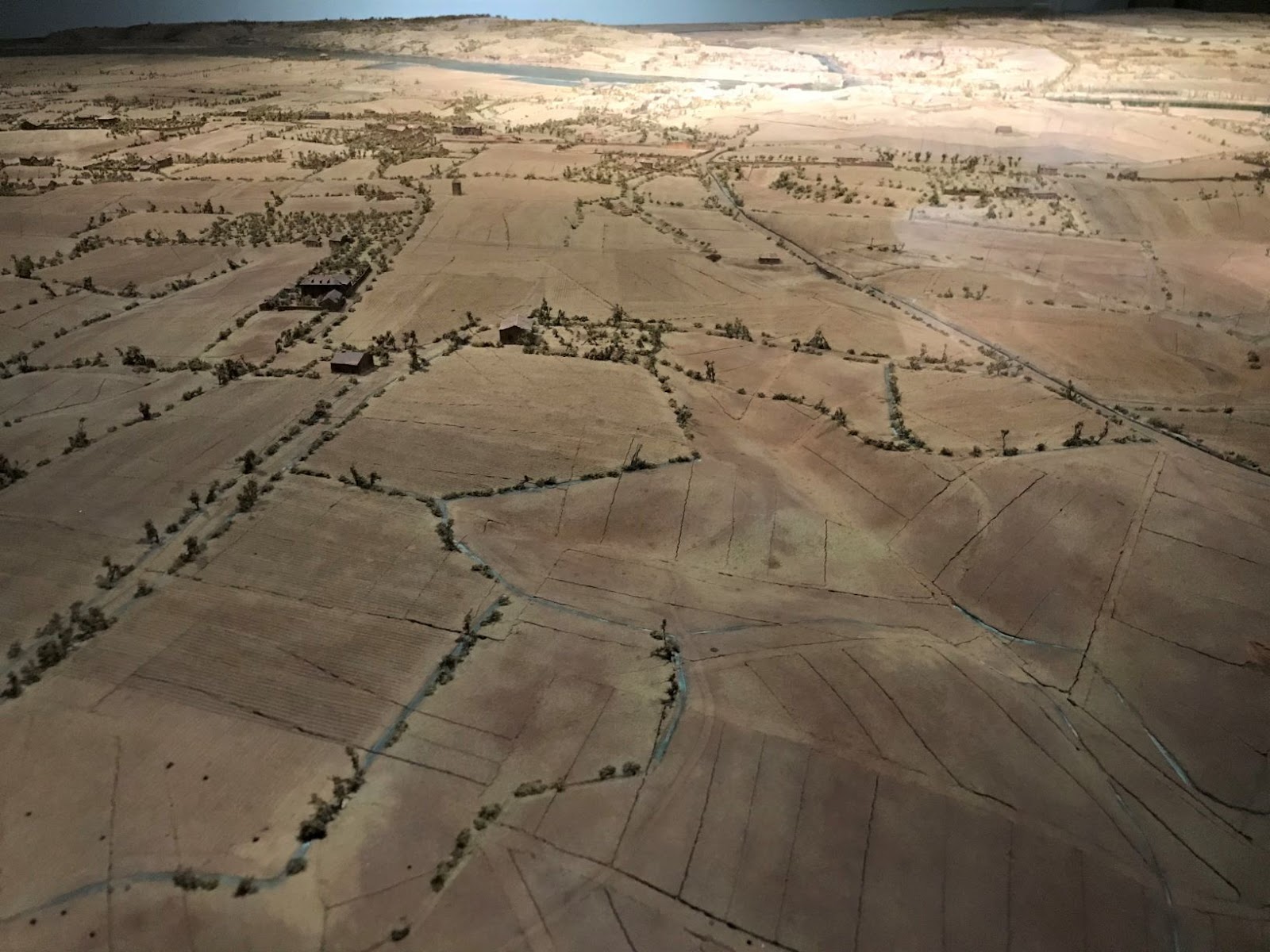
Two years ago I wrote here about the plans-reliefs that Andrew Graham-Dixon visited for a TV documentary - he described them as 'a collection of extraordinary but largely forgotten' table-top landscapes. I mentioned that some of them remain in Paris and last weekend I got to see them - they are on display in Les Invalides.  I framed the photograph above so that this example resembles a real aerial landscape.  However, it is eerily empty - there are roads and buildings but no sign of actual human life: no figures in the fields, no cattle or horses or any other animals.  None of the relief maps show anything happening in these landscapes.  They are quite different from the models we are used to seeing in museums that recreate a key historical event or evoke everyday life at some date in the past.  The plans-reliefs represent a rather bleak vision of the world, as mere terrain to be defended or fought over.  Seeing a relief map of Saint-Tropez in this context was a particular shock - a place that conjures ideas of life at its most joyous - sun, sea, wine, music and Brigitte Bardot on the beach...


Near the glass cabinet dedicated to St Tropez, there is another one containing the Chateau d'If.  I remember that when I first began reading The Count of Monte Cristo I didn't realise that this place, a strangely-named island fortress near Marseilles, was a real location (or that Monte Cristo is an actual island).  But as this relief map from 1681 shows, the Chateau d'If was a key French fortification long before Dumas wrote his novel and the fictional Edmond Dantès was wrongly imprisoned there. Chateau d'Ifs have subsequently multiplied in the many adaptations of Dumas' novel: plays, films and, most recently, video games.  Sometimes other islands have stood in for it - Saint Mary's Tower on Comino, for example, was used in a 2002 film.  Dumas himself would later create another kind of model of the Chateau d'If.  In 1846 he bestowed the name on a grand writer's studio that he had built in the grounds of his country home.  But Dumas spent a lot less time there than Dantès spent in the Chateau d'If - just two years later, short of money, he had to sell it.