Tuesday, April 14, 2020

Nature is not a place to visit

One use now made of writing on landscape that didn't exist when I started this blog is the Instagram Caption.  Many websites now offer Instagrammers advice on captions for their landscape photographs, because of course these images won't simply speak for themselves.  "Having a cool text will bring attraction to your photos and your social profile will gain popularity (that means more followers, likes, comments…)"  Some of the phrases suggested are inspirational statements with no definite author that seem to have arisen spontaneously from the internet itself, but others are real quotes.  Elite Daily, for example, has a Top Thirty for you to pick from, ranging from "Sometimes, all you need is a change in scenery" (no author) to "I seek to sea more" (which I guess I guess is just a bad pun?  Again, no author).  The actual writers in this list form a strange kind of pantheon: Confucious, Cat Stevens, John Ruskin, Dr. Seuss, John Muir, Mattie Stepanek and George Santayana.

Here are some other Instagram caption sites:
  • Captionclick has "150+" quotes.  "Nature captions for Instagram are in demand as we live on the most beautiful planet i.e Earth.... We see nature, enjoy it and click pictures of every moment and post it on social media..."  They have a section of real quotes which includes some writers I have featured here on this blog in the past: Gary Snyder, Walt Whitman, Jane Austin (sic), Dante Alighieri and Henry David Thoreau.
  • Quotesmaster boasts "200+" nature captions.  None of these are attributed to writers, although "Nature is not a place to visit it is home" is there and this is an unpuctuated version of the Gary Snyder quote provided on the other site.  Interestingly, but perhaps not surprisingly, the actual word "landscape" appears nowhere in their list.
  • Sweety High gives just 13 examples but offers specific advice to Instagrammers. "For the pic of you looking happy and carefree among the trees," they suggest: "Study nature, love nature, stay close to nature. It will never fail you" (Frank Lloyd Wright). Or, "for the over-the-shoulder image of you creating art inspired by the world around you", there is: "The richness I achieve comes from nature, the source of my inspiration" (Claude Monet).  And then there's Gary Snyder again: "For the shot of you camping out in your favorite place: 'Nature is not a place to visit. It is home' - Gary Snyder."

  • I have embedded a video above with suggestions form a site called Travel+Leisure.  They recommend using their list of nature captions "so you can spend more time exploring our nation's amazing national parks, or chasing fleeting natural wonders — and spend less time brainstorming. That way, when the Wi-Fi signal picks up again, you can thank us for your most-liked nature posts ever." They have some different suggestions of writers, including Edgar Allen Poe, Sylvia Plath and Robin Williams ("Spring is nature's way of saying ‘let's party!").  They also suggest embellishing a John Muir quote: '"The mountains are calling and I must go.” ― John Muir *insert mountain emoticon*' [it occurs to me that the resulting post would provide an interesting semiotic combination of icon, index and symbol].
  • These websites may sound a bit obscure, but lists of suggested Instagram captions appear everywhere. Good Housekeeping, a media institution that dates back to 1885, had some seasonal spring quotes recently, although Robin Williams didn't feature in their selection.  Dickens, Neruda and Lady Bird Johnson were on the list, whilst they also had songwriters like The Beatles and John Denver (though sadly nothing from George Formby's 'Springtime's Here Again').  
So do people on Instagram really use these quotes?  I have just checked and the asnwer is: Yes!  However, the quotes and authors seem mostly to be turned into hashtags.  There are 1,218 posts with the hashtag #natureisnotaplacetovisititishome and 5,802 with #garysnyder. Instagram actually allows you to 'follow' #garysnyder, along with the 'related hashtags' which are as follows: #sunrise_sunsets_aroundtheworld, #treesilhouettes, #worldonsunset, #skypainters, #firesky, #cloudscapephotography, #powerofnature, #sunsetsworld, #cloudshot, #mothernature.  Nothing here about poetry, Buddhism, or ecology - presumably the algorithm's idea of 'garysnyder' is based on what photographs people have captioned with his name.


I should probably point out that in their 11 tips for crafting the perfect Instagram caption, Hootsuite advice against the use of quotes of 'the cliché inspirational variety'.  They also recommend a special app for ensuring Instagram texts are clear and use simple words: "Readability is key, especially on a medium like Instagram where users scroll through content quickly. The Hemingway app will help you craft clear, punchy copy that draws in a scanning set of eyes."  This suggests that accompanying a landscape photo with a quote from, say, Gerard Manley Hopkins, would not be advisable.

In some ways the unattributed caption suggestions on these sites are as interesting as their choice of literary quotes (especially as some of them seem to have been put through a translation package to give sentences like this: "I receive more than I initially seek when I walk in the nature.")  Most of these lists include a section of 'funny' captions.  The IG site explains that "by using nature captions for Instagram in lighthearted tone, does not mean that you are not appreciating it. It is actually the opposite instead, you are so awed by the nature that it is reflected through your witty personality."  The first suggestion in its list is this: "You won’t experience nature on the internet."

Monday, April 13, 2020

Hope-of-dew the giants call them, power-of-storms the elves

Alvíssmál ('All-Wise's Sayings') is a poem in the Poetic Edda in which Thor outwits a dwarf called Alvíss, 'All-Wise'.  All-Wise is 'the image of an ogre' and as 'pale as a corpse', but otherwise he's a kind of Robert Macfarlane character, ascending from the underland to list and explain poetic words and phrases for natural phenomena.  Here, for example, is the exchange on clouds, beginning with Thor's question.
'Tell me this, All-wise - I reckon, dwarf,
that you know all the fates of men -
what those clouds are called which mix with showers,
in each world.'

'Clouds they're called by men, and hope-of-showers by the gods,
the Vanir call them wind-floaters,
hope-of-dew the giants call them, power-of-storms the elves,
in hell the concealing helmet.'
W. G. Collingwood's illustration of the poem: 
The god Þórr holds his daughter Þrúðr while conversing with the dwarf Alvíss

Here are some of my favourites from the rest of Alvíssmál - the elves seem best at coming up with memorable kennings.
Earth: 'splendid-green' (the giants), 'the growing one' (the elves)
Sky: 'wind-weaver' (the Vanir), 'the dripping hall' (the dwarfs)
Moon: 'the hastener' (the giants), 'counter of years' (the elves)
Sun: 'everglow' (the giants), 'the lovely wheel' (the elves)
Wind: 'the waverer' (the gods), 'din-journeyer (the elves)
Calm: 'wind-end' (the Vanir), 'day-soother' (the elves)
Ocean: 'rolling one' (the Vanir), 'liquid-fundament' (the elves)
Fire: 'waverer' (the Vanir), 'ravener' (the giants)
Wood: 'wand' (the Vanir), 'lovely boughs' (the elves)
Night: 'unlight' (the giants), 'sleep-joy' (the elves)
Some of these kennings endow nature with human abilities (weaving, journeying) whilst others (used elsewhere in the Poetic Edda) attribute elements of landscape to the human body: a beard is a cheek-forest, a head is a shoulder-rock. Humanity was created, according to the 'Seeress's Prophecy', from driftwood and people are often compared to trees. One hero, Helgi, is called a 'splendidly-born elm'.  Warriors are an 'apple-tree of strife' or a 'maple of sharp weapons'; the blood they shed is 'slaughter-dew'.  Animals too can be linked to landscapes - wolves are heath-wanderers - and places can be names for animals - one of the dwarf Alviss's phrases for the sea is 'eel-land' (I prefer the kenning for sea used in Beowulf - whale-road.)  

I have quoted so far from the translation by Carolyne Larrington (The Poetic Edda itself was compiled in Iceland in the 1270s, drawing on much older material).  There is an excellent online resource, the Skaldic Project, which has a list of kennings found in the wider corpus of Skaldic verse, including those The Poetic Edda (i.e. the Codex Regius). Some of the longer kennings can read like cryptic crossword clues or compressed landscape poems in their own right.  I will conclude here with three examples from the site's list of 'big kennings' - those with at least four referents.  'Generosity' is gold, arising in a landscape of green rocks or from the 'salty, cool meadow' of the sea, whilst 'poetry' is a powerful drink, found in a cave on the 'path of the snow-drift.'

Monday, April 06, 2020

Sea Pictures


On 5 October 1899 attendees at the Norfolk and Norwich Festival heard the first performance of Edward Elgar's Sea Pictures, with Elgar conducting and Clara Butt singing, dressed as a mermaid.  The five songs were each based on a nineteenth century poem.

'Sea Slumber Song' by Roden Noel

Sea-birds are asleep,
The world forgets to weep,
Sea murmurs her soft slumber-song
On the shadowy sand
Of this elfin land...

Roden Noel (1834-94) was a poet attracted to sublime landscape: he called an 1885 collection Songs of the Heights and Deeps. One of these poems is 'Suspiria' - a word that for the modern reader recalls De Quncey's Suspiria de Profundis and the Dario Argento films it has inspired.  Like the film Suspiria, it is full of colour and drama. 'Do you remember the billowy roar of tumultuous ocean? / Darkling, emerald, eager under vaults of the cave, / Shattered to simmer of foam on a boulder of delicate lilac, / Disenchantless youth of the clear, immortal wave?' (and so on).  A posthumous collection was called My Sea and Other Poems and its editor praised Noel's nature poetry: 'numerous are the poets, still living, who will babble to you of brooks and flowers, but few or none who care to fathom the deeper mysteries of nature'.  It was the sea, above all, that 'had an overmastering fascination for him' and his poems inspired by it ring with a 'grand yet subtle music'.

In Haven (Capri) by Caroline Alice Elgar

... Closely cling, for waves beat fast,
Foam-flakes cloud the hurrying blast ...

The second 'Sea Picture' uses text by the composer's wife, who had also written 'The Wind at Dawn', a poem she gave Elgar on their engagement and that he had set to music in 1888.  'The Wind at Dawn' gives a dramatic description of a day beginning: 'The wind went out to meet with the sun / At the dawn when the night was done, / And he racked the clouds in lofty disdain / As they flocked in his airy train...'  C. Alice Roberts was actually a published novelist before she met Elgar.  In his book about the composer, Jerrold Northrop Moore notes the landscape symbolism in her book Marchcroft Manor (1882), where 'the feminine presence of Nature is recognised as the initiator of insight.'  In it she describes the beauty of autumn days when 'the lights and shades which we see varying and changing in the sunlight, enter into and work strange changes in the lives of some of us as well as play over the surface of the waters and hills.'

Sabbath Morning at Sea by Elizabeth Barrett Browning

The ship went on with solemn face:
    To meet the darkness on the deep.
        The solemn ship went onward...

This one can't be called a seascape poem. Harper's Magazine for some reason reprinted it a few years ago and explained that 'for a modern audience, this may still be one of the less approachable of her major poems. It seems a typical example of Victorian religious sentimentality – the theme is the approach of death, and on All Saints Day, the narrator finds herself on a ship at sea.'  Of more interest to readers of this blog would be 'A Sea-side Walk', published three years earlier in 1836.  Again, the mood of the landscape affects the thoughts of those walking through it: 'For though we never spoke / Of the grey water and the shaded rock, / Dark wave and stone unconsciously were fused / Into the plaintive speaking that we used / Of absent friends and memories unforsook...'

Where Corals Lie by Richard Garnett

The deeps have music soft and low
When winds awake the airy spry,
It lures me, lures me on to go
And see the land where corals lie.

Richard Garnett was a biographer employed by the British Museum - Constance Garnett, translator of the Russian classics was his daughter-in-law and Bloomsbury writer David Garnett was his grandson.  His poems are (perhaps deservedly) seldom read these days.  Looking through the contents list of his collection Io in Egypt a few titles look promising, but they are marred by stale and out-dated language. 'Summer Moonlight', for example, begins with clouds leaving the moon 'half pillaged' of her light, until suddenly she is revealed and lights up a cascade.  Then, in an effect quite hard to imagine, the 'lustrous foam' melts 'into the rosy fires that made / The brown demureness of the rocks superb.' Another poem, 'Fading leaf and Fallen-leaf', sounds almost Japanese in its theme, but I couldn't get beyond the opening lines: 'Said Fading-leaf to Fallen-leaf, / "I toss alone on a forsaken tree..."'
The Swimmer by Adam Lindsay Gordon

With short, sharp, violent lights made vivid,
   To southward far as the sight can roam;
Only the swirl of the surges livid,
   The seas that climb and the surfs that comb...

The final poem is by an Australian poet whose reputation has fluctuated over the years - Bernard Shaw mocked him but he is the only Australian in Westminster Abbey's Poet's Corner.  The Queen (praised for her coronavirus speech yesterday) actually quoted him in her 1992 annus mirabilis Christmas message.  'The Swimmer' appeared in Gordon's second collection Bush Ballads and Galloping Rhymes, published a day before his suicide in 1870.  The phrase 'galloping rhymes' is an allusion to his career as a jockey.  At Blue Lake in South Australia an obelisk was erected to commemorate one of his horse-riding feats: 'This obelisk was erected as a memorial to the famous Australian poet. From near this spot in July, 1864, Gordon made his famed leap on horseback over an old post and rail guard fence onto a narrow ledge overlooking the Blue Lake and jumped back again onto the roadway...'  From a landscape perspective this monument may be his most significant contribution - few of his poems stop long to admire a view.

Stamp issued in May 1985

Sea Pictures itself is apparently not well known outside Europe, possibly affected by Elgar's Last Night of the Proms reputation, as an Arts Fuse article suggests.  I cannot comment on the music because it so far removed from what I normally listen to, but it certainly drew praise at the time.  'A certain amount of less favourable criticism was directed towards the poetry,' however, according to an ABC article.  'Elgar did seem to have sentimentally Victorian tastes when it came to lyrics.'  Of the five writers he alighted on, only Roden Noel could really be described as a landscape poet and his work is now largely forgotten.  It is strange how some creative figures have an afterlife only via another medium, painted by a great artist, say, or inspiring a character in a novel, or in this case, drawn into a piece of music that has carried this odd little collection of poems floating out of their original time like flotsam drifting on the sea. 

Thursday, April 02, 2020

This grove, these fountains, this interwoven shade

Occasionally you read a sentence in an old book and you become suddenly aware of the vertiginous gulf of time separating you from its writer.  In one of Martial's Epigrams (4.25), written in 89 CE, he describes a region of northern Italy where he imagines spending his old age.  Its first line mentions the coastal town of Altinum and in a footnote to the poem, translator Gideon Nisbet says that its remains 'now lie a little inland.  After its sack by Attila the Hun in 452, its inhabitants, the Veneti, relocated to islands in the lagoon where their descendants would one day build Venice.'  So there is Martial, writing for a civilised and sophisticated Roman audience, unaware of the fate that would befall this town four centuries later, or the whole subsequent history of the rise and fall of the Venetian Republic.  Nor at that point could he foresee that he would spend his final days back in Spain, at Bibilis, the town where he had grown up.  Or that Bibilis too would disappear, to be replaced by a city the Moors called Qal‘at ’Ayyūb, the castle of Ayyub, and which we know today as Calatayud.

Sundial from St Buryan Church, Cornwall
Source: Wikimedia Commons

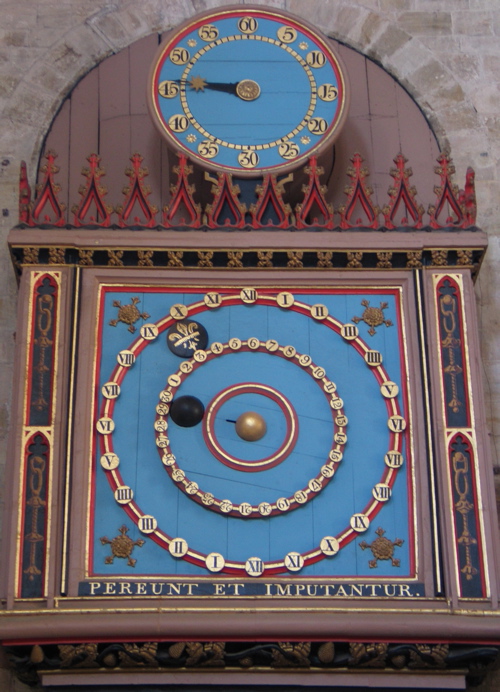
Martial dealt with the passing of time in a poem in praise of his friend, Julius Martial (5.20).  Instead of having to spend time on 'frowning lawsuits and the gloomy Forum' he imagines their days devoted to living well and spending time with books.  'As it is now, neither of us lives for his own benefit; each of us can feel his best days slipping away and leaving us behind.  They're gone, they've been debited from our account.'  That line - bonosque soles effugere atque abire sentit, qui nobis pereunt et imputantur - inspired a fashion for carving the phrase Pereunt et imputantur onto sundials. I've included here a couple of examples.  It is tempting here to digress onto the fascinating topic of sundial mottoes, but I will refer you instead to an Atlas Obscura article (here) and return to the poetry of Martial.
  
Sundial from Exeter Cathedral
Source: Wikimedia Commons

Even those of us who enjoy living in busy capital cities sometimes long for a more peaceful and beautiful environment.  Martial wrote (6.64) admiringly of the home of his friend Julius Martial, sited well above the streets of Rome, on the Janiculan Hill, a place 'more blissful than the gardens of the Hesperides'. Here is a late 19th century public domain translation of the next few lines:
Secluded retreats are spread over the hills, and the smooth summit, with gentle undulations, enjoys a cloudless sky, and, while a mist covers the hollow valleys, shines conspicuous in a light all its own. The graceful turrets of a lofty villa rise gently towards the stars. Hence you may see the seven hills, rulers of the world, and contemplate the whole extent of Rome, as well as the heights of Alba and Tusculum, and every cool retreat that lies in the suburbs...  
It is pleasing to think that Martial was able to enjoy a pleasant garden in his retirement.  The twelfth book of Epigrams was written in Spain and one of its poems (12.31) describes a retreat apparently gifted by his patron and mistress, Marcella.
This grove, these fountains, this interwoven shade of the spreading vine; this meandering stream of gurgling water; these meadows, and these rosaries which will not yield to the twice-bearing Paestum; these vegetables which bloom in the month of January, and feel not the cold; these eels that swim domestic in the enclosed waters; this white tower which affords an asylum for doves like itself in colour; all these are the gift of my mistress; Marcella gave me this retreat, this little kingdom, on my return to my native home after thirty-five years of absence. Had Nausicaa offered me the gardens of her sire, I should have said to Alcinous, "I prefer my own."

Saturday, March 28, 2020

Scrub and quarry

Painting en plein air can bring many unexpected problems, from the bandits encountered by Thomas Jones to the waves that drenched Claude Monet.  The British artist Ray Atkins has not made it easy for himself:
'He sets up his boards – sometimes up to 10 foot wide, and weighing a hundredweight – in the landscape he's painting, tethering the work to the ground with rocks and leaving them in situ for weeks at a time. Obviously this method leaves the work at the mercy of the elements and of vandals - indeed, one of his monumental works of the Thames at Millwall ended up floating downstream after his secret painting place was discovered by local vandals.' (The Guardian, October 2012)
Wind is a particular risk if you're going to set up pictures on this scale - once one of Atkins' pictures ended up at the bottom of a quarry, as William Feaver noted in his catalogue essay for a 1996 retrospective.

Catalogue for the 1996 Ray Atkins exhibition at Art Space Gallery, Bristol

It would be easy to criticise this approach to painting as playing out the stereotype of 'man' against nature.  But William Feaver argued that
'there is no need to label Atkins 'heroic' in his persistence. The difficulties he makes for himself are essential to the outcome. Without them he would lack the resistance necessary for deep impetus. Painting on board rather than canvas gives him another sort of resistance. He dedicates himself to laborious cultivation; his is a kind of fieldcraft and makes him more the hunter-farmer than the painter of pleasing projects.' 
Feaver was impressed by Atkins's paintings of Cornwall, which were mainly done inland in an environment of 'scrub and quarry, land worked over and worked out.'  Scrapyard IV (1989) is particularly striking - 'crumpled colours dumped on the landscape'.


Eventually Atkins left Cornwall for the French Pyrennees, where he still lives and paints.  There is a YouTube video of him made in 2018 which shows a soft-focus sun-dappled landscape a world away from the docks of Millwall and scrapyards of Cornwall.  Here, near his home, you see him fixing up one of his boards in a field and beginning to work, before breaking off to enjoy the sunset.  As someone says at the end of the film, artistic fame may have passed him by, but at least he has been able to spend a lifetime painting.

Sunday, March 22, 2020

Driving with Greenland Dogs


In these days of forced isolation, lots of people are turning to film streaming sites.  If you are interested in silent movies, I can highly recommend the Danish Film Institute's new site which so far has 64 good quality videos from the Golden Age of Danish cinema, including classics like The Abyss and A Trip to Mars.  The first Danish film, Peter Elfelt's Driving with Greenland Dogs (1897), can also be seen there in all its 40-second glory.  It is like a haiku in its brevity, single memorable incident and strong seasonal imagery.  Of course this film's original viewers would have been amazed by the way motion is captured, but viewing it now, what I like is the moment of stillness half way through, after the sled has left the shot and before it enters again from the other side (see image above).  For a second or so you just see a winter landscape with a line of trees like musical notes on the high horizon and fresh tracks written in the snow.


Another film you can see on Stumfilm.dk is Løvejagten (The Lion Hunt, 1907) made by Ole Olsen's Nordisk Film and directed by Viggo Larsen.  It is an extraordinary eleven minutes - a catalogue of tasteless moments that I can't really do justice to in a short description (do all hunters enjoy a sort of post-coital cigarette with the carcass?)  Attitudes change, but even back then the film caused an uproar because the two lions (bought by Olsen from Hamburg Zoo) were actually killed.  Even before these poor creatures and the film they starred in were shot, the Danish Society for the Prevention of Cruelty to Animals was protesting in vain to the Minister for Justice.  The publicity just helped the film become a success. 

Most stories from the early years of cinema with external scenes were set somewhere easy to simulate with local scenery.  But Denmark is not well-endowed with jungles and so one was recreated in Jægersborg Dyrehave near Copenhagen, a beautiful deer park (as I recall from visiting it once) but not an obvious setting for a lion hunt.  There's something a bit Douanier Rousseau about the scenes filmed there, with unnatural looking tropical plants sticking out of woodland paths.  The shore on which the lions met their end (see above) doesn't exactly bring to mind a tropical beach either - this scene was filmed on the island of Elleore in Roskilde fjord and watching it you can almost feel the cold wind whipping off the sea.


I will end here with something more uplifting, two lovely tinted photographs which can be found in an article on Danish art cinema by .  He speculates that early non-dramatic travelogue films (now lost) may have had 'atmospheric exteriors' resembling picturesque postcards,
'as could possibly be demonstrated by one of the two Nordisk films Fiskerliv i Norden [literally: Being a Fisherman in the Nordic Countries] (Viggo Larsen, 1906) or Ved Havet [literally: By the Sea] (Ole Olsen, 1909). These two fisherman tales only survive in a Swedish distribution copy in which the two were cut together, but what remains contains two beautiful tinted atmospheric inserts of a moonlit and sunset seascape though it is unclear in which of the two these are featured.'
This footage is not yet available on Stumfilm but perhaps under current circumstances the Danish Film Institute will be able to add more titles like this soon.

Friday, March 20, 2020

A Lane Near Arles


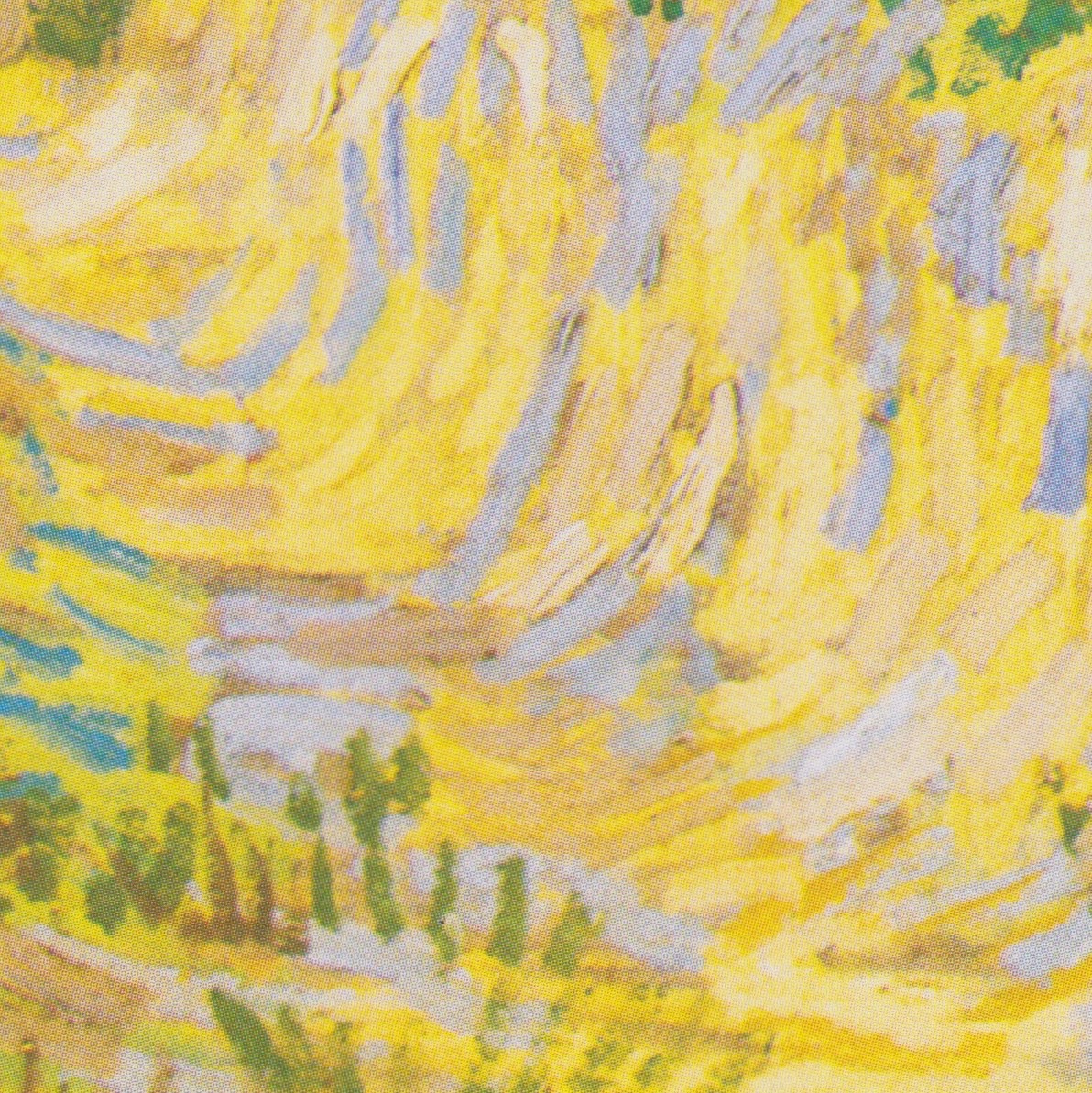
One of the many pleasures of Vincent van Gogh's paintings is the way he changes his style of painting at different places in the composition whilst retaining their overall harmony.  Here we have densely stippled foliage, a path defined by broad strokes of yellow and lavender, and a sky in which the zig-zag swirls of blue suggest the movements of a Provençal breeze. As you can see below, there are also blocks of pure colour - the green of the fields, the yellow of the house, the blue (!) of the tree trunks.  But it all works perfectly together. The same can be said of other landscapes from this time, like Farmhouse in Provence with its wonderful lilac wall and turquoise sky.  You imagine van Gogh looking at these landscapes and intuiting the phenomena before him - tree, path, sky - in such a way that the right means of conveying them in paint came almost instinctively.

Vincent van Gogh, A Lane Near Arles, 1888

Saturday, March 14, 2020

Wandering on the Tiantai Mountains

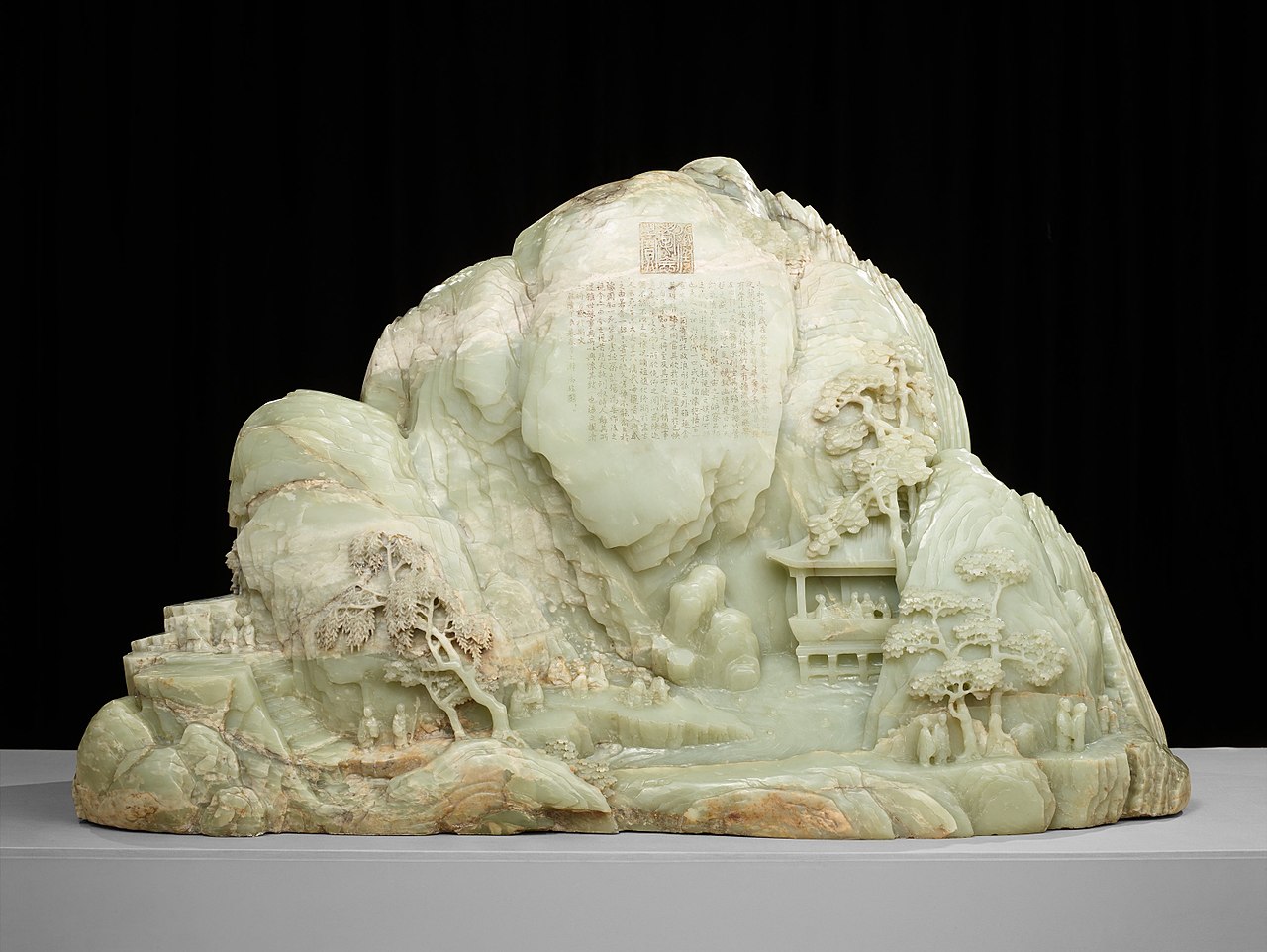
Unknown artist, Jade Mountain Illustrating 
the Gathering of Scholars at the Lanting Pavilion, 1790
Source: Wikimedia Commons

This landscape in jade shows Mount Kuaiji (in present-day Zhejiang) and the celebrated Orchard Pavilion Gathering that took place there during the Spring Purification Festival on the third day of the third month in the year 353.  The event is most famous for a piece of calligraphy, the Lantingji Xu - 'Preface to the Poems Collected from the Orchid Pavilion' written by Wang Xizhi (303-361).  He describes the location, with its
'mighty mountains and towering ridges covered with lush forests and tall bamboo, where a clear stream with swirling eddies cast back a sparkling light upon both shores.  From this we cut a winding channel in which to float our wine cups, and around this everyone took their appointed seats.  True, we did not have harps and flutes of a great feast, but a cup of wine and a song served well enough to free our most hidden feelings.' (trans. Stephen Owen)
Feng Chengsu, Tang Dynasty copy of Wang Xizhi's Lantingji Xu (now lost) 
Source: Wikimedia Commons

There were forty-two literati at this famous party and one of them was the poet Sun Chuo (Sun Ch'o, 314-71), whose fu 'Wandering on the Tiantai Mountains' has also been translated by Stephen Owen.  Here is an extract:
... I pushed through thickets,     dense and concealing,
I scaled sheer escarpments     looming above me.
I waded the You Creek,      went straight on ahead,
left five borders behind me     and fared swiftly forward.
I strode over arch     of a Sky-Hung Walkway,
looked down ten thousand yards     lost in its blackness;
I trod upon mosses     of slippery rock,
clung to the Azure Screen     that stands like a wall ...
Burton Watson has also translated this poem and writes of Sun's journey that 'as he proceeds up the mountain, the scenery becomes increasingly fantastic and idealized, until at the end he reaches a plane of pure philosophy, in which Taoist and Buddhist allusions are balanced one against the other.'

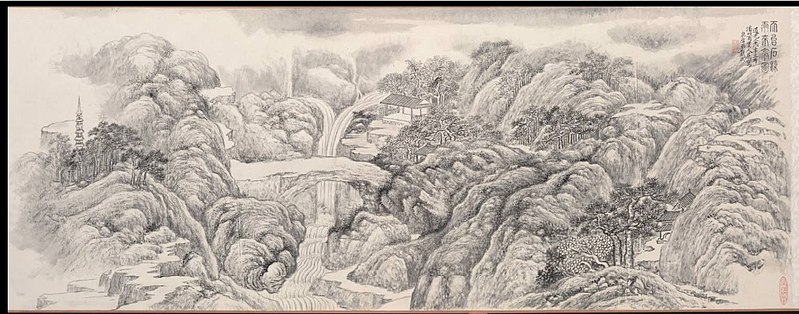
Dai Xi,  Rain-coming Pavilion by the Stone Bridge at Mt. Tiantai, 1848
Source: Wikimedia Commons

The Sky-Hung Walkway referred to in this poem was a natural stone bridge.  It has often been depicted in art - The Smithsonian has a twelfth century painting of it by Zhou Jichang and they describe it as follows:
'The natural rock bridge spanning a waterfall is one Tiantai's most famous sights. According to legend, this arch is also a pathway to paradise where the five-hundred luohan, saintly guardians of the Buddhist faith, worship and dwell among magnificent celestial temples. Those who venture to tread this perilous trail, however, find that the bridge, which narrows to a width of several centimeters, is obstructed at its far end by an insurmountable block of stone.'
There are some photographs online of tourists admiring what I assume is this same rock bridge (e.g. on Wikimedia).  In the Japanese ink painting below by Soga Shōhaku (1730–1781) it looks much more spectacular.  In this dramatic scene a mother lion throws cubs over the cliff to see which will succeed in life by being able to climb back up to her.

Soga Shōhaku, Lions at the Stone Bridge of Mount Tiantai, 1790 
Source: Met Museum

An article by Zornica Kirkova explains that Mount Tiantai also features in a poem by Sun Chuo’s friend, the Buddhist monk Zhidun (314–366).  This 'opens in the idyllic setting of a spring garden, where the poet leisurely reflects on the passage of time and, “moved by things” ... lets his thoughts soar up to the sacred realm of the Celestial Terrace Mountain'.
The piping creek plays clear tunes.
Empyrean cliffs nurture numinous mists,
Divine plants, holding moisture, grow.
Cinnabar sand shimmers in the turquoise stream,
Fragrant mushrooms sparkle with the five brilliances.
In this poem, 'the mountains are envisioned as a sublime and sacred realm of purity and beauty.'  As with Sun Chuo, more realistic images - the cool breeze, the clear tunes of the creek - are combined with 'fantastic paradise depictions, pertaining to the theme of immortality (eternal divine plants, cinnabar sand, magic mushrooms)'.  It is easy to forget when you read poetry like this that it is a real mountain, so I will end here with an image from the internet taken with an iPhone 6S in June 2016, 1,663 years after the Orchard Pavilion Gathering.

The cliffs of Mount Tiantai
Source: Huangdan2060

Saturday, February 29, 2020

White torrents and emerald depths

Because this blog focuses on the arts, I have rarely mentioned books by geographers, although it goes without saying that they often write beautifully about landscape.  In A Commentary on the Book of Rivers, Li Tao-Yuan (Li Daoyuan, d. 527) quoted no less than 437 different sources, but he also drew on his own memories and included the kind of description that would become common in future Chinese travel writing.  His monumental book was an expansion of an earlier author's Guide to Rivers, now lost, and it described 1,389 Chinese rivers (or 1,252 - I've seen both numbers quoted, but either way, that's a lot of water).

Li is regarded as the first writer to describe the famous Three Gorges landscape in detail.  For example:
'When winter turns to spring, there are white torrents and emerald depths; reflections appear upside down in the swirling eddies. Many oddly shaped junipers grow forth from jagged mountain peaks from which waterfalls plummet clamorously. Pure, verdant, lofty, flourishing—such qualities provide innumerable kinds of fascination. After a storm has cleared, or on frosty mornings, among forests chilled and streams desolate, the loud cry of a gibbon is often heard, prolonged and mournful. As it echoes through the empty valleys, its despairing wail lingers before disappearing. So the fishermen sing,
Of the Three Gorges in Eastern Pa
   Shaman Gorge is the longest.
Three cries of the gibbon
   and one's clothes become drenched with tears.'
Xie Shichen, Clouds and Waves at the Wu Gorge, 1368

This translation is from Richard E. Strassberg's Inscribed Landscapes, a wonderful book I have quoted from here before.  Strassberg also includes Li's descriptions of two other landscapes.  Meng's Gate Mountain (Meng-men-shan) straddles the Yellow River and Li describes its slanting cliffs with giant boulders poised to fall, white mist on the water where currents collide and colossal waves that 'multiply and collapse all the way down to the outlet.'  Lotus Mountain (Hua-shan) is one of the Five Sacred Mountains of China and Li describes climbing it: ascending through junipers and past shrines and rock altars until, at the summit, he is able to see two sacred springs, one called Reed Pond that flows westwards, and the other, Supremely Exalted Spring, flowing east.

Saturday, February 22, 2020

An artificial island on the Arno

Netherlandish Master, after Jacques Callot, 
The Mock Battle Between the Weavers' and Dyers' Guilds
on the Arno in Florence on 25 July 1619 (detail), c. 1620

In seventeenth century Florence there was an annual festival in which the Weavers' and Dyers' Guilds fought for possession of an artificial hill, built in the middle of the river.  This painting of the event, in Frankfurt's Städel Museum, was based on an etching by the French artist Jacques Callot (1592-1635).  Several museums have copies of Callot's print, which was made in the form of a fan.  The Grand Duke, Cosimo II, had these fans made before the event and distributed to the spectators.  It would be good if one of the people shown in the foreground of this picture could be seen holding one of those fans, but I can't see one. Callot may have included one though in his original design, as a Courtauld blog post about the print explains.


From a landscape perspective I would love to know more about this artificial island.  Who designed it?  How was it made?  It looks pretty big.  How was it anchored so that it didn't drift away or collapse under the weight of the battling weavers and dyers? An earlier artificial island on the Arno, complete with a temple, had been constructed as part of the extravagant wedding celebrations for Cosimo and Maria Magdalena on the 18 October 1608.  It was the stage for a re-enactment of Jason and the Golden Fleece and you can see it in the print below by Matthaeus Greuter (1564–1638).  But this doesn't look as impressive as the one built in 1619, which resembles a real landscape.  Did this hill only look real from a distance?  Were actual trees used?  I imagine a group of picnickers rowing out to enjoy this temporary idyll on the night before the battle.


Has anyone done a study of such islands?  They seem to have featured prominently in various European festivals and royal pageants.  In 1638, for example, another Medici, the Queen of France, was led in procession to an artificial island in the Amstel River for a display of dramatic tableaux. In England, Queen Elizabeth was entertained at Kenilworth Castle in 1575 with a famous display that included a floating island with the Lady of the Lake attended by nymphs (these festivities may have inspired Shakespeare’s A Midsummer Night’s Dream). There is an interesting description on the Brown University site, of one of these islands, made for the marriage of Louise-Elizabeth of France and Philip, prince and grand admiral of Spain, in August 1739.  It was not designed to resemble a natural island; this was pure stagecraft - it even contained a salon for an eighty-piece orchestra.
'The structure was suspended on two large boats which were concealed beneath the artificial rock outcroppings along the island’s perimeter. ... The citizens of Paris would instantly recognize that the island was not part of the natural landscape, but an illusionary construct on the river’s surface. However, rather than detracting from its ability to awe, in fact it added to the island’s captivating quality. The entirety of the structure was created for the conspicuous consumption of the spectators.'

Friday, February 21, 2020

Mirages of landscapes leaping upwards


In July 1942, Filippo Tommaso Marinetti and Tullio Crali published in Rome a Futurist Manifesto entitled 'Plastic Illusionism of War and Perfecting the Earth'.  It was inspired by Crali's work on camouflage projects and it suggests that the 'plastic illusionism' used in Futurist painting could be used both to deceive enemy pilots and confuse them with 'visions of accelerated fractured cityscapes' and 'mirages of landscapes leaping upwards'.  And it goes further, arguing that the landscape itself could be altered - giving 'a volumetric character to plains', for example, by raising up artificial mountains.  These points read like a manifesto for Land Art and indeed Crali himself later argued that he had 'anticipated the interventions of American artists in this sphere by thirty years.'  In their vision for 'perfecting the earth', Marinetti and Crali wanted to 'refine the severe rugged aspects of wartime landscapes and cityscapes and their brutal masses.'  They would both 'virilise' and 'feminise' war-torn Italy, spirtualising and purifying it through the interventions of aeropainters, aeropoets, aeroarchitects and aeromusicians.

The aeropaintings of Tullio Crali are currently on display at the Estorick Gallery - their earlier exhibition devoted to the aeropainter Gerardo Dottori was the subject of a post I wrote here back in 2014.  Crali was much younger than Futurists like Dottori and Marinetti; he was only born in 1910, the year of the first Futurist Manifesto, and he lived until 2000, long after Futurism had become part of art history.  By the time the American Land Artists were coming to attention, Crali was a step ahead, thinking about extraterrestrial artworks.and writing his Futurist Manifesto of 'Orbital Art' (1969).  Some examples of his ideas are below - I particularly like the idea of the 'message-trains of audiovisual poetry' heading out into the cosmos like the Voyager golden record.


Another of Crali's artistic projects at that time (for which he had written a Manifesto in 1959) were the Sassintessi, compositions of stones mounted on neutral black or white backgrounds.  These were originally inspired by trips to Ploumanac'h where he saw the rocks that had fascinated earlier artists like Eileen Agar (her photographs have been admired, in turn, by Tacita Dean - see my earlier post, 'Rocks at Ploumenac’h, Brittany').  In her review of the Crali exhibition, Laura Cumming notes the novelty of the Sassintessi and thinks that 'every now and again they hit the mark, when Crali takes some sea-carved rock and twists it out of kilter, so that it suddenly looks like a rushing futurist figure.'  I was intrigued by the idea and by some examples, like Future Fossil of the Mechanical Civilisation (1963) which would fit right into a contemporary Anthropocene-themed exhibition.  Crali's rock collecting also inspired his son Massimo, who became a geologist.  Massimo's wife, Anna, was partly responsible for the exhibition and has been interviewed about it for a piece in the Telegraph.  

Finally, I should mention Tullio Crali's paintings.  After the war, he made various aerial views that combine abstract space with details of lakes or mountain peaks.  They reminded me a bit of Peter Lanyon's later works, particularly in the way they convey the intense blue of the sky.  Even as a nineteen-year old, Crali was making interesting compositions of intersecting clouds and planes of light, expressing the excitement of his first flight in 1928 ("the rebelliousness of the wind, air pockets, steep climbs: everything was wondrous...")  Arcs of overlapping colour are used to great effect in Lights at Sunset in Ostia (1930).  As Laura Cumming writes, this captures a moment when 'the shadows of hill and vale deepen, and rays of dying light arch between earth and sky. Translucent green patches stand for trees and clouds, and everything meets at the vanishing point of the ocean, radiant and serene – perhaps the most beautiful scene Crali ever painted.'

Saturday, February 15, 2020

In jasmine country, it is evening

Marutam, Queen's Flower, Lagerstroemia speciosa 
Source: Mokkie
 
In the afterword to A. K. Ramanujan's celebrated anthology of classical Tamil love poetry, The Interior Landscape (1967), there is a diagram showing the conceptual framework within which they were written.  This is based around five landscapes, each linked to a phase of love.  I have set these out below.  Their names derive from kinds of plant: mullai is jasmine, kuṟiñci is a mountain flower (strobilanthes), marutam is a tree that grows in pastoral regions and neytal is a water lily.  Ramanujan's diagram also lists other features of each category: (i) time, (ii) season, (iii) birds, (iv) beasts, (v) trees/plants, (vi) type of water, and (vii) the type of people or activity likely to be encountered.  For example, a kuṟiñci poem may refer to (i) night time, (ii) the cold season or early frost, (iii) a peacock or parrot; (iv) a monkey, elephant, horse or bull; (v) a jackfruit, bamboo or vengai; (vi) a waterfall; (vii) hill tribes, guarding the millet harvest or gathering honey.  In a footnote he says 'this is not an exhaustive list ... the names of gods, clans, musical instruments, and kinds of food have been omitted.'
Genre Landscape Theme
kuṟiñci mountains Sexual union
mullai forest Yearning
marutam countryside Sulking
neytal seashore Pining
pālai wasteland Separation
  
You can read a fuller description of this schema in the Wikipedia article 'Sangam Landscape'.  Sangam is the name given to this classical literature, which was composed in the early years of the common era (one narrow estimate is between 100 BCE to 250 CE).  Its poets are known by their names or by epithets that are often based on specific metaphors they used.  As a result, there are writers called The Poet of the Red Earth and Pouring Rain, The Poet of the Long White Moonlight and The Poet of the Foam on the Rocks.  These writers were not constrained to rigid formulae by the system of symbols - they were at liberty to 'confuse' the genres and to convey a precise mood.  And although the genres were named after landscapes, their settings were not as important as the people in them. 'Mere nature-description or "imagism"', Ramanujan explains, 'would be uninteresting to Tamil poets and critics.'

The existence of these poetic modes mean that when you read a Tamil love poem you are experiencing a kind of hidden landscape poem. And when poems are ostensibly nature scenes, they are really about some episode in a love affair.  To give a brief sense of the actual Tamil landscape in these poems I will quote here two of Ramanujan's translations, both of which refer to jasmine and are thus about 'yearning'.  
In jasmine country, it is evening
for the hovering bees,
but look, he hasn't come back. 
These lines are by a woman writer, Okkur Macatt.  She begins this poem with rains bringing new leaves to the fields and grass spears 'trimmed and blunted by the deer.'  The next one is by Uraiyar Mutukorran, whose name implies he may have been a stone mason in Uraiyur, the Chola dynasty's capital city in Tamil Nadu.  It is also in the voice of a female lover and set during rainfall.  A goat-herd comes to town to obtain rice and take it to some others who are waiting, holding palmyra rain-guards.  In the goat-herd's hair, tiny buds of jasmine are visible.
My lover has not come back:
the jasmine has blossomed.

Jasmine buds
Source: SKsiddhartthan

Friday, February 14, 2020

A bend in the river


This is a detail from one of the colour Polaroid photographs taken by Wim Wenders in 1974, when he was working on The Wrong Move.  These Polaroids were on show in London a couple of years ago and I recently treated myself to the accompanying book, Instant Stories, where they are mostly reproduced in their original 7 x 9cm dimensions, re-photographed with all the dust and markings of age.  This particular image, along with a few others, is blown up to five times its original size, as if to see how it works as a photographic art, rather than a small physical artefact of the film making process.  When I saw this Polaroid in the exhibition, I thought it was the river bend the characters in The Wrong Move have behind them on their walk up the hill.  But memory mists over details and, as you can see from the embedded clip below, it is not the same place.


For this post I will just note three other highlights of the book (focusing on landscape subjects):
  • There are a small group of location scouting Polaroids from his unsuccessful adaptation of The Scarlet Letter (1973), eventually filmed in Spain.  New England hadn't looked right (I have written before here about the gap between the real American landscape and the way Europeans imagine it).  At first, when the archivist unearthed these Polaroids, Wenders thought they must be views of the Baltic. 'Those Polaroids had aged, but the amazing effect was: they had become more beautiful in the process.  They now showed the place that I had been looking for in vain. A lost America.' 
  • For the third of his road movies, Kings of the Road, Wenders says 'I traveled all along the German/German border and visited each and every movie theater that was left in that stretch of land from the Elbe river in the North down to the German/Czech border in the South.  the entire border covered some 1400 kilometres. A deep depression had befallen these lost little towns and villages that were cut off from their hinterland.'  In these places he took a poignant sequence of black and white Polaroids showing these small, drab cinemas with their grandiose names, Capital, RIO, LUX...
  • On this page you can see Wenders' shots of the Elbe where he filmed the memorable opening sequence of Kings of the Road. The location was near the old Dömitz fortress. 'There, across the stream, stood the watchtowers of the East German border patrol.  Wherever we shot, we saw their binoculars blinking.  I always wondered what they were thinking of us.'
Finally, I am embedding below a video of Wim Wenders in which he describes his use of the Polaroid camera.

Tuesday, February 04, 2020

Clouds Sweeping Distant Mountains

 
The Guide to Capturing a Plum Blossom by Sung Po-jen is the world’s earliest-known printed art book, published in 1238.  Only one copy seems to have survived the Mongol invasion of 1276 and this eventually came to be owned by the 16th century artist Wen Cheng-ming (Wen Zhengming), who I have mentioned here before in connection with his painting Garden of the Inept Administrator.  This copy disappeared from view until it was found in 1801 in a Peking antique market by a connoisseur who recognised its importance and had it reprinted.  There is an English translation by Red Pine, published in a lovely edition by the Copper Canyon Press.  Sung Po-jen's book takes the form of one hundred ink drawings, showing a plum blossom in all its stages from budding to opening, flowering, fading and forming fruit.  Each is accompanied by a short poem on a subject suggested by the shape of the blossom.  Thus there are poems on bowls and drinking vessels, hats, birds, insects, fruit, shells, an ancient coin, an arrow head, a zither pick, a hanging bell, a fan and a jade dipper.

Some of the poem titles evoke actual landscapes and moments of time, suggested by nothing more than the simple form of a single branch and flower.  'Lone Goose Calling to the Moon', 'New Lily Pads in Pouring Rain', 'Crow Landing on a Tree in Winter...'  Poem 78 in the sequence is called 'Clouds Sweeping Distant Mountains'.  Looking at the accompanying image (left), I can start to see it.  Through this visual metaphor Sung's plum blossom becomes a kind of landscape drawing.

The four lines of 'Clouds Sweeping Distant Mountains' each recall other the words of other poets. The first pictures clouds 'aimlessly rolling out of mountain caves' and refers to something T'ao Yuan-ming wrote (I mentioned T'ao last month in my post about We Ying-wu). The second, 'one wave and the slopes are gone' quotes a contemporary poet, Huang Keng, whose 'Evening Stroll in the West Garden in Spring', describes the disappearance of a mountain at sunset.  The third refers to to a Tu Fu poem on the changeability of the sky: 'a turn of the hand and the clouds appear / another turn and they become rain'.  And the last line, which mentions the 'demon of drought', is derived from 'River of Clouds', a poem in the earliest collection Chinese poetry, the Book of Songs

Saturday, February 01, 2020

Woodland Scenery with Hermits

 
 Pieter Stevens, Woodland Scenery with Hermits, 1614

This beautiful, atmospheric landscape painting is just 6.9 x 12.8 cm, as you can see from the photo with my hand below.  What makes it so enchanting is the silvery light on bark and leaves, and the way trees frame an opening onto sunlit space, suggesting a whole other world beyond the green shadows of the forest.  You can zoom in on this at the Frankfurt Städel Museum website, but all you see is Pieter Stevens' brushstrokes.  When you look at the real painting your eyes don't register this - it really feels like you are peering into a miniature world.  This approach to painting in the early sixteenth century can be seen in various forms, most notably the cabinet paintings on copper of Paul Bril, Adam Elsheimer and others.  Here, though, it is on a significantly smaller scale.  This landscape is the size of a playing card, because it was actually painted on the back of one.  When the museum bought it in 1869, it was possible to turn the painting over and see the front of a playing card.  Annoyingly, this got removed, but there are still traces and modern curators have worked out that it was a court card used in the game of Trappola.    


As noted a few weeks ago, I'm going to keep a lot of my blog posts short from now on, so I won't say more here about the work of Pieter Stevens, a Flemish artist mainly based in Prague, or riff on the subject of landscape and playing cards.  Miniature portraits were sometimes painted or mounted on cards (there is one of Henry VIII, for example) but I don't know of any other landscape views.  I have written before about many kinds of miniature landscape but the way this one opens up a whole world for the imagination reminded me particular of the Raymond Roussel poem 'The View', a description over 2000 lines long of a tiny beach scene set into the lens of a pen-holder.

Wednesday, January 29, 2020

Water, the unsteady element

Georg Melchior Kraus, Weimar Römisches Haus, 1799
A building in the Park an der Ilm, based on an idea by Goethe

Goethe's novel Elective Affinities (1809) is about attraction and marriage, duty and freedom, centring on an analogy with the way certain chemicals combine with others.  It is also about landscape design - something barely mentioned in Walter Benjamin's much-admired essay on the book, but clearly influential on Tom Stoppard, whose play Arcadia, a re-writing of Elective Affinities, foregrounds this theme.  Goethe's story begins with a rich married couple, Eduard and Charlotte, gardening for pleasure on their large estate.  The first of the two characters whose arrival disrupts their marriage, Eduard's old friend The Captain, is given the job of surveying this land and making improvements.  He undoes some of Charlotte's work, suggesting changes to a rocky path she made that would create instead a sweeping curve.  Their constant companionship eventually turns to love and meanwhile Eduard is himself falling for Ottilie, the young girl - his daughter's contemporary - who comes to stay with them.  He has a new house has built in an ideal spot with a fine prospect over the landscape, and it seems as if he has built it for her.

In the introduction to his translation, David Constantine describes the characters' focus on gardening.  'Though the style aimed at is English and so, by comparison with the French, informal, this is only the studied informality achieved also in the village when the villagers, spruced up for Sundays, gather before their cottages in 'natural' family groups.  The principal impulse in the garden is still to control, arrange and tame.'  The novel, particularly in its later stages, is haunted by death.  And 'although in real life there may be nothing particularly wrong (at least nothing deserving of death) in landscape gardening,' this and other examples of controlling behaviour suggest a society set against change or any way for the characters to escape their roles.  The most ambitious landscaping project involves the merging of three ponds and in a celebration to mark this event, a boy is nearly drowned.  At the end of the book, Ottilie accidentally drowns Charlotte's baby in these same waters.
'Ironically, by merging the ponds they were returning them to their former and in that sense more natural state; for they were once, as the captain has found out, a mountain lake.  Nature, especially water, 'the unsteady element', constitutes a threat throughout the novel; or we might say, it is present as an alternative to the rigidity of the estate.  That alternative, the way of greater naturalness, appears as a threat, and in the end as a deadly threat, to people afraid to embrace it.'

Friday, January 24, 2020

Goethe's oak

 
 Paintings in the Goethe House, Frankfurt

I was on something of a Goethe pilgrimage last weekend, with five stops, beginning in his childhood home in Frankfurt.  This was where he began Faust and wrote Werther before moving to Weimar at the age of twenty-six.  The house itself was destroyed in an Allied bombing raid but has been reconstructed; the contents were all kept safe during the war.  What you see when you look round is essentially the home Goethe's father created, including his pictures - some of them landscapes - all framed in black and gold.  I particularly liked two circular landscape views in the music room either side of a pyramid piano. There is no readily accessible information on who painted these, which is a pity because I would love to know more.  The website refers to paintings 'in the Dutch tradition (Trautmann, Schütz the Elder, Juncker, Hirt, Nothnagel, Morgenstern), and by the Darmstadt court painter Seekatz'.  Schütz the Elder was a landscape specialist, so perhaps they are by him.

The music room in the Goethe House, Frankfurt

From Frankfurt I travelled to Weimar and the Park an der Ilm, landscaped from 1778 under the influence of Goethe.  It was based on the Wörlitzer park, Germany's first English-style landscape garden, which also inspired the setting for Goethe's novel Elective Affinities (which I will write about in my next post).  In the park you can look round Goethe's Garden House, his first Weimar residence, bought for him in 1776 by Duke Carl August.  Here he could write while listening to the water running over a weir in the river.  Among Goethe's landscape sketches on the wall are three he called 'My Moonlights'.  "Gazing at the moon from his cottage," the audioguide says, "Goethe was frequently inspired to bathe in the Ilm River by moonlight."  One of Goethe's best known poems is 'An der Mond' ('To the Moon'), a poem he sent in a letter to Charlotte von Stein in March 1778.

Goethe's Garden House, Weimar

Goethe returned to this garden house near the end of his life to work on the Italian Journey (this account of his travels in 1786 has always been one of my favourite books, in the classic translation by W. H. Auden and Elizabeth Mayer).  To help remember the topography of Rome he had two large panoramas of the city put up in the dining room.  The print I photographed below is Giuseppe Vasi’s view of modern Rome as seen from the Janiculum Hill (1765).  Turn round and on the opposite wall you see Pirro Ligorio’s bird’s-eye view of ancient Rome, originally published in 1561.

 A panorama of Rome inside the Garden House

From the Garden House I moved on to the main Goethe House and Museum in Weimar, where you start to get an idea of the extraordinary range and depth of his collections.  There are, for example, cases he had specially made for Majolica, which he wrote about in an 1804 essay.  But the true breadth of Goethe's interests was really underlined at my fourth stop, the Schiller House, which was hosting a superb exhibition called 'Adventure of Reason: Goethe and the Sciences around 1800'.  Here there was evidence of his interest in many branches of knowledge that relate indirectly to landscape, from botany (the 'urplant'), fossils and vulcanism to light and colour theory.  He was clearly a key node in the era's overlapping intellectual networks and among his many correspondents, as I've mentioned here before, was the landscape painter Carl Gustav Carus.  Goethe owned this painting by Carus, which reminded me of the chalk cliffs I wrote about in Frozen Air.

 Carl Gustav Carus, Chalk cliffs at Cape Arkana on Rügen, after 1819

The drawing below by Goethe below looks at first sight like a view of cliffs, but is actually a Hypothetical Depiction of a Mountain. It is a good example of his interest in morphology and archetypal structures.  Goethe had a professional interest in geology through his involvement in mining, but it was evidently an absolute passion for him.  His geological collection eventually numbered 18,000 items.  I loved this quote about his collection of tin specimens:
'For many years, especially after 1813, Goethe was occupied by stannous (tin) rock formations.  He collected them in Bohemia and Saxony and had them sent to him from all over Europe.  He called it his "tin pleasure".  He considered tin to be the primeval metal, as it marked the end of the granite age.  Despite years of study, he only published one short article on the subject of tin.'
Goethe's Hypothetical Depiction of a Mountain (probably 1824)
Goethe died in 1832.  Just a century later the Nazis were on the verge of power and five years on they were constructing a concentration camp on the beautiful wooded hill overlooking Weimar. The camp was originally going to be called Ettensburg, but because this place name had such strong associations with Goethe and enlightenment, it was decided to use the name Buchenwald, 'Beech Wood'.  Trees were cleared for the building of the camp, but one oak tree was left standing.  The inmates began to call it Goethe's oak, a living symbol of a better Germany.  The tree was damaged by bombing in 1944 and then felled, but its base has been preserved as part of the Buchenwald memorial.  You can see it in my photograph below under last weekend's grey winter sky.  The dark shape among the trees behind it is the tower of the crematorium.
  
Buchenwald