Friday, April 29, 2016

The Golden Island

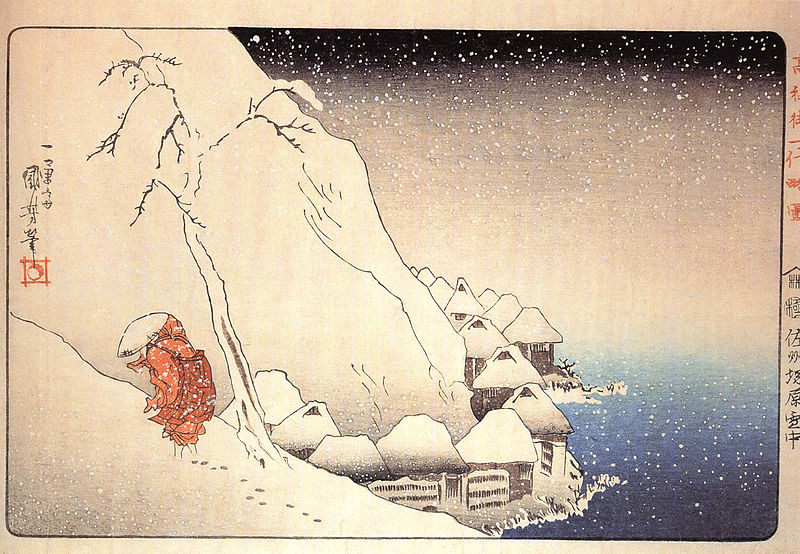
Utagawa Kuniyoshi, Nichiren going into exile on the island of Sado, 1835-6

Exile has been a spur to some of the greatest literature: would we have The Divine Comedy if Dante had not had to leave Florence and learn 'the bitter taste of others' bread'?  It could be said that the whole 'rivers-and-mountains' tradition in Chinese poetry stems from the exile of Hsieh Ling-yün in 422 to the wild southern coast.  Literary heroes from Prince Rama to Prince Genji have found themselves sent into exile.  Just recently I was looking round the National Gallery's Delacroix exhibition which includes his painting Ovid Among the Scythians.  Beyond the small group coming to the aid of the poet, there is a dark, inhospitable landscape.  The banishment of a writer like Ovid can evolve into a kind of legend itself, the historical facts having become lost to us.  Here I want to write about the exile of Zeami Matokiyo, banished in 1434 at the advanced age of seventy-one by the shogun for reasons that are also no longer fully clear.  He was sent to the island of Sado, a place that already had a long history as a place of banishment - the great Buddhist monk Nichiren, for example, was exiled there in 1271.  Zeami is famous for in the West for his Noh plays and writings on aesthetics, but 'The Book of the Golden Island' (Kintosho, 1436), which describes his journey to Sado, deserves to be better known.

Arthur Waley, in his anthology The Nō Plays of Japan, wrote that Zeami's Kintosho 'bears the same relation to his plays that Basho's prose-sketches bear to his hokku.'  It is shorter than Basho's travel sketches, only fourteen pages in the translation Susan Matisoff published in the Winter 1977 edition of Monumenta Nipponica, and structured in eight sections.

Jakushu: Leaving the capital, Zeami reaches the port of Obama where he looks across the bay to the mountains.  He had visited this place before, many years ago, but now his memories of it are uncertain.  

Sea Route: His boat sets sail across the northern sea to Sado.  Far to the east, the mountain of Shirayama (now called Hakusan) is visible, wit hits lingering snow patches.  Other landmarks are sighted as the boat travels day and night.  Finally, he sees pine trees amid dawn waves: Sado.

Plaec of Exile: Zeami makes his way inland and stays at a small temple where water trickles through moss and the walls are damp and weathered.  He looks at the moon, a lingering connection to the capital for it can be seen from there too.

Hototogisu: This section contains a story that Arthur Waley translatedThe hototogisu (Japanese cuckoo) can be heard everywhere on Sado but at a certain shrine.  Minister Tamekane, exiled to Sado, had composed a poem there asking the singing birds to leave because they reminded him of Kyoto.

Utagawa Kuniyoshi, Hototogisu, mid-nineteenth century
Images source: Wikimedia Commons

Izumi: At this place in Sado Zeami is reminded of another exile, Emperor Juntoka, whose poetry he quotes.  Juntoka lived with the pure heart of a lotus and at Izumi 'must have walked the refreshing path', the road to the Pure Land paradise.

Ten Shrines: Time passes: autumn, winter, and in the spring of 1435, Zeami composes a poem to the gods of the Ten Shrines.

Northern Mountain: Zeami meets a man who tells him of this golden island's origins.  Here on the highest peak the 'light of the moon of Buddha's nirvana' has shone unceasingly.  Zeami comes to accept that he must live for a time this unsettled life of clouds and water.'

Firelight Ceremony: The last section of the Kintosho focuses on the traditional ceremony marking the beginning of the cycle of the seasons.  It concludes with these beautiful lines:
'Look on these words,
The plover tracks
Of one left on the Golden Island,
To last as a sign, unweathered,
For future generations.'

Friday, April 22, 2016

The Black World


I did a post here back in 2010 about Trevor Paglen, the artist-geographer who has explored the 'black world' of US military and intelligence agencies.  I focused then on his 'limit telephotography' in which restricted landscapes, cut-off and unseeable with the naked eye, can be glimpsed using high-powered telescopes.  Today I popped into an excellent small exhibition of his work to coincide with the Deutsche Börse prize (like the exhibition of Richard Mosse photographs I described here two years ago).  Three exhibits of particular interest from a landscape perspective:
  • They Watch the Moon (2010), which you can see above in the window of the Photographers Gallery, is a beautiful vista of hills completely covered in rich green vegetation.  At their centre, a constellation of artificial lights and the dishes of telescopes arranged in a circle like orbiting moons.  In an essay on Paglen's work, 'Visiting the Planetarium: Images of the Black World', Brian Holmes has written of this photograph that whilst we may see in it something grand, an image of the cosmic relation of earth and sky, in fact 'the radio telescope depicted is devoted to banalities: it picks up stray cell-phone conversations bouncing off the lunar surface from halfway around the globe.'
  • Untitled (Reaper Drone) 2010, is just as visually stunning: a late-Turner swirl of yellow light - the desert sky near Las Vegas - and caught in the image the tiny silhouette of military drone.  This series of photographs, the curators explain, are achieved with a large-format camera trained on the sky: 'when the film is developed, small insect-like drones are peppered throughout the images.'  There is another, Untitled (Predators), not in the exhibition, which could be a high cirrus sky over Suffolk - an ominous contemporary version of Constable's cloud studies.
  • NSA-Tapped Fiber Optic Cable Landing Site, Marseilles, France (2015) partly comprises another large-scale landscape photograph, juxtaposed with a nautical map onto which various diagrams and images have been pinned like the visual prompts on a crime investigation board.  The view of rocky islands in the bay of Marseilles inevitably brings to mind The Count of Monte Cristo, a novel that features surveillance, secret locations, political plots and, here where the NSA-tapped cable came ashore, the fortress prison where the novel's hero is cut off from all communication with the outside world. 

Paul Cézanne, The Bay of Marseilles from L'Estaque, c. 1885
(a postcard of this painting is one of the items Paglen has attached to the map of Marseilles)

Having written this I see that the Photographers Gallery have just today posted an interview with Paglen on their website.  In this clip, embedded here, he talks in front of the map of Marseille about the way his work aims to make visitors look at the world more closely and more suspiciously.

Saturday, April 16, 2016

Composing in the Wilderness


This week I thought I would highlight a website called Landscape Music and the associated Landscape Music Composers Network.  They are run by a Brooklyn-based artist and composer, Nell Shaw Cohen, who writes of having tried 'to achieve the sonic equivalent of what visual artists accomplish with landscape art. I coined the term “Landscape Music” to communicate this ideal and philosophy.'  Among the projects on her CV is an app, Explore John Muir’s Yosemite.  Looking through the biographies of the Network composers on her site it becomes clear that California, the American National Parks and John Muir are recurring interests.  The soundcloud above, for example, is Jenni Brandon's The Sequoia Trio, 'inspired by the Big Trees in Sequoia National Park and the words of John Muir'. 


In this video clip you can see Rachel Panitch, another of the Network composers, playing the fiddle in Zion National Park.  The film also provides an insight into the way the National Parks' artist-in-residence programmes facilitate this kind of work.  Such schemes are welcome and it will be interesting to see what kind of music they give rise to in future.  I can't help thinking though that the way the park authorities pay for an artist to reside in a cabin is a little reminiscent of the way wealthy eighteenth-century landowners employed hermits to occupy huts on their estates.  These hermits would sometimes have to make themselves available to speak to visitors, just as the modern artist in residence needs to give occasional talks or performances.  One composer, Stephen Lias, has been taking advantage of several of these residencies to build up a body of work that responds to the parks' rivers, forests, mountains and storms.  Some of this music has been collected on a CD, Encounters.


Stephen Lias calls himself an 'adventurer-composer' and some of his research sounds quite arduous.  For the Gates of the Arctic National Park residency he was required to prove his fitness beforehand on a 10-day backcountry patrol.  He has led a regular field seminar with other composers in Alaska, 'Composing in the Wilderness'.  Its website advises applicants that they'll have to make do with pen and paper (no electricity) and notes that 'it is important that all participants are comfortable “roughing it” in close quarters for a few days.' Another Network composer, Justin Ralls has described being a participant on the first of these trips, reflecting on his need to get away from city life and wondering to what extent he was being a 'creative tourist' in the wilds of Alaska.  It would be easy to find historical precedents for this kind of activity too in the Romantic period.  Nowadays, wilderness expeditions organised for the benefit of artists are an alternative to the residency model - I have referred here more than once to the Cape Farewell trips which included composers and sound artist like Jarvis Cocker and Max Eastley.

John Muir & Theodore Roosevelt above Yosemite Valley, California.
Source: Wikimedia Commons

When it came to making a work about Yosemite, Range Light, Stephen Lias chose to work from photographs by Ansel Adams rather than his own direct experiences of the National Park.  Justin Ralls has written an environmental chamber opera, Two Yosemites, about the famous camping trip that President Theodore Roosevelt took with John Muir.  His Tree Ride, for orchestra, was 'inspired by Muir, backpacking, and listening to the breath of the world in California.'  He has also composed a string quartet, Tree Wavings, which derives from a beautiful passage in John Muir's The Mountains of California.
“We all travel the milky way together, trees and men; but it never occurred to me until this storm-day, while swinging in the wind, that trees are travellers in an ordinary sense. They make little journeys, not extensive ones, it is true; but our own little journey, away and back again, are little more than tree-wavings—many of them not so much.”

Saturday, April 09, 2016

Bruges-la-Morte

Henri Le Sidaner, The Quay: View of the Quai Long in Bruges, 1898
Source: Wikimedia Commons

When landscape reflects the emotions of a fictional character it is usually through some mood of the weather, but sometimes there is a more profound connection, when a location is sought out because it resonates deeply with a particular state of mind.  This is the case in Bruges-la-Morte (1892), the short Symbolist novel by Georges Rodenbach, whose bereaved hero finds solace in the melancholy streets of the old medieval city.  Bruges, Rodenbach says in his preface, 'establishes a powerful influence over all who stay there.  It moulds them through its monuments and its bells.'  In an essay he published three years earlier, The Death Throes of Towns, (included in the Dedalus edition I am quoting here), Rodenbach decribed the city as stricken by a kind of consumption.  The cause of this was the silting up of the waterway linking Bruges to the sea, isolating it economically and leading to its slow decline.  The essay ends with a memorable passage in which the city's mute pain mirrors that of a troubled soul.  In Bruges,
'one gradually submits to the creeping counsel of the stones, and I imagine that a soul, bleeding from some recent, cruel sorrow, that had walked amidst this silence, would leave that place accepting the order of things - not to live any longer - and, beside the neighbouring lake, sense what those gravediggers of Shakespeare said of Ophelia: it is not she who goes to the waters, but the water which comes to meet her grief.'  (Translated by Will Stone.)
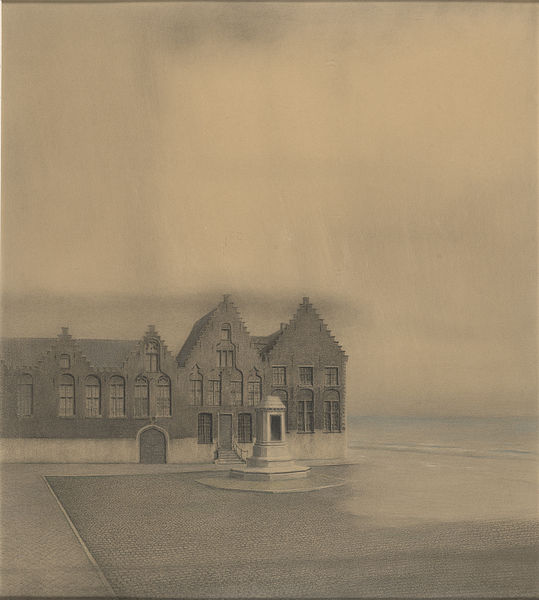
Fernand Khnopff, Book Cover Design for 'Bruges-la-Morte', unknown date
Source: Wikimedia Commons

A 2005 article in Frieze describes Rodenbach's use of photographs in Bruges-la-Morte, which could be seen as prefiguring Andre Breton's Nadja and the writings of W. G. Sebald.  
'The images were taken from the picturesque local stock of prints and postcards sold to tourists; they picture a city almost wholly uninhabited. Occasionally, minute figures in the distance have even been excised, so that these photographs, in 1892, are already outdated, resembling daguerreotype city views of half a century earlier, with their vanished or blurred citizens.
'For the most part these photographs of deserted squares, looming bell-towers and impassive façades have been left out of subsequent editions of Rodenbach’s novel, as though they added a touch of distracting realism to his dreamlike narrative. The opposite, in fact, is the case: where the story merely reflects the lurid expectations of the writer’s Parisian audience, the photographs reveal an act of grand deception — the Bruges they depict is in many places an architectural concoction of the 19th century, a renovation further finessed by the photographers’ choosing to leave out the incidental evidence of modern life. In an inexplicable twist to this tale of trompe-l’oeil medievalism the latest edition of the book, from Dedalus Press, has replaced the original images with 23 new photographs taken by the translator: once again the ‘real’ town has been carefully cropped out.'

Photograph in the 1892 edition of Bruges-la-Morte
This and others can be seen at Wikimedia Commons

I have been looking back at some old photographs I took in Bruges almost exactly a century after the book's publication, but even with some careful cropping I don't think they would convey a sense of melancholy (I should have risen earlier perhaps, before the tourists, when the streets were empty and autumn mist still hung over the motionless canals).  A modified version of Bruges is the basis for one of the most remarkable images drawn under the influence of Rodenbach, Fernand Khnopff's The Abandoned Town (1904).  Here too there is an absence of people and even the statue is missing, leaving just an empty plinth.  An incoming tide is starting to cover the stones of the Woensdagmarkt.  Instead of having been separated from the sea, the city here looks as if it is being flooded and abandoned to the waters.

Fernand Khnopff, The abandoned city, 1904
Source: Wikimedia Commons

Frances Fowle's essay 'Silent Cities', in Van Gogh to Kandinsky: Symbolist Landscape in Europe 1880-1910, describes Rodenbach's influence on artists like Khnopff and Henri Le Sidaner (called the Rodenbach of painting by one critic).  Knopff, she says, 'spent part of his childhood in Bruges, which he described as 'truly a dead city, unfrequented by visitors'.  As an adult he allegedly wore opaque dark glasses while travelling through the city, so as not to confuse his memory with modern reality.'  She notes however, that visitors had been drawn to Bruges before Rodenbach, including Holman Hunt and Rossetti, whose poem 'On Leaving Bruges' describes its grey towers under a sunless sky.  Baudelaire too had been there and called it a 'ghost town, a mummified place that smelled of death and the Middle Ages.'

After Rodenbach, more writers of 'dead-city-prose' emerged (a type of writing it would be interesting to trace forwards and backwards from this Symbolist moment).  Will Stone mentions Camille Lemonnier and Franz Hellens, whose En Ville Morte (1906), written about Ghent, 'gives the impression that the town is literally decomposing'  Other more recent writings can be linked to Bruges-la-Morte: there is a website, Villes Mortes, which provides a list works that provide context for Rodenbach's novel.  The book has also featured on two excellent blogs which have stimulated my reading over the years: Writers No One Reads and Vertigo.  And, finally, while I'm on further reading, see also the Preface to the 2005 Dedalus edition, written by Alan Hollinghurst, which The Guardian reprinted. As Nicholas Lezard pointed out in his review of the book, Hollinghurst's own '1994 novel The Folding Star is itself a homage to Bruges-la-Morte.'

Sunday, April 03, 2016

Light on the reservoir


I have not yet read any obituaries in the national media for David Blackburn, whose passing was reported last month in the Huddersfield Examiner.  This may just be a matter of time, although perhaps he is not as well known now as he once was.  There has always been a sense that he was swimming against the main currents of contemporary art, with his visionary abstract landscapes executed in pastel.  Perhaps the praise he received from Kenneth Clark whilst still a student didn't help in this respect, although a quote still appears on the front page of the artist's website. Writing in 1990, Malcolm Yorke pointed out that though Blackburn had achieved a strong international following, he had not 'courted the fickle attentions of the London galleries.'  I used to see small exhibitions of his work at the Hart Gallery, a little oasis among the crowds on Upper Street in Islington (now closed, and recently in the local news when squatters took over the premises).  More recently he has been represented by Messum's, who in 2005 made the hour-long documentary David Blackburn Landscapes of the Mind.  This includes contributions from another famous son of Huddersfield, Simon Armitage, as you can see from the slightly unfortunate thumbnail image below, where he is caught in mid-gesticulation.


Although the Hart Gallery was much more welcoming than a West End gallery, the paintings on sale were sadly beyond my means.  I recall wondering though whether the rich colours that draw you into Blackburn's images might eventually start to pall.  What did intrigue me was the way both individual pictures and composite works were constructed.  Sometimes he would mount a set of landscape studies to form a composite vision of a place, where each view remains ambiguous, poised between abstraction and the actual forms of trees, mountains, bodies of water.  Malcolm Yorke likened these grids to film stills or the panels on an altarpiece.  In this article (published in Modern Painters) he described the process of exploring a David Blackburn picture:
'A landscape can appear domesticated until you notice the tiny sun-dot in the sky, which suddenly throws the scale switch and the fields become vast as prairies.  On the other hand gross, misshapen, orange suns have recently begun to overwhelm the skylines of the hills they are supposed to set behind.  Blue stands for both sky and water, and, since we have no clouds or waves or reflections to guide us here, we might be disconcerted to find that it is water occupying the top third of the picture, not sky.  We must remember the artist's fondness for flying and take off with him.'
These ambiguities appeal to Simon Armitage, who (unlike me) does own some David Blackburns and talks about them in the film I have embedded above. One of these pictures had seemed to him to be an aerial view of fields, but, as he says in the film, "a few months ago I was driving back, not far from David's actually, near Blackmoorfoot Reservoir, almost on eye level with the reservoir, and it was something to do with the light in the evening, on the top of the reservoir, that made me realise that that could well be what's happening in the picture." And so the image changed into a vision of water.  This mutable quality is what Kenneth Clark identified as the essence of David Blackburn's art:
'People ask: What is his work like? I don’t know any artist to whom I can compare him. He is not a landscape painter, not an abstractionist in the ordinary sense of the word. He is a painter of metamorphosis.'

Saturday, April 02, 2016

The ink dark moon


I read in the New York Review recently of another new translation of Murasaki's The Tale of Genji and recalled that it is not that long ago that The Pillow Book of Sei Shōnagon was reissued in a new version by Penguin Classics.  Strange then that their great contemporary Izumi Shikibu (c. 974-c. 1034) remains relatively unpublished and neglected in comparison.  However, anyone curious about her poetry can find a rewarding set of translations made in the late eighties and published in 1990 by Jane Hirshfield with Mariko Aratani.  Their book, The Ink Dark Moon also contains a selection of earlier poetry by Ono no Komachi (c. 834-?), the only woman writer included among the 'Six Poetic Geniuses' of Japan by Ki no Tsurayuki, writing in the Preface to the Kokinshū, c. 905.

It is a bit of a stretch to make a connection between The Ink Dark Moon's short love poems and themes of landscape, although both writers' inner emotions find their objective correlatives in the sounds, scents and colours of nature.  In one of her poems Ono no Komachi, picturing the evergreen pine trees of Tokiwa Mountain, wonders whether they recognise the coming of autumn in the sound of the blowing wind.  Izumi Shikibu observes that pine trees may keep their original colour, but everything that is green looks different in spring.  As Jane Hirshfield says in her notes, it is interesting to see in these examples the different use made of the idea of unchanging evergreen trees.  Many Japanese poems feature this trope, although it is not actually true that pine trees retain their colour, since the older needles turn brown and fall to the ground.  Edwin A. Cranston mentions this in his note on a poem in the second of his monumental waka anthologies, in which a sad lover sees that 'even the treetops of the pines' are changing colour.  'The possibility of paradox is not lightly to be dismissed from poetry - or from considerations of the workings of the human heart.'


In Jane Hirshfield's own poetry written over the decades since The Ink Dark Moon she has occasionally written about Japanese and Chinese culture.  'Recalling a Sung Dynasty Landscape', for example, describes moonlit mountains and a solitary thatched hut, a place to rest the eye.  She concludes that
... the heart, unscrolled,
is comforted by such small things:
a cup of green tea rescues us, grows deep and large, a lake.
In other poetry the influence of studying writers like Izumi comes through in the metaphors she uses.  There is, for example, a poem in her collection The Beauty on 'The landscape by Dürer / of a dandelion amid grasses' (the painting appears on the cover of he Bloodaxe edition).  In this she sees 'exiles / writing letters / sent over the mountains' - the exiles are the flowers and their messengers the passing horses and donkeys.

There are two Jane Hirshfield poems in the Bloodaxe ecopoetry anthology Earth Shattering - one of which 'Global Warming' is particularly striking (you can Google it but as ever I'm trying to adhere to fair-use copyright rules here).  The clip below is a short talk on ecopoetics that she delivered in 2013.  It traces environmental attitudes in literature from Gilgamesh cutting down the cedar forest, to Gary Snyder, whose haibun series 'Dust in the Wind' achieves a balance between the human and natural worlds.  Hirshfield wrote a beautiful poem herself in haibun form (prose:haiku) which can be found in the collection Come, Thief.  It describes walks over the course of a summer in which she sees an old man building a boat until, 'finally, today, it is being painted: a clear Baltic blue.'  This boat, at rest on its wooden cradle, resembles a horse waiting in a stable.  She thinks of the way horses dream and of the hopes of the old man.  The brief concluding poem is simply the image of that blue boat, high on a mountain among the summer trees.

Friday, March 25, 2016

Topological loss

The building work I mentioned a fortnight ago is well underway, covering everything in layers of dirt from crumbling Victorian bricks so that any neglected surfaces begin to look like Man Ray's Dust Breeding (1920).  Meanwhile I have been reading this week about the first study of London's air quality which puts a figure on the number who die prematurely from the long run effects of nitrogen dioxide and dangerous fine particulates.  Such airborne pollutants have been used by the Italian artist Luca Vitone for a new kind of plein air landscape art, canvases that capture the grey substance of the city that we all have to breathe.  He has also made similar works from the kind of dust I am surrounded by now: Rooms (1914) comprised four watercolours made from dust collected in the German Federal Court, Bundesbank, Bundestag and Berlin's Pergamonmuseum.  You can see an example of a dust piece accompanying an article on Vitone in Frieze from a couple of years ago.  In this overview of Vitone's art Barbara Casavecchia discusses other works that deal with a sense of placelessness:
'In 1988, at the age of 24, Luca Vitone began working on ‘Carte Atopiche’ (Atopic Maps), a series of 1:25,000 scaled maps from which he removed all topographic indications. [...] ‘All my works reference a condition to which we are subject, which I call “topological loss”,’ Vitone explained in an interview with the critic Emanuela De Cecco in 1992.2 So deep-rooted were his feelings that he had the geographical coordinates of his place of birth, the Galliera hospital in Genoa (Lat. N. 44°24’07’’ Long. E. 8°56’31’’), tattooed on his arm, while his website constantly updates his position with a tracking system. Travelling widely and regularly exhibiting internationally, Vitone (who is now based in Berlin) compensates for his placelessness through constant scrutiny of his relationship to the contemporary Italian landscape, which he transforms into minimalist installations, soundscapes and, more recently, monochromes and videos.'  
The article concludes with a description of Vitone's recent work in which visitors to the Venice Biennale were confronted with a scent that the artist had developed 'in collaboration with the master perfumer Maria Candida Gentile by mixing three rhubarb essences.'  This was no perfume though, it was designed to evoke the smell of asbestos. For Vitone there was a particular association with asbestos-related deaths in Piedmont.  (When we first moved in here we were told by the man who dismantled an old structure in the garden that he thought it contained a small amount of asbestos. In mentioning this I should point out that our garden is pretty small and a significant portion of it constitutes an inconvenient ivy-clad mound that we understand to be a concreted-in World War Two air raid shelter nobody has had the energy or money to have removed.  Still, I suspect this visible remnant of the past is something of an antidote to feelings of placelessness and topological loss). 


After Venice, Vitone and Gentile created a new olfactory sculpture for an exhibition in Berlin, Imperium (2014), 'composed of different fragrances, which together evoke the “smell of power”' (something I think I may have sniffed before). Olfactory landscape art may well be a growing trend.  One of the best known artists working with smell, Sissel Tolaas (who recently featured in The Guardian) is also based in Berlin and made an installation charting the smells of its districts back in 2004.  The city is also home to a Smell Lab dedicated to olfactory experiments.  The results from one of its field trips are not hugely impressive ('Piece of Textile Left for an Hour Underneath a Rug at a Späti on Kottbusser Damm' - 'Smells like Nothing'), but I guess this kind of smellscape research is still in its infancy.  It is not yet possible to embed smell clips into these blog posts so I have added a short video about Luca Vitone above.  Now, on a fine evening here in Stoke Newington, I think I can smell the spring at last, overlaid with a whiff of brick dust and a hint of ancient soot from the old kitchen fireplace we have just uncovered.

Fragment of old wallpaper, Stoke Newington, date unknown

Sunday, March 20, 2016

The Tarn

 
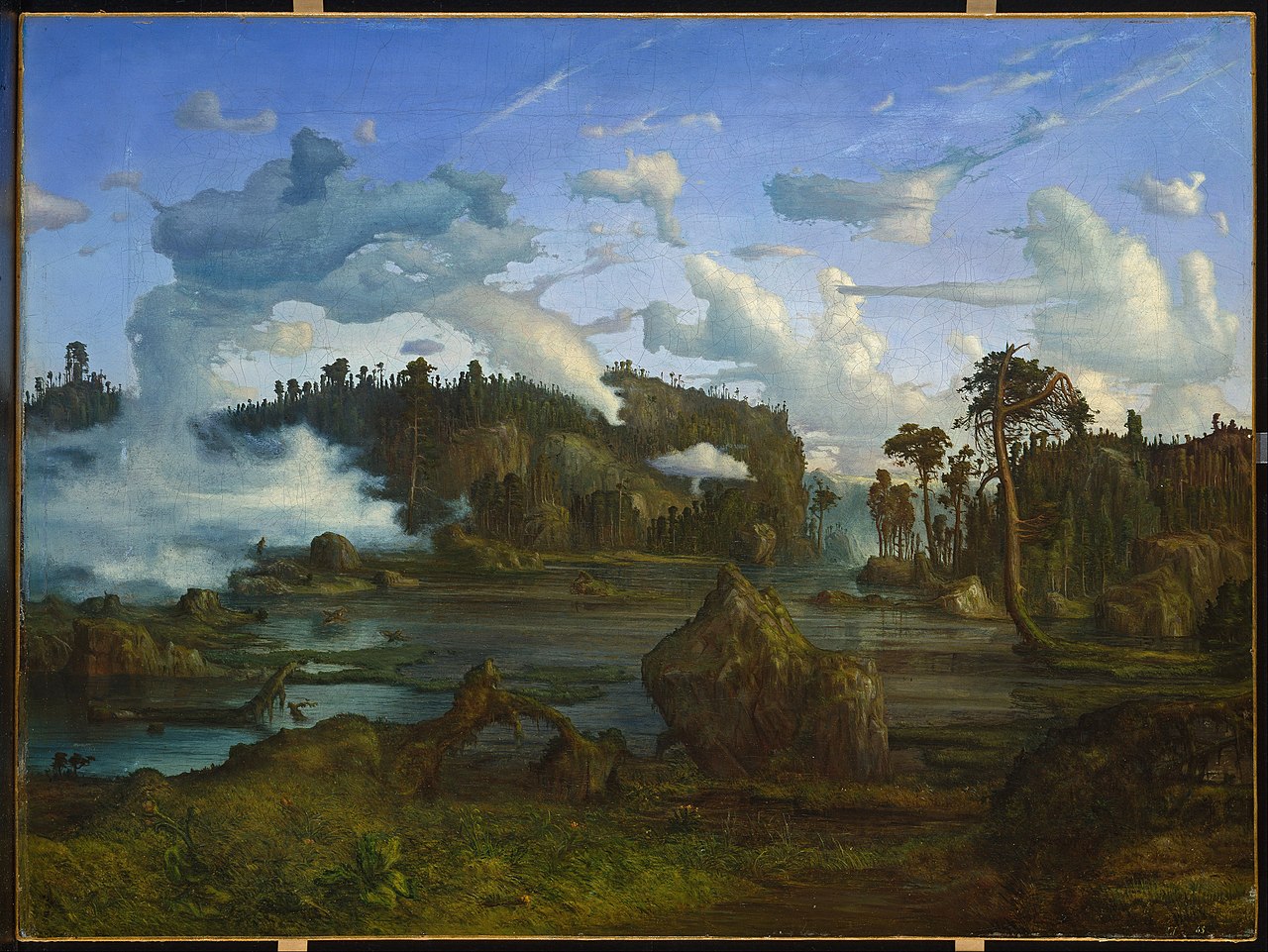
Lars Hertervig, Borgøya Island, 1867

Yesterday I watched the first of Andrew Graham-Dixon's new three-part series on Scandinavian art.  He has begun it in Norway, crunching through the snow in a parka and discussing some artists I've featured here before: Munch, Dahl, Balke.  In one hour he couldn't include everyone (no Kitty Kielland) but I was interested in the story of Lars Hertervig (1830-1902), whose traumatic move from a poor farm on the west coast of Norway to the city of Düsseldorf, where his sponsors sent him to study at the Arts Academy, was likened by Graham-Dixon to the shock of Norway's transition from rural backwater to modern state.  One day, Hertervig, who had fallen in love with the beautiful daughter of his landlady in Düsseldorf, was told that a rendezvous had been arranged with her.  But when he arrived to meet her he found no one there but a bunch of bullying, mocking students.  This practical joke contributed to a depression which led him to return to Norway, where he was placed in the asylum at Gaustad.  After eighteen months, 'incurably insane', Hertervig went home to his family.  There he began to paint again.  Two examples of this new style were discussed in the programme: the first (above) shows a crag emerging from boiling clouds above a mirror of water; the second (below) is stranger still, a vision of what might almost be a prehistoric landscape.

 Lars Hertervig, The Tarn, 1865

Here is what Andrew Graham-Dixon had to say in front of The Tarn:  
"Looks at these clouds.  There's nothing else like this in all of nineteenth century landscape painting. It's almost as if the landscape itself has gone mad, been provoked into these paroxysms of movement and gesture.  It's almost as if you are looking into the mirror of a troubled mind. The landscape itself has a tremendously primitive, ancient feel about it.  To me it's almost as if Hertervig is attempting to summon up or capture that sense of the landscape that's always been there in the Norwegian soul, whether in the soul of the Vikings or the Christians who followed.  And together with that there's a kind of fear present in it all.  A fear perhaps that just as this landscape might almost be on the point of reverting back to some primordial waste, that there is no meaning, there is no purpose, there is no pattern to the natural world.  The world simply is there."

Friday, March 18, 2016

The lake of Como

Francesco Gonin, View of Lake Como, 1840 
(illustration for chapter 1 of Alessandro Manzoni's I Promessi Sposi)
   'That branch of the lake of Como, which extends towards the south, is enclosed by two unbroken chains of mountains, which, as they advance and recede, diversify its shores with numerous bays and inlets.  Suddenly the lake contracts itself, and takes the course and form of a river, between a promontory on the right, and a wide open shore on the opposite side. The bridge which there joins the two banks seems to render this transformation more sensible to the eye, and marks the point where the lake ends, and the Adda again begins—soon to resume the name of the lake, where the banks receding afresh, allow the water to extend and spread itself in new gulfs and bays.
   The open country, bordering the lake, formed of the alluvial deposits of three great torrents, reclines upon the roots of two contiguous mountains...'
- Alessandro Manzoni, The Betrothed, 1827
Thus Manzoni begins his celebrated novel in the manor of a rather dry geography lesson.  According to Umberto Eco, almost all Italians hate the book 'because they were forced to read it at school.'  They also wonder why he spends so long describing the features of Lake Como before getting on with the story.  'Manzoni proceed as if he were filming from a helicopter slowly landing (or as if he were reproducing the way God looks down from the heavens to single out a human individual on the Earth's surface).'  With the third sentence the description moves from geography to topography.  Then, once it has attained a human scale, the landscape begins to be described as it would be experienced by someone walking over it.  And from there Manzoni passes from topography to history before finally alighting on an individual, Don Abbondio, who is making his way along a lane on the 7th day of November, 1628.  

On this blog I have described something similar before: Joseph Conrad's Nostromo, in which the long scene-setting prepares the reader for a book whose story will encompass more than just the activities of its characters.  In The Betrothed, Eco says, 'we are being told not just the story of some poor little human beings but the History of Divine Providence.'  That opening in which Manzoni assumes 'the viewpoint of god, the great Geographer' also tells us something about Don Abbondio.  This is 'not just an exercise in literary self-indulgence; it's a way of preparing the reader straightaway to a read a book whose main protagonist is someone who looks at the way of the world from on high.'  In the portrait I have reproduced here Manzoni is shown in front of Lake Como.  He looks neither towards us or over his surroundings but upwards, to a point somewhere above the world.

Giuseppe Molteni, Alessandro Manzoni, 1835

The Umberto Eco quotations above are from Six Walks in the Fictional Woods, the Charles Eliot Norton Lectures he delivered in 1993.  This post is prompted in part by the sad news of Eco's death last month, which has been marked by many tributes and obituaries, from The New York Times to BLDGBLOG.  The last of his Walks concludes with the story of a visit he had recently made to a planetarium.  There the curator arranged the display so that it showed what the stars would have looked like on the night of 5-6 January 1932, the first night of Umberto Eco's life.
'Perhaps others have had a similar experience.  But you will forgive me if during those fifteen minutes I had the impression that I was the only man, since the dawn of time, who had ever had the privilege of being reunited with his own beginning. ... Perhaps I had found the story that we all look for in the pages of books and on the screens of movie theaters: it was the story in which the stars and I were protagonists. ... That was a fictional wood I wish I had never had to leave.' 

Friday, March 11, 2016

Blind Orion Searching for the Rising Sun

Nicholas Poussin, Blind Orion Searching for the Rising Sun, 1658

I write this surrounded by piles of books with a couple of pictures propped against them.  This would be pleasant except that they've all been brought upstairs to be out of the way of some imminent building work.  Sadly there's too much I've got to do here in the house to spend time writing anything very thoughtful about landscape and art.  So here instead I will just give you a couple of beautifully written passages from an essay by William Hazlitt, 'On a Landscape of Nicholas Poussin.'
'Orion, the subject of this landscape, was the classical Nimrod; and is called by Homer, 'a hunter of shadows, himself a shade.' [...] Mists rise around him, and veil the sides of the green forests; earth is dank and fresh with dews, the 'gray dawn and the Pleiades before him dance,' and in the distance are seen the blue hills and sullen ocean. Nothing was ever more finely conceived or done. It breathes the spirit of the morning; its moisture, its repose, its obscurity, waiting the miracle of light to kindle it into smiles; the whole is, like the principal figure in it, 'a forerunner of the dawn.' The same atmosphere tinges and imbues every object, the same dull light 'shadowy sets off' the face of nature: one feeling of vastness, of strangeness, and of primeval forms pervades the painter's canvas, and we are thrown back upon the first integrity of things. [...] To give us nature, such as we see it, is well and deserving of praise; to give us nature, such as we have never seen, but have often wished to see it, is better, and deserving of higher praise. He who can show the world in its first naked glory, with the hues of fancy spread over it, or in its high and palmy state, with the gravity of history stamped on the proud monuments of vanished empire,--who, by his 'so potent art,' can recall time past, transport us to distant places, and join the regions of imagination (a new conquest) to those of reality,--who shows us not only what Nature is, but what she has been, and is capable of,--he who does this, and does it with simplicity, with truth, and grandeur, is lord of Nature and her powers; and his mind is universal, and his art the master-art!'
Poussin's Blind Orion Searching for the Rising Sun is now owned by the Met but when Hazlitt saw it, the painting was 'one of a series from the old masters, which have for some years back embrowned the walls of the British Gallery, and enriched the public eye.'  His essay praises what were the world's first regular temporary exhibitions of Old Master paintings.  Pictures, he concludes, 'are scattered like stray gifts through the world; and while they remain, earth has yet a little gilding left, not quite rubbed off, dishonoured, and defaced.'  I don't think Hazlitt would have thought much of the Alexander Calder lithograph I'm about to pack away in an old sheet for a few months.  But he would have agreed that to take pleasure from art it is unnecessary to have pictures hanging on the walls around you.
'Pictures are a set of chosen images, a stream of pleasant thoughts passing through the mind. It is a luxury to have the walls of our rooms hung round with them, and no less so to have such a gallery in the mind, to con over the relies of ancient art bound up 'within the book and volume of the brain, unmixed (if it were possible) with baser matter!' A life passed among pictures, in the study and the love of art, is a happy noiseless dream: or rather, it is to dream and to be awake at the same time; for it has all 'the sober certainty of waking bliss,' with the romantic voluptuousness of a visionary and abstracted being.' 

Friday, March 04, 2016

Song of the Forests


I have often written here about music inspired by landscape, but the Song of the Forests is an oratorio dedicated to the reshaping of landscape.  It was by written by Dmitri Shostakovich in the summer of 1949 to celebrate the forestation of the Russian steppes.  A year earlier he had been denounced for formalism.  Living in fear, he took to waiting on the landing by the lift each night for the anticipated arrest, as Julian Barnes describes in his new novel The Noise of Time.  While Shostakovich composed serious work 'for the desk drawer', the Song of the Forests was written to help secure his rehabilitation.  It was a setting of what Barnes calls 'an enormous, windy text by Dolmatovsky' that referred to Stalin as The Great Gardener.  'Under Stalin, the oratorio insisted, even apple trees grew more courageously, fighting off the frosts just as the Red Army had fought off the Nazis.  The work's thunderous banality had ensured its immediate success.'


This was not the only collaboration between Shostakovich and the poet Yevgeniy Dolmatovsky.  In 1951 they wrote 'The Motherland Hears, The Motherland Knows' which Yuri Gagarin whistled on his descent to earth ten years later, making it the first song performed in space.  An article on Dolmatovsky in a journal dedicated to Shostakovich mentions more of his work, including songs that were popular during the war.  In his memoirs Krushchev said he'd been inspired by 'The Song of the Dnieper' which describes the river filling with the blood of the Fascists (you can hear renditions by the Red Army Choir on Youtube).  Shostakovich and Dolmatovsky continued working together and met for the last time just before the death of Shostakovich in 1975.  Apparently Shostakovich said to him "You know, The Song of the Forests was really about protecting the environment - a subject the whole world is talking about now.  We hit the nail on the head!"'  Forty years later we are still talking about it, but as Hannah Ellis-Peterson wrote last year, the contemporary relevance of the Song of the Forests may have more to do with politics than the environment.

Monday, February 29, 2016

Wanderings through the Mark Brandenburg


Reading the new translations of Walter Benjamin's radio broadcasts, made between 1929 and 1932, you are aware of how quickly the world in which they went out would disappear.  The final set of programmes about the catastrophes of history now seems to point towards the disaster that would shortly engulf Germany and eventually Benjamin himself.  The broadcaster was, in Benjamin's imagination, a guest in people's homes but, as Peter Conrad wrote in his review of Radio Benjamin, 'when the Nazis took control of Germany’s airwaves, such polite protocols were suspended.  A welcome guest no longer dispensed sage advice or told cautionary stories; instead, one man harangued a crowd, shouting tirades at top volume.'  How many Berlin Youth Hour listeners, you wonder, would grow up to fight in the Wehrmacht ten years later?  
 
The programme I want to highight here, 'Fontane's Wanderings through the Mark Brandenburg', begins with the idea that the landscape surrounding the city was 'discovered by the youth of Berlin'.  This Wandervogel movement would soon be outlawed, along with other groups distinct from the Hitler Youth.  However, as its title indicates, the main subject of Benjamin's broadcast was not these young walkers, or the wider groups of Bündische Jugend.  What he proceded to talk about was a remarkable topographical project, conceived one day in 1858 on Loch Levan in Scotland, by Theodor Fontane.
'In the middle of the loch lies an island, and on the middle of the island, half hidden behind ash trees and black firs, rises an old Douglas castle, the Loch Levan Castle of song and legend.  On returning to land by boat, the oars rapidly engaged, the island became a strip, finally disappearing altogether, and for a while, only as a figure of the mind, the round tower remained before us on the water, until suddenly our imagination receded further into its memories and older images eclipsed the images of this hour.  They were memories of our native land, an unforgotten day.  It was the image of Rheinsberg Castle that, like a Fata Morgana, hovered over Loch Levan...'
In that moment Fontane realised that the landscape made famous by Walter Scott was really no more beautiful than the sandy terrain of his native Mark Brandenburg.  And so he began his wanderings, selecting material to write about like 'a walker picking individual ears of grain'.  In 1860 he wrote to his friend Theodor Storm that the result might run to twenty volumes; in the event it was published in five, between 1862 and 1889.  The result was, as Benjamin told his listeners, 'far more than tedious descriptions of landscapes and castles, these books are full of stories, anecdotes, old documents, and portraits of fascinating people.'  It is not hard to imagine this appealing to Benjamin.  It sounds as if it would be enjoyed by English readers too if a modern selection were published, perhaps by an editor/translator looking, like Benjamin, to illuminate our understanding of culture and social change.  Although Fontane's novels have appeared in English (Before The Storm is one of my father's favourite books), I've not come across a translation of the Wanderings through the Mark Brandenburg, either in full or abridged form.

Carl Blechen, Rural Landscape in the Mark Brandenburg, c. 1831-8

Benjamin concluded this broadcast with his own description of the broad, expansive landscape of the Mark - quoted below again in the translation by Lecia Rosenthal - and some verse by Fontane that hardly needs to be translated.
'Its sandy, marly soil does not lend itself to strong shapes; however, one is occasionally surprised to come across a steep precipice, or a gorge ripped into the earth.  But the plain of the Mark, with its birch forests and cast acres of fields stretching to the horizon like a broad sea of gray and green, is the landscape's most beautiful feature.  It is so shy, subtle, and unobtrusive that sometimes, at sundown, on the water amid pillars of pine, you think you're in Japan, and other times, in the limestone hills of Rüdersdorf, you imagine yourself in the desert, until the names of the villages here call you back to reality.  Fontane strung some of these names together in a few light and airy lines, which we close with today.

And on this tapestry's flourishing seam
the laughing villages prosper and teem:
Linow, Lindow,
Rhinow, Glindow,
Beetz and Gatow,
Dreetz and Flatow,
Bamme, Damme, Kriele, Krielow,
Petzow, Retzow, Ferch am Schwielow,
Zachow, Wachow and Groß-Behnitz,
Marquardt-Ütz at Wublitz-Schlänitz,
Senzke, Lenzke and Marzahne,
Lietzow, Tietzow and Rekahne,
And lastly a garland of lively haunts:
Ketzin, Ketzür and Vehlefanz.'

Landscape view in the 1986 TV adaptation
Theodor Fontane, Wanderungen durch die Mark Brandenburg


Footnote: Michael Rosen's excellent programme on the Benjamin broadcasts can be heard on the BBC archive.  Although he doesn't explore the countryside of the Mark Brandenburg, he visits the Benjamin archive in Berlin and locations described in the original programmes .

Monday, February 22, 2016

Utopia

 Ambrosius Holbein, The Island of Utopia, 1516

2016 marks the five hundredth anniversary of Thomas More's Utopia.  The book has little in detail to say about Utopia's topography, although we are told that it was once a peninsula, before a channel was cut through the isthmus connecting it to the mainland, creating a crescent shaped island that is like one great harbour.  The land itself is not especially fertile but the Utopians make good use of their natural resources and enjoy their communal gardens.  In his introduction to the Penguin translation Paul Turner provides an amusing overview of utopian and dystopian literature, from the vision of paradise in The Epic of Gilgamesh  to recent novels by Huxley, Orwell, Evelyn Waugh and Mary McCarthy.  More's chief model was Plato's Republic, in which Socrates describes his ideal state.  It is in Plato's Critias however, that he imagines an actual location for a utopian society: the island of Atlantis, formed of concentric rings with springs that provide both hot and cold water.  Before Plato, Paradise was imagined in the form of Elysium, which Homer located on the western edge of Earth. Turner writes that in The Odyssey 'the description of the Elysian Fields stresses chiefly the superb weather-conditions; but Lucian, completing the picture later, represents Elysium as a luxurious holiday-camp, with honey and scent laid on, permanent background music provided by nightingales, and self-filling wine glasses.'

Ambrosius Holbein, The Island of Utopia, 1518

The first edition of Utopia came with a sketch-map of the island by Hans Holbein's elder brother Ambrosius.  However a slightly different version appeared in 1518, within a book devoted to the work of More and Erasmus that had engravings by both of the Holbeins.  In this new version the ship's position in relation to the island makes it resemble a skull, slightly reminiscent of the famous anamorphic skull in Hans Holbein's The Ambassadors.  There is an interesting article on this in the British Dental Journal which suggests that Erasmus may have suggested a memento mori design as a pun on More's name.  At first I thought special dental techniques had been used in this research and that there might have been something uniquely interesting about the 'ship of teeth'.  However, the article is actually an excursion into art history by a practising dentist whose 'experience in dental radiology' heightened his perception of concealed anatomical structures.  It is a striking idea that the particular viewpoint dentists habitually have of our upturned faces may lead them to read landscapes differently (not what Woody Allen had in mind I think when he wrote 'If the Impressionists Had Been Dentists').  The Utopians may have had need of dentists, as their meals ended with a great variety of sweets and fruits.  Dentists are not mentioned explicitly but Utopia has a plentiful supply of medical equipment, experienced doctors and sympathetic nurses, so that 'practically everyone would rather be ill in hospitals than at home.'

Saturday, February 13, 2016

Rainbow Mid Life’s Willows

Ian Nairn once described the view from 'decent quiet Duquesne Heights onto the roaring heart of Pittsburgh' as the epitome of terribilità.  If he were there today, half a century later, he could look across to the city's cultural district, where the Wood Street Galleries are hosting an exhibition of British landscape art.  Pastoral Noir is curated by Justin Hopper who grew up in the city but now lives over here, in Suffolk.  He has been responsible for some interesting recent experiments in the fusion of image, sound and text on themes of place and memory.  In 2014 he recorded Ley Line, 'a series of poems based on walks in Pittsburgh along a fabricated ley line connecting the central church with a handmade shrine to the Virgin Mary overlooking the river - passing, on the way, the house in which Andy Warhol was built and the one in which Keith Haring lived, as well as many local and personal landmarks.' These pieces were 'bookended by two poems based on Anglo-American folk songs found in both Sussex and Appalachia, read by myself and Shirley Collins' and there was music too by The Belbury Poly and Host Skull.


Justin has now sent me his new album, 'I Made Some Low Inquiries', which again combines words and music and draws connections between the old weird American and English folklore.  Its title is a line in an old song that Almeda Riddle recorded under the poetic title 'Rainbow Mid Life’s Willows' for Alan Lomax and Shirley Collins, during their field recording trip through the South in 1959.  Justin's texts also draw on stories told to George Ewart Evans, poems by Seán Ó Ríordáin and the writings of French psychogeographer Jacques Réda.  You can see in the video clip below how this sounds with musical accompaniment from Jem Finer, Susie Honeyman of the Mekons and others.  Justin has a great voice for spoken word performance - from an English perspective his American accent sounds neutrally classless, not immediately identifiable either with those who live and work on the land or those who own, walk over and contemplate it.  Folk music always raises awkward questions around our position as listeners, our yearning for authenticity and lost connections with the land.  But Justin is prepared to risk romanticising a singer like Almeda Riddle in order to convey some of the emotional intensity, the terribilità, in her songs...   
'Throughout Collins’ and Lomax’s recordings one pictures oneself at the scene hearing these men and women sing, an act so normal to them as breathing and yet an act of alien beauty to the visitor.  It is, of course, wrong to produce an ‘other’ of one’s subject.  But this Ozark songstress is alien – not in place, but in time.  Hers is a song of the landscape – an intersection of history and now, of weather and sorrow.  It is untranslatable, and yet, here, we attempt to translate it. It is a song worth imbibing – despite its powerful, uncanny taste.'

Friday, February 12, 2016

The Coast of Bohemia

Joseph Wright of Derby, Antigonus in the Storm, 1790-2

On Tuesday we went to see The Winter's Tale at the atmospheric, candlelit Sam Wannamaker Theatre.  I am sure I was not alone in looking forward to seeing how the director dealt with Shakespeare's most famous stage direction: 'Exit, pursued by a bear'.  When it came, this scene played out in near darkness, rightly leaving a lot to the imagination.  This worked well not just because it must be hard to convincingly stage an unexpected bear attack, but because the pursuit takes place on the non-existent desert shoreline of Bohemia.  Perhaps we are not meant to try too hard to picture the surrounding landscape.  Nevertheless, I love the way Joseph Wright has endeavoured to imagine this scene as it might actually have occurred, depicting the rocky beach where Antigonus was pursued and met his grisly end, 'torn to pieces with a bear.'  This painting is in Ontario where it has been shown alongside sound machines traditionally used in 18th century theatre productions, one imitating the wind (canvas passing over wood) and the other rain (beads rotating in a drum.)

Much speculation has gone into Shakespeare's setting for this part of the play.  Some historians have thought he cannot have meant Bohemia and was referring to somewhere else - Apulia, perhaps, or Bithynia.  Others have pointed to the play's source (Robert Green's pastoral Pandosto) which also refers to Bohemia's coast, or have explained it in terms of the political advantage in siting the action in the country of an ally of James I.  But pastoral has never been at all realistic and Shakespeare probably felt as free to imagine 'Bohemia' as his contemporaries would Arcadia.  This is not the only point in the play where reality and fantasy fuse: the actual Renaissance artist Giulio Romano is referred to as sculptor of the statue of Hermione that miraculously comes to life (Giulio was a painter, not a sculptor).  Shakespeare's Bohemia reminds me of another mythical place that I wrote about here before, Kafka's Amerika.  Kafka created a version of that distant continent that was a kind of 'exploded Bohemia'; Shakespeare's coast of Bohemia is similarly a country drawn out of dreams and desires (Kafka on the shore, one might say).

Gelett Burgess, A Map of Bohemia, 1896

In A Time of Gifts the young Patrick Leigh Fermor, walking alone along the Danube near the southern edge of old Bohemia, thinking of The Winter's Tale, dreams up his own theory.  'As I marched downstream, inspiration struck.  'Coast' must originally have meant 'side' or 'edge', not necessarily connected with 'sea' at all!  Perhaps this very path was the Coast of Bohemia - at any rate the Coast of the Forest: near enough!'  Remembering the plot, he imagines a route for Antigonus: sailing from Sicilia to Trieste, overland to Vienna and then up the Danube. 'The ship, running into terrible storms, probably among the Grein whirlpools, founders.  Antigonous, the old courtier, scrambles ashore, - perhaps just under the castle of Werfenstein!' The bear would have emerged from the forest and Act IV's sheep-shearing festivities might have been celebrated in one of the nearby farms.  It is a wonderful moment of creative excitement... followed by crushing disappointment when he arrives at Vienna, checks the play text and realises that Shakespeare's didn't actually use the word coast at all:

SCENE III. Bohemia. A desert country near the sea.  

Later, unable to give up on his speculations, Leigh Fermor has a second moment of jubilation after an afternoon spent in his host's library searching for connections between England and Bohemia.  'The windows of the flat looked down on the whole of Prague.  Towards the end of my search, the pale sun had set among those silver and purplish clouds and at lighting-up time all the lamps of the city had leapt simultaneously to life.'  His host suddenly has an idea and takes down a history book.  It explains that Bohemia did briefly have a coastline, when its territory extended to Dalmatia.  Celebratory drinks are poured in a mood both victorious and valedictory, as the young literary detective is set to leave Prague and head off again on his slow journey to Istanbul.  Years later, writing the book, Leigh Fermor looks back on all this with the knowledge that Shakespeare's comedies always have an imaginary topography...
'Woods and parkland on the Warwickshire, Worcestershire and Gloucestershire borders, that is; flocks and fairs and a palace or two, a mixture of Cockayne- and Cloud-Cuckoo- and fairyland with stage mountains rather taller than the Cotswolds and full of torrents and caves, haunted by bears and washed, if need be, by an ocean teeming with foundering ships and mermaids.'

Monday, February 08, 2016

Tall Mountains and Flowing Waters

In an earlier post, 'Clouds over the Xiao and Xiang Rivers', I discussed landscape imagery in Song dynasty music for the qin (Wade-Giles: ch'in).  The ch'in, a type of zither but sometimes confusingly referred to as a lute, is the great instrument of Chinese history, played by scholars, emperors and poets.  There was T'ao Yüan-ming for example, whose fondness for it, along with books and wine, I once referred to here (T'ao was the founder of 'fields-and-gardens' poetry).  Indeed, 'T'ao was ultimately so imbued with ch'in music that he removed the strings from his instrument, writing that "I have understood the deeper meaning of the ch'in, why should I need the sound of the strings?"  This may help to explain why certain inaudible effects executed on the ch'in are admired, as both the performer and the educated listener can imagine the sounds even when they cannot hear them.  T'ao's statement also provided an excuse for later scholars who owned an instrument but could not play it.'

 Uragami Shunkin, A Portrait of Uragami Gyokudō, 1813

This quotation actually comes from a book about a Japanese ch'in player, Uragami Gyokudō (1745-1820).  In Tall Mountains and Flowing Waters: The Arts of Uragami Gyokudō, Stephen Addiss covers not just his music, but also Gyokudō's poetry, calligraphy and landscape painting.  It was music that came first though, as Minagawa Kien made clear in the preface to a collection of Gyokudō's poems, suggesting that this ability on the ch'in enabled Gyokudō to evoke the 'craggy and vast'.  In this he resembled the ancient Chinese ch'in player Po Ya, who could convey in his music the qualities of 'Tall Mountains' and 'Flowing Waters'.  Kien was referring here to a story in the Taoist text Lieh-tzu that became proverbial as an example of the understanding between friends.  Po Ya's friend Chung Tzu-ch'i was so in tune with his mind and music that he always knew what Po Ya was thinking when he played.  When Chung Tzu-ch'i died, Po Ya broke the strings of his ch'in and never played again.

Uragami Gyokudō, Snow Sifted Through Frozen Clouds, c. 1810

Gyokudō epitomised the bunjin ideal: an amateur artist who painted 'without knowledge of the six laws', who loved to play the ch'in but did not 'know the rules', who read for pleasure and detested scholarship.  Nevertheless it is easy to imagine that as the years went by his daily work as an official would have been increasingly tiresome.  In 1794 political circumstances prompted him to resign and devote himself entirely to the arts.  He seems to have had no regrets.  In 'Shutting My Gate, I Play the Ch'in' he writes of having left his concerns behind.  In another poem he finds that 'fifty years have passed / like a whistle in the wind,' and now 'among the short-tailed deer, / I strum my ch'in.'  Elsewhere he describes  himself like a figure in a painting: an old man playing his instrument as night deepens, illuminated by a moon above Dragon Mountain.   Or he can be found listening to the autumn wind in the forest trees and chanting his poems to the accompaniment of a waterfall.
You ask the plan of my life?
At roof's edge a strip of clouds,
inside the walls a ch'in.

Stephen Addiss performing 'Hito - Man's Nature' by Uragami Gyokudō

Friday, February 05, 2016

Study of Rocks and Trees


The Regional Book by David Matless was reviewed back in October by Ken Worpole on his New English Landscape blog.  He summarises it as 'a gazetteer of 44 Norfolk places, each described in telegraphese, halfway in style between Pevsner and the poet Roy Fuller.'  The book's style is indeed unusual, its highly abbreviated sentences reflecting the flatness of the landscape described, its cadences often reminding me of crossword clues.  Rather than discuss the book as a whole and risk repeating what Ken says, I want here to mention just one of the entries, on Norwich Castle Museum.  It's hardly a representative location but the section begins like others, with a spatial location and succinct description: ‘Ten miles from the Bure, one from the Wensum, on a Norman mound. The region on display in paint and diorama.’ A list of local subjects treated in the museum's paintings it terminates thus: ‘Studies in landscape, Langley’s scrutiny: uninventable.’ The solution to this cryptic reference can be found towards the end of R. F. Langley's wonderful journals (Helen MacDonald's desert island book).  Matless is referring to an entry for August 2005, when Langley stopped and studied the Museum's paintings with the kind of long, close attention I've written about here before.

What Langley most admired were the watercolours of John Middleton (1827-56), particularly a Study of Rocks and Trees.  'The left side is ghosted in, a rising track, the right an equally hinted slope falling away with sky open behind it.  The foreground is out of focus rocks and clitter, done with the slightest washes and touches.  The centre is thus presented as altogether important, with the feeling of air around your head as you look at it, space where you are not looking.’ He describes the knots and gnarls and bulges of the trunks, patches of lichen found by the sun and branches twisting in unpredictable ways.  ‘Shadows jink over the individuality of irregularities.  The whole is done without any mess, everywhere with flair.’ Langley, writing of Middleton in a way that could easily be a description of his own prose and poems, finds that ‘nobody else has done the looking that was involved like this.  A study.  Indeed.’  Nothing else in the gallery that day had quite this quality of an actual place found, unique and ‘uninventable’.  The tree Middleton painted is a kind of challenge to the way we experience art and landscape.  ‘It makes fools of those who pass down the corridor with only a glance, as it does those who stroll down the lanes without being brought to a stop.  Seeing it like this must matter.’


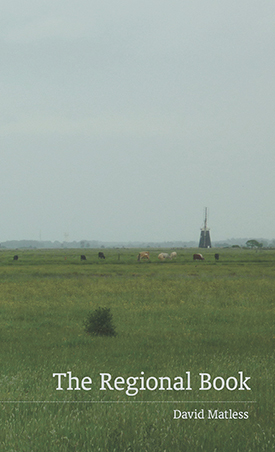
The cover of the book is a drawing made by the author in 1962
(I cannot find an image of John Middleton's painting, but this looks to have ths same uninventable quality)

Sunday, January 31, 2016

A Ruin on the Road

 
 Francis Towne, A Ruin on the Road to the Ponte Nomentana, 1780
 
Yesterday I visited the British Museum for Light, time, legacy: Francis Towne’s watercolours of Rome.  The exhibition is curated by Richard Stephens, whose Catalogue Raisonné will soon be appearing online.  This is based on the PhD. Richard was still completing when he commented on a post I wrote here ten years ago referring to Francis Towne.  Back then I was sharing a favourite passage from the diaries of Thomas Jones, another painter rediscovered in the twentieth century.  Jones had taken Towne sketching in the countryside near Naples.  There they encountered 'three ugly-looking fellows dressed in the fantastic garb of the Sbirri di Campagna, with long knives, cutting up a dead jackAss… Towne started back as if struck by an electric Shock… "I'll go no further" says he, with a most solemn face, adding with a forced smile, that however he might admire Scenes in a Picture - he did not relish them in Nature.' 

Francis Towne, Temple of Minerva at Sunset, 1781

While he stayed in Rome, Towne also left the environs of the city to paint the surrounding countryside.  However, as Jonathan Jones points out in his  review of the exhibition, by 1780 the city itself had become a picturesque landscape.
'Towne’s Rome is not a modern living city: it’s a woodland dotted with half-collapsed temples, a meandering countryside populated by a few peasants, antiquaries and market traders, dwarfed by the melancholy remains of a greater past.  While Towne was wandering the seven hills of Rome, the historian Edward Gibbon was six years into writing The History of the Decline and Fall of the Roman Empire. Their visions of Rome are remarkably similar. Gibbon’s masterpiece is an awed attempt to understand how something as vast and powerful as the Roman empire could vanish. Towne’s watercolours ask that same question: what has happened in these sleepy valleys and woods? Temples and palaces that once ruled a huge part of the world are now the decaying picturesque decorations of a pastoral landscape where time seems to have slowed down like the meandering Tiber.'

Paul Oppé's article, 'Francis Towne, Landscape painter'  

Francis Towne, Arricia, 1781
Images from the exhibition's downloadable guide

The exhibition refers at several points to the revival of interest in Towne's work following his rediscovery and promotion by the collector Paul Oppé.  'Modernist taste of the 1920s and 1930s embraced the flat planes and spare, angular design of drawings like Arricia and Towne was feted as a pioneer.'  It made me wonder how future generations will look back on the more recent excitement over landscape paintings by Balke and Strindberg (which I discussed here).  I confess I usually find myself agreeing with modernist taste and for me the high points of this exhibition are the works they found most admirable.  Hard too not to envy Oppé, then a young civil servant at the ministry of education, who bought a bunch of uncatalogued watercolours in 1907 for 25 shillings that included several works by Towne, including A Study on the Spot at Tivoli.  The closest I'll ever get to owning a sketch of Tivoli is to paint one myself...  Having tried this on a couple of holidays, wrestling with the strong light contrasts and struggling to unify details of pine branches, Roman brickwork and distant ruins, I'm in awe at the way Towne achieved his elegant compositions.  As Laura Cummings writes in another Guardian review: 'he puts together a version of the great outdoors of exceptional lucidity – the world contained in limber lines, its colours pearly with light and marked by the ever-shifting atmosphere.'

Sketching on the Spot, Hadrian's Villa, Tivoli, 2014