Showing posts with label William Shakespeare. Show all posts

Friday, February 12, 2016

The Coast of Bohemia

Joseph Wright of Derby, Antigonus in the Storm, 1790-2

On Tuesday we went to see The Winter's Tale at the atmospheric, candlelit Sam Wannamaker Theatre.  I am sure I was not alone in looking forward to seeing how the director dealt with Shakespeare's most famous stage direction: 'Exit, pursued by a bear'.  When it came, this scene played out in near darkness, rightly leaving a lot to the imagination.  This worked well not just because it must be hard to convincingly stage an unexpected bear attack, but because the pursuit takes place on the non-existent desert shoreline of Bohemia.  Perhaps we are not meant to try too hard to picture the surrounding landscape.  Nevertheless, I love the way Joseph Wright has endeavoured to imagine this scene as it might actually have occurred, depicting the rocky beach where Antigonus was pursued and met his grisly end, 'torn to pieces with a bear.'  This painting is in Ontario where it has been shown alongside sound machines traditionally used in 18th century theatre productions, one imitating the wind (canvas passing over wood) and the other rain (beads rotating in a drum.)

Much speculation has gone into Shakespeare's setting for this part of the play.  Some historians have thought he cannot have meant Bohemia and was referring to somewhere else - Apulia, perhaps, or Bithynia.  Others have pointed to the play's source (Robert Green's pastoral Pandosto) which also refers to Bohemia's coast, or have explained it in terms of the political advantage in siting the action in the country of an ally of James I.  But pastoral has never been at all realistic and Shakespeare probably felt as free to imagine 'Bohemia' as his contemporaries would Arcadia.  This is not the only point in the play where reality and fantasy fuse: the actual Renaissance artist Giulio Romano is referred to as sculptor of the statue of Hermione that miraculously comes to life (Giulio was a painter, not a sculptor).  Shakespeare's Bohemia reminds me of another mythical place that I wrote about here before, Kafka's Amerika.  Kafka created a version of that distant continent that was a kind of 'exploded Bohemia'; Shakespeare's coast of Bohemia is similarly a country drawn out of dreams and desires (Kafka on the shore, one might say).

Gelett Burgess, A Map of Bohemia, 1896

In A Time of Gifts the young Patrick Leigh Fermor, walking alone along the Danube near the southern edge of old Bohemia, thinking of The Winter's Tale, dreams up his own theory.  'As I marched downstream, inspiration struck.  'Coast' must originally have meant 'side' or 'edge', not necessarily connected with 'sea' at all!  Perhaps this very path was the Coast of Bohemia - at any rate the Coast of the Forest: near enough!'  Remembering the plot, he imagines a route for Antigonus: sailing from Sicilia to Trieste, overland to Vienna and then up the Danube. 'The ship, running into terrible storms, probably among the Grein whirlpools, founders.  Antigonous, the old courtier, scrambles ashore, - perhaps just under the castle of Werfenstein!' The bear would have emerged from the forest and Act IV's sheep-shearing festivities might have been celebrated in one of the nearby farms.  It is a wonderful moment of creative excitement... followed by crushing disappointment when he arrives at Vienna, checks the play text and realises that Shakespeare's didn't actually use the word coast at all:

SCENE III. Bohemia. A desert country near the sea.  

Later, unable to give up on his speculations, Leigh Fermor has a second moment of jubilation after an afternoon spent in his host's library searching for connections between England and Bohemia.  'The windows of the flat looked down on the whole of Prague.  Towards the end of my search, the pale sun had set among those silver and purplish clouds and at lighting-up time all the lamps of the city had leapt simultaneously to life.'  His host suddenly has an idea and takes down a history book.  It explains that Bohemia did briefly have a coastline, when its territory extended to Dalmatia.  Celebratory drinks are poured in a mood both victorious and valedictory, as the young literary detective is set to leave Prague and head off again on his slow journey to Istanbul.  Years later, writing the book, Leigh Fermor looks back on all this with the knowledge that Shakespeare's comedies always have an imaginary topography...
'Woods and parkland on the Warwickshire, Worcestershire and Gloucestershire borders, that is; flocks and fairs and a palace or two, a mixture of Cockayne- and Cloud-Cuckoo- and fairyland with stage mountains rather taller than the Cotswolds and full of torrents and caves, haunted by bears and washed, if need be, by an ocean teeming with foundering ships and mermaids.'

Friday, April 05, 2013

They played one evening in a grove of oak trees

 The Ben Greet Players in scenes from As You Like It
Photographs from The Craftsman, September 1907

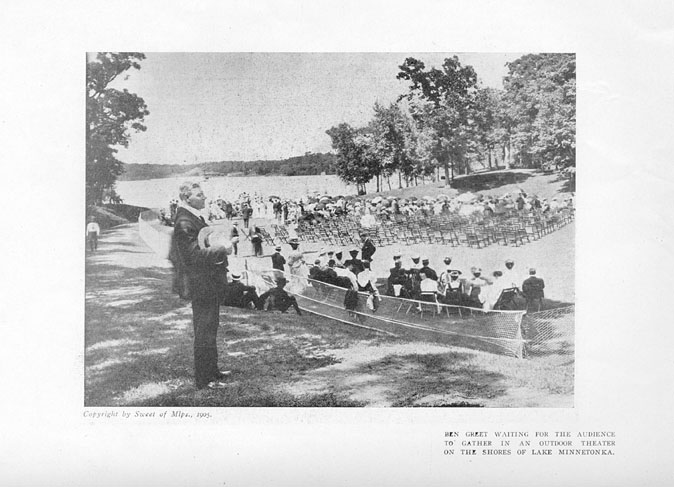
In 1886 the English actor and impresario Ben Greet came up with the novel idea of forming a professional theatre company dedicated to performing plays at outdoor locations.  One of his actors later recalled that "the pieces most generally chosen were 'The Tempest,' 'The Dream,' 'Twelfth Night,' and 'As You Like It.'  Seasons lasting six weeks were sometimes given in the Botanic Gardens, Regent's Park, while on country tours, care was taken to have an option over a neighbouring playhouse in case of rain - which is not quite unknown In England!  In Llandudno (Wales) we played 'The Dream,' in a beautiful natural amphitheatre, known as 'The Happy Valley,' before 10,000 people, a memorably unique occasion."  Greet himself explained to an interviewer why they mainly stuck to Shakespeare comedies: "frock coats and grey trousers don’t seem to fit in with the green background of nature. Doublet and hose is the only wear that the public like, and I quite agree with them."

Ben Greet at an outdoor theatre on the shores of Lake Minnetonka

The company was based in America from 1902 to 1914 (when Greet returned to London to take over the Old Vic) and a Google search will reveal various references to their performances in old newspapers.  In June 1911 for example they were in Princeton: '"A Midsummer Night's Dream," which will be given to-night, is above all plays, adapted to outdoor production and has been produced with much favor at many colleges. The woodland effect will be easily achieved on the Princeton campus, and the performance should be both charming and instructive'.  In 1908 President Roosevelt invited Greet's Woodland Players to perform on the lawn of the White House - on this occasion they opted for a play based on Greek myth rather than a Shakespeare comedy.  However, it wasn't all plain sailing: 'Greet, ever mindful of the box-office, was convinced, during one Canadian alfresco matinee, that two latecomers had slipped into the back row without paying — they were discovered to be two bears.'

 'The poetic value of forest settings'

To what extent did the outdoor environment and surrounding landscape affect the way people experienced these plays?  Some anecdotes are given in a 1907 article in The Craftsman by Selene Ayer Armstrong, entitled 'Under the greenwood tree with Ben Greet and his merry woodland players: their happiness in the simple things of life a lesson in the joy of living.'  At a performance of The Tempest on the shore of Lake Michigan, 'the weather was fine until the play began, when one of those sudden storms frequent on the lake front was threatened.  Trees were swayed by the wind and a few gentle raindrops fell.  The sky grew black at the very moment in which Miranda, who grasped the possibilities of the situation, pleaded with her father to allay the storm. [...] On another occasion, when the company was presenting "Midsummer Night's Dream," Titania, looking up at an uncertain moon, spoke the line "The moon, methinks, looks with a watery eye," and a gentle rain began to fall.  The audience simply laughed heartily and raised its umbrellas for the moment, while the play continued uninterruptedly.'  The article concludes with the memories of an audience member who had seen A Midsummer Night's Dream in Rockford, Illinois:
"They played one evening in a grove of oak trees on the bank of the Rock River.  The river flowed behind them, and from somewhere in the trees soft music was heard.  It was in August, and in the distant background a wonderful harvest moon, all red, came up.  The actors, in their Greek costumes, seemed the most natural and beautiful part of the scene.  As a spectacle, I shall never forget it.  We all showed signs of tears, and I cared not whether a line were spoken, had I but been allowed to look."

Wednesday, November 07, 2012

Tongues in trees


I was at the Barbican yesterday for Calixto Bieito's Forests, a World Shakespeare Festival production composed from fragments of Shakespeare's woodland and heath scenes.  'The play takes audiences from As You Like It’s forest of Arden through the moving trees of Macbeth’s Birnam Wood, ending in the bare wilderness of King Lear’s cliffs of Dover: a vivid theatrical journey from the calmness of paradise to the uncertainties of purgatory and finally into the flames of hell.'  In a Guardian interview Bieito says "I became fascinated with how often Shakespeare's characters go into the forest. In Shakespeare, the forest can be many things: a place of self-discovery, a place of magic, a place of darkness. I tried to shape this work as if it were a symphonic poem. You don't have to understand the whole plot. What matters is the strength of the images and the music of the text." It is a great concept and made me wonder about sampling and sequencing landscape moments from other writers, not for  descriptions of nature, but to see what kinds of action is staged in these settings.  In Forests we have cross-dressing, seduction, assault, madness and suicide.  It doesn't all work, as Kate Kellaway's review points out, though, as she says, 'Shakespeare proves tolerant to reinvention, his words pliant as willow.'

Saturday, July 04, 2009

So foul a sky clears not without a storm

'In the time of Spanish rule, and for many years afterwards, the town of Sulaco -the luxuriant beauty of the orange gardens bears witness to its antiquity-had never been commercially anything more important than a coasting port with a fairly large local trade in ox-hides and indigo.' This is the euphonious opening sentence to Joseph Conrad's Nostromo (its rhythm reminds me of the famous declaration at the start of The Adventures of Augie March “I am an American, Chicago born—Chicago, that somber city—and go about things as I have taught myself, free-style, and will make the record in my own way.”)
Conrad spends the whole of the first chapter describing the landscape of Sulaco and the Golfo Placido: scene setting, yes, but also a sign that this novel's ambition includes the creation of a completely believable South American country in all its details. Here, for example, is Conrad's first mention of the Cordillera - mountains which have isolated Sulaco from the effects of Civil War until the turbulent events of the novel:

'On crossing the imaginary line drawn from Punta Mala to Azuera the ships from Europe bound to Sulaco lose at once the strong breezes of the ocean. They become the prey of capricious airs that play with them for thirty hours at a stretch sometimes. Before them the head of the calm gulf is filled on most days of the year by a great body of motionless and opaque clouds. On the rare clear mornings another shadow is cast upon the sweep of the gulf. The dawn breaks high behind the towering and serrated wall of the Cordillera, a clear-cut vision of dark peaks rearing their steep slopes on a lofty pedestal of forest rising from the very edge of the shore. Amongst them the white head of Higuerota rises majestically upon the blue. Bare clusters of enormous rocks sprinkle with tiny black dots the smooth dome of snow.'

The landscape in this first chapter will impact on the narrative and, literally in the case of the Cordellera, cast a shadow on Nostromo's characters. Conrad describes the political struggle for this territory, the transformation brought about by foreign capital and the coming of the railway, and the exploitation of its natural resources in the form of the increasingly productive silver mine. But like a Turner history painting it also registers the fleeting effects of sunlight and atmosphere: clouds are often described and the novel begins with a quotation from Shakespeare, "So foul a sky clears not without a storm."

At one key point in the novel, the landscape disappears altogether, as Decoud and Nostromo try to spirit away the mine's silver in a small boat in the misty silence of night: 'A great recrudescence of obscurity embraced the boat. The sea in the gulf was as black as the clouds above. Nostromo, after striking a couple of matches to get a glimpse of the boat-compass he had with him in the lighter, steered by the feel of the wind on his cheek. It was a new experience for Decoud, this mysteriousness of the great waters spread out strangely smooth, as if their restlessness had been crushed by the weight of that dense night...'

The novel actually contains a landscape painting - a vision of the country before the mine was developed, captured by the wife of the mine administrator, Charles Gould. 'The waterfall existed no longer. The tree-ferns that had luxuriated in its spray had died around the dried-up pool, and the high ravine was only a big trench half filled up with the refuse of excavations and tailings. The torrent, dammed up above, sent its water rushing along the open flumes of scooped tree trunks striding on trestle-legs to the turbines working the stamps on the lower plateau--the mesa grande of the San Tome mountain. Only the memory of the waterfall, with its amazing fernery, like a hanging garden above the rocks of the gorge, was preserved in Mrs. Gould's water-colour sketch; she had made it hastily one day from a cleared patch in the bushes, sitting in the shade of a roof of straw erected for her on three rough poles under Don Pepe's direction.'

It is like a description of Eden - a comparison made explicit when Mrs Gould looks at the landscape visible now only in this watercolour:

"Ah, if we had left it alone, Charley!"

"No," Charles Gould said, moodily; "it was impossible to leave it alone."

"Perhaps it was impossible," Mrs. Gould admitted, slowly. Her lips quivered a little, but she smiled with an air of dainty bravado. "We have disturbed a good many snakes in that Paradise, Charley, haven't we?"

Sunday, August 17, 2008

Dover cliff

This posting concerns King Lear, ‘which it is surely impossible for anybody who cares about poetry to write on without some expression of awe’ (Frank Kermode, Shakespeare’s Language). There is an awesome description in Act IV of the view from the top of a cliff, when Edgar tells his blinded father, Gloucester
‘Come on, sir; here's the place: stand still. How fearful
And dizzy 'tis, to cast one's eyes so low!
The crows and choughs that wing the midway air
Show scarce so gross as beetles: half way down
Hangs one that gathers samphire, dreadful trade!
Methinks he seems no bigger than his head:
The fishermen, that walk upon the beach,
Appear like mice; and yond tall anchoring bark,
Diminish'd to her cock; her cock, a buoy
Almost too small for sight: the murmuring surge,
That on the unnumber'd idle pebbles chafes,
Cannot be heard so high. I'll look no more;
Lest my brain turn, and the deficient sight
Topple down headlong.’
This description is a reminder that landscapes appear relatively rarely in plays – there is not normally a reason for a character to describe what lies before them. But here, Gloucester has been blinded and cannot see the danger ahead of him. Edgar says “Give me your hand; you are now within a foot / Of the extreme verge: for all beneath the moon / Would I not leap upright.”
Reading the play to myself, I pictured the distant fishermen like the peasants in Breughel’s Landscape with the Fall of Icraus, unaware of the drama being enacted in their midst. In his essay ‘Perspectives: Dover Cliff and the Conditions of Representation’, Jonathan Goldberg likens Edgar’s description to a Renaissance painting, with Gloucester asked to imagine distant objects progressively smaller, reducing them to near invisibility. Goldberg thinks Shakespeare was influenced by ideas of perspective which were being incorporated at this time into English stage design by Inigo Jones.
Watching the play you can’t stop to admire the view – the action continues and Gloucester falls, although not to his death. I went to see King Lear performed at The Globe theatre last week, a place which doesn’t give any real scope for landscape stage sets or other illusionistic devices to help the audience visualise the scene. Trystan Gravelle (Edgar) and Joseph Mydell (Gloucester) stood at the edge of the stage and delivered their lines surrounded on three sides by groundlings with upturned faces just feet away. It was hard to imagine a precipitous cliff and the distant pebbles below.
Nevertheless, this whole scene is curious as it’s not clear how much of what Edgar describes is really there. He tricks his father into believing he has fallen down the cliff and survived, telling him:
‘Hadst thou been aught but gossamer, feathers, air,
So many fathom down precipitating,
Thou’dst shiver’d like an egg; but thou dost breathe,
Hast heavy substance, bleed’st not, speak’st, art sound.
Ten masts at each make not the altitude
Which thou hast perpendicularly fell:
Thy life’s a miracle.’
Earlier, as they approach the cliff, Gloucester cannot picture their location and his ‘view’ actually resembles the one we in the audience have – no slope, no sea:
Glo. Methinks the ground is even.
Edg. Horrible steep: Hark! do you hear the sea?
Glo. No, truly.
We, just as much a Gloucester, have to rely on the power of Edgar’s language to visualise what he could apparently see before him.

Sunday, April 20, 2008

The lost gardens of Richmond Palace


Those detailed scenes visible through a window behind the sitter in Renaissance portraits often seem like glimpses of lost landscapes. Here is a specific example, from the portrait of Henry Prince of Wales (1594-1612) by Robert Peake. The youthful heir to James I was a patron of the arts who sought to create a spectacular garden at Richmond.


In the words of James Maxwell:
To plant and build he had a great delight,
Old ruins his sole presence did repair;
Orchards and gardens forthwith at his sight
Began to sprout and spring, to flourish fair...
However, almost before these gardens had had a chance to flourish, Henry died, and work on it was halted.

Roy Strong, in The Renaissance Garden in England, discusses the evidence we have on the appearance of these lost gardens, which ‘must have constituted a remarkable spectacle, conceived as they seem to have been on a vast scale.’ The Works Accounts refer to the creation of three artificial islands, one of which may be discernable in the garden vista within Peake’s portrait of Henry. It is possible that one of the islands was created in the shape of a vast river god, modelled on Giambologna’s giant at Pratolino. A contemporary described the erection of a ‘great figure... three times as large as the one at Pratolino, with rooms inside, a dove-cot in the head and grottoes in the base.’ Salomon de Caus, the chief designer at Richmond, included a couple of illustrations of giants in his Les raisons des forces mouvantes (1615). The one here has an old bearded head like the giant of Giambologna and a rugged but strangely feminine body.


Like the vague and tantalising view in the portrait of Henry, there may be echoes and memories of the lost gardens at Richmond in the literature of the time. Roy Strong wonders whether Inigo Jones’ scenery for Ben Jonson’s Pleasure Reconciled to Virtue recalls an island giant: ‘The scene was the mountain Atlas, who had his top ending in the figure of an old man, his head and beard all hoary and frost as if his shoulders were covered with snow; the rest wood and rock.’ And then there is The Tempest, where we seem ‘to be wondering through a garden by de Caus where we are suddenly confronted by dreamlike monsters, or entering a wild grotto to be struck suddenly, at the turn of a stopcock, with surprise and wonder at moving statues and magical music, as gods and goddesses spring to life and enact an intermezzo.’

Monday, January 02, 2006

Early morning

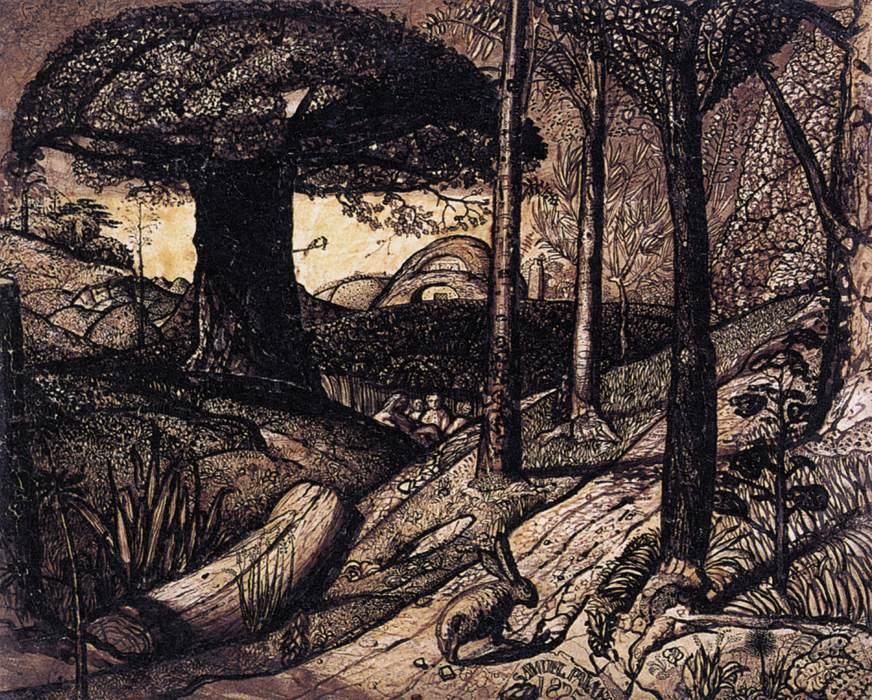
Samuel Palmer, Early Morning, 1825

There is still time to see the British Museum’s Samuel Palmer exhibition before it transfers to the Met in New York. One of the highlights is the ‘Oxford sepia series’ of 1825: early monochromes in gum and sepia ink, showing idealised rural scenes and mysterious atmospheric light effects. Most of them are accompanied by a poetic inscription:

A Rustic Scene: lines from Virgil’s Georgics evoking the autumnal equinox
Libra die somnique pares ubi fecerit horas
et medium luci atque umbris iam dividit orbem,
exercete, viri, tauros, serite hordea campis
usque sub extremum brumae intractabilis imbrem;

The Valley with a Bright Cloud: lines from Shakespeare’s As You Like It:
This is our life, exempt from public haunt,
Finds tongues in trees, books in ye running brooks,
Sermons in stones, and good in everything.

Early Morning: lines from the poem A Complaint of the Black Knight thought by Palmer to be by Chaucer but now believed to have been written by John Lydgate:
I rose anone and thought I would be gone
Into the wode, to hear the birdes sing,
When that misty vapour was agone
And cleare and fair was the morning.
 
Late Twilight: a line from Macbeth, oddly misattributed to Milton
The west yet glimmers with some streaks of day

The Skirts of Wood: no quotation is given

The Valley Thick with Corn: a quotation from Psalm 65:
Though crownest the year with Thy goodness: and Thy clouds drop fatness. They shall drop upon the dwellings of the wilderness; and the little hills shall rejoice on every side. Thy folds shall be full of sheep, the valleys also shall stand so thick with corn that they shall laugh and sing.

Even without the images these quotations evoke the mood of Palmer’s work. The lines for Early Morning by Lydgate were new to me and have a timeless simple beauty. As William Vaughan explains in the exhibition catalogue, these quotations became associated with the pictures sometime during Palmer’s life, possibly well after they were painted. However, the practice of exhibiting landscapes with accompanying poems was common in England at the time.

It is interesting to compare the effect of these paintings with that of Chinese landscapes currently on display at the Royal Academy where poetry also accompanies the image, for example the twelve Scenes Described in Poems of Du Fu by Wang Shimin (1592-1680) or the Eight Scenes of Yangzhou by Gao Xiang (1688-1754) that are accompanied by quatrains by different authors.