Showing posts with label Walter Benjamin. Show all posts

Friday, June 28, 2019

Undercity


I have started the audiobook of Underland.  I listen to it underground, during my tube journeys to work, where claustrophobia comes from the crush of people rather than the confined space of the tunnels.  It is the first of Robert Macfarlane's books I have listened to and so far the reading is excellent and clear, although there is a point on my daily journey between Highbury and Kings Cross where the scream of the train is so loud that I have to reverse back a little way in order to move forward again.  The fifth chapter, 'Invisible Cities', is particularly resonant to anyone listening on the Underground, as it describes a weekend spent with urban explorers in the world beneath Paris.  At one point Rob is compelled to crawl through a crumbling tunnel which begins to rumble and shake with the passage of a train heading overhead to Montparnasse station.  It wasn't difficult to predict, as I did here a few years ago when Underland was a work in progress, that there would be some 'arduous activity' of this kind in the book.  But there are also rich seams of cultural history, like the pages devoted to Walter Benjamin (including his arduous final walk and memorial.)  And there's Italo Calvino of course: his 'Invisible City' of Eusapia had a copy of itself underground, a dead place that over time became more and more like the 'real city' above.  

Cities are increasingly vertical - it has been estimated that the infrastructure supporting urban life spans from 10,000m below sea level to 35,000 km above it.  But one day they will be gone. Then
'it is the invisible cities - the undercities - that will be preserved most cleanly, embedded as they already are within bedrock.  The above-ground structures we have built will collapse to form jumbled urban strata: medleys of concrete, brick and asphalt, glass compressed to a milky crystalline solid, steel dissolved to leave trace impressions of its presence.  Below ground, though, the subways and the sewerage systems, the catacombs and the quarry voids - these may preserve their integrity far into a post-human future.'
Listening to this, I imagined our tube train preserved intact within the fossil record, along with other machines and artifacts that have been abandoned or buried underground.  In an earlier chapter, Rob is told that potash mining machines are simply left when they come to the end of their lifespan.  In their caves they will gradually be covered in translucent halite, burial shrouds of salt.  Another striking Ballardian image occurs in 'Invisible Cities', when Rob remembers a trip he made to a slate mine with the writer and urban explorer Bradley Garrett.  There, in a great flooded chamber, a shaft of sunlight illuminates an avalanche of abandoned vehicles. The oldest cars were the furthest down - at its base, 'a blue Cortina estate was poised as perfectly as a glacial erratic atop the moraine, with a moss-green Triumph Herald both its pivot and its point of repose.'   

Guardian readers may recall a 2013 article Rob wrote about urban exploration, describing his first excursion with Bradley Garrett.  Some of this material reappears in Underland and encountering it again made me wonder about the tube journey I was taking - who else might have passed through those tunnels during the night?  Towards the end of his 'place-hacking' day in London, Rob was worried he might miss his half-midnight train from King's Cross.
'"We'll get you there," replied Garrett. "In fact, if you want we'll walk you north up the tunnels, and pop you out of a manhole just by the station." I liked the thought of taking the tube rather than the Tube back to King's Cross. But I pitied whoever sat next to me on the way home.

Monday, February 29, 2016

Wanderings through the Mark Brandenburg


Reading the new translations of Walter Benjamin's radio broadcasts, made between 1929 and 1932, you are aware of how quickly the world in which they went out would disappear.  The final set of programmes about the catastrophes of history now seems to point towards the disaster that would shortly engulf Germany and eventually Benjamin himself.  The broadcaster was, in Benjamin's imagination, a guest in people's homes but, as Peter Conrad wrote in his review of Radio Benjamin, 'when the Nazis took control of Germany’s airwaves, such polite protocols were suspended.  A welcome guest no longer dispensed sage advice or told cautionary stories; instead, one man harangued a crowd, shouting tirades at top volume.'  How many Berlin Youth Hour listeners, you wonder, would grow up to fight in the Wehrmacht ten years later?  
 
The programme I want to highight here, 'Fontane's Wanderings through the Mark Brandenburg', begins with the idea that the landscape surrounding the city was 'discovered by the youth of Berlin'.  This Wandervogel movement would soon be outlawed, along with other groups distinct from the Hitler Youth.  However, as its title indicates, the main subject of Benjamin's broadcast was not these young walkers, or the wider groups of Bündische Jugend.  What he proceded to talk about was a remarkable topographical project, conceived one day in 1858 on Loch Levan in Scotland, by Theodor Fontane.
'In the middle of the loch lies an island, and on the middle of the island, half hidden behind ash trees and black firs, rises an old Douglas castle, the Loch Levan Castle of song and legend.  On returning to land by boat, the oars rapidly engaged, the island became a strip, finally disappearing altogether, and for a while, only as a figure of the mind, the round tower remained before us on the water, until suddenly our imagination receded further into its memories and older images eclipsed the images of this hour.  They were memories of our native land, an unforgotten day.  It was the image of Rheinsberg Castle that, like a Fata Morgana, hovered over Loch Levan...'
In that moment Fontane realised that the landscape made famous by Walter Scott was really no more beautiful than the sandy terrain of his native Mark Brandenburg.  And so he began his wanderings, selecting material to write about like 'a walker picking individual ears of grain'.  In 1860 he wrote to his friend Theodor Storm that the result might run to twenty volumes; in the event it was published in five, between 1862 and 1889.  The result was, as Benjamin told his listeners, 'far more than tedious descriptions of landscapes and castles, these books are full of stories, anecdotes, old documents, and portraits of fascinating people.'  It is not hard to imagine this appealing to Benjamin.  It sounds as if it would be enjoyed by English readers too if a modern selection were published, perhaps by an editor/translator looking, like Benjamin, to illuminate our understanding of culture and social change.  Although Fontane's novels have appeared in English (Before The Storm is one of my father's favourite books), I've not come across a translation of the Wanderings through the Mark Brandenburg, either in full or abridged form.

Carl Blechen, Rural Landscape in the Mark Brandenburg, c. 1831-8

Benjamin concluded this broadcast with his own description of the broad, expansive landscape of the Mark - quoted below again in the translation by Lecia Rosenthal - and some verse by Fontane that hardly needs to be translated.
'Its sandy, marly soil does not lend itself to strong shapes; however, one is occasionally surprised to come across a steep precipice, or a gorge ripped into the earth.  But the plain of the Mark, with its birch forests and cast acres of fields stretching to the horizon like a broad sea of gray and green, is the landscape's most beautiful feature.  It is so shy, subtle, and unobtrusive that sometimes, at sundown, on the water amid pillars of pine, you think you're in Japan, and other times, in the limestone hills of Rüdersdorf, you imagine yourself in the desert, until the names of the villages here call you back to reality.  Fontane strung some of these names together in a few light and airy lines, which we close with today.

And on this tapestry's flourishing seam
the laughing villages prosper and teem:
Linow, Lindow,
Rhinow, Glindow,
Beetz and Gatow,
Dreetz and Flatow,
Bamme, Damme, Kriele, Krielow,
Petzow, Retzow, Ferch am Schwielow,
Zachow, Wachow and Groß-Behnitz,
Marquardt-Ütz at Wublitz-Schlänitz,
Senzke, Lenzke and Marzahne,
Lietzow, Tietzow and Rekahne,
And lastly a garland of lively haunts:
Ketzin, Ketzür and Vehlefanz.'

Landscape view in the 1986 TV adaptation
Theodor Fontane, Wanderungen durch die Mark Brandenburg


Footnote: Michael Rosen's excellent programme on the Benjamin broadcasts can be heard on the BBC archive.  Although he doesn't explore the countryside of the Mark Brandenburg, he visits the Benjamin archive in Berlin and locations described in the original programmes .

Thursday, June 04, 2015

Wreckage upon wreckage

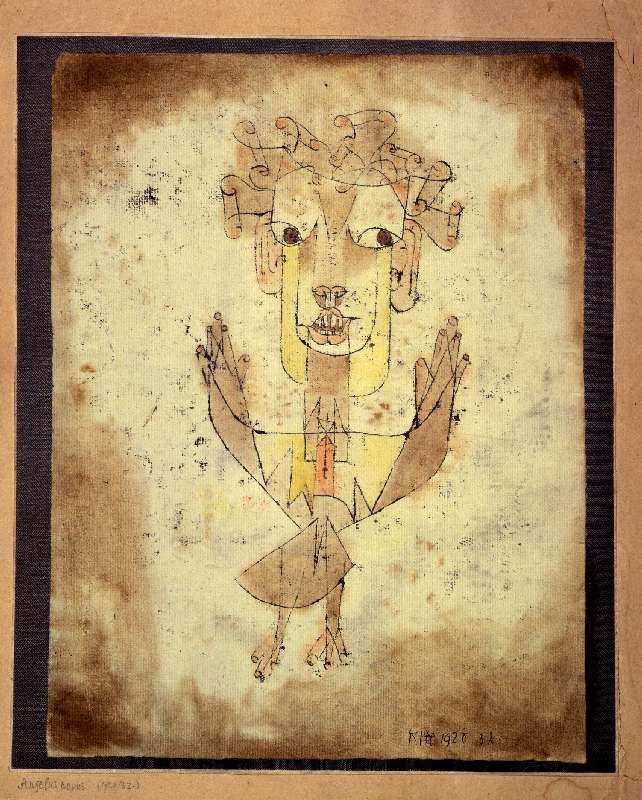
Paul Klee, Angelus Novus, 1920
'A Klee painting named Angelus Novus shows an angel looking as though he is about to move away from something he is fixedly contemplating. His eyes are staring, his mouth is open, his wings are spread. This is how one pictures the angel of history. His face is turned toward the past. Where we perceive a chain of events, he sees one single catastrophe which keeps piling wreckage upon wreckage and hurls it in front of his feet. The angel would like to stay, awaken the dead, and make whole what has been smashed. But a storm is blowing from Paradise; it has got caught in his wings with such violence that the angel can no longer close them. The storm irresistibly propels him into the future to which his back is turned, while the pile of debris before him grows skyward. This storm is what we call progress.'  - Walter Benjamin, 'Theses on the Philosophy of History'

A couple of months ago I was in Eastbourne to see the exhibition Ori Gersht: Don’t Look Back. It included his two-screen film, Evaders, a reimagining of the last journey of Walter Benjamin.  The film begins with an actor in a hotel room and we hear Benjamin's famous description of the angel of history.  When the voice-over reaches “his face is turned toward the past”, the other screen is activated.  Now the actor is trudging through the cold mountains, battered by the weather, looking older than Benjamin actually was in 1940 (but Benjamin was physically frail and encumbered by a heavy suitcase). ‘He moves at a steady, laboured pace through patches of mist, along a snowy tree-lined path. Often, on the right screen majestic landscapes contrast with the man’s suffering and vulnerability on the left: sweeping mountain vistas grazed by clouds, trees shrouded in fog, craggy boulders, and the wind whipping over a riverbed’ (Al Miner, Ori Gersht: History Repeating).  The route taken by Benjamin was  'particularly dangerous because of the tramontana, a violently strong, dry wind that can last for days and is, in the cooler months, bitterly cold. The tramontana is known for its piercing moan, and locals attribute murders and suicides to long exposure to the sound.’  Benjamin survived the journey but at Portbou, on the border of France and Spain (as I wrote here a few years ago), exhausted and fearing repatriation, he took his own life with an overdose of morphine tablets.

.

In 2005 Ori Gersht travelled to Kosov in Ukraine, the birthplace of his father-in-law, who hid there for from the Germans two and a half years after the village had been declared “Judenrein” (cleansed of Jews).  The blurred Richter-like photographs Gersht took raise similar questions about the representation of such places as the Sally Mann Civil War landscapes I wrote about here a few years ago.  Gersht explained his decision not to photograph what he saw in a clear, objective way: ‘the camera can only depict the here and now, in this instance a pastoral Brueghelesque landscape, but my experience of these places was conditioned by what I knew…’ Steven Bode puts it well in an essay in the book to accompany Gersht's exhibition The Clearing: ‘the ghostly indeterminacy of the majority of the images, rather than reading as portentous, seems more redolent, at times, of feelings of uncertainty and doubt. Is this landscape as haunted, and as loaded, as he himself sees it? Have these places retained any traces of what happened over sixty years ago? And if not, how can they be made to communicate, so that the memory of what once went on there is not to be forgotten?’

On the same journey Gersht made a film in the Moskolovka Forest (see the clip below).  The setting, a site of Nazi atrocities during the war, reminded me of Simon Schama's Landscape and Memory ('Blood in the Forest') and the histories, myths and ideologies associated with Europe's ancient woodlands.  In Forest trees are felled, crashing slowly to the ground with a sound that reverberated around the gallery.  In between these moments, birdsong can be heard again as the camera remains still or pans slowly across the tall trunks, leaving you wondering which one will be next.  We never see the men whose actions result in the death of these trees.  Whilst it is, in Al Miner's words, ‘an elegy for the nameless dead who were lost in wartime atrocities, the piece also enacts the kind of ceaseless vigil that will be needed if these crimes are not to be repeated.’

Saturday, December 14, 2013

A landscape built of pure life

Among the Convolutes of Walter Benjamin's Arcades Project (translated by Howard Eiland and Kevin MacLoughlin), one section is devoted to 'Ancient Paris, Catacombs, Demolitions, Decline of Paris.'  There, Benjamin observes that 'few things in the history of humanity are as well known to us as the history of Paris':
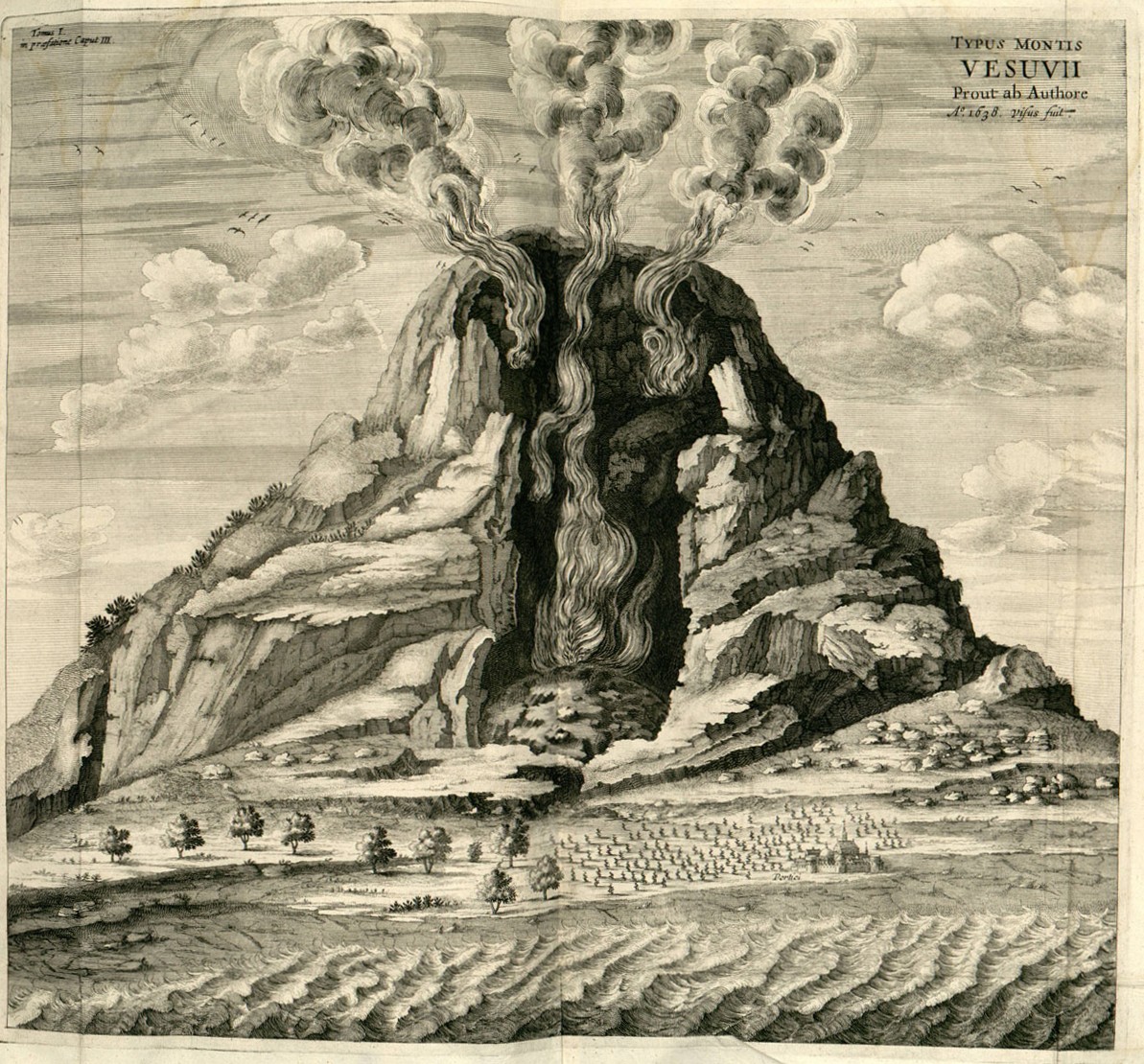
'Many of the main thoroughfares have their own special literature, and we possess written accounts of thousands of the most inconspicuous houses.  In a beautiful turn of phrase, Hugo von Hofmannsthal called [this city] 'a landscape built of pure life:' And at work in the attraction it exercises on people is the kind of beauty that is proper to great landscapes - more precisely, to volcanic landscapes.  Paris is a counterpart in the social order to what Vesuvius is in the geographic order: a menacing, hazardous massif, an ever-active hotbed of revolution.  But just as the slopes of Vesuvius, thanks to the layers of lava that cover them, have been transformed into paradisal orchards, so the lava of revolutions provides uniquely fertile ground for the blossoming of art, festivity, fashion.'

Vesuvius, from Mundus Subterraneus by Athanasius Kircher, 1664

Sunday, November 13, 2011

Walter Benjamin's Grave

'The cemetery faces a small bay directly looking over the Mediterranean; it is carved in stone in terraces; the coffins are also pushed into such stone walls.  It is by far one of the most fantastic and most beautiful spots I have ever seen in my life.'
- Hannah Arendt, letter to Gershom Scholem, 21 October 1940


Michael Taussig's essay, 'Walter Benjamin's Grave: A Profane Illumination', describes the cemetery of Portbou, the small town on the border of France and Spain where Benjamin died in 1940.  Carrying his possessions in a heavy black briefcase, Benjamin was led there over the mountains by a young woman, Lisa Fittko.  'It was the first time she had made the trip.  Benjamin was her first refugee ... She got lost.  They backtracked.  Then they found their way to the summit: "The spectacular scene appeared so unexpectedly that for a moment I thought I was seeing a mirage ... the Vermillion Coast, an autumnal landscape with innumerable hues of reds and yellow-gold.  I gasped for breath - I had never seen such beauty before."' But the the Franco government had cancelled all transit visas and on the night of September 25th Walter Benjamin, fearing repatriation, took an overdose of morphine tablets.  Hannah Arendt, then still in the South of France, came to look for his grave soon afterwards. Lisa Fittko and her husband Hans continued the dangerous work of escorting refugees across the border.  Hans took to wearing a Basque cap and sandals to blend in with the locals.  Sometime he would sit for hours on a cliff projection looking out to sea.


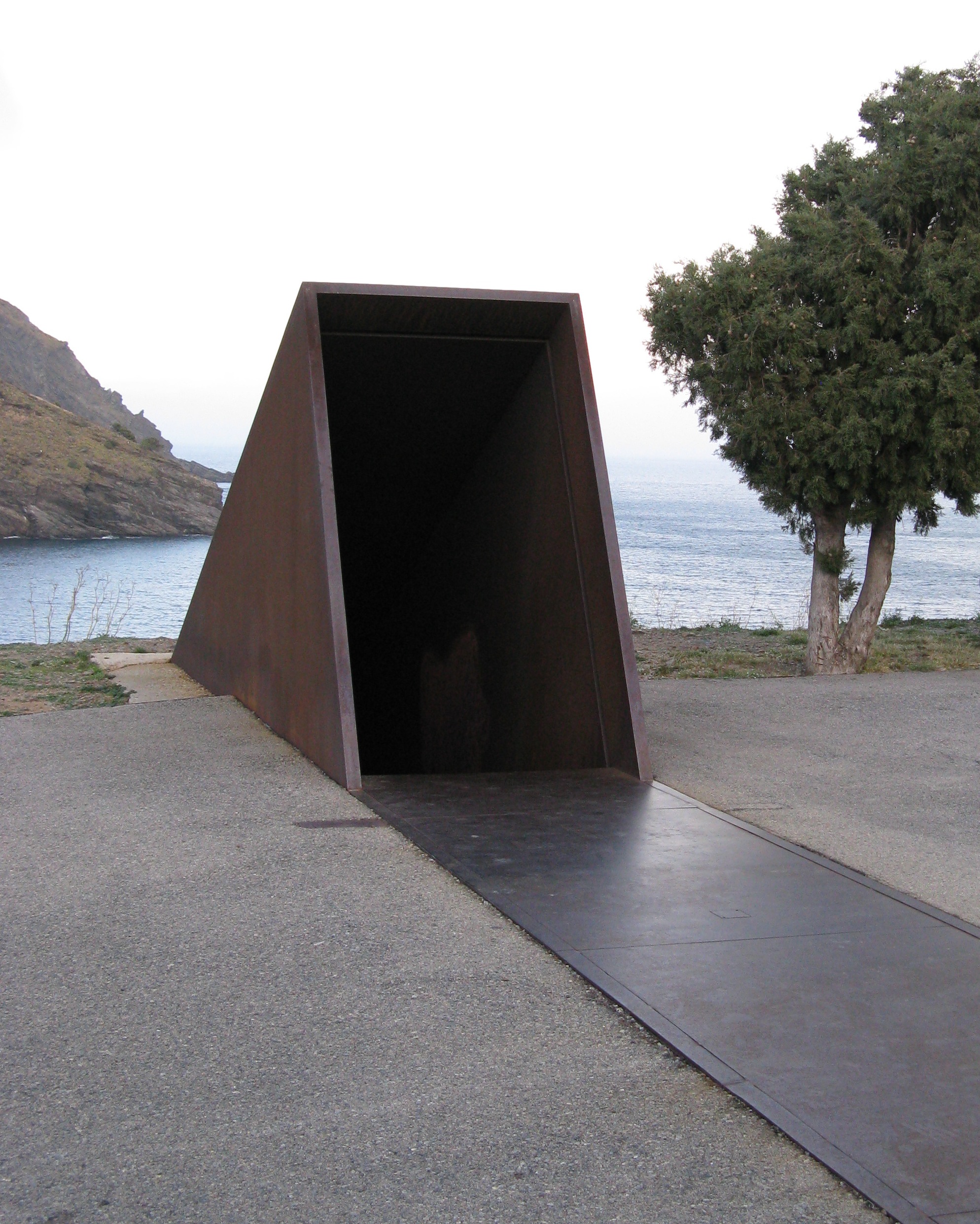
Dani Karavan, Walter Benjamin Memorial at Portbou, 1994

The beauty of this place, which so struck Hannah Arendt and Lisa Fittko, seems at variance with its  history of displacement and disappearance.  Michael Taussig first visited Portbou in 1987 and found the whole town a sad monument to Benjamin's death - 'cold, nasty, and enigmatic.'  But now, on returning fifteen years later, he comes upon the new monument to Walter Benjamin, designed by Dani Karavan, an artist from Tel Aviv.  An iron triangle forms a doorway leading to steps that take you down the slope of the hill towards the sea.  At the bottom there is a thick pane of glass inscribed with Benjamin's words: 'It is more arduous to honour the memory of the nameless than that of the renowned.  Historical construction is devoted to the memory of the nameless.'  The words could be taken to refer as much to the victims of Franco as to the Nazis.  Looking back up the stairs, the doorway frames a rectangle of blue sky, echoing the view of the breaking waves below.

Later, inside the cemetery itself, Taussig is struck by a virtually identical set of steps, leading from the graves to the chapel.  He recalls Benjamin's surrealist conception of the 'profane illumination', where something provides a new kind of experience whilst retaining the trace of the kind of religious illumination it has surpassed. In the cemetery at Portbou there are niches bearing the names of the dead and a common grave, the fosa común, in which Benjamin's remains may actually lie.  The monument, by contrast, is a profane illumination, which 'gathers its strength through the open expression of namelessness as empty space, sea and sky.  It truly is an emphatic statement on the weighting of the world by its nameless dead.'  Standing on the headland Taussig feels the full force of the transmontaña wind.  'Can we imagine a state, a religion, or a community bound to remembrance which would have thye courage or craziness to call a wind a monument?'  Walter Benjamin once wrote that the best way to light a cigarette is with a flintstone and fuse.  'The wind blows the matches out, but the harder the wind blows, the more the fuse glows.'

Thursday, August 31, 2006

Red Arch Mountain, Utah

In Berlin Childhood around 1900 Walter Benjamin relates his childhood immersion in watercolours to the story of an old Chinese painter. The old man invited friends around to see his most recent picture. They were shown a landscape with a footpath leading along a stream and through a grove to a small cottage. When they turned around and looked for the painter, he had gone. They saw that he had entered the picture and was walking up the path to the door, where he paused ‘quite still, turned, smiled and disappeared through the narrow opening.’

Reading Benjamin’s book it is difficult not to reflect on one’s own childhood memories. Benjamin describes the streets, parks and monuments of Berlin but he also dwells on the landscapes of furniture and household objects that a child negotiates. He remembers the power of postcards and the old Imperial Panorama where ‘one afternoon, while seated before a transparency of Aix, I tried to persuade myself that, once upon a time, I must have played on the patch of pavement that is guarded by the old plane trees of the Cours Mirabeau.’ On reading this I went down to our cellar and found my father’s old stereoscope which had enchanted me as a child. The image below, for example, is Red Arch Mountain, Utah, probably photographed in about 1947 (some of the discs have this date). An anonymous photographer’s tiny image in Kodachrome “natural colour”, it now has the time capsule qualities of a miniature landscape in a Book of Hours. What seemed a strange, distant mountain to me as a child is now potentially accessible, but the world that produced the stereoscope is irretrievable, along with the imaginative space of childhood.

Wednesday, December 21, 2005

Heidelberg castle

Source: Wikimedia Commons

Walter Benjamin writes of Heidelberg Castle in One Way Street: “Ruins jutting into the sky can appear doubly beautiful on clear days when, in their windows or above their contours, the gaze meets passing clouds. Through the transient spectacle it opens in the sky, destruction reaffirms the eternity of these fallen stones.”

One might compare the effect of the statues of the apostles, lining the façade of St Peter’s Basilica in Rome. As I remember it, the vast blue sky renders them life-like, stepping out of time, with nothing to connect them to the modern city beneath. In contrast the ruined walls of Heidelberg and the passing clouds seen by Benjamin signal the presence of time, slow and fleeting.

Stone and sky: both statues and ruins are temporary transformations of stone, but the sky itself, ever-changing, represents the fullness of time.