Showing posts with label Nicolas Poussin. Show all posts

Friday, March 11, 2016

Blind Orion Searching for the Rising Sun

Nicholas Poussin, Blind Orion Searching for the Rising Sun, 1658

I write this surrounded by piles of books with a couple of pictures propped against them.  This would be pleasant except that they've all been brought upstairs to be out of the way of some imminent building work.  Sadly there's too much I've got to do here in the house to spend time writing anything very thoughtful about landscape and art.  So here instead I will just give you a couple of beautifully written passages from an essay by William Hazlitt, 'On a Landscape of Nicholas Poussin.'
'Orion, the subject of this landscape, was the classical Nimrod; and is called by Homer, 'a hunter of shadows, himself a shade.' [...] Mists rise around him, and veil the sides of the green forests; earth is dank and fresh with dews, the 'gray dawn and the Pleiades before him dance,' and in the distance are seen the blue hills and sullen ocean. Nothing was ever more finely conceived or done. It breathes the spirit of the morning; its moisture, its repose, its obscurity, waiting the miracle of light to kindle it into smiles; the whole is, like the principal figure in it, 'a forerunner of the dawn.' The same atmosphere tinges and imbues every object, the same dull light 'shadowy sets off' the face of nature: one feeling of vastness, of strangeness, and of primeval forms pervades the painter's canvas, and we are thrown back upon the first integrity of things. [...] To give us nature, such as we see it, is well and deserving of praise; to give us nature, such as we have never seen, but have often wished to see it, is better, and deserving of higher praise. He who can show the world in its first naked glory, with the hues of fancy spread over it, or in its high and palmy state, with the gravity of history stamped on the proud monuments of vanished empire,--who, by his 'so potent art,' can recall time past, transport us to distant places, and join the regions of imagination (a new conquest) to those of reality,--who shows us not only what Nature is, but what she has been, and is capable of,--he who does this, and does it with simplicity, with truth, and grandeur, is lord of Nature and her powers; and his mind is universal, and his art the master-art!'
Poussin's Blind Orion Searching for the Rising Sun is now owned by the Met but when Hazlitt saw it, the painting was 'one of a series from the old masters, which have for some years back embrowned the walls of the British Gallery, and enriched the public eye.'  His essay praises what were the world's first regular temporary exhibitions of Old Master paintings.  Pictures, he concludes, 'are scattered like stray gifts through the world; and while they remain, earth has yet a little gilding left, not quite rubbed off, dishonoured, and defaced.'  I don't think Hazlitt would have thought much of the Alexander Calder lithograph I'm about to pack away in an old sheet for a few months.  But he would have agreed that to take pleasure from art it is unnecessary to have pictures hanging on the walls around you.
'Pictures are a set of chosen images, a stream of pleasant thoughts passing through the mind. It is a luxury to have the walls of our rooms hung round with them, and no less so to have such a gallery in the mind, to con over the relies of ancient art bound up 'within the book and volume of the brain, unmixed (if it were possible) with baser matter!' A life passed among pictures, in the study and the love of art, is a happy noiseless dream: or rather, it is to dream and to be awake at the same time; for it has all 'the sober certainty of waking bliss,' with the romantic voluptuousness of a visionary and abstracted being.' 

Wednesday, May 28, 2014

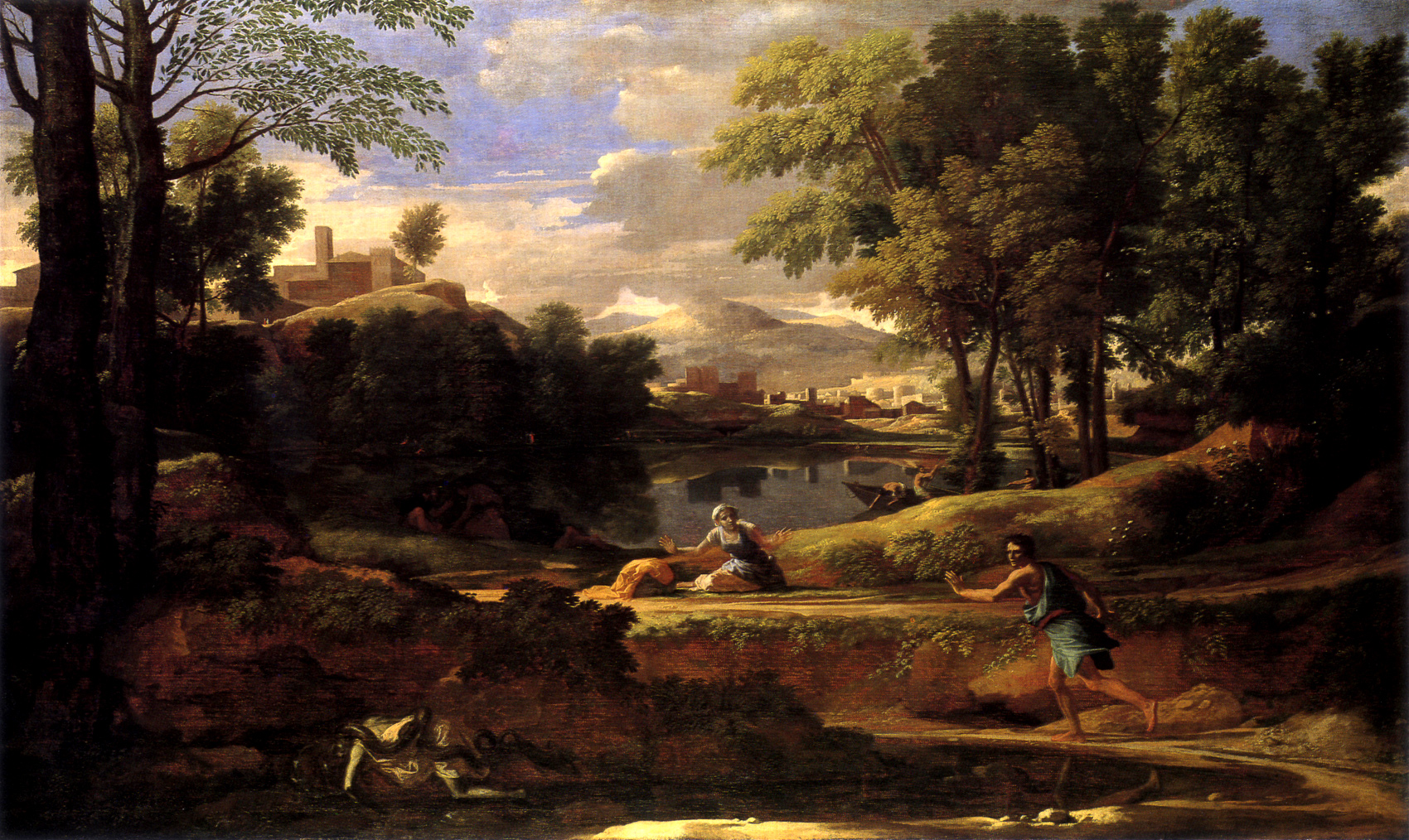
Landscape with a Man Killed by a Snake

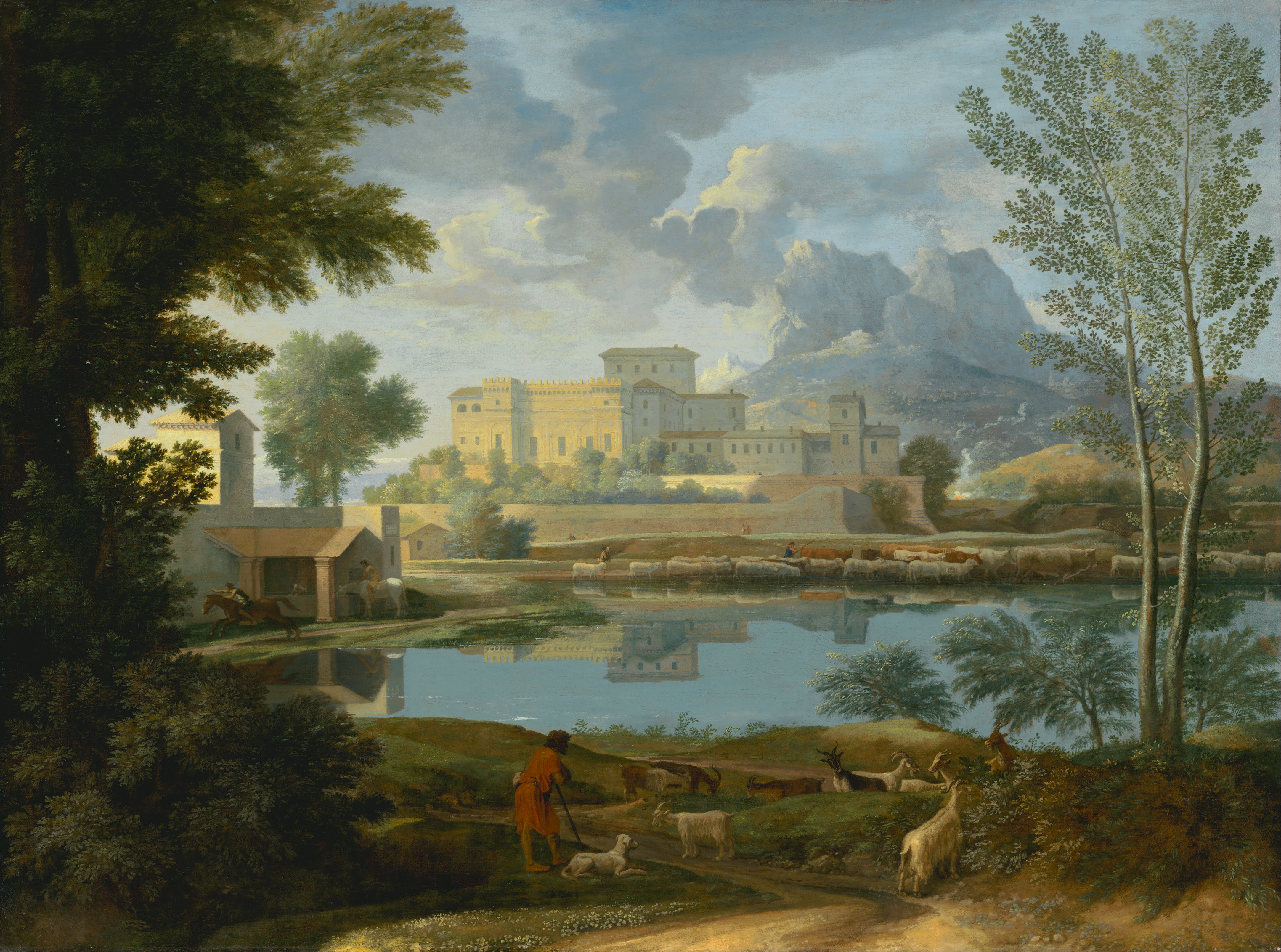
Nicolas Poussin, Landscape with a Calm, 1650-1
Source: Wikimedia Commons

Alain de Botton's recent ideas for making art more popular have not gone down well with the critics: 'pointless''smarmy and banal', 'merely stupid or simply patronising'.  Perhaps an alternative to trying to engage with 'Art as Therapy', would be for more people to take a lead from T. J. Clark's unpromisingly-titled but highly rewarding book The Sight of Death.  The idea behind it was a simple one: to return repeatedly to an art museum (the Getty) and look at the two Poussin paintings I've reproduced here, engaging with them as paintings and writing down each day's discoveries.  Clark deliberately did not research them in advance, he just looked at them closely, in a way that any of us could.  The result, as writer/psychotherapist Adam Philips wrote in his 2006 review, is more than just a detailed account of these landscapes, it is a book 'about what having a good look might mean at a time when most contemporary imagery, by showing us everything, doesn't want us to see too much'. 

Nicolas Poussin, Landscape with a Man Killed by a Snake, 1648
Source: Wikimedia Commons

When you attend closely to a painting you start to appreciate all the choices the artist made - in Poussin, for example, there are his tiny details, like the two figures talking on the brow of the hill in Landscape with a Man Killed by a Snake.  This part of the painting is discussed in The Sight of Death (in the entry for 13 April 2000) and I will quote a few sentences to exemplify the way Clark writes about it.  Here he is thinking about the extent to which Poussin's details relate to the painting's overall structure:
'Right in the middle of the crisscross of greenery here Poussin suddenly interjects a partial opening into the sky, and not content with the offer of a roofline and white light that this enables, he puts a marvelous tiny square of white into the architecture, as if finally we are looking at the sky through an empty (ruined?) window.  Or maybe somehow a pane of glass is glinting in the sun.  The blip of white connects with one or two others close by, picking out the sky higher up in the foliage.  But the window is essentially gratuitious - profoundly unnecessary, un-structural.  It is pure delight.'

Clark's final entry in November 2003 is rather dispiriting.  Snake had been returned from the Getty, where it was on loan, to the National Gallery.  There he encountered it hung right near the exit, in the Yves Saint Laurent Room, under 'lighting apparently borrowed from an indoor swimming pool in Tooting Bec'.  He describes sitting, 'miserable and stupefied for an hour or so, listening to the songs played by the cell phones', along with the 'mild hysteria of twelve-year-olds' and their shushing teachers in the assembly area for school visits next door.  He estimates that thirty-plus people a minute stream past Poussin's painting, 'one or two of whom give it a passing glance.'  But, then, he reflects, this painting has suffered many indignities over the centuries, from the darkening effect of smoke to the pressure of a restorer's iron.  He ends on note of optimism: 'one of these days Snake will go on its travels again - back to Room 20 would be a start - daylight will catch it, and new viewers stop at the sight of death.'

Although not a new viewer, I did go and have a long look at Snake on a rainy Bank Holiday afternoon this week, to see what new things I could see in it.  I am happy to report that it is no longer in the Yves Saint Laurent room -  that unfortunate spot now seems to be taken by Claude's Landscape with Cephalus and Procris reunited by Diana.  Instead it can be found in Room 19, surrounded by other Poussins and directly opposite the extremely sexy Nymph with Satyrs.  Of course I was not able to sit contemplating it undisturbed, but it was possible to ignore the groups of teenagers wondering through the room chatting.  At one point an insistent ring tone was finally answered by a woman standing right in front of Snake, but she was ushered away fairly quickly by an attendant.  The National Gallery may not be as tranquil as the Getty, but I still spent a satisfying half hour in the company of Snake.

The longer I looked the more I found to think about, and despite having read T. J. Clark's 260 pages I came away convinced I had seen one or two things he doesn't mention (for instance, that the postures of the three fishermen seem to rhyme with the running man, the washerwoman and her bag).  Perhaps those visitors walking past me and ignoring all this would have been detained by a philosophical or therapeutic post-it note, like those Alain De Botton has had placed around the Rijksmuseum, although I like to think they really just needed persuading to stop for a while and look.  As Anita Brookner points out in her review of The Sight of Death, Poussin himself is usually seen as a ‘peintre-philosophe’, but Clark shows us how he was also a pure maker.  What the book demonstrates 'is that the best antidote to reading is looking.' This, she concludes, 'is the way to see pictures.'

Sunday, March 02, 2014

Like a crystal flood

The story of Acis and Galatea is rooted in the landscape of Sicily.  When the sea-nymph sees her lover killed by a great rock, thrown by the jealous Cyclops Polyphemus, she transforms his blood into the river Acis. Polyphemus tries to lure Galatea away from the sea with descriptions of life on the island.  'Here there are bays, and here slender cypresses, / Here is sombre ivy, and here the vine's sweet fruit / Here there is ice-cold water which dense-wooded Etna / Sends from its snows - a drink fit for the gods.'  These lines are given him by Theocritus in Idyll 11 (trans Anthony Verity), whilst in Virgil's ninth Eclogue the Cyclops tells her 'Coloured spring is here.  The river banks are spangled / with flowers of many hues.  Above my grotto a silvery / Poplar sways, and vines cast a shifting lace of shadow.' (trans. C. Day Lewis).

Nicholas Poussin, Landscape with Polyphemus, 1648

Landscape imagery is used in a different way in Ovid's Metamorphoses, where Polyphemus climbs to the apex of a hill on a spur jutting out into the sea and sings in praise of Galatea, listing her qualities in terms of the beauties of nature.  She is

whiter than the snowy columbine
a sweeter flower than any in the meadows 
taller and more stately than alder
more radiant than crystal
friskier than a tender kid
smoother than shells polished by the sea
more welcome than sun in winter or summer shade
more choice than apples
lovelier to see than the tall plane trees
more sparkling than ice
sweeter than ripe grapes
softer than swansdown or creamy cheese
fairer than a watered garden

But also

wilder than an untamed heifer
harder than an ancient oak
more treacherous than the sea
tougher than willow-twigs or white vine branches
as immovable as the rocks
more turbulent than a river
vainer than the much-praised peacock
fiercer than fire
harsher than harrows
more truculent than a pregnant bear
deafer than the waters
crueler than a trodden snake

What Polyphemus most regrets however, is her ability to outrun him, for she is 'swifter than the deer, driven by loud barking, swifter even than the winds, and the passing breeze'.

Claude Lorrain, Landscape with Acis and Galatea, 1657

As you can see above, Claude and Poussin both based beautiful paintings on the myth, one a view looking out to sea, the other looking back into the island's rocky interior.  Acis and Galatea are small figures in the foreground and Polyphemus is barely distinguishable from the landscape.  In Poussin's painting his back merges into the rocks where he sits, turned away from the lovers, playing his flute.  In Claude's, the Cyclops is barely visible - you can just glimpse him (right) sadly watching from the wooded slope, his view of the lovers obscured by the sheet they have put up to afford them some privacy.  Of course not all artists put emphasis on the landscape and Poussin himself did a version with additional cherubs and embracing lovers in which Polyphemus looks on like the sad guy at a particularly riotous party.


It was at a hunting party that Jean-Baptiste Lully's opera Acis et Galatée saw its first performance in 1686.  Elaborate artificial sets of the kind he had previously specialised in were no longer an option now that he was out of favour with Louis XIV (who had become increasingly religious and less tolerant of Lully's openly homosexual lifestyle).  It is tempting to imagine this being successfully performed with very little scenery, perhaps even outside amid 'natural' scenery.  After Lully there are a few more steps in the operatic story before we get to Handel's Acis and Galatea.  There was an English version by John Eccles and P.A. Motteux in 1701, which depressingly included 'a subplot concerned with the quarrel of rustic couple Roger and Joan, introduced to “make the piece the more dramatical.”'  Then came Giovanni Bononcini's Polyfemo (1702) and an Italian version by the young Handel himself, Aci, Galatea e Polifemo (1708).  Ten years later Handel had moved to England and was employed by James Brydges, 9th Baron Chandos, the 'Apollo of the Arts', and it was for him that Acis and Galatea, was composed, with a libretto by John Gay (aided by two more poets, John Hughes and Alexander Pope).


Acis and Galatea was first performed on a summer's day at Cannons, the house Brydges was then still building at vast expense (and which would be razed to the ground in 1747 when the family fortune gave out).   Pleasingly this does seem to have taken place in the open air, although The Grove Book of Operas is a bit sniffy about this 'local tradition', remarking that the discovery of piping to supply an old fountain "might fancifully be invoked as support".  If true, the audience would have been within earshot of the water features designed by John Theophilus Deaguliers, another remarkable individual patronised by Brydges, who combined the roles of local priest and hydraulic engineer.  Perhaps the sound of water would have been a constant reminder of Galatea, the sea nymph loved by both Acis and Polyphemus. At the end of the opera, as you can hear in the clip embedded below, when Galatea transforms Acis into a river, she sings
Heart, the seat of soft delight,
Be thou now a fountain bright!
Purple be no more thy blood,
Glide thou like a crystal flood.
Rock, thy hollow womb disclose!
The bubbling fountain, lo! it flows;
Through the plains he joys to rove,
Murm'ring still his gentle love.

Friday, May 10, 2013

The Arrière-pays


'I have often experienced a feeling of anxiety, at crossroads.  At such moments it seems to me that here, or close by, a couple of steps away on the path I didn't take and which is already receding – that just over there a more elevated kind of country would open up, where I might have gone to live and which I've already lost.'  This unattainable country is the subject of Yves Bonnefoy's beautiful aesthetic reverie, The Arrière-pays (1972), recently translated by Stephen Romer.  Certain landscapes seem almost to speak 'like a language, as if the absolute would declare itself, if we could only look and listen intently.' But it remains out of reach: 'it is as if from the forces of life, from the syntax of colours and forms, from dense or iridescent words that nature perennially repeats, there is a single articulation we cannot grasp.'   And yet 'there are certain works that can, for all that, give us a fair idea of the impossible potential.  The blue in Nicolas Poussin's Bacchanalia with Guitar Player has that stormy immediacy, that non-conceptual clear-sightedness for which our whole consciousness craves.' 

Last night in the school hall of the Lycée Français, introducing an event dedicated to The Arrière-pays, Stephen Romer said he often recollected that image of the blue in Poussin's sky.  When he entered the room of Claude landscapes in Oxford that I mentioned here a couple of years ago for example, the arrière-pays was suddenly present in their blue distances.  As I listened to this I peered at a reproduction of Poussin's painting, dimly projected onto a screen behind the speakers, but the blue was hard to discern.  If 'the absolute' failed to declare itself on this occasion, it was partly because there were so many distractions in the room - temporary seats rattling, bored students whispering to each other and an organiser who spent her time coming in and out and interrupting proceedings to tell the speakers how to use microphones.  Still, we had come to experience the aura of the great Yves Bonnefoy, now ninety years old, who seemed unfazed by his surroundings.  He talked vividly about the way his childhood imagination was stirred by the names on a radio dial, the memory of summers spent in the country near the River Lot and his first impressions in Italy of the real landscape he had gazed at in the paintings of the Quattrocento.

Just before the event came to an unexpected end, Bonnefoy was talking with Romer and Anthony Rudolf about an old photograph of an Armenian church that appears in one of the later essays appended to  this edition of The Arrière-pays.  They made a link with the poetic images Sebald used in his books - both have a mysterious, disconnected quality.  This is attributable in part to their grainy light which seems to fall like a "metaphysical snow", directing our thoughts away from the objects depicted and taking us back to early childhood, before our minds had started to impose a structure on the world.  They are mirages, seducing us into dreams that deny the reality of the world.  'I have suffered much, myself, from the lure of images,' Bonnefoy writes in this essay, and it was partly to counteract this that he took up the study of art history.  In Poussin he eventually found 'a painter who could guide me into a self-acceptance of our finite nature.'  As he writes at the end of The Arrière-pays, 'Poussin searches long for the key to the 'music of knowledge', to a return to the wellspring of the real by the power of number; but he is also the man who gathers a handful of earth and says Rome is that.'

Nicolas Poussin, Moses Saved from the Waters, 1647

Thursday, December 03, 2009

The Liverpool Cityscape

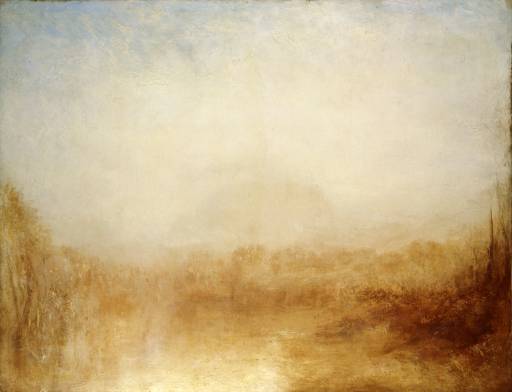
I've been in Liverpool this week and managed to squeeze in a trip to the Walker Art Gallery.  I think my favourite painting in their collection is Simone Martini's Christ Discovered in the Temple (reminiscent of the attitude my son assumes when he's done something wrong), but there are some great landscape paintings too.  In Poussin's Landscape with the Ashes of Phocion (1648), for example, with its contrast between the serene classical architecture and the wild rock formation towering above, you can almost hear the wind blowing menacingly through the trees.  Much wilder still is John Martin's The Last Man, a rendering of Thomas Campbell's apocalyptic poem, and there is a dramatic view of The Ruins of Holyrood Chapel (c. 1824) by Louis Daguerre, painter of dioramas, inventor of the daguerrotype.  However, for me the most striking landscape painting in the museum (and you really have to see it rather than peer at a jpeg) is this:


J.M.W. Turner, Landscape, c1845

Leaving the permanent collection, I came to an exhibition celebrating the John Moores Painting Prize.  In 2006 this was awarded to Martin Greenland for Before Vermeer's Clouds.  The painting uses the sky from Vermeer's A View of Delft and according to the artist's statement, it was originally to be titled 'A Vision of Heaven', designed to have 'the same appearance of stability and unhurried peace as Vermeer’s, and incorporate as many elements of the stable or perpetual as could be organised.'  It's quite a risky strategy, as the borrowed sky and 'perpetual' landscape elements could seem nothing more than dull pastiche.  You can see other examples of Greenland's imagined landscapes on his website.

Last year, during Liverpool's turn as European City of Culture, the artist Ben Johnson was in residence at the Walker completing his Liverpool Cityscape.  Seeing it up close this week, I thought it quite strange to be described as a "celebration" of Liverpool (as in the video clip below), because it shows an lifeless city, emptied of people and traffic.  The background is painted with the naturalistic realism you would expect in a panorama, but the foreground buildings resemble a computer generated architectural model with their dimensions oddly distorted.  Everything is pristine and well lit and the dominant colour is the dead beige of recent urban regeneration.  Still, according to the Liverpool Echo, 'Ben Johnson's painstaking and wondrous Liverpool cityscape – the distillation of team work referencing 3,000 photographs and occupying 24,000 man hours – is the definitive visual statement of our 2008 renaissance.'


Thursday, April 10, 2008

The stones and shadows sigh breaths of amorous fire

The Met has an exhibition at the moment called ‘Poussin and Nature: Arcadian Visions’. The excellent Ionarts blog has an article on it with links to other reviews. I learned from this that Poussin's Landscape with Three Monks (La Solitude) is showing 'outside Serbia for the first time since 1934. One of the curators of the exhibit claims to have seen it hanging in Tito's office'.

There is an interesting description of Poussin’s sensual style of landscape painting in a review by Andrew Butterfield. Poussin originally moved to Rome after the Italian poet Giambattista Marino, based in Paris at the court of Marie de Medici, recognised and encouraged his talent. In Poussin’s paintings in this early period, where the figures still dominate the composition, ‘landscape elements seem to smolder with intense ardor. He achieved this effect by applying the upper layers of paint in relatively thin and rough brush strokes that allowed the red-brown ground layer of paint to show through, giving the entire image a warm and sensual glow. In European poetry the tradition of describing nature with amorous metaphors was an ancient one going back all the way to the Homeric hymns.... Poussin was extremely familiar with this tradition thanks to his friendship with Marino, whose poem L'Adone is a rich repository of the same vein of imagery. The artist read the book with the author, even making illustrations of it at his request, and Marino and Poussin also discussed how to translate the power of poetic language into the visual forms of painting. In L'Adone Marino wrote descriptive passages such as "Even the stones and the shadows of the place/sigh breaths of amorous fire." In his early mythic landscapes Poussin sought to capture the same sense of pathos and inspiration as is conveyed by lush and elevated writing of this kind.’

Nicolas Poussin, Nymph Spied on by Satyrs, c 1627
Source: Wikimedia Commons

Wednesday, March 19, 2008

Landscape Architecture of the Great Painters of Italy


Gilbert Meason was the first writer to use the term ‘landscape architecture’, in the title of his book The Landscape Architecture of the Great Painters of Italy (1828). It says here he ‘died without the faintest idea that his concept of 'landscape architecture' was destined for a worldwide future. Few copies of the book were printed but one of them fell into the hands of John Claudius Loudon, the most prolific garden author of any age. Loudon took up the term and passed it to Andrew Jackson Downing, who passed it to Frederick Law Olmsted...’ And the rest is history.

Apparently, few copies of Meason’s book were produced in 1828 and I don’t think it’s been reprinted. However, the British Library has a copy of the original which you can flick through in their rare books room. Its frontispiece, the first of many lithographs in the book by H W Burgess, is based on a Dominichino painting. The book then opens with a quotation from Reynolds' Discourses which urges architects to aim for ‘variety and intricacy’, an approach consistent with Meason’s picturesque ideal. The text that follows discusses various types of building, in chapters on: The Rise of Domestic Architecture, Defensive Architecture, Roman Villas, Masonry of Roman Architecture, Architecture of the Middle Ages, Domestic Architecture of England, Architecture of the Italian Painters, Tuscan Architecture and Gothic Architecture. At the back are the illustrations accompanied with brief descriptions - Burgess’s depictions of buildings that appear in the drawings and paintings of artists such as Raphael, Leonardo, Andrea Mantegna, Sermonita, Claude, Palma Vecchio, Guercino and Lavinia Fontana.

Meason explains that ‘in selecting examples of landscape architecture from the pictures of Italy, we have avoided those in the foreground or in street architecture, as well as those, (such as in Claude,) which had so much Grecian or Roman ruins attached to them as gave the air of composition architecture of the artist.’ So, interestingly, he was tending to choose buildings that were quite incidental to the main theme of the painting. Meason found that these tended to display a mixture of architectural styles, partly based on real buildings sketched by the artists. He quotes Richard Payne Knight: ‘the best style of architecture for irregular and picturesque houses, which can now be adopted, is that mixed style which characterizes the buildings of Claude and the Poussins…’ Here are three examples of Meason’s landscape architecture (sadly without the lithographs).
Plate 1: This is taken from Titian and shows a castle with prominent round towers. Meason says ‘Titian seldom introduced buildings of consequence in his landscapes, and to such as are given, sheds and low mean buildings are joined. This building is in a landscape of a mountainous country. It is difficult to assign any period for its construction, or for what purpose part of the building was destined.’
Plate 15: This is a tower on a rocky promontory by ‘Nicolo Poussin’. ‘This picturesque building is only a small part of that magnificent pile in the fine picture of the infant Moses exposed. The scenery and site are by our artist, for the original had none of note near the extensive buildings. It is to the architecture of this picture that Sir Uvedale Price refers [Meason’s footnote: See Essays on the Picturesque vol ii p316]. The whole is evidently a composition; and in the central tower Poussin had for his model the castle of St. Angelo in Rome.’
Plate 54: Here Meason looked back as far as Giotto for his material, but the drawing takes some poetic license – it is a dark and rather Romantic sketch of a castle-like building. ‘We give another specimen of a building of this father of the art of painting, copied from a fresco in the Campo Santo. We have here a very early example of the Tuscan window: Outward steps lead to the door from the platform; and the large windows, and of course the principal rooms, are placed high in the building. These are indications of the necessity at the period of defensible country dwellings.’
Gilbert Meason wanted to see the landscape architecture of Italian painting recreated in the British countryside. ‘In selecting specimens out of many in our possession to illustrate this work, we have in view such as may be useful to architects in the composition of irregular mansions. These may be arranged under single towers, buildings of small size but simple in their form, and large edifices, picturesque in the disposition of their parts, and those parts of such breadth as to impress, in general, grandeur on the whole composition… Such edifices spread over the country would contribute most essentially to the beauty of British landscape.’

Sunday, November 18, 2007

Landscape with a Man Killed by a Snake

A few months ago I did a search on Scholars Resource.com for paintings with titles starting ‘Landscape with…’ I was curious to see some of the subjects that gave artists as excuse to paint landscapes. There were landscapes ‘with’ each of the following:
Animals, Aqueduct, Artist Drawing, Baptism of Christ, Baptism of Christ and St. John the Baptist Preaching, Birds, Board Fence, Boat, Bowlers, Bridge, Bridge and Castle, Buildings, Castle, Castle and Inn, Castle on Lake Shore, Cephalus and Procris, Chateau (Le Chateau au Crepescule), Christ Carrying Cross, Christ on the Road to Emmaus, City and River, City on the Sea, Classical Ruins, Clay Pipe, Cow Drinking, Cows, Cows and Duck Hunters, Dead Tree, Deer Hunt, Domestic Animals and Children, Figures, Figures and Rainbow, Finding of Moses, Fishermen, Fishing Boats, Flight into Egypt, Footbridge, Ford, Gallows, Good Samaritan, Green Corn, Grove of Trees, Gushing River, Gypsies, Hermit (St. Fulgentius), Hunters, Inn, Inn and Skittles, Ironworks, Loaded Boats, Man and Trees, Mill, Peasants, Pythagoras, Rest on Flight into Egypt, Rising Moon, River, Road to Emmaus, Robbers, Ruins, Ruins of Monastery, Satyr, Saw Mill, Scenes from Life of St. John the Baptist and Christ, Shepherds, Shepherds and Countryfolk, Shipwreck, Square Tower, St. Anthony the Hermit, St. Christopher, St. Francis, St. Jerome Penitent, St. Paul the Hermit, Stormy Sea, Thamar and Juda, the Fall of Icarus, Tower, Trees (Rocks and Trees), Trees and Village, Two Trees, Viaduct, Mont Saint-Victoire, Village, Village by the River, Washerwomen, Waterfall, Wild Horses, Windmill, Woman Washing Her Legs, and Women in the Foreground.

There is an interesting essay in the posthumous Louis Marin collection, Sublime Poussin (trans. Catherine Porter), called ‘Description of an Image’ which talks about the ways titles like these operate. Marin notes that ‘Landscapes with a subject’ are a subgenre of landscape painting and as the list above indicates, the subject can itself come from different genres. Marin discusses Nicolas Poussin’s Landscape with a Man Killed by a Snake (c1648), where the subject may be a myth, story or contemporary event: the title is not explicit. If it were called Landscape with Cadmus and the Snake, as it has been in the past, it would take its place more firmly in the genre of mythological paintings.

Nicolas Poussin, Landscape with a Man Killed by a Snake, c1648

The trees, sky, lake and pathway which take up most of this picture can be expressed in just one word ‘Landscape’, but the human subject needs more words to pin it down. Marin notes that this may reflect the opposition between ‘timeless’ static landscape which can be shown pictorially, and sequential narrative which is easier to relate in words. But it is more complex than this. The landscape is like the setting for a drama, and Marin distinguishes between decor, the backdrop which has no link to the human action, and stage which is the situation for the story: actors tread the stage but do not interact with the decor. In Poussin’s painting, the stream at the bottom is tied in to the action: this is where the man lies killed by the snake, perhaps after going to draw water. However, the sky, the trees and the mountains in the distance are more like decor, a (welcome) distraction from the events unfolding at the front of the stage.