Saturday, August 28, 2010

The Green Pasture

'I know a painting so evanescent that it is seldom viewed at all, except by some wandering deer. It is a river who wields the brush, and it is the same river who, before I can bring my friends to view his work, erases it forever from human view. After that it exists only in my mind's eye.'  I'm always interested in examples of the landscape creating its own art, and in 'The Green Pasture' section of his environental classic A Sand County Almanac (1949), Aldo Leopold writes of the way the river builds up a painting, first with silt and then with plants which in turn attract birds and animals.

'To view the painting, give the river three more weeks of solitude, and then visit the bar on some bright morning just after the sun has melted the day-break fog. The artist has now laid his colors, and sprayed them with dew. The Eleocharis sod, greener than ever, is now spangled with blue mimulus, pink dragon-head, and the milk-white blooms of Sagittaria. Here and there a cardinal flower thrusts a red spear skyward. At the head of the bar, purple ironweeds and pale pink joe-pyes stand tall against the wall of willows. And if you have come quietly and humbly, as you should to any spot that can be beautiful only once, you may surprise a fox-red deer, standing knee-high in the garden of his delight.'

 Eleocharis
Photo: Wikimedia Commons (James Lindsey at Ecology of Commanster)

There are several instances in the book where nature is described as a superior, more fundamental kind of culture - the essay that follows 'The Green Pasture', for example, is called 'The Choral Copse' and describes 'the misty autumn daybreaks ... What one remembers is the invisible hermit thrush pouring silver chords from impenetrable shadows; the soaring crane trumpeting from behind a cloud; the prairie chicken booming from the mists of nowhere; the quail’s Ave Maria in the hush of dawn.'  This kind of artistic epiphany in the landscape is a nice way of promoting the land ethic to city folk like me who admire the naturalist's endless curiosity and patient observation of wildlife but, to be honest, would rather not read too much of the detail.

Monday, August 23, 2010

Sometimes Doing Something Leads to Nothing

Francis Alÿs, The Loop, Tijuana - San Diego 1997
Postcard given free at the exhibition Francis Alÿs: A Story of Deception

One of the best exhibitions I've seen in London this year has been Francis Alÿs: A Story of Deception, and in the very first room you encounter a kind of landscape film - footage of a mirage on a desert highway in Patagonia.  This work provides the title for the exhibition and it is accompanied by a small canvas with a murky indistinct view, Untitled, Patagonia 2004 - the canvas is slashed and, going further than Lucio Fontana, the cut actually penetrates the wall of the gallery.  The mirage reminded me of Herzog's Fata Morgana; other Alÿs works like Rehearsal I (1999-2001), where a VW Beetle is repeatedly driving up a hill, and Tornado (2000-10), documenting attempts to to run into the eye of a dust storm, might also have been scenes in Herzog's films.

In my previous post on Francis Alÿs I described When Faith Moves Mountains, a communal effort that challenged earlier land art. "When Richard Long made his walks in the Peruvian desert, he was pursuing a contemplative practice that distanced him from the immediate social context. When Robert Smithson built the Spiral Jetty on the Salt Lake in Utah, he was turning civil engineering into sculpture and vice versa. Here, we have attempted to create a kind of Land art for the land-less, and, with the help of hundreds of people and shovels, we created a social allegory." In this exhibition there were other works that provided interesting contrasts with land artists, like Paradox of Praxis 1 (Sometimes Doing Something Leads to Nothing) (1997) where, three years before Andy Goldsworthy left snowballs melting around London, Alÿs was pushing a block of ice around the centre of Mexico City until it disappeared.


This kind of walking project, reminiscent of Richard Long but with a strong social or political edge, has been a persistent element of Alÿs's practice.  In The Green Line he trod the 1948-67 border between Israel and Jordan dripping green paint as he went.  In The Collectors (1990-92) he walked round Mexico City with magnetised 'dogs' collecting metal detritus.  And in my favourite, Patriotic Tales (1997), he 'led a circle of sheep around the flagpole in the Zócalo, the ceremonial square and the site of political rallies. The action is based on an event in 1968 when civil servants were paraded in the city to show support for the government, but bleated like sheep to protest their subservience.'

Saturday, August 14, 2010

On the Island of Saint-Pierre


Near the start of this section of Civilisation (1969) we see Kenneth Clark sitting in a rowing boat discussing the 'revolution in human feeling' that occurred when Jean-Jacques Rousseau spent two months on the Island of Saint-Pierre in 1765.  'In listening to the flux and reflux of the waves, he tells us, he became completely at one with nature, lost all consciousness of an independent self, all painful memories of the past or anxieties about the future, everything except the sense of being.'  It is one of those points in the series where the beauty of the colour photography and ambient sounds convey as much as Clark's words. 


The writing referred to here is the fifth of Rousseau's ten Reveries of the Solitary Walker, composed during the last two years of his life (1776-78).  There he says that 'everything is in constant flux' and 'our earthly joys are almost without exception the creatures of a moment.'  But happiness can be found as long as we can experience nothing but 'the simple feeling of existence, a feeling that fills our soul entirely ...  Such is the state I often experienced on the Island of Saint-Pierre in my solitary reveries, whether I lay in a boat and drifted where the water carried me, or sat by the shores of the stormy lake, or elsewhere, on the banks of a lovely river or a stream murmuring over the stones' (trans. Peter France).  When writing The Reveries of the Solitary Walker Rousseau was living in Paris, but able to escape the city in order to breath freely under the trees.  The quiet happiness he was able to experience was only possible because he had learned to rid himself of 'self-love' (amour-propre) and leave behind the bustle of the world. 

This fifth walk gives an account of Rousseau's happy life on the island walking, botanising, boating and losing himself in reverie, and within the book as a whole it comes as refreshing contrast to the other walks, with their sad and bitter complaints against the enemies he saw all around him.  In this it is very like the all-too-brief description Rousseau gives of the island in Confessions.  This comes in Book 12, a detailed account of his troubles which starts: 'This is where the works of darkness begin, in which for eight years I have found myself entombed without it being possible for me, however I have gone about it, to penetrate their terrifying obscurity'.  Rousseau describes the landscape as a refuge from his persecutors.  'Often, abandoning my boat to the mercy of wind and water, I would give myself up to a reverie without object, and which, for being foolish, was none the less sweet.  At times, filled with emotion, I would cry aloud, "O nature! O my mother! Here at least I am under your guardianship alone; no cunning or treacherous man can come between us here." In this way I would drift up to half a league from the shore; I should have liked this lake to be the ocean' (trans. Angela Scholar).

Friday, August 13, 2010

The Magnetic City


Ten years ago I went to the Hayward Gallery's Sonic Boom exhibition where one of the more memorable works, Christina Kubisch's Oasis 2000: Music for a Concrete Jungle, required us to put on headphones that replaced the noise of the city on the gallery's bleak concrete terrace with a soundworld recorded in a distant rain forest.  In more recent years the city itself has been the subject of her investigations and in her 'electrical walks' participants wear special headphones that pick up the waves emanating from 'light systems, transformers, anti-theft security devices, surveillance cameras, cell phones, computers, elevators, streetcar cables, antennae, navigation systes, automated teller machines, neon advertising, electric devices, etc.'  As she says in the liner notes to the album The Magnetic City (2008), recorded in Poitiers, "often what you can see normally and what you hear electromagnetically, is quite different: quiet streets burst out with strong electrical hums, the lively market place is quiet instead, the train station is a dense net of regular beats and clicks, the parking Carnot is the place where antennas fill the air with internet signals, the ATM machines of the banks hum musical chords and the security gates in the shopping streets surprise by their volume and intensity of continuous signals."

In an interview in Cabinet Magazine she describes the sonic characteristics of different cities.  "In Bremen, there’s a tram system that you hear all over the city, even when you’re not near it. It’s a kind of basic drone that’s very present. And in Madrid, a really persistent sound is that of the mobile phones that people carry around. You don’t hear people talking, of course. But you hear when they dial—that moment when the information is being transported. It’s a sort of short chirp: dip, da-rip, da-rip, da-rip, something like that. You hear that every moment, sometimes in duos or trios, because, in Madrid, everyone lives with their phones. In Taiwan the sounds are very aesthetic. Maybe they have a new technology that’s already very sophisticated. In Paris you have some very heavy sounds, like in the train stations, where there is so much interrupted current. Train stations in general are very full, heavy, and dusty with sound." You can hear sound samples at the Cabinet Magazine website or by clicking on the link to Boomkat below:

Wednesday, August 11, 2010

The sand and the stars


Last year I finally finished converting all my CDs to MP3s and while going through the crates came upon some Flying Saucer Attack albums, like Chorus (above), which I hadn't really listened to in at least a decade.  I thought about a post then on FSA's use of landscape imagery but didn't think I had much to say about it.  However, I was interested to read this week in the latest edition of Wire about the links between their strain of pastoral post-rock and the hauntology of the Ghost Box label, which I discussed here a few years ago.  In his article Joseph Stannard also makes connections with Richard Youngs, Fredrik Ness Sevendal and the groups associated with the Jewelled Antler Collective (mentioned in passing in a recent post about Richard Skelton).


Flying Saucer Attack's music had by the mid 90s, according to Stannard, 'arrived at a heady, impressionistic hybrid of pastoral acoustics and wraithlike feedback...  Vast, wordless drones such as 'Rainstorm Blues' evoked the feeling of being a tiny human speck in a mythic English landscape, time-locked in perpetual twilight, at the mercy of the elements.' One of Simon Reynolds' blogs reproduces a 1995 article on the band where he notes that 'on their three albums and innumberable 7 inch singles so far, FSA have consistently, nay, obsessively, deployed cover images of idyllic Nature: cloud-castles in the sky, scintillating seascapes at sunset, lakeshore trees reflected in limpid water, ebbtide beaches at dusk. Then there's the song titles: "Land Beyond The Sun", "In The Light Of Time", "To The Shore", "Standing Stone", "November Mist", "Oceans"...' However, FSA's Dave Pearce punctures any grand ideas about this: "the pastoralism comes down to the fact that as a child I used to live in the countryside, in the Cotswolds. And being a shy, quiet person, I prefer the country, 'cos you can wander off on your own. In the city you get aggro and hassle all the time."


FSA were part of a Bristol scene that included Crescent, AMP, the Third Eye Foundation and Movietone.  Rachel Brook was in both FSA and Movietone, and several Movietone records had a landscape connection, like the single above, released in 1997.  In 2003 Movietone recorded The Sand and the Stars at various outdoor locations.  As Andy Beta says in a review for Pitchfork, 'the quintet lugged recording equipment out of their home studio and into churches and warehouses, up a cliff, and even into a bay near Land's End to capture that quality. The incidental, environmental sounds infuse with guitar, dulcimer, banjo, brushed drums, cubist bass, and the pastoral whispers of Kate Wright and Rachel Brook (who offset the brunt of early Flying Saucer Attack with a gentle serenity in her maiden days).'  The Domino website quotes Kate Wright: "We found the perfect bay in which to play the music, near Land’s End.  The sand shelved gently and the waves were loud even on calm days. We found a house to rent above the bay. The path down to the beach was steeper than I remembered and fairly difficult to navigate in the dark. But there were clear nights under the stars. We recorded on the beach with two microphones."

Monday, August 09, 2010

Chemical and Biological Weapons Proving Ground, Dugway, UT

There are several surveillance landscapes on show at Tate Modern at the moment - the Exposed exhibition website has some of Jonathan Olley's photographs of watchtowers built by the British Army in Northern Ireland; other examples are Sophie Ristelhueber's Fait (1992) series, providing aerial evidence of the impact of the first Gulf War, and Shai Kremer's Panorama, Urban Warfare Training Centre, Tze'elim (2007).  However, the photograph in this exhibition that most intrigued me was Trevor Paglen's Chemical and Biological Weapons Proving Ground / Dugway, UT / Distance - 42 miles / 10:51 am (2006).  It is a beautiful, shimmering, nearly abstract image taken from so far away that the landscape is impossible to read.  Paglen's website has an explanation of the 'limit telephotography' method used for this and similar images:

'A number of classified military bases and installations are located in some of the remotest parts of the United States, hidden deep in western deserts and buffered by dozens of miles of restricted land. Many of these sites are so remote, in fact, that there is nowhere on Earth where a civilian might be able to see them with an unaided eye. In order to produce images of these remote and hidden landscapes, therefore, some unorthodox viewing and imaging techniques are required.  Limit-telephotography involves photographing landscapes that cannot be seen with the unaided eye. The technique employs high powered telescopes whose focal lengths range between 1300mm and 7000mm. At this level of magnification, hidden aspects of the landscape become apparent.'


Bryan Finoki's 2005 article on Paglen's work for Archinect explains that 'by zooming in on the military taking cover in the sheer remoteness of nature, Paglen seeks to debunk the mythologies that adorn the American frontier, and expose those off-limit landscapes-as-camouflage for the pervasive culture of inscrutability they serve.' Paglen is both artist and geographer, and he sees his experimental geography as running counter to the history and current practice of the discipline (he tells Finoki "I've heard that around 40% of professional geographers in this country work for the CIA or other intelligence agencies.") In the clip below he compares nineteenth century photographers, whose work helped open up the West for expansion, to modern reconnaissance satellites. In The Other Night Sky, Paglen uses the data of amateur satellite watchers to track classified spacecraft in Earth's orbit so as to photograph them over iconic Western landscapes. His book Invisible: Covert Operations and Classified Landscapes will be available soon, with an accompanying essay by Rebecca Solnit.

Sunday, August 08, 2010

Chiswick House Garden

Chiswick House, designed by the third Earl of Burlington, 
completed by 1729 
My photograph, July 2010

Last month we visited Chiswick House and its gardens for the first time in years, lured by the website which says: 'in recent decades the gardens fell into decline with over one million visits every year taking their toll. This decline has now been spectacularly reversed with an ambitious £12.1 million project which has restored the gardens to their original 18th century glory.'  There is a nice new cafe and children's play area, but anyone thinking of going may wish to wait until the restoration is complete - the Ionic Temple for example is still under scaffolding. 

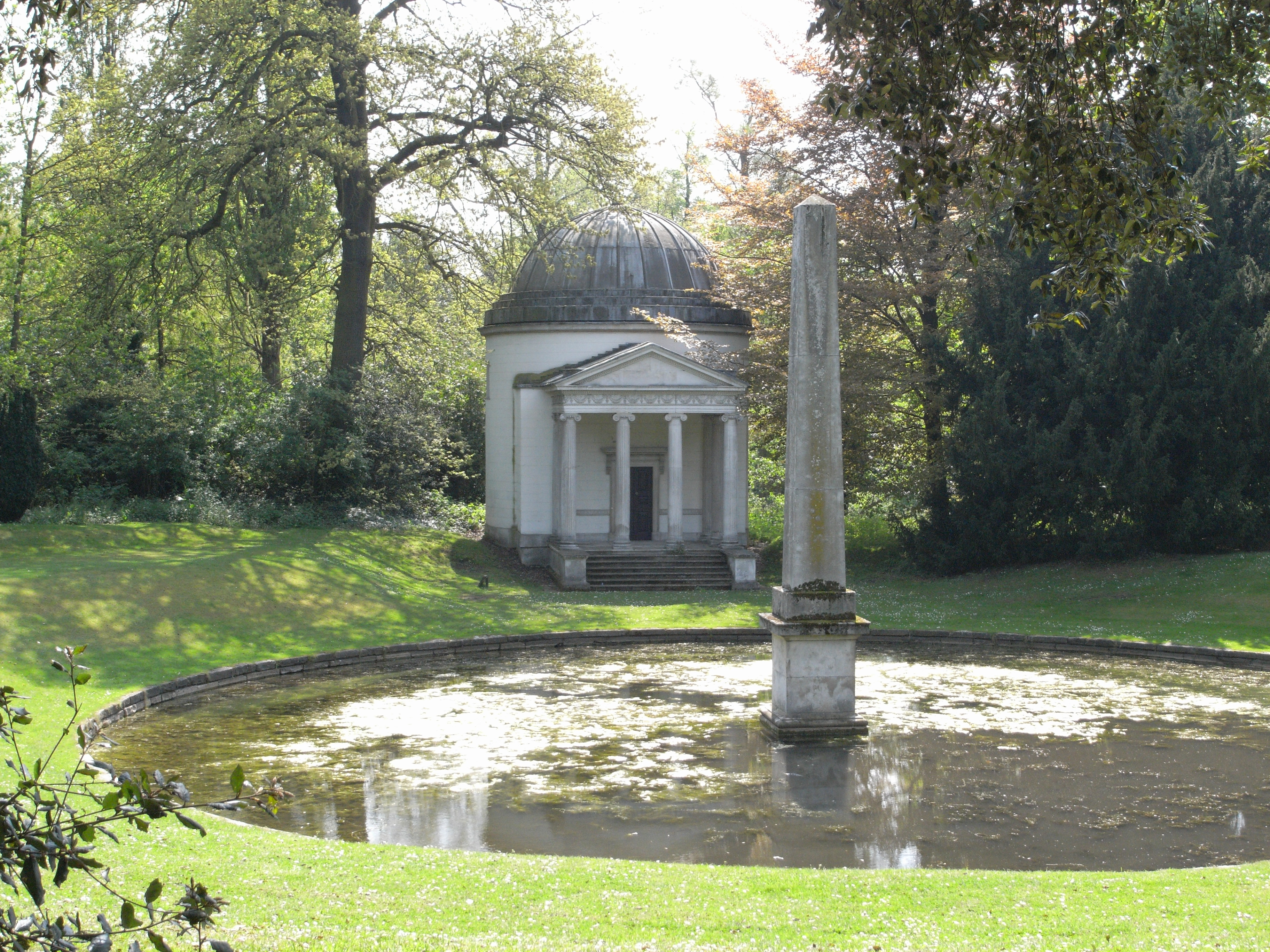
The Ionic Temple and Orange Tree Garden, c. 1726
Source: Wikimedia Commons, photograph from 2008.

The restorers have erected several notices around the gardens in the form of picture frames.   The one shown below reproduces an idealised view of the house and invites you to compare it with the present view (somewhat obscured by trees).

Picturesque viewpoint, Chiswick House
My photograph, July 2010

The gardens designed by Burlington and William Kent have a special place in landscape history, having inspired Alexander Pope's fourth 'Epistle' on good taste, which argues that all should be 'adapted to the genius and use of the place, and the beauties not forced into it, but resulting from it.'  Here are the lines relating to garden design:
To build, to plant, whatever you intend,
To rear the column, or the arch to bend,
To swell the terrace, or to sink the grot;
In all, let Nature never be forgot.
But treat the goddess like a modest fair,
Nor overdress, nor leave her wholly bare;
Let not each beauty ev'rywhere be spied,
Where half the skill is decently to hide.
He gains all points, who pleasingly confounds,
Surprises, varies, and conceals the bounds.

Consult the genius of the place in all;
That tells the waters or to rise, or fall;
Or helps th' ambitious hill the heav'ns to scale,
Or scoops in circling theatres the vale;
Calls in the country, catches opening glades,
Joins willing woods, and varies shades from shades,
Now breaks, or now directs, th' intending lines;
Paints as you plant, and, as you work, designs.

- Alexander Pope, 'Epistle to Burlington', 1731

The cascade, Chiswick House garden, designed by William Kent
My photograph, July 2010

As this verse implies, the garden is both formal and informal.  It has geometrical features like the Patte d’oie (‘goose-foot’) - three radiating avenues ending in small buildings - but it also has a lake created from a stream and 'naturalised'.  The overall design 'pleasingly confounds, surprises, varies'.  As John Dixon Hunt says in The Figure in the Landscape (p96), the visitor, once walking down the main axis of the garden, was confronted with 'frequent openings that tempted to left and right; once such invitations to divert from the main avenue were accepted the windings and intricacies of the garden were quickly discovered.'

Jean Rocque, Plan du Jardin & Vue des Maisons de Chiswick, 1736

Finally, here are The Beatles in May 1966 performing 'Paperback Writer' in the gardens.  At the start you can see them at the exedra, a semicircular yew hedge which formed a backdrop to Burlington's copies of antique statues said to represent Caesar, Pompey and Cicero. The other main location is the conservatory, renowned for its camellias, designed by Samuel Ware in 1813, a forerunner of the famous glasshouses at Kew and Crystal Palace.

Sunday, August 01, 2010

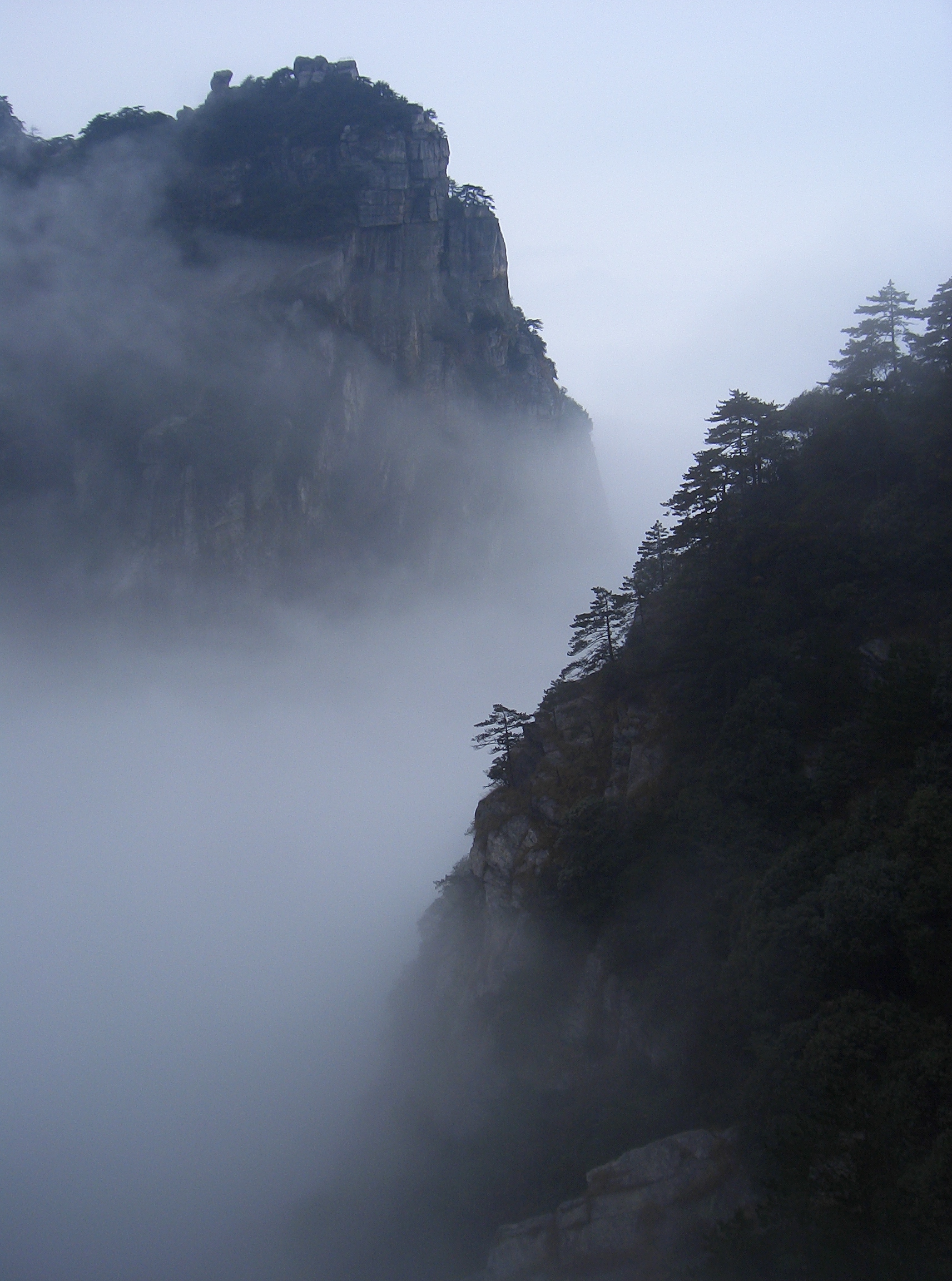
Lu Mountain's true face

Mount Lu

Lu Mountain (Lu-shan or Hermitage Mountain), at the juncture of the Long River and Lake P'o-yang in China, must be a contender for the most inspirational landscape in literature.  It became established as an important religious centre with the arrival of Hui-yung (332-414), for whom the West-Forest Monastery was rebuilt in 377, and Hui Yüan (334-416) who taught Pure Land Buddhism at the East-Forest Monastery.  The poet T'ao Yüan-ming (365-427), founder of the fields-and-gardens tradition (see my earlier post here) knew Hui Yüan and lived on a farm near the mountain.  Hsieh Ling-yün (385-433), whose mountains-and-rivers poetry I discussed here earlier, was influenced by the teachings of Hui Yüan and wrote about Lu-shan, with its 'jumbled canyons', 'thronging peaks' and 'dragon pools.'

Three hundred years later the T’ang Dynasty poet Meng Hao-jan (689-740) had his own mountain home further west in Hsiang-yang and made Deer-Gate Mountain there famous through his poetry.  But on one of the many journeys he made as an official he wrote about Incense Burner Peak, the most spectacular in the Lu Mountain range, and the distant sound of the bell from East-Forest monastery.  Li Po (701-62) stayed at the monastery and wrote of the silence and emptiness that could be found there away from the city. Climbing towards Incense-Burner Peak, he gazed at the waterfall, three thousand feet high, and wrote a celebrated poem which I have discussed here previously.

Po Chü-i (772-848) composed poems about the mountain and a famous prose account of the thatch hut he built in 817 facing Incense-Burner’s north slope. From this place he could experience 'the blossoms of Brocade Valley' in spring, 'in summer the clouds of Stone Gate Ravine, in autumn the moon over Tiger Creek, in winter the snows on Incense Burner Peak' (trans. Burton Watson). I particularly like his description of the way water was channeled around the hut, with a small waterfall that in twilight and dawn had 'the color of white silk' and at night made 'a sound like jade pendants or a lute or harp'  A bamboo trough led water from a spring in the cliff, across the hall into channels that fell from the eaves to wet the paving, giving 'a steady stream of strung pearls, a gentle mist like rain or dew, dripping down and soaking things or blowing far off in the wind.'

By the Sung Dynasty, the mountain was almost overburdened with poetic tradition.  In An Anthology of Chinese Literature Stephen Owen writes that Su Tung p’o (Su Shi, 1037-1101) resolved to visit the mountain as 'an "innocent traveler", wanting to experience the mountains without writing poems (as a modern tourist might resolve to travel without taking photographs).'  But he was unable to restrain himself and ended up composing several, writing his own reputation into the landscape with perhaps the best known of all the mountain's poems, a quatrain 'Inscribed on the Wall of West Forest Monastery', stating the impossibility of ever knowing Lu Mountain's true face.

Saturday, July 31, 2010

Where flowers drop and waters flow

Shen Fu's memoir, Six Records of a Floating Life (1809), describes his life as an undistinguished civil servant and art enthusiast, with an account of some of the famous landscapes seen on his travels.  The book's popularity has rested on the poignant account Shen Fu gives of his marriage to Yün, with their shared interests and misfortunes from the age of thirteen, when their marriage was arranged, to Yün's death at the age of forty.  Here is an incident from a section on 'The Pleasures of Leisure' in which the two of them make a a miniature landscape in a rectangular pot:

'The mountain was on the left, with another small mound on the right.  Along the mountain we made horizontal patterns, similar to those on the mountain paintings by Yün-lin.  The cliffs were irregular, like those along a river bank.  We filled an empty corner of the pot with river mud and planted duckweed, white with many petals.  On top of the stones we planted morning glories, which are usually called cloud pines.  It took us several days to complete.  By the deep autumn the morning glories had grown all over the mountain, covering it like wisteria hanging from a rock face, and when their flowers bloomed they were a deep red.  The white duckweed also bloomed, and letting one's spirit wander among the red and white was like a visit to Peng Island.  We put the pot under the eaves and discussed it in detail: here we would build a pavilion on the water, there a thatched arbour; here we should inscribe a stone with the characters 'Where flowers drop and waters flow'.  We could live here, we could fish there, from this other place we could gaze off into the distance.  We were as excited about it as if we were actually going to move those imaginary hills and vales.  But one night some miserable cats fighting over something to eat fell from the eaves, smashing the pot in an instant.' (Trans. Leonard Pratt and Chiang Su-hui)


Ni Zan (also known as Yün-lin),  
Woods and Valleys of Mount Yu, 1372

Thursday, July 29, 2010

The lush blue landscape

Last year Denis Dutton, editor of that useful website Arts and Letters Daily, published The Art Instinct, a book that applies evolutionary thinking to aesthetics.  Of particular interest for this blog is his opening chapter, 'Landscape and Longing', which begins with a discussion of Komar and Melamid's America's Most Wanted, a project I briefly discussed here before (one of the comments made on that post was a recommendation to read The Art Instinct).  Dutton takes Komar and Melamid's survey seriously and argues that 'the lush blue landscape type that the Russian artists discovered is found across the world because it is an innate preference.'  To do this he draws on some of the psychology of landscape literature that has grown up in the wake of Jay Appleton's book The Experience of Landscape:
  • Gordon H. Orians and Judith H. Heerwagen in 'Evolved Responses to Landscapes' (1992) suggest human beings would take pleasure in 'savanna landscapes', featuring open spaces with low grass and groupings of trees, with evidence of water, diverse vegetation, animal and bird life, and a view to the horizon.  Our taste in trees depends on how climbable they are: the authors posit a cross-cultural preference for dense canopies that fork near the ground. 
  • Stephen and Rachel Kaplan (e.g. Cognition and Envionment, 1982) have looked at the degree of complexity people like in landscapes and found a tendency to prefer terrain that both 'provides orientation and invites exploration.'  Legibility is enhanced with a clear focal point, whilst rivers or paths leading out of a picture give a pleasurable sense of mystery. 
  • Jay Appleton's original 'prospect and refuge' idea suggested that humans prefer to view a prospect from a place of refuge, ideally with an overhang (e.g. trees or roof) and protection from behind.  
  • Steve Sailor's 2005 article, 'From Bauhaus to Golf Course' describes this earlier literature and makes the link to Komar and Melamid's America's Most Wanted.  Sailor says that 'Harvard biologist Edward O. Wilson, author of the landmark 1975 book Sociobiology, once told me, "I believe that the reason that people find well-landscaped golf courses 'beautiful' is that they look like savannas, down to the scattered trees, copses, and lakes, and most especially if they have vistas of the sea."'   
  • J.D. Balling and J.H. Falk ('Development of Visual Preference for Natural Environments', 1982) showed photographs of landscapes to six different age groups and found a preference among the youngest: eight year olds preferred savannas to forests and deserts.  Similar results have apparently been found by Erich Synek and Karl Grammer (no precise reference for this research is given by Dutton).  They believe that increasing outdoor experience develops children's sophistication in response to landscapes.
  • Finally, moving from age to gender, Dutton cites Elizabeth Lyons ('Demographic Correlates of Landscape Preference', 1983) who has found that women have a greater liking for vegetation in landscapes than men, with an evolutionary predisposition towards areas providing refuge and fruit, as opposed to prospects providing opportunities for exploration and hunting. 

Frederick Edwin Church, The Heart of the Andes, 1859

This painting is reproduced in The Art Instinct.
Dutton says of it: 'the worldwide attraction of such landscapes even today is very likely an evolved trait'

Well, inspired by this line of research I tested my own six year old son with some art postcards.  He wasn't terrifically excited by any of them and certainly showed little interest in my example of a 'lush blue landscape' - his favourite was a forbidding vista of ice and mountains by Caspar Wolf.  Not to be put off, I then decided to search for atavistic environmental preferences in my wife, only to be disappointed when she picked out Friedrich's nearly featureless and abstract Monk by the Sea.  However, she then went on to say that she also liked a Cezanne and a Klimt because they had beautiful trees.  And asked about the lush blue landscape (by Claude) she said "yes I guess that's got trees too but, I don't know, there's something too big and spacious about that landscape..."

The Art Instinct has provoked a lot of debate and commentary (for example on the website of the The International Cognition & Culture Institute).  Denis Dutton assures readers and reviewers that he is not being reductive and views art as much more than just a product of evolution.  He covers a lot of ground and writes engagingly, but a fuller discussion on landscape might have helped to dispel natural concerns that the arguments being made are insufficiently sophisticated.  A longer treatment could have explored in more detail the relationship between research into our attitudes to certain natural environments and the slow development and complex history of landscape art in different parts of the world.  The book could also have dealt with more of the literature on landscape preferences, which is referred to in one of the articles collected on Dutton's website, a review by Mara Miller (author of The Garden as an Art).

Miller writes that 'there is no mention of the recent work on palaeolithic art, like David Lewis-Williams’s The Mind in the Cave: Consciousness and the Origins of Art (Thames and Hudson, 2004), or theory about the selective advantage conferred by Stone Age campsite selection.  More troublesome, Dutton does not mention, much less analyze (nor even cite in the bibliography), the deep body of work by new philosophers over the past fifteen years that is directly relevant to his topics and arguments.'  She goes on to list Emily Brady’s Aesthetics of the Natural Environment (University of Alabama Press, 2003), Malcolm Budd’s The Aesthetic Appreciation of Nature (Oxford University Press, 2002), The Aesthetics of Human Environments, edited by Arnold Berleant and Allen Carlson (Broadview Press, 2007); and the essays in The Journal of Aesthetics and Art Criticism's “Special Issue on Environmental Aesthetics” 56 (1998), 'with John Andrew Fisher’s “What the Hills Are Alive With: In Defense of the Sounds of Nature” (this last highly relevant, given Dutton’s relatively extensive discussion of sound and music).'  Some useful references there if you're interested in this topic.

Friday, July 23, 2010

The Road North

When Basho and Sora set off in 1689 on the Narrow Road to the Deep North, they were traveling into the past, to re-visit landscapes with long held poetic associations.  As Haruo Shirane says in Traces of Dreams: Landscape, Cultural Memory and the Poetry of Basho, these places (utamakura) had traditionally served as 'cultural nodes in the poetic tradition', where travelers could hope to compose poems that would match the famous examples of their predecessors.  Shirakawa Barrier for example, features in a tenth century poem by Taira Kanemori and is then treated by Priest Noin in 1025, by Minamoto Yorimosa in 1170, and by later poets like Saigyo and Sogi (whose account of his journey to the Shirakawa Barrier in 1468 is a precursor of The Narrow Road to the Deep North).  Interestingly Basho seems to have been more easily inspired to compose haikai where an utamakura disappoints his expectations - at Shinobu Mottling Rock, for example, where he and Sora find the renowned rock lying face down, half buried in the grass.  And as he made his way north Basho established new haimakura, haikai places that do not appear in the work of earlier poets like Saigyo and Sogi.  As Basho's follower Kyoriku wrote, "travel is the flower of haikai. Haikai is the spirit of the traveler.  Everything that Saigyo and Sogi have overlooked is haikai.'

A new sequence of hamaikura is now being established in Scotland by artist-poets Alec Finlay and Ken Cockburn, who are making their own journey inspired by Basho and Sora.  As their blog The Road North explains, they are creating a word-map 'as they travel through their homeland, guided by the Japanese poet Basho, whose Oku-no-Hosomichi (Narrow Road to the Deep North) is one of the masterpieces of travel literature. Ken and Alec left Edo (Edinburgh) on May 16, 2010 – the very same date that Basho and his companion Sora departed in 1689 – and when they return, on May 16, 2011, they will publish 53 collaborative audio and visual poems describing the landscapes they have seen and people they have met.'  So far they have reached seven of the stations on Basho's journey - Scotland's equivalent of the rock at Shinobu and Shirakawa Barrier lie ahead (see map).  Nor have they yet got to a version of Nikko where, as I mentioned in an earlier post, I once made my own literary pilgrimage to see a station on Basho's journey north.  A few days ago they were at their Cascade of Silver Threads (Shiraito-no-taki) - the Falls of Bruar - and there, like Japanese poets, they were conscious of their own poetic predecessors, in this case Robert Burns, who wrote about the Falls in 1787:

Here, foaming down the skelvy rocks,
In twisting strength I rin;
There, high my boiling torrent smokes,
Wild-roaring o'er a linn:
Enjoying each large spring and well,
As Nature gave them me,
I am, altho' I say't mysel',
Worth gaun a mile to see.

from 'The Humble Petition of Bruar Water'

Saturday, July 17, 2010

And all the peaks shone


The Present Order is the Disorder of the Future - Saint-Just
Sculpture at Ian Hamilton Finlay's Little Sparta
Source: Wikimedia Commons

On Thursday I went to the National Theatre to see a new version of Danton's Death, Georg Büchner's extraordinary first play - written when he was twenty-one, only two years before his early death from typhus in 1837. The writing is so vivid that you're swept along - I almost found myself cheering a terrifying speech by Saint-Just, and I thought of Ian Hamilton Finlay's interest in this Apollonian figure, whose life was cut short by the guillotine at the age of twenty-six. Anyone who admires the modernity and power of this play should also read Lenz, Büchner's account of the descent into madness of a young Sturm und Drang playwright.  Lenz begins in the Vosges: 'snow on the peaks and upper slopes, down into the valleys grey stone, green patches, rocks and pine trees.'  Here is an extract from the description of Lenz's journey over the mountains (found on the blog Dispatches from Zembla):

Only once or twice, when the storm forced the clouds down into the valleys and the mist rose from below, and voices echoed from the rocks, sometimes like distant thunder, sometimes in a mighty rush like wild songs in celebration of the earth; or when the clouds reared up like wildly whinnying horses and the sun's rays shone through, drawing their glittering sword across the snowy slopes, so that a blinding light sliced downwards from peak to valley; or when the stormwind blew the clouds down and away, tearing into them a pale blue lake of sky, until the wind abated and a humming sound like a lullaby or the ringing of the bells floated upwards from the gorges far below and from the tops of the fir trees, and a gentle red crept across the deep blue , and tiny clouds drifted past on silver wings, and all the peaks shone and glistened sharp and clear far across the landscape; at such moments he felt a tugging in his breast and he stood panting, his body leaned forward, eyes and mouth torn open; he felt as though he would have to suck up the storm and receive it within him. 


Lenz walks on, increasingly lonely and fearful as darkness descends, until he eventually finds himself in the village of Waldbach where he is helped by the pastor Obelin. The rest of the narrative describes his struggles to find mental peace in this place: "you know I can't bear it anywhere but here, in this countryside; if I couldn't get out on to a mountain occasionally and see the landscape all around, then come home and walk through the garden and look inside through the window - I'd go mad!"  Sadly the landscape cannot cure the mental disturbances that come with increasing frequency or the ultimate collapse where all Lenz can hear is the constant scream of silence.  He is taken back to Strasbourg by carriage, from which he sees another heightened landscape, with no end to his mental torment in sight.  This translation is from the really excellent John Reddick edition of Büchner's writings, published by Penguin:
 
Towards evening they reached the Rhine Valley.  They drew further and further away from the mountains that now rose into the red of evening like a deep-blue crystal wave upon whose floods of warmth the russet glow of evening played; across the plain at the foot of the mountains lay a gossamer of shimmering blue.  It grew dark as they came closer to Strasbourg; a full moon high in the sky, distant objects all dark and vague, only the hill close by in sharp relief; the earth was like a goblet of gold over which the golden waves of moonlight foamed and tumbled.  Lenz stared out, impassive, without a flicker of recognition or response, except for a turbid fear that grew as more and more things disappeared in the darkness.

Friday, July 16, 2010

The tame delineation of a given spot

Henry Fuseli, who became professor of painting at the Royal Academy in 1799, famously warned his pupils off 'that kind of landscape which is entirely occupied with the tame delineation of a given spot.'  Such views 'may delight the owner of the acres they enclose, the inhabitants of the spot, perhaps the antiquary or the traveller, but to every other eye they are little more than topography.  The landscape of Titian, of Mola, of Salvator, of the Poussins, Claude, Rubens, Elzheimer, Rembrandt and Wilson, spurns all relation with this kind of map-work.'  In the wake of artists like Constable this distinction should have seemed outmoded but, as John Barrell points out in an article inspired by the recent Paul Sandby exhibition, 'Topography v. Landscape', the contrast between mere topography and true landscape art became more important as the nineteenth century progressed.


A View of Vintners at Boxley Kent, 
with Mr Whatman's Turkey Paper Mills (detail), Paul Sandby, 1794
Source: Austenonly

Barrell points in his article to the influence of a series of essays by William Pyne, 'The Rise and Progress of Watercolour Painting in England' (1823-4), which traced the shift from 'tinted drawing' (of which Sandby was the chief exponent) to the modern school of watercolour painting.  For Pyne, topographical images were views of ancient sites that would appeal to the antiquarian, as opposed to landscapes - rural scenes where specific buildings were secondary.  Clearly modern artists like Girtin and Turner painted both kinds of view, but later writers tended to associate their approach with the word 'landscape', whilst 'topography' became synonymous with the earlier, less sophisticated style.  In the nineteenth century the British Museum's collection of landscapes was split between those deemed art - filed in the Prints and Drawings collection - and a large group labeled 'topography' which was kept with maps in the library.

What did Paul Sandby's contemporaries understand by the word 'topographical' in relation to art?  John Barrell has been searching the online 18th century databases, checking the years between 1751 and 1800.  'I have had, in three separate searches over a fortnight, a total of between 2000 and 3000 hits for 'topographical'.  Sad I know, but that's what life is like for the semi-retired.'  Sad?  It sounds delightful fun, although I'm surprised there aren't students queuing up to help him.  Anyway, after stripping out repetitions, Barrell  reports that his pile of references was reduced down to 33: 'most of the time the adjective was used more or less as Pyne used it, in connection with images of old buildings of antiquarian interest.'  This suggests a much narrower sense of the word than we would expect given the range of scenes depicted by Paul Sandby and other 'topographical' artists.  As Barrell points out and the exhibition made clear, Sandby's landscape paintings are 'topographical' in the broader sense that we find in topographical writing - capable of conveying different aspects of a site's history, economy, architecture and natural features.  As such they may delight the cultural geographer (as Fuseli might now put it) but should also impress any interested contemporary viewer with what Stephen Daniels describes as 'the scope and intensity of 18th-century topographical art'.

Friday, July 09, 2010

A place crowned by a single oak tree

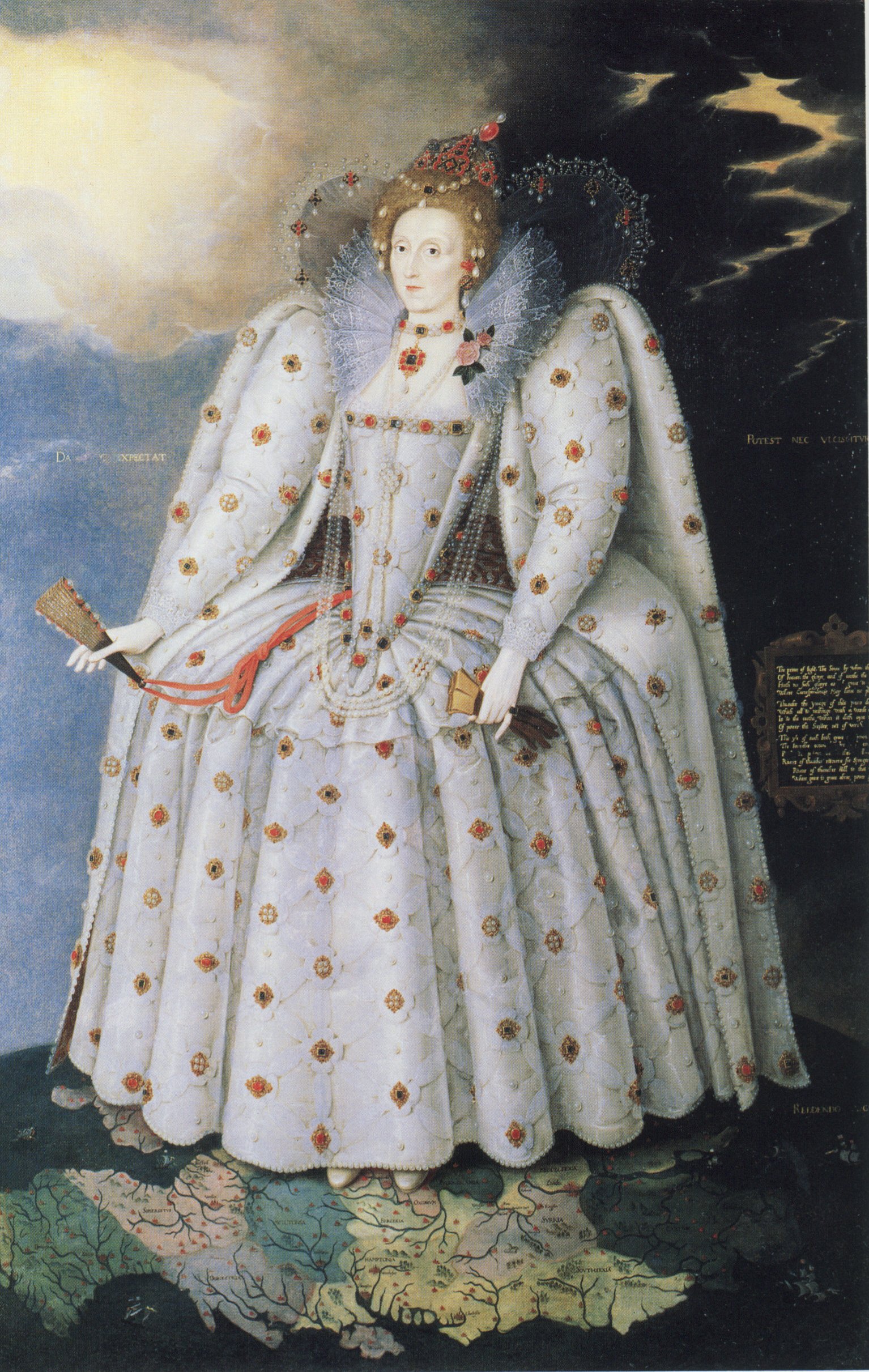
Marcus Gheeraerts the younger, Queen Elizabeth I, c1592
Source: Wikimedia Commons 

The reader of Virginia Woolf's Orlando (1928) soon realises that its hero/heroine is no ordinary person - here is the novel's fifth paragraph:

'So, after a long silence, 'I am alone', he breathed at last, opening his lips for the first time in this record. He had walked very quickly uphill through ferns and hawthorn bushes, startling deer and wild birds, to a place crowned by a single oak tree. It was very high, so high indeed that nineteen English counties could be seen beneath; and on clear days thirty or perhaps forty, if the weather was very fine. Sometimes one could see the English Channel, wave reiterating upon wave. Rivers could be seen and pleasure boats gliding on them; and galleons setting out to sea; and armadas with puffs of smoke from which came the dull thud of cannon firing; and forts on the coast; and castles among the meadows; and here a watch tower; and there a fortress; and again some vast mansion like that of Orlando's father, massed like a town in the valley circled by walls. To the east there were the spires of London and the smoke of the city; and perhaps on the very sky line, when the wind was in the right quarter, the craggy top and serrated edges of Snowdon herself showed mountainous among the clouds. For a moment Orlando stood counting, gazing, recognizing. That was his father's house; that his uncle's. His aunt owned those three great turrets among the trees there. The heath was theirs and the forest; the pheasant and the deer, the fox, the badger, and the butterfly.'

It is a fantastic view in every sense, compressing history and geography so that Snowdon, the Spanish Armada, and the city of London can all be picked out in the distance. Like Queen Elizabeth I standing on the map of England in 'The Ditchley Portrait' (above), Orlando is able to survey the whole country from beneath the oak tree. Here is an extreme version of the aristocratic prospects found in poetry and painting - Orlando gazing and counting, taking visual possession of the landscape ("the heath was theirs and the forest...") The gaze comes eventually to focus in on a butterfly, an early hint of Orlando's persistent love for the natural world (later in the book it is said that 'the English disease, a love of Nature, was inborn in her'). The symbol of the oak tree runs through the novel in the form of a poem, which Orlando works on for centuries as she observes the changes in literary fashion from Shakespeare's time to Virginia Woolf's present day.  At the end of the book, Orlando thinks of burying a copy of 'The Oak Tree' but decides against it, as 'no luck ever attends these symbolical celebrations'. 

'So she let her book lie unburied and dishevelled on the ground, and watched the vast view, varied like an ocean floor this evening with the sun lightening it and the shadows darkening it. There was a village with a church tower among elm trees; a grey domed manor house in a park; a spark of light burning on some glass-house; a farmyard with yellow corn stacks. The fields were marked with black tree clumps, and beyond the fields stretched long woodlands, and there was the gleam of a river, and then hills again. In the far distance Snowdon's crags broke white among the clouds; she saw the far Scottish hills and the wild tides that swirl about the Hebrides. She listened for the sound of gun-firing out at sea. No--only the wind blew. There was no war to-day. Drake had gone; Nelson had gone. 'And there', she thought, letting her eyes, which had been looking at these far distances, drop once more to the land beneath her, 'was my land once: that Castle between the downs was mine; and all that moor running almost to the sea was mine...' 

In an amusing preface to Orlando, Woolf thanks all her friends and various experts - including Arthur Waley for help with the non-existent Chinese element of the book.  She concludes: 'Finally, I would thank, had I not lost his name and address, a gentleman in America, who has generously and gratuitously corrected the punctuation, the botany, the entomology, the geography, and the chronology of previous works of mine and will, I hope, not spare his services on the present occasion.'  I will venture to say no more about Orlando lest I provoke similar corrections from the experts - I'm very conscious of my ignorance when it comes to Virginia Woolf and others will know a lot more about this book than me (not least Mrs Plinius, who is a Woolf aficionado).  However, I'll risk a few more words about the place where one might hope to find Orlando's oak tree: at Knole, the ancestral home of Vita Sackville-West.


As the National Trust Knole site explains, Orlando is dedicated to Vita Sackville-West 'and, in the words of Vita's son, Nigel Nicolson, it is 'the longest and most charming love letter in literature'. Vita is the eponymous hero/heroine (Orlando changes gender over the four centuries in which the novel is set) and Orlando's ancestral home is a house, like Knole, with a legendary 365 rooms. The pages are threaded through with similarly specific references to Knole and to its past and present incumbents. It ends with Orlando taking possession of the house whereas, in fact, Vita had been denied ownership of her beloved Knole because the house was passed through the male line.'  In her book Knole and the Sackvilles (1922), Vita Sackville-West wrote of the house that "it has the tone of England; it melts into the green of the garden turf, into the tawnier green of the park beyond, into the blue of the pale English sky."  The park surrounding the house has remained largely unchanged since the time of Elizabeth I, although it did lose 70% of its trees in The Great Storm of 1987.  We explored it and took the photograph below on a summer's day last year.

Knole Deer Park
Photographed by me in 2009

Sunday, July 04, 2010

A Farm Picture

In a post a few years ago I reprinted a short poem by Coleridge, written in 1828, of which Richard Holmes said 'this fragment of Dutch landscape is an almost perfect imagist poem'.  In an article in the New York Review (24 June), Christopher Benfey quotes Robert Hass, editor of a Walt Whitman collection, describing some of Whitman's poems as anticipating 'the imagist procedures of the young modernists who came a half century later.'  These very short poems, 'those "brilliant and surprising experiments" in which, in three or four lines, Whitman composes a snapshot view', include 'The Runner', 'A Paumonok Picture' and 'Cavalry Crossing a Ford'.  One of them is, in effect, a three line landscape painting, 'A Farm Picture' (1865):

THROUGH the ample open door of the peaceful country barn,
A sun-lit pasture field, with cattle and horses feeding;
And haze, and vista, and the far horizon, fading away

Benfey says that Whitman 'loved art galleries and one can imagine him trying, in such poems, to capture some of the effects of the painters of his time, such as the "haze and vista" of the landscape paintings of Martin Johnson Heade...'  Heade, one of those American artists subsequently described as luminists for their interest in light effects, began painting landscapes in the early 1860s and became best known for his salt marsh paintings.  He is also one of the four cultural figures examined in Christopher Benfey's recent book A Summer of Hummingbirds: Love, Art, and Scandal in the Intersecting Worlds of Emily Dickinson, Mark Twain, Harriet Beecher Stowe & Martin Johnson Heade.

Martin Johnson Heade, Newburyport Meadows, c1872-8
Source: Artchive

Wednesday, June 30, 2010

The Wanderer's Night Song

There is a great tradition of poets contemplating the landscape from mountain huts.  I've talked here before about Gary Snyder 'looking down for miles / through high still air' from his hut on Sourdough Mountain.  One of the most famous Japanese examples is Kamo-no-Chomei who in the early thirteenth century built his own modest hut (like Thoreau) above a valley thick with trees, with a view of the Western heavens.  Earlier still, in China, there was Hsieh Ling-yün's retreat on Stone-Gate Mountain (although most of the time he lived 'in a comfortable mountain-side house, which included an enormous library and vast landscape gardens').  But it is not necessary to live in a mountain hut - a fleeting visit can suffice for a poet to make a permanent imprint on the landscape:

                          Über allen Gipfeln
                          Ist Ruh,
                          In allen Wipfeln
                          Spürest du
                          Kaum einen Hauch;
                          Die Vögelein schweigen im Walde.
                          Warte nur, balde
                          Ruhest du auch.

In September 1780 Goethe wrote these lines on the wall of a mountain hut in Ilmenau. 'The Wanderer's Night Song I' is now one of the best known German poems and has been set to music many times, by composers such as Schubert, Liszt, Schumann and Ives.  Here is a recent version by Peter Viereck which can be found at the Poetry Library site.  Viereck says that 'along with Pushkin’s ‘On the Hills of Georgia’, this is the simplest great poem in history.'

                     To every hill crest
                     Comes rest.
                     In every tree crest
                     the forest
                     scarcely draws breath.
                     Each bird-nest is hushed on the heath.
                     Wait a bit; soon you
                     will find rest too.


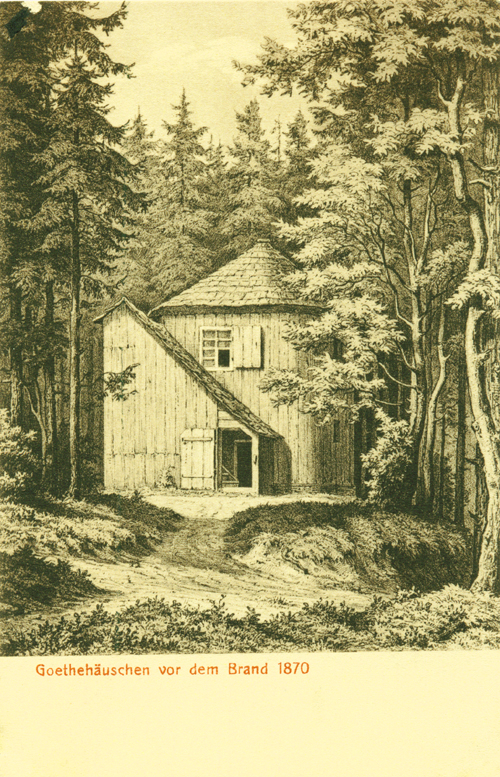
Goethe revisits the mountain hut
Goethe didn't return to Ilmenau until August 1831, seven months before his death, but was then moved to tears to see his poem still there.  During the nineteenth century, the hut became a place of literary pilgrimage - you can see a collection of old postcards like the one shown above at the Goethezeitportal.  According to David Luke (who has translated the poem for Penguin Classics) 'in the nineteenth century a forester is said to have discovered a literary English tourist attempting to saw the poem out of the wooden wall, and this led to a photographic record being made.  The hut was burnt down in 1870, and later exactly restored; Goethe's lines are there again, engraved on a brass plate.'

 The restored hut today
Source: Wikimedia Commons

You can see a recent interior image of the hut in a post on Goethe's poem at the Poemas del rio Wang blog.  As mentioned there, Goethe drew inspiration for 'The Wanderer's Night Song' from a fragment by the Spartan poet Alcman, which had been published in 1773.  Alcman does not address the listener, unlike Goethe's Wanderer; he simply describes all of nature asleep - the mountains, the ocean, the birds and beasts.  Nor, in what we have of Alcman's verse, does he contrast the hushed landscape with the busy activities of people, a poetic theme which (as C. M. Bowra points out) begins with Euripides' Iphigenia at Aulis:

  Agamemnon: The birds are still at any rate and the sea is calm; hushed are the winds, and silence broods o’er this narrow firth.

  Attendant: Then why art thou outside thy tent, why so restless, my lord Agamemnon?

The restlessness of men like Agamemnon was gladly left behind, far below, by Goethe and the other poets seeking rest and tranquility in a simple hut high up in the mountains.

Sunday, June 27, 2010

Robinson in Ruins

On Friday I got to see extracts from Patrick Keiller's forthcoming film, Robinson in Ruins, at the AHRC's 'Art and Environment' conference at Tate Britain.  Keiller has been making it as part of an interdisciplinary project for the Landscape and Environment programme.  With him to present and talk about the film were an all-star panel - Patrick Wright, Doreen Massey, Matthew Flintham and Iain Sinclair.  Each of these, apart from Sinclair, was involved in the project, but working in parallel rather than contributing directly to the film itself.  Robinson in Ruins looks similar to Robinson in Space, filmed this time around Oxfordshire and focusing on the financial crisis unfolding through 2008.  Vanessa Redgrave takes over from Paul Scofield as the narrator. The film documents sites of political or historical significance, like the woodland where Professor David Kelly committed suicide, interleaved with recurrent images - letter boxes, wind blown flowers, lichen growing on traffic signs.  

The Five Sisters - shale bings admired by John Latham

It was great to talk yesterday to some readers of this blog and enjoy a post-conference dinner in the sunlit landscape of St James Park with Kathryn and Jen (Kathryn Yusoff contributed a talk in the afternoon about the relationship between weather and climate).  Here, as promised, are a few quick impressions of the rest of the conference, which focused mainly on art and and had quite a lot to say about land art.  Richard Long's A Ten Mile Walk (1968), for example, was discussed by Nicholas Alfrey, who uncovered the historical landscape of Exmoor that the artist had traversed.  Craig Richardson talked about John Latham's involvement with the earthwork-like shale bings of West Lothian.  Ben Tufnell described Cai Guo Qiang's encounters with Spiral Jetty and Double Negative, and a trip to the Nevada testing site where the artist and his team managed to cause panic by detonating a small mushroom cloud.
  
The theme of artistic pilgrimage came up several times in different sessions.  Joy Sleeman described her trip to see Spiral Jetty and Sun Tunnels, finding there the idea of a pristine landscape (as described by Nancy Holt) belied by the evidence of some spent gun cartridges on the ground.  Brian Dillon re-told the story of his pilgrimage to Robert Smithson’s Monuments of Passaic and discussed examples of other recent artistic encounters with the ruins of modernism.  Spanish artist Lara Almarcegui talked about regularly re-visiting her own special site, A Wasteland in Rotterdam Harbour, 2003-2018.  Of course there is nothing new about footstepping earlier artists and Richard Wrigley began his presentation on the climate of the Roman Campagna with Corot's La promenade de Poussin.

Jean-Baptiste-Camille Corot, La promenade de Poussin, c1826

The landscapes imagined by Ballard, Tarkovsky, Sebald remain key influences - Matthew Gandy mentioned all of these in his talk (he included a bizarre photograph of a Ballardian luxury development in Argentina that has been inspired by the writings of Borges).  Russell Hoban's novel Riddley Walker, which imagines a post-apocalypse 'Inland' on the present landscape of Kent, is the source for a new work described yesterday by artist Heather Morison - a puppet show to be staged in Tasmania.  Heather and Ivan Morison travel the world making art but are based in Wales, where they own a wood and are creating an arboretum.  They also have a studio in Brighton where they are 'developing an atelier'.  Their approach somehow put me in mind of those glossy food/garden/design programmes on TV.  At one point we were shown a slide of the artists cooking for the locals in the manner of Hugh Fearnley-Wittenstall - the Morisons had designed their own burger and named it a 'J.G.' in honour of Ballard (I didn't manage to note down the ingredients).   

More interesting to me was Katie Paterson, whose work was discussed in a session on the Sublime. She described a work completed only last week, Inside this desert lies the tiniest grain of sand, which had involved returning to the Sahara desert a grain of sand that had been chiseled to 0.00005mm using the techniques of nanotechnology.  At extreme magnification the grain of sand resembled a planet and presumably the chiseling process could have created some nano-land art - a microscopic Spiral Jetty or near invisible Double Negative.  The point was made (by Brian Dillon) that she brings a necessary sense of humour to art that deals with cosmic scales of space and time.  This idea was reinforced near the end of the conference when Simon Faithfull showed his film of a domestic chair lifted to the edge of space by a weather balloon (see below). He also showed extracts from 0°00 Navigation, a Keaton-esque journey from the Channel to the North Sea along the Greenwich Meridian.  The clip below shows a section of this epic journey starting with the artist climbing undaunted through the back gardens of East Grinstead. Watching this it was hard not to think back to Richard Long, negotiating the obstacles of Exmoor, climbing doggedly over fences and sticking rigidly to the straight line on his Ordinance Survey Map. 

Simon Faithfull, Escape Vehicle No. 6, 2004

Simon Faithfull, 0°00 Navigation extract, 2009

Saturday, June 19, 2010

July Mountain


'We live in a constellation / Of patches and of pitches' wrote Wallace Stevens in 'July Mountain'. This poem is the starting point for Michael Pisaro's recent collaboration with percussionist Greg Stuart, which I've been listening to this week, along with A wave and waves, an earlier poetry and landscape inspired piece. July Mountain starts with 'patches and pitches' of environmental sound and until a striking moment, eight minutes in, when you hear the first note of a piano.  As the piece builds the natural sounds fade and the percussion intensifies (the effect is powerful but is a bit like listening to a hoover).  Several people have already written posts about July Mountain but the best description is by Yuko Zama  - here is an extract:

'From the start, some environmental sounds like falling rain, birds chirping, distant voices of people, airplanes flying overhead and cars passing by are heard. Despite this being a mixture of field recordings made at ten different locations, the sounds are all nicely blended as if they were sharing the same time and space, without causing any chaos or discordance, perhaps due to the delicately controlled balance of the individual volumes. At this point, any percussion sounds are barely recognizable.Then as time goes by, more environmental sounds like helicopters, calls of sea gulls, and waves (as well as many other almost unrecognizable sounds) appear in the soundscape. Since the transition between field recording sources is so natural and subtle, there is no impression that one field recording is switched to another at all. It is rather like the landscape and the time you are in is slowly and endlessly shifting to somewhere else almost before you realize it.  About eight minutes in, one strong, determined piano chord is added in the middle of the environmental sounds. The appearance of this piano chord changes the atmosphere of the whole soundscape...'

Brian Olewnick, on his Just Outside blog, describes 'letting "July Mountain" cascade over you. The sounds begin quietly with birds, wind, the low throb of an airplane engine, etc. and gradually mass into an onrush that remains strangely delicate for all its force. The piano, children's voices, sine tones, light metallic clatter and much more begin to funnel into an ever widening vortex that absolutely sucks you in while always providing oxygen. It's as if you're sitting on the mountain or in that valley having had your ears hyper-sensitized so they were picking up every sound within miles and, more, making a kind of sense of them, collating them into a semi-recognizable pattern.'

The latest Wire has an interview with Pisaro in which Philip Clark asks him about a persistent worry with field recordings - that you can just stick a microphone in the landscape and call the result 'art'.  For his part, Pisaro points to the importance of the way an artist selects and frames nature (true of all landscape art) and Clark agrees, citing July Mountain, which is based on 'the pre-compositional strategies of a graphic score.' The instructions future versions are: '20 recordings may be made by the performer(s) or obtained from the composer.  They should all be made in mountain areas or valleys if possible. See the attached chart for the arrangement of the recordings in time, panning, and information about the fades...'  You can download the score from the Jez riley French site and see how precisely programmed the percussion is, e.g. 10 bells + beating sine tones (13 sounds) starting at 15:30 with duration 20", using bell numbers 1 and 2;  1, 2 and 4; 3; 1, 2, 3 and 4 etc.


A wave and waves (2007) has no environmental sounds - it is an orchestral piece in two parts, scored for 100 percussion instruments.  The title is a clue to the influences - John Ashbery's poem 'A Wave' and the sound pattern of waves at Big Sur, California.  At the moment, I think I prefer it to July Mountain. Part I, 'a world is an integer', is a single, cresting wave and Part II, 'a haven of serenity and unreachable', was inspired by Pisaro's observance of the waves at Big Sur, arriving with a periodicity of 15-20 seconds where "every seventh wave would be a 'big one'".  Here is another extract from the writing of Yuko Zama, emphasising the connection between the music and natural sounds:

'The pure straight tones in different pitches, created by bowing various musical instruments, evoke the horizontal vastness and a slow, gradual move of a single wave. Meanwhile, the fine particles of small grainy sounds, created by the showers of rice, seeds and pebbles falling on various materials or simply from ripping paper, evoke the image of a microscopic world inside the wave - where thousands of small bubbles and swirls of water constantly emerge and disappear. The layer of the various sounds with different textures creates a stereoscopic effect and a realistic perspective for the whole soundscape, resulting in the lifelike impression of a single wave slowly and silently surging from a far distance. The whole sound also evokes a feeling of floating in space, as if I were watching small stars glowing in the dark - appearing one by one in the galaxy, slowly passing by each other, then disappearing into the dark.'

      Friday, June 11, 2010

      Infrared landscapes

      Florian Maier-Aichen uses special lenses and computer imaging to render epic landscapes mysterious or disturbing. One of his untitled photographs at the Saatchi Gallery, shows 'a virgin beach lined with superhighway and luxury homes expanding into the misty distance. Tinting the surrounding forest in an unnatural shade of red, he casts an apocalyptic glow over the seascape, framing wilderness and human intervention as a scene of science fiction portent.' In another, the frontier wilderness, stretching off into the distance, is bathed in unnatural darkness. A Friedrich-like snow-scape, Untitled (2005), is lit by a suburban street light. A black and white photograph of Long Beach transforms urban sprawl a desert of ash, overlooked by an icy mountain range.


      In the Art21 video embedded above, Maier-Aichen talks about his infrared landscapes. He says "I'm not interested in pure landscape, the Ansel Adams way for example. I think it's too pure and it's not interesting because there's nothing happening." But he still sees his work as directly relating to the history of landscape photography, rather than environmental protest art. The second clip below shows him in action, preparing to try to recapture an image from an old postcard.  You can see more of his work at the 303 Gallery, e.g. Der Watzmann (2009) and Salton Seas I (2008).