Showing posts with label Su Shi. Show all posts

Tuesday, August 15, 2023

Sunlit emptiness


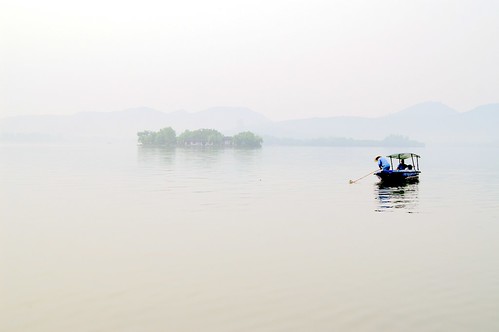
West Lake, Hangzhou
Source: Wikimedia

I've just read Love & Time: The Poems of Ou-Yang Hsiu, a slim volume of J. P. Seaton translations published by the Copper Canyon Press in 1989. It includes Ou-Yang's series of ten poems entitled West Lake Is Good, which popularised the tz'u form (ci in pinyin) where verse is fitted into the form of a pre-existing song. His West Lake poems (the lake is in Hangzhou - see my earlier post on it) were written to the tune Picking Mulberries. I guess it would be like someone writing a set of poems about Windermere using the rhythms and rhyme scheme of 'Scarborough Fair'. Ouyang also wrote some beautiful landscape poems in the short shih (shi) style, like 'Drifting at I-Ch'uan' in which a stream grows in a gorge and rapids turn a tiny boat. 'Birds on the sand turn too: / away from me / and fly, to the grove's green tips.'  

Ouyang Xiu (1007-72 - I'm swapping now to pinyin spelling) had the Zuiweng Pavilion constructed at Langya Mountain near Chuzhou. It was built to his design by a Buddhist priest of the mountain, Zhi Xian, and you can now build one yourself – I see that a Lego set is available to buy! Ouyang called it The Pavilion of the Old Drunkard, but as Richard Strassberg writes in Inscribed Landscapes, what Ouyang ‘cares about is to be amid mountains and streams. The joy of the landscape has been captured in his heart, and wine drinking merely expresses this.’ Ouyang’s calligraphy was engraved at the pavilion in 1048 but because it was difficult to make rubbings, Su Shi (1037-1101) rewrote it in larger characters (rubbings of this still exist). Inscribed Landscapes includes a further text on another pavilion ordered near here by Ouyang Xiu: The Pavilion of Joyful Abundance, which is by a spring at the foot of Mount Abundance, Fengshan. 

In 1070 Ouyang wrote his ‘Account of the Pavilion on Mount Xian’ (1070), an early description of the ‘principle whereby a place becomes known through a particular person’, as Stephen Owen says in his Anthology of Chinese Literature. ‘Mount Xian looks down on the river Han', Ouyang wrote. 'when I gaze at it, I can barely make it out. It is surely the smallest of the major mountains, yet its name is particularly well known in Jingzhou. This is, of course, because it of the persons associated with it. And who are those persons? None other than Yang Hu and Du Yu.’ Yang Hu and Du Yu were governors during the Jin Dynasty and Mount Xian, near Xiangyang (formerly Xiangfan) had a ‘stele for shedding tears’ dedicated to Yang Hu.  

Of course Ouyang himself created sites of future literary pilgrimage - not just the pavilions near Chuzhou. Pingshan Hall was built in 1048 when he was prefecture chief of Yangzhou. Su Shi was again on hand to commemorate the older poet, writing a poem after Ouyang’s death on an occasion when he revisited the hall. It can still be visited today - it is in the western part of Daming Temple, on the middle peak of Shugang Mountain near Yangzhou - but it has been destroyed and re-built many times over the years. Stephen Owen’s anthology includes ‘An Account of the Reconstruction of Level Mountain Hall’ written in the seventeenth century by Wei Xi (1624-80). Pingshan means ‘Level Mountain’ and comes from the fact that the mountains from this viewpoint all appear at the same level. J. P. Seaton translated one of Ouyang's poems on this landscape. He looks out and leans into 'sunlit emptiness, / the mountain's colours in the mist / now there, now gone.'


Sunday, February 24, 2019

Wild Geese Returning


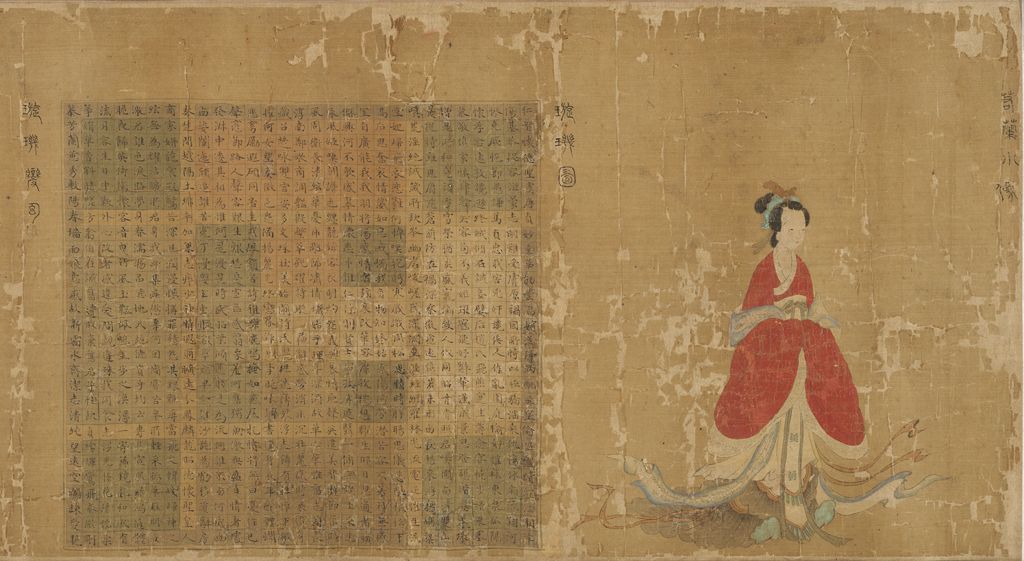
Wild Geese Returning: Chinese Reversible Poems (2011) is an introduction to a form of poetry that can be read in different directions.  Thanks to the way Chinese written characters take meaning from their position in a text, it is possible to write poetry that reads both forwards and backwards, whilst still retaining the formal the rhymes and syllable counts specific to poetic forms.  As it says on the Calligrams site, reversible poetry's 'greatest practitioner, and the focus of this critical anthology, is Su Hui, a woman who, in the fourth century, embroidered a silk for her distant husband consisting of a grid of 840 characters. No one has ever fully explored all of its possibilities, but it is estimated that the poem—and the poems within the poem—may be read as many as twelve thousand ways.'  Michèle Métail is a sinologist and poet who was also the first woman to be elected to the Oulipo back in 1975.  She has studied this underground current in Chinese literature and translated examples by providing French versions (English, in Jody Gladding's recent translation) that go first one way and then another. 

Su Hui with her great palindrome poem, the Xuanji Tu.

For this blog, I am particularly interested in landscape poems, and there are plenty of examples in Métail's book.  Wang Rong (468-494), for example, wrote a short 'Reversible Poem Composed in the Imperial Garden'  which begins with mountain peaks and ends with cicadas singing in the trees, and vice versa.  'In contemplating this landscape', Métail writes, we move from the distant to the close and from the close to the distant.'  The imperial garden was the setting for a sequence of reversible quatrains composed in the next century by a gathering of poets in the circle of the emperor of the Liang dynasty, Xiao Gang (503-551).  Xiao himself wrote of clouds over rocky peaks, water flowing through mountain slopes, a pond with swans and trees losing their leaves.  Or, in reverse, leaves flying from the trees, swans gathered on a lake, mountains with veins of water and rock summits dividing the clouds.

Some of the most famous Chinese poets wrote reversible poems.  The writer I discussed here last week, Yang Wanli, is included in Wild Geese Returning, along with two other Song Dynasty writers I have mentioned on this blog: Wang Anshi and Su Shi.  Wang Anshi (1021-86) wrote 'Thoughts of a Traveler', which begins with geese on a secluded island and ends with the twists and turns of a river, then, twisting back on itself, returns across the landscape to the wild geese at rest.  Su Shi (or Su Dongpo, 1036-1101) wrote poems to be sung in which the second half is the mirror image of the first.  In one of them, there are reminders of the way nature itself produces reversals, in a branch turned upside down, or with reflections in water.  This poem begins with the image of a horse running after fragrances and ends with a light fragrance following a horse.  Su Shi also wrote a sequence on the fours seasons in which each individual line is sung and then reversed.

The theme of the seasons was also used by a more obscure Song Dynasty poet, Mei Chuang (dates unknown) and landscape imagery can be found within his other four extant reversible poems.  In 'Two Poems Composed on West Lake for Amusement' the reverse reading renders the name West Lake into a description, 'west of the lake'.  The same is true of Gushan, Solitary Mountain, and thus his poem provides new readings for Chinese place names.  Earlier in the Song Dynasty, Qian Weizhi wrote a collection of ninety reversible and circular poems of which six have come down to us.  'Climbing the Pavilion of Great Compassion on a Spring Day' describes an ascent, or, read backwards, a descent.  Circular poems are a separate genre that can be read from any point in one way or the other.  Métail provides eight examples from the forty possibilities in one of Qian's poems.  I will give two below (you have to think of 'kiosk' in its original sense as a garden pavilion).

Mountains like a point, snow lights the pavilion
Distant and close, sky turns the kiosk blue.
Peacefully receiving the moon, the shades shine
Cold penetrates the shelter in the misty evening.

Snow punctuates the mountainous shelter
Evening mist pentrates the cold shades.
Brilliant moon on the peaceful kiosk
Blue sky, near and sistant pavilion. 

After the Song Dynasty there are further isolated examples of these kinds of poem, culminating, it could be said, in the sequence Zhang Yude wrote in the late eighteenth century for the Great Contemplation Pavilion in Xi'an, two hundred and sixty of which survive carved on stone stelas.  But what of contemporary Chinese poets?  Unsurprisingly perhaps, reversible poetry has not featured in recent official histories of Chinese literature, or written except as games or curiosities.  However, Métail is aware of one exception: Xiong Yinzuo, a Chinese writer living in the US who has published collections of Reversible Poems on the Four Seasons (1978) and Reversible Poems from the Ju Hsin Studio (1980).  Sadly, these have not been translated as far as I can see. Métail writes that they are 'devoted to the impressionistic notation of the smallest details of a landscape in order to comprehend the multiple changes at work in the universe, for which the reversible poem remains the most original poetic illustration.' 

Saturday, April 21, 2018

Picturing Paradise

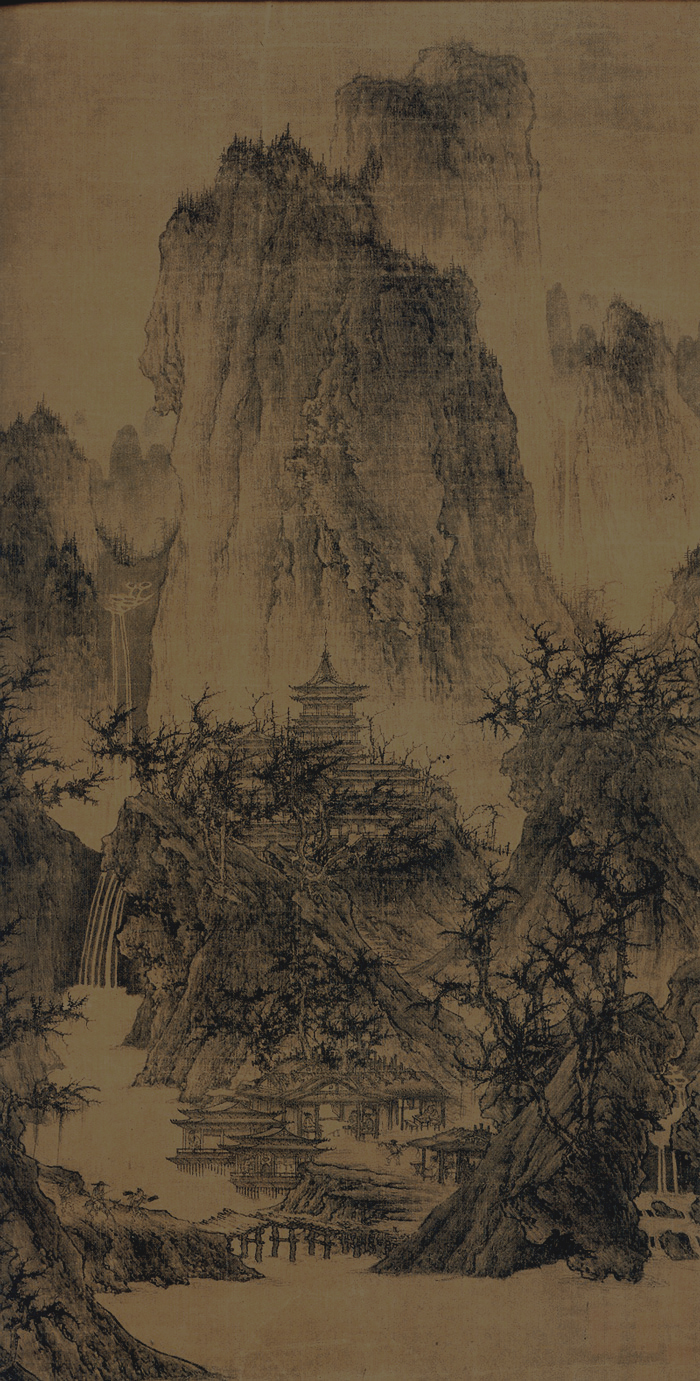
Li Cheng, A Solitary Temple Among Clearing Peaks, Song Dynasty

We have got rather behind in watching Civilisations on the iPlayer, so I have only just seen Simon Schama's episode concerning landscape, 'Picturing Paradise'.  I really enjoyed it and was full of admiration for the way he explained the significance and beauty of specific works of art in a such a short space of time. The programme actually begins in twentieth century China with Mu Xin, who painted his landscapes in secret during the Cultural Revolution.  His trajectory from enemy of the people to revered cultural figure culminated recently in the establishment of a Mu Xin museum in Wuzhen.  Schama then takes the story back to Song Dynasty China and Li Cheng, whose paintings I wrote about last year.  The way the camera pans in close over A Solitary Temple Among Clearing Peaks reveals far more detail (see below) than can be gleaned from the rather dark image of this painting (above) I've used here before. 


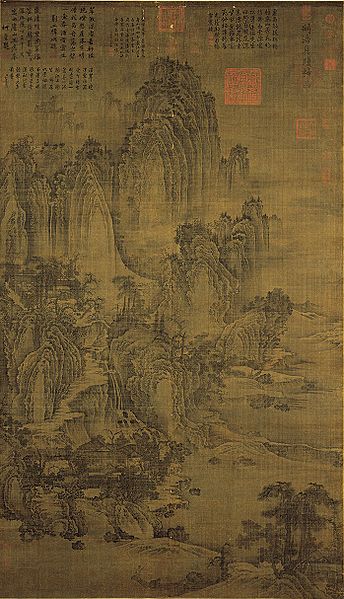
Having devoted a decent amount of time to Li Cheng, the programme moves on to Qiao Zhongchang's handscroll illustrating The Second Prose Poem on the Red Cliff.  I imagine Schama would love to have had time to give the full background on Shu Shi's poem, but he focuses on the mood conveyed in this painting, contrasting the pleasures of an excursion with the sadness of exile, "a dream, but one with a bitter-sweet taste".  This Chinese section concludes with Wang Meng's Dwelling in the Qingbiang Mountains, allowing Schama to introduce themes of political symbolism - the turbulence in Song Dynasty China echoed in the way Wang painted his landscape.  The idea that landscapes tell us much about the world in which they were painted is then taken up, after a brief mention of Islamic art and gardens, in his account of Western landscape art.  In all, a quarter of the whole programme is devoted to Chinese landscape painting - if only this could have been expanded into a whole series...

 Qiao Zhonchang, Illustration to the Second Prose Poem on the Red Cliff, Song Dynasty

By this point in the programme we had become conscious of Simon Schama's rather idiosyncratic pronunciation of certain words.  'Most of us', as Gerard O'Donovan wrote in his Telegraph review,
'put the stress on the first syllable (MOUNtain), but he places it on the second (mounTAIN). As in, say, maintain or plantain. Usually, such idiosyncrasy would go unremarked. But being devoted to landscape art, there were so many mounTAINs (and even a founTAIN) in last night’s enthralling third edition of Civilisations, you had to wonder whether he’d ever noticed it himself.'
A bit harsh, but then it is hard not to focus on the mannerisms of the presenters given that they are effectively being pitched against the magisterial, patrician authority of Sir Kenneth Clark (incidentally, there's a nice clip of Clark in the original Civilisation (1969) embedded in a post I did back in 2010 about Jean-Jacques Rousseau).  I was dismayed to read a few days ago an article headlined 'Mary Beard 'cut' from US version of Civilisations, fearing 'slightly creaky old lady isn't ideal for US TV'.  I agree with O'Donovan that Schama's enthusiasm is inspiring to watch and that, like him, I'm happy to listen to views delivered 'with the unshakeable confidence of a man who goes through life pronouncing mounTAIN like he’d invented the word himself.'

I will not attempt to summarise the rest of the programme, which focuses on some of the themes Schama has written about before - the German forest, mercantile Holland and the American wilderness.  Perhaps the fact that he has written things like Landscape and Memory explains why he has not contributed a series tie-in book, unlike the other two presenters.  As for the inevitable omissions in this programme, I'm guessing Turner, Constable, Monet and Van Gogh will come in somehow to a later episode, but suspect there might be no more on post-Song Dynasty Chinese landscape art.  To conclude here I will transcribe a quote from the programme which I hope conveys why I think Schama is so good.  Here he takes an apparently unprepossessing painting by the prolific Jan Van Goyen and leaves you thinking of it as a minor masterpiece.

Jan Van Goyen, Polder Landscape, 1644
"Even though we know that Van Goyen really had to work fast and with rubbish materials that didn't cost him very much money (he was so always in debt), there's a credible kind of convergence between what he's painting and how he's painting it.  It's like a sketch.  It's like an immediate note from his own vision.  And everything that's kind of rough and raw and crude and clay-like and meagre about it actually makes you feel there. There are tops of houses - roofs - and you don't see anything else of the house.  Why?  Because they're actually below the waterline.  This delivers a world - the silvery quality of the canals, a little boat floating past, and you think you're waking up and you can smell the peat turned over; it's a raw day in the middle of winter, and you're absolutely enveloped by the wind, the dark, lead coloured light.  But this still, in it's scraped-away authenticity, is a kind of home."

Saturday, October 21, 2017

Red Cliff

Unidentified artist in the style of Sheng Mou, 
Fan painting illustrating Su Shi's 'Second Ode on the Red Cliff', 
late 14th/early 15th century 
Source: The Met, public domain

Earlier this year I wrote about the Battle of Red Cliff, focusing on landscape in the poetry of Cao Cao, the warlord whose army was defeated there by the combined forces of Sun Quan and Liu Bei.  The battle's most famous literary retelling is in The Romance of the Three Kingdoms, one of the Four Great Classical Novels of China (I discussed one of the others, Dream of the Red Chamber, here five years ago).  There is no dwelling on natural scenery in The Romance of the Three Kingdoms - the focus is entirely on the action, one of hundreds of battles in this vast novel covering an extraordinarily turbulent historical period.  But The Romance of the Three Kingdoms is only one lens through which the conflict has been remembered, as you can see in A Thousand, Thousand Churning Waves - The Legendary Red Cliff Heritage, an online exhibition at the Taiwan National Palace Museum.  Here I want to focus on the influence of Su Shi's two Red Cliff Odes, written in 1082, three centuries before The Romance of the Three Kingdoms.  These two poems have themselves been the inspiration for artworks in many forms; I mentioned one - a stone seal - 1,002 posts ago, and have included some others here: a fan, a vase, a scroll, a plate and another stone seal.

 Square form vase decorated with Su Shi's Odes on the Red Cliff, c. 1662–1722
Source: The Met, public domain 

The two 'Odes' Su Shi wrote were in the wen fu form - fu were prose poems, and the wen fu was more prose than poem.  Burton Watson includes translations in his wonderful Selected Poems of Su Tung-p'o (Tung p'o means Eastern Slope and was the literary pseudonym Su assumed after building a residence on a Huangzhou hillside in 1081, thus incorporating a landscape feature into his actual name).  I will summarise the two poems here, with the knowledge that this can't really do them justice - they are very beautiful even in translation, so it does not seem surprising that they have been so admired in China over the last thousand years.  Just one thing to note though: the landscape that so moved Su Shi was not really the place where Cao Cao's forces were defeated in 208 CE (the precise location is still disputed).  As Burton Watson writes, 'because of its fame, many other spots on the Yangtze came to be called Red Cliff; the one where the poet and his friends are the spending the evening is not the actual site of the battle but considerably farther down the river.'

 Zhao Mengfu, The First Red Cliff Ode of Su Shi and His Portrait, 1301
Source: Wikimedia Commons 

The First Ode.
On an autumn night, Su Shi and some friends ventured out in a small boat to the foot of Red Cliff, drinking wine and admiring the moon.  'White dew settled over the river, and its shining surface reached to the sky.  Letting the boat go where it pleased, we drifted over the immeasurable fields of water.'  Inspired by the wine and the scenery Su composed a song while one of his friends played mournful notes on the flute.  They remembered the poem Cao Cao composed (see my earlier post) and his vast army on the river, 'yet where is he now?'  Su Shi suggested that they should take comfort in the changelessness of things - the river water never ceases to flow and the moon always rises.  Realising they had nothing left to eat, the friends lay down in the boat to sleep, 'unaware that the east was already growing light'.

Silver plate showing a scene from the First Ode, 13th century
Source: Minneapolis Institute of Art, public domain 

The Second Ode.
Later that autumn, with the trees bare and frost on the ground, Su Shi was joined at his home by two guests.  They decided to make another trip to Red Cliff but when they got there Su realised the landscape had changed.  'The river raced along noisily, its sheer banks rising a thousand feet.  The mountains were very high, the moon small.  The level of the water had fallen, leaving boulders sticking out.'  Su begun to climb the embankment, leaving his friends trailing behind.  At the summit he gave a shrill whoop and the trees and grass swayed.  A wind suddenly rose and he felt a chill of fear.  He returned to his friends and they got back into the boat, letting it drift on the water.  A single crane flew in from the east, swooping low over the boat.  That night, back at home, Su dreamed that a Daoist immortal in a feather robe came to him and asked whether he had enjoyed his outing to Red Cliff.  Su recognised him as the crane.  The immortal just turned and laughed and when Su woke up, he was gone.

Tianhuang Seal showing Su Shi beneath Red Cliff, first half of the 19th century
Source: The Brooklyn Museum, public domain 

Friday, September 15, 2017

This snow has never melted

Anon (once attributed to Guo Xi), Mount Emei under Heavy Snow, 17th century

Mount Omei, or Emei, in Sichuan province, is one of the Four Sacred Buddhist Mountains of China and has often featured in Chinese poetry.  Li Po spent the early part of his life (before 725) in Sichuan and wrote a 'Song of Mount Omei's Moon', that would later be quoted by Su Shi in one of his own poems.  Su Shi was actually born near the foot of the mountain, in 1037, but spent his life being moved from one post to another, getting further and further away until he eventually found himself living on the island of Hainan (he died, back on the mainland, four years later).  Fan Ch'eng-ta, one of the 'Four Masters of Southern Sung Poetry', specialising in the field-and-gardens genre, described Mount Emei in his Diary of a Boat Trip to Wu (1177).  The higher he got, the colder it was - intensely so at night.  Reaching Brilliant Cliff he looked down into the clouds and glimpsed halos of coloured light.  Further on he could see the mountain range that stretches West, until it eventually becomes the Himalayas:
'Lofty, rugged, carved, sliced; scores, perhaps a hundred peaks in all.  When the rising sun first illuminates them, the snow glistens like shiny silver, shimmering in the light of the dawn.  From antiquity to the present, this snow has never melted.  These mountains extend all the way to the land of India and to tributary kingdoms along the border for a distance of I don't know how many thousands of li.  It looks like it is spread out on a table before one.  This spectacular, unique, unsurpassable view was truly the crowning one of my entire life.' 

Last month I was surprised to encounter a fragment of Mt Emei, perched on the summit of a mountain in Switzerland.  This 8 ton lump of basalt, the Emei Stone, was installed on the top of Mt. Rigi in 2015, a year after a Rigi Stone was 'inagurated' on Mt Emei.  They are meant to 'symbolise the cultural and touristic collaboration' between the two mountains.  An explanatory board refers to these landscapes like global corporations, with the exchange symbolising 'the valuable and long-standing partnership between RIGI and EMEI.'  I had not been to Switzerland for a while and was surprised by the number of Chinese tour groups.  There are visitors too from other parts of Asia.  At the bottom of Mount Titlis, a high, snow-capped peak near Rigi, you encounter the inviting smell of Indian street food on sale at the Spice Bistro.  And at its summit, you can take a selfie with cardboard cutout stars of the famous Bollywood film Dilwale Dulhania Le Jayenge (1995), which was set in Switzerland (though not actually on Titlis).  The appeal of the Alps for Bollywood directors is discussed in an article for The Smithsonian and the Indian fascination with Switzerland is explored in an interestingby


Mount Rigi became a major tourist destination in the nineteenth century, in part because it is easy to get to from Lucerne.  A Telegraph article on this phenomenon made the connection with Turner's Blue Rigi, a centrepiece of the Tate's 2014 Late Turner show (looking back I see I wrote at the time about Turner's Italian landscapes rather than the exhibition's views of the Alps).  Rigi developed a special appeal, and
'so great was this charisma, that within a couple of decades of Turner’s visit, a stay in Lucerne and an ascent of The Rigi were among the most desirable experiences for any traveller to Continental Europe. In 1857 the first grand hotel opened at the summit, and by 1860 there were 1,000 horses and numerous guides and sedan chairs stationed at the foot of the mountain in Weggis. The highlight of Thomas Cook’s first group tour to Switzerland, in 1863, was an ascent of The Rigi to watch the sunrise, and in 1868 Queen Victoria herself came here, to be carried up to the hotel in a chair, and woken before dawn for the same view.

J.M.W. Turner, The Blue Rigi, Sunrise, c. 1841-42
Source: Wikimedia Commons

Mount Emei has a much longer tradition of tourism than Mount Rigi, centred on its temples and the 'silver world' - a sea of clouds - visible from its summit.  In the Qing Dynasty, the poet Tan Zhongyue named ten scenic attractions, including 'Blue Sky After Snowfall on the Great Plateau', 'Crystal Waters and Autumn Winds', and 'Felicitous Light on the Golden Summit'.  Today, the UNESCO World Heritage site acknowledges the threat posed by visitor numbers ('there are numerous drink stands and souvenir stalls which detract from the natural atmosphere of the mountain'), but also notes that 'as a sacred place, Mount Emei has benefited from a long-standing and traditional regime of conservation and restoration.'


A thousand years ago, back in the Song Synasty, Fan Ch'eng-ta's does not mention encountering any other sight-seers.  Perhaps he had the view to himself.  Turner never tried making the ascent of Rigi, possibly put off by the prospect of tourists.  In J. M. W. Turner: A Wonderful Range of Mind, John Gage suggests that 'it may be that he felt the Rigi was already too popular a vantage point, and he did not want to share his experiences with the two or three hundred other tourists who were said to congregate daily on the summit for the dawn.'  Gage quotes an earlier traveller, Henry Matthews, who did make the ascent and what he saw is reminiscent of Fan Ch'eng-ta's vision of dawn on Mt. Emei.  Matthews found it a 'magnificent spectacle' and concluded that experiencing a sunrise on Rigi 'forms an epoch in one's life, which can never be forgotten.'

J.M.W. Turner, The Red Rigi, 1842
Source: Wikimedia Commons

Saturday, December 19, 2015

Jagg'd mountain peaks and skies ice-green

Pieter Bruegel the Elder, Hunters in the Snow (Winter), 1565

According to Robert D. Denham's, Poets on Paintings: A Bibliography (2010), Brueghel’s Landscape with the Fall of Icarus has been the subject of at least sixty-three poems.  In addition to the well-known ones by W. H. Auden and William Carlos Williams, there have been others by, for example, Dannie Abse, Gottfried Benn, Allen Curnow, Michael Hamburger and Philip Whalen.  However, it is clear from this bibliography that Bruegel's Hunters in the Snow has also drawn an interesting range of writers: Williams again, John Berryman, Anne Stevenson, Walter De La Mare (and they keep coming: the new edition of Granta has one by Andrew Motion).  Berryman considers the hunters frozen at a moment in history and Stevenson imagines their moment of arrival as they 'pull / off their caked boots, curse the weather / slump down over stoups. . .'  Williams describes Bruegel's artistry, beginning matter-of-factly - 'The over-all picture is winter / icy mountains / in the background...' - and ending by noting the way he chose 'a winter-struck bush for his / foreground to / complete the picture.'  Walter De La Mare begins in ekphrasis, starting like Williams with the distant landscape: 'Jagg'd mountain peaks and skies ice-green / Wall in the wild, cold scene below'.  His poem ends on a mysterious note:
But flame, nor ice, nor piercing rock,
Nor silence, as of a frozen sea,
Nor that slant inward infinite line
Of signboard, bird, and hill, and tree,
Give more than subtle hint of him
Who squandered here life's mystery.


William Carlos Williams' Bruegel poems appeared posthumously in Pictures from Brueghel and other poems (1962).  Denham's bibliography lists other examples of poets who have written extended sequences or whole volumes devoted to painting.  Perhaps the most prominent of these is, R. S. Thomas, whose ‘Impressions’ in Between Here and Now (1981) include landscapes by Monet, Pissaro and Gauguin.  One of them is devoted to Cézanne’s The Bridge at Maincy which was featured in one of my earlier posts here.  There have also been whole books devoted to single artists, such as Turner and Monet.  Robert Fagles, best known for his translations of Homer, published one of these in 1978: I, Vincent: Poems from the Pictures of Van Gogh.


Denham has compiled a long list of individual poems but my impression on leafing through it is that relatively few of them have been about independent, unpeopled landscape paintings.  It is though unsurprising to find that writers have been more attracted to paintings suggesting drama, complexity or ambiguity - in the last century artists like Edward Hopper and Marc Chagall were common subjects.  Even in paintings where landscape dominates the composition, people exert a fascination (Czeslaw Milosz, reflecting on a painting by Salvator Rosa, writes of 'figures on the other shore tiny, and in their activities mysterious.')  Simple unadorned description of a what a painting shows is rare, although William Carlos Williams, advocate of 'no ideas but in things', does this in 'Classic Scene', recreating in words Charles Sheeler's 1931 view of the new Ford plant near Detroit.

Although Denham explicitly excludes from the book examples of reverse ekphrasis (paintings inspired by poems), the variety of poems listed invite speculation on ways of combining writing, painting and landscape.  It occurs to me that you could use a kind of algebra (which would need to allow for poets painting and painters writing poems): if, say, the combination of a poet, P, writing, w, about landscape, L, gives rise to a landscape poem, P.w(L), and, similarly, a landscape painting arises from an artist creating a landscape, A.c(L), then a poet writing about a landscape painting is P.w(A.c(L)).  Reverse ekphrasis involving a landscape poem would then be A.c(P.w(L)).  Here's an example of something more complicated.  John Hollander (whose visual poetry I have mentioned here before) wrote a poem about another Charles Sheeler painting, The Artist Looks at Nature (1943).  Sheeler's painting is a kind of landscape - there are grassy slopes and the walls of battlements - but it also contains an artist working on a canvas.  And though apparently painting from nature, his canvas depicts the interior of a studio.  Thus Hollander's poem could be represented as P.w(A.c(L+A.c(L'))).

Being thirsty,
I filled a cup with water,
And, behold!—Fuji-yama lay upon the water,
Like a dropped leaf!

This is Amy Lowell's imagist poem inspired by Hokusai's 'Hundred Views of Mt Fuji'.  Denham's book doesn't really get into the subject of Japanese or Chinese poetry about landscape painting, although he does mention Su Shi's ‘Two Poems on Guo Xi’s Autumn Mountains in Level Distance'. In Chinese art where the 'three perfections' (poetry, calligraphy, painting) are combined in one object, we are often not sure what came first: the poem or the painting.  Where artist and writer are one and the same, my algebraic distinctions would be meaningless. I will end here with part of another poem inspired by a Hokusai, 'Lightning Storm on Fuji' by Howard Nemerov.

Katsushika Hokusai, Rainstorm Beneath the Summit, c. 1830
                        ... the serene mountain rises
And falls in a clear cadence.  The snowy peak,
Where the brown foliage falls away, is white
As the sky behind it, so that line alone
Seems to be left, and the hard rock become
Limpid as water, the form engraved on glass.
There at the left, hanging in empty heaven,
A cartouche with written characters proclaims
Even to such as do not know the script
That this is art, not nature. ...

Saturday, October 24, 2015

Stone Bell Mountain

A short way downriver from Jiujiang, where the the Yangtze meets Boyang Lake, there is a famous sonorous landscape called Stone Bell Mountain (Shizhong Shan).  According to the Song dynasty poet Su Shih, 'Li Po of the T'ang was the first to travel to the site, and he found a pair of rocks protruding from the lake. "I struck them and listened," he wrote. "The one to the south sounded deep and turbid, the one to the north had a high, clear pitch. After they were struck, the sounds continued to reverberate as the vibrations slowly faded." He thought that he had thus solved the matter. But I still had my doubts about this theory.'  Su found himself in the area in July 1084 and went to investigate.  Testing Li Po's explanation he found that the rocks in the lake merely gave off a dull thud.  Later that evening, he and his son took a boat out under the cliff and heard the piercing cries of falcons, followed by the cry of an old man, or was it a crane?
'I had just begun to feel uneasy and wanted to return when loud sounds were emitted on the surface of the water, booming "tseng-hung " like continuous bells or drums. The boatman was frightened. We slowly approached to investigate and found that at the foot of the mountain were grottoes and fissures in the rock. I could not tell how deep they were, but it was the small waves which entered, surged around, and crashed against each other that were causing this sound.
'As the boat returned, it passed between two mountains and was about to enter the harbor. There was a huge rock standing in the middle of the current, which could accommodate a hundred people seated. It was hollow inside, and it also had many holes in it. It swallowed and spit out the wind and water, giving off ringing sounds—"k'uan-k'an t'ang-t'a "—as the water struck it. It seemed to reply to the booming sound we had previously heard, just like a musical performance.'
Su Shi felt he had solved the mystery of the Stone Bells, but his account stimulated further enquiries, as Richard Strassberg writes in Inscribed Landscapes, from which this translation is taken.  'Among those visiting the place during the Ming and Ch'ing periods were Ch'iu Chün (1420–1495) and Lo Hung-hsien (1504–1564), who argued that the name was based on the mountain's shape, and P'eng Yü-lin (1816–1890), who discovered an underwater grotto and asserted that the mountain was hollow like a bell.'  Are people still seeking to understand the mysteries of this landscape?  I can't find anything much about Stone Bell Mountain online beyond a few tourism sites - we need a sound artist like Wang Changcun, Yan Jun, or Chris Watson to go there and investigate in the spirit of Su Shi.

Friday, January 09, 2015

Hunger Mountain


In the clip I've embedded above, David Hinton introduces his book Hunger Mountain (2012)The eponymous peak is in Vermont, where Hinton lives and works on the translations of Chinese poetry often referred to here (see for example this post from 2006: 'Lit dew shimmers').  Hunger Mountain uses walks on the mountain to frame a discussion of the 'spiritual ecology' he has found in the old poets and philosophers. It begins with the notion of 'sincerity', expressed as a character that combines a person standing and words rising from a mouth.  Although he doesn't mention it, this Confucian term is also the first Chinese character in The Cantos, where Ezra Pound applies it in praise of the sixth US president John Quincy Adams.  Hinton uses it to discuss 'a more fundamental sense of sincerity as an identification of outside and inside', a deep feeling of belonging to the cosmos.  This is evident, for example, in Tu Fu's poem 'Moonrise' (a different poem to 'Full Moon', which I quoted here in an earlier post on moonlit landscapes). 'Moonrise' doesn't simply project an emotion into the landscape, it describes a fundamental identity between the poet and the world. By the time Tu Fu wrote his poem, the character for 'friend' was being written as it still is as two moons side by side (below).  Hinton sees a form of 'friendship' in the way Tu Fu, his modern reader and the wider cosmos are united through contemplation of the moon.


The idea that consciousness is like a lake or mirrored pool is common in Chinese literature.  One of the four masters of southern Sung poetry, Yang Wan-li, wrote of the lake's 'mind': a gaze 'holding the mountain utterly.'   The character for mind is derived from the image for a heart, suggesting that thinking and feeling are deeply connected.  'Thinking' is written as this symbol for heart-mind underneath the character for 'fieldland'.  'Feeling' is a stylized version of the heart-mind symbol written next to the character for the blue-green of landscape.  In light of this it seems unsurprising that poets expressed themselves by writing directly about nature.  Hunger Mountain is quite dense in places with speculations on the connection between language and natural processes, something that has fascinated poets since Ezra Pound published Ernest Fenollosa's The Chinese Written Character as a Medium for Poetry in 1918.  It is a subject I have written about here before in connection with Cecilia Lindqvist's wonderful book China: Empire of Living Symbols.  The extent to which these ideas are widely accepted is something I am not qualified to judge, but they are certainly inspiring to read about.

It remains possible that even poetry drawn directly from the the rivers and mountains will be a kind of barrier.  Hinton talks about the risk that ultimately 'we can say nothing about the world without creating in some sense a breach between consciousness and landscape'.  In one of his many wine poems the poet T'ao Ch'ien, discussed in an earlier post here, wrote that whenever he started trying to explain Lu Mountain, 'I forget words altogether'.  Lu Mountain is the range of peaks that have been central to Chinese landscape poetry (the subject of another post here). Throughout the book Hunger Mountain stands in for Lu and Hinton tries to learn, like the poets, from his frequent walks to the summit. Su Tung p'o, who came to Lu seven centuries after T'ao Ch'ien, stayed at the East Forest Monastery, but said he learnt more from the mountain's streams and mirrored pools.
'Su Tung p'o established himself as a master of Tao's mental dimensions when he described flowing waters as the form of mind negotiating the exigencies of life, a spontaneous and crystalline responsiveness working its way through, taking shape according to whatever it encounters.  This is mind moving through the occasions of its attention like water through stones and branches and colourful leaves, adapting itself to the forms it encounters, becoming sometimes loud and othertimes silent, sometimes seething with light and other times lost in shadow.'
Attributed to Jing Hao, Mount Lu, c.900

Sunday, August 01, 2010

Lu Mountain's true face

Mount Lu

Lu Mountain (Lu-shan or Hermitage Mountain), at the juncture of the Long River and Lake P'o-yang in China, must be a contender for the most inspirational landscape in literature.  It became established as an important religious centre with the arrival of Hui-yung (332-414), for whom the West-Forest Monastery was rebuilt in 377, and Hui Yüan (334-416) who taught Pure Land Buddhism at the East-Forest Monastery.  The poet T'ao Yüan-ming (365-427), founder of the fields-and-gardens tradition (see my earlier post here) knew Hui Yüan and lived on a farm near the mountain.  Hsieh Ling-yün (385-433), whose mountains-and-rivers poetry I discussed here earlier, was influenced by the teachings of Hui Yüan and wrote about Lu-shan, with its 'jumbled canyons', 'thronging peaks' and 'dragon pools.'

Three hundred years later the T’ang Dynasty poet Meng Hao-jan (689-740) had his own mountain home further west in Hsiang-yang and made Deer-Gate Mountain there famous through his poetry.  But on one of the many journeys he made as an official he wrote about Incense Burner Peak, the most spectacular in the Lu Mountain range, and the distant sound of the bell from East-Forest monastery.  Li Po (701-62) stayed at the monastery and wrote of the silence and emptiness that could be found there away from the city. Climbing towards Incense-Burner Peak, he gazed at the waterfall, three thousand feet high, and wrote a celebrated poem which I have discussed here previously.

Po Chü-i (772-848) composed poems about the mountain and a famous prose account of the thatch hut he built in 817 facing Incense-Burner’s north slope. From this place he could experience 'the blossoms of Brocade Valley' in spring, 'in summer the clouds of Stone Gate Ravine, in autumn the moon over Tiger Creek, in winter the snows on Incense Burner Peak' (trans. Burton Watson). I particularly like his description of the way water was channeled around the hut, with a small waterfall that in twilight and dawn had 'the color of white silk' and at night made 'a sound like jade pendants or a lute or harp'  A bamboo trough led water from a spring in the cliff, across the hall into channels that fell from the eaves to wet the paving, giving 'a steady stream of strung pearls, a gentle mist like rain or dew, dripping down and soaking things or blowing far off in the wind.'

By the Sung Dynasty, the mountain was almost overburdened with poetic tradition.  In An Anthology of Chinese Literature Stephen Owen writes that Su Tung p’o (Su Shi, 1037-1101) resolved to visit the mountain as 'an "innocent traveler", wanting to experience the mountains without writing poems (as a modern tourist might resolve to travel without taking photographs).'  But he was unable to restrain himself and ended up composing several, writing his own reputation into the landscape with perhaps the best known of all the mountain's poems, a quatrain 'Inscribed on the Wall of West Forest Monastery', stating the impossibility of ever knowing Lu Mountain's true face.

Friday, September 04, 2009

Sadness of the Gorges

Triple Gorge one thread of heaven over
ten thousand cascading thongs of water,

slivers of sun and moon sheering away
above, and wild swells walled-in below,

splintered spirits glisten, a few glints
frozen how many hundred years in dark

gorges midday light never finds, gorges
hungry froth fills with peril. Rotting

coffins locked into tree roots, isolate
bones twist and sway, dangling free,

and grieving frost roosts in branches,
keeping lament's dark, distant harmony

fresh. Exile, tattered heart all scattered
away, you'll simmer in seething flame

here, your life like fine-spun thread,
its road a trace of string traveled away.

Offer tears to mourn the water-ghosts,
and water-ghosts take them, glimmering.

These are some lines from David Hinton's translation of Meng Chiao's Laments of the Gorges.  It is a frightening vision of nature, a world away from the contemplative landscapes found in other Tang dynasty poems.  This poem (the third of Meng's ten laments) appears on David Hinton's website - I like his description of the poet there: "Late in life, Meng Chiao (751-814 C.E.) developed an experimental poetry of virtuosic beauty, a poetry that anticipated landmark developments in the modern Western tradition by a millennium. With the T'ang Dynasty crumbling, Meng's later work employed surrealist and symbolist techniques as it turned to a deep introspection. This is truly major work, work that may be the most radical in the Chinese tradition."


There is another translation of this poem by Matthew Flannery, under the title 'Sadness in the Gorges' ('...Hungry maw foamed with danger its naked curling roots encoffin jumbled bones that hang and swing while monkeys whine from icy trees faint unhappy elegies...')  However, I think my favourite translation remains the first one that I read, A. C. Graham's in Poems of the Late T'ang (1965).  Graham's punctuation is clearer than Hinton's, which I makes it seem less avant garde, but allows some memorable phrases to stand out - 'The shock of a gleam, and then another, / In depths of shadow frozen for centuries.'

The Indiana Companion to Traditional Chinese Poetry describes Meng's poem as an encounter with cosmic malice embodied in the landscape.  David Hinton writes that Laments of the Gorges articulates 'nonbeing as a murderous furnace at the heart of change.' A. C. Graham remarks upon the violence of the imagery, e.g. 'the spray on rocks compared with the spittle of the hungry ghosts of the drowned'.  Meng Chiao acknowledged the bleakness of his style, especially in comparison to that of his friend Han Yü.  He wrote: 'The bones of poetry jut in Meng Chao, / The waves of poetry surge in Han Yü.'  The great Song dynasty poet Su Shih described Meng Chao's verse as a 'cold cicada's call'.

The title of Meng's poem has an added poignancy today.  His imagery reflected the dangers of the upper Yangtze river, but the inexorable progress of the Three Gorges Dam has gradually been flooding these gorges.

Monday, March 16, 2009

The West Lake of Hangzhou

An article in February's Landscape Architecture by Carl Steinitz is entitled ‘Landscape Planning A History of Influential Ideas’. Reading it reminded me a bit of those Medieval chronicles which start with a brief history of the world before proceeding seamlessly to a detailed account of much more recent events. His list begins in Song Dynasty China, races forward past the Medicis' villas and English landscape gardens before slowing down in the late nineteenth century and then dwelling on a range of American landscape architects and related figures. These include Eisenhower, who makes the list for coming up with interstate highways, and Lady Bird Johnson (more positively) for adding aesthetic considerations to the US National Environmental Protection Act’s criteria.

The first in his list of great ideas is the West Lake of Hangzhou: ‘important because it is the result of a decision made in the eighth century to build a very large lake - a deliberate act to create a new landscape on a large scale. This landscape was made primarily for reasons of defense, water supply, aquaculture, and agriculture. In the Song Dynasty it was rebuilt under the direction of the poet and governor of Hangzhou, Su Shi (1037-1101). Over time, it has become considered 'natural', a place of great scenic beauty and cultural importance. Emperor Qianlong's Ten Scenes of the West Lake, poems composed in the 18th century, is learned by all Chinese schoolchildren today. Too many people believe landscape planning is only conservation and reaction, but the West Lake shows that landscape planning includes action with foresight. The big idea embodied by the West Lake is that a landscape built for practical reasons can be designed and transformed over time into a highly valued cultural landscape, and even one that is primarily assumed to have been the result of natural processes.'


Source: shenxy

This account misses out Su Shi's predecessor as governor of Hangzhou, Bai Juyi (who I still think of in Wade-Giles terms as Po Chü-i). Bai Juyi was prefect of Hangzhou in 822-24 and rebuilt the dyke that previous governors had neglected. He ordered 'the construction of a causeway connecting the Broken Bridge with the Solitary Hill, to facilitate walking on foot, instead of depending on boat. Then he planted coolabah trees and willows trees along the dyke, making it a beautiful landmark'. The causeway is now known as Bai Causeway (another one, the Su Causeway, was built later by Su Shi). One of Bai Juyi's poems about the West Lake (called in earlier times Qiantang) can be found here: 'The water's surface now is calm, the bottom of the clouds low. / In several places, the first orioles are fighting in warm trees, / By every house new swallows peck at spring mud.'

Here is the list of Emperor Qianlong's Ten Scenes:

Dawn on the Su Causeway in Spring
Curved Yard and Lotus Pool in Summer
Moon over the Peaceful Lake in Autumn
Remnant Snow on the Bridge in Winter
Leifeng Pagoda in the Sunset
Two Peaks Piercing the Clouds
Orioles Singing in the Willows
Fish Viewing at the Flower Pond
Three Ponds Mirroring the Moon
Evening Bell Ringing at the Nanping Hill