Showing posts with label Meng Hao-jan. Show all posts

Sunday, September 11, 2011

One streak of dying light


Landscapes, finished in 1949 and premiered by the San Francisco Symphony in 1953, is the earliest work for orchestra by Chinese-American composer Chou Wen-chung.  It uses three traditional Chinese melodies to create three different 'landscapes': 'Under the Cliff in the Bay,' 'The Sorrow of Parting,' and 'One Streak of Dying Light.'  The titles come from poems by Cheng Hsieh (1693-1765), Ting P’eng (c. 1661) and Liu Chi (1311-75).  You can read the full poems and see the score on the composer's excellent website.  The third one, for example, reads: 'Green, green the grass west of the pavilion,/ The clouds low, the cries of the wild geese faint,/ Two lines of sparse willows, /One streak of dying light, /Hundreds of homing ravens dotting the sky.'

In the years following Landscapes Chou worked as student and assistant to Edgard Varèse (the manuscript for Déserts was written out by him).  He also continued to compose his own landscape-inspired music; in 1956 for example came And the Fallen Petals, based on a poem by Meng Hao-jan (689-740).  He says 'in this work I have tried to convey through sound the emotional qualities of Chinese landscape painting and to achieve this end with the same economy of means ...  In this as well as in my other works to date, I am influenced by the philosophy that governs every Chinese artist, whether he be poet or painter; namely, affinity to nature in conception, allusiveness in expression, and terseness in realization.'  The music is in three sections: 'Part 1: Against a quiet and mysterious landscape, budding blossoms dance the praise of life in the Spring wind', 'Part 2: A storm breaks and the furious wind drives the dazed petals far and wide,' 'Part 3: Against a quiet and mysterious landscape, the fallen petals are being swept away and fresh blossoms on the branches dance in the Spring wind.'

Chou's long career continues and his most recent piece is from 2009, Ode to Eternal Pine, dedicated to Elliott Carter (who is still going strong in his second century).  He says of this that 'in East Asian cultures, the pine, often seen on mountain peaks, is a symbol of longevity and the eternity of nature. “Meditating on Eternity” is a reflection on the fundamental esthetic principle of East Asia, as expressed in the Chinese terms tian di ren, heaven, earth and humanity. It suggests human emotion within the timelessness of the universe and the physical constraints on earth, the two axes symbolized by the subsequent movements, “Lofty Peaks” and “Profound Gorges.”'  I was reminded of these two axes while reading an interesting interview with Chou, where he says that back in 1977 he had been responsible for selecting a traditional Chinese zither piece called 'Flowing water' for inclusion on the Voyager golden records - music that has now left behind the physical constraints of earth on its journey out into the universe.

Sunday, August 01, 2010

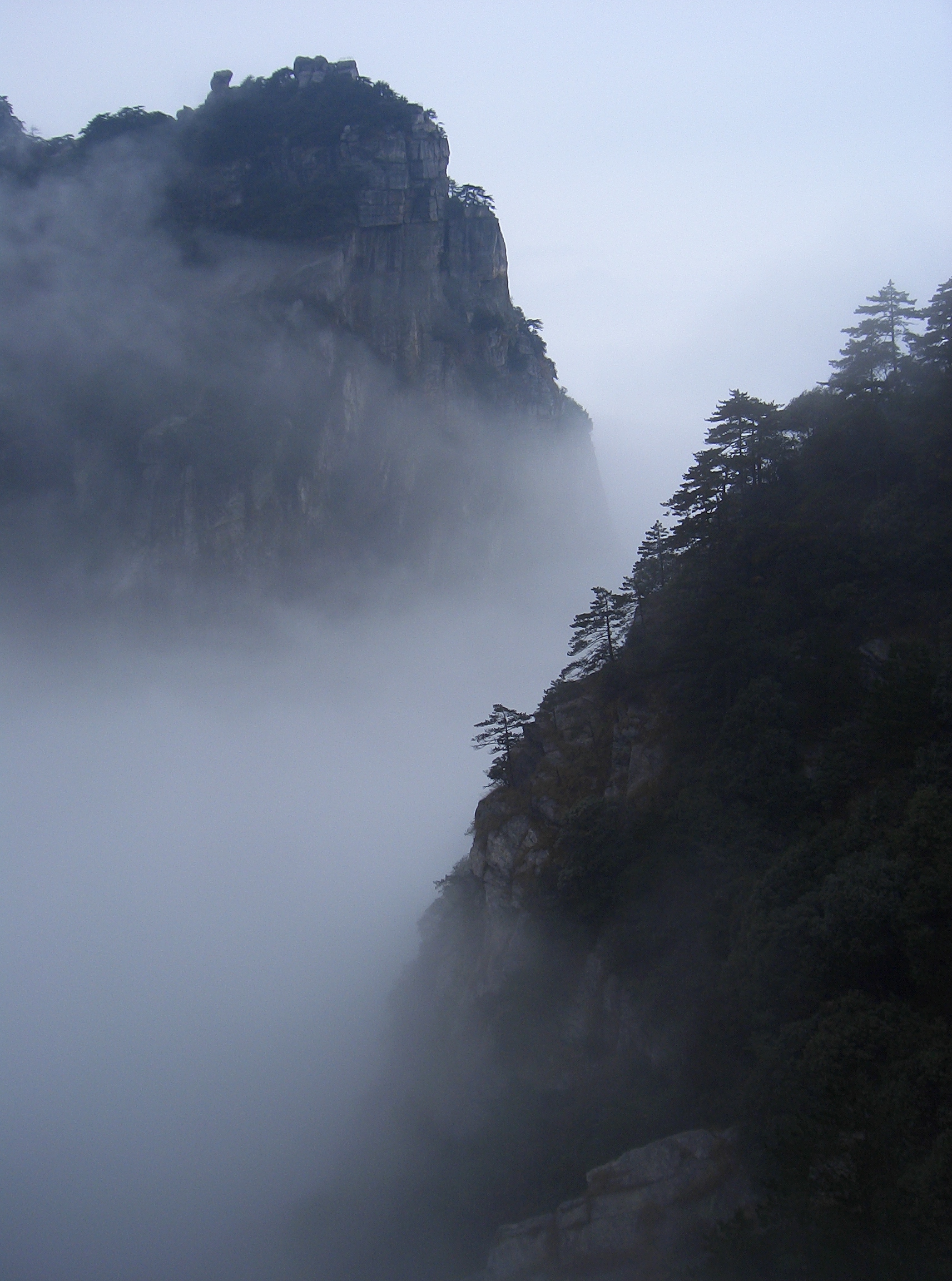
Lu Mountain's true face

Mount Lu

Lu Mountain (Lu-shan or Hermitage Mountain), at the juncture of the Long River and Lake P'o-yang in China, must be a contender for the most inspirational landscape in literature.  It became established as an important religious centre with the arrival of Hui-yung (332-414), for whom the West-Forest Monastery was rebuilt in 377, and Hui Yüan (334-416) who taught Pure Land Buddhism at the East-Forest Monastery.  The poet T'ao Yüan-ming (365-427), founder of the fields-and-gardens tradition (see my earlier post here) knew Hui Yüan and lived on a farm near the mountain.  Hsieh Ling-yün (385-433), whose mountains-and-rivers poetry I discussed here earlier, was influenced by the teachings of Hui Yüan and wrote about Lu-shan, with its 'jumbled canyons', 'thronging peaks' and 'dragon pools.'

Three hundred years later the T’ang Dynasty poet Meng Hao-jan (689-740) had his own mountain home further west in Hsiang-yang and made Deer-Gate Mountain there famous through his poetry.  But on one of the many journeys he made as an official he wrote about Incense Burner Peak, the most spectacular in the Lu Mountain range, and the distant sound of the bell from East-Forest monastery.  Li Po (701-62) stayed at the monastery and wrote of the silence and emptiness that could be found there away from the city. Climbing towards Incense-Burner Peak, he gazed at the waterfall, three thousand feet high, and wrote a celebrated poem which I have discussed here previously.

Po Chü-i (772-848) composed poems about the mountain and a famous prose account of the thatch hut he built in 817 facing Incense-Burner’s north slope. From this place he could experience 'the blossoms of Brocade Valley' in spring, 'in summer the clouds of Stone Gate Ravine, in autumn the moon over Tiger Creek, in winter the snows on Incense Burner Peak' (trans. Burton Watson). I particularly like his description of the way water was channeled around the hut, with a small waterfall that in twilight and dawn had 'the color of white silk' and at night made 'a sound like jade pendants or a lute or harp'  A bamboo trough led water from a spring in the cliff, across the hall into channels that fell from the eaves to wet the paving, giving 'a steady stream of strung pearls, a gentle mist like rain or dew, dripping down and soaking things or blowing far off in the wind.'

By the Sung Dynasty, the mountain was almost overburdened with poetic tradition.  In An Anthology of Chinese Literature Stephen Owen writes that Su Tung p’o (Su Shi, 1037-1101) resolved to visit the mountain as 'an "innocent traveler", wanting to experience the mountains without writing poems (as a modern tourist might resolve to travel without taking photographs).'  But he was unable to restrain himself and ended up composing several, writing his own reputation into the landscape with perhaps the best known of all the mountain's poems, a quatrain 'Inscribed on the Wall of West Forest Monastery', stating the impossibility of ever knowing Lu Mountain's true face.

Sunday, April 30, 2006

Lit dew shimmers


Poet and Chinese scholar David Hinton has specialised in translations from the Chinese rivers-and-mountains tradition. He has been well served by publishers – the books are beautifully produced, as can be seen on the David Hinton website. As I write this I am looking at the Archipelago Books edition of The Mountain Poems of Meng Hao-jan, printed on “60lb Mohawk Vellum” paper, with its imagistic poems spaced elegantly on each page.

The Mountain Poems of Meng Hao-jan is the first English book devoted completely to the High T’ang poet Meng Hao-jan (689-740). The introduction quotes poems by Li Po and Wang Wei to give a sense of how these better known poets revered Meng, and a later poem by Po Chü-i in which ‘Meng himself disappears into landscape while his poems survive as landscape’. Rather than become a bureaucrat or monk, Meng lived a simple life in the mountains of Hsiang-yang. His surviving body of work is not large; ‘it is said that Meng’s practice was to destroy poems after writing them because they inevitably failed to render experience at that absolute level that lies beyond words.’

There are a few sample poems on Hinton’s site which demonstrate the way Meng rendered experience: “My thatch hut grows still. At the bottom stair, in bunchgrass, lit dew shimmers.” In one of these poems, Meng climbs Long-View Mountain to survey the landscape, clouded in mists and blossoms. In another, Meng writes from his ‘bamboo-leaf gardens’ to Ch'ao, the ‘Palace Reviser’ – while Ch’ao toils in the library, Meng lives close to nature, where words start to be forgotten.