Showing posts with label Ian Hamilton Finlay. Show all posts

Friday, August 08, 2025

Lochan Eck


Alec Finlay has two new books out - here I am holding one of them, ready for borrowing at the National Poetry Library in London. Not Sealions but Lions by the Sea features condensed landscapes in the form of ‘place-name poems’, one of which uses a phrase I gave as a title to my book on cliffs: 'the first light greets / the frozen air' (Abergeldie - Brightmouth). These originally appeared in gathering: a place-aware guide to the Cairngorms - there is more information on the Hauser & Wirth website. I was interested to read some of the autobiographical poems in Sealions, including one about Sweeney's Bothy, an artist retreat on the Isle of Eigg which I described here in 2014. There is also a group of poems about Stonypath, the garden designed and maintained by Alec's parents Sue and Ian Hamilton Finlay. Here is one in which he remembers the lochan named in his honour.

LOCHAN ECK 
I miss the skimming
swallows
over the dark lochan 
the waters where I swam
eye-to-eye 
with the blue dragonfly


Alec's other recent collection The Walkative Revolution, published by the Guillemot Press, is a book that takes on ableist attitudes to walking. It is a welcome change from reading about the arduous treks of certain nature writers, which can make even those of us without disabilities feel like we are missing out (see also my comments on the miles clocked up by Richard Long...)  ME and long Covid have reduced Alec's ability to walk, but 'as a ‘not-walker’, the joys of toddling into the fringe of a wood, or along a short beach, are heartfelt and healing. Like so much writing, these texts attempt to heal the experience of exile.' There are poems about paths and proxy walks, a manifesto for minor walks and designs for walking sticks (including a fork-shaped one for Sweeney with the words TIME and TINE). One of the poems concludes 'a chapter of autobiography: Landscapes I Have Sat In' - which reminded me of the Tate's current Edward Burra exhibition, for reasons I'll explain in my next blog post. The book ends with a poem to celebrate the inaugural Day of Access (June 15, 2019), when four disabled people were driven up to an altitude of 720m. 

The Walkative Revolution also describes a new form of 'disability poetics' that Alec has devised: the conspectus. This is explained on the Day of Access blog

'Conspectus arose from a frustration that my disability, ME, prevented me walking over and through hilly landscapes. I loved to be in wild places, but my experience of them was bittersweet. ... I found myself, sat on a hillock, an OS map in my hand, knowing I couldn't walk any further, trying to find a new way to belong in the landscape. I began to identify the various summits that surrounded me, picking them out by name. Although I was experiencing distance, altitude, and inaccessibility, from a static viewpoint, I could feel an imaginative connection to the landscape.'

Thus arose a form of 'visual poem / composed from the names of hills / defining the view from a single location ... the conspectus is a place to gaze at the landscape; / a viewpoint where the terrain opens itself to the viewer; / where the eye threads in and out of the circle of hills; /where place-names suggest an ecological narrative.'

Sunday, May 07, 2023

Atlantic Flowers


Last year I bought the latest New Arcadian Journal, Atlantic Flowers: The Naval Memorials of Little Sparta. 'The upland garden of Little Sparta is evocative of distant seas. Atlantic Flowers offers fresh insights into the poetic gardening of Ian Hamilton Finlay (1925-2006) by acknowledging that the warship sculptures are simultaneously naval memorials.' This makes it sound like quite a specialised study but the pleasure of reading the journal (essentially a beautifully illustrated book), is that it conveys a lifetime's engagement with the garden as a whole and Patrick Eyres' long friendship with Finlay. An appendix provides a bibliography of ten previous NAJs and eleven New Arcadian Broadsheets devoted to Little Sparta and IHF. Photographs show how garden features have evolved over time, since Patrick's first visit in 1979. Paintings, drawings and artworks are reproduced on almost every page, based on the work of Finlay and NAJ collaborators and friends like Chris Broughton, Catherine Aldred and former-Mekon Kevin Lycett.

The last artwork discussed in Atlantic Flowers was installed in 2001, not long before Finlay's death: Camouflaged Flowers. This was conceived as a monument to the men of the wartime Flower Class corvettes, ships that had been given incongruously pastoral names like Begonia, Larkspur and Heartsease. Some of them were transferred to the US Navy during the war and renamed; in 'Ovidian Flowers' Finlay highlighted these metamorphoses: Begonia became Impulse, Larkspur Fury and Heartsease Courage. Nicholas Monsarrat wrote about life on board a corvette in The Cruel Sea. In his memoir he described these boats as 'cramped, wet, noisy, crowded, and starkly uncomfortable.' They may have had lovely floral names but they were all the same: 'wallowing cages for eighty-eight men condemned to a world of shock, fatigue, crude violence and grinding anxiety' (It Was Cruel, 1970). Finlay's Camouflaged Flowers was the culmination of his interest in the Flower Class corvettes, following printed works, wall plaques and an obelisk. It consists of seven brick plinths with bronze plaques commemorating five ships: Lavender, Campion, Polyanthus, Montbretia and Bergamot. Three of these survived, two were torpedoed. Polyanthus sunk with total loss of life.

I'll conclude here with Patrick Eyres' description of Camouflaged Flowers, which Finlay located 'high on the hillside at the edge of moorland, where they are exposed to wind and the vagaries of weather.'

'Here this monumental artwork is an epic composition that embraces the 'disparate elements' of garden and landscape, planting and sculpture, weather and seasons, and which is animated by leaf, blossom and berries. Now that it has matured, we can appreciate that the moorland swell and undulating horizon are evocative of Atlantic seascapes. The plantings can be imagined as the waves, through which the corvettes plough their way. Sea states are intimated by the foreground grasses, whether windblown or swaying in the breeze.'

Friday, February 20, 2015

The Louvre of the Pebble


We were at Kettle's Yard in Cambridge last weekend to see Beauty and Revolution: The Poetry and Art of Ian Hamilton Finlay.  You can read a review of this in the FT and I also recommend a post on Ken Worpole's excellent blog which concludes that Finlay’s great and original achievement was 'the re-inscription of the landscape.'  The exhibition has its origins in the early sixties when the future art historian and promoter of concrete poetry Stephen Bann got to know both Finlay and the owner of Kettle's Yard, Jim Ede.  His catalogue essay makes it all sound rather wonderful...
'I am not able to pinpoint exactly the period when I began to wend my way not infrequently from my room in King's College, University of Cambridge, across the Backs to Kettle's Yard, and to spend the late afternoon drinking tea from Jim's silver bullet teapot.  Certainly by the summer of 1963, this pleasant habit was well entrenched.  Jim wrote to me from Derbyshire to congratulate me on my success in part two of the History Tripos exam, and then surprised me by giving me a small self-portrait by Henri Gaudier-Brzeska (1891-1915) as a twenty-first birthday present.  It was in August of the following year that I made the journey up to Edinburgh to meet Ian Hamilton Finlay...'
Bann traces the subsequent connections between Finlay and Ede: Finlay was interested in Kettle's Yard despite being unable to visit it in person, Ede corresponded with him and went up to visit Stonypath, the garden Finlay began to develop in the late sixties.  Their mutual admiration seems to have been tempered with some aesthetic differences.  In 1972 Bann offered a Finlay piece that he owned to Kettle's Yard but it was politely declined.  He thinks Finlay's use of text may have been a barrier for Ede, although looking round the house I was reminded that it includes a text piece by another artist-poet, David Jones.  Ede rather tactlessly filled one of Finlay's bowls with pebbles, obscuring the inscription, and a few years later Finlay wrote one of his detached sentences: 'Kettle's Yard, in Cambridge, England, is the Louvre of the PEBBLE'.  This was later inscribed onto a flat pebble and acquired for Kettle's Yard, where it can has been placed artfully on a table the colour of driftwood, an ambiguous compliment to a collection Bann believes Finlay always did admire.

Ian Hamilton Finlay and Ron Costley, schiff, 1975
Max Planck institute, Stuttgart

That bowl obscured by pebbles was a version of schiff, in which the German word for ship is reflected to suggest the presence of water. The lettering was designed by Ron Costley, one of Finlay's long-time collaborators, who sadly died earlier this month.  His work in the exhibition includes Prinz Eugen, a print of a ship that is also a tribute to the concrete poet Eugen Gomringer, Sheaves, which I referred to in a post here six years ago, and Spiral Binding, in which a sketchbook is converted into a yacht with such simplicity that it is tempting to try to make a version oneself.  Costley was one of the many designers and makers who helped Finlay develop his garden - the exhibition includes a poetic early film Stonypath Days, showing the garden as it was in 1973 (although the sound was turned so low it was impossible to hear Stephen Bann's occasional comments on the soundtrack).   It would be fascinating to write a book about the independent artistic lives of all Finlay's collaborators, ranging from Patrick Caulfield, subject of a major exhibition at the Tate last year, to my friend Colin's father, who helped Finlay print his poems in the late sixties. 

On returning from Cambridge I read an interesting essay on Ian Hamilton Finlay by Marjorie Perloff, published online in the latest edition of the Battersea Review.  Her discussion of 'Finlayan Translation' refers to several texts that can be read as minimal landscape poems, such as 'Kennst Du', a version of Goethe that I think was in the Kettle's Yard exhibition (it is not listed in the catalogue so I may be misremembering). 'Kennst du daß Land?' (1795), 'notoriously difficult to translate', expresses a longing for the South with its lemons and oranges, where 'a soft wind blows in the blue sky, / The myrtle silent and the laurel high'.  Finlay's 'translation' is a seascape as desirable as Goethe’s Mediterranean landscape, with lemon-shaped fishing boats, orange nets, a salt wind and a fountain of spray.  Goethe ends his poem with the lover's desire to fly south, whereas Finlay asks 'Beloved did you know this sea? / Did you know it well?'  This seems to Perloff more appropriate for Finlay’s late twentieth-century Scotland, 'a cooler, less idealistic form of longing.'

Friday, October 05, 2012

A Shaded Path

Next month Tate Britain will feature a new display of its works by Ian Hamilton Finlay.  Meanwhile in Edinburgh there are still a few more weeks of 'Ian Hamilton Finlay: Twilight Remembers' at the Ingleby Gallery.  It is worth finding your way there (through the confusion of construction work in and around Edinburgh Waverley) if only to see Carrier Strike!, a short film in which a sea battle a fleet of irons and an ironing board aircraft carrier.  Climb the stairs and you encounter a line of bricks called A Shaded Path, each one stamped with the word 'Virgil' - a pastoral version of Carl Andre's Equivalent VIII. The room contains examples of Finlay's garden sculptures: Three Inscribed Stones bearing the names of Japanese war planes, a stile inspired by De Stijl, a pairs of benches Glade / Grove and a 'milestone' which says simply 'MAN / A PASSERBY'.  Downstairs there is a whole wall devoted to prints and postcards of Finlay's concrete and experimental poetry.  These poems can also be read, along with early verse and prose, later texts and 'detatched sentences', in Ian Hamilton Finlay: Selections, a new anthology edited by Alec Finlay.  I thought I would include here a few extracts from the Introduction that give a sense of Ian Hamilton Finlay's engagement with landscape over the years.


late 1940s: Finlay left Glasgow with his first wife for the Highlands, where they lived in a whitewashed cottage resembling his later home at Stonypath.  'Druim-na-Cille was "an extraordinary landscape of pines and mountains which I still owe many poems to," and "bittersweet, like a mixture of Heine and Trakl."  ... In these glens he had a dream of 'young men engaged in learned discourse', a vision that would eventually become the garden where the thought of Hegel, Schelling and Heidegger was actualised in herm, stile and wood-path.  ... The more one reflects on his biography the more clear it is that each new landscape of home became, in time, a created landscape, shaped by the memory of a lost idyll.'

mid 1950s: 'In a rite familiar to Scottish writers, Finlay found refuge on an island, Rousay, one of Orkney's smaller islands.  ... For all its wildness, Rousay has a platonic perfection, its constituent parts - loch, mill and farms; the single road, upon which he worked as a labourer; the rugged coast - were, "being on an island ... like a concrete poem, very particular, very realised."'

late 1960s: After some years in Edinburgh Finlay wrote to George Mackay Brown that he had found a new home with his partner Sue: "STONYPATH ('Of life' being understood in brackets, no doubt).  I am looking forward to the wildness very much." 'The area around the house was wild, except for an overgrown walled garden at the front, with lilac trees, currant bushes and an old ash - this last Finlay celebrated with a stone plaque 'MARE NOSTRUM' ('Our Sea'), after the Roman Mediterranean: "except on very calm days [...] the ash fills the garden with its sea-sound.  When people ask why so many poems refer to the sea, or comment that it is odd to find so many sea-references so far from the sea itself, I often point to the Ash Tree and say, That is our sea."'

1970s: The garden at Stonypath took shape. 'Year by year the composed landscape distinguished itself from the wild hillside and the broad waste of the moor.  Finlay extolled the 'slow excitement' of his new art.  His imaginative fancy conjured Stonypath as a belated episode in the English landscape garden tradition - those "quite extraordinary PURE SYMPHONIC creations', in which nature is poeticized, abstracted: pond as Pool, grass as Lawn, sundial gnomon dividing shadow into measure and order.'

1980s: By 1982 Finlay had renamed his garden 'Little Sparta' and transformed his gallery into a Garden Temple dedicated 'To Apollo: His Music, His Missiles, His Muses.' 'For Finlay, poetics now became secondary to the lightning flash of incitement, which found its apotheosis in Robespiere's protégé Saint-Just, a Spartan Rimbaud or Young Apollo, identified by his flute and blade. ... Balancing the insurrectionary mood are the poet's sober meditations, as the era of rebellion gradually gives way to an era of contemplation, and the garden itself matures to enclose the still shadows of a cypress grove.'

late 1990s: 'There unfolded a last long autumnal decade whose emblems were the wild flower and the fishing-boat, and whose ideal literary form was the proverb.  Sometimes Finlay expressed puzzlement that he had lost the energy for battles.  In truth his imagination had returned to the pastoral, in poems which recalled the early days at Stonypath, celebrating the moor, with its larks and bog-cotton, and the wild roses that grew by the burn.'

Saturday, July 17, 2010

And all the peaks shone


The Present Order is the Disorder of the Future - Saint-Just
Sculpture at Ian Hamilton Finlay's Little Sparta
Source: Wikimedia Commons

On Thursday I went to the National Theatre to see a new version of Danton's Death, Georg Büchner's extraordinary first play - written when he was twenty-one, only two years before his early death from typhus in 1837. The writing is so vivid that you're swept along - I almost found myself cheering a terrifying speech by Saint-Just, and I thought of Ian Hamilton Finlay's interest in this Apollonian figure, whose life was cut short by the guillotine at the age of twenty-six. Anyone who admires the modernity and power of this play should also read Lenz, Büchner's account of the descent into madness of a young Sturm und Drang playwright.  Lenz begins in the Vosges: 'snow on the peaks and upper slopes, down into the valleys grey stone, green patches, rocks and pine trees.'  Here is an extract from the description of Lenz's journey over the mountains (found on the blog Dispatches from Zembla):

Only once or twice, when the storm forced the clouds down into the valleys and the mist rose from below, and voices echoed from the rocks, sometimes like distant thunder, sometimes in a mighty rush like wild songs in celebration of the earth; or when the clouds reared up like wildly whinnying horses and the sun's rays shone through, drawing their glittering sword across the snowy slopes, so that a blinding light sliced downwards from peak to valley; or when the stormwind blew the clouds down and away, tearing into them a pale blue lake of sky, until the wind abated and a humming sound like a lullaby or the ringing of the bells floated upwards from the gorges far below and from the tops of the fir trees, and a gentle red crept across the deep blue , and tiny clouds drifted past on silver wings, and all the peaks shone and glistened sharp and clear far across the landscape; at such moments he felt a tugging in his breast and he stood panting, his body leaned forward, eyes and mouth torn open; he felt as though he would have to suck up the storm and receive it within him. 


Lenz walks on, increasingly lonely and fearful as darkness descends, until he eventually finds himself in the village of Waldbach where he is helped by the pastor Obelin. The rest of the narrative describes his struggles to find mental peace in this place: "you know I can't bear it anywhere but here, in this countryside; if I couldn't get out on to a mountain occasionally and see the landscape all around, then come home and walk through the garden and look inside through the window - I'd go mad!"  Sadly the landscape cannot cure the mental disturbances that come with increasing frequency or the ultimate collapse where all Lenz can hear is the constant scream of silence.  He is taken back to Strasbourg by carriage, from which he sees another heightened landscape, with no end to his mental torment in sight.  This translation is from the really excellent John Reddick edition of Büchner's writings, published by Penguin:
 
Towards evening they reached the Rhine Valley.  They drew further and further away from the mountains that now rose into the red of evening like a deep-blue crystal wave upon whose floods of warmth the russet glow of evening played; across the plain at the foot of the mountains lay a gossamer of shimmering blue.  It grew dark as they came closer to Strasbourg; a full moon high in the sky, distant objects all dark and vague, only the hill close by in sharp relief; the earth was like a goblet of gold over which the golden waves of moonlight foamed and tumbled.  Lenz stared out, impassive, without a flicker of recognition or response, except for a turbid fear that grew as more and more things disappeared in the darkness.

Friday, November 13, 2009

Algonquin

Today I went to the Small Publishers Fair, an annual event which I based posts on last year and the year before. Among today's purchases was a Chris Drury book, Algonquin, on sale at Peter Foolen's stall. Peter publishes prints and books by some of this site's favourite landscape artists - Hamish Fulton, Thomas A. Clark, Roger Ackling.  He has his own blog - recent posts feature Richard Long's huge Riverlines for the entrance of Norman Foster's Hearst Tower, and Ian Hamilton Finlay's exhibition at the David Nolan Gallery (I like his statement in camouflage green: "Camouflage is the last form of classical landscape painting. It represents not this tree or that field but fields and trees").

 Chris Drury, Algonquin, 2008

The Chris Drury book, jointly designed by Peter Foolen, is described on (and can be ordered from) the artist's website.  Based on a canoeing trip in Algonquin Provincial Park, Ontario, it was inspired by the Algonquin language 'which had its beginnings as bite marks on bark.’  'I experimented to find out how you could make bite marks on Birch bark and found that if you fold the bark, bite it and then unfold, you create a line, which must have formed the basis of a cuneiform writing. For each of the seven days I collected one piece of Birch bark and kept a diary of things seen, heard, experienced and sensed. The result is this small publication.'

The natural 'writing' on these pieces of bark might look asemic in isolation (I'm thinking of the many interesting examples of asemic writing collected on The New Post-Literate site), but each one seems to take on meaning from its accompanying text, which could be taken for translations.  So, for example, the 'liquid wave patterns' seen from the canoe on 18th August are echoed in four wave-like marks in the bark.  The shape of the bark itself also reflects the pattern of the text - a long strip follows a similarly shaped column of short descriptive words for 17th August - and the 'silver grey' first light of August 16th is repeated in the colouring of the bark itself.

Friday, June 26, 2009

The horizon of Holland


Back in 1965 the ICA organised an exhibition called 'Between Poetry and Painting' which included work by Ian Hamilton Finlay. Forty-four years later the ICA now has a similar exhibition entitled 'Poor. Old. Tired. Horse.', named after Ian Hamilton Finlay's magazine of that title. In addition to Ian Hamilton Finlay, the new exhibition includes work by two other artists I've discussed here before, Robert Smithson and Carl Andre. I've just taken the photo above which shows the catalogue for the 1965 exhibition next to the catalogue for the current show (which takes the form of a magazine called 'Roland'). The earlier exhibition took place before I was born but I think my uncle must have been to it and so the catalogue has found its way into my library. At that time Ian Hamilton Finlay had not yet moved to Stonypath to start work on the garden that would become Little Sparta - the catalogue says simply that he 'has lived in Perthshire, Orkney and Edinburgh, and now lives in the north of Scotland.'

On Tuesday Stephen Bann came to the ICA to give a talk about Ian Hamilton Finlay. He focused on the pre-Stonypath period and included some never-published colour photographs that he had been unable to use in an Architectural Review article (it was only printed in black and white in those days). One of these photographs showed THE HORIZON OF HOLLAND IS ALL EARS, a concrete poem made into a wooden structure and placed in the garden of Finlay's home in Ross-shire. This is the first of Finlay's interventions in the landscape, the ancestor of the sculptures at Little Sparta.

There were several references in the talk to Finlay's poetic interests and links with contemporaries like Lorine Niedecker. Finlay wrote to Bann saying that the landscape of Orkney was equivalent to a Wallace Stevens poem. He also said that Orkney resembled concrete poetry, whilst Perthshire seemed more like the writing German poets like Trakl. The less particularised landscape of Ross-shire on the other hand required more effort to make a poem out of the place... the kind of effort Ian Hamilton Finlay put there into making his first artist garden and his first poem in the landscape.

Sunday, October 19, 2008

Of flutes & wild roses

There is an interesting Flashpoint article by Mark Scroggins on 'The Piety of Terror: Ian Hamilton Finlay, the Modernist Fragment, and the Neo-classical Sublime'. Scroggins discusses a 1979 proposal for an inscription on a tree-seat, a two line 'poem' that reads "of flutes / & wild roses." Finlay explained "clearly this inscription is not a `poem' as we know it, but equally short fragments appear in recent translations of Archilocus, Alkman & Sappho." Scroggins notes that 'there is behind these translations a complex history of the modernist appropriation of the fragment, one outlined in detail in Hugh Kenner's The Pound Era (54-75). Kenner dates the modernist renaissance of the fragment to such works as Pound's "Papyrus" (1916), where the poet, instead of worrying over what might be missing from the poem at hand (a mere three words, a few stray letters, and three lines from a Papyrus deciphered in Berlin in 1907), translates and presents the scrap as it stands, asserting the status of the poetic, not merely for the poem itself, but for the fragment of the poem.'

Another possible link is to Romantic poems in the form of fragments written by Coleridge and Goethe. For Schlegel, "a fragment, like a miniature work of art, has to be entirely isolated from the surrounding world and be complete in itself like a porcupine." However, according to Scroggins, Finlay's inscription on the tree-seat 'is a fragment in neither the Romantic nor the Modernist sense: it serves neither as the occasion to meditate on a lost spiritual whole, nor as the surviving index of a historical moment now fallen into desuetude: formally speaking, it is in no way detachable from its context, "complete in itself like a porcupine." Rather, the tree-seat "poem" is an element of the larger garden as a whole. It is a syntagm in the larger signifying complex of the entire piece, and seems fragmentary and abbreviated only when read out of context.'

Ian Hamilton Finlay was on my mind this week after I attended a meeting at No. 10 Downing Street and saw the set of his prints now decorating the waiting room there, e.g. Rock Rose and Seams. An article in The Telegraph attributes this selection to Sarah Brown, the PM's wife. It describes her choices as 'not particularly inspiring'... I would beg to differ.

Wednesday, August 27, 2008

The Solar Mount

This is a diptych dial that I saw in Oxford recently: incorporating a compass and astronomical data, it was designed by Paul Reinmann's workshop in 1612 and it actually includes a miniature landscape view. Sundials are one of those indexical instruments that allow the environment, as it were, to communicate with us and therefore seem connected to recent art in the landscape, such as sound and kinetic sculpture, that reacts to the elements. The most spectacular example of a sundial as the basis for land art is probably Laurent Maget's 'Le Mont solaire' (2006). With the help of the French army he erected reflective aluminium plates on scaffolding bases around Mont Saint Michel to form Roman numerals, 'swept by the shadow of the 150 foot spire of the abbey atop the Mont, which thus became the pointer of a sundial, its shadow three quarters of a mile long.' On a more human scale, Ian Hamilton Finlay has made various sundials, including one at Little Sparta with the inscription 'poems written upon the breath / poems read between the hour lines'. Stephen Scobie has written about another: 'facing west, it also bears the full force of the Scottish weather—and, as the years have gone by, this sundial has weathered too. Moss grows on the wood; the carving of letters is worn and evened down. Marking the passage of time on a yearly as well as an hourly basis...'

Friday, April 18, 2008

The sea's waves' sheaves

Ian Hamilton Finlay, Sheaves, 1970

Now showing at the V&A in London - Certain Trees: The Constructed Book, Poem and Object (an exhibition I discussed last year after it had been in Paris), which features artists engaged in a 'dialogue between the natural world and its classification and presentation through the idiom of language'. The approach is illustrated here by Ian Hamilton Finlay's poem-book, 'the SEA'S WAVES' SHEAVES' shown above, a 'small folder with 3 leaf concertina-folded card', published by the artist's Wild Hawthorn Press. Works like this and the kinetic poem below are easy to imagine in an exhibition entitled 'Certain Landscapes'. Some other Ian Hamilton Finlay pieces in Certain Trees are 'Stonechats', 'Wave', 'A Woodland Flute', 'A Butterfly Garden', 'Two Trees', 'Wildflower' and 'Landscape / Interior'.


Ian Hamilton Finlay, Canal Stripe Series 4, 1964

Writing in The Independent, Tom Lubbock has praised Certain Trees, contrasting it with the often 'vain and thoughtless' approach of the famous artists gathered together in the V&A's concurrent exhibition Blood on Paper – The Art of the Book. He writes that the Certain Trees artists 'never forget where books come from: there's natural gravitation toward the subject of wood and trees. The artists dwell wittily on their materials – on letters, typefaces, inks, paper, printing, the way books work. Steve Wheatley's Over the Hills and Far Away is a book whose leaves are cut in the shapes of dipping hills; overlapped, they become a receding valley. Thomas Clark prints the words "small grey bird of dusk" in deep blue letters, but the vowels are printed in grey, like birds in an evening sky. The five vowels, you notice, run a e i o u ... Stuart Mills' booklet The Bridle Path is Filled with Clouds has a photo of puddles, brimming with reflections. The page opens and reveals. There's a knack for making imaginative leaps from the physical world of the book to the larger universe.'


Stuart Mills, Three Swallows in the River Meadows, 1969

Thanks to Colin Sackett, whose books/poems/artworks feature in the exhibition, for alerting me to the arrival of Certain Trees at the V&A and pointing me to the Tom Lubbock article.

Thursday, November 22, 2007

Concerning scenes

William Shenstone's house The Leasowes in 1765

Ian Hamilton Finlay started writing his Detatched Sentences on Gardening after Stephen Bann lent him an edition of William Shenstone's 'Unconnected Thoughts on Gardening' (1764).  Shenstone's book is reprinted on line.  Here is an extract:
Concerning scenes, the more uncommon they appear, the better, provided they form a picture, and include nothing that pretends to be of nature’s production, and is not. The shape of ground, the site of trees, and the fall of water, nature’s province. Whatever thwarts her is treason.

On the other hand, buildings and the works of art, need have no other reference to nature than that they afford the ευσεμνον [beautiful] with which the human mind is delighted.

Art should never be allowed to set a foot in the province of nature, otherwise than clandestinely and by night. Whenever she is allowed to appear here, and men begin to compromise the difference: night, gothicism, confusion and absolute chaos are come again.

To see one’s urns, obelisks, and waterfalls laid open; the nakedness of our beloved mistresses, the naiads, and the dryads, exposed by that ruffian winter to universal observation; is a severity scarcely to be supported by the help of blazing hearths, cheerful companions, and a bottle of the most grateful burgundy.

The works of a person that builds, begin immediately to decay; while those of him who plants begin directly to improve. In this, planting promises a more lasting pleasure, than building; which, were it to remain in equal perfection, would at best begin to moulder and want repairs in imagination. Now trees have a circumstance that suits our taste, and that is annual variety. It is inconvenient indeed, if they cause our love of life to take root and flourish with them; whereas the very sameness of our structures will, without the help of dilapidation, serve to wean us from our attachment to them.

It is a custom in some countries to condemn the characters of those (after death) that have neither planted a tree, nor begat a child.

Friday, January 19, 2007

The Bridlepath is Filled with Clouds

Certain Trees was the title of an exhibition of 'the constructed book, poem and object 1964-2006' held at the Centre des livres d'artistes last year. It focused on a loosely connected group of artists and poets who have presented their own work through small presses and exhibition spaces: Simon Cutts, Stuart Mills, Brian Lane, Les Coleman, Thomas A. Clark and others. In his essay for the catalogue, John Bevis sees these artists as inhabiting the (relatively narrow) space between Robert Lax, the American minimalist poet (working in a line that runs from Emily Dickinson through William Carlos Williams and the Objectivists), and Ian Hamilton Finlay, maker of concrete poems.

It is interesting how often these artists work with landscape themes. Bevis himself is represented by works called Cloud Study (1981), The Foliage Society (1984), and An A-Z of Birdsong (1995). The catalogue describes Bevis as pursuing a 'dialogue between the natural world and its classification and presentation through the idiom of language'. This is a description that could be also applied to works by Thomas A. Clark, Ian Hamilton Finlay and other books and objects: Simon Cutts' After John Clare (2002-4), Stuart Mills' The Bridlepath is Filled with Clouds (1970), Fridjof Nansens's Fog Log (1978) by Brian Lane. Some of the names of the small presses also suggest an affinity with the natural world: Moschatel, Wild Hawthorn, Coracle.

The title 'Certain Trees', with its own hint of landscape, comes from a Roy Fisher poem 'Epitaph: Lorine Neidecker' (evoking her best known poem, 'My Friend Tree', which was published in Ian Hamilton Finlay's magazine 'Poor. Old. Tired. Horse', which was in turn named after a line in a Robert Creeley poem...) The lines by Roy Fisher are juxtaposed in the catalogue with a Simon Cutts poem from 1968, 'The Menagerie goes for a Walk': '.... shade from your tree / touch from my wood. A wood full of trees / a tree full of wood.'

Finlay, Fisher and Neidecker all feature in another exhibition, 'The possibility of poetry: from Migrant magazine to artists' books' currently on at the British Library, which celebrates Gael Turnbull's 1960s little magazine, Migrant.

Monday, July 10, 2006

Six milestones

Ian Hamilton Finlay has said: “A milestone is poetical though it only tells the way” (‘Six Milestones’, 1992). For those of us encountering milestones in the context of project planning they are anything but poetical (just as ‘slippage’ conjures up no images of scree slopes or crumbling river banks and ‘gateways’ never open onto interesting paths). But to encounter a real milestone in the landscape is always poignant, the eroded surface signifying all those years of journeys briefly punctuated.

Ian Nairn and many others have criticised the excessive signage obliterating the countryside and milestones are the antithesis: simple, functional, almost ‘natural’. They now seem as ancient as runic stones, but milestones are never really more than a few centuries old. The first ones appeared on the Dover Road in 1663 and milestones gradually becoming more prevalent until they were made compulsory on the turnpikes in 1773.

There are some poetical milestone photographs on this Oxford history site and some links on this milestones site. Ian Hamilton Finlay’s proposed milestones were realised and temporarily installed along the banks of the Floriade lake in the Hague in 1992. They were then acquired by Zoetermeer council, although sadly according to this SKOR site “one of the six stones has disappeared”, a fate that has overtaken many of the milestones that once marked the English landscape.

Friday, June 23, 2006

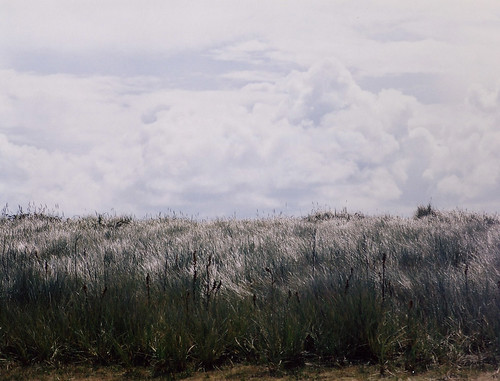
Waking in the marram grass

The photograph here shows some silver marram grass we saw on the island of Bryher a couple of summers ago. It was swaying invitingly and reminded me of Thomas A. Clark’s short poem on falling asleep in marram grass, a poem that can be seen on his website. As the Scottish poetry library site’s page on him explains, Clark runs the Cairn gallery which has recently re-located to Pittenweem. I have not visited the new version, but the earlier gallery in Nailsworth was a special place with the feeling of a sanctuary: above an old post office, quiet, white rooms hung with minimalist art works and, here and there, small poetic inscriptions. We last went there in 2002 when there was an exhibition that made a connection between Novalis and Ian Hamilton Finlay’s book The Blue Sail. In the midst of Finlay’s poems this book includes Novalis’s statement on the importance of romanticising the everyday. The title of the anthology also recalls Novalis’s symbol of the blue flower.


Monday, May 08, 2006

Sahara line

Among critical writing dealing with the origins of land art, Rosalind Krauss’s essay ‘Sculpture in the Expanded Field’ is particularly interesting (it is reprinted in her stimulating collection The Originality of the Avant-Garde and Other Modernist Myths). She argues that for most of its history sculpture was site specific, but that increasingly Modernist sculpture (the kind of work made by artists like Brancusi and Caro) was site-less and self-referential, no longer directly connected to buildings or landscapes. Sculpture had become implicitly defined as not-landscape and not-architecture, but all this started to change in the late sixties when artists began to seek an expanded field of possibilities.
 
To describe these developments Krauss uses a structuralist diagram based on the Piaget group. Sculpture is in one corner, but there are three other options. The opposite of sculpture is art that is both landscape and architecture: site-constructions like Robert Smithson’s Partially Buried Woodshed (1970). Ian Hamilton Finlay’s garden Little Sparta would seem to fit this category (Krauss saw Japanese gardens as an example of non-Western art that is both architecture and landscape). The architecture but not-architecture category covers various kinds of interventions into real buildings - Gordon Matta-Clark’s work springs to mind. Then there is art that is both landscape and not-landscape, which Krauss identifies as the marked sites of land art, including the work of Richard Long. A work like Long’s Sahara Line (1988) can thus be seen as art in the landscape that is nevertheless, like sculpture, an autonomous art work separate from any landscape.

Friday, December 09, 2005

Fountain on a heath


In September 1801 Samuel Taylor Coleridge noted in his journal “The spring with the little tiny cone of loose sand ever rising and sinking at the bottom, but its surface without a wrinkle.” The following year he published a poem inspired by this site Inscription for a Fountain on a Heath. “Here Twilight is and Coolness: here is moss, / A soft seat, and a deep and ample shade…” Thus the poem describes a lovely spot for the weary walker.
Drink, Pilgrim, here; Here rest! and if thy heart
Be innocent, here too shalt thou refresh
Thy spirit, listening to some gentle sound,
Or passing gale or hum of murmuring bees!
It is a pleasant poem, but what if there really was a fountain with this inscription? What if Coleridge himself had carved these lines beside the spring or on the “jutting stone” of the "fountain" itself? Would this have enhanced the landscape? I don’t think many of us would want there to be a real inscription, even by the hand of Coleridge.

We tend to want the 'real' landscape kept pure, with text and poems confined to our gardens. Ian Hamilton Finlay’s Little Sparta is the most celebrated modern example, but he acknowledges the influence of poet-gardener William Shenstone. Shenstone compiled a book of Inscriptions, mostly in Latin, many of which were used in his garden The Leasowes. Shenstone was also an inspiration for the garden at Ermenonville, designed by Rouseau's friend the Marquis de Giradin, where the poem in the grotto of the naiads, for example, is derived from one of Shenstone’s inscriptions.