Showing posts with label Tu Fu. Show all posts

Saturday, December 16, 2023

Branches Waving in the Current

Back in October I was fortunate to be able to attend a book launch for Michael Wood's new book In the Footsteps of Du Fu. He gave an excellent speech on Du Fu's life and importance (not everyone present had read the poetry) and was clearly moved when he quoted '500 Words on the Road to Fengxian'. He said his interest in Chinese poetry was sparked by A. C. Graham's Poems of the Late T’ang, published in 1965 (this was the book that inspired Roger Waters' lyrics for 'Set the Controls for the Heart of the Sun'). When I first read this book in the mid eighties there were still hardly any translations of Chinese poetry available, although Arthur Cooper's Li Po and Tu Fu had appeared as a Penguin Classic in 1973. I've never understood why more haven't appeared over the years, although readers of this blog will have encountered quotes from the trickle of books published by American publishers. I doubt Michael Wood's book will provoke a new wave of enthusiasm here for Du Fu, but you never know.

 
Michael Wood on the Yangtze
(from the one hour BBC documentary Du Fu: China's Greatest Poet, 2020)

Rather than discuss the whole book, I thought I'd use the opportunity to talk here about a specific landscape which Du Fu wrote about. White Emperor City (Baidicheng or Baidi Fortress) is on the northern shore of the Yangtze, near Fengjie. Sadly, construction of the Three Gorges Dam submerged many buildings although tourists can still visit what remains on an island. Du Fu was one of many poets who came here over the years - ‘Early Departure from White King City’ by his friend Li Bai (701-62) is in the Arthur Cooper book. On the 15th of November 767 Du Fu saw here ‘a pupil of the Lady Kung-Sun dance the sword mime.’ In response he wrote a beautiful, moving meditation on aging, at about the age I am now. He had seen Lady Kung-Sun when he was a child in 717, but now even her pupil was past her prime. Arthur Cooper says in his notes for the poem that the dance, in the style of ‘West of the Yangtse’, was ‘probably at its climax very fast and vigorous, much like Tartar or so-called Polovtian dances known today through Russian ballet.’

A. C. Graham, in Poems of the Late T'ang, explains that Kuizhou (K’uei-chou), was ‘a town adjoining and apparently no longer distinguished from Pai Ti (White Emperor City)’. These places can be seen in the helpful map above, which I hope it's OK to reproduce from Michael Wood's book. ‘K’uei-chou had been part of the old kingdom of Shu and contained a temple to the great Shu statesman Chu-ko Liang, who was one of Tu Fu’s heroes’ (David Hawkes). ‘Ballad of the Old Cypress’ concerns a tree that Chu-ko Liang (Zhuge Liang) was supposed to have planted. Also near the city ‘there was a formation of dolmens which appeared as the Yangzi river sank. This was supposed to have been Zhuge Liang’s symbolic representation of the military formations his army should assume in the conquest of Wu’ (Stephen Owen). Du Fu wrote a famous poem about these too, ‘The Diagram of Eight Formations’. This was the setting for Brian W. Aldiss's 1978 short story 'The Small Stones of Tu Fu' in which a time traveller meets the aging poet. 

Zhuge Liang's Diagram of Eight Formations, or Stone Sentinel Maze, features in The Romance of the Three Kingdoms, written in the 14th century about events at the end of the Han Dynasty. Lu Xun is leading his troops towards Kui Pass when he begins to sense danger, but no sign of enemy soldiers. One of his followers inspects the area but finds only 'eighty or ninety chaotic rock piles alongside the river.' Some locals tell Lu Xun that when his enemy Zhuge Liang had been here, he had sent troops to arrange these rock formations and 'since then, a kind of cloudlike effluvium seems to emanate from their interiors'. As the sun goes down Lu Xun goes to investigate the rocks himself. Suddenly violent winds appear, the river rumbles and the sky is covered with streams of sand and stone. An old man appears and tells him this is the Eightfold Maze, whose openings appear unpredictably. They each have a name and Lu Xun had entered by the one called 'Perish'. But the man, who identifies himself as Zhuge Liang's father-in-law, leads him to safety. The novel then quotes Du Fu's poem.   

Du Fu had arrived in the Kuizhou-Baidicheng area in the spring of 766 and found two farmsteads to live in, the main house an hour’s walk uphill. Michael Wood, in the footsteps of Du Fu, noted that the poet's ‘vegetable garden with an orchard and orange grove of almost six acres commanded wonderful views which with a little imagination we can still see in the mind’s eye. Sometimes he walked higher up above the Gorges to see the whole vista unfold with distant mountain ranges beyond. So although the river has covered the site of Du Fu’s houses, if we look up, something of the ‘landscape remains’, as we would say’. It was here that the poet wrote his two great 'Autumn' sequences, which many consider the greatest of all Chinese poems. 


Bill Porter (Red Pine) visited this location a few years before Michael Wood for his odyssey round the poetic sites of China, Finding Them Gone (2016). The island of Baidicheng (Paiticheng) was surprisingly quiet - 'the only sounds I heard above the wind were those of crickets and doves. I was also joined by a passel of sparrows and what must have been the last butterflies of the year.' The famous view down the gorge (which can be found on a 10 Yuan note) still looked beautiful. As the site of Du Fu's Western Study has been drowned, a replacement version has been carved from rocks higher up. Red Pine ignored this and headed instead for Huanhua Village, named after the stream Du Fu lived by in Chengdu where he could look down over a slope of farm plots to the water, beneath which the poet's hut and orange grove now lie. He then made for the site of Du Fu's second submerged home, at a place called Huangchuehshu. A local explained that it is named for the ancient trees (Ficus virens) planted there.

'The trees were so big, he said, it took the outstretched arms of several people to encircle one of them. The huang-chueh was a relative of the banyan and was often used in that part of China to honour sites of historical or communal importance, and the site of Tu Fu's former house would have qualified. I thought about all those branches waving in the current where so many poems were written. It wasn't simply the landscape that inspired Tu Fu's poems. It was also his life coming to an end and he felt it.'

Friday, January 09, 2015

Hunger Mountain


In the clip I've embedded above, David Hinton introduces his book Hunger Mountain (2012)The eponymous peak is in Vermont, where Hinton lives and works on the translations of Chinese poetry often referred to here (see for example this post from 2006: 'Lit dew shimmers').  Hunger Mountain uses walks on the mountain to frame a discussion of the 'spiritual ecology' he has found in the old poets and philosophers. It begins with the notion of 'sincerity', expressed as a character that combines a person standing and words rising from a mouth.  Although he doesn't mention it, this Confucian term is also the first Chinese character in The Cantos, where Ezra Pound applies it in praise of the sixth US president John Quincy Adams.  Hinton uses it to discuss 'a more fundamental sense of sincerity as an identification of outside and inside', a deep feeling of belonging to the cosmos.  This is evident, for example, in Tu Fu's poem 'Moonrise' (a different poem to 'Full Moon', which I quoted here in an earlier post on moonlit landscapes). 'Moonrise' doesn't simply project an emotion into the landscape, it describes a fundamental identity between the poet and the world. By the time Tu Fu wrote his poem, the character for 'friend' was being written as it still is as two moons side by side (below).  Hinton sees a form of 'friendship' in the way Tu Fu, his modern reader and the wider cosmos are united through contemplation of the moon.


The idea that consciousness is like a lake or mirrored pool is common in Chinese literature.  One of the four masters of southern Sung poetry, Yang Wan-li, wrote of the lake's 'mind': a gaze 'holding the mountain utterly.'   The character for mind is derived from the image for a heart, suggesting that thinking and feeling are deeply connected.  'Thinking' is written as this symbol for heart-mind underneath the character for 'fieldland'.  'Feeling' is a stylized version of the heart-mind symbol written next to the character for the blue-green of landscape.  In light of this it seems unsurprising that poets expressed themselves by writing directly about nature.  Hunger Mountain is quite dense in places with speculations on the connection between language and natural processes, something that has fascinated poets since Ezra Pound published Ernest Fenollosa's The Chinese Written Character as a Medium for Poetry in 1918.  It is a subject I have written about here before in connection with Cecilia Lindqvist's wonderful book China: Empire of Living Symbols.  The extent to which these ideas are widely accepted is something I am not qualified to judge, but they are certainly inspiring to read about.

It remains possible that even poetry drawn directly from the the rivers and mountains will be a kind of barrier.  Hinton talks about the risk that ultimately 'we can say nothing about the world without creating in some sense a breach between consciousness and landscape'.  In one of his many wine poems the poet T'ao Ch'ien, discussed in an earlier post here, wrote that whenever he started trying to explain Lu Mountain, 'I forget words altogether'.  Lu Mountain is the range of peaks that have been central to Chinese landscape poetry (the subject of another post here). Throughout the book Hunger Mountain stands in for Lu and Hinton tries to learn, like the poets, from his frequent walks to the summit. Su Tung p'o, who came to Lu seven centuries after T'ao Ch'ien, stayed at the East Forest Monastery, but said he learnt more from the mountain's streams and mirrored pools.
'Su Tung p'o established himself as a master of Tao's mental dimensions when he described flowing waters as the form of mind negotiating the exigencies of life, a spontaneous and crystalline responsiveness working its way through, taking shape according to whatever it encounters.  This is mind moving through the occasions of its attention like water through stones and branches and colourful leaves, adapting itself to the forms it encounters, becoming sometimes loud and othertimes silent, sometimes seething with light and other times lost in shadow.'
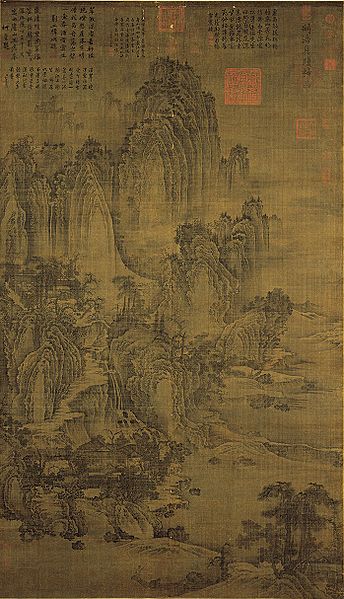
Attributed to Jing Hao, Mount Lu, c.900

Saturday, May 01, 2010

Moons of the Iapetus Ocean

'Empty peaks, silence: Among sparse stars,/ not yet flawed, it drifts.'  Tu Fu's short poem 'Full Moon' describes the strange effect of a landscape at night, 'all light'.  In David Hinton's translation the 'twice-sized moon ... scatters restless gold across waves' and it transforms the garden and house in which Tu Fu sits - 'on mats, it shines richer than silken gauze.'


Ando Hiroshige, Autumn Moon on Ishiyama Temple, c. 1834

Hiroshige used moonlight for landscapes, as above, for figure scenes like Trout Fishing in the Tamagawa in the Autumn Moonlight, and for animal paintings, such as Two Rabbits under a Full Moon.  His prints were an inspiration for Whistler's Nocturnes.  As a post about this at the Princeton blog says, 'Whistler’s Nocturne in Blue and Gold: Entrance to Southampton Water bears striking similarity to Night View of Kanazawa under the Full Moon, depicting a moonlit bay done in a binary color scheme of blue and gray.'  Whistler got the idea of calling his moonlit scenes 'nocturnes' from a Chopin-admiring patron.  He wrote ‘I can’t thank you too much for the name ‘Nocturne’ as a title for my moonlights!...You have no idea what an irritation it proves to the critics and consequent pleasure to me – besides it is really so charming and does so poetically say all that I want it to say and no more than I wish.’

Among contemporary artists, Darren Almond has shown a particular interest in the way landscapes look under a full moon.  For his Fullmoons series he has traveled the world photographing the landscape at night, using a 15 minute exposure so that they shine with a strange luminosity.  A couple of years ago he exhibited some of these photographs, taken around Britain, in a show called ‘Moons of the Iapetus Ocean’.  The title is reference to the sea between England and Scotland 400-600 million years ago; Almond's frozen moonlight takes these places outside measurable time.  All these sites take on an unreal quality and, as a Times review said, images like Fullmoon@Gairloch or Fullmoon@Wester Ross seem to show 'the mossy, ferny landscapes of bygone British folklore.'  More recently, at the Tate's Altermodern exhibition, Almond showed three full moon images that recall the poem by Tu Fu: still, misty views of the mountains of Huang Shan - 'empty peaks, silence...'