Showing posts with label windmills. Show all posts

Saturday, March 23, 2024

Mirror of Holland

This morning I walked along our local canal, with bright sunny weather creating reflections of the barges and bridges, the buildings of Hoxton and Haggerston, a few trees and many joggers pounding down the path. This evening I watched Mirror of Holland, made up entirely of shots of canal reflections, which won the short film Palme d'Or in 1951. It begins with the windmill below and a young lad who bends down to see the image the 'right way round' - the rest of the film continues in this way, with the reflections turned into water-blurred moving images of farms, gabled houses, a church tower, locks and canal boats. The director Bert Haanstra went on to make many other documentary films - his other big success was based on another reflective medium, Glass (1958).

Mirror of Holland put me in mind of Haanstra's Dutch contemporary M.C. Escher, whose compositions like Puddle and Three Worlds are interested in how water can contain a landscape. There are some abstract moments in the film that look like Escher's Rippled Surface which also dates from 1950. Of course there are reflections in Dutch Golden Age paintings too and you could probably make a version of Haanstra's film by montaging these together - the example below is in Jan Van de Heyden's Country House on the Vliet near Delft (1665). 

Saturday, April 21, 2018

Picturing Paradise

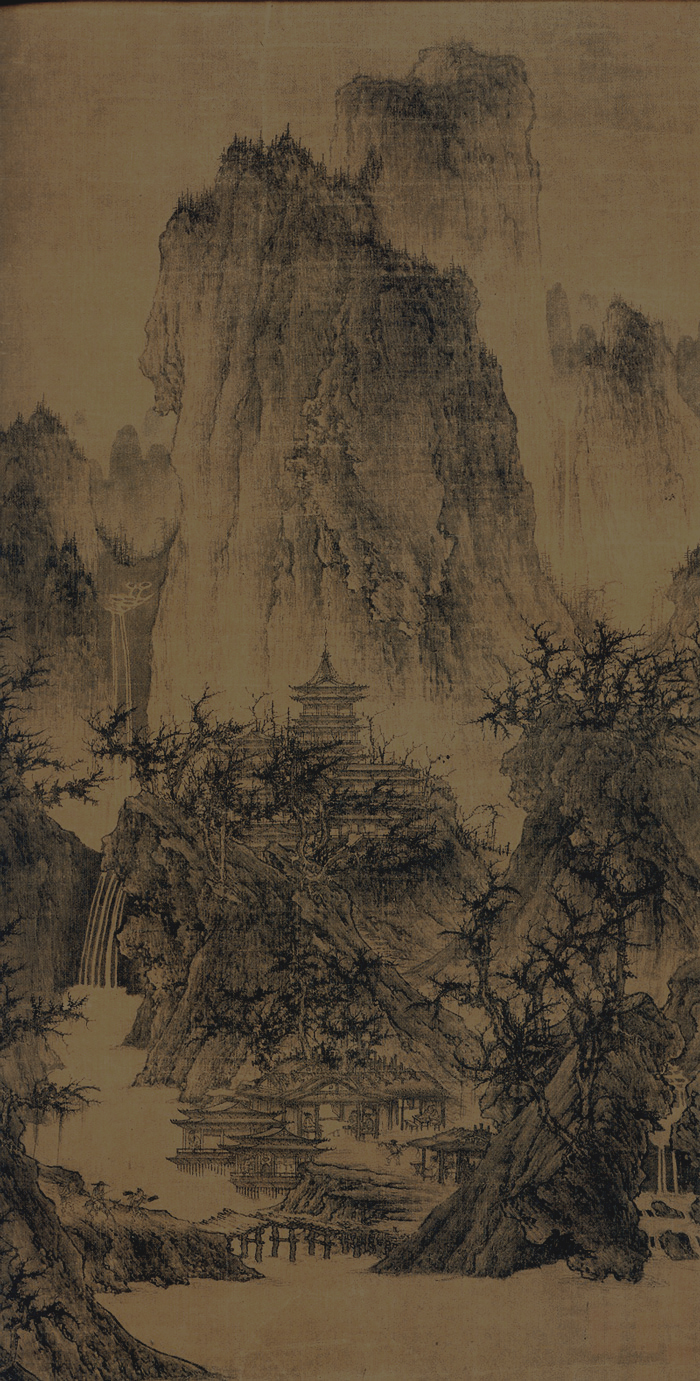
Li Cheng, A Solitary Temple Among Clearing Peaks, Song Dynasty

We have got rather behind in watching Civilisations on the iPlayer, so I have only just seen Simon Schama's episode concerning landscape, 'Picturing Paradise'.  I really enjoyed it and was full of admiration for the way he explained the significance and beauty of specific works of art in a such a short space of time. The programme actually begins in twentieth century China with Mu Xin, who painted his landscapes in secret during the Cultural Revolution.  His trajectory from enemy of the people to revered cultural figure culminated recently in the establishment of a Mu Xin museum in Wuzhen.  Schama then takes the story back to Song Dynasty China and Li Cheng, whose paintings I wrote about last year.  The way the camera pans in close over A Solitary Temple Among Clearing Peaks reveals far more detail (see below) than can be gleaned from the rather dark image of this painting (above) I've used here before. 


Having devoted a decent amount of time to Li Cheng, the programme moves on to Qiao Zhongchang's handscroll illustrating The Second Prose Poem on the Red Cliff.  I imagine Schama would love to have had time to give the full background on Shu Shi's poem, but he focuses on the mood conveyed in this painting, contrasting the pleasures of an excursion with the sadness of exile, "a dream, but one with a bitter-sweet taste".  This Chinese section concludes with Wang Meng's Dwelling in the Qingbiang Mountains, allowing Schama to introduce themes of political symbolism - the turbulence in Song Dynasty China echoed in the way Wang painted his landscape.  The idea that landscapes tell us much about the world in which they were painted is then taken up, after a brief mention of Islamic art and gardens, in his account of Western landscape art.  In all, a quarter of the whole programme is devoted to Chinese landscape painting - if only this could have been expanded into a whole series...

 Qiao Zhonchang, Illustration to the Second Prose Poem on the Red Cliff, Song Dynasty

By this point in the programme we had become conscious of Simon Schama's rather idiosyncratic pronunciation of certain words.  'Most of us', as Gerard O'Donovan wrote in his Telegraph review,
'put the stress on the first syllable (MOUNtain), but he places it on the second (mounTAIN). As in, say, maintain or plantain. Usually, such idiosyncrasy would go unremarked. But being devoted to landscape art, there were so many mounTAINs (and even a founTAIN) in last night’s enthralling third edition of Civilisations, you had to wonder whether he’d ever noticed it himself.'
A bit harsh, but then it is hard not to focus on the mannerisms of the presenters given that they are effectively being pitched against the magisterial, patrician authority of Sir Kenneth Clark (incidentally, there's a nice clip of Clark in the original Civilisation (1969) embedded in a post I did back in 2010 about Jean-Jacques Rousseau).  I was dismayed to read a few days ago an article headlined 'Mary Beard 'cut' from US version of Civilisations, fearing 'slightly creaky old lady isn't ideal for US TV'.  I agree with O'Donovan that Schama's enthusiasm is inspiring to watch and that, like him, I'm happy to listen to views delivered 'with the unshakeable confidence of a man who goes through life pronouncing mounTAIN like he’d invented the word himself.'

I will not attempt to summarise the rest of the programme, which focuses on some of the themes Schama has written about before - the German forest, mercantile Holland and the American wilderness.  Perhaps the fact that he has written things like Landscape and Memory explains why he has not contributed a series tie-in book, unlike the other two presenters.  As for the inevitable omissions in this programme, I'm guessing Turner, Constable, Monet and Van Gogh will come in somehow to a later episode, but suspect there might be no more on post-Song Dynasty Chinese landscape art.  To conclude here I will transcribe a quote from the programme which I hope conveys why I think Schama is so good.  Here he takes an apparently unprepossessing painting by the prolific Jan Van Goyen and leaves you thinking of it as a minor masterpiece.

Jan Van Goyen, Polder Landscape, 1644
"Even though we know that Van Goyen really had to work fast and with rubbish materials that didn't cost him very much money (he was so always in debt), there's a credible kind of convergence between what he's painting and how he's painting it.  It's like a sketch.  It's like an immediate note from his own vision.  And everything that's kind of rough and raw and crude and clay-like and meagre about it actually makes you feel there. There are tops of houses - roofs - and you don't see anything else of the house.  Why?  Because they're actually below the waterline.  This delivers a world - the silvery quality of the canals, a little boat floating past, and you think you're waking up and you can smell the peat turned over; it's a raw day in the middle of winter, and you're absolutely enveloped by the wind, the dark, lead coloured light.  But this still, in it's scraped-away authenticity, is a kind of home."

Friday, May 22, 2015

The sound of water escaping from Mill dams

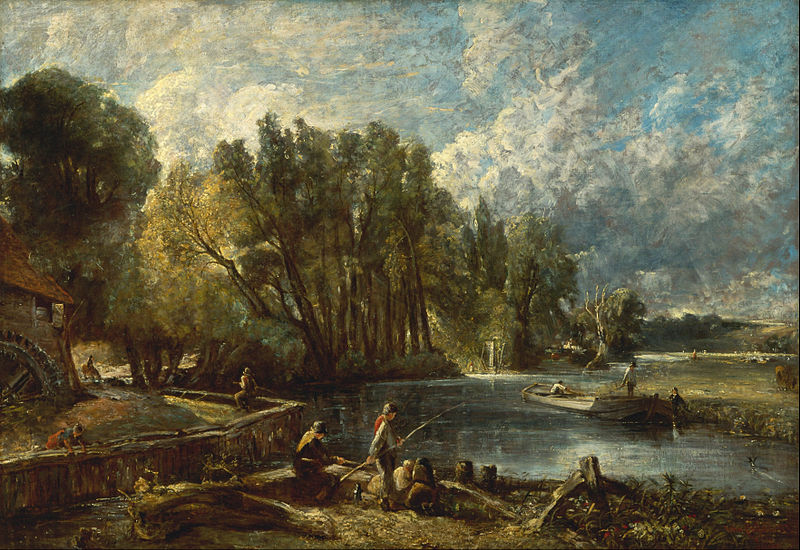
John Constable, Stratford Mill, c. 1820
Source: Wikimedia Commons (National Gallery)

Anglers often appear in the paintings of John Constable, who had gone fishing on the Stour in his youth.  In his 'micro-biography' Constable in Love (2009) Martin Gayford writes that 'angling was a perfect preparation for landscape-painting, which also involved sitting patiently in the countryside, trying to capture something.  By a river with a rod in his hand, an imaginative boy would absorb impressions - the reflections on water, the shadows beneath the willows, the smells, the sounds - while waiting for a bite.'  Constable wrote of a painting of a mill* by Jacob van Ruisdael, that he could 'all but see the ells [eels]' in its water. 'The most famous of all Constable's statements was sparked by the topic of fishing.  In 1821 the younger John Fisher wrote, mentioning that he had been up to his middle in a fine, deep New Forest river and as happy as a 'careless boy'.  He caught two pike and thought of John Constable.  In reply, Constable produced an amazing sequence of free sensory associations:'
"The sound of water escaping from Mill dams... Willows, Old rotten Banks, slimy posts, & brickwork. I love such things... As long as I do paint I shall never cease to paint such Places......"
In a similar vein, Constable exhibited the 'eye of a miller and relish of a connoisseur' in the way he praised another Ruisdael painting, Thatched-Roofed House with a Water Mill (Constable's father operated Dedham and Flatford mills).  The quotation of Constable's is also referred to by Andrew Motion in an article he wrote at the time of the RA's 2006 Ruisdael exhibition
'Constable's brother once said: "When I look at a mill painted by John, I see that it will go round, which is not always the case with those by other artists." It was a smart remark, and takes us to the heart of Constable's genius, where accuracy and authenticity generate a mighty emotional strength. This is what so pleased him about Ruisdael: we can hear it ... in his response to Thatched-Roofed House with a Water Mill. "It haunts my mind and clings to my heart," he told his friend Archdeacon Fisher, the very day he saw the painting, "and has stood between me & you while I am now talking to you. It is a watermill, not unlike Perne's Mill - a man & boy are cutting rushes in the running stream (in the 'tail water') - the whole so true clear & fresh - & as brisk as champagne - a shower has not long passed."'
Constable moves here from technical appreciation with specialised, poetic vocabulary ('tail water') to a simile that describes the painting's overall atmosphere in terms of a taste which, as Gayford says, 'brings with it a feeling: the exhilaration of sparkling wine.'

John Constable, Dedham Lock and Mill, 1820
Source: Wikimedia Commons (V&A)

* Gayford writes 'watermill' but Seymour Slive says that this refers to Evening Landscape: a Windmill by a Stream (Jacob Van Ruisdael: Windmills and Water Mills p12)

Sunday, November 23, 2014

Watermeadows at Salisbury

John Constable,  Landscape with goatherd and goats, 1823
Source for all images: Wikimedia Commons

The V&A's Constable: The Making of Master exhibition provides a fascinating survey of the way Constable was influenced by other artists throughout his career.  He admired the early Gainsborough and it is easy to see why: the Landscape with Pool (1745-6) which Constable would have seen in Ipswich is absolutely exquisite.  Rubens was another stimulus: Constable's Moonlit Landscape with Hadleigh Castle uses effects he took from Rubens' Landscape by Moonlight.  I was fascinated by another Rubens in the show, Summer, with its sunlit plain and turquoise distances (Mrs Plinius dismissed it as "garish").  Also on display are direct copies of seventeenth century masters - the 'facsimile' of a Claude painting (above), and the version (below) of a Ruisdael winter scene owned by Sir Robert Peel, who insisted that Constable include a small dog to distinguish it from the original (I wonder which version is worth more now?)  This added dog inevitably reminded me of the cruise missiles inserted by Peter Kennard into his 1980 version of Constable's The Haywain, a work now owned by the Tate.

John Constable, A winter landscape with figures on a path,
a footbridge and windmills beyond, 1832
  Inscribed on the stretcher 'Copied from the Original Picture by Ruisdael in the possession of Sir Robt Peel Bt by me John Constable RA at Hampstead Sep. 1832 P.S. color (...) Dog added (...) only (...) Size of the Original (...) and Showed this pictures to Dear John Dunthrone Octr 30 1832 (...) this was the last time I (...)' and further inscribed 'Poor J Dunthorne died on Friday (all Saints) the 2d of November. 1832-at 4 o clock in the afternoon Aged 34 years.'

Constable was also interested in the methods and advice of earlier artists.  The exhibition juxtaposes Twenty Studies of Skies after Alexander Cozens (1823) with a copy of Cozens' own examples.  Constable drew these at Coleorton Hall, home of the great collector Sir George Beaumont, where (as I read on the NGA site) Constable 'also studied Cozens’s list of twenty-seven types of ‘Circumstance’ in nature, consisting of accidents (wind, rain, storm etc.), seasons (spring, autumn etc.) and characters (time of day such as ‘rising-sun’, ‘setting-sun’, and ‘close of day’'.  There is something both seductive and reductive about the idea that landscape can be classified in this way, like the tags used to label internet images.  Constable also took heed of Leonardo's advice on a means of achieving accurate perspective whilst out sketching directly from nature, a method demonstrated in this exhibition with a drawing for Watermeadows at Salisbury.
'Take a glass as large as your paper, fasten it well between your eye and the object you mean to draw, and fixing your head in a frame (in such a manner as not to be able to move it) at the distance of two feet from the glass; shut one eye, and draw with a pencil accurately upon the glass all that you see through it. After that, trace upon paper what you have drawn on the glass, which tracing you may paint at pleasure, observing the aerial perspective.' - Leonardo da Vinci - A Treatise on Painting
John Constable, Watermeadows at Salisbury, 1820 or 1829

The most interesting room in this excellent exhibition is the least colourful, devoted to Constable's collection of prints.  As the curators explain, over his career Constable amassed '59 oil paintings by ‘Old and Modern Masters’ and over 5000 prints, 250 drawings, 37 books of prints and 39 framed prints and drawings.'  This enthusiasm reminds me of Van Gogh, whose letters vividly convey his pleasure in acquiring prints (and also photographic reproductions, an option not yet available to Constable).  The small selection of Constable's collection displayed at the V&A amounts to a history of Western landscape art in its diverse forms: Dürer, Titian, Claude, Rubens, Rembrandt, Rosa, Waterloo.  It was only a few years ago that I too would need to have owned a reproduction of one of these images to study it here in the comfort of my home.  Now they are available to me instantly wherever my phone can get a signal.

Google Image Search: Rembrandt's The Three Trees (1643),
an etching owned by Constable.


Postscript

Earlier this week, at the LRB bookshop event mentioned in my last post, I met Chris from pastoral punk duo Way Through, who told me that they had been in Constable Country this summer for a Field Broadcast project called Scene on a Navigable River.  As part of this they reworked the track 'Dedham Vale' which appeared on their 2013 album Clapper Is Still.  Field Broadcast is 'a live digital broadcasting platform led by artists Rebecca Birch and Rob Smith. After downloading a special Field Broadcast app, the software waits quietly until the artist’s work is ready for transmission, when a live video stream opens unannounced on the recipient’s computer, tablet or mobile phone desktop.'  I am now imagining what would have happened if Way Through's dissonant music had suddenly activated while I was in an important meeting - I suppose this element of surprise is a way of countering the sheer availability of art online.  Two hundred years ago there was only Constable, leaving his room full of prints to walk out into the landscape his paintings were in the process of 'creating' for us.  He could reproduce an old painting but in working from nature he held up a small screen of glass the size of a modern tablet device and tried to trace what he could see.  'When I sit down to make a sketch from nature,' he wrote, 'the first thing I try to do is to forget that I have ever seen a picture.' 

John Constable, Dedham Vale, 1802 

Friday, December 23, 2011

Landscape in the Trésor des Histoires

Landscape in the Trésor des Histoires, Bruges, c. 1475-80

The British Library's Royal Manuscripts exhibition includes books made from the ninth to the sixteenth centuries but begins with the extraordinary collection of Edward IV, including this copy of a French historical chronicle lying open at 'one of the earliest known European paintings in which landscape is the principal subject.'  I've just found that this image also appears in a list of mill images at the Medieval and Renaissance Material Culture site - a good source for other glimpses of landscape in the Middle Ages.  What I like about this sort of list is the way it ignores the subject of the picture in favour of an unobtrusive detail - yes, there's an interesting windmill in the illustration below, but you have to drag your eyes away from the gruesome murder to see it (the windmill here nicely balances the clump of trees in a V-shaped composition pointing to the heart of the Roman Emperor).  In other images on the site, mills are quietly grinding corn in the background whilst Narcissus looks down at his reflection, King David kneels before God, Elisha raises a woman's son from the dead, Arthurian knights go head to head in a tournament, Priam inspects the reconstruction of Troy, the Romans colonise Latium and ships navigate the coastal waters of Britain. 


The assassination of Vitellius in De casibus, first quarter of the 15th century
BNF Fr. 226, fol. 201v, source: larsdatter

Saturday, March 24, 2007

Saint Anthony in a landscape

Hieronymous Bosch, The Temptation of Saint Anthony, c1500.
Source: Wikimedia Commons

I remember once visiting the Musées royaux des Beaux-Arts de Belgique in Brussels and enjoying the fantastic Bosch painting of the Temptation of Saint Anthony. Here the landscape is a backdrop to the usual Bosch scenes of weirdness and horror, although as can be seen below (in another version of the painting now in Lisbon), there are intriguing misty details in the distance, where modest windmills and strange temples exist side by side. But this isn’t the only Temptation in the museum. You also come upon another painting of the same subject by an artist of the ‘Southern Netherlandish School’, which is as different as could be: an intimate rustic landscape where St Anthony seems at first glance to be sitting have a quiet read. I’m just as interested (if not more interested) in this painting, but have never been able to find out anything about it, other than the basic fact that it is painted on wood and is 24 x 16.5 cm in size.


Hieronymous Bosch, The Temptation of Saint Anthony, c1500.
Source: Wikimedia Commons

Saturday, December 31, 2005

Water and windmills

Richard Holmes’ anthology of Samuel Taylor Coleridge poems is notable for its inspired thematic arrangement and the inclusion of some of Coleridge’s more obscure but intriguing verse and fragments. These lines were written in 1828 when Coleridge, reconciled with Wordsworth, toured through Germany and Holland with him:


Water and windmills, greenness, Islets green; -
Willows whose Trunks beside the shadows stood
Of their own higher half, and willowy swamp: -
Farmhouses that at anchor seem’d – in the inland sky
The fog-transfixing Spires

The MS. contains two more lines, which appear to be the false start of a second stanza, “Water, wide water, greeness and green banks…”

Holmes thinks “this fragment of Dutch landscape is an almost perfect imagist poem”. This is interesting given the Imagists’ dislike of Romantic poetry; it is true that Coleridge’s poem achieves a direct treatment of the Dutch landscape and has none of the “magnificent and sonorous” generalisations that Imagism rejected. The Imagists were interested in the idea of fragments (as in Sappho for example) and here it feels as if the poem's incompleteness preserves Coleridge’s experience of the landscape intact, giving it a similar modern appeal to that of the vivid oil sketches made by contemporaries like Pierre-Henri de Valenciennes and Thomas Jones.