Showing posts with label Li Cheng. Show all posts

Saturday, April 21, 2018

Picturing Paradise

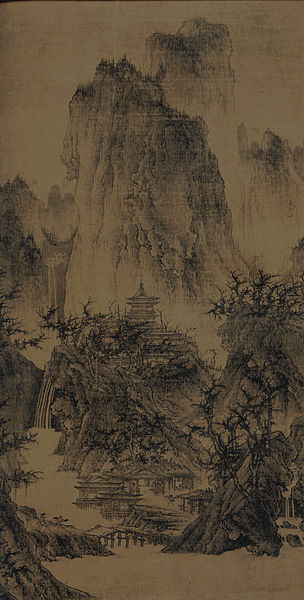
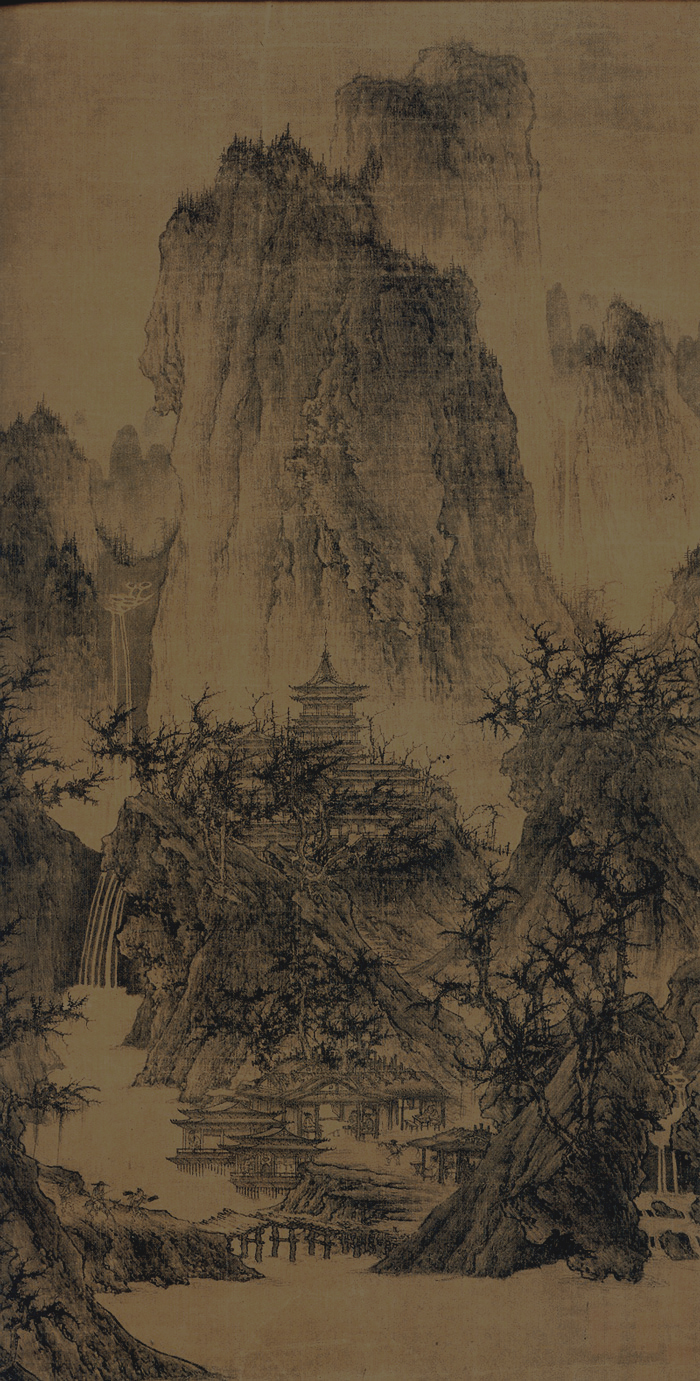
Li Cheng, A Solitary Temple Among Clearing Peaks, Song Dynasty

We have got rather behind in watching Civilisations on the iPlayer, so I have only just seen Simon Schama's episode concerning landscape, 'Picturing Paradise'.  I really enjoyed it and was full of admiration for the way he explained the significance and beauty of specific works of art in a such a short space of time. The programme actually begins in twentieth century China with Mu Xin, who painted his landscapes in secret during the Cultural Revolution.  His trajectory from enemy of the people to revered cultural figure culminated recently in the establishment of a Mu Xin museum in Wuzhen.  Schama then takes the story back to Song Dynasty China and Li Cheng, whose paintings I wrote about last year.  The way the camera pans in close over A Solitary Temple Among Clearing Peaks reveals far more detail (see below) than can be gleaned from the rather dark image of this painting (above) I've used here before. 


Having devoted a decent amount of time to Li Cheng, the programme moves on to Qiao Zhongchang's handscroll illustrating The Second Prose Poem on the Red Cliff.  I imagine Schama would love to have had time to give the full background on Shu Shi's poem, but he focuses on the mood conveyed in this painting, contrasting the pleasures of an excursion with the sadness of exile, "a dream, but one with a bitter-sweet taste".  This Chinese section concludes with Wang Meng's Dwelling in the Qingbiang Mountains, allowing Schama to introduce themes of political symbolism - the turbulence in Song Dynasty China echoed in the way Wang painted his landscape.  The idea that landscapes tell us much about the world in which they were painted is then taken up, after a brief mention of Islamic art and gardens, in his account of Western landscape art.  In all, a quarter of the whole programme is devoted to Chinese landscape painting - if only this could have been expanded into a whole series...

 Qiao Zhonchang, Illustration to the Second Prose Poem on the Red Cliff, Song Dynasty

By this point in the programme we had become conscious of Simon Schama's rather idiosyncratic pronunciation of certain words.  'Most of us', as Gerard O'Donovan wrote in his Telegraph review,
'put the stress on the first syllable (MOUNtain), but he places it on the second (mounTAIN). As in, say, maintain or plantain. Usually, such idiosyncrasy would go unremarked. But being devoted to landscape art, there were so many mounTAINs (and even a founTAIN) in last night’s enthralling third edition of Civilisations, you had to wonder whether he’d ever noticed it himself.'
A bit harsh, but then it is hard not to focus on the mannerisms of the presenters given that they are effectively being pitched against the magisterial, patrician authority of Sir Kenneth Clark (incidentally, there's a nice clip of Clark in the original Civilisation (1969) embedded in a post I did back in 2010 about Jean-Jacques Rousseau).  I was dismayed to read a few days ago an article headlined 'Mary Beard 'cut' from US version of Civilisations, fearing 'slightly creaky old lady isn't ideal for US TV'.  I agree with O'Donovan that Schama's enthusiasm is inspiring to watch and that, like him, I'm happy to listen to views delivered 'with the unshakeable confidence of a man who goes through life pronouncing mounTAIN like he’d invented the word himself.'

I will not attempt to summarise the rest of the programme, which focuses on some of the themes Schama has written about before - the German forest, mercantile Holland and the American wilderness.  Perhaps the fact that he has written things like Landscape and Memory explains why he has not contributed a series tie-in book, unlike the other two presenters.  As for the inevitable omissions in this programme, I'm guessing Turner, Constable, Monet and Van Gogh will come in somehow to a later episode, but suspect there might be no more on post-Song Dynasty Chinese landscape art.  To conclude here I will transcribe a quote from the programme which I hope conveys why I think Schama is so good.  Here he takes an apparently unprepossessing painting by the prolific Jan Van Goyen and leaves you thinking of it as a minor masterpiece.

Jan Van Goyen, Polder Landscape, 1644
"Even though we know that Van Goyen really had to work fast and with rubbish materials that didn't cost him very much money (he was so always in debt), there's a credible kind of convergence between what he's painting and how he's painting it.  It's like a sketch.  It's like an immediate note from his own vision.  And everything that's kind of rough and raw and crude and clay-like and meagre about it actually makes you feel there. There are tops of houses - roofs - and you don't see anything else of the house.  Why?  Because they're actually below the waterline.  This delivers a world - the silvery quality of the canals, a little boat floating past, and you think you're waking up and you can smell the peat turned over; it's a raw day in the middle of winter, and you're absolutely enveloped by the wind, the dark, lead coloured light.  But this still, in it's scraped-away authenticity, is a kind of home."

Thursday, October 12, 2017

Luxuriant Forest among Distant Peaks

Li Ch'eng, A Solitary Temple amid Clearing Peaks, Sung Dynasty

In Michael Sullivan's history of Chinese landscape painting, Symbols of Eternity, he describes the predicament of one of the great painters of the early Sung Dynasty.
'Li Ch'eng - unsuccessful aspirant to office, gentleman, poet, recluse - came of a family of Confucian scholars that had gone down in the world.  One wonders what he lived on.  To a persistent patron, owner of a fashionable restaurant in the capital, he is said to have written: "Since antiquity the four social classes have not mixed.  I am a Confucian scholar, and although I paint, I do it only for my own pleasure.  Why should I submit to being a retainer in a great household who grinds and licks his colours and is classed with the hua shih [i.e. men who hold office by virtue of their skill as painters] and other such riffraff?"  Yet he had to live, and did not consider it beneath him to exhibit his paintings in that same restaurant, which the emperor himself patronised.  Li Ch'eng's son and grandson were rather ashamed of him, for in spite of his disclaimer, he was a professional by necessity.  This was a predicament that was to face more and more artists of the scholar class, and the most delicate and indirect ways had to be found to reward them for their work without causing them to lose face as amateurs and gentlemen.'
I wonder how Li thought about that restaurant and its diners.  Mark Rothko apparently said of his murals for the Four Seasons restaurant in New York, "anybody who will eat that kind of food for those kind of prices will never look at a painting of mine." 

 Li Ch'eng, Luxuriant Forest among Distant Peaks (detail), Sung Dynasty

Detail of that detail

The paintings here are both attributed to Li - possibly painted by his followers but probably no later than the tenth century.  Attribution of early Chinese paintings is always tricky - there is a story that Mi Fu (1051-1107), who lived only a century after Li Ch'eng (919-67), could locate only two genuine scrolls painted by Li and wondered if in fact any really existed.  Recently the art historian James Cahill caused controversy by suggesting some paintings from this period were twentieth century forgeries.  He thought Li's Reading the Memorial Stele, now in Osaka, was a copy, but valuable nonetheless.  I wrote about that painting here four years ago, after seeing it in an exhibition in London.  The warlord depicted in it trying to decipher the memorial stone, Cao Cao, was the subject of another Some Landscapes post earlier this year.

Here is one more quote concerning Li Ch'eng - Richard M. Barnhart's description of A Solitary Temple amid Clearing Peaks and Luxuriant Forest among Distant Peaks (in an essay in Yale's Three Thousand Years of Chinese Painting).  He sees them as wonderfully detailed alternative worlds to escape into, but also models of the new Chinese state.
'Li Ch'eng's works contain rich human and architectural details - temples, villages, bridges, pagodas, wine shops, pavilions and pathways - and constitute deep miniature realms of imaginative construction, dream worlds that one is invited to enter like tray landscapes, or penzai (bonsai in Japanese).  Their compositional structure, however, is the very structure of the new empire of Sung, with the Son of Heaven represented in the dominant central peak, his ministers and associates in the supportive ranges and hills around the central peak, and the entire vast structure as ordered, clear and infinite as the great empire of China itself.  There is no dust or dirt, no violence or disorder, nature is placid and benevolent, controlled by the power and wisdom of the enlightened ruler who has brought humanity to this lofty condition through wise interaction with Heaven.'

Sunday, March 08, 2015

Clouds break over the land, spring light stirs

From a 1996 interview for the Paris Review on the Art of Poetry:
'Interviewer:
Since we are talking about Chinese poetry I wanted to ask you about the Han Shan translations, Cold Mountain Poems. It is curious because Chinese poetry is so canonical, and Han Shan is not in the canon. I think at the time there were people who thought that you made him up. I wondered how you discovered him?
Gary Snyder:
Well, he is only noncanonical for Europeans and Americans. The Chinese and the Japanese are very fond of Han Shan, and he is widely known in the Far East as an eccentric and as possibly the only Buddhist poet that serious Far Eastern litterateurs would take seriously. They don't like the rest of Buddhist poetry—and for good reason, for the most part.'

Given this (mostly) negative assessment of Buddhist poetry it would be interesting to know what Gary Snyder makes of a recently published anthology, Clouds Thick, Whereabouts Unknown:Poems by Zen Monks of China.  In his introduction Charles Egan says that 'poetry from the monasteries comprises a distinct tradition of rich imagery and profound reflection, spiced liberally with wit and humor.'  His book covers the writings of Chan (Zen) Buddhist priests but also stretches to former monks who were more central to the literary tradition: Jiaoran, Guanxiu, Jia Dao (I'll be using pinyin versions of names here).  A reviewer in the Journal of the American Oriental Society worries that their inclusion makes it hard to see a distinction between 'Chan poetry' and literati poems more generally. He notes that the title of the book is an unusual rendering of the final line of Jia Dao's 'Looking for a Recluse and Not Finding Him', turning one of many poems on this theme in Chinese literature into something that sounds more distinctively Buddhist, a kind of koan.  But even without such literati poems the anthology would interest me for the way it shows the mountain-dwelling monks expressing their religion through landscape.     

Li Cheng, A Solitary Temple Amid Clearing Peaks, c. 960
Source: Wikimedia Commons

Rather than describe the book as a whole, I will try to convey the atmosphere of its poetry by quoting couplets from seven poems that all have the same title, 'Living in the Mountains'.*    
'Mist rises, separating summit colors;
Rain falls, muting sounds of spring'

'I love pines, and leave the branches
  that hinder other men's way'                                  

'incense from a jade censer
     curls and roils;
water in a stone brook
     burbles and splashes'

'lazily watching white clouds
     rise on jasper peaks;
quietly hearing clear chimes
     fall in murmuring water'

'willow catkins are all flown,
   green shadows merge'

'Clouds break over the land, spring light stirs;
A faint scent of plum blossom, whence does it come?' 

'thinking back on the past,
it seems like madness now.'
Mi Youren, Cloudy mountains, 1130
Source: Wikimedia Commons

Finally, for my own benefit but perhaps of interest to others, here are some notes drawn from Charles Egan's endnotes, forming a brief guide to nature imagery in the anthology.  Some have Chan associations, most would apply more generally to Chinese poetry.
  • Bamboo, pines and plum trees, the 'three friends of winter' were metaphors for 'one who maintains moral principles even in adversity'.
  • Butterflies - a symbol of unreality and uncertainty, from the famous story of Zhuangzi who dreamt he was a butterfly and then, on waking, wondered if he was not really a butterfly dreaming of being Zhuangzi.
  • Chrysanthemums - blooming on into the autumn they became an image of longevity.
  • Cicadas - in Chinese poetry their sound could be optimistic (a symbol of rebirth through the transformation from larva to insect) or mournful, as a sign of autumn.
  • Clouds - might denote the freedom of wandering monks or in other contexts the way that ignorance obscures the true path.  Their shadows symbolised emptiness.
  • Cuckoos - their cry was a sign of separation.
  • Dead trees - no longer subject to change, they symbolised detachment from the world
  • Grass hut - the home of a recluse.
  • Monkeys and gibbons - they conveyed either 'the insatiable curiosity of the uncultivated mind wholly immersed in the world of causation', or the original buddha mind, 'spontaneous and free of time and space'.
  • Peaches - represented immortality; I wrote about the story of the Peach Blossom Spring in an earlier post.
  • Reeds - specifically associated with Chan Buddhism; the First Patriarch Bodhidharma crossed the Yangtze on a reed.
  • Reflections - the illusory nature of reality. In a recent post I mentioned the association in Chinese literature between mirrored pools and the mind.
  • Rivers and streams - crossing them represented the process of enlightenment.
  • Sunflowers - they always face the sun, rather than the wind, just as a Chan practitioner 'should remain focused on the buddha nature'.
  • Vines and lichens - associated with the hermit life.  Descriptions involving the creeping fig (ficus pumila) and bearded lichen (usnea longissima) referred back to the opening lines of 'The Mountain Spirit', one of the 'Nine Songs of Chu'.
  • Waterfalls - traditionally they symbolised dynamism, purity or proximity to the source, but they could also be a rushing torrent of worries preventing enlightenment.
  • White egrets, cranes or stalks - the enlightened mind (the origin of this association is the Daoist immortal Wangzi Qiao who flew on the back of a crane).  The white-on-white of egrets standing in snow was an example of a kind of metaphor showing how different phenomena all ultimately derive from the same Source.
  • White lotus flowers - buddha nature


*  The seven poets:
  • Changda (d. 874), who had 'a purity akin to that of a white heron', wrote eight poems on this theme and lived on Mount Lu
  • Guanxiu (832-912), a famous poet, calligrapher and painter, spent some time in a temple on Mount Shishuang
  • Danxia Zichun (1064-1117), 'of a lofty disposition and stern appearance', was the abbot at various mountain temples
  • Changling Shouzhou (1065-1123), also abbot of several temples and also said to have been stern and severe: 'he gained the nickname Iron Face'
  • Botang Nanya (fl. 12th century), another abbot at different monasteries, he said of this poem: 'True clarity is reflected therein'
  • Hanshan Deqing (1546-1623), a famous Buddhist priest who meditated by a stream on Mount Wutai until he could no longer hear the sounds of spring torrents
  • Yongjue Yuanxian (1578-1657), another eminent priest who was abbot at Mount Gu and later directed charitable relief work during the Manchu invasion.

Friday, November 15, 2013

Clouds and Mist in the Mountains

Ten landscape highlights from the V&A's exhibition Masterpieces of Chinese Painting 700-1900
(1) Possibly Yan Wenghui - Landscape with Pavilions (early 11th century)
There is an aura of great age about this scroll, although its exact date and the authenticity of its signature are in doubt.  Peering through the mist of fine grey ink and sepia-coloured paper you can discern little figures with umbrellas: it is a landscape in bad weather.  The catalogue describes the sky as 'dark and leaden' - 'as one moves towards the last section, the mountains become increasingly steep and rugged; a swiftly moving stream appears, and bent trees tell of the power of the wind and rain.'  The painting's fine details draw you into its world: you feel that with a magnifying glass it would be possible to enter even further into the past.  The Song Dynasty critic Liu Daochun found in Yan Wengui's paintings that 'the ship is like a leaf and the figures are like seeds of millet ... A thousand miles in a single foot - such was his subtlety!'
(2) Unidentified Artist - Reading the Memorial Stele (14th century or earlier)
This is a remarkably atmospheric painting, darkened by age (although not as dark as it appears in the catalogue, which is either badly printed in places or aiming to convery what these ancient silk hanging scrolls would look like in the shadows of an old library; fortunately it is much easier to see online.) Skeletal trees surround the stele and you wonder how the two travellers have the courage to linger there to decipher the inscription.  The warlord Cao Cao remains baffled as they ride away, but his attendant realises immediately that it commemorates a famously filial daughter of the Han Dynasty.  Another inscription to one side of the stele identifies the artists as Wang Xiao (the rather stylised figures) and Li Cheng (the extraordinary trees and rocks).  Li Cheng (Li Ch'eng, 919-967) was the great early Song Dynasty painter but sadly this scroll is probably from a later date, executed in his style.
(3) Mi Youren - Cloudy Mountains (1140s)
This painting has been impressed with the red seal marks and colophons of collectors and admirers over the course of 800 years, and yet it seems to be nothing more than an empty landscape of a few trees and distant peaks, brushed in thin dabs of watery grey ink.  It is owned by the Met who explain the appeal of the 'cloudy mountain' genre developed by Mi Fu and his son Mi Youren: 'referred to by scholar-artists as "ink play," the style suggests the importance of the painter's psychological expression, thereby raising the status of painting to that of poetry and calligraphy.'  The Mi style became popular again in the early Yuan dynasty, when the calligrapher and scholar Xianyu Shu wrote in his colophon to this painting (quoted in the exhibition catalogue) that 'an artisan's painting is short in ideas but long on representative likeness, but the opposite is true with the works of lofty souls and superior scholars.'  The vagueness of the view is such as to leave the viewer free to imagine 'a choice stretch of river shore lying far beyond the actual brushwork.'

(4) Qiu Ying - Saying Farewell at Xunyang (early 15th century)
Leaping forward from the early Song Dynasty due to my self-imposed limit of choosing just ten, and passing over works like Ni Zan's Woods and Valleys of Mount Yu (which you can see in an earlier post here), I come to this scroll, which is still 600 years old, although its colours remain as vivid as enamel. You can see it at the Google Art Project and even from the small reproduction above, it should be evident that this is a beautiful example of 'green and blue' landscape painting, the style that had arisen in the Tang dynasty when the subject of this scroll, Bai Juyi (Po-Chü-i) was writing his poetry.  In the middle a small group of men can be seen in a boat, listening to a woman playing a pipa, the Chinese lute.  It is a scene from Bai's famous poem 'Song of the Lute', written in 816.  Hearing the the sound of a pipa, Bai and his friends ask the musician to join them, but after playing some selections she puts down her plectrum and lapses into silence.  Then she tells them of the sad contrast between her youth as a beautiful courtesan in the capital and her current lonely existence.  Bai, who had been exiled from the capital the year before, is moved to tears.  There is a lovely translation of this poem in Burton Watson's Po Chü-i: Selected Poems.
(5) Wen Zhengming - Garden of the Inept Administrator (1551)
I have chosen this one partly for its amusing title: 'Inept' is rather different from 'humble', the usual translation of the name for this famous garden in Suzhou.  In 1535 Wen Zhengming painted aspects of it in a 31-leaf album for Wang Xianchen, its owner and designer.  This exhibition includes a different, later set of eight views, drawn in a 'humble' style so understated that the garden architecture has been diminished in size. The artist himself might be described as an inept administrator, having first sat the civil service exam in 1495 and failed another nine times before at last being granted an honorary position in 1522 (extraordinary to think that Wen, China's most famous sixteenth century artist, spent the whole period of the Italian High Renaissance failing to become a government administrator).  Having finally made it into the elite Hanlin Academy he resigned, disillusioned, after just three years and devoted the rest of his life to painting and calligraphy.  
(6) Fan Qi - Yangzi Riverscape (1660s)
'Fan Qi was one of the first artists in Chinese art history to paint a true horizon, namely a horizontal line separating heaven and earth.  In earlier and most later Chinese painting, including most landscapes by Fan Qi himself, the meeting of earth or water with the sky is ambiguous and blurred by clouds and a misty vagueness.  In fact, in the revolutionary horizon line here, which is about 75 centimetres long, there are only two short stretches of about 5 centimetres where sky and water really touch: at the three boat sails, and to the right of the tip of the tallest tree.  Everywhere else, shoals and clifs in pale grey and brown washes without contour lines appear behind the horizon, as if floating on it.  It is as if Fan Qi was afraid to show directly the full implications of his line: the earth is round, and even the tallest mountain, if far enough away, sinks beneath the horizon.'  (Kure Motoyuki, writing in the exhibition catalogue). 
(7) Wang Jian - Landscapes in the Manner of Old Masters (1669-73)
Twelve large scrolls in a row, each showing mountains and rivers in a different style but composed in a similar way: as the catalogue points out, 'from the stones and banks to the soaring peaks near the apex: a ridge almost like the undulating backbone of a dragon runs through each work.'  This ought to be a fascinating lesson in the history of Chinese landscape painting but neither the exhibition or the catalogue explain whose work Wang was imitating.  All we are told is that 'while some of the original paintings on which this set was based remain obscure to us today, others are instantly recognisable' (Fan Kuan's famous Travellers amid Streams and Mountains is clearly one of them).  Wang Jian was one of 'The Four Wangs', influenced by Dong Qichang (who I mentioned here last year), working in the lineage of literati-painters going back to Wang Wei.  The exhibition contrasts their more orthodox work nicely with the individualistic styles of Shitao and Bada Shanren.
(8) Fa Ruozhen - Clouds and Mist in the Mountains (c. 1690)
Fa Ruozhen is known now for cloud and mountain paintings in which the mist and rock are hard to distinguish.  The Met has one: ' like a great cumulonimbus cloud, the landscape billows upward in roiling layers of earth punctuated by misty vales harbouring half-concealed groves of trees.'  For this exhibition the V&A have borrowed a hanging scroll from Stockholm, and, as the catalogue says, 'it is sometimes difficult to decide whether cliffs and rocks are protruding or receding.  The space is relatively constricted, he clouds and mist failing to create any sense of depth.  The crags reaching almost to the top of the painting contribute to an almost claustrophobic atmosphere.'  Entering this place you would encounter cumulus boulders and trees like dark rain clouds; ascending through the mist you could never be sure how far the mountain extended.  If you kept on going you might realise you had left solid ground behind some time ago without ever having reached a summit.
(9) Bada Shanren - Flowers on the River (1697)
This painting of lotus flowers is so long, 14 metres, that following it feels like walking by a real riverbank.  What you can't really appreciate from reproductions is the sense of joyous freedom in Bada Shanren's gestural brushstrokes.  His poem at the end concludes: 'Happily singing my way, I immerse myself in the splashes of spring water and the sprays of flowers.  East and west, south and north after all are the same.'  A contemporary wrote that the artist's colophons 'were so strange that no one could understand them.  His brushwork was impulsively reckless; he did not stick to any established method, but worked in a firm and thorough and often unrestrained manner.' Michael Sullivan quotes this in his book Symbols of Eternity and goes on to wonder how Bada Shanren (Pa-ta Shan-jen) would have explained another landscape scroll which I have reproduced to the right.  'He might (if he were sober) have spoken of the Tao, or of the Void out of which form is manifest and into which it dissolves again.  This picture, executed with no preconceived composition in a kind of aesthetic ecstasy, carries us to the outer limits of pictorial art, to the edge of Void, stopping just short of the point of pure abstraction.'
(10) Xu Yang - Prosperous Suzhou (1759)
Finally, in complete contrast, this scroll is similar in length to Flowers on the River, but so detailed it seems to contain a whole world.  On reaching it, visitors to the exhibition stop and become immersed in its detail, edging along the display case from the morning light on Lingyan Hill past wharves and workshops, streets and shops, to the evening mist over the outskirts of the city.  It was commissioned by the Qianlong Emperor, whose own paintings and poetry I have described on this blog before.  Five years after completing it, Xu Yang and his assistants were asked to create scrolls depicting the Emperor's southern tours.  Six years and a hundred and fifty metres later they finished in time for his sixtieth birthday.  Art historians (and David Hockney) have compared these unfavourably with a similar set of scrolls painted in the 1690s by Wang Hui, attributing a certain stiffness in Xu Yang's work to the deleterious influence of new Western pictorial conventions that had arrived with the Jesuits.
NB: for copyright reasons I have not included images here beyond what is on Wikimedia Commons, although I have added links where possible.