Monday, August 17, 2009

Landscapes of melancholy emptiness


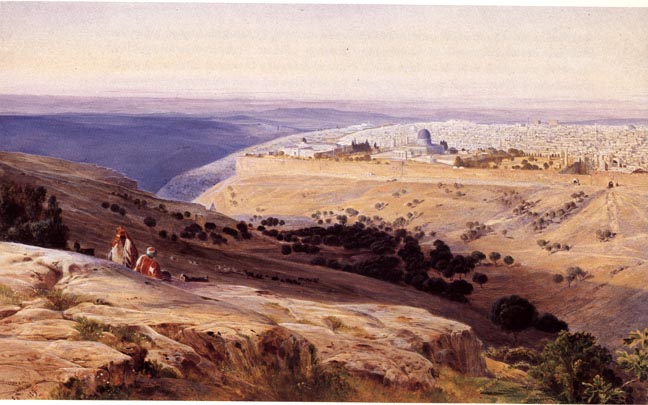
Edward Lear, Jerusalem from the Mount of Olives, Sunrise, 1859

I have mentioned Edward Lear briefly before - specifically the habit he developed of annotating his sketches.  In reading Robert Harbison recently I came upon an excellent description of Lear's landscape paintings with their 'droll notations'.  Lear's life was 

'spent mostly abroad simply because the English climate disagreed with him and he could find nothing to do at home.  So he became the sketcher and painter of exotic views, taking himself unhappily over big stretches of southern Europe and the middle East.  Much of his interest lies in his misplacement, a man who would be the truest homebody but for some flaw, who now converts preposterous places to clever mechanical tracery.  To someone familiar with his books of nonsense the landscapes are disappointingly uneccentric.  For an artist to confine himself to forms other than human is usually significant of something, and Lear provokes the suspicion that he is in these places because there are few Englishmen to meet or paint.  His earlier zoological and ornithological work is revealing because he invests every subject with personality, but the later, more refined landscapes leave out, as do all accounts of his life, the essential facts.  The most individual things about them are the droll notations in a springy script, which are painted out by the colors they describe; Lear erases the glimpse of himself he gives.  And the compositions are of such slender substance, the solidities of the picture often vacating to the back center, evading near-sighted eyes, echoing the flight from the self.  These landscapes of melancholy emptiness, faraway places seen from far away, are only a distinctive case of a Victorian genre - romantic topographical sketches of Near Eastern scenes.'

Harbison says here that 'for an artist to confine himself to forms other than human is usually significant of something.'  His suspicion that Lear was running away from people echoes a concern sometimes expressed that landscape art is an escape from the body - see the earlier post I did on this in connection with D. H. Lawrence. The paragraph on Lear forms part of his discussion of 'Dreaming Rooms: Sanctums', those spaces of safety in which the mind is free to travel.  Exotic topographical landscapes like Lear's 'exemplify a special nineteenth-century indecision between the literal and the imaginary, functioning like an invented imagery, but located on a particular page of the atlas.'

These observations form part of Harbison's Eccentric Spaces (1977), a consciously eccentric book that begins in the garden, moves inside to the sanctum (see above), then out into the world of machines and cities before spending a good deal of space discussing literature - topographical and architectural fictions - and concluding with the increasingly abstract spaces of maps, museums and catalogues. The book's preface describes the difficulty Harbison had in publishing this interdisciplinary, digressive book.  You can see why editors might have worried about sentences like this: 'A map seems the type of the conceptual object, yet the interesting thing is the grotesquely token foot it keeps in the world of the physical, having the unreality without the far-fetched appropriateness of the edibles in Communion, being a picture to the degree that that sacrament is a meal.'  But the book has several illuminating passages for those interested in landscape: much of the gardens chapter of course, descriptions of Ruskin in Venice, an argument for the important role of landscape in Mrs Radcliffe's Mysteries of Udolpho, and an appreciation of the detailed, almost cartographic paintings of Breugel in which significant and insignificant scenes are balanced and a spatial order replaces the moral.

Thursday, August 13, 2009

The Hebrides Overture


J. M. W. Turner, Staffa, Fingal's Cave, 1832 

Last night I watched the recent Charles Hazlewood documentary for the BBC on Felix Mendelssohn which included some discussion of the Hebrides Overture (completed in 1830).  There is an interview with biographer R. Larry Todd on the BBC's Mendelssohn site in which the composer's creation of the Hebrides Overture is discussed:

'From what I can tell, he was essentially a synaesthete, meaning that for him visual and musical imagery are interconnected. So when he goes to the Hebrides and he’s in Oban looking out at the coastline of Mull, it’s there he gets the idea for the opening of the Hebrides Overture and he writes a famous letter that sketches everything out in piano score. The fact that he puts it in a particular location means it’s clear that already in that composition there’s something about the particular combinations of colour that evolve and that what’s triggering it is the visual impression of looking out at the Isle of Mull. Well before he even got to Fingal’s Cave, he’s having the ideas for the Overture and it’s a visual impression that’s sparking the musical response. These things go hand in hand and particularly are tied in with the art of orchestration. That’s the romantic side of Mendelssohn.'

Sketch of a scene by Felix Mendelssohn 
found in his letter of August 1, 1829 to his sister Fanny

As you can see on the Birth of British Music site, Charles Hazlewood donned his woolly hat and headed north to Staffa (don't get me wrong - I like the hat - it could have been much worse).  The wind, waves and echoes of Fingal's Cave threatened to drown out Hazlewood as he stood there explaining the genesis of Mendelssohn's overture.  The programme included a clip of Andrew Motion comparing Mendelssohn to John Keats, who also visited Staffa in 1818 (Mendelssohn went in 1829).   Keats jotted down a poem, 'Staffa', in a letter to his brother Tom (rather dismissing it, saying "I am sorry I am so indolent as to write such stuff as this"). Here is part of the poem in which a spirit, Lycidas, describes the overwhelming power of the natural music to be heard at Fingal's Cave:

This was architectur'd thus
By the great Oceanus! -
Here his mighty waters play
Hollow organs all the day;
Here by turns his dolphins all,
Finny palmers great and small,
Come to pay devotion due -
Each a mouth of pearls must strew.
Many a mortal of these days,
Dares to pass our sacred ways,
Dares to touch audaciously
This Cathedral of the Sea!
I have been the pontiff-priest
Where the waters never rest,
Where a fledgy sea-bird choir
Soars for ever; holy fire
I have hid from mortal man;
Proteus is my Sacristan.

Monday, August 10, 2009

The Devil's Arse

Undoubtedly one of the best books I've ever read on landscape is Marjorie Hope Nicolson's Mountain Gloom and Mountain Glory (1959).  Here is a brief extract in which she cites Thomas Hobbes as an example of the tendency to denigrate mountain scenery, writing at a time when mountains were still viewed with distaste or fear.

'In 1636 the still unknown tutor of the youthful William Cavendish, later second Earl of Devonshire, set himself the task of celebrating the district in which his patron lived, and Thomas Hobbes - who considered himself at this time a man of letters rather than a philosopher - produced a poem, De Mirabilibus Pecci Carmen.  Hobbes was quite at home at Chatsworth.  He had also traveled abroad with his pupil.  He had experienced dangers of travel compared with which the Derbyshire Highlands were only child's play.  Certainly he could not really have felt the fear and distaste he expressed in his poem, but was obviously describing the scenery about Chatsworth as Latin tradition dictated.

Although the De Mirabilibus Pecci Carmen may offer some material to a reader interested in manifestations of semiscientific curiosity, the student of literature is likely to remember it rather because Hobbes, when he attempted to be a poet, left behind him one of the worst examples of "metaphysical" grotesquerie:

          Behind a ruin'd mountain does appear
          Swelling into two parts, which turgent are
          As when we bend our bodies to the ground,
          The buttocks amply sticking out are found.

Such was the mountain poetry of the philosopher who was to give new direction to aesthetics and literary criticism.'

Here is the title page from the 1678 edition, which included Hobbes' Latin and an English translation by 'a person of quality'.  Note the reference to 'the Devil's Arse'.

 
Source: British Library

Saturday, August 08, 2009

Vertigini

This is the last of my short series of posts about contemporary landscape drawing, based on Phaidon's Vitamin D survey.  Serse, in addition to being one of my wife's favourite operas, is the name of an Italian artist whose sea, forest and mountainscapes are all drawn by a process of erasure.  He works from photographs, covering a sheet of paper with base of graphite and then working on it with an eraser to reproduce the image.  Writing ten years ago in the New York Times, Grace Glueck concluded that 'at this point the artist's technical virtuosity is more impressive than his esthetic achievement.'  But in Vitamin D, Barbara MacAdam finds much to admire: 'the drawings end up having more depth and intensity than actual photographs.  The artist uses graphite not only to depict or imitate nature, but also to imitate a photograph.  In so doing he achieves a strange conceptual distance from his original source, which is often a color photo.' Whether or not copying photographs in this way can create a 'strange conceptual distance', it's true that some of his views have a strange feel to them, like Vertigini (Dizziness) (1999) which shows a mountain range with two separate vanishing points.

In her description of Serse's drawings, Barbara MacAdam draws links with quite a range of other artists - Hiroshi Sugimoto, Robert Longo, Robert Smithson, Jean Dubuffet and Edvard Munch. One could add to this list Caspar David Friedrich and Giorgio Morandi, mentioned in another short piece on Serse to accompany an exhibition at the Tim Van Laere gallery in Antwerp.  But Serse was a new name for me on reading Vitamin D and I can't see much about him online (at least not in English).  And if you google for images by Serse (or Serse Roma, to use his full name) you're actually most likely to hit upon these Freddo glasses which he has designed for Illy, with undulating waves of silver inspired by the sea at Trieste.

Thursday, August 06, 2009

The Mill on the Floss

In The Mill on the Floss (1860), George Eliot describes the landscape of childhood.  'Life did change for Tom and Maggie; and yet they were not wrong in believing that the thoughts and loves of these first years would always make part of their lives. We could never have loved the earth so well if we had had no childhood in it, - if it were not the earth where the same flowers come up again every spring that we used to gather with our tiny fingers as we sat lisping to ourselves on the grass - the same hips and haws on the autumn hedgerows - the same redbreasts that we used to call 'God's birds' because they did no harm to the precious crops. What novelty is worth that sweet monotony where everything is known and loved because it is known?'

'The wood I walk in on this mild May day, with the young yellow-brown foliage of the oaks between me and the blue sky, the white star-flowers and the blue-eyed speedwell and the ground ivy at my feet - what grove of tropic palms, what strange ferns or splendid broad-petalled blossoms, could ever thrill such deep and delicate fibres within me as this home-scene? These familiar flowers, these well-remembered bird-notes, this sky with its fitful brightness, these furrowed and grassy fields, each with a sort of personality given to it by the capricious hedgerows - such things as these are the mother tongue of our imagination, the language that is laden with all the subtle inextricable associations the fleeting hours of our childhood left behind them. Our delight in the sunshine on the deep bladed grass today, might be no more than the faint perception of wearied souls, if it were not for the sunshine and the grass in the far-off years, which still live in us and transform our perception into love' (Chapter 5).

And the theme is picked up again at the end of Chapter 14: 'There is no sense of ease like the ease we felt in those scenes where we were born, where objects became dear to us before we had known the labour of choice, and where the outer world seemed only an extension of our own personality: we accepted and loved it as we accepted our own sense of existence and our own limbs. ...  One's delight in an elderberry bush overhanging the confused leafage of a hedgerow bank as a more gladdening sight than the finest cistus or fuchsia spreading itself on the softest undulating turf, is an entirely unjustifiable preference to a landscape gardener, or to any of those severely regulated minds who are free from the weakness of any attachment that does not rest on a demonstrable superiority of qualities. And there is no better reason for preferring this elderberry bush than that it stirs an early memory - that it is no novelty in my life speaking to me merely through my present sensibilities to form and colour, but the long companion of my existence that wove itself into my joys when joys were vivid.'

Sunday, August 02, 2009

Wind Vane

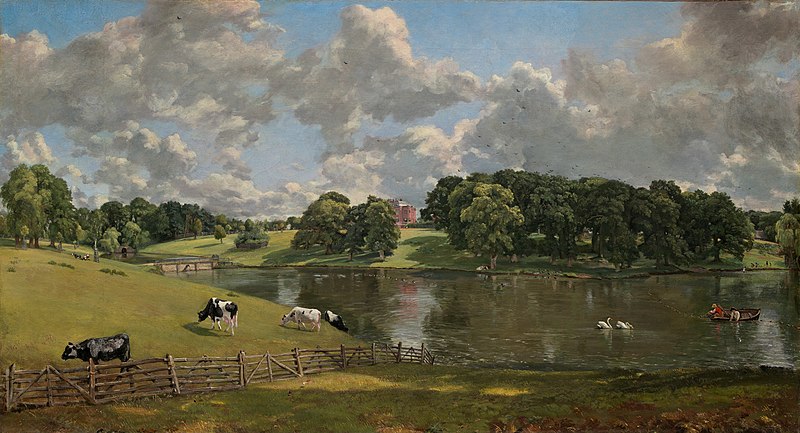
We know that naturalism is a style like any other - Gombrich's Art and Illusion goes to some lengths demonstrating this in the case of Constable's apparently simple, realistic painting of Wivenhoe Park.  For photographers and film makers the landscape imprints itself more directly, but they still decide where to point the camera.  Chris Welsby's 1972 film Wind Vane, however, partly dispenses with this artistic control by allowing the wind to decide the frame at any given moment, using a kind of sail device.  The photo below shows how this was done, suggesting that to get close to a landscape-generated landscape film requires quite an elaborate artistic set-up.

 
Chris Welsby with cameras for Wind Vane, 1972

The film is described on Chris Welsby's excellent website. 'The location for this film is the western end of Hampstead Heath in London. Two cameras mounted on tripods with wind vane attachments were positioned about 50 feet apart along an axis of 45 degrees to the direction of the wind. Both cameras were free to pan through 360 degrees in the horizontal plane. There are three continuous 100 foot takes for each screen. The movements of the two cameras, which were filming simultaneously, were controlled by the wind strength and direction. The sound was recorded synchronously with the picture track and consists mainly of wind noise. Each screen has its own soundtrack when projected.'

For me the most interesting thing about this film is the way the two cameras register the passing wind - both move in response to it but one follows slightly later than the other, giving a sense of the wind's movement across the Heath.  In an article called 'Blowin' in the Wind', Fred Camper describes another film in which the wind is integral to the filming process: Tree (1974): 'Welsby tied his camera to a tree branch during a strong wind; he'd planned an 11-minute film, but the camera malfunctioned and the usable portion was 4 minutes. The wobbles of the frame as the branch moves dominate the movements of grass and branches within the frame: the viewer becomes profoundly aware of how much the act of framing conveys dominance and control though here the agent is the wind.'


The BFI have released a DVD of Chris Welsby's films in the same series as the William Raban collection I described last month.  It includes his collaboration with Raban, River Yar (1972), Drift 'a study of winter light falling on the surface of water, metal and cloud', and (for me the most effective film) Sky Light - 'an idyllic river flows through a forest, flashes of light and colour threaten to erase the image, bursts of short wave radio and static invade the tranquillity of the natural sound.' The films should be viewed on bigger screens than our little TV, but I think the DVD is well worth watching to get a sense of Welsby's progress from early films like Wind Vane to recent installations like Lost Lake.  (I can't speak for the DVD's 20 page booklet which sounds good but was missing in the copy I borrowed from our local video shop.)


To conclude, here is how Chris Welsby views his work as a landscape artist, quoted from the introduction to his website: 'unlike the landscape painters and photographers of the nineteenth century, I have avoided the objective view point implicit in panoramic vistas or depictions of homogeneous pictorial space. I have instead concentrated on 'close up' detail and the more transient aspects of the landscape, using the flickering, luminous characteristics of the film and video mediums, and their respective technologies, to suggest both the beauty and fragility of the natural world. The process of re-presenting the landscape in either the single screen works or the installations is not seen to be separate from nature or in any way objective, but is viewed instead, as part of a more symbiotic model in which technology and nature are both viewed as inter-related parts of a larger gestalt.'

Friday, July 31, 2009

4 postcards from Venice

I heard designer Celia Birtwell on the radio the other day saying how her friend David Hockney often sends her drawings made on his iPhone.  This reminded me of Simon Faithfull, who has made a new kind of plein air landscape art using a personal digital assistant.  According to Mark Godfrey, writing in Vitamin D: New Perspectives in Drawing, the results have 'a stuttering, awkward quality; childlike, but divorced from from childlike themes.  The lines appear either black against a white ground, or vice versa, meaning that no twilight tones can be registered.  There is little shading, and when this does appear, it is not as cross-hatching or rubbing, but as one of a limited number of preset "fill-in" options.  Faithfull also sometimes uses basic animating devices.  He replicates a rippling canal surface with moving horizontal dashes (in the series "4 postcards from Venice," 2003, completed during the Biennale).  These animations aren't particularly dramatic.  Rather, Faithfull seems to emphasize the inadequacy of a new medium to render basic perception or to deliver the spectacular.'  This new take on the Venetian landscape may not sound too promising, but you can judge for yourself by looking at the work in question on his website.

Here is another description of Simon Faithfull's methods, from Donna Da Salvo's essay for an exhibition of sketches made at Dreamland, an old amusement park in Margate:  'Produced quickly using a Palm Pilot and finger, each of Faithfull’s drawings is made from life, and constitutes a map of his walk through Dreamland. Like the modern day flaneur roaming the park, Faithfull captures the momentary pleasure of looking. Some drawings are complex compositions, including views of the undulating landscape of the grade II listed Scenic Railway, or the frenetic movement of a car as it speeds along the rails of the Wild-Mouse, or even a solitary person and a gull on their respective perches by the sea. In others, he offers glimpses of life – a half-empty soda-fountain glass left behind, or the incomplete outline of two figures hidden behind sunglasses. These images can be read as pages from a sketchbook, albeit one that uses software to endlessly reproduce and then reintroduce them back into the world. He has said of them, ‘They are distillations of moments filtered through my head, but not my memory.’'

And finally, here is what he had to say to Sarah Kent at Time Out about the Antarctic landscape, which he visited in 2004-5 on an Arts Council fellowship, traveling with the British Antarctic Survey. 'I was afraid I’d come back with images looking like photographs from the National Geographic, but it’s the opposite of scenic. Antarctica is a huge glacier, which is absolutely flat and cloud-covered, but the light is almost supernatural in strength; its intensity is more than your eyes can deal with. The sun doesn’t set and there’s a weird phenomenon called ‘ice blink’; the underside of the clouds glows white with light reflected off the ice, so there’s complete white-out, which is utterly disorientating. Because there’s no moisture, the air is crystal clear and you can see further than ever before. But because there’s no horizon line, you lose all sense of scale and, instead of a landscape unfolding towards the horizon, there’s literally nothing to see. As you walk you can hear your feet making footsteps, but you can’t see them because there’s no definition or contrast, so it feels claustrophobic – as if everything were folding back on itself. I’d gone all that way to see the wilderness, but there was absolutely nothing to see, except the stuff brought there by people!'

Tuesday, July 28, 2009

Naught moves but clouds

Edward Thomas wrote all his poetry over a period of twenty-seven months, from November 1914 to January 1917.  Read in sequence they trace the progress of the seasons, often drawing on his memories of Kent, Hampshire, Somerset, Wales.  Sometimes they describe the landscape of the trenches, and sometimes they mingle past and present.  Here are extracts from different poems that refer to specific months, arranged as a kind of Edward Thomas calender:

February

The rock-like mud unfroze a little and rills / Ran and sparkled down each side of the road / Under the catkins wagging in the hedge

Black rocks with white gulls following the plough

... the sun on the celandines...

March

What did the thrushes know?  Rain, snow, sleet, hail, / had kept them quiet as the primroses.
 ad kept the
After a night of frost, before / The March sun brightened and the South-west blew, / Jackdaws began to shout and float and soar / Already, and one was racing straight and high / Alone, shouting like a black warrior / Challenges and menaces to the wider sky.

April

The April mist, the chill, the calm...

When mist has been forgiven / And the sun has stolen out, / Peered, and resolved to shine at seven / On dabbled lengthening grasses, / Thick primroses and early leaves uneven, / When earth’s breath, warm and humid, far surpasses / The richest oven’s...

May

Thrush, blackbird, all that sing in May...

The sedgewarblers that hung so light / On willow twigs, sang longer than any lark, / Quick, shrill or grating, a song to match the heat / Of the strong sun, nor less the water’s cool / Gushing through narrows, swirling in the pool.

The cherry trees bend over and are shedding / On the old road where all that passed are dead...

June

What I saw / Was Adlestrop – only the name / And willows, willow-herb, and grass, / And meadowsweet, and haycocks dry, /No whit less still and lonely fair / Than the high cloudlets in the sky.

The green roads that end in the forest / Are strewn with white goose feathers this June...

... in the little thickets where a sleeper / For ever might lie lost, the nettle-creeper / And garden warbler sang unceasingly; / While over them shrill shrieked in his fierce glee / The swift with wings and tail as sharp and narrow / As if the bow had flown off with the arrow.

July

Naught moves but clouds, and in the glassy lake / Their doubles and the shadow of my boat.

September

... September hides herself / In bracken and blackberry, harebell and dwarf gorse.

October

The green elm with one great bough of gold / Lets leaves into the grass slip, one by one

November

November has begun / Yet never shone the sun as fair as now / While the sweet last-left damsons from the bough / With spangles of the morning’s storm drop down / Because the starling shakes it, whistling what / Once swallows sang.

... of all the months when earth is greener / Not one has clean skies that are cleaner.   Clean and clear and sweet and cold...

Thursday, July 23, 2009

From the Mountains to the Lagoon

The first chapter of Peter Humfrey's 2007 monograph on Titian is called 'From the Mountains to the Lagoon'.  Titian was born in Pieve di Cadore, a small town in the Dolomites, and later 'acquired property there and invested in his family's timber business, which carried logs from the mountains and valleys of Cadore to the boatyards of Venice by way of the River Piave and the Adriatic Sea.  Titian's enduring affection for his homeland seems to be reflected in the jagged peaks, precipitous rocks, rushing torrents and dense forest that he added to the existing repertory of Venetian painting.'


Titian, background to Giovanni Bellini's Feast of the Gods, 1529

Humfrey's first example is actually a Giovanni Bellini painting, Feast of the Gods (1514), which had been the first commission for Alfonso d'Este's camerino in Ferrara.  Once Titian started producing paintings like Bacchus and Ariadne for Alfonso, Bellini's painting would have looked a bit old hat, so Titian was asked to re-work the landscape.  Another work that seems to draw on Titian's memories of the Dolomites is the mountainous background to the Presentation of the Virgin in the Temple (1534-8).  And a third example given by Peter Humfrey is the 'savage, fitfully illuminated landscape' of St Jerome in Penitence, painted just before Titian's death in 1575 (a far cry from the generalised Arcadian landscapes he had painted under the influence of Giorgione seventy years earlier).


Titian, background to Presentation of the Virgin in the Temple, 1534-8

The influence of Titian's birthplace is not discussed in A. Richard Turner's classic survey, The Vision of Landscape in Renaissance Italy.  Instead he shows the great range of landscapes Titian was able to paint, beginning his account by quoting Count Francesco Algarotti's view, expressed in 1756, that 'Titian, nature's greatest confidant, is among landscapists the Homer.'  For Algorotti, 'perhaps the most beautiful landscape ever painted is that of the Peter Martyr, where for the variety of trunks, of leaves, of the various bearings of the limbs one can discern the difference between one tree and another; where the land is so well partitioned and rolls on with such natural grace; where a botanist would go to gather plants.'


Titian, engraving after The Death of St Peter Martyr, 1530

Looking back to Kenneth Clark's Landscape into Art, I find the following: 'anyone who has visited Cadore will recognize that the impressions of Titian's native place remained with him all his life.  The rocky hills with their thick clusters of trees, the rushing streams and blue mountain distances are seized upon with Titian's sensual power, and crowded into the small background of a portrait.  Very occasionally they are given more space, and we recognise the origin of all Carracciesque landscape.  The great hunting landscapes by the Carracci in the Louvre are no more than freer and more crowded versions of the Venus of the Pardo which hangs opposite them; and from the lost St Peter Martyr, the most copied picture in the world, there flowed a series of landscape compositions which furnished the seventeenth century.  Titian's appetite for nature gives to his landscapes a magnificent fullness.  His trees, in particular, have a weight of leaf and roundness of trunk never surpassed, and it is not surprising that Poussin and Rubens, Constable and Turner all looked on him as a source of inspiration.'

Among all the many qualities that distinguish Titian, how wonderful to think that he painted a 'roundness of trunk never surpassed'...

Friday, July 17, 2009

The Overlook

Another short post on a contemporary artist drawing imaginary landscapes: Frank Magnotta.  According to Dominic Molon in Vitamin D, Magnotta's drawings reflect 'the staggeringly constant turnover of the contemporary American landscape in the past fifty years, resulting from the heightened cycles of real estate development and relentless urban gentrification' leading to 'a national sense of perpetual unsettledness'.  Many of these feature architectural fantasies set against an empty background, like Post (2007), which can be seen accompanying an interview in Fecal Face magazine, where Magnotta says 'in the U.S. I'm not sure that we really build monuments any more, but in a way popular culture is the great ephemeral American monument. I'm interested in giving form to that.'

Sometimes he'll draw in a surreal landscape background, as in the recent Grand Optimist. In The Overlook (2004) buildings are entierly absent.  This drawing 'features a vast snowy landscape with such phrases as as HERITAGE HILLS, CRYSTAL LAKE, and GOLDEN ROSE placed at various points within the image.  Divorced from the assumed villaages that the phrases herald, the names become empty signifiers, meaningless ascriptions of perceived exclusivity and privelege that speak more to our desire for the trappings of wealth and prestige than the actual ability of language or objects to provide such bounty' (Dominic Molon).

Sunday, July 12, 2009

Thames Film


I spent a happy evening with a friend yesterday eating Il Bacio pizzas and watching the BFI's DVD compilation of William Raban films.  It includes his 66 minute long documentary Thames Film (1986), which flows from the city of London to the mouth of the river and ends with the incredible science fiction landscape of the Thames estuary seaforts.  The film was partly inspired by T.S. Eliot and includes lines from Four Quartets read by the poet.  The inclusion of poetry like this is familiar from other landscape and city documentaries - Terence Davies' Of Time and the City (2008) is just one recent example.  More striking, I think, is Raban's clever use of Breughel's painting The Triumph of Death which the camera pans over (in a manner reminiscent of Tarkovsky in Solaris) at several points in the film, revealing a series of links between the river's dark past and Breughel's apocalyptic vision.

Pieter Breughel the Elder, The Triumph of Death, c1562

Peter Ackroyd (inevitably) is an admirer of Thames Film and you can read his essay at the Luxonline site for William Raban.  He says, for example, that it is 'in many respects it is a visionary film. There are moments of light and colour that lift the spirit with exaltation. There are giant shapes and structures that fill the mind with awe. There are passages of mist and turbulence that recall the primaeval Thames of swamps and marshes. The multifold images of the river run through this film like the currents and tides of the water itself. It is a film, in every sense, of great fluency. The sounds, as well as the images, of the river are of great importance. There is a continual clangour, a loud lament, with the sound of machinery fighting against the lap of the water and the cry of the seagulls.'

Thames estuary seaforts, from Thames Film

William Raban has been making landscape films since Sky (1970) and River Yar (1971-72 a collaboration with Chris Welsby).  He says 'the first films I made were extensions to my work as a painter. The paintings involved taking impressions from natural surfaces like waves and tree bark. For the 'Tree Print' series canvas was left installed on tree trunks for long periods to weather and discolour. The films made at this time had a similar naturalistic approach towards documenting changes, and were mostly static views of landscapes where various 'time-lapse' systems were used to make slow movements like the rise and drop of tide levels and development of cloud patterns clearly perceptible.'

In the wake of these early experimental works, he has, in addition to Thames Film, made a sequence of films that have charted the changing face of London and its river:
  • Thames Barrier (1977) - a synchronised three-screen time-lapse film of the river during the building of the Thames Barrier
  • Sundial (1992) - the tower of Canary Wharf filmed as a giant gnomon to mark the passing of a day
  • A13 (1994) - a Vertov-influenced commentary-free sequence showing the construction of Limehouse Road Link and its effects on the local landscape
  • Beating the Bridges (1998) - another river film in which thirty Thames bridges provide 'a range of acoustic space that is featured on the soundtrack by the ambient reverb and a live percussion score'
  • MM (2002) - like A13, another quietly polemical film about the changing cityscape, this time focusing on the creation of the Millenium Dome

The Millenium Dome, from MM

Friday, July 10, 2009

From Murano Grande

This is one of a few posts I'm going to do on contemporary drawn landscapes, based on Phaidon's excellent survey Vitamin D: New Perspectives in Drawing. Emma Dexter's introduction to the book examines the open possibilities of drawing today - in contrast to photography this archaic form is now 'an under-regarded and under-theorized backwater.' The definition of drawing can be stretched from pictures made with pencil and paper to inscribed landscapes (she reproduces Richard Long's A Line Made by Walking where the earth is revealed 'as a surface or ground to be marked, etched, and scarred by the body as the instrument of drawing, taking the role of pencil or pen.') However, the artists I'll mention here have been concerned with drawing in the traditional sense, depicting imaginary landscapes in a medium that can convey formal precision, satirical bite or childlike innocence.

The first of these is Cuban artist Glexis Novoa, who now lives in Miami. Here is an extract from Rubén Gallo's discussion of his work. 'Rem Koolhaas once wrote that in the future, all cities will be generic, as bland and nondescript as airports. Many of Novoa's drawn landscapes, including From Murano Grande (2002) depict the generic city of the future: unspecific urban spaces that could be located in Europe or America, in India or Africa. The cityscapes seem ostensibly prosperous - the buildings are tall, the streets are clean - but are entirely devoid of life. There is not a single soul on the streets. The cemetery-like coldness of these environments is further intensified by the artist's choice of slabs of marble as support for his drawings. Novoa provokes our thoughts: Are these dehumanized cities what the future holds in store? Or are they already a reality in many parts of the world?'

Looking around for an image of this work on the web, I see it is possible to buy a From Murano Grande scarf. Here are three more Glexis Novoa landscapes from the artist's website:
You can also get a feel for his work from a few videos on Youtube, e.g. "Cuba, Fidel & Obama" (SITE, YF-23, Kim Il, Samotracia, ONL & palmera Antiimperialista).

Tuesday, July 07, 2009

Landscape futures


Geoff Manaugh was in London today to launch the BLDGBLOG book, so I popped over to the Architectural Association this evening to hear him give an entertaining whistle-stop tour of its contents. It had been a day of strange weather with a massive downpour earlier, like something out of the book's 'Redesigning the Sky' chapter (aggressive cloud seeding during the Vietnam War). The book is fascinating and beautiful to look at, with a lot of on landscapes and soundscapes. Some of the people I've discussed here before crop up - Simon Norfolk, Christian Bök, W.G. Sebald, J. G. Ballard (of course). So here are Ten More Reasons to read the book (in addition to those given on the BLDGBLOG site) - examples of the book's 'architectural conjecture :: urban speculation :: landscape futures'.

The idea that...
  • the Mesolithic landscape of Doggerland, which lies under the North Sea, could be made to re-emerge behind massive ring cities in the form of hydrological projects, encircling the flooded landscape
  • John Milton anticipated the Manhattan Project in his description of the preparations for 'an insurrectionary terrorist invasion of Heaven' in Paradise Lost - a 'mineral activation of the Earth as a resource for high-tech weaponry'
  • the fountains of Rome could be turned into a sequence of liquid cinemas
  • a kind of Sir John Soane museum of historically important architectural fragments culd be established, exhibiting items like the window JFK was shot from, detached like a Gordon Matta-Clark building cut
  • a new set of sound mirrors should be built in the landscape to create specific sounds at specific times - 'a distant gully that moans every year in the second week of November'
  • bands should start doing cover versions of environmental sound recordings - Godspeed You! Black Emperor providing a perfect rendition of a Brian Eno recording of Bayswater Road
  • Rachel Whiteread should begin filling whole cave systems with plaster
  • with a version of the inflatable architecture designed by Swiss architecture firm Instant, you could inflate 'an entire borough that has never otherwise existed, sprawling across the marshy plains of east London. Call it Hackney 2, or Stoke Airington' (a reference to Stoke Newington, where I'm now sitting and writing this)
  • hurricanes could be averted by storing winds in an Aeolian Reef, inspired by the 'weather breeding isle' in Virgil's Aeneid: 'Here in a vast cavern King Aeolus /Rules the contending winds and moaning gales /As warden of their prison. Round the walls / They chafe and bluster underground. The din /Makes a great mountain murmer overhead...'
  • 'a distant heir of J. M. W. Turner returns sunburnt from the tropics to find London an archipelago of failed sea walls and waterlogged high-rises, the suburbs an intricate filigree of uninhabited canals, bonded warehousing forming atolls amidst sandbanks and deltas'

Saturday, July 04, 2009

So foul a sky clears not without a storm

'In the time of Spanish rule, and for many years afterwards, the town of Sulaco -the luxuriant beauty of the orange gardens bears witness to its antiquity-had never been commercially anything more important than a coasting port with a fairly large local trade in ox-hides and indigo.' This is the euphonious opening sentence to Joseph Conrad's Nostromo (its rhythm reminds me of the famous declaration at the start of The Adventures of Augie March “I am an American, Chicago born—Chicago, that somber city—and go about things as I have taught myself, free-style, and will make the record in my own way.”)
Conrad spends the whole of the first chapter describing the landscape of Sulaco and the Golfo Placido: scene setting, yes, but also a sign that this novel's ambition includes the creation of a completely believable South American country in all its details. Here, for example, is Conrad's first mention of the Cordillera - mountains which have isolated Sulaco from the effects of Civil War until the turbulent events of the novel:

'On crossing the imaginary line drawn from Punta Mala to Azuera the ships from Europe bound to Sulaco lose at once the strong breezes of the ocean. They become the prey of capricious airs that play with them for thirty hours at a stretch sometimes. Before them the head of the calm gulf is filled on most days of the year by a great body of motionless and opaque clouds. On the rare clear mornings another shadow is cast upon the sweep of the gulf. The dawn breaks high behind the towering and serrated wall of the Cordillera, a clear-cut vision of dark peaks rearing their steep slopes on a lofty pedestal of forest rising from the very edge of the shore. Amongst them the white head of Higuerota rises majestically upon the blue. Bare clusters of enormous rocks sprinkle with tiny black dots the smooth dome of snow.'

The landscape in this first chapter will impact on the narrative and, literally in the case of the Cordellera, cast a shadow on Nostromo's characters. Conrad describes the political struggle for this territory, the transformation brought about by foreign capital and the coming of the railway, and the exploitation of its natural resources in the form of the increasingly productive silver mine. But like a Turner history painting it also registers the fleeting effects of sunlight and atmosphere: clouds are often described and the novel begins with a quotation from Shakespeare, "So foul a sky clears not without a storm."

At one key point in the novel, the landscape disappears altogether, as Decoud and Nostromo try to spirit away the mine's silver in a small boat in the misty silence of night: 'A great recrudescence of obscurity embraced the boat. The sea in the gulf was as black as the clouds above. Nostromo, after striking a couple of matches to get a glimpse of the boat-compass he had with him in the lighter, steered by the feel of the wind on his cheek. It was a new experience for Decoud, this mysteriousness of the great waters spread out strangely smooth, as if their restlessness had been crushed by the weight of that dense night...'

The novel actually contains a landscape painting - a vision of the country before the mine was developed, captured by the wife of the mine administrator, Charles Gould. 'The waterfall existed no longer. The tree-ferns that had luxuriated in its spray had died around the dried-up pool, and the high ravine was only a big trench half filled up with the refuse of excavations and tailings. The torrent, dammed up above, sent its water rushing along the open flumes of scooped tree trunks striding on trestle-legs to the turbines working the stamps on the lower plateau--the mesa grande of the San Tome mountain. Only the memory of the waterfall, with its amazing fernery, like a hanging garden above the rocks of the gorge, was preserved in Mrs. Gould's water-colour sketch; she had made it hastily one day from a cleared patch in the bushes, sitting in the shade of a roof of straw erected for her on three rough poles under Don Pepe's direction.'

It is like a description of Eden - a comparison made explicit when Mrs Gould looks at the landscape visible now only in this watercolour:

"Ah, if we had left it alone, Charley!"

"No," Charles Gould said, moodily; "it was impossible to leave it alone."

"Perhaps it was impossible," Mrs. Gould admitted, slowly. Her lips quivered a little, but she smiled with an air of dainty bravado. "We have disturbed a good many snakes in that Paradise, Charley, haven't we?"

Monday, June 29, 2009

Straight Miles and Meandering Miles

The catalogue to the Richard Long exhibition Heaven and Earth, which I discussed here recently, draws attention to Long's early career at art school, when he first developed the ideas that have motivated his art ever since. Long has recalled one important influence at the time was John Cage. He saw Cage lecture at the Saville Theatre in November 1966: 'It was all about chance and eccentric lateral thinking and humour - all sorts of John Cage ideas which were new to me.' A year later he experienced a recorded lecture, Indeterminacy, in which Cage told sixty stories in sixty minutes, varying the pace according to the length of the story. As Clarrie Wallis points out, this procedure is similar to that used in Long's map work A Walk of Four Hours and Four Circles (1972), where concentric circles were each walked in one hour (the smallest circle slowest, the largest fastest).

Thinking of avant garde composers in this context, I was reminded of La Monte Young's Compositions 1960 - an early example of conceptual art as instructions, e.g.
#2: Build a fire in front of the audience…
or
#5: Turn a butterfly (or any number of butterflies) loose in the performance area. When the composition is over, be sure to allow the butterfly to fly away outside…
One of these compositions sounds like a Richard Long walk:
#10: Draw a straight line and follow it
You could imagine one of Long's early map works re-written in this way as instructions for an imaginary walker:

A Ten Mile Walk, England, 1968
1. Pick a starting point x
2. Pick a round number y
3. Draw a straight line from x of length y in a direction that it is possible to walk
4. Walk the line

Of course the fact that Long has done his walks is the whole point. It is his landscape experience that we are presented with, even though we can accompany him in our imagination (just as we can join Gary Snyder on the riprap trail, or Basho on the narrow road). His work is not participative in the style of contemporary relational aesthetics. Still, while I'm on this road not taken, here are four more Richard Long walks recast as instructions. They might come in useful if you are short of ideas this summer, and, adapted for cities, they could even be used as the basis for some Situationist dérives...

A Walk of Four Hours and Four Circles, England, 1972
1. Draw a circle a on the map of diameter x
2. Superimpose a second circle b centred on the same spot with diameter 3x
3. Superimpose 2 more circles c and d with diameters 5x and 7x
4. Spend exactly an hour walking each of the four circles

A Hundred Tors in a Hundred Hours, Devon, England, 1976
1. Pick a distinctive common land form
2. Locate a round number of them, x
3. Walk to all of them in exactly x hours

A Five Day Walk, England, 1980
1. Choose a route that is x miles
2. Walk 1/15 of this distance x on the first day
3. On the second and subsequent days walk 2/15, 3/15, 4/15 and 5/15 of the distance

Straight Miles and Meandering Miles, England, 1985
1. Choose a long distance walk
2. Map out a certain number of locations where it is possible to walk a straight mile
3. Walk the route by, alternatively, normal paths and straight lines

Friday, June 26, 2009

The horizon of Holland


Back in 1965 the ICA organised an exhibition called 'Between Poetry and Painting' which included work by Ian Hamilton Finlay. Forty-four years later the ICA now has a similar exhibition entitled 'Poor. Old. Tired. Horse.', named after Ian Hamilton Finlay's magazine of that title. In addition to Ian Hamilton Finlay, the new exhibition includes work by two other artists I've discussed here before, Robert Smithson and Carl Andre. I've just taken the photo above which shows the catalogue for the 1965 exhibition next to the catalogue for the current show (which takes the form of a magazine called 'Roland'). The earlier exhibition took place before I was born but I think my uncle must have been to it and so the catalogue has found its way into my library. At that time Ian Hamilton Finlay had not yet moved to Stonypath to start work on the garden that would become Little Sparta - the catalogue says simply that he 'has lived in Perthshire, Orkney and Edinburgh, and now lives in the north of Scotland.'

On Tuesday Stephen Bann came to the ICA to give a talk about Ian Hamilton Finlay. He focused on the pre-Stonypath period and included some never-published colour photographs that he had been unable to use in an Architectural Review article (it was only printed in black and white in those days). One of these photographs showed THE HORIZON OF HOLLAND IS ALL EARS, a concrete poem made into a wooden structure and placed in the garden of Finlay's home in Ross-shire. This is the first of Finlay's interventions in the landscape, the ancestor of the sculptures at Little Sparta.

There were several references in the talk to Finlay's poetic interests and links with contemporaries like Lorine Niedecker. Finlay wrote to Bann saying that the landscape of Orkney was equivalent to a Wallace Stevens poem. He also said that Orkney resembled concrete poetry, whilst Perthshire seemed more like the writing German poets like Trakl. The less particularised landscape of Ross-shire on the other hand required more effort to make a poem out of the place... the kind of effort Ian Hamilton Finlay put there into making his first artist garden and his first poem in the landscape.

Tuesday, June 23, 2009

Design for an artificial echo

In a previous post here I quoted an extract from Gilbert White's A Natural History of Selborne, which included a proposal: "Should any gentleman of fortune think an echo in his park or outlet a pleasing incident, he might build one at little or no expense. For whenever he had occasion for a new barn, stable, dog-kennel, or the like structure, it would be only needful to erect this building on the gentle declivity of an hill, with a like rising opposite to it, at a few hundred yards distance; and perhaps success might be the easier ensured could some canal, lake, or stream, intervene. From a seat at the centrum phonicum he and his friends might amuse themselves sometimes of an evening with the prattle of this loquacious nymph..."

Back in the late seventeenth century, John Evelyn had the same thought and provided a design in his unpublished Elysium Britannicum, "to instruct you how to produce an Artificial Echo and by an innocent magick & without superstition, to raise up & deprehend that vocal & fugitive Nymph." The illustration below is reproduced from John Dixon Hunt's Greater Perfections, in which it is used to illustrate the point that Evelyn, generally a proponent of natural gardens, was nevertheless happy to recommend artificial effects where nature had not provided them.


In John Evelyn's "Elysium Britannicum" and European Gardening Therese O'Malley describes this as a sketch of the artificial echo at the Tuileries in Paris. The excellent Gardenvisit.com includes an extract from Evelyn's diary from 4 February 1644: "I finished this day with a walk in the great garden of the Tuileries, marvelously contrived for privacy, shade, or company, by groves, plantations of tall trees, especially that in the middle, being of elms, the other of mulberries. It has a labyrinth of cypresses; not omitting the noble hedges of pomegranates, fountains, fish-ponds, and an aviary; but above all, the artificial echo, redoubling the words so distinctly; and, as it is never without some fair nymph singing to its grateful returns; standing at one of the focuses, which is under a tree, or little cabinet of hedges, the voice seems to descend from the clouds; at another, as if it was underground..."

Evelyn's experience in Paris is referred to in a 1995 survey of artificial soundscapes by Joseph Dillon Ford, 'From Vocal Memnon To The Stereophonic Garden, A Short History Of Sound And Technology In Landscape Design': He concludes: 'the creation of acoustically pleasant and appropriate landscapes represents a significant opportunity for those who recognize that a design which delights the eye but neglects the ear is likely to be as well-received as a handsomely costumed actor who mumbles, butchers or forgets his lines. An excerpt from Alexander Pope's An Essay on Criticism (part II, line 62) seems especially appropriate in this connection: "Tis not enough no harshness gives offence; / The sound must seem an echo to the sense." Those landscape architects who fully appreciate the historical role of sound as a design element essential to the creation of a strong sense of place and who accept the considerable technical, aesthetic, environmental, and legal challenges required to renew the soundscape, will have the distinct satisfaction of extending their art into new, ever-richer realms of poetic experience.'

Sunday, June 21, 2009

Woods


The BBC has recently been running a Poetry Season. I didn't get to see all of it, but made a point of watching Simon Armitage on Gawain and the Green Knight. Unfortunately it was marred by some desultory attempts at popularisation - instead of discussing the poem with literary scholars Armitage was filmed trying on a suit of armour with a couple of medieval re-enactors, one of whom was called Gandalf. We saw Armitage walking in the landscape, dressed for the British weather, but there was no sense of the extremes of winter experienced by Gawain in the poem (see my earlier post on this). Still, we know Armitage is a music fan and the programme afforded my wife and I a good opportunity to play 'name that tune' with the soundtrack... "Always great to hear Joy Division..."  "Isn't that a bit of Nick Drake?..." "Goodness, he's put in 'Sheela-Na-Gig'!" "'A Forest'... nice touch."

In marked contrast to this, Owen Sheers' series ‘A Poet’s Guide to Britain’ was exemplary - completely accessible but no dumbing down. He clearly felt no need to jazz up the poetry with snatches of post-punk and his interlocutors were all interesting and relevant. Each programme lasted half an hour and circled round one poem, so that by the end you felt you really knew it. As can be seen, the list was an eclectic mixture of the famous and the not-so-famous:
  • ‘Composed Upon Westminster Bridge’ by William Wordsworth – May 4th
  • ‘Wuthering Heights’ by Sylvia Plath – May 11th
  • ‘Hamnavoe’ by George Mackay Brown – May 18th
  • ‘Dover Beach’ by Matthew Arnold – May 25th
  • ‘Poem from Llanybri’ by Lynette Roberts – June 1st
  • ‘Woods’ by Louis MacNeice – June 8th

I liked the way he didn't choose the most obvious landscape poets (Edward Thomas, say) or the most renowned poems by each writer ('Woods' is not I think that well known). The programme that opted to feature Sylvia Plath on Yorkshire instead of Ted Hughes worked really well. The poems in this list are not 'just' about the landscape - George Mackay Brown and Louis MacNeice talk about their fathers, for example; it seems to me that Owen Sheers' own poetry often combines landscape and personal memory in this way ('My Grandfather's Garden').

Louis MacNiece's poem 'Woods' was new to me. It reflects on the fact that his father, 'found the English landscape tame' - for him Escape meant an Irish landscape of 'bog or rock'. But MacNiece himself had another choice, experienced first as a schoolboy in Dorset, 'a kingdom free from time and sky'. These English woods were the landscape of 'Malory's knights, Keats' nymphs or the Midsummer Night's Dream'. 'So in a grassy ride a rain-filled hoof-mark coined / By a finger of sun from the mint of Long Ago / Was the last of Lancelot's glitter...'

This Father's Day post is dedicated to my father (who has never 'found the English landscape tame').

Saturday, June 20, 2009

Ruined

To imprint the landscape on a work of art somehow, rather than copy it in paint or describe it in words, seems a natural instinct for a landscape artist. Photography does this of course, but there are other approaches, like Roger Ackling's traces of concentrated sunlight on driftwood. The grains of sand embedded in beach paintings by plein air painters like Manet suggest a next step that might have been to leave the canvases outside for a time to weather before adding paint to them. Artists painting found objects, like the driftwood used by Alfred Wallis, may feel that they are soaking up the spirit of a place through their materials. A musical analogy to this would be the approach Ross Bolleter and the World Association for Ruined Piano Studies take, in finding and making music on old abandoned pianos. Bolleter writes:

"A piano judiciously left in the open and exposed to all weathers will ruin. All that fine nineteenth-century European craftmanship, all the damp and unrequited loves of Schumann, Brahms and Chopin dry out, degrading to a heap of rotten wood and rusting wire. The piano returns to aboriginality, re-enters the earth where the chirrup of its loose wires blown about by the desert Easterly is almost indistinguishable from the cicadas' long electric blurt.

"In which case it's not necessary (or desirable) to burn or bury a piano in order to ruin it. A Ruined Piano should be an object trouve. However, I cannot eradicate the fantasy of a piano theme park - ancient Ronischs and Bechsteins hidden in the reeds at the edge of Camel Lake or behind the Banksia being lovely watered through the long harsh West Australian summer, nurtured gently towards ruin by members of WARPS."

A sanctuary for ruined pianos has now actually been created at Wambyn Olive Farm near Perth.


Alison Croggan has a good review at the Theatre Notes blog of Bolleter's concert / installation Ruined in Tasmania earlier this year (source for the photograph above). If you want to hear a ruined piano, the WARPS website has some examples of Bolleter's music, e.g. Myo Sei / Dark Sky.

Thursday, June 18, 2009

A Line Made by Walking


Earlier this week we took a day off work and went to see the new Richard Long exhibition at Tate Britain, Heaven and Earth. I was prepared to be a bit disappointed, wondering what he'd been doing in the years since 'Walking in Circles', the last big Richard Long retrospective in 1991. Since the rise of the young British artists, Long's walks have seemed somewhat out of step with the times. In recent years it has almost seemed as if Hamish Fulton (who had a big solo show at Tate Britain and a mural in the Tate Modern cafe) was coming to overshadow Richard Long - the walking land artist equivalent of Manchester City finishing above Manchester United... I'm also not sure how much he has benefited from the growing interest in outdoor, green pursuits. Long doesn't document global warming, reclaim poisoned sites or dramatise ecological issues and, as I've discussed here before, his approach to walking in distant wilderness areas can be criticised.

Well, regardless of what Long has done recently, you can't help being struck in this exhibition by the range and creativity in his early work...
  • A Ten Mile Walk 1968 - map with route
  • A Line in Ireland 1974 - sculpture: in situ
  • Stone Line 1980 - sculpture: on the gallery floor
  • River Avon Mud Circle 1982 - mud wall painting
  • A Walk of the Same Length as the River Avon 1977 - photo/text conceptual walk
  • Mountains to Mountains 1980 - text: instructions
  • A Straight Northward Walk Across Dartmoor 1979 - text: impressions
  • From Along a Riverbank 1971 - a pamphlet
  • A Hundred Stones 1977 - a book
  • Campfire Ash 1972 - a trace of the journey
These are ten examples from the fifteen years that began with A Line Made by Walking (1967), a work that seems increasingly important with the passing years. (Its status as a classic was confirmed for me when I saw Sinisa Mitrovic urban take on it, Lines Made By Walking (2003), a film in which a woman walks against the ceaseless flow of commuters on London Bridge one morning).

But what of Long's work over the last twenty years? Like Hamish Fulton, he has been making larger work with colour photographs and bolder messages, but they do not seem loud or overstated. He still does his stone circles, his text works describing simple walk-generating procedures, and his photographs of minimal grey rock piles (which can make Andy Goldsworthy's sculptures look unnecessarily laborious). Long is treading a familiar path, but the landscape is constantly changing and I found myself admiring many of these recent works as much as his older ones. Here, to conclude, are some extracts from Jonathan Jones' highly complimentary review in The Guardian:
'Richard Long's day has come, and the controlled note of triumph in his new Tate Britain exhibition, Heaven and Earth, suggests he knows it.... An exhibition by an artist of his vintage ought by rights to be a yawn - yet another retrospective by yet another pillar of the establishment. But this is more like the birth of a new artist than the affirmation of an old one...
Long takes us back to the origins and innocence of conceptual art. The reason so much British art of the last 15 years has disappointed is not that it is "conceptual" - that it treats ideas as forms - but that so much of it is weakly conceived: pastiche conceptualism. Encountering Long again is like a great blast of fresh Dartmoor air. This is a masterclass in what an art of ideas can be, from the simple declarative prose to the grandeur of a wall that seems to seep mud. There is modesty, but no false modesty. There is reticence, but no inarticulacy.
There are criticisms to make of Long. Perhaps he is too pure, too clean an artist - not visceral enough. Perhaps his simplicity lacks nuance and depth. But, to be honest, in this deeply attractive and moving exhibition, it's hard to remember what potential reservations there might be. Today he seems like a wonderful British visionary, heir to Blake as much as to Constable.'

Saturday, June 13, 2009

Vatnajoküll

In his most recent Guardian column Charlie Brooker reminisced about compiling C90s for friends and mentioned that something similar was possible using the playlist option on Spotify. 'If you're not familiar with it [Spotify], it's effectively a cross between iTunes and a customisable online radio station. I'd heard people raving about it and didn't grasp why, until suddenly I realised you could compile a playlist, then generate a URL for it that others can click on. It's like being able to mass-produce a compilation tape in minutes. OK, so it's broken up with irritating adverts now and then, but hey, it's easy to use and it seems to work.'

Here, then, is a Some Landscapes playlist featuring some of the music I have discussed on the blog:
http://open.spotify.com/user/plinius/playlist/1hSMm6tNhRU62No0rUWgov
I hope this works... you'll need to install Spotify first. (And apologies - I realise that Spotify is not yet available in some parts of the world, e.g. Canada and the USA).

I've listed the 20 tracks below with links to earlier posts. Some things I would like to have included aren't yet available on Spotify - for example, you can't hear Jonathan Richman singing 'Twilight in Boston', although you can listen to a rather mediocre cover version. Spotify are also a bit short on soundscapes and sound art, although I've included a Chris Watson track here. They don't have Gavin Bryars' 'The South Downs', but I've put in a Roxy Music instrumental of the same title instead (a B-side from 1980). The list features composers I haven't yet discussed here in detail, e.g. Vaughan Williams (I picked his 'Norfolk Rhapsody') and Mahler, from whose Das Lied von der Erde I've selected 'Der Einsame im Herbst' ("The lonely one in Autumn"), based on a poem by Chang Tsi. A few other tracks not yet covered on this blog are Cage's 'Imaginary Landscape', one of Moondog's evocations of the New York cityscape and a Durutti Column track that seemed appropriate.
The order here is the one imposed by Spotify (alphabetic based on album title, from Ambient 4: On Land to Weather Report). But it's not a bad one - and I like the way it ends with 'Vatnajoküll', the sound of "the 10,000 year climatic journey of ice formed deep within this Icelandic glacier and its lingering flow into the Norwegian Sea."

Sunday, June 07, 2009

Scenery that retains its wild poetry and bucolic charm


We watched Eric Rohmer's The Romance of Astrea and Celadon last night. As Peter Bradshaw wrote in his review last year: 'it is an adaptation of the 1607 pastoral fantasy by Honoré d'Urfe about a lovelorn shepherd in fifth-century Gaul. There are absolutely no modern twists or inventions. The actors wear flowing robes and speak in earnest classical language. The movie is performed largely in the open air, and the wandering camera follows the players unobtrusively, keeping largely a stone's throw away. The action takes place on sunny, blowy days in an unspoilt rural landscape that could belong to any century, and filmed in such a way that it could have been made at any time in the past 30 years.'

The film has divided opinion and I'm with those like Jonathan Romney who like it. In pastoral literature, landscape is of little importance, love is all. But in filming the shepherds and shepherdesses of Honoré d'Urfe, Rohmer gives them a real backdrop, where their dialogue competes with the sounds of birdsong, water and wind in the trees. The film's opening text explains that they chose to film in a location which retains its bucolic charm (the Auvergne) - see below (the final words of this paragraph are "et de leur charme bucolique.") It makes you wonder what the film would have looked like if they had filmed it in the Forez plain, where the book was set, but I am glad Rohmer took the less obvious option of playing it straight rather than devising a post-pastoral update on the story.

Friday, June 05, 2009

Third nature

In Garden Perfections: The Practice of Garden Theory, John Dixon Hunt identifies the cultural landscape (agriculture, urban development, roads etc.) with Cicero's 'second nature.' In De natura deorum Cicero wrote "We sow corn, we plant trees, we fertilize the soil by irrigation, we dam the rivers and direct them where we want. In short, by means of our hands we try to create as it were a second nature within the natural world." 'First nature' - wilderness - is the realm of the gods, but it is also the raw material for second nature. John Dixon Hunt thinks that Cicero's formulation would have been in the mind of Jacopo Bonfadio when he wrote in 1541 to a fellow humanist that gardens make a 'third nature, which I would not know how to name.' Later in the century, another humanist Bartolomeo Taegio also used the term 'terza natura' in describing gardens.


Frontispiece to l'Abbé de Vallemont's Curiositez de la nature et de l'art (1705)

The illustration here shows a distant mountain (first nature) giving way to cultivated agricultural land (second nature) and then a formal garden (third nature). The transition is reversed in the foreground - garden, regularly planted trees, waste ground. Gardens have usually, as here, been contiguous with second nature, but sometimes they have been created directly from first nature - early American gardens carved out of the 'wilderness' for example, like Middleton Place in South Carolina. According to John Dixon Hunt, gardens have tended to represent within their own areas aspects of the three natures. In the garden above, for example, the fountain echoes the mountain spring and the cultivated garden beds can be related to the fields beyond the hedge.

Charles Jencks suggests that underneath these three natures there is 'what I have called 'zero nature', the planet, that level of nature that interests me particularly--the cosmos, its laws, the underlying physics.... The Nobel Laureate, the chemist Ilya Prigogine, often spoke about the new sciences of complexity as being 'in a dialogue with nature' because they revealed the dynamic processes of feedback and change over time. This transformation is the essence of a garden, and those I am constructing are chiefly engaged with presenting zero nature in conversation with the others. Often this discourse is carried out, literally, with letters, phrases, a rebus, and unfolding DNA codes in short, an iconography referring to zero nature built with non-living matter, or sculpture.'