Showing posts with label Saint Jerome. Show all posts

Friday, June 24, 2011

The world is blue at its edges and in its depths

'The world is blue at its edges and in its depths,' writes Rebecca Solnit in A Field Guide to Getting Lost.  Blue is 'the color of an emotion, the color of solitude and desire, the colour of there seen from here, the colour of where you are not.  And the color of where you can never go.  For the blue is not in the place those miles away at the horizon, but in the atmospheric distance between you and the mountains.'

Solnit goes on to describe the blue distances of Renaissance paintings - the hills in Solario's Crucifixion (1503), for instance, or in the right hand panel of Memling's Resurrection (c1490).  I was gazing into one such painting by Jacopo del Sellaio last Saturday at the National Gallery of Scotland when my reverie was broken by the announcement that the room was closing for an hour, due to staff shortages.  (I just found the painting online - reproduced below - but failed to note down any information on it as I was hurried out of the gallery, and there is no information on the website).  I felt like offering to sit in for the attendant so as to look undisturbed at the painting while he had his lunch, but I could see that in the National Gallery of Scotland all male staff must wear tartan trousers.

Jacopo del Sellaio, St Jerome in the Wilderness 
with Saints John the Baptist and Mary Magdalene

In Sellaio's painting the eye follows a succession of mountains set further and further into the distance where sky and sea merge.  These mountains resemble waves of rock, emanating from beyond the horizon.  They look as if they could form an infinite series - every time you reached one, another peak would be visible further on and, as Rebecca Solnit says, you could never actually reach that blue at the world's edge. 


To stare out to sea may be to overlook what is happening in the foreground, and here there is a stark reminder of this in the crucified Christ.  And yet this figure, which entirely fills St Jerome's attention, exists only in his mind's eye...  There is much to look at in Sellaio's figures of the Saints, their rocky backdrops in three contrasting types of stone, the curiously transparent stream flowing around their feet, and the stylised, perfectly shaped trees behind them.  But in the end my eye gets drawn back to that mountain range, receding into the distant blue.

Friday, March 04, 2011

Without Colours

The exterior panels of Northern Renaissance altarpieces were sometimes painted in what my computer would call 'grayscale' but what art historians refer to as 'grisaille' (a term invented in the seventeenth century to describe stained glass in different shades of grey).  As Susie Nash points out in her book Northern Renaissance Art, these grey panels would also have provided a 'suitably less materially-rich image for Lent and ordinary feast days, and a more durable protective covering, easier to repaint and with no colours to fade.'  Typically these would show Biblical figures as if they were statues and would contrast dramatically when opened with the 'real' figures painted inside.  No wooden altarpiece could have supported the weight of actual stone sculpture and so painting 'made possible the impossible, and painters developed and complicated the idea further by representing sculpture that would have been near-impossible to carve, or in which there is ambiguity about whether what is represented is a sculpted or living form.'  Once artists had developed this practice of painting disconcertingly life-like stone figures, it was not too great a step to replace their sculptural niche with a natural setting - a grisaille landscape.

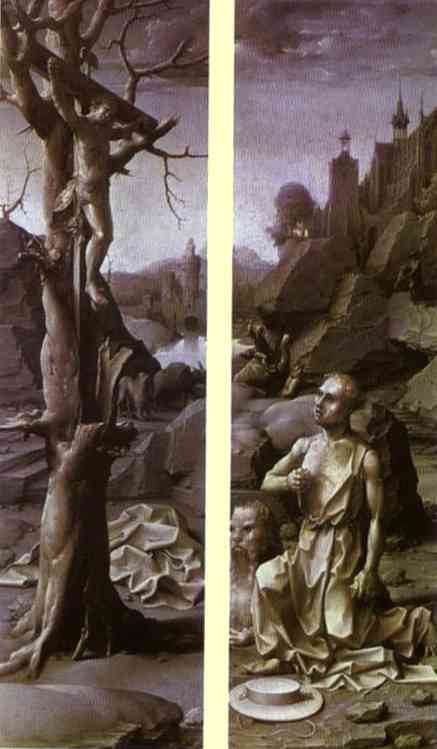
Jan Gossaert, Saint Jerome Penitent, ca. 1510

The panels above showing Saint Jerome in the wilderness have clearly left the idea of painted sculpture behind - but for the grisaille they are fairly traditional depiction of the story (showing two earlier episodes in the saint's life in the background).  In other media, frescoes and illuminated manuscripts were also being produced at this time in monochrome or with deliberately reduced palettes, emphasising form over colour.  But looking at this painting on a grisaille winter's day last week, in the National Gallery's new exhibition Jan Gossaert's Renaissance, I was still struck by the scene's uncanny resemblance to a world turned to stone. Perhaps it is because Saint Jerome himself is holding a rock, as he kneels in the rocky landscape with a great stone city in the background, whilst on the other panel, the statue-like figure of Christ is set on a petrified tree beneath an ash-coloured sky.    

Hieronymus Bosch, The Garden of Earthly Delights outer wings, c1490-1510

Possibly the best known grisaille outer panels from this period are those of Hieronymus Bosch and those for The Garden of Earthly Delights show the earth as it was on the third day of creation.  This is a world before colour, where land is only just emerging from the misty sea under dark rain clouds, and newly formed trees are seen alongside other stranger growths, half-vegetable, half-mineral.   Italo Calvino's story 'Without Colours', in Cosmicomics, describes the the beauty of the grey earth before an atmosphere has formed to filter the light of the sun.  Here 'trees of smoke-colored lava stretched out twisted branches from which hung thin leaves of slate.  Butterflies of ash flying over clay meadows hovered above opaque crystal daises...' Calvino's hero Qfwfq, who yearns for contrast, colour and sound, falls in love with the beautiful Ayl, 'a happy inhabitant of the silence that reigns where all vibration is excluded'.  When the world begins to change Ayl takes fright at the disruption to her beloved neutral landscape and they are parted.  As Qfwfq looks sadly out on the 'canary-yellow fields which striped the tawny hills sloping down to a sea full of azure glints, all seemed so trivial...'  He realises Ayl could never have been happy here among 'those gilded and silvered gleams, those little clouds that turned from blue to pink, those green leaves that yellowed every autumn, and that Ayl's perfect world was lost forever.' 

The Brothers Quay, cover for Italo Calvino's Cosmicomics, 
 a photographic collage grisaille landscape.

Tuesday, December 28, 2010

Penitent Saint Jerome

Fra Angelico, The San Domenico Altarpiece (detail), c. 1422-23

In the 1420s Fra Angelico painted three altarpieces and illuminated a choir book for the church and convent of San Domenico in Fiesole, the first of which was a triptych with the Virgin and Child flanked by two sets of saints: Aquinas, Barnabas, Dominic and Peter Martyr.  However, as Diane Cole Ahl explains in her monograph Fra Angelico (2008) it was united into a single panel and repainted by Lorenzo di Credi in 1501.  One of the alterations Lorenzo made was to replace the gold background with a continuous architectural and landscape setting - a serene pattern of water, fields, trees and distant mountains under a misty sky that fades into blue.  Why was this done?  It was possibly part of the renovation of the church, but another motivation could have been to pay homage to the saints and to the revered artist himself:  Lorenzo 'left the figures as they had been painted as precious relics of Angelico's mastery.'  The result is a beautiful hybrid work.  Looking at it, even in reproduction, you feel a particularly strong version of that familiar longing in front of a Renaissance altarpiece to travel beyond the foreground figures and out through the window into the idealised world beyond.

Fra Angelico, The San Domenico Altarpiece (detail), c. 1422-23
landscapes added by Lorenzo di Credi in 1501

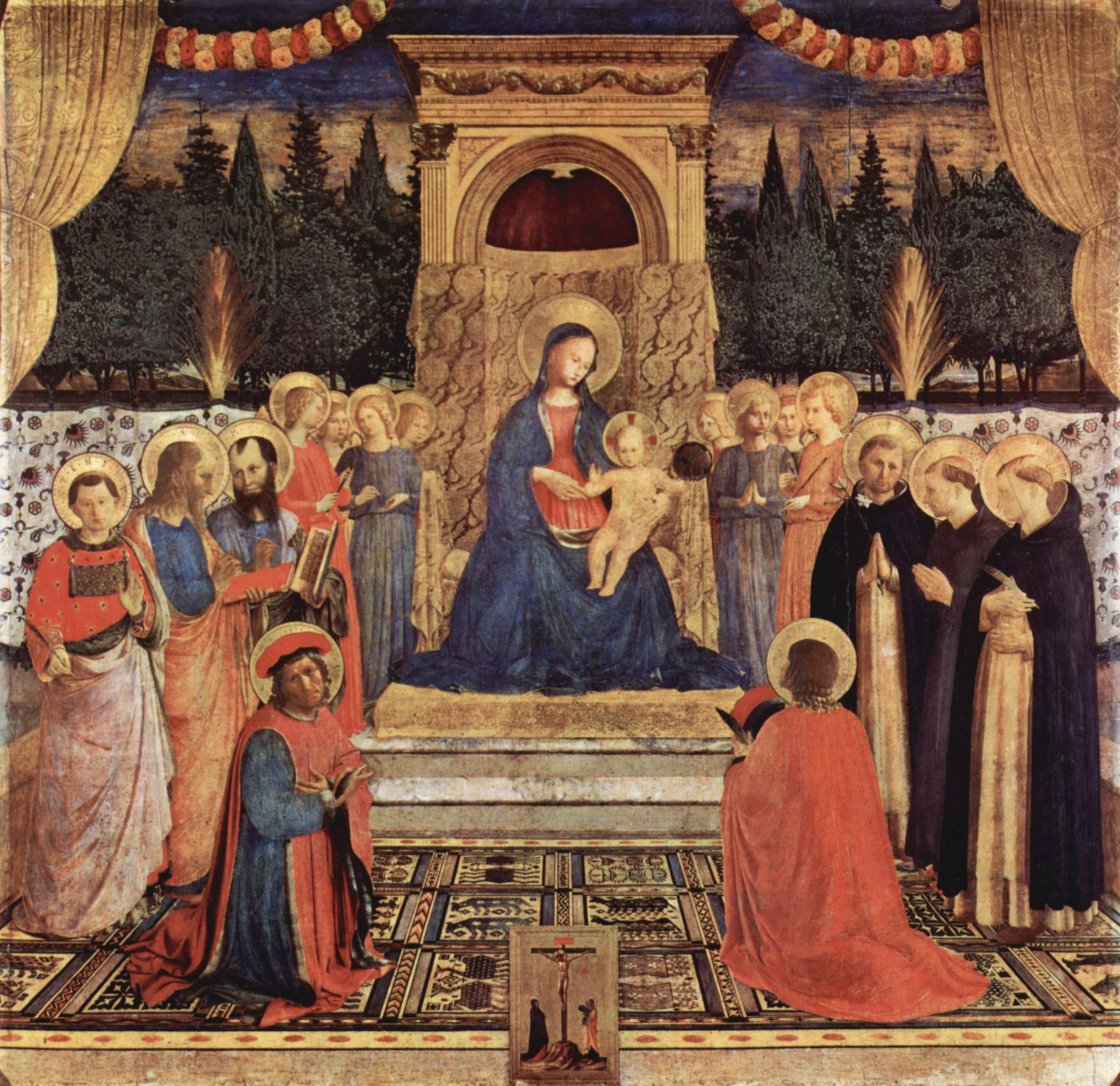
When Fra Angelico began his career gilt backgrounds were still the norm and in early paintings like Madonna and Child with Twelve Angels (c1423-4) he placed his figures on solid architecture under a gold leaf sky.  But when he came to paint the Annalena Altarpiece (c. 1435), the simple golden background had been superseded by a realistic interior decoration, showing the Virgin, Child and saints in sacra conversazione before a golden cloth of honour.  This rapid evolution culminates in the San Marco Altarpiece, painted with Benozzo Gozzoli, with its gold throne, mosaic floor and curtains opening onto a golden sunset over a realistic landscape.  It might almost be dusk falling on a Viennese park in the time of Klimt and Schiele. 

 Fra Angelico assisted by Benozzo Gozzoli,
San Marco Altarpiece, c1438-40

Egon Schiele, Autumn Sun, 1914

I'll be saying more about Fra Angelico in my next post, but I can't leave this specific subject without mentioning one more early Fra Angelico painting where the gold background seems less regal or ornamental than harsh and frightening.  Saint Jerome in the wilderness has often been painted by artists interested in landscape, but here he is shown starkly alone, half in shadow, among bear rocks beneath a molten sky. 

Fra Angelico, Penitent Saint Jerome, c1424

Sunday, June 06, 2010

Landscape with the Penitent St Jerome


Leonardo da Vinci, Landscape, 1473

The British Museum's 'Fra Angelico to Leonardo: Italian Renaissance Drawings' exhibition includes three landscapes.  The first is Leonardo's famous drawing of the Arno valley dated August 5th 1473, which I mentioned in an earlier post on the link between panoramic landscape drawing to topographical maps.  We do not know if this sketch was drawn in situ, but as A. Richard Turner writes in The Vision of Landscape in Renaissance Italy, 'these quick lines have all the quality of a spontaneous reaction to a living model.'  The next artist discussed in Turner's book is Piero di Cosimo, whose highly artificial and literary paintings he contrasts with Leonardo's.  Piero's main contribution to landscape art came in panels like Forest Fire, Hunt and Return from the Hunt but the British Museum exhibition has one of his drawings: Landscape with the Penitent St Jerome (c1490-1500).  The curators say of this that 'the intricacy of the landscape compels the viewer to unravel it slowly, a visual equivalent to the pilgrim's slow and difficult ascent to the church in the background.'

The third landscape drawing on show at the BM is a simple pen and brown ink study of travellers journeying to a village, made c1495-1508: one of the fifty or so landscape drawings that survive by Fra Bartolommeo.  He doesn't feature in Turner's book, possibly because Fra Bartolommeo's importance for landscape history wasn't fully realised until after the rediscovery of forty-one landscape sketches in 1957.  Some of the views drawn by the artist have now been identified with specific Dominican buildings, but the Christies site, describing a sketch the artist made of a tree (which sold for $996,000), suggests that 'trees rather than buildings are central to the structure of Fra Bartolommeo's landscapes.  By focusing on trees, a new analysis of these compositions is possible. There are no mountains, only gentle hills and small rocky outcrops. In most compositions elongated trees reach to the sky and shrink the buildings into insignificance as they appear to be engulfed by the undergrowth. Either sketched lightly in swirling calligraphy, or carefully outlined, the trees punctuate the scene. As in the Tuscan woods at La Verna where Saint Francis experienced his vision, Fra Bartolommeo's trees are often seen growing in between rocks. Trees, for Fra Bartolommeo, are thus the essence of landscape.'

Thursday, July 23, 2009

From the Mountains to the Lagoon

The first chapter of Peter Humfrey's 2007 monograph on Titian is called 'From the Mountains to the Lagoon'.  Titian was born in Pieve di Cadore, a small town in the Dolomites, and later 'acquired property there and invested in his family's timber business, which carried logs from the mountains and valleys of Cadore to the boatyards of Venice by way of the River Piave and the Adriatic Sea.  Titian's enduring affection for his homeland seems to be reflected in the jagged peaks, precipitous rocks, rushing torrents and dense forest that he added to the existing repertory of Venetian painting.'


Titian, background to Giovanni Bellini's Feast of the Gods, 1529

Humfrey's first example is actually a Giovanni Bellini painting, Feast of the Gods (1514), which had been the first commission for Alfonso d'Este's camerino in Ferrara.  Once Titian started producing paintings like Bacchus and Ariadne for Alfonso, Bellini's painting would have looked a bit old hat, so Titian was asked to re-work the landscape.  Another work that seems to draw on Titian's memories of the Dolomites is the mountainous background to the Presentation of the Virgin in the Temple (1534-8).  And a third example given by Peter Humfrey is the 'savage, fitfully illuminated landscape' of St Jerome in Penitence, painted just before Titian's death in 1575 (a far cry from the generalised Arcadian landscapes he had painted under the influence of Giorgione seventy years earlier).


Titian, background to Presentation of the Virgin in the Temple, 1534-8

The influence of Titian's birthplace is not discussed in A. Richard Turner's classic survey, The Vision of Landscape in Renaissance Italy.  Instead he shows the great range of landscapes Titian was able to paint, beginning his account by quoting Count Francesco Algarotti's view, expressed in 1756, that 'Titian, nature's greatest confidant, is among landscapists the Homer.'  For Algorotti, 'perhaps the most beautiful landscape ever painted is that of the Peter Martyr, where for the variety of trunks, of leaves, of the various bearings of the limbs one can discern the difference between one tree and another; where the land is so well partitioned and rolls on with such natural grace; where a botanist would go to gather plants.'


Titian, engraving after The Death of St Peter Martyr, 1530

Looking back to Kenneth Clark's Landscape into Art, I find the following: 'anyone who has visited Cadore will recognize that the impressions of Titian's native place remained with him all his life.  The rocky hills with their thick clusters of trees, the rushing streams and blue mountain distances are seized upon with Titian's sensual power, and crowded into the small background of a portrait.  Very occasionally they are given more space, and we recognise the origin of all Carracciesque landscape.  The great hunting landscapes by the Carracci in the Louvre are no more than freer and more crowded versions of the Venus of the Pardo which hangs opposite them; and from the lost St Peter Martyr, the most copied picture in the world, there flowed a series of landscape compositions which furnished the seventeenth century.  Titian's appetite for nature gives to his landscapes a magnificent fullness.  His trees, in particular, have a weight of leaf and roundness of trunk never surpassed, and it is not surprising that Poussin and Rubens, Constable and Turner all looked on him as a source of inspiration.'

Among all the many qualities that distinguish Titian, how wonderful to think that he painted a 'roundness of trunk never surpassed'...

Thursday, February 19, 2009

Judgment shall dwell in the wilderness

This is the first of three (probably) postings on art in The Hague, which I visited earlier this week. The Mauritshuis has two side panels from a triptych painted by Gerard David c1510-15 which at first sight appear to be sections of an early independent landscape painting. However, the animals that can be seen by the pond - an ass and an ox - may refer to verses in the Bible (Isaiah 32): 'Upon the land of my people shall come up thorns and briers; yea, upon all the houses of joy in the joyous city: Because the palaces shall be forsaken; the multitude of the city shall be left; the forts and towers shall be for dens for ever, a joy of wild asses, a pasture of flocks; Until the spirit be poured upon us from on high, and the wilderness be a fruitful field, and the fruitful field be counted for a forest. Then judgement shall dwell in the wilderness, and righteousness remain in the fruitful field... Blessed are ye that sow beside all waters, that send forth thither the feet of the ox and the ass.' On Feast Days the doors of the triptych would be opened to reveal the fulfilment of this prophecy. This interior can be seen at The Met: The Nativity with Donors and Saints Jerome and Leonard.


According to the Met website, Friedländer thought these landscapes originally included the figures of Adam and Eve; 'however, no trace of such figures is visible with the naked eye, and, as many authors have observed, there is hardly room for them in the landscape as it is.'