Showing posts with label Edward Lear. Show all posts

Sunday, May 03, 2026

Soracte white with deep snow

Mountains in the Classical Tradition was a research project based at St. Andrews University from 2017 to 2023. It incorporated a blog which considered, among other cultural topics, 'William Golding at Thermopylae' and 'Edward Dodwell on Mt. Hymettos' (the subject of a post here back in 2013). In 'Augustus Hare on Mt. Soracte' Jason Konig discusses the travel writer and watercolourist who published two books about his walks near Rome. These volumes not only described Hare's own impressions of Mount Soracte (now called Monte Soratte) but also referred to twelve other nineteenth century writers who wrote about it. These included Byron, whose Childe Harold lists this rather modest peak alongside the most famous mountains of classical Greece. Soracte's unlikely fame was entirely down to just a few words of Latin verse: the first stanza of Horace's Ode 1.9, in which it stands covered in snow. 

As Jason Konig points out, 

It seems extraordinary that such a brief glimpse could have haunted the imagination of centuries of later readers. It was the opening line of this poem that Patrick Leigh Fermor’s German captive, General Kreipe, quoted to him in looking at the sunrise on Mt Ida in Crete in 1944; Leigh Fermor claims to have quoted the rest of the poem to him from memory in response, an incident which united the two men temporarily in their shared mastery of the classical heritage.

After describing the winter landscape Horace turns to his young companion, Thaliarchus, and urges him not to waste his youth - a similar theme to the famous carpe diem lines in Ode 1.11. There are numerous translations of the full poem online - at the Pantheon Poets site, for example, where you can hear it in Latin. I'll just quote here the start and end of a modern version by David Ferry. 

See Mount Soracte shining in the snow.
See how the laboring overladen trees
Can scarcely bear their burdens any longer.

See how the streams are frozen in the cold.
Bring in the wood and light the fire and open
The fourth-year vintage wine in the Sabine jars.

O Thaliarchus, as for everything else,
Forget tomorrow. Leave it up to the gods. [...] 

[...] While you’re still young,
And while morose old age is far away,

There’s love, there are parties, there’s dancing and there’s music,
There are young people out in the city squares together
As evening comes on, there are whispers of lovers, there’s laughter.

The American literary scholar H. T. Kirby-Smith, a witty historian of poetry, discusses the Soracte Ode in his book The Celestial Twins.   
Critical commentary on this poem usually neglects the metrics and settles on the issue of whether it consistently develops its subject. One reads indignant objections to the idea of sending some young man out into the streets in the dead of winter in hopes of picking up a girl, or suggestions that Horace simply meandered away from his original intention of evoking a winter landscape and contrasting it with the consolations of a roaring fire and a drink. Others, more sensibly, suggest that as Horace turns from himself to his young friend he imagines a more hospitable season — of life as well as the year — when the perils of senescent hypothermia are less threatening. 

It is easy to find online images of snow on Mt. Ida (height 2,456 m) but I failed to locate any of Mt. Soracte (height 691 m). I guess we live in warmer times, but perhaps it was a rare event even in Horace's day. Kirby-Smith thinks the poem's familiar landscape transformed by snow sets the poem going with 'Alpine excitement and novelty.' Neither August Hare nor his literary sources mention seeing the kind of scene described by Horace - they describe Soracte as a distant blue peak. This is how it appears in Edward Lear's panoramic vision (below). Corot painted it several times and you can see pale areas of rock on its slopes, but no sign of snow anywhere. Perhaps Horace was only ever using it as a metaphor - in Kirby-Smith's phrase, 'age as the season of snow.'


Edward Lear, Monte Soratte near Rome, 1880s(?)

Sunday, April 04, 2021

A Landscape Painter in Albania


 Edward Lear, The valley of the Shkumbin River
near Elbasan in central Albania
, 26 September 1848 

Edward Lear's travel writing is, as you would expect, written with a sharp wit and punctuated with discriptions of landscape. The fact that he was travelling and then writing as a landscape painter gives his books a double interest for me. Journals of a Landscape Painter in Albania for example begins with a description of his equipment - only the essentials needed to travel light, in what was then still a region barely visited by English travellers. He complains a lot about his accommodation but explains that he had no choice but to stay in roadside khans - if he had tried to stay instead with the local pashas he would need to have fitted in with ceremonies and meals that would have left no time for sketching. Lear was there in the autumn of 1848 and mentions finding a German newspaper to read and being amazed at the news of revolutions across Europe. His route through what is now Albania was partly forced on him by widespread quarantine and travel restrictions (cholera, rather than Covid-19, in those days). It began in the east, after he had travelled overland from Thessalonika via Bitola and Ohrid. He then headed towards Tirana and just before reaching it wrote this description of the mountain landscape.

'How glorious, in spite of the dimming scirocco haze, was the view from the summit, as my eyes wandered over the perspective of winding valley and stream to the farthest edge of the horizon — a scene realizing the fondest fancies of artist imagination! The wide branching oak, firmly rivetted in crevices, all tangled over with fern and creepers, hung half-way down the precipices of the giant crag, while silver-white goats (which chime so picturesquely in with such landscapes as this) stood motionless as statues on the highest pinnacle, sharply defined against the clear blue sky. [...] 
It was difficult to turn away from this magnificent mountain view — from these chosen nooks and corners of a beautiful world — from sights of which no painter-soul can ever weary: even now, that fold beyond fold of wood, swelling far as the eye can reach — that vale ever parted by its serpentine river — that calm blue plain, with Tomohr in the midst, like an azure island in a boundless sea, haunt my mind's eye, and vary the present with visions of the past. With regret I turned northwards to descend to the new district of Tyrana; the town (and it is now past eleven) being still some hours distant.
 
Edward Lear: Tepeleni, Albania, c. 1848–1849

Unfortunately, as this suggests, Lear's descriptions of scenery are not all that interesting, even if they do make you want to visit Albania. You wouldn't expect anything like his nonsense verse but you might hope for a more original mode of landscape description. In an NYRB review (from which the image above is taken) of a reprint of the journal, Brad Leithauser says

'The book imparts almost no sense of Lear’s reading, the literary spirits he might have been seeking to commune or contend with during his travels. Most of the few literary references are to Byron, only because he happened to precede Lear to Albania by a couple of decades. Sentence by sentence, the book gives scant indication of a poet’s sensibility, for Lear was a slapdash prose stylist. Edward Lear in Albania often seeks to portray panoramic landscapes through words, a challenge that typically elicited from Lear sweeping and obvious adjectives: “noble,” “majestic,” “sublime.” He was especially fond of “picturesque,” which at one point appears three times in a single paragraph.'

Despite this defect, it is fascinating to read about Lear's experiences of a country that had so recently been under the rule of Ali Pasha. I'll end here with his decription of visiting Tepelenë:

'At the end of the space enclosed by the walls, and overhanging the river, is a single mosque — solitary witness of the grandeur of days past ; — and beyond that, all the space, as far as the battlement terrace looking north and west is occupied by the mass of ruin which represents Ali's ruined palace. The sun was sinking as I sat down to draw in what had been a great chamber, below one of the many crumbling walls — perhaps in the very spot where the dreaded Ali gave audience to his Frank guests in 1809 — when Childe Harold was but twenty- four years old, and the Vizir in the zenith of his power. The poet is no more ; — the host is beheaded, and his family nearly extinct ; — the palace is burned, and levelled with the ground ; — war, and change, and time have, perhaps, left but one or two living beings who, forty years back, were assembled in these gay and sumptuous halls.'*


*I'm not sure what Tepelenë is like today. In 2013, Tim Neville, on the trail of Byron, described it in a travel piece for the Financial Times: 'I drove to Tepelena, where the remains of Ali Pasha’s palace stood derelict and littered with rubbish. A plaque celebrating the poet’s visit hung from the side of a wall next to a petrol station...'

Monday, August 17, 2009

Landscapes of melancholy emptiness


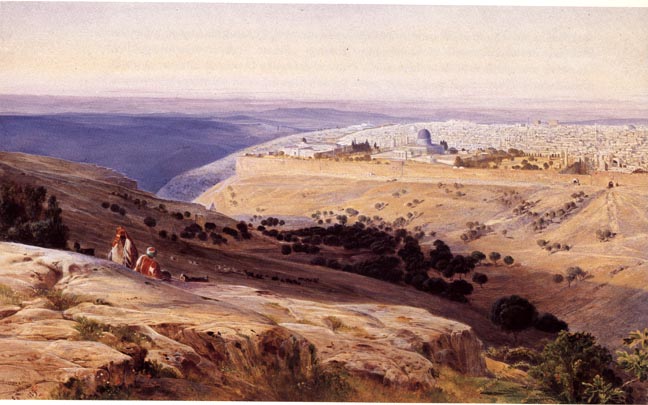
Edward Lear, Jerusalem from the Mount of Olives, Sunrise, 1859

I have mentioned Edward Lear briefly before - specifically the habit he developed of annotating his sketches.  In reading Robert Harbison recently I came upon an excellent description of Lear's landscape paintings with their 'droll notations'.  Lear's life was 

'spent mostly abroad simply because the English climate disagreed with him and he could find nothing to do at home.  So he became the sketcher and painter of exotic views, taking himself unhappily over big stretches of southern Europe and the middle East.  Much of his interest lies in his misplacement, a man who would be the truest homebody but for some flaw, who now converts preposterous places to clever mechanical tracery.  To someone familiar with his books of nonsense the landscapes are disappointingly uneccentric.  For an artist to confine himself to forms other than human is usually significant of something, and Lear provokes the suspicion that he is in these places because there are few Englishmen to meet or paint.  His earlier zoological and ornithological work is revealing because he invests every subject with personality, but the later, more refined landscapes leave out, as do all accounts of his life, the essential facts.  The most individual things about them are the droll notations in a springy script, which are painted out by the colors they describe; Lear erases the glimpse of himself he gives.  And the compositions are of such slender substance, the solidities of the picture often vacating to the back center, evading near-sighted eyes, echoing the flight from the self.  These landscapes of melancholy emptiness, faraway places seen from far away, are only a distinctive case of a Victorian genre - romantic topographical sketches of Near Eastern scenes.'

Harbison says here that 'for an artist to confine himself to forms other than human is usually significant of something.'  His suspicion that Lear was running away from people echoes a concern sometimes expressed that landscape art is an escape from the body - see the earlier post I did on this in connection with D. H. Lawrence. The paragraph on Lear forms part of his discussion of 'Dreaming Rooms: Sanctums', those spaces of safety in which the mind is free to travel.  Exotic topographical landscapes like Lear's 'exemplify a special nineteenth-century indecision between the literal and the imaginary, functioning like an invented imagery, but located on a particular page of the atlas.'

These observations form part of Harbison's Eccentric Spaces (1977), a consciously eccentric book that begins in the garden, moves inside to the sanctum (see above), then out into the world of machines and cities before spending a good deal of space discussing literature - topographical and architectural fictions - and concluding with the increasingly abstract spaces of maps, museums and catalogues. The book's preface describes the difficulty Harbison had in publishing this interdisciplinary, digressive book.  You can see why editors might have worried about sentences like this: 'A map seems the type of the conceptual object, yet the interesting thing is the grotesquely token foot it keeps in the world of the physical, having the unreality without the far-fetched appropriateness of the edibles in Communion, being a picture to the degree that that sacrament is a meal.'  But the book has several illuminating passages for those interested in landscape: much of the gardens chapter of course, descriptions of Ruskin in Venice, an argument for the important role of landscape in Mrs Radcliffe's Mysteries of Udolpho, and an appreciation of the detailed, almost cartographic paintings of Breugel in which significant and insignificant scenes are balanced and a spatial order replaces the moral.

Monday, July 07, 2008

Petra, 13 April 1858

In his essay 'Painters as Writers' Stephen Spender wrote:

'The meeting place of words and painting is those drawings in which painters have scribbled the names of colours as an aide-mémoire. The word "grey" written against olive trees by van Gogh or Cotman obviously means something different to the artist from that which it suggests to the reader. When one looks at a sketch and sees a written word, there is the suggestion of a leap from the word to the miracle of the paint, and this is itself an effect of poetry, which Apollinaire tried to exploit when he arranged the words of a poem in the form of sketches. Moreover, the painters who write most on their sketches themselves seem to be extremely open to the suggestion of words, an extreme example being the painter and humorous poet Edward Lear, who did many such sketches.'

The Edward Lear example below was the best I could find with a quick search - other sketches of his have a lot more words on them. I'm tempted to suggest that Lear's paintings in this vein belong to a rarely noticed subgenre of 'annotated landscapes', along with photographs like Roni Horn's Still Water, Chinese landscape paintings like Mount Pan, and even, at a stretch, geographical illustrations like those of Geoffrey Hutchings.


Edward Lear, Petra 13 April 1858