Friday, March 01, 2019

The Mountains of Madness

'The last lap of the voyage was vivid and fancy-stirring, great barren peaks of mystery looming up constantly against the west as the low northern sun of noon or the still lower horizon-grazing southern sun of midnight poured its hazy reddish rays over the white snow, bluish ice and water lanes, and black bits of exposed granite slope. Through the desolate summits swept raging intermittent gusts of the terrible antarctic wind; whose cadences sometimes held vague suggestions of a wild and half-sentient musical piping, with notes extending over a wide range, and which for some subconscious mnemonic reason seemed to me disquieting and even dimly terrible. Something about the scene reminded me of the strange and disturbing Asian paintings of Nicholas Roerich, and of the still stranger and more disturbing descriptions of the evilly fabled plateau of Leng which occur in the dreaded Necronomicon of the mad Arab Abdul Alhazred. I was rather sorry, later on, that I had ever looked into that monstrous book at the college library.'
- H. P. Lovecraft - At the Mountains of Madness, 1936
Nicholas Roerich, Milarepa, the One Who Harkened, 1925 

Nicholas Roerich's 'strange and disturbing' Asian paintings are mentioned several times in Lovecraft's novel.  A character notices 'odd formations on slopes of highest mountains. Great low square blocks with exactly vertical sides, and rectangular lines of low vertical ramparts, like the old Asian castles clinging to steep mountains in Roerich’s paintings.'  Later the narrator says 'There was indeed something hauntingly Roerich-like about this whole unearthly continent of mountainous mystery.' Finally, at the end of the story, after the horror of the mountains of madness is revealed:
'From these foothills the black, ruin-crusted slopes reared up starkly and hideously against the east, again reminding us of those strange Asian paintings of Nicholas Roerich; and when we thought of the damnable honeycombs inside them, and of the frightful amorphous entities that might have pushed their foetidly squirming way even to the topmost hollow pinnacles, we could not face without panic the prospect of again sailing by those suggestive skyward cave-mouths where the wind made sounds like an evil musical piping over a wide range.'

Nicholas Roerich, Himalayas, 1933

Various Lovecraft bloggers have mentioned Roerich and posted images of his art.  One quotes a letter Lovecraft wrote in 1930: "surely Roerich is one of those rare fantastic souls who have glimpsed the grotesque, terrible secrets outside space & beyond time, & who have retained some ability to hint at the marvels they have seen."  Lovecraft was able to see these paintings at the Nicholas Roerich museum, established in New York in 1929.  In that same year Roerich was nominated for the Nobel Peace Prize - the Roerich Pact protecting cultural property in war is named after him.  It would be hard to briefly summarise his extraordinary life up until that point - it included a long trip through Russia painting its architecture, set designs for Diaghilev (including The Rite of Spring), the creation of a mystical sect in London and then the epic Journey Through Asia that inspired the paintings Lovecraft admired.  You can read the story of this expedition, in which Roerich hoped to find the hidden land of Shambhala, in an Atlas Obscura article 'Why the Soviets Sponsored a Doomed Expedition to a Hollow Earth Kingdom.'  Roerich's own experiences sound very much like those of a Lovecraftian explorer:
It is said that the closer one approaches to the hidden, hollow-earth city, the more vague their writings become, because Shambhala cannot be described in mere words. In his esoteric book Shambhala the Resplendent, which he was writing along with his more scientific and much drier travel diary, Nicholas began charting another, parallel journey written in stories and riddles. As the expedition went deeper, he increasingly recorded strange manifestations, fires, lights and visions over their camp —though those were mostly left out of his scientifically-minded travel diary. His paintings also became more esoteric, increasingly depicting the messianic King of Shambhala. ... Communication was lost, and the Roerichs were considered dead. [Eventually, after a year, they reemerged in India, having been detained in Tibet where five expedition members died.]   The closest they had gotten to Shambhala, according to Nicholas’ travel diaries, was in the Altai mountains, in the valley of Uimon, when an “Old Believer” proudly showed them the entrance to the subterranean kingdom, now barred with stones.

Sunday, February 24, 2019

Wild Geese Returning


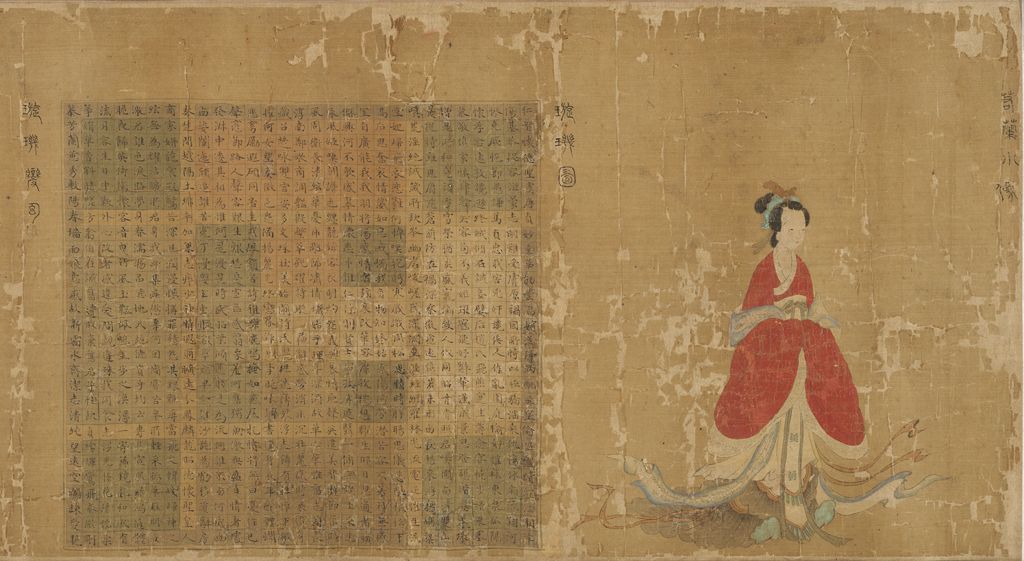
Wild Geese Returning: Chinese Reversible Poems (2011) is an introduction to a form of poetry that can be read in different directions.  Thanks to the way Chinese written characters take meaning from their position in a text, it is possible to write poetry that reads both forwards and backwards, whilst still retaining the formal the rhymes and syllable counts specific to poetic forms.  As it says on the Calligrams site, reversible poetry's 'greatest practitioner, and the focus of this critical anthology, is Su Hui, a woman who, in the fourth century, embroidered a silk for her distant husband consisting of a grid of 840 characters. No one has ever fully explored all of its possibilities, but it is estimated that the poem—and the poems within the poem—may be read as many as twelve thousand ways.'  Michèle Métail is a sinologist and poet who was also the first woman to be elected to the Oulipo back in 1975.  She has studied this underground current in Chinese literature and translated examples by providing French versions (English, in Jody Gladding's recent translation) that go first one way and then another. 

Su Hui with her great palindrome poem, the Xuanji Tu.

For this blog, I am particularly interested in landscape poems, and there are plenty of examples in Métail's book.  Wang Rong (468-494), for example, wrote a short 'Reversible Poem Composed in the Imperial Garden'  which begins with mountain peaks and ends with cicadas singing in the trees, and vice versa.  'In contemplating this landscape', Métail writes, we move from the distant to the close and from the close to the distant.'  The imperial garden was the setting for a sequence of reversible quatrains composed in the next century by a gathering of poets in the circle of the emperor of the Liang dynasty, Xiao Gang (503-551).  Xiao himself wrote of clouds over rocky peaks, water flowing through mountain slopes, a pond with swans and trees losing their leaves.  Or, in reverse, leaves flying from the trees, swans gathered on a lake, mountains with veins of water and rock summits dividing the clouds.

Some of the most famous Chinese poets wrote reversible poems.  The writer I discussed here last week, Yang Wanli, is included in Wild Geese Returning, along with two other Song Dynasty writers I have mentioned on this blog: Wang Anshi and Su Shi.  Wang Anshi (1021-86) wrote 'Thoughts of a Traveler', which begins with geese on a secluded island and ends with the twists and turns of a river, then, twisting back on itself, returns across the landscape to the wild geese at rest.  Su Shi (or Su Dongpo, 1036-1101) wrote poems to be sung in which the second half is the mirror image of the first.  In one of them, there are reminders of the way nature itself produces reversals, in a branch turned upside down, or with reflections in water.  This poem begins with the image of a horse running after fragrances and ends with a light fragrance following a horse.  Su Shi also wrote a sequence on the fours seasons in which each individual line is sung and then reversed.

The theme of the seasons was also used by a more obscure Song Dynasty poet, Mei Chuang (dates unknown) and landscape imagery can be found within his other four extant reversible poems.  In 'Two Poems Composed on West Lake for Amusement' the reverse reading renders the name West Lake into a description, 'west of the lake'.  The same is true of Gushan, Solitary Mountain, and thus his poem provides new readings for Chinese place names.  Earlier in the Song Dynasty, Qian Weizhi wrote a collection of ninety reversible and circular poems of which six have come down to us.  'Climbing the Pavilion of Great Compassion on a Spring Day' describes an ascent, or, read backwards, a descent.  Circular poems are a separate genre that can be read from any point in one way or the other.  Métail provides eight examples from the forty possibilities in one of Qian's poems.  I will give two below (you have to think of 'kiosk' in its original sense as a garden pavilion).

Mountains like a point, snow lights the pavilion
Distant and close, sky turns the kiosk blue.
Peacefully receiving the moon, the shades shine
Cold penetrates the shelter in the misty evening.

Snow punctuates the mountainous shelter
Evening mist pentrates the cold shades.
Brilliant moon on the peaceful kiosk
Blue sky, near and sistant pavilion. 

After the Song Dynasty there are further isolated examples of these kinds of poem, culminating, it could be said, in the sequence Zhang Yude wrote in the late eighteenth century for the Great Contemplation Pavilion in Xi'an, two hundred and sixty of which survive carved on stone stelas.  But what of contemporary Chinese poets?  Unsurprisingly perhaps, reversible poetry has not featured in recent official histories of Chinese literature, or written except as games or curiosities.  However, Métail is aware of one exception: Xiong Yinzuo, a Chinese writer living in the US who has published collections of Reversible Poems on the Four Seasons (1978) and Reversible Poems from the Ju Hsin Studio (1980).  Sadly, these have not been translated as far as I can see. Métail writes that they are 'devoted to the impressionistic notation of the smallest details of a landscape in order to comprehend the multiple changes at work in the universe, for which the reversible poem remains the most original poetic illustration.' 

Saturday, February 16, 2019

Heaven My Blanket, Earth My Pillow


The Song Dynasty poet Yang Wanli (1127–1206) currently has a mere three-line entry on Wikipedia and there is no anthology of his verse in translation currently in print.  However, it is easy to pick up a copy of Heaven My Blanket, Earth My Pillow second-hand - something I've done, as you can see above. The book's title comes from a four-line poem which begins 'the pure wind makes me chant poems, / the bright moon urges me to drink.'  There is quite a lot of drinking in these poems (the translations by Jonathan Chaves, published in 1975, perhaps indicate their age by the way he describes this as getting high).  A love of poetry also comes through - for example in the lovely short poem 'Reading by the Window', in which Yang opens a book of Tang Dynasty poetry to find inside a peach blossom petal, still fresh, that had been caught inside the previous spring.  But nature is his main theme and there are examples in this book of what can unhesitatingly be described as 'landscape poems', recalling a view seen from a boat, a mountain temple or a moon viewing terrace. 

Landscape poems like these may frame the world like a painting but their words are able to convey sound and motion and time passing.  There are two 'Evening Lake Scenes' for example, in the first of which Yang watches geese in Vs and crows in flocks, flying over a lake and taking their time settling down for the night.  In the second he describes the sunset:
I sit watching the sun set over the lake.
The sun is not swallowed by mountains or clouds:
it descends inch by inch, then disappears completely,
leaving no trace where it sinks into the water.
In his introduction, Chaves highlights Yang's 'obsession with capturing the momentary changes in natural phenomena'.  This is from a poem recording his impressions as he crossed between Zhedong and Yongfeng on a spring day in 1179.
The sunlight must be moving the waves by itself;
the sky is calm, and there is no wind.

Wu Zhen, Fisherman, c. 1350
One of the Chinese paintings reproduced as illustrations in Heaven My Blanket, Earth My Pillow

Yang Wanli is the last poet in David Hinton's anthology, Mountain Home: The Wilderness Poets of Ancient China. Hinton says that 'with him China's rivers-and-mountains poetry had opened up virtually all of its possibilities'. He highlights Yang's adherence to Ch'an Buddhism and the way it gave rise to a 'crystalline attention to things themselves ... The rivers-and-mountains realm was the natural terrain for this attentiveness, as its grandeur so easily calls one from the limitations of self to the expansiveness of a mirror-like empty mind that contains all things.'  Here, to conclude, are four lines from Hinton's translation of a poem Yang wrote after a hike to Universal-Completion Monastery. 
As our boat lacing mists angles off the cove's willow shores,
cloud mountains appear and disappear among the willows.

And the beauty of climbing a mountain while adrift on a lake?
It's this lake's mind - that gaze holding the mountain utterly.

Friday, February 15, 2019

The Ascent to the Village


I was very tempted this week to go to Cafe Oto for Brunhild Ferrari in conversation with David Grubbs, but it was on 14 February and I didn't think this proposal would go down very well.  I did though enjoy reading her 'Epiphany' at the back of February's Wire Magazine, which recalls how she met and started making music with Luc Ferrari (1929-2005). Apparently they bonded over a love of rocks - she loved painting them, he was fascinated by the geology of Corsica, where his father came from.  In the paragraph below she describes their experiments in field recording and mentions two famous landscapes that I have featured here before (in connection with Petrarch and Monet).  I have embedded above a clip of the composition she mentions, Presque Rien No. 1 (1967-70).


A couple of years ago Ferrari's four 'Presque Rien' ('Almost Nothing') compositions were reissued by Editions Mego.  Here, from a review by John Kealy, is a description of the fourth.
Presque Rien No. 4: La Remontée du Village (Almost Nothing No. 4: The Ascent to the Village) seemingly returns to bare elegance of the original work. This is the sound of Ferrari and his wife Brunhild ascending the hill to the Italian town of Ventimiglia and it is remarkably similar to the moods and feelings of the first piece. However, the sleepy isolation of the 1960s countryside has been lost as sounds from nearby televisions and passing scooters permeate the air around Ferrari’s microphones. Gradually, evidence of Ferrari’s tinkering becomes more and more noticeable as he slowly blends the sounds as they were recorded into something more akin to musique concrète. The climax of this is the powerful intrusion of a cow, preposterously embellished by Ferrari to sound super-real.
Another landscape-related piece reissued by Editions Mego was Petite symphonie intuitive pour un paysage de printemps (1973–1974).  Ferrari's notes explain that this too was based on a walk with his wife.
'Brunhild and I were in the Gorges du Tarn area. We chose to take a small path that was going up a rocky mountain for about ten kilometres. After a last turn, a totally unexpected landscape opened before my eyes. It was sunset. Before us, a vast plateau spread open with soft curves up to the horizon, up to the sun. The colours ranged from dry grass yellow to purple, in the distance, with the darkness of a few small groves punctuating the space. The almost bare nature was presenting itself to the eye, free from any obstacle. We could see everything. Later, when I recollected this place and the sensations I had experienced there, I tried to compose a music that could revive this memory.'
The reviewer for Pitchfork thought initially that this sounded like Boards of Canada, but then decided it 'feels more complex than that. For as alien as musique concrète can be, in the hands of Ferrari, he was able to render it into something that felt warmly familiar. Here he paints a stunning vista at dusk, capturing the expansive horizon with sound rather than sight.'

Wednesday, February 13, 2019

A view of Magdala

Watercolour World is a new online database of documentary watercolours painted before 1900 which launched at the end of January.  You can use filters and search by a keyword, e.g. 'waterfall', which brings up waterfalls in South Australia, Japan, Italy, French Polynesia and so on.  Enter 'Cozens' and you get a selection of watercolours by Cozens (although the first one is a Turner painting 'after J. R. Cozens').  But perhaps the main attraction is a map which you can zoom around and look for specific landmarks or places.  The distribution of watercolours on the map shows that this is a British initiative - there are over 25,000 watercolours for the British Isles but only around 50 for Japan (and those Japanese images are by late nineteenth century British illustrators).  They do have global ambitions, but the emphasis on 'documentary' images means that there is bound to be a bias towards cultures which valued topographic accuracy (either as art or as part of some branch of science).


Why watercolours and not, say, oil sketches?  Well non-watercolours are allowed in - they include aquatints and pencil sketches, for example, 'at our discretion'.  Perhaps surprisingly, they are happy to have images where the location is unknown, tagging these to the home of the artist.  How do they choose the images?  'We try to select images that have a clear connection to a real person, place or event, that the artist could plausibly have known first-hand. A painting of a battle that happened years before the artist was born would not be included, but an artist's satirical painting of Londoners in a pub would stay.'  As this last comment indicates, the website goes beyond landscape and covers all kinds of subject matter.  I am not sure how they would feel about, artists who were moving away from simple representation, a Cézanne watercolour of Mont Sainte-Victoire, for example.  There are none of these in the database; the only image from this part of Provence is a view of Aix-en-Provence by William Callow dating from 1836.

William Simpson, Untitled (Magdala), 1868
British Museum

I thought I would check out a a part of the world I don't recall featuring before here - Ethiopia.  In addition to a few archaeological drawings, I came upon the view above. It shows 'a vast stretch of bare tableland with winding gullies, and three figures in the foreground on the spur of a hill'.  There is no further context - the website refers you to the British Museum for more information.  In fact William Simpson had gone to Abyssinia as an illustrator for the London Evening News, covering the British Army's punitive campaign against the Ethiopian Emporer, who had captured British hostages.  Simpson arrived at Magdala after the fighting was over - those tiny figures are therefore looking out over a landscape that had recently seen a siege and bombardment.  Before leaving Magdala, the troops were permitted to loot it and some of the artifacts they took found their way eventually into London museums like the British Museum.  An Association For the Return Of the Magdala Ethiopian Treasures was formed in 1999 to lobby for their return to Ethiopia.

Friday, February 08, 2019

The Umbrian lake, smiling in summer heat

Richard Wilson, The Temple of Clitumnus, 
with the cows drinking from the spring of Clitumnus, 
near Spoleto, Umbria (detail), 18th century 
Source: Christies

I have been re-reading Gilbert Highet, whose Poets in a Landscape (1957) I wrote about in an earlier post about the Springs of Clitumnus.  Highet was drawn to this place through 'two lines of sincere poetry' in an elegy by Sextus Propertius (c. 50/45-15 BCE):
among the woods where the Clitumnus hides its lovely
  springs, and white oxen bathe in the cool stream
The rest of this poem, and almost everything else Propertius wrote, is about love and his life in the city of Rome.  However, you can find more landscape in his poetry, in this description of his origins.
Old Umbria bore you on a famous family-tree,
  I do not lie; the borders of your home
are these: cloudy Mevania, among rain-soaked fields,
  the Umbrian lake, smiling in summer heat,
and steep Asisium's wall climbing towards the peak -
  the wall to which your genius has brought fame.
Mevania is modern Bevagna and the lake was nearby although it was drained long ago and no longer exists. Asisum is Assisi and there are still Roman stones there bearing the Propertius family name.  But, as Highet explains,
'In Assisi today, everything belongs to the world of St. Francis.  Apart from a few inscriptions and details, there is only a small and elegant Capitoline temple (dedicated to the trinity of Jupiter, Juno, and Minerva) above ground to remind the visitor of the world of Propertius, and, below ground, the relics of the Roman Forum.  High above them soar the immense walls and towers of the churches of St. Francis. ... Around the towers of the church of St. Francis, the doves which once were the messengers of Venus now rise, the emanations of a loftier and purer spirit.'
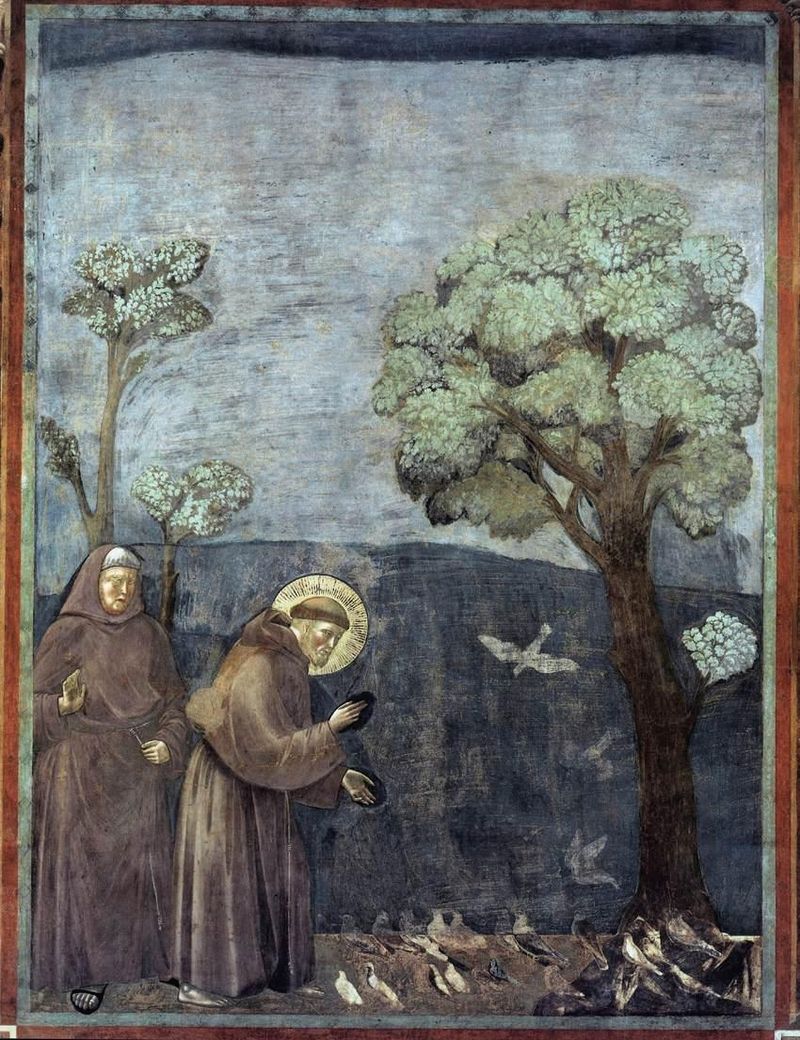
Giotto (attribution uncertain), St. Francis Preaching to the Birds, 1297-99
Source: Wikimedia Commons

Francesco Bernadone - St. Francis - is much more associated with nature than Propertius, through the stories that he preached to the birds and made peace between a wolf and a village.  He is included, albeit 'stretching the point', in Italian Landscape Poems, the 1993 anthology compiled and translated by Alistair Elliot, who sadly died late last year.  The book starts with St. Francis' Canticle of the Sun or Laudes Creaturarum ('Praise of the Creatures'), which is said to have been composed in 1224.  It is in the Umbrian dialect of Italian, rather than the Latin written by Propertius, and is often considered the earliest work of Italian literature.  Here are some lines in praise of the elements: the wind, air and clouds, water ('so helpful and humble, precious and chaste'), fire and finally earth, 'who nourishes and guides us / and brings forth fruit in kinds, with coloured flowers, and grass.'
Laudato si, mi Signore, per frate Vento
et per aere et nubilo et sereno et onne tempo,
per lo quale, a le Tue creature dài sustentamento.

Laudato si, mi Signore, per sor'Acqua,
la quale è multo utile et humile et pretiosa et casta.

Laudato si, mi Signore, per frate Focu,
per lo quale ennallumini la nocte:
ed ello è bello et iucundo et robustoso et forte.

Laudato si, mi Signore, per sora nostra matre Terra,
la quale ne sustenta et gouerna,
et produce diuersi fructi con coloriti fior et herba.

Saturday, February 02, 2019

The Great Polish Map of Scotland

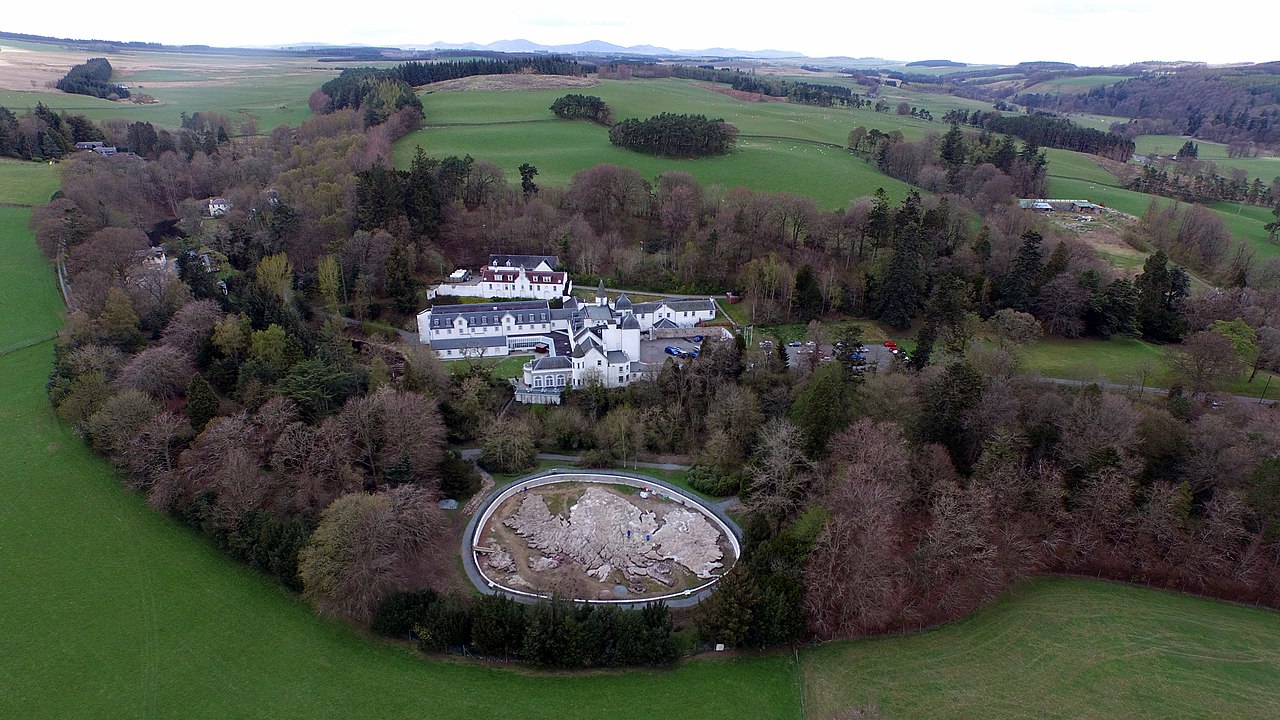
The Great Polish Map of Scotland
Source: Wikimedia Commons (John Riddell)

I have written here before about relief maps, focusing on the impressive set of table-top landscapes made at the behest of Louis XIV.  These were relatively portable, indoor objects, but there is also a history of larger relief maps made outdoors.  Such scaled-down landscapes are subject to the same forces of weathering and erosion as the 'real' landscape in which they are set.  Thus, one of the best-known examples, the Great Polish Map of Scotland, has had to undergo a process of restoration recently.  Its concrete is more vulnerable to frost and rain than the gneiss and granite of the Scottish mountains, but, unlike the Highlands, it can always be repaired and maintained in a relatively pristine state.  The map was constructed in the late 1970s at a hotel owned by the Polish war veteran, Jan Tomasik and designed by cartographer Kazimierz Trafas. Water for the sea, rivers and lochs was diverted from a nearby stream.  There are various photographs online - the one below showing the map in snow is quite striking.

 Aerial view in snow
Source: Wikimedia Commons (Novemberscot)

The Great Polish Map of Scotland is 50x40m and has been described as the largest relief map in the world.  However, according to Wikipedia, a site in Ningxia province, China was spotted in 2006 using satellite imagery measuring 900 by 700 metres.  It 'appeared to be a large scale relief model (1:500) of Aksai Chin, a disputed territory between China and India.'  You can find this using Google - I have reproduced the satellite image below.  It is a reminder that the history of relief maps in China, as elsewhere, has always been associated with politics and territorial claims (a map is the territory...)  There are other examples of large-scale relief maps around the world: the Philippines can be seen in reproduced in Rizal Park, Manila, and Guatemala has been scaled down in the 'Mapa en Relieve', as described in an Atlas Obscura article.  Such endeavours have been conceived and executed by scientists rather than artists, but I could imagine some more creative alternatives, relief maps that only partially reproduce a landscape, in order to idealise, reinvent or deconstruct it. 

 A large outdoor relief map in China?

Friday, January 25, 2019

I made those waters flow over it


I am returning here to a subject I covered over ten years ago, the gardens of the kings of Assyria, because I have been to see the British Museum's exhibition, 'I am Ashurbanipal'.  I ended my previous post by referring to a relief dated 645 which shows King Ashurbanipal and his Queen in the royal park in Nineveh, dining under an arbour of grape vines, with the decapitated head of the conquered king of the Elamites hanging from a nearby tree.  This scene is on show in the current exhibition, mounted with other smaller ones to show how a complete wall might have looked.  You can see this in my photograph above, which I think also gives an indicates of how wonderfully well lit everything is.  The garden landscape in which Ashurbanipal is seen drinking and listening to music contains alternating pine and fruit-bearing date palms, perhaps symbols of Assyria and Babylonia respectively.  And in the foliage, a bird goes after a locust - in his annals, Ashurbanipal likened the Elamites to a swarm of locusts.


This second photograph shows the royal park created by Ashurbanipal's grandfather Sennacherib, which I also mentioned in my earlier post.  In the new exhibition, coloured light is projected onto this relief, picking out the irrigation channels and trees.  You can see the effect in a gif at the British Museum blog site. I will quote here what this site has to say about the landscape:
'The gardens at Nineveh were irrigated by an immense canal network built by Ashurbanipal’s grandfather, Sennacherib. He brought water to the city over a great distance using channels and aqueducts to create a year-round oasis of all types of flora. The canals stretched over 50km into the mountains, and Sennacherib boasted about the engineering technology he used. A monumental aqueduct crossing the valley at Jewan, which you can still see the remains of today, was made of over 2 million stones and waterproof cement. The aqueduct was constructed over 500 years before the Romans started building their aqueducts, and was inscribed with the following words: "Sennacherib king of the world king of Assyria. Over a great distance I had a watercourse directed to the environs of Nineveh, joining together the waters… Over steep-sided valleys I spanned an aqueduct of white limestone blocks, I made those waters flow over it."
Since I wrote my last blog post on the gardens at Nineveh, it has been argued that they were in fact 'the real Hanging Gardens of Babylon'.  Archaeologist Stephanie Dalley first formulated this theory in 1992 and then published a book with new research in 2013.  A Channel 4 documentary was made and her new evidence was widely reported in the news.  It would obviously be helpful to do some more digging, but the site of Nineveh, around Mosul, has been too dangerous to excavate.  Dalley was quoted in 2013 as saying she thought it unlikely that excavations would be possible in her lifetime.  A year later, Daesh overran the area and, as Jonathan Jones says in his review of this exhibition, 'they smashed antiquities in the Mosul Museum and set about demolishing Nineveh itself.'  It is sad to think how much can change in the course of a few years, but at least these remarkable artifacts remain to give us, amongst much else, an idea of the gardens created by the kings of Assyria.

Saturday, January 19, 2019

The mountain tops, like little isles appear'd

Salomon Gessner, Bucolic Scene, 1767

My post yesterday was about a nineteenth century French-speaking Swiss writer from Geneva; this one is about an eighteenth century German-speaking Swiss poet from Zurich.  However, as can be seen above, Salomon Gessner (1730-88) was also a visual artist.  Here is a snatch of his poetry, describing autumn. It is taken from an 1809 translation of Gessner's Idylls (1756-72).  According to the Encyclopedia Britannica, 'his pastorals were translated into 20 languages, including Welsh, Latin, and Hebrew. The English translation ran through many editions and was admired by the Romantic writers Sir Walter Scott, Lord Byron, and Wordsworth.'  However, I see from Wikipedia that 'The New International Encyclopædia (1905) finds his writing “insipidly sweet and monotonously melodious,” and attributes Gessner's popularity to the taste of a generation nursed on Rousseau.'
O'er every vine of gold and purple hue
The sun its animating lustre threw;
And every curling branch, whose friendly shade
Waved o'er his cot, beneath the zephyr play’d.
Clear was the sky, o'er all the valley's bed
The low-land vapours like a lake were spread;
Amidst whose floating surface lightly rear'd
The mountain tops, like little isles appear'd;
Where smoaking huts and fruitful groves were seen
In autumn's richest vest of gold and green.

Salomon Gessner, Pastoral landscape with two women and a boy
playing a flute in front of a herm of Pan, 1787

Gessner was on my mind today as I saw the painting above in the British Museum.  It was in the Prints and Drawings room, in a display of art linked to the sketch by Joseph Anton Koch they recently purchased from the Brian Sewell estate (see my post on it last year).  Gessner's painting was the basis for an 1805 etching by another artist I have discussed here before, Carl Wilhelm Kolbe.  The British Museum also owns an etching by Kolbe of the memorial to Gessner which stands in Zurich's Platspitz Park.  In it, 'a well-dressed couple and child looking at Gessner's tomb in the form of a Greek memorial with a low relief sculpture, set behind a railing in woodland.'

Carl Wilhelm Kolbe, The Monument to Salomon Gessner in Zurich, c. 1807

In their current exhibition, the British Museum curators have put Gessner's Pastoral Landscape on show next to a different memorial to Gessner, this one by Johann Heinrich Bleuler.  The etching was published in the year of Gessner's death and shows a memorial to him situated by a lake.  Was it imaginary, like Caspar David Friedrich's proposal for a monument to Goethe?  If not, is there still something resembling this at Lake Klöntal, a permanent presence of a landscape painter in the landscape he painted?  Yes, it would seem there is, according to the local tourism website and you can do a nice walk to it. They describe the origin of the inscription thus: 'Sie wurde ihm von zwei Verehrern gewidmet, die sich 1788 zur Einweihung des Gedenksteins mit Tränen in den Augen um den Hals fielen und küssten.' ('It was dedicated to him by two devotees who fell around the neck and kissed each other in 1788 with tears in their eyes for the inauguration of the memorial stone' - Google Translate). The writing looks quite amateurish and crudely done, but clearly those admirers meant well.

Johann Heinrich Bleuler, Commemorative stone in memory of Salomon Gessner, 
at Lake Klöntal, Glarus, 1788

Friday, January 18, 2019

A fine rain was falling

'Any landscape is a condition of the spirit.' -  Henri-Frédéric Amiel

This is one of those quotes about landscape you come across in a diverse range of books.  It is also available in tweet-friendly images, such as the one below where it is superimposed on a mountain scene.  This longer version is from the translation of Amiel's Journal Intime, published in 1885 by the British novelist Mrs. Humphry Ward.  The whole book can be found on Project Gutenburg, so I have copied from there below the journal entry where Amiel makes his observation.  As can be seen, it was prompted by an autumn day, with leaves on the ground and a few flowers lingering in the garden.  The mountains in the distance were the Alps - Lancy is part of Geneva, the city where Amiel was born and died.  This entry was written when he was thirty-one.  He was a poet and a philosopher but this journal only appeared posthumously. 'It reveals,' according to the Encyclopedia Bitannica, 'a sensitive man of great intellectual ability, struggling for values against the skepticism of the age. Widely translated, it gained Amiel lasting fame.'

 
October 31, 1852. (Lancy.)—Walked for half an hour in the garden. A fine rain was falling, and the landscape was that of autumn. The sky was hung with various shades of gray, and mists hovered about the distant mountains, a melancholy nature. The leaves were falling on all sides like the last illusions of youth under the tears of irremediable grief. A brood of chattering birds were chasing each other through the Shrubberies, and playing games among the branches, like a knot of hiding schoolboys. The ground strewn with leaves, brown, yellow, and reddish; the trees half-stripped, some more, some less, and decked in ragged splendors of dark-red, scarlet, and yellow; the reddening shrubs and plantations; a few flowers still lingering behind, roses, nasturtiums, dahlias, shedding their petals round them; the bare fields, the thinned hedges; and the fir, the only green thing left, vigorous and stoical, like eternal youth braving decay; all these innumerable and marvelous symbols which forms colors, plants, and living beings, the earth and the sky, yield at all times to the eye which has learned to look for them, charmed and enthralled me. I wielded a poetic wand, and had but to touch a phenomenon to make it render up to me its moral significance. Every landscape is, as it were, a state of the soul, and whoever penetrates into both is astonished to find how much likeness there is in each detail. True poetry is truer than science, because it is synthetic, and seizes at once what the combination of all the sciences is able at most to attain as a final result. The soul of nature is divined by the poet; the man of science, only serves to accumulate materials for its demonstration.
Ferdinand Hodler, Lake Geneva with the Savoy Alps, 1907

Mrs Ward's translation of Amiel's Journal was reviewed and praised by the great Victorian critic, Walter Pater.  He quotes Amiel's statement about landscape and the soul in this review (which can be read online).  He also observes that although 'in Switzerland it is easy to be pleased with scenery', there are passages of natural description in Amiel that 'rise to real distinction.'   He gives three examples, on the effects of fog, frost and rain, and I will close here by quoting the last of these:
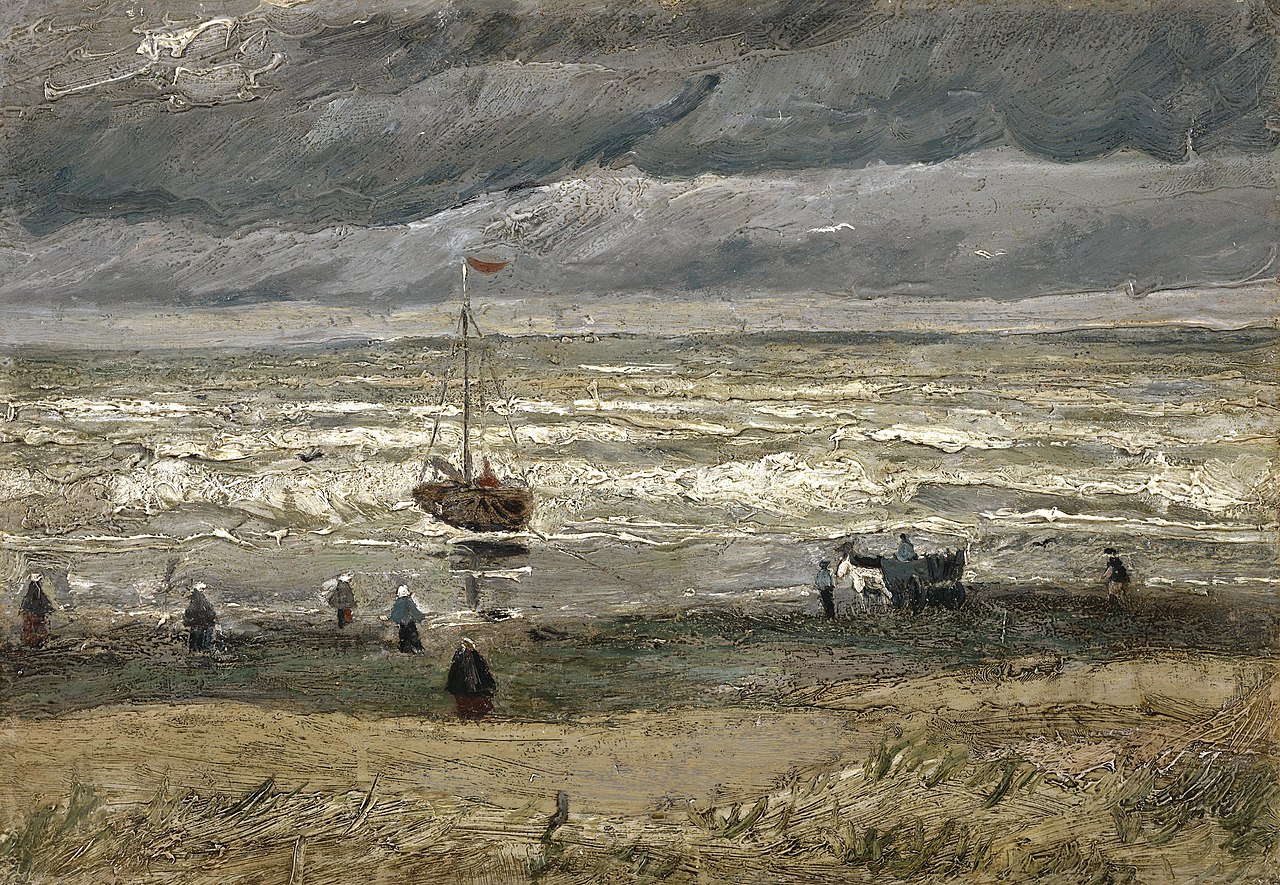
August 22, 1873. (Scheveningen).—The weather is rainy, the whole atmosphere gray; it is a time favorable to thought and meditation. I have a liking for such days as these; they revive one’s converse with one’s self and make it possible to live the inner life; they are quiet and peaceful, like a song in a minor key. We are nothing but thought, but we feel our life to its very center. Our very sensations turn to reverie. It is a strange state of mind; it is like those silences in worship which are not the empty moments of devotion, but the full moments, and which are so because at such times the soul, instead of being polarized, dispersed, localized, in a single impression or thought, feels her own totality and is conscious of herself. 
Vincent Van Gogh, Scheveningen Beach in Stormy Weather, 1882

Thursday, December 27, 2018

Hollywoodland

'A lot of my paintings are anonymous backdrops for the drama of words.  In a way, they're words in front of the old Paramount Studios mountain.  You don't have to have a mountain back there - you could have a landscape, a farm.  I have background, foreground.  It's so simple.  And the backgrounds are of no particular character.  They're just meant to support the drama, like the Hollywood sign being held up by sticks.' - Ed Ruscha interviewed in Shift magazine, 1988.
I've been reading Richard D. Marshall's monograph on Ed Ruscha and what comes over repeatedly is his very postmodern, conceptual insistence that there is nothing very significant about the content of his paintings - backgrounds and foregrounds, images and texts are often arbitrary or deliberately chosen to subvert any obvious interpretation.  In this quote he is talking about the paintings he has done of words and mountains - I can't reproduce one for copyright reasons but you can see above in low res the results of a google image search for "Ed Ruscha mountain".  In these paintings, the mountains dominate the visual field and yet Ruscha's insistence that they are nothing more than a background returns landscape to its Renaissance function as parergon, secondary to the painting's actual subject matter. 

The original Paramount mountain, used from 1917 to 1967

Mention of the Paramount mountain made me look it up on Wikipedia.  The article's authors make this corporate logo's origins and meaning sound like an intriguing mystery:
'Legend has it that the mountain is based on a doodle made by W. W. Hodkinson during a meeting with Adolph Zukor. It is said to be based on the memories of his childhood in Utah. Some claim that Utah's Ben Lomond is the mountain Hodkinson doodled, and that Peru's Artesonraju is the mountain in the live-action logo, while others claim that the Italian side of Monviso inspired the logo. Some editions of the logo bear a striking resemblance to the Pfeifferhorn, another Wasatch Range peak, and to the Matterhorn on the border between Switzerland and Italy.'
The twenty-four stars on the logo referred to the actors originally under contract at Paramount in 1916.  Logos generally have to be simple but because this one is shown on a movie screen it can be very detailed - modern versions have tended to resemble nineteenth century landscape paintings.  And of course the actual logo you see at the cinema now is animated - I've included a clip of the 100th anniversary version below.   


In the quote above Ed Ruscha mentions another, different form of Hollywood landscape art - the famous old sign itself.  Erected in 1923, to advertise "HOLLYWOODLAND", a new segregated, whites-only housing development in the hills above the LA, it was originally only meant to stay up for a year, but soon came to be seen as a popular landmark and symbol of the home of cinema.  It was renovated in 1949 (losing the 'LAND') and again in 1978.  Wikipedia will tell you about some of the ways it has been altered, imitated and spoofed over the years, although I see that their 'In Popular Culture' section has a stern note from the editors saying 'this section appears to contain trivial, minor, or unrelated references...'  Perhaps someone should put a mention of Ed Ruscha in there - he painted several versions of the Hollywood sign in 1968 and returned to the subject again in 1977, showing the letters in reverse as The Back of Hollywood.  Here's another Ruscha quote, from an interview in 1984.
'The Hollywood sign is actually a landscape in a sense.  It's a real thing and my view of it was really a conservative interpretation of something that exists, so it almost isn't a word in a woay - it's a structure.  It's a phenomenon or something.' 
I think this ilustrates how difficult it is to define this sign, let alone an oil painting of it that exists within a long sequence of works whose subject is nothing but painted words.

The back of the HOLLYWOOD sign
Image from Wikipedia

Wednesday, December 26, 2018

Wovenland

I thought it was time to bring back my regular surveys of 'landscape music', having had a couple of years off.  The last one I did was in 2015 - it contains links to the earlier ones, or you can just check back through my old December posts.  I should apologise for some dead links in my previous surveys, as videos and tracks have been moved or taken down over the years.  Looking back I see there's now a missing video in a post I wrote back in 2010 about Toshiya Tsunoda, the Japanese sound artist.  He's the first of my picks for 2018, with the album Wovenland, a collaboration with Taku Unami (the title refers to the way their separate field recordings are woven together).  Reviewing it in Wire Magazine, Derek Walmsley thought this 'one of the most original and startling recording projects in recent years.'


One of the albums I missed by not doing this in 2016 was 3hattrio's Solitaire, inspired by Edward Abbey’s nature writing classic, Desert Solitaire (1968).  Abbey, author of The Monkey Wrench Gang, based this, his first non-fiction book, on the time he spent as a park ranger at Arches National Monument.  3hattrio say they play 'American desert music':
'Their aim is to create a new music which responds to the natural world of their sacred homeland near Zion National Park in Utah.  They also strive to acknowledge the cultural traditions of generations of people who have worked and lived on the deserts of the American southwest. The subject matter of the songs is often desert oriented, sometimes not. Mostly, they express the desert experientially from a daily-ness of watching light off distant mesas and hearing the way sound plays off sheer sandstone cliffs. Then they play music. They don’t over-think it.' 
Their new release is Lord Of The Desert and includes tracks called 'Night Sky', 'Skeleton Tree' and 'Dust Devil' (see video clip below).


My earlier round-ups always featured music from Touch and their most recent release is relevant - Howlround's The Debatable Lands.  This was inspired by the border region in Cumbria which Graham Robb wrote about in his latest book (quite interesting, but not as rewarding a read as I was expecting).  Another liminal space was the source for Jana Winderen's Spring Bloom in the Marginal Ice Zone, originally a sound installation for the 2017 Sonic Acts Festival:
'The marginal ice zone is the dynamic border between the open sea and the sea ice, which is ecologically extremely vulnerable. The phytoplankton present in the sea produces half of the oxygen on the planet. During spring, this zone is the most important CO2 sink in our biosphere. In Spring Bloom in the Marginal Ice Zone the sounds of the living creatures become a voice in the current political debate concerning the official definition of the location of the ice edge.' 
I'm listening to the album now as I write this, streaming from Jana Winderen's bandcamp page.


In my round-up for 2012 I featured Erland Cooper's Orkney Symphony.  In March this year he released Solan Goose, its tracks named after the Orcadian words for seabirds (the solan goose is a northern gannet).  He also released Murmeration, with a Norman Ackroyd picture on the cover (incidentally, Ackroyd's daughter Poppy is a Brighton-based composer, whose work sometimes references landscape themes and uses field recordings).  Erland Cooper is planning a third record in this vein, as he explained in an interview for The Island Review, which will explore 'our relationship and respect for the sea: how it surrounds the community and the landscape; how it supports the greatest ecosystem of all.'  Together these albums are inspired by the words of the poet George Mackay Brown. “The essence of Orkney's magic is silence, loneliness and the deep marvellous rhythms of sea and land, darkness and light.”


Stuart Hyatt's Metaphonics: The Complete Field Works Recordings comprises 7 LPs and a book, based around his own field recordings but incorporating collaborations from around forty other artists.  The YouTube clip below presents a track from the album Pogue's Run - 'from its source, through the city, into a mysterious three-mile underground tunnel, and finally to the White River, Pogue’s Run represents the ongoing tension between nature and civilization.'  I enjoyed seeing field recordists filmed as if they were in a pop video, although as this goes on and they reach the underground river, it more closely resembles scenes a scene from a science fiction film.  There is an interview with Hyatt at the online art/science magazine CLOT.  He quotes from an essay by Yiorgis Sakellariou in the Metaphonics book, which views field recording as "an alchemical practice, a transformation of perception of both recordist and environment. A recording location is not simply a geographically framed scenery, but more importantly, a place of inquiry, experimentation, and wonder."


I will stick there at five main recommendations, but here, briefly, are a few other albums from 2018 that reflect landscape in different ways.  Further suggestions in the comments below would be welcome.
  • Grouper's Grid of Points, written by Liz Harris during a residency in Ucross, Wyoming. One of its tracks is inspired by Zabriskie Point, a film I wrote about here in May.
  • Richard Skelton's Front Variations subjected sine waves 'to increasing amounts of feedback in order to simulate the so-called ice-albedo feedback mechanism. This is the process whereby the action of melting glaciers reduces the global surface area of ice, thereby reducing the amount of solar radiation that glaciers reflect, which in turn increases global temperatures and causes further glacial melting.'
  • Laurie Anderson's Landfall is a cycle of songs about Hurricane Sandy - a recording was released this year with the Kronos Quartet.  Tracks include 'Wind Whistles Through the Dark City,' 'The Water Rises' and 'Our Street is a Black River'...  
  • Daniel Bachman's guitar in The Morning Star is set against a background of field recordings.  It continues a sequence of 'Songs for the Setting Sun' that he began on the 2015 album River (which was featured on my 2015 round-up). 
  • Jim Ghedi's A Hymn For Ancient Land, was a bit too pastoral for the Quietus reviewer: 'only on ‘Phoenix Works’, a song dealing with the decline of traditional industries in the north, does he explicitly deal with darkness. This, coupled with the dense, meandering tonalities of ‘Fortingall Yew’, saves the album from being a landscape painting.' 
  • According to The Quietus, the album of the year was Gazelle Twin's Pastoral, which 'picks away at the bucolic, Constable-generated image of English countryside like a fetid scab.' Gazelle Twin is Brighton-based electonic musician  Elizabeth Bernholz, whose previous project was based on J. G. Ballard's last novel Kingdom Come. 
Finally, I will conclude here not with an album, but with an app.  Numero Group's 'Environments collects the entire historic record series by master sound engineer Irv Teibel into one easy to use package for the iPhone and iPad' (it costs £2.99).  If you're not familiar with Irv Teibel's 1970s psychoacoustic nature recordings, there's a good article about him at Pitchfork.  Aquarium Drunkard described the new app as 'an ingenious re-contextualization of this retro-futurist “gebrauchtsmusik” that recapitulates the series’ initial novelty. However captivating Teibel’s tale, the Environments app now illuminates an anthropocene landscape where 'Dusk in the Okefenokee Swamp' and a 'Summer Cornfield' are mediated by an inescapable layer of sleek, fabricated hardware and playfully nostalgic software.'

Sunday, December 23, 2018

Liquid landscapes

George Lambert, Box Hill with Dorking in the Distance, 1733
Images: Wikimedia Commons

Yale University's British Art Studies is a completely open access journal and its Autumn issue is dedicated to 'Landscape Now'.  In addition to various articles, including the Tim Barringer piece I referred to earlier this month, there is a 'Conversation Piece' coordinated by Alexandra Harris.  She refers to the current popularity of books about nature, but suggests that 'while readers are offered new ideas about landscape writing at every festival (several festivals are devoted to the subject) and with every Amazon click and with each week’s Caught by the River newsletter, it can be harder to get much purchase on developments in contemporary visual arts and art history. Work by art historians is not always being brought to the common table...'  Unsurprisingly (given what I wite about here), agree with this.  She also gives an insight into what she has been researching recently (I have written about here before about her previous books on landscape and culture, Weatherland and Romantic Moderns). 
I've been trying in my own research to get closer to an understanding of what places have looked like to different kinds of people living in them. I want to find evidence for what “views” have looked like to people, other than the makers and consumers of landscape art. It’s hard: I’ve been reading for two years—parish registers, local histories, antiquarian guides, court proceedings, wills and inventories, tithe maps, a very occasional diary; I’ve been wondering at the skill and sensitivity of local historians like Margaret Spufford and many who followed her lead—yet still I’m baffled by the difficulty of reaching the landscape feelings of the past. [...] Whether we are reaching back to life before (or without access to) the grammars of Western landscape painting, or looking again at Lambert, Wootton, and Wilson, or thinking about contemporary artists, it may be fruitful to reunite landscape with local knowledge and local people, from the airy prospects to make out local habitations and names.
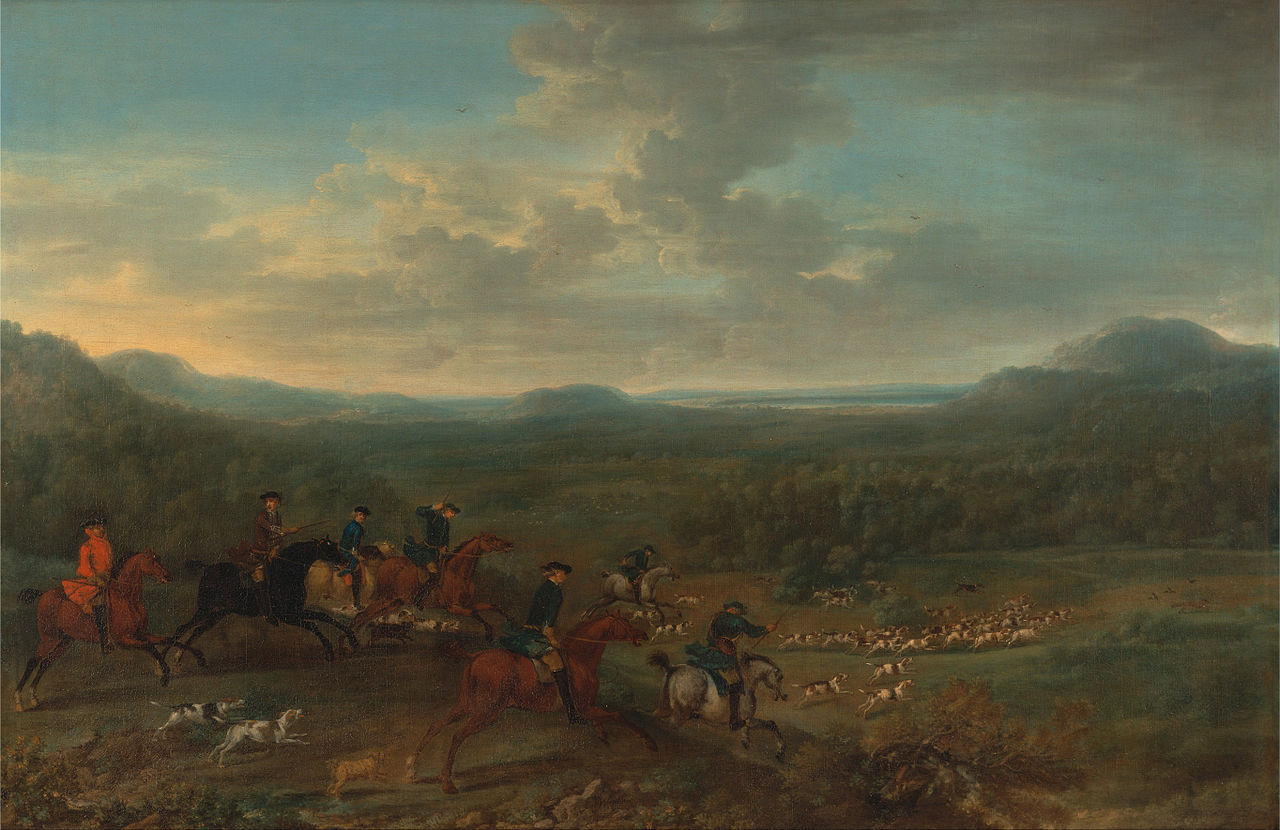
John Wootton, A Fox Hunt, c. 1735

Several responses follow Alexandra Harris's introduction, some more informative than others.  Rachel Hewitt for example, tells us that at present 'there is important work being done, by Hayley Flynn among others, on [William] Blake’s interactions with, and subversions of, the eighteenth-century British landscape tradition' (I wonder if this new scholarship will surface in the Tate's Blake exhibition, scheduled for autumn next year). Emily Hayes writes about the influence of the Royal Geographical Society's magic lantern lectures, including those by Vaughan Cornish, a 'chemist turned geographer' who specialised in the study of waves, before turning later 'towards eugenics and landscape heritage activism'.  The intention is that this Conversation 'will develop as more respondents enter the debate. Readers can also join in by adding a response at the bottom of the page.'  There are no responses yet - I hope there will be, but I've learnt here that in the age of Twitter you can't really expect people to go to the trouble of adding written comments.

Vaughan Cornish, Breaker and Bores on a Flat Shore, 1910  

I will conclude here by pointing you to three other articles in the journal, each about landscape artists I have discussed here before.

  • Greg Smith takes a fresh look at Thomas Girtin's panorama, The Eidometropolis, drawing on material that has become available only in recent years;
  • And in 'Liquid Landscapes', Stephen Daniels juxtaposes a series of pond photographs by Jem Southam with Constable's depiction of Branch Hill Pond in his pictures of Hampstead Heath.


 John Constable, Hampstead Heath, with Pond and Bathers, 1821

Sunday, December 16, 2018

Water Village

Zhao Mengfu, Water Village, 1302
Source: Wikimedia Commons

I have been reading Shane McCausland's scholarly study, Zhao Mengfu: Calligraphy and Painting for Khubilai's China, which focuses not just on Zhao's paintings, but on the colophons added to them over the years by writers wishing to comment on the artist and his work.  These are not usually visible in reproductions - the photograph of Water Village above shows only the annotations and seals visible on the composition itself.  Below I've photographed the colophons for Water Village reproduced in McCausland's book (pp242-3).  A footnote lists the authors of these - most were writing soon after the painting was finished but others date from the late Ming Dynasty.  It would be natural to consider these as critical texts rather than works of landscape art themselves.  But the fact that these colophons were composed in verse and written in beautiful calligraphy mean that they form a kind of secondary landscape art themselves.  Zhao Mengfu himself was a renowned calligrapher and his own artistry can therefore be seen in colophons he added to other scrolls of paintings or poetry.


Water Village has a pictorial realism that impressed its colophon writers - one said you could almost forget it is actually a picture.  The handscroll 'begins' at the far right with a vertical title, leading the eye down to a bluff with bushes sprouting from it (see below).  McCausland sees this as having a 'liminal role', marking the transition from calligraphy to painting and from surface to illusionistic space. From there the eye can explore the low-lying landscape, arranged in an X-shape and centred on a tiny bridge. There are few people, just a few isolated huts.  Zhao Menfu himself wrote that this subject captured the ideal hermitage, a place of scholarly retreat. Other colophon writers were reminded of Wang Wei, the great landscape poet and painter who wrote about his own retirement from the world in the Wang River Sequence.


The most intrusive colophons to Water Village were added by the Qianlong Emperor, who reigned over China for much of the eighteenth century.  He added two seals and a poem to the painting itself.  In one of the first posts on this blog I wrote about the way the emperor filled his own painting of Mount Pan with no less than thirty-four later descriptions.  He also added a colophon to Zhao Mengfu's Autumn Colours on the Qiao and Hua Mountains (1296) pointing out an error in the artist's  geography (this painting is discussed in an earlier post).  For Water Village, he wrote a colophon referring to Qu Yuan, an early Chinese poet I wrote about here in March, who drowned himself after being wrongly banished from court.  The emperor read this act as a gesture of loyalty, perhaps reflecting his own anxieties as a Manchu ruler of the Chinese.  He also described taking the painting with him on a visit to the Eastern Mountains, where Water Village is set (somewhere near Sonjiang). 'In surveying the scene,' McCausland writes, 'the emperor drained this place and its depiction of any symbolism as a private refuge of the literati from the affairs of state and government.'

Monday, December 03, 2018

La Mer Pacifique

Jean-Gabriel Charvet and Joseph Dufour,
 Sauvages de la Mer Pacifique wallpaper, before 1829

A new article in British Art Studies by Tim Barringer provides a history of recent trends in landscape art history. In this century, he explains, there has been a strong focus on art and empire, influenced by Edward Said’s Orientalism, and analysis of paintings made far from Europe, which reveal 'the impediments offered to the totalizing “colonial picturesque” by local geographies'.  He then describes a recent artwork that I was looking at only this weekend:
'The work of contemporary indigenous artists increasingly offers critical reflections on the continuing power of landscape as a contested space open to multiple interpretations, and as a site of historical and contemporary violence. Lisa Reihana’s in Pursuit of Venus [infected], (2015–2017), on display at the time of publication in the exhibition Oceania at the Royal Academy of Arts in London, responds to the historical provocation of Les Sauvages de la Mer Pacifique, a scenic coloured wallpaper in twenty panels, created in 1804 by Joseph Dufour on the basis of imagery from the Pacific voyages of James Cook (Les Voyages du Capitaine Cook was proposed as an alternative title for the paper). Reihana’s panoramic video spanning 26 metres embraces the “monarch of all I survey” viewpoint of the painted panoramas of the late eighteenth century, but inserts speaking, singing, and moving figures to contest the silent, stereotypical representations of indigenous people in eighteenth- and nineteenth-century sources.'


At the Royal Academy, you encounter this video panorama towards the end of the exhibition and I found it quite hard to drag myself away.  Figures like Captain Cook, Joseph Banks and Chief Kalani'opu'u are seen in various moving tableaux as the viewpoint pans steadily round.  The original wallpaper was not on display in the exhibition (the National Gallery of Australia has an example) - perhaps it would have been out of place among so many beautiful objects from the islands.  In an interview in the Guardian, Lisa Reihana describes its design as
'“a concoction, a fabulation invented in someone else’s elsewhere”.  The greenery, for example, was transplanted not from Polynesia but from South America, which Jean Gabriel Charvet, the Frenchman who designed the wallpaper, had recently visited. Similarly, the idealised, pale-skinned locals are dressed in neoclassical costumes inspired more by what had recently been dug up at Pompeii than by anything from Hawaii or Tahiti.'
In Pursuit of Venus was previously shown at the Venice Biennale and has its own website (it even has an Instagram feed, although there are no posts on it yet...)  Tim Marlow, the RA Director, calls it 'stupendous' in an interview with Lisa Reihana, viewable on the RA's site.  Excellent as it is, there are many more wonders in the show which I could mention but which go beyond the remit of this blog, from the Brancusi-like male deity sculpture tino aitu to a Tobi Island necklace of sea-urchin spines.  As Jenny Uglow wrote in her review, 'Oceania is a powerful demonstration of art’s capacity to fight the tide of loss, honoring tradition, reclaiming places, histories, and identities, and opening the way to the future.'

Saturday, December 01, 2018

Crossing a river


One of the most renowned Buster Keaton stunts involves him getting the better of a landscape feature.  Our Hospitality (1923) has scenes filmed at California's Truckee River and when I first saw it I thought the waterfall scene (above) was filmed at a real location.  In reality the whole waterfall was constructed on a Hollywood backlot, as is explained (with photographs) on the excellent Silent Locations website.  I will quote here what John Bengtson says there:
During the climax of Our Hospitality, Buster rescues his girlfriend, played by his first wife Natalie Talmadge, from sweeping over the brink of a waterfall, by swinging like a pendulum from a rope tied to a log jammed in the rocks, grabbing her just as she starts to fall.  Buster’s waterfall stunt set was built astride the [...] T-shaped concrete pool (or plunge as they were called back then) that stood on the Robert Brunton Studio backlot just north of Melrose Avenue, now part of the current-day Paramount Studios lot.

The Our Hospitality waterfall stunt set
Image from Photoplay Productions Ltd via SilentLocations.
 
In Sherlock Jr. (1924), Keaton, a projectionist, falls asleep and walks in his dream into the motion picture he is showing.  We then see him in a sequence of cuts that seamlessly position Keaton in different landscapes: a rocky promontory (below), a jungle, a beach, a rock in the sea.  This was done using surveying instruments to position him at precisely the right place in each setting.  From the rock in the sea, Keaton dives into the water and lands in a park, then leans against a tree and finds himself in a garden, after which the main story of this film-within-a-film begins, with the humble projectionist somehow transformed into a Sherlock Holmes style detective. 

Buster Keaton in Sherlock Jr. (1924)

The bridge scene in The General (1926)

Thinking about Keaton in relation to this blog, it occurs to me that his most spectacular film stunt - building a bridge and wrecking a real train for The General (1926) - had a similar level of ambition to the works of land artists like Christo and Jeanne Claude.  Apparently, bits of Keaton's railtrack can still be seen at the bottom of Row River at low tide.  But if I had to choose my favourite example of Buster Keaton 'landscape art' it would be the moment in The Scarecrow (1920) when he manages to cross a river without getting his feet wet, by walking across it on his hands. 


I will conclude here by recommending again the website SilentLocations.com, which is still posting fascinating information on Keaton and other silent movie stars.  Browsing through it I came across the photograph below: if Richard Long had been working in the 1920s he might have looked like Charlie Chaplin in this field.  In fact, this circle is the trace of the departing circus, which is just packing up and leaving The Little Tramp behind.  Detective work by Bengtson and other enthusiasts has identified the location for this scene and even a surviving tree that was there when the film was made.  'Just as there are trees that remain today having witnessed the making of The Birth of A Nation, a giant old oak tree in Glendale, appearing onscreen at left, witnessed the concluding scenes from The Circus.'

Charlie Chaplin in The Circus
Image from SilentLocations.