Showing posts with label Richard Wilson. Show all posts

Friday, February 08, 2019

The Umbrian lake, smiling in summer heat

Richard Wilson, The Temple of Clitumnus, 
with the cows drinking from the spring of Clitumnus, 
near Spoleto, Umbria (detail), 18th century 
Source: Christies

I have been re-reading Gilbert Highet, whose Poets in a Landscape (1957) I wrote about in an earlier post about the Springs of Clitumnus.  Highet was drawn to this place through 'two lines of sincere poetry' in an elegy by Sextus Propertius (c. 50/45-15 BCE):
among the woods where the Clitumnus hides its lovely
  springs, and white oxen bathe in the cool stream
The rest of this poem, and almost everything else Propertius wrote, is about love and his life in the city of Rome.  However, you can find more landscape in his poetry, in this description of his origins.
Old Umbria bore you on a famous family-tree,
  I do not lie; the borders of your home
are these: cloudy Mevania, among rain-soaked fields,
  the Umbrian lake, smiling in summer heat,
and steep Asisium's wall climbing towards the peak -
  the wall to which your genius has brought fame.
Mevania is modern Bevagna and the lake was nearby although it was drained long ago and no longer exists. Asisum is Assisi and there are still Roman stones there bearing the Propertius family name.  But, as Highet explains,
'In Assisi today, everything belongs to the world of St. Francis.  Apart from a few inscriptions and details, there is only a small and elegant Capitoline temple (dedicated to the trinity of Jupiter, Juno, and Minerva) above ground to remind the visitor of the world of Propertius, and, below ground, the relics of the Roman Forum.  High above them soar the immense walls and towers of the churches of St. Francis. ... Around the towers of the church of St. Francis, the doves which once were the messengers of Venus now rise, the emanations of a loftier and purer spirit.'
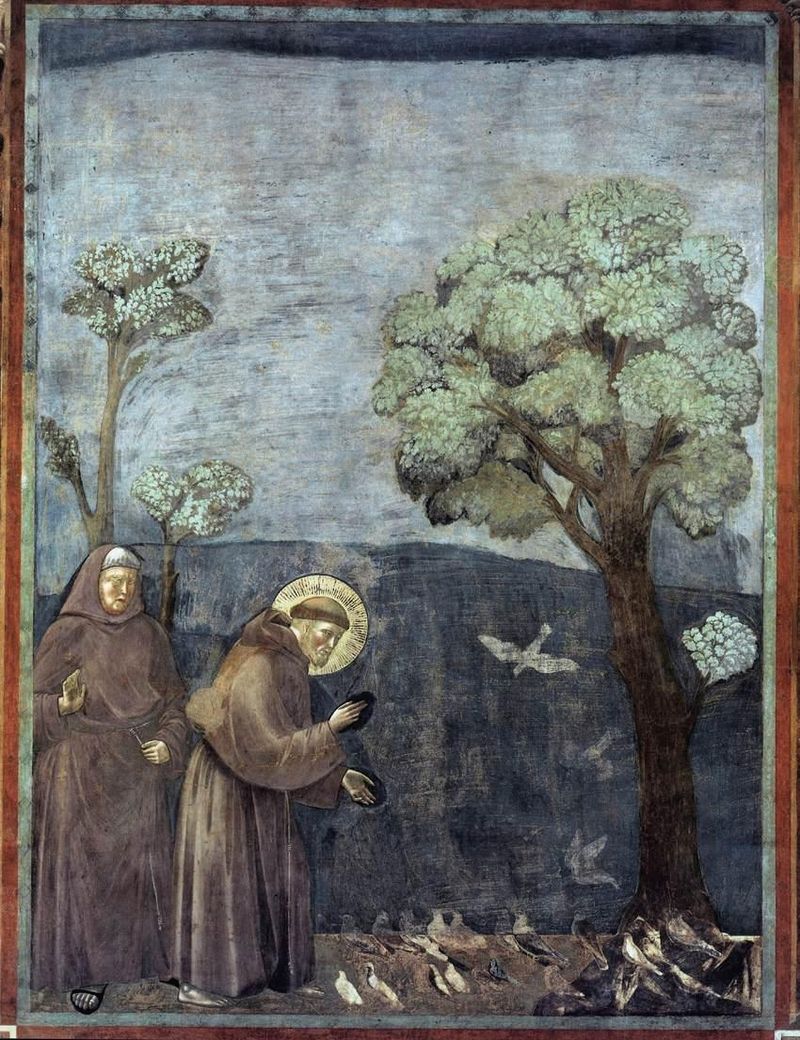
Giotto (attribution uncertain), St. Francis Preaching to the Birds, 1297-99
Source: Wikimedia Commons

Francesco Bernadone - St. Francis - is much more associated with nature than Propertius, through the stories that he preached to the birds and made peace between a wolf and a village.  He is included, albeit 'stretching the point', in Italian Landscape Poems, the 1993 anthology compiled and translated by Alistair Elliot, who sadly died late last year.  The book starts with St. Francis' Canticle of the Sun or Laudes Creaturarum ('Praise of the Creatures'), which is said to have been composed in 1224.  It is in the Umbrian dialect of Italian, rather than the Latin written by Propertius, and is often considered the earliest work of Italian literature.  Here are some lines in praise of the elements: the wind, air and clouds, water ('so helpful and humble, precious and chaste'), fire and finally earth, 'who nourishes and guides us / and brings forth fruit in kinds, with coloured flowers, and grass.'
Laudato si, mi Signore, per frate Vento
et per aere et nubilo et sereno et onne tempo,
per lo quale, a le Tue creature dài sustentamento.

Laudato si, mi Signore, per sor'Acqua,
la quale è multo utile et humile et pretiosa et casta.

Laudato si, mi Signore, per frate Focu,
per lo quale ennallumini la nocte:
ed ello è bello et iucundo et robustoso et forte.

Laudato si, mi Signore, per sora nostra matre Terra,
la quale ne sustenta et gouerna,
et produce diuersi fructi con coloriti fior et herba.

Friday, June 08, 2018

Deep mellow shades breaking upon the view

Harriet Gouldsmith, A View of Hampstead Heath Looking Towards Cannon Place, 1818

I recently came across a curious publication in which a landscape painting is the narrator of its own story.  A Voice from a Picture, privately printed in 1837, was by 'A Female Artist'; a review three years later, revealed that the author was Harriet Gouldsmith Arnold (1787–1863), an English landscape painter.  This review can be read online, as can the full text of A Voice from a Picture.  According to the reviewer, 'the idea of making a picture tell its history is not new; but it will bear a new treatment'.  This is interesting initself - are there actually earlier examples of landscape paintings relating their autobiographies?  In her introduction, Gouldsmith (she used the name Arnold after her marriage in 1839) says that she hopes her little book will help spread the knowledge of art 'as the fittest guide to the instructive love of nature in her better forms.'

The painting begins its autobiography with an account of 'the sorrows, hopes, and fears' of its 'parent': an artist (male) who possessed 'an unfeigned delight for the sublimities and beauties of nature.' 
Often have I witnessed the feelings of my fond parent, whilst gazing upon the last gleams of the setting sun, - the deep mellow shades breaking upon the view, 'ere night shed silence and repose upon all earthly things; and often has grey morning, the sweet harbinger of another day, brought vigour and renewed exertion to his enthusiastic and unwearied mind.  At length, after many solitary wanderings, and anxious efforts, I became a Picture.  Then, again, new fears and anxieties arose. - What was to be thought of me, amongst the thousands of connoisseurs, amateurs, artists, and critics, whom I should be compelled to face?
The painting was right to be anxious.  It imagines being neglected like the 'unobtrusive works' of Richard Wilson, put into the shade by the flash and fire of Loutherbourg.  For a long time it hangs unregarded on a London wall, while the painter accumulates a body of work, and is then taken to be exhibited in Manchester, but remains unsold.  People praise it but, because the artist is not a big name, nobody will buy it.  More exhibitions and an auction follow, without success, and eventually the painter becomes so poor that he sells all his possessions, including the landscape painting.  Then, at the low point of the story, the painting gets 'carried into a back garret, to answer all the purpose of a chimney board.'  However, after the poor artist dies in a debtors prison, his work starts to become sought after.  Found and restored, the painting becomes highly praised and ends up decorating 'the mansion of nobility.'

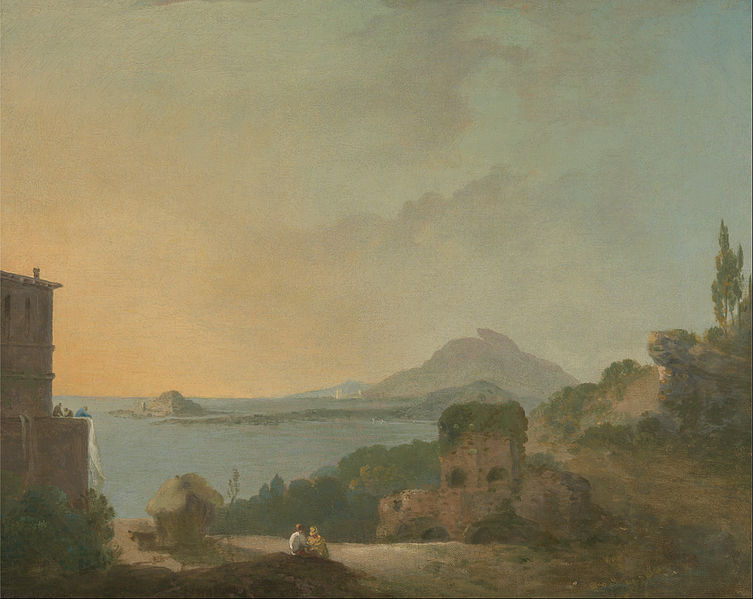
Richard Wilson, Lake Avernus, c. 1765

Before leaving A Voice from a Picture I can't resist a digression, to quote an anecdote Gouldsmith includes as an illustration of the straits to which poverty reduces artists.  Here a landscape painting is actually worn.
'A party of English artists meeting together in Italy, for the purpose of making studies from nature.  The weather proving very sultry, the members proposed that all should take off their coats, which was strongly objected to by one of the party, but at last submitting to the others, a Waterfall was discovered on his back, his waistcoat having been made out of a picture of that subject.'
Harriet Gouldsmith was painting during the Golden Age of British landscape painting.  She first exhibited at the RA in 1807 and was elected to the Water Colour Society in 1813.  The painting below is a late work and can be found in the Egham Museum, which purchased it in 1985.  I wonder how its 'life' played out over the preceding 140 years...  Its subject, Magna Carta Island, was itself put up for sale four years ago, with an asking price of £3,950,000 (see the BBC's report).  This island includes a Grade II-listed house, built a few years before Gouldsmith's painting, that features a specially-built Charter Room to house the stone on which the charter is supposed to have been signed.  Perhaps someone should write A Voice from an Island, to relate the history of its owners since that day in 1215 when Runnymede took its place in the story of England.  The Times reported that as a result of the sale, Magna Carta Island has been acquired by a Chinese family.

Harriet Gouldsmith Arnold, Magna Carta Island, 1845

Friday, October 03, 2014

Tusculan's romantic groves


Olafur Eliasson's Turner Colour Experiments (2014) at Tate Britain

As reviewers of Tate Britain's Late Turner – Painting Set Free have pointed out, there is much more to the artist's final years than the 'sublimely empty pictures' that regularly get compared to the work of abstract artists.  The last Turner show I went to, at Margate earlier this year, paired him with Helen Frankenthaler and two years ago the Tate itself mounted an exhibition that made the link with Cy Twombly's later paintings.  Visiting this new exhibition last weekend, I came ready to enjoy the art anachronistically: the abstract expressionism of Turner's Rough Sea (1840-5), the minimalist sequence of blue and grey sky studies (similar to those in the Channel Sketchbook viewable at Google Art) and of course those famous visions of Venice dissolved in light.  The temptation to forget Turner's subject matter and see his work in terms of pure colour was also encouraged by the presence of Olafur Eliasson's Turner Colour Experiments (for a discussion of these, see BLDGBLOG).  But ultimately I found I was just as interested in the way Turner persisted with history painting, where his spectacular effects seem often to magnify rather than overshadow the incidents they depict, drawn from Shakespeare, the Bible and the classics.  For this post I want to focus on one of these, Cicero at his Villa, which Turner exhibited in 1839.

J. M. W. Turner, Cicero at his Villa, 1839

I have written here before about the appeal of bringing the work of Latin writers to life by imagining them in their setting, as Gilbert Highet did in his classic study Poets in a Landscape (1957).  In 1819 Turner was in Italy, sketching at Frascati, which, according to a travel book he owned, was the site of  Roman Tusculum.  There he would have pictured Marcus Tullius Cicero, who wrote Stoical essays there (the Tusculan Disputations, 45 BCE) on such cheerful topics as grief of mind, bearing pain and contempt of death, two years before being killed as an enemy of the state.  However, Turner was approaching Cicero through the lens of art, because, as his sketchbook makes clear, he was looking for the site where his admired predecessor, Richard Wilson, had set Cicero and his Friends at his Villa.  This painting, first exhibited in 1770, is usually identified with Arpinum, but Turner would have seen another version (see below) which its owner called Cicero at Tusculum.  Another source for Turner's painting may have been 'The Pleasures of Memory', a long poem that brought Samuel Rogers literary celebrity when it appeared in 1792, which mentions Cicero at Tusculum.  Thus there are various paths that lead from Turner's picture back to its classical source and the three texts below (all referred to in a 1981 article by William Chubb) show how art drawn from landscape leads back to art again.

Richard Wilson, Cicero with his friend Atticus and brother Quintus,
 at his villa at Arpinum, c.1771-75

(1) First there is Turner himself, drawing a parallel between Wilson and Cicero in a lecture called 'Backgrounds, Introduction of Architecture and Landcape' which he delivered in February 1811.  This can be found in an old edition of the Journal of the Warburg and Courtauld Institutes - the reason it is not widely published is presumably that it is not very well written (Roger Fry tried to transcribe it and gave up saying that "it would be unfair to Turner to publish work that only shows his weaknesses").  Towards the end of the lecture, Turner regrets the fact that Zuccarelli's 'meretricious' paintings
'defrauded the immortal Wilson of his right and snatched the laurel from his aged brow. In vain did ...  the Cicero at his Villa sigh for the hope, the pleasure of peaceful retirement, or the dignified simplicity of thought and grandeur, the more than solemn solitude that told his feelings.  In acute anguish he retired, and as he lived he died neglected.'
(2)  Then there is the passage on Cicero that Turner marked in his own copy of Rogers' Poems (1827).  Turner knew the poet and illustrated the long poem Italy that Rogers based on his travels (fit was from Italy that Rogers wrote to a friend: 'Oh if you knew what it was to look upon a Lake which Virgil has mentioned & Catullus sailed upon, to see a house in which Petrarch has lived.')  In 'The Pleasures of Memory', Rogers describes 'the charm historic scenes impart' and refers to the time Cicero (Tully) visited Syracuse a hundred and sixty years after the death of Archimedes, to find the Sage's grave unregarded and overgrown.
'So TULLY paus'd, amid the wrecks of Time,
On the rude stone to trace the truth sublime;
When at his feet, in honour'd dust disclos'd,
The immortal Sage of Syracuse repos'd.
And as his youth in sweet delusion hung,
Where once a PLATO taught, a PINDAR sung;
Who now but meets him musing, when he roves
His ruin'd Tusculan's romantic groves?'
(3)  Finally, Cicero.  At various times he owned villas at different locations, so that Wilson was able to paint another Cicero-related view (below) that combines Italian light and classical allusion.  Cicero's Arpinum villa was used as the setting for his book on law, De Legibus.  This begins with the scene Wilson depicts in the painting shown above, where Cicero (Marcus), his brother Quintus and friend Atticus are looking at an old oak tree associated with the Consul Gaius Marius (157-86 BCE).  Thus the poignant capacity of landscape to preserve fragments of culture, which Wilson, Rogers and Turner experienced in Italy and exemplified in their art and poetry, can be found in De Legibus described by the writer who inspired them.  Cicero's dialogue refers to his own earlier poem, and to a palm tree on Delos that takes us all the way back to Homer. 
'Atticus. —This is the very grove, and this the oak of Arpinum, whose description in your poem on Marius, I have often read. If, my Marcus, that oak is still in being, this must certainly be it, but it appears extremely old.
Quintus Cicero. —Yes, my Atticus, my brother’s oak tree still exists, and will ever flourish, for it is a nursling of genius. No plant can owe such longevity to the care of the agriculturist as this derives from the verse of the poet.
Atticus. —How can that happen, my Quintus? How can poets bestow immortality on trees? It seems to me that in eulogising your brother, you flatter your own vanity.
Quintus. —You may rally me as much as you please, but as long as the Latin language is spoken, this oak of Marius will not lose its reputation; and as Scævola said of my brother’s poem on Marius, it will “Extend its hoary age, through countless years.” Do not your Athenians maintain that the olive near their citadel is immortal, and that tall and slender palm tree which Homer’s Ulysses says he beheld at Delos, do they not make an exhibition of it to this very day? and so with regard to other things, in many places, whose memorial endures beyond the term of their natural life. Therefore this acorn-bearing oak, on which once lighted “Jove’s golden Eagle, dazzling as the sun,” still flourishes before us. And when the storms of centuries shall have wasted it, there will still be found a relic on this sacred spot, which shall be called the Oak of Marius'
Richard Wilson, Cicero's Villa and the Gulf of Pozzuoli, 1770-80

Thursday, January 21, 2010

1,244 real Views of Great-Britain

In 1772 Catherine the Great wrote to Voltaire, saying that she loved gardens in the English style: ‘the curving lines, the gentle slopes, the ponds in the forms of lakes, the archipelago on dry land, and I scorn straight lines and twin allées.’  Catherine invited John Busch to Russia to work at Pulkova and then on Tsarskoye Selo, near St Petersburg, where he collaborated with the architect Vasily Neyelov.  It must have been quite a  leap from Hackney, where Busch owned a nursery off Church Street that he sold on to Conrad Loddiges in 1771 (it became famous for its rare plants in the early nineteenth century).  Another landscape architect who went to Russia and contributed to the design of Tsarskoye Selo was Charles Cameron, who later worked for Alexander I and became Architect-in-Chief to the Admiralty.  But perhaps the most extraordinary example of Catherine's anglophile taste in landscapes was the order she placed with Josiah Wedgwood, for a 'Table and Dessert Service, consisting of 952 pieces and ornamented in enamel with 1244 real Views of Great Britain'.

Now 1,244 is not a trivial number and Wedgwood was understandably concerned: 'why all the gardens of England will scarcely furnish subjects sufficient for this sett, every piece having a different subject'.  How he did it is explained by Alison Kelly in 'Wedgwood's Catherine Services', an article for The Burlington Magazine (August 1980).  Wedgwood and his partner Thomas Bentley started with the famous landscape gardens that Catherine was particularly interested in, basing designs on published engravings like Beauties of Stowe, by George Bickham (1750-56) and Chambers's Description of the Gardens and Buildings of Kew (1771), as well as views sent in by sympathetic friends, like Mr Anson of Shugborough.  Stowe, unsurprisingly, provided more views (43) than any other landscape garden.

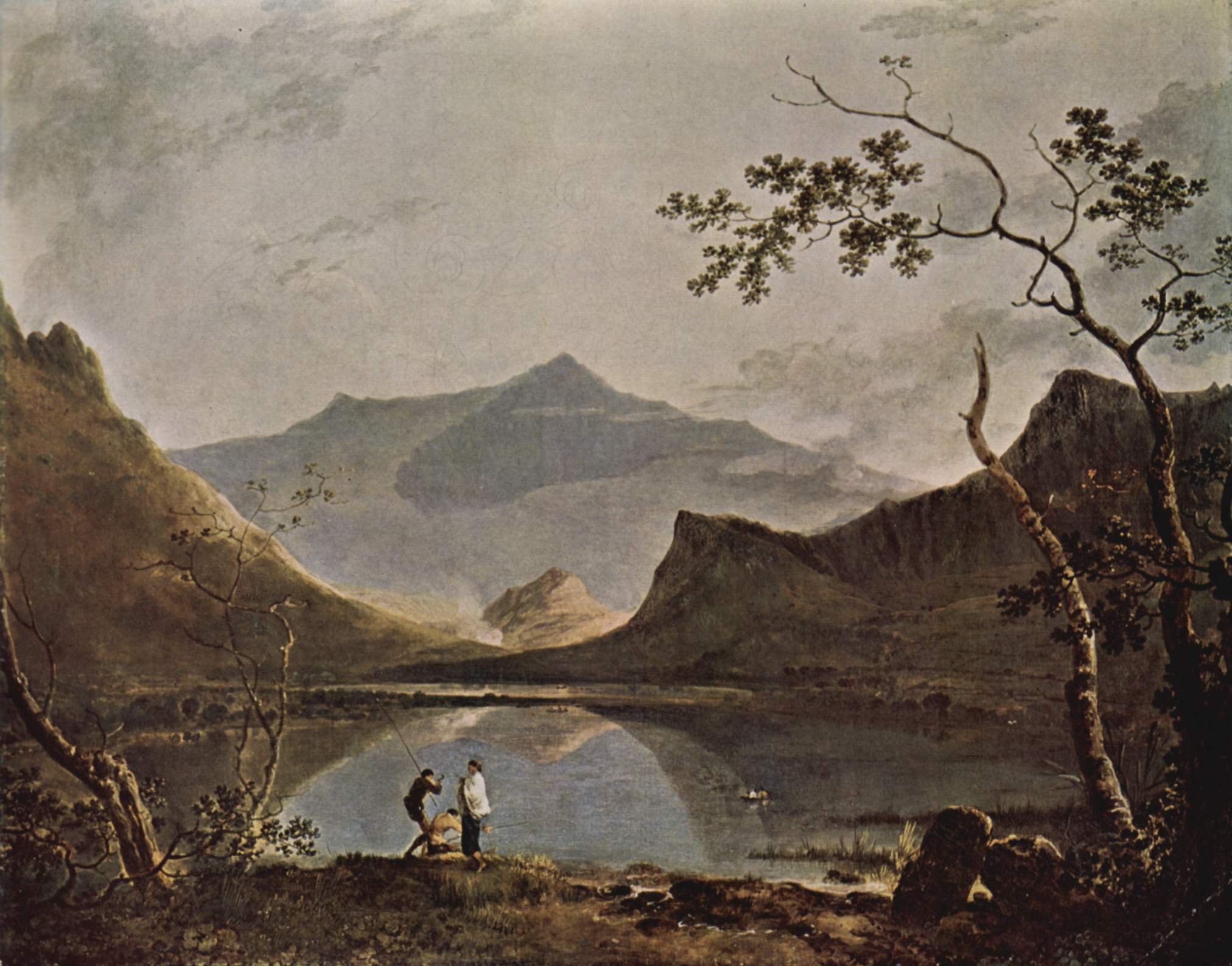
In addition to the nation's most celebrated gardens, Wedgwood and Bentley used images of famous country houses, although Bentley wrote that 'we have purposely omitted to represent the most modern buildings, considering them unpicturesque'.  Picturesque landscapes accounted for a good number of the designs: ruined abbeys, castles (150 of these) and even some early remains: Stonehenge, Kit's Coty House, a Cornish Dolmen and the Roman ruins of Silchester.  Wedgwood and Bentley were also up-to-date with tastes in the Sublime, including various views of the Lake District, the Peak Cavern, the Giant's Causeway and Fingal's Cave.  There is a letter from Wedgwood to Bentley in 1773 asking about Richard Wilson's landscapes: 'Pray have you Wilson's Views from different places in Wales? If you have not, Mr. Sneyd will lend them us'.  Alison Kelly writes that 'after reading this letter it is pleasant to recognise on a dish the unmistakable outlines of Wilson's Snowdon from Llyn Nantlle.'

Richard Wilson, Snowdon from Llyn Nantlle, c1766

Given their role in the Industrial Revolution it is interesting that a few of the pieces feature such scenes as Papermills at Rickmansworth, a Colliery and Pump near Bristol and the Dock at Plymouth.  However, urban views are largely absent, with the notable exception of London.  You can see a plate from the dinner service showing Somerset House on the Hermitage website (there don't seem to be any non-copyright images available to put up here).  Other obvious London highlights included Kensington Palace, the Mall and Horseguards Parade but there were also a few views from the fringes of the city - Erith, Sunbury, Shepperton.  Mention of Shepperton made me wonder what a contemporary 952 piece Ballardian dinner service might look - traffic islands, car parks, terminal beaches, abandoned hotels...

Eventually Wedgwood and Bentley had got together all 1,244 views and the completed service went on show in London before being sent to Russia.  Apparently this was a great social success, as people were came to see whether one man's country estate featured more prominently than another's.  When it arrived, Catherine the Great was satisfied and used it for state occasions in the Chesmenski Palace. But after her death it was eventually forgotten about and only rediscovered at the beginning of the last century, when nearly 800 pieces were found to have survived.

Friday, February 06, 2009

View of a ruined arch

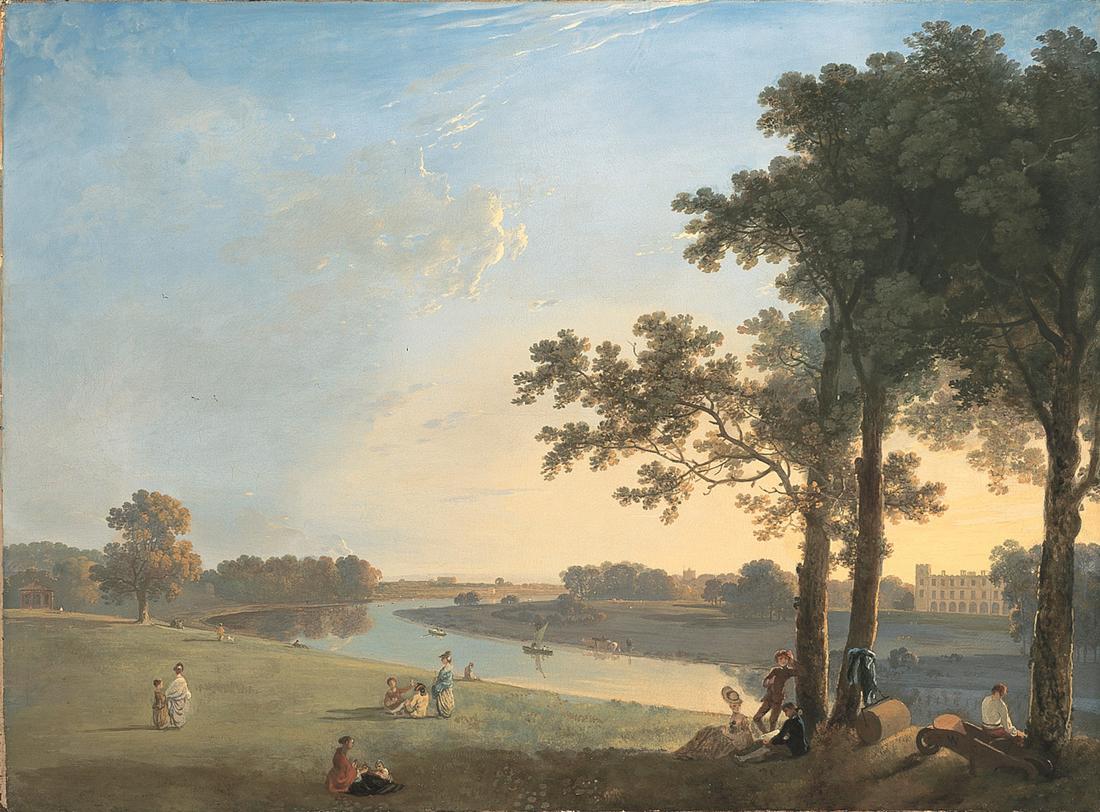
Kew Gardens: The Pagoda and Bridge by Richard Wilson, 1762

A brief addendum to my last posting - here is Richard Wilson's idealised image of the Pagoda at Kew. He painted other landscapes in the vicinity, including a View of Syon House. In reviewing an exhibition of works from Sir Brinsley Ford's art collection, Charles Fitzroy writes: "one of Sir Brinsley's favourite anecdotes was how Lord Clark used to begin his lecture on the Grand Tour by showing a Wilson view of a ruined arch, describing it as showing the grounds of the Villa Borghese. It was actually a depiction of Kew gardens. The Olympian Lord Clark may not have appreciated the joke, but Sir Brinsley was vastly amused by his mistake, which demonstrated the extent to which an Italianate light permeates Wilson's best work."