Showing posts with label memorial landscapes. Show all posts

Saturday, January 19, 2019

The mountain tops, like little isles appear'd

Salomon Gessner, Bucolic Scene, 1767

My post yesterday was about a nineteenth century French-speaking Swiss writer from Geneva; this one is about an eighteenth century German-speaking Swiss poet from Zurich.  However, as can be seen above, Salomon Gessner (1730-88) was also a visual artist.  Here is a snatch of his poetry, describing autumn. It is taken from an 1809 translation of Gessner's Idylls (1756-72).  According to the Encyclopedia Britannica, 'his pastorals were translated into 20 languages, including Welsh, Latin, and Hebrew. The English translation ran through many editions and was admired by the Romantic writers Sir Walter Scott, Lord Byron, and Wordsworth.'  However, I see from Wikipedia that 'The New International Encyclopædia (1905) finds his writing “insipidly sweet and monotonously melodious,” and attributes Gessner's popularity to the taste of a generation nursed on Rousseau.'
O'er every vine of gold and purple hue
The sun its animating lustre threw;
And every curling branch, whose friendly shade
Waved o'er his cot, beneath the zephyr play’d.
Clear was the sky, o'er all the valley's bed
The low-land vapours like a lake were spread;
Amidst whose floating surface lightly rear'd
The mountain tops, like little isles appear'd;
Where smoaking huts and fruitful groves were seen
In autumn's richest vest of gold and green.

Salomon Gessner, Pastoral landscape with two women and a boy
playing a flute in front of a herm of Pan, 1787

Gessner was on my mind today as I saw the painting above in the British Museum.  It was in the Prints and Drawings room, in a display of art linked to the sketch by Joseph Anton Koch they recently purchased from the Brian Sewell estate (see my post on it last year).  Gessner's painting was the basis for an 1805 etching by another artist I have discussed here before, Carl Wilhelm Kolbe.  The British Museum also owns an etching by Kolbe of the memorial to Gessner which stands in Zurich's Platspitz Park.  In it, 'a well-dressed couple and child looking at Gessner's tomb in the form of a Greek memorial with a low relief sculpture, set behind a railing in woodland.'

Carl Wilhelm Kolbe, The Monument to Salomon Gessner in Zurich, c. 1807

In their current exhibition, the British Museum curators have put Gessner's Pastoral Landscape on show next to a different memorial to Gessner, this one by Johann Heinrich Bleuler.  The etching was published in the year of Gessner's death and shows a memorial to him situated by a lake.  Was it imaginary, like Caspar David Friedrich's proposal for a monument to Goethe?  If not, is there still something resembling this at Lake Klöntal, a permanent presence of a landscape painter in the landscape he painted?  Yes, it would seem there is, according to the local tourism website and you can do a nice walk to it. They describe the origin of the inscription thus: 'Sie wurde ihm von zwei Verehrern gewidmet, die sich 1788 zur Einweihung des Gedenksteins mit Tränen in den Augen um den Hals fielen und küssten.' ('It was dedicated to him by two devotees who fell around the neck and kissed each other in 1788 with tears in their eyes for the inauguration of the memorial stone' - Google Translate). The writing looks quite amateurish and crudely done, but clearly those admirers meant well.

Johann Heinrich Bleuler, Commemorative stone in memory of Salomon Gessner, 
at Lake Klöntal, Glarus, 1788

Saturday, July 08, 2017

Igualada Cemetery


Commenting yesterday on my post about the Stockholm Woodland Cemetery, Ken Worpole, author of Last Landscapes: The Architecture of the Cemetery in the West, mentioned his high regard for the modern cemetery at Igualada in Spain.  Ken has also kindly sent me three photographs which I have included here (an ArchDaily article on Igualada has more images, including some taken after a snowfall).  Enric Miralles designed the cemetery with his partner Carme Pinòs in 1984 and it was constructed over the following decade.  In Britain, Miralles is best known for the Scottish Parliament Building which was completed after his early death in 2000 (he is buried at Igualada). Writing last year in The Architectural Review, Ken notes that Igualada 'is in harsh rocky terrain punctuated by quarries' and so the architects made use of this in their design, incorporating rusting steel, old railway sleepers, quarried stone.  The result is somewhere that 'possesses a profound spiritual presence within its severe landscape: serious and purposeful without being in any way morbid.'


I have not visited Igualada myself (though we weren't that far away a couple of summers ago).  I will therefore quote here some impressions by two British architects, Joe Morris and Mary Duggan, interviewed in Building Design.
'The work is like no other we had come across. It is an architecture of the land, a work which choreographs the geological and sculptural qualities of the landscape; an architecture of topography. The narrative, one in which the living are brought downwards into a city of the dead, is potent and creates an eerie but contemplative series of spaces. 
'The palette of materials speaks of the site. It is reduced to materials which over time will express the ravages of time and weather and are intended to be subsumed by the landscape within which they sit. Concrete, granite, Corten, each material is selected for the visceral illustration of its origin, forged or excavated from the earth, and slowly returning to the landscape.'

And to conclude, from a lengthier more theoretical article by Tom Bliska, here is another reflection on the way the architects worked with space and time:
'Miralles and Pinos are serving as “exegetes of the landscape,” drawing from the site’s history and local landform precedents to create a space that is itself a program. Every cemetery has an explicit connection to the past, in the sense of a distorted reflection of the city that produced it, but Miralles and Pinos are specific in creating traces of the past through articulation of fragments, frameworks, and the path one takes through them. The long walk down to the mausoleum plaza at the low point of the site is filled with the “immediate and imperfect”: rough aggregate ground surface, violently skewed steel markers, indeterminate edges between precast concrete and gabion wall. It is this layering that builds the narrative quality of the space, boundaries that shift with movement and tactility to present an abstracted history of the site itself as process. In this way, Igualada cemetery can be read as a chronotopia, a space where fragments of the past are either exposed or rearticulated didactically to express the meaning of the site’s current form.'

Thursday, July 06, 2017

Skogskyrkogården, the Woodland Cemetery


I was in Stockholm for a meeting in May and took the opportunity to visit Skogskyrkogården, the famous Woodland Cemetery which in 1994 became only the second location developed in the twentieth century to become a UNESCO World Heritage site.  It was late on Sunday afternoon when I got there - the visitor centre was shut but I had the place almost to myself.  A couple of other tourists, one person tending a grave, a solitary jogger (they are everywhere).  I took a short video clip on my phone (below) which gives a sense of how peaceful it was, though you could never escape the low background rumble of traffic.  I'm not sure how many deer there are in these woods; another one emerged from behind these graves just after I stopped filming.  They were watchful but not fearful.  It did not seem that surprising to find them there - even here in London when you step into a graveyard like Abney Park Cemetery, near my home in Stoke Newington, you become aware that you are among squirrels, birds and butterflies.


Skogskyrkogården was conceived jointly by architects by Gunnar Asplund (1885-1940) and Sigurd Lewerentz (1885-1975), who won a competition in 1915 to design a new cemetery on the site of an old quarry.  In addition to the landscape, they designed distinctive buildings - a classical Resurrection Chapel positioned at the end of a long tree-lined path, an intimate Woodland Chapel amid the pines, and a graceful and a functionalist crematorium.  From this crematorium you look across a pond towards a bare slope on the summit of which is a group of trees.  On my visit this meditation grove was a dark silhouette against a white sky which would soon be filling Stockholm with unseasonable snow.  But you can see the trees in full leaf on the cover of Ken Worpole's fascinating book, Last Landscapes: The Architecture of the Cemetery in the West (2003).  From the vantage point of this photograph (by Larraine Worpole), the foreground is dominated by Asplund's stark granite cross, inspired by Caspar David Friedrich.


Caspar David Friedrich, Cross on the Baltic Sea, 1815
Source: Wikimedia Commons

On the occasions I have visited graveyards over the years, there has usually been at least one prominent memorial I've been keen to find - Ezra Pound at San Michele near Venice, Alejo Carpentier in Havana's Colon Cemetery, Karl Marx at Highgate, dozens of culture heroes at Père Lachaise...  Wandering around the Stockholm Woodland Cemetery it was something of a relief just to be experiencing the landscape, without looking for anybody famous.  Nevertheless, I did come upon the grave of Greta Garbo, whose family chose this for her because it was 'a long way from the hustle and bustle of the world'.  There is no eye-catching monument to the great movie star, but neither is it the case that she is simply buried in an egalitarian spirit along with all the others.  Her headstone stands isolated against the trees -  fittingly perhaps for someone famous for saying "I just want to be alone".  It seems to have the makings of a shrine: a path has been laid to it and, as you can see below, trees are being planted in a semi circle to form a kind of special enclosed space.    


There are no film stars buried in Abney Park Cemetery, though you can find a famous nineteenth century music hall artist, George Leybourne, the original 'Champagne Charlie' - a fact mentioned in Last Landscapes (Ken lives near me in Stoke Newington).  I would agree with Ken that despite the efforts of the Abney Park Trust, it is still in parts 'a forlorn, tangled forest', very different from the woods of Skogskyrkogården.  Originally the early Victorian London cemeteries were designed as Gardenesque landscapes - John Claudius Loudon published an influential book on the subject in 1843.  Abney Park Cemetery Originally (which opened in 1840) was designed as an arboretum and became a kind of tourist attraction like Kew Gardens.  As the population grew it rapidly filled up, but perhaps in its early days it would have had something of the atmosphere of a woodland cemetery.  Today they are very different: as Ken says, the Stockholm Woodland Cemetery gives the impression when you enter it of 'a vast rolling landscape, with deep forest beyond', yet you quickly come upon intimate, peaceful spaces for tranquil reflection.  It is, he concludes, 'the most successful example of large-scale landscape design in the twentieth century.'

Sunday, November 13, 2011

Walter Benjamin's Grave

'The cemetery faces a small bay directly looking over the Mediterranean; it is carved in stone in terraces; the coffins are also pushed into such stone walls.  It is by far one of the most fantastic and most beautiful spots I have ever seen in my life.'
- Hannah Arendt, letter to Gershom Scholem, 21 October 1940


Michael Taussig's essay, 'Walter Benjamin's Grave: A Profane Illumination', describes the cemetery of Portbou, the small town on the border of France and Spain where Benjamin died in 1940.  Carrying his possessions in a heavy black briefcase, Benjamin was led there over the mountains by a young woman, Lisa Fittko.  'It was the first time she had made the trip.  Benjamin was her first refugee ... She got lost.  They backtracked.  Then they found their way to the summit: "The spectacular scene appeared so unexpectedly that for a moment I thought I was seeing a mirage ... the Vermillion Coast, an autumnal landscape with innumerable hues of reds and yellow-gold.  I gasped for breath - I had never seen such beauty before."' But the the Franco government had cancelled all transit visas and on the night of September 25th Walter Benjamin, fearing repatriation, took an overdose of morphine tablets.  Hannah Arendt, then still in the South of France, came to look for his grave soon afterwards. Lisa Fittko and her husband Hans continued the dangerous work of escorting refugees across the border.  Hans took to wearing a Basque cap and sandals to blend in with the locals.  Sometime he would sit for hours on a cliff projection looking out to sea.


Dani Karavan, Walter Benjamin Memorial at Portbou, 1994

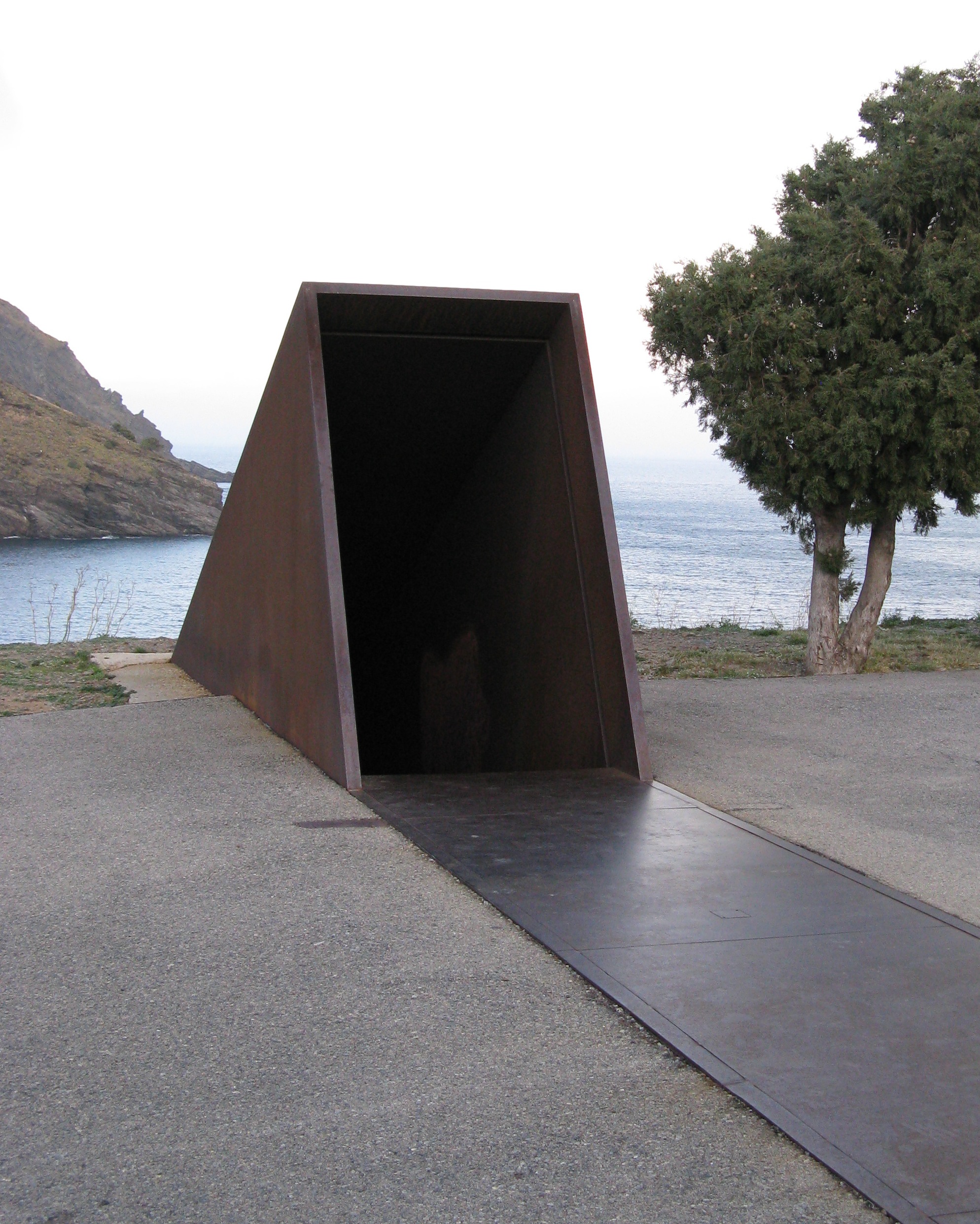
The beauty of this place, which so struck Hannah Arendt and Lisa Fittko, seems at variance with its  history of displacement and disappearance.  Michael Taussig first visited Portbou in 1987 and found the whole town a sad monument to Benjamin's death - 'cold, nasty, and enigmatic.'  But now, on returning fifteen years later, he comes upon the new monument to Walter Benjamin, designed by Dani Karavan, an artist from Tel Aviv.  An iron triangle forms a doorway leading to steps that take you down the slope of the hill towards the sea.  At the bottom there is a thick pane of glass inscribed with Benjamin's words: 'It is more arduous to honour the memory of the nameless than that of the renowned.  Historical construction is devoted to the memory of the nameless.'  The words could be taken to refer as much to the victims of Franco as to the Nazis.  Looking back up the stairs, the doorway frames a rectangle of blue sky, echoing the view of the breaking waves below.

Later, inside the cemetery itself, Taussig is struck by a virtually identical set of steps, leading from the graves to the chapel.  He recalls Benjamin's surrealist conception of the 'profane illumination', where something provides a new kind of experience whilst retaining the trace of the kind of religious illumination it has surpassed. In the cemetery at Portbou there are niches bearing the names of the dead and a common grave, the fosa común, in which Benjamin's remains may actually lie.  The monument, by contrast, is a profane illumination, which 'gathers its strength through the open expression of namelessness as empty space, sea and sky.  It truly is an emphatic statement on the weighting of the world by its nameless dead.'  Standing on the headland Taussig feels the full force of the transmontaña wind.  'Can we imagine a state, a religion, or a community bound to remembrance which would have thye courage or craziness to call a wind a monument?'  Walter Benjamin once wrote that the best way to light a cigarette is with a flintstone and fuse.  'The wind blows the matches out, but the harder the wind blows, the more the fuse glows.'