Showing posts with label Wang Wei. Show all posts

Friday, September 26, 2025

White-Rock Shallows


Pat Suet-Bik Hui, Painting with Poem by Wang Wei, 1995

This is one of the paintings on show in the Ashmolean at the moment, in a small exhibition called The Three Perfections
'Hui has inscribed this painting with a Tang-era (618-907) poem that transforms her seemingly abstract streaks of blue into the image of a flowing river: Clear and shallow rapids formed out of white rocks / Green reeds grasp reaching for the sky / Families dotted along both banks / Silk rustling as it's washed beneath the bright moon.'

The curators don't say, but this is one of Wang Wei's poems from the celebrated Wang River Sequence, which I first mentioned here back in 2006. David Hinton calls it 'White-Rock Shallows'. The poems are not purely landscape description - here we see people by the river washing silk. The second slightly confusing line suggests rushes 'grasping' for the sky. Alternative translations include: 'green rushes once could be grasped', 'green reeds almost near enough to touch'  and (Hinton) 'green reeds past prime for harvest.'

Pat Suet-Bik Hui (b. 1943) gave a set these paintings to the Chinese art expert Michael Sullivan, who bequeathed then to the Ashmolean. In addition to paintings with calligraphy, Hui made images without words; one, called 'Landscape', consists of a blue wash for the sky and a green wash for the land, separated by a lavender horizon. Hui has lived for many years in North America but originally studied in Hong Kong under the traditional ink painter Lui Shou Kwan. They were introduced by another of his pupils, Wucius Wong, who specialises in landscapes set within geometric structures (see, for example, the Met's Reminiscing About the River). The Ashmolean has a painting of his called Autumn Feelings which incorporates two leaves and splashes of red and brown ink. There were trees in Oxford this week that are starting to turn and paint the ground with fallen leaves.  

Sunday, June 23, 2019

The wind that waves the pines

The Overstory (2018) is the novel about trees that was up for the Booker last year and has now won the Pulitzer Prize.  Clearly it is a very highly regarded novel but I have to admit I found it a slog to get through.  There is a lot of explanation of what we now know about trees and the Wood Wide Web which is very reminiscent of Peter Wohlleben, indeed one of the characters in the novel writes a book that sounds just like The Hidden Life of Trees (Powers has said this particular character is inspired by Suzanne Simard and Diana Beresford-Kroeger).  As for the story itself - I agree with Benjamin Markovits that 'the ordinary diversity that tends to shape plot on a human scale doesn’t get much of a look-in'.  There is an article by Sam Jordison that does a good job of describing the reasons why the novel didn't work for me ('if The Overstory really is one of the best books of the year, then the novel is dying even faster than the forests.')  However, you may well disagree - Powers clearly has lots of admirers - and my purpose on this blog is not really to give positive or negative reviews. 

I am mentioning The Overstory here because it deals in a sustained way with trees and forests, although I wouldn't say it has any particularly memorable descriptions of landscape.  I am therefore going to veer off and talk about a poem by Wang Wei that plays an important part in the book. One of the main characters learns that her father, a Chinese immigrant, has committed suicide.  He
'puts a Smith & Wesson 686 with hardwood grips up to his temple and spreads the workings of his infinite being across the flagstones of the backyard. He leaves no note except a calligraphic copy of Wang Wei’s twelve-hundred-year-old poem left unfurled on parchment across the desk in his study:
An old man,
I want only peace.
The things of this world
mean nothing.
I know no good way
to live and I can’t
stop getting lost in my
thoughts, my ancient forests.
The wind that waves the pines
loosens my belt.
The mountain moon lights me
as I play my lute.
You ask: how does a man rise or fall in this life?
The fisherman’s song flows deep under the river.'                                                                 (p51)
This poem, 'Answering Magistrate Zhang', can be found translated in many anthologies.  Most of them note that the last line is an allusion to an ancient poem 'Yu fu' ('The Fisherman'), one of The Songs of the South. 'The Fisherman' concerns the banishment of poet Qu Yuan (4th century BCE), which I wrote about here last year. Wandering by a river bank, he encounters a fisherman who tells him that it is wise not to be chained to material circumstances, but move as the world moves.  Qu Yuan wishes to hold himself aloof and pure rather than submit 'to the dirt of others'.  But the fisherman advises him to adapt to the times.  He paddles off, singing as he goes that when the river's waters are clear he can wash his hat-strings in them, and when they are muddy he can wash his feet.  The same song also appears in the Mencius, where the philosopher asks how to deal with a man who is inhumane, and who delights in the things that could lead to his destruction.  It can certainly feel sometimes as if we are dealing with such people in these times, and living in a world where mud is clouding the river waters...

Qu Yuan and the Fisherman
From 'Scenes from the Chu Ci poem Yu Fu' by Bai Yunli 
source: Silkqin.com

Sunday, December 16, 2018

Water Village

Zhao Mengfu, Water Village, 1302
Source: Wikimedia Commons

I have been reading Shane McCausland's scholarly study, Zhao Mengfu: Calligraphy and Painting for Khubilai's China, which focuses not just on Zhao's paintings, but on the colophons added to them over the years by writers wishing to comment on the artist and his work.  These are not usually visible in reproductions - the photograph of Water Village above shows only the annotations and seals visible on the composition itself.  Below I've photographed the colophons for Water Village reproduced in McCausland's book (pp242-3).  A footnote lists the authors of these - most were writing soon after the painting was finished but others date from the late Ming Dynasty.  It would be natural to consider these as critical texts rather than works of landscape art themselves.  But the fact that these colophons were composed in verse and written in beautiful calligraphy mean that they form a kind of secondary landscape art themselves.  Zhao Mengfu himself was a renowned calligrapher and his own artistry can therefore be seen in colophons he added to other scrolls of paintings or poetry.


Water Village has a pictorial realism that impressed its colophon writers - one said you could almost forget it is actually a picture.  The handscroll 'begins' at the far right with a vertical title, leading the eye down to a bluff with bushes sprouting from it (see below).  McCausland sees this as having a 'liminal role', marking the transition from calligraphy to painting and from surface to illusionistic space. From there the eye can explore the low-lying landscape, arranged in an X-shape and centred on a tiny bridge. There are few people, just a few isolated huts.  Zhao Menfu himself wrote that this subject captured the ideal hermitage, a place of scholarly retreat. Other colophon writers were reminded of Wang Wei, the great landscape poet and painter who wrote about his own retirement from the world in the Wang River Sequence.


The most intrusive colophons to Water Village were added by the Qianlong Emperor, who reigned over China for much of the eighteenth century.  He added two seals and a poem to the painting itself.  In one of the first posts on this blog I wrote about the way the emperor filled his own painting of Mount Pan with no less than thirty-four later descriptions.  He also added a colophon to Zhao Mengfu's Autumn Colours on the Qiao and Hua Mountains (1296) pointing out an error in the artist's  geography (this painting is discussed in an earlier post).  For Water Village, he wrote a colophon referring to Qu Yuan, an early Chinese poet I wrote about here in March, who drowned himself after being wrongly banished from court.  The emperor read this act as a gesture of loyalty, perhaps reflecting his own anxieties as a Manchu ruler of the Chinese.  He also described taking the painting with him on a visit to the Eastern Mountains, where Water Village is set (somewhere near Sonjiang). 'In surveying the scene,' McCausland writes, 'the emperor drained this place and its depiction of any symbolism as a private refuge of the literati from the affairs of state and government.'

Friday, October 09, 2009

The landscape of the bland


Ni Zan, Landscape, 1372
National Museum of Taipei (Source: Wikimedia Commons)
 
'Trees on the riverbank, an expanse of water, some nebulous hills, a deserted shelter.  The artist, Ni Zan (fourteenth century), painted virtually the same landscape throughout his life.  He did this not, it seems, because of any particular attachment to these motifs but, on the contrary, to better express his inner detachment regarding all particular motifs and all possible motivations.  His is the monotonous, monochromatic landscape that encompasses all landscapes - where all landscapes blend together and assimilate each other.'

This interesting description of the Ni Zan painting shown here is by François Jullien and comes from his book In Praise of Blandness: Proceeding from Chinese Thought and Aesthetics.  'Bland' is translator Paula M. Varsaro's rendering of the French word 'fadeur', which in turn is Jullien's approximation to the Chinese term dan.  Varsaro notes that readers familiar with Chinese literature will recognise in the book the Song dynasty ideal of pingdan (the 'plain and bland'), but will 'see their understanding recast in  broader and more significant framework, as Jullien demonstrates the philosophical udnerpinnings of the label'.  It is impossible to summarise Julien's book briefly, but the following sentences from his fourth chapter may give you a flavour...
 
'While flavor establishes opposition and separation, the bland links the various aspects of the real, opening each to the other, putting all of them in comunication.  The bland renders perceptible their shared character and, through this, their primordial nature.  Blandness is  the color of the whole, as it appears to the eyes who look farthest into the distance; it makes us experience the world and existence itself beyond the narrow confines of the individual's point of view - in their true dimension.'

The first great poet of the bland was the subject of my previous post, Tao Yuanming (apologies for my perennial inconsistency in the Chinese translation conventions but I tend to go with whichever writer I'm currently quoting, so here it's the Pinyin system).  In the Tang dynasty, the 'canonical' bland poets were Wang Wei, Wei Yingwu and Liu Zongyuan.  Poetic blandness involves a balancing of the senses, with nothing overwhelming our attention.  Language resembles what happens when, 'in the Azure Fields beneath the warmth of the sun, a hidden piece of jade emanates a vapor: one can contemplate it, but one cannot fix it precisely with one's gaze.'

At the end of the book Jullien returns to Ni Zan, reproducing another of his 'bland' landscapes and, by way of complete contrast, the painting by Wang Meng shown below.  In the latter, 'topography reveals itself convulsively before our eyes like some mountainous mass in the process of solidifying.  Matter is at work everywhere: twists and folds push at each other; everything pierces through and retracts.  The space is saturated; the turmoil of the scene has reached an extreme.'  Despite the vast difference in their attitude to landscape, the two artists were friends and Ni Zan praised the vitality of Wang Meng's style.  During the upheavals at the end of the Mongolian occuption, Wang Meng remained involved in politics and died in prison. Ni Zan, artist of the 'bland', gave up his estates and freed himself from worldly concerns.


Wang Meng, Lin-wu Grotto at Chu-ch'u, 1378
National Museum of Taipei (Source: Wikimedia Commons)

Monday, October 05, 2009

The Peach Blossom Spring

Having described the poetry of Hsieh Ling-yün last time, I now feel the need to refer to his contemporary T'ao Yüan-ming (also known as T'ao Ch'ien or Tao Qian), who is traditionally seen as the founder of 'fields-and-gardens' poetry.  According to David Hinton, both poets 'embody the cosmology that essentially is the Chinese wilderness, and as rivers-and-mountains is the broader context within which fields-and-gardens operates, it seems more accurate to speak of both modes together as a single rivers-and-mountains tradition.' (see his introduction to Mountain Home: The Wilderness poetry of Ancient China).


Portrait of Tao Qian by Chen Hongshou

In The Columbia Book of Chinese Poetry (1984) Burton Watson devotes a whole chapter to T'ao (whereas Hsieh only gets three poems).  Watson writes that the poetry of T'ao is ambiguous - 'exclamations upon the beauties of nature and the freedom and peace of rustic life, set uneasily alongside confessions of loneliness, frustration, and fear, particularly of death.  He sought solace in his zither, his books, and above all in wine, about half of his poems mentioning his fondness for "the thing in the cup," though in one of the poems he wrote depicting his own funeral, he declares that he was never able to get enough of it.'

T'ao Yüan-ming is probably most famous for the 'Peach Blossom Spring', a story told first in a preface and then as a short poem.  It concerns a fisherman who lost his way in a valley stream and came upon a forest of blossoming peach trees.  At the end of the forest was a hill with a spring, and an opening through which the fisherman squeezed, coming out onto a broad plane with houses, rich fields, pretty ponds, mulberry and bamboo.  Everyone he saw seemed happy and when they noticed the fisherman in their midst they invited him for a meal.  The villagers explained that people had first come to this secluded place during the troubled times of the Ch'in dynasty and had been cut off from the world since then.  The fisherman stayed several days before taking his leave, whereupon the villagers asked him not to tell the people outside about them.  However after making his way home, the fisherman did tell the local governor about the Peach Blossom Spring, who sent men to find it only to have them return unsuccessful.  Nobody since then has been able to find it.

Among later poets inspired by this tale was Wang Wei, who wrote his 'Song of the Peach Tree Spring' at the age of 19.  He tells the same story as T'ao, but ends with the fisherman mistakenly thinking he will be able to find the place again (from G. W. Robinson's translation):
He was sure of his way there
                             could never go wrong

How should he know that peaks and valleys
                             can so soon change?

When the time came he simply remembered
                             having gone deep into the hills

But how many green streams
                             lead into cloud-high woods -

When spring comes, everywhere
                             there are peach blossom streams

No one can tell which may be
                             the spring of paradise.

Thursday, December 27, 2007

Sunset Landscape

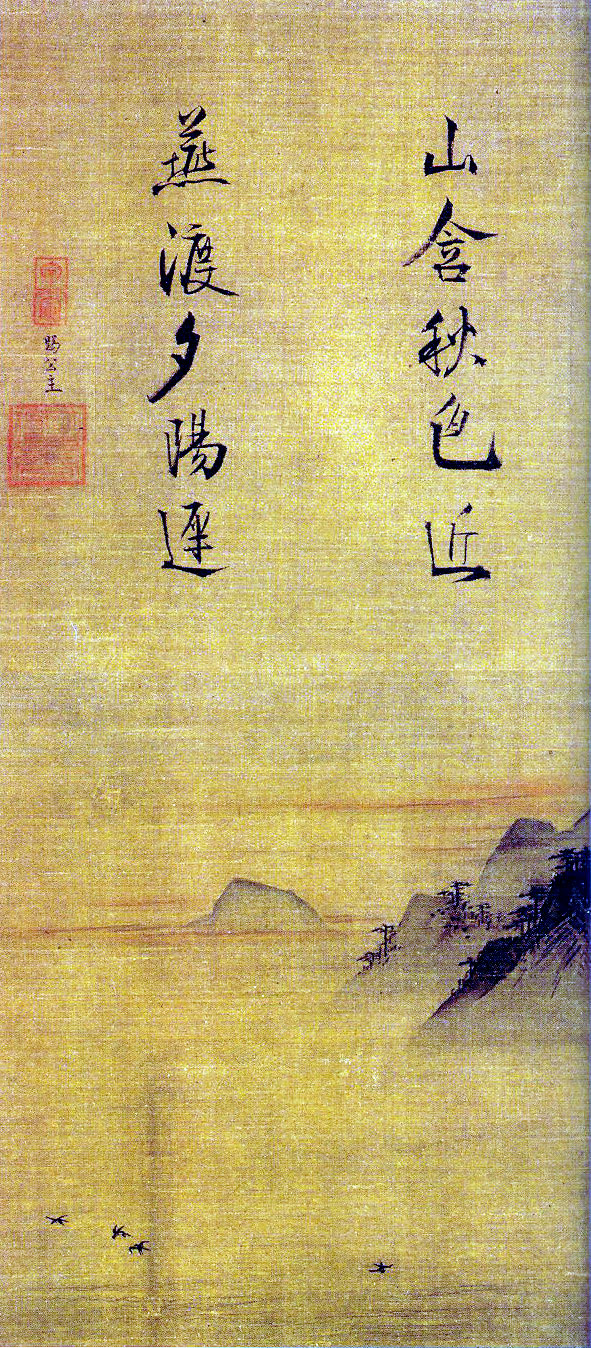
I have mentioned the Southern Song landscape painter Ma Yuan here before in connection with a Wallace Stevens poem. I’ve just been reading about the Ma family in Richard M. Barnhart’s chapter of Yale’s Three Thousand Years of Chinese Painting. They served Chinese emperors for five generations, starting with Ma Ben (Fen) in the early twelfth century and ending with Ma Lin, who was active in the early to mid thirteenth century. Ma Lin’s ‘touching Sunset Landscape seems almost to be an elegy for his dynasty, so preoccupied is it with the end of light and vision.’ It is a minimal landscape set beneath two lines by Wang Wei, “Mountains hold the autumn colour near / Swallows cross the evening slowly.” Barnhart notes that many scholars have detected a melancholy mood in Ma Lin’s paintings, but, since it was the emperor that commissioned these works, their poignancy cannot solely be attributed to the artist. In Ma Lin, the doomed Song dynasty court ‘found the perfect voice to sing their sad songs for them as they presided over the end of a great empire.’

Ma Lin, Sunset Landscape, 1254

Friday, October 12, 2007

Return to Songshan

There's a promising site called Mountain Songs that "connects ancient (and some modern) Chinese poetry to the sites where the poetry was written or written about. It enables you to experience the same sights that the poets themselves viewed hundreds of years ago." It's not all that clear yet - for example when I looked up Wang Wei I wasn't sure what landscape is shown in the photograph. But you can look up a few of the mountains that Wang Wei wrote about in his poems, such as Mount Sung or Sōngshān: "Setting sun floods autumn mountains. Sōngshān towers high in the distance, / Coming back, I shut my door on the world..."

Postscript 2023

Mountain Songs, with the links I included above, has disappeared from its original place and is now harder to find, but it does still exist at a new address: https://mountainsongs.mishanghai.org/index.php

The 'About Us' tab gives no information on the authors and still says the site is under construction. However, Bill Porter wrote about Mountain Songs in his 2016 book about a thirty day journey round the sites of Chinese poetry, Finding Them Gone (p361). The site was created by Gary Flint, who travelled all over China photographing mountains and compiling translations. His 'technical adviser' was Robin Chang (Chang Ch'i). Flint sadly died of cancer in 2009, three years after I wrote this post on my blog. He had been a classmate at Reed College of Gary Snyder, whose translations of Han Shan first got me interested in Chinese poetry. 

In 2011 Mountain Songs was the fifth recommendation for classical Chinese poetry by Qiu Xaolong, on the Five Books site. Here's what he says of Gary Flint:

For a few years he worked and lived in Shanghai, where I met him. We would talk about poetry and poetry translation over dim sum, but he passed away over a year ago. I chose his website because he so selflessly dedicated his time, energy and money to create it. He collected translations by other translators, and also published some of his own. The website is still available because a friend of his, in memory of him, is keeping it up. Poetry translation is difficult, and he did it simply because of his passion for it. Anybody who loves Chinese poetry can go to the website. So I felt I had to mention it in his memory.

Sunday, June 11, 2006

Deer Park

The most famous landscape poems of Wang Wei (699-761) are contained in the Wang River Sequence, or as David Hinton’s recent translation calls it, the WheelRim River Sequence. One of these poems, ‘Deer Park’ briefly evokes the solitude of the mountains, with no sound but ‘hints of drifting voice, and in the wooded slopes, a beautiful detail – light falling on moss. It is the subject of an engaging book by Eliot Weinberger and Octavio Paz, Nineteen Ways of Looking at Wang Wei: How a Chinese Poem Is Translated, containing versions by Burton Watson, Gary Snyder and Kenneth Rexroth among others. There are interesting ‘Further Comments’, in which Paz discusses his own version of ‘Deer Park’, and a postscript with a translation by an American professor that Weinberg describes as ‘Gerard Manley Hopkins on LSD’. In the subsequent twenty years there have of course been more translations, including Hinton’s and a version by Vikram Seth. These are discussed in an interesting article at textets.com.


All this critical interest in ‘Deer Park’ seems to be detaching it from its original sequence and the landscape of Wang Wei’s estate. It is not so much that the poem itself has peculiar resonance, like a song that invites endless cover versions or a painting that is continually referenced. It is more that the process of translations have turned the poem into a challenge, like a mountain peak which must be scaled, while the translators hear the attempts of earlier poets like the ‘hints of drifting voice’ in Deer Park.