Showing posts with label Eric Ravilious. Show all posts

Sunday, April 13, 2025

Cornstalks and wildflowers

 Tirzah Garwood, The Photographer, c. 1947

The Dulwich Picture Gallery's current exhibition is a Tirzah Garwood, covering her early woodcuts, marbled papers, box-frame collages and slightly surreal oil paintings like this one, The Photographer. The trees here are represented by leaf prints: 'using a method favoured by Victorian botanists, Garwood covered one side of a leaf with ink and then pressed it onto paper, creating a strange miniature tree.' The subject was inspired by some Edwardian family photographs found by Henry Swanzy, who had become her second husband in 1946 (as a key figure in encouraging post-war Caribbean and African literature he is almost as interesting as her first husband, Eric Ravilious). Sadly they only had a brief time together - her cancer returned in 1948 and she died in 1951. 

Tirzah Garwood, Etna, 1944

Garwood clearly enjoyed playing with scale and creating artificial landscapes - an earlier painting shows toys (that for a moment look real) in a garden, so that the foliage surrounding them seems unnaturally large. It reminded me of oddities I've written about here before, like Carl Wilhelm Kolbe's Kräuterblätter scenes featuring over-sized plant life, or the botanical illustrations of Gherardo Cino that blow up herbs to the size of trees. In Etna she depicts Mount Caburn in Sussex with a toy train and 'cornstalks and wildflowers that seem to dwarf the chickens pecking alongside the railway line.' In the exhibition catalogue James Russell writes that the hill in this painting 'is dependably solid, modelled in a different medium but with a similar feeling for mass to The Westbury Horse, one of her late husband's career-defining pre-war watercolours that she had with her still. Perhaps she referred to it as she worked; perhaps she was even responding to it, but also in her own way transforming the Sussex countryside into a landscape from a dream.'

Friday, September 11, 2015

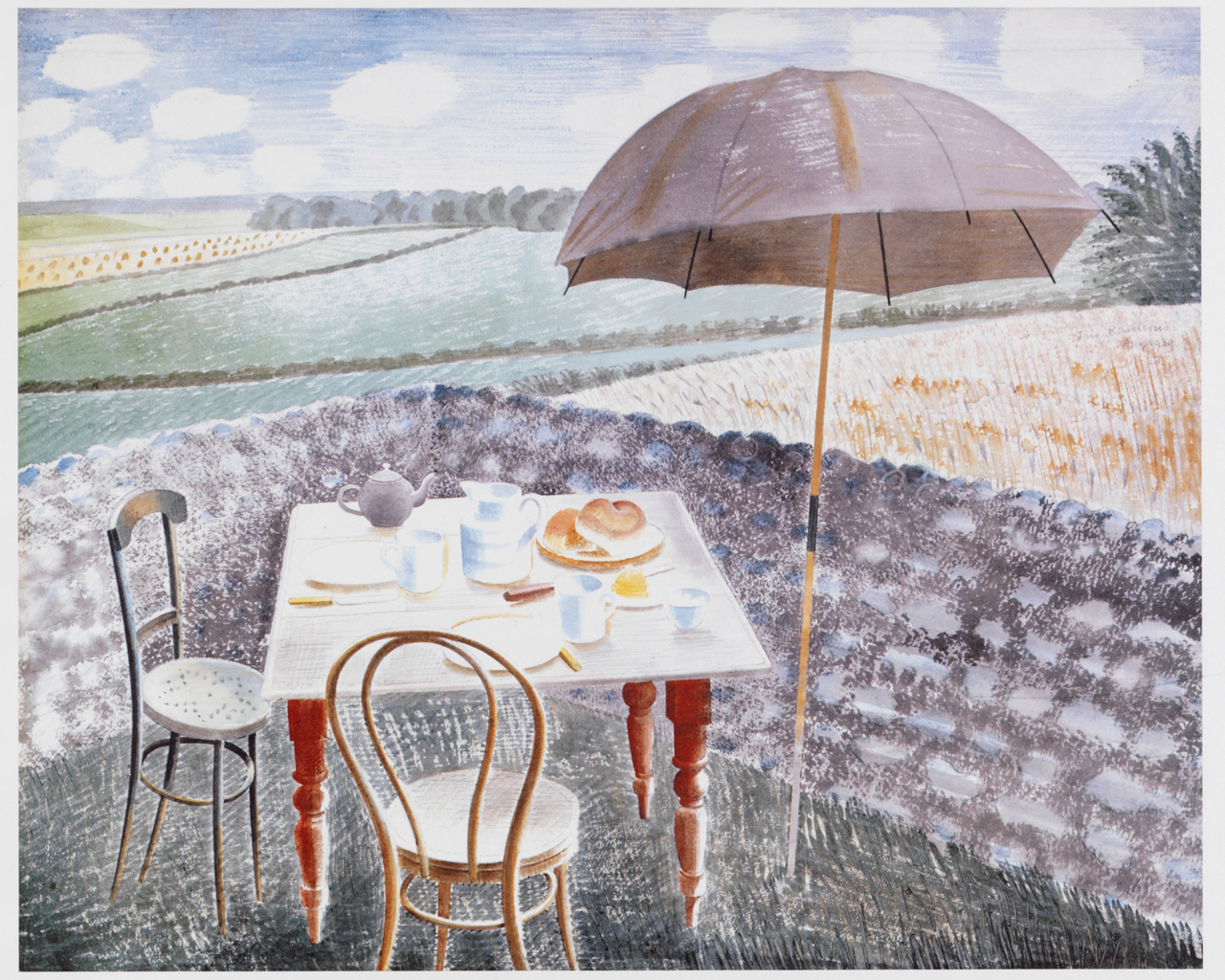
Tea at Furlongs

I have not had a chance to say anything here yet about the Dulwich Picture Gallery's Eric Ravilious exhibition.  Reviewers loved it: Laura Cumming described the paintings as 'exhilarating, enthralling and outstandingly beautiful', Martin Gayford thought them 'irresistible' and Richard Dorment found them 'a joy from start to finish'.  From a landscape perspective he is fascinating, with those subtle distortions, unusual textures and patterns, curious perspectives and framing devices all combining to give the paintings their unique and hard-to-define quality.  The exhibition included the full range of his war paintings - submarine interiors, fortified beaches, aircraft in flight and remarkable visions of ships illuminated by the Arctic sun which suggest what he might have gone on to paint if he had not been on the air-sea rescue plane that disappeared off the coast of Iceland in September 1942.  It was easy to turn from these and enjoy watercolours from the 1930s of fireworks, flowers and fields.  Tea at Furlongs seemed relatively uncomplicated, with its tasty-looking spread and view of the countryside: 'beyond the garden wall the wheat is almost ready to harvest , and Beddingham Hill rises to meet a sky as yet untroubled by hostile squadrons.'  However, as James Russell goes on to say in the catalogue, the oddities of light and perspective suggest a scene that was 'designed to be remembered - not any old tea at Furlongs but the last, the tea that must be preserved against all eventualities.'

Eric Ravilious, Tea at Furlongs, 1939

At Furlongs, Ravilious was a guest of Peggy Angus, whom he had met when they were students at the Royal College of Art.  She had left London in 1933 to teach in Sussex and found a tenant farmer willing to let her rent a cottage with a spare room, next door to a ploughman who appears in some of Ravilious's paintings.   Life there, Russell writes, 'involved a good day's work, scratch meals and long evenings of music and song.  Water had to be hauled out of a well and amenities consisted of a primitive stove for cooking and an earth closet in the garden.'  Furlongs is quite a long walk from any main road but my parents went to look at it this summer and have sent me the photographs below.  Apparently the current owners are building a new wall, perhaps prompted by the increase in visitors as Ravilious's popularity continues to grow.  This cottage has an important place in British art history as the inspiration for some of Ravilious's best known work, like Train Landscape and The Wilmington Giant.  'Furlongs', he wrote, 'altered my whole outlook and way of painting, I think because the colour of the landscape was so lovely and the design so beautifully obvious...'


Friday, September 19, 2014

Fort Process

Musical performance and sound art installation come together in site-specific festivals like the one I attended on Saturday at Newhaven Fort, 'Fort Process', or the TÖNE Festival in June, originally planned for Chatham Dockyard (the review in this month's Wire magazine explains that it ended up split over several venues).  From the perspective of this blog, what interests me in these is the way invited artists work with the structure and history of a site and the extent to which the wider soundscape is incorporated in the audience's experience.  Newhaven Fort is a defensive structure - one of Palmerston's follies, completed in 1871 - and as such it encloses you from the wider landscape.  Sound pieces were located underground and many of the performances took place in enclosed, bunker-like enclosed spaces.  The small main stage was set up on the parade ground in the centre of the fort, surrounded on all sides by grass embankments, giving a sense of containment and isolation.  To see out we had to climb these slopes and stand where the guns once pointed seawards, the vantage point where Eric Ravilious sketched Newhaven's coastal defences in 1940 (a few months after he had been stationed at Chatham).  

Eric Ravilious, Coastal Defences, 1940

John Butcher's contribution to Fort Process felt symptomatic of the way the site's remnants of fortification influenced the sounds we heard.  I wrote here eight years ago about an outdoor performance he did at the Standing Stones of Stenness, when the local sheep joined in with their bleating and the wind played tunes on his amplified soprano saxaphone.  Based on this I had imagined we might watch him perform on the ramparts of the fort, blowing his horn towards the English Channel while sea birds wheeled above.  Instead, while the sun set over the Downs on what had been a beautiful warm day, we gathered to listen to his improvisations on the cold concrete floor of a room once used to store gunpowder and shells.  Earlier, one of the artists (Sara Jane Glendinning) tried to entice seagulls to land on switch pads connected to sound samples, but they were strangely resistant to landing near the old gun emplacements.  At the end of the day we were in an old World War II hut, watching the start of an explosive set by Steve Noble and Peter Brötzmann (best known for his 1968 free jazz album Machine Gun). As the sound clattered off the corrugated iron roof it was easy to imagine the soldiers stationed here during World War II, listening to the bombers heading out to sea. 

As a collection of disparate artists linked only be location, this kind of event inevitably differs from an immersive theatre performance or the kind of multimedia environmental drama pioneered by Robert Wilson.  It was impossible to see everything - in addition to the sound art and performances there were talks and some interesting-sounding film works (sadly the projector broke down before we could see any of these).  The photograph below was taken during a performance of Fourfleckflock, a graphical score based on the motion of starlings.  I was interested in music like this with a landscape/nature connection (Thomas Köner showed that you don't need drums when you've sampled the sound of thunder) but was just as happy listening to Ex-Easter Island Head and Part Wild Horses Mane on Both Sides.  There was time to wander round and look at the art, installed inside tunnels and gun towers - some new, some versions of existing work so that the interest for the artist will have been in seeing how their pieces were transformed in this particular setting.  Sarah Angliss brought a collection of little mobile robots to the Fort's Laboratory, where live shells were once constructed.  Their bells, rung in alarm when they encountered walls and doorsteps, had a pleasing, gentle quality when heard from a distance.  Not something you could say of Noble and Brötzmann, whose gunfire followed us for some distance as we headed out of the fort during their set to get the train back to London...