Showing posts with label William Wordsworth. Show all posts

Sunday, July 21, 2024

A grassy couch

I have written here often about the importance of a viewing point - one of the pleasures of any walk is finding a natural seat from which to survey the scene in comfort. On occasions, my family have expressed frustration at my desire to wait and find just the right circle of rocks or inviting, mossy logs, away from other people, where we can finally crack open a picnic. Ideally these perches allow for both convivial conversation and contemplation of the landscape (and are close enough together to facilitate the sharing of crisps). Sometimes a small bit of harmless rearrangement is required - moving an uncomfortable stone or temporarily pinning back a branch. Those lucky enough to live near the countryside will have favourite natural seats, outcrops of nature that connect the walker with the land; here in the city we have street furniture and park benches that are more like extensions of the surrounding buildings. 


Resting on rocks in the Lake District


I have been reading an old article published by the Proceedings of the Modern Language Association of America in September 1945 (the month the war ended), intrigued by its mildly amusing title, 'The Symbol of the Sod-Seat in Coleridge' (although I don't think the word 'sod' has any offensive connotations in American English). In this essay, Charles S. Bouslog identifies a 'mild obsession with sod-seats' in the early writings of Coleridge and the Wordsworths. For example, there is the Hermit who sees the ship of the Ancient Mariner from his vantage point: 'He kneels at morn, and noon and eve- / He hath a cushion plump: / It is the moss that wholly hides / The rotted old oak-stump.' And there is Coleridge's 'Inscription for a Fountain on a Heath', a poem I talked about in one of my earliest blog posts : 'Here Twilight is and Coolness: here is moss, / A soft seat, and a deep and ample shade.'

Bouslog identifies three actual sod-seats that the Romantic poets referred to in their writings: 'the "Windy Brow" seat, the orchard seat at Dove Cottage, and the "sod-built seat of Camomile" made for Sara Hutchinson.

  • Wordsworth's 'Inscription for a Seat by the Pathway Side Ascending to Windy Brow' warns readers to imagine the relief older walkers will feel on finding this seat (although surely we all enjoy the 'excuse' to rest that a seat with a good view affords...) There is a later 'version' of this poem published under Coleridge's name, 'Inscription for a Seat by the Road Side Halfway up a Steep Hill Facing South' which describes the ascent of those bent double with weak frames until 'at last / They gain this / wished-for turf, this seat of sods'. Here they 'Repose, and, well admonished, ponder here / On final rest.
  • At Grasmere on September 1, 1800, Dorothy recorded that "after dinner Coleridge discovered a rock-seat in the orchard. Cleared away the brambles. Coleridge obliged to go to bed after tea." They must have managed the job eventually, with or without Coleridge, because on October 22 "C. and I went to look at the prospect from his seat." The following year there is an idyllic scene in May as William and Dorothy sowed "scarlet beans in the orchard, and read Henry V there. William lay on his back on the seat." Later, with Coleridge gone, Dorothy laments: 'how happily could we sit with Coleridge upon the moss seat!"
  • It is in 'Dejection: An Ode' (1802) that Coleridge wishes Sara Hutchinson had been sitting in the 'weather-fended Wood' on 'the sod-built Seat of Camomile.' Bouslog detects the influence of Wordsworth's The Excursion, written at the same time, which mentions a kind of shelter built by children 'to weather-fend a little turf-built seat / Whereon a full-grown man might rest, nor dread / The burning sunshine, or a transient shower.' Years later the image of such a seat was still in Coleridge's mind, appearing in an unfinished text from 1822 with, Bouslog thinks, a 'tell-tale opium tone'. Its hero enters a deserted garden where, 'beneath a bushy elder-tree, that had shot forth from the crumbling ruin, something higher than midway from the base, he found a grassy couch, a sofa or ottoman of sods, over-crept with wild-sage and camomile.'

Sunday, September 25, 2016

Weatherland


I only recently got round to reading Alexandra Harris’s Weatherland: Writers and Artists Under English Skies and can highly recommend it to readers of this blog.  A book like this will cover some familiar ground – Gawain’s winter journey, Lear goading the storm, Turner’s light, Constable’s clouds, Dickens’ fog – but it is written so well that you never feel like you’re just being told things you already know.  On the Wordsworths, to choose just one example, she points out that their appreciation of weather turned on ‘very specific moments of transformation – when the sun suddenly strikes through cloud, for example, or when a figure is glimpsed through fog.’  She quotes Dorothy noting ‘her favourite birch tree coming to life: “it was yielding to the gusty wind with all its tender twigs, the sun upon it and it glanced in the wind like a flying sunshine show […] It was like a spirit of water.” The earth-rooted tree takes flight in air, dissolves into a water spirit and, and glitters in the sun.’

The whole history of English literature seems to be contained in the book but it cannot of course be completely comprehensive.  There is no George Eliot for instance - just as I was finishing Weatherland, Mrs Plinius was rereading Middlemarch and reminded me that the love between Will and Dorothea finally surfaces during a thunderstorm.  This though is an example of ‘significant weather’, a novelist’s device deplored by Julian Barnes who, I learnt from Weatherland, originally intended his novel Metroland to be called No Weather, since he was determined to avoid using it as a symbol of anything.  The book's scope is restricted to England and there are moments when Alexandra Harris comes across as very English herself (as she did in Romantic Moderns - see my post on 'The bracing glory of our clouds').  She refers, for example, to Milton’s Paradise, where the seasons are fixed and bountiful and ‘Eve lays out a spread for the visiting archangel Raphael’, observing that Eve may have been ‘the only picnicker in history to remain completely free from concerns about the weather.’  Hard to imagine, say, a Californian academic writing this!

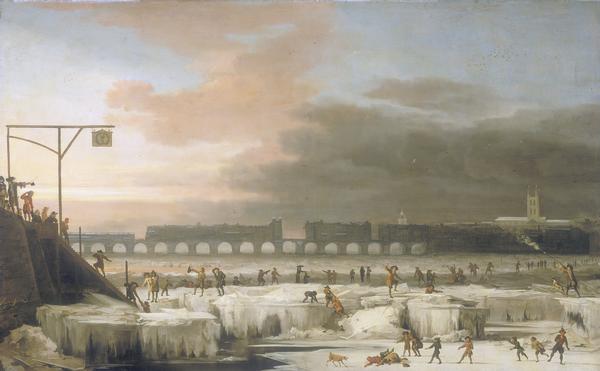
Abraham Hondius, The Frozen Thames, 1677
 Source: Wikimedia Commons

Weatherland takes inspiration at various points from Virginia Woolf's Orlando, a book I have referred to here before.  My favourite scenes in Orlando concern the icing over of the Thames, when birds suddenly freeze in the air and Orlando falls in love with a Muscovite princess.  Woolf herself had read an evocative account of the winter of 1608 in Thomas Dekker's The Great Frost: Cold Doings in London, which refers to a new 'pavement of glass' and fish trapped below a thick roof of ice.  Here, from Weatherland's chapter 'On Freezeland Street', are three more responses to those surreal transformations of the city, which only came to an end when the demolition of London Bridge made the river swifter, deeper and permanently liquid. 
  • Poetry: John Taylor, Thames boatman and self-styled water-poet, composed The Cold Tearme: Or the Frozen Age: Or the Metamorphosis of the River of Thames in 1621.  He compared the ice to a pastry crust and the freezing wind to a barber's razor, 'turning Thames streames, to hard congealed flakes, / And pearled water drops to Christall cakes.'  He describes visitors coming to the Frost Fair, 'Some for two Pots at Tables, Cards or Dice: / Some slipping in betwixt two cakes of Ice.'  Here he added a rueful note in the margin, 'Witnesse my selfe'.  
  • Painting: the view reproduced above is by one of the many artists who came over to England from the Low Countries in the seventeenth century.  'While Englishmen produced diagrammatic engravings of the Frost Fairs, labelling the attractions, Hondius produced an essay in atmosphere.  His expansive sky, worthy of the Netherlands, is flushed with the apricot pinks of a winter sunset.'  Alexandra Harris imagines the effect the frozen river would have had on his imagination.  At around the same time he painted a ship stuck in the pack ice of Greenland, Arctic Adventure.  'The Thames was a noisy, busy river, but in its frozen state it transported Hondius to the desolate edges of the world.'
  • Music: John Dryden may have been inspired by the Frost Fair of 1683-4 when he wrote the libretto for Purcell's King Arthur.  Together 'they wanted to freeze and melt the human voice, dramatising in the process the freezing and melting of the the heart.'  The evil Saxon magician Osmond strikes his wand on the ground and magically summons up 'a prospect of winter in frozen countries.'  Then the personification of Cold sings slowly in C minor, chosen as the coldest key, and is followed by a chorus of cold people, whose stuttering singing mimics the chattering of teeth.  The whole masque is conjured to demonstrate the warmth of love, but it is a deception played on Emmeline, who is betrothed to Arthur.  His plan is foiled though and at the end of the opera he is cast into a dungeon whilst Arthur and Emmeline are reunited.  


There are numerous versions of the 'Cold Song' online, some pretty strange.  I've chosen here a  concert version by Andreas Scholl; you can also see a video for this where the singer is dressed in a pale suit, looking lost near some tower blocks.  Incidentally, the Prelude to the Frost Scene was the basis for Michael Nyman's 'Chasing Sheep is Best Left to Shepherds' in The Draughtsman's Contract and was recently used again by the Pet Shop Boys in 'Love Is a Bourgeois Construct'.

Friday, September 23, 2016

Naturgemälde

Friedrich Georg Weitsch, Alexander von Humboldt, 1806
Images: Wikimedia Commons

Andrea Wulf has just won another prize for The Invention of Nature and I am not surprised as it is a really good read.  In addition to telling the life of Alexander von Humboldt, she has chapters on other great men who he influenced: Goethe, Jefferson, Bolívar, Darwin, Thoreau, Haeckel, Muir and America's first environmentalist, George Perkins Marsh.  Of course Humboldt was so protean and long-lived that she could have included far more people, at the risk of turning her own book into something the size of Humboldt's thirty-four volume Voyage to the Equinoctial Regions of the New Continent.  The one time I have referred to Humboldt's influence on this blog was in connection with Carl Gustav Carus and his notion of Earth-life painting - Carus doesn't make it into the book at all.  Here though are some of the artists, writers and composers she does mention, in connection with three of Humboldt's most widely read publications.
In 1808 Humboldt published Views of Nature in Germany and France, combining scientific facts with poetic landscape description.  Reading it, Goethe told him 'that I plunged with you into the wildest regions' and Chateaubriand said that 'you believe you are surfing the waves with him, losing yourself with him in the depths of the woods.'  Later it inspired Darwin, Thoreau and Emerson.  Jules Verne used passages verbatim in his Voyages Extraordinaires, particularly The Mighty Orinoco.  Captain Nemo owned the complete works of Alexander von Humboldt.
In 1814 Humboldt's account of his travels in South America, the Personal Narrative, appeared in England and started to influence writers like Wordsworth, who adapted a passage for his sonnet sequence on the River Duddon. Coleridge may already have read him in the original German; he had spent some time with Wilhelm, the 'brother of the great traveller', in Rome in 1805.  Byron had fun with the idea of Humboldt's cyanometer, a device for measuring the blueness of the sky which he had taken on his travels.  Here are the lines from Don Juan:
Humboldt, 'the first of travellers,' but not
The last, if late accounts be accurate,
 Invented, by some name I have forgot,
As well as the sublime discovery's date,
An airy instrument, with which he sought
To ascertain the atmospheric state,
 By measuring 'the intensity of blue:'
O, Lady Daphne! let me measure you!

Horace Bénédicte de Saussure, cyanometer, 1760
 Saussure (like Humboldt a scientist and mountaineer) originally devised the cyanometer

In 1845, after eleven years' work, Humboldt published Cosmos, a huge success with students, scientists, politicians and even royalty (Prince Albert ordered a copy).  Hector Berlioz declared him 'a 'dazzling writer; the book was so popular among musicians, Berlioz said, that he knew one who had 'read, re-read, pondered and understood' Cosmos during his breaks at opera performances when his colleagues played on.'  In America, Emerson got hold of one of the first copies, Poe was inspired by it to write his visionary last work Eureka, and Whitman wrote Leaves of Grass with a copy of Cosmos on his desk.
 
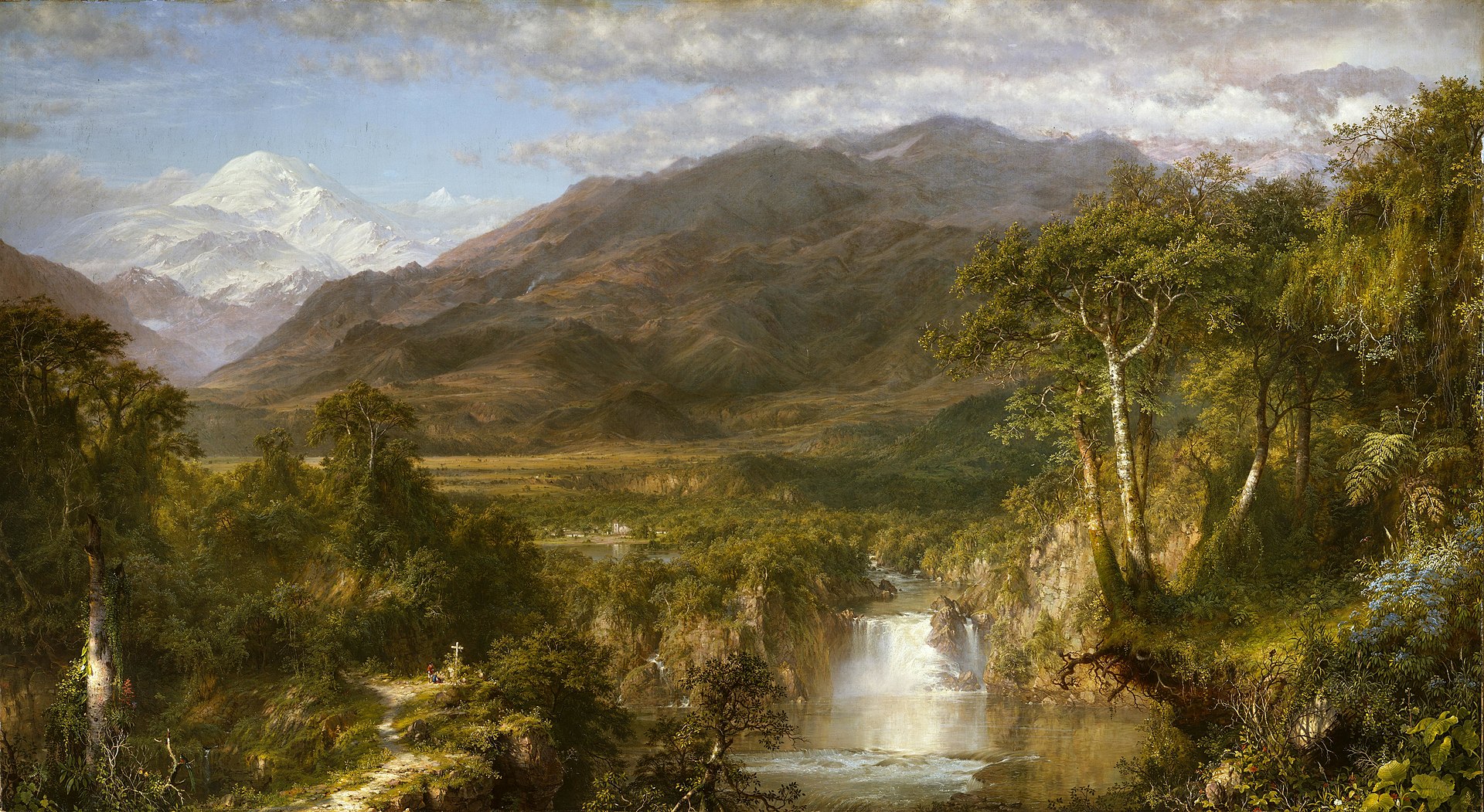
Frederic Edwin Church, The Heart of the Andes, 1859

On the day Humboldt died in May 1859, New Yorkers were queuing to see a painting he had inspired: The Heart of the Andes by Frederic Edwin Church.  Church had gone to South America and retraced Humboldt's route, returning to paint landscapes that united poetic feeling with scientific accuracy.  The New York Times described him as 'the artistic Humboldt of the new world.'  Church wanted his painting to travel to Berlin so that the old man could see again 'the scenery which delighted his eyes sixty years ago.'  When he heard the news of Humboldt's passing, Church said that it felt as if he had 'lost a friend.'

Alexander von Humboldt, Naturgemälde, 1807

The Invention of Nature begins on a high ridge of Chimborazo, the great extinct volcano that Humboldt climbed in 1802.  Nobody had ever been this high before, not even the early balloonists.  After descending to the Andean foothills, Humboldt began to sketch the first version of his famous Naturgemälde - an image of Chimborazo familiar to those of us professionally interested in infographics but more importantly, as Andrea Wulf emphasises, an encapsulation in one two-by three foot page of Humboldt's new vision of nature as a living whole.  She ends her book with a beautiful quote from his friend Goethe, who compared Humboldt to a 'fountain with many spouts from which streams flow refreshingly and infinitely, so that we only have to place vessels under them.'

Thursday, June 26, 2014

The River Duddon

The valley of the River Duddon

In 1820 William Wordsworth published The River Duddon, A Series of SonnetsAs Stephen Gill points out in his essay, 'Wordsworth and the River Duddon', reviewers were bemused that a famous poet should choose to write about this ‘insignificant river’ with a ‘barbarous name’:
‘What would he not have written had the majestic Thames employed his muse’, exclaimed the Literary Chronicle and Weekly Review, getting the matter exactly wrong. The lines from Burns quoted at the close of the ‘Postscript’ to the River Duddon sonnet sequence ought to have alerted the reviewer to Wordsworth’s poetic intent. In the verse letter ‘To William Simson, Ochiltree’, Burns declares that, ‘Illisus, Tiber, Thames, an’ Seine’ having all been celebrated in ‘monie a tunefu’ line’, he and his fellow poet should now rather seek the Muse ‘Adown some trottin burn’s meander’ in their own locality, to ‘gar our streams and burnies shine / Up wi’ the best’.  Wordsworth read this poem almost as soon as it was published in 1786, quoted from it throughout his life, and adopted its forthrightness as he began his celebration of the river with the barbarous name.'
In The Song of the Earth, Jonathan Bate suggests that the choice of the Duddon for a sonnet sequence over, for example, those other Wordsworthian rivers, the Wye and the Derwent, may have had something to do with its location, rising near the confluence of Westmoreland, Cumberland and Lancashire.  Standing in three counties at once is to feel both connected to the local and in touch with a much wider geography.  Wordsworth believed in a nationalism rooted in the regions, a country of small Anglican parishes where the periphery was as important as the centre, the Duddon as worthy of literature as the Thames.  A couple of years ago I wrote here about Wordsworth's sonnet Composed Upon Westminster Bridge, Sept. 3, 1802, in which the poet stood looking out over the Thames.  Here I will give a brief summary of the River Duddon sequence, from source to sea.
  1. Wordsworth's first sonnet announces his theme - not the spring of Bandusia, not some Persian fountain, not an Alpine torrent, but 'long-loved Duddon'.
  2. This river is 'remote from every taint / of sordid industry' and has remained unchanged, long after the surrounding forests have vanished 'where stalked the huge deer to his shaggy lair / through paths and alleys roofed with darkest green.'
  3. Wordsworth sits and prepares to 'paint' the river in words.  No monument marks its birthplace but instead the river itself has 'shed a gleam / of brilliant moss, instinct with freshness rare.'  
  4. The Duddon is like a snake, threading 'with sinuous lapse the rushes, through / dwarf willows gliding, and by ferny brake.'  
  5. After the solitude of 'sullen moss and craggy mound' the river becomes shaded by green alders, ashes and 'birch-trees risen in silver colonnade'.
  6. He describes the flowers that grow by the side of the river: wild strawberries, thyme and 'trembling eyebright ... sapphire blue'.
  7. A 'love-sick Stripling' might envy the plucked rose lying on his lover's breast, or imagine himself her caged bird singing, but those with 'calmer mind' would rather be an 'unculled floweret or darkling wren / that tunes on Duddon's banks her slender voice.'
  8. The poet wonders what kind of man first came upon this stream.  Whatever his ancient beliefs, the river's role was then as it is now, to heal, restore, soothe and cleanse.
  9. There are some stepping stones in the river.  Crossing here, when a flood runs 'fierce and wild', the Child puts 'his budding courage to the proof', whilst 'Declining Manhood learns to note the sly / and sure encroachments of infirmity.'
  10. The stepping stones again, and this time two young lovers cross, she blushing and holding out her hand, he teasingly withdrawing it, and then both of them feeling the thrill when their hands touch.  
  11. A flight of fancy in which tiny dancing elves are imagined dancing by their 'sunless cleft' and stealing a baby.
  12. As if realising that this sort of thing will try our patience, he exclaims: 'On, loitering Muse--the swift Stream chides us--on!'  It is all too easy for the river's features to become the 'toys of Fancy.'
  13. We zoom out to an open prospect of fields and a hamlet under a green hill.  Wordsworth imagines the pleasures of a warm hearth here in cold weather, 'when bleak winds roar / through the stiff lance-like shoots of pollard ash'.
  14. The river seems to seek its own solitude, attended only by its own voice, leaving behind the solitary shepherd and his cottage.
  15. From a 'deep chasm, where quivering sunbeams play', he sees a kind of 'gloomy niche' in the rock where some ancient statue might have been placed, sculpted by men perhaps, or fire, or the waters of the Deluge.
  16. A continuation of the theme, in which Wordsworth describes the caves and rock drawings of Native Americans.
  17. He hears the croak of a raven on a blasted yew and an eagle 'shedding where he flew / loose fragments of wild wailing.'  Sheep sleep by the remains of the old Roman fort and the ancient stone circle of the Druids.
  18. The sonnet is entitled 'Seathwaite Chapel' and suggests that the vale of the River Duddon protects 'Truth's holy lamp', alluding to the ministry of the Reverend Thomas Walker of whom Wordsworth wrote a short memoir, appended to the poem sequence.
  19. A tributary: 'waters, from their aery height / hurrying, with lordly Duddon to unite.'  Its musical murmur announces a source of refreshment to the thirsty fields.
  20. On the flowery plain of Donnerdale, the waters are slow and serene, but further on the course is rougher and the river dances from rock to rock.  
  21. 'The cloudy stall / of Time, breaks forth triumphant Memory' and Wordsworth recalls those he once roved with on the banks of the River Duddon.
  22. In a sonnet called 'Tradition' the story is told of a love-lorn Maid who yearns for a primrose reflected in a clear, blue pool and, it is implied, drowns there.
  23. Banishing such sad thoughts, he recalls the 'blithe cheer' of boys shouting and dogs barking whilst sheep are washed in a pool formed where bands of rock check the stream.
  24. Now he finds a good place to rest, 'with woodbine hung and straggling weed ... half grot, half arbour', enclosing both the body and the mind.
  25. Here he can imagine 'the One for whom my heart shall ever beat / with tenderest love' being brought.  But without her, 'the waters seem to waste / their vocal charm.'
  26. Memories of childhood: 'fondly I pursued, / even when a child, the Streams--unheard, unseen; / through tangled woods, impending rocks between.'  He has learnt much from the river.   
  27. He describes a ruined castle, 'quietly self-buried in earth's mould'. 
  28. He rises to continue his onward journey, while cattle avoid the heat of the day by crowding together 'under rustling trees / brushed by the current of the water-breeze.'  
  29. There are no stories of battles fought over this landscape, but to those who lie buried and unremembered,'the passing Winds memorial tribute pay'.
  30. In life, Wordsworth suggests, it is best not to yield to sudden temptations or swerve away too far from innocence.  He is content to 'saunter o'er the grassy plain' here, chained loosely to the river, knowing when he leaves that he will always return to it.
  31. The 'Kirk of Ulpha' is a welcome sight and he imagines reclining among its graves or marking the distant moonlit mountain summits, faintly shining, 'soothed by the unseen River's gentle roar.'  
  32. This penultimate sonnet is pure landscape: a description of the lower reaches of the river, 'gliding in silence with unfettered sweep'.
  33. The original sequence ends with the sea that the Duddon flows into - here there are no warships, just humble sailing boats.  Wordsworth would like to end his days like the river, 'prepared, in peace of heart, in calm of mind / and soul, to mingle with Eternity!'
Postscript: Wordsworth later added a thirty-fourth sonnet in which, as Jonathan Bate says, 'the poet deconstructs, then reconstructs, the analogy between human life and the life of the river.'  It can be read at The Poetry Foundation.

The stone circle referred to in Sonnet 17

[In one of his endnotes Wordsworth says that 'the country people call this circle Sunken Church'.  We visited Sunkenkirk, as it is now known, on our recent trip to the Lakes.  In The Modern Antiquarian, Julian Cope calls it 'perfect from all angles ... this Sunkenkirk is a place for the most righteous devotion.']

Sunday, January 26, 2014

Soft Estate


I mentioned Edward Chell's art of the motorway verges in an earlier post on Paul Farley and Michael Symmons Roberts' book Edgelands.  Since then he has had an AHRC grant to make new work and research the parallels between motorway design and historic theories of landscape appreciation. Edward has kindly sent me a copy of the resulting book, Soft Estate, handsomely produced by The Bluecoat gallery in Liverpool, where his paintings and sculptures have been exhibited alongside work by ten other contemporary artists of the edgelands.  His own work focuses on the plants to be found in this 'soft estate', the name given by the Highway Agency to the 22,000 hectares of land it manages as part of the national system of motorways and trunk roads.  Silhouettes of thistle and hairy bittercress, buttercup and dandelion, lady's bedstraw and yellow rocket are printed on paper in a mixture of ink and road dust, or onto blue reflective aluminium panels resembling roadsigns.  There is a sad sense of isolation in these monochrome images, abstracted from photographs of plants that are growing in places nobody visits.  Some of them are coated in lacquer and would resemble pressed flowers except that they are painted in black, like shadows or carbon traces.

 Edward Chell, Yellow Rocket or winter cress Barbarea vulgaris, 2013

In the book's main essay, Edward describes efforts made over the years to landscape the motorway network and quotes the official Design Manual for Roads and Bridges encouraging 'visual variety' in a tone reminiscent of the original Picturesque theorists.  Nearly 10 million trees and shrubs were planted in the decade up to 1974 are now maturing and the wild grass areas have been left to evolve in their own way.  There is an interesting contrast here with the tidier appearance of French motorways, reflecting national differences in landscape design that have been apparent for over three hundred years.  Soft Estate also contains an essay by Richard Mabey, author of The Unofficial Countryside and Weeds, who describes the way various plants (including the wild daffodils celebrated by Wordsworth) have colonised the motorway cuttings and verges.  Back in the early eighties Mabey actually wrote a Motorway Nature Trail, sponsored jointly by the Nature Conservancy Council and Gulf Oil.  'I'm still unsure whether I ought to feel embarrassed about this.  It happened before carbon emissions became the critical issue they are today, but I was still giving my backing to a resource-guzzling and polluting car culture.'  The rationale at the time was that passengers would get something out of a guide to the ecology of the regions through which their car was passing.  Even so, looking back, he finds it surprising that nobody felt it worth emphasising that this was not something the driver should be concentrating on: 'the programme of peripheral observation it outlines, downloaded into a driver's brain, could be as distracting as a mobile phone conversation.'

I should probably admit that as a very infrequent and unconfident driver myself I have always avoided motorways.  They seem to me a kind of inverse of the Sublime - instead of viewing an awesome natural phenomenon from a place of safety, you pass through miles of banal terrain whilst having to safely negotiate the torrents of cars and looming juggernauts.  Everything seems to conspire against aesthetic pleasure in the environment, from the constant pressure to keep up speed to the need to seal yourself in from the wind and noise.  I wonder how different the motorway would feel if you had it all to yourself and could concentrate on the experience of the unfolding roadscape.  In his essay, Edward mentions a formative childhood incident: 'I secretly rode my Raleigh on the M62 after it was constructed across the Pennines at Outlane near Huddersfield but before it was open to the public.'  It sounds like Wordsworth's 'act of stealth / And troubled pleasure' in stealing a boat to row out onto a lake, as recollected in The Prelude.  I am reminded too Tony Smith's much discussed account of the moment when he realised that traditional art could not compete with the feeling of driving along the unfinished New Jersey Turnpike, a text that became central to debates about the future of art in the late sixties.

Nothing can be appreciated from a motorway that cannot be taken in at speed.  The individual plants that Edward paints are never glimpsed, unless traffic grinds to an unscheduled halt.  However, as Richard Mabey argues, the fact that they are there is important, 'and enough have grown into significant features to become part of the foreground of the motorway landscape.'  He ends his essay with a description of the way Danish scurvy grass began to appear along the edges of roads thirty years ago.  'There are many reasons for the plant's spread throughout the UK road system - the turbulent slipstream of traffic whirling the seeds along; the similarity between its native strandline habitat and the stone edges of the road.  But there is little doubt that the major factor is the saltiness of the modern road - that shoreline tang sprayed from gritting lorries on icy evenings even in the landlocked heart of Britain.  Seen close to, Danish scurvy grass is an undistinguished plant.  Streamed by at speed, it is a ribbon of dazzling white at the motorway's edge, a traveller's joy.' 

Tuesday, July 31, 2012

Earth has not anything to shew more fair


I was going to photograph the view from Westminster Bridge this morning but we've been asked to work from home during the Olympics period, so I took the snaps above with my phone last week.  Two hundred and ten years ago today, Wordsworth admired the city from this same spot, although he dated his famous sonnet September 3rd.  His sister's diary briefly records the moment, a vision of the city seen from the Dover coach, en route to Calais where they would meet Annette Vallon and Wordsworth would see his daughter Caroline for the first time. 'It was a beautiful morning.  The City, St Pauls, with the River & a multitude of little Boats, made a most beautiful sight as we crossed Westminster Bridge.  The houses were not overhung by their cloud of smoke & they were spread out endlessly, yet the sun shone so brightly with such a pure light that there was even something like the purity of nature's own grand Spectacles.'

Upon Westminster Bridge, Sept. 3, 1802

EARTH has not anything to show more fair;
  Dull would he be of soul who could pass by
  A sight so touching in its majesty.
This city now doth like a garment wear
The beauty of the morning: silent, bare,        
  Ships, towers, domes, theatres, and temples lie
  Open unto the fields, and to the sky,—
All bright and glittering in the smokeless air.
Never did sun more beautifully steep
  In his first splendour valley, rock, or hill;
Ne'er saw I, never felt, a calm so deep!
  The river glideth at his own sweet will:
Dear God! the very houses seem asleep;
  And all that mighty heart is lying still!

Ten years ago, Shakespeare's Globe and The Wordsworth Trust published a commemorative volume, Earth has not any thing to shew more fair, edited by the Trust's director Peter Woolf and the writers Alice and Peter Oswald.  The book contains thirty-seven poems inspired by Wordsworth's, including a couple of re-writes from the point of view of Dorothy.  Most of the poets write about the modern view, which can now be enjoyed from the London Eye (as in Charles Tomlinson's poem) or, from even higher up, in an aeroplane coming in to land (Kona McPhee).  By contrast, 'Composed Underneath Westminster Bridge' (Denise Riley) looks down at the river itself: barges, pigeons and brown particles 'churning through the tide.'  I first read Wordsworth at school in A Choice of Poets and none of us taught from this to compare and contrast Wordsworth's 'sight so touching in its majesty' with Blake's bleak 'London' would be surprised to encounter a poem here like Matthew Caley's 'No Bulwark', which asks us to 'behold the tableau, two crackheads and their spoonlit underchins / 'neath the doubled alcove of a riverbridge.'  Language itself has become degraded in Peter Finch's 'N Wst Brdg', a re-write of Wordsworth's lines as an extended text message. Edwin Morgan looks into the future in 'Sometime upon Westminster Bridge' and sees a swollen Thames, shattered Barrier and the city left to drown.

Westminster Bridge on the cover of A Choice of Poets

In some of the book's other poems, parallels are drawn with different bridges or historical moments on the Thames.  Ciaran Carson makes the link with Monet (who came to England in the autumn of 1870 to escape the Franco-Prussian War), contributing a brief imagistic poem entitled 'Claude Monet, The Thames Below Westminster, 1871', which reproduces in words that famous painting of the Houses of Parliament in the mist. Perhaps unsurprisingly those who work in the Houses of Parliament receive short shrift in this collection: Sean O'Brien imagines the bridge 'speaking truth to power' and Alice Oswald stares at 'the regular waves of apparently motionless motion / under the teetering structures of administration.'  She seems to have little time for the people who work round here... 'the weather trespasses into strip-lit offices / through tiny windows into tiny thoughts'. Peter Oswald is equally bleak, imagining  that 'trickles of thinking mingle with the flow / from pipes of every kind' and seep into the river - 'the squeezed out city's boil of poisons / stirred to one colour by the rush to ocean.'  But it doesn't always feel like this, and those of us who love London, despite everything, will always love Wordsworth's poem for the way it conveys the beauty of certain sunlit mornings, when dull would he be who would pass by such a sight, so touching in its majesty.

Detail of the plaque on Westminster Bridge

Thursday, March 24, 2011

The falls of Cora Linn

The Clyde at New Lanark, March 2011

On Saturday August 20th 1803, Coleridge and the Wordsworths arrived in Lanark.  William headed off immediately to look at the celebrated waterfalls, leaving the others to find an inn.  Rejecting the Black Bull, whose 'genteel apartments' turned out to be 'the abode of dirt and poverty', they opted for the New Inn, where they sat in the parlour (tables unwiped, floor dirty and the smell of liquor 'most offensive'), grateful for a rest.  Dorothy's diary records that 'poor Coleridge was unwell', struggling with withdrawal symptoms, but she set off after William, hoping to meet him by the falls.  Evening was drawing in though, and she found that 'the Falls of the Clyde were shut up in a gentleman's grounds, and to be viewed only by means of lock and key'. Next day however, all three were able to see the falls of Cora Linn, where they sat on a bench placed specially for the view.  Dorothy was struck with astonishment, 'which died away, giving place to more delightful feelings; though there were some buildings that I could have wished had not been there, though at first unnoticed.'

'A lady and gentleman, more expeditious tourists than ourselves, came to the spot; they left us at the seat, and we found them again at another station above the Falls.  Coleridge, who is always good-natured enough to enter into conversation with anybody whom he meets in his way, began to talk with the gentleman, who observed that it was a majestic waterfall.  Coleridge was delighted with the accuracy of the epithet, particularly as he had been settling in his own mind the precise meaning of the words grand, majestic, sublime etc., and had discussed the subject with William at some length the day before.  'Yes, sir,' says Coleridge, 'it is a majestic waterfall.'  'Sublime and beautiful,' replied his friend.  Poor Coleridge could make no answer, and, not very desirous to continue the conversation, came to us and related the story, laughing heartily.'

Cora Linn Falls

I mentioned in a previous post that 'the 'astounding flood', as William described the falls of Cora Linn, appears less impressive now that hydroelectric power has been introduced to the Clyde.' This is evident in the photograph above which I took on Saturday.  The site today is a nature reserve, part of the New Lanark world heritage site, and the sign at Cora Linn explains that the electricity produced there 'is important not only for people, but also for wildlife'.  Other notices nearby warn visitors to stick to the path and be aware that the hydroelectric power station can cause water levels in the river to suddenly change.  Not that I was planning to have a dip - the walk itself was rewarding enough - and half way between Cora Linn and the falls of Bonnington Linn I stood for a while watching a peregrine falcon (its nesting site well signposted).  It is a steep walk back up to Lanark and I had a train to catch back to Glasgow and thence to London.  Dorothy Wordsworth and the poets returned for one more night at the New Inn where they 'ate heartily' of a 'true Scottish' dish: 'boiled sheep's head, with the hair singed off.'

Hydroelectric pipes near Cora Linn

Sunday, September 26, 2010

Windings of the River Tummel


Inspired by a recent visit to Scotland, I have been reading the Yale edition of Dorothy Wordsworth's Recollections of a Tour Made in Scotland.  The pleasures of this text are considerably enhanced by editor Carol Kyros Walker's atmospheric black and white photographs, taken as she retraced Dorothy's route.  Walker explains her decision not to use colour photography with reference to the process of writing an account of a journey. 'In calling up, and re-collecting the images of a place there must be a moment just before total illumination in the mind when what is there pauses for the final investment of the thinker.  For me, that instant is in black and white.'  The Recollections itself comprises two distinct sections and modes of recall: the first written in 1803 just after Dorothy's return from Scotland and full of daily detail, the second written in 1805 and prefaced with a note explaining that the style and tone had been affected both by the passage of time and the recent loss of her brother in a shipwreck.

The Recollections demonstrate an impressive willingness to endure physical discomfort in the search for Romantic scenery.  Dorothy Wordsworth travelled with her brother and Samuel Taylor Coleridge in an Irish 'jaunting car' - an open-air two wheeled cart that made the landscape more accessible than a chaise, and which provoked amused or suspicious looks at various points along the way.  Their poor horse had a miserable time of it, ending up frightened by even the suspicion of another awful loch crossing, and the travellers encountered dirt and inhospitality at many of the inns and homes along the way (not surprising given the prevailing poverty and resentfulness towards England and the ongoing Highland Clearances).  The terrain and roads could be difficult too and Carol Kyros Walker lists the distances travelled, along with the adjective Dorothy uses for that part of the route.  The resulting table reads to me like a Richard Long text piece, for example:

Killin (tolerable) 7
Kenmore (baddish) 15
Blair (bad) 23
Fascally (wretchedly bad) 18
Dunkeld (bad) 12
Ambletress (hilly - good) 10
Crieff (hilly - goodish) 11
Loch Erne Head (tolerable) 20
Callander (most excellent) 14

Dorothy Wordsworth used various means of evoking the landscape - topographical description, reference to earlier writers like Sir John Stoddard, quotation from Wordsworth's poems ('To a Highland Girl', 'Stepping Westward', 'The Solitary Reaper' etc.) She also made some sketches, like this one of the River Tummel, 'a glassy river' gliding through the level ground 'not in serpentine windings, but in direct turnings backwards and forwards.'  There is no doubt that she was influenced by writers on the Picturesque (Walker refers to a study on this by John R. Nabholtz which notes, for example, that her sensitivity to the absence of trees may reflect the aesthetics of Uvedale Price).  She remarks upon the landscape's 'inhabited solitudes' and sometimes sees isolated figures in pictorial terms, like the melancholy woman alone in a desolate field and an old man exhibiting 'a scriptural solemnity'.  These provoke the thought that in Scotland 'a man of imagination may carve out his own pleasures'.  Walking over the brow of a hill at twilight, she sees a boy wrapped in grey plaid, calling to his cattle in Gaelic. 'His appearance was in the highest degree moving to the imagination... It was a text, as William has since observed to me, containing in itself the whole history of the Highlander's life - his melancholy, his simplicity, his poverty, his superstition, and above all, that visionariness which results from a communion with the unworldliness of nature.' 


Both Dorothy and William Wordsworth noticed the changes being made to the landscape - deploring the felling of trees at Neidpath Castle, for example, and complaining at Douglas Mill that 'large tracts of corn; trees in clumps, no hedgerows ... always make a country look bare and unlovely'.  Carol Kyros Walker finds much of what Dorothy wrote about unaltered, with a few obvious changes (the photograph of a 'solitary reaper' shows a distant tractor).  Nevertheless, the 'astounding flood', as William described the falls of Cora Linn, appears less impressive now that hydroelectirc power has been introduced to the Clyde.  Dunglass Castle can still be seen on its promontory, where Dorothy, admired the view 'terminated by the rock of Dumbarton, at five or six miles distance, which stands by itself, without any hills near it, like a sea rock.'  However, the accompanying footnote explains that the castle, later home to Charles Rennie Mackintosh, eventually became a stationery store.  'It is now on the grounds of an ESSO oil terminal which is kept under strict security.  To visit the castle one must be escorted by an ESSO guard and agree to don a hard hat.'

Wednesday, December 09, 2009

The Cerne Abbas Giant

In what ways can landscape archaeology be considered a form of landscape art?  Matthew Johnson's Ideas of Landscape (2007) traces the roots of the discipline (at least in its English version) to Romanticism and draws parallels between W.G. Hoskins (whose The Making of the English Landscape I've mentioned here before) and Wordsworth.  They were both solitary walkers, interested in the local (the genius loci) and the national, combining direct bodily experience with intuitive understanding, traveling in imagination into the past, gazing on the landscape from a social and physical distance and with a degree of expert knowledge, viewing the landscape aesthetically and translating it into text.

Johnson argues that landscape archaeologists working on prehistoric (rather than historic) sites have tended to operate more objectively and certainly in the US have been more open to theory.  One could perhaps draw parallels here with English and American land artists - Richard Long shares many of the Romantic characteristics listed above, in contrast to, say, Robert Smithson.   Johnson discusses some of the tools of landscape archaeology - maps, aerial photography and the hachured plan.  Ostensibly objective and empirical, they are 'complicit in a Romantic view of the world - each invites the observer to gaze down on the landscape like Wordsworth in the Lakes.'  Land artists have used photographs and maps extensively to document their earthworks but this book made me think there's some untapped potential in hachured plans...

In contrasting the attitudes of archaeologists to history and prehistory, Johnson discusses the Cerne Abbas Giant.  This mysterious work of art in the landscape has been taken to be prehistoric, since it could not be linked to Christian imagery and there were no historic documents relating to its creation.  But neither of these factors precludes a later date - 'Ronald Hutton (1999) has argued convincingly that it in fact sits longside a 17th century landscape of politics and conflict between king and Parliament.'  A third view has been put forward by Barbara Bender (an academic who, fifty years ago, was a college friend of my mother's.)  She suggests that the specific date of origin does not matter - 'the Giant has to be scoured and re-scoured every generation; it takes its place, and its historical importance, as part of a continuing tradition that links the past to the present.'


The Cerne Abbas Giant
Source: Wikimedia Commons

Friday, November 06, 2009

At Dieppe: Green and Grey


There used to be several good secondhand bookshops in Brighton's Duke Street, and in one of them about twenty years ago I bought Geoffrey Grigson's Faber Book of Poetry and Places (1980).  It is, as you would expect with Grigson, an excellent survey of the British landscape in poetry, and includes many of the poems in his earlier anthology The Poet's Eye.   One thing I like about this selection is that Grigson can't resist including a selection of poems on France and Italy ("across the Channel, up to the present (but how will it be later?) our general emotions have flowed with most willingness and familiarity into France and Italy ... so I add a section for each country.")  There are only five English poems in the France section, two of which describe the Channel coast -Wordsworth's 'Evening on Calais Beach' ("Breathless with adoration; the broad sun / Is sinking down in its tranquillity") and Arthur Symons' sad vision of Dieppe:
At Dieppe: Green and Grey
to Walter Sickert

The grey-green stretch of sandy grass,
Indefinitely desolate;
A sea of lead, a sky of slate;
Already autumn in the air, alas!

One stark monotony of stone,
The long hotel, acutely white,
Against the after-sunset light
Withers grey-green, and takes the grass's tone.

Listless and endless it outlies,
And means, to you and me, no more
Than any pebble on the shore,
Or this indifferent moment as it dies.

The other three poems in English are Matthew Arnold's 'Scenes from Carnac', Roy Campbell's imagistic 'Fishing Boats in Martiques' and an extract from Alexander Hume's descriptive poem 'Of the Day Estivall' (1599) (called in the anthology 'Midsummer Day in France').  Hume's poem featured in Arthur Quiller-Couch's 1919 Oxford Book of English Verse as 'A Summer Day'.  But was it really about France?  Grigson has an interesting endnote - 'though he became a severe Puritan, Alexander Hume went to Paris as a young man to study law.  During his four years in France he must have visited, I would say on the evidence of this poem, the neighbourhood of Bourdeaux, and then have written this wine-country piece - perhaps about the country where the Dordogne flows into the Gironde - amazed by a Midsummer Day's heat so different from his Scotch summers.  Scotch commentators like to deny that he is picturing a French scene, but what about the salads with olive oil, the wine in caves, the peaches, and the honey plums, i.e. reines claudes or greengages, which reached the British Isles only in 1724?'

Which French poems of place does Grigson include alongside these English verses?  Here's a list:
  • A sonnet of Joachim du Bellay's evoking Liré (near the château of La Turmelière where he was born)
  • Various poems by du Bellay's friend Pierre de Ronsard set in Blois, Couture and Vendômois
  • The 'Stances' of Honorat de Racan (1618)  
  • André Chénier on the river Seine
  • The beginning of a long poem by Pierre Lebrun recording a return to Tancarville, where he grew up; Grigson's endnote says that 'petrol, not moss and leaves and the tidal Seine, is the modern smell of Tancarville, from the barges which go up and down under the great modern suspension bridge'
  • An extract from the Cuban poet José María de Heredia's Les trophées ('La Mer de Bretagne' section) on Brittany
  • Victor Hugo's 'Près d'Avranches' (1843) and a 'Lettre' from Champagne
  • Tristan Corbière's 'Au Vieux Roscoff
  • Part of 'Paris aux réverbères' by Alphonse Esquiros
  • Paris again in Verlaine's 'Nocturne Parisien'
  • Two poems by Paul Claudel - 'Châteaux de Loire' and 'The Cathedral and the Plain', the latter an extract from 'Présentation de la Beauce à Notre-Dame de Chartres' (but wasn't this actually written by Charles Péguy not Paul Claudel?)
  • And finally, Guillaume Apollinaire on 'Le Pont Mirabeau'
Grigson eschews translation and assumes we'll be able to read these poems in French, so I'll end likewise, with the André Chénier fragment.  Chénier is one of those fascinating literary figures from the Romantic period that you just can't seem to read in easily available modern translations (other examples include German contemporaries like Tieck and Novalis). They are crying out for Penguin Classic editions (after all, Penguin have published selections from writers like Kleist and Nerval).  Or Carcanet perhaps? Or New Directions...?
Des vallons de Bourgogne, ô toi, fille limpide,
Qui pares de raisins ton front pur et liquide,
Belle Seine, à pas lents de ton berceau sacré
Descends, tandis qu’assise en cet antre azuré,
D’un vers syracusain la Muse de Mantoue
Fait résonner ton onde où le cygne se joue.

Friday, October 02, 2009

The ride to Stone Court


Margaret Drabble has published a new edition of her 1979 book, 'A Writer's Britain'.  Like other books I've discussed here - Edward Thomas's The Literary Pilgrim in England and the Phaidon Companion to Art and Artists in the British Isles - it offers a chance to view the whole country through the lens of culture and the lives of writers.  And as The Metro's three star review says, 'A Writer’s Britain will get you walking'!

In The Guardian Margaret Drabble lists her Top Ten Literary Landscapes. There is an unsurprising emphasis on Romantic poets (four mentions for Wordsworth) and sublime locations: Goredale Scar, Stonehenge. The one that was new to me (never having read Arnold Bennett) is Burslem, and it sounds like an interesting place to visit. 'The Potteries still have some of the picturesque pot banks Arnold Bennett made famous in his Five Towns novels. It's a weird post-industrial landscape now, with a haunting poetic dereliction. The draper's shop from The Old Wives Tale is still there on the street corner in Burslem, and was for sale last time I saw it (in June this year).'

There is an interview with Margaret Drabble on Woman's Hour in which she says that British authors write a lot about landscape in preference to sex (compare, for example, Wordsworth to Romantic poets on the continent...)  She also feels that Wordsworth is fundamental to the link between landscape and memories of childhood.  Gillian Clarke is on the programme too and says that before she writes any poetry she looks out at the surrounding landscape from a room with two walls made of glass (as I type this I can see the terraced houses opposite, and the next terrace beyond, and the chimneys of the one beyond that...)  She regrets that Drabble included no poetry by Dafydd ap Gwilym or more scenes of the Welsh valleys.  The clip starts with a reading from George Eliot's Middlemarch, a landscape with which I'll conclude this post:

'The ride to Stone Court, which Fred and Rosamond took the next morning, lay through a pretty bit of midland landscape, almost all meadows and pastures, with hedgerows still allowed to grow in bushy beauty and to spread out coral fruit for the birds. Little details gave each field a particular physiognomy, dear to the eyes that have looked on them from childhood: the pool in the corner where the grasses were dank and trees leaned whisperingly; the great oak shadowing a bare place in mid-pasture; the high bank where the ash-trees grew; the sudden slope of the old marl-pit making a red background for the burdock; the huddled roofs and ricks of the homestead without a traceable way of approach; the gray gate and fences against the depths of the bordering wood; and the stray hovel, its old, old thatch full of mossy hills and valleys with wondrous modulations of light and shadow such as we travel far to see in later life, and see larger, but not more beautiful. These are the things that make the gamut of joy in landscape to midland-bred souls -- the things they toddled among, or perhaps learned by heart standing between their father's knees while he drove leisurely.'

Friday, February 20, 2009

Belle Isle, Windermere

The Round House, Belle Isle, Windermere
Source: Flickr

William Wordsworth described this building in a letter of 1844 as 'the first house that was built in the Lake District for the sake of the beauty of the country.' Belle Isle had already been identified as a Picturesque 'station' from which to view the surrounding landscape, e.g. by Arthur Young in his tour through the North of England in 1768, and the house itself was started in 1774 and completed in the 1780s. In a recent essay for The Georgian Group Journal, Peter Leach has discussed this 'house with a view' in relation to evolving tastes in landscape. Such a location would have been hard to imagine a generation or so earlier, nevertheless, the house seems poised midway between classical and Romantic tastes. Leach includes an engraving of the landscape around Belle Isle by John 'Warwick' Smith, in which the house resembles one of Claude's circular temples, and notes that the wilder, more Salvator Rosa parts of the Lake District were built on at a later period.

Some contemporaries saw buildings like Belle Isle as graceful additions to the landscape, enhancing the view for others as well as providing a viewpoint for their owners. Others disagreed - Leach quotes Richard Warner's condemnation of the 'miserable buildings' Joseph Pocklington erected on Pocklington's Island in 1778-80 which destroy 'the effects of those scenes of Nature... which the general voice have pronounced to be beautiful.' However, after 1800 houses in the Lake District tended to be more discreet, and about this time Picturesque theorists were emphasising the importance of the view of the house rather than simply the view from the house. Richard Payne Knight, in his Analytical Inquiry into the Principles of Taste, sums this up nicely:

'In choosing the situation for a house ..., which is to be a principal feature in a place, more consideration ought to be had of the views towards it, than of those fromwards it: for, consistently with comfort, which ought to be the first object in every dwelling, it very rarely happens that a perfect composition of landscape scenery can be obtained from a door or window; nor does it appear to me particularly desirable that it should be; for few persons ever look for such compositions or pay much attention to them, while within doors. It is in walks or rides through parks, gardens, or pleasure grounds, that they are attended to and examined, and become subjects of conversation...'

Monday, January 12, 2009

D'autres auront nos champs

Landscape is a central theme of Graham Robb's fascinating book The Discovery of France (2007). He is continually overturning the reader's expectations, for example in this passage on the impact of modernity on the French landscape.

'Until the late nineteenth century, there are few equivalents in French literature of the sentiment expressed by William Wordsworth: 'wheresoe'er the traveller turns his steps, / He sees the barren wilderness erased, / Or disappearing' (1814). 'Is then no nook of English ground secure / From rash assault?' (1844). The best-known French elegy on the theme of changing landscape is Victor Hugo's 'Tristesse d'Olympio' (1837). It refers to the gatekeeper's cottage near Bièvres, eight miles south-west of Pairs, in which Hugo rented a room for his mistress. To an English poet, the changes described by Hugo would have seemed barely worth a mention. The steep and sandy road where the beloved left her footprint has been paved, and the milestone on which she sat and waited for her lover has been scuffed by cart wheels. A wall has been built around a spring. But other parts are returning to the wild: 'Here, the forest is missing, and there, it has grown.' 'Our leafy chambers now are thickets.' There is no sign that Bièvres would one day be the home of an industrial bakery, the Burospace technology park, the 'RAID' division of the riot police and the Victor Hugo car park.

D'autres auront nos champs, nos sentiers, nos retraites ;
Ton bois, ma bien-aimée, est à des inconnus.

(Others shall have our fields, our paths and hiding places. /
Your wood, my beloved, now belongs to strangers.)'

Saturday, September 27, 2008

On the Great Fog in London


Walking by the Thames this morning, I found myself, like a tourist, taking this photograph, beguiled by the autumn mist that had turned the river into a Whistler painting. On the rare occasions when fog descends on London, you feel yourself walking through a city of the collective imagination. I suppose the most famous description of London fog is at the start of Bleak House:

'Fog everywhere. Fog up the river, where it flows among green aits and meadows; fog down the river, where it rolls defiled among the tiers of shipping and the waterside pollutions of a great (and dirty) city. Fog on the Essex marshes, fog on the Kentish heights. Fog creeping into the cabooses of collier-brigs; fog lying out on the yards, and hovering in the rigging of great ships; fog drooping on the gunwales of barges and small boats. Fog in the eyes and throats of ancient Greenwich pensioners, wheezing by the firesides of their wards; fog in the stem and bowl of the afternoon pipe of the wrathful skipper, down in his close cabin; fog cruelly pinching the toes and fingers of his shivering little ’prentice boy on deck. Chance people on the bridges peeping over the parapets into a nether sky of fog, with fog all round them, as if they were up in a balloon, and hanging in the misty clouds.'

Unlike Dickens, James Eyre Weeks has been rather lost in the mists of time. He wrote a poem 'On the Great Fog in London, December 1762' which describes the transfiguration of the city brought about by the 'black curtain drawn across the sky'. 'The trees, / as we approach 'em seem, seem like hanging webs / spun by the spider - even the great St. Paul, / with his huge dome and cupola, appears / A craggy precipice, rude, uninformed; / Or, like the ruins of an ancient fort / Upon a hill, when twilight shuts the day.' Thus the weather could reduce this city of the Enlightenment into something more primitive, and Wren's cathedral into an old 'uninformed' ruin.

As we walked closer to Tower Bridge, the mist started to lift (as did the Bridge) and the city came more to resemble Wordsworth's, 'all bright and glittering in the smokeless air. / Never did sun more beautifully steep / In his first splendour valley, rock, or hill; / Ne'er saw I, never felt, a calm so deep! / The river glideth at his own sweet will: / Dear God! the very houses seem asleep; / And all that mighty heart is lying still!'

Sunday, September 23, 2007

The quiet of the sky

In his chapter on 'The Picturesque Environment' in The Song of the Earth, Jonathan Bate quotes Adorno: 'If you exclaim "what a sight!" in some natural setting, you detract from the beauty by violating the silence of its language'.

For Bate, 'the impossible task of the ecopoet is to speak the silence of the place'. He thinks Wordsworth got close in 'Lines written a few miles above Tintern Abbey' which goes 'beyond the enumeration of picturesque beauties to a wholly felt, but perforce not fully describable sense of 'the indeterminate quality of things.'' (The last phrase is Valery's, quoted by Adorno: 'the beautiful may require the slavish imitation of the indeterminable quality of things.') In the lines below, Wordsworth sees the landscape but connects it to the silence of the sky:

Once again
Do I behold these steep and lofty cliffs,
That on a wild secluded scene impress
Thoughts of more deep seclusion; and connect
The landscape with the quiet of the sky.

As Jonathan Bate says, 'the picturesque looks, the ecopoetic connects.'

Monday, April 02, 2007

On Quantock’s grassy Hills

The latest The New York Review has an article on the friendship between Coleridge and Wordsworth. You might think this would be a worthy but dull read on a pretty well-worn topic, but here’s how it starts: ‘Coleridge once said that people should take time to lean on gates. There is a wooden gate above a field in Dorset which is well worth leaning on...’ Ah... unmistakably Richard Holmes, who has never written a dull essay.

The gate in Dorset was the one Coleridge vaulted in his enthusiasm to see the Wordsworths. ‘Coleridge’s impetuous arrival that afternoon – exuberant, bounding, breaking the barriers, “leaping through the corn”’ presaged a three week period in which their friendship was formed, and eighteen months of discussion and composition that culminated in the lyrical ballads. It was a time recalled by Wordsworth in The Prelude: ‘that summer, when on Quantock’s grassy Hills / Far ranging, and among the sylvan Coombs, / Thou in delicious words, with happy heart, / Didst speak the Vision of that Ancient Man, the bright-eyed Mariner...’ (The equivalent lines from the 1850 Prelude are reprinted, with photographs of the Quantocks, on the appropriately named Friends of Coleridge site).

(Incidentally, I’m typing this in Word and its grammar checker has just said to me “Fragment – consider revising”, which made me smile: Holmes says that Coleridge’s ‘idea of the creative fragment became one of his greatest contributions to the aesthetics of Romanticism.’)

Holmes speculates on the nature of literary partnerships and suggests an interesting twentieth century parallel: Ted Hughes = Wordsworth, Sylvia Plath = Coleridge. He also reproduces an Irish joke noted by Coleridge in 1833 and recently published in the Coleridge Bulletin (Winter 2006). It could be seen as a surreal allegory of the friendship between the two famous poets:
Dan Hennesay’s story – passing over Black Friar’s whom should I see (coming from t’other end of the Bridge) but my old Chum, Pat Mahoney – and at the same moment he saw me – We ran towards each, & when we met, just in the middle of the Bridge – by Jasus! – it was neither of us.

Monday, April 17, 2006

Mountains and clouds, reflected

Charles Tomlinson, a poet who has always drawn inspiration from landscapes and landscape painting, once wrote a review (Modern Painters Spring 1989) in which he described his discovery of Cézanne through books. This intellectual journey began during the war, when it was not possible to view any actual paintings, with a tiny black and white illustration of a view of Gardanne in Eric Newton’s European Painting and Sculpture. However, the first significant book was Adrian Stokes’ Cézanne, which Tomlinson read in 1948. Stokes likened Cézanne’s treatment of form to ‘trees reflected by slightly undulating water’, a metaphor that Tomlinson links to these lines of Wordsworth (The Prelude Book IV) that, like the paintings, focus our attention on the process of perception itself:

As one who hangs down-bending from the side
Of a slow-moving boat, upon the breast
Of a still water, solacing himself
With such discoveries as his eye can make
Beneath him in the bottom of the deep,
Sees many beauteous sights--weeds, fishes, flowers,
Grots, pebbles, roots of trees, and fancies more,
Yet often is perplexed, and cannot part
The shadow from the substance, rocks and sky,
Mountains and clouds, reflected in the depth
Of the clear flood, from things which there abide
In their true dwelling…


Who else did Tomlinson go on to read? Merleau-Ponty’s 1948 essay Le Doute de Cézanne is described quite rightly as a ‘wonderful fifteen pages’. Tomlinson was also stimulated by the discussion of Cézanne’s painting The Abandoned House in André Breton’s L’Amour Fou. Then there were the writings of William Rubin (‘Cézanne and the beginnings of Cubism’, 1977), Theodore Reff (‘Painting and Theory in the Final Decade’, 1978) and Meyer Shapiro (various books). However, Tomlinson ends the review recommending the ‘necessary’ book, Cézanne: A Biography by John Rewald.

A postscript to this list was a letter Tomlinson wrote in the next issue explaining that he regretted having had to exclude Kurt Badt’s ‘remarkable’ The Art of Cézanne (1965), as well as D.H. Lawrence’s ‘Introduction to these Paintings’ (1929), Rilke’s letters on Cézanne and Charles Biederman’s The New Cézanne (1958)… So, to summarise, here were Tomlinson’s favourite Cézanne writers, 17 years ago: Stokes, Merleau-Ponty, Breton, Rubin, Reff, Shapiro, Rewald, Badt, Lawrence, Rilke and Biederman.

Tomlinson mentions the Modern Painters piece on Cézanne in a 1991 interview with David Morley in The North. For more on Tomlinson see The Charles Tomlinson Resource Centre. His new book Cracks in the Universe appears next month.