Showing posts with label Ingmar Bergman. Show all posts

Tuesday, August 23, 2016

The rocks of Fårö

'My ties with Fårö have several origins.  The first was intuitive. This is your landscape, Bergman.  It corresponds to your internal imaginings of forms, proportions, colours, horizons, sounds, silences, lights and reflections.  Security is here.  Don't ask why. Explanations are clumsy rationalisations with hindsight. In, for instance, your profession you look for simplification, proportion, exertion, relaxation, breathing.  The Fårö landscape gives you a wealth of all that.'
- Ingmar Bergman in his autobiography The Magic Lantern (1987, trans. Joan Tate)
View from the Bergmancenter on Fårö

This notion of finding ones ideal landscape is an interesting one and prompts me to wonder what my own might be.  Bergman spent much of his life in theatres and the island of Fårö, with its rocks and trees and open skies, seems at first to be a very different kind of space.  But as he says here, it suited his outlook on directing as well as the deeper need for a retreat which we often see in creative artists.  Bergman was only persuaded to visit Fårö in the first place when Svensk Filmindustri requested that he consider an alternative to Orkney as a setting for Through a Glass Darkly (1961).  He made three more films there, along with two documentaries about life on the island and the TV series Scenes From a Marriage (1973), which led to an upsurge in the Swedish divorce rate and was apparently an inspiration for Dallas.
 
It might be thought that Bergman filmed more often on Fårö than he actually did because rocky coastal settings are so associated with his work.  In a post I wrote just after he died I referred to the chess game on the beach in The Seventh Seal, but this was made four years before he had set foot on the island.  I was only able to quote a description of Fårö then; now I have been myself and walked, for example, the windswept shore at Langhammars, with its strange rock formations, that Bergman used for the final scene in Shame (1968).  In this the couple – Liv Ullman and Max Von Sidow - wait for a boat which they hope will take them and other refugees away from their war-torn country.  The film ends with them adrift in a grey featureless sea.
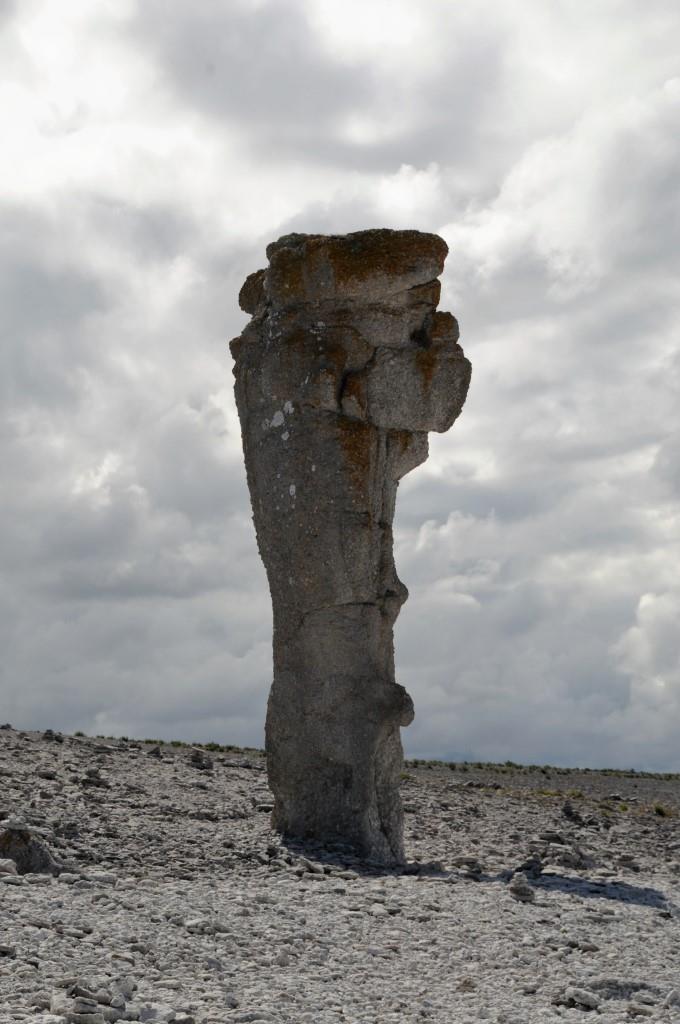
 
One of the limestone stacks ('rauks') at Langhammars

Perhaps another reason we associate Bergman so strongly with Fårö is the continuing fascination with Persona, which is I think, after The Seventh Seal, his most famous and iconic film (both are parodied in Woody Allen’s Love and Death).  Fårö's Bergmancenter currently has an exhibition marking its fiftieth anniversary.  Among the exhibits are Liv Ullman’s camera, Bibi Andersson’s shades and some atmospheric behind-the-scenes colour photographs of a film that is hard to imagine in anything other than beautifully-lit black and white.  Sadly it is not possible to visit the actual house used in Persona, situated on the rocky eastern shore of Fårö, where the troubled actress played by Liv Ullman withdraws from the world.  This no longer survives.

Liv Ullman on the rocks of Fårö in Persona (1966)

Friday, July 22, 2016

Coulisses de Forêt

 Six friezes for a paper theatre, 1880-1920
Source: 50Watts

I have been rather busy of late, as the tidal wave of consequences from the Referendum has swept over and fundamentally altered my place of work, and so it's been hard to find time to think about landscape and art.  However, I've just looked back at some draft posts and come upon the material here, which I wrote in 2011 after reading Will Schofield's 50Watts blog, where he reproduced various sets of scenery, like the one above, from a Dutch Puppetry Museum database.  They are all in muted colours, like memories of childhood.  When we were growing up I wasn't that taken with the Pollock’s Toy Theatre my parents got us; more recently, however, my sons did play a little with a Czech magnetic theatre.  The novelty wore off quite quickly though.  In an essay on the toy theatre, Robert Louis Stevenson looked back on the pleasure he had experienced admiring and painting these scenes and figures.  But then what?  'You might as well set up a scene or two to look at, but to cut the figures out was simply sacrilege; nor could any child twice court the tedium, the worry, and the long-drawn disenchantment of an actual performance.'

Another of my favourite blogs back in 2011, the now defunct Venetian Red, did an informative post on the history of toy theatres and their enthusiasts (you can read it here).  Writers and artists who remembered them with fondness included Goethe, Jack B. Yeats, Cocteau and Chesterton, who asked
“has not everyone noticed how sweet and startling any landscape looks when seen through an arch? This strong, square shape, this shutting off of everything else, is not only an assistance to beauty; it is the essential of beauty… This is especially true of toy theatre, that by reducing the scale of events it can introduce much larger events… Because it is small it could easily represent the Day of Judgement. Exactly in so far as it is limited, so far it could play easily with falling cities or with falling stars.”

Marcel Jambon, set design model for Verdi's Otello, 1895
Source: Wikimedia Commons

I wonder if there were painters who toyed with toy theatres while working up their compositional ideas, like set designers experimenting with their scale models?  Thomas Gainsborough, after all, was said to have 'built model landscapes in his studio, consisting of coal, clay or sand with pieces of mirror for lakes and sprigs of broccoli to represent trees, in order to help him construct his compositions.'  The set of Coulisses de Forêt below could have been used to design a hunting scene with framing trees and repoussoir stag, except, I suppose, that by the time it was printed in 1889, art had largely left behind these classical conventions.  The Toy Theatre blog says that the Épinal-based firm behind this example, Pellerin, produced scenes that were 'very distinctive in style and very French, but for all that rather second rate. The Pellerin sheets were like its other cut-out products, intended to be made, set up and looked at but not performed. There were no Toy Theatre plays as such, only tableaux.'

Coulisses de Forêt, 1889
Source: Geheugen van Nederland


Postscript
It is a month later and I have just seen a toy theatre - the one used at the start of Ingmar Bergman's Fanny and Alexander.  As I mention in my most recent post, I visited the Bergmancentrer on Fårö and it is on display there. I have included a photograph below (sorry about the unavoidable reflection from the window opposite).  The sign above the stage means 'Not for Pleasure Alone'.  The film begins with running water and then cuts to this theatre, where a young boy's face is revealed as he pulls up the background landscape scenery.

Tuesday, July 31, 2007

A hot gust of wind blows across the colourless sea...


'The night had brought little relief from the heat, and at dawn a hot gust of wind blows across the colourless sea. The KNIGHT, Antonius Block, lies prostrate on some spruce branches spread over the fine sand....' So begins The Seventh Seal...

In his little BFI Film Classics book about the film Melvyn Bragg says how the opening of the film resembles a play. But in a theatre we would not see the landscape, and it is the setting of this scene that seems to me crucial. The screenplay describes the knight opening his eyes after a morning prayer: he 'stares directly into the morning sun which wallows up from the misty sea like some bloated, dying fish. The sky is grey and immobile, a dome of lead. A cloud hangs mute over the western horizon. High up, barely visible, a seagull floats on motionless wings. Its cry is weird and restless.' It is at this point that the knight turns round and sees Death.

Rugged coasts and islands are perhaps the most archetypal Bergman landscape. In addition to his use of Hovs Hallar in Skåne for The Seventh Seal, I think primarily of the way he used the Stockholm Archipelago in Summer with Monika and his repeated use of the island of Fårö, which first appeared in Through a Glass Darkly. Fårö is, according to, Geoffrey Macnab, a "a remote, windswept place with a landscape that appears flat and barren. There are countless pine trees, fields with ancient stone walls, a succession of sand and shingle beaches, and more sheep than humans." It was on Fårö that Bergman lived until the sad news of his death was announced yesterday.