Sunday, September 25, 2011
High Arctic
I've talked here before about the ongoing Cape Farewell project which takes a group of artists and scientists each year to the Arctic. Last year's trip sailed around Svalbard and among those on board were poet Nick Drake and artist Matt Clark of United Visual Artists. They have now collaborated on an installation for the National Maritime Museum: High Arctic. It is described as 'an exhibition with no touchscreens, no static photographs, and no panels with text: instead High Arctic is a genuinely immersive, responsive environment. Ultraviolet torches unlock hidden elements, constantly shifting patterns of graphics and text that react to visitors approaching; an archipelago of thousands of columns fills the gallery space, each representing a real glacier in Svalbard; an artificial horizon borders the gallery as a seamless canvas of light, shifting in intensity and colour. A Max Eastley and Henrik Ekeus-designed generative soundscape flows through the gallery, weaving in the voices of arctic explorers across the centuries as well as the poetry of Nick Drake.'
The exhibition looks into a future where we will have to imagine the Arctic as it once was. As you walk on what seem to be pristine snowfields dark patches spread around you, and ice-floes break up as if melted by your torch. When the voices are silent you can hear the bleak sound of wind whistling over the ice. Each ice column has the name of one of Svalbard's disappearing glaciers on it, which appears and then vanishes when you move the light over it. These minimal white blocks and their arrangement in the museum space reminded me of Rachel Whiteread's Embankment at Tate Modern, which was a response to her own Cape Farewell trip in 2005. I took my sons along to High Arctic today and they really enjoyed interacting with the lights and exploring the labyrinth of ice blocks. I see that, according to an article in Wired, the scale of these was 'based on Lego models because, as team member Ben Kreukniet explains, “Lego is awesome.”'
Friday, September 23, 2011
Before the melt-waters
My copy of The Oxford Companion to the Literature of Wales has a landscape by David Jones on the cover, painted in the twenties when he went to live with Eric Gill and others at Capel-y-ffin in the Black Mountains. The book describes Jones' long poem The Anathemata (1952) as 'at once devotional and commemorative, a celebration of Christian mysteries and a recalling of the making - both geological and cultural - of Britain ... The poem draws its material mainly from Celtic, Latin and Teutonic 'deposits' underlying London and Wales, and from English literature.' Peter Ackroyd and Iain Sinclair have followed a similar path in their recent writings (London Orbital quotes 'The Lady of the Pool' section of The Anathemata, in which Jones uncovers the mythic strata of the City). But before the poem reaches London, before following the waves of ship-borne settlers whose culture has shaped Britain, there is a section called 'Rite and Fore-Time' which describes the formation of the land itself. What I like about these lines is the way they too contain 'Celtic, Latin and Teutonic 'deposits'', projected back onto Ice Age Britain, 'before the melt-waters / had drumlin-dammed a high hill-water for the water-maid / to lave her maiden hair.'
He says for example, that it is long ages since these melt-waters 'troughed, in solid Ordovician / his Bala bed for Tacitus. / Long, long ago they'd turned the flow about. / But had they as yet morained / where holy Deva's entry is? / Or pebbled his mere, where / still the Parthenos / she makes her devious exit?' A footnote explains some of these etymological references: Bala is also called Pimblemere, and in Welsh, Llyn Tegid, the Lake of Tacitus. Jones adds that 'it may be noted that Tacitus was the name of Cunedda's great grandfather' (the kind of fact that these days we can find instantly and then pursue as far as we like). He also explains in the footnote that the lake 'is formed of solid rock but the S. W. end at least is thought to have been influenced by morainic deposits. At some remote geological period the outflow was southward whereas now the Dee flows northward through the lake, but, says immemorial tradition, the two waters never mingle.'
Lake Bala
Source: Wikimedia Commons
The poem goes on to describe the movement south of glacial material, 'heaped amorphous / out of Caledonia / into Cambria.' It was from the Southern Uplands, Jones notes, that 'geological deposits of the Ice Age and certain legendary and historical deposits of the sub-Roman age came to Wales.' At the same time ice sheets from Ireland, Scotland and the Lake District converged into the depression of the Irish Sea and moved south, 'part thrust against the land mass of North Wales' (here Jones' footnote quotes Brit. Reg. Geol. N. Wales pp77-8). Microgranites and clay-bonded erratics were wrenched away and carried 'with what was harrowed-out in via, up, from the long drowned out-crops, under, coalesced and southed by the North Channel.' And then the description of glacial action ends with the strange image of St Brendan on his sea horse. A footnote explains that glaciation extended 'just beyond the waters between South Wales and Ireland, which very many millenia later became associated with the marvel-voyages of the Celtic ascetics; such as the navigation-saint, Brendan, who in the legend rides the narrow channel on a marine creature and hails Finbar, mounted on David's swimming horse, with the words 'God is marvellous in his saints.''
Location:
Llyn Tegid
Saturday, September 17, 2011
Soft pink landscape
Earlier this week I was sad to read Waldemar Januszczak tweet 'Oh no, Richard Hamilton died this morning. That is a HUGE loss. Probably Britain's most important post-war artist.' But, as he went on to say, 'Richard Hamilton was working on a big touring retrospective when he died. So at least there is that to look forward to.' Back in 1992 I went to a sizable retrospective at the Tate Gallery and have just been re-reading the catalogue. This reminded me that five years before his famous collage, Just What Is It That Makes Today's Homes So Different, So Appealing?, Hamilton was helping to make large map-models of New Towns (Harlow, Basildon and Speke) for the Festival of Britain's Exhibition of Architecture, Town Planning and Building Research. There is a small black and white photograph of one of these in the catalogue (like a Ghost Box album cover), where it is contrasted with Landscape (1965-6). This later work is mixed media added to an enlarged postcard image of the South Downs - panoramic landscape as a 'self-reflexive, game-playing switching of representational codes, rather than as a mimetic, miniaturised simulation of the new Socialist Britain.'
In the early sixties Hamilton was struck by a new advertising campaign for Andrex toilet paper that featured photographs of girls posed in a forest glade. He described the scene: 'Nature is beautiful. Pink from a morning sun filters through a tissue of autumn leaves. Golden shafts gleam through the the perforated vaulting of the forest to illuminate a stage set-up for the Sunday supplement voyeur.' It is a masturbatory fantasy: 'the woodland equipped with every convenience. A veil of soft-focus vegetation screens the peeper from the sentinel. Poussin? Claude? No, more like Watteau in its magical ambiguity.' In Soft pink landscape (1971-2) he reproduces this scene in misty paint, as if seen through half-closed eyes, with a roll of Andrex placed on the ground.
In 1975 Hamilton exhibited Andrex-inspired work at the Serpentine Gallery along with other landscape views derived from postcards. Some of these show Miers, the French spa noted for the laxative properties of its waters. There were also nine pastel images of sunsets, each with a giant turd in the foreground. One further view was of sunrise over Cadaqués with a turd blotting out its church, and Hamilton linked this with Jung's account of a dream he had: 'the cathedral, the blue sky, God sits on his throne, high above the world - and an enormous turd falls upon the sparkling new roof, shatters it, and breaks the walls of the cathedral asunder.' Hamilton's interest in the Andrex adverts continued and in 1980 he completed Soft blue landscape (the cover of the Tate's 1992 exhibition catalogue, below, shows a detail from this painting, omitting the toilet roll). It was at this point that Hamilton discovered the rather surprising identity of an artist who had actually worked on the original 1960s Andrex campaign... Bridget Riley.
In the early sixties Hamilton was struck by a new advertising campaign for Andrex toilet paper that featured photographs of girls posed in a forest glade. He described the scene: 'Nature is beautiful. Pink from a morning sun filters through a tissue of autumn leaves. Golden shafts gleam through the the perforated vaulting of the forest to illuminate a stage set-up for the Sunday supplement voyeur.' It is a masturbatory fantasy: 'the woodland equipped with every convenience. A veil of soft-focus vegetation screens the peeper from the sentinel. Poussin? Claude? No, more like Watteau in its magical ambiguity.' In Soft pink landscape (1971-2) he reproduces this scene in misty paint, as if seen through half-closed eyes, with a roll of Andrex placed on the ground.
In 1975 Hamilton exhibited Andrex-inspired work at the Serpentine Gallery along with other landscape views derived from postcards. Some of these show Miers, the French spa noted for the laxative properties of its waters. There were also nine pastel images of sunsets, each with a giant turd in the foreground. One further view was of sunrise over Cadaqués with a turd blotting out its church, and Hamilton linked this with Jung's account of a dream he had: 'the cathedral, the blue sky, God sits on his throne, high above the world - and an enormous turd falls upon the sparkling new roof, shatters it, and breaks the walls of the cathedral asunder.' Hamilton's interest in the Andrex adverts continued and in 1980 he completed Soft blue landscape (the cover of the Tate's 1992 exhibition catalogue, below, shows a detail from this painting, omitting the toilet roll). It was at this point that Hamilton discovered the rather surprising identity of an artist who had actually worked on the original 1960s Andrex campaign... Bridget Riley.
Labels:
aerial landscapes,
maps,
the body
Location:
Cadaqués
Sunday, September 11, 2011
One streak of dying light
Landscapes, finished in 1949 and premiered by the San Francisco Symphony in 1953, is the earliest work for orchestra by Chinese-American composer Chou Wen-chung. It uses three traditional Chinese melodies to create three different 'landscapes': 'Under the Cliff in the Bay,' 'The Sorrow of Parting,' and 'One Streak of Dying Light.' The titles come from poems by Cheng Hsieh (1693-1765), Ting P’eng (c. 1661) and Liu Chi (1311-75). You can read the full poems and see the score on the composer's excellent website. The third one, for example, reads: 'Green, green the grass west of the pavilion,/ The clouds low, the cries of the wild geese faint,/ Two lines of sparse willows, /One streak of dying light, /Hundreds of homing ravens dotting the sky.'
In the years following Landscapes Chou worked as student and assistant to Edgard Varèse (the manuscript for Déserts was written out by him). He also continued to compose his own landscape-inspired music; in 1956 for example came And the Fallen Petals, based on a poem by Meng Hao-jan (689-740). He says 'in this work I have tried to convey through sound the emotional qualities of Chinese landscape painting and to achieve this end with the same economy of means ... In this as well as in my other works to date, I am influenced by the philosophy that governs every Chinese artist, whether he be poet or painter; namely, affinity to nature in conception, allusiveness in expression, and terseness in realization.' The music is in three sections: 'Part 1: Against a quiet and mysterious landscape, budding blossoms dance the praise of life in the Spring wind', 'Part 2: A storm breaks and the furious wind drives the dazed petals far and wide,' 'Part 3: Against a quiet and mysterious landscape, the fallen petals are being swept away and fresh blossoms on the branches dance in the Spring wind.'
Chou's long career continues and his most recent piece is from 2009, Ode to Eternal Pine, dedicated to Elliott Carter (who is still going strong in his second century). He says of this that 'in East Asian cultures, the pine, often seen on mountain peaks, is a symbol of longevity and the eternity of nature. “Meditating on Eternity” is a reflection on the fundamental esthetic principle of East Asia, as expressed in the Chinese terms tian di ren, heaven, earth and humanity. It suggests human emotion within the timelessness of the universe and the physical constraints on earth, the two axes symbolized by the subsequent movements, “Lofty Peaks” and “Profound Gorges.”' I was reminded of these two axes while reading an interesting interview with Chou, where he says that back in 1977 he had been responsible for selecting a traditional Chinese zither piece called 'Flowing water' for inclusion on the Voyager golden records - music that has now left behind the physical constraints of earth on its journey out into the universe.
Saturday, September 10, 2011
A falcon flew across the marsh, weaving through the wind
On Thursday Radio 4 are broadcasting a new play by Helen Macdonald about that classic of English nature writing, J. A. Baker's The Peregrine (1967). It will be, I'm told, "a strange thing", comparing Baker's pursuit of wild falcons with Helen's own experiences keeping a goshawk called Mabel. The play has been produced by Tim Dee, who wrote in his own bird memoir, The Running Sky, about his fascination with the book and its strange author, who seemed to lose himself in a quest to follow the peregrine wherever it took him: 'earthed, haggard and self-loathing, traipsing through marshes, crouching in ditches and lurking on field edges.' Whether Helen ended up in this state too we shall be able to hear next week.
Robert Macfarlane's preface to the 2005 NYRB edition of The Peregrine noted that little is known of Baker's life beyond what is recorded in his book. This mystery has added to the aura surrounding him over the years (in a way reminiscent to me of Robert Johnson, who in 1961 could be described on King of the Delta Blues Singers as 'little, very little more than a name on aging index cards and a few dusty master records in the files of a phonograph company that no longer exists'). But (as with Johnson) investigators have now unearthed more information and it turns out that when he wasn't on the trail of falcons or composing his visionary masterpiece, Baker managed the Chelmsford branch of the AA. This new biographical material has been included in the introduction to The Complete Works of J. A. Baker, published earlier this year. In addition to The Peregrine this volume has a selection of diary entries devoted to bird watching, The Hill of Summer (Baker's second, almost-forgotten book) and an essay, On the Essex Coast.
'Detailed descriptions of landscape are tedious,' writes Baker at the start of The Peregrine, and indeed he never needs to amass detail to convey a vivid and original sense of place. By omitting all reference to identifiable locations (500 of which actually appear in the newly published diary selections), Baker strips his landscape down to the shapes and colours and sensory impressions that a falcon might experience. Mark Cocker (in his introduction to The Peregrine) says that 'for Baker devotees this compositional device has given rise to a kind of sport, as they try to tease out a real geography behind the otherwise anonymous descriptions.' But equally, it has the effect of transforming Baker's corner of Essex into a universal landscape.
The Peregrine draws on observations made over a ten year period but is written as if they all took place in one year. I have quoted below some of the opening lines to convey a sense of the way Baker often sets the scene with a distilled, imagistic landscape description. The first entry in the book is for October 1st, when he finds a peregrine and watches as it picks off a jay (too vivid and conspicuous against the green water-meadows) and vows to follow him all winter, sharing 'the fear, and the exultation, and the boredom, of the hunting life.' The last entry is on April 4th, when he pursues the peregrine until he is able to crawl to a position five yards away, right in front of the bird, whose eyes look into his but seem to see something beyond 'from which they cannot look away.'
Robert Macfarlane's preface to the 2005 NYRB edition of The Peregrine noted that little is known of Baker's life beyond what is recorded in his book. This mystery has added to the aura surrounding him over the years (in a way reminiscent to me of Robert Johnson, who in 1961 could be described on King of the Delta Blues Singers as 'little, very little more than a name on aging index cards and a few dusty master records in the files of a phonograph company that no longer exists'). But (as with Johnson) investigators have now unearthed more information and it turns out that when he wasn't on the trail of falcons or composing his visionary masterpiece, Baker managed the Chelmsford branch of the AA. This new biographical material has been included in the introduction to The Complete Works of J. A. Baker, published earlier this year. In addition to The Peregrine this volume has a selection of diary entries devoted to bird watching, The Hill of Summer (Baker's second, almost-forgotten book) and an essay, On the Essex Coast.
'Detailed descriptions of landscape are tedious,' writes Baker at the start of The Peregrine, and indeed he never needs to amass detail to convey a vivid and original sense of place. By omitting all reference to identifiable locations (500 of which actually appear in the newly published diary selections), Baker strips his landscape down to the shapes and colours and sensory impressions that a falcon might experience. Mark Cocker (in his introduction to The Peregrine) says that 'for Baker devotees this compositional device has given rise to a kind of sport, as they try to tease out a real geography behind the otherwise anonymous descriptions.' But equally, it has the effect of transforming Baker's corner of Essex into a universal landscape.
The Peregrine draws on observations made over a ten year period but is written as if they all took place in one year. I have quoted below some of the opening lines to convey a sense of the way Baker often sets the scene with a distilled, imagistic landscape description. The first entry in the book is for October 1st, when he finds a peregrine and watches as it picks off a jay (too vivid and conspicuous against the green water-meadows) and vows to follow him all winter, sharing 'the fear, and the exultation, and the boredom, of the hunting life.' The last entry is on April 4th, when he pursues the peregrine until he is able to crawl to a position five yards away, right in front of the bird, whose eyes look into his but seem to see something beyond 'from which they cannot look away.'
October 14th: One of those rare autumn days, calm under high cloud, mild, with patches of distant sunlight circling round and rafters of blue sky crumbling into mist...
October 30th: The wind-shred banner of the autumn light spanned the green headland between the two estuaries...
November 2nd: The whole land shone golden-yellow, bronze, and rusty-red, gleamed water-clear, submerged in brine of autumn light...
November 11th: Wisps of sunlight in a bleak of cloud, gulls bone-white in ashes of sky...
November 16th: The valley was calm, magnified in mist, domed with a cold adamantine glory...
November 21st: A wrought-iron starkness of leafless trees stands sharply up along the valley skyline...
December 8th: Golden leaves of sunlight drifted down through the morning fog...
December 15th: The warm west gale heaved and thundered across the flat river plain, crashed and threshed high its crests of airy spray against the black breakwater of the wooded ridge...
January 5th: Broken columns of snow towered over lanes dug from ten foot drifts. Roads were ridged and fanged with white ice, opaque and shiny as frozen rivers...
February 10th: This was a day made absolute, the sun unflawed, the blue sky pure...
March 10th: Towering white clouds grew in the marble sunlight of the morning. The wind eroded them to falling weirs of rain. The estuary at high tide brimmed with blue and silver light, then tarnished and thinned to grey. A falcon flew across the marsh, weaving through the wind...
Friday, September 02, 2011
Bless all ports.
Well, summer is over - the coldest for eighteen years apparently and, as The Tate's Vorticism exhibition also comes to an end, it is perhaps excusable to curse the English climate 'for its sins and infections'. The Vorticist Manifesto blasts our 'flabby sky that can manufacture no snow, but can only drop the sea on us in a drizzle like a poem by Mr. Robert Bridges.' But at the same time, claims that 'the English Character is based on the Sea' and blesses England's
PORTS, RESTLESS MACHINES OF | scooped out basins
| heavy insect dredgers
| monotonous cranes
| stations
| lighthouses, blazing
| through the frosty
| starlight, cutting the
| storm like a cake
| beaks of infant boats,
| side by side,
| heavy chaos of
| wharves,
| steep walls of
| factories
| womanly town
There follows a list of the great ports, including Newcastle, which is portrayed a few pages later in a Vorticist woodcut by Edward Wadsworth. The Tate exhibition includes a similar print, called simply Port, and it was a subject Wadsworth would return to throughout his career (although his later harbour views are much less interesting). During the First World War Wadsworth was involved in the application of dazzle camouflage to allied ships and used this experience in what may be his most famous port scene, Dazzle-ship in Drydock at Liverpool (1919). Roy Behrens has recently unearthed a photograph of Wadsworth painting this - you can see it on his Camoupedia blog.
PORTS, RESTLESS MACHINES OF | scooped out basins
| heavy insect dredgers
| monotonous cranes
| stations
| lighthouses, blazing
| through the frosty
| starlight, cutting the
| storm like a cake
| beaks of infant boats,
| side by side,
| heavy chaos of
| wharves,
| steep walls of
| factories
| womanly town
There follows a list of the great ports, including Newcastle, which is portrayed a few pages later in a Vorticist woodcut by Edward Wadsworth. The Tate exhibition includes a similar print, called simply Port, and it was a subject Wadsworth would return to throughout his career (although his later harbour views are much less interesting). During the First World War Wadsworth was involved in the application of dazzle camouflage to allied ships and used this experience in what may be his most famous port scene, Dazzle-ship in Drydock at Liverpool (1919). Roy Behrens has recently unearthed a photograph of Wadsworth painting this - you can see it on his Camoupedia blog.
Monday, August 29, 2011
Rain-saturated, churning, chanting thunder
The education in Latin shared by English gentlemen was obviously an influence on their landscape gardening. As Tim Richardson puts it in The Arcadian Friends, 'from the schoolroom to the garden, Virgil set the scene, Horace set the tone, Cicero inspired the political iconography, Pliny extolled the creature comforts, and Ovid directed the sensual fantasy narrative.' Beyond this basic pantheon it is interesting to consider any other writers who touched on landscape themes or inspired future landscape thinking. One example, less well-known today, was Persius (Aulus Persius Flaccus) who lived in Rome and died young (his dates were 34-62). His Sixth Satire was translated by Dryden in the 1690s. In it, a land-owner rejoices in his life free from the concerns of business and state: 'here I enjoy my private Thoughts' and do not care if crops fail or neighbouring farmers have 'a larger Crop than mine.' However, the poem is not concerned with farming or landscape specifically, its general theme is 'an admirable common-place of Moral
Philosophy; Of the true Use of Riches'.
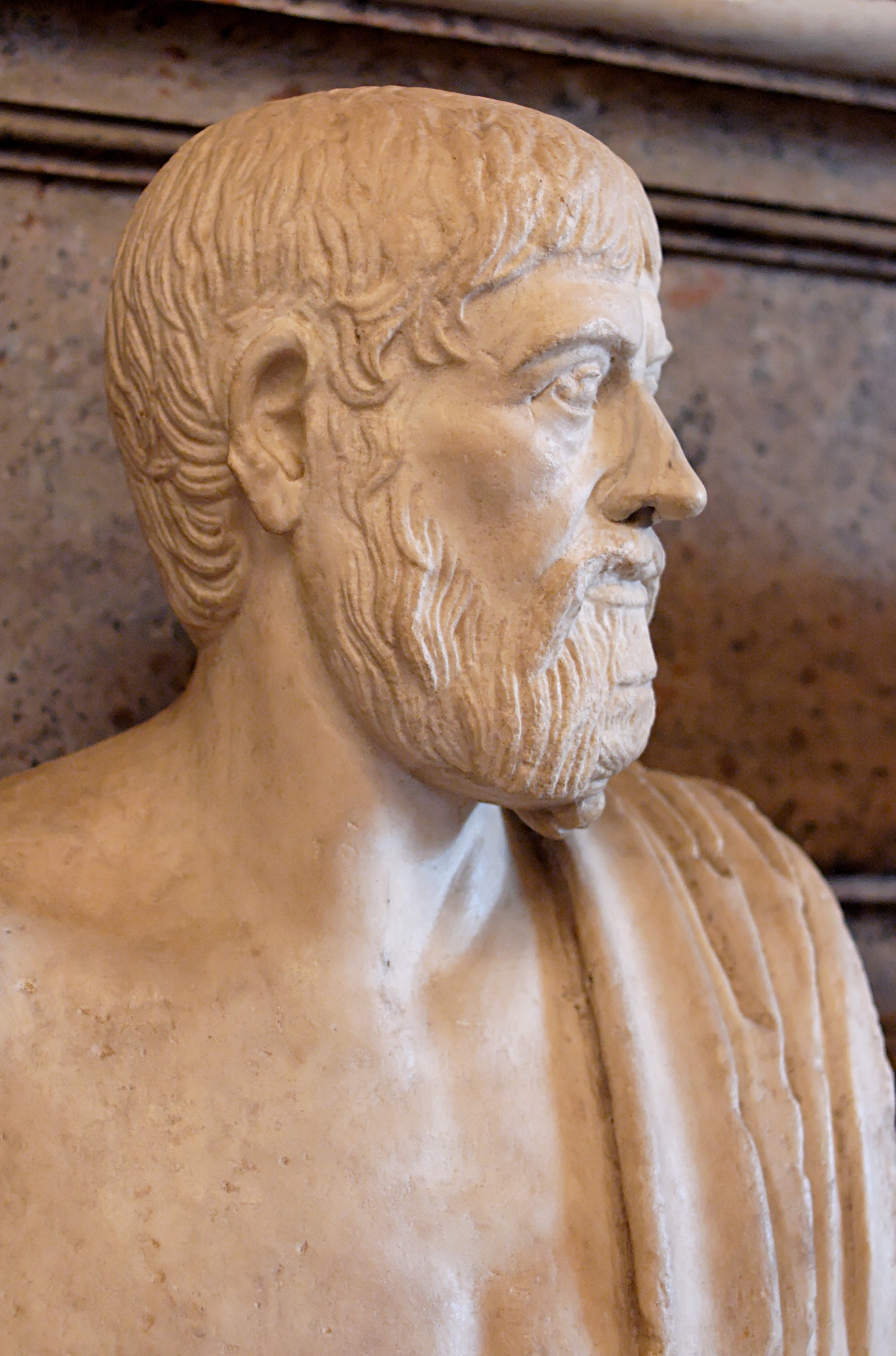
The erudite Joseph Addison had read more widely than these Latin writers and in a piece for The Spectator in 1712 showed off his knowledge of Greek: 'my compositions on gardening are altogether after the Pindarick manner, and run into the beautiful wildness of nature, without affecting the nicer elegancies of art.' According to Richardson, 'Pindar's verse mingles an admiration of the grandeur of raw nature with an ability to complement its changefulness and variety through elegant expression.' This makes him sound like an interesting wilderness poet, although as with Persius there is no direct writing on landscape in his Odes. Addison was probably thinking more about the way Pindar wrote. Horace, for example, compared Pindar's writing to a wild landscape: 'a river bursts its banks and rushes down a mountain with uncontrollable momentum, rain-saturated, churning, chanting thunder – there you have Pindar's style...'
Pindar (Roman copy after a Greek original of the 5th century BCE)
Source: Wikimedia Commons
Sunday, August 28, 2011
The Valley of the Shadow of Death
Jonathan Tyers, the owner of Vauxhall Pleasure Gardens, had his own private estate at Denbies in Surrey. There he named an 8-acre woodland 'Il Penseroso' after Milton's poem - perhaps, as Tim Richardson says in his book The Arcadian Friends, Tyers 'viewed Vauxhall Gardens as its equivalent, the more jocund L'Allegro' and the melancholy woodland as 'a kind of penance for the jolly hedonism of Vauxhall.' In this wooded part of the garden there was a hermitage called the Temple of Death which contained, in addition to a memorial to garden designer Lord Petre, a model of a white raven and a clock that chimed every minute, to remind visitors of the transience of life. Black leather-bound copies of Edward Young's Night Thoughts and Robert Blair's The Grave were available for perusal on a table. Beyond the hermitage was a gateway with posts made from upright coffins, 'its arch surmounted by a pair of human skulls (reputedly real - one belonging to a highwayman, the other a prostitute's)'. This was the entrance to the Valley of the Shadow of Death. Here the two artists Tyers had previously employed at Vauxhall were asked to decorate the interior of a temple. Either side of an allegorical statue by Louis-François Roubiliac were paintings by Francis Hayman: The Death of a Christian (peaceful and accompanied by an angel) and The Death of an Unbeliever (about to be speared by a leering skeleton). Richardson concludes that 'any visitors who arrived thinking they might have an amusing time with the happy-go-lucky proprietor of Vauxhall Gardens were in for a disappointment.'
William Blake, illustration intended for the 1805
publication of Blair's poem 'The Grave'
Source: Wikimedia Commons
Labels:
gardens,
John Milton,
William Blake
Location:
Denbies, Surrey
Wednesday, August 17, 2011
The Back Bay Fens
Frederick Law Olmsted, Plan for the Back Bay Fens, 1887
Source: Wikimedia Commons
Within the essays and conversation that make up Landscape Theory (see my previous post), there are many interesting comments that could serve as the basis for posts here, but I'll just pick one example for now. In the course of the seminar Anne Whiston Spirn observed that we no longer perceive some works of landscape art as having been designed and constructed. Frederick Law Olmsted's plan for the Back Bay Fens, for instance, was 'the first attempt, so far as I know, to construct a wetland. Olmsted proposed the Fens as a combination of utility and beauty, a restoration of polluted tidal marsh flats to serve human needs. The power of that restoration wasn't lost on people in Boston at the time, but within a generation people forgot that it was constructed.' So, Spirn asked, 'how did Olmsted move from the pastoral, pictorial style he had used in Central Park, to the idea of reconstructing a marsh? Well, Martin Johnson Heade had been painting coastal marshes north of Boston. Perhaps his paintings influenced Olmsted. Certainly they must have contributed to public acceptance of Olmsted's revolutionary proposal.'
Martin Johnson Heade, Marsh with a Hunter, 1874
Tuesday, August 16, 2011
Theoryscapes
Landscape Theory (2008), edited by Rachael Ziady DeLue and James Elkins, is Volume Six in the 'Art Seminar' series, which addresses current issues in writing about art through roundtable discussions and invited contributions. It is a really rich and readable anthology of writing about landscape; the theory doesn't get too heavy despite the forbidding cover - an empty seminar table rather than a picturesque landscape. Interestingly, one contributor to the book, Jill H. Casid, noticed the way that the general preface to the whole series, written by Elkins, is actually 'implicated in the discourse of landscape with its rehearsal of what we might call the metaphorics of theoryscaping. Current writing on the visual arts is compared to a "trackless thicket" in order to assert that it is "not a wilderness." Instead, visual graphs (that are given the look of geological formations [they are 3D area charts]) convert "theory in art history" into a "landscape of interpretive strategies" through which the series offers a well-blazed and navigable trail.'
I thought it might be interesting here to try to summarise briefly the seminar discussion (70 pages in the book!) and in doing so add links to some relevant earlier posts on this blog. The event took place in June 2006 at the Burren College of Art in Ireland and brought together art history, geography and landscape architecture academics (plus an independent scholar - Rebecca Solnit). James Elkins opened the discussion by remarking that in the years since the original publication of Denis Cosgrove's influential Social Formation and Symbolic Landscape (1984), it has become increasingly possible to move beyond the idea of landscape-as-ideology. There was general agreement to this, including from Cosgrove himself, who nonetheless recalled that his book had been a reaction against two then-prevalent ways of thinking about landscape: as the romantic, aesthetic response to nature or as more scientific, geographical analysis. Elkins introduced a third notion, landscape as a work of physical production, leading to discussion of the etymology of 'landscape' - the OED defines it in relation to art but another root is the Old English 'landscipe', which concerns the shaping of a place. A fourth version of landscape, the representation of space and time ('landscope') provoked discussion of the priviledged position of the observer in art history and those 'timeless' landscapes without figures, like Ansel Adams' photographs of Yosemite.
The problems of separation - either by framing a view or more generally from the unbridgable distance between observer and those actively shaping the landscape - led to the first mention of phenomenology as a way of thinking more about our experience of landscape. Jessica Dubow talked about the recent turn to phenomenology in cultural geography, which has moved beyond the study of images (or images-as-texts) to a more direct encounter where the subject is inside the landscape. There was some further discussion of ideology and whether it is helpful to think of 'landscapes' in the postmodern global cultural economy (Arjun Appadurai's notions of 'finance-scapes', 'techno-scapes' and so on). But the last words of the morning session were Denis Cosgrove's, concluding that a focus on virtual spaces 'raises issues in relation to the materiality of landscape that phenomenology emphasizes.'
The conversation recommenced with discussion of the extent to which landscape became less central to twentieth century art. David Hays referred to a different trend in landscape architecture, where art has become less influential: ecological concerns now dominate and 'art' is seen as almost a dirty word (although there are exceptions - Anne Whiston Spirn mentioned Martha Schwartz's Splice Garden). The discussion then turned to maps, panoramas and their military origins and from map-making to the distinction between cartography, the conceptual visualisation of the landscape, and chorography, a more sensory, descriptive approach. But in the midst of this I was struck by Denis Cosgrove's comment that 'mapping removes us a little from the suffocating embrace of ecology when thinking about the natural world and places and our relations to them.' Trenchant stuff - just as well no ecocritics had been invited! The absence of any ecological discussion in this seminar was interesting to me (since this blog has always focused on forms of landscape art, rather than environmental art) but disappointing too, given the natural expectation that there would be cutting edge theoretical thinking in this area.
At this point in the seminar James Elkins intervened to change the subject and ask whether it is possible to imagine landscapes outside of their representation in art. The subsequent discussion touched on the way tourists see Yosemite through the lens of Muybridge and Adams, partly because the park's infrastructure leads them to specific viewpoints. These photographs are social acts - people rarely take a view without posing in front of it - but such views are still based (for Elkins) on the late-Romantic Western tradition of painting and photography. This view has been put forward in Joseph Leo Koerner's writings on Friedrich and indeed one participant, Michael Newman, suggested that Friedrich's hyperreal style clearly pre-figures our contemporary digital landscapes. I was surprised there wasn't more exploration at this point of different perspectives, although participants did mention the Silent Traveller books, written in England by Chiang Yee, and the landscape architect Nicholas Brown, who 'walks somewhat in the spirit of Richard Long.' But time was obviously running short and after a few more questions from the audience Elkins closed the seminar, inviting participants to head out for a hike 'in what we persist in pretending is the actual landscape'.
The Burren landscape
Source: Wikimedia Commons
Friday, August 05, 2011
Landscape from Finnmark
This week I popped into the National Gallery to see an interesting new exhibition: 'Forests, Rocks, Torrents: Norwegian and Swiss Landscapes from the Lunde Collection'. These two countries were in many ways very different in the nineteenth century - Switzerland prosperous, independent and rapidly industrialising, Norway poor, dominated by Denmark and Sweden and dependent on exporting its natural resources. Swiss artists tended to stay in Switzerland whereas the Norwegians tended to travel. The importance of getting away from the familiar is illustrated in the case of Peder Balke (1804-87) who studied art in Christiania and Stockholm and began his career painting conventional landscapes. In 1832, as Christopher Riopelle and Sarah Herring write in the catalogue, he travelled by ship to the North Cape, 'a rugged and largely inaccessible area of the country. There he found bleak and original motifs which allowed him to define his highly individual painting style. He continued to explore these motifs in increasingly austere images throughout his career.' The exhibition includes Landscape from Finnmark (about 1860), an icy view across snow-covered rocks to distant grey mountains, dominated by a single tree, leaning at an angle as if battered by the elements. The painting reproduced below is another of Balke's Finnmark scenes.
On entering the exhibition, the first thing you see is a large map on the wall, reproduced from an 1873 Baedecker on Switzerland, with pins showing locations of the paintings: The Wetterhorn, Lake Lucerne, the Valley of Lauterbrunnen and so on. There are also pin maps of Norway, based on Thomas B. Wilson's 'Handy Guide' to the country of 1888. These reminded me of another thing I've been doing this week: working on the Some Landscapes Timeline and Map. I am still compiling this so the screenshots below represent work in progress. The map shows a selection of places connected to my blog posts - I shall now be able to add a little Google pin on Finnmark. The timeline, similarly, is no more than another way of viewing the blog, but I suppose you could see it as a rather eccentric history of landscape and culture. So far it stretches from Sargon II's park at Ninevah (715 BCE) to Hamish Fulton's Everest ascent (2009). Some of the dates relate to paintings or publications but many involve encounters with landscape: Wang Po at the Pavilion of the Prince of T'eng, Dorothy Wordsworth in Scotland, Olivier Messiaen in Utah, and here, Peder Balke in Finnmark.
Peder Balke, From Hammerfest, 1851
Source: Wikimedia Commons
On entering the exhibition, the first thing you see is a large map on the wall, reproduced from an 1873 Baedecker on Switzerland, with pins showing locations of the paintings: The Wetterhorn, Lake Lucerne, the Valley of Lauterbrunnen and so on. There are also pin maps of Norway, based on Thomas B. Wilson's 'Handy Guide' to the country of 1888. These reminded me of another thing I've been doing this week: working on the Some Landscapes Timeline and Map. I am still compiling this so the screenshots below represent work in progress. The map shows a selection of places connected to my blog posts - I shall now be able to add a little Google pin on Finnmark. The timeline, similarly, is no more than another way of viewing the blog, but I suppose you could see it as a rather eccentric history of landscape and culture. So far it stretches from Sargon II's park at Ninevah (715 BCE) to Hamish Fulton's Everest ascent (2009). Some of the dates relate to paintings or publications but many involve encounters with landscape: Wang Po at the Pavilion of the Prince of T'eng, Dorothy Wordsworth in Scotland, Olivier Messiaen in Utah, and here, Peder Balke in Finnmark.
Thursday, July 28, 2011
Climbing Mount Kagu
Among the 4,500 poems which make up the Manyōshū ('Collection of Ten Thousand Leaves'), there is one attributed to the Emperor Jomei (593-641), called 'Climbing Mount Kagu'. It describes the view from the mountain down towards the land of Yamato: 'Over the wide plain the smoke-wreaths rise and rise, Over the wide lake the gulls are on the wing...' This translation, like others I have seen, omits the poem's descriptive epithet for Yamato, 'island of the dragonfly'. The phrase refers to the way a dragonfly's tail touches its mouth to form a ring, like the circle of mountains round the plain of Yamato. It is an example of a pillow-word (makura kotoba), which Geoffrey Bownas calls in his introduction to The Penguin Book of Japanese Verse (1964) 'a qualifier describing, by tradition, certain nouns or concepts.' Among other examples connected with actual places are 'rock running' for Ômi' (from the image of water gushing over rocks) and 'spring mist' used to modify Kasuga. Pillow-words are often likened to the Homeric stock epithet, although most of those describe people (ox-eyed Hera, swift-footed Achilles, laughter-loving Aphrodite) rather than places (Mycenae rich in gold). According to Bownas the comparison fails to do full justice to the essence and purpose of pillow-words, whose 'alliterative or assonantal ring' ensure that the reader pauses on the word being qualified. 'Further, since many of the head-words are place names, it is argued that part of the purpose of the pillow-word in its early use in primitive society was to act as a talisman for the good fortune of the place in question.' He goes on to provide his own example poem in the form of a donnish joke about Oxford's 'Heaven-preserve-it Western By-Pass'.
The phrase 'pillow shot' has come to be used to describe the short transitional images of landscapes, interiors and objects that are such a distinctive feature of Yasujiro Ozu's cinema. There are many examples on the excellent Ozu-San website and a montage on Youtube (embedded below). The first scene of my favourite Ozu film, Tokyo Story (1953), shows an old couple, the Hirayamas, packing for their trip to Tokyo. The second takes place in the house belonging to their son, a doctor in the capital. We do not see the journey itself - instead the scenes are intercut with three pillow shots showing smokestacks (see above), a railway crossing and the sign outside their son's office. These are more than just establishing shots - as David Desser writes in his handbook to the film, 'careful examination of the exterior shots in the rest of the film reveals that the smokestacks and train station are, in fact spaces "connected" to Dr. Hirayama's, but nothing so indicates that at the start.' This connection resembles the way that particular words in early Japanese poetry were given associative pillow-words.
The ear/OAR label specialise in avant garde sounds and environmental recordings; landscape-related examples include Kiyoshi Mizutani's Scenery Of The Border, Francisco López's Trilogy of the Americas and the Phonography series. In 2007 they released a compilation of music inspired by Ozu's pillow-shots. A review in The Wire concluded that 'despite the range of idioms on display, from delicate electroacoustic tapestries (Bernhard Gunter) and meditative drones (Keith Berry) to bucolic field recordings (Kiyoshi Mizutani) and frequent uses of silence (almost all), each perfectly serves their respective image. Highlights include Steve Roden's beautiful pairing of chiming guitar and hushed percussive patterns; label owner Dale Lloyd's gently shifting gamelan shapes; and Taku Sugimoto's 'Tengu In Linguistics', where he drops six strident piano notes into a reductive vacuum, reflecting another of Ozu's themes, the eschewal of action in favour of the contemplation of the surrounding space.' Yasujiro Ozu - Hitokomakura followed an earlier compilation dedicated to Andrei Tarkovsky. The sequence was completed last year with a tribute to Michelangelo Antonioni.
Pillow shot from Tokyo Story (Ozu-San.com)
The phrase 'pillow shot' has come to be used to describe the short transitional images of landscapes, interiors and objects that are such a distinctive feature of Yasujiro Ozu's cinema. There are many examples on the excellent Ozu-San website and a montage on Youtube (embedded below). The first scene of my favourite Ozu film, Tokyo Story (1953), shows an old couple, the Hirayamas, packing for their trip to Tokyo. The second takes place in the house belonging to their son, a doctor in the capital. We do not see the journey itself - instead the scenes are intercut with three pillow shots showing smokestacks (see above), a railway crossing and the sign outside their son's office. These are more than just establishing shots - as David Desser writes in his handbook to the film, 'careful examination of the exterior shots in the rest of the film reveals that the smokestacks and train station are, in fact spaces "connected" to Dr. Hirayama's, but nothing so indicates that at the start.' This connection resembles the way that particular words in early Japanese poetry were given associative pillow-words.
The ear/OAR label specialise in avant garde sounds and environmental recordings; landscape-related examples include Kiyoshi Mizutani's Scenery Of The Border, Francisco López's Trilogy of the Americas and the Phonography series. In 2007 they released a compilation of music inspired by Ozu's pillow-shots. A review in The Wire concluded that 'despite the range of idioms on display, from delicate electroacoustic tapestries (Bernhard Gunter) and meditative drones (Keith Berry) to bucolic field recordings (Kiyoshi Mizutani) and frequent uses of silence (almost all), each perfectly serves their respective image. Highlights include Steve Roden's beautiful pairing of chiming guitar and hushed percussive patterns; label owner Dale Lloyd's gently shifting gamelan shapes; and Taku Sugimoto's 'Tengu In Linguistics', where he drops six strident piano notes into a reductive vacuum, reflecting another of Ozu's themes, the eschewal of action in favour of the contemplation of the surrounding space.' Yasujiro Ozu - Hitokomakura followed an earlier compilation dedicated to Andrei Tarkovsky. The sequence was completed last year with a tribute to Michelangelo Antonioni.
Friday, July 22, 2011
Face to face with sheer mountains of water
The main reason the last three posts have featured both James Wright and German literature is that I've been reading Wright's translations of Theodor Storm in The Rider on the White Horse, originally published in 1964. Wright's involvement in translating poetry from Spanish and German influenced a transformation in style around the time of The Branch Will Not Break (1963), in which he abandoned traditional poetic forms for a free verse that has been described as 'pastoral surrealism, built around strong images and a simple spoken rhetoric.' The second poem in that book actually begins with these lines of Theodor Storm: 'Dark cypresses- / The world is uneasily happy: / It will all be forgotten.' In The Rider on the White Horse it is wonderful to have nearly three hundred pages of German literature translated by such a good poet. It reminds me that another short novel that I've mentioned here, Adalbert Stifter's Rock Crystal, was translated in 1945 by Marianne Moore (with Elizabeth Mayer). And Elizabeth Mayer also collaborated with Louise Bogan on books by Goethe and Jünger, and translated Goethe's Italian Journey with W.H. Auden. (That journey came up earlier this week in the comments to my post on landscape seen through windows, when Mike C referred to Tischbein's sketch of Goethe leaning out of a window in Rome).
The Rider on the White Horse contains eight stories, many of which share a similar theme of thwarted love recollected in old age, and also a common setting: the North Friesland coast. 'Aquis Submersis', for example, starts with a description of heathland with its sweet clouds of erica and resinous bushes, a village with one single tall poplar and, out to the west, the 'luminous green of the marshes and, beyond them, the silver flood of the sea'. Maps and photographs of this distinctive landscape can be found on the Theodor Storm website. 'The Rider on the White Horse' (Der Schimmelreiter) is based on the legend of a horse and rider that appears when storms threaten the dikes. The New York Review Books site, calls it 'a story of devotion and disappointment, of pettiness and superstition, of spiritual pride and ultimate desolation, and of the beauty and indifference of the natural world.' It tells the life of Hauke Haien, dikemaster and rider of the white horse, who oversees the construction of a new dike only to see it threatened by the sea in a great storm. He rides out to stand 'face to face with sheer mountains of water that reared against the night sky, clambered up over one another's shoulders in the terrible twilight, and rushed, one white-crowned avalanche after another, against the shore ... The white horse pawed the ground and snorted into the storm, but the rider felt that here, at last, human strength had reached its limit. Now it was time for night to fall, and chaos, and death.'
The influence of landscape and weather is not confined to the end of this story - there is, for example, a winter festival (Eisboseln) on the frozen marshes, where Hauke wins acclaim for his victory in a game requiring a ball to be thrown across the fields towards a distant goal. But the main reason this is such an interesting combination of landscape and literature is that the story itself is about the reimagining and reshaping of the environment. It is a theme that can be written in practical or mythic terms, as is evident in Theodor Storm's blend of realism and Romanticism. There are echoes of Goethe's Faust, who towards the end of the play, is rewarded by the Emperor with permission to reclaim land from the sea, only to find his progress impeded by an old couple holding out against the development (a story we still see repeated, as in Donald Trump's construction of a golf course near Aberdeen). Storm describes the boy Hauke bringing some clay home with him, to sit by his father 'and there, by the light of a narrow tallow candle, he would model little dikes of all sizes and shapes; and then he would set them in a pan of water and try to re-create the beating of the waves against the shore. Or he would take out his writing slate and sketch the profile of the dike - the side facing the sea - as he felt it ought to look.' Then, years later, as the dikemaster he is able to contemplate his grand project: 'the tide was low and the golden sunlight of September gleamed on the naked strip of mud, a hundred feet or so across, and into the deep watercourse through which, even now, the sea was pouring. "It could be dammed up," Hauke murmured...'
Labels:
Goethe,
James Wright,
shores,
storms
Location:
Nordfriesland
Saturday, July 16, 2011
Rome must be like the clouds
A reference to one of Joseph von Eichendorff's poems in that last post reminds me that I've not previously mentioned here one of my favourite Romantic Novellen, his 'Life of a Good-for-Nothing' (1826). Its guileless hero makes his way to Italy... 'Eventually, when I had covered quite a distance, I gathered that I was only a few miles from Rome. This filled me with joy, for when I was a child at home I had heard many wonderful stories of the splendour of this city. As I lay on the grass outside the mill on Sunday afternoons and everything around was so quiet, I used to think that Rome must be like the clouds moving above me, with wonderful mountains and ravines going down to the blue sea, and golden gates, and tall gleaming towers on which the golden-robed angels were singing. Night had fallen long since, and the moon was shining brightly when I finally came out of the wood onto a hilltop and suddenly saw the city in the distance. The sea was glimmering far off, the immeasurable heavens were twinkling and sparkling with their countless stars, and below them lay the Holy City, of which only a long strip of mist was visible, like a sleeping lion on the quiet earth, while the hills stood round like dark giants watching over it.' (trans. F.G. Nichols)
He walks on over 'a wide, lonely heath' and on to the city where 'the tall palaces and gates and the golden cupolas gleamed in the bright moonlight.' We have entered a Rome of the northern imagination here, with the same appeal as that dream image of 'Amerika' in Kafka's novel (which I quoted from here in an earlier post). Eichendorff's hero goes 'past a few small houses and then through a magnificent gate into the renowned city of Rome. The moon shone between the palaces and down into the streets as though it were broad daylight, but the streets were all deserted except for the occasional ragged fellow lying in a marble doorway in the warm night and sleeping like the dead. The fountains were plashing in the silent squares, and the gardens along the street were rustling and filling the air with refreshing scents.' In Rome he encounters a painter and visits his studio in the attic of an old house, where we are given one of those images of the Romantic artist at the window I described yesterday. 'The painter flung the window open, so that the fresh morning air swirled through the whole room. There was a marvellous outlook over the city and towards the mountains, with the early sun shining on the white villas and vineyards. "Here's to our cool green Germany beyond those mountains!" cried the painter, drinking from the bottle he then passed to me. I responded to him politely and in my heart I thought again and again of my beautiful distant home.'
Labels:
cities,
clouds,
night,
window views
Location:
Rome
Friday, July 15, 2011
From a Bus Window in Central Ohio, Just Before a Thunder Shower
One of the James Wright poems in The Branch Will Not Break that I didn't mention in my previous post is 'From a Bus Window in Central Ohio, Just Before a Thunder Shower'. The view through a window provides a natural frame for a 'landscape poem', although if a fixed point of view is required that hammock at William Duffy's farm would do just as well. Looking out of the bus in central Ohio, James Wright saw 'cribs loaded with roughage huddle together / before the north clouds', poplars, silver maples leaves and an old farmer calling 'a hundred black-and-white Holsteins / from the clover field.' It would be great to compile an anthology of 'window poetry' like this, and from my landscape perspective I would be tempted to group them according to what was being seen: storms, sunsets, industrial landscapes, rural scenes, or just some cropped fragment of a city or the slowly moving branches of a tree. A more interesting arrangement might reflect the nature of the frame itself: windows open and closed, windows in castles and palaces, in suburban houses, office buildings, hospital wards, school rooms, prison cells, or the windows of trains, aeroplanes, buses, still or in motion. A third version of the anthology would order poems according to the nature of the viewer: their identity, their attitude and their mood, projected onto the landscape beyond the window.
In his classic 1955 essay, 'The Open Window and the Storm-Tossed Boat: An Essay in the Iconography of Romanticism' Lorenz Eitner describes a favourite theme in Romantic literature: 'the poet at the window surveys a distant landscape and is troubled by a desire to escape from his narrow existence into the world spread out before him' The example he gives is Eichendorff's poem 'Longing' where the golden stars and sound of a distant post-horn make the poet's heart ache to travel out into the summer night. 'The window is like a threshold and at the same time a barrier. Through it nature, the world, the active life beckon, but the artist remains imprisoned, not unpleasantly, in domestic snugness ... This juxtaposition of the very close and the far-away adds a peculiar tension to the sense of distance, more poignant than could be achieved in pure landscape. "Eveything at a distance," wrote Novalis, "turns into poetry: distant mountains, distant people, distant events; all become romantic."'
Eitner's essay was an inspiration for the Met's recent exhibition Rooms with a View: The Open Window in the 19th Century. According to the exhibition notes, 'Caspar David Friedrich's two sepia drawings of the river Elbe of 1805–6 (View from the Artist's Studio, Window on the Right and View from the Artist's Studio, Window on the Left) inaugurated the Romantic motif of the open window. Unlike the stark balance between the darkened interior and the pale landscape rendered in these views, the artists who followed Friedrich created gentler versions of the motif. Their windows open onto flat plains in Sweden, parks in German spas, or rooftops in Copenhagen. Artists' studios overlook houses in Dresden or Turin, bucolic Vienna suburbs, or Roman cityscapes saturated with light. In several sitting rooms offering urban views of Berlin, the interiors evoke stage sets to satisfy the artist's delightful mania [sic!] with perspective and reflections. ... Even a barren landscape, when framed in a window, can be transformed into an enthralling scene. Some artists recorded actual sites—Copenhagen's harbor, the river Elbe near Dresden, the Bay of Naples—while others invented, or even largely blocked, the views from their studios or painted them in the chill of moonlight.'
One of the paintings referred to by Lorenz Eitner was Friedrich's Woman at a Window, in which the artist's wife looks out at the world beyond the shutters. This painting was in the first of the Met's the four exhibition rooms, dedicated to interiors with figures; the second room displayed images of artists' studios. These suggest another category for an imaginary poetry anthology: domestic scenes in which the window view is just one element. And when you think about it such interior spaces could feature in a whole companion anthology where the position of the observer is reversed, to be on the outside, looking in. As Charles Baudelaire says in his prose poem 'Les Fenêtres', 'Ce qu'on peut voir au soleil est toujours moins intéressant que ce qui se passe derrière une vitre. Dans ce trou noir ou lumineux vit la vit, rêve la vie, souffre la vie. (What we can see out in the sunlight is always less interesting than what we can perceive taking place behind a pane of windowglass. In that pit, in that blackness or brightness, life is being lived, life is suffering, life is dreaming.... )'
In his classic 1955 essay, 'The Open Window and the Storm-Tossed Boat: An Essay in the Iconography of Romanticism' Lorenz Eitner describes a favourite theme in Romantic literature: 'the poet at the window surveys a distant landscape and is troubled by a desire to escape from his narrow existence into the world spread out before him' The example he gives is Eichendorff's poem 'Longing' where the golden stars and sound of a distant post-horn make the poet's heart ache to travel out into the summer night. 'The window is like a threshold and at the same time a barrier. Through it nature, the world, the active life beckon, but the artist remains imprisoned, not unpleasantly, in domestic snugness ... This juxtaposition of the very close and the far-away adds a peculiar tension to the sense of distance, more poignant than could be achieved in pure landscape. "Eveything at a distance," wrote Novalis, "turns into poetry: distant mountains, distant people, distant events; all become romantic."'
Eitner's essay was an inspiration for the Met's recent exhibition Rooms with a View: The Open Window in the 19th Century. According to the exhibition notes, 'Caspar David Friedrich's two sepia drawings of the river Elbe of 1805–6 (View from the Artist's Studio, Window on the Right and View from the Artist's Studio, Window on the Left) inaugurated the Romantic motif of the open window. Unlike the stark balance between the darkened interior and the pale landscape rendered in these views, the artists who followed Friedrich created gentler versions of the motif. Their windows open onto flat plains in Sweden, parks in German spas, or rooftops in Copenhagen. Artists' studios overlook houses in Dresden or Turin, bucolic Vienna suburbs, or Roman cityscapes saturated with light. In several sitting rooms offering urban views of Berlin, the interiors evoke stage sets to satisfy the artist's delightful mania [sic!] with perspective and reflections. ... Even a barren landscape, when framed in a window, can be transformed into an enthralling scene. Some artists recorded actual sites—Copenhagen's harbor, the river Elbe near Dresden, the Bay of Naples—while others invented, or even largely blocked, the views from their studios or painted them in the chill of moonlight.'
Caspar David Friedrich, Woman at a Window, 1822
Source: Wikimedia Commons
One of the paintings referred to by Lorenz Eitner was Friedrich's Woman at a Window, in which the artist's wife looks out at the world beyond the shutters. This painting was in the first of the Met's the four exhibition rooms, dedicated to interiors with figures; the second room displayed images of artists' studios. These suggest another category for an imaginary poetry anthology: domestic scenes in which the window view is just one element. And when you think about it such interior spaces could feature in a whole companion anthology where the position of the observer is reversed, to be on the outside, looking in. As Charles Baudelaire says in his prose poem 'Les Fenêtres', 'Ce qu'on peut voir au soleil est toujours moins intéressant que ce qui se passe derrière une vitre. Dans ce trou noir ou lumineux vit la vit, rêve la vie, souffre la vie. (What we can see out in the sunlight is always less interesting than what we can perceive taking place behind a pane of windowglass. In that pit, in that blackness or brightness, life is being lived, life is suffering, life is dreaming.... )'
Labels:
Caspar David Friedrich,
Goethe,
James Wright,
window views
Location:
Ohio, USA
Friday, July 08, 2011
At William Duffy's Farm in Pine Island, Minnesota
One poem I've never managed to persuade my wife to like is James Wright's 'Lying in a Hammock at William Duffy's Farm in Pine Island, Minnesota'. Our point of contention is not the twelve lines describing what the poet sees from that hammock: a bronze butterfly asleep on a black trunk, a field of sunlight between two pines, a chicken hawk floating over, looking for home. It is the concluding sentence, 'I have wasted my life.' Now I don't really feel that this is true of myself, but that doesn't mean the thought doesn't occasionally occur, particularly when I'm alone in a landscape. It is an inversion of Rilke's memorable final sentence in 'Archaic
Torso of Apollo': 'you
must change your life' (Rimbaud is another possible source). James Wright said to David Smith, 'I think that the poem is a description of a mood and this kind of poem is the kind of poem that has been written for thousands of years by the Chinese poets ... It is not surrealistic. I said, at the end of that poem, "I have wasted my life" because it was what I happened to feel at that moment and as part of the mood I had while lying in the hammock. This poem made English critics angry. I have never understood what would have so infuriated them. They could say the poem was limp or that it did not have enough intellectual content. I can see that. But I hope that it did not pretend to. It just said, I am lying here in this hammock and this and that is happening.'
This poem appeared in Wright's 1963 collection The Branch Will Not Break, named after a line in 'Two Hangovers' in which he emerges from sleep to laugh at a blue jay springing up and down, up and down, on a branch in a pine tree. In 'A Prayer to Escape from the Market Place' Wright says he wants to 'renounce the blindness of magazines' and 'lie down under a tree'. In 'Today I Was Happy So I Made This Poem' he finds solace in the permanence of the moon. 'Depressed by a Book of Bad Poetry, I Walk Toward an Unused Pasture and Invite the Insects to Join Me' finds him closing his eyes to listen to the sound of a cricket in the maple trees. And in the anthology favourite 'A Blessing', the sight and feel of two horses in a field just off the highway make him realise 'that if I stepped out of my body I would break / into blossom.' However, that branch can sometimes seem fragile and Wright also describes his darker moods in poems like 'I Was Afraid of Dying', 'In the Cold House' and 'A Dream of Burial'. The book opens with Wright thinking of Po Chü-i, the great Chinese poet 'uneasily entering the gorges of the Yang-tze', and of the tall rocks of Minneapolis building 'my own black twilight.' Where, he asks 'is the sea, that once solved the whole loneliness of the Midwest? Where is Minneapolis? I can see nothing / But the great terrible oak tree darkening with winter.'
Friday, July 01, 2011
Great green reflections in the blue satin of the sea
John La Farge, Diadem Mountain at Sunset, Tahiti, c1891
Source: Wikimedia Commons
There was an interesting article recently by Christopher Benfey in the New York Review about John La Farge, an American painter also known for his stained glass windows, in which historian Henry Adams detected “infinite shades and refractions of light". In 1890 Adams and La Farge traveled in the South Pacific, first to Hawaii and then to Samoa (where they met Robert Louis Stevenson). There 'the two friends became connoisseurs of the so-called “afterglow,” when sky and surf were irradiated by the setting sun. Under La Farge’s tutelage, Adams became “gently intoxicated on the soft violets and strong blues, the masses of purple and the broad bands of orange and green in the sunsets.” La Farge took notes on the pattern of the waves breaking across a coral reef, then made a superb watercolor based on his observations. The best description of such scenes, at once overwhelming and elusive, comes from his own account, in what the art historian John Stuart Gordon, writing in the catalog, aptly calls a “stained-glass window of words”:
There was all the charm that belongs to the near coasting of land in smooth waters: the rise and fall of the great green reflections in the blue satin of the sea inside of the reef; the sharp blue outside of the white line of reef all iridescent with the breaking of the surf; the patches of coral, white or yellow or purple, wavering below the crystal swell, so transparent as to recall the texture of uncut topaz or amethyst; the shoals of brilliant fish, blue and gold-green, as bright and flickering as tropical hummingbirds; the contrast of great shadows upon the mountain, black with an inkiness that I have never seen elsewhere; the fringes of golden or green palms upon the shores, sometimes inviting, sometimes dreary.'The catalog referred to above was produced to accompany the exhibition John La Farge's Second Paradise: Voyages in the South Seas, 1890-1891. Yale Art Gallery has a very good site where you can look at John La Farge's South Sea sketch books - the first one, for example, covers Samoa and includes a quick sketch of a view out toward the sea.
Saturday, June 25, 2011
A rain-swept valley and two lines of sheep
I have been watching the DVD of Gideon Koppel's acclaimed film sleep furiously (2009), a remarkably poetic documentary shot over the course of a year around the faming village of Trefeurig in Wales, where the filmaker grew up. Koppel has said 'I wanted to make a film in which moments of intimacy and human gesture became juxtaposed with the infinite space and time of the landscape. I think about the landscape of sleep furiously as an ‘internal landscape’: it has a quality of childhood about it.' The film has the soft light and muted colours of childhood memories (rather like Tarkovsky's polaroids). At the end of the BBC interview below Koppel explains his preference for using film because it can evoke a world, like paint. A landscape on a big screen shot in HD video "works like a signifier - it says very strongly: 'this is a beautiful landscape', but that's all it does. The same landscape shot on film allows the audience to engage with that image through their imagination."
There may be nothing new in breaking off from scenes of people interacting to show, for a few seconds, a panoramic landscape like a gently moving painting (as in Werner Herzog), or in holding a camera steady while a car makes its way slowly across the screen and into the distance (Kiarostami), but each time Gideon Koppel does this in sleep furiously it seems fresh and original. A practice session for the village choir is intercut with shots of an epic landscape of shadowy hills, drifting clouds and crepuscular rays on a distant sea - it sounds too obvious but the effect is genuinely moving, and the sequence concludes modestly with the choir leader's verdict: "well done... at least we have an end now." John Banville, writing of another landscape in sleep furiously, says 'one of the most beautiful and mysteriously affecting sequences is shot from a high mountainside down into a rain-swept valley into which two lines of sheep straggle slowly from different directions to form a kind of ragged magic square. It is the inexplicable beauty of these images that one remembers long after the screen has gone dark.'
Friday, June 24, 2011
The world is blue at its edges and in its depths
'The world is blue at its edges and in its depths,' writes Rebecca Solnit in A Field Guide to Getting Lost. Blue is 'the color of an emotion, the color of solitude and desire, the colour of there seen from here, the colour of where you are not. And the color of where you can never go. For the blue is not in the place those miles away at the horizon, but in the atmospheric distance between you and the mountains.'
Solnit goes on to describe the blue distances of Renaissance paintings - the hills in Solario's Crucifixion (1503), for instance, or in the right hand panel of Memling's Resurrection (c1490). I was gazing into one such painting by Jacopo del Sellaio last Saturday at the National Gallery of Scotland when my reverie was broken by the announcement that the room was closing for an hour, due to staff shortages. (I just found the painting online - reproduced below - but failed to note down any information on it as I was hurried out of the gallery, and there is no information on the website). I felt like offering to sit in for the attendant so as to look undisturbed at the painting while he had his lunch, but I could see that in the National Gallery of Scotland all male staff must wear tartan trousers.
In Sellaio's painting the eye follows a succession of mountains set further and further into the distance where sky and sea merge. These mountains resemble waves of rock, emanating from beyond the horizon. They look as if they could form an infinite series - every time you reached one, another peak would be visible further on and, as Rebecca Solnit says, you could never actually reach that blue at the world's edge.
To stare out to sea may be to overlook what is happening in the foreground, and here there is a stark reminder of this in the crucified Christ. And yet this figure, which entirely fills St Jerome's attention, exists only in his mind's eye... There is much to look at in Sellaio's figures of the Saints, their rocky backdrops in three contrasting types of stone, the curiously transparent stream flowing around their feet, and the stylised, perfectly shaped trees behind them. But in the end my eye gets drawn back to that mountain range, receding into the distant blue.
Solnit goes on to describe the blue distances of Renaissance paintings - the hills in Solario's Crucifixion (1503), for instance, or in the right hand panel of Memling's Resurrection (c1490). I was gazing into one such painting by Jacopo del Sellaio last Saturday at the National Gallery of Scotland when my reverie was broken by the announcement that the room was closing for an hour, due to staff shortages. (I just found the painting online - reproduced below - but failed to note down any information on it as I was hurried out of the gallery, and there is no information on the website). I felt like offering to sit in for the attendant so as to look undisturbed at the painting while he had his lunch, but I could see that in the National Gallery of Scotland all male staff must wear tartan trousers.
Jacopo del Sellaio, St Jerome in the Wilderness
with Saints John the Baptist and Mary Magdalene
In Sellaio's painting the eye follows a succession of mountains set further and further into the distance where sky and sea merge. These mountains resemble waves of rock, emanating from beyond the horizon. They look as if they could form an infinite series - every time you reached one, another peak would be visible further on and, as Rebecca Solnit says, you could never actually reach that blue at the world's edge.
To stare out to sea may be to overlook what is happening in the foreground, and here there is a stark reminder of this in the crucified Christ. And yet this figure, which entirely fills St Jerome's attention, exists only in his mind's eye... There is much to look at in Sellaio's figures of the Saints, their rocky backdrops in three contrasting types of stone, the curiously transparent stream flowing around their feet, and the stylised, perfectly shaped trees behind them. But in the end my eye gets drawn back to that mountain range, receding into the distant blue.
Friday, June 10, 2011
To repeat the forest
Richard Long and Giuseppe Penone both came to prominence in the late sixties making art in the landscape, and their most recent work is currently being shown together at Haunch of Venison in London. I went along last week keen to see Long's new work but equally interested in Penone, whose installations, sculptures and interventions have involved trees, leaves, rivers, earth and stones. I remember really liking his Breathing the Shadow - a room lined with fragrant laurel leaves containing a small gilt bronze lung - which we saw in 2000 in the old Tour de la Gache of the Palais Des Papes in Avignon. This new exhibition is full of trees and starts with To repeat the forest - fragment 28, part of a series Penone has been making since 1969 where the trees hidden inside mass-produced lumber are liberated by carving away the pulp to reveal 'the way the tree rose into the sky, from which side it absorbed the southern light, whether it was born in a crowded forest, in a meadow or at the edge of a wood.' Several works connect the skin of a tree to the touch of the artist - a wall drawing where rings propagate out from a finger print and photographs of like It Will Continue to Grow Except at This Point (1968-78) where a tree has been growing round a cast of the artist's hand. One room is shared between Long and Penone - a stone spiral and a block of wood. 'Here Penone has chosen to show a wood work in which he has carved into the block following the rings of growth. Long's sculpture in river stones is a spiral which echoes the expanding rings.'
The Richard Long exhibition is called 'Human Nature' and in addition to the expected text pieces, photographs and floor sculptures it includes a small room with objects that hint at the peopled landscape generally missing from his work - North African tent pegs, scrap metal from Niger and driftwood from the river Avon. The final room includes a huge mud work called Human Nature (2011) which has a 'human' side made from clay with a Chinese blue pigment and a 'natural' side where Long has used a red clay from Vallauris in France. Moor Moon (2009) is also a work in two parts, a 39 mile walk 'from one metaphor to another', pairing landmarks on Dartmoor with landmarks on the moon. I have listed the locations below as I think they each have their own poetry. There is something poignant in the way an airless grey plain of basaltic lava on the moon has been named Sinus Iridium, the bay of rainbows. Here it is matched with Raybarrow Pool, described on Dartmoor Walks as a dangerous mire, 'an enclosed and isolated place'.
Visualising Richard Long striding through the landscape I couldn't help having the rather banal thought that all the walking has certainly kept him fit. Fibonacci Walk, Somerset (2009) is a text work recording 'continuous walks on consecutive days' in 2009. These increased in length according to the Fibonacci number sequence: 1 mile, 1 mile, 2 miles, 3 miles, 5, 8, 13, 21, 34, 55, 89. 89 miles? So he walked 89 miles in one day? After walking 55 miles the previous day? Maybe it just seems extraordinary because I spend my days walking something more like a Kolakoski number sequence (1 mile, 2 miles, 2 miles, 1 mile...) Long now has a lengthy back catalogue of walks that he can return to, re-trace and reinterpret. Two Continuous Walks Following the Same Line, England (2011) for example matches a straight walk northward across Dartmoor with another straight walk northward in 1979. Not much seems to have changed - a pair of buzzards, dead sheep, gorse, ponies... some larksong this time, foxes last time. You could probably write a whole article on the different ways in which land artists have returned to those places they once made into artworks (for another example see the Simon English project I described last year). Giuseppe Penone too has gone back to the woods in order to photograph the trees he first came upon back in the early Arte Povera days; at Haunch of Venison, It will continue to grow except at this point - radiography (2010) shows the trace of the young artist's hand on a tree, in the form of a ghostly x-ray.
The Richard Long exhibition is called 'Human Nature' and in addition to the expected text pieces, photographs and floor sculptures it includes a small room with objects that hint at the peopled landscape generally missing from his work - North African tent pegs, scrap metal from Niger and driftwood from the river Avon. The final room includes a huge mud work called Human Nature (2011) which has a 'human' side made from clay with a Chinese blue pigment and a 'natural' side where Long has used a red clay from Vallauris in France. Moor Moon (2009) is also a work in two parts, a 39 mile walk 'from one metaphor to another', pairing landmarks on Dartmoor with landmarks on the moon. I have listed the locations below as I think they each have their own poetry. There is something poignant in the way an airless grey plain of basaltic lava on the moon has been named Sinus Iridium, the bay of rainbows. Here it is matched with Raybarrow Pool, described on Dartmoor Walks as a dangerous mire, 'an enclosed and isolated place'.
Visualising Richard Long striding through the landscape I couldn't help having the rather banal thought that all the walking has certainly kept him fit. Fibonacci Walk, Somerset (2009) is a text work recording 'continuous walks on consecutive days' in 2009. These increased in length according to the Fibonacci number sequence: 1 mile, 1 mile, 2 miles, 3 miles, 5, 8, 13, 21, 34, 55, 89. 89 miles? So he walked 89 miles in one day? After walking 55 miles the previous day? Maybe it just seems extraordinary because I spend my days walking something more like a Kolakoski number sequence (1 mile, 2 miles, 2 miles, 1 mile...) Long now has a lengthy back catalogue of walks that he can return to, re-trace and reinterpret. Two Continuous Walks Following the Same Line, England (2011) for example matches a straight walk northward across Dartmoor with another straight walk northward in 1979. Not much seems to have changed - a pair of buzzards, dead sheep, gorse, ponies... some larksong this time, foxes last time. You could probably write a whole article on the different ways in which land artists have returned to those places they once made into artworks (for another example see the Simon English project I described last year). Giuseppe Penone too has gone back to the woods in order to photograph the trees he first came upon back in the early Arte Povera days; at Haunch of Venison, It will continue to grow except at this point - radiography (2010) shows the trace of the young artist's hand on a tree, in the form of a ghostly x-ray.
Wednesday, June 08, 2011
The Morning Glory
If I hadn't been so busy at work I might have tried to get to the Aubin & Wills Literary Salon this evening, where Travis Elborough was talking about his seaside book Wish You Were Here and Gavin Pretor-Pinney was due to discuss The Wavewatchers' Companion. Never mind - I was actually at the seaside watching the waves last week, and although I've not yet got round to either of these books, I did have Gavin Pretor-Pinney's earlier bestseller The Cloudspotter's Guide with me. You can read various reviews and articles online that tell the story of The Cloud Appreciation Society, which Pretor-Pinney founded in 2004, and the writing and design of The Cloudspotter's Guide, rejected by 28 publishers before becoming a runaway bestseller. The book is not a cultural history, although there are references to clouds in the work of Mantegna and Correggio, Kalidasa and Thoreau. Keen not to be seen as too highbrow, the author describes himself wondering through the Tate's American Sublime exhibition with the catalogue upside down (his point being that the skyscapes in Bierstadt and Church are as important as the landscapes). His sense of humour did grow on me - it is hard to resist the comparison of strato-cumulus, 'always in transition', with 'the pop singer Cher at the height of her costume-changing stage routines'. One species of this cloud, the Morning Glory, is likened to Cher 'in the brass armour bikini and gold Viking helmet she wore on the sleeve of her 1979 album Take Me Home'. This is a long way from Hubert Damisch and A Theory of /Cloud/, I thought, as I read this, but then Damisch was interested in the painted signifier, Pretor-Pinney in explaining and celebrating the real thing.
The Cloudspotter's Guide includes a brief description of the Cloud Harp, an instrument designed by Nicolas Reeves that responds to the shape of the clouds above it (see video clip below), and in the chapter on stratus there is an account of the Blur Building, designed by Liz Diller and Ric Scofidio for the 2002 Swiss Expo, which took the form of a cloud floating on the surface of Lake Neuchâtel. The design for this consisted of a metal skeleton covered with 31,400 high-pressure water jets controlled by computer which took account of temperature, humidity and prevailing winds. 'By responding dynamically to the constant changing atmospheric conditions, the system ensured there was always enough fog to envelop the structure, but not so much as to cause a nuisance downwind.' Artificial clouds and the manipulation of weather for military ends are the depressing subject of the book's penultimate chapter. A 1996 report for the US government, Weather as a Force Multiplier: Owning the Weather in 2025, describes a future in which an enemy can be hit with fog, rain, storms and lightning, and where clouds are controlled through nanotechnology and are able to communicate with each other. After this it is a relief to turn to the final chapter, where Gavin Pretor-Pinney travels to a small town near the Gulf of Carpentaria in search of the Morning Glory (the cloud he likened to Cher in her brass bikini). There he meets the glider pilots who surf this magnificent roll of cloud as it heads inland, and is taken up himself to see the morning sun cascading 'down the cloud's face, casting long shadows along the ripples of its surface. The undulations gently rose up with the progress of the wave, before disappearing over the crest.'
Altocumulus stratiformus translucidus I believe
(but feel free to correct me if I've got it wrong...)
The Cloudspotter's Guide includes a brief description of the Cloud Harp, an instrument designed by Nicolas Reeves that responds to the shape of the clouds above it (see video clip below), and in the chapter on stratus there is an account of the Blur Building, designed by Liz Diller and Ric Scofidio for the 2002 Swiss Expo, which took the form of a cloud floating on the surface of Lake Neuchâtel. The design for this consisted of a metal skeleton covered with 31,400 high-pressure water jets controlled by computer which took account of temperature, humidity and prevailing winds. 'By responding dynamically to the constant changing atmospheric conditions, the system ensured there was always enough fog to envelop the structure, but not so much as to cause a nuisance downwind.' Artificial clouds and the manipulation of weather for military ends are the depressing subject of the book's penultimate chapter. A 1996 report for the US government, Weather as a Force Multiplier: Owning the Weather in 2025, describes a future in which an enemy can be hit with fog, rain, storms and lightning, and where clouds are controlled through nanotechnology and are able to communicate with each other. After this it is a relief to turn to the final chapter, where Gavin Pretor-Pinney travels to a small town near the Gulf of Carpentaria in search of the Morning Glory (the cloud he likened to Cher in her brass bikini). There he meets the glider pilots who surf this magnificent roll of cloud as it heads inland, and is taken up himself to see the morning sun cascading 'down the cloud's face, casting long shadows along the ripples of its surface. The undulations gently rose up with the progress of the wave, before disappearing over the crest.'
Subscribe to:
Posts (Atom)