Showing posts with label William Blake. Show all posts

Tuesday, December 26, 2017

Landscape of the Megaliths

Lucas de Heere, Stonehenge, c. 1572
Images: Wikimedia Commons

In British Art: Ancient Landscapes, a catalogue published last year for an exhibition at The Salisbury Museum, Sam Smiles describes the history of artistic engagement with Britain's ancient stone circles and chalk figures.  It goes roughly as follows:
  • In the late sixteenth and seventeenth centuries, illustrations to accompany the writings of early antiquarians like William Stukeley.  The first known painting was by a Flemish artist, Lucas de Heere.
  • From the mid eighteenth century, topographical engravings and watercolours by artists like Thomas Hearne and Samual Prout.
  • Romantic era paintings of Celtic bards and druids, along with the stone circles in William Blake's vision of Albion.
    William Blake, Milton: a Poem, c. 1811
    "All things begin & end in Albion's ancient Druid rocky shore: But now the Starry Heavens are fled from the mighty limbs of Albion."  

  • Also at this time, dramatically composed paintings of Stonehenge with Sublime, stormy skies by the great figures in British landscape art: Girtin, Turner, Constable.
  • Then relatively few Victorian paintings, but a revival of interest among the Neo-Romantics - Paul Nash, John Piper, Henry Moore - who drew on Surrealism, Primitivism and abstract art, but also took an interest in the findings of twentieth century archaeology.
  • In the inter-war years, sights like Stonehenge, The Long Man of Wilmington were celebrated in Shell posters and their strong, simple forms made them ideal subjects for prints and watercolours by contemporary artists like Eric Ravilious.
  • After the war attention turned to urban subjects but there was a revivial of interest in the late sixties and new forms of engaging with the monuments: the walks of Richard Long, Derek Jarman's film, Journey to Avebury.  
  • Finally, the present day, and it is surprising that the exhibition couldn't find more recent artworks shaped by psychogeography, hauntology and modern antiquarianism.  The story currently ends with Jeremy Deller, whose bouncy Stonehenge I featured here back in 2012.

    John Constable, Stonehenge, 1835


Postscript 27/12/17

After putting a link to this post on Twitter, the excellent @BL_prints alerted me to a Sam Smiles piece on their blog, which tells the story above up to the early nineteenth century.  Here's a brief extract for you, his final two paragraphs, with an image from the BL website
The aesthetic presentation of prehistoric structures was most successful when their massiveness and monumentality was heightened by the artist’s approach. The topographer John Britton recruited very capable artists to illustrate his numerous publications: the title page of the third volume of his survey The Beauties of Wiltshire (1825) includes an engraving of 1812, based on a drawing by John Sell Cotman. The subject is the cromlech on Marlborough Downs known as the Devil’s Den and the impact of the image relies on close focus, a low horizon and a stormy sky.
This tendency to exaggerate the sublimity associated with these monuments, concentrating on their enigmatic, even weird presence in the landscape, ran the risk of removing them from topography completely. The key instance of this approach is probably JMW Turner’s watercolour of Stonehenge, engraved in 1829 for Charles Heath’s Picturesque Views in England and Wales (1827–38). Turner had visited the site at least twice, in 1799 and 1811, and had studied it carefully. His watercolour, however, sacrifices detail for theatrical effect as Stonehenge becomes the setting for a spectacular thunderstorm, with sheep killed by lightning, their shepherd struck down and his dog howling at the sky. Here, then, topography’s ideal of the accurate record surrenders almost completely to the artistic impulse.

Thursday, February 02, 2017

The spousalls betwixt the Medway and the Thames

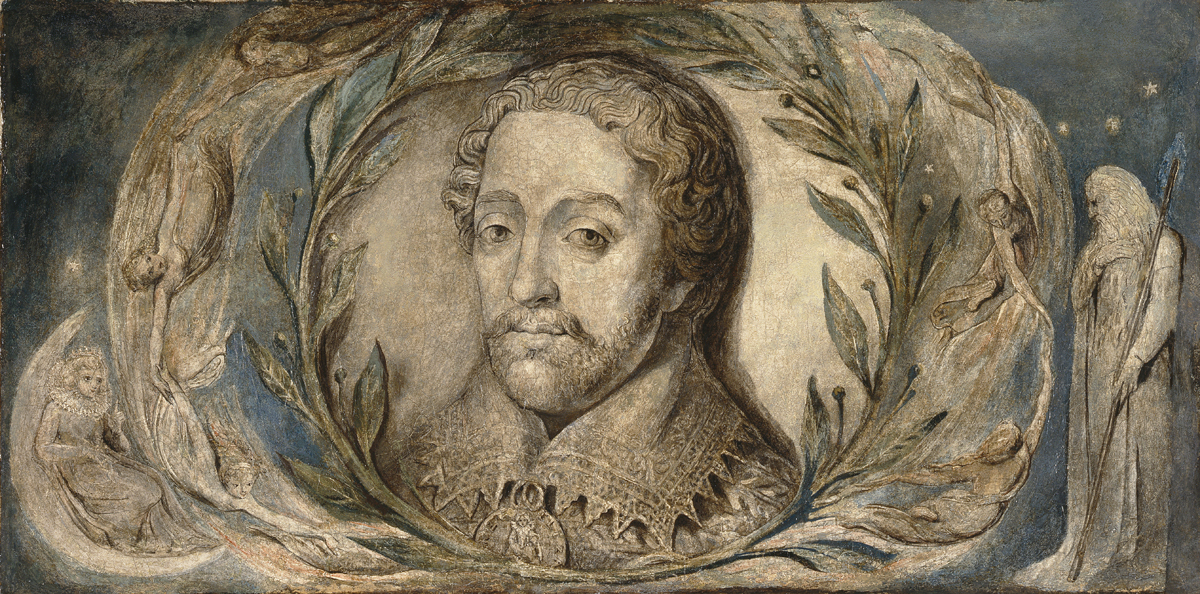
William Blake, Edmund Spenser, c. 1800
Source: Wiimedia Commons

In Book IV, Canto XI of The Faerie Queene (1596), Edmund Spenser describes the marriage of Thames and Medway.  I won't attempt to describe here how this fits into the plot, but it takes place in Proteus's house and the guests include many gods of seas and rivers.  Among these are Nile, Rhine, Ganges, Amazon and 'rich Oranochy, though but knowen late' (Spenser's friend Raleigh had explored the Orinoco a year earlier, hoping to find El Dorado).  English rivers are of course invited, but so too are the rivers of Ireland, where Spenser was living at the time.  Incidentally, there are occasional brief references to the Irish landscape in other parts of The Faerie Queene, e.g. the River Shannon (Shenan) whose battle with the ocean tide is a simile for the struggle between two knights (and perhaps the unequal struggle between Ireland and England too).  I have written here before about Spenser and Ireland and it is not really surprising that this wedding encompasses the Irish rivers, for 'why should they not likewise in loue agree'.

Thames, the bridegroom, arrives with his elderly parents Thame and Isis to the accompaniment of a harp played by Arion.  His bride arrives later with handmaids and sea nymphs.  I will quote here just one stanza, which comes as Thames processes in, dressed in a light blue robe and wearing a coronet in the shape of London.  Various tributaries to the Thames are mentioned, including the one nearest to where I live, the Lee.
And round about him many a pretty Page
Attended duly, ready to obey;
All little Rivers, which owe Vassalage
To him, as to their Lord, and Tribute pay;
The chaulky Kenet, and the Thetis grey,
The morish Cole, and the soft-sliding Brean,
The wanton Lee, that oft doth lose his way,
And the still Darent, in whose Waters clean
Ten thousand Fishes play, and deck his pleasant Stream.
I love that description of the Lee.  It would make a good quiz to match the epithet to the river in this Canto - stately Severn, storming Humber, speedy Tamar - or guess it from a brief description 'decked all with Woods / Like a Wood-God, and flowing fast to Rhy' (the River Rother).  In real life the Thames and Medway meet and merge at Rochester, where Spenser had worked as secretary to the Bishop in 1589.  A year later he mentioned in a letter a poem he was working on, now lost, called Epithalamion Thamesis, which prefigured this section of The Faerie Queene.  There was also a model for this Canto in another river-wedding poem, De Connubio Tamae et Isis, fragments of which appear in William Camden's great topographical work Britannia (1586).  In Camden, Isis is the male god, who comes from a cave in the Cotswolds to meet his bride, Tame, at Dorchester in Oxfordshire, where they retire to the nuptial chamber.  After the celebration they rise as one, Thamisis, and make their way downriver, past Windsor, Runnymede, Hampton Court and Richmond, towards the sea.   

Are there earlier examples of river-marriage poems?  In a an article on the subject ('Spenser, Camden, and the Poetic Marriages of Rivers', Studies in Philology, 1967), Jack B. Oruch notes that the Italian humanist Giovanni Pontano wrote a 'topographical pageant' into his poem Lepidina (1496), in which Sebeto, a river god, marries the patron divinity of Naples.  As for later writers, there is Michael Drayton, whose Poly-Olbion I have mentioned here before - his Fifteenth Song (1612) takes up again the theme of the marriage of Thame and Isis.  The rivers Walla and Tavy are wed in Britannia's Pastorals (1616) by a friend of Drayton's, William Browne of Tavistock.  Browne may also be the author of an anonymous poem in which the Torridge marries the Ock.  And there is a 1613 masque by Francis Beaumont in which the Thames marries the Rhine, part of the celebrations for the wedding of Princess Elizabeth (later called The Winter Queen) and Frederick V.

J. M. W. Turner, Union of the Thames and Isis ('Dorchester Mead, Oxfordshire), 1808
Source: Wiimedia Commons 

The poetic tradition seems to have faded out in the early seventeenth century.  In 1808 Turner exhibited a painting entitled the Union of the Thames and Isis, but this is not one of his mythological paintings.  Instead of Camden's magnificent bridal chamber, prepared for Tame by Grace, Concord, Hymen and the Naiads, we have a view of cows standing in brown water.  The Tate's curators describe this quiet landscape: 'The Thame, hardly more than a stream, is in the foreground while the Thames [Isis] is glimpsed beyond the wooden bridge on the right. Modest and direct, the picture also evokes the seventeenth-century painter Aelbert Cuyp in its lighting and pastoral imagery.'  Two more centuries on, it is hard to imagine a return to the extravagant topological wedding feasts of Spenser's time, though it would be fun to write one in which the river gods make small talk over glasses of fizz, watch the bride and groom trying not to giggle, sit through an inappropriate best man's speech and end up the dancing drunkenly to Abba on a slippery dance floor.

Sunday, August 28, 2011

The Valley of the Shadow of Death

Jonathan Tyers, the owner of Vauxhall Pleasure Gardens, had his own private estate at Denbies in Surrey.  There he named an 8-acre woodland 'Il Penseroso' after Milton's poem - perhaps, as Tim Richardson says in his book The Arcadian Friends, Tyers 'viewed Vauxhall Gardens as its equivalent, the more jocund L'Allegro' and the melancholy woodland as 'a kind of penance for the jolly hedonism of Vauxhall.'  In this wooded part of the garden there was a hermitage called the Temple of Death which contained, in addition to a memorial to garden designer Lord Petre, a model of a white raven and a clock that chimed every minute, to remind visitors of the transience of life.  Black leather-bound copies of Edward Young's Night Thoughts and Robert Blair's The Grave were available for perusal on a table.  Beyond the hermitage was a gateway with posts made from upright coffins, 'its arch surmounted by a pair of human skulls (reputedly real - one belonging to a highwayman, the other a prostitute's)'.  This was the entrance to the Valley of the Shadow of Death.  Here the two artists Tyers had previously employed at Vauxhall were asked to decorate the interior of a temple.  Either side of an allegorical statue by Louis-François Roubiliac were paintings by Francis Hayman: The Death of a Christian (peaceful and accompanied by an angel) and The Death of an Unbeliever (about to be speared by a leering skeleton).  Richardson concludes that 'any visitors who arrived thinking they might have an amusing time with the happy-go-lucky proprietor of Vauxhall Gardens were in for a disappointment.'

William Blake, illustration intended for the 1805
publication of Blair's poem 'The Grave'

Sunday, May 27, 2007

Landscape near Felpham

I have already mentioned here the exhibition in Chichester, ‘Poets in the Landscape’, and I have now been to see it. It is like three little exhibitions in one.

The first room focuses on the local poet William Hayley (1745-1820) who was a friend of artists such as Blake, Romney and Joseph Wright of Derby. Hayley is not well known now and the catalogue quotes a letter from Southey to Coleridge in 1802 – ‘everything about that man is good, except his poetry.’ He does however provide an interesting figure from which to view the links between poetry and painting at the end of the eighteenth century. The highlight in this room is an unusual watercolour by Blake that I don’t recall seeing before (although it is in the Tate) – a pale, unfinished sketch with a hint of Turner about it: Landscape near Felpham (c1800).

The second room is a fascinating display of engravings and etchings, encompassing the familiar pastoral poetry of Blake, Palmer and the Ancients, and their followers in the 1920s: Goldsmiths students Graham Sutherland, Robin Tanner, Paul Drury, their teacher F.L. Griggs, and contemporary Joseph Webb. Sutherland saw his first Palmer etching when a fellow student bought one in a shop on the Charing Cross Road (those were the days!) He, Tanner and Drury made a pilgrimage to Shoreham and ‘even wore cloaks in imitation of the Ancients’.

The third room includes Neo-Romantic artists like Sutherland, John Piper and Paul Nash, with particular reference again to their links with poetry, through book illustration and work for Horizon, Penguin New Writing and Poetry London. There is Geoffrey Grigson’s The Poet’s Eye, for example, with illustrations by John Craxton: the first in a series of seven anthologies, New Excursions into English Poetry, whose general editors were Sheila Shannon and Walter James Turner. Other volumes included English, Scottish and Welsh Landscape, illustrated by Piper with verse chosen by John Betjeman and Geoffrey Taylor, and Sea Poems chosen by Myfanwy Piper and illustrated by Mona Moore. Walter James Turner was the general editor of Britain in Pictures, a series covering various aspects of Britishness, including Romanticism: John Piper’s British Romantic Art traced the tradition from Wilson, Blake and Constable through to Nash and Sutherland. Other volumes included Grigson’s English Landscape, Betjeman’s English Churches, Vita Sackville-West’s English Country houses, Lord David Cecil’s English Poets and Stephen Bone’s British Weather.

Saturday, April 07, 2007

Visions of little dells

In The Guardian today Andrew Motion writes about the exhibition ‘Poets in the Landscape: The Romantic Spirit in British Art’, at Pallant House Gallery, Chichester. In discussing William Blake’s illustrations to Virgil’s Eclogues, he cites a beautiful description by Samuel Palmer, who saw the woodcuts as "visions of little dells, and nooks, and corners of Paradise; models of the exquisitest pitch of intense poetry. I thought of their light and shade, and looking upon them I find no word to describe it. Intense depth, solemnity, and vivid brilliancy only coldly and partially describes them. There is in all such a mystic and dreamy glimmer as penetrates and kindles the innermost soul, and gives a complete and unreserved delight, unlike the gaudy daylight of this world."

However, Andrew Motion wants to emphasise the darkness lurking in these pastoral visions, many of which were made in time of war and political uncertainty. They are ‘not so much escapist as defended’, a ‘form of opposition to the threats that circle them’. He cites, for example, John Piper’s set designs for the ballet Job (1948), which on the surface seem to be simple pastoral landscapes, but in which he sees ‘an optimism that is too determined to be entirely convincing.’ These set designs are, incidentally, a nice example of the interconnectedness of the English Romantic landscape traditions. The ballet is based on Blake’s illustrations to the Book of Job and composed by Ralph Vaughan Williams, following a proposal by Geoffrey Keynes (essayist and brother of the economist) and wood engraver Gwen Raverat (who was related to both Keynes and Vaughan Williams, and whose prints, including various landscapes, can be seen on-line here).