Friday, May 02, 2008

One particular spot in the King's-field


Gilbert White was intrigued by echoes and in A Natural History of Selborne considered the means whereby 'any gentleman of fortune' could create the conditions for listening to echoes in his park by erecting an appropriate structure 'on the gentle declivity of an hill, with a like rising opposite to it... From a seat at the centrum phonicum he and his friends might amuse themselves sometimes of an evening with the prattle of this loquacious nymph.' The text here is from Letter XXXVIII, February 12th, 1778 (the Latin at the end means ‘answering echo, who has yet to learn / To keep her peace when spoken to, or speak the first in turn’):
In a district so diversified as this, so full of hollow vales, and hanging woods, it is no wonder that echoes should abound. Many we have discovered that return the cry of a pack of dogs, the notes of a hunting-horn, a tunable ring of bells, or the melody of birds, very agreeably: but we were still at a loss for a polysyllabical, articulate echo, till a young gentleman, who had parted from his company in a summer evening walk, and was calling after them, stumbled upon a very curious one in a spot where it might least be expected. At first he was much surprised, and could not be persuaded but that he was mocked by some boy; but, repeating his trials in several languages, and finding his respondent to be a very adroit polyglot, he then discerned the deception [...]
All echoes have some one place to which they are returned stronger and more distinct than to any other; and that is always the place that lies at right angles with the object of repercussion, and is not too near, nor too far off. Buildings, or naked rocks, re-echo much more articulately than hanging wood or vales; because in the latter the voice is as it were entangled, and embarrassed in the covert, and weakened in the rebound.
The true object of this echo, as we found by various experiments, is the stone-built, tiled hop-kiln in Galleylane, which measures in front 40 feet, and from the ground to the eaves 12 feet. The true centrum phonicum, or just distance, is one particular spot in the King's-field, in the path to Nore-hill, on the very brink of the steep balk above the hollow cart way. In this case there is no choice of distance; but the path, by mere contingency, happens to be the lucky, the identical spot [....]
Should any gentleman of fortune think an echo in his park or outlet a pleasing incident, he might build one at little or no expense. For whenever he had occasion for a new barn, stable, dog-kennel, or the like structure, it would be only needful to erect this building on the gentle declivity of an hill, with a like rising opposite to it, at a few hundred yards distance; and perhaps success might be the easier ensured could some canal, lake, or stream, intervene. From a seat at the centrum phonicum he and his friends might amuse themselves sometimes of an evening with the prattle of this loquacious nymph; of whose complacency and decent reserve more may be said than can with truth of every individual of her sex; since she is
… quae nec reticere loquenti, Nec prior ipsa loqui didicit resonabilis echo.

Saturday, April 26, 2008

Greta Bridge

John Sell Cotman, Greta Bridge c1805

In 1980 Phaidon published a Companion to Art and Artists in the British Isles which divides the country into regions and discusses the places with which artists have been associated. I’ve used it here to consider the connections between art and landscape in one of the books’ nine regions, the North.
  • Many northern artists left to work in London and elsewhere, but there are artists born in the region of who seem to have been strongly influenced by the local landscape. There was John Martin, for example, for whom ‘the wild scenery around Haydon Bridge, especially Allendale Gorge, had undoubtedly helped foster his lifelong fascination for the terrifying and the spectacular.’ Henry Moore and Barbara Hepworth were born in Castleford and Wakefield respectively – Moore later recalled the influence of a sculptural rocky outcrop called Adel Crag. The urban landscape also influenced artists, like Vorticist Edward Wadsworth, whom Wyndham Lewis described as a genius of industrial England just as much as John Crome was a genius of agricultural England. In its caption for View of a Town (c1918) the Tate says that Wadsworth ‘took Wyndham Lewis on a tour of some of Yorkshire’s cities including Halifax. Lewis recalled, ‘He stopped the car and we gazed down into its blackened labyrinth. I could see he was proud of it. “It’s like Hell, isn’t it?” he said enthusiastically’
  • Other artists stayed in the North and became associated with particular landscapes, the most famous I suppose being L.S. Lowry in Manchester. Lowry was taught by the Frenchman Auguste Valette whose ‘impressionistic canvases show loney, stylized figures set against a foggy gloom.’ Other notable local painters include Atkinson Grimshaw, who lived in Leeds all his life and specialised in moonlit scenes, the Liverpool pre-Raphaelites William J. J. C. Bond and William Davis, who painted Wirral landscapes, and Ethel Walker, based at Robin Hood’s Bay in North Yorkshire. But one of the most interesting is one of the first English landscape painters, Francis Place, who lived mostly in York. As the Tate site says, Place ‘made various sketching tours of the north of England. He often travelled on foot, and worked outdoors on the spot... Such activity was so unusual at the time that he was arrested as a spy, suspected of involved in a Catholic plot.’
  • Then there are artists who came to live in the north, like landscape painter Julius Caesar Ibbotson, who moved to Masham in Yorkshire in 1805, near the home of his patron William Danby. John Ruskin first visited the Lakes at the age of five and eventually moved north to live in Coniston Water in 1871. Another more surprising resident of Cumbria was Dadaist Kurt Schwitters who painted some local scenes to make money while working on his Merzbarn. The best known artists’ colony in the region was at Staithes, a fishing village ‘discovered’ in the 1880s by Gilbert Foster.
  • The Companion’s authors Michael Jacobs and Malcolm Warner note with some surprise that the Romantic landscape painters were more attracted to the Yorkshire landscape than the Lake District. Thomas Girtin, for example, was one of many to depict Kirstall Abbey, Turner used to stay at Farnley with his patron Walter Ramsden Hawkes, and James Ward painted the famous view of Gordale Scar now in the Tate. Another visitor to Yorshire was John Sell Cotman, who stayed at Rokeby Hall in 1805 (in 1814 the owner of this Palladian manor, classical scholar John Morritt, would purchase a Velazquez painting that’s now known as The Rokeby Venus). Here Cotman discovered the landscape around Greta Bridge and painted some of the most celebrated watercolours in the history of art.
  • Finally, there is the modern trend for sculpture parks and site-specific works. The Companion mentions David Nash’s carvings and constructions along the Silurian Way in Grizedale Forest. However, the Yorkshire Sculpture Park had only just been set up when the book was written and the Angel of the North wasn’t even a gleam in Antony Gormley’s eye...
James Ward, Gordale Scar (A View of Gordale, in the Manor of East Malham in Craven, Yorkshire, the Property of Lord Ribblesdale) c1812-14
The Tate exhibition A Picture of Britain had a similar aim to the Companion and it included a section on ‘The Romantic North’ which features some of the same artists.
I was wondering what a 2008 edition of the Companion would need to include. Not just landscape art of course – it would have to feature art about the people and history of the north, like Jeremy Deller’s The Battle of Orgreave. But in terms of landscape, the safest bet would be Andy Goldsworthy, surely the best-known northern artist working in the diffuse modern field of 'land art'. Photographers like Fay Godwin and John Davies spring to mind too, but it occurred to me that there were hardly any photographs in the original Companion (no Roger Fenton, for example, whose image of Furness Abbey I have mentioned here). Photography now seems inseperable from art, but perhaps this was still not quite the case when the Companion was compiled.

Friday, April 25, 2008

The Three Philosophers

The life and writings of Denis Cosgrove (1948-2008) are celebrated in some recent obituaries: The Telegraph, The Times and David Lowenthal’s in The Independent. Lowenthal was Cosgrove’s external thesis examiner back in 1976 and “had the privilege of upgrading this remarkable synthesis of architectural enterprise, land management and regional history from a BLitt to a PhD. He refined and amplified it in The Palladian Landscape: geographical change and its cultural representations in sixteenth-century Italy (1993).” The Times obit says: “If today it is much more common to find questions of geography - place, landscape, experience and imagination - treated within the arts and humanities, it needs to be recalled just how exotic this appeared in the academic world of the 1970s, when it was geography's utilitarian promise as a tool of planning or development that held sway. One of Cosgrove's principal achievements as a scholar was to provide a coherent rationale for geography as a humanities discipline, concerned as much with the emotional texture of places as with their spatial structure, with the worlds of the imagination as well as lived experience.”

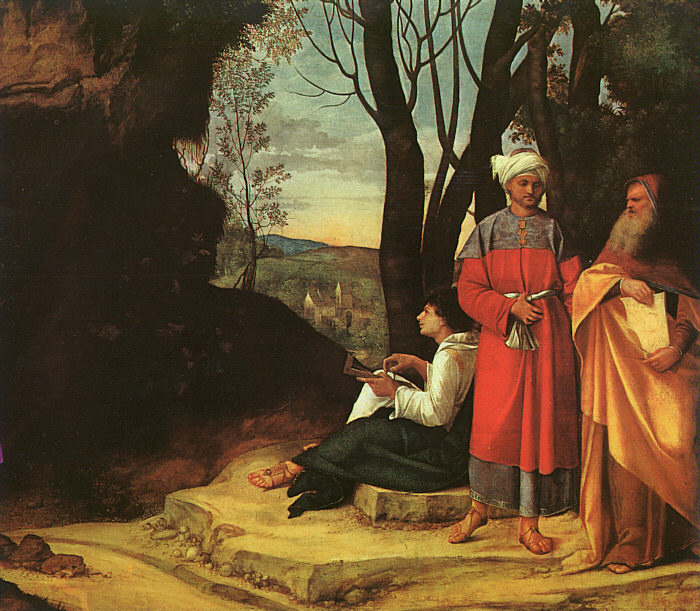
Giorgione, The Three Philosophers, c1500
Source: CFGA

I see I referred to one of Cosgrove’s essays in an earlier post in the context of mapping and landscape art. The full title of the essay I quoted is ‘The geometry of landscape: practical and speculative arts in sixteenth-century Venetian land territories.’ His starting point is classic human geography: the fortification, irrigation, and agricultural development of Venice’s terraferma. He then describes the importance of practical geometry in surveying and mapping this territory. It is possible to link this with the Venetian vision of landscape, in the art of Bellini, Giorgione and Titian, in the architecture of Palladio, and in the pastoral poetry of Bembo and Tasso. However, to provide a fuller connection, Cosgrove goes further and describes the concurrent interest in ‘speculative geometry’, which along with number theory underlay the esoteric culture, mystic symbolism and cosmology popular with Venetian humanists. It was therefore the combination of ‘practical chorography and a speculative philosophy’ which influenced the iconography of landscape in Venice and its territories. Cosgrove ends the essay by describing Giorgione’s The Three Philosophers, which seems to portray the different seasons in one landscape, along with the setting sun, magi and a quadrant, ‘the archetypal geometrical instrument.’ It combines the obscure intellectual poetry of Venetian culture with ‘the practical world of survey and mapping then spreading a new rational order across the fields of the terraferma.’ Denis Cosgrove’s work similarly bridged ideas of landscape as art and landscape as terrain, an approach that has created such a fruitful field of enquiry in cultural geography.

Sunday, April 20, 2008

The lost gardens of Richmond Palace


Those detailed scenes visible through a window behind the sitter in Renaissance portraits often seem like glimpses of lost landscapes. Here is a specific example, from the portrait of Henry Prince of Wales (1594-1612) by Robert Peake. The youthful heir to James I was a patron of the arts who sought to create a spectacular garden at Richmond.


In the words of James Maxwell:
To plant and build he had a great delight,
Old ruins his sole presence did repair;
Orchards and gardens forthwith at his sight
Began to sprout and spring, to flourish fair...
However, almost before these gardens had had a chance to flourish, Henry died, and work on it was halted.

Roy Strong, in The Renaissance Garden in England, discusses the evidence we have on the appearance of these lost gardens, which ‘must have constituted a remarkable spectacle, conceived as they seem to have been on a vast scale.’ The Works Accounts refer to the creation of three artificial islands, one of which may be discernable in the garden vista within Peake’s portrait of Henry. It is possible that one of the islands was created in the shape of a vast river god, modelled on Giambologna’s giant at Pratolino. A contemporary described the erection of a ‘great figure... three times as large as the one at Pratolino, with rooms inside, a dove-cot in the head and grottoes in the base.’ Salomon de Caus, the chief designer at Richmond, included a couple of illustrations of giants in his Les raisons des forces mouvantes (1615). The one here has an old bearded head like the giant of Giambologna and a rugged but strangely feminine body.


Like the vague and tantalising view in the portrait of Henry, there may be echoes and memories of the lost gardens at Richmond in the literature of the time. Roy Strong wonders whether Inigo Jones’ scenery for Ben Jonson’s Pleasure Reconciled to Virtue recalls an island giant: ‘The scene was the mountain Atlas, who had his top ending in the figure of an old man, his head and beard all hoary and frost as if his shoulders were covered with snow; the rest wood and rock.’ And then there is The Tempest, where we seem ‘to be wondering through a garden by de Caus where we are suddenly confronted by dreamlike monsters, or entering a wild grotto to be struck suddenly, at the turn of a stopcock, with surprise and wonder at moving statues and magical music, as gods and goddesses spring to life and enact an intermezzo.’

Friday, April 18, 2008

The sea's waves' sheaves

Ian Hamilton Finlay, Sheaves, 1970

Now showing at the V&A in London - Certain Trees: The Constructed Book, Poem and Object (an exhibition I discussed last year after it had been in Paris), which features artists engaged in a 'dialogue between the natural world and its classification and presentation through the idiom of language'. The approach is illustrated here by Ian Hamilton Finlay's poem-book, 'the SEA'S WAVES' SHEAVES' shown above, a 'small folder with 3 leaf concertina-folded card', published by the artist's Wild Hawthorn Press. Works like this and the kinetic poem below are easy to imagine in an exhibition entitled 'Certain Landscapes'. Some other Ian Hamilton Finlay pieces in Certain Trees are 'Stonechats', 'Wave', 'A Woodland Flute', 'A Butterfly Garden', 'Two Trees', 'Wildflower' and 'Landscape / Interior'.


Ian Hamilton Finlay, Canal Stripe Series 4, 1964

Writing in The Independent, Tom Lubbock has praised Certain Trees, contrasting it with the often 'vain and thoughtless' approach of the famous artists gathered together in the V&A's concurrent exhibition Blood on Paper – The Art of the Book. He writes that the Certain Trees artists 'never forget where books come from: there's natural gravitation toward the subject of wood and trees. The artists dwell wittily on their materials – on letters, typefaces, inks, paper, printing, the way books work. Steve Wheatley's Over the Hills and Far Away is a book whose leaves are cut in the shapes of dipping hills; overlapped, they become a receding valley. Thomas Clark prints the words "small grey bird of dusk" in deep blue letters, but the vowels are printed in grey, like birds in an evening sky. The five vowels, you notice, run a e i o u ... Stuart Mills' booklet The Bridle Path is Filled with Clouds has a photo of puddles, brimming with reflections. The page opens and reveals. There's a knack for making imaginative leaps from the physical world of the book to the larger universe.'


Stuart Mills, Three Swallows in the River Meadows, 1969

Thanks to Colin Sackett, whose books/poems/artworks feature in the exhibition, for alerting me to the arrival of Certain Trees at the V&A and pointing me to the Tom Lubbock article.

Thursday, April 10, 2008

The stones and shadows sigh breaths of amorous fire

The Met has an exhibition at the moment called ‘Poussin and Nature: Arcadian Visions’. The excellent Ionarts blog has an article on it with links to other reviews. I learned from this that Poussin's Landscape with Three Monks (La Solitude) is showing 'outside Serbia for the first time since 1934. One of the curators of the exhibit claims to have seen it hanging in Tito's office'.

There is an interesting description of Poussin’s sensual style of landscape painting in a review by Andrew Butterfield. Poussin originally moved to Rome after the Italian poet Giambattista Marino, based in Paris at the court of Marie de Medici, recognised and encouraged his talent. In Poussin’s paintings in this early period, where the figures still dominate the composition, ‘landscape elements seem to smolder with intense ardor. He achieved this effect by applying the upper layers of paint in relatively thin and rough brush strokes that allowed the red-brown ground layer of paint to show through, giving the entire image a warm and sensual glow. In European poetry the tradition of describing nature with amorous metaphors was an ancient one going back all the way to the Homeric hymns.... Poussin was extremely familiar with this tradition thanks to his friendship with Marino, whose poem L'Adone is a rich repository of the same vein of imagery. The artist read the book with the author, even making illustrations of it at his request, and Marino and Poussin also discussed how to translate the power of poetic language into the visual forms of painting. In L'Adone Marino wrote descriptive passages such as "Even the stones and the shadows of the place/sigh breaths of amorous fire." In his early mythic landscapes Poussin sought to capture the same sense of pathos and inspiration as is conveyed by lush and elevated writing of this kind.’

Nicolas Poussin, Nymph Spied on by Satyrs, c 1627
Source: Wikimedia Commons

Wednesday, April 09, 2008

Eden

So on he fares, and to the border comes
Of Eden, where delicious Paradise,
Now nearer, Crowns with her enclosure green,
As with a rural mound the champain head
Of a steep wilderness, whose hairie sides
With thicket overgrown, grottesque and wilde,
Access deni'd; and over head up grew
Insuperable highth of loftiest shade,
Cedar, and Pine, and Firr, and branching Palm
A Silvan Scene, and as the ranks ascend
Shade above shade, a woodie Theatre
Of stateliest view. Yet higher then thir tops
The verdurous wall of paradise up sprung:
Which to our general Sire gave prospect large
Into his neather Empire neighbouring round.
And higher then that Wall a circling row
Of goodliest Trees loaden with fairest Fruit,
Blossoms and Fruits at once of golden hue
Appeerd, with gay enameld colours mixt:
On which the Sun more glad impress'd his beams
Then in fair Evening Cloud, or humid Bow,
When God hath showrd the earth; so lovely seemd
That Lantskip...

Thus, in Paradise Lost Book 4, Satan arrives in Eden. I was going to talk about the rather Milton-like artist Nicolas Poussin today, but the comment left by Arcady on my earlier posting about Milton made me want instead to quote some landscape description from this great poem. In his book The Figure in the Landscape, John Dixon Hunt talks about the influence Milton’s portrayal of Eden had on eighteenth century gardeners and champions of natural landscaping like Stephen Switzer. From it, they ‘derived authority for serpentine lines, natural treatment of water, rural mounds, wooded theatres...’ In the passage below, for instance, it is Nature rather than ‘nice Art’ that orders the flowers. A ‘happy rural seat of various view’ would thus exhibit what Shaftsbury would later call ‘things of a natural kind; where Art, nor the Conceit or Caprice of Man has spoil’d their genuine order.’

Southward through Eden went a River large,
Nor chang'd his course, but through the shaggie hill
Pass'd underneath ingulft, for God had thrown
That Mountain as his Garden mould high rais'd
Upon the rapid current, which through veins
Of porous Earth with kindly thirst up drawn,
Rose a fresh Fountain, and with many a rill
Waterd the Garden; thence united fell
Down the steep glade, and met the neather Flood,
Which from his darksom passage now appeers,
And now divided into four main Streams,
Runs divers, wandring many a famous Realme
And Country whereof here needs no account,
But rather to tell how, if Art could tell,
How from that Saphire Fount the crisped Brooks,
Rowling on Orient Pearl and sands of Gold,
With mazie error under pendant shades
Ran Nectar, visiting each plant, and fed
Flours worthy of Paradise which not nice Art
In Beds and curious Knots, but Nature boon
Powrd forth profuse on Hill and Dale and Plaine,
Both where the morning Sun first warmly smote
The open field, and where the unpierc't shade
Imbround the noontide Bowrs: Thus was this place,
A happy rural seat of various view...

Friday, April 04, 2008

River Snow

There is a good account of landscaping, written 1200 years ago, in one of Liu Zong-yuan's 'Eight Accounts of Yong-zhou' (see Stephen Owen's Anthology of Chinese Literature). Liu Zong-yuan went exploring with two companions and found a beautiful spot near Gu-mu pond. Above a fish-weir, they saw a hill covered with trees and bamboo, and littered with a landscape of rocks that resembled strange animals. The whole site covered no more than an acre and, to his joy, Liu Zong-yuan found that it was available for purchase. Having bought it, the three companions 'went to get tools, scything away the undesirable plants and cutting down the bad trees, which we set fire to and burned. Then the fine trees stood out, the lovely bamboo were exposed, and the unusual rocks were revealed. When we gazed out from upon it, the heights of the mountains, the drifting of clouds, the currents of streams, and the cavorting of birds and beasts all cheerfully demonstrated their art and skill in performance for us below the hill. When we spread out our mats and lay down there, the clear and sharply defined shapes were in rapport with our eyes; the sounds of babbling waters were in rapport with our ears; all those things that went on forever in emptiness were in rapport with our spirits; and what was as deep and still as an abyss was in rapport with our hearts.'

Liu Zong-yuan goes on to reflect that were this splendid scenery situated within easy reach of the nobility, they would be fighting each other to buy it. Here in out-of-the-way Yong-zhou it's capability, as Lancelot Brown would have put it, went unnoticed until he came along.

This Chinese site has a bit of information on Liu Zong-yuan in slightly eccentric English, describing him as having "been stern in a manner of aloofness and arrogance though he was sad and depressed all his life. In his poem "River Snow", he drew a self-portrait by describing a lonely fisherman fishing in snow." There is a nice translation here of 'River Snow', which 'has been the subject of numerous landscape paintings. It is a terrifically imagist poem; the twenty characters of the poem create a whole landscape, sketch an intimate scene, and suggest a chill ineffable solitude. There is also a Buddhist element to the poem, and Liu Zongyuan's old man becomes like Wallace Stevens's “Snow Man,” with a “mind of winter”.

15th century landscape by Zhou Wenjing, 
featuring part of Liu Zongyuan's poem 'Winter Snow' in the upper right corner

Wednesday, April 02, 2008

The Heart of Old San Juan

As mentioned in an earlier posting, the Tate have a major Peter Doig retrospective at the moment. When I looked round last week I was interested to see some of the more recent paintings, having been to an earlier show at the Whitechapel in 1998. The Whitechapel exhibition leaflet, shown here, starts predictably by explaining that Doig is like Friedrich and Turner, but also not like them - it compares his attitude to nature and artifice with contemporaries Jeff Wall and Lari Pittman. Gerhard Richter is also referenced, along with Munch, Hopper and Magritte. Despite all these correspondences, it's impressive that Doig's art of the nineties remains so distinctive. All his work is interesting, although the exhibition at Tate Britain gives the impression of a fairly intense five-year burst of creativity at the start of the decade, encompassing landscapes inspired by, for example, the film Friday the 13th, Le Corbusier's Unité d'Habitation apartment, various Canadian winter scenes and an empty field at night.
The Tate leaflet here shows a detail of Country Rock (1998-99), with the painted archway under the Don Valley Parkway in Toronto, which it describes as a nondescript 'in-between' space. It quotes Doig: "A lot of my work deals with peripheral or marginal sites, places where the urban world meets the natural world. Where the urban elements become - literally - abstract devices." A similar kind of painting from the same time shows an empty basketball court, The Heart of Old San Juan (1999). However, these relatively people-free human landscapes have been replaced in Doig's more recent paintings with scenes that include figures derived from found postcards, snapshots or earlier art. Somehow, these simpler, more figurative paintings seem even more mysterious than his landscapes. As Adrian Searle has written "genuine disquiet pervades Doig's newest work. The man climbing a palm in one appears oblivious to the shadowy forms in the sky filling the rest of the canvas. The stories are dissolving, leaving only emptiness and murmurs."

Friday, March 28, 2008

Carnac

When I was at university I tried to model mathematically the spacing of the prehistoric menhirs at Carnac in Brittany and started to become interested in stories about this ancient landscape. Regrettably at that point I had never come across Guillevic’s Carnac (1961), a book now available in the excellent Bloodaxe Contemporary French Poets series. Guillevic (he dropped his first name) is one of those poets who seems to fit his environment – rugged, tough, paired down to the essentials. He grew up in a traditional and highly religious Breton speaking community but never learned the language. Guillevic went on to work at a tax office and write deceptively simple French poems about Choses (things). Carnac was composed after he left work at the age of 52, and it represented a return to the landscape of his childhood. He said that in it "I found myself completely, I found my country again, the land, the sea, I relived what I had been before."

Carnac throws up some fundamental questions on the relationship between an artist and the landscape. On this site, I’ve written about artistic responses to views, spaces and places rather than specific objects: a crab, say, or a lichen covered rock, or an old boat. In a review of Carnac, James Sallis writes that ‘traditionally the poet comes to the landscape to divest himself of naming, of differentiation, of all that prevents him from speaking generally. Incorporating, suggesting, the landscape offers escape from particularity.’ Guillevic is able to talk of the sea, the sun and the sand without describing them - there are only a couple of points where he deliberately moves into details (a list of the smells of Carnac for example: warmed stone, saxifrage, tar, slurry, dried seaweed...) Furthermore, Sallis continues, the poet in a landscape, not only seeks ‘relief from naming, from knowing, he comes seeking also a paradoxical relief from self. In classic nature poetry, the landscape actually becomes an extension of self, body and world synonymous. But it is into the very gap between the two, into that divide, that Guillevic writes Carnac.’

When Guillevic looks at the sea, he wants to give it human attributes, ‘alternately maternal and monstrous’, as Stephen Romer puts it in his introduction to Carnac. But the poet recognizes that the sea is ultimately ‘the Absent, the Other, the Unknowable... Even worse: it is indifferent.’ No matter how we study a landscape or try to convey it in art, it remains fundamentally outside our comprehension. The sea provides a particularly compelling example of nature's alterity since it so easily resists interpretation and constantly changes. At one point in Carnac, Guillevic tracks the sea back to some salt marshes where he is able to ‘possess’ it, but only in the form of mounds of salt. Guillevic writes of both wanting to be the ocean and remain himself: he needs to preserve some distance in order to speak about his subject and avoid dissolving into formlessness (as in the Whistler sea painting I discussed here recently).

And what of Carnac’s megalithic stones? Although they are part of the same elemental landscape as the sea, the menhirs embody human activity and meaning (perhaps partly in any significance attaching to the stones’ placement that I once tried to investigate.) As Romer says, ‘they stand then, both in obeisance to, as well as in defiance against, the ocean, and as such reflect the poet’s own divided allegiances.’ Inevitably perhaps, Guillevic’s poems have themselves been compared to menhirs. For Denise Levertov, one of several eminent poets who have translated Guillevic into English, they are like ‘a gathering of sacred stones.'

Sunday, March 23, 2008

Man Ray 1914

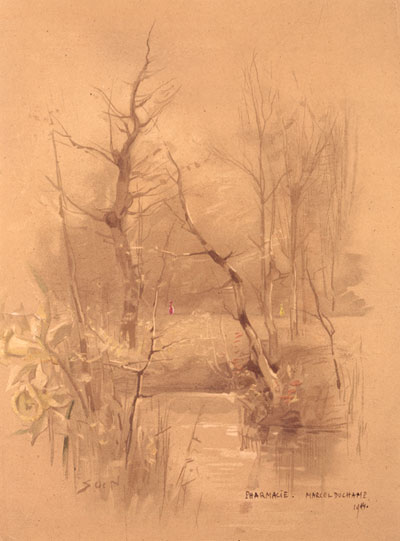
I’ve talked before about some of the ways twentieth century artists turned away from landscape. It is telling, for example, that Marcel Duchamp chose a clichéd landscape image to transform into a readymade artwork, Pharmacy (1914), through the addition of a couple of dabs of paint and a signature. Walking round the superb ‘Duchamp, Man Ray, Picabia’ exhibition at Tate Modern yesterday I read on the wall that Duchamp’s Glider, part of his Bachelor machine, is ‘activated by a waterfall (which Duchamp did not represent as he wanted to avoid the trap of becoming a landscape painter).’ The case of Man Ray is also interesting. The Tate curators say ‘Even before he met Duchamp or Picabia he was playing with the conventional elements of art works: Man Ray 1914 is both a landscape and the artist’s signature.’ This small painting looks at first glance like a cubist landscape, influenced by, say, Cézanne or Braque, but once you read the artist’s name it becomes hard to see it as anything other than a reduction of the modern artwork to its one essential component, the signature. There is a clear affinity with Duchamp's Pharmacy, which was made in the same year.

An interesting article by Edward Leffingwell sets Man Ray 1914 in context. Man Ray had been producing landscapes in New Jersey in 1913: ‘two landscapes from that first winter are distinguished by a tentative, exploratory use of unprimed canvas serving to represent bare fields... With the change of seasons, Man Ray began to produce vibrant landscapes in watercolor and oil that again bring to mind the precedent of Cezanne... The oils Ridgefield Landscape and the more abstracted Ridgefield (both 1913) incorporate receding bands of rolling hills extending to the ridge beyond. The first is largely pastoral, with a repoussoir motif of trees and two farm houses in the foreground and a freight train in the middle distance; the other establishes elongated factory sheds in the foreground and repeats that form in the bands of hills and fields beyond.’ Man Ray subsequently ‘produced a series of watercolors and oils of the Ramapo Hills, in which abstracted arrangements of trees and hills become increasingly Cubistic and also increasingly expressive. In the decorative Elderflowers (1914), relatively large at 30 inches square, he produces an allover field, abstracting the white, saucerlike clusters of blossoms on a dense, crosshatched thicket of leaves. Reduced and compressed to the status of an icon, Man Ray 1914 consists entirely of the date and artist's name, piled up like palisades across the surface of the diminutive oil.’

Thursday, March 20, 2008

Spiral Jetty under threat

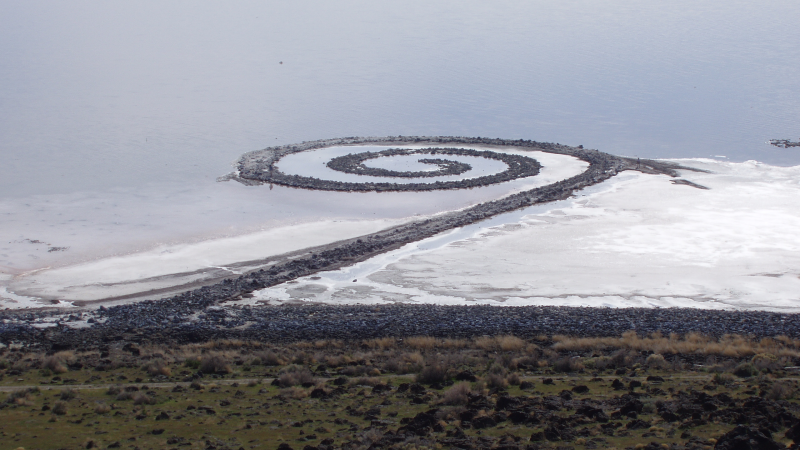
I feel a bit bad for not writing before now about the threat to Robert Smithson's Spiral Jetty. As the New York Times put it, 'a Canadian company’s plan to begin oil-drilling from a pair of barges near Rozel Point, on the edge of the lake... is not much different from drilling through the heart of Smithson’s earth sculpture.' DIA Foundation Director Jeffrey Weiss has said 'The expansive natural setting is integral to Smithson's artwork, providing an essential frame for experiencing the Spiral Jetty. Any incursion on the open landscape, including the proposed drilling, would significantly compromise this important work of art.'

The public comment period for the drilling application ended on February 13, so I guess we're now just waiting for the verdict. Living in a country where public sculpture is all the rage it seems improbable that the State of Utah would let this happen, but who knows? I was wondering where the best place is to keep up to date on this story. The DIA foundation site for Spiral Jetty says they'll post news. There's also a French site which is posting regular reports.

Source: Wikimedia Commons

Postscript September 2015:  Utah officials received over 3,000 emails relating to the drilling and on August 7 2008 state officials rejected it. Of course the threat of future drilling remains and then there are the ongoing debates about maintaining the site and what the artists' intentions would have been.  Here are the opening paragraphs from a piece in the Art Newspaper yesterday.
The Great Salt Lake in Utah, home to Robert Smithson’s Spiral Jetty, is facing the most severe drought in its history. Water levels are “inches” fr om the historic low set in 1963, says Bonnie Baxter, the director of the Great Salt Lake Institute. As a result, the pink salt-encrusted basalt rocks of Spiral Jetty are perhaps the most exposed they have ever has been—the 1,500ft-long work was constructed in 1970 during a drought and subsequently submerged for more than three decades before re-emerging in 2004.

However, the consensus among the three organisations that look after the work (the Dia Art Foundation in New York, the Great Salt Lake Institute and the Utah Museum of Fine Arts) is that there is no need to take direct action to protect the work. “The current thinking by most is that Robert Smithson would have loved to see the environmental changes that occur around his artwork, so there is no real talk of intervention,” Baxter says. 

Wednesday, March 19, 2008

Landscape Architecture of the Great Painters of Italy


Gilbert Meason was the first writer to use the term ‘landscape architecture’, in the title of his book The Landscape Architecture of the Great Painters of Italy (1828). It says here he ‘died without the faintest idea that his concept of 'landscape architecture' was destined for a worldwide future. Few copies of the book were printed but one of them fell into the hands of John Claudius Loudon, the most prolific garden author of any age. Loudon took up the term and passed it to Andrew Jackson Downing, who passed it to Frederick Law Olmsted...’ And the rest is history.

Apparently, few copies of Meason’s book were produced in 1828 and I don’t think it’s been reprinted. However, the British Library has a copy of the original which you can flick through in their rare books room. Its frontispiece, the first of many lithographs in the book by H W Burgess, is based on a Dominichino painting. The book then opens with a quotation from Reynolds' Discourses which urges architects to aim for ‘variety and intricacy’, an approach consistent with Meason’s picturesque ideal. The text that follows discusses various types of building, in chapters on: The Rise of Domestic Architecture, Defensive Architecture, Roman Villas, Masonry of Roman Architecture, Architecture of the Middle Ages, Domestic Architecture of England, Architecture of the Italian Painters, Tuscan Architecture and Gothic Architecture. At the back are the illustrations accompanied with brief descriptions - Burgess’s depictions of buildings that appear in the drawings and paintings of artists such as Raphael, Leonardo, Andrea Mantegna, Sermonita, Claude, Palma Vecchio, Guercino and Lavinia Fontana.

Meason explains that ‘in selecting examples of landscape architecture from the pictures of Italy, we have avoided those in the foreground or in street architecture, as well as those, (such as in Claude,) which had so much Grecian or Roman ruins attached to them as gave the air of composition architecture of the artist.’ So, interestingly, he was tending to choose buildings that were quite incidental to the main theme of the painting. Meason found that these tended to display a mixture of architectural styles, partly based on real buildings sketched by the artists. He quotes Richard Payne Knight: ‘the best style of architecture for irregular and picturesque houses, which can now be adopted, is that mixed style which characterizes the buildings of Claude and the Poussins…’ Here are three examples of Meason’s landscape architecture (sadly without the lithographs).
Plate 1: This is taken from Titian and shows a castle with prominent round towers. Meason says ‘Titian seldom introduced buildings of consequence in his landscapes, and to such as are given, sheds and low mean buildings are joined. This building is in a landscape of a mountainous country. It is difficult to assign any period for its construction, or for what purpose part of the building was destined.’
Plate 15: This is a tower on a rocky promontory by ‘Nicolo Poussin’. ‘This picturesque building is only a small part of that magnificent pile in the fine picture of the infant Moses exposed. The scenery and site are by our artist, for the original had none of note near the extensive buildings. It is to the architecture of this picture that Sir Uvedale Price refers [Meason’s footnote: See Essays on the Picturesque vol ii p316]. The whole is evidently a composition; and in the central tower Poussin had for his model the castle of St. Angelo in Rome.’
Plate 54: Here Meason looked back as far as Giotto for his material, but the drawing takes some poetic license – it is a dark and rather Romantic sketch of a castle-like building. ‘We give another specimen of a building of this father of the art of painting, copied from a fresco in the Campo Santo. We have here a very early example of the Tuscan window: Outward steps lead to the door from the platform; and the large windows, and of course the principal rooms, are placed high in the building. These are indications of the necessity at the period of defensible country dwellings.’
Gilbert Meason wanted to see the landscape architecture of Italian painting recreated in the British countryside. ‘In selecting specimens out of many in our possession to illustrate this work, we have in view such as may be useful to architects in the composition of irregular mansions. These may be arranged under single towers, buildings of small size but simple in their form, and large edifices, picturesque in the disposition of their parts, and those parts of such breadth as to impress, in general, grandeur on the whole composition… Such edifices spread over the country would contribute most essentially to the beauty of British landscape.’

Sunday, March 16, 2008

Russet Lawns, and Fallows Gray

Thomas Cole, L'Allegro (Italian Sunset), 1845

John Milton's poem describing 'the happy man', L'Allegro (1631), inspired various artists: Turner, Blake and Cole (above) for example. Here are some lines in which Milton himself paints a Lantskip (
in the final line, a cynosure is, according to the OED, 'something that attracts attention by its brilliancy or beauty; a centre of attraction, interest, or admiration').
Streit mine eye hath caught new pleasures
Whilst the Lantskip round it measures,
Russet Lawns, and Fallows Gray,
Where the nibling flocks do stray,
Mountains on whose barren brest
The labouring clouds do often rest:
Meadows trim with Daisies pide,
Shallow Brooks, and Rivers wide.
Towers, and Battlements it sees
Boosom'd high in tufted Trees,
Wher perhaps som beauty lies,
The Cynosure of neighbouring eyes.
In 1740 Handel premiered a composition based on Milton: L'Allegro, il Penseroso ed il Moderato. Its libretto by Charles Jennens interweaved L'Allegro with Milton's companion poem Il Penseroso ('The contemplative man') and, in the third movement, resolved their differing moods with a poem of Jennens' own, Il Moderato. Here is part of the libretto which starts with text from Il Penseroso and ends with the lines in L'Allegro just before those quoted above, describing a pleasant scene of unfeasibly cheerful pastoral characters:

16. Air

Il Penseroso (soprano):

Oft on a plat of rising ground,
I hear the far-off curfew sound,
Over some wide-water'd shore,
Swinging slow, with sullen roar;
Or if the air will not permit,
Some still removed place will fit,
Where glowing embers through the room
Teach light to counterfeit a gloom.

17. Air

Il Penseroso (soprano or tenor):

Far from all resort of mirth,
Save the cricket on the hearth,
Or the bellman's drowsy charm,
To bless the doors from nightly harm.

18. Recitative

L'Allegro (tenor):

If I give thee honour due,
Mirth, admit me of thy crew!

19. Air

L'Allegro (tenor or soprano):

Let me wander, not unseen
By hedge-row elms, on hillocks green.
There the ploughman, near at hand,
Whistles over the furrow'd land,
And the milkmaid singeth blithe,
And the mower whets his scythe,
And every shepherd tells his tale
Under the hawthorn in the dale.

Donald Teeters has written some interesting and amusing reflections on Handel's composition, Milton's poems and English plumbing: 'As anyone who has ever spent a winter in London will know, the English seem always to be surprised — offended really — that winter arrives. Their houses, even now, rely on bizarrely inadequate heating devices; the plumbing lines, often attached to the exterior of a house, are expected not to freeze, but usually do. The advertisements for L'Allegro's first performance stressed that "Care is taken to have the House secur'd against the Cold, constant Fires being order'd to be kept in the House 'till the Time of Performance."' It doesn't get this cold in London anymore but after a weekend of such miserable weather it would certainly be nice to welcome back Milton's 'frolick Wind that breathes the Spring, Zephir with Aurora playing...'

Saturday, March 08, 2008

Manhatta

I first saw Walter Ruttmann's Berlin: Symphony of a Great City (1927) at the ICA in the early nineties. They didn't have a soundtrack so we sat and watched it in silence, just listening to each other coughing or shifting position occasionally. I thought it was great, and still prefer it to Man with a Movie Camera (1929), Dziga Vertov's famous experimental film, another 'city symphony', mostly set in Odessa. Both of these were predated by Paul Strand and Charles Sheeler's six minute New York film Manhatta, made in 1920. Like Ruttmann's film of Berlin, Manhatta spans a day in the life of a city, from footage of Staten Island ferry commuters to the final scene of sun setting over the Hudson River. You can see the film at the Met website [Postscript: I am now able to embed it from Youtube.]


Other examples of city symphonies? Regen (Rain) a poetic ten minute film from 1929 directed by Joris Ivens, for which Hans Eisler later composed a soundtrack in 1941, 'Fourteen Ways to Describe Rain'. Ivens' earlier film The Bridge (1927) is similar, showing on a drawbridge in Rotterdam. Both can be seen at Ubuweb. In France there was Rien que les heures (1926), Alberto Cavalcanti's film about Paris, and Jean Vigo's A Propos de Nice (1929). Keith Beattie writes that the 'subtitle of Ruttmann's film was applied to numerous films within which practices of visual kinaesthesia constructed a 'symphony' based on the diurnal cycle of life in the modern metropolis, while simultaneously infusing avant-gardist perspectives with a historically and politically cognizant form of social criticism.' At a simple level, as Scott MacDonald has noted, the city symphonies were the flipside of contemporary documentaries like Nanook of the North which brought the exotic to cinema audiences: these films instead exoticised the familiar life of the city.

These films are obviously rich in poetic cityscapes and Charles Sheeler actually used the footage he and Strand created as inspiration for paintings. Robert Hughes in American Visions writes that 'one shot in Manhatta looked down at a train on the Church Street elevated railway sliding into view; Church Street El, 1920, takes this image, colors it and cleans it up, abstracts it, but leaves it essentially recognizable.'

Charles Sheeler, Church Street El, 1920

Friday, February 29, 2008

At Maple Bridge

Source: Abebooks

I was heartened on the Underground the other day to see a Gary Snyder poem in the carriage among the adverts: 'On Maple Bridge' (1984) paired with his translation of 'Maple Bridge Night Mooring' (c.765) by Chang Chi. Back in 765, the temple bell could be heard by Chang Chi in his boat; Gary Snyder noted that its sound had now travelled far across the sea. I think it was possible to hear it faintly down in the Victoria Line amid the crush of morning commuters.


I was even more pleased to spot on YouTube recently some great footage of a Gary Snyder reading. Here are the links: Part 1, Part 2, Part 3, Part 4.


This is the 300th post on Some Landscapes, and I think it's sometimes a little hard to see coherent patterns and themes emerging here. I've been looking again at Gary Snyder: Dimensions of a Life, a festschrift published back in 1991 by the Sierra Club. It includes an essay by Peter Coyote describing a cross-referenced library card index system Snyder has evolved, to organise his quotes, thoughts and ideas. There is, of course, a big step between this simple academic kind of organisation and the ability to organise one's perceptions of the world. Coyote writes that Snyder does this and then goes a step further again, by actually 'identifying with the patterns he perceives... he might, for instance, feel that the back of his head opens onto the Sierra mountain range, and that that range is his spine.' It's natural to identify Snyder with the Sierra landscape. Flicking back to a poem in the same book, 'September Ridge' by Will Peterson, there's a quote from Snyder, writing in Japan more than fifty years ago, that 'the best wandering mountains in the world may be the high sierra - no bugs, no rain, no people, clear cool sunshine & hundreds of square miles of alpine terrain...'

Monday, February 25, 2008

The Artist on the Seashore at Palavas


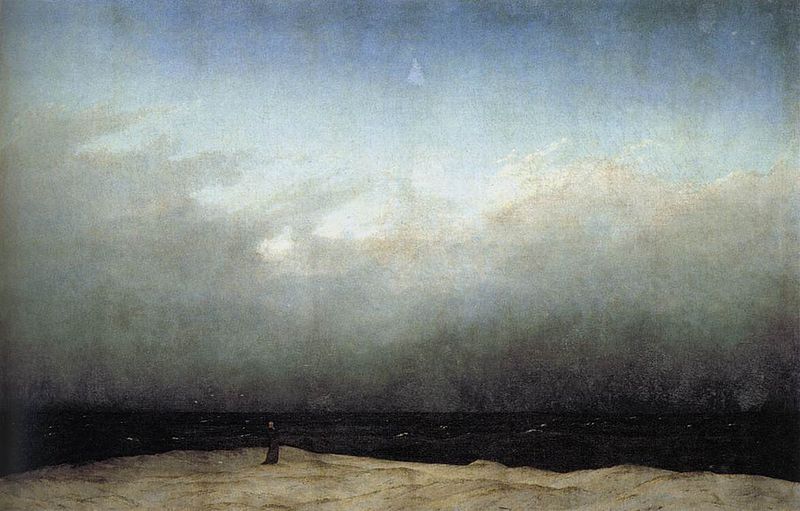
Caspar David Friedrich, Monk by the Sea, 1809
Source: Wikimedia Commons

Robert Rosenblum’s book Modern Painting and the Northern Romantic Tradition: From Friedrich to Rothko traces a lineage from Monk by the Sea (1809) to Green on Blue (1956) by way of ‘Romantic’ paintings by Blake, Runge, Van Gogh, Munch, Kandinsky, Ernst, Mondrian... Rosenblum’s thesis was first elaborated in a set of lectures delivered in 1972. It is interesting to think of some of the ‘Northern’ artists from the last fifty years that a revised version of the book written today might include. Andreas Gursky perhaps? Olafur Eliasson? Peter Doig? A look through the index to this site suggests quite a few other possible names.

And what of the other kind of non-Northern, non-Romantic artist? Rosenblum provides a couple of interesting contrasts with the aesthetic of Monk by the Sea. Gustave Courbet’s The Artist on the Seashore at Palavas (1854) combines the same basic elements as Friedrich’s painting. ‘Yet far from suggesting silent absorption into some spiritual beyond, the figure appears strangely earthy and self-assertive. It is no surprise to read Courbet’s comments on this self-portrait: “Oh sea! your voice is tremendous, but it will never succeed in drowning out the voice of fame as it shouts my name to the whole world!”’ Great stuff! For more on Courbet’s ego, see the article by John Golding in a recent New York Review of Books (the same issue has an article about blogs: “Blog writing is id writing—grandiose, dreamy, private, free-associative, infantile, sexy, petty, dirty” - hmm... I’m not sure how many of these adjectives I recognise. But it makes me think Courbet would have written an entertaining blog.)

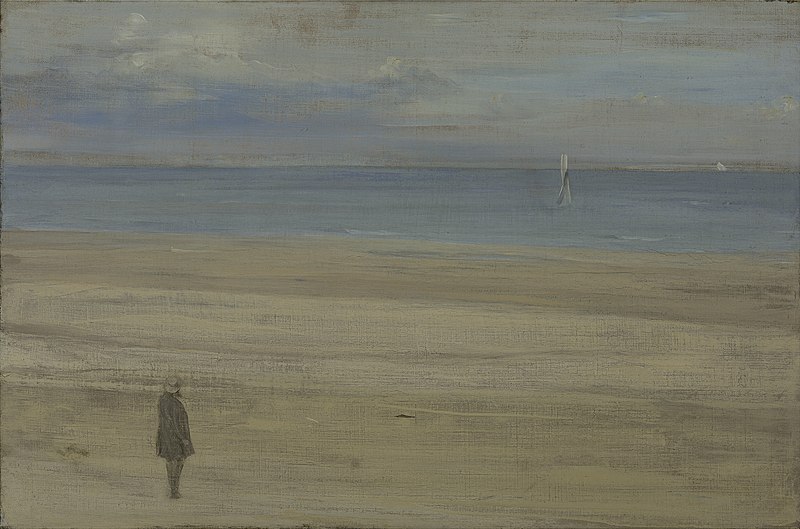
‘Eleven years later,’ Rosenblum continues, ‘in 1865, Whistler, by then thoroughly steeped in the art pour l’art ambience of Paris, also painted a picture of Courbet, who now stands on the beach at Trouville, once more turned to the unbroken stretch of sand and sea. This time, Courbet’s swollen ego has vanished in favour of a ghost of a figure, hardly discernible as anyone at all. Yet if the presence of this lone figure as the only human element on a deserted beach can evoke some whisper of mood, the painting nevertheless imposes itself primarily as an exquisite tour de force of muted tonalities arranged in horizontal tiers.’ Whistler originally called the painting Harmony in Blue and Silver, thus emphasising its abstract qualities over any sense of sublime mystery. And so both Courbet and Whistler, working in France, represent for Rosenblum a different way of painting landscapes to the Northern Romantic tradition.


James Abbott McNeill Whistler, Harmony in blue and silver: Trouville (1865)
Source: Wikimedia Commons

In contemporary art it is no doubt possible, though perhaps not easy, to find similar comparisons. How about Francis Alÿs versus Richard Long for example? Any others? It’s appealing to think that the ‘Northern Romantic tradition’ might still be possible to trace, partly because the whole idea seems so old-fashioned, partly because it is so easy to imagine that today’s global art world would make even such broad generalisations seem, in reality, quite implausible.

Friday, February 22, 2008

Klausen Pass

According to Fiona Bradley, when Andreas Gursky 'photographed the scene that became Klausen Pass (1984), he did not notice the people scattered at the base of the mountain. Looking at the photograph later, he identified the people as the reason for the success of the image: dispersed throughout the field of vision, the people direct and animate it' (Andreas Gursky: Images 1995). This account seems rather unlikely even for an amateur photographer - who photographs a landscape without instinctively noting where other people are and how it will affect the image? In other works from the early eighties, Andreas Gursky was finding interesting groups of people to photograph, like Sunday Walkers, Dusseldorf (1984)... the scatter of figures on the sunny mountainside in Klausen Pass seem too interesting to have been overlooked in the work's composition.

It is true, however, that in Klausen Pass the individuality of the adults and children standing and walking through the image can be ignored - as part of the composition they are an irregular sequence of coloured forms leading the eye up a path to the mountain. They provide some scale like the small foreground figures in traditional picturesque painting. And yet because the photographic medium means we are looking at real people, rather than, say, anonymous pastoral shepherds, they remain intriguing. Why is that woman walking off the path? Who is that bare-chested man waiting for? Which of these people know each other and which are strangers?

In later works by Andreas Gursky, individual people may be absent, but the traces of human activity - rows of windows, cars, containers - continue to provoke questions about what we are looking at. In general his landscapes are given structure and pattern by groups of figures and the accumulation of human artifacts. This gives them their distinctive formal beauty whilst simultaneously drawing attention to some of the ways in which we now work, travel and spend our leisure time.

Saturday, February 16, 2008

A morbid melancholy

"The works of Caspar David Friedrich, hitherto almost totally unknown in this country, will be a revelation for the British Art public..." When was this written? 1822? 1872? 1922? It is actually on the back of the Tate Gallery's 1972 Friedrich exhibition catalogue, "the only full-scale publication on Friedrich in English". Well there must have been a lot of books on Friedrich since then, but this catalogue would have set a high standard, with its excellent long essay by William Vaughan and catalogue entries by Helmut Borsch-Supan. Near the end of the catalogue there are an interesting set of 'Reminiscences of Friedrich and his Art', translated by Vaughan with George and Elizabeth Katkov. Here's an extract from one of these, by a younger contemporary, the Dresden landscape painter Adrian Ludwig Richter. His criticism of Friedrich may resonate for those who think Friedrich's art can sometimes feel a little forced:
'... it seems to me that Friedrich's method of conception leads in a false direction, that could be highly epidemic in our time; the majority of his pictures exhale that morbid melancholy, that feverishness that grips every sensitive observer so forcefully, but which always produces a disconsolate feeling - this is not the seriousness, not the character, nor the spirit and importance of nature, this has been imposed onto it. Friedrich chains us to an abstract idea, making use of the forms of nature in a purely allegorical manner, as signs and hieroglyphs - they are made to mean that and that. In nature however, every thing expresses itself; her spirit, her language lies in every shape and colour. A beautiful scene in nature, it is true, also awakes only one feeling (not a thought), but this is so all-embracing, so grand, powerful and intense, that every allegory seems in comparison dried out and shrivelled up. The liberation of the spirit, the feeling of freedom in a broad, beautiful, enlivening space, this is principally what nature can affect us with so beneficially...' (Diary entry, 30 January 1824)

Abbey in an Oak Forest, Caspar David Friedrich, 1809-10
Source: CGFA

Friday, February 15, 2008

A Bull in a Storm on a Moor


It was exactly five years ago today that millions of us marched through London to protest about the impending war on Iraq. One of my abiding memories is the extraordinarily slow progress we made, such was the weight of numbers. As we inched down Piccadilly I remember looking up at some figures carved on a building and realising suddenly I was seeing a sculpture of Thomas Girtin, one of my favourite landscape watercolourists. The building was designed for the Royal Institute of Painters in Water Colour (now located at the Mall Galleries) and along with Girtin it has busts of Sandby, Cozens, Girtin, Turner, Cox, De Wint, Barret and Hunt.

There is a description of the building at British History Online: 'Nos. 190–195 Piccadilly were rebuilt between 1881 and 1883 for the Royal Institute of Painters in Water Colours, which had been founded in 1831 as the New Society of Painters in Water Colours... The new galleries with shops and a public hall beneath were built from the designs of E. R. Robson... The galleries of the Royal Institute were damaged by enemy action in 1940, and were reopened on 1 July 1948. Three bays of the ground-floor façade have now been extensively altered by Pan American Airways, and the remainder of the lower parts of the building, with Nos. 36–40 Jermyn Street, is occupied by shops, restaurants and offices. The building in its present state is no more than a sad relic of Robson's original design, its ground and second storeys, and indeed its whole proportions, having been ruthlessly sacrificed to commercial interests. A photograph of 1896 in the possession of the National Buildings Record shows a three-storeyed stone façade arranged in two stages, the two-storeyed upper stage being twice the height of the lower and almost completely devoid of windows, expressing the exhibition galleries within. The ground storey was divided into nine bays by pilasters supporting a simple but well-proportioned entablature, and in the middle and outer bays were three splendid Baroque doorways, each having a swan-neck pediment enclosed within a broken segmental pediment...'

The Royal Institute of Painters in Water Colour, photographed in 2008

It seemed inappropriate to be protesting against the possibility of war and thinking about the gentile art of watercolour. However, I remembered that Paul Sandby, who stands at the beginning of the British tradition of watercolour painting, actually worked for the army: making maps to help avert another Jacobite rebellion. And subsequent watercolourists were not always in the business of creating serene classical idylls. Here, for example, is a painting by another of the watercolourists honoured by the Royal Institute building, David Cox. The V&A site says of it "he often depicted scenes of rain and strong winds. In this watercolour Cox attacks the sheet with his brush to achieve an aggressive and threatening effect." The threat and uncertainty felt very real five years ago; the storm came hasn't blown over yet.

The Challenge: A Bull in a Storm on a Moor by David Cox
Souce: V&A

Saturday, February 09, 2008

Freed from the old perspective

In The Spectacle of Flight: Aviation and the Western Imagination, 1920-1950, Robert Wohl describes how writers experiencing flight for the first time started to see landscape differently - both in terms of viewpoint and speed. Paul Morand, for example, in Flèche d’orient (1932) noticed the absence of familiar sites: ‘the blue bottoms of leaves, the stratified facades of mountains, the colonnade formed by a forest, the dark pockets of valleys, and human beings...’ Instead the, world looked ‘like a painting that has been freed from the old perspective and yesterday’s colours.’

The analogy with abstract painting occurred to other writers. Ernest Hemingway flew from Paris to Strasbourg in 1922 and saw below ‘brown squares, yellow squares, and big flat blotches of green where there was a forest. I began to understand cubist painting.’ Gertrude Stein looked down at the American landscape and saw “all the lines of cubism made at a time when not a painter had ever gone up in an airplane. I saw three on the earth the mingling lines of Picasso, coming and going, developing and destroying themselves. I saw the simple solutions of Braque, I saw the wondering lines of Masson...’ Stein concluded that ‘as the twentieth century is a century which sees the earth as none has ever seen it, the earth has a splendour that it never has had...’

Friday, February 08, 2008

The Description of Cooke-ham

I was recently flicking through Kenneth Baker's anthology The Faber Book of Landscape Poetry (2000), which, as you would expect from the editor of The Faber Book of Conservatism, is a solidly conservative selection. It's not exactly Earth Shattering, even if it does acknowledge that ‘Man has a lot to answer for when it comes to spoiling the environment.’ He certainly does! Baker provides an example in the Introduction of the way politicians like himself can promote policies to help the environment: ‘as a result of positive government intervention and tax incentives more trees are planted each year than are felled.’ He has a whole section on trees, which includes an extract from an interesting early landscape poem, 'The Description of Cooke-ham' by Aemelia Lanyer. Here are a few lines:
Now let me come vnto that stately Tree,
Wherein such goodly Prospects you did see;
That Oake that did in height his fellowes passe,
As much as lofty trees, low growing grasse:
Much like a comely Cedar streight and tall,
Whose beauteous stature farre exceeded all...

A biographical note by Kari Boyd McBride explains that ''The Description of Cooke-ham' must have been written between February 25, 1609 (when Anne Clifford married and took the name "Dorset," by which she is called in the poem), and October 2, 1610 (when the poem was entered in the Stationers' Register).... [It] is the first country house poem to be published in English (predating Ben Jonson's "To Penshurst" [1616]). Drawing on classical generic features, Lanyer figures the virtue of the "Lady" of the poem, Margaret, Countess of Cumberland, in the homage accorded her by the estate's flora and fauna.' "Dorset", Anne Clifford, was Margaret's daughter.

Here is another extract in which Lanyer describes the effect of Lady Margaret's departure:

But your occasions call'd you so away,
That nothing there had power to make you stay:
Yet did I see a noble gratefull minde,
Requiting each according to their kind,
Forgetting not to turne and take your leaue
Of these sad creatures, powrelesse to receiue
Your fauour, when with griefe you did depart,
Placing their former pleasures in your heart;
Giuing great charge to noble Memory,
There to preserue their loue continually:
But specially the loue of that faire tree,
That first and last you did vouchsafe to see:
In which it pleas'd you oft to take the ayre,
With noble Dorset, then a virgin faire:
Where many a learned Booke was read and skand
To this faire tree, taking me by the hand,
You did repeat the pleasures which had past,
Seeming to grieue they could no longer last.

Saturday, February 02, 2008

North Country Sketches

Publisher and poet Jonathan Williams has often written about music. There is A Celestial Centennial Reverie for Charles Edward Ives, for example, which draws on Emerson and Thoreau ('the poet's flute / is heard / out over / the pond'). There are his epitaphs for composers like Ives, Elgar, Poulenc, Satie, Charlie Parker... some of these connect music to landscape, e.g. Jean Sibelius: 'the drone of overtones in / a rye field by / a river'. And in 1978 came The Delian Seasons, a sound poem inspired by Frederick Delius's North Country Sketches (1913-14).

Williams explains in a note to The Delian Seasons that ‘North Country Sketches is Delius’s only composition evoked by the Pennine Dales of the West Riding of Yorkshire, the landscape of his growing up... Following Delius’s passion for wordless choruses, I have restricted my words (except for three in ‘The March of Spring’) to place names found on four Ordnance Survey maps… Nouns are made to work harder than merely be places. The way they are sounded and placed in the poems owes ‘something’ to incessant listening to North Country Sketches.’ To give you a limited idea of the result, the first one, ‘Autumn: the wind soughs in the trees’ starts as follows 'whins end / whins end / arrant lattera carlin / whins end...'

I suppose this doesn't make a great deal of sense... you really need to see the original poem in its visual arrangement and read the entire thing. I have noticed that Williams has tended to suffer a bit from having his poems republished away from the original settings. For example, Blues & Roots, Rue and Bluets: A Garland from the Appalachians, in its original 1971 edition, had photographs by Nicholas Dean on almost every page and some of Williams' found poems were literally photographs of road signs etc. A 1985 reprint dropped the images and, I think, lost a lot of the impact.

Incidentally, did you know that Frederick Delius has a MySpace site? And that he numbers Beethoven and Schubert among his friends? He doesn't seem to be posting a blog though...

Friday, February 01, 2008

The South Downs

It is interesting to consider how far you can get from a direct representation of a landscape and still provide a space that can elicit some kind of idea or memory of that place. There are various distancing effects like abstraction or surrealism that can be used in any of the arts. There is obviously the degree to which any representation is personal or universal, precise and objective or rather generalised. And of course there is the art form itself: in terms of representational detail one might expect, ceteris paribus, photography > painting > poetry > music.

I was listening to a musical evocation of landscape yesterday and thinking how difficult it was to associate it with my idea of the place (particularly, to be honest, as I was listening to an iPod amid the traffic of St Paul's Road, Islington). The piece was Gavin Bryars' 'The South Downs' and its dominant sound is a mournful cello. It seemed to me to evoke a colder, more rugged place than the soft green hills of Sussex. I actually had in mind 'The North Shore', a similar composition that precedes 'The South Downs' on Bryars' album A Man in a Room, Gambling, and I was thinking that 'The South Downs' sounded, for me, like the sea. Then I remembered reading that Bryars actually based it on the view from Birling Gap, where the sea is very present as you stand on the edge of the South Downs, looking down at the waves, hearing the wind and feeling the space around you. So I felt more of a connection, even though the music still feels too mournful and poignant for me: perhaps I've only been there on beautiful days...


The sea near Birling Gap - photographed by me in 2003

There is a good description of 'The South Downs' on this site in which various adjectives suggest possible correspondences between the music and the place:

"The piece is somewhat episodic in form, its 15-minute duration being separated by pauses and fermatas into a string of short scenes. These begin quite lucidly, with arpeggiated figures in the viola and simple tones in the piano. With each successive tableau, however, the viola's music becomes more urgent and dynamic, while the piano becomes more involved. Eventually, the instruments trade places: the viola indulges in long, relaxed tones and trills while the piano takes up the softly undulating arpeggios and broken chords. This slowing of motion in the cello corresponds to its descent into its lower ranges, alternately sliding further and further down to subterranean pedal tones and taking lyrical melodic ascents on the upper strings; the piano, in the meantime, maintains its humble task of pulsing away on rich minor mode harmonies. Bryars' chord progressions sometimes take unexpected turns, but his focused consistency of sonority and texture make them an almost secondary aspect of the piece. Still, one of the most dramatic moments in the piece occurs about ten minutes in when, as the piano sets the somber mood, the violin undertakes an unexpectedly poignant tremolando melody on double stops. The gesture and chords are so lush as to suggest irony in any other context, but in this piece Bryars has set the scene so convincingly as to leave little doubt about his expressive sincerity."

The last sentence is interesting and is a reminder of the difficulty artists have today in dealing with the genuinely moving feelings we still have in a place as picturesque as Birling Gap. Interestingly the description here refers to 'successive tableau', as if Bryars is reproducing a series of photographs. Which suggests another distancing effect: the representation of a representation, something I've mentioned here in relation to Gerhard Richter and (a reminder that this has always been a possibility) in connection with Domenichino's frescoes for the Villa Aldobrandini.