Showing posts with label Thomas Cole. Show all posts

Saturday, August 11, 2018

River in the Catskills

Thomas Cole, River in the Catskills, 1843
Source: Wikimedia Commons

What was the first appearance of a train in a painting? Most people know Turner's Rain, Steam and Speed (1844), which is the earliest example listed on a Wikipedia page dedicated to railways and art. However, visitors to the National Gallery's Thomas Cole exhibition will see an earlier one in the painting reproduced above, River in the Catskills (1843).  At the scale you're reading this you probably can't see the train, just a faint puff of steam in an idyllic landscape.  But the railroad is in place and there are other signs too that the landscape is being changed - in the foreground men are chopping down trees.  At the exhibition this painting is juxtaposed with a similar view painted in the 1830s, showing a vision of America unsullied.  A baby reaches for the bouquet of wild flowers her mother has picked and on the gentle river an Indian canoe suggests a world of harmonious coexistence. However, as the curators point out, not everyone regretted the way things were going - there is a third view of this river by Asher Brown Durand, painted in 1853, with unmistakable signs of alteration and 'development', entitled Progress (The Advance of Civilisation).

Detail of River in the Catskills showing the train

Thomas Cole, View on the Catskill – Early Autumn, 1836-7
Source: Wikimedia Commons

Detail of View on the Catskill
Source: Wikimedia Commons

It would probably take too long to write here about the main subject of the National Gallery's exhibition, Cole's series of paintings charting The Course of Empire, or about their simultaneous Ed Ruscha show that updates the theme and raises questions about contemporary America.  You can read about these in various online reviews - e.g. Jonathan Jones, Waldemar Janusczcak, Michael Glover.  Instead I will just add a few words more on Cole's remarkable painting Titan's Goblet which normally hangs in the Met, where its curators admit that it 'defies explanation'.  This huge stone goblet is higher than the surrounding mountains and along its rim there are is a flourishing civilisation.  Water falls like divine light onto the ground far below, where there are also signs of habitation but of a more primitive kind.  That small sunlit sea, framed by the goblet's rim, is a landscape-within-a-landscape.  But it could also be viewed as an unusual example of the hybrid genre I discussed in connection with Tacita Dean recently, the still-life-within-a-landscape.  You can lose yourself in most of Cole's paintings but this is particularly true here.  His friend Louis Legrand Noble saw a kind of Mediterranean in those waters, where tourists might travel to versions of Greece or Syria, tracing their fancies in 'in the golden splendours of a summer sunset.'

Thomas Cole, Titan's Goblet, 1833
Source: Wikimedia Commons

Detail of Titan's Goblet
Source: Wikimedia Commons

Friday, September 01, 2017

Crags, upon whose extreme edge I stand...

And thou fresh breaking Day, and you, ye Mountains,
Why are ye beautiful? I cannot love ye.
And thou, the bright eye of the universe,
That openest over all, and unto all
Art a delight—thou shin’st not on my heart.
And you, ye crags, upon whose extreme edge
I stand, and on the torrent’s brink beneath
Behold the tall pines dwindled as to shrubs
In dizziness of distance; when a leap,
A stir, a motion, even a breath, would bring
My breast upon its rocky bosom’s bed
To rest for ever—wherefore do I pause?

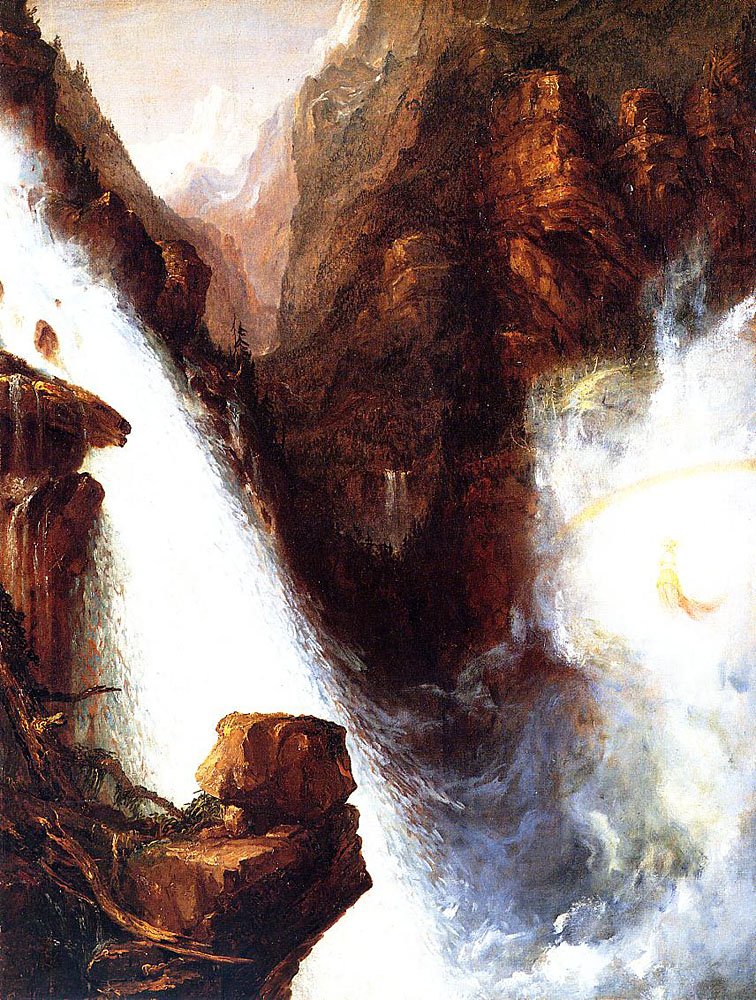
Lord Byron's poetic drama, Manfred, begun in 1816 when he was living in Switzerland, was published two hundred years ago.  Although its hero resembles Faust, the poem was, Byron claimed, more influenced by his impressions of the mountain landscape than his reading of Goethe.  There are no lengthy descriptions of scenery in Byron's poem, just enough to convey a sense of the high peaks where it is set (the quotation above is from Act 1 Scene 2: 'The Mountain of the Jungfrau.—Time, Morning. MANFRED alone upon the Cliffs.')  Instead, it is the entire poem that has the sublimity of the Alps, its themes of loss and despair echoing the spectacular but lonely isolation experienced on their heights.  Reading Manfred reminded me that works of art infused with a spirit of place are far more numerous than the ones I tend to restrict myself to here, that describe the actual appearance of a landscape.

Thomas Cole, Scene from 'Manfred', 1833
Source: Wikimedia Commons
 
There is one reference in Manfred to a natural phenomenon that is based on what Byron saw on 22 September, 1816.   He and his travelling companion John Cam Hobhouse were in the Lauterbrunnen Valley, looking up at the The Staubbach Fall.  Byron wrote in his journal that the torrent reminded him of the tail of a pale horse, such as Death might ride at the Apocalypse.  The next day they returned and Byron noted 'the Sun upon it forming a rainbow of the lower part of all colours – but principally purple and gold – the bow moving as you move – I never saw anything like this – it is only in the Sunshine.'  These impressions were used to set the scene for Act 2 Scene 2, with Byron also including a footnote on the rainbow.
It is not noon; the sunbow’s rays1 still arch
The torrent with the many hues of heaven,
And roll the sheeted silver’s waving column
O’er the crag’s headlong perpendicular,
And fling its lines of foaming light along,
And to and fro, like the pale courser’s tail
The Giant steed, to be bestrode by Death,
As told in the Apocalypse.
1This Iris is formed by the rays of the Sun over the lower part of the Alpine torrents. It is exactly like a rainbow come down to pay a visit, and so close that you may walk into it. This effect lasts till Noon.

A rainbow in the Trümmelbach Falls
Photographed by me, August 2017

We were in the Bernese Oberland ourselves last month and observed one of these rainbows in a waterfall near the one Byron visited.  We also ascended to the top of the Schilthorn, to look as he and Hobhouse had, across to the summit of the Jungfrau.  Byron saw clouds gathering on one side - 'curling up perpendicular precipices – like the foam of the Ocean of Hell during a Springtide – it was white & sulphery – and immeasurably deep in appearance.'  We picked a beautiful clear day, so clear that we could see Mont Blanc.  The downside of this was that the summit was pretty crowded with other tourists.  Even Byron could not enjoy the sight of the Jungfrau in solitude.  'Lying down for a few minutes to contemplate these wonders, Hobhouse and Byron were irritated by the sudden appearance of two or three female tourists on horseback when they had imagined they had the mountain to themselves' (Fiona MacCarthy, Byron: Life and Legend).

The Eiger, Mönch and Jungfrau
Photographed by me, August 2017

Byron's hero has to get away from other people: 'my nature was averse from life; / And yet not cruel; for I would not make,  / But find a desolation.'  Manfred thinks he is alone on the summit of the Jungfrau, but he too is disturbed - by the unexpected appearance of a passing chamois hunter.  Death may be Manfred's inevitable fate at the end of the poem, but now, in its opening scene, this hunter prevents him from jumping into the void and leads him back down to safety:
The clouds grow thicker—there—now lean on me—
Place your foot here—here, take this staff, and cling
A moment to that shrub—now give me your hand,
And hold fast by my girdle—softly—well—
The Chalet will be gain’d within an hour.

John Martin, Manfred on the Jungfrau, 1837
Source: Wikimedia Commons

Friday, March 23, 2012

The stationary blasts of waterfalls


Paintings freeze the vision of landscape at a moment in time, whilst poems can convey the shifting impressions of a walk.  But a poem that pauses whilst the writer pictures the landscape may be more successful than a painting at slowing and focusing the attention on nature.  Elements of a landscape will in any case be in motion themselves, or appear in a state of constant movement that comes to seem a form of stillness.  In his book Can Poetry Save the Earth? (2009) John Felstiner suggests that this permanence in transience is a natural figure in poetry: William Carlos Williams 'senses an "unmoving roar" in Passaic Falls, A. R. Ammons in an "onbreaking wave" finds "immobility in motion." Derek Walcott recalls Caribbean swallows "moving yet motionless."' Waterfalls in particular seem to elicit this response from poets: ‘Coleridge in the Alps is struck by “Motionless torrents!” and Wordsworth by “The stationary blasts of waterfalls” ... Imagination, momentarily grasping things in flux, admits in the same moment that nature is ungraspable.’  Felstiner quotes Thomas Cole who saw in waterfalls ‘“fixedness and motion – a single existence in which we perceive unceasing change and everlasting duration.”  A poem like a painting catches life for the ear of eye, stills what’s ongoing in human and nonhuman nature.’ 

Thomas Cole, Falls of the Kaaterskill, 1826

Can Poetry Save the Earth? has reproduced on its cover Joseph Farington's view of the waterfall at Ambleside (1816).  Felstiner says that 'Keats saw these falls soon after he'd said "The poetry of the earth is never dead," and they blew his mind'.  It was on his tour of the Lakes in 1818: Keats and his friend Charles Brown arose at six in the morning and headed out before breakfast to search for the falls.  Having heard the noise of the water through the trees, they made their way down to the bottom of a valley ("Keats scrambled down lightly and quickly") to watch the cataract's waters darting and spreading over the rocks, descending into "the thunder and the freshness".  "What astonishes me more than any thing," Keats wrote in a letter to his brother Tom, "is the tone, the coloring, the slate, the stone, the moss, the rock-weed; or, if I may so say, the intellect, the countenance of such places. The space, the magnitude of mountains and waterfalls are well imagined before one sees them; but this countenance or intellectual tone must surpass every imagination and defy any remembrance. I shall learn poetry here and shall henceforth write more than ever, for the abstract endeavor of being able to add a mite to that mass of beauty which is harvested from these grand materials, by the finest spirits, and put into etherial existence for the relish of one's fellows."  Felstiner quotes this letter and truncates that last sentence after the first five words, turning it into a resounding affirmation of the way Keats felt art could flow from nature: "I shall learn poetry here."

Sunday, March 16, 2008

Russet Lawns, and Fallows Gray

Thomas Cole, L'Allegro (Italian Sunset), 1845

John Milton's poem describing 'the happy man', L'Allegro (1631), inspired various artists: Turner, Blake and Cole (above) for example. Here are some lines in which Milton himself paints a Lantskip (
in the final line, a cynosure is, according to the OED, 'something that attracts attention by its brilliancy or beauty; a centre of attraction, interest, or admiration').
Streit mine eye hath caught new pleasures
Whilst the Lantskip round it measures,
Russet Lawns, and Fallows Gray,
Where the nibling flocks do stray,
Mountains on whose barren brest
The labouring clouds do often rest:
Meadows trim with Daisies pide,
Shallow Brooks, and Rivers wide.
Towers, and Battlements it sees
Boosom'd high in tufted Trees,
Wher perhaps som beauty lies,
The Cynosure of neighbouring eyes.
In 1740 Handel premiered a composition based on Milton: L'Allegro, il Penseroso ed il Moderato. Its libretto by Charles Jennens interweaved L'Allegro with Milton's companion poem Il Penseroso ('The contemplative man') and, in the third movement, resolved their differing moods with a poem of Jennens' own, Il Moderato. Here is part of the libretto which starts with text from Il Penseroso and ends with the lines in L'Allegro just before those quoted above, describing a pleasant scene of unfeasibly cheerful pastoral characters:

16. Air

Il Penseroso (soprano):

Oft on a plat of rising ground,
I hear the far-off curfew sound,
Over some wide-water'd shore,
Swinging slow, with sullen roar;
Or if the air will not permit,
Some still removed place will fit,
Where glowing embers through the room
Teach light to counterfeit a gloom.

17. Air

Il Penseroso (soprano or tenor):

Far from all resort of mirth,
Save the cricket on the hearth,
Or the bellman's drowsy charm,
To bless the doors from nightly harm.

18. Recitative

L'Allegro (tenor):

If I give thee honour due,
Mirth, admit me of thy crew!

19. Air

L'Allegro (tenor or soprano):

Let me wander, not unseen
By hedge-row elms, on hillocks green.
There the ploughman, near at hand,
Whistles over the furrow'd land,
And the milkmaid singeth blithe,
And the mower whets his scythe,
And every shepherd tells his tale
Under the hawthorn in the dale.

Donald Teeters has written some interesting and amusing reflections on Handel's composition, Milton's poems and English plumbing: 'As anyone who has ever spent a winter in London will know, the English seem always to be surprised — offended really — that winter arrives. Their houses, even now, rely on bizarrely inadequate heating devices; the plumbing lines, often attached to the exterior of a house, are expected not to freeze, but usually do. The advertisements for L'Allegro's first performance stressed that "Care is taken to have the House secur'd against the Cold, constant Fires being order'd to be kept in the House 'till the Time of Performance."' It doesn't get this cold in London anymore but after a weekend of such miserable weather it would certainly be nice to welcome back Milton's 'frolick Wind that breathes the Spring, Zephir with Aurora playing...'