Showing posts with label Ando Hiroshige. Show all posts

Saturday, February 14, 2026

Listening to Insects at Dōkan Hill


Utagawa Hiroshige, Listening to Insects at Dōkan Hill
from the series Famous Places in the Eastern Capital, 1835-1845 

This is one of the prints that was on display in the British Museum's exhibition Hiroshige: artist of the open road last year. Lafcadio Hearn published an essay on 'insect musicians' and the listening practices surrounding them in his collection Exotics and Retrospectives (1898):

There are charming references to singing-insects in poetical collections made during the tenth century, and doubtless containing many compositions of a yet earlier period. And just as places famous for cherry, plum, or other blossoming trees, are still regularly visited every year by thousands and tens of thousands, merely for the delight of seeing the flowers in their seasons,—so in ancient times city-dwellers made autumn excursions to country-districts simply for the pleasure of hearing the chirruping choruses of crickets and of locusts,—the night-singers especially. Centuries ago places were noted as pleasure-resorts solely because of this melodious attraction;—such were Musashino (now Tōkyō), Yatano in the province of Echizen, and Mano in the province of Ōmi. Somewhat later, probably, people discovered that each of the principal species of singing-insects haunted by preference some particular locality, where its peculiar chanting could be heard to the best advantage; and eventually no less than eleven places became famous throughout Japan for different kinds of insect-music. [He goes on to list them...]

The Hiroshige print is analysed in a 2023 acoustic ecology paper by soundscape researcher Keiko Torigoe. She includes a description of Dōkan Hill from the Edo Meisho Zue (1834-6).

There are many medicinal herbs in this area, and people who gather medicines always come here. Especially in autumn, pine insects and bell ringers make exquisite sounds. Therefore, courtesans and persons of elegance and refinement all come here to recite poems in the winds and sing songs under the moon, appreciating the sound of the insects.

The pine insect is the matsumushi 'much esteemed for the peculiar clearness and sweetness of its notes', according to Hearn, and the bell ringer is the suzumushi which 'in certain lonesome places might easily be mistaken,—as it has been by myself more than once,—for the sound of rapids.' You can hear what they sound like on YouTube: here are links for the pine cricket and bell cricket. There is actually a temple in Kyoto known as Suzumushidera because the monks keep bell crickets there to sing all year round.  

Dōkan Hill features in other 19th century prints. Hiroshige's son-in-law Suzuki Chinpei (Hiroshige II) composed a scene similar to the one above in 1864: Listening to insects on Dōkan Hill. There is a comic 1859 scene by Utagawa Hirokage called Catching fireflies at Mount Dōkan, which the Library of Congress describes as showing 'four men drinking alcoholic beverages in a field at night' (one of them is rolling round, clearly pissed as a pudding). And in 1884 Kobayashi Kiyochika depicted a couple climbing the hill to enjoy the views, whilst in the foreground a horse looks startled, perhaps by the sight of some huge white daikon radishes lying on the floor. I'll end here with another example: a simple and rather lovely pink and turquoise view of the landscape below Dōkan Hill, by Hiroshige himself.    


Utagawa Hiroshige, Below Dokan Hill
from the series Twelve Views of Edo, c. 1835 

Friday, June 01, 2018

Potted landscapes on the Tōkaidō

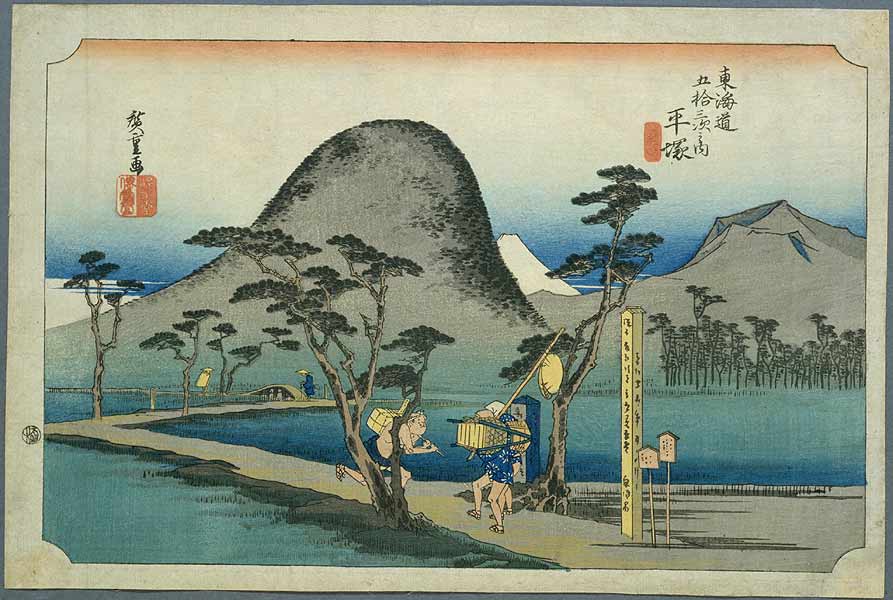
Utagawa Hiroshige, Hiratsuka on the Tokaido, 1833–1834

The Public Domain Review is a constant source of fascinating material and I thought I'd share here something I read about there recently, a book called Tokaido Gojusan-eki Hachiyama Edyu.
Connecting Edo (now known as Tokyo) to Kyoto, the Tōkaidō road was the most important of the “Five Routes” in Edo-period Japan. This coastal road and its fifty-three stations has been the subject of both art and literature, perhaps most famously depicted by the Japanese artist Utagawa Hiroshige in his The Fifty-three Stations of the Tōkaidō, a series of ukiyo-e woodcut prints created in the 1830s. This book from the mid-19th century, Tokaido Gojusan-eki Hachiyama Edyu, presents a series of fifty-three prints created by a relatively obscure ukiyo-e artist named Utagawa Yoshishige, each illustration depicting a Tōkaidō station in the form of a potted landscape. The preface tells us that the illustrations are based on actual pieces constructed by the preface writer’s father, Kimura Tōsen. Creating the models in 1847, a year before publication, Tōsen commissioned Utagawa Yoshishige to make illustrations of each model for a book through which he could share them with the world, and (due to his modesty) asked his son to write the preface.
The Public Domain Review article doesn't identify Kimura Tōsen's landscapes, but you can puzzle them out.  The image below is clearly a view of Hiratsuka - I have reproduced Hiroshige's version above. The other two examples below are (I think) Chiryū (No. 39, scene of a horse fair) and Kanbara (No. 15, a snow scene). Here landscape has been refracted first through the prints of Hiroshige, then through the tray landscapes of Tōsen and then once again through the medium of print, a trace of a trace of a trace of the views from the Tōkaidō road.


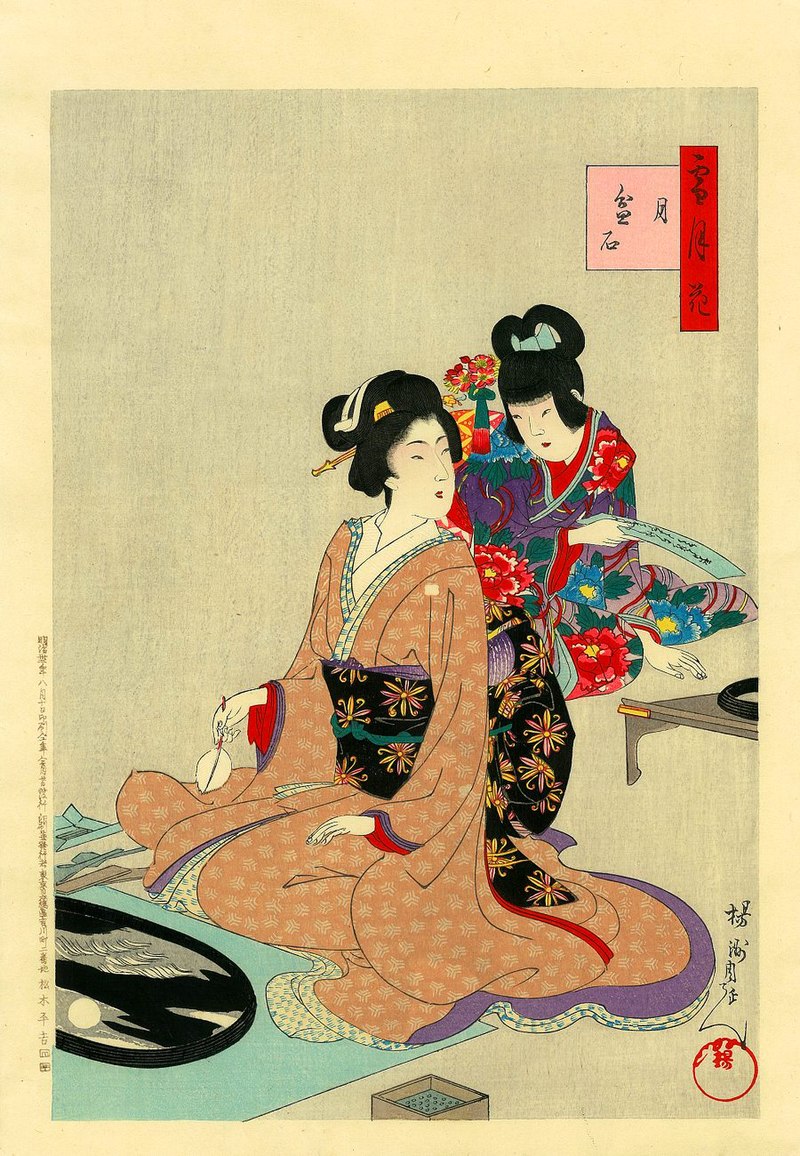
The article goes on to explain that of the two main types of Japanese potted landscape, these are likely to have been bonkei - sculpted models featuring people or buildings - as opposed to saikei in which real miniature trees and plants would grow.  The art of creating miniature landscapes was widespread and there were versions of it in China (penjing) and Vietnam (hòn non bộ).  The Wikipedia article refers as well to the Western model railway, a form of landscape art I have so far neglected on this blog!  In Japan there is another related art form, bonseki, in which sand and rocks are used to make a landscape on a black lacquer tray.  Below I have included three examples of women making bonseki tray landscapes, concluding with a recent Youtube clip showing the use of special tools and materials.  These bonseki could be seen as a subgenre of sand art, which reminds me of another childhood pursuit that I've never mentioned here, the art of the sand castle.  Perhaps next time we are on a beach I will have a go at some of the Fifty-three stations of the Tōkaidō... 

Katsushika Hokusai, Woman making a bonseki mountain, n.d.


Yōshū Chikanobu, A woman making a bonseki tray landscape showing the full moon, 1899  


Tuesday, July 07, 2015

The River of Heaven

Ando Hiroshige, Tanabata Festival in Edo, 1852
(from Thirty-six Views of Mount Fuji)

'Among the many charming festivals celebrated by Old Japan, the most romantic was the festival of Tanabata-Sama, the Weaving-Lady of the Milky Way.'  When Lafcadio Hearn wrote this at the beginning of the twentieth century, the custom had largely been abandoned in the cities.  I wonder if even then light pollution was beginning to make it hard to see the Milky Way (in 2008 the Japanese prime minister asked people to switch off their lights to celebrate the festival).  The Chinese legend behind the festival tells of Orihime, daughter of the Sky King, who weaves clothes beside the heavenly river, and her marriage to the herder Hikoboshi.  Once married she stops weaving and he lets his cattle stray all over Heaven, so the Sky King forbids them to meet.  However, moved by his daughter's tears he relents and allows them to cross the river once a year, on the seventh day of the seventh month, when a flock of magpies create a bridge for them.  Today, July 7th, still marks the beginning of the Tanabata festivals, although the exact date varies by region.  Lafcadio Hearn's description of how it used to be celebrated is, I think, particularly evocative: ink stones, morning dew, poetry, bamboo planting and offerings to the star deities...   
'The popular customs relating to the festival differed according to locality. Those of Izumo—where all classes of society, samurai or common folk, celebrated the holiday in much the same way—used to be particularly interesting; and a brief account of them will suggest something of the happy aspects of life in feudal times. At the Hour of the Tiger, on the seventh night of the seventh month, everybody was up; and the work of washing the inkstones and writing-brushes was performed. Then, in the household garden, dew was collected upon yam-leaves. This dew was called Amanogawa no suzuki  ("drops from the River of Heaven"); and it was used to make fresh ink for writing the poems which were to be suspended to bamboos planted in the garden. It was usual for friends to present each other with new inkstones at the time of the Tanabata festival; and if there were any new inkstones in the house, the fresh ink was prepared in these. Each member of the family then wrote poems. The adults composed verses, according to their ability, in praise of the Star-deities; and the children either wrote dictation or tried to improvise. Little folk too young to use the writing-brush without help had their small hands guided, by parent or elder sister or elder brother, so as to shape on a tanzaku the character of some single word or phrase relating to the festival,—such as "Amanogawa," or "Tanabata," or "Kasasagi no Hashi" (the Bridge of Magpies). In the garden were planted two freshly-cut bamboos, with branches and leaves entire,—a male bamboo (otoko-daké) and a female bamboo (onna-daké). They were set up about six feet apart, and to a cord extended between them were suspended paper-cuttings of five colors, and skeins of dyed thread of five colors. The paper-cuttings represented upper-robes,—kimono. To the leaves and branches of the bamboos were tied the tanzaku on which poems had been written by the members of the family. And upon a table, set between the bamboos, or immediately before them, were placed vessels containing various offerings to the Star-deities,—fruits, sōmen, rice-wine, and vegetables of different kinds, such as cucumbers and watermelons.' (The Romance of the Milky Way and Other Studies and Stories, 1905)
One reason for mentioning this festival here is that in the Tanabata story the Milky Way has been imagined as a landscape feature in the sky.  Hearn begins his essay with a quotation from an 'ancient scholar': 'Of old it was said: "The River of Heaven is the Ghost of Waters." We behold it shifting its bed in the course of the year as an earthly river sometimes does.'  At the end of the festival people went down to their nearest earthly rivers.  The bamboo that had been planted and fixed to houses (like branches in the European May traditions I wrote about here recently) were then thrown into the water with poems attached to them.  Hearn concludes his essay with the reflection that old Japanese poetry based on the Tanabata legend, so remote from our modern worldview, may have little appeal in the West.
'Nevertheless, in the silence of transparent nights, before the rising of the moon, the charm of the ancient tale sometimes descends upon me, out of the scintillant sky,—to make me forget the monstrous facts of science, and the stupendous horror of Space. Then I no longer behold the Milky Way as that awful Ring of the Cosmos, whose hundred million suns are powerless to lighten the Abyss, but as the very Amanogawa itself,—the River Celestial. I see the thrill of its shining stream, and the mists that hover along its verge, and the water-grasses that bend in the winds of autumn.'

Saturday, May 01, 2010

Moons of the Iapetus Ocean

'Empty peaks, silence: Among sparse stars,/ not yet flawed, it drifts.'  Tu Fu's short poem 'Full Moon' describes the strange effect of a landscape at night, 'all light'.  In David Hinton's translation the 'twice-sized moon ... scatters restless gold across waves' and it transforms the garden and house in which Tu Fu sits - 'on mats, it shines richer than silken gauze.'


Ando Hiroshige, Autumn Moon on Ishiyama Temple, c. 1834

Hiroshige used moonlight for landscapes, as above, for figure scenes like Trout Fishing in the Tamagawa in the Autumn Moonlight, and for animal paintings, such as Two Rabbits under a Full Moon.  His prints were an inspiration for Whistler's Nocturnes.  As a post about this at the Princeton blog says, 'Whistler’s Nocturne in Blue and Gold: Entrance to Southampton Water bears striking similarity to Night View of Kanazawa under the Full Moon, depicting a moonlit bay done in a binary color scheme of blue and gray.'  Whistler got the idea of calling his moonlit scenes 'nocturnes' from a Chopin-admiring patron.  He wrote ‘I can’t thank you too much for the name ‘Nocturne’ as a title for my moonlights!...You have no idea what an irritation it proves to the critics and consequent pleasure to me – besides it is really so charming and does so poetically say all that I want it to say and no more than I wish.’

Among contemporary artists, Darren Almond has shown a particular interest in the way landscapes look under a full moon.  For his Fullmoons series he has traveled the world photographing the landscape at night, using a 15 minute exposure so that they shine with a strange luminosity.  A couple of years ago he exhibited some of these photographs, taken around Britain, in a show called ‘Moons of the Iapetus Ocean’.  The title is reference to the sea between England and Scotland 400-600 million years ago; Almond's frozen moonlight takes these places outside measurable time.  All these sites take on an unreal quality and, as a Times review said, images like Fullmoon@Gairloch or Fullmoon@Wester Ross seem to show 'the mossy, ferny landscapes of bygone British folklore.'  More recently, at the Tate's Altermodern exhibition, Almond showed three full moon images that recall the poem by Tu Fu: still, misty views of the mountains of Huang Shan - 'empty peaks, silence...'

    Monday, June 05, 2006

    Eight Views of the Hsiao and Hsiang Rivers

    Muqi Fachang, A fishing village at sunset, c. 1250
    Source: Wikimedia Commons

    In the eleventh century Sung Ti painted Eight Views of the Hsiao and Hsiang Rivers. His example inspired many subsequent Chinese painters to depict the same views (one example is given above):
     
    1. Clear-weather mists above a mountain market-village
    2. A fishing village at sunset
    3. A sailboat returning to a distant inlet
    4. The confluence of the Hsiao and Hsiang rivers in the rain
    5. A temple bell in the evening mist
    6. The autumn moon over Tung-t’ing Lake
    7. Geese descending to a sandbar
    8. Snow falling on a river at dusk.
    As Hiroyuki Suzuki has pointed out in his essay ‘The Garden of Shisendo’, in Japan a similar set of eight views was eventually established which closely parallels the original of Sung Ti - The Eight Views of Omi:
     
    1. The town of Awazu on a clear and windy day
    2. The village of Seta at sunset
    3. A sailboat returning off the shore of Yabashi
    4. Karasaki in the night rain
    5. The evening bell at Mii temple near Biwa
    6. The autumn moon over Ishiyama temple near Lake Biwa
    7. Geese landing near Katada
    8. Snow falling at dusk from Mount Hira, overlooking Lake Biwa.
    Japanese artists took to the idea of ‘Eight Views’ and established similar lists for other landscapes at Kyoto, Nara, Fukagawa and elsewhere. And, as Suzuki notes, ‘during the Edo period it was fashionable to select eight views inside the gardens of feudal lords. For instance, there were eight views in the Rikugien garden at Komogome and of the Yuin’en garden in Ichigaya, both in Edo’. In the twentieth century official lists of the best eight views were still being drawn up, and Dazai Osamu referred to the tradition in the title of his novel Eight Views in Tokyo.
     
    Neither of the lists of eight views here relate purely to location. The descent of geese and the falling snow relate to specific moments in time. Temporary effects of weather, season or time of day bring out the poetic qualities of the landscapes.

    Note that in modern pinyin, Sung Ti is Song Di, and the rivers are Xiao and Xiang. An example of an early Chinese painting in the tradition is the scene of a returning sailboat by Mu Xi in Kyoto National Museum. There is a Korean version of the Xiao and Xiang scenes by Kim Tuk-sin in the National Museum of Asian Art-Guimet. In Japan, Ando Hiroshige made three versions of the Eight Views of Omi, which can be seen at the Woodblock Prints of Ando Hiroshige site.

    Sunday, May 07, 2006

    Views of Suma

    Utagawa Hiroshige, The Beach at Suma, 1853

    In the preface to his book on Japanese Linked Verse Earl Miner discusses the way Japanese poems are affective - responses in words to something moving – and that recipients of poems would in turn be moved by the way these emotions had been expressed. The same principle applies to landscape paintings. For example, in The Tale of Genji, the sketches and poetic descriptions Genji made during his exile in Suma move Prince Hotaru almost to tears. Miner relates this affective-expressive mode to two terms: 
    ‘”kokoro” means heart, mind, or spirit – the human capacity to be affected and to understand. “Kotoba” means words, languages, signs, or techniques – the human capacity to make known to others what has been gained by kokoro… Not to possess kokoro was to be barbarian, worse than animals. The warbler among plum blossoms, the frog in summer waters, the stag crying for a mate in autumn – all were poets. All gave voice to experience. Thus being moved and being led to expression defined poetic activity. In addition these animal singers and criers moved one to respond in poetry, just as would the poem of a friend.’
    So it is not simply that landscape views provoke an emotional response; the possessor of kokoro will literally be spoken to by the natural world.

    Monday, January 30, 2006

    The New Station of Naito at Yotsuya

    Ando Hiroshige, Maple Leaves and the Tekona Shrine and Bridge at Mama, 1856-9

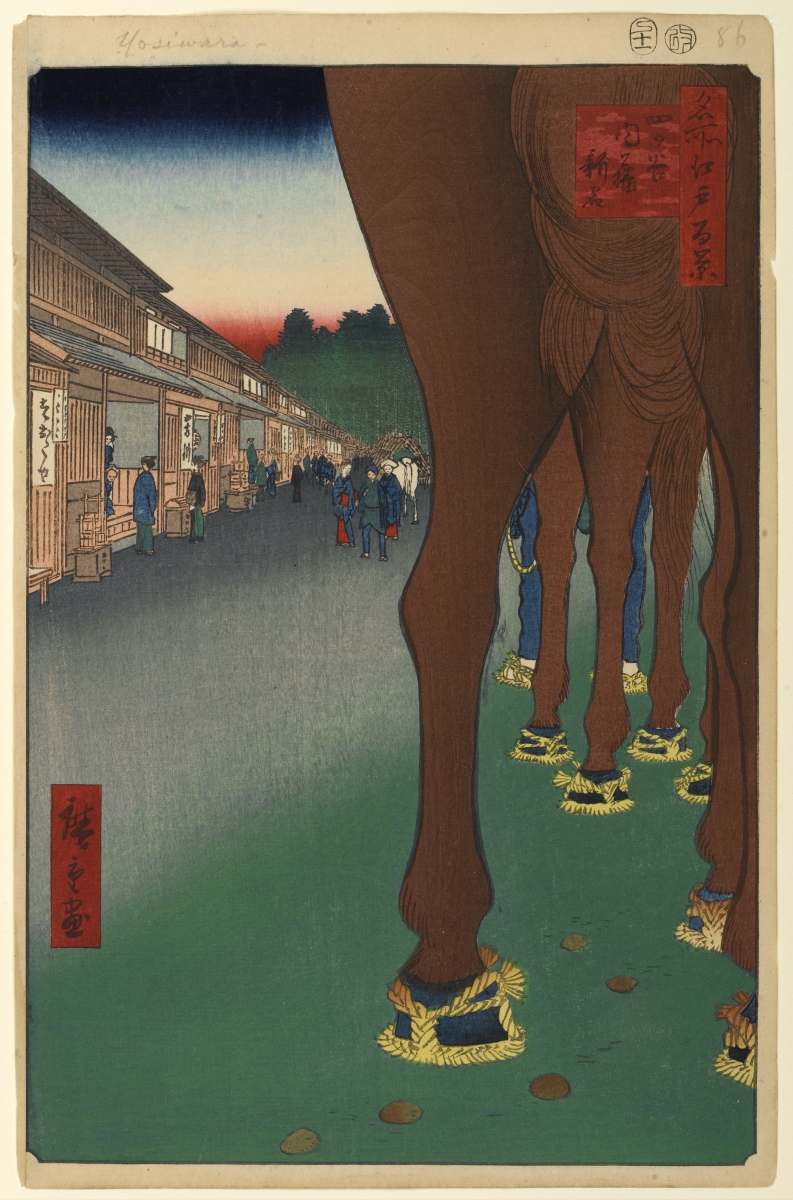
    Ando Hiroshige’s landscape prints often employ traditional Chinese or Japanese techniques, such as the use of mist to separate distant forms and a spatial arrangement where the nearest objects are in the lowest part of the image. However, as Matthi Forrer has written (‘The Art of Hiroshige’), when Hiroshige designed One Hundred Views of Edo (1856-8) he often used Western artists’ repoussoir device of placing large objects in the foreground. For example, in Maple Leaves and the Tekona Shrine and Bridge at Mama the view is framed by tree branches, whilst the Kinryuzan Temple at Asakusa is seen from a doorway with an overhanging lantern. However, it has to be said that the technique was not always successful. There is too much bridge in Nihon Bridge and Edo Bridge and the hanging turtle does not seem to add much to Mannen Bridge and the Fukagawa District. The presence of a large horse’s bottom and droppings in The New Station of Naito at Yotsuya are particularly unfortunate...

    Ando Hiroshige, The New Station of Naito at Yotsuya, 1856-9

    The links here are all to images on a beautiful website, The Woodblock Prints of Ando Hiroshige. I came upon the Hiroshige site by following a link on the excellent Pruned blog. 

    [These images are now more widely available, e.g. on Wikimedia Commons, so I have added two subsequently to this post]