Saturday, February 28, 2015

The evergreen forest seethes and roars

There are still a couple of weeks to see From the Forest to the Sea: Emily Carr in British Columbia, an exhibition I have already referred to here.  It was her paintings of trees that most impressed me and their qualities are well described in Laura Cumming's review:
'Carr paints young pine trees aspiring tall but fragile in the silvery light of dawn, the air scintillating around them like St Elmo’s fire. She paints clearings in the forest where the sunlight is tinged with the deep green of the trees, which spread across the canvas like an all-over Jackson Pollock. An astonishing painting of windswept trees shows the painter’s arm moving round the scene like the wind itself, the forest branches shivering and roaring, the air made visible in a sort of spectral transparence that appears to lie both in and on top of the painting.  As the painter Peter Doig remarks in the catalogue, you don’t just see Carr’s trees, you hear them too.'
This auditory quality is evident in Emily Carr's prose description of the Canadian forest in The Book of Small (1942):
'The silence of our Western forests was so profound that our ears could scarcely comprehend it. If you spoke your voice came back to you as your face is thrown back to you in a mirror. It seemed as if the forest were so full of silence that there was no room for sounds. The birds who lived there were birds of prey -- eagles, hawks, owls. Had a song bird loosed his throat the others would have pounced. Sober-coloured, silent little birds were the first to follow settlers into the West. Gulls there had always been; they began with the sea and had always cried over it. The vast sky spaces above, hungry for noise, steadily lapped up their cries. The forest was different --she brooded over silence and secrecy.'
The Canadian composer and acoustic ecologist  R. Murray Schafer quotes this passage in his book The Natural Soundscape.  Every type of forest, he suggests, produces its own keynote. 
'Evergreen forest, in its mature phase, produces darkly vaulted aisles, through which sound reverberates with unusual clarity – a circumstance which, according to Oswald Spengler, drove the northern Europeans to try to duplicate the reverberation in the construction of Gothic cathedrals. When the wind blows in the forests of British Columbia, there is nothing of the rattling and rustling familiar with deciduous forests; rather there is a low, breathy whistle. In a strong wind the evergreen forest seethes and roars, for the needles twist and turn in turbine motion.  The lack of undergrowth or openings into clearings kept the British Columbia forests unusually free of animal, bird and insect life, a circumstance which produced an awesome, even sinister impression on the first white settlers. ... The uneasiness of the early settlers with the forest, and their desire for space and sunlight, soon produced another keynote sound: the noise of lumbering.'
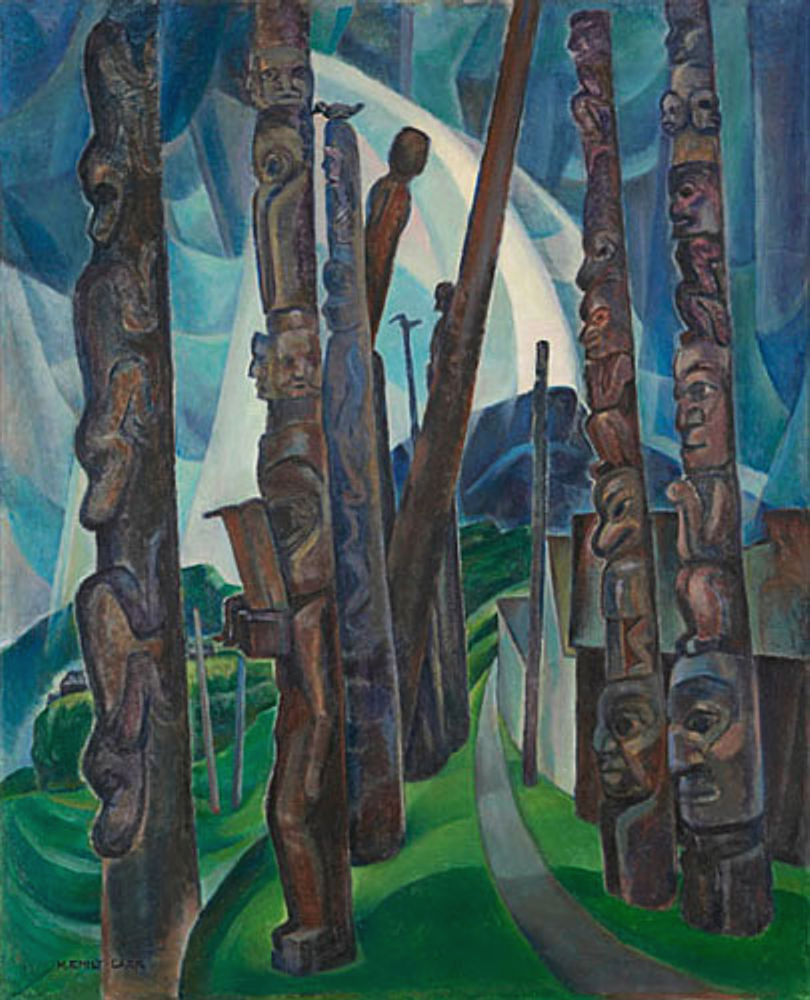
Emily Carr, The Remains of a Forest, 1939
Source: Wikimedia Commons

Friday, February 20, 2015

The Louvre of the Pebble


We were at Kettle's Yard in Cambridge last weekend to see Beauty and Revolution: The Poetry and Art of Ian Hamilton Finlay.  You can read a review of this in the FT and I also recommend a post on Ken Worpole's excellent blog which concludes that Finlay’s great and original achievement was 'the re-inscription of the landscape.'  The exhibition has its origins in the early sixties when the future art historian and promoter of concrete poetry Stephen Bann got to know both Finlay and the owner of Kettle's Yard, Jim Ede.  His catalogue essay makes it all sound rather wonderful...
'I am not able to pinpoint exactly the period when I began to wend my way not infrequently from my room in King's College, University of Cambridge, across the Backs to Kettle's Yard, and to spend the late afternoon drinking tea from Jim's silver bullet teapot.  Certainly by the summer of 1963, this pleasant habit was well entrenched.  Jim wrote to me from Derbyshire to congratulate me on my success in part two of the History Tripos exam, and then surprised me by giving me a small self-portrait by Henri Gaudier-Brzeska (1891-1915) as a twenty-first birthday present.  It was in August of the following year that I made the journey up to Edinburgh to meet Ian Hamilton Finlay...'
Bann traces the subsequent connections between Finlay and Ede: Finlay was interested in Kettle's Yard despite being unable to visit it in person, Ede corresponded with him and went up to visit Stonypath, the garden Finlay began to develop in the late sixties.  Their mutual admiration seems to have been tempered with some aesthetic differences.  In 1972 Bann offered a Finlay piece that he owned to Kettle's Yard but it was politely declined.  He thinks Finlay's use of text may have been a barrier for Ede, although looking round the house I was reminded that it includes a text piece by another artist-poet, David Jones.  Ede rather tactlessly filled one of Finlay's bowls with pebbles, obscuring the inscription, and a few years later Finlay wrote one of his detached sentences: 'Kettle's Yard, in Cambridge, England, is the Louvre of the PEBBLE'.  This was later inscribed onto a flat pebble and acquired for Kettle's Yard, where it can has been placed artfully on a table the colour of driftwood, an ambiguous compliment to a collection Bann believes Finlay always did admire.

Ian Hamilton Finlay and Ron Costley, schiff, 1975
Max Planck institute, Stuttgart

That bowl obscured by pebbles was a version of schiff, in which the German word for ship is reflected to suggest the presence of water. The lettering was designed by Ron Costley, one of Finlay's long-time collaborators, who sadly died earlier this month.  His work in the exhibition includes Prinz Eugen, a print of a ship that is also a tribute to the concrete poet Eugen Gomringer, Sheaves, which I referred to in a post here six years ago, and Spiral Binding, in which a sketchbook is converted into a yacht with such simplicity that it is tempting to try to make a version oneself.  Costley was one of the many designers and makers who helped Finlay develop his garden - the exhibition includes a poetic early film Stonypath Days, showing the garden as it was in 1973 (although the sound was turned so low it was impossible to hear Stephen Bann's occasional comments on the soundtrack).   It would be fascinating to write a book about the independent artistic lives of all Finlay's collaborators, ranging from Patrick Caulfield, subject of a major exhibition at the Tate last year, to my friend Colin's father, who helped Finlay print his poems in the late sixties. 

On returning from Cambridge I read an interesting essay on Ian Hamilton Finlay by Marjorie Perloff, published online in the latest edition of the Battersea Review.  Her discussion of 'Finlayan Translation' refers to several texts that can be read as minimal landscape poems, such as 'Kennst Du', a version of Goethe that I think was in the Kettle's Yard exhibition (it is not listed in the catalogue so I may be misremembering). 'Kennst du daß Land?' (1795), 'notoriously difficult to translate', expresses a longing for the South with its lemons and oranges, where 'a soft wind blows in the blue sky, / The myrtle silent and the laurel high'.  Finlay's 'translation' is a seascape as desirable as Goethe’s Mediterranean landscape, with lemon-shaped fishing boats, orange nets, a salt wind and a fountain of spray.  Goethe ends his poem with the lover's desire to fly south, whereas Finlay asks 'Beloved did you know this sea? / Did you know it well?'  This seems to Perloff more appropriate for Finlay’s late twentieth-century Scotland, 'a cooler, less idealistic form of longing.'

Friday, February 13, 2015

Of Walking in Ice

A few days before Bruce Chatwin's death in January 1989 he asked Werner Herzog to visit him.  They shared a belief in the restorative powers of walking and Chatwin was convinced that Herzog had healing powers.  Too weak now to rise from his bed, Chatwin nevertheless longed to be out on the road again.  Herzog's account of their conversation appears in Nicholas Shakespeare's biography Bruce Chatwin (1999).  'He looked down at himself and he saw the legs were only spindles and he looked at me in this very lucid moment and he said: "I'm never going to walk again." He said: "Werner, I'm dying." And I said, "Yes I am aware of that." and then he said: "You must carry my rucksack, you are the one who must carry it."  And I said: "Yes, I will proudly do that."'

In 1978 Herzog had published a short book, Vom Gehen im Eis (Of Walking in Ice) that had particularly impressed Chatwin.  'At the end of November 1974', Herzog wrote in its preface, 'a friend from Paris called and told me that Lotte Eisner was seriously ill and would probably die.  I said that this must not be, not at this time, German cinema could not do without her now, we would not permit her death.  I took my jacket, a compass and a duffel bag with the necessities.  My boots were so solid and new that I had confidence in them.  I set off on the most direct route to Paris, in full faith, believing that she would stay alive if I came on foot.'  Herzog set off from Munich and arrived twenty days later, exhausted, to sit by her bedside.  Lotte Eisner made a recovery and lived on until 1983. 

I have created a map that tries to give a visual impression of this elemental journey, through snow and ice (white), rain and water (blue), mist and fog (grey) and the occasional burst of sunshine (yellow).  You can click on each square for a short quote from the book and imagine them read in Herzog's familiar voice: 'The snow lies wet on the fields, darkness comes, all lies barren...'  The black circles record the places he found to sleep: a barn, a stable, a few inns, abandoned buildings and empty holiday homes.  It would of course be possible to derive many alternative maps from the text, marking, for example, moments of physical pain and exhaustion, or fleeting, strange encounters with Herzogian characters, or those points in the narrative where the account of his walk dissolves into descriptions of dreams.


'A rainbow before me all at once fills me with the greatest confidence.  What a sign it is, over and in front of him who walks.  Everyone should walk.'
- Werner Herzog, Thursday 5th December, 1974

Monday, February 09, 2015

Picturing Sheffield

When I first started coming regularly to Sheffield in the late nineties it was to work in a building described in Owen Hatherley's The New Ruins of Great Britain (2010) as a 'thrillingly paranoid Cold War megastructure.'  In those days I still carried around strong memories of the traumatic TV drama Threads (1984) in which Sheffield is devastated and plunged into a nuclear winter, a conclusion to the Cold War that seemed a very real possibility then.  The local Town Hall officials in Threads, people like my work colleagues, end up buried alive.  Such extreme fears for the future have come to seem unreal, an old bad dream that is becoming hard to recollect.  Our office moved some time ago to a fresh site at St Paul's Place, built over what had been the New Town Hall extension.  This structure -'the Egg Box', as it was not very affectionately know - had been erected in 1977 with concrete designed to last five hundred years, but only lasted until 2002.  I didn't witness its demolition... but then I had already seen it in ruins, blown apart by the bomb blast in Threads.

Jonathan Wilkinson, The Egg Box, 2007
© the artist

Jonathan Wilkinson's print The Egg Box records the design of this lost building, simplified and extracted from its surroundings and the people who used to work there.  It can be seen on display in the Millenium Gallery, another new building by the Town Hall in the 'Heart of the City' redevelopment. The current exhibition, Picturing Sheffield, includes many such reminders of the city's vanishing architecture.  Next to a painting and photograph of the Kelvin Flats - streets in the sky built in 1967 - there is a case containing artifacts retrieved before the building was pulled down, displayed like archaeological finds: keys, newspaper clippings, an old sign. Castle Market, subject of another Wilkinson print, as well as a painting called Elvis at Castle Fish Market, was still open but under threat when The New Ruins of Britain came out. 'The recession has given it a stay of execution likely to last a couple of years.  Get there while you can: nothing like it will be built again.'  It was demolished in 2013.

Henry Rushbury, Snig Hill from Angel Street, 1941
© the artist's estate

Sheffield always seems to be in a state of flux.  William Boden's watercolour snapshots painted in 1903 record views that no longer exist: Gilbert Street - 'these houses and this passage way have been demolished'; steps leading to Arundel Lane - 'this area has since been redeveloped and looks markedly different'; the Sheffield Canal Basin - now 'converted into luxury flats looking out over the water.'  Even as he worked Boden knew the city was ever-changing; painting the Pheasant Inn Yard he noted that it was about to be demolished.  The Sheffield Blitz, just two nights of bombing in December 1940, left 78,000 houses damaged.  Henry Rushbury's Angel Street from Snig Hill, Sheffield shows its aftermath, a scene of smouldering rubble hosed down by a group of soldiers. Derrick Greaves' painting of the city is a composite portrait in industrial greys and austerity browns, executed at a time when the war damaged areas were being cleared for the new housing and offices that have now been removed and replaced again.

Derrick Greaves, Sheffield, 1953
© Derrick Greaves, courtesy James Hyman Gallery, London

This sense of constantly forging a new urban environment resonates with the image of a steel industry which began here in the eighteenth century, at around the same time as the first images of the city.  However, alongside work with titles like Men Seated Around a Fire in a Grinding Shop and Rebuilding a Blast Furnace the exhibition includes several paintings where traces of industry are hard to discern.  In early views Sheffield is still relatively small - in Turner's watercolour it could almost be a rural village, dominated by its church.  In the nineteenth century it could still be painted as a rural idyll with green pastures flanking the river Don and cattle drinking from a pool at Hillsborough. But as the city grew it seems to have been harder to find vistas and scenes that would appeal to prevailing tastes.  Bill Brandt's photograph Misty Evening in Sheffield is no more than an abstract detail, and its 'mist' is probably industrial fog. 

J.M.W. Turner, View of Sheffield from Derbyshire Lane, 1797
© Guild of St George & Museums Sheffield

Is Sheffield Ugly? asked Harold Coop in his 1926 painting. Owen Hatherley argues that post-war architecture here made great use 'of the thing that makes Sheffield truly special - its landscape.  Practically any view here provides you with a photogenic picture of either a cityscape or the Peak District.'  Looking around this exhibition on my most recent trip to Sheffield I got a real sense of this - it would be hard for this city, framed by its green hills, to be 'ugly', even though Hatherley finds little to admire in its newer buildings.  Back across the square from the Gallery, I looked out from our office over the city at the patterns of buildings stretching away beyond the Town Hall.  On the distant high ground beyond, patches of snow shone in the afternoon sun.

Friday, January 30, 2015

Cha-atl

Emily Carr, Kitwancool, 1928

'Emily Who? Outside Canada, no one’s ever heard of Emily Carr, the iconic landscape painter whose remarkable career spanned the first half of the 20th century.'  This is the Telegraph's Richard Dorment introducing the Dulwich Picture Gallery's current exhibition, 'From the Forest to the Sea: Emily Carr in British Columbia'.  If, as he and other reviewers have pointed out, her paintings are underappreciated here in Britain, her award-winning memoir Klee Wyck (1941) may be even less well known.  This book brought Carr belated public attention at the end of her life and helped shape the image of her for Canadians: 'the intrepid pioneer woman who fearlessly travelled into the wilderness, lived among the native people, recorded their lives and, more to the point, portrayed the spirit of the land they inhabit.' (Karen Wright).  Its text is freely available at Project Gutenburg and I am including below an extended quotation from Chapter 13 which shows how prose allowed Carr to capture the sounds and smells of the landscapes she went out to sketch.    
'Jimmie, a Haida Indian, had a good boat, and he agreed to take me to Cha-atl, so he and his wife Louisa, Maria and I all started off in the boat. I took my sheep dog and Louisa took her cat.

We made a short stop at a little island where there were a few totem poles and a great smell because of all the dogfish thrown up on the beach and putrefying in the sun. Then we went on till we got to the long narrow Skidegate Inlet.

The tips of the fresh young pines made circles of pale green from the wide base of each tree to the top. They looked like multitudes of little ladies in crinolines trooping down the bank.

The day was hot and still. Eagles circled in the sky and porpoises followed us up the Inlet till we came to the shallows; they leaped up and down in the water making a great commotion on both sides of our boat. Their blunt noses came right out of the water and their tails splashed furiously. It was exciting to watch them.

It took Jimmie all his time in the shallows to keep us in the channel. Louisa was at the wheel while he lay face down on the edge of the boat peering into the water and making signals to Louisa with his arms.

In the late afternoon, Jimmie shut off his engine and said, "Listen."

Then we heard a terrific pounding and roaring. It was the surf-beat on the west coast of Queen Charlotte Islands. Every minute it got louder as we came nearer to the mouth of the Inlet. It was as if you were coming into the jaws of something too big and awful even to have a name. It never quite got us, because we turned into Cha-atl, just before we came to the corner, so we did not see the awfulness of the roaring ocean. Seamen say this is one of the worst waters in the world and one of the most wicked coasts.

Cha-atl had been abandoned a great many years. The one house standing was quite uninhabitable. Trees had pushed the roof off and burst the sides. Under the hot sun the lush growth smelt rank.

Jimmie lowered the canoe and put Billy, the dog, and me ashore. He left the gas boat anchored far out. When he had put me on the beach, he went back to get Louisa and Maria and the things. While I stood there that awful boom, boom, seemed to drown out every other thing. It made even the forest seem weak and shivery. Perhaps if you could have seen the breakers and had not had the whole weight of the noise left entirely to your ears it would not have seemed so stunning. When the others came ashore the noise seemed more bearable.

There were many fine totem poles in Cha-atl - Haida poles, tragic and fierce. The wood of them was bleached out, but looked green from the mosses which grew in the chinks, and the tufts of grass on the heads of the figures stuck up like coarse hair. The human faces carved on the totem poles were stern and grim, the animal faces fierce and strong; supernatural things were pictured on the poles too. Everything about Cha-atl was so vast and deep you shrivelled up.

When it was too dark to work I came back to the others. They were gathered round a fire on the beach. We did not talk while we ate; you had to shout to be heard above the surf. The smell of the ocean was very strong.'
The 1941 edition

Friday, January 23, 2015

From pastoral ruin to pastoral ruin


The amphitheatre, Caerleon, August 2014

In Wales last summer we visited the remains of Caerleon, the City of the Legions.  Charlotte Higgins stopped there too in her journey round Roman Britain, Under Another Sky, and describes it in a wonderful chapter on 'Wales and the West' that she structures around the life of archaeologist Mortimer Wheeler.  His illustrious career began at Wroxeter, working in the summers before the First World War on the old Roman town of Uriconium.  Wilfred Owen, who wrote 'Uriconium: An Ode' in 1913, was fascinated by these ruins and probably saw Wheeler digging there.  Higgins wonders if the poet might have done something related to archaeology himself if he had survived the war.  Owen missed out on UCL where he would have been an undergraduate contemporary of Tessa Verney, who married Wheeler in 1912 and became a prominent archaeologist in her own right.  It was she who led the excavation of the impressive amphitheatre at Caerleon.  Ten years later, in 1936, the Wheelers were at Maiden Castle (which is where, years ago, I took the photograph of a line in the grass that I has served as a background for this blog).  Mortimer Wheeler left temporarily for a trip to the Levant and on his way back, flicking through a paper in Paris, came upon his wife's obituary.  The shock of her sudden death is described out of sequence in Wheeler's memoirs, alongside an account of his traumatic experiences at Passchendaele.  Of the five student archaeologists at Uriconium, Wheeler had been the only one to make it home from the war.  Back at Maiden Castle he resumed work and uncovered a collection of graves.  It seemed to him that he had found an ancient war cemetery.  Surely, he wrote, 'no poor relic in the soil of Britain was ever more eloquent of high tragedy.'

This chapter of Under Another Sky traces other connections between war and poetry and ruins: through A. E. Housman for example, Wheeler's classics tutor at UCL, whose book A Shropshire Lad was popular with soldiers in the trenches.  In his poem 'On Wenlock Edge' the wind blows over the land, indifferent to history, while the Romans who once stood there 'are ashes under Uricon.'  The Romans themselves saw that time would eventually leave nothing behind but shattered walls.  Charlotte Higgins quotes Book 8 of The Aeneid in which Aeneas and his companions, survivors of the Trojan War, encounter a king who shows them the ruins of ancient buildings and the wooded hills on which Rome will one day rise.  In these lines, 'Virgil is giving the topography of Augustan Rome a numinous aetiology, suffusing its everyday modernity with the mythical.'  The king leads Aeneas through what will be, in Virgil's time, the centre of the city. ''Everywhere they saw herds of cattle lowing in the Roman forum and the smart Carinae'. Virgil lets time collapse here, such that for a moment his contemporary readers would have been given the head-spinning image of cattle roaming the streets of their own busy city - a kind of double exposure, past and present in the same frame.  Reading these lines in the twenty-first century, there is a different frisson again: the oleander- and cypress-fringed Forum of our day is once more empty but for tourists and old stones ... Time has come full circle: from pastoral ruin to pastoral ruin.'

The Forum, Rome, April 2014

Thursday, January 22, 2015

Imitations of the pasture

J. M. W. Turner, The Deer in Petworth Park, 1827
 
In The Theory of the Leisure Class (1899) Thorstein Veblen argued that different views of what is beautiful reflect a 'code of reputability' that varies between classes, and the leisure class will not value things on the basis of mere utility.  When it comes to landscape, the close-cropped lawn appeals on an atavistic level, 'beautiful in the eyes of a people whose inherited bent it is to readily find pleasure in contemplating a well-preserved pasture or grazing land.'  But it would lose its beauty for the leisure class if it were genuinely productive, or gave that impression.  In particular,
'the vulgar suggestion of thrift, which is nearly inseparable from the cow, is a standing objection to the decorative use of this animal. So that in all cases, except where luxurious surroundings negate this suggestion, the use of the cow as an object of taste must be avoided. Where the predilection for some grazing animal to fill out the suggestion of the pasture is too strong to be suppressed, the cow's place is often given to some more or less inadequate substitute, such as deer, antelopes, or some such exotic beast. These substitutes, although less beautiful to the pastoral eye of Western man than the cow, are in such cases preferred because of their superior expensiveness or futility, and their consequent repute. They are not vulgarly lucrative either in fact or in suggestion.
Public parks of course fall in the same category with the lawn; they too, at their best, are imitations of the pasture. Such a park is of course best kept by grazing, and the cattle on the grass are themselves no mean addition to the beauty of the thing, as need scarcely be insisted on with anyone who has once seen a well-kept pasture. But it is worth noting, as an expression of the pecuniary element in popular taste, that such a method of keeping public grounds is seldom resorted to. The best that is done by skilled workmen under the supervision of a trained keeper is a more or less close imitation of a pasture, but the result invariably falls somewhat short of the artistic effect of grazing. But to the average popular apprehension a herd of cattle so pointedly suggests thrift and usefulness that their presence in the public pleasure ground would be intolerably cheap. This method of keeping grounds is comparatively inexpensive, therefore it is indecorous.'

William Merrit Chase, View from Central Park, 1889

Friday, January 16, 2015

The North Cape


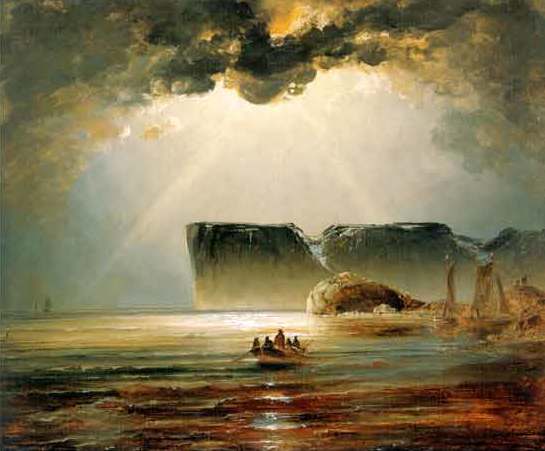
 Peder Balke, The North Cape, c.1840

There are still four months to see the fascinating Peder Balke exhibition currently on at the National Gallery.  I have written about him on this blog before - in Landscape from Finnmark I highlighted the trip he made in 1832 beyond the North Cape and in Gausta Peak I focused on the way his reputation has risen as critics and collectors have come to view his later work in the light of Modernism. This exhibition shows how often the artist returned to his memories of the North, adding strange light effects or reducing the motif to a bare abstract form.  As Christopher Riopelle writes in the catalogue, 'the cape's angular notched profile is as distinctive as Paul Cézanne's Mont Sainte-Victoire. The experimental side of Balke is also evident, particularly in a group of ghostly monochrome sketches lent by the Daniel Katz gallery (they recently donated a Balke to the Gallery's permanent collection).  With their thin washes worked over with fingers and comb such works have, according to Riopelle, particularly caught the attention of collectors, 'so intriguing are the processes of their making and so remarkable the powers of evocation they employ in such small compass.'

Peder Balke, Northern Lights over Coastal Landscape, 1870

Looking back at the notes I made at the exhibition in November I see I disliked some paintings that now look good to me in the catalogue - probably something to do with the thinness, dullness and age of the paint when viewed up close.  But I was particularly excited by the way some of Balke's coastal landscapes, with their high peaks floating over empty clouds, resembled Chinese ink paintings.  Riopelle refers to this in his essay: 'spared areas magically summon up complicated motifs like waterfalls, or receding mountain ranges, or trails through fields and up hillsides, along which the eye, like a Chinese scholar on a contemplative stroll through his garden, can freely roam.'  In his review of the exhibition Alastair Sooke complains that scholars haven't done more to find out whether Balke was aware of Chinese art, although Friedrich and Turner are a more obvious starting point for seas of fog and mountains shrouded in mist.

Anders Fredrik Skjöldebrand, Arrival at the North Cape (18th-19th July 1799), 1801-2

In addition to Riopelle's reflections ('Balke / London / Then / Now') the catalogue has a biographical essay by Marit Ingeborg Lange based largely on Balke's own memoirs, which it would be fascinating to read (they have not even been fully published in Norwegian). There is also a short piece by Knut Ljøgodt, Director of The Northern Norway Art Museum in Tromsø, which discusses Balke in relation to the 'artistic discovery of Norway'.  This began with the Danish painter Erik Paulsen, who travelled to Norway in 1788, and was followed by others, including the leading Norwegian painter Johan Christian Dahl, who would become a supporter of Balke.  Northern Norway first appears in an engraved travelogue (see above) and later became a recurring theme for a contemporary of Balke's, Knud Baade, who made the journey to Nordland in 1834.  Balke's journey two years earlier was the furthest north any Norwegian artist had gone.  In this paragraph quoted by Lange he has found respite from a storm-tossed sea at Vardøhus Fortress.
'The day after our arrival at Vardø I crossed the island for a good view of the sea breaking against the cliffs after the previous day's hurricane, and the magnificent sight that manifested itself to my scrutinizing gaze will never fade from my memory.  I had positioned myself on a rocky plateau some 100 feet above the sea, and I felt I had to hold on tight to the cliff when the backwash hurled itself against the rock face and with a deafening sound like thunder rolled out again into the heaving sea, only to repeat the same fruitless onslaught on the unshakeable wall around which swirled the mighty waves of the Arctic Ocean.'
Peder Balke, Vardøhus Fortress, 1870

Friday, January 09, 2015

Hunger Mountain


In the clip I've embedded above, David Hinton introduces his book Hunger Mountain (2012)The eponymous peak is in Vermont, where Hinton lives and works on the translations of Chinese poetry often referred to here (see for example this post from 2006: 'Lit dew shimmers').  Hunger Mountain uses walks on the mountain to frame a discussion of the 'spiritual ecology' he has found in the old poets and philosophers. It begins with the notion of 'sincerity', expressed as a character that combines a person standing and words rising from a mouth.  Although he doesn't mention it, this Confucian term is also the first Chinese character in The Cantos, where Ezra Pound applies it in praise of the sixth US president John Quincy Adams.  Hinton uses it to discuss 'a more fundamental sense of sincerity as an identification of outside and inside', a deep feeling of belonging to the cosmos.  This is evident, for example, in Tu Fu's poem 'Moonrise' (a different poem to 'Full Moon', which I quoted here in an earlier post on moonlit landscapes). 'Moonrise' doesn't simply project an emotion into the landscape, it describes a fundamental identity between the poet and the world. By the time Tu Fu wrote his poem, the character for 'friend' was being written as it still is as two moons side by side (below).  Hinton sees a form of 'friendship' in the way Tu Fu, his modern reader and the wider cosmos are united through contemplation of the moon.


The idea that consciousness is like a lake or mirrored pool is common in Chinese literature.  One of the four masters of southern Sung poetry, Yang Wan-li, wrote of the lake's 'mind': a gaze 'holding the mountain utterly.'   The character for mind is derived from the image for a heart, suggesting that thinking and feeling are deeply connected.  'Thinking' is written as this symbol for heart-mind underneath the character for 'fieldland'.  'Feeling' is a stylized version of the heart-mind symbol written next to the character for the blue-green of landscape.  In light of this it seems unsurprising that poets expressed themselves by writing directly about nature.  Hunger Mountain is quite dense in places with speculations on the connection between language and natural processes, something that has fascinated poets since Ezra Pound published Ernest Fenollosa's The Chinese Written Character as a Medium for Poetry in 1918.  It is a subject I have written about here before in connection with Cecilia Lindqvist's wonderful book China: Empire of Living Symbols.  The extent to which these ideas are widely accepted is something I am not qualified to judge, but they are certainly inspiring to read about.

It remains possible that even poetry drawn directly from the the rivers and mountains will be a kind of barrier.  Hinton talks about the risk that ultimately 'we can say nothing about the world without creating in some sense a breach between consciousness and landscape'.  In one of his many wine poems the poet T'ao Ch'ien, discussed in an earlier post here, wrote that whenever he started trying to explain Lu Mountain, 'I forget words altogether'.  Lu Mountain is the range of peaks that have been central to Chinese landscape poetry (the subject of another post here). Throughout the book Hunger Mountain stands in for Lu and Hinton tries to learn, like the poets, from his frequent walks to the summit. Su Tung p'o, who came to Lu seven centuries after T'ao Ch'ien, stayed at the East Forest Monastery, but said he learnt more from the mountain's streams and mirrored pools.
'Su Tung p'o established himself as a master of Tao's mental dimensions when he described flowing waters as the form of mind negotiating the exigencies of life, a spontaneous and crystalline responsiveness working its way through, taking shape according to whatever it encounters.  This is mind moving through the occasions of its attention like water through stones and branches and colourful leaves, adapting itself to the forms it encounters, becoming sometimes loud and othertimes silent, sometimes seething with light and other times lost in shadow.'
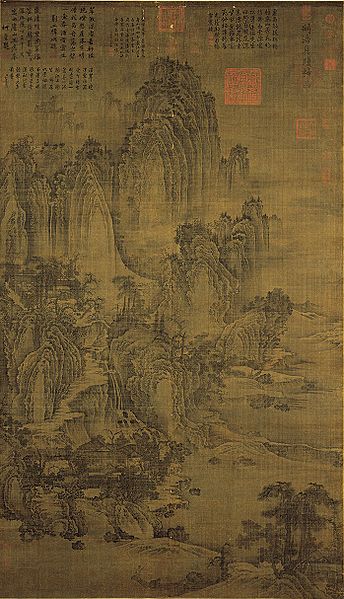
Attributed to Jing Hao, Mount Lu, c.900

Friday, January 02, 2015

River Man


I was given a handsome new book for Christmas, Nick Drake: Remembered for a While.  It is made up of miscellaneous writings, interviews, letters, diary excerpts and photographs from the Nick Drake archive. For me, the most charming essay is by Danish poet Gorm Henrik Rasmussen, who came over to England to interview Nick Drake's parents in 1979 and left with a tape of early unreleased recordings and an overriding impression of their kindness.  Rodney Drake went to the trouble of picking him up and driving him through the Warwickshire countryside under a cloudless November sky to the family house at Tanworth-in-Arden.  The first thing they did was to look round the garden that had been a source of solace to Rodney during Nick's depression, but which had also been the scene of happier childhood days.  Rasmussen describes the way this garden 'opens onto a hilly landscape, cut across with creeks; stubble fields, moss-grown stone fences, little copses and meadows as far as the eye can see.  I try to imagine what it must have been like to grow up here.  Boys need a lot of space to romp about in.  If I were a songwriter and my point of origin was this spot, the likelihood would be that words such as 'sky', 'sun', 'rivers', 'leaves', 'wind' and 'grass' would slip into my vocabulary with the same ease as moving one's feet or drawing a breath.'
'Black days of winter all were through
The blossoms came and they brought you' 
These simple lyrics are from the opening of 'Blossom Friend', one of the Nick Drake songs that Rasmussen had not heard before that day.  Leafing now through the handwritten lyrics reproduced in this book I see that the cycle of the seasons featured in three other early compositions, 'Rain', 'Blue Season' and 'Time Of No Reply.'  In his long essay 'Exiled from Heaven', the late Ian McDonald wrote of Nick Drake's literary influences and one of his speculations leapt out at me, as it mentions two of my favourite books.  'Drake may have derived this haiku-like simplicity from books on the shelves of every hopeful young writer in the mid-Sixties: The Penguin Book of Japanese Verse and Basho's The Narrow Road to the Deep North.'  It would be fascinating to know more about what Nick Drake had been reading when he composed his songs.  In another of the book's essays, Will Stone wonders whether he might have encountered in translation the visionary German poets Hölderlin and Trakl.  What we do know is that he was influenced by William Blake, a writer he studied at Cambridge and apparently came to regard as 'the only good English poet'.


As Ian McDonald says, 'it's crucial to recognise that Drake was not a poet and that it's misleading to treat his lyrics as verse.'  But the teenage Nick Drake did try his hand at poetry and there are a couple of examples reproduced from his days at Marlborough College.  The book also has a photograph of a school notebook in which he has written out Robert Southey's onomatopaeic waterfall poem 'The Cataract of Lodore' (1820).  I wrote about this poem here a couple of years ago and said 'if you converted the rhythms and rhymes of this poem to music, you might hear echoes of the way water sounds change as they cascade down the rocks'. Perhaps similar thoughts occurred to Nick Drake?  One of the most admired songs, on his first album, 'River Man', seems to evoke the flow of water.  Folk singer Robin Frederick puts it this way her contribution to the book.
'By writing a song about a river that is based on groups of five beats (5/4), Nick subtly conveys the feeling that there's an extra beat, one that spills over into the next group of beats, pulling you forward, like the momentum of a river current ... Everything is in wave-like motion, everything is flowing with a rhythmical, swaying feel that literally picks you up and carries you down the river.'


Sunday, December 28, 2014

The morning and I meet up again

After many leaden days in London there was a bright sun rising over the rooftops this morning.  It seemed a good moment to listen to Alice Oswald's dawn poem 'Tithonus' on the BBC iPlayer (still available for another four weeks).  This was a shortened version of the performance we went to see back in October at the Queen Elizabeth Hall:
'The world premiere of a specially commissioned new poem, read by the poet herself.
In Greek mythology, the Dawn fell in love with Tithonus and asked Zeus to make him immortal, but she forgot to ask that he should not grow old.  Unable to die, he grew older and older, until at last Dawn locked him in a room where, several thousand years later, he still sits babbling to himself.  This is an account of his babbling, written in real time, through a series of dawns from spring to midsummer 2014. It is a poem about survival.
The performance begins in darkness and lasts 46 minutes (the length of dawn in midsummer).'
Looking back on Twitter for my instant verdict then, I see I said "Alice Oswald performing her dawn poem Tithonus last night reminded me of Patti Smith (if she'd done Classics and lived in Devon)."  I was thinking about the similarities in the way they perform their poetry over music, holding you from the start and building to a point where language starts to overflow and key phrases turn into a refrain (I wrote here a few years ago about a Patti Smith performance like this, a tribute to W. G. Sebald).  At the same time I was conscious of the differences - Patti Smith's rock & roll romanticism and New York drawl contrasting with Alice Oswald's classical learning and precise diction.  The comparison feels less obvious with this new radio version, which had slightly less time for the impressive nykelharp accompaniment of Griselda Sanderson and cut the later part of the poem where poor babbling Tithonus repeats the same lines over and over.  However, listening to it rather than experiencing the performance focused my attention much more on the words of the poem itself.  Here are a few from 12 minutes in (I am transcribing from the broadcast so do not have the line breaks); a vision of the coming dawn: 
'...the wood still lost in its inmost unable.  And mist forms an orderly queue for the horizon.  Green ropes of wind.  White silks of field.  And buried under several feet of colour, the eyes can never quite see out, but it is glittering now in the gaps between things.  And a thistle begins to be properly named and certain of its spikes.  What a chandelier of dock flowers dangles from the ground inverted.  So the morning and I meet up again, but not on talking terms.'
Waking up this morning

Friday, December 26, 2014

Various sorts of landscapes with fine histories composed therein

Joannes and Lucas van Doetecum after Pieter Bruegel the Elder,
Magdalena Poenitens (Penitent Magdalene), ca. 1555–56
Engraving in the Metropolitan Museum of Art

In sixteenth century Antwerp there was a shop selling prints with the lovely name, Aux Quatre Vents. It was set up by by Hieronymus Cock in 1548 and run with his wife, Volcxken Dierix, who continued the business for thirty years after Cock's death in 1570.  They were highly successful, as might be inferred from their motto, 'let the cock cook what the people (volcx) want'. The great Pieter Bruegel came to work for Cock at the start of his career, in the mid 1550s, and designed a series of twelve Large Landscapes based in part on what he had observed during his recent travels over the Alps and in Italy.  As the Met site notes, these engravings (actually executed by the brothers Joannes and Lucas van Doetecum), 'among the most widely circulated and celebrated of Bruegel's images, allowed a large audience to become acquainted with his strikingly naturalistic and broad-eyed conception of landscape.'  The British Museum has the only surviving drawing for these etchings (below) - its odd title may be a mistake in Latin for the more appealing sounding Solitudo Rustica ('Rustic Solitude').

Pieter Bruegel the Elder, Solicitudo Rustica (Country Concerns), ca. 1555
Drawing in The British Museum - Wikimedia Commons
 
Hieronymus Cock, View of the Colosseum, 1551 
Engraving in the Museum Boijmans Van Beuningen, Rotterdam - Wikimedia Commons

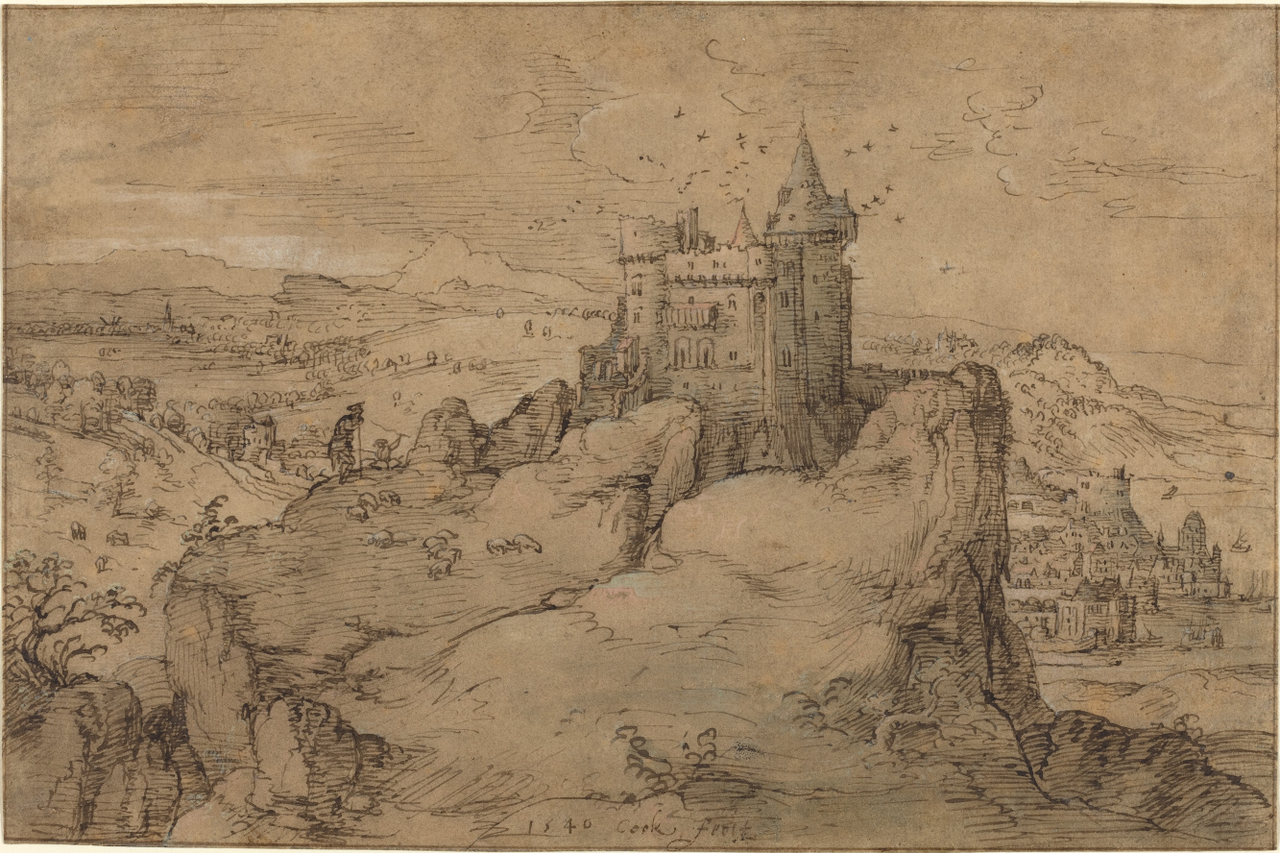
What could a customer of Aux Quatre Vents have purchased?  Cock himself designed a series of topographical engravings of Roman sites based on his own time there (1546-8) and they may have influenced Bruegel in paintings like The Tower of Babel (the walls of which are reminiscent of the Colosseum). Last year's exhibition on Hieronymus Cock in Leuven included (according to Jamie Edwards of the University of Birmingham) a monumental monograph on the Baths of Diocletian, 'the very first published architectural monograph of its kind, which is staggering for both its physical size and its visual richness.'  Cock also printed a series based on drawings by his older brother Matthys, Various sorts of landscapes with fine histories composed therein, from the Old and New Testaments, and several merry Poems, very convenient for painters and other connoisseurs of the arts (1558). Matthys was later included (with his brother) in the canon-forming collection of twenty-three portraits of 'celebrated painters of Lower Germany' by Dominicus Lampsonius, published by Volcxken Dierix in 1572.   The Latin poem underneath includes a pun on the word 'Cock': 'Tu quoque, Matthia, sic pingere rura sciebas, / Ut tibi vix dederint tempora nostra parem.' ('You too, Matthias, knew how to paint fields in such a way, that our age has scarcely produced your equal.')

Matthys Cock
This engraving is from the 1612 expanded version (69 portraits) by Hendrik Hondius I

Matthys Cock, Landscape with Castle above a Harbour, 1550
Drawing in the National Gallery of Art, Washington - Wikimedia Commons

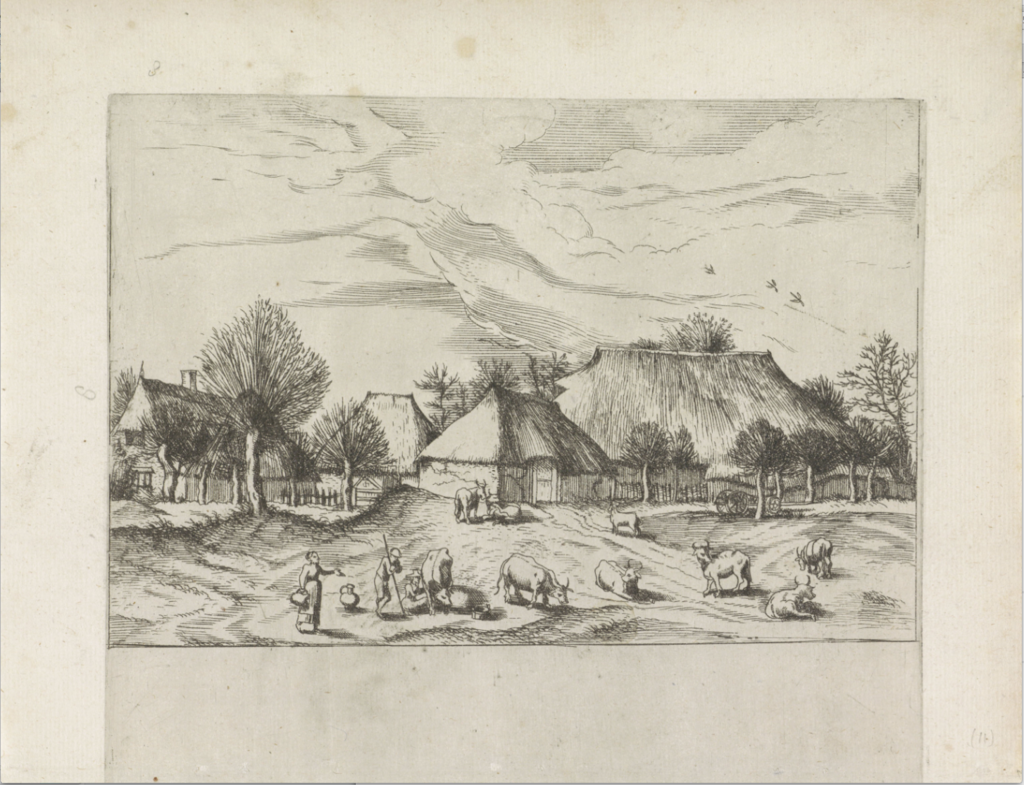
Perhaps the most intriguing Aux Quatre Vents productions on a landscape theme appeared in 1559 and 1561.  Their artist is unknown and has come to be known as the Master of the Small Landscapes.  He is credited with turning painters away from the panoramic 'world landscapes' of Joachim Patinir (c. 1460-1524) to the kind of modest scenes familiar to us from seventeenth century Dutch art.  This influence spread through a 1612 set of engravings produced in Amsterdam by Claes Jansz. Visscher (it has been argued that they would have provided buyers with a nostalgic view of the Brabant countryside prior to the revolt of the Seventeen Provinces, territory that had recently been ceded to the Spanish).  But who was the original Master?  The Visscher prints were credited to Bruegel but various other contenders have been proposed.  Was it the relatively obscure Joos van Liere?  Or Cornelis Cort, who worked for Cock and was named as the prints' author in a 1601 re-issue?  Or Hieronymus Cock himself?  It is not impossible that one day scholarly detective work will reveal a hitherto unknown independent landscape artist...

The Master of the Small Landscapes, Landscape with farms and a herdsman, 1559-61
Engraving in the Rijksmuseum - Wikimedia Commons

The Master of the Small Landscapes, Village view, late 1550s
Drawing in the Stichting Museum Boymans - Wikimedia Commons

Saturday, December 20, 2014

Factory chimneys across the River Eden


When we visited Aix-en-Provence and Mont Sainte-Victoire, a couple of years before France adopted the Euro, it was mildly gratifying to be able to pay for things using Paul Cézanne banknotes.  At that time the 50 Franc notes honoured another of my heroes, Antoine de Saint-ExupéryThe 20 Franc Debussy notes featured landscapes on both sides: a stormy sea representing La Mer, and scenery for Pelléas et Mélisande (1902), originally painted by Lucien Jusseaume and Eugène Ronsin.  I suppose the Euro notes that replaced these might be seen as having a tangential landscape association, but the bridges on them are really generic symbols rather than specific landmarks (unlike the original designs which included the Rialto Bridge in Venice and the Pont de Neuilly in Paris).  Bridges are popular currency motifs - outside the Eurozone Denmark uses them and here in Britian we can spend five different Bank of Scotland notes, ranging from the 14th century Brig O'Doon (£5) to the Kessock Bridge, completed in 1982 (£100).


Another landscape painter honoured on a banknote is Edvard Munch - he appears with his painting, The Sun on Norway's 1000-kroner note.  There has been a lot of praise this year for the new Norwegian note designs ('the world's coolest currency' according to Slate).  The original Snøhetta Design idea was to pair black and white coastal photographs with pixelated colour versions.  The Norges Bank has kept the pixels but gone for more traditional images on the obverse.  Personally I am even more envious of the new Norwegian passports, designed by Neue, which the Guardian described as 'beautifully simplified depictions of Norway’s natural landscapes drawn with fine lines in pastel shades ... When shone under UV light, the landscapes within the pages transform to show the northern lights in the night sky, a magical touch that adds a deeper sense of intrigue to the already striking document.'


Of course there are many examples of landscapes on banknotes, from the dramatic mountains of Guilin on China's 20 yuan, to the Ulster Bank's vignette's of the Mourne Mountains, Giant's Causeway and Queen Elizabeth Bridge (another one...)  There was a time when individual banks in England as well as other parts of the British Isles issued their own notes. The British Museum site explains how these became increasingly sophisticated in the nineteenth century with the use of steel engraving:
'Printers such as Perkins and Heath in London and W.H.Lizars in Edinburgh exploited this potential to produce exquisite banknote designs combining dazzling machine-engraved patterns – a trademark of Perkins’ firm – with delicate hand-engraved figures and rural scenes that reflected a growing taste for romantic landscape, evident in the popularity of topographical prints, watercolours and poetry. A wonderful note of the Carlisle City and District Banking Company carries a panoramic view of the city with its castle, cathedral, houses and factory chimneys across the River Eden; people stroll in fields in the foreground, while on the far bank cattle are wading and a line of washing is hanging out to dry.' 
This kind of local pride expressed through banknotes seems remote in the era of e-commerce and bitcoins.  Will physical money last any longer than passports or stamps?  I have written here before about landscapes on stamps, which represented the beauty and productive potential of far flung imperial territories.   It would be interesting to compare the iconography of banknotes, which represent financial geography, with stamps that link territories together.  Clearly a lot of thought goes into what they show as well as the ways in which they resist counterfeiters.  The Bank of Canada museum, for example, quotes an internal memo from 1954: 'the traditional ornamentation of bank notes reflects a ‘Victorian’ taste in design….derived from times associated with an immature, colonial status.'  Instead,
'officials at the Bank wanted the notes to feature images of Canadian landscapes that showed little or no evidence of human activity. They chose the final 8 images from over 3,000 photographs supplied from the collections of railways, archives and news agencies. From the Maritimes, through Eastern Canada, the Prairies, the Rockies and the North, what resulted was an extended portrait of The Great Lone Land vision of Canada. This vision was already out-dated, but served as the natural starting point for an evolving manifestation of official identity that would be played out on all future bank notes.'
Bank of Canada 1954 note showing Okanagan Lake in British Columbia, 
engraved by William Ford of the American Bank Note Company

Earlier this year the Huffington Post reported on calls to have a woman on Canadian notes for the first time - their suggestions include Margaret Atwood, Emily Carr (the subject of a retrospective at Dulwich Picture Gallery that I'll probably be writing about here soon) and, er, Shania Twain ("Canadian country and pop music star, famous for hits such as 'Man! I Feel Like a Woman.'")  Over here there was controversy recently at the announcement that a man (Churchill) would replace a woman, Elizabeth Fry, on the £5 note, until the Bank of England said it was planning to balance things out with Jane Austen on the next £10.  I'll end here on an Icelandic note with another landscape painter, Johannes Sveinsson Kjarval, depicted on the 2000 Kronur.  Björk, who will surely feature on the Icelandic currency herself before too long, named an instrumental after him on the album she recorded as an eleven-year-old in 1977.

Saturday, December 13, 2014

Become Ocean

This time last year I wrote a lengthy (for this blog) survey of landscape and music in 2013 (following similar but shorter posts in 2010, 2011, 2012).  Here due to pressure of time I will revert to something much less ambitious and highlight just four releases, beginning with the winner of the Pulitzer Prize, Become Ocean, by John Luther Adams.  I wrote a post about Adams here in 2010 and last year I mentioned a recording of his composition Inuksuit.  The Pulitzer jury described Become Ocean as 'a haunting orchestral work that suggests a relentless tidal surge, evoking thoughts of melting polar ice and rising sea levels.'  In a New Yorker review of its première, Alex Ross explained that it has the structure of a palindrome.  'One mystery of Become Ocean is how different the material often sounds during the second half of the palindrome. The section after the first climax is thick with minor chords, particularly in the brass. Somehow, as these chords loom again during the buildup to the final climax, they take on a heavier, more sorrowful air. There is a sense of unwinding, of subsiding, of dissolution. I thought of Matthew Arnold’s “melancholy, long, withdrawing roar,” and also of the line that the earth goddess Erda utters in the Ring: “Everything that is, ends.”'


J.M.W. Turner has been hard to avoid in 2014.  I've not yet got myself to a cinema to see Mr Turner but did write here recently about the Late Turner exhibition and the Turner-inspired colour experiments of Olafur Eliasson.  In last year's music round-up I mentioned Burkhard Stangl's Unfinished. For William Turner, painter and this year I can refer you to Robert Curgenven's album Sirène, which includes a track referencing the famous story of Turner strapped to the mast in a snow storm (an episode recreated in Mike Leigh's film).  Rob St. John thinks a 'comparison might be made between Turner and Curgenven in the way that their work evokes – in texture, tone and colour – abstractions of the natural world: in this case the power and unpredictability of the sea.'  The track itself sounds foggy and eerie to me rather than tempestuous and chaotic - a long drone based on recordings of the pipe organs of Cornwall's coastal churches.  In the clip below you can hear some of the opening piece from Sirène, although the footage was shot not in Cornwall but at Lake Mungo in New South Wales, making a connection with Curgenven's new LP recorded in remote parts of Australia, They Tore the Earth and, Like a Scar, It Swallowed Them


Michael Pisaro is another American composer I did a post on here four years ago and his new work Continuum Unbound (3 CDs  in a box, with an essay) is reviewed in the latest Wire Magazine. Kingsnake Grey is a field recording of sundown in the Congaree National Park, providing a temporal interpretation of a landscape.  Congaree Nomads by contrast moves across the land from Cedar Creek to the Congaree River.  It is made up of 24 three-minute field recordings but these are overlaid with 'instrumental fogs' - bowed percussion instruments that can  be quite hard on the ear.   Anabasis is 'a composition in 72 parts for five musicians, loosely based on four kinds of materials: Sand, Wind, Tone and Wave'.  It begins quietly with what might be the rustle of something moving through undergrowth, but soon gathers strength until it starts to sound like an oncoming 'weather bomb' (a phrase we heard repeatedly on the news this week).  Overall the segments making up this piece are quite abstract, with no direct relationship to the landscape of the Congaree National Park.  You can read a detailed review on Brian Olewnick's Just Outside blog.


The new end-of-year Wire Magazine also reviews a Wist Rec compilation of music inspired by Richard Mabey's classic The Unofficial Countryside.  Seven tracks span a range of approaches: Ruhe combine birdsong, electronics and piano, Ian Hawgood includes samples of human voice, Sub Loam (who featured in my 2011 survey) evoke hedges, ditches and weeds with a sound that Sukhdev Sandhu describes in his review as a kind of 'junkyard improv, a dream collaboration between The Clangers and Pierre Schaeffer'.  The Unofficial Countryside comes as a collectable package, with 'Pierre-Emmanuel Tendero's moody photographs, all encased in a wooden box that reproduces, in hand-burned fashion, the pylons on the cover of the book's most recent edition'.  As Sandhu points out, this might seem 'at odds with a book dedicated to landscapes that are messy, sprawling and fertile', although I suppose it is consistent with the idea that such spaces are as valuable in their own way as wild landscapes.


It is increasingly clear each year that any survey of 'landscape' music is also a survey of its accompanying essays, photographs, videos, artwork, hand crafted packaging, maps, instructions and found objects.  Whether the notion of ambient 'soundtracks' to books will take off with mainstream publishers I am not sure, but some of them are starting to offer music as part of the package (a 10" record is planned to accompany Melissa Harrison's second novel In Hawthorn Time, due out next year).  Psychogeography in particular seems to lend itself to the notion of a soundtrack - Gareth Rees put together a mix for his book Marshland: Dreams & Nightmares on the Edge of London, aiming to convey 'that blend of industrial and pastoral noise, the late night raves, the raucous birds, the unrelenting drone of the city and the eternal lapping of the dirty river.'  I will end here by recommending another mix Gareth has curated, the Unofficial Britain Soundtrack 2014.  It opens with the sound of  Howlround's Torridon Gate, an album entirely based around the wrenching metallic sounds of suburban garden gate... It would be quite hard to imagine anything more different to John Luther Adams' Become Ocean.

Friday, December 05, 2014

Wall of Treasures

Frans Francken II, Preziosenwand (Wall of Treasures), 1636

Detail

A whole book could be devoted to the history of landscape paintings within paintings (not a potential best seller perhaps, but I'd read it).  The art collection genre might be a place to begin - rooms crowded with paintings, not just on the walls but propped up on the floor and furniture.  The rocky mountain scene above is one of six different landscapes in the Wall of Treasures, first painted around 1610 by Frans Francken who 'may be considered the father of the genre' (Vlieghe, Flemish Art and Architecture 1585-1700).  Within a few decades, artists like Gonzales Coques and Gaspar Jacob van Opstal were doing art collection scenes whose miniature works of art were painted in by the actual artists who had created the full scale originals.  Thus the depiction of a collection was itself a collection of art works.  It makes you wonder whether any artists thought of including the gallery painting itself, anticipating its own arrival into the collection, to create a mise en abyme in which  landscape paintings would be repeated on a smaller and smaller scale ad infinitum. 

Gonzales Coques, Picture Gallery, 1671

Detail

What you are looking at here is the reproduction of a photograph of a painting of a painting of a landscape. And that last term might be broken down still further, since at this date a painting of a landscape was not really a painting of a landscape, but an imaginary construct based on observation of actual places and scenes from other paintings.  Just to the right of Francken's Wall of Treasures a 'real' tree can be glimpsed through a window, in what at first looks like a separate room until you realise it is presumably the reflection in a mirror, so that even within the world of the painting we are again only seeing the image of nature.  Galleries often have no windows, for practical reasons of course but aesthetic ones too - actual views might distract us from those the artists have projected onto rectangles of canvas.  Willem van Haecht's The Picture Gallery of Cornelis van der Geest (1628) depicts a high ceilinged room full of art and a group of connoisseurs intent on studying it, but you feel that one or two will eventually tire of this close study and wander over to the tall window visible on one side to gaze out instead on the distant green parkland.  

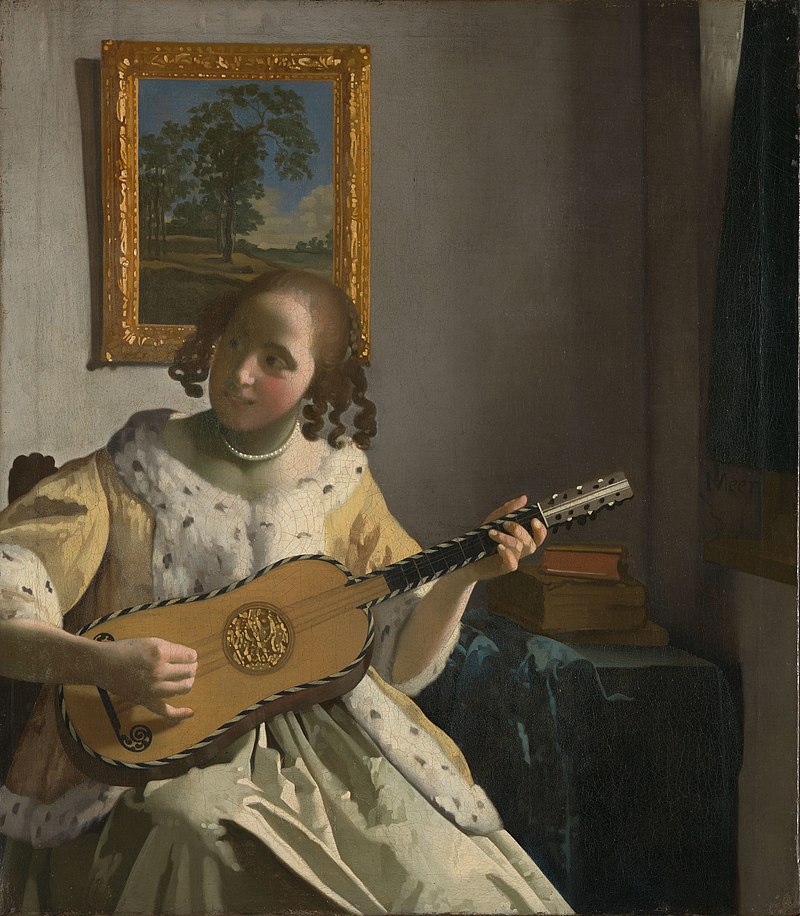
Jan Vermeer, The Guitar Player, 1672

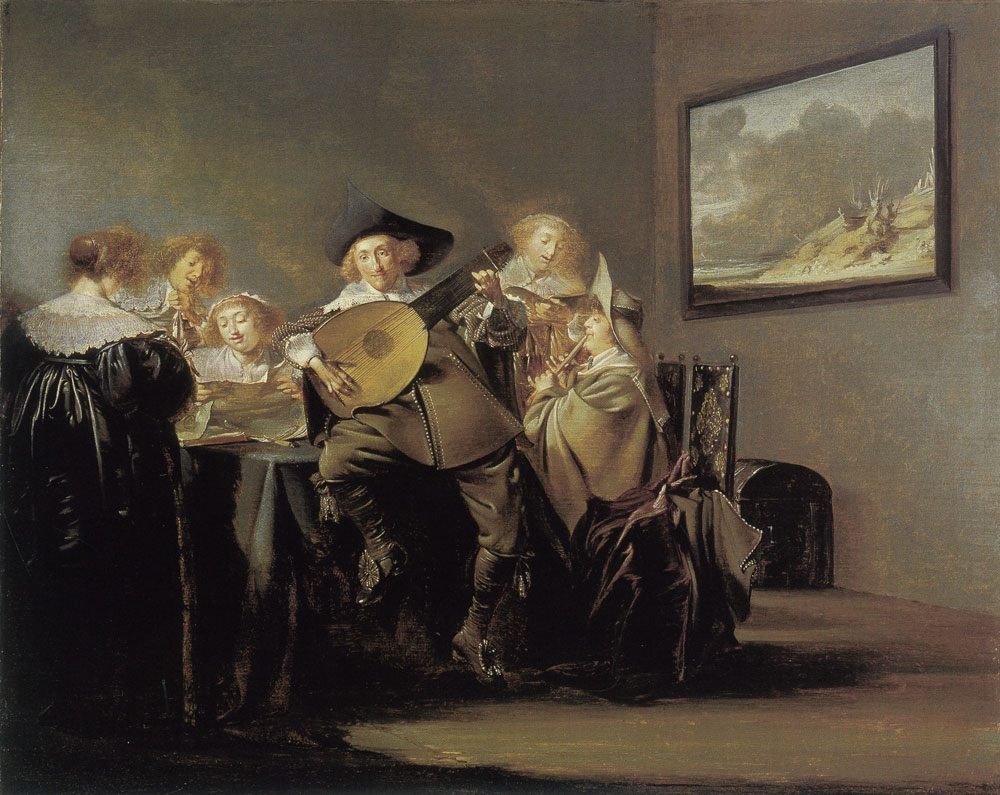
Willem Pieterszoon Buytewech's The Merry Company, 1622-4

Of course landscape paintings were collected on a more modest scale throughout Europe and are a natural component of interior scenes by artists like Pieter de Hooch, Dirck Hals, Gillis van Tilborch and David Teniers.  They can be found in some famous Vermeers: The Glass of Wine, The Love Letter and The Concert, where there is both a landscape painting on the wall and a landscape painting on the inside cover of the harpsichord.  One that is especially familiar to me from visits to Kenwood House at Hampstead Heath is The Guitar Player (above) - a simple view of a tree that could be a snapshot of the heath that surrounds the house.  The tree's foliage resembles the girl's hair, a kind of compositional echo you often find in these paintings.  Another example (above) is the lacy clouds and plume-like trees in Willem Pieterszoon Buytewech's The Merry Company.  And here is Amy Powell's description of another Merry Company, painted by Pieter Codde (c. 1633):
'Lit from the upper left and painted mostly in white, grey, and sandy flesh tones, the musicians lean and look in various different directions, the men’s hats ending in sharp little points. Lit from the upper left and painted in the same sandy colours, the decaying vegetation in the landscape likewise leans in various different directions and ends in sharp little points, as if the landscape painting had somehow magically adapted itself to the attitudes of its viewers. Thin on iconography (a brewing storm at most), the landscape would have little to recommend itself as a moralising allegory if not for its funny way of resembling the merry company of musicians, who are of course happily oblivious to their inevitable disappearance.'
In this Oxford Art Journal article, Powell notes that paintings in Dutch interiors are often dark or indistinct, subordinate to the surrounding furniture.  She draws a modern parallel with Alan McCollum's Surrogate Paintings (blank images hung in groups) and his Perpetual Photos - blurry blow ups of paintings glimpsed in black and white TV movies. To these I would add the Polish artist Rafał Bujnowski's Framed painting (Whistler), 2002-3, which is a version of the painting hanging beside Whistler's mother repainted 'life size' so that it looks like a radically abstract landscape.  (Of course I'm conscious in writing this that I am only actually seeing it reproduced here on my screen, at a scale smaller than Whistler's).  In an earlier post here I mentioned Gerhard Richter's Details, extreme close-ups of paint that 'appear like fictitious landscapes.'  If you were to enlarge a landscape painting-within-a-painting sufficiently you would reach a scale where a new view seems to emerge in the patterns of its pigments.

James Abbot McNeill Whistler, Portrait of the Artist's Mother, 1871

Detail