Showing posts with label rainbows. Show all posts

Saturday, September 09, 2017

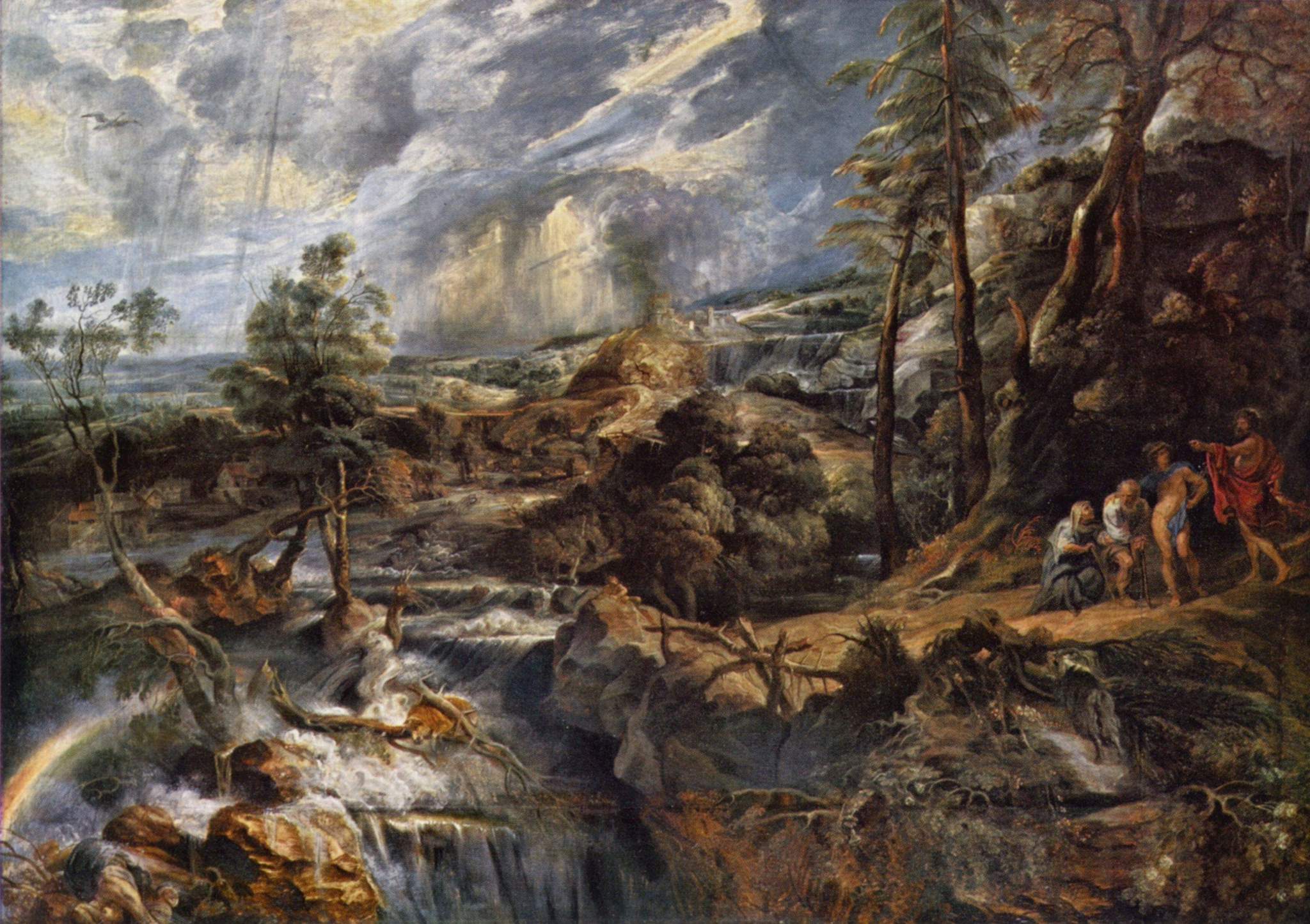
Landscape near Malines


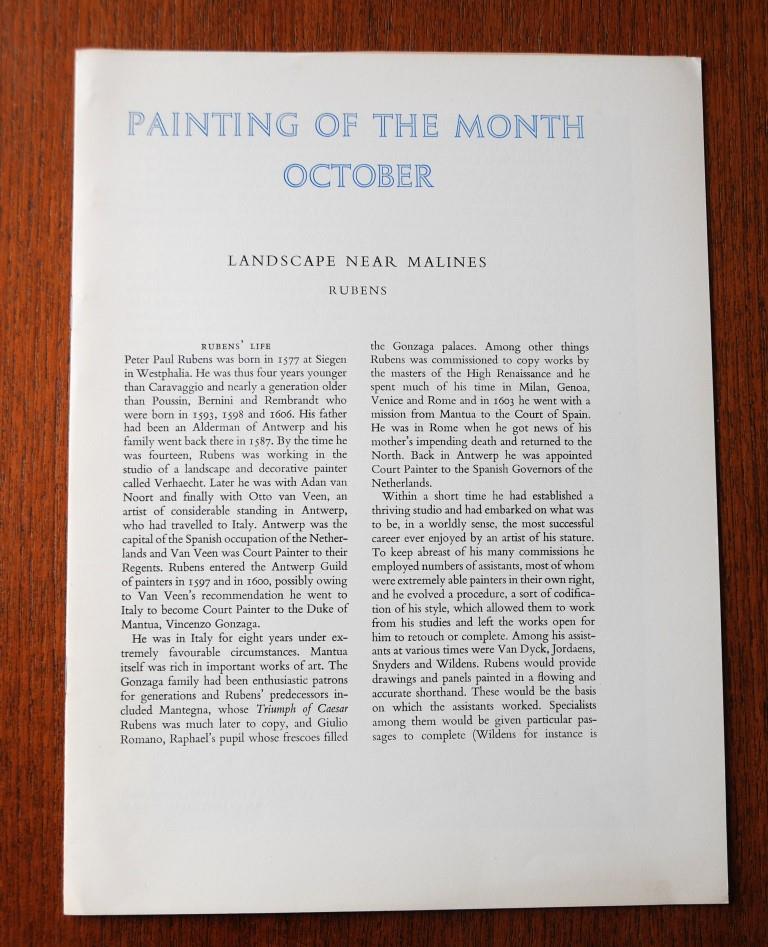
The Listener magazine, founded by John Reith as a cultural supplement to the BBC's Radio Times, folded in 1991.  I think I remember some sadness when it ended, but it doesn't seem to have been much missed.  'It gradually declined after 1960 as British society changed, the BBC became more plural, and other sources of information became more readily available' (Wikipedia).  There is a digital archive but, perhaps surprisingly for a Reithian product, it is not freely accessible to the public.  Back in the early sixties, the Listener featured essays on art, first broadcast as part of a Home Service series called 'Painting of the Month'.  In each programme, an art expert would discuss in an accessible way a work that could be found in a British museum.  The aim was 'to contribute to the listener's understanding of what the artist is trying to convey, and in this way to increase his enjoyment of painting.'  In addition to the programmes and Listener articles, you could collect separate illustrated supplements each month with notes on the paintings, and keep them in special folders.  My parents still have complete sets of these and the accompanying Listener articles for four years, covering 1962-5.  The example above is for October 1962, when Andrew Forge discussed a landscape by Rubens which hangs in Birmingham University's Barber Institute of Fine Arts.

Peter Paul Rubens, Landscape near Malines, 1630s
See The Barber Insitute, where it is now called A Landscape in Flanders 

The talk on this painting sets it in the context of the great allegories and mythological scenes for which Rubens was famous, and spends some time discussing two of his more famous landscapes.  'The Rainbow Landscape and its great companion the Chateau de Steen in the National Gallery are in a sense no less public utterances than Rubens' figure pieces.'  However, these late works do convey more of a feel for his surroundings than was evident in Rubens' earlier compositions.  Mr Forge (as The Listener calls him) describes the Rainbow Landscape, for all its drama, as inconsistent in its design.  It is only the distant part that looks real - 'here all the busyness of separate incidents is resolved: everything is unified and calm.  Arrived here, one feels suddenly released - no longer tied to categories of things and no longer involved in watching events.'  And it is just this quality that we find in Landscape near Malines.  'The whole landscape turns in front of us, not with the coiling artifice of the earlier pictures but with the simple single unfolding that our own movement brings to landscape.'

Peter Paul Rubens, Rainbow Landscape, c. 1636
Source: Wikimedia Commons 

Over the course of 1962 Andrew Forge discussed two more landscapes, Constable's Leaping Horse and Matisse's Tree near Trivaux Pond.  Other speakers did three programmes each on still life, figure painting and portraits.  In 1963 the entire series was devoted to Renaissance art, which meant landscape was only touched upon, e.g. in Bryan Robertson's talk on Leonardo's The Virgin of the Rocks.  I have to admit to being fascinated by some of the advertisements in the old Listener magazines - turning from Leonardo you come to a full page ad for the British Iron and Steel Federation ('Britain needs more homes fast.  Steel shows the way in multi-story flats...')   In 1964 the series had twice as many paintings and included landscapes by Canaletto and Turner.  In 1965 the focus was on British art and there were landscapes by Gainsborough, Crome, Constable and Turner.  Perhaps I will draw on some of these essays in future.

I can't resist a list, especially a chronological one, so I was interested to see in the introduction to the 1962 series a table of 'Some Important Paintings in Europe in the Four Categories covered by the Talks.'  There are sixty in the landscape list, beginning with Lorenzetti's Good and Bad Government (which I wrote about here nine years ago) and ending with the Matisse I mentioned above.  Nothing more recent than Matisse and only five on the list by artists born in the nineteenth century.  This was the BBC that would soon commission Civilisation so the skew towards Old Masters is not surprising (nearly half the artists on the landscape list were born before 1500).  There is no mention of Caspar David Friedrich - as I have noted here before, he was barely known in Britain before the 1970s.  Here are the works on this list I have featured here before - just a fraction of them, because even though this is my 996th post on Some Landscapes, I have only scratched the surface of the history of landscape art.

Friday, September 01, 2017

Crags, upon whose extreme edge I stand...

And thou fresh breaking Day, and you, ye Mountains,
Why are ye beautiful? I cannot love ye.
And thou, the bright eye of the universe,
That openest over all, and unto all
Art a delight—thou shin’st not on my heart.
And you, ye crags, upon whose extreme edge
I stand, and on the torrent’s brink beneath
Behold the tall pines dwindled as to shrubs
In dizziness of distance; when a leap,
A stir, a motion, even a breath, would bring
My breast upon its rocky bosom’s bed
To rest for ever—wherefore do I pause?

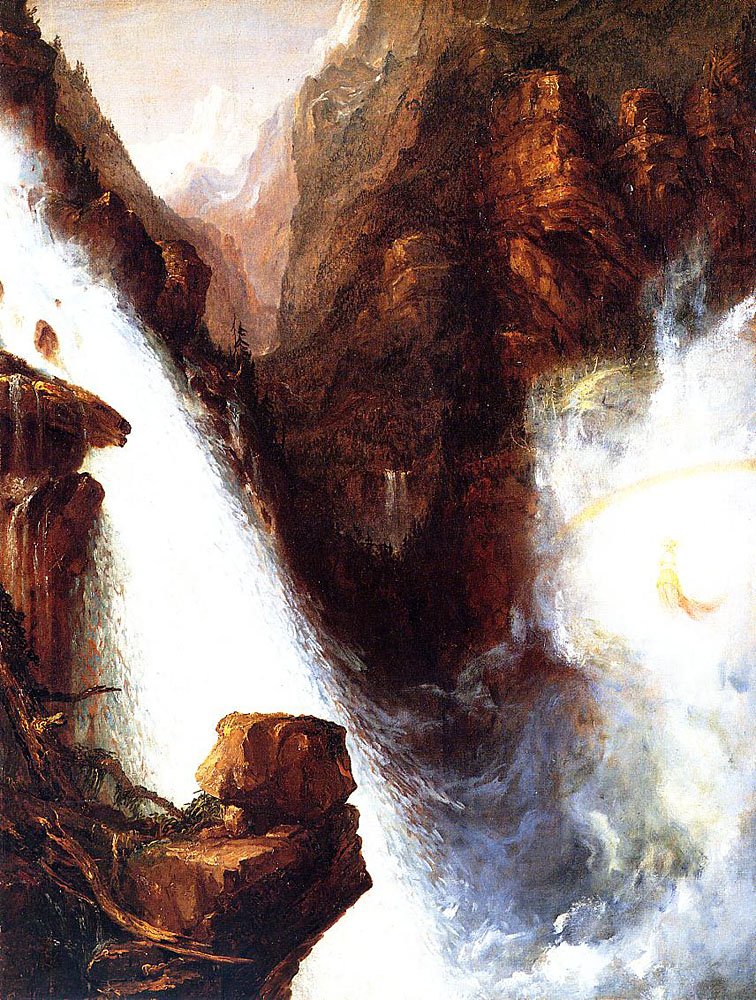
Lord Byron's poetic drama, Manfred, begun in 1816 when he was living in Switzerland, was published two hundred years ago.  Although its hero resembles Faust, the poem was, Byron claimed, more influenced by his impressions of the mountain landscape than his reading of Goethe.  There are no lengthy descriptions of scenery in Byron's poem, just enough to convey a sense of the high peaks where it is set (the quotation above is from Act 1 Scene 2: 'The Mountain of the Jungfrau.—Time, Morning. MANFRED alone upon the Cliffs.')  Instead, it is the entire poem that has the sublimity of the Alps, its themes of loss and despair echoing the spectacular but lonely isolation experienced on their heights.  Reading Manfred reminded me that works of art infused with a spirit of place are far more numerous than the ones I tend to restrict myself to here, that describe the actual appearance of a landscape.

Thomas Cole, Scene from 'Manfred', 1833
Source: Wikimedia Commons
 
There is one reference in Manfred to a natural phenomenon that is based on what Byron saw on 22 September, 1816.   He and his travelling companion John Cam Hobhouse were in the Lauterbrunnen Valley, looking up at the The Staubbach Fall.  Byron wrote in his journal that the torrent reminded him of the tail of a pale horse, such as Death might ride at the Apocalypse.  The next day they returned and Byron noted 'the Sun upon it forming a rainbow of the lower part of all colours – but principally purple and gold – the bow moving as you move – I never saw anything like this – it is only in the Sunshine.'  These impressions were used to set the scene for Act 2 Scene 2, with Byron also including a footnote on the rainbow.
It is not noon; the sunbow’s rays1 still arch
The torrent with the many hues of heaven,
And roll the sheeted silver’s waving column
O’er the crag’s headlong perpendicular,
And fling its lines of foaming light along,
And to and fro, like the pale courser’s tail
The Giant steed, to be bestrode by Death,
As told in the Apocalypse.
1This Iris is formed by the rays of the Sun over the lower part of the Alpine torrents. It is exactly like a rainbow come down to pay a visit, and so close that you may walk into it. This effect lasts till Noon.

A rainbow in the Trümmelbach Falls
Photographed by me, August 2017

We were in the Bernese Oberland ourselves last month and observed one of these rainbows in a waterfall near the one Byron visited.  We also ascended to the top of the Schilthorn, to look as he and Hobhouse had, across to the summit of the Jungfrau.  Byron saw clouds gathering on one side - 'curling up perpendicular precipices – like the foam of the Ocean of Hell during a Springtide – it was white & sulphery – and immeasurably deep in appearance.'  We picked a beautiful clear day, so clear that we could see Mont Blanc.  The downside of this was that the summit was pretty crowded with other tourists.  Even Byron could not enjoy the sight of the Jungfrau in solitude.  'Lying down for a few minutes to contemplate these wonders, Hobhouse and Byron were irritated by the sudden appearance of two or three female tourists on horseback when they had imagined they had the mountain to themselves' (Fiona MacCarthy, Byron: Life and Legend).

The Eiger, Mönch and Jungfrau
Photographed by me, August 2017

Byron's hero has to get away from other people: 'my nature was averse from life; / And yet not cruel; for I would not make,  / But find a desolation.'  Manfred thinks he is alone on the summit of the Jungfrau, but he too is disturbed - by the unexpected appearance of a passing chamois hunter.  Death may be Manfred's inevitable fate at the end of the poem, but now, in its opening scene, this hunter prevents him from jumping into the void and leads him back down to safety:
The clouds grow thicker—there—now lean on me—
Place your foot here—here, take this staff, and cling
A moment to that shrub—now give me your hand,
And hold fast by my girdle—softly—well—
The Chalet will be gain’d within an hour.

John Martin, Manfred on the Jungfrau, 1837
Source: Wikimedia Commons

Saturday, August 26, 2017

Bellevue

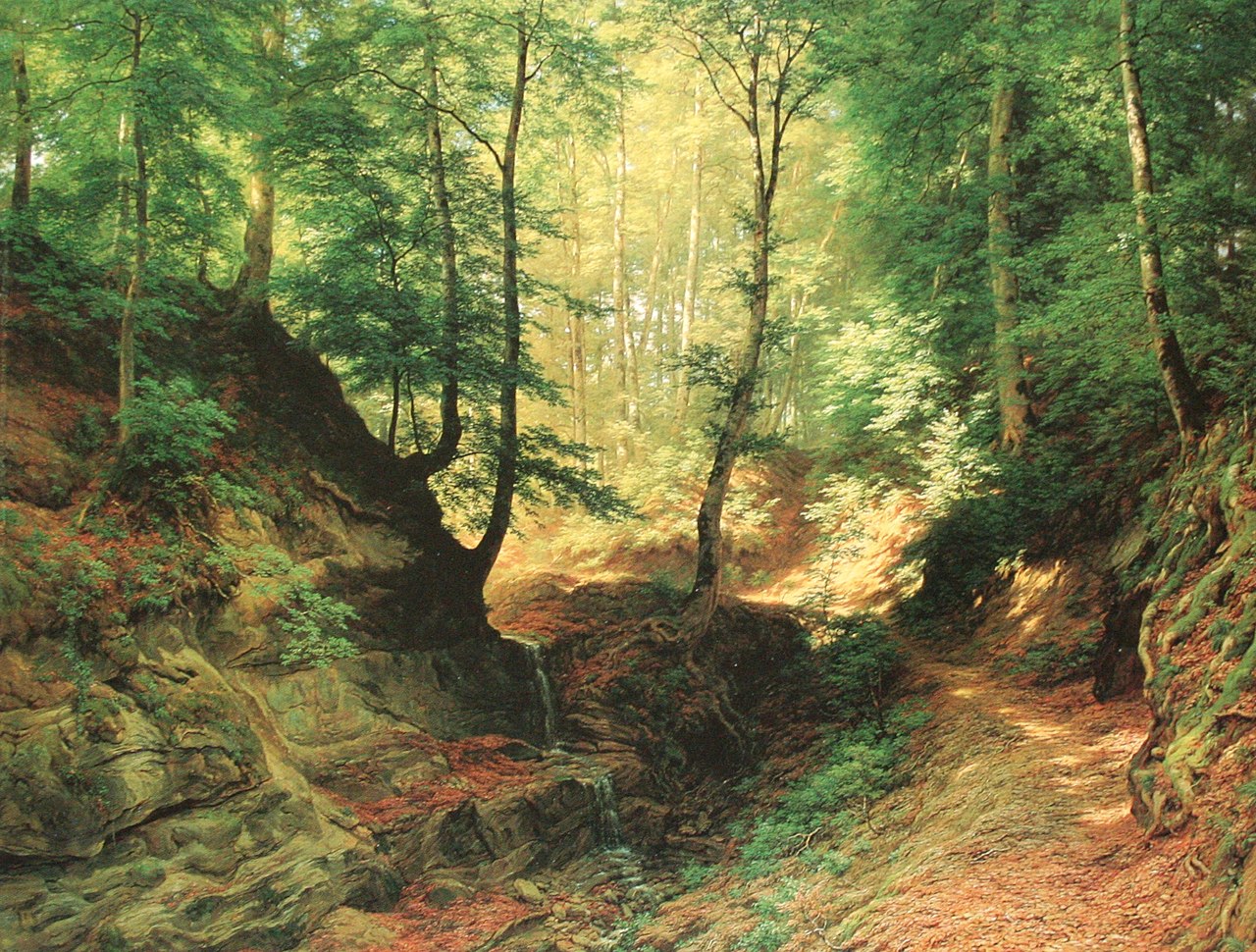
Robert Zünd, Buchenwald, 1887
Source: Wikimedia Commons

In English the word 'Buchenwald' is synonymous with horror and darkness, but in German it still denotes one of nature's most beautiful things, a beech forest.  This is a painting by a nineteenth century artist who became known as The Master of the Beech Leaf for his meticulous views of woods.  Robert Zünd (1826-1909) walked and sketched in the forests around Lucerne, producing highly finished landscapes back in the studio that came in different sizes to suit the budgets of different potential buyers.  His work can be found in most Swiss museums but is currently the subject of an exhibition, Bellevue, at the Kunstmuseum Luzern which pairs his paintings with large format analogue photographs by Tobias Madörin.  Madörin is based in Zürich but has travelled widely working on a project called Topos which examines 'communal spaces, the outskirts of metropolises, waste disposals sites, and landscapes marked by agriculture and mining.'  For Bellevue he has taken photographs around Lucerne, based on the compositions and methods of Robert Zünd.


Shows in which contemporary artists respond to old paintings that have hung for decades on museum walls are are very common these days.  Just to mention one other example, I wrote here last year about George Shaw's Back to Nature at the National Gallery.  Publicly funded institutions have a mission to make their collections engaging and accessible, which is why we don't really see the same phenomenon in other more 'private' art forms (though it is easy to imagine an anthology interspersing, say, tales by Poe with stories by a modern weird fiction writer, or an album juxtaposing nineteenth century études with a young composer's new works on similar themes).  The key to making these exhibitions work, I think, is for the artist not to go down the obvious route of producing a kind of 'negative' version of the earlier art.  As you can see above,  Madörin has partially done this in photographing the effects of logging on Zünd's woodland, exposing the economic role of the landscape and questioning the idyllic impression of the original scenes.  But he has also taken pains to produce photographs in tune with Zünd's desire to capture the splendour of natural phenomena.  Zünd could paint a rainbow at leisure in his studio whereas Madörin had to wait for the real thing, pitching a tent and being prepared for a moment when light would shine forth from the stormy sky.

Friday, February 13, 2015

Of Walking in Ice

A few days before Bruce Chatwin's death in January 1989 he asked Werner Herzog to visit him.  They shared a belief in the restorative powers of walking and Chatwin was convinced that Herzog had healing powers.  Too weak now to rise from his bed, Chatwin nevertheless longed to be out on the road again.  Herzog's account of their conversation appears in Nicholas Shakespeare's biography Bruce Chatwin (1999).  'He looked down at himself and he saw the legs were only spindles and he looked at me in this very lucid moment and he said: "I'm never going to walk again." He said: "Werner, I'm dying." And I said, "Yes I am aware of that." and then he said: "You must carry my rucksack, you are the one who must carry it."  And I said: "Yes, I will proudly do that."'

In 1978 Herzog had published a short book, Vom Gehen im Eis (Of Walking in Ice) that had particularly impressed Chatwin.  'At the end of November 1974', Herzog wrote in its preface, 'a friend from Paris called and told me that Lotte Eisner was seriously ill and would probably die.  I said that this must not be, not at this time, German cinema could not do without her now, we would not permit her death.  I took my jacket, a compass and a duffel bag with the necessities.  My boots were so solid and new that I had confidence in them.  I set off on the most direct route to Paris, in full faith, believing that she would stay alive if I came on foot.'  Herzog set off from Munich and arrived twenty days later, exhausted, to sit by her bedside.  Lotte Eisner made a recovery and lived on until 1983. 

I have created a map that tries to give a visual impression of this elemental journey, through snow and ice (white), rain and water (blue), mist and fog (grey) and the occasional burst of sunshine (yellow).  You can click on each square for a short quote from the book and imagine them read in Herzog's familiar voice: 'The snow lies wet on the fields, darkness comes, all lies barren...'  The black circles record the places he found to sleep: a barn, a stable, a few inns, abandoned buildings and empty holiday homes.  It would of course be possible to derive many alternative maps from the text, marking, for example, moments of physical pain and exhaustion, or fleeting, strange encounters with Herzogian characters, or those points in the narrative where the account of his walk dissolves into descriptions of dreams.


'A rainbow before me all at once fills me with the greatest confidence.  What a sign it is, over and in front of him who walks.  Everyone should walk.'
- Werner Herzog, Thursday 5th December, 1974

Sunday, September 08, 2013

Entertained with a rainbow


In an earlier post here I mentioned the chapter Edward Thomas devoted to John Aubrey in The Literary Pilgrim in England and his praise for the way Aubrey's description of places isolate telling details.  'Who but Aubrey would have noticed and entered in a book the spring after the fire of London "all the ruins were overgrown with an herb or two, but especially with a yellow flower, Ericolevis Neapolitana."' This attention to the more curious or illuminating facets of what he was writing about have made his biographical notes published posthumously as Brief Lives far more popular than many worthy but dull works by his contemporaries.  It occurred to me, browsing through a volume of these just now, that I might highlight here three of his subjects who had some connection with three of the arts of landscape: drawing, poetry and garden design.

Wenceslaus Hollar, St. Martin's Cathedral in Mainz, 1632

Wenceslaus Hollar (1607-77) was a Bohemian engraver, known now for his panoramic views of London. 'He told me,' writes Aubrey, 'that when he was a schoolboy he took a delight in drawing of maps; which drafts he kept, and they were pretty.  He was designed by his father to have been a lawyer, and was put to that profession, when his father's troubles, together with the wars, forced him to leave his country.  So that what he did for his delight and recreation only when a boy, proved to be his livelihood when a man.'  Hollar's talents were spotted by the Earl of Arundel, who engaged him as a draughtsman.  He travelled to Vienna with the Earl, 'very well clad', to 'take views, landscapes, buildings, etc remarkable in their journey, which we see now at the print shops.'  In 1637 he came with the Earl to England and 'at Arundel House, he married my lady's waiting woman, Mrs Tracy, by whom he has a daughter, that was one of the greatest beauties I have ever seen; his son by her died in the plague, an ingenious youth, who drew delicately.'

Hollar, we are told, was very shortsighted and his landscapes were done in such detail that they are 'not to be judged without a magnifying glass.'  During the Civil War he lived in Antwerp but returned in 1652.  'I remember he told me that when he first came into England (which was a serene time of peace) that the people, both poor and rich, did look cheerfully, but at his return, he found the countenances of the people all changed, melancholy, spiteful, as if bewitched.'  Hollar himself 'was a very friendly good natured man as could be, but shiftless as to the world [careless in his affairs] and died not rich.'

Wenceslaus Hollar, Landscape Face, unknown date

Sir John Denham (1615-69) is of interest here as the author of 'Cooper's Hill' (1642), the first English topographical poem.  Aubrey writes that at Oxford University, the young Denham 'would game extremely; when he had played away all his money, he would play away his father's wrought rich gold cups. ... From Trinity College he went to Lincoln's Inn, where (as Judge Wadham Windham, who was his contemporary, told me) he was as good a student as any in the house.'  Nevertheless, on one occasion 'having been merry at a tavern with his comrades, late at night, a frolic came into his head, to get a plasterer's brush and a pot of ink, and blot out all the signs between Temple Bar and Charing Cross' (they were caught - 'this I had from R. Estcott, esquire, who carried the inkpot').

Denham's play The Sophy was a huge success - the poet 'Mr Edmund Waller said then of him, that he '"broke out like the Irish Rebellion."'  His poem 'Cooper's Hill' was published after the Battle of Edgehill 'in a sort of brown paper, for then they could get no better.'  As a Royalist, Denham was not welcome during the Commonwealth but returned from abroad and eventually became Surveyor of the King's Work. 'In 1665 he married his second wife, a [Margaret] Brookes, a very beautiful young lady; Sir John was ancient and limping.  The Duke of York fell deeply in love with her, though (I have been morally assured) he never had carnal knowledge of her.  This occasioned Sir John Denham's distemper of madness ... but it pleased God that he was cured of this distemper, and wrote excellent verses, particularly on the death of Mr Abraham Cowley, afterwards.  His second lady had no child; was poisoned by the hands of the Countess of Rochester with chocolate.'

Aubrey gives us some details of Denham's physical appearance: thin hair, a slow gait, tall but 'a little incurvetting at his shoulders, not very robust.'  He 'was satirical when he had a mind to it' and 'his eye was a kind of light goose-grey, not big; but it had a strange piercingness, not as to shining and glory, but (like a Momus) when he conversed with you he looked into your very thoughts.'  He describes the delight Denham took in the landscape around his home - Camomile Hill, 'from the camomile that grows their naturally', and Prunewell Hill, 'where was a fine tuft of trees, a clear spring, and a pleasant prospect to the east.'  This house was near Cooper's Hill, 'incomparably well described by that sweet swan, Sir John Denham.'


Thomas Bushell (1594-1674) was a servant of Francis Bacon, from whom he learnt the science of metallurgy, and whose writings inspired him, after Bacon's death in 1626, to live for three years on the Isle of Lundy as a hermit.  Having married and moved to Oxfordshire, he designed for himself an extraordinary grotto with elaborate water features, including a silver ball that rose and fell on a jet of water and a sequence of fountains designed to surprise the ladies as they walked over them.  Aubrey says that it faced south 'so that when it artificially rains upon the turning of a cock [tap], you are entertained with a rainbow.  In a very little pond (no bigger than a basin) opposite to the rock, and hard by, stood (1643, August 8) a Neptune, neatly cut in wood, holding his trident in his hand, and aiming with it at a duck which perpetually turned round him, and a spaniel swimming after her.'  Bushell lived above this grotto in three rooms, one painted with Biblical stories concerning water, another with the story of Christ told in wall hangings and the third, a hermit's cell, hung in black baize.  In 1636 Bushell presented his 'Rock' to King Charles and Henrietta Maria to the accompaniment of music - Aubrey unhelpfully notes that 'I remember the student of Christ Church which sang the songs (I now forget his name)'. 

A year after the royal visit, Bushell was made King's farmer of minerals in Wales and spent the rest of his career putting Bacon's science into practise in a series of mining schemes. 'He had so delicate a way of making his projects alluring and feasible, profitable, that he drew to his baits not only rich men of no design, but also the craftiest knaves in the country ... As he had the art of running into debt, so sometimes he was attacked and thrown into prison; but he would extricate himself again strangely.'  Aubrey relates that after offending parliament or Cromwell, Bushell hid at his house in Lambeth Marsh, dating his letters as if they had been sent from overseas.  He had a room there hung all in black, with a painted skeleton and 'an emaciated dead man stretched out.  Here he had several mortifying and divine mottoes (he imitated his lord [Bacon] as much as he could) and out of his windows a very pleasant prospect.'  He was, according to Aubrey, 'a handsome proper gentleman when I saw him at his house aforesaid at Lambeth.  He was about 70, but I should not have guessed him hardly 60.  He had a perfectly healthy constitution; fresh, ruddy, face; hawk-nosed, and was temperate.'
 
Engraving showing Thomas Bushell's hermitage at Enstone,
from Robert Plot's Natural History of Oxfordshire, 1677.
(Aubrey read this and modelled his own unfinished book about Wiltshire on it)

Friday, January 08, 2010

Rainbows, showers, partial gleams of sunshine


Peter Paul Rubens, Philemon and Baucis, c1630

In 1822 William Hazlitt compared Rubens with Claude: 'I imagine that Rubens's landscapes are picturesque: Claude's are ideal. Rubens is always in extremes; Claude in the middle. Rubens carries some one peculiar quality or feature of nature to the utmost verge of probability: Claude balances and harmonises different forms and masses with laboured delicacy, so that nothing falls short, no one thing overpowers another. Rainbows, showers, partial gleams of sunshine, moonlight, are the means with which Rubens produces his most gorgeous and enchanting effects: there are neither rainbows, nor showers, nor sudden bursts of sunshine, nor glittering moonbeams in Claude. He is all softness and proportion: the other is all spirit and brilliant excess. The two sides (for example) of one of Claude's landscapes balance one another, as in a scale of beauty: in Rubens the several objects are grouped and thrown together with capricious wantonness. Claude has more repose: Rubens more gaiety and extravagance.'


Claude Lorraine, Landscape with Acis and Galatea, 1657

According to Kenneth Clark, 'no great painter ever lived so completely within his resources as Claude.  Unlike such prodigals as Rubens, his pictures always suggest a tactful and far-sighted economy.'  In Landscape into Art, Clark praises the earlier writing on Claude of Hazlitt and of Roger Fry, whose essay on the artist appeared in the Burlington Magazine in 1907.  Fry also praised Claude (rather faintly), whilst comparing him with more vital, colourful artists and writers.  For example, he says that 'Robert Bridges, in his essay on Keats, very aptly describes for literature the kind of beauty which we find in Shakespeare : "the power of concentrating all the far-reaching resources of language on one point, so that a single and apparently effortless expression rejoices the aesthetic imagination at the moment when it is most expectant and exacting." That, ceteris paribus, applies admirably to certain kinds of design. It corresponds to the nervous touch of a Pollajuolo or a Rembrandt. But Claude's line is almost nerveless and dull. Even when it is most rapid and free it never surprises us by any intimate revelation of character, any summary indications of the central truth. But it has a certain inexpressive beauty of its own. It is never elegant, never florid, and, above all, never has any ostentation of cleverness.'

Friday, March 03, 2006

Nacreous cloud, Iceland

There are various sites about rainbows and related atmospheric effects, e.g. the excellent Atmospheric Optics site. A recent addition is an extraordinary nacreous cloudscape in Iceland, whilst elsewhere there are images of a glory and broken spectre in Ireland, a low bow in Australia and a moon bow in Hawaii. The site provides technical information and software for simulating different optical effects: HaloSim. There is also some history: Lowitz arcs are named after Tobias Lowitz, who sketched a complex display visible from St Petersburg on June 18th 1790, and Parry arcs were first recorded by William Perry on 8 April 1820, near Melvile Island in the Canadian Arctic, during the search for the Northwest Passage.


Postscript August 2015
This early post was written before I was able to easily embed images and videos so I have included a timelapse video of nacreous clouds.  It was also written before I decided to restrict this blog to the arts, although of course those links involve many spectacular photographs.  Nacreous clouds in literature?  It is now possible to do a search in Google Books which turns up a novel by the poet Conrad Aiken, Blue Voyage (1927), set on a cruise ship, in which they sound like ice cream: 'The half-opened windows opposite, rising, scooped a rapid green evening sky; then slowly, forwardly, swooped again, scooping a nacreaous cloud touched with flamingo.'

  Jacob Heinrich Elbfas, Vädersolstavlan, 1636

I would also like to add in here a remarkable 17th century painting of Stockholm, the Vädersolstavlan, depicting a halo display event in 1535.  It is a copy of an original, now lost, by Urban Målare.  The painting has become an iconic image, appearing on banknotes, stamps, metro stations and Swedish tourist gifts.  There is a lengthy article on it on Wikipedia covering the topographical and meteorological details, its historical/political background and the possible artistic precedents - Albrecht Altdorfer and his less-well-known brother Erhard who was responsible for some apocalyptic Bible illustrations.

Thursday, March 02, 2006

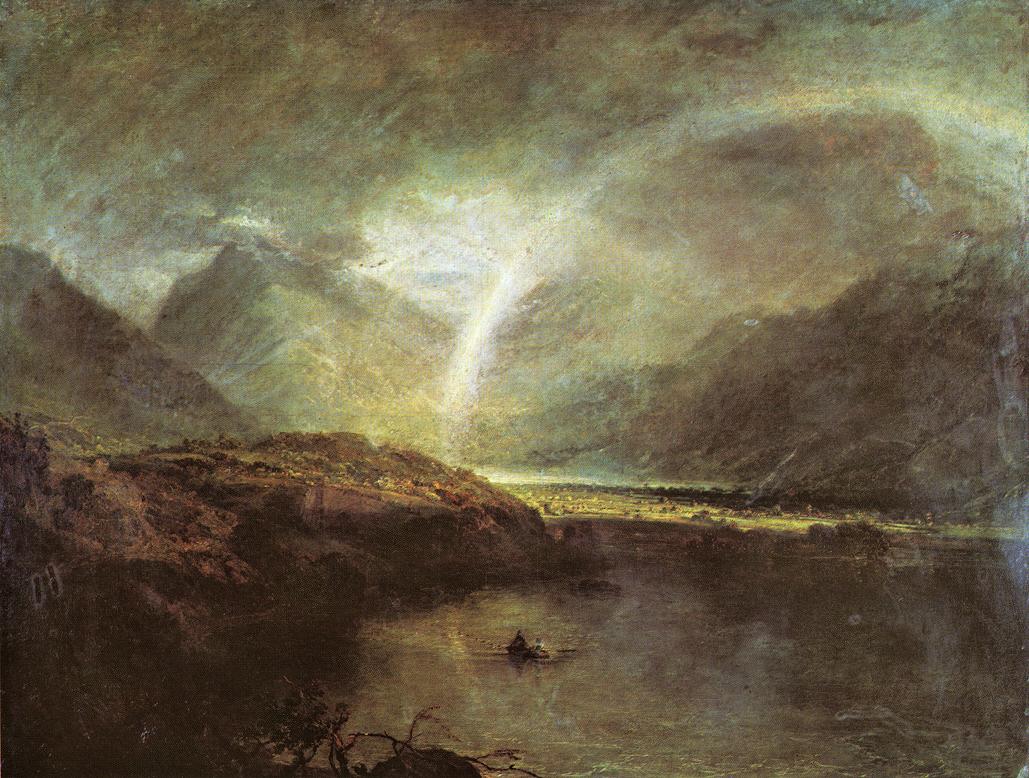
Buttermere Lake, a shower

In his book Colour and Culture John Gage discusses the way in which a few artists of the Romantic period strove to paint unusual forms of the rainbow. There are double rainbows by Constable, a parhelion by Cotman (in a drawing of 1815) and a lunar rainbow in a landscape by Caspar David Friedrich (1808). Depicting strange atmospheric effects could have appealed either as a form of scientific naturalism or as a means of heightening the mood of sublime landscapes. Given the opportunity they afforded for examples of artistic virtuosity, it is perhaps surprising that examples of these strange rainbows are relatively rare. However it is consistent with the sense that mere ‘accidents of light’ did not really have a place in classical landscape painting (as was indicated by Joshua Reynolds in his fourth Discourse). Nevertheless, rainbows in general were frequently used, retaining some of their symbolic value from earlier periods of art. Turner was perhaps the most prominent exponent and his Buttermere Lake, Cumberland, a shower of 1798 is just the first landscape with a rainbow that he exhibited. It shows the rare white fog bow.


J. M. W. Turner Buttermere Lake, Cumberland, a shower (1798)
Source: Wikimedia Commons (The Atheneum)